COMPONENTS
OF INDUSTRY
4.0
INTRODUCTION
• The modern and more sophisticated machines and tools with advanced software and
networked sensors can be used to
• plan,
• predict,
• adjust and
• control the societal outcome
• and business models
• To create another phase of value chain organization and it can be managed
throughout the whole cycle of a product.
COMPONENTS OF INDUSTRY 4.0
• In order to preferably implement Industries 4.0, the following three key features
should be considered
• (1) horizontal integration through value networks, to facilitate inter-corporation
collaboration,
• (2) vertical integration and networked manufacturing systems of hierarchical
subsystems inside a factory to create flexible and reconfigurable manufacturing
system, and
• (3) end to end digital integration of engineering integration across the entire value
chain to support product customization.
• The horizontal integration of corporations and the vertical integration of factory
inside are two bases for the end-to end integration of engineering process. This is
because the product lifecycle comprises several stages that should be performed
by different corporations.
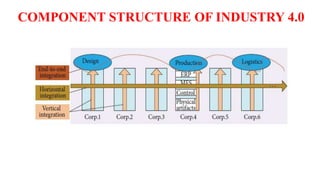
• Horizontal Integration. One corporation should both compete and cooperate with many
other related corporations. By the inter-corporation horizontal integration, related
information, finance, and material can flow fluently among these corporations.
Therefore, new value networks as well as business models may emerge.
• Vertical Integration. A factory owns several physical and informational subsystems, such
as actuator and sensor, control, production management, manufacturing, and corporate
planning. It’s essential to vertical integration of actuator and sensor signals across
different levels right up to the enterprise resource planning (ERP) level to enable a
flexible and reconfigurable manufacturing system. By this integration, the smart
machines form a self-organized system that can be dynamically reconfigured to adapt to
different product types.
• End-To-End Engineering Integration. In a product-centric value creation process, a
chain of activities is involved, such as customer requirement expression, product design
and development, production planning, production engineering, production, services,
maintenance, and recycle. By integration, a continuous and consistent product model can
be reused in all stage. The effect of product design and service can be foreseen using the
powerful software tool chain so that the customized products are enabled.
COMPONENT STRUCTURE OF INDUSTRY 4.0
TRADITIONAL VS SMART FACTORY SYSTEMS
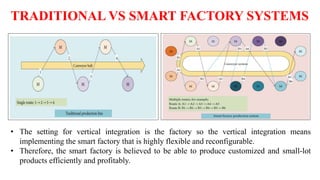
• The setting for vertical integration is the factory so the vertical integration means
implementing the smart factory that is highly flexible and reconfigurable.
• Therefore, the smart factory is believed to be able to produce customized and small-lot
products efficiently and profitably.
FACTORS OF INDUSTRY 4.0 IN PRACTICE
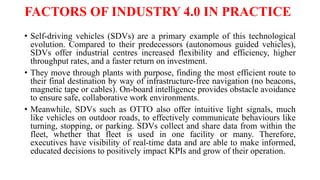
• Self-driving vehicles (SDVs) are a primary example of this technological
evolution. Compared to their predecessors (autonomous guided vehicles),
SDVs offer industrial centres increased flexibility and efficiency, higher
throughput rates, and a faster return on investment.
• They move through plants with purpose, finding the most efficient route to
their final destination by way of infrastructure-free navigation (no beacons,
magnetic tape or cables). On-board intelligence provides obstacle avoidance
to ensure safe, collaborative work environments.
• Meanwhile, SDVs such as OTTO also offer intuitive light signals, much
like vehicles on outdoor roads, to effectively communicate behaviours like
turning, stopping, or parking. SDVs collect and share data from within the
fleet, whether that fleet is used in one facility or many. Therefore,
executives have visibility of real-time data and are able to make informed,
educated decisions to positively impact KPIs and grow of their operation.
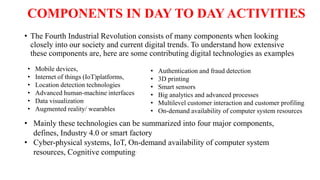
COMPONENTS IN DAY TO DAY ACTIVITIES
• The Fourth Industrial Revolution consists of many components when looking
closely into our society and current digital trends. To understand how extensive
these components are, here are some contributing digital technologies as examples
• Authentication and fraud detection
• 3D printing
• Smart sensors
• Big analytics and advanced processes
• Multilevel customer interaction and customer profiling
• On-demand availability of computer system resources
• Mobile devices,
• Internet of things (IoT)platforms,
• Location detection technologies
• Advanced human-machine interfaces
• Data visualization.
• Augmented reality/ wearables
• Mainly these technologies can be summarized into four major components,
defines, Industry 4.0 or smart factory
• Cyber-physical systems, IoT, On-demand availability of computer system
resources, Cognitive computing.
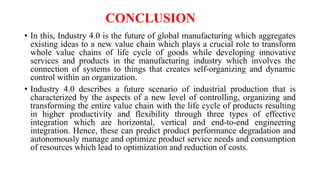
CONCLUSION
• In this, Industry 4.0 is the future of global manufacturing which aggregates
existing ideas to a new value chain which plays a crucial role to transform
whole value chains of life cycle of goods while developing innovative
services and products in the manufacturing industry which involves the
connection of systems to things that creates self-organizing and dynamic
control within an organization.
• Industry 4.0 describes a future scenario of industrial production that is
characterized by the aspects of a new level of controlling, organizing and
transforming the entire value chain with the life cycle of products resulting
in higher productivity and flexibility through three types of effective
integration which are horizontal, vertical and end-to-end engineering
integration. Hence, these can predict product performance degradation and
autonomously manage and optimize product service needs and consumption
of resources which lead to optimization and reduction of costs.
Thank You

COMPONENTS OF INDUSTRY 4.0

  • 1.
  • 2.
    INTRODUCTION • The modernand more sophisticated machines and tools with advanced software and networked sensors can be used to • plan, • predict, • adjust and • control the societal outcome • and business models • To create another phase of value chain organization and it can be managed throughout the whole cycle of a product.
  • 3.
    COMPONENTS OF INDUSTRY4.0 • In order to preferably implement Industries 4.0, the following three key features should be considered • (1) horizontal integration through value networks, to facilitate inter-corporation collaboration, • (2) vertical integration and networked manufacturing systems of hierarchical subsystems inside a factory to create flexible and reconfigurable manufacturing system, and • (3) end to end digital integration of engineering integration across the entire value chain to support product customization. • The horizontal integration of corporations and the vertical integration of factory inside are two bases for the end-to end integration of engineering process. This is because the product lifecycle comprises several stages that should be performed by different corporations.
  • 4.
    • Horizontal Integration.One corporation should both compete and cooperate with many other related corporations. By the inter-corporation horizontal integration, related information, finance, and material can flow fluently among these corporations. Therefore, new value networks as well as business models may emerge. • Vertical Integration. A factory owns several physical and informational subsystems, such as actuator and sensor, control, production management, manufacturing, and corporate planning. It’s essential to vertical integration of actuator and sensor signals across different levels right up to the enterprise resource planning (ERP) level to enable a flexible and reconfigurable manufacturing system. By this integration, the smart machines form a self-organized system that can be dynamically reconfigured to adapt to different product types. • End-To-End Engineering Integration. In a product-centric value creation process, a chain of activities is involved, such as customer requirement expression, product design and development, production planning, production engineering, production, services, maintenance, and recycle. By integration, a continuous and consistent product model can be reused in all stage. The effect of product design and service can be foreseen using the powerful software tool chain so that the customized products are enabled.
  • 5.
  • 6.
    TRADITIONAL VS SMARTFACTORY SYSTEMS • The setting for vertical integration is the factory so the vertical integration means implementing the smart factory that is highly flexible and reconfigurable. • Therefore, the smart factory is believed to be able to produce customized and small-lot products efficiently and profitably.
  • 7.
    FACTORS OF INDUSTRY4.0 IN PRACTICE • Self-driving vehicles (SDVs) are a primary example of this technological evolution. Compared to their predecessors (autonomous guided vehicles), SDVs offer industrial centres increased flexibility and efficiency, higher throughput rates, and a faster return on investment. • They move through plants with purpose, finding the most efficient route to their final destination by way of infrastructure-free navigation (no beacons, magnetic tape or cables). On-board intelligence provides obstacle avoidance to ensure safe, collaborative work environments. • Meanwhile, SDVs such as OTTO also offer intuitive light signals, much like vehicles on outdoor roads, to effectively communicate behaviours like turning, stopping, or parking. SDVs collect and share data from within the fleet, whether that fleet is used in one facility or many. Therefore, executives have visibility of real-time data and are able to make informed, educated decisions to positively impact KPIs and grow of their operation.
  • 8.
    COMPONENTS IN DAYTO DAY ACTIVITIES • The Fourth Industrial Revolution consists of many components when looking closely into our society and current digital trends. To understand how extensive these components are, here are some contributing digital technologies as examples • Authentication and fraud detection • 3D printing • Smart sensors • Big analytics and advanced processes • Multilevel customer interaction and customer profiling • On-demand availability of computer system resources • Mobile devices, • Internet of things (IoT)platforms, • Location detection technologies • Advanced human-machine interfaces • Data visualization. • Augmented reality/ wearables • Mainly these technologies can be summarized into four major components, defines, Industry 4.0 or smart factory • Cyber-physical systems, IoT, On-demand availability of computer system resources, Cognitive computing.
  • 9.
    CONCLUSION • In this,Industry 4.0 is the future of global manufacturing which aggregates existing ideas to a new value chain which plays a crucial role to transform whole value chains of life cycle of goods while developing innovative services and products in the manufacturing industry which involves the connection of systems to things that creates self-organizing and dynamic control within an organization. • Industry 4.0 describes a future scenario of industrial production that is characterized by the aspects of a new level of controlling, organizing and transforming the entire value chain with the life cycle of products resulting in higher productivity and flexibility through three types of effective integration which are horizontal, vertical and end-to-end engineering integration. Hence, these can predict product performance degradation and autonomously manage and optimize product service needs and consumption of resources which lead to optimization and reduction of costs.
  • 10.