Core Concepts KeyDesign Principles
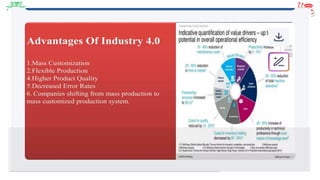
Enabling Technologies Benefits of Industry 4.0
Challenges:
CONCEPT OF INDUSTRY 4.0
Conventional Automation/Automation in Industry 4.0:
5.
INTRODUCTION
● Conventional Automation:
○ use of machines, robotics, and control systems to perform tasks with
minimal human intervention.
○ replacing manual labor and streamlining specific processes, without
extensive connectivity or data-driven insights.
● Automation in Industry 4.0:
○ leveraging digital technologies, connectivity, and data analytics to create
smart, flexible, and interconnected systems.
○ characterized by the integration of cyber-physical systems, the Internet of
Things (IoT), cloud computing, artificial intelligence (AI), big data
analytics, and machine learning.
6.
CHARACTERISTICS OF CONVENTIONALAUTOMATION
● Task-specific automation: Machines and robots are programmed to perform
specific tasks repeatedly, such as assembly line operations or material handling.
● Limited connectivity: Conventional automation systems often work in isolation
and have limited communication and connectivity with other machines or systems.
● Centralized decision-making: Decisions are usually made by human operators or a
centralized control system based on pre-programmed instructions or simple rule-
based logic.
● Limited data utilization: While data may be collected during automation
processes, it is not extensively used for real-time monitoring, analysis, or
optimization.
7.
CHARACTERISTICS OF INDUSTRY4.0
● Cyber-physical systems: Physical machines, devices, and sensors are connected
to digital systems, enabling real-time data exchange and decision-making.
● Internet of Things (Virtualization): Connected devices and sensors gather vast
amounts of data from various sources, facilitating seamless communication and
collaboration between machines, humans, and systems. This enables a virtual
copy of the Smart Factory which is created by linking sensor data (from
monitoring physical processes) with virtual plant models and simulation models
● Decentralized decision-making: Intelligent systems and algorithms empower
machines to make autonomous decisions based on real-time data, enabling agile
and adaptive manufacturing processes.
8.
CHARACTERISTICS OF INDUSTRY4.0 CONT..
● Data-driven insights (Real-Time Capability): Advanced analytics and
machine learning algorithms analyze the collected data to generate actionable
insights, optimize operations, predict maintenance needs, and improve overall
performance.
● Enhanced human-machine interaction (Service Orientation): Industry 4.0
envisions humans and machines working together harmoniously, with humans
focusing on complex decision-making, creativity, and problem-solving, while
machines handle repetitive and data-intensive tasks.
● Customization and flexibility (Modularity): Industry 4.0 enables the efficient
production of highly customized products through flexible manufacturing
processes that can adapt to changing customer demands.
10.
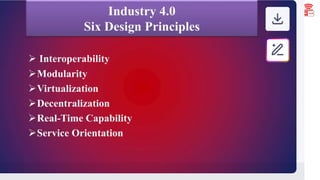
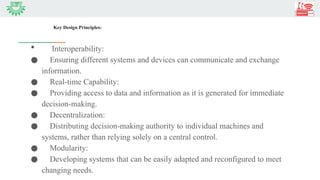
Key Design Principles:
Interoperability:
● Ensuring different systems and devices can communicate and exchange
information.
● Real-time Capability:
● Providing access to data and information as it is generated for immediate
decision-making.
● Decentralization:
● Distributing decision-making authority to individual machines and
systems, rather than relying solely on a central control.
● Modularity:
● Developing systems that can be easily adapted and reconfigured to meet
changing needs.
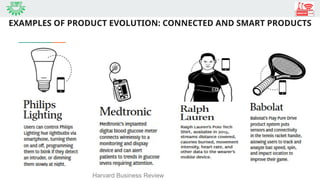
EXAMPLES OF PRODUCTEVOLUTION: CONNECTED AND SMART PRODUCTS
Harvard Business Review
13.
● German manufacturinggiant Siemens, an industrial user, is
implementing an Industry 4.0 solution in medical engineering.
For years, artificial knee and hip joints were standardized
products, with engineers needing several days to customize
them for patients. Now, new software and steering solutions
enable Siemens to produce an implant within 3 to 4 hours.
Examples
SIEMENS
14.
Examples
TRUMPF
● German toolmakerTrumpf, an Industry 4.0 supplier and worldwide market
leader of laser systems, has put the first "social machines" to work. Each
component is "smart" and knows what work has already been carried out on
it. Because the production facility already knows its capacity utilization and
communicates with other facilities, production options are automatically
optimized.
15.
EXAMPLES
GE
●Predix, the operatingsystem for the Industrial Internet, is
powering digital industrial businesses that drive the global
economy. By connecting industrial equipment, analyzing
data, and delivering real-time insights, Predix-based apps
are unleashing new levels of performance of both GE and
non-GE assets.
16.
MEGA TRENDS (PHYSICAL)
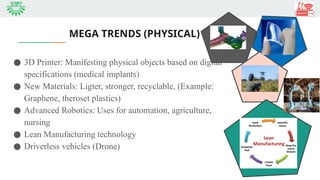
●3D Printer: Manifesting physical objects based on digital
specifications (medical implants)
● New Materials: Ligter, stronger, recyclable, (Example:
Graphene, theroset plastics)
● Advanced Robotics: Uses for automation, agriculture,
nursing
● Lean Manufacturing technology
● Driverless vehicles (Drone)
17.
MEGATRENDS (DIGITAL)
● Internetof Things
● RFID: Tracking, asset management
● Bitcoin: digital currency
● Blockchain: securing banking transactions
● Uber model of transportation: Sharing and pooling the resources for
better utilization (storage, computing)
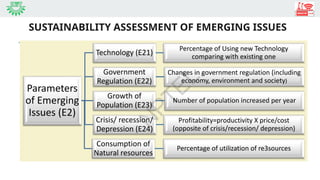
SUSTAINABILITY AND I4.0
●Continue at a fixed price
● Energy efficiency, Resourse conservation, Low-waste production
● Globalization: Bussiness model, Emerging markets, Supplychain Management,
Adapting state-of-art ICT(Information and Communications Technology)
● Energy consumption: from non-renewable to renewable
● Government Regulations: Environment guidelines, Privacy regulations,
emplyement & labor rule, advertisement regulations, safety and health
guidelines
● Economic crises/ recession
20.
TYPES OF WASTES
●Transportation – Excessive movements of people for materials or information
● Waiting – Period of inactivity of people for material or information
● Motion – Non value-added movement of people
● Inventory – Cost of inventory such as raw materials, work in process, finished goods
● Over-processing – Doing more work in product than customer values
● Defects – Defects can be in products or paper works
● Overproduction – Producing more product sooner than the customers ready for
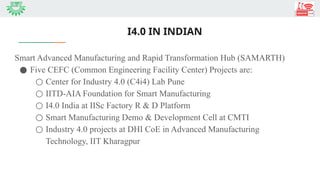
I4.0 IN INDIAN
SmartAdvanced Manufacturing and Rapid Transformation Hub (SAMARTH)
● Five CEFC (Common Engineering Facility Center) Projects are:
○ Center for Industry 4.0 (C4i4) Lab Pune
○ IITD-AIA Foundation for Smart Manufacturing
○ I4.0 India at IISc Factory R & D Platform
○ Smart Manufacturing Demo & Development Cell at CMTI
○ Industry 4.0 projects at DHI CoE in Advanced Manufacturing
Technology, IIT Kharagpur