© Fraunhofer ISST
DATA RESOURCE MANAGEMENT
GOOD PRACTICES TO MAKE THE MOST OF A HIDDEN TREASURE
Prof. Dr.-Ing. Boris Otto  Dortmund  12 July 2018
public· 1
© Fraunhofer ISST
TABLE OF CONTENT
 Data as an Enterprise Resource
 Good Practices for Data Resource Management
 Data Ecosystems
public· 2
© Fraunhofer ISST
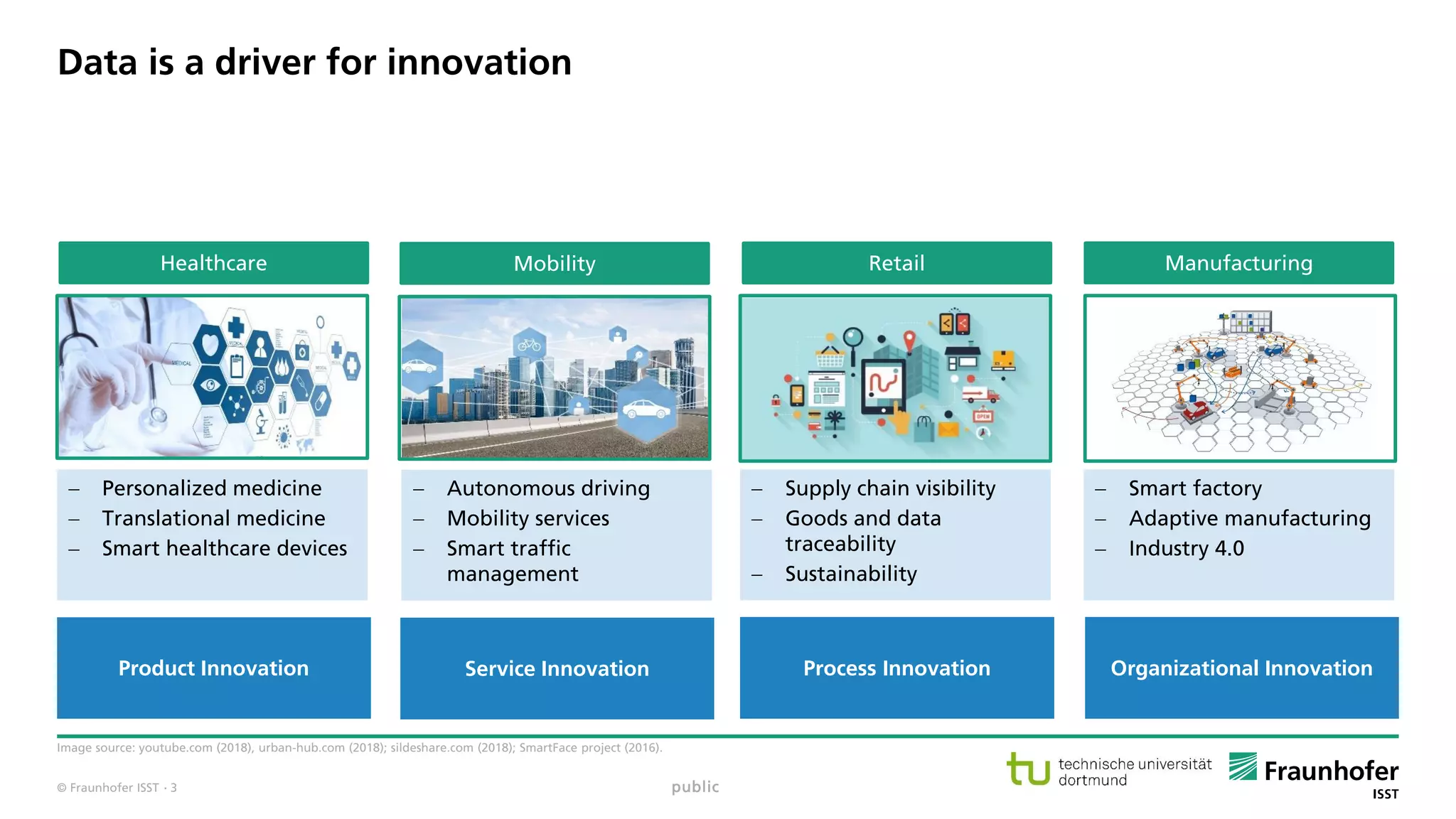
Data is a driver for innovation
Image source: youtube.com (2018), urban-hub.com (2018); sildeshare.com (2018); SmartFace project (2016).
Mobility
 Autonomous driving
 Mobility services
 Smart traffic
management
Service Innovation
Manufacturing
 Smart factory
 Adaptive manufacturing
 Industry 4.0
Organizational Innovation
Healthcare
 Personalized medicine
 Translational medicine
 Smart healthcare devices
Product Innovation
Retail
 Supply chain visibility
 Goods and data
traceability
 Sustainability
Process Innovation
public· 3
© Fraunhofer ISST
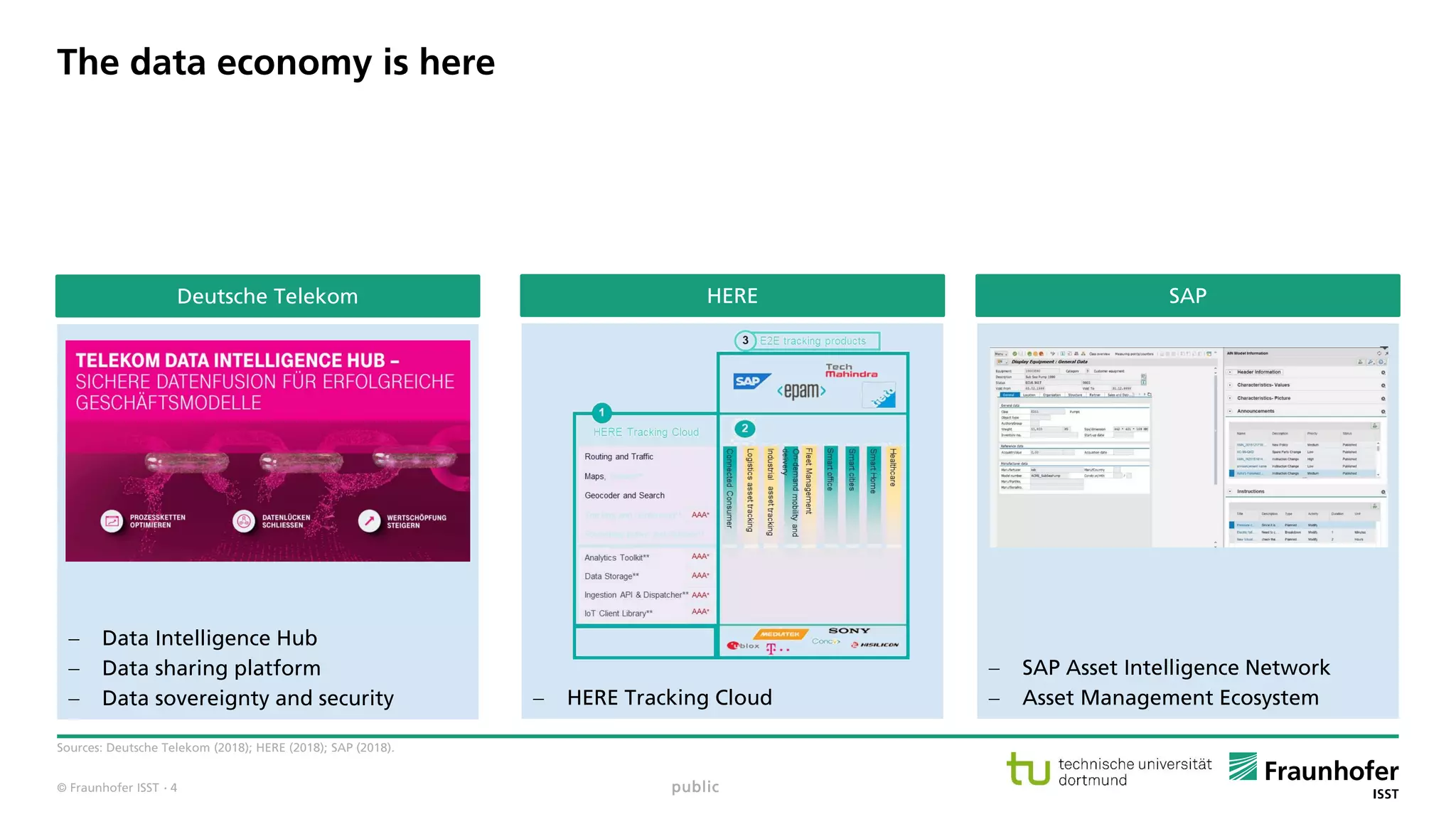
 Data Intelligence Hub
 Data sharing platform
 Data sovereignty and security
The data economy is here
Sources: Deutsche Telekom (2018); HERE (2018); SAP (2018).
public
 HERE Tracking Cloud
 SAP Asset Intelligence Network
 Asset Management Ecosystem
Deutsche Telekom HERE SAP
· 4
© Fraunhofer ISST
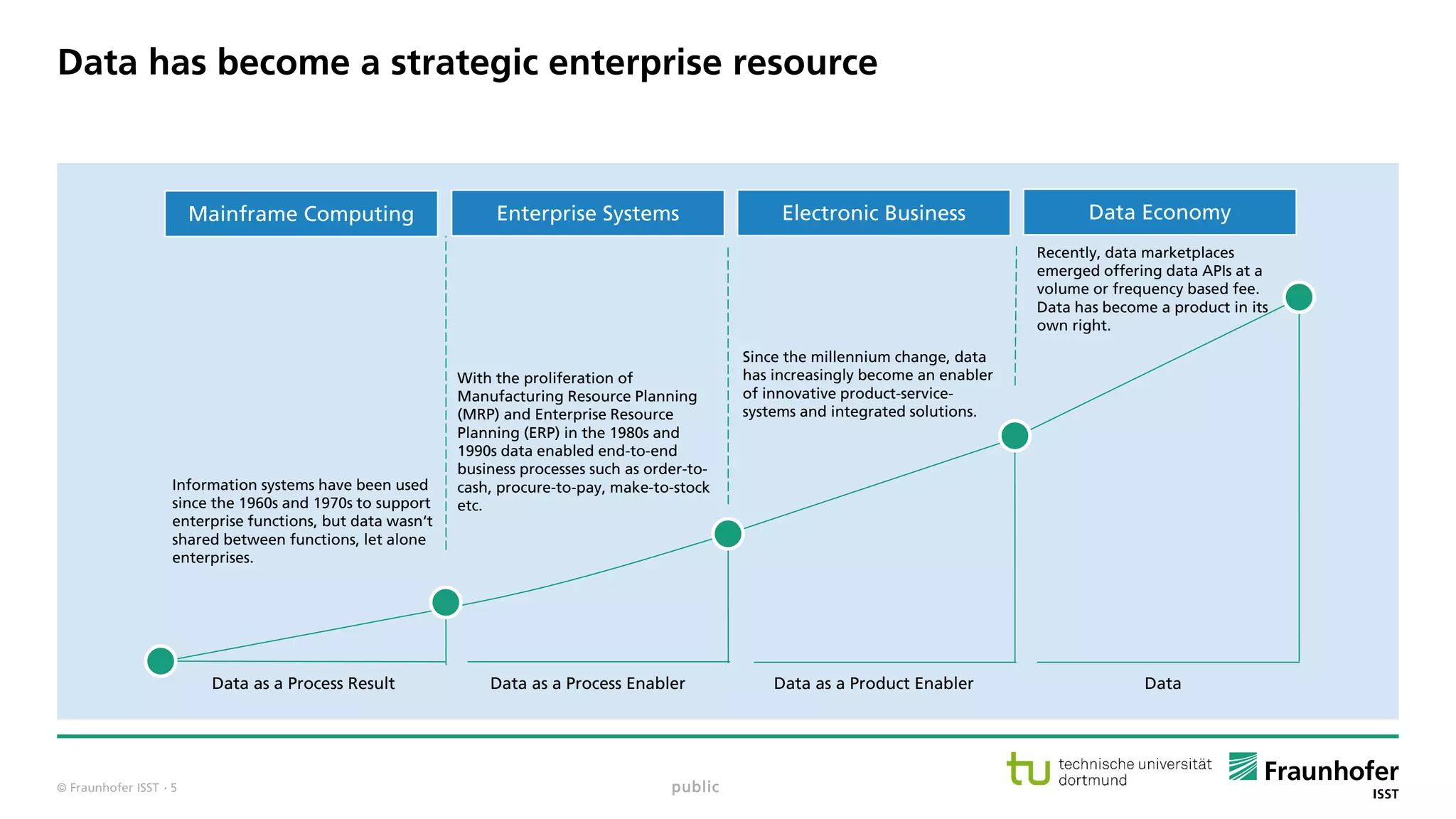
Data has become a strategic enterprise resource
public
Data as a Process Result Data as a Process Enabler Data as a Product Enabler Data
Information systems have been used
since the 1960s and 1970s to support
enterprise functions, but data wasn‘t
shared between functions, let alone
enterprises.
With the proliferation of
Manufacturing Resource Planning
(MRP) and Enterprise Resource
Planning (ERP) in the 1980s and
1990s data enabled end-to-end
business processes such as order-to-
cash, procure-to-pay, make-to-stock
etc.
Since the millennium change, data
has increasingly become an enabler
of innovative product-service-
systems and integrated solutions.
Recently, data marketplaces
emerged offering data APIs at a
volume or frequency based fee.
Data has become a product in its
own right.
Mainframe Computing Enterprise Systems Electronic Business Data Economy
· 5
© Fraunhofer ISST
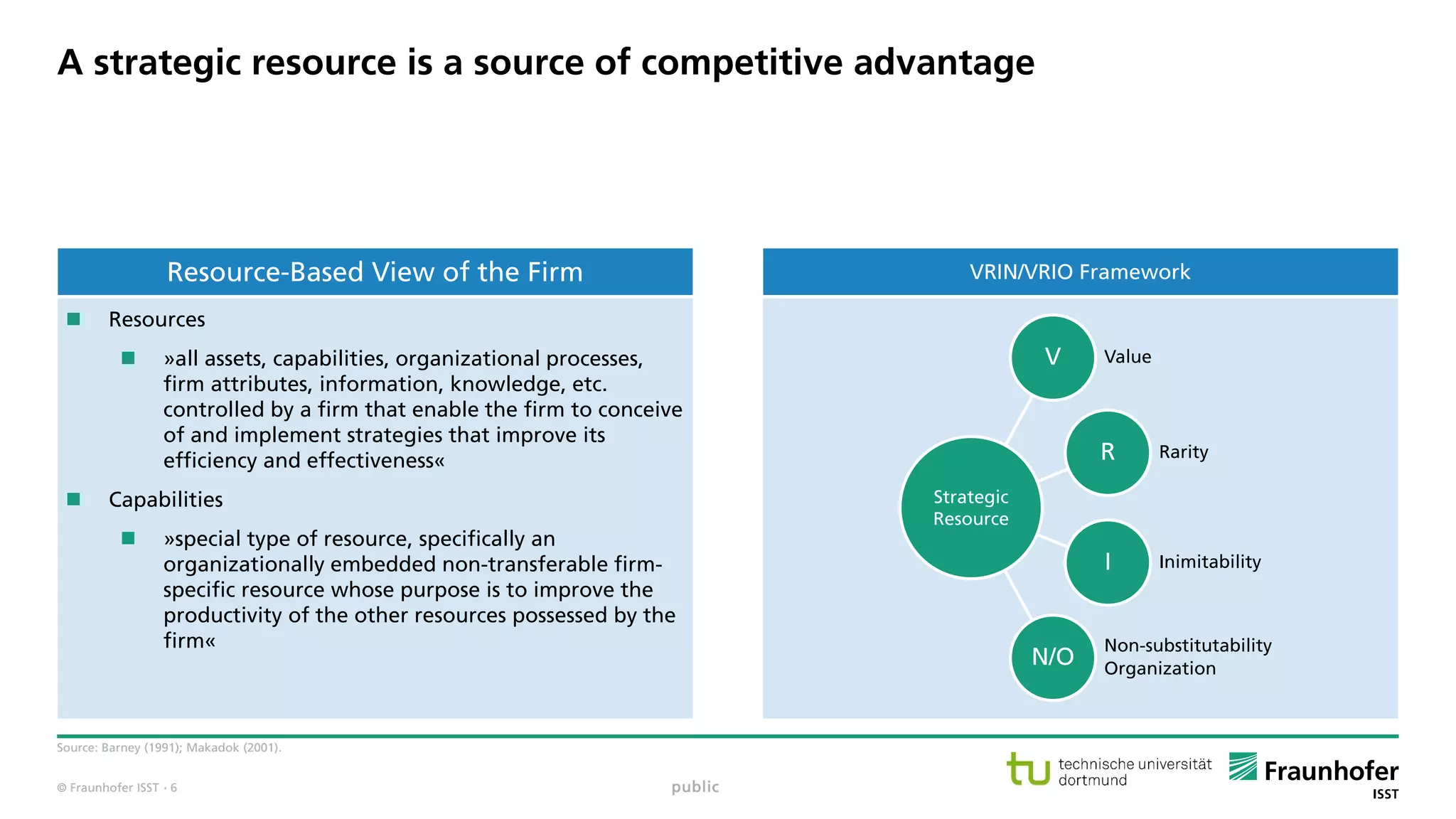
A strategic resource is a source of competitive advantage
Strategic
Resource
V Value
R Rarity
I Inimitability
N/O
Non-substitutability
Organization
Source: Barney (1991); Makadok (2001).
public
VRIN/VRIO Framework
 Resources
 »all assets, capabilities, organizational processes,
firm attributes, information, knowledge, etc.
controlled by a firm that enable the firm to conceive
of and implement strategies that improve its
efficiency and effectiveness«
 Capabilities
 »special type of resource, specifically an
organizationally embedded non-transferable firm-
specific resource whose purpose is to improve the
productivity of the other resources possessed by the
firm«
Resource-Based View of the Firm
· 6
© Fraunhofer ISST
TABLE OF CONTENT
 Data as an Enterprise Resource
 Good Practices for Data Resource Management
 Data Ecosystems
public· 7
© Fraunhofer ISST
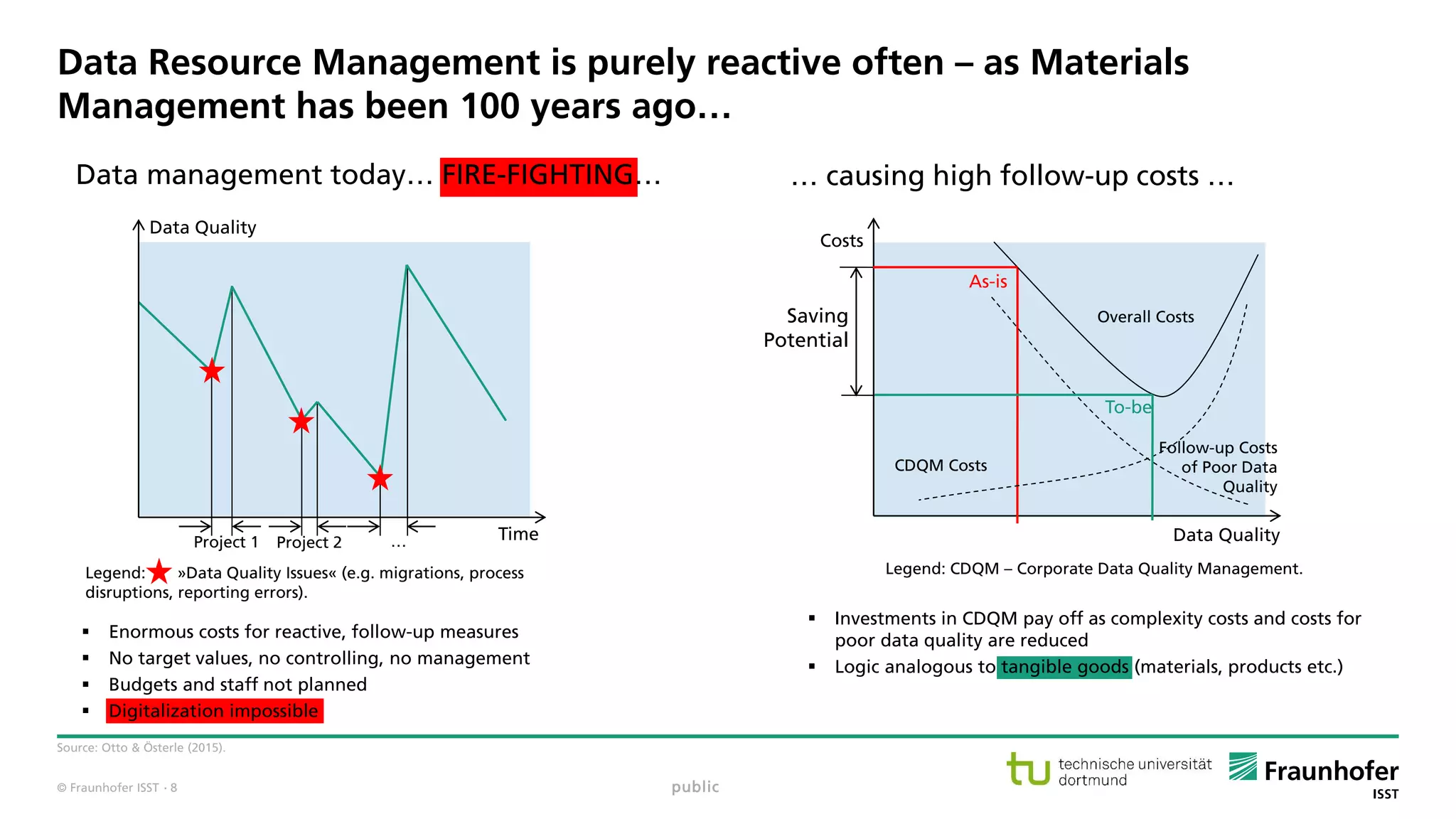
Data Resource Management is purely reactive often – as Materials
Management has been 100 years ago…
Source: Otto & Österle (2015).
public
Data management today… FIRE-FIGHTING…
 Enormous costs for reactive, follow-up measures
 No target values, no controlling, no management
 Budgets and staff not planned
 Digitalization impossible
… causing high follow-up costs …
 Investments in CDQM pay off as complexity costs and costs for
poor data quality are reduced
 Logic analogous to tangible goods (materials, products etc.)
Data Quality
Time
Legend: »Data Quality Issues« (e.g. migrations, process
disruptions, reporting errors).
Project 1 Project 2 …
As-is
Overall Costs
Costs
Data Quality
Follow-up Costs
of Poor Data
Quality
CDQM Costs
To-be
Legend: CDQM – Corporate Data Quality Management.
Saving
Potential
· 8
© Fraunhofer ISST
Data resource management has to be planned, monitored, executed as
materials and asset management
Source: Womack et al. (1991).
»Our findings were eye-opening. The Japanese plant requires
(less effort the American and European plants). At the same
time, the Japanese plant greatly exceeds the quality level of all
plants execpt one in Europe - and this plant requires four times
the effort […]«
»When we visited the high-quality but low productivity
European plant […] we didn‘t have to go far to find the basic
problem […]. At the end of the assembly line was an enormous
rework and rectification area where armies of technicians in
white laboratory jackets labored to bring the finished vehicles
up to the company‘s fabled quality standard.«
public· 9
© Fraunhofer ISST
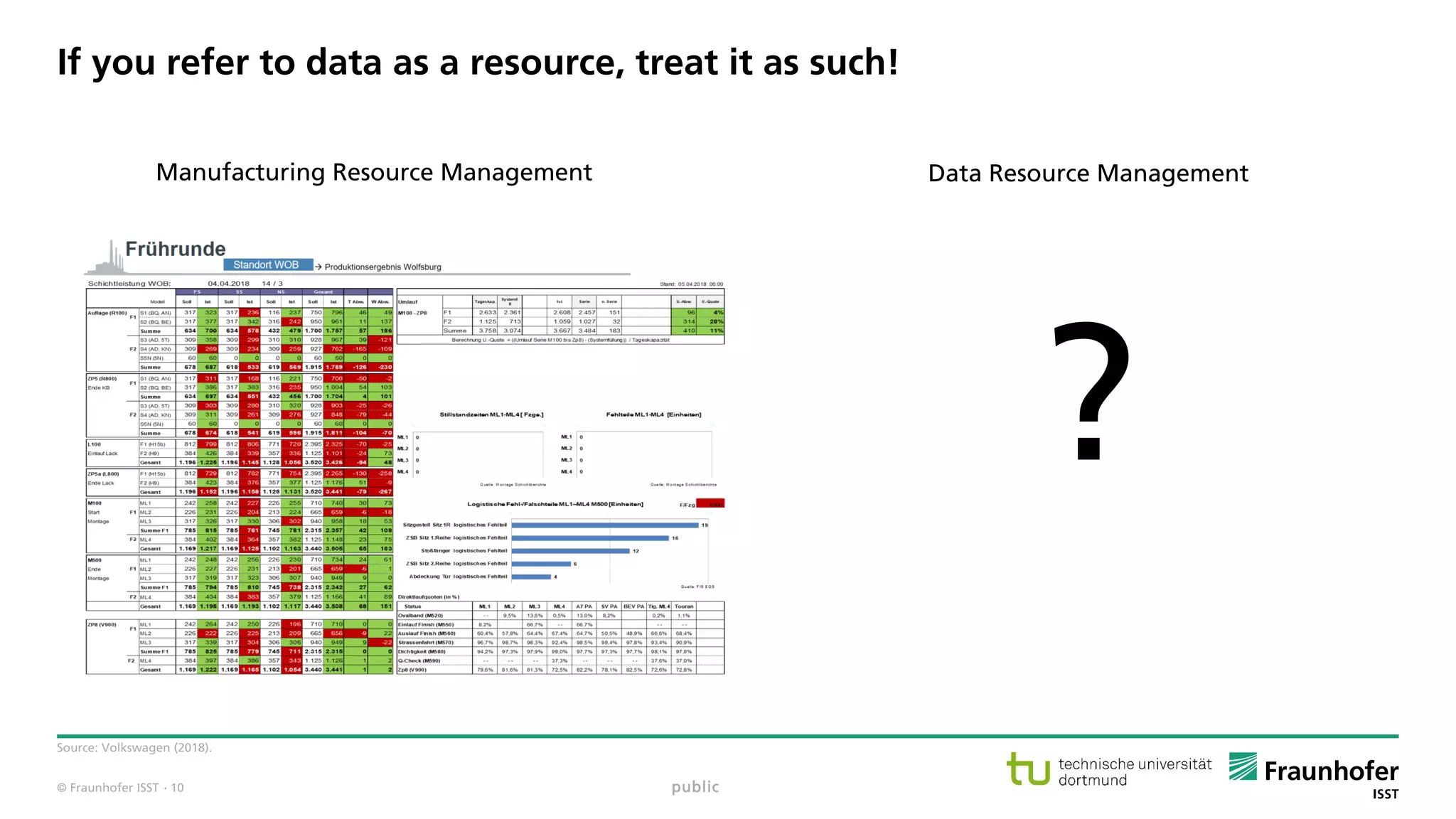
If you refer to data as a resource, treat it as such!
Source: Volkswagen (2018).
Manufacturing Resource Management Data Resource Management
?
public· 10
© Fraunhofer ISST
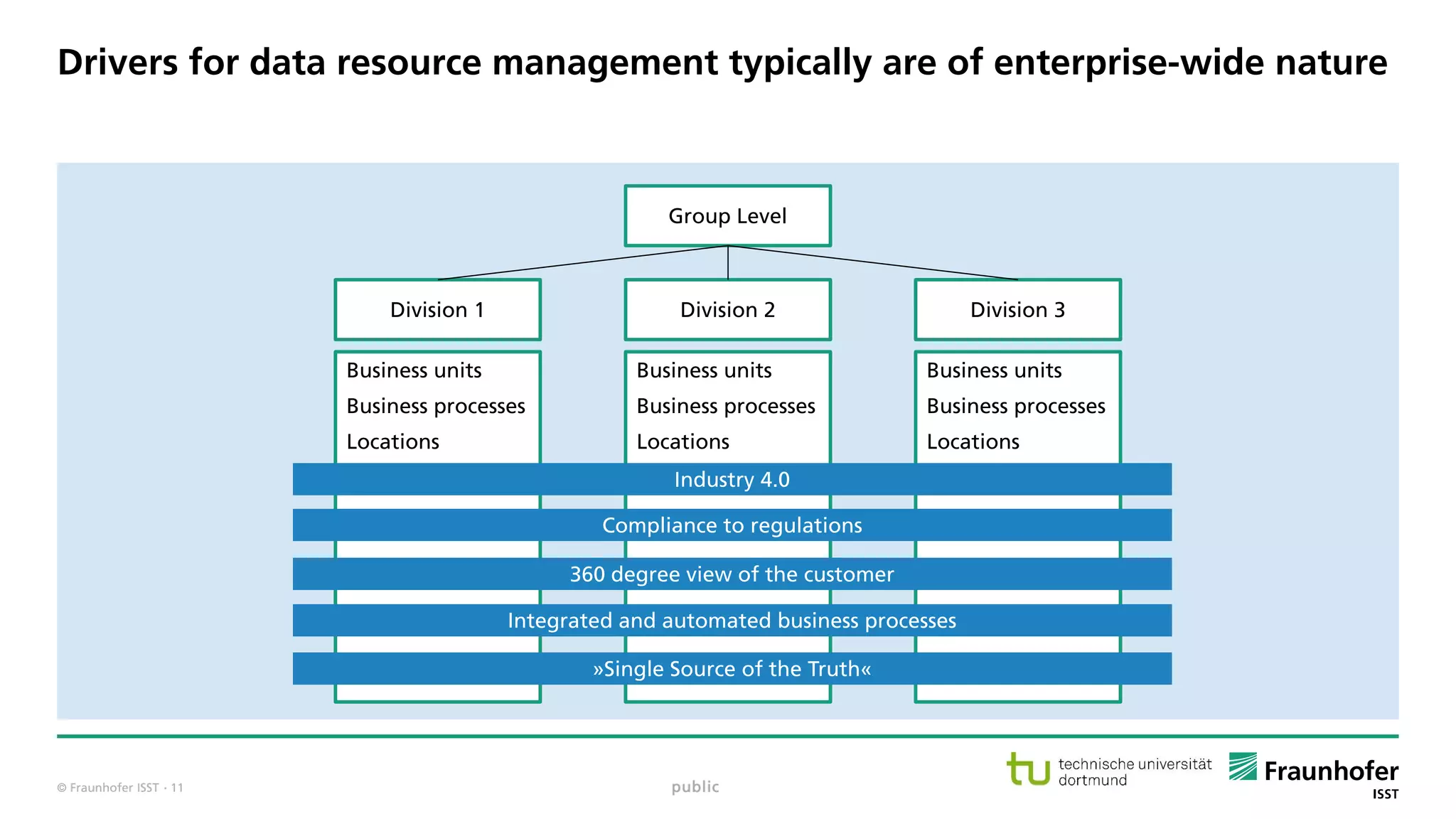
Drivers for data resource management typically are of enterprise-wide nature
public
Group Level
Division 2Division 1 Division 3
Business units
Business processes
Locations
Business units
Business processes
Locations
Business units
Business processes
Locations
Compliance to regulations
360 degree view of the customer
Integrated and automated business processes
»Single Source of the Truth«
Industry 4.0
· 11
© Fraunhofer ISST
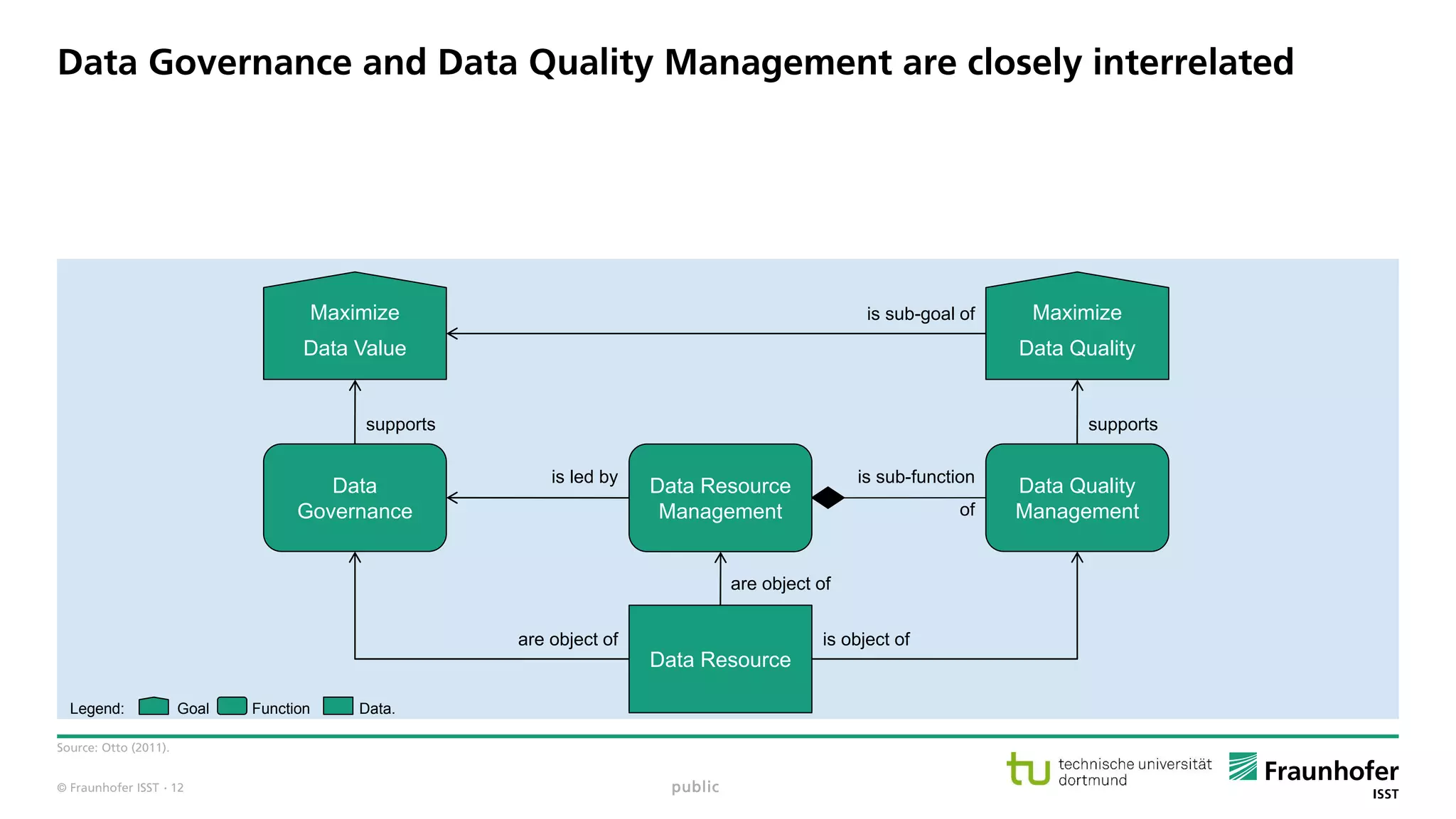
Data Governance and Data Quality Management are closely interrelated
Source: Otto (2011).
public
Legend: Goal Function Data.
Data
Governance
Data Quality
Management
Maximize
Data Quality
Maximize
Data Value
Data Resource
Data Resource
Management
is sub-goal of
supports supports
is led by is sub-function
of
are object of is object of
are object of
· 12
© Fraunhofer ISST
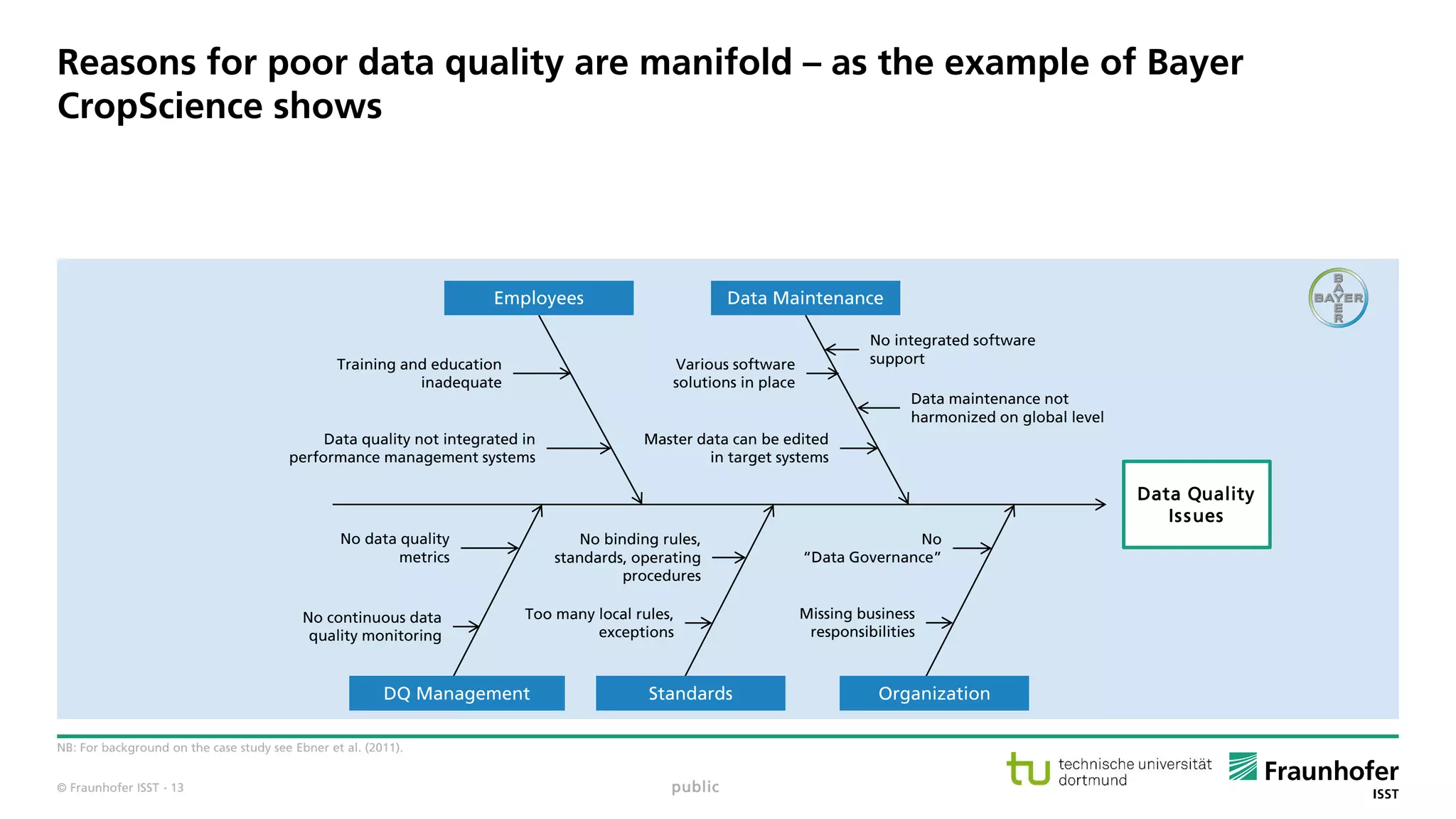
Reasons for poor data quality are manifold – as the example of Bayer
CropScience shows
NB: For background on the case study see Ebner et al. (2011).
public
Data Quality
Issues
Employees Data Maintenance
DQ Management Standards Organization
Training and education
inadequate
Data quality not integrated in
performance management systems
Various software
solutions in place
Master data can be edited
in target systems
No integrated software
support
Data maintenance not
harmonized on global level
No data quality
metrics
No continuous data
quality monitoring
No binding rules,
standards, operating
procedures
Too many local rules,
exceptions
No
“Data Governance”
Missing business
responsibilities
· 13
© Fraunhofer ISST
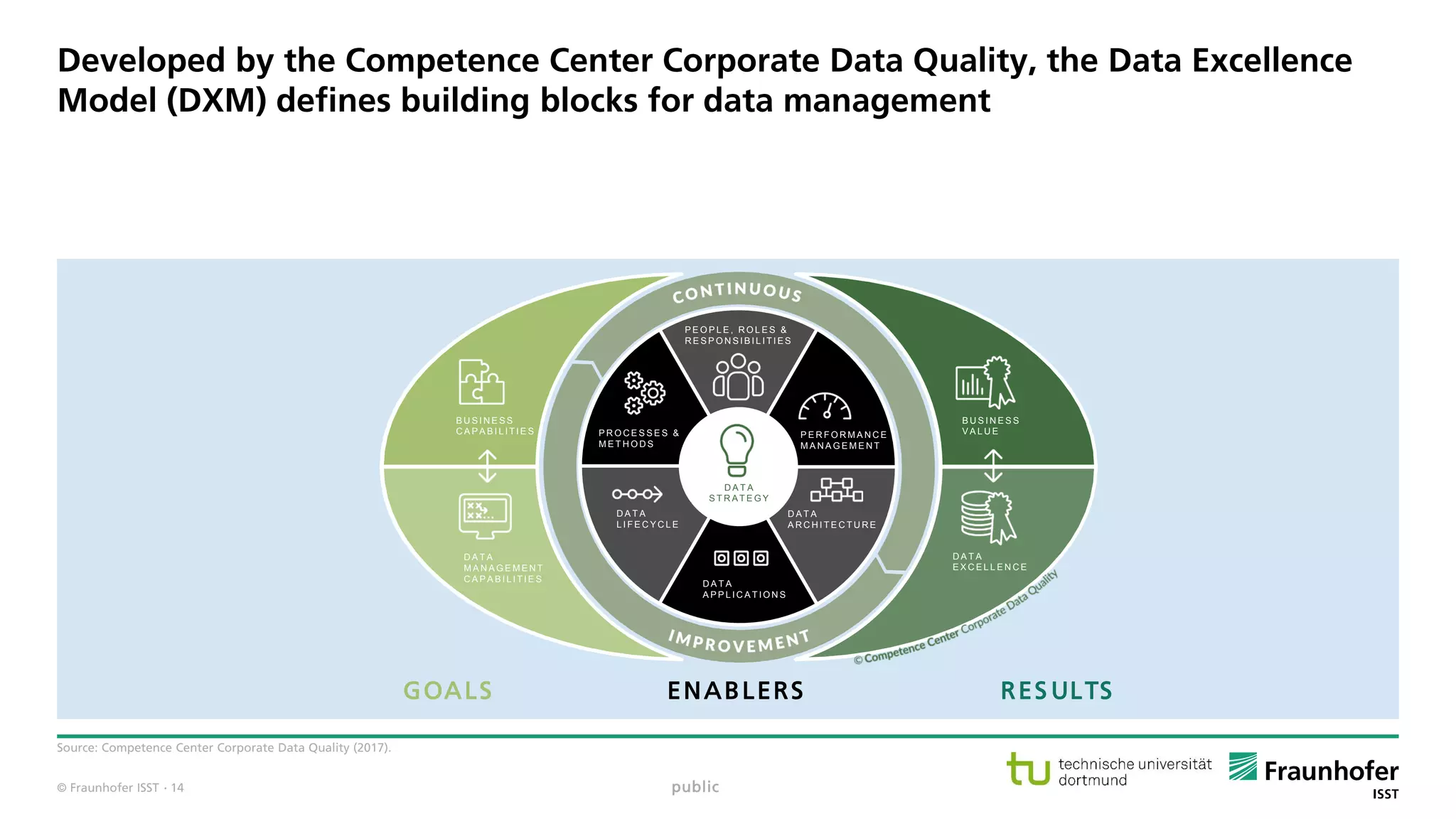
Developed by the Competence Center Corporate Data Quality, the Data Excellence
Model (DXM) defines building blocks for data management
Source: Competence Center Corporate Data Quality (2017).
public
GOALS ENABLERS RES ULTS
D A T A
S T R A T E G Y
P E O P L E , R O L E S &
R E S P O N S I B I L I T I E S
P R O C E S S E S &
M E T H O D S
D A T A
L I F E C Y C L E
D A T A
A P P L I C A T I O N S
D A T A
A R C H I T E C T U R E
P E R F O R M A N C E
M A N A G E M E N T
B U S I N E S S
C A P A B I L I T I E S
D A T A
M A N A G E M E N T
C A P A B I L I T I E S
B U S I N E S S
V A L U E
D A T A
E X C E L L E N C E
· 14
© Fraunhofer ISST
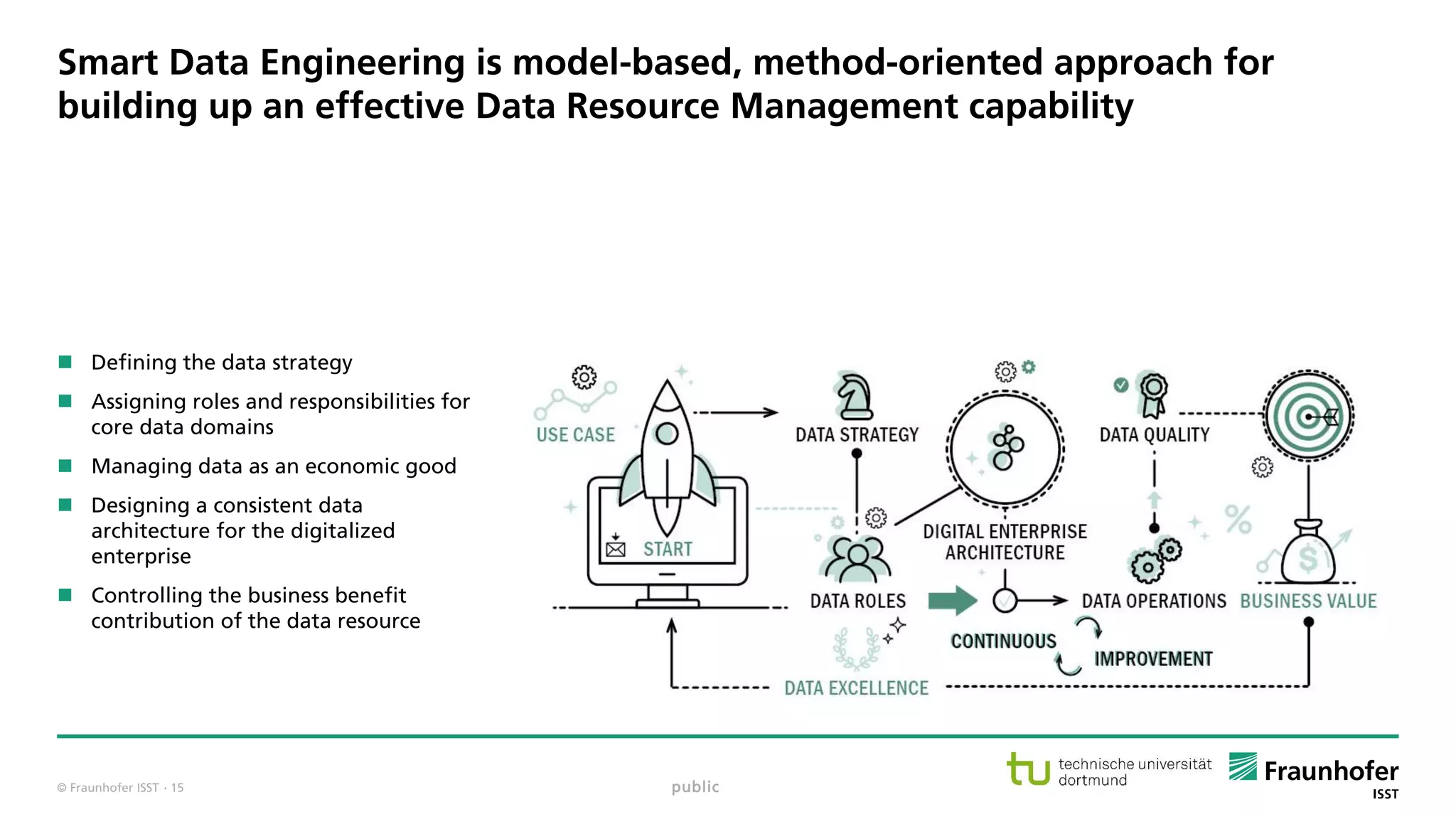
Smart Data Engineering is model-based, method-oriented approach for
building up an effective Data Resource Management capability
 Defining the data strategy
 Assigning roles and responsibilities for
core data domains
 Managing data as an economic good
 Designing a consistent data
architecture for the digitalized
enterprise
 Controlling the business benefit
contribution of the data resource
public· 15
© Fraunhofer ISST
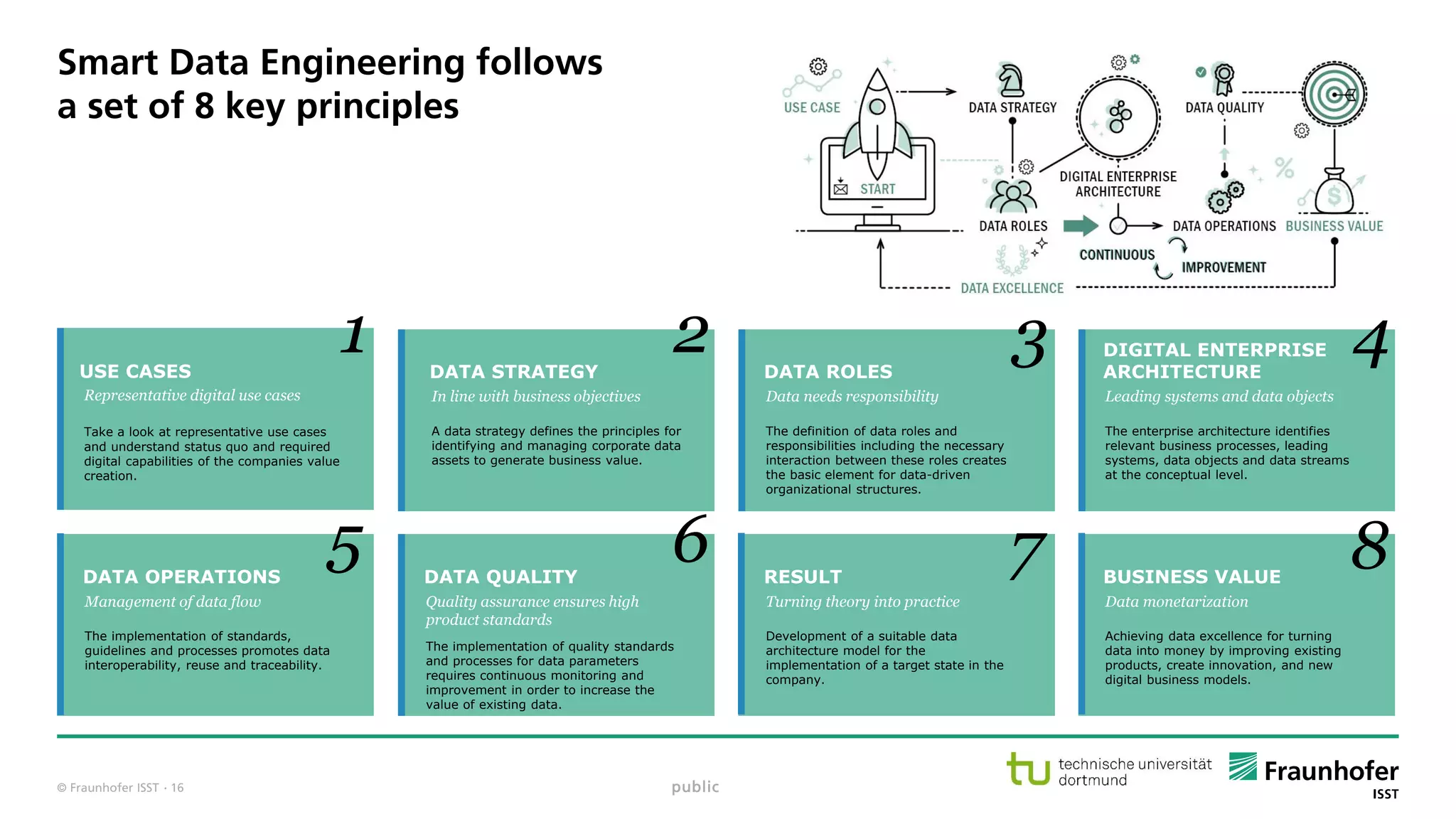
Smart Data Engineering follows
a set of 8 key principles
public
In line with business objectives
A data strategy defines the principles for
identifying and managing corporate data
assets to generate business value.
DATA STRATEGY
Representative digital use cases
Take a look at representative use cases
and understand status quo and required
digital capabilities of the companies value
creation.
USE CASES
1 2 3
5 6 7
4
8
Data needs responsibility
The definition of data roles and
responsibilities including the necessary
interaction between these roles creates
the basic element for data-driven
organizational structures.
DATA ROLES
Leading systems and data objects
The enterprise architecture identifies
relevant business processes, leading
systems, data objects and data streams
at the conceptual level.
DIGITAL ENTERPRISE
ARCHITECTURE
Data monetarization
Achieving data excellence for turning
data into money by improving existing
products, create innovation, and new
digital business models.
BUSINESS VALUE
Management of data flow
The implementation of standards,
guidelines and processes promotes data
interoperability, reuse and traceability.
DATA OPERATIONS
Quality assurance ensures high
product standards
The implementation of quality standards
and processes for data parameters
requires continuous monitoring and
improvement in order to increase the
value of existing data.
DATA QUALITY
Turning theory into practice
Development of a suitable data
architecture model for the
implementation of a target state in the
company.
RESULT
· 16
© Fraunhofer ISST
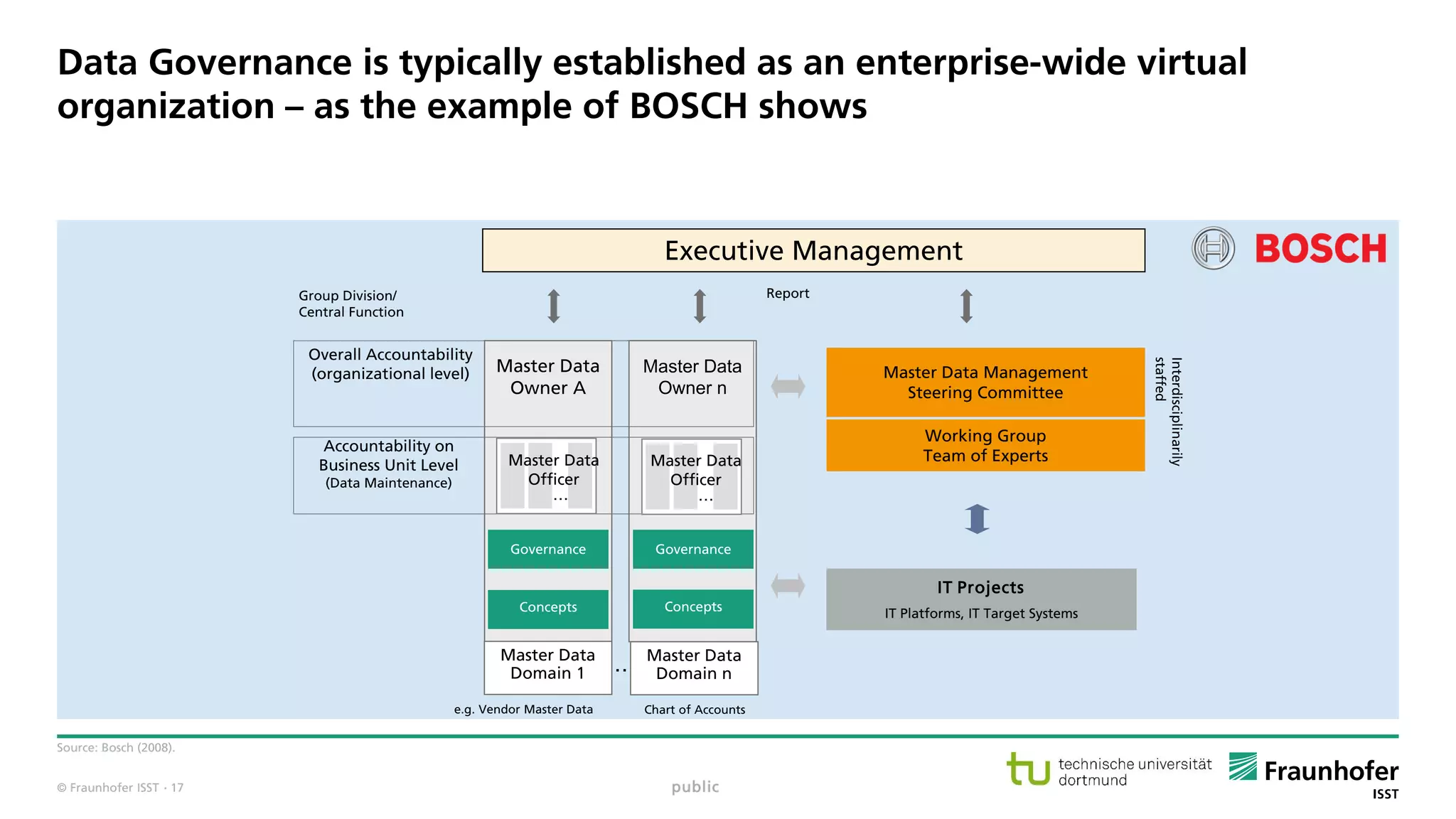
Data Governance is typically established as an enterprise-wide virtual
organization – as the example of BOSCH shows
Source: Bosch (2008).
public
Master Data
Owner n
Executive Management
Master Data Management
Steering Committee
…
Group Division/
Central Function
Accountability on
Business Unit Level
(Data Maintenance)
IT Projects
IT Platforms, IT Target Systems
Overall Accountability
(organizational level) Master Data
Owner A
Master Data
Domain 1
Master Data
Domain n
Report
Governance
Working Group
Team of Experts
ConceptsConcepts
Governance
… …
e.g. Vendor Master Data Chart of Accounts
Interdisciplinarily
staffed
Master Data
Officer
Master Data
Officer
· 17
© Fraunhofer ISST
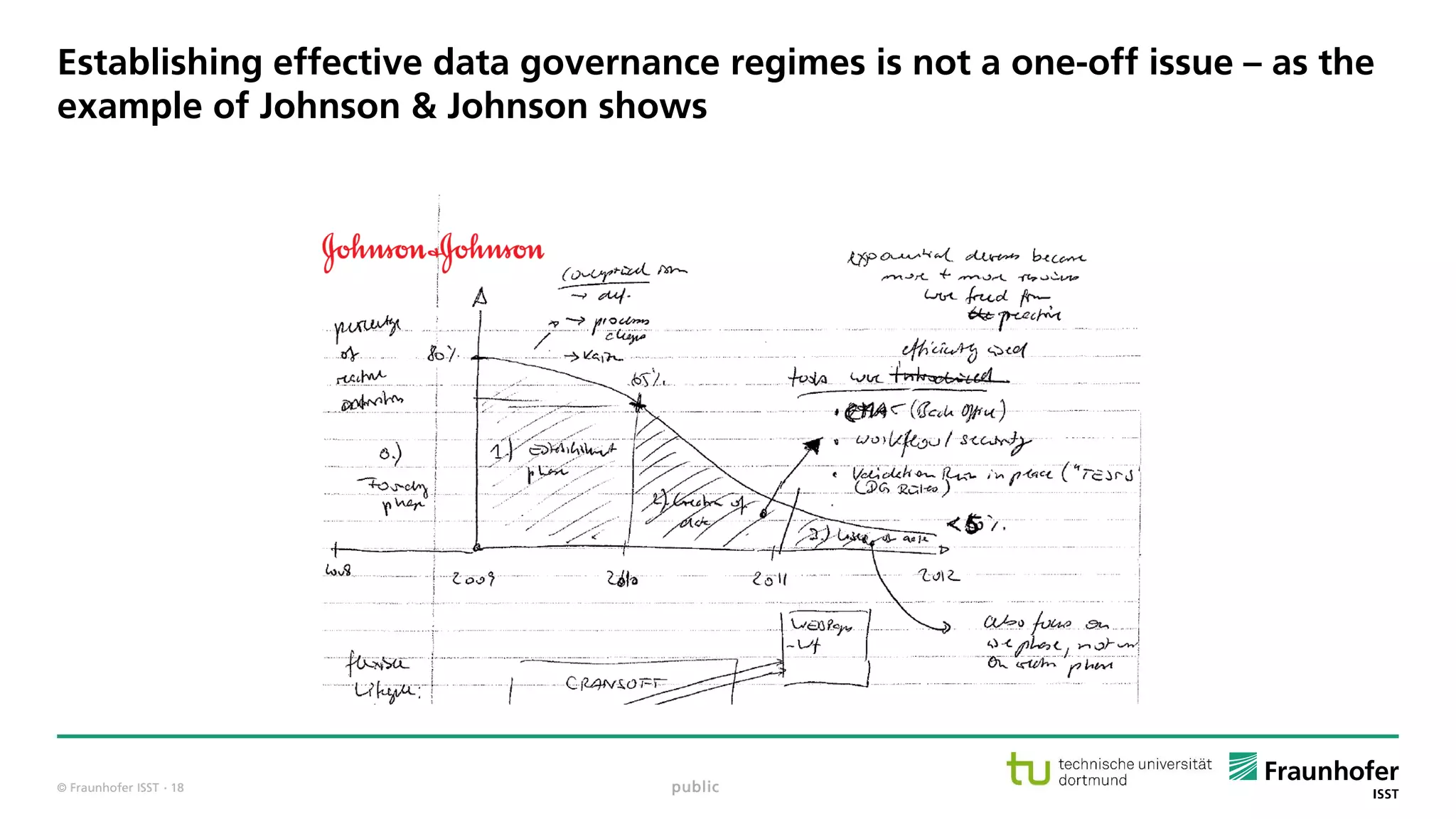
Establishing effective data governance regimes is not a one-off issue – as the
example of Johnson & Johnson shows
public· 18
© Fraunhofer ISST
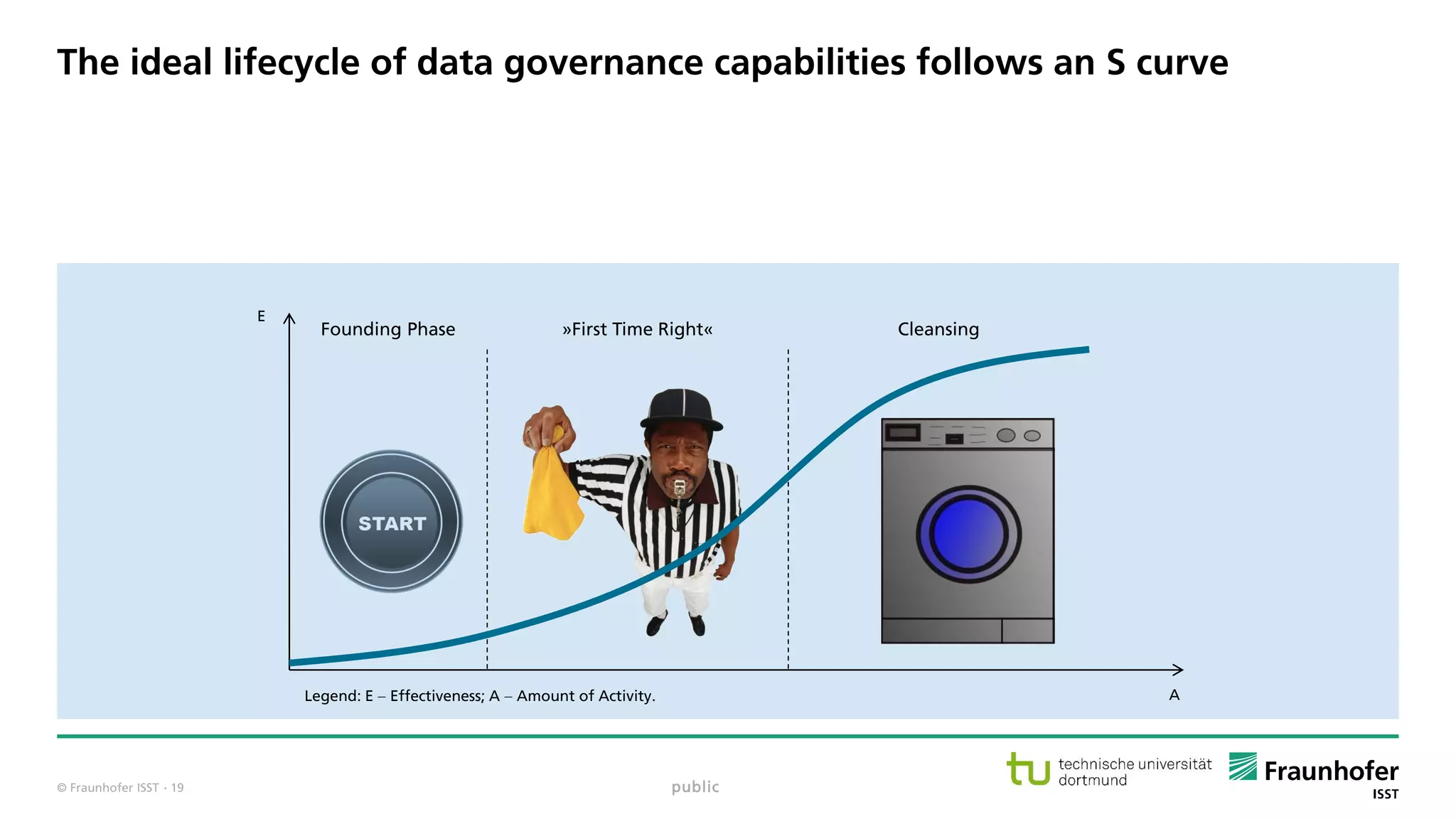
The ideal lifecycle of data governance capabilities follows an S curve
Founding Phase »First Time Right« Cleansing
Legend: E  Effectiveness; A  Amount of Activity.
E
A
public· 19
© Fraunhofer ISST
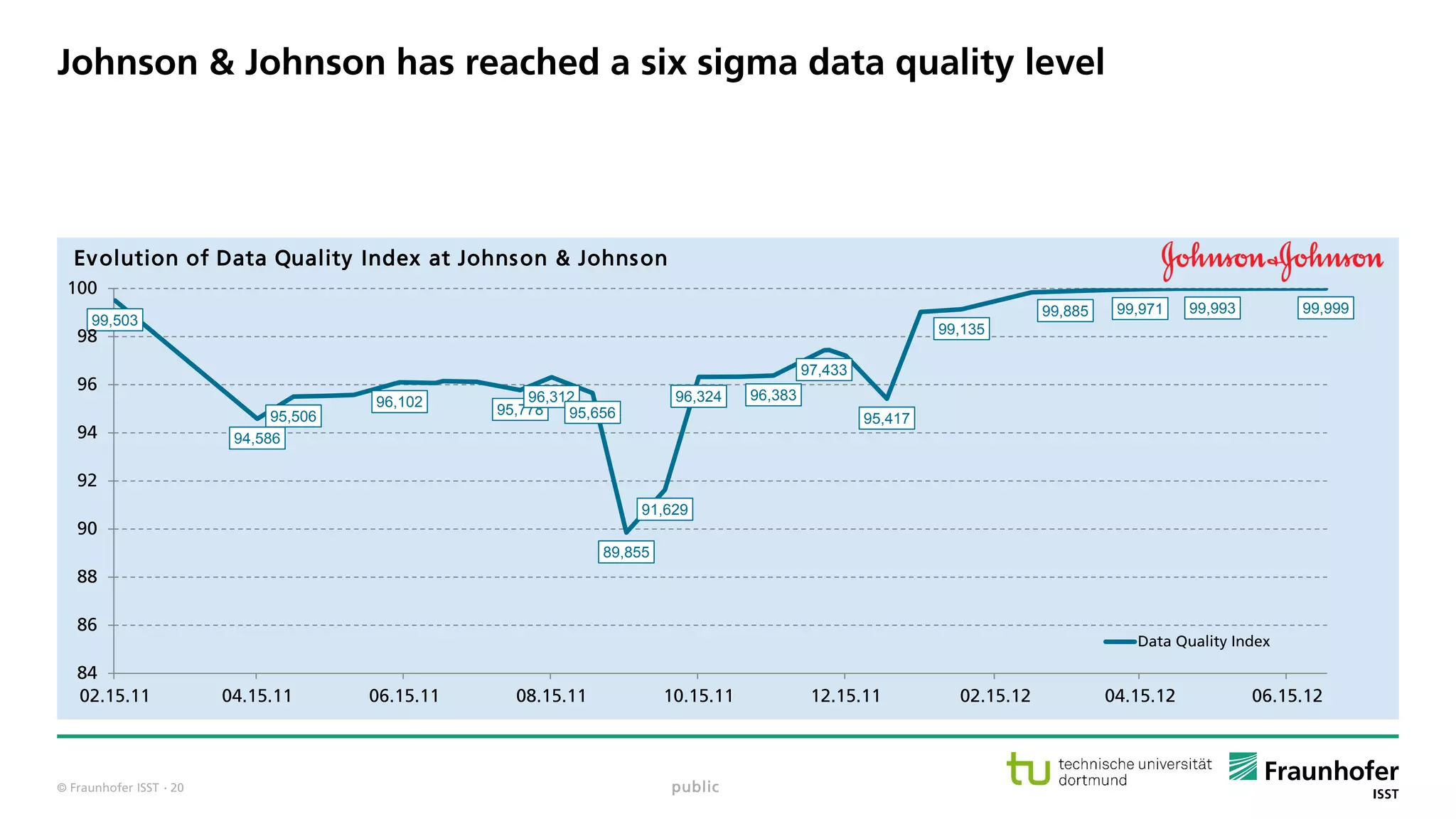
Johnson & Johnson has reached a six sigma data quality level
99,503
94,586
95,506
96,102
95,778
96,312
95,656
89,855
91,629
96,324 96,383
97,433
95,417
99,135
99,885 99,971 99,993 99,999
84
86
88
90
92
94
96
98
100
02.15.11 04.15.11 06.15.11 08.15.11 10.15.11 12.15.11 02.15.12 04.15.12 06.15.12
Evolution of Data Quality Index at Johnson & Johnson
Data Quality Index
public· 20
© Fraunhofer ISST
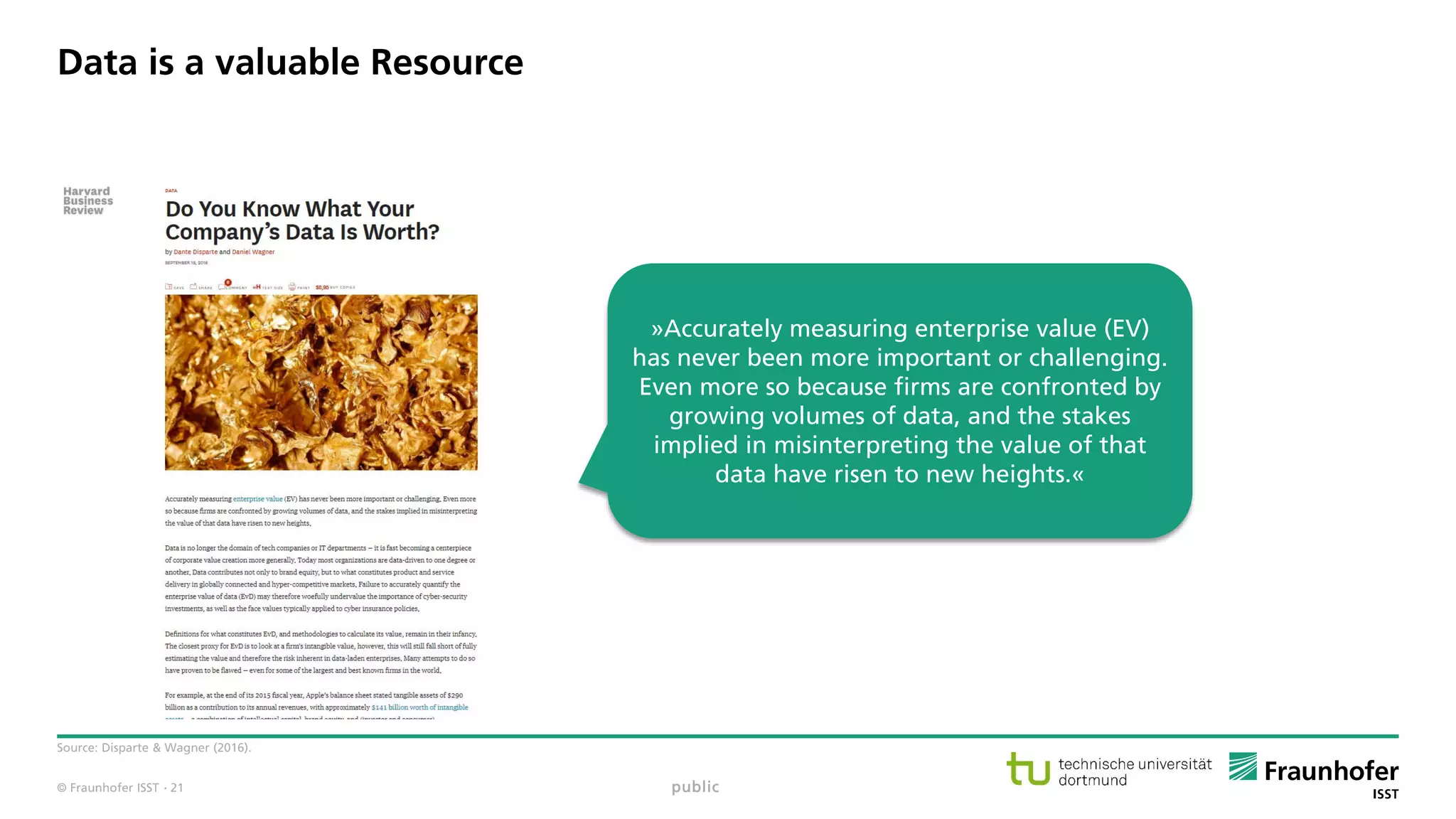
Data is a valuable Resource
Source: Disparte & Wagner (2016).
public
»Accurately measuring enterprise value (EV)
has never been more important or challenging.
Even more so because firms are confronted by
growing volumes of data, and the stakes
implied in misinterpreting the value of that
data have risen to new heights.«
· 21
© Fraunhofer ISST
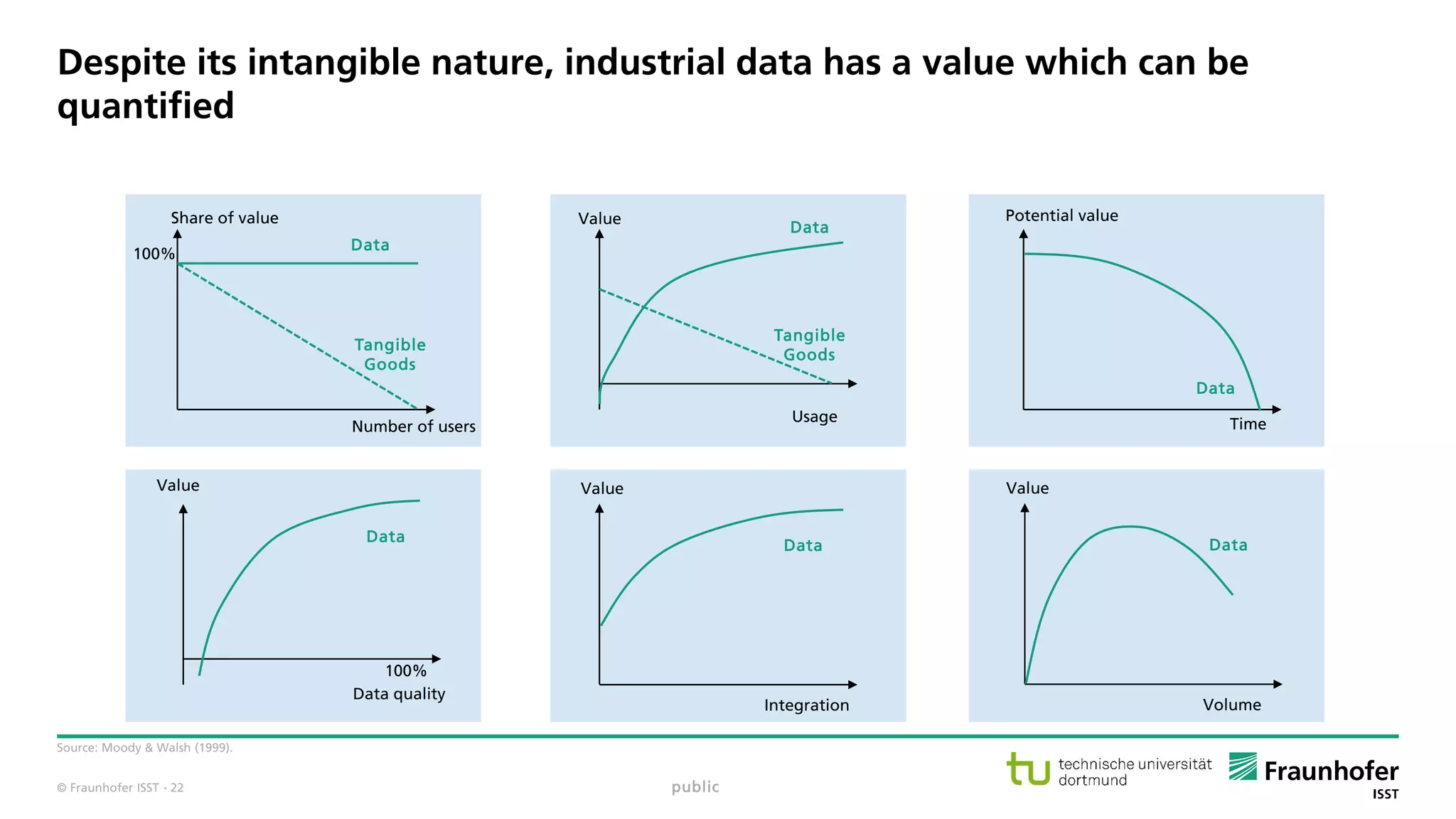
Despite its intangible nature, industrial data has a value which can be
quantified
Source: Moody & Walsh (1999).
public
Number of users
Share of value
100%
Data
Tangible
Goods
Tangible
Goods
Value
Data
Usage Time
Potential value
Data
Data quality
Value
100%
Data
Integration
Value
Data
Volume
Value
Data
· 22
© Fraunhofer ISST
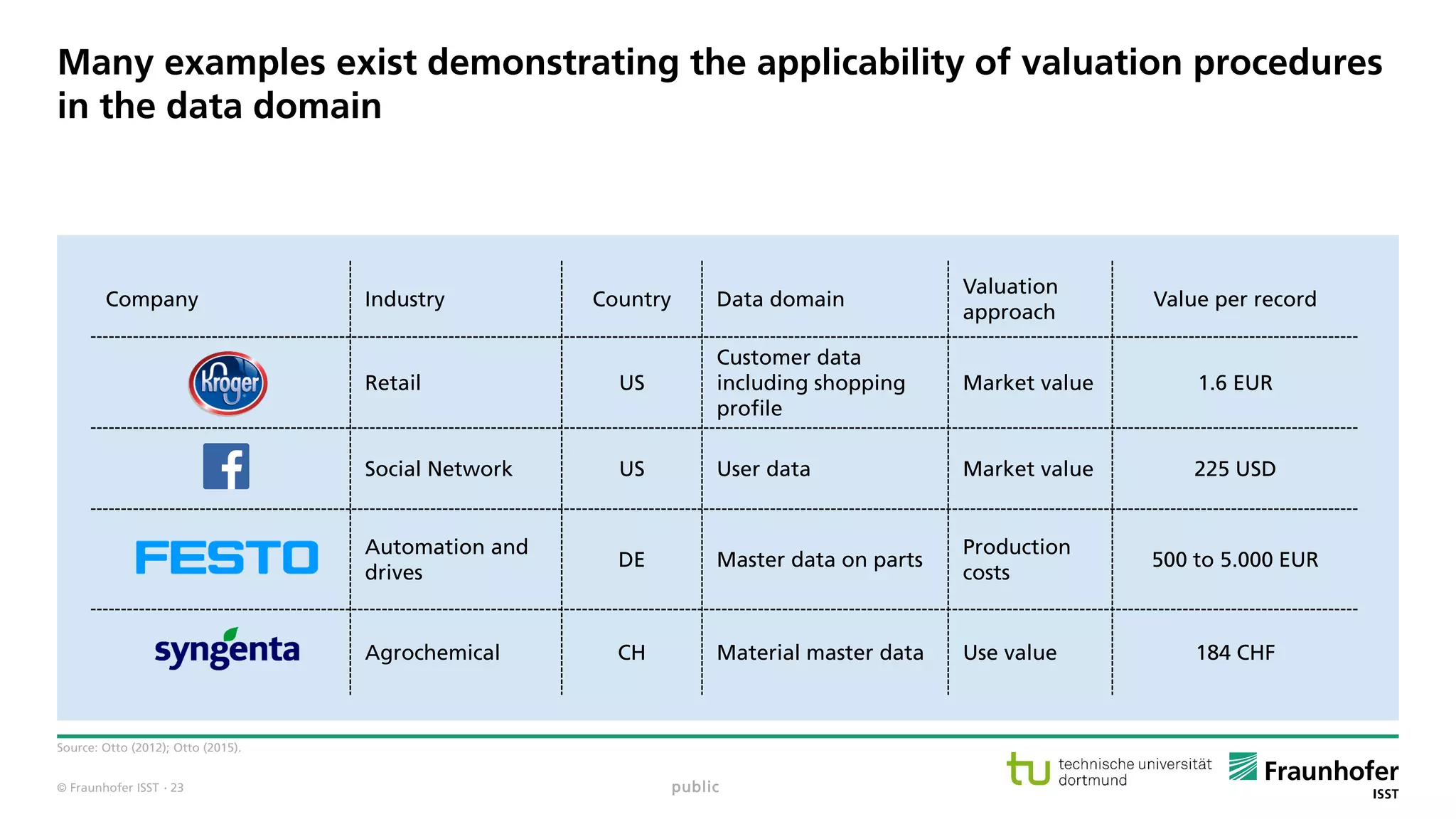
Many examples exist demonstrating the applicability of valuation procedures
in the data domain
Source: Otto (2012); Otto (2015).
Company Industry Country Data domain
Valuation
approach
Value per record
Retail US
Customer data
including shopping
profile
Market value 1.6 EUR
Social Network US User data Market value 225 USD
Automation and
drives
DE Master data on parts
Production
costs
500 to 5.000 EUR
Agrochemical CH Material master data Use value 184 CHF
public· 23
© Fraunhofer ISST
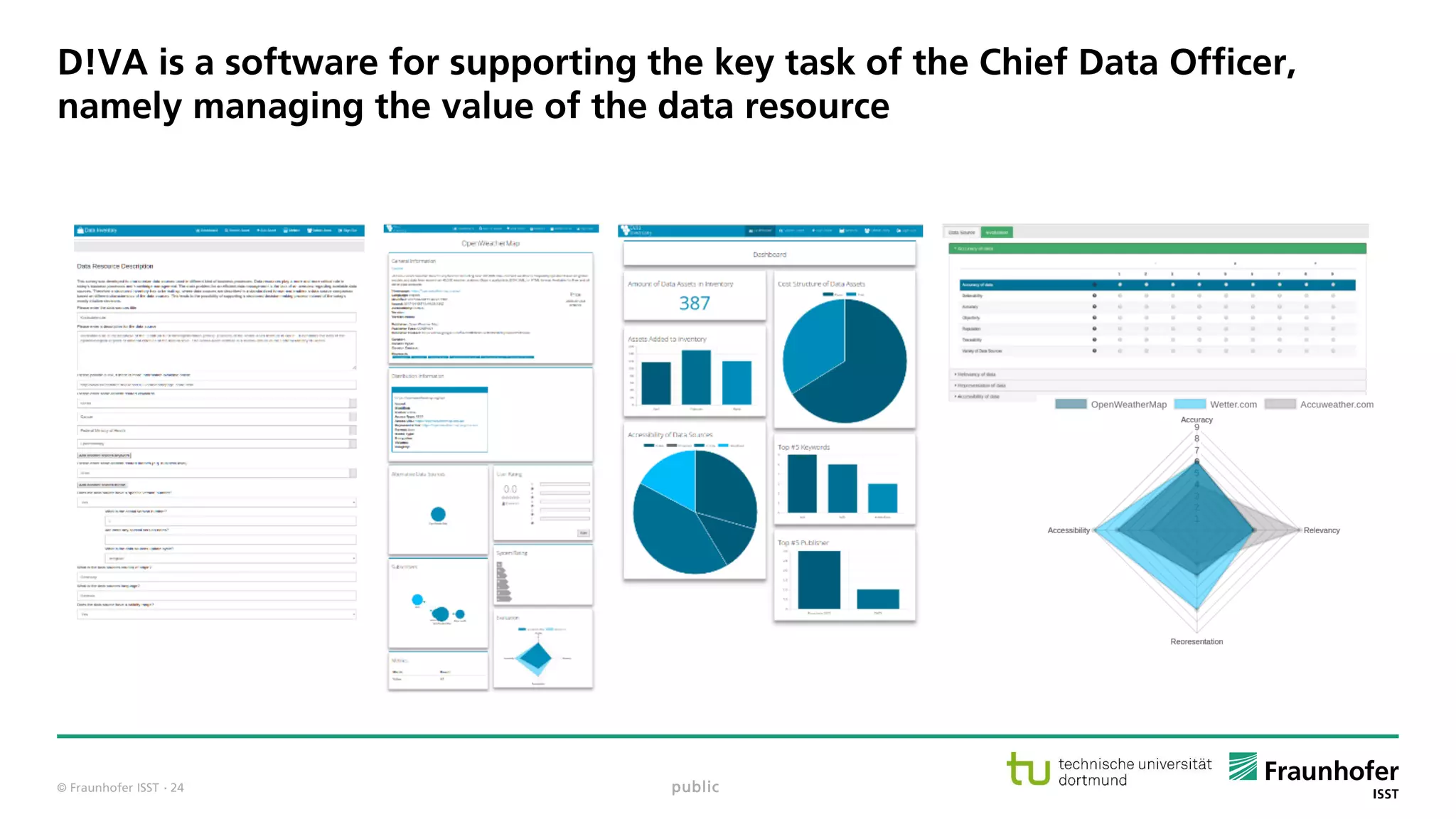
D!VA is a software for supporting the key task of the Chief Data Officer,
namely managing the value of the data resource
public· 24
© Fraunhofer ISST
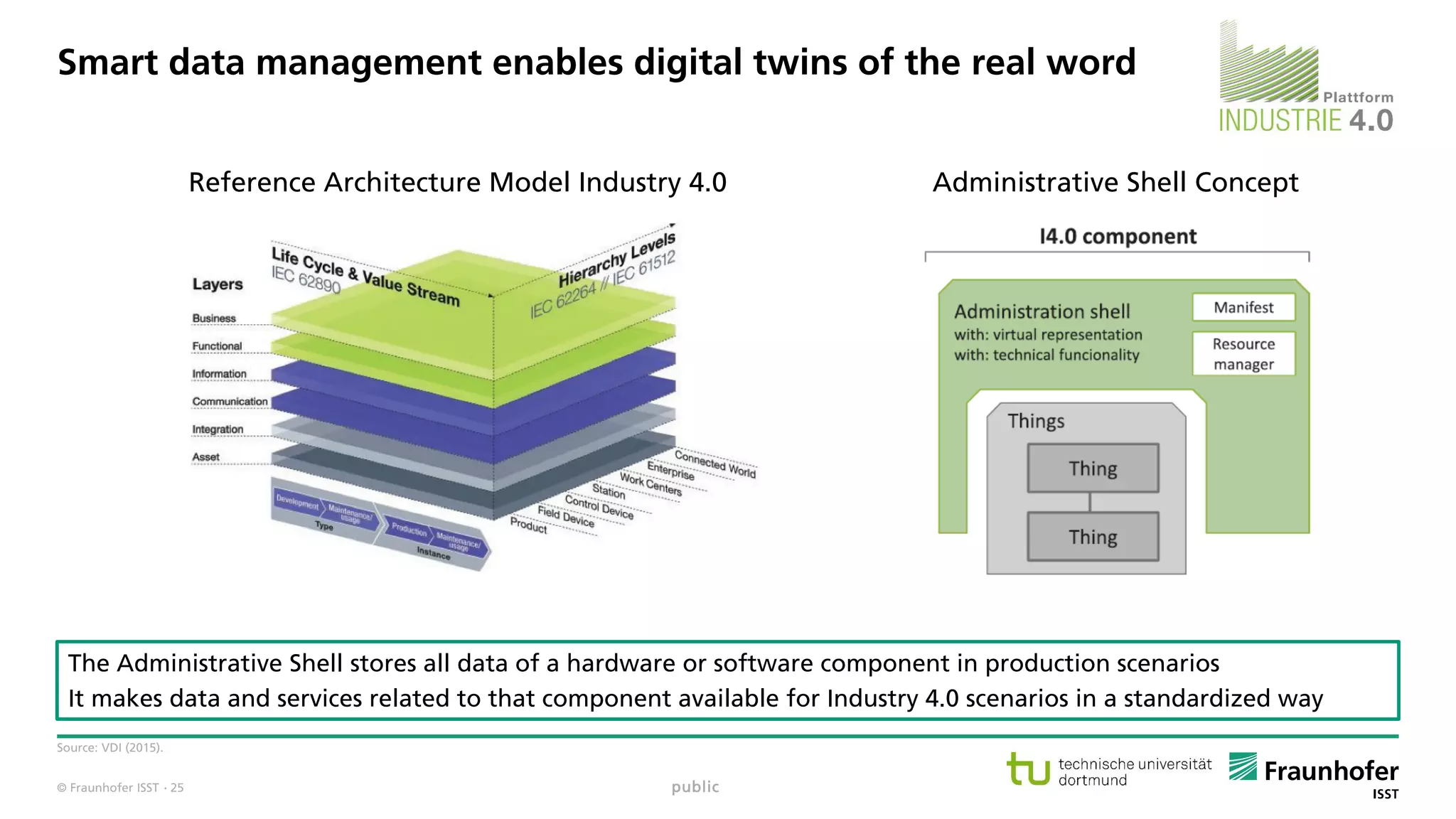
Smart data management enables digital twins of the real word
Source: VDI (2015).
Reference Architecture Model Industry 4.0 Administrative Shell Concept
The Administrative Shell stores all data of a hardware or software component in production scenarios
It makes data and services related to that component available for Industry 4.0 scenarios in a standardized way
public· 25
© Fraunhofer ISST
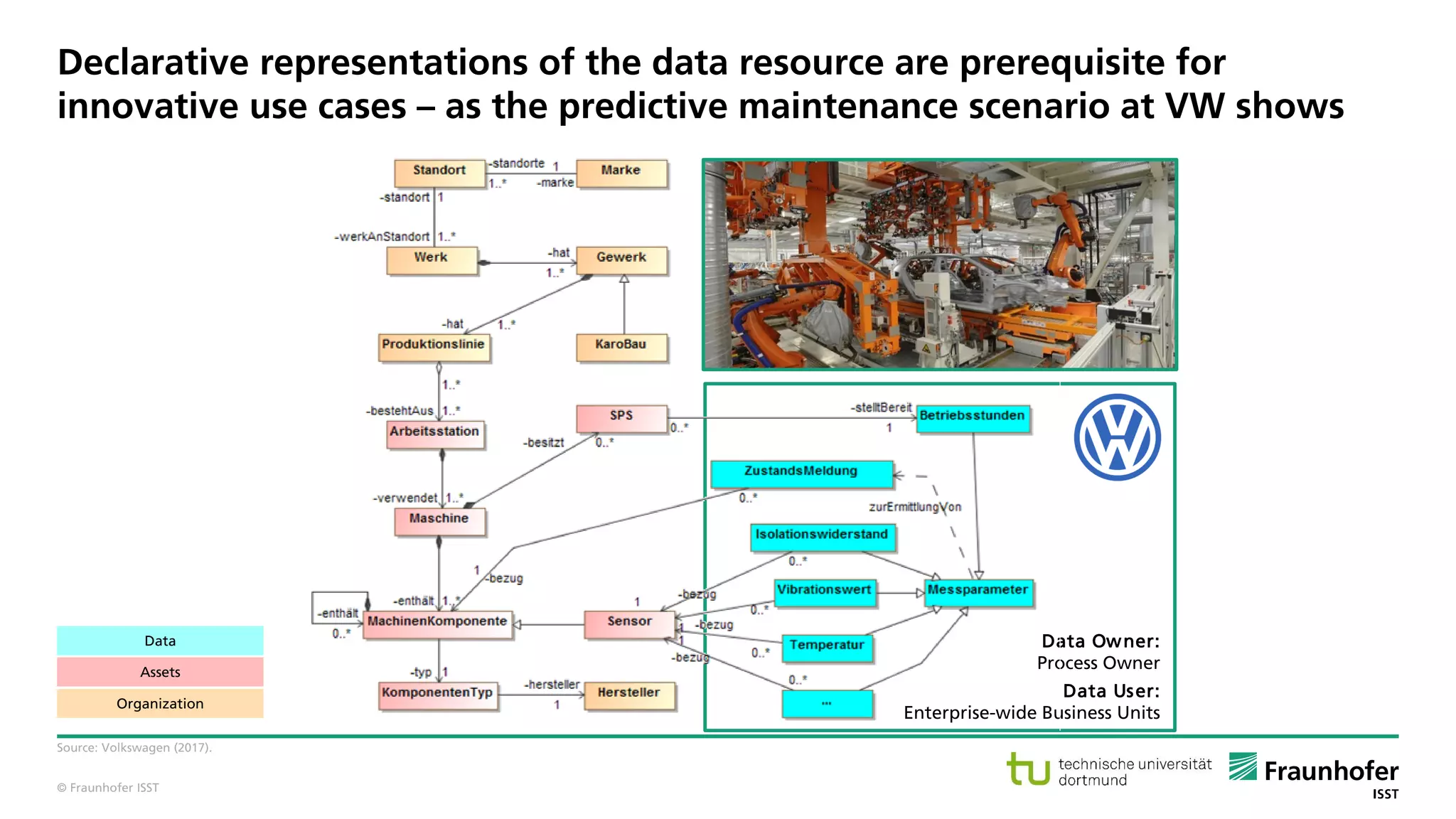
Data Owner:
Process Owner
Data User:
Enterprise-wide Business Units
Declarative representations of the data resource are prerequisite for
innovative use cases – as the predictive maintenance scenario at VW shows
Source: Volkswagen (2017).
Assets
Data
Organization
© Fraunhofer ISST
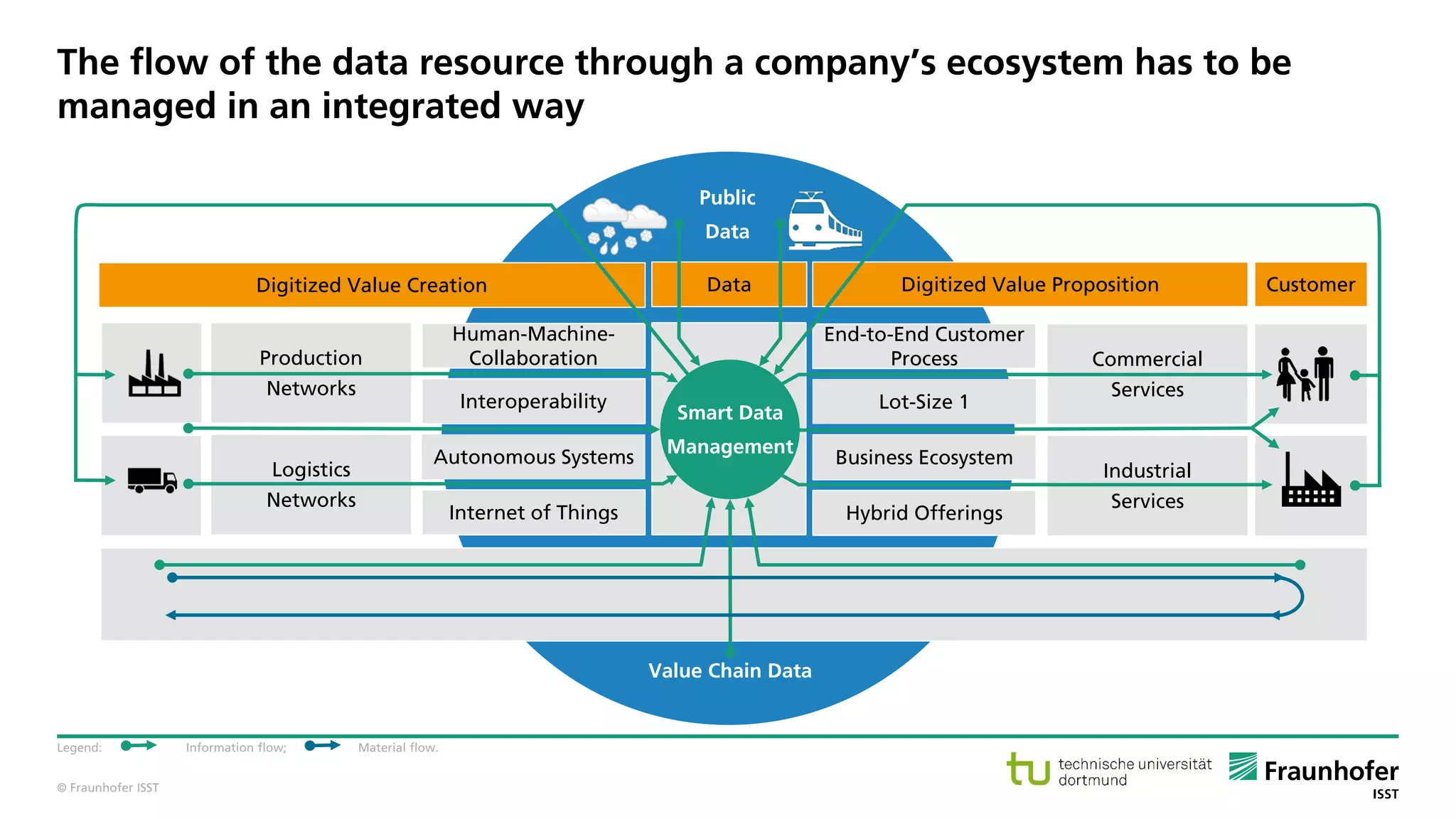
The flow of the data resource through a company’s ecosystem has to be
managed in an integrated way
Legend: Information flow; Material flow.
Public
Data
Value Chain Data
Commercial
Services
Industrial
Services
Lot-Size 1
End-to-End Customer
Process
Business Ecosystem
Hybrid Offerings
Smart Data
Management
Interoperability
Human-Machine-
Collaboration
Autonomous Systems
Internet of Things
Customer
Production
Networks
Logistics
Networks
Digitized Value PropositionDataDigitized Value Creation
© Fraunhofer ISST
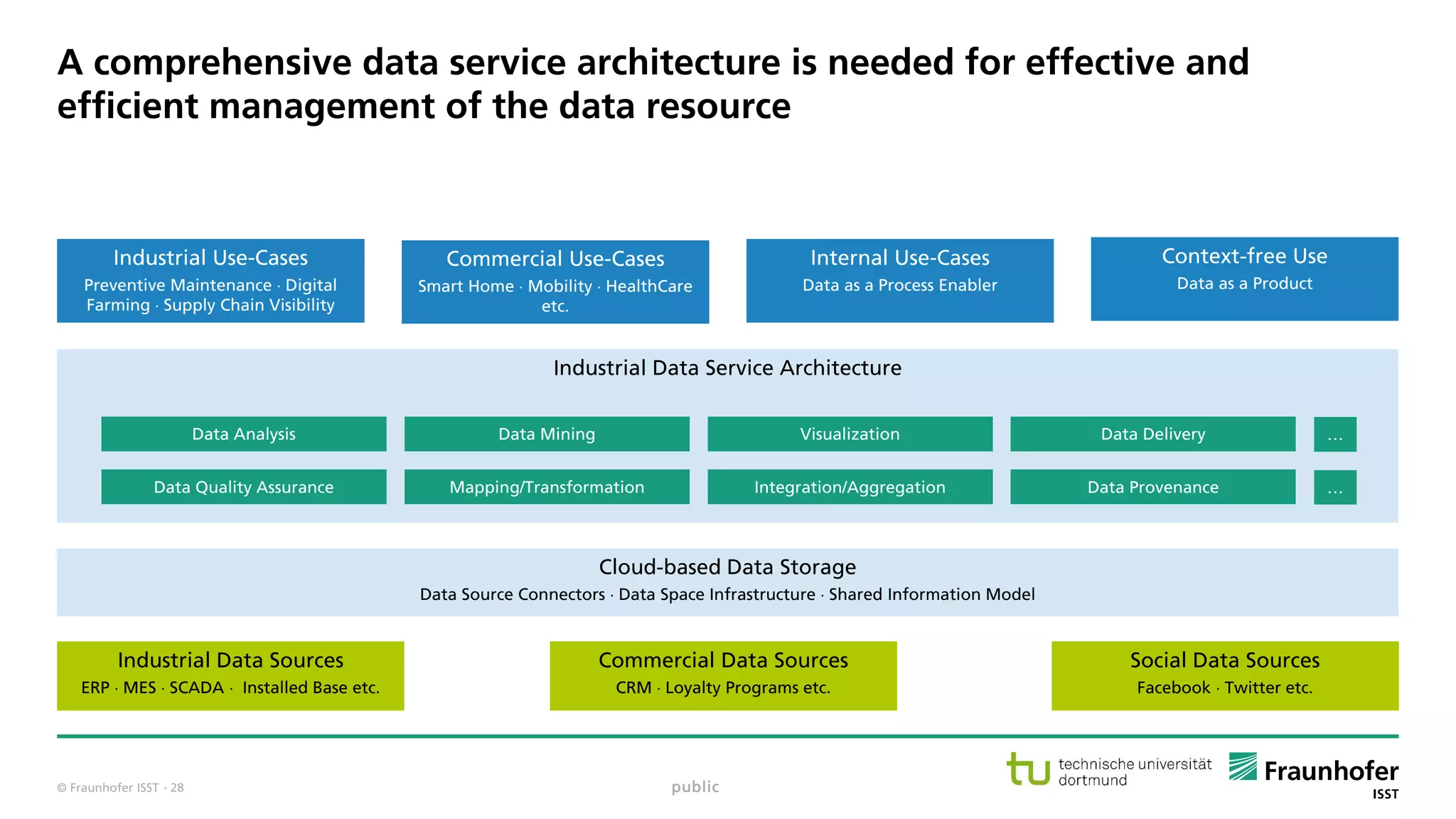
A comprehensive data service architecture is needed for effective and
efficient management of the data resource
public
Industrial Data Sources
ERP  MES  SCADA  Installed Base etc.
Commercial Data Sources
CRM  Loyalty Programs etc.
Social Data Sources
Facebook  Twitter etc.
Cloud-based Data Storage
Data Source Connectors  Data Space Infrastructure  Shared Information Model
Industrial Data Service Architecture
Data Quality Assurance Mapping/Transformation Integration/Aggregation Data Provenance …
Data Analysis Data Mining Visualization Data Delivery …
Industrial Use-Cases
Preventive Maintenance  Digital
Farming  Supply Chain Visibility
Commercial Use-Cases
Smart Home  Mobility  HealthCare
etc.
Internal Use-Cases
Data as a Process Enabler
Context-free Use
Data as a Product
· 28
© Fraunhofer ISST
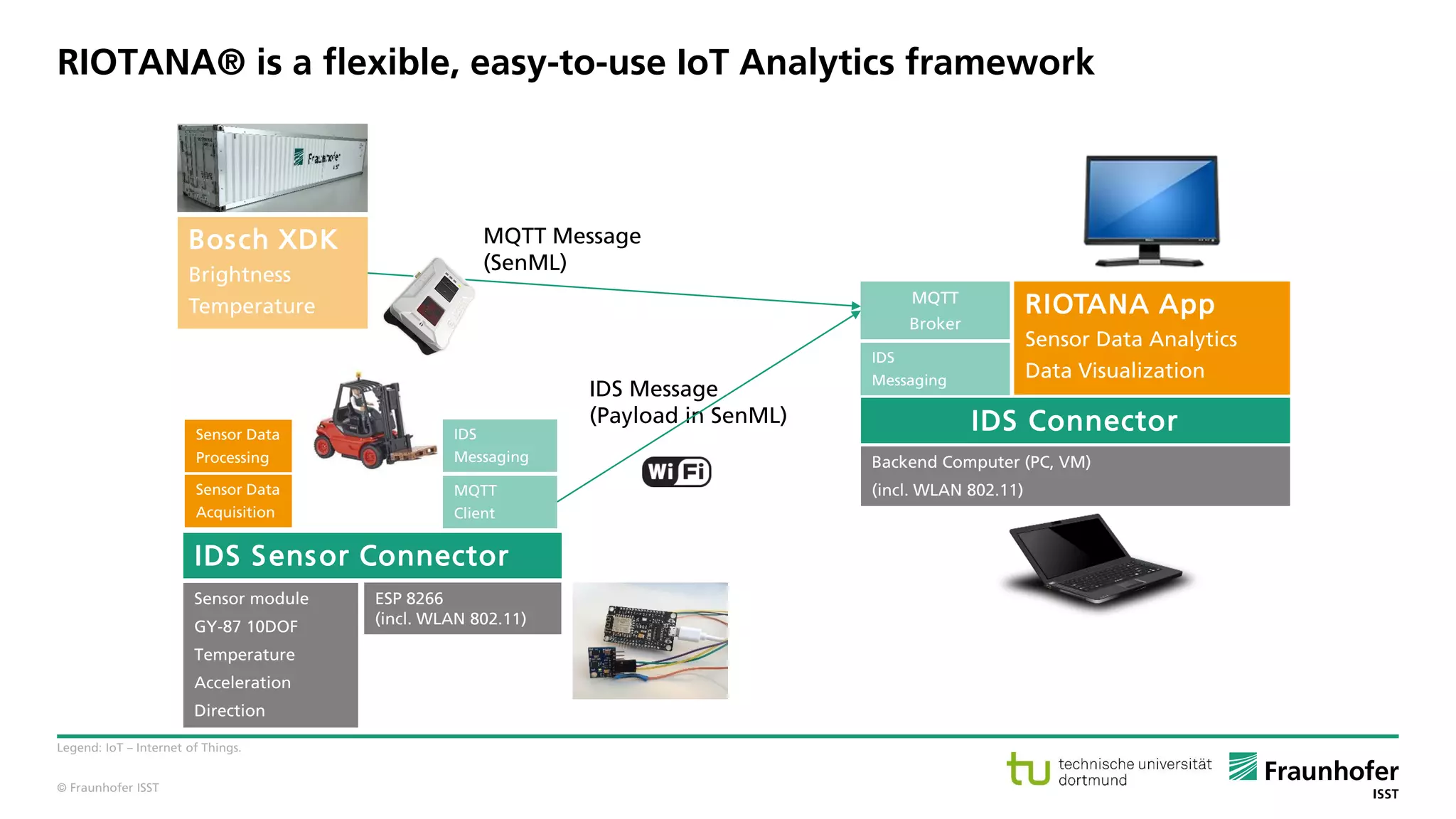
RIOTANA® is a flexible, easy-to-use IoT Analytics framework
Legend: IoT – Internet of Things.
IDS Sensor Connector
IDS Connector
RIOTANA App
Sensor Data Analytics
Data Visualization
IDS Message
(Payload in SenML)
MQTT Message
(SenML)
MQTT
Broker
Bosch XDK
Brightness
Temperature
ESP 8266
(incl. WLAN 802.11)
Sensor module
GY-87 10DOF
Temperature
Acceleration
Direction
Backend Computer (PC, VM)
(incl. WLAN 802.11)Sensor Data
Acquisition
Sensor Data
Processing
MQTT
Client
IDS
Messaging
IDS
Messaging
© Fraunhofer ISST
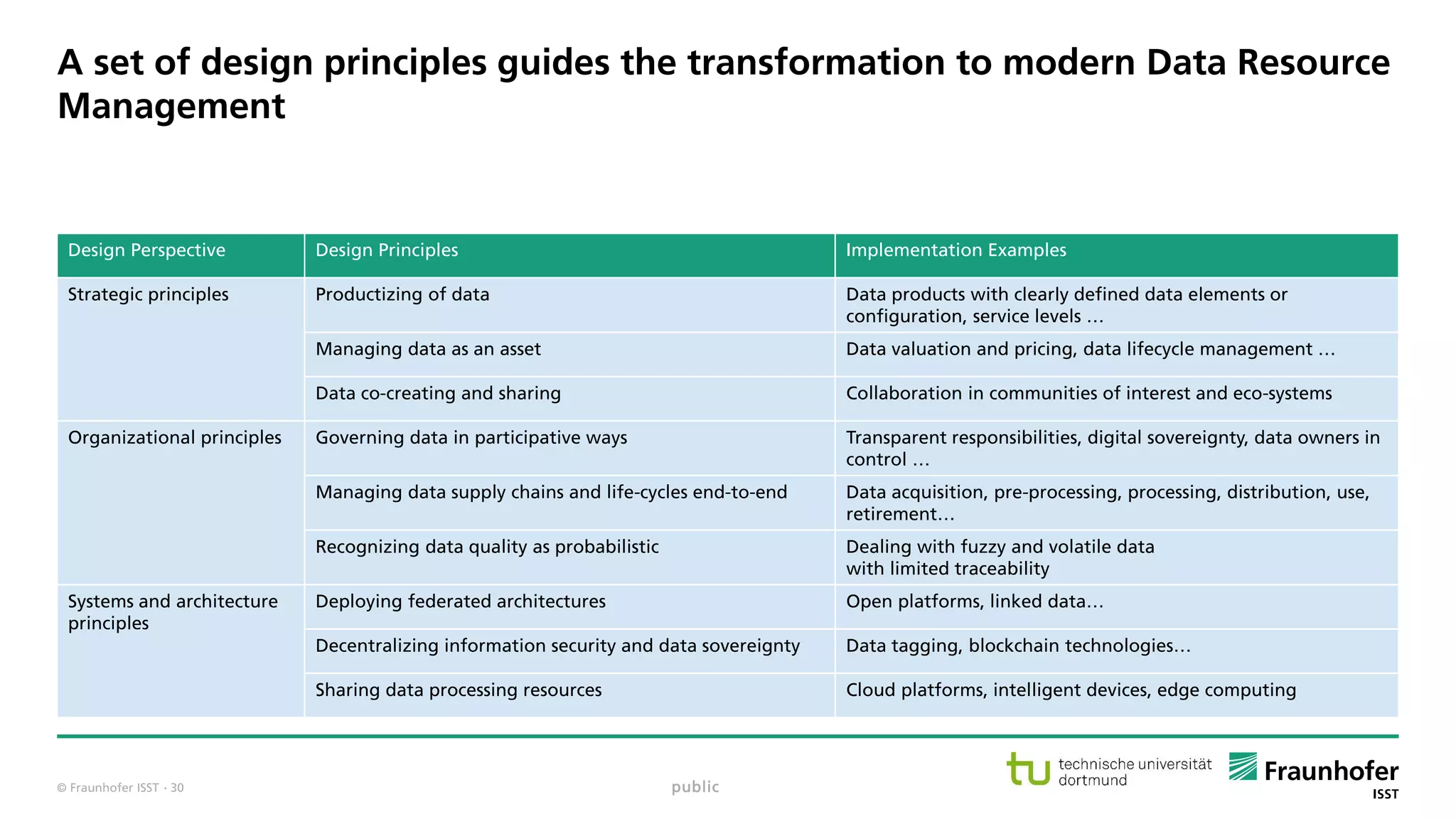
A set of design principles guides the transformation to modern Data Resource
Management
public· 30
Design Perspective Design Principles Implementation Examples
Strategic principles Productizing of data Data products with clearly defined data elements or
configuration, service levels …
Managing data as an asset Data valuation and pricing, data lifecycle management …
Data co-creating and sharing Collaboration in communities of interest and eco-systems
Organizational principles Governing data in participative ways Transparent responsibilities, digital sovereignty, data owners in
control …
Managing data supply chains and life-cycles end-to-end Data acquisition, pre-processing, processing, distribution, use,
retirement…
Recognizing data quality as probabilistic Dealing with fuzzy and volatile data
with limited traceability
Systems and architecture
principles
Deploying federated architectures Open platforms, linked data…
Decentralizing information security and data sovereignty Data tagging, blockchain technologies…
Sharing data processing resources Cloud platforms, intelligent devices, edge computing
© Fraunhofer ISST
TABLE OF CONTENT
 Data as an Enterprise Resource
 Good Practices for Data Resource Management
 Data Ecosystems
public· 31
© Fraunhofer ISST
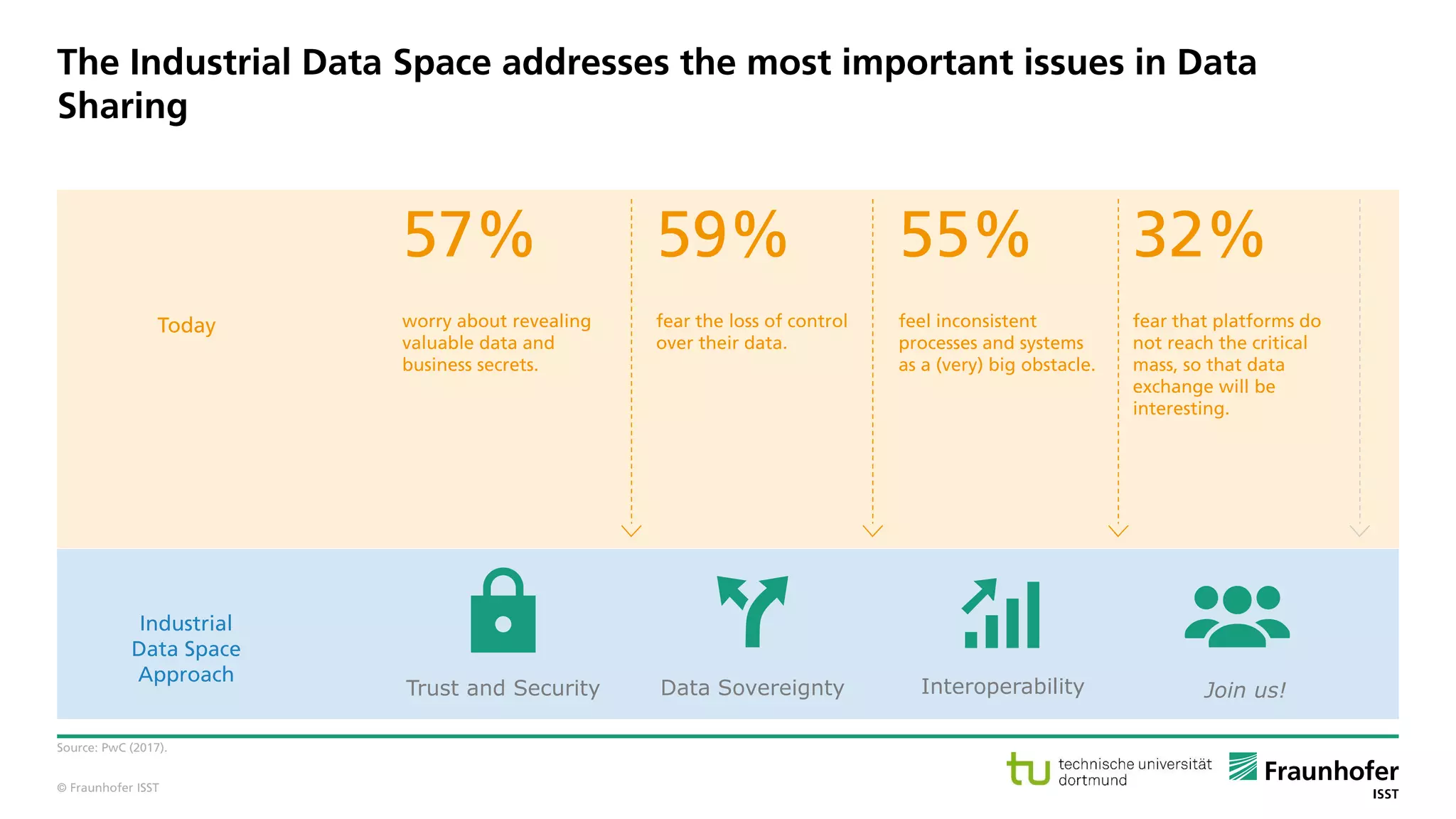
The Industrial Data Space addresses the most important issues in Data
Sharing
Source: PwC (2017).
57%
worry about revealing
valuable data and
business secrets.
59%
fear the loss of control
over their data.
55%
feel inconsistent
processes and systems
as a (very) big obstacle.
32%
fear that platforms do
not reach the critical
mass, so that data
exchange will be
interesting.
InteroperabilityData SovereigntyTrust and Security Join us!
Today
Industrial
Data Space
Approach
© Fraunhofer ISST
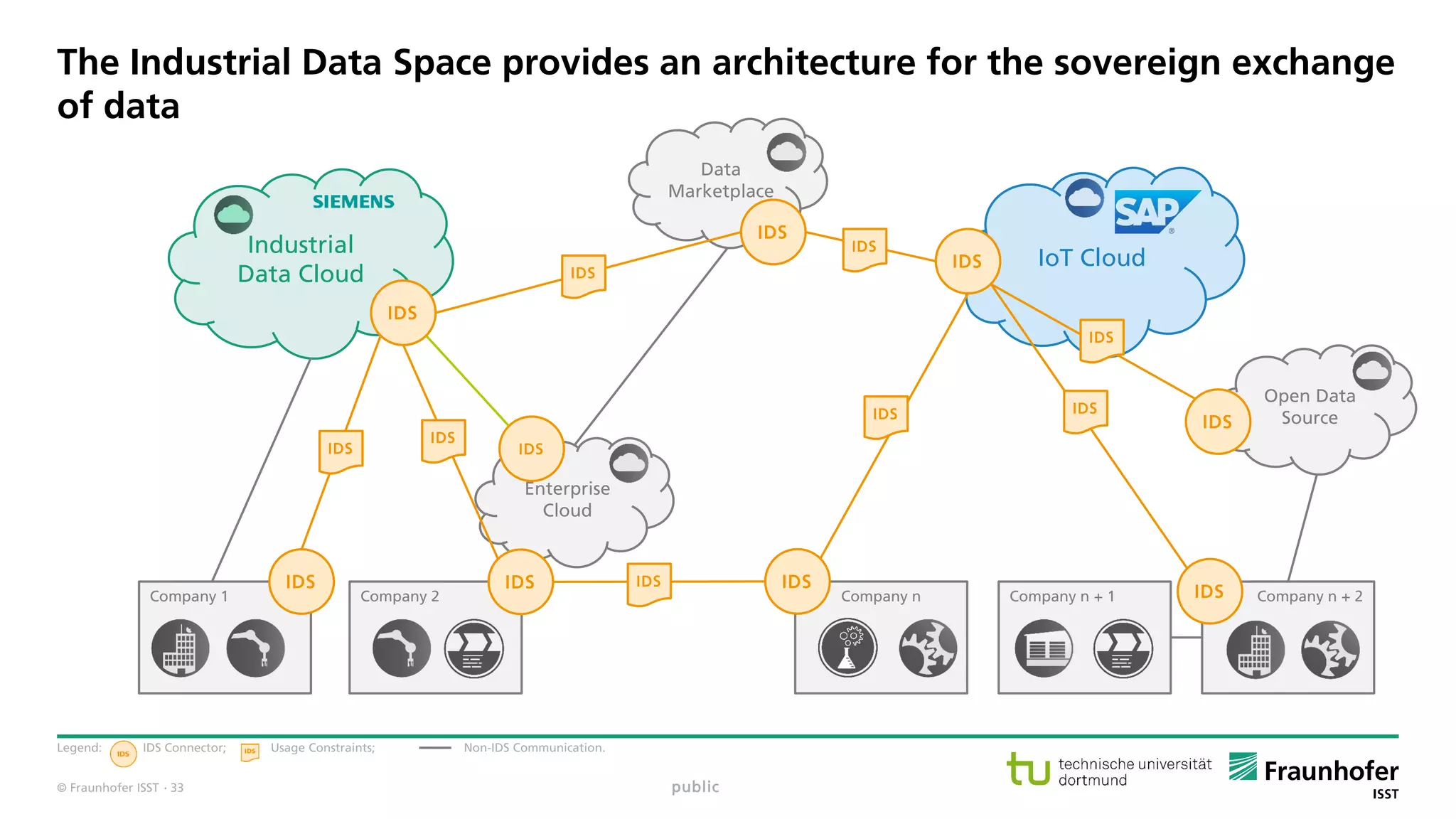
The Industrial Data Space provides an architecture for the sovereign exchange
of data
Legend: IDS Connector; Usage Constraints; Non-IDS Communication.
public· 33
Industrial
Data Cloud
IoT Cloud
Enterprise
Cloud
Data
Marketplace
Company 1 Company 2 Company n + 2Company n + 1Company n
Open Data
Source
IDS
IDS IDS
IDS
IDS
IDS
IDS
IDS
IDS
IDS
IDS
IDS
IDS
IDS
IDS
IDS
IDS
© Fraunhofer ISST
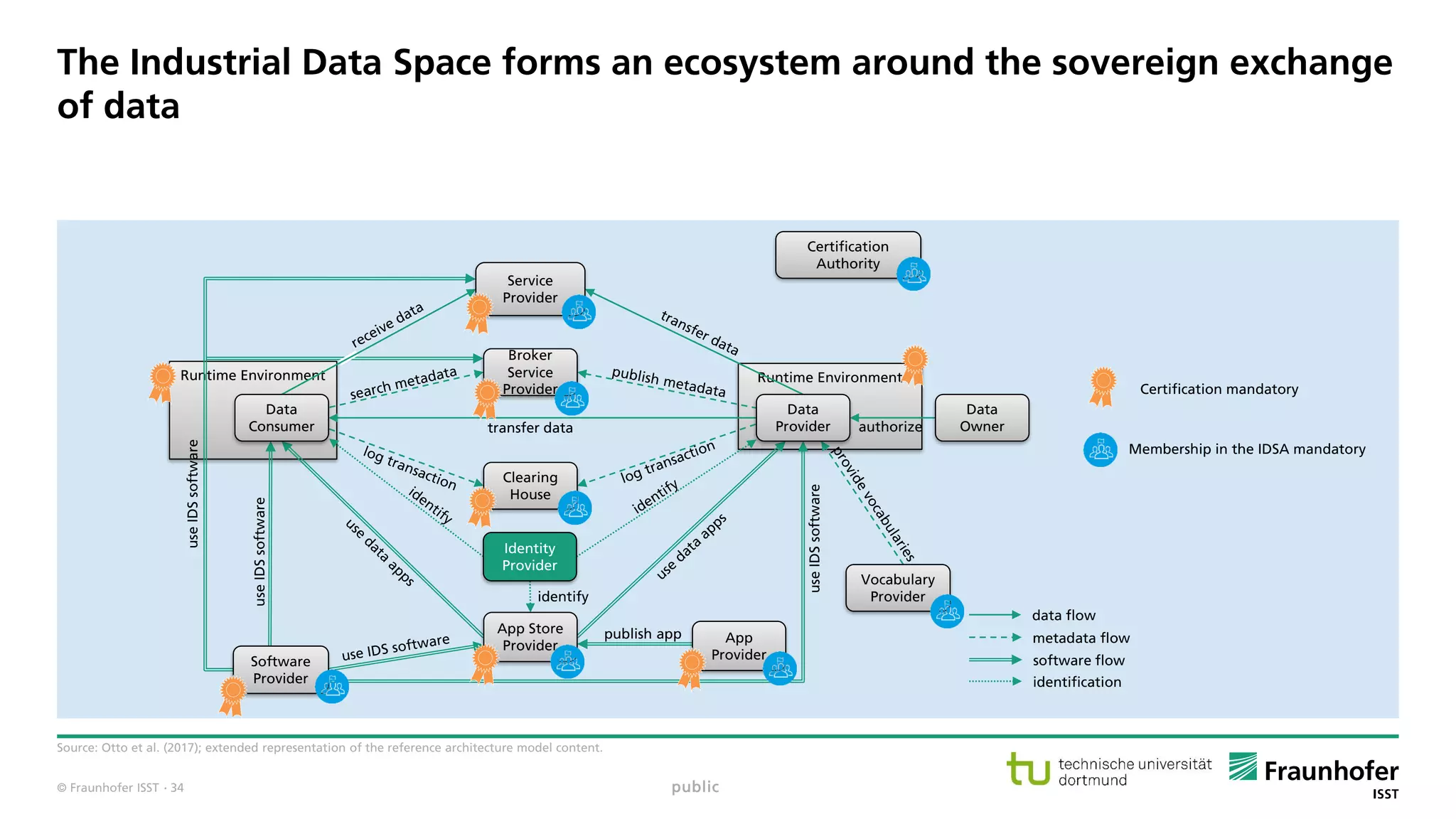
The Industrial Data Space forms an ecosystem around the sovereign exchange
of data
Source: Otto et al. (2017); extended representation of the reference architecture model content.
public· 34
Runtime EnvironmentRuntime Environment
authorize
publish app
transfer data
data flow
metadata flow
software flow
identification
useIDSsoftware
useIDSsoftware
useIDSsoftware
identify
Data
Owner
App
Provider
Vocabulary
Provider
Clearing
House
App Store
Provider
Identity
Provider
Data
Consumer
Broker
Service
Provider
Service
Provider
Software
Provider
Data
Provider
Certification mandatory
Membership in the IDSA mandatory
Certification
Authority
© Fraunhofer ISST
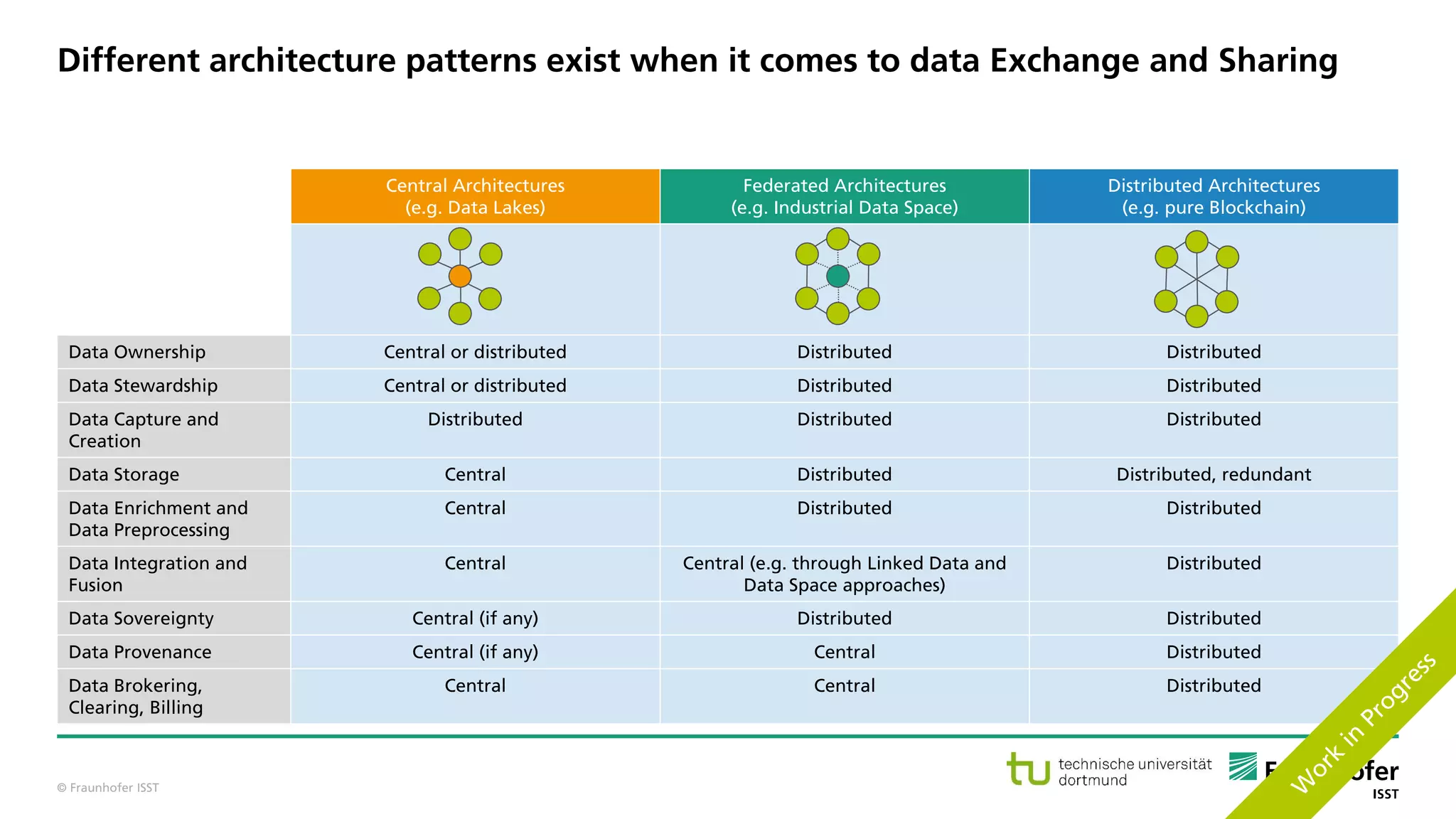
Central Architectures
(e.g. Data Lakes)
Federated Architectures
(e.g. Industrial Data Space)
Distributed Architectures
(e.g. pure Blockchain)
Data Ownership Central or distributed Distributed Distributed
Data Stewardship Central or distributed Distributed Distributed
Data Capture and
Creation
Distributed Distributed Distributed
Data Storage Central Distributed Distributed, redundant
Data Enrichment and
Data Preprocessing
Central Distributed Distributed
Data Integration and
Fusion
Central Central (e.g. through Linked Data and
Data Space approaches)
Distributed
Data Sovereignty Central (if any) Distributed Distributed
Data Provenance Central (if any) Central Distributed
Data Brokering,
Clearing, Billing
Central Central Distributed
Different architecture patterns exist when it comes to data Exchange and Sharing
© Fraunhofer ISST
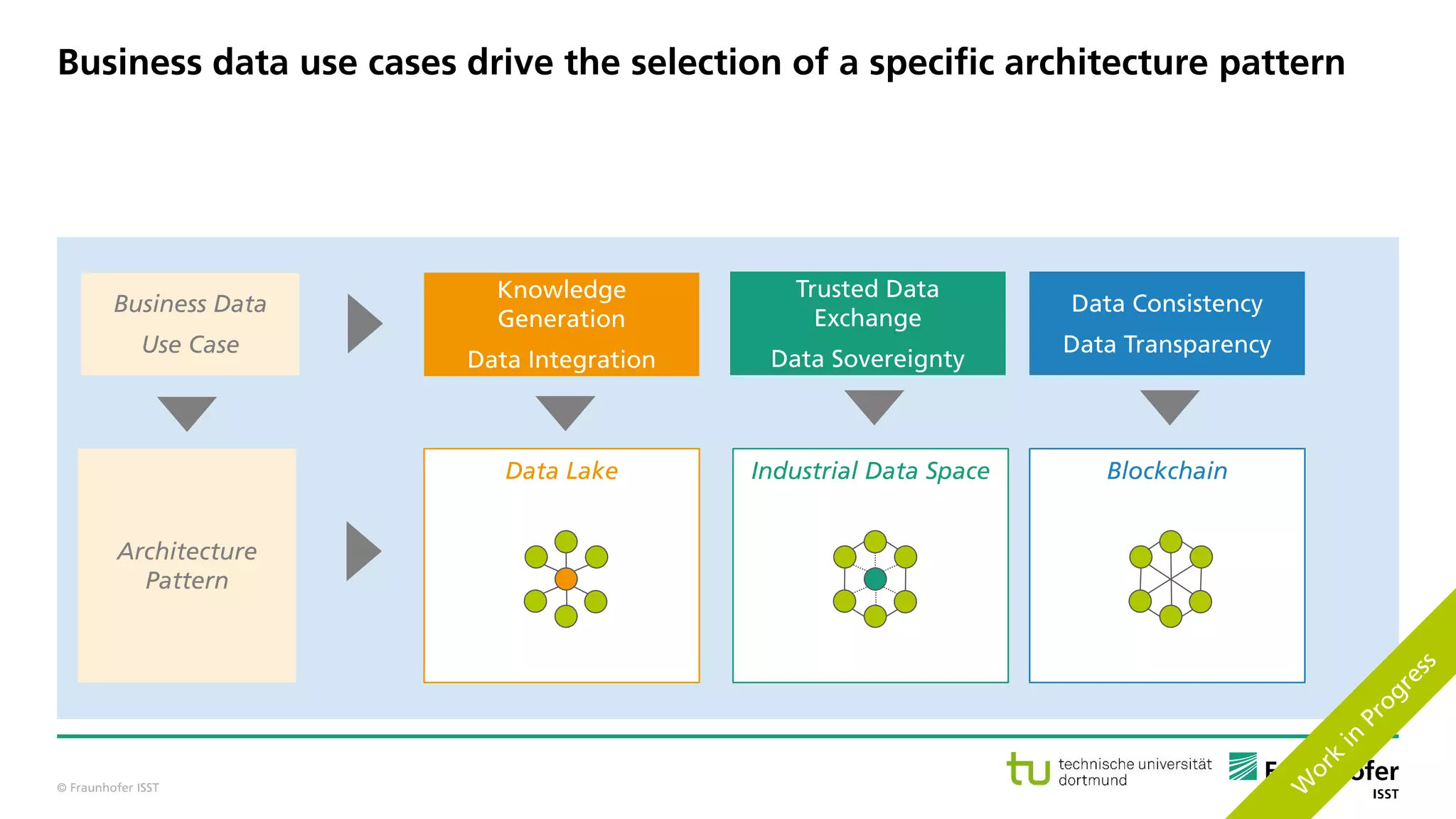
Business data use cases drive the selection of a specific architecture pattern
Business Data
Use Case
Architecture
Pattern
Knowledge
Generation
Data Integration
Trusted Data
Exchange
Data Sovereignty
Data Consistency
Data Transparency
Data Lake Industrial Data Space Blockchain
© Fraunhofer ISST
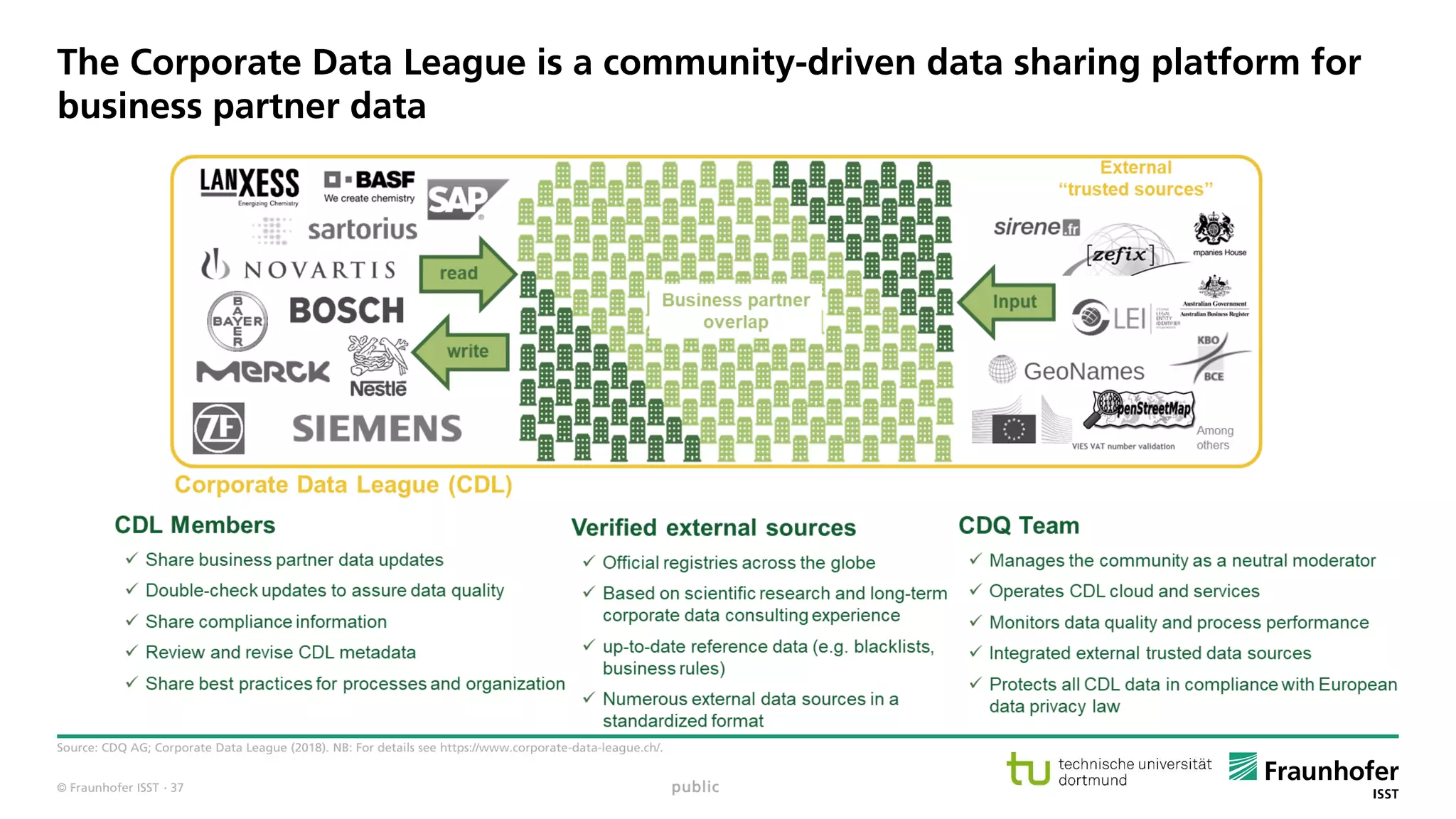
The Corporate Data League is a community-driven data sharing platform for
business partner data
Source: CDQ AG; Corporate Data League (2018). NB: For details see https://www.corporate-data-league.ch/.
public· 37
© Fraunhofer ISST
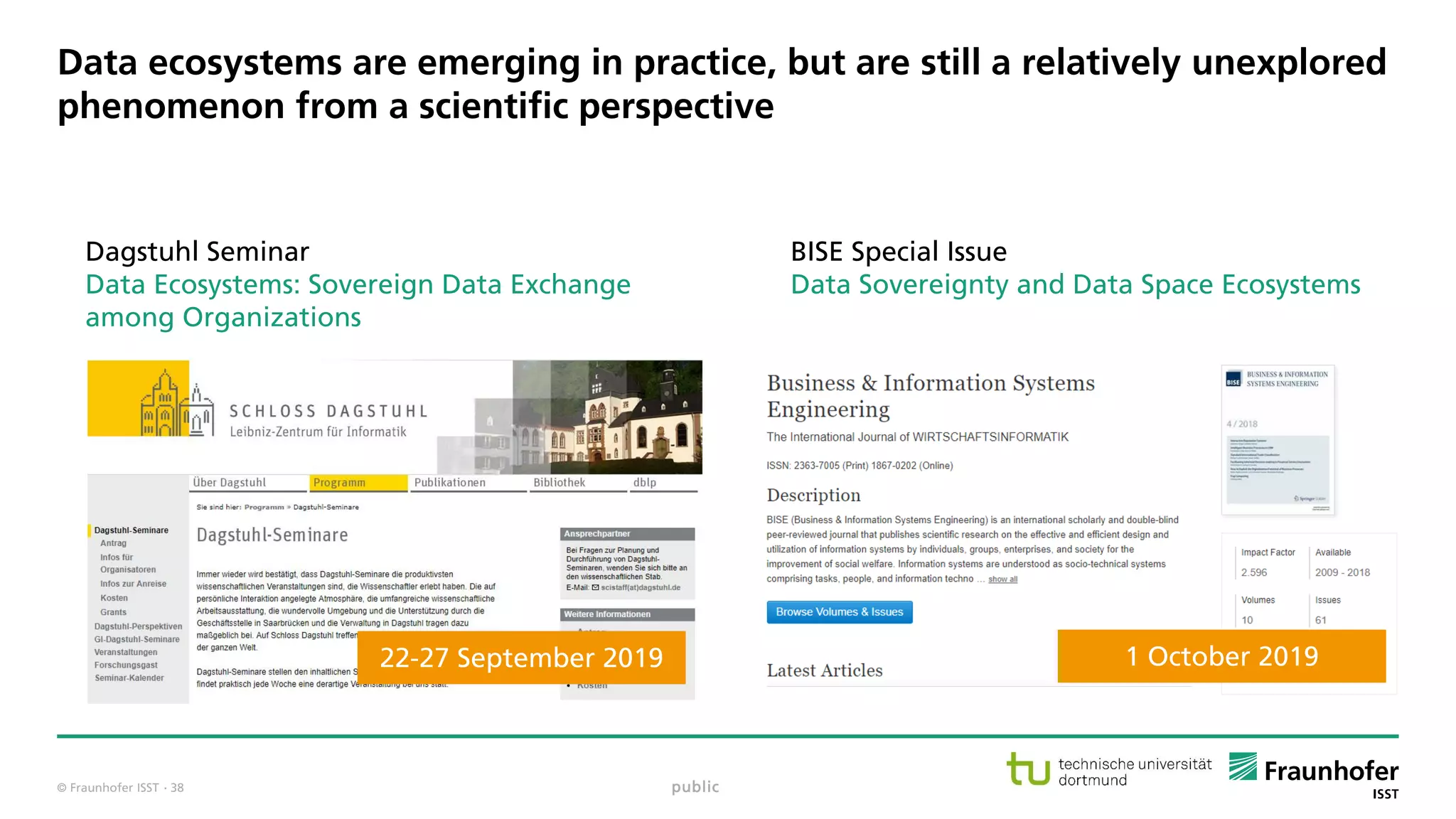
Data ecosystems are emerging in practice, but are still a relatively unexplored
phenomenon from a scientific perspective
public· 38
Dagstuhl Seminar
Data Ecosystems: Sovereign Data Exchange
among Organizations
22-27 September 2019
BISE Special Issue
Data Sovereignty and Data Space Ecosystems
1 October 2019
© Fraunhofer ISST
Prof. Dr.-Ing. Boris Otto
Fraunhofer ISST · Executive Director
TU Dortmund · Faculty of Mechanical Engineering
Boris.Otto@isst.fraunhofer.de · Boris.Otto@tu-dortmund.de
https://de.linkedin.com/pub/boris-otto/1/1b5/570
https://twitter.com/drborisotto
https://www.xing.com/profile/Boris_Otto
http://www.researchgate.net/profile/Boris_Otto
http://de.slideshare.net/borisotto
Please get in touch!
public· 39
© Fraunhofer ISST
DATA RESOURCE MANAGEMENT
GOOD PRACTICES TO MAKE THE MOST OF A HIDDEN TREASURE
Prof. Dr.-Ing. Boris Otto  Dortmund  12 July 2018
public· 40

Data Resource Management: Good Practices to Make the Most out of a Hidden Treasure

  • 1.
    © Fraunhofer ISST DATARESOURCE MANAGEMENT GOOD PRACTICES TO MAKE THE MOST OF A HIDDEN TREASURE Prof. Dr.-Ing. Boris Otto  Dortmund  12 July 2018 public· 1
  • 2.
    © Fraunhofer ISST TABLEOF CONTENT  Data as an Enterprise Resource  Good Practices for Data Resource Management  Data Ecosystems public· 2
  • 3.
    © Fraunhofer ISST Datais a driver for innovation Image source: youtube.com (2018), urban-hub.com (2018); sildeshare.com (2018); SmartFace project (2016). Mobility  Autonomous driving  Mobility services  Smart traffic management Service Innovation Manufacturing  Smart factory  Adaptive manufacturing  Industry 4.0 Organizational Innovation Healthcare  Personalized medicine  Translational medicine  Smart healthcare devices Product Innovation Retail  Supply chain visibility  Goods and data traceability  Sustainability Process Innovation public· 3
  • 4.
    © Fraunhofer ISST Data Intelligence Hub  Data sharing platform  Data sovereignty and security The data economy is here Sources: Deutsche Telekom (2018); HERE (2018); SAP (2018). public  HERE Tracking Cloud  SAP Asset Intelligence Network  Asset Management Ecosystem Deutsche Telekom HERE SAP · 4
  • 5.
    © Fraunhofer ISST Datahas become a strategic enterprise resource public Data as a Process Result Data as a Process Enabler Data as a Product Enabler Data Information systems have been used since the 1960s and 1970s to support enterprise functions, but data wasn‘t shared between functions, let alone enterprises. With the proliferation of Manufacturing Resource Planning (MRP) and Enterprise Resource Planning (ERP) in the 1980s and 1990s data enabled end-to-end business processes such as order-to- cash, procure-to-pay, make-to-stock etc. Since the millennium change, data has increasingly become an enabler of innovative product-service- systems and integrated solutions. Recently, data marketplaces emerged offering data APIs at a volume or frequency based fee. Data has become a product in its own right. Mainframe Computing Enterprise Systems Electronic Business Data Economy · 5
  • 6.
    © Fraunhofer ISST Astrategic resource is a source of competitive advantage Strategic Resource V Value R Rarity I Inimitability N/O Non-substitutability Organization Source: Barney (1991); Makadok (2001). public VRIN/VRIO Framework  Resources  »all assets, capabilities, organizational processes, firm attributes, information, knowledge, etc. controlled by a firm that enable the firm to conceive of and implement strategies that improve its efficiency and effectiveness«  Capabilities  »special type of resource, specifically an organizationally embedded non-transferable firm- specific resource whose purpose is to improve the productivity of the other resources possessed by the firm« Resource-Based View of the Firm · 6
  • 7.
    © Fraunhofer ISST TABLEOF CONTENT  Data as an Enterprise Resource  Good Practices for Data Resource Management  Data Ecosystems public· 7
  • 8.
    © Fraunhofer ISST DataResource Management is purely reactive often – as Materials Management has been 100 years ago… Source: Otto & Österle (2015). public Data management today… FIRE-FIGHTING…  Enormous costs for reactive, follow-up measures  No target values, no controlling, no management  Budgets and staff not planned  Digitalization impossible … causing high follow-up costs …  Investments in CDQM pay off as complexity costs and costs for poor data quality are reduced  Logic analogous to tangible goods (materials, products etc.) Data Quality Time Legend: »Data Quality Issues« (e.g. migrations, process disruptions, reporting errors). Project 1 Project 2 … As-is Overall Costs Costs Data Quality Follow-up Costs of Poor Data Quality CDQM Costs To-be Legend: CDQM – Corporate Data Quality Management. Saving Potential · 8
  • 9.
    © Fraunhofer ISST Dataresource management has to be planned, monitored, executed as materials and asset management Source: Womack et al. (1991). »Our findings were eye-opening. The Japanese plant requires (less effort the American and European plants). At the same time, the Japanese plant greatly exceeds the quality level of all plants execpt one in Europe - and this plant requires four times the effort […]« »When we visited the high-quality but low productivity European plant […] we didn‘t have to go far to find the basic problem […]. At the end of the assembly line was an enormous rework and rectification area where armies of technicians in white laboratory jackets labored to bring the finished vehicles up to the company‘s fabled quality standard.« public· 9
  • 10.
    © Fraunhofer ISST Ifyou refer to data as a resource, treat it as such! Source: Volkswagen (2018). Manufacturing Resource Management Data Resource Management ? public· 10
  • 11.
    © Fraunhofer ISST Driversfor data resource management typically are of enterprise-wide nature public Group Level Division 2Division 1 Division 3 Business units Business processes Locations Business units Business processes Locations Business units Business processes Locations Compliance to regulations 360 degree view of the customer Integrated and automated business processes »Single Source of the Truth« Industry 4.0 · 11
  • 12.
    © Fraunhofer ISST DataGovernance and Data Quality Management are closely interrelated Source: Otto (2011). public Legend: Goal Function Data. Data Governance Data Quality Management Maximize Data Quality Maximize Data Value Data Resource Data Resource Management is sub-goal of supports supports is led by is sub-function of are object of is object of are object of · 12
  • 13.
    © Fraunhofer ISST Reasonsfor poor data quality are manifold – as the example of Bayer CropScience shows NB: For background on the case study see Ebner et al. (2011). public Data Quality Issues Employees Data Maintenance DQ Management Standards Organization Training and education inadequate Data quality not integrated in performance management systems Various software solutions in place Master data can be edited in target systems No integrated software support Data maintenance not harmonized on global level No data quality metrics No continuous data quality monitoring No binding rules, standards, operating procedures Too many local rules, exceptions No “Data Governance” Missing business responsibilities · 13
  • 14.
    © Fraunhofer ISST Developedby the Competence Center Corporate Data Quality, the Data Excellence Model (DXM) defines building blocks for data management Source: Competence Center Corporate Data Quality (2017). public GOALS ENABLERS RES ULTS D A T A S T R A T E G Y P E O P L E , R O L E S & R E S P O N S I B I L I T I E S P R O C E S S E S & M E T H O D S D A T A L I F E C Y C L E D A T A A P P L I C A T I O N S D A T A A R C H I T E C T U R E P E R F O R M A N C E M A N A G E M E N T B U S I N E S S C A P A B I L I T I E S D A T A M A N A G E M E N T C A P A B I L I T I E S B U S I N E S S V A L U E D A T A E X C E L L E N C E · 14
  • 15.
    © Fraunhofer ISST SmartData Engineering is model-based, method-oriented approach for building up an effective Data Resource Management capability  Defining the data strategy  Assigning roles and responsibilities for core data domains  Managing data as an economic good  Designing a consistent data architecture for the digitalized enterprise  Controlling the business benefit contribution of the data resource public· 15
  • 16.
    © Fraunhofer ISST SmartData Engineering follows a set of 8 key principles public In line with business objectives A data strategy defines the principles for identifying and managing corporate data assets to generate business value. DATA STRATEGY Representative digital use cases Take a look at representative use cases and understand status quo and required digital capabilities of the companies value creation. USE CASES 1 2 3 5 6 7 4 8 Data needs responsibility The definition of data roles and responsibilities including the necessary interaction between these roles creates the basic element for data-driven organizational structures. DATA ROLES Leading systems and data objects The enterprise architecture identifies relevant business processes, leading systems, data objects and data streams at the conceptual level. DIGITAL ENTERPRISE ARCHITECTURE Data monetarization Achieving data excellence for turning data into money by improving existing products, create innovation, and new digital business models. BUSINESS VALUE Management of data flow The implementation of standards, guidelines and processes promotes data interoperability, reuse and traceability. DATA OPERATIONS Quality assurance ensures high product standards The implementation of quality standards and processes for data parameters requires continuous monitoring and improvement in order to increase the value of existing data. DATA QUALITY Turning theory into practice Development of a suitable data architecture model for the implementation of a target state in the company. RESULT · 16
  • 17.
    © Fraunhofer ISST DataGovernance is typically established as an enterprise-wide virtual organization – as the example of BOSCH shows Source: Bosch (2008). public Master Data Owner n Executive Management Master Data Management Steering Committee … Group Division/ Central Function Accountability on Business Unit Level (Data Maintenance) IT Projects IT Platforms, IT Target Systems Overall Accountability (organizational level) Master Data Owner A Master Data Domain 1 Master Data Domain n Report Governance Working Group Team of Experts ConceptsConcepts Governance … … e.g. Vendor Master Data Chart of Accounts Interdisciplinarily staffed Master Data Officer Master Data Officer · 17
  • 18.
    © Fraunhofer ISST Establishingeffective data governance regimes is not a one-off issue – as the example of Johnson & Johnson shows public· 18
  • 19.
    © Fraunhofer ISST Theideal lifecycle of data governance capabilities follows an S curve Founding Phase »First Time Right« Cleansing Legend: E  Effectiveness; A  Amount of Activity. E A public· 19
  • 20.
    © Fraunhofer ISST Johnson& Johnson has reached a six sigma data quality level 99,503 94,586 95,506 96,102 95,778 96,312 95,656 89,855 91,629 96,324 96,383 97,433 95,417 99,135 99,885 99,971 99,993 99,999 84 86 88 90 92 94 96 98 100 02.15.11 04.15.11 06.15.11 08.15.11 10.15.11 12.15.11 02.15.12 04.15.12 06.15.12 Evolution of Data Quality Index at Johnson & Johnson Data Quality Index public· 20
  • 21.
    © Fraunhofer ISST Datais a valuable Resource Source: Disparte & Wagner (2016). public »Accurately measuring enterprise value (EV) has never been more important or challenging. Even more so because firms are confronted by growing volumes of data, and the stakes implied in misinterpreting the value of that data have risen to new heights.« · 21
  • 22.
    © Fraunhofer ISST Despiteits intangible nature, industrial data has a value which can be quantified Source: Moody & Walsh (1999). public Number of users Share of value 100% Data Tangible Goods Tangible Goods Value Data Usage Time Potential value Data Data quality Value 100% Data Integration Value Data Volume Value Data · 22
  • 23.
    © Fraunhofer ISST Manyexamples exist demonstrating the applicability of valuation procedures in the data domain Source: Otto (2012); Otto (2015). Company Industry Country Data domain Valuation approach Value per record Retail US Customer data including shopping profile Market value 1.6 EUR Social Network US User data Market value 225 USD Automation and drives DE Master data on parts Production costs 500 to 5.000 EUR Agrochemical CH Material master data Use value 184 CHF public· 23
  • 24.
    © Fraunhofer ISST D!VAis a software for supporting the key task of the Chief Data Officer, namely managing the value of the data resource public· 24
  • 25.
    © Fraunhofer ISST Smartdata management enables digital twins of the real word Source: VDI (2015). Reference Architecture Model Industry 4.0 Administrative Shell Concept The Administrative Shell stores all data of a hardware or software component in production scenarios It makes data and services related to that component available for Industry 4.0 scenarios in a standardized way public· 25
  • 26.
    © Fraunhofer ISST DataOwner: Process Owner Data User: Enterprise-wide Business Units Declarative representations of the data resource are prerequisite for innovative use cases – as the predictive maintenance scenario at VW shows Source: Volkswagen (2017). Assets Data Organization
  • 27.
    © Fraunhofer ISST Theflow of the data resource through a company’s ecosystem has to be managed in an integrated way Legend: Information flow; Material flow. Public Data Value Chain Data Commercial Services Industrial Services Lot-Size 1 End-to-End Customer Process Business Ecosystem Hybrid Offerings Smart Data Management Interoperability Human-Machine- Collaboration Autonomous Systems Internet of Things Customer Production Networks Logistics Networks Digitized Value PropositionDataDigitized Value Creation
  • 28.
    © Fraunhofer ISST Acomprehensive data service architecture is needed for effective and efficient management of the data resource public Industrial Data Sources ERP  MES  SCADA  Installed Base etc. Commercial Data Sources CRM  Loyalty Programs etc. Social Data Sources Facebook  Twitter etc. Cloud-based Data Storage Data Source Connectors  Data Space Infrastructure  Shared Information Model Industrial Data Service Architecture Data Quality Assurance Mapping/Transformation Integration/Aggregation Data Provenance … Data Analysis Data Mining Visualization Data Delivery … Industrial Use-Cases Preventive Maintenance  Digital Farming  Supply Chain Visibility Commercial Use-Cases Smart Home  Mobility  HealthCare etc. Internal Use-Cases Data as a Process Enabler Context-free Use Data as a Product · 28
  • 29.
    © Fraunhofer ISST RIOTANA®is a flexible, easy-to-use IoT Analytics framework Legend: IoT – Internet of Things. IDS Sensor Connector IDS Connector RIOTANA App Sensor Data Analytics Data Visualization IDS Message (Payload in SenML) MQTT Message (SenML) MQTT Broker Bosch XDK Brightness Temperature ESP 8266 (incl. WLAN 802.11) Sensor module GY-87 10DOF Temperature Acceleration Direction Backend Computer (PC, VM) (incl. WLAN 802.11)Sensor Data Acquisition Sensor Data Processing MQTT Client IDS Messaging IDS Messaging
  • 30.
    © Fraunhofer ISST Aset of design principles guides the transformation to modern Data Resource Management public· 30 Design Perspective Design Principles Implementation Examples Strategic principles Productizing of data Data products with clearly defined data elements or configuration, service levels … Managing data as an asset Data valuation and pricing, data lifecycle management … Data co-creating and sharing Collaboration in communities of interest and eco-systems Organizational principles Governing data in participative ways Transparent responsibilities, digital sovereignty, data owners in control … Managing data supply chains and life-cycles end-to-end Data acquisition, pre-processing, processing, distribution, use, retirement… Recognizing data quality as probabilistic Dealing with fuzzy and volatile data with limited traceability Systems and architecture principles Deploying federated architectures Open platforms, linked data… Decentralizing information security and data sovereignty Data tagging, blockchain technologies… Sharing data processing resources Cloud platforms, intelligent devices, edge computing
  • 31.
    © Fraunhofer ISST TABLEOF CONTENT  Data as an Enterprise Resource  Good Practices for Data Resource Management  Data Ecosystems public· 31
  • 32.
    © Fraunhofer ISST TheIndustrial Data Space addresses the most important issues in Data Sharing Source: PwC (2017). 57% worry about revealing valuable data and business secrets. 59% fear the loss of control over their data. 55% feel inconsistent processes and systems as a (very) big obstacle. 32% fear that platforms do not reach the critical mass, so that data exchange will be interesting. InteroperabilityData SovereigntyTrust and Security Join us! Today Industrial Data Space Approach
  • 33.
    © Fraunhofer ISST TheIndustrial Data Space provides an architecture for the sovereign exchange of data Legend: IDS Connector; Usage Constraints; Non-IDS Communication. public· 33 Industrial Data Cloud IoT Cloud Enterprise Cloud Data Marketplace Company 1 Company 2 Company n + 2Company n + 1Company n Open Data Source IDS IDS IDS IDS IDS IDS IDS IDS IDS IDS IDS IDS IDS IDS IDS IDS IDS
  • 34.
    © Fraunhofer ISST TheIndustrial Data Space forms an ecosystem around the sovereign exchange of data Source: Otto et al. (2017); extended representation of the reference architecture model content. public· 34 Runtime EnvironmentRuntime Environment authorize publish app transfer data data flow metadata flow software flow identification useIDSsoftware useIDSsoftware useIDSsoftware identify Data Owner App Provider Vocabulary Provider Clearing House App Store Provider Identity Provider Data Consumer Broker Service Provider Service Provider Software Provider Data Provider Certification mandatory Membership in the IDSA mandatory Certification Authority
  • 35.
    © Fraunhofer ISST CentralArchitectures (e.g. Data Lakes) Federated Architectures (e.g. Industrial Data Space) Distributed Architectures (e.g. pure Blockchain) Data Ownership Central or distributed Distributed Distributed Data Stewardship Central or distributed Distributed Distributed Data Capture and Creation Distributed Distributed Distributed Data Storage Central Distributed Distributed, redundant Data Enrichment and Data Preprocessing Central Distributed Distributed Data Integration and Fusion Central Central (e.g. through Linked Data and Data Space approaches) Distributed Data Sovereignty Central (if any) Distributed Distributed Data Provenance Central (if any) Central Distributed Data Brokering, Clearing, Billing Central Central Distributed Different architecture patterns exist when it comes to data Exchange and Sharing
  • 36.
    © Fraunhofer ISST Businessdata use cases drive the selection of a specific architecture pattern Business Data Use Case Architecture Pattern Knowledge Generation Data Integration Trusted Data Exchange Data Sovereignty Data Consistency Data Transparency Data Lake Industrial Data Space Blockchain
  • 37.
    © Fraunhofer ISST TheCorporate Data League is a community-driven data sharing platform for business partner data Source: CDQ AG; Corporate Data League (2018). NB: For details see https://www.corporate-data-league.ch/. public· 37
  • 38.
    © Fraunhofer ISST Dataecosystems are emerging in practice, but are still a relatively unexplored phenomenon from a scientific perspective public· 38 Dagstuhl Seminar Data Ecosystems: Sovereign Data Exchange among Organizations 22-27 September 2019 BISE Special Issue Data Sovereignty and Data Space Ecosystems 1 October 2019
  • 39.
    © Fraunhofer ISST Prof.Dr.-Ing. Boris Otto Fraunhofer ISST · Executive Director TU Dortmund · Faculty of Mechanical Engineering Boris.Otto@isst.fraunhofer.de · Boris.Otto@tu-dortmund.de https://de.linkedin.com/pub/boris-otto/1/1b5/570 https://twitter.com/drborisotto https://www.xing.com/profile/Boris_Otto http://www.researchgate.net/profile/Boris_Otto http://de.slideshare.net/borisotto Please get in touch! public· 39
  • 40.
    © Fraunhofer ISST DATARESOURCE MANAGEMENT GOOD PRACTICES TO MAKE THE MOST OF A HIDDEN TREASURE Prof. Dr.-Ing. Boris Otto  Dortmund  12 July 2018 public· 40