© Fraunhofer ISST
SHARED DIGITAL TWIN:
COLLABORATION IN ECOSYSTEMS
Prof. Dr.-Ing. Boris Otto  Berlin  18 September 2019
public· 1
© Fraunhofer ISST
Agenda
 Business Rationale and Use Cases
 Definition and Conceptual Framework
 State of the Art and Outlook
public· 2
© Fraunhofer ISST
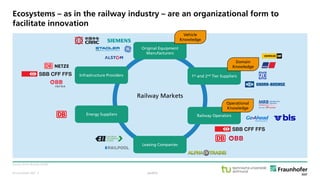
Ecosystems – as in the railway industry – are an organizational form to
facilitate innovation
Source: Knorr-Bremse (2018).
public
Railway Markets
Original Equipment
Manufacturers
1st and 2nd Tier SuppliersInfrastructure Providers
Energy Suppliers Railway Operators
Domain
Knowledge
Vehicle
Knowledge
Operational
Knowledge
Leasing Companies
· 3
© Fraunhofer ISST
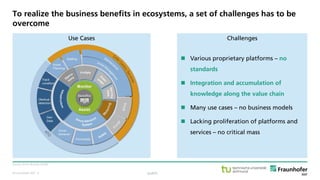
 Various proprietary platforms – no
standards
 Integration and accumulation of
knowledge along the value chain
 Many use cases – no business models
 Lacking proliferation of platforms and
services – no critical mass
Use Cases
To realize the business benefits in ecosystems, a set of challenges has to be
overcome
Source: Knorr-Bremse (2018).
public
Challenges
· 4
© Fraunhofer ISST
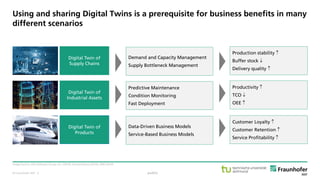
Using and sharing Digital Twins is a prerequisite for business benefits in many
different scenarios
Image Source: JDA Software Group, Inc. (2019); DirectIndustry (2019); ABB (2019).
public
Digital Twin of
Supply Chains
Demand and Capacity Management
Supply Bottleneck Management
Production stability 
Buffer stock 
Delivery quality 
Digital Twin of
Industrial Assets
Predictive Maintenance
Condition Monitoring
Fast Deployment
Productivity 
TCO 
OEE 
Digital Twin of
Products
Data-Driven Business Models
Service-Based Business Models
Customer Loyalty 
Customer Retention 
Service Profitability 
· 5
© Fraunhofer ISST
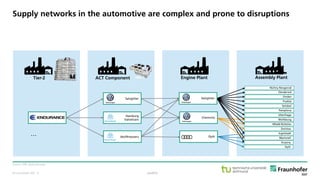
Supply networks in the automotive are complex and prone to disruptions
Source: VW, thyssenkrupp.
ACT ComponentTier-2
Jászfényszaru
Salzgitter
Ilsenburg
Valvetrain
Győr
Ingolstadt
Wolfsburg
Emden
Pamplona
Setúbal
Puebla
Mladá Boleslav
Kvasiny
Uitenhage
Martorell
Zwickau
Osnabrück
Nizhny Novgorod
Chemnitz
Győr
Salzgitter
Engine Plant Assembly Plant
public
…
· 6
© Fraunhofer ISST
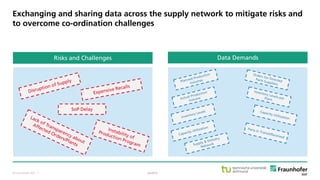
Exchanging and sharing data across the supply network to mitigate risks and
to overcome co-ordination challenges
public
Risks and Challenges Data Demands
SoP Delay
· 7
© Fraunhofer ISST
Many requirements exists with regard to a Digital Supply Chain Twin
 Data must be available on demand
 Data events (access, use etc.) must be logged
 Access and usage rights must be customizable
 Data exchange must follow a harmonized data model
 Data use in backend systems must be prohibited/tracked
 Data provenance
 Data must only be shared together with usage constraints
 Only recent updates of data must be stored – if at all
 Data sharing follows »quid pro quo« principle
 Views must be defined with regard to entire digital twin
 …
public· 8
© Fraunhofer ISST
Source: Platform Industrie 4.0, Working Group 1 & 3 (2019).
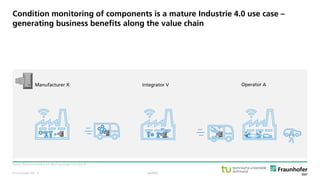
Manufacturer X
Condition monitoring of components is a mature Industrie 4.0 use case –
generating business benefits along the value chain
Integrator V Operator A
public· 9
© Fraunhofer ISST
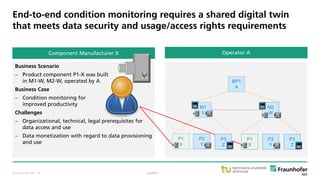
Component Manufacturer X
Business Scenario
 Product component P1-X was built
in M1-W, M2-W, operated by A
Business Case
 Condition monitoring for
improved productivity
Challenges
 Organizational, technical, legal prerequisites for
data access and use
 Data monetization with regard to data provisioning
and use
End-to-end condition monitoring requires a shared digital twin
that meets data security and usage/access rights requirements
BP1
A
M1
V
M2
W
P1
X
P2
Y
P1
X
P2
Y
P3
Z
P3
Z
Operator A
public· 10
© Fraunhofer ISST
Agenda
 Business Rationale and Use Cases
 Definition and Conceptual Framework
 State of the Art and Outlook
public· 11
© Fraunhofer ISST
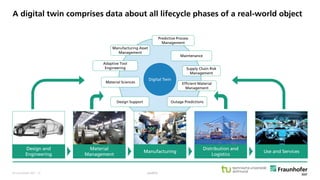
Digital Twin
A digital twin comprises data about all lifecycle phases of a real-world object
Design Support
Material Sciences
Supply Chain Risk
Management
Outage Predictions
Design and
Engineering
Material
Management
Manufacturing
Distribution and
Logistics
Use and Services
Manufacturing Asset
Management
Adaptive Tool
Engineering
Maintenance
Predictive Process
Management
Efficient Material
Management
public· 12
© Fraunhofer ISST
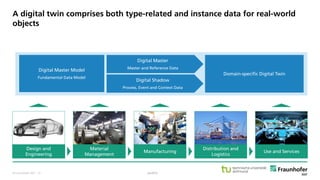
A digital twin comprises both type-related and instance data for real-world
objects
Domain-specific Digital Twin
Digital Master
Master and Reference Data
Digital Shadow
Process, Event and Context Data
Digital Master Model
Fundamental Data Model
public
Design and
Engineering
Material
Management
Manufacturing
Distribution and
Logistics
Use and Services
· 13
© Fraunhofer ISST
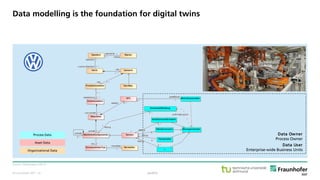
Data Owner
Process Owner
Data User
Enterprise-wide Business Units
Data modelling is the foundation for digital twins
Source: Volkswagen (2017).
Asset Data
Process Data
Organizational Data
public· 14
© Fraunhofer ISST
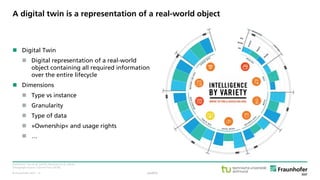
A digital twin is a representation of a real-world object
 Digital Twin
 Digital representation of a real-world
object containing all required information
over the entire lifecycle
 Dimensions
 Type vs instance
 Granularity
 Type of data
 »Ownership« and usage rights
 …
Definition: Tao et al. (2019); Boschert et al. (2016).
Viewgraph source: Column Five (2019).
public· 15
© Fraunhofer ISST
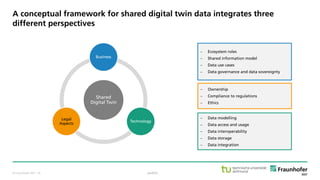
A conceptual framework for shared digital twin data integrates three
different perspectives
public
Shared
Digital Twin
Business
Technology
Legal
Aspects
 Ecosystem roles
 Shared information model
 Data use cases
 Data governance and data sovereignty
 Data modelling
 Data access and usage
 Data interoperability
 Data storage
 Data integration
 Ownership
 Compliance to regulations
 Ethics
· 16
© Fraunhofer ISST
Agenda
 Business Rationale and Use Cases
 Definition and Conceptual Framework
 State of the Art and Outlook
public· 17
© Fraunhofer ISST
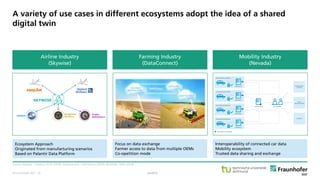
A variety of use cases in different ecosystems adopt the idea of a shared
digital twin
Source: Skywise – Tardieu, ATOS (2019); DataConnect – John Deere (2019); NEVADA – VDA (2018).
public
Airline Industry
(Skywise)
Farming Industry
(DataConnect)
Mobility Industry
(Nevada)
Ecosystem Approach
Originated from manufacturing scenarios
Based on Palantir Data Platform
Focus on data exchange
Farmer access to data from multiple OEMs
Co-opetition mode
Interoperability of connected car data
Mobility ecosystem
Trusted data sharing and exchange
SKYWISE
Engine
Maintainers
AIRBUS
Equipment
Vendors
· 18
© Fraunhofer ISST
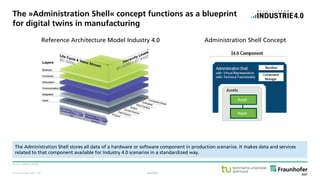
The »Administration Shell« concept functions as a blueprint
for digital twins in manufacturing
Source: BMWi (2016).
Reference Architecture Model Industry 4.0 Administration Shell Concept
The Administration Shell stores all data of a hardware or software component in production scenarios. It makes data and services
related to that component available for Industry 4.0 scenarios in a standardized way.
public· 19
© Fraunhofer ISST
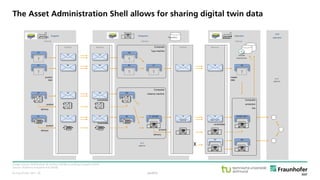
The Asset Administration Shell allows for sharing digital twin data
Image source: Hoffmeister & Jochem (2018) according to Epple (2016).
Source: Platform Industrie 4.0 (2018).
IntegratorSupplier
Internal
public
Operator
Repository
Verteilte
Repositories
2
Publish
A1
T
B1
T
Receive Publish ReceiveComposite
Type machine
Internal
A4
T
B4
T
C1
T
C4
T
D1
E1
Composite
Instance machineD4
E4 F1 (D4,E4)
G3
X
F4 (D4*,E4*)
product
type
consolidate
consolidate
consolidate
delivery
delivery
product
product
2nd
operator
master
data
G4
Composite
production
line
I4.0-
platform
18
I4.0-
platform
Internal
delivery
product
A2 A3
B2 B3 C2 C3
D2 D3
E2 E2 F2
(D4,E4)
F3
(D4*,E4*)
public· 20
© Fraunhofer ISST
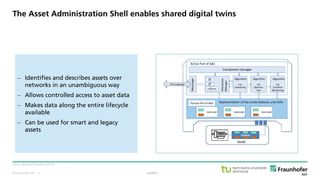
The Asset Administration Shell enables shared digital twins
Source: Belyaev & Diedrich (2019).
public
 Identifies and describes assets over
networks in an unambiguous way
 Allows controlled access to asset data
 Makes data along the entire lifecycle
available
 Can be used for smart and legacy
assets
· 21
© Fraunhofer ISST
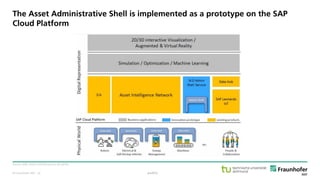
The Asset Administrative Shell is implemented as a prototype on the SAP
Cloud Platform
Source: SAP, cited in All-Electronics.de (2019).
public· 22
© Fraunhofer ISST
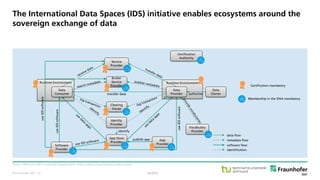
The International Data Spaces (IDS) initiative enables ecosystems around the
sovereign exchange of data
Source: Otto et al. (2017); extended representation of the reference architecture model content.
public
Runtime EnvironmentRuntime Environment
authorize
publish app
transfer data
data flow
metadata flow
software flow
identification
useIDSsoftware
useIDSsoftware
useIDSsoftware
identify
Data
Owner
App
Provider
Vocabulary
Provider
Clearing
House
App Store
Provider
Identity
Provider
Data
Consumer
Broker
Service
Provider
Service
Provider
Software
Provider
Data
Provider
Certification mandatory
Membership in the IDSA mandatory
Certification
Authority
· 23
© Fraunhofer ISST
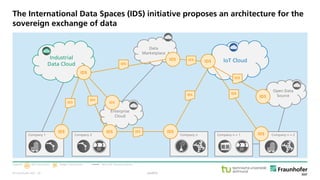
The International Data Spaces (IDS) initiative proposes an architecture for the
sovereign exchange of data
Legend: IDS Connector; Usage Constraints; Non-IDS Communication.
public
Industrial
Data Cloud
IoT Cloud
Enterprise
Cloud
Data
Marketplace
Company 1 Company 2 Company n + 2Company n + 1Company n
Open Data
Source
IDS
IDS IDS
IDS
IDS IDS
IDS
IDS
IDS
IDS
IDS
IDS
IDS
IDS
IDS
IDS
IDS
· 24
© Fraunhofer ISST
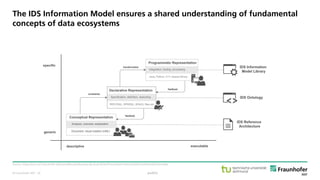
The IDS Information Model ensures a shared understanding of fundamental
concepts of data ecosystems
Source: https://mvn.isst.fraunhofer.de/nexus/#browse/browse:ids-local:de%2Ffraunhofer%2Fiais%2Feis%2Fids%2Finfomodel
public· 25
© Fraunhofer ISST
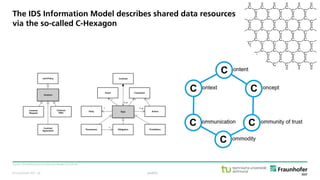
The IDS Information Model describes shared data resources
via the so-called C-Hexagon
Source: IDS Reference Architecture Model 3.0 (2019).
public· 26
© Fraunhofer ISST
Legend: IoT – Internet of Things.
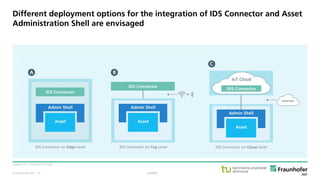
Different deployment options for the integration of IDS Connector and Asset
Administration Shell are envisaged
public· 27
© Fraunhofer ISST
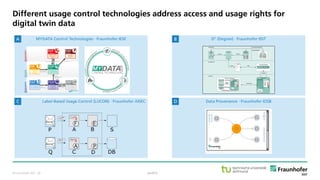
Data Provenance · Fraunhofer IOSBLabel-Based Usage Control (LUCON) · Fraunhofer AISEC
D° (Degree) · Fraunhofer ISSTMYDATA Control Technologies · Fraunhofer IESE
Information
Provisioning
Instantiation
Policy
Provisioning
Policy
Deployment &
Revocation
Consultation Decision
Storage
Execution
DECISIONMANAGEMENTENFORCEMENT
A B
C D
Different usage control technologies address access and usage rights for
digital twin data
public· 28
© Fraunhofer ISST
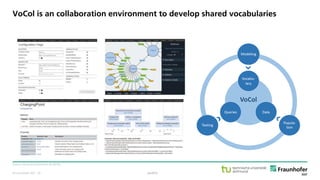
Source: vocol.iais.fraunhofer.de (2019).
VoCol is an collaboration environment to develop shared vocabularies
public· 29
© Fraunhofer ISST
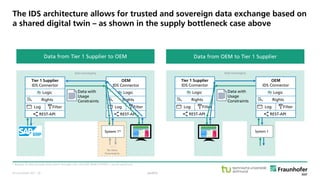
The IDS architecture allows for trusted and sovereign data exchange based on
a shared digital twin – as shown in the supply bottleneck case above
* Release of data through data owner through rule: »ALLOW_RAW_EXPORT«, can be opted out.
Data Sovereignty
Data with
Usage
Constraints
No Data
Sovereignty
System 1*
Tier 1 Supplier
IDS Connector
Logic
Rights
Log Filter
REST-API
OEM
IDS Connector
Logic
Rights
Log Filter
REST-API
Data Sovereignty
Data with
Usage
Constraints
System 1
Tier 1 Supplier
IDS Connector
Logic
Rights
Log Filter
REST-API
OEM
IDS Connector
Logic
Rights
Log Filter
REST-API
…
Data from Tier 1 Supplier to OEM Data from OEM to Tier 1 Supplier
public· 30
© Fraunhofer ISST
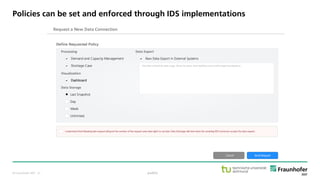
Policies can be set and enforced through IDS implementations
public· 31
© Fraunhofer ISST
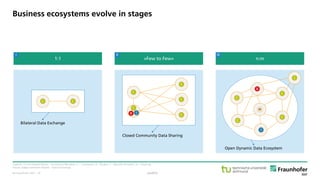
Legend: Circle-shaped Nodes – Ecosystem Member; C – Connector; B – Broker; I – Identity Provider; H – Clearing
House; Edges between Nodes – Data Exchange.
1:1 »Few to Few« n:m
C C
Bilateral Data Exchange
C
C
C
C
C
B I
Closed Community Data Sharing
C
C
C
H
C
C
I
B
Open Dynamic Data Ecosystem
II IIII
Business ecosystems evolve in stages
public· 32
© Fraunhofer ISST
VALUES & FRAMEWORK FOR INNOVATION
ENTERPRISE/DIGITAL
ECOSYSTEM (using EU standards)
SMART ECONONY &
SOCIETY
SERVICE PLATFORMS
DATA SHARING
INFRASTRUCTURE
CLOUD/EDGE
INFRASTRUCTURE
NETWORK
SMART SERVICES
SMART DATA
SMART PRODUCTS
SMART NETWORK
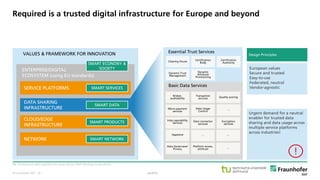
European values
Secure and trusted
Easy-to-use
Federated, neutral
Vendor-agnostic
Design Principles
Urgent demand for a neutral
enabler for trusted data
sharing and data usage across
multiple service platforms
across industries!
Certification
Body
Transaction
services
Data connector
services
Platform access,
antitrust
Micro-payment
services
Quality scoring
Encryption
services
Certification
AuthorityClearing House
Broker,
auditability
Inter-operability
Serivces
Data Governace/
Privacy
Essential Trust Services
Basic Data Services
Dynamic Trust
Management
Dynamic
Attribute
Provisioning
…
Appstore
Data Usage
Control
…
…
…
NB: Architecture stack adapted from Smart Service Welt Working Group (2015).
Required is a trusted digital infrastructure for Europe and beyond
public· 33
© Fraunhofer ISST
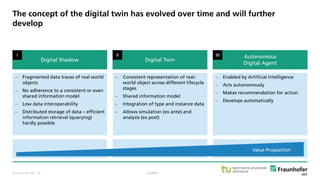
The concept of the digital twin has evolved over time and will further
develop
public
Digital Shadow Digital Twin
Autonomous
Digital Agent
I II III
 Fragmented data traces of real world
objects
 No adherence to a consistent or even
shared information model
 Low data interoperability
 Distributed storage of data – efficient
information retrieval (querying)
hardly possible
 Consistent representation of real-
world object across different lifecycle
stages
 Shared information model
 Integration of type and instance data
 Allows simulation (ex ante) and
analysis (ex post)
 Enabled by Artificial Intelligence
 Acts autonomously
 Makes recommendation for action
 Develops automatically
Value Proposition
· 34
© Fraunhofer ISST
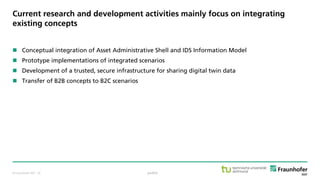
Current research and development activities mainly focus on integrating
existing concepts
 Conceptual integration of Asset Administrative Shell and IDS Information Model
 Prototype implementations of integrated scenarios
 Development of a trusted, secure infrastructure for sharing digital twin data
 Transfer of B2B concepts to B2C scenarios
public· 35
© Fraunhofer ISST
SHARED DIGITAL TWIN:
COLLABORATION IN ECOSYSTEMS
Prof. Dr.-Ing. Boris Otto  Berlin  18 September 2019
public· 36

Shared Digital Twins: Collaboration in Ecosystems

  • 1.
    © Fraunhofer ISST SHAREDDIGITAL TWIN: COLLABORATION IN ECOSYSTEMS Prof. Dr.-Ing. Boris Otto  Berlin  18 September 2019 public· 1
  • 2.
    © Fraunhofer ISST Agenda Business Rationale and Use Cases  Definition and Conceptual Framework  State of the Art and Outlook public· 2
  • 3.
    © Fraunhofer ISST Ecosystems– as in the railway industry – are an organizational form to facilitate innovation Source: Knorr-Bremse (2018). public Railway Markets Original Equipment Manufacturers 1st and 2nd Tier SuppliersInfrastructure Providers Energy Suppliers Railway Operators Domain Knowledge Vehicle Knowledge Operational Knowledge Leasing Companies · 3
  • 4.
    © Fraunhofer ISST Various proprietary platforms – no standards  Integration and accumulation of knowledge along the value chain  Many use cases – no business models  Lacking proliferation of platforms and services – no critical mass Use Cases To realize the business benefits in ecosystems, a set of challenges has to be overcome Source: Knorr-Bremse (2018). public Challenges · 4
  • 5.
    © Fraunhofer ISST Usingand sharing Digital Twins is a prerequisite for business benefits in many different scenarios Image Source: JDA Software Group, Inc. (2019); DirectIndustry (2019); ABB (2019). public Digital Twin of Supply Chains Demand and Capacity Management Supply Bottleneck Management Production stability  Buffer stock  Delivery quality  Digital Twin of Industrial Assets Predictive Maintenance Condition Monitoring Fast Deployment Productivity  TCO  OEE  Digital Twin of Products Data-Driven Business Models Service-Based Business Models Customer Loyalty  Customer Retention  Service Profitability  · 5
  • 6.
    © Fraunhofer ISST Supplynetworks in the automotive are complex and prone to disruptions Source: VW, thyssenkrupp. ACT ComponentTier-2 Jászfényszaru Salzgitter Ilsenburg Valvetrain Győr Ingolstadt Wolfsburg Emden Pamplona Setúbal Puebla Mladá Boleslav Kvasiny Uitenhage Martorell Zwickau Osnabrück Nizhny Novgorod Chemnitz Győr Salzgitter Engine Plant Assembly Plant public … · 6
  • 7.
    © Fraunhofer ISST Exchangingand sharing data across the supply network to mitigate risks and to overcome co-ordination challenges public Risks and Challenges Data Demands SoP Delay · 7
  • 8.
    © Fraunhofer ISST Manyrequirements exists with regard to a Digital Supply Chain Twin  Data must be available on demand  Data events (access, use etc.) must be logged  Access and usage rights must be customizable  Data exchange must follow a harmonized data model  Data use in backend systems must be prohibited/tracked  Data provenance  Data must only be shared together with usage constraints  Only recent updates of data must be stored – if at all  Data sharing follows »quid pro quo« principle  Views must be defined with regard to entire digital twin  … public· 8
  • 9.
    © Fraunhofer ISST Source:Platform Industrie 4.0, Working Group 1 & 3 (2019). Manufacturer X Condition monitoring of components is a mature Industrie 4.0 use case – generating business benefits along the value chain Integrator V Operator A public· 9
  • 10.
    © Fraunhofer ISST ComponentManufacturer X Business Scenario  Product component P1-X was built in M1-W, M2-W, operated by A Business Case  Condition monitoring for improved productivity Challenges  Organizational, technical, legal prerequisites for data access and use  Data monetization with regard to data provisioning and use End-to-end condition monitoring requires a shared digital twin that meets data security and usage/access rights requirements BP1 A M1 V M2 W P1 X P2 Y P1 X P2 Y P3 Z P3 Z Operator A public· 10
  • 11.
    © Fraunhofer ISST Agenda Business Rationale and Use Cases  Definition and Conceptual Framework  State of the Art and Outlook public· 11
  • 12.
    © Fraunhofer ISST DigitalTwin A digital twin comprises data about all lifecycle phases of a real-world object Design Support Material Sciences Supply Chain Risk Management Outage Predictions Design and Engineering Material Management Manufacturing Distribution and Logistics Use and Services Manufacturing Asset Management Adaptive Tool Engineering Maintenance Predictive Process Management Efficient Material Management public· 12
  • 13.
    © Fraunhofer ISST Adigital twin comprises both type-related and instance data for real-world objects Domain-specific Digital Twin Digital Master Master and Reference Data Digital Shadow Process, Event and Context Data Digital Master Model Fundamental Data Model public Design and Engineering Material Management Manufacturing Distribution and Logistics Use and Services · 13
  • 14.
    © Fraunhofer ISST DataOwner Process Owner Data User Enterprise-wide Business Units Data modelling is the foundation for digital twins Source: Volkswagen (2017). Asset Data Process Data Organizational Data public· 14
  • 15.
    © Fraunhofer ISST Adigital twin is a representation of a real-world object  Digital Twin  Digital representation of a real-world object containing all required information over the entire lifecycle  Dimensions  Type vs instance  Granularity  Type of data  »Ownership« and usage rights  … Definition: Tao et al. (2019); Boschert et al. (2016). Viewgraph source: Column Five (2019). public· 15
  • 16.
    © Fraunhofer ISST Aconceptual framework for shared digital twin data integrates three different perspectives public Shared Digital Twin Business Technology Legal Aspects  Ecosystem roles  Shared information model  Data use cases  Data governance and data sovereignty  Data modelling  Data access and usage  Data interoperability  Data storage  Data integration  Ownership  Compliance to regulations  Ethics · 16
  • 17.
    © Fraunhofer ISST Agenda Business Rationale and Use Cases  Definition and Conceptual Framework  State of the Art and Outlook public· 17
  • 18.
    © Fraunhofer ISST Avariety of use cases in different ecosystems adopt the idea of a shared digital twin Source: Skywise – Tardieu, ATOS (2019); DataConnect – John Deere (2019); NEVADA – VDA (2018). public Airline Industry (Skywise) Farming Industry (DataConnect) Mobility Industry (Nevada) Ecosystem Approach Originated from manufacturing scenarios Based on Palantir Data Platform Focus on data exchange Farmer access to data from multiple OEMs Co-opetition mode Interoperability of connected car data Mobility ecosystem Trusted data sharing and exchange SKYWISE Engine Maintainers AIRBUS Equipment Vendors · 18
  • 19.
    © Fraunhofer ISST The»Administration Shell« concept functions as a blueprint for digital twins in manufacturing Source: BMWi (2016). Reference Architecture Model Industry 4.0 Administration Shell Concept The Administration Shell stores all data of a hardware or software component in production scenarios. It makes data and services related to that component available for Industry 4.0 scenarios in a standardized way. public· 19
  • 20.
    © Fraunhofer ISST TheAsset Administration Shell allows for sharing digital twin data Image source: Hoffmeister & Jochem (2018) according to Epple (2016). Source: Platform Industrie 4.0 (2018). IntegratorSupplier Internal public Operator Repository Verteilte Repositories 2 Publish A1 T B1 T Receive Publish ReceiveComposite Type machine Internal A4 T B4 T C1 T C4 T D1 E1 Composite Instance machineD4 E4 F1 (D4,E4) G3 X F4 (D4*,E4*) product type consolidate consolidate consolidate delivery delivery product product 2nd operator master data G4 Composite production line I4.0- platform 18 I4.0- platform Internal delivery product A2 A3 B2 B3 C2 C3 D2 D3 E2 E2 F2 (D4,E4) F3 (D4*,E4*) public· 20
  • 21.
    © Fraunhofer ISST TheAsset Administration Shell enables shared digital twins Source: Belyaev & Diedrich (2019). public  Identifies and describes assets over networks in an unambiguous way  Allows controlled access to asset data  Makes data along the entire lifecycle available  Can be used for smart and legacy assets · 21
  • 22.
    © Fraunhofer ISST TheAsset Administrative Shell is implemented as a prototype on the SAP Cloud Platform Source: SAP, cited in All-Electronics.de (2019). public· 22
  • 23.
    © Fraunhofer ISST TheInternational Data Spaces (IDS) initiative enables ecosystems around the sovereign exchange of data Source: Otto et al. (2017); extended representation of the reference architecture model content. public Runtime EnvironmentRuntime Environment authorize publish app transfer data data flow metadata flow software flow identification useIDSsoftware useIDSsoftware useIDSsoftware identify Data Owner App Provider Vocabulary Provider Clearing House App Store Provider Identity Provider Data Consumer Broker Service Provider Service Provider Software Provider Data Provider Certification mandatory Membership in the IDSA mandatory Certification Authority · 23
  • 24.
    © Fraunhofer ISST TheInternational Data Spaces (IDS) initiative proposes an architecture for the sovereign exchange of data Legend: IDS Connector; Usage Constraints; Non-IDS Communication. public Industrial Data Cloud IoT Cloud Enterprise Cloud Data Marketplace Company 1 Company 2 Company n + 2Company n + 1Company n Open Data Source IDS IDS IDS IDS IDS IDS IDS IDS IDS IDS IDS IDS IDS IDS IDS IDS IDS · 24
  • 25.
    © Fraunhofer ISST TheIDS Information Model ensures a shared understanding of fundamental concepts of data ecosystems Source: https://mvn.isst.fraunhofer.de/nexus/#browse/browse:ids-local:de%2Ffraunhofer%2Fiais%2Feis%2Fids%2Finfomodel public· 25
  • 26.
    © Fraunhofer ISST TheIDS Information Model describes shared data resources via the so-called C-Hexagon Source: IDS Reference Architecture Model 3.0 (2019). public· 26
  • 27.
    © Fraunhofer ISST Legend:IoT – Internet of Things. Different deployment options for the integration of IDS Connector and Asset Administration Shell are envisaged public· 27
  • 28.
    © Fraunhofer ISST DataProvenance · Fraunhofer IOSBLabel-Based Usage Control (LUCON) · Fraunhofer AISEC D° (Degree) · Fraunhofer ISSTMYDATA Control Technologies · Fraunhofer IESE Information Provisioning Instantiation Policy Provisioning Policy Deployment & Revocation Consultation Decision Storage Execution DECISIONMANAGEMENTENFORCEMENT A B C D Different usage control technologies address access and usage rights for digital twin data public· 28
  • 29.
    © Fraunhofer ISST Source:vocol.iais.fraunhofer.de (2019). VoCol is an collaboration environment to develop shared vocabularies public· 29
  • 30.
    © Fraunhofer ISST TheIDS architecture allows for trusted and sovereign data exchange based on a shared digital twin – as shown in the supply bottleneck case above * Release of data through data owner through rule: »ALLOW_RAW_EXPORT«, can be opted out. Data Sovereignty Data with Usage Constraints No Data Sovereignty System 1* Tier 1 Supplier IDS Connector Logic Rights Log Filter REST-API OEM IDS Connector Logic Rights Log Filter REST-API Data Sovereignty Data with Usage Constraints System 1 Tier 1 Supplier IDS Connector Logic Rights Log Filter REST-API OEM IDS Connector Logic Rights Log Filter REST-API … Data from Tier 1 Supplier to OEM Data from OEM to Tier 1 Supplier public· 30
  • 31.
    © Fraunhofer ISST Policiescan be set and enforced through IDS implementations public· 31
  • 32.
    © Fraunhofer ISST Legend:Circle-shaped Nodes – Ecosystem Member; C – Connector; B – Broker; I – Identity Provider; H – Clearing House; Edges between Nodes – Data Exchange. 1:1 »Few to Few« n:m C C Bilateral Data Exchange C C C C C B I Closed Community Data Sharing C C C H C C I B Open Dynamic Data Ecosystem II IIII Business ecosystems evolve in stages public· 32
  • 33.
    © Fraunhofer ISST VALUES& FRAMEWORK FOR INNOVATION ENTERPRISE/DIGITAL ECOSYSTEM (using EU standards) SMART ECONONY & SOCIETY SERVICE PLATFORMS DATA SHARING INFRASTRUCTURE CLOUD/EDGE INFRASTRUCTURE NETWORK SMART SERVICES SMART DATA SMART PRODUCTS SMART NETWORK European values Secure and trusted Easy-to-use Federated, neutral Vendor-agnostic Design Principles Urgent demand for a neutral enabler for trusted data sharing and data usage across multiple service platforms across industries! Certification Body Transaction services Data connector services Platform access, antitrust Micro-payment services Quality scoring Encryption services Certification AuthorityClearing House Broker, auditability Inter-operability Serivces Data Governace/ Privacy Essential Trust Services Basic Data Services Dynamic Trust Management Dynamic Attribute Provisioning … Appstore Data Usage Control … … … NB: Architecture stack adapted from Smart Service Welt Working Group (2015). Required is a trusted digital infrastructure for Europe and beyond public· 33
  • 34.
    © Fraunhofer ISST Theconcept of the digital twin has evolved over time and will further develop public Digital Shadow Digital Twin Autonomous Digital Agent I II III  Fragmented data traces of real world objects  No adherence to a consistent or even shared information model  Low data interoperability  Distributed storage of data – efficient information retrieval (querying) hardly possible  Consistent representation of real- world object across different lifecycle stages  Shared information model  Integration of type and instance data  Allows simulation (ex ante) and analysis (ex post)  Enabled by Artificial Intelligence  Acts autonomously  Makes recommendation for action  Develops automatically Value Proposition · 34
  • 35.
    © Fraunhofer ISST Currentresearch and development activities mainly focus on integrating existing concepts  Conceptual integration of Asset Administrative Shell and IDS Information Model  Prototype implementations of integrated scenarios  Development of a trusted, secure infrastructure for sharing digital twin data  Transfer of B2B concepts to B2C scenarios public· 35
  • 36.
    © Fraunhofer ISST SHAREDDIGITAL TWIN: COLLABORATION IN ECOSYSTEMS Prof. Dr.-Ing. Boris Otto  Berlin  18 September 2019 public· 36