EMULSION
Ronald Peter
Assistant Professor
Dept. of Pharmaceutics
Definition
 Emulsion is a biphasic liquid preparation containing two immiscible liquids, one of
which is dispersed as minute globules into the other.
The liquid converted to minute globules – dispersed phase
The liquid in which globules are dispersed – continuous phase
 Normally – 2 immiscible liquids alone – cannot exit as dispersed form – for long
time.
 So an emulsifying agent – added to the system
 It forms a film around the globules – reduces IT – helps to scatter uniformly – stable
emulsion formed.
2 Lisie College of Pharmacy, Kochi
3 Lisie College of Pharmacy, Kochi
Formation of o/w or w/o
type emulsion
Orientation of surfactant
Natural emulsion
Advantages
• Medicines having unpleasant taste and odour – can be made more palatable
• Protection for drugs – prone to oxidation and hydrolysis
• Novel preparations – creams, lotions, foam aerosols – formulated as emulsions
• Sterile IV emulsions can be prepared and administered
• Emulsion improves absorption of oils – when taken orally
• Radio opaque emulsions can be prepared – used as diagnostic agents
4 Lisie College of Pharmacy, Kochi
Types
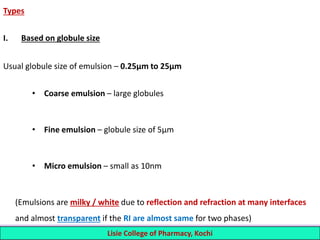
I. Based on globule size
Usual globule size of emulsion – 0.25µm to 25µm
• Coarse emulsion – large globules
• Fine emulsion – globule size of 5µm
• Micro emulsion – small as 10nm
(Emulsions are milky / white due to reflection and refraction at many interfaces
and almost transparent if the RI are almost same for two phases)
5 Lisie College of Pharmacy, Kochi
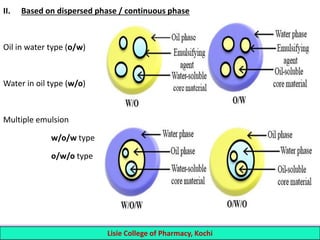
II. Based on dispersed phase / continuous phase
Oil in water type (o/w)
Water in oil type (w/o)
Multiple emulsion
w/o/w type
o/w/o type
6 Lisie College of Pharmacy, Kochi
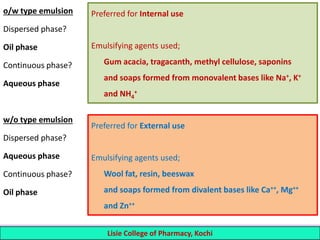
o/w type emulsion
Dispersed phase?
Oil phase
Continuous phase?
Aqueous phase
w/o type emulsion
Dispersed phase?
Aqueous phase
Continuous phase?
Oil phase
7 Lisie College of Pharmacy, Kochi
Preferred for Internal use
Emulsifying agents used;
Gum acacia, tragacanth, methyl cellulose, saponins
and soaps formed from monovalent bases like Na+, K+
and NH4
+
Preferred for External use
Emulsifying agents used;
Wool fat, resin, beeswax
and soaps formed from divalent bases like Ca++, Mg++
and Zn++
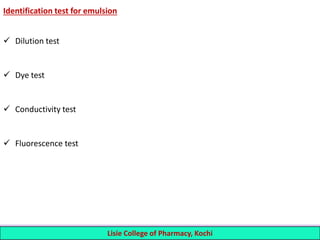
Identification test for emulsion
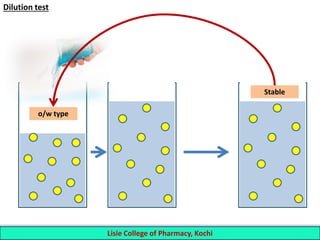
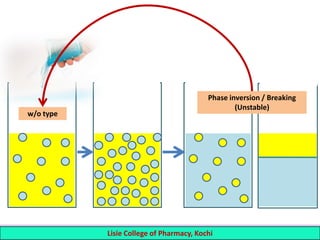
 Dilution test
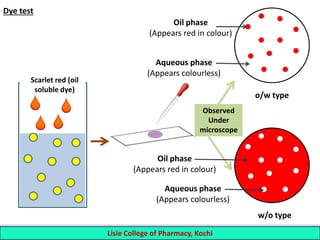
 Dye test
 Conductivity test
 Fluorescence test
8 Lisie College of Pharmacy, Kochi
9 Lisie College of Pharmacy, Kochi
o/w type
Stable
Dilution test
10 Lisie College of Pharmacy, Kochi
w/o type
Phase inversion / Breaking
(Unstable)
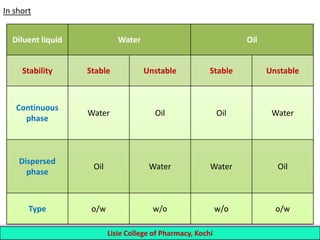
In short
11 Lisie College of Pharmacy, Kochi
Diluent liquid Water Oil
Stability Stable Unstable Stable Unstable
Continuous
phase
Water Oil Oil Water
Dispersed
phase
Oil Water Water Oil
Type o/w w/o w/o o/w
Dye test
12 Lisie College of Pharmacy, Kochi
Scarlet red (oil
soluble dye)
o/w type
w/o type
Oil phase
(Appears red in colour)
Aqueous phase
(Appears colourless)
Oil phase
(Appears red in colour)
Aqueous phase
(Appears colourless)
Observed
Under
microscope
13 Lisie College of Pharmacy, Kochi
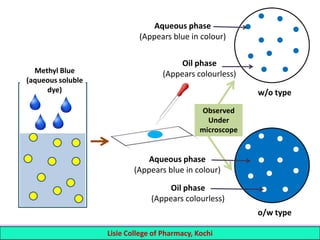
Methyl Blue
(aqueous soluble
dye)
o/w type
w/o type
Oil phase
(Appears colourless)
Aqueous phase
(Appears blue in colour)
Oil phase
(Appears colourless)
Aqueous phase
(Appears blue in colour)
Observed
Under
microscope
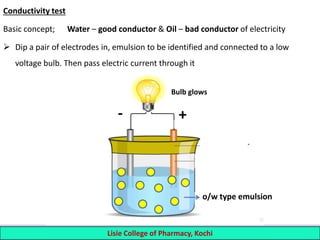
Conductivity test
Basic concept; Water – good conductor & Oil – bad conductor of electricity
 Dip a pair of electrodes in, emulsion to be identified and connected to a low
voltage bulb. Then pass electric current through it
14 Lisie College of Pharmacy, Kochi
+
-
o/w type emulsion
Bulb glows
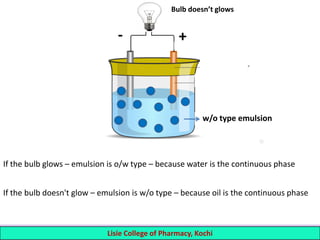
If the bulb glows – emulsion is o/w type – because water is the continuous phase
If the bulb doesn't glow – emulsion is w/o type – because oil is the continuous phase
15 Lisie College of Pharmacy, Kochi
+
-
w/o type emulsion
Bulb doesn’t glows
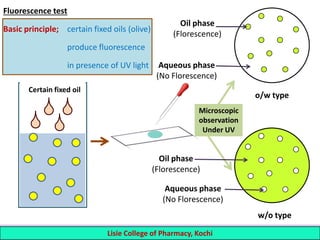
Fluorescence test
Basic principle; certain fixed oils (olive)
produce fluorescence
in presence of UV light
16 Lisie College of Pharmacy, Kochi
Certain fixed oil
o/w type
w/o type
Oil phase
(Florescence)
Aqueous phase
(No Florescence)
Oil phase
(Florescence)
Aqueous phase
(No Florescence)
Microscopic
observation
Under UV
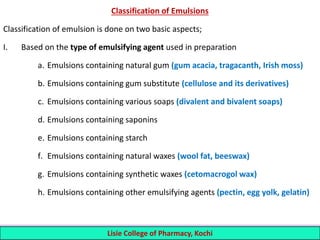
Classification of Emulsions
Classification of emulsion is done on two basic aspects;
I. Based on the type of emulsifying agent used in preparation
a. Emulsions containing natural gum (gum acacia, tragacanth, Irish moss)
b. Emulsions containing gum substitute (cellulose and its derivatives)
c. Emulsions containing various soaps (divalent and bivalent soaps)
d. Emulsions containing saponins
e. Emulsions containing starch
f. Emulsions containing natural waxes (wool fat, beeswax)
g. Emulsions containing synthetic waxes (cetomacrogol wax)
h. Emulsions containing other emulsifying agents (pectin, egg yolk, gelatin)
17 Lisie College of Pharmacy, Kochi
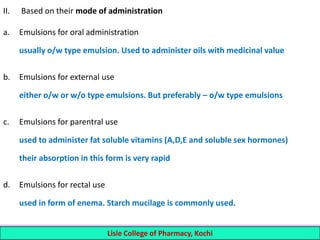
II. Based on their mode of administration
a. Emulsions for oral administration
usually o/w type emulsion. Used to administer oils with medicinal value
b. Emulsions for external use
either o/w or w/o type emulsions. But preferably – o/w type emulsions
c. Emulsions for parentral use
used to administer fat soluble vitamins (A,D,E and soluble sex hormones)
their absorption in this form is very rapid
d. Emulsions for rectal use
used in form of enema. Starch mucilage is commonly used.
18 Lisie College of Pharmacy, Kochi
To be continued.................
19 Lisie College of Pharmacy, Kochi

Emulsion (intro, adv, types and classifictaion)

  • 1.
  • 2.
    Definition  Emulsion isa biphasic liquid preparation containing two immiscible liquids, one of which is dispersed as minute globules into the other. The liquid converted to minute globules – dispersed phase The liquid in which globules are dispersed – continuous phase  Normally – 2 immiscible liquids alone – cannot exit as dispersed form – for long time.  So an emulsifying agent – added to the system  It forms a film around the globules – reduces IT – helps to scatter uniformly – stable emulsion formed. 2 Lisie College of Pharmacy, Kochi
  • 3.
    3 Lisie Collegeof Pharmacy, Kochi Formation of o/w or w/o type emulsion Orientation of surfactant Natural emulsion
  • 4.
    Advantages • Medicines havingunpleasant taste and odour – can be made more palatable • Protection for drugs – prone to oxidation and hydrolysis • Novel preparations – creams, lotions, foam aerosols – formulated as emulsions • Sterile IV emulsions can be prepared and administered • Emulsion improves absorption of oils – when taken orally • Radio opaque emulsions can be prepared – used as diagnostic agents 4 Lisie College of Pharmacy, Kochi
  • 5.
    Types I. Based onglobule size Usual globule size of emulsion – 0.25µm to 25µm • Coarse emulsion – large globules • Fine emulsion – globule size of 5µm • Micro emulsion – small as 10nm (Emulsions are milky / white due to reflection and refraction at many interfaces and almost transparent if the RI are almost same for two phases) 5 Lisie College of Pharmacy, Kochi
  • 6.
    II. Based ondispersed phase / continuous phase Oil in water type (o/w) Water in oil type (w/o) Multiple emulsion w/o/w type o/w/o type 6 Lisie College of Pharmacy, Kochi
  • 7.
    o/w type emulsion Dispersedphase? Oil phase Continuous phase? Aqueous phase w/o type emulsion Dispersed phase? Aqueous phase Continuous phase? Oil phase 7 Lisie College of Pharmacy, Kochi Preferred for Internal use Emulsifying agents used; Gum acacia, tragacanth, methyl cellulose, saponins and soaps formed from monovalent bases like Na+, K+ and NH4 + Preferred for External use Emulsifying agents used; Wool fat, resin, beeswax and soaps formed from divalent bases like Ca++, Mg++ and Zn++
  • 8.
    Identification test foremulsion  Dilution test  Dye test  Conductivity test  Fluorescence test 8 Lisie College of Pharmacy, Kochi
  • 9.
    9 Lisie Collegeof Pharmacy, Kochi o/w type Stable Dilution test
  • 10.
    10 Lisie Collegeof Pharmacy, Kochi w/o type Phase inversion / Breaking (Unstable)
  • 11.
    In short 11 LisieCollege of Pharmacy, Kochi Diluent liquid Water Oil Stability Stable Unstable Stable Unstable Continuous phase Water Oil Oil Water Dispersed phase Oil Water Water Oil Type o/w w/o w/o o/w
  • 12.
    Dye test 12 LisieCollege of Pharmacy, Kochi Scarlet red (oil soluble dye) o/w type w/o type Oil phase (Appears red in colour) Aqueous phase (Appears colourless) Oil phase (Appears red in colour) Aqueous phase (Appears colourless) Observed Under microscope
  • 13.
    13 Lisie Collegeof Pharmacy, Kochi Methyl Blue (aqueous soluble dye) o/w type w/o type Oil phase (Appears colourless) Aqueous phase (Appears blue in colour) Oil phase (Appears colourless) Aqueous phase (Appears blue in colour) Observed Under microscope
  • 14.
    Conductivity test Basic concept;Water – good conductor & Oil – bad conductor of electricity  Dip a pair of electrodes in, emulsion to be identified and connected to a low voltage bulb. Then pass electric current through it 14 Lisie College of Pharmacy, Kochi + - o/w type emulsion Bulb glows
  • 15.
    If the bulbglows – emulsion is o/w type – because water is the continuous phase If the bulb doesn't glow – emulsion is w/o type – because oil is the continuous phase 15 Lisie College of Pharmacy, Kochi + - w/o type emulsion Bulb doesn’t glows
  • 16.
    Fluorescence test Basic principle;certain fixed oils (olive) produce fluorescence in presence of UV light 16 Lisie College of Pharmacy, Kochi Certain fixed oil o/w type w/o type Oil phase (Florescence) Aqueous phase (No Florescence) Oil phase (Florescence) Aqueous phase (No Florescence) Microscopic observation Under UV
  • 17.
    Classification of Emulsions Classificationof emulsion is done on two basic aspects; I. Based on the type of emulsifying agent used in preparation a. Emulsions containing natural gum (gum acacia, tragacanth, Irish moss) b. Emulsions containing gum substitute (cellulose and its derivatives) c. Emulsions containing various soaps (divalent and bivalent soaps) d. Emulsions containing saponins e. Emulsions containing starch f. Emulsions containing natural waxes (wool fat, beeswax) g. Emulsions containing synthetic waxes (cetomacrogol wax) h. Emulsions containing other emulsifying agents (pectin, egg yolk, gelatin) 17 Lisie College of Pharmacy, Kochi
  • 18.
    II. Based ontheir mode of administration a. Emulsions for oral administration usually o/w type emulsion. Used to administer oils with medicinal value b. Emulsions for external use either o/w or w/o type emulsions. But preferably – o/w type emulsions c. Emulsions for parentral use used to administer fat soluble vitamins (A,D,E and soluble sex hormones) their absorption in this form is very rapid d. Emulsions for rectal use used in form of enema. Starch mucilage is commonly used. 18 Lisie College of Pharmacy, Kochi
  • 19.
    To be continued................. 19Lisie College of Pharmacy, Kochi