Environmental Aspect/ImpactsEnvironmental Aspect/Impacts
ByBy
Abakash NayakAbakash Nayak
Environmental aspects are the building
blocks of EMS!!
Objectives
1. Define an environmental impact
2. Give examples of impacts from our operations
ISO14001 Requirement
ISO14001 requires:
“the organization shall establish and maintain a
procedure to identify the environmental aspects of its
activities, products and services that it can control and
over which it can be expected to have an influence, in
order to determine those which have or can have
significant impacts on the environment”
ISO14001 Requirement
ISO14001 requires:
“the organization shall establish and maintain a
procedure to identify the environmental aspects of its
activities, products and services that it can control and
over which it can be expected to have an influence, in
order to determine those which have or can have
significant impacts on the environment”
What is an
environmental aspect?
ISO14001 defines an environmental aspect as an:
“element of an organization’s activities, products or services
that can interact with the environment”
Aspects can be
- regulated or non-regulated
- natural or man-made
- positive or negative
- controlled or influenced by the organization
What is an
environmental impact?
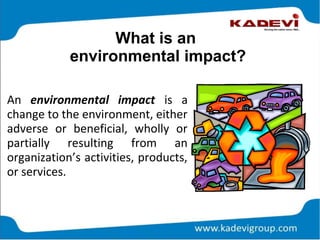
An environmental impact is a
change to the environment, either
adverse or beneficial, wholly or
partially resulting from an
organization’s activities, products,
or services.
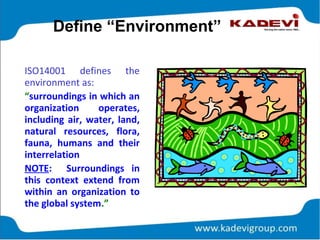
Define “Environment”
ISO14001 defines the
environment as:
“surroundings in which an
organization operates,
including air, water, land,
natural resources, flora,
fauna, humans and their
interrelation
NOTE: Surroundings in
this context extend from
within an organization to
the global system.”
Examples of Impacts
General
depletion of natural
resources
destruction of habitats
Water
pH
oxygen level
toxicity
Air
air toxicity
smog
global Warming
ozone Depletion
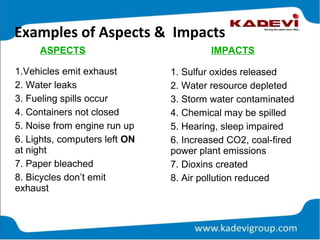
Examples of Aspects & Impacts
ASPECTS IMPACTS
1.Vehicles emit exhaust
2. Water leaks
3. Fueling spills occur
4. Containers not closed
5. Noise from engine run up
6. Lights, computers left ON
at night
7. Paper bleached
8. Bicycles don’t emit
exhaust
1. Sulfur oxides released
2. Water resource depleted
3. Storm water contaminated
4. Chemical may be spilled
5. Hearing, sleep impaired
6. Increased CO2, coal-fired
power plant emissions
7. Dioxins created
8. Air pollution reduced
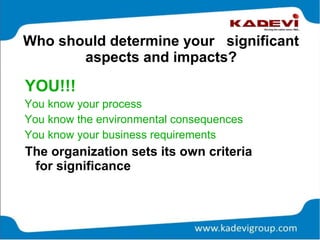
Who should determine your significant
aspects and impacts?
YOU!!!
You know your process
You know the environmental consequences
You know your business requirements
The organization sets its own criteria
for significance
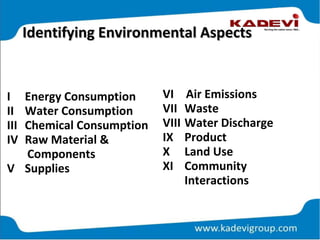
Identifying Environmental AspectsIdentifying Environmental Aspects
I Energy Consumption
II Water Consumption
III Chemical Consumption
IV Raw Material &
Components
V Supplies
VI Air Emissions
VII Waste
VIII Water Discharge
IX Product
X Land Use
XI Community
Interactions
EnvironmentalEnvironmental
AspectsAspects
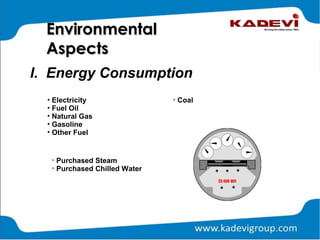
I. Energy Consumption
• Electricity
• Fuel Oil
• Natural Gas
• Gasoline
• Other Fuel
• Purchased Steam
• Purchased Chilled Water
• Coal
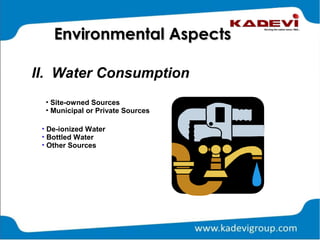
II. Water Consumption
Environmental AspectsEnvironmental Aspects
• Site-owned Sources
• Municipal or Private Sources
• De-ionized Water
• Bottled Water
• Other Sources
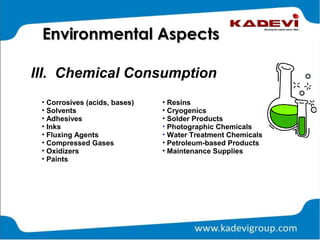
III. Chemical Consumption
Environmental AspectsEnvironmental Aspects
• Corrosives (acids, bases)
• Solvents
• Adhesives
• Inks
• Fluxing Agents
• Compressed Gases
• Oxidizers
• Paints
• Resins
• Cryogenics
• Solder Products
• Photographic Chemicals
• Water Treatment Chemicals
• Petroleum-based Products
• Maintenance Supplies
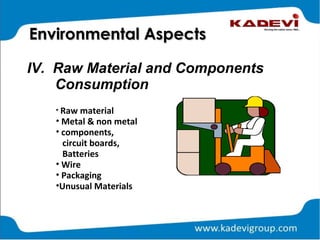
• Raw material
• Metal & non metal
• components,
circuit boards,
Batteries
• Wire
• Packaging
•Unusual Materials
IV. Raw Material and Components
Consumption
Environmental AspectsEnvironmental Aspects
• Office Paper
• Computer Paper
• Carbon paper
• Food
V. Supplies
Environmental AspectsEnvironmental Aspects
VII. Waste
Environmental AspectsEnvironmental Aspects
• Concentrated Corrosives
• Solvents
• Adhesives
• Inks
• Solder/lead Wastes
• Oxidizers
• Paint/Paint Related Waste
• Waste Treatment Sludge
• Contaminated Soil
• Batteries
• Mercury-containing Wastes
• Lab Packs
• PCBs
• Petroleum Waste
• Hazardous Waste Solids
• Hazardous Waste Liquids
• Other Mixtures
VIII. Water Discharge
Environmental AspectsEnvironmental Aspects
• Sanitary
• Industrial Pretreatment
• Storm water etc.
IX. Product
Environmental AspectsEnvironmental Aspects
• Transportation
• Mode/distance
• Energy Use
• Emissions
• End of Life Management
• Reusability
• Recyclability
• Hazardous/toxic Material Content
• Material Diversity
• Upgradability
• Waste Classification
• Assembly/disassembly techniques
• Disposal/emissions
X. Land Use
Environmental AspectsEnvironmental Aspects
• On-site Storage/containment/distribution/handling of
Solids, Liquids, Gases
• Interactions with natural surface or ground water
on the property; wetlands
• Cooling Tower Operation
• Thermal Emissions
• Maintenance Activities
• Soil Erosion
• Release of Pesticides, Fertilizers, etc.
• soil contamination
XI. Community Interactions
Environmental AspectsEnvironmental Aspects
• Noise, Odor, Vibration, Heat Generation, Site Lighting
• Employee Commuting
• Trucking In and Out
• Dust Generation
• Electromagnetic Frequency Releases
• Recycling and Recovery Operations
• Appearance (Visual Impact)
and Housekeeping
Summary
Identification of environmental aspects and impacts is
a key part of an EMS.
Aspects and impacts arise from activities, products,
and services.
An EMS includes procedures for identification and
updating of aspects and impacts.
Ensure Success
Define your
methodology
Select team
facilitator(s)
– Strong team skills
– Respected by peers
– Knowledgeable
Involve multi- functional team
Ask managers to identify
candidates with specific
competencies
Consider different teams for
different activities
At a minimum, validate the
aspect/impact identification and
significance scoring for our
operations
Keep information up-to-date
“Earth provides enough to satisfy every man's
needs, but not every man's greed.”
Mahatma Gandhi
Thank You

Ems aspect impacat

  • 1.
  • 2.
    Environmental aspects arethe building blocks of EMS!!
  • 3.
    Objectives 1. Define anenvironmental impact 2. Give examples of impacts from our operations
  • 4.
    ISO14001 Requirement ISO14001 requires: “theorganization shall establish and maintain a procedure to identify the environmental aspects of its activities, products and services that it can control and over which it can be expected to have an influence, in order to determine those which have or can have significant impacts on the environment”
  • 5.
    ISO14001 Requirement ISO14001 requires: “theorganization shall establish and maintain a procedure to identify the environmental aspects of its activities, products and services that it can control and over which it can be expected to have an influence, in order to determine those which have or can have significant impacts on the environment”
  • 6.
    What is an environmentalaspect? ISO14001 defines an environmental aspect as an: “element of an organization’s activities, products or services that can interact with the environment” Aspects can be - regulated or non-regulated - natural or man-made - positive or negative - controlled or influenced by the organization
  • 7.
    What is an environmentalimpact? An environmental impact is a change to the environment, either adverse or beneficial, wholly or partially resulting from an organization’s activities, products, or services.
  • 8.
    Define “Environment” ISO14001 definesthe environment as: “surroundings in which an organization operates, including air, water, land, natural resources, flora, fauna, humans and their interrelation NOTE: Surroundings in this context extend from within an organization to the global system.”
  • 9.
    Examples of Impacts General depletionof natural resources destruction of habitats Water pH oxygen level toxicity Air air toxicity smog global Warming ozone Depletion
  • 10.
    Examples of Aspects& Impacts ASPECTS IMPACTS 1.Vehicles emit exhaust 2. Water leaks 3. Fueling spills occur 4. Containers not closed 5. Noise from engine run up 6. Lights, computers left ON at night 7. Paper bleached 8. Bicycles don’t emit exhaust 1. Sulfur oxides released 2. Water resource depleted 3. Storm water contaminated 4. Chemical may be spilled 5. Hearing, sleep impaired 6. Increased CO2, coal-fired power plant emissions 7. Dioxins created 8. Air pollution reduced
  • 11.
    Who should determineyour significant aspects and impacts? YOU!!! You know your process You know the environmental consequences You know your business requirements The organization sets its own criteria for significance
  • 12.
    Identifying Environmental AspectsIdentifyingEnvironmental Aspects I Energy Consumption II Water Consumption III Chemical Consumption IV Raw Material & Components V Supplies VI Air Emissions VII Waste VIII Water Discharge IX Product X Land Use XI Community Interactions
  • 13.
    EnvironmentalEnvironmental AspectsAspects I. Energy Consumption •Electricity • Fuel Oil • Natural Gas • Gasoline • Other Fuel • Purchased Steam • Purchased Chilled Water • Coal
  • 14.
    II. Water Consumption EnvironmentalAspectsEnvironmental Aspects • Site-owned Sources • Municipal or Private Sources • De-ionized Water • Bottled Water • Other Sources
  • 15.
    III. Chemical Consumption EnvironmentalAspectsEnvironmental Aspects • Corrosives (acids, bases) • Solvents • Adhesives • Inks • Fluxing Agents • Compressed Gases • Oxidizers • Paints • Resins • Cryogenics • Solder Products • Photographic Chemicals • Water Treatment Chemicals • Petroleum-based Products • Maintenance Supplies
  • 16.
    • Raw material •Metal & non metal • components, circuit boards, Batteries • Wire • Packaging •Unusual Materials IV. Raw Material and Components Consumption Environmental AspectsEnvironmental Aspects
  • 17.
    • Office Paper •Computer Paper • Carbon paper • Food V. Supplies Environmental AspectsEnvironmental Aspects
  • 18.
    VII. Waste Environmental AspectsEnvironmentalAspects • Concentrated Corrosives • Solvents • Adhesives • Inks • Solder/lead Wastes • Oxidizers • Paint/Paint Related Waste • Waste Treatment Sludge • Contaminated Soil • Batteries • Mercury-containing Wastes • Lab Packs • PCBs • Petroleum Waste • Hazardous Waste Solids • Hazardous Waste Liquids • Other Mixtures
  • 19.
    VIII. Water Discharge EnvironmentalAspectsEnvironmental Aspects • Sanitary • Industrial Pretreatment • Storm water etc.
  • 20.
    IX. Product Environmental AspectsEnvironmentalAspects • Transportation • Mode/distance • Energy Use • Emissions • End of Life Management • Reusability • Recyclability • Hazardous/toxic Material Content • Material Diversity • Upgradability • Waste Classification • Assembly/disassembly techniques • Disposal/emissions
  • 21.
    X. Land Use EnvironmentalAspectsEnvironmental Aspects • On-site Storage/containment/distribution/handling of Solids, Liquids, Gases • Interactions with natural surface or ground water on the property; wetlands • Cooling Tower Operation • Thermal Emissions • Maintenance Activities • Soil Erosion • Release of Pesticides, Fertilizers, etc. • soil contamination
  • 22.
    XI. Community Interactions EnvironmentalAspectsEnvironmental Aspects • Noise, Odor, Vibration, Heat Generation, Site Lighting • Employee Commuting • Trucking In and Out • Dust Generation • Electromagnetic Frequency Releases • Recycling and Recovery Operations • Appearance (Visual Impact) and Housekeeping
  • 23.
    Summary Identification of environmentalaspects and impacts is a key part of an EMS. Aspects and impacts arise from activities, products, and services. An EMS includes procedures for identification and updating of aspects and impacts.
  • 24.
    Ensure Success Define your methodology Selectteam facilitator(s) – Strong team skills – Respected by peers – Knowledgeable Involve multi- functional team Ask managers to identify candidates with specific competencies Consider different teams for different activities At a minimum, validate the aspect/impact identification and significance scoring for our operations Keep information up-to-date
  • 25.
    “Earth provides enoughto satisfy every man's needs, but not every man's greed.” Mahatma Gandhi
  • 26.