ISO 14001
Section 4.3.1
Environmental Aspects
Julie Woosley, NC DPPEA
Coordinator, EMS
Development Course
for Government Agencies
Novozymes facility
Franklinton, NC
October 9, 2001
4.3.1 Environmental Aspects
 “The organization shall establish and maintain (a)
procedure(s) to identify the environmental aspects
of its activities, products, or services that it can
control and over which it can be expected to have
an influence, in order to determine those which
have or can have significant impacts on the
environment. The organization shall ensure that
the aspects related to these significant impacts are
considered in settings its environmental
objectives.
 The organization shall keep this information up-
to-date.”
Core Elements of EMS
 Most other elements are directly associated with
results from identifying and ranking aspects and
their associated impacts:
– Objectives and Targets
– Management Program
– Training/Awareness
– Operational Control
– Emergency preparedness
– Monitoring and measuring
– Corrective and Preventative Action
– Auditing
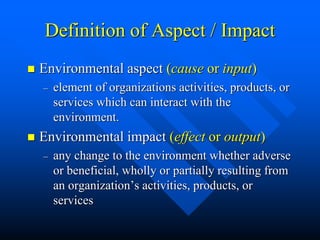
Definition of Aspect / Impact
 Environmental aspect (cause or input)
– element of organizations activities, products, or
services which can interact with the
environment.
 Environmental impact (effect or output)
– any change to the environment whether adverse
or beneficial, wholly or partially resulting from
an organization’s activities, products, or
services
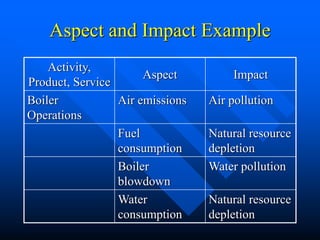
Aspect and Impact Example
Activity,
Product, Service
Aspect Impact
Boiler
Operations
Air emissions Air pollution
Fuel
consumption
Natural resource
depletion
Boiler
blowdown
Water pollution
Water
consumption
Natural resource
depletion
Step One
1) Establish a team.
Examples: representative of QA/QC,
maintenance, utilities, production divisions,
office, environmental, etc.
2) Educate the team on purpose and
implications of identifying aspects and
impacts.
Include general training on EMS’s and ISO
14001.
Purpose and Implications
 Determining the significant environmental
aspects and associated impacts allows a
facility to focus its time and resources on
those issues with the greatest potential
for environmental impact.
Purpose and Implications
 The evaluation of environmental aspects
and their associated impacts should be
primarily “fenceline” issues.
– 3.12 Definition of organization will establish
“fenceline” or boundaries.
– Internal issues should not be a
primary focus unless health and
safety are included in management
system.
Purpose and Implications
 The organization only has to identify those
environmental aspects that it “can control
and over which it can be expected to have
influence”.
– Control includes fiscal control (financial ability
that can affect aspect) and organizational
control (decision making authority that can
effect aspect)
– The facility should not spend resources
assessing aspects it cannot do anything about.
Purpose and Implications
 The significant environmental aspects that
are identified will determine how other
elements of the standard are fulfilled:
– Operational procedures
– Education, competence and training of
employees whose activities affect these aspects.
– Monitoring and measuring techniques.
Step Two
Identify Aspects / Impacts
 Select an activity, a product or service.
 Identify as many environmental aspects as
possible associated with the selected
activity.
 Identify as many actual and potential,
positive and negative, environmental
impacts associated with each identified
aspect.
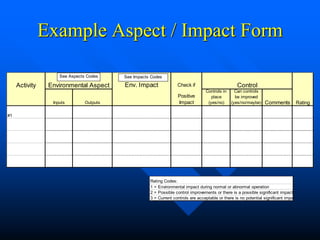
Activity Environmental Aspect Env. Impact Check if Control
Inputs Outputs
Positive
Impact
Controls in
place
(yes/no)
Can controls
be improved
(yes/no/maybe) Comments Rating
#1
See Aspects Codes See Impacts Codes
Rating Codes:
1 = Environmental impact during normal or abnormal operation
2 = Possible control improvements or there is a possible significant impact
3 = Current controls are acceptable or there is no potential significant impact
Example Aspect / Impact Form
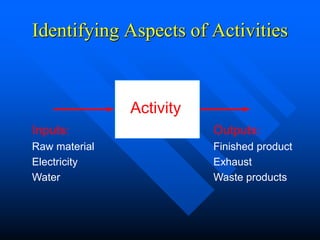
Identifying Aspects of Activities
Activity
Inputs:
Raw material
Electricity
Water
Outputs:
Finished product
Exhaust
Waste products
Identifying Aspects and Impacts
 Aspects of activities that should be
considered include:
– Emissions to air / releases to water
» Surface and groundwater
– Waste disposal / land contamination
– Raw material / natural resource use
» energy, water, chemicals, lumber, etc.
– Local environmental / community issues
» noise, odor, land use, appearance, etc.
Sources of information
 process flow diagram
 input/output (mass balance)
 regulatory reports
 utility bills
 QC information (defects, product changes)
 waste hauling records
 purchasing receipts
 records of external communication
Aspects and Impacts - Feedback
 What did your facility do?
 Are you finished identifying
aspects/impacts?
 How many did you identify?
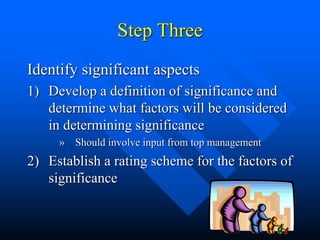
Step Three
Identify significant aspects
1) Develop a definition of significance and
determine what factors will be considered
in determining significance
» Should involve input from top management
2) Establish a rating scheme for the factors of
significance
Factors to Consider
 Environmental Concerns such as:
– The scale of the impact
– The severity of impact
– The probability of impact
– Duration of impact
 Business Concerns such as:
– Potential regulatory and legal exposure
– Difficulty and cost of changing the impact
– Effect of change on other activities and processes
– Concerns of interested parties
– Effect on the public image of the organization
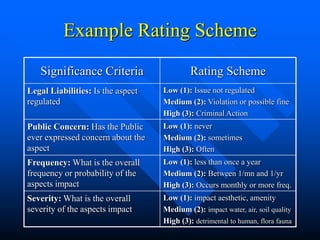
Example Rating Scheme
Significance Criteria Rating Scheme
Legal Liabilities: Is the aspect
regulated
Low (1): Issue not regulated
Medium (2): Violation or possible fine
High (3): Criminal Action
Public Concern: Has the Public
ever expressed concern about the
aspect
Low (1): never
Medium (2): sometimes
High (3): Often
Frequency: What is the overall
frequency or probability of the
aspects impact
Low (1): less than once a year
Medium (2): Between 1/mn and 1/yr
High (3): Occurs monthly or more freq.
Severity: What is the overall
severity of the aspects impact
Low (1): impact aesthetic, amenity
Medium (2): impact water, air, soil quality
High (3): detrimental to human, flora fauna
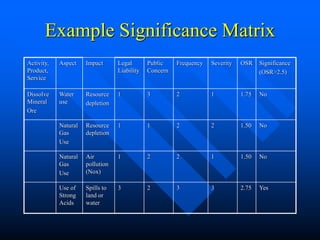
Example Significance Matrix
Activity,
Product,
Service
Aspect Impact Legal
Liability
Public
Concern
Frequency Severity OSR Significance
(OSR>2.5)
Dissolve
Mineral
Ore
Water
use
Resource
depletion
1 3 2 1 1.75 No
Natural
Gas
Use
Resource
depletion
1 1 2 2 1.50 No
Natural
Gas
Use
Air
pollution
(Nox)
1 2 2 1 1.50 No
Use of
Strong
Acids
Spills to
land or
water
3 2 3 3 2.75 Yes
Dames and Moore
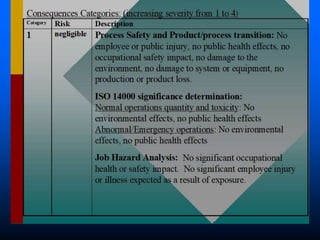
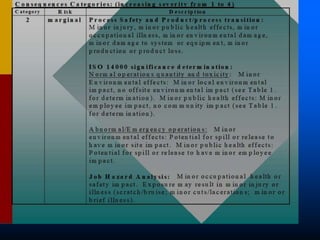
Significance Determination
 Included Health and Safety in their EMS: EHS
– Why?:
» Leverage clear relationship b/w H&S and Env. impacts
» To prioritize H&S and improve performance
» Organizational convenience
» NOTE: Don’t recommend including H&S during
implementation
 Organized in form of a consequence and
frequency matrix
Ranking Environmental Aspects:
Example Procedures and Lists
 City of Gastonia, NC
 City of Charleston, SC
 City of Scottsdale, AZ
Additional Resources
 ISO 14004
 See DPPEA website
http://www.p2pays.org/iso/index.htm
 Refer to Alcoa and Uniroyal Chemical Co.
EMS Manuals on our website, others:
http://www.p2pays.org/iso/tools/manuals.htm
 Coaches – ask if you would like help on
aspect/impact identification and ranking
 Road maps
From the EMS Team Meeting to
determining significance
 Effective Meeting/Group Project
Management Handbook
– Remember to take notes at EMS Team
meetings: how did you agree to determine
aspects/impacts, ranking?
– Use discussion techniques listed to determine
what factors you will use to rank aspects:
brainstorming, multivoting, nominal group
consensus, reaching consensus
– Write the procedures
Exercise: Determining Significance
 What factors do you think are important for
determining significance? List at least 15
 Vote on three each
Expectations of Participants:
Your BACK PACK!
 Be enthusiastic
 Attend all courses
 Complete homework and bring to course
 Keep in touch with your coach
 Persevere
 Ask for help
 Be Creative
 Keep developing your EMS between
course meetings and after the course ends
EMS Team Members:
Add some WATER
to your backpacks!
Willingness - to learn and participate
Agenda - so everyone is prepared
Talking stick – so everyone knows the
ground rules for meetings
Energy and Enthusiasm – no such thing as too much
Role understanding – for each participant, for both EMS
meetings and for EMS design and implementation
Road Maps
Don’t go hacking through the jungle,
follow the Yellow Brick Road
See Guides – Online Resources
 IEMS
 Implementation Guide for Small and Medium-
Sized Businesses
 Environmental Aspects Identification – activities
list (fishbone diagram) – Suzanne Sessoms,
August 28
 Gap analysis (initial environmental review) See
GEMI handout – John Burke
Homework Assignment
For next course meeting (Nov. 13):
 Complete identification of aspects and
impacts
 Rank aspects and impacts
 Determine significant aspects and impacts
If you get stuck. . .
. . . Ask for help!
 On-line Resources
 Your Coach – ask them to help you!
 DPPEA Staff
 DPPEA’s free EMS training
 DPPEA’s free, non-regulatory waste assessments

aspect_impact.pptx

  • 1.
    ISO 14001 Section 4.3.1 EnvironmentalAspects Julie Woosley, NC DPPEA Coordinator, EMS Development Course for Government Agencies Novozymes facility Franklinton, NC October 9, 2001
  • 2.
    4.3.1 Environmental Aspects “The organization shall establish and maintain (a) procedure(s) to identify the environmental aspects of its activities, products, or services that it can control and over which it can be expected to have an influence, in order to determine those which have or can have significant impacts on the environment. The organization shall ensure that the aspects related to these significant impacts are considered in settings its environmental objectives.  The organization shall keep this information up- to-date.”
  • 3.
    Core Elements ofEMS  Most other elements are directly associated with results from identifying and ranking aspects and their associated impacts: – Objectives and Targets – Management Program – Training/Awareness – Operational Control – Emergency preparedness – Monitoring and measuring – Corrective and Preventative Action – Auditing
  • 4.
    Definition of Aspect/ Impact  Environmental aspect (cause or input) – element of organizations activities, products, or services which can interact with the environment.  Environmental impact (effect or output) – any change to the environment whether adverse or beneficial, wholly or partially resulting from an organization’s activities, products, or services
  • 5.
    Aspect and ImpactExample Activity, Product, Service Aspect Impact Boiler Operations Air emissions Air pollution Fuel consumption Natural resource depletion Boiler blowdown Water pollution Water consumption Natural resource depletion
  • 6.
    Step One 1) Establisha team. Examples: representative of QA/QC, maintenance, utilities, production divisions, office, environmental, etc. 2) Educate the team on purpose and implications of identifying aspects and impacts. Include general training on EMS’s and ISO 14001.
  • 7.
    Purpose and Implications Determining the significant environmental aspects and associated impacts allows a facility to focus its time and resources on those issues with the greatest potential for environmental impact.
  • 8.
    Purpose and Implications The evaluation of environmental aspects and their associated impacts should be primarily “fenceline” issues. – 3.12 Definition of organization will establish “fenceline” or boundaries. – Internal issues should not be a primary focus unless health and safety are included in management system.
  • 9.
    Purpose and Implications The organization only has to identify those environmental aspects that it “can control and over which it can be expected to have influence”. – Control includes fiscal control (financial ability that can affect aspect) and organizational control (decision making authority that can effect aspect) – The facility should not spend resources assessing aspects it cannot do anything about.
  • 10.
    Purpose and Implications The significant environmental aspects that are identified will determine how other elements of the standard are fulfilled: – Operational procedures – Education, competence and training of employees whose activities affect these aspects. – Monitoring and measuring techniques.
  • 11.
    Step Two Identify Aspects/ Impacts  Select an activity, a product or service.  Identify as many environmental aspects as possible associated with the selected activity.  Identify as many actual and potential, positive and negative, environmental impacts associated with each identified aspect.
  • 12.
    Activity Environmental AspectEnv. Impact Check if Control Inputs Outputs Positive Impact Controls in place (yes/no) Can controls be improved (yes/no/maybe) Comments Rating #1 See Aspects Codes See Impacts Codes Rating Codes: 1 = Environmental impact during normal or abnormal operation 2 = Possible control improvements or there is a possible significant impact 3 = Current controls are acceptable or there is no potential significant impact Example Aspect / Impact Form
  • 13.
    Identifying Aspects ofActivities Activity Inputs: Raw material Electricity Water Outputs: Finished product Exhaust Waste products
  • 14.
    Identifying Aspects andImpacts  Aspects of activities that should be considered include: – Emissions to air / releases to water » Surface and groundwater – Waste disposal / land contamination – Raw material / natural resource use » energy, water, chemicals, lumber, etc. – Local environmental / community issues » noise, odor, land use, appearance, etc.
  • 15.
    Sources of information process flow diagram  input/output (mass balance)  regulatory reports  utility bills  QC information (defects, product changes)  waste hauling records  purchasing receipts  records of external communication
  • 16.
    Aspects and Impacts- Feedback  What did your facility do?  Are you finished identifying aspects/impacts?  How many did you identify?
  • 17.
    Step Three Identify significantaspects 1) Develop a definition of significance and determine what factors will be considered in determining significance » Should involve input from top management 2) Establish a rating scheme for the factors of significance
  • 18.
    Factors to Consider Environmental Concerns such as: – The scale of the impact – The severity of impact – The probability of impact – Duration of impact  Business Concerns such as: – Potential regulatory and legal exposure – Difficulty and cost of changing the impact – Effect of change on other activities and processes – Concerns of interested parties – Effect on the public image of the organization
  • 19.
    Example Rating Scheme SignificanceCriteria Rating Scheme Legal Liabilities: Is the aspect regulated Low (1): Issue not regulated Medium (2): Violation or possible fine High (3): Criminal Action Public Concern: Has the Public ever expressed concern about the aspect Low (1): never Medium (2): sometimes High (3): Often Frequency: What is the overall frequency or probability of the aspects impact Low (1): less than once a year Medium (2): Between 1/mn and 1/yr High (3): Occurs monthly or more freq. Severity: What is the overall severity of the aspects impact Low (1): impact aesthetic, amenity Medium (2): impact water, air, soil quality High (3): detrimental to human, flora fauna
  • 20.
    Example Significance Matrix Activity, Product, Service AspectImpact Legal Liability Public Concern Frequency Severity OSR Significance (OSR>2.5) Dissolve Mineral Ore Water use Resource depletion 1 3 2 1 1.75 No Natural Gas Use Resource depletion 1 1 2 2 1.50 No Natural Gas Use Air pollution (Nox) 1 2 2 1 1.50 No Use of Strong Acids Spills to land or water 3 2 3 3 2.75 Yes
  • 21.
    Dames and Moore SignificanceDetermination  Included Health and Safety in their EMS: EHS – Why?: » Leverage clear relationship b/w H&S and Env. impacts » To prioritize H&S and improve performance » Organizational convenience » NOTE: Don’t recommend including H&S during implementation  Organized in form of a consequence and frequency matrix
  • 29.
    Ranking Environmental Aspects: ExampleProcedures and Lists  City of Gastonia, NC  City of Charleston, SC  City of Scottsdale, AZ
  • 30.
    Additional Resources  ISO14004  See DPPEA website http://www.p2pays.org/iso/index.htm  Refer to Alcoa and Uniroyal Chemical Co. EMS Manuals on our website, others: http://www.p2pays.org/iso/tools/manuals.htm  Coaches – ask if you would like help on aspect/impact identification and ranking  Road maps
  • 31.
    From the EMSTeam Meeting to determining significance  Effective Meeting/Group Project Management Handbook – Remember to take notes at EMS Team meetings: how did you agree to determine aspects/impacts, ranking? – Use discussion techniques listed to determine what factors you will use to rank aspects: brainstorming, multivoting, nominal group consensus, reaching consensus – Write the procedures
  • 32.
    Exercise: Determining Significance What factors do you think are important for determining significance? List at least 15  Vote on three each
  • 33.
    Expectations of Participants: YourBACK PACK!  Be enthusiastic  Attend all courses  Complete homework and bring to course  Keep in touch with your coach  Persevere  Ask for help  Be Creative  Keep developing your EMS between course meetings and after the course ends
  • 34.
    EMS Team Members: Addsome WATER to your backpacks! Willingness - to learn and participate Agenda - so everyone is prepared Talking stick – so everyone knows the ground rules for meetings Energy and Enthusiasm – no such thing as too much Role understanding – for each participant, for both EMS meetings and for EMS design and implementation
  • 35.
    Road Maps Don’t gohacking through the jungle, follow the Yellow Brick Road See Guides – Online Resources  IEMS  Implementation Guide for Small and Medium- Sized Businesses  Environmental Aspects Identification – activities list (fishbone diagram) – Suzanne Sessoms, August 28  Gap analysis (initial environmental review) See GEMI handout – John Burke
  • 36.
    Homework Assignment For nextcourse meeting (Nov. 13):  Complete identification of aspects and impacts  Rank aspects and impacts  Determine significant aspects and impacts
  • 37.
    If you getstuck. . . . . . Ask for help!  On-line Resources  Your Coach – ask them to help you!  DPPEA Staff  DPPEA’s free EMS training  DPPEA’s free, non-regulatory waste assessments