Empowered Educators:
How High-Performing Systems Shape Teaching Quality
www.ncee.org/empowered-educators
June 6th, 2017
Linda Darling-Hammond, Dion Burns
Goal of Empowered Educators
Aim: to provide rich descriptions of the policy
and practices that support teaching quality in
high-performing jurisdictions
www.amazon.com
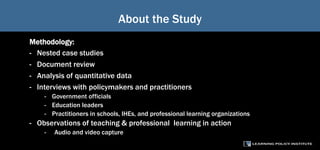
About the Study
Methodology:
- Nested case studies
- Document review
- Analysis of quantitative data
- Interviews with policymakers and practitioners
- Government officials
- Education leaders
- Practitioners in schools, IHEs, and professional learning organizations
- Observations of teaching & professional learning in action
- Audio and video capture
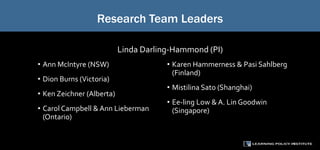
Research Team Leaders
• Ann McIntyre (NSW)
• Dion Burns (Victoria)
• Ken Zeichner (Alberta)
• Carol Campbell & Ann Lieberman
(Ontario)
• Karen Hammerness & Pasi Sahlberg
(Finland)
• Mistilina Sato (Shanghai)
• Ee-ling Low & A. Lin Goodwin
(Singapore)
5
Linda Darling-Hammond (PI)
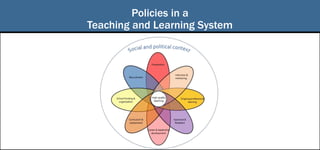
Policies in a
Teaching and Learning System
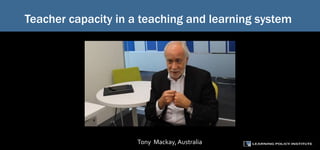
Teacher capacity in a teaching and learning system
Tony Mackay, Australia
Teacher capacity in a teaching and learning system
Tony Mackay, Australia
Finding and Keeping the Best: Recruitment, Selection &
Compensation
Recruitment
• Competitive recruitment based on academics and dispositions associated
with teaching
Research orientation
Commitment to all children & the profession
Interpersonal / verbal skills
• Into a small number of programs of comparable quality and rigor
• Preparation largely or completely paid for
• Some countries also pay stipends/ salaries
Recruitment &
Selection
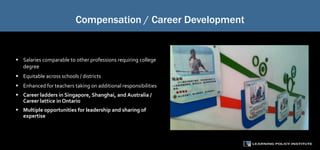
Compensation / Career Development
 Salaries comparable to other professions requiring college
degree
 Equitable across schools / districts
 Enhanced for teachers taking on additional responsibilities
 Career ladders in Singapore, Shanghai, and Australia /
Career lattice in Ontario
 Multiple opportunities for leadership and sharing of
expertise
Profession-Ready Teachers: Preparation & Induction
Preparation
• Guided by Professional Standards of Practice
• Strong Preparation in
Content-Specific Pedagogy focused on 21st Century Skills
Learning and Development
Curriculum and Assessment
• Research-Based and Research-Oriented
• Learning in Practice with Expert Mentors
3 current research projects;
Recently published a book
3 master’s degrees and PhD
MentorTeachers
Finishing PhD
”Model” Schools in Finland
Teacher preparation - Finland
Professional Teaching Schools
As in medicine and other professions, teaching schools allow
teachers to see and enact best practices linked to research and
theory
• State-of-the art education for students
• Learning from expert veterans
• Tightly linked coursework
• Development of new curriculum, new practices, and research
Initial Teacher Education:
U. of Melbourne, Victoria
Clinical
Specialist
Teaching Fellow
Induction for Beginners
Regularly available to all
Guided by trained Senior Teachers
• In-classroom coaching
• Curriculum and lesson planning
• Seminars on key topics
Reduced teaching load
Typically 2 years
• 4 years in Toronto
Induction in Singapore
Developing High-Quality Teaching: Effective Professional
Learning
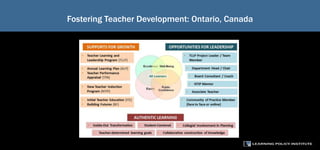
Fostering Teacher Development: Ontario, Canada
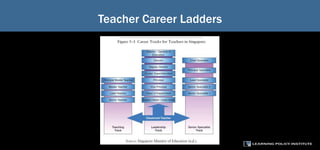
Teacher Career Ladders
Professional Learning Opportunities
Professional learning:
• Continual and developmental
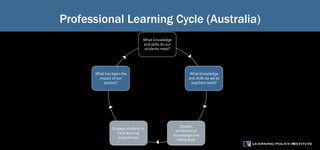
What knowledge
and skills do our
students need?
What knowledge
and skills do we as
teachers need?
Deepen
professional
knowledge and
refine skills
Engage students in
new learning
experiences
What has been the
impact of our
actions?
Professional Learning Cycle (Australia)
25
Professional Learning Opportunities
Professional learning:
• Continual and developmental
• Collaborative
• Time for professional learning in teacher schedules, plus paid time for professional
learning
• Teachers lead learning for colleagues
• Teacher and school networks
Teacher professional learning in Singapore
27
Time for professional collaboration in Singapore
Professional Learning Is Collaborative
29
Source: OECD.TALIS 2013 Results:
An International Perspective on
Teaching and Learning. OECD
Publishing.
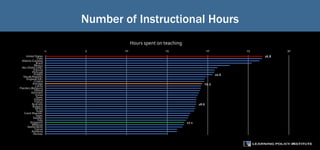
Number of Instructional Hours
26.8
20.6
19.3
18.6
17.1
0 5 10 15 20 25 30
United States
Chile
Alberta (Canada)
Brazil
Mexico
Abu Dhabi (UAE)
Estonia
Portugal
Finland
Slovak Republic
England (UK)
Croatia
Average
Latvia
Flanders (Belgium)
Iceland
Denmark
Korea
Spain
Poland
France
Australia
Bulgaria
Serbia
Israel
Czech Republic
Japan
Sweden
Italy
Singapore
Malaysia
Netherlands
Cyprus
Romania
Norway
Hours spent on teaching
30
Professional Learning Opportunities
Professional learning:
• Continual and developmental
• Collaborative
• Time for professional learning in teacher schedules, plus paid time for professional
learning
• Teachers lead learning for colleagues
• Teacher and school networks
• Teachers are researchers
• Action research, grants, and publications
Professional Collaboration in Shanghai
Jiaoyanzu at Pujian No. 2
Elementary School, Shanghai
Towards a Teaching and Learning System
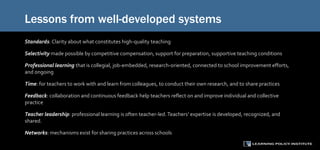
Lessons from well-developed systems
Standards: Clarity about what constitutes high-quality teaching
Selectivity made possible by competitive compensation, support for preparation, supportive teaching conditions
Professional learning that is collegial, job-embedded, research-oriented, connected to school improvement efforts,
and ongoing
Time: for teachers to work with and learn from colleagues, to conduct their own research, and to share practices
Feedback: collaboration and continuous feedback help teachers reflect on and improve individual and collective
practice
Teacher leadership: professional learning is often teacher-led.Teachers’ expertise is developed, recognized, and
shared.
Networks: mechanisms exist for sharing practices across schools
Questions?

Empowered Educators Presentation

  • 1.
    Empowered Educators: How High-PerformingSystems Shape Teaching Quality www.ncee.org/empowered-educators June 6th, 2017 Linda Darling-Hammond, Dion Burns
  • 2.
    Goal of EmpoweredEducators Aim: to provide rich descriptions of the policy and practices that support teaching quality in high-performing jurisdictions
  • 3.
  • 4.
    About the Study Methodology: -Nested case studies - Document review - Analysis of quantitative data - Interviews with policymakers and practitioners - Government officials - Education leaders - Practitioners in schools, IHEs, and professional learning organizations - Observations of teaching & professional learning in action - Audio and video capture
  • 5.
    Research Team Leaders •Ann McIntyre (NSW) • Dion Burns (Victoria) • Ken Zeichner (Alberta) • Carol Campbell & Ann Lieberman (Ontario) • Karen Hammerness & Pasi Sahlberg (Finland) • Mistilina Sato (Shanghai) • Ee-ling Low & A. Lin Goodwin (Singapore) 5 Linda Darling-Hammond (PI)
  • 6.
    Policies in a Teachingand Learning System
  • 7.
    Teacher capacity ina teaching and learning system Tony Mackay, Australia
  • 8.
    Teacher capacity ina teaching and learning system Tony Mackay, Australia
  • 9.
    Finding and Keepingthe Best: Recruitment, Selection & Compensation
  • 10.
    Recruitment • Competitive recruitmentbased on academics and dispositions associated with teaching Research orientation Commitment to all children & the profession Interpersonal / verbal skills • Into a small number of programs of comparable quality and rigor • Preparation largely or completely paid for • Some countries also pay stipends/ salaries
  • 11.
  • 12.
    Compensation / CareerDevelopment  Salaries comparable to other professions requiring college degree  Equitable across schools / districts  Enhanced for teachers taking on additional responsibilities  Career ladders in Singapore, Shanghai, and Australia / Career lattice in Ontario  Multiple opportunities for leadership and sharing of expertise
  • 13.
  • 14.
    Preparation • Guided byProfessional Standards of Practice • Strong Preparation in Content-Specific Pedagogy focused on 21st Century Skills Learning and Development Curriculum and Assessment • Research-Based and Research-Oriented • Learning in Practice with Expert Mentors
  • 15.
    3 current researchprojects; Recently published a book 3 master’s degrees and PhD MentorTeachers Finishing PhD ”Model” Schools in Finland
  • 16.
  • 17.
    Professional Teaching Schools Asin medicine and other professions, teaching schools allow teachers to see and enact best practices linked to research and theory • State-of-the art education for students • Learning from expert veterans • Tightly linked coursework • Development of new curriculum, new practices, and research
  • 18.
    Initial Teacher Education: U.of Melbourne, Victoria Clinical Specialist Teaching Fellow
  • 19.
    Induction for Beginners Regularlyavailable to all Guided by trained Senior Teachers • In-classroom coaching • Curriculum and lesson planning • Seminars on key topics Reduced teaching load Typically 2 years • 4 years in Toronto
  • 20.
  • 21.
    Developing High-Quality Teaching:Effective Professional Learning
  • 22.
  • 23.
  • 24.
    Professional Learning Opportunities Professionallearning: • Continual and developmental
  • 25.
    What knowledge and skillsdo our students need? What knowledge and skills do we as teachers need? Deepen professional knowledge and refine skills Engage students in new learning experiences What has been the impact of our actions? Professional Learning Cycle (Australia) 25
  • 26.
    Professional Learning Opportunities Professionallearning: • Continual and developmental • Collaborative • Time for professional learning in teacher schedules, plus paid time for professional learning • Teachers lead learning for colleagues • Teacher and school networks
  • 27.
  • 28.
    Time for professionalcollaboration in Singapore
  • 29.
    Professional Learning IsCollaborative 29 Source: OECD.TALIS 2013 Results: An International Perspective on Teaching and Learning. OECD Publishing.
  • 30.
    Number of InstructionalHours 26.8 20.6 19.3 18.6 17.1 0 5 10 15 20 25 30 United States Chile Alberta (Canada) Brazil Mexico Abu Dhabi (UAE) Estonia Portugal Finland Slovak Republic England (UK) Croatia Average Latvia Flanders (Belgium) Iceland Denmark Korea Spain Poland France Australia Bulgaria Serbia Israel Czech Republic Japan Sweden Italy Singapore Malaysia Netherlands Cyprus Romania Norway Hours spent on teaching 30
  • 31.
    Professional Learning Opportunities Professionallearning: • Continual and developmental • Collaborative • Time for professional learning in teacher schedules, plus paid time for professional learning • Teachers lead learning for colleagues • Teacher and school networks • Teachers are researchers • Action research, grants, and publications
  • 32.
    Professional Collaboration inShanghai Jiaoyanzu at Pujian No. 2 Elementary School, Shanghai
  • 33.
    Towards a Teachingand Learning System
  • 34.
    Lessons from well-developedsystems Standards: Clarity about what constitutes high-quality teaching Selectivity made possible by competitive compensation, support for preparation, supportive teaching conditions Professional learning that is collegial, job-embedded, research-oriented, connected to school improvement efforts, and ongoing Time: for teachers to work with and learn from colleagues, to conduct their own research, and to share practices Feedback: collaboration and continuous feedback help teachers reflect on and improve individual and collective practice Teacher leadership: professional learning is often teacher-led.Teachers’ expertise is developed, recognized, and shared. Networks: mechanisms exist for sharing practices across schools
  • 35.

Editor's Notes

  • #4 This has culminated in a series of books – five country case studies, and a cross-case book – that will be released next month. (Although you can pre-order now on Amazon!)
  • #7 A high social regard for teaching Selectivity into the profession Financial support for preparation and professional learning Professional standards that outline teaching Preparation and induction grounded in well-defined curriculum content and well-supported clinical training Teaching as a research-informed and research-engaged profession Teaching as a collaborative, not isolated, occupation Teacher development as a continuum Opportunities for leadership Systems organized to support quality teaching and equity
  • #12 I’ll give you a sense of how some of these principles look in a few policy areas. The systems are highly selective, using a broad set of criteria to select recruits Selective recruitment is supported by competitive salaries and subsidized preparation “I want to inspire the profession to not only think about how they can become great practitioners of current knowledge but [also] how they can actually be constructors of new knowledge. That new knowledge is going to make a big difference to the way in which young people will learn, what they learn, and their capacity to thrive and survive.” (Tony Mackay)
  • #16 Teacher training -school teachers are also especially selected to teach in the training schools; they typically have more experience as teachers and many of them are actively involved in academic research. While the formal qualifications are that one has to have worked for two years as a teacher; however, the norm is that teacher training teachers are highly accomplished, experienced teachers who are actively engaged in research.
  • #19 At the University of Melbourne: Clinical Specialists and Teaching Fellows provide supports for bridging theory and practice. Together they work: - Firstly with pre-service candidates providing feedback on their analysis and lesson plans against the clinical thinking model,. Secondly with mentor teachers in the partner schools, helping build their capacity in using the clinical practice model. Thus teacher candidates are brought into a school culture that shares a common language and approach to teaching and learning
  • #21 Although teacher-education programs are designed to equip teachers with the knowledge and skills they need to be able to teach successfully, educators know that teachers are not fully prepared for all they will encounter. Like doctors, who take part in internships and residencies following their medical school training, teachers need additional support to develop the broader repertoire of strategies and problem-solving knowledge and skill they need for their complex jobs. As a result, most high-performing jurisdictions have developed intensive programs of mentoring and induction for new teachers that provide helpful learning supports.
  • #22 As Linda described, the systems we studied place a strong emphasis on providing prospective teachers with a solid grounding to ensure they are ready to practice. But our research found that these systems also provide structures and opportunities to enable teachers to continually improve their practice. We found there were common principles that underpinned professional learning in each of these systems, and that each also offered teacher career and leadership opportunities in which teachers could employ these skills and take on new roles in schools and school systems.
  • #23 By way of example, this chart shows an overview of the key provincial policies supporting the development of teachers in Ontario. The boxes on the RHS show some of the major opportunities for teacher leadership.
  • #24 As a second example, Singapore offers a range of career possibilities, divided into three major tracks.
  • #25 In order to develop the skills to progress throughout the career, teachers in these systems have access to professional learning opportunities with several common characteristics: PL is continual and developmental: Teaching standards set out expectations of the knowledge and skills at the various career stages.
  • #26 This is the cycle that guides teacher professional learning to activate and embed the standards, and implement them in their classroom practice. Teachers follow this cycle of professional learning with the standards in order to maintain their professional certification. It is centered on student learning.
  • #27 PL is collaborative: extended time is made available in teacher schedules for teachers to meet, plan together, review student work. And there are opportunities to observe classes, and receive feedback to improve practice. Teachers lead professional learning for their colleagues. Ontario’s TLLP is one such example. This deepens professional knowledge, ensures that professional learning is relevant to teachers’ learning needs, and connects individual learning goals to school goals Each jurisdiction has teacher and school networks, such that effective practices can be shared system-wide
  • #29 Schools in countries such as Singapore build significant time for teacher professional learning into their schedules. This is Rosmiliah’s schedule set over a two week period. (Total:~36 hrs in school: ~12hrs teaching; ~5 hrs co-curricular; ~19 hrs professional learning & planning)
  • #30 One of the reasons teacher collaboration is so important is its relationship to teacher self-efficacy and job satisfaction.
  • #31 Part of what makes teacher collaborative professional learning more challenging in the United States is time, and in particular, the different number of weekly instructional hours with students.
  • #32 Teachers are researchers: teachers are expected to be not only versed in current literature, but increasingly involved in programs such as action research to inform their teaching practice.
  • #33 This is a teaching research group, or jiaoyanzu. These are common in schools in China. Teacher meet weekly to engage in research and joint lesson planning, they then observe classes, and come back together to provide feedback on teaching. This is an example of the kind of structures that support teachers, to enable them to be reflective in their practice, and to continually develop their skills throughout the teaching career.