Empathy Mapping Exercise
Danielle Souder
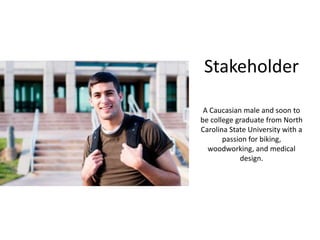
Stakeholder
A Caucasian male and soon to
be college graduate from North
Carolina State University with a
passion for biking,
woodworking, and medical
design.
Say Think
Do Feel
Stakeholder
• “The mindset is changing…from the early 2000s…..you could get your degree and have no problem
getting a job…now that is different.”
• “Engineers are working low paying jobs just to get by…in that case it might be valuable to go back
and get a masters…but then you get student loans and debt…so it is equally a tough.”
• “My education is going to prepare me for the best that it can but I am for the internships after
graduating.”
• Ideally if I could redo something…I would have loved to travel and go abroad.”
• I am not going to let my schooling get in the way of education.
• I hated the education system before college. Standardized testing does not test all strengths…it
only tests certain aspects…somebody may not be able to write a beautiful paper…but somebody
that can take apart a motor and fix a car….has a different gifting that is not being recognized as
valuable.
• “Four years of college is not enough time to know exactly what I want to do.”
• “I would feel a lot better about getting a job if there had been more experiential opportunities in
college.”
• A cool way to approach the transition…is allow past students and professionals the ability to
influence and add to the existing curriculum.
• There needs to be more workshops that teach students basic interviewing and resume building
strategies.
• I think it is important to get as much exposure to the trends and the knowledge currently out in the
market place or in any field within degree. Making connections with people is such an important
aspect of life after college.
Say
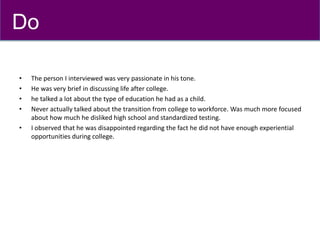
• The person I interviewed was very passionate in his tone.
• He was very brief in discussing life after college.
• he talked a lot about the type of education he had as a child.
• Never actually talked about the transition from college to workforce. Was much more focused
about how much he disliked high school and standardized testing.
• I observed that he was disappointed regarding the fact he did not have enough experiential
opportunities during college.
Do
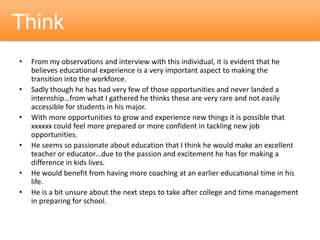
• From my observations and interview with this individual, it is evident that he
believes educational experience is a very important aspect to making the
transition into the workforce.
• Sadly though he has had very few of those opportunities and never landed a
internship…from what I gathered he thinks these are very rare and not easily
accessible for students in his major.
• With more opportunities to grow and experience new things it is possible that
xxxxxx could feel more prepared or more confident in tackling new job
opportunities.
• He seems so passionate about education that I think he would make an excellent
teacher or educator…due to the passion and excitement he has for making a
difference in kids lives.
• He would benefit from having more coaching at an earlier educational time in his
life.
• He is a bit unsure about the next steps to take after college and time management
in preparing for school.
Think
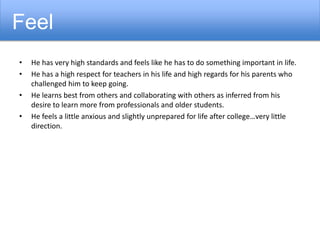
• He has very high standards and feels like he has to do something important in life.
• He has a high respect for teachers in his life and high regards for his parents who
challenged him to keep going.
• He learns best from others and collaborating with others as inferred from his
desire to learn more from professionals and older students.
• He feels a little anxious and slightly unprepared for life after college…very little
direction.
Feel
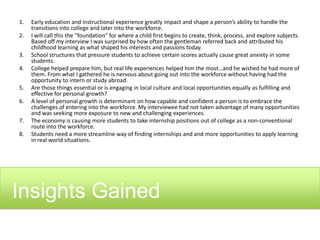
1. Early education and instructional experience greatly impact and shape a person’s ability to handle the
transitions into college and later into the workforce.
2. I will call this the “foundation” for where a child first begins to create, think, process, and explore subjects.
Based off my interview I was surprised by how often the gentleman referred back and attributed his
childhood learning as what shaped his interests and passions today.
3. School structures that pressure students to achieve certain scores actually cause great anxiety in some
students.
4. College helped prepare him, but real life experiences helped him the most…and he wished he had more of
them. From what I gathered he is nervous about going out into the workforce without having had the
opportunity to intern or study abroad.
5. Are those things essential or is engaging in local culture and local opportunities equally as fulfilling and
effective for personal growth?
6. A level of personal growth is determinant on how capable and confident a person is to embrace the
challenges of entering into the workforce. My interviewee had not taken advantage of many opportunities
and was seeking more exposure to new and challenging experiences.
7. The economy is causing more students to take internship positions out of college as a non-conventional
route into the workforce.
8. Students need a more streamline way of finding internships and and more opportunities to apply learning
in real world situations.
Insights Gained
“To make the student-to-workforce transition smoother,
educators need to provide students with new and fresh ways of
experiencing learning beyond what is taught in the classroom
because many students do not fully understand how their
academic interests benefit people and impact the real world.”
Problem Statement

Empathy map danielle souder

  • 1.
  • 2.
    Stakeholder A Caucasian maleand soon to be college graduate from North Carolina State University with a passion for biking, woodworking, and medical design.
  • 3.
  • 4.
    • “The mindsetis changing…from the early 2000s…..you could get your degree and have no problem getting a job…now that is different.” • “Engineers are working low paying jobs just to get by…in that case it might be valuable to go back and get a masters…but then you get student loans and debt…so it is equally a tough.” • “My education is going to prepare me for the best that it can but I am for the internships after graduating.” • Ideally if I could redo something…I would have loved to travel and go abroad.” • I am not going to let my schooling get in the way of education. • I hated the education system before college. Standardized testing does not test all strengths…it only tests certain aspects…somebody may not be able to write a beautiful paper…but somebody that can take apart a motor and fix a car….has a different gifting that is not being recognized as valuable. • “Four years of college is not enough time to know exactly what I want to do.” • “I would feel a lot better about getting a job if there had been more experiential opportunities in college.” • A cool way to approach the transition…is allow past students and professionals the ability to influence and add to the existing curriculum. • There needs to be more workshops that teach students basic interviewing and resume building strategies. • I think it is important to get as much exposure to the trends and the knowledge currently out in the market place or in any field within degree. Making connections with people is such an important aspect of life after college. Say
  • 5.
    • The personI interviewed was very passionate in his tone. • He was very brief in discussing life after college. • he talked a lot about the type of education he had as a child. • Never actually talked about the transition from college to workforce. Was much more focused about how much he disliked high school and standardized testing. • I observed that he was disappointed regarding the fact he did not have enough experiential opportunities during college. Do
  • 6.
    • From myobservations and interview with this individual, it is evident that he believes educational experience is a very important aspect to making the transition into the workforce. • Sadly though he has had very few of those opportunities and never landed a internship…from what I gathered he thinks these are very rare and not easily accessible for students in his major. • With more opportunities to grow and experience new things it is possible that xxxxxx could feel more prepared or more confident in tackling new job opportunities. • He seems so passionate about education that I think he would make an excellent teacher or educator…due to the passion and excitement he has for making a difference in kids lives. • He would benefit from having more coaching at an earlier educational time in his life. • He is a bit unsure about the next steps to take after college and time management in preparing for school. Think
  • 7.
    • He hasvery high standards and feels like he has to do something important in life. • He has a high respect for teachers in his life and high regards for his parents who challenged him to keep going. • He learns best from others and collaborating with others as inferred from his desire to learn more from professionals and older students. • He feels a little anxious and slightly unprepared for life after college…very little direction. Feel
  • 8.
    1. Early educationand instructional experience greatly impact and shape a person’s ability to handle the transitions into college and later into the workforce. 2. I will call this the “foundation” for where a child first begins to create, think, process, and explore subjects. Based off my interview I was surprised by how often the gentleman referred back and attributed his childhood learning as what shaped his interests and passions today. 3. School structures that pressure students to achieve certain scores actually cause great anxiety in some students. 4. College helped prepare him, but real life experiences helped him the most…and he wished he had more of them. From what I gathered he is nervous about going out into the workforce without having had the opportunity to intern or study abroad. 5. Are those things essential or is engaging in local culture and local opportunities equally as fulfilling and effective for personal growth? 6. A level of personal growth is determinant on how capable and confident a person is to embrace the challenges of entering into the workforce. My interviewee had not taken advantage of many opportunities and was seeking more exposure to new and challenging experiences. 7. The economy is causing more students to take internship positions out of college as a non-conventional route into the workforce. 8. Students need a more streamline way of finding internships and and more opportunities to apply learning in real world situations. Insights Gained
  • 9.
    “To make thestudent-to-workforce transition smoother, educators need to provide students with new and fresh ways of experiencing learning beyond what is taught in the classroom because many students do not fully understand how their academic interests benefit people and impact the real world.” Problem Statement