EMPATHY MAP
TAT I A N A TAVA R E S
INTERVIEW
INTERVIEWS
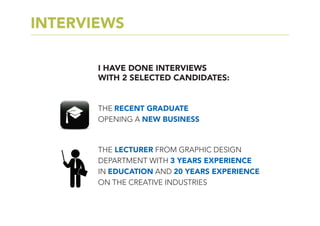
I HAVE DONE INTERVIEWS
WITH 2 SELECTED CANDIDATES:
THE RECENT GRADUATE
OPENING A NEW BUSINESS
THE LECTURER FROM GRAPHIC DESIGN
DEPARTMENT WITH 3 YEARS EXPERIENCE
IN EDUCATION AND 20 YEARS EXPERIENCE
ON THE CREATIVE INDUSTRIES
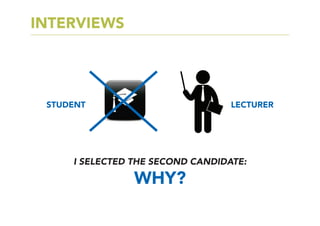
I SELECTED THE SECOND CANDIDATE:
WHY?
LECTURERSTUDENT
INTERVIEWS
THE RECENT GRADUATE HAD JUST
OPENED A NEW BUSINESS AND HAS A
UNREALISTIC VISION
ABOUT THE WORK ENVIRONMENT.
SHE WASN’T ABLE TO IDENTIFY
ANY PARTICULAR PROBLEM WITH
HER SCHOOL-WORK TRANSITION.
THIS WAS THE PROBLEM!
I SELECTED THE SECOND CANDIDATE:
LECTURER
INTERVIEWS
A LECTURER FROM GRAPHIC DESIGN
DEPARTMENT WITH 3 YEARS EXPERIENCE
IN EDUCATION AND 20 YEARS EXPERIENCE
ON THE CREATIVE INDUSTRIES
SAY
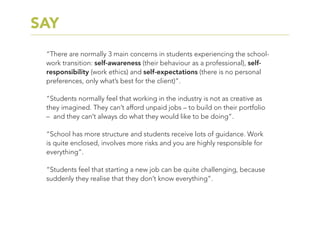
“There are normally 3 main concerns in students experiencing the school-
work transition: self-awareness (their behaviour as a professional), self-
responsibility (work ethics) and self-expectations (there is no personal
preferences, only what’s best for the client)”.
“Students normally feel that working in the industry is not as creative as
they imagined. They can’t afford unpaid jobs – to build on their portfolio
– and they can’t always do what they would like to be doing”.
“School has more structure and students receive lots of guidance. Work
is quite enclosed, involves more risks and you are highly responsible for
everything”.
“Students feel that starting a new job can be quite challenging, because
suddenly they realise that they don’t know everything”.
SAY
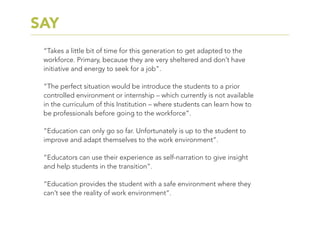
“Takes a little bit of time for this generation to get adapted to the
workforce. Primary, because they are very sheltered and don’t have
initiative and energy to seek for a job”.
“The perfect situation would be introduce the students to a prior
controlled environment or internship – which currently is not available
in the curriculum of this Institution – where students can learn how to
be professionals before going to the workforce”.
“Education can only go so far. Unfortunately is up to the student to
improve and adapt themselves to the work environment”.
“Educators can use their experience as self-narration to give insight
and help students in the transition”.
“Education provides the student with a safe environment where they
can’t see the reality of work environment”.
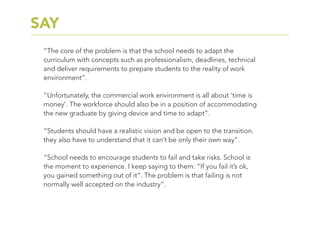
SAY
“The core of the problem is that the school needs to adapt the
curriculum with concepts such as professionalism, deadlines, technical
and deliver requirements to prepare students to the reality of work
environment”.
“Unfortunately, the commercial work environment is all about ‘time is
money’. The workforce should also be in a position of accommodating
the new graduate by giving device and time to adapt”.
“Students should have a realistic vision and be open to the transition.
they also have to understand that it can’t be only their own way”.
“School needs to encourage students to fail and take risks. School is
the moment to experience. I keep saying to them: “If you fail it’s ok,
you gained something out of it”. The problem is that failing is not
normally well accepted on the industry”.
SAY
THINK / FEEL
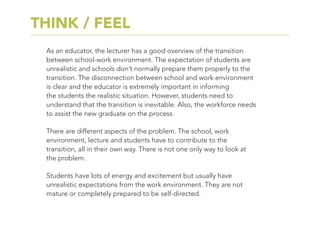
As an educator, the lecturer has a good overview of the transition
between school-work environment. The expectation of students are
unrealistic and schools don’t normally prepare them properly to the
transition. The disconnection between school and work environment
is clear and the educator is extremely important in informing
the students the realistic situation. However, students need to
understand that the transition is inevitable. Also, the workforce needs
to assist the new graduate on the process.
There are different aspects of the problem. The school, work
environment, lecture and students have to contribute to the
transition, all in their own way. There is not one only way to look at
the problem.
Students have lots of energy and excitement but usually have
unrealistic expectations from the work environment. They are not
mature or completely prepared to be self-directed.
THINK / FEEL
INSIGHTS
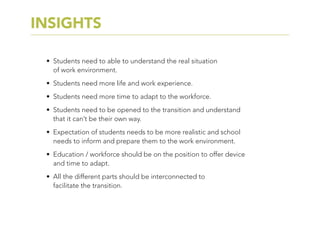
•	 Students need to able to understand the real situation
of work environment.
•	 Students need more life and work experience.
•	 Students need more time to adapt to the workforce.
•	 Students need to be opened to the transition and understand
that it can’t be their own way.
•	 Expectation of students needs to be more realistic and school
needs to inform and prepare them to the work environment.
•	 Education / workforce should be on the position to offer device
and time to adapt.
•	 All the different parts should be interconnected to
facilitate the transition.
INSIGHTS
PROBLEM STATEMENT
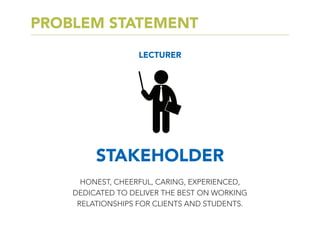
STAKEHOLDER
LECTURER
PROBLEM STATEMENT
HONEST, CHEERFUL, CARING, EXPERIENCED,
DEDICATED TO DELIVER THE BEST ON WORKING
RELATIONSHIPS FOR CLIENTS AND STUDENTS.
NEEDS A WAY TO
BECAUSE
PROBLEM STATEMENT
GUIDE STUDENTS ON THE
WORK-SCHOOL TRANSITION
STUDENTS HAVE AN UNREALIST
EXPECTATION AND SCHOOLS DON’T PREPARE
THEM TO THE WORK ENVIRONMENT.

Empathy map / problem statement - Tatiana Tavares

  • 1.
    EMPATHY MAP TAT IA N A TAVA R E S
  • 2.
  • 3.
    INTERVIEWS I HAVE DONEINTERVIEWS WITH 2 SELECTED CANDIDATES: THE RECENT GRADUATE OPENING A NEW BUSINESS THE LECTURER FROM GRAPHIC DESIGN DEPARTMENT WITH 3 YEARS EXPERIENCE IN EDUCATION AND 20 YEARS EXPERIENCE ON THE CREATIVE INDUSTRIES
  • 4.
    I SELECTED THESECOND CANDIDATE: WHY? LECTURERSTUDENT INTERVIEWS
  • 5.
    THE RECENT GRADUATEHAD JUST OPENED A NEW BUSINESS AND HAS A UNREALISTIC VISION ABOUT THE WORK ENVIRONMENT. SHE WASN’T ABLE TO IDENTIFY ANY PARTICULAR PROBLEM WITH HER SCHOOL-WORK TRANSITION. THIS WAS THE PROBLEM!
  • 6.
    I SELECTED THESECOND CANDIDATE: LECTURER INTERVIEWS A LECTURER FROM GRAPHIC DESIGN DEPARTMENT WITH 3 YEARS EXPERIENCE IN EDUCATION AND 20 YEARS EXPERIENCE ON THE CREATIVE INDUSTRIES
  • 7.
  • 8.
    “There are normally3 main concerns in students experiencing the school- work transition: self-awareness (their behaviour as a professional), self- responsibility (work ethics) and self-expectations (there is no personal preferences, only what’s best for the client)”. “Students normally feel that working in the industry is not as creative as they imagined. They can’t afford unpaid jobs – to build on their portfolio – and they can’t always do what they would like to be doing”. “School has more structure and students receive lots of guidance. Work is quite enclosed, involves more risks and you are highly responsible for everything”. “Students feel that starting a new job can be quite challenging, because suddenly they realise that they don’t know everything”. SAY
  • 9.
    “Takes a littlebit of time for this generation to get adapted to the workforce. Primary, because they are very sheltered and don’t have initiative and energy to seek for a job”. “The perfect situation would be introduce the students to a prior controlled environment or internship – which currently is not available in the curriculum of this Institution – where students can learn how to be professionals before going to the workforce”. “Education can only go so far. Unfortunately is up to the student to improve and adapt themselves to the work environment”. “Educators can use their experience as self-narration to give insight and help students in the transition”. “Education provides the student with a safe environment where they can’t see the reality of work environment”. SAY
  • 10.
    “The core ofthe problem is that the school needs to adapt the curriculum with concepts such as professionalism, deadlines, technical and deliver requirements to prepare students to the reality of work environment”. “Unfortunately, the commercial work environment is all about ‘time is money’. The workforce should also be in a position of accommodating the new graduate by giving device and time to adapt”. “Students should have a realistic vision and be open to the transition. they also have to understand that it can’t be only their own way”. “School needs to encourage students to fail and take risks. School is the moment to experience. I keep saying to them: “If you fail it’s ok, you gained something out of it”. The problem is that failing is not normally well accepted on the industry”. SAY
  • 11.
  • 12.
    As an educator,the lecturer has a good overview of the transition between school-work environment. The expectation of students are unrealistic and schools don’t normally prepare them properly to the transition. The disconnection between school and work environment is clear and the educator is extremely important in informing the students the realistic situation. However, students need to understand that the transition is inevitable. Also, the workforce needs to assist the new graduate on the process. There are different aspects of the problem. The school, work environment, lecture and students have to contribute to the transition, all in their own way. There is not one only way to look at the problem. Students have lots of energy and excitement but usually have unrealistic expectations from the work environment. They are not mature or completely prepared to be self-directed. THINK / FEEL
  • 13.
  • 14.
    • Students needto able to understand the real situation of work environment. • Students need more life and work experience. • Students need more time to adapt to the workforce. • Students need to be opened to the transition and understand that it can’t be their own way. • Expectation of students needs to be more realistic and school needs to inform and prepare them to the work environment. • Education / workforce should be on the position to offer device and time to adapt. • All the different parts should be interconnected to facilitate the transition. INSIGHTS
  • 15.
  • 16.
    STAKEHOLDER LECTURER PROBLEM STATEMENT HONEST, CHEERFUL,CARING, EXPERIENCED, DEDICATED TO DELIVER THE BEST ON WORKING RELATIONSHIPS FOR CLIENTS AND STUDENTS.
  • 17.
    NEEDS A WAYTO BECAUSE PROBLEM STATEMENT GUIDE STUDENTS ON THE WORK-SCHOOL TRANSITION STUDENTS HAVE AN UNREALIST EXPECTATION AND SCHOOLS DON’T PREPARE THEM TO THE WORK ENVIRONMENT.