Description
of
Stakeholder
Say/Do (from the
Stakeholder)
Think/Feel
Inferences
(Educated guesses
about how the
Stakeholder
feels/thinks)
Insight(s) Problem(s)
Problem
Statement
34-year-old
university
graduate
who worked
in both a
corporate
and start up
environment
for 5+ years.
"If students are on
financial aid, they
become dependent
on it."
"This makes the
transition from
school to work
difficult because
not only are they
not getting
financial aid, they
also have to start
paying it back."
* Difficult to teach
students about
financial matters, eg
saving, paying back
loans, etc
* Lack of effective
resources to teach
students how to pay
back loans in time
* Lack of
widespread/well-
known resources to
teach students about
loans
* Need for more
scholarships (that
students don't have
to pay back)
* Need for longer
payback time for
loans
* Need for less
interest on loans
Students don't
know about all
the resources
that are
available to
them at schools
and online.
Students need a
way to
understand
resources
available for
their transition
into the
workplace
Schools need a
method to
understand and
meet the needs
of students
who will be
transitioning
into the
workplace
because there
still exists a
time gap
between
graduation and
attaining a
related job.
Had a desire
to more
concretely
give back to
the
community,
so because
an academic
counselor at
the local
community
college.
"School often
times prepares
students
academically, but
not with proper
skill that are
desired in the
workplace."
"In other words,
many students
don't graduate
with the skills that
are in demand,
which means
there's little need
for the skills the
students come out
of college with."
* Lack of courses on
"real-world" skills
* Need for "real
world scenario"
courses in the
education
program/degree
* Lack of
communication (of
skills needed)
between colleges
and businesses
* Need for
restructure/reorganization
of current
educational
requirements
Students
graduate
without much
preparaion for
the skills
needed in a
work setting.
Education
systems need to
have a method
to understand
the skills
needed in the
workplace, and
to address those
skills in their
curriculum.
1
Meets with
students
regularly to
aid in
registration,
course
selection/scheduling,
and
transition to
work
"These days,
many students are
non-traditional,
meaning they are
married, have
children, or
already working
2-3 part-time
jobs."
"In order to
transition
effectively to the
workplace, they
have to at least
complete a
certificate or
degree."
"Often times, this
is very
challenging to do
while balancing
their other
priorities."
* Need for resources
for students with
diverse backgrounds
(eg little/no English
skills vs in poverty
vs time constraints,
etc)
* Need for a
degree/certification
that actual does
contribute skills
used in the
workplace
* Need for
stakeholders/board
of education to
make getting a
certification easier
on those who are not
academically adept,
but can contribute
greatly to society
(eg why does a
carpenter need
mastery of US
History 101?)
The student
body is now
more diverse
than ever
before.
Both schools
and workplaces
should have a
method to
address diverse
student/employee
populations
Involved
with local
non-profits,
notably the
Austin
chapter of
Room to
Read (which
aims to
improve
literacy and
gender
equality in
education)
"Most schools
don't teach the
skills needed for
effective job
searching (ie.
resume writing,
interview skills,
etc.)."
"Therefore, many
students with the
proper skills
cannot find or
effectively land
jobs that they're
qualified for."
* Lack of person-to-
person resources for
job searching
* Lack of affordable
quality resources for
job searching
* Lack of education
on discovering jobs
that students are
qualified for
Students are
unaware of job
openings for
which they
meet the job
requirements.
There needs to
be a easy way
to connect
qualified people
with available
jobs.
2
Eagle Scout
(Boy Scouts
of America)
whose father
served in the
Air Force
and whose
parents are
immigrants
who
attended
college in
the US
"Many students
today feel
entitled."
"They want to
make $60,000
/year without
having to work
their way up the
system."
"They also want
strategic jobs, etc.
and few (if any)
companies are
willing to give
these experienced
jobs to people
fresh out of
college".
* Lack of
internships/coops to
expose students to
understanding "the
real world"
* Need for
instruction/courses
on discipline,
responsbility,
negotitation,
working hard, etc
* Need for positive
role models for
students to better
understand how to
get jobs they desire
(eg mentors, a big
brother/sister for
graduates)
The "real
world"
unfortunately
comes as a
surprise to
many students.
Realistic
information
needs to be
conveyed to
students and
upcoming
graduates
somehow.
Do: Has a lot fo
say about both
college
requirements,
student feedback,
views from an
employer, etc.
* Clearly very
passionate about the
education system in
the US, as well as
the transition of
students into the
workplace.
There are
stakeholders
already in the
education
system who
would aid in
development of
programs for
school-to-work
transition
Do: Calm
demeanor, but
succinct and well
versed.
* Must be patient
when dealing with
students and the
education system.
Academic
advisors could
be one of the
intial points of
contact for
students who
want
information
about how to
tranition into
the workplace
Do: Enjoys using
hand gestures to
emphasize points.
* Excited to discuss
issues in the school
to work transition
Academic
advisors may
be great for
relaying
problems in the
school system
to students,
schools, and
businesses
3
Do: Answers
questions from
walk-ins and well
as responds to
student emails
during downtime
* Open to learning
new resources that
can address student
concerns
Roles of those
in the
education
system could
be even more
diversified
4

Empathy map 4 pages

  • 1.
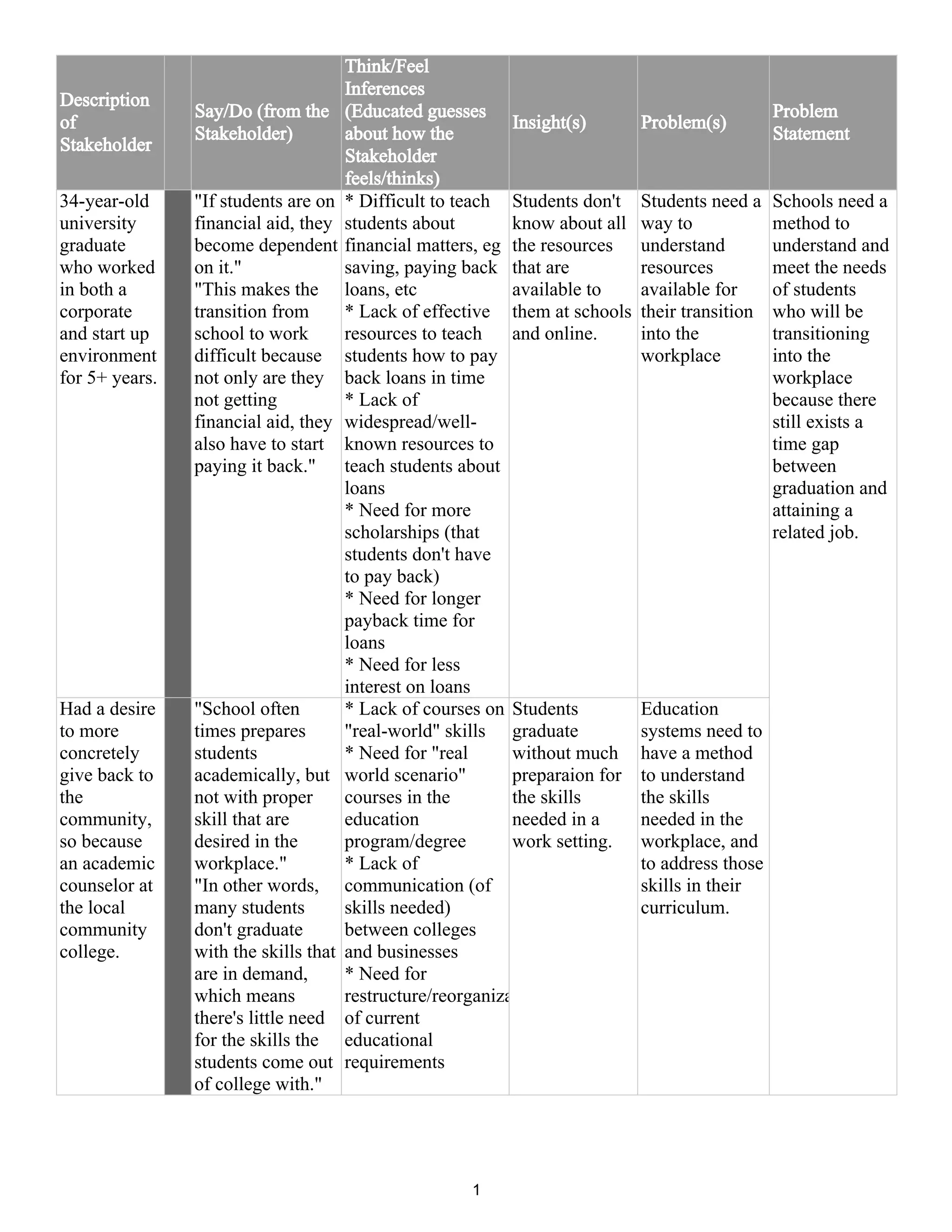
    Description of Stakeholder Say/Do (from the Stakeholder) Think/Feel Inferences (Educatedguesses about how the Stakeholder feels/thinks) Insight(s) Problem(s) Problem Statement 34-year-old university graduate who worked in both a corporate and start up environment for 5+ years. "If students are on financial aid, they become dependent on it." "This makes the transition from school to work difficult because not only are they not getting financial aid, they also have to start paying it back." * Difficult to teach students about financial matters, eg saving, paying back loans, etc * Lack of effective resources to teach students how to pay back loans in time * Lack of widespread/well- known resources to teach students about loans * Need for more scholarships (that students don't have to pay back) * Need for longer payback time for loans * Need for less interest on loans Students don't know about all the resources that are available to them at schools and online. Students need a way to understand resources available for their transition into the workplace Schools need a method to understand and meet the needs of students who will be transitioning into the workplace because there still exists a time gap between graduation and attaining a related job. Had a desire to more concretely give back to the community, so because an academic counselor at the local community college. "School often times prepares students academically, but not with proper skill that are desired in the workplace." "In other words, many students don't graduate with the skills that are in demand, which means there's little need for the skills the students come out of college with." * Lack of courses on "real-world" skills * Need for "real world scenario" courses in the education program/degree * Lack of communication (of skills needed) between colleges and businesses * Need for restructure/reorganization of current educational requirements Students graduate without much preparaion for the skills needed in a work setting. Education systems need to have a method to understand the skills needed in the workplace, and to address those skills in their curriculum. 1
  • 2.
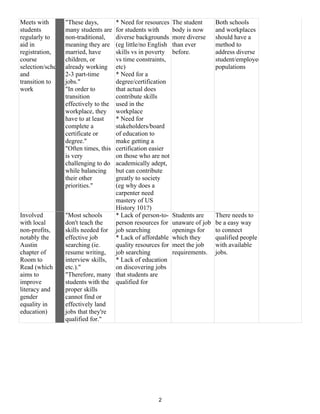
    Meets with students regularly to aidin registration, course selection/scheduling, and transition to work "These days, many students are non-traditional, meaning they are married, have children, or already working 2-3 part-time jobs." "In order to transition effectively to the workplace, they have to at least complete a certificate or degree." "Often times, this is very challenging to do while balancing their other priorities." * Need for resources for students with diverse backgrounds (eg little/no English skills vs in poverty vs time constraints, etc) * Need for a degree/certification that actual does contribute skills used in the workplace * Need for stakeholders/board of education to make getting a certification easier on those who are not academically adept, but can contribute greatly to society (eg why does a carpenter need mastery of US History 101?) The student body is now more diverse than ever before. Both schools and workplaces should have a method to address diverse student/employee populations Involved with local non-profits, notably the Austin chapter of Room to Read (which aims to improve literacy and gender equality in education) "Most schools don't teach the skills needed for effective job searching (ie. resume writing, interview skills, etc.)." "Therefore, many students with the proper skills cannot find or effectively land jobs that they're qualified for." * Lack of person-to- person resources for job searching * Lack of affordable quality resources for job searching * Lack of education on discovering jobs that students are qualified for Students are unaware of job openings for which they meet the job requirements. There needs to be a easy way to connect qualified people with available jobs. 2
  • 3.
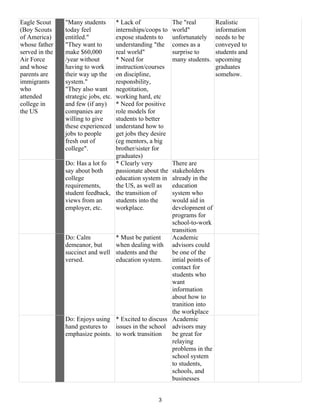
    Eagle Scout (Boy Scouts ofAmerica) whose father served in the Air Force and whose parents are immigrants who attended college in the US "Many students today feel entitled." "They want to make $60,000 /year without having to work their way up the system." "They also want strategic jobs, etc. and few (if any) companies are willing to give these experienced jobs to people fresh out of college". * Lack of internships/coops to expose students to understanding "the real world" * Need for instruction/courses on discipline, responsbility, negotitation, working hard, etc * Need for positive role models for students to better understand how to get jobs they desire (eg mentors, a big brother/sister for graduates) The "real world" unfortunately comes as a surprise to many students. Realistic information needs to be conveyed to students and upcoming graduates somehow. Do: Has a lot fo say about both college requirements, student feedback, views from an employer, etc. * Clearly very passionate about the education system in the US, as well as the transition of students into the workplace. There are stakeholders already in the education system who would aid in development of programs for school-to-work transition Do: Calm demeanor, but succinct and well versed. * Must be patient when dealing with students and the education system. Academic advisors could be one of the intial points of contact for students who want information about how to tranition into the workplace Do: Enjoys using hand gestures to emphasize points. * Excited to discuss issues in the school to work transition Academic advisors may be great for relaying problems in the school system to students, schools, and businesses 3
  • 4.
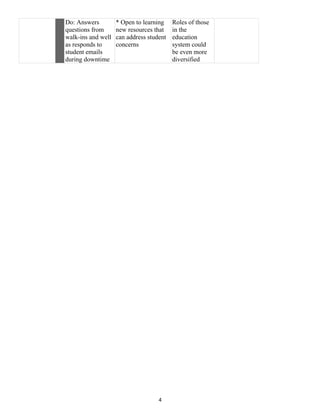
    Do: Answers questions from walk-insand well as responds to student emails during downtime * Open to learning new resources that can address student concerns Roles of those in the education system could be even more diversified 4