RUNNING HEAD: EFFECTS OF TENURE STATUS ON NEW EDUCATORS 1
Effects of Tenure Status on New Educators
Morgan Sanders
Dr. Ann Petersen
EDCI 631 Research Design and Data Analysis
Chadron State College
Spring 2021
Effects of Tenure Status on New Educators 2
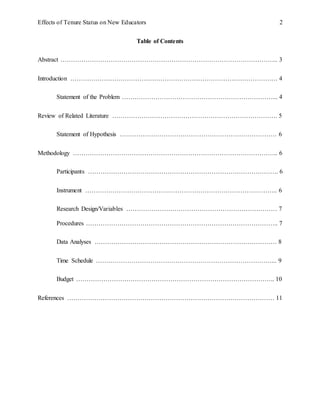
Table of Contents
Abstract ………………………………………………………………………………………….. 3
Introduction ……………………………………………………………………………………… 4
Statement of the Problem ………………………………………………………………... 4
Review of Related Literature ……………………………………………………………………. 5
Statement of Hypothesis ………………………………………………………………… 6
Methodology …………………………………………………………………………………….. 6
Participants ………………………………………………………………………………. 6
Instrument ……………………………………………………………………………….. 6
Research Design/Variables ……………………………………………………………… 7
Procedures ……………………………………………………………………………….. 7
Data Analyses …………………………………………………………………………… 8
Time Schedule …………………………………………………………………………... 9
Budget ………………………………………………………………………………….. 10
References ……………………………………………………………………………………… 11
Effects of Tenure Status on New Educators 3
Abstract
Due to the underlying pressures of becoming a skilled and experienced teacher, many
newly hired teachers face a large amount of mental, emotional, and physical health battles as
they enter the teaching profession. The purpose of this study will be to unveil the distress that
non-continuing contract teachers face as they are evaluated and learn what it takes to earn a
continuing contract in a competitive school district.
Many teachers who are hired without any teaching experience are placed in a situation
where they are formally evaluated two to three times in one given school year. This can be an
extremely stressful process to put a young teacher through, especially when earning a continuing
contract is on the line. Therefore, the effectiveness of newly hired teachers can be hindered when
they are pushed to the limits and overwhelmed.
Effects of Tenure Status on New Educators 4
Effects of Tenure Status on New Educators
Introduction
Teachers do not earn tenure status until they have successfully completed their third year
of teaching; teachers who have not earned tenure status are on the “non-continuing” contract and
can be let go at the end of a school year without being given a reason. Thus, the first three years
of teaching can be some of the most stressful years for an educator. This is due to copious
amounts of pressure that are placed on the educator to be their best and work hard to earn a spot
in the school district.
Many school districts evaluate their non-continuing contract teachers twice a year, while
continuing contract teachers are only evaluated once a year. According to Jacobs, “In a
profession where salary is still largely determined by years on the job, tenure is defended as
protecting more veteran teachers from losing their jobs to lower-paid, novice teachers” (P. 1). It
can certainly be the case that a new teacher is much more effective than a veteran teacher, but
because of the tenure status, the new teacher would be let go before the veteran teacher is.
Several teachers who have not earned tenure status are also new to the profession and only have
student teaching experience. Therefore, these new teachers can experience emotional, physical,
and mental health issues as they venture into this profession with very little experience and
training.
Statement of Problem
The purpose of this study will be to discover the implications of tenure status on the
effectiveness of new teachers within the classroom and the mental, physical, and emotional
health of teachers who are new to the profession. The Merriam-Webster Dictionary defines
Effects of Tenure Status on New Educators 5
tenure status as “the act, right, manner, or term of holding something” (such as a landed property,
a position, or an office).
Review of Related Literature
Many teacher-preparatory programs have limited chances for pre-service teachers to
spend time in the classroom. This is a problem because true experience and learning
opportunities happen when a person can spend time learning from someone who is already
working in the field. At the University of Wyoming in Laramie, Wyoming, pre-service teachers
are required to complete a sixty-hour practicum experience during their junior year, then they
complete a sixteen-week student teaching experience during their final semester in the education
program. Thus, pre-service teachers do not even experience what a true classroom looks and
feels like until they are over half-way through with the education program requirements at this
Wyoming university. This is just one example of the issues that occur in the teacher preparatory
programs; pre-service teachers are not given enough time to work and learn from teachers and
then this causes anxiety and stress during their first few years of teaching.
In education, there is a gap between holding teachers responsible for learning and
allowing them to climb the job security ladder. The gap not only occurs at the teacher level, but
also at the level of administration for school districts. There are instances where a principal may
walk into a teacher’s classroom unannounced and will complete an information observation of
what is occurring in the classroom that day. This creates an imbalance in the process of informal
versus formal evaluations conducted on educators. It could happen that principals informally
visit some classroom teachers more than others. Range et al. (2014) suggests, “Principals face a
predicament in providing formative supervision to non-tenured teachers and tenured teachers
because their needs are very different” (P. 13). Many new teachers find the evaluation process
Effects of Tenure Status on New Educators 6
very stressful because of the worries of not being re-hired for the next school year; however,
there are many veteran teachers who do not feel worried or anxious when their time to get
evaluated comes around, because they have almost 100% job security.
Statement of Hypothesis
The purpose of this study is to investigate the evaluation process for non-tenure teachers
has become more intense over the past decade, while the evaluation process has declined for
teachers who have earned tenure status. Due to this intense evaluation process, there is a large
amount of stress on new teachers that affects their overall health and effectiveness as an
educator.
𝑃 = teachers who have and have not earned tenure status.
𝑋 = the number of times a teacher is evaluated in one school year.
𝑌 = the mental, emotional, and physical health of the teacher
Methodology
Participants
Participants for this study will be ten secondary school teachers who have one to three
years of experience at Cheyenne East High School in Cheyenne, Wyoming. Additionally, ten
secondary school teachers who have more than five years of experience at Cheyenne East High
School. Overall, twenty teachers will be selected and asked questions about their time working to
earn tenure status.
Effects of Tenure Status on New Educators 7
Instrument
The effectiveness of new teachers will be determined by comparing how they build
relationships with students and colleagues, teach subject matters, and how many hours they
spend at the school each week with their colleagues who have taught for more than five years.
This will be measured by a survey that each teacher will be asked to fill out at the end of each
month during the school year. The survey will ask questions dealing with how involved the
teacher is with their work-load, and how many hours are spent at the school each week.
ResearchDesignand Variables
There will be two groups of ten secondary teachers each. The teachers from both groups
will be formally and informally evaluated throughout the school year to test their mental,
emotional, and physical health status. The teachers in both groups will be post-tested in May
using a Likert Scale to determine their mental, emotional, and physical health after completing
an entire school year of teaching. It is important that this test happens after each teacher
completes another school year because some participants will have just finished their first year of
teaching, while other teachers will much more experience than this.
Procedures
At the beginning of the school year, twenty secondary school teachers will be selected
from a population of approximately one-hundred and fifteen teachers at Cheyenne East High
School. The teachers who are selected will be divided into two groups, and the group of non-
contract teachers will be designated to be the experimental group. The group of teachers who
have earned tenure status will be used to compare how experience and tenure affects the job.
Effects of Tenure Status on New Educators 8
During the school year, the non-experimental group will teach their classes in their own
fashion. However, five of the teachers from the non-experimental group will be randomly and
informally evaluated four times throughout the school year by their evaluating principal, in
addition to the one formal evaluation they must have. The other five teachers from the non-
experimental group will retain their current evaluation process and will also be tested from
mental, emotional, and physical health status at the end of their one formal evaluation. These five
teachers will not be randomly and informally evaluated during the school year. The teachers will
be followed up with right after their evaluation to test their mental, emotional, and physical
health; their evaluation results will also be documented.
Additionally, five teachers from the experimental group will also teach their classes in
their own fashion but will be informationally and randomly evaluated four times through the
school year by their evaluating principal and will be formally evaluated twice during the school
year. However, the other five teachers from this group will only be formally evaluated twice
during the school year, but not randomly and informally evaluated at all during the school year.
After each formal and informal evaluation, the mental, emotional, and physical health status of
the teachers in the experimental group will be tested.
Data Analysis
I would use a qualitative approach for this study because there are multiple realities that
could occur within this specific study. For example, some people, in general, handle stressful
situations better than others. This can be especially true for people who are older and more
experienced. The more time you spend in a career or hobby, the better you will get. There is
always an initial learning curve when anyone begins a career. Thus, some of the teachers from
the experimental group may not show signs of being worried or anxious about evaluations
Effects of Tenure Status on New Educators 9
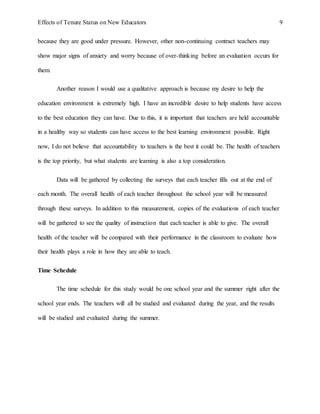
because they are good under pressure. However, other non-continuing contract teachers may
show major signs of anxiety and worry because of over-thinking before an evaluation occurs for
them.
Another reason I would use a qualitative approach is because my desire to help the
education environment is extremely high. I have an incredible desire to help students have access
to the best education they can have. Due to this, it is important that teachers are held accountable
in a healthy way so students can have access to the best learning environment possible. Right
now, I do not believe that accountability to teachers is the best it could be. The health of teachers
is the top priority, but what students are learning is also a top consideration.
Data will be gathered by collecting the surveys that each teacher fills out at the end of
each month. The overall health of each teacher throughout the school year will be measured
through these surveys. In addition to this measurement, copies of the evaluations of each teacher
will be gathered to see the quality of instruction that each teacher is able to give. The overall
health of the teacher will be compared with their performance in the classroom to evaluate how
their health plays a role in how they are able to teach.
Time Schedule
The time schedule for this study would be one school year and the summer right after the
school year ends. The teachers will all be studied and evaluated during the year, and the results
will be studied and evaluated during the summer.
Effects of Tenure Status on New Educators 10
Budget
The budget for this study is minimal because the surveys will be created by the
researchers. The results of this study will be shared with each PLC group at Cheyenne East High
School for the teachers to see how they may relate to the findings from the participants of the
study. There will be a power point presentation that is created to show the principals of the
school how their evaluation process plays a role in how teachers perform. This presentation will
also be shown to the superintendents of Laramie County School District #1 to make them
consider how they are making teachers earn tenure status in their school district.
Effects of Tenure Status on New Educators 11
References
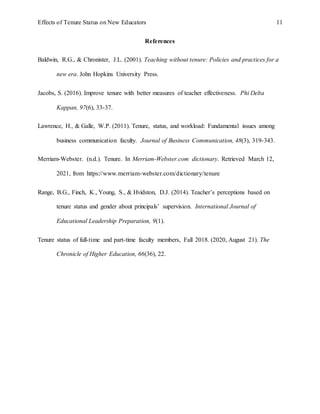
Baldwin, R.G., & Chronister, J.L. (2001). Teaching without tenure: Policies and practices for a
new era. John Hopkins University Press.
Jacobs, S. (2016). Improve tenure with better measures of teacher effectiveness. Phi Delta
Kappan, 97(6), 33-37.
Lawrence, H., & Galle, W.P. (2011). Tenure, status, and workload: Fundamental issues among
business communication faculty. Journal of Business Communication, 48(3), 319-343.
Merriam-Webster. (n.d.). Tenure. In Merriam-Webster.com dictionary. Retrieved March 12,
2021, from https://www.merriam-webster.com/dictionary/tenure
Range, B.G., Finch, K., Young, S., & Hvidston, D.J. (2014). Teacher’s perceptions based on
tenure status and gender about principals’ supervision. International Journal of
Educational Leadership Preparation, 9(1).
Tenure status of full-time and part-time faculty members, Fall 2018. (2020, August 21). The
Chronicle of Higher Education, 66(36), 22.
Effects of Tenure Status on New Educators 12
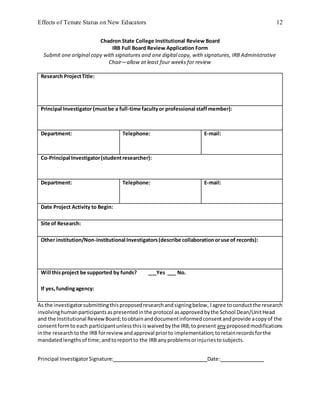
Chadron State College Institutional Review Board
IRB Full Board Review Application Form
Submit one original copy with signatures and one digital copy, with signatures, IRB Administrative
Chair—allow at least four weeks for review
Research ProjectTitle:
Principal Investigator (mustbe a full-time facultyor professional staffmember):
Department: Telephone: E-mail:
Co-Principal Investigator(studentresearcher):
Department: Telephone: E-mail:
Date Project Activity to Begin:
Site of Research:
Other institution/Non-institutional Investigators(describe collaborationoruse of records):
Will thisproject be supported by funds? ___Yes ___ No.
If yes,fundingagency:
As the investigatorsubmittingthisproposedresearchandsigningbelow, Iagree toconductthe research
involvinghumanparticipantsaspresentedinthe protocol asapprovedbythe School Dean/UnitHead
and the Institutional ReviewBoard;toobtainanddocumentinformedconsentandprovide acopyof the
consentformto each participantunlessthisiswaivedbythe IRB;to present anyproposedmodifications
inthe researchtothe IRB forreviewandapproval priorto implementation;toretainrecordsforthe
mandatedlengthsof time;andtoreportto the IRB anyproblemsorinjuriestosubjects.
Principal InvestigatorSignature: Date:
Effects of Tenure Status on New Educators 13
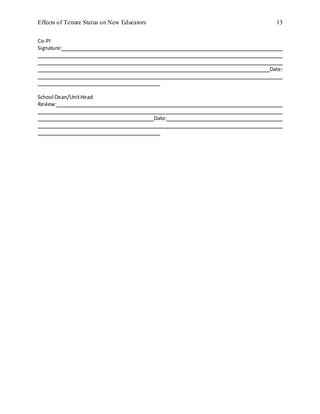
Co-PI
Signature:
Date:
School Dean/UnitHead
Review:
Date:

EDCI 631 research paper

  • 1.
    RUNNING HEAD: EFFECTSOF TENURE STATUS ON NEW EDUCATORS 1 Effects of Tenure Status on New Educators Morgan Sanders Dr. Ann Petersen EDCI 631 Research Design and Data Analysis Chadron State College Spring 2021
  • 2.
    Effects of TenureStatus on New Educators 2 Table of Contents Abstract ………………………………………………………………………………………….. 3 Introduction ……………………………………………………………………………………… 4 Statement of the Problem ………………………………………………………………... 4 Review of Related Literature ……………………………………………………………………. 5 Statement of Hypothesis ………………………………………………………………… 6 Methodology …………………………………………………………………………………….. 6 Participants ………………………………………………………………………………. 6 Instrument ……………………………………………………………………………….. 6 Research Design/Variables ……………………………………………………………… 7 Procedures ……………………………………………………………………………….. 7 Data Analyses …………………………………………………………………………… 8 Time Schedule …………………………………………………………………………... 9 Budget ………………………………………………………………………………….. 10 References ……………………………………………………………………………………… 11
  • 3.
    Effects of TenureStatus on New Educators 3 Abstract Due to the underlying pressures of becoming a skilled and experienced teacher, many newly hired teachers face a large amount of mental, emotional, and physical health battles as they enter the teaching profession. The purpose of this study will be to unveil the distress that non-continuing contract teachers face as they are evaluated and learn what it takes to earn a continuing contract in a competitive school district. Many teachers who are hired without any teaching experience are placed in a situation where they are formally evaluated two to three times in one given school year. This can be an extremely stressful process to put a young teacher through, especially when earning a continuing contract is on the line. Therefore, the effectiveness of newly hired teachers can be hindered when they are pushed to the limits and overwhelmed.
  • 4.
    Effects of TenureStatus on New Educators 4 Effects of Tenure Status on New Educators Introduction Teachers do not earn tenure status until they have successfully completed their third year of teaching; teachers who have not earned tenure status are on the “non-continuing” contract and can be let go at the end of a school year without being given a reason. Thus, the first three years of teaching can be some of the most stressful years for an educator. This is due to copious amounts of pressure that are placed on the educator to be their best and work hard to earn a spot in the school district. Many school districts evaluate their non-continuing contract teachers twice a year, while continuing contract teachers are only evaluated once a year. According to Jacobs, “In a profession where salary is still largely determined by years on the job, tenure is defended as protecting more veteran teachers from losing their jobs to lower-paid, novice teachers” (P. 1). It can certainly be the case that a new teacher is much more effective than a veteran teacher, but because of the tenure status, the new teacher would be let go before the veteran teacher is. Several teachers who have not earned tenure status are also new to the profession and only have student teaching experience. Therefore, these new teachers can experience emotional, physical, and mental health issues as they venture into this profession with very little experience and training. Statement of Problem The purpose of this study will be to discover the implications of tenure status on the effectiveness of new teachers within the classroom and the mental, physical, and emotional health of teachers who are new to the profession. The Merriam-Webster Dictionary defines
  • 5.
    Effects of TenureStatus on New Educators 5 tenure status as “the act, right, manner, or term of holding something” (such as a landed property, a position, or an office). Review of Related Literature Many teacher-preparatory programs have limited chances for pre-service teachers to spend time in the classroom. This is a problem because true experience and learning opportunities happen when a person can spend time learning from someone who is already working in the field. At the University of Wyoming in Laramie, Wyoming, pre-service teachers are required to complete a sixty-hour practicum experience during their junior year, then they complete a sixteen-week student teaching experience during their final semester in the education program. Thus, pre-service teachers do not even experience what a true classroom looks and feels like until they are over half-way through with the education program requirements at this Wyoming university. This is just one example of the issues that occur in the teacher preparatory programs; pre-service teachers are not given enough time to work and learn from teachers and then this causes anxiety and stress during their first few years of teaching. In education, there is a gap between holding teachers responsible for learning and allowing them to climb the job security ladder. The gap not only occurs at the teacher level, but also at the level of administration for school districts. There are instances where a principal may walk into a teacher’s classroom unannounced and will complete an information observation of what is occurring in the classroom that day. This creates an imbalance in the process of informal versus formal evaluations conducted on educators. It could happen that principals informally visit some classroom teachers more than others. Range et al. (2014) suggests, “Principals face a predicament in providing formative supervision to non-tenured teachers and tenured teachers because their needs are very different” (P. 13). Many new teachers find the evaluation process
  • 6.
    Effects of TenureStatus on New Educators 6 very stressful because of the worries of not being re-hired for the next school year; however, there are many veteran teachers who do not feel worried or anxious when their time to get evaluated comes around, because they have almost 100% job security. Statement of Hypothesis The purpose of this study is to investigate the evaluation process for non-tenure teachers has become more intense over the past decade, while the evaluation process has declined for teachers who have earned tenure status. Due to this intense evaluation process, there is a large amount of stress on new teachers that affects their overall health and effectiveness as an educator. 𝑃 = teachers who have and have not earned tenure status. 𝑋 = the number of times a teacher is evaluated in one school year. 𝑌 = the mental, emotional, and physical health of the teacher Methodology Participants Participants for this study will be ten secondary school teachers who have one to three years of experience at Cheyenne East High School in Cheyenne, Wyoming. Additionally, ten secondary school teachers who have more than five years of experience at Cheyenne East High School. Overall, twenty teachers will be selected and asked questions about their time working to earn tenure status.
  • 7.
    Effects of TenureStatus on New Educators 7 Instrument The effectiveness of new teachers will be determined by comparing how they build relationships with students and colleagues, teach subject matters, and how many hours they spend at the school each week with their colleagues who have taught for more than five years. This will be measured by a survey that each teacher will be asked to fill out at the end of each month during the school year. The survey will ask questions dealing with how involved the teacher is with their work-load, and how many hours are spent at the school each week. ResearchDesignand Variables There will be two groups of ten secondary teachers each. The teachers from both groups will be formally and informally evaluated throughout the school year to test their mental, emotional, and physical health status. The teachers in both groups will be post-tested in May using a Likert Scale to determine their mental, emotional, and physical health after completing an entire school year of teaching. It is important that this test happens after each teacher completes another school year because some participants will have just finished their first year of teaching, while other teachers will much more experience than this. Procedures At the beginning of the school year, twenty secondary school teachers will be selected from a population of approximately one-hundred and fifteen teachers at Cheyenne East High School. The teachers who are selected will be divided into two groups, and the group of non- contract teachers will be designated to be the experimental group. The group of teachers who have earned tenure status will be used to compare how experience and tenure affects the job.
  • 8.
    Effects of TenureStatus on New Educators 8 During the school year, the non-experimental group will teach their classes in their own fashion. However, five of the teachers from the non-experimental group will be randomly and informally evaluated four times throughout the school year by their evaluating principal, in addition to the one formal evaluation they must have. The other five teachers from the non- experimental group will retain their current evaluation process and will also be tested from mental, emotional, and physical health status at the end of their one formal evaluation. These five teachers will not be randomly and informally evaluated during the school year. The teachers will be followed up with right after their evaluation to test their mental, emotional, and physical health; their evaluation results will also be documented. Additionally, five teachers from the experimental group will also teach their classes in their own fashion but will be informationally and randomly evaluated four times through the school year by their evaluating principal and will be formally evaluated twice during the school year. However, the other five teachers from this group will only be formally evaluated twice during the school year, but not randomly and informally evaluated at all during the school year. After each formal and informal evaluation, the mental, emotional, and physical health status of the teachers in the experimental group will be tested. Data Analysis I would use a qualitative approach for this study because there are multiple realities that could occur within this specific study. For example, some people, in general, handle stressful situations better than others. This can be especially true for people who are older and more experienced. The more time you spend in a career or hobby, the better you will get. There is always an initial learning curve when anyone begins a career. Thus, some of the teachers from the experimental group may not show signs of being worried or anxious about evaluations
  • 9.
    Effects of TenureStatus on New Educators 9 because they are good under pressure. However, other non-continuing contract teachers may show major signs of anxiety and worry because of over-thinking before an evaluation occurs for them. Another reason I would use a qualitative approach is because my desire to help the education environment is extremely high. I have an incredible desire to help students have access to the best education they can have. Due to this, it is important that teachers are held accountable in a healthy way so students can have access to the best learning environment possible. Right now, I do not believe that accountability to teachers is the best it could be. The health of teachers is the top priority, but what students are learning is also a top consideration. Data will be gathered by collecting the surveys that each teacher fills out at the end of each month. The overall health of each teacher throughout the school year will be measured through these surveys. In addition to this measurement, copies of the evaluations of each teacher will be gathered to see the quality of instruction that each teacher is able to give. The overall health of the teacher will be compared with their performance in the classroom to evaluate how their health plays a role in how they are able to teach. Time Schedule The time schedule for this study would be one school year and the summer right after the school year ends. The teachers will all be studied and evaluated during the year, and the results will be studied and evaluated during the summer.
  • 10.
    Effects of TenureStatus on New Educators 10 Budget The budget for this study is minimal because the surveys will be created by the researchers. The results of this study will be shared with each PLC group at Cheyenne East High School for the teachers to see how they may relate to the findings from the participants of the study. There will be a power point presentation that is created to show the principals of the school how their evaluation process plays a role in how teachers perform. This presentation will also be shown to the superintendents of Laramie County School District #1 to make them consider how they are making teachers earn tenure status in their school district.
  • 11.
    Effects of TenureStatus on New Educators 11 References Baldwin, R.G., & Chronister, J.L. (2001). Teaching without tenure: Policies and practices for a new era. John Hopkins University Press. Jacobs, S. (2016). Improve tenure with better measures of teacher effectiveness. Phi Delta Kappan, 97(6), 33-37. Lawrence, H., & Galle, W.P. (2011). Tenure, status, and workload: Fundamental issues among business communication faculty. Journal of Business Communication, 48(3), 319-343. Merriam-Webster. (n.d.). Tenure. In Merriam-Webster.com dictionary. Retrieved March 12, 2021, from https://www.merriam-webster.com/dictionary/tenure Range, B.G., Finch, K., Young, S., & Hvidston, D.J. (2014). Teacher’s perceptions based on tenure status and gender about principals’ supervision. International Journal of Educational Leadership Preparation, 9(1). Tenure status of full-time and part-time faculty members, Fall 2018. (2020, August 21). The Chronicle of Higher Education, 66(36), 22.
  • 12.
    Effects of TenureStatus on New Educators 12 Chadron State College Institutional Review Board IRB Full Board Review Application Form Submit one original copy with signatures and one digital copy, with signatures, IRB Administrative Chair—allow at least four weeks for review Research ProjectTitle: Principal Investigator (mustbe a full-time facultyor professional staffmember): Department: Telephone: E-mail: Co-Principal Investigator(studentresearcher): Department: Telephone: E-mail: Date Project Activity to Begin: Site of Research: Other institution/Non-institutional Investigators(describe collaborationoruse of records): Will thisproject be supported by funds? ___Yes ___ No. If yes,fundingagency: As the investigatorsubmittingthisproposedresearchandsigningbelow, Iagree toconductthe research involvinghumanparticipantsaspresentedinthe protocol asapprovedbythe School Dean/UnitHead and the Institutional ReviewBoard;toobtainanddocumentinformedconsentandprovide acopyof the consentformto each participantunlessthisiswaivedbythe IRB;to present anyproposedmodifications inthe researchtothe IRB forreviewandapproval priorto implementation;toretainrecordsforthe mandatedlengthsof time;andtoreportto the IRB anyproblemsorinjuriestosubjects. Principal InvestigatorSignature: Date:
  • 13.
    Effects of TenureStatus on New Educators 13 Co-PI Signature: Date: School Dean/UnitHead Review: Date: