School to Work Transition
One way street or something else?
Chosen Stakeholder = Educator
Reasons:
• Everybody has one.
• Gives you the fundamentals and a platform of
knowledge to build upon.
Details of the interviewed educator:
• 3 of them teaching different subjects and
settings (ie: Youth Organization leader, High
School teacher, Professor)
SAY
``We are not responsible for finding job for our
students.``
“Its not more about the knowledge gained while
in university, but about learning to grow up.”
“Really there is not much difference between
work and school. Just do what you are asked and
you will be fine.”
THINK
• Not responsible for jobs probably thinks that
educator only disseminate knowledge.
• Learning to grow up means becoming more
mature, learn to taking care yourself, and learn to
deal with others. Formally completing the
transitions from adolescence to adulthood.
• Work and School are based on the same
principles; you were given a task, do it well and
you will be rewarded. Else, you will be punished.
FEEL
• Just doing the bare minimum thing.
• Concerning the maturity of the students
• Playing it safe
SAY
“Education is a life long learning endeavour, I
would not call it a transition. Instead its more
like a revolving door.”
“The biggest reward is seeing the student come
away with something gained.”
“You don’t need education to succeed, just the
attitude, courage, and perseverance.”
THINK
• Points out the idea of lifelong learning and
how it changes the meaning of work and
school.
• The most satisfying aspect of being an
educator and its purpose in the learning
process.
• Some of the qualities that successful people
has, and school is just an environment for you
to develop on it.
FEEL
• That education and work goes hand in hand,
like a partnership.
• The satisfaction of being an educator.
• The importance of character.
SAY
“There aren’t any differences between learning
in school and at work.”
“Getting a degree does not guarantee wealth,
but a good/comfortable job.”
“Being the school is probably the best time of
your life.”
THINK
• Similar to the above point, but more on the
process of how we learn.
• A point of view that education leads you to a
better life and more opportunities.
• When life is more straightforward and less
political (unlike work).
FEEL
• They are the same. No surprise there.
• Felt pretty confident about it.
• Strongly agree to the statement.
SAY
“With the advancement of technology, school
and work are not two distinct entities.”
“The students will always be a part of us.”
“Its not about jobs and career, its about doing
what you love and making a difference to the
world.”
THINK
• Technology allows work and school can be a
concurrent process, which may accelerate their
interactions on each other.
• Your school is one of the most important things in
your life. It is where you dream, meet your life-
long friends, and be inspired while being burden
free from the complexity of life.
• The purpose of education is to make us a better
citizen and to empower us to make a difference in
this world. An ideology indeed.
FEEL
• Somewhat excited, yet unsure about it.
• Sense of belonging, community feel.
• Anything its possible.
PROBLEM STATEMENT (Good)
“Well-Educated, Experienced, Dedicated,
Innovative, Inspirational, Leader, Well-Versed,
Talented, Intelligent, Brilliant, Smart, and
Technology-Savvy Educator needs a way to
blend the education and work together Because
we need workers to can solve problems
differently.”
PROBLEM STATEMENT (Better)
“Well-Educated, Experienced, Dedicated,
Innovative, Inspirational, Leader, Well-Versed,
Talented, Intelligent, Brilliant, Smart, and
Technology-Savvy Educator needs a way to
integrate knowledge and real world practice in
one coherent package Because we need workers
able to solve complex problem using different
approaches.”
PROBLEM STATEMENT (Best, aka the
Final Statement)
“Well-Educated, Experienced, Dedicated,
Innovative, Inspirational, Leader, Well-Versed,
Talented, Intelligent, Brilliant, Smart, and
Technology-Savvy Educator needs a way to balance
theoretical knowledge and practical experiences
dynamically and fluently (smooth) while having a
sense of urgency Because we need workers be able
to solve complex problems using different
methodologies with empathy, understanding, and
patience on the stakeholders/customers.”

School to Work Transition

  • 1.
    School to WorkTransition One way street or something else?
  • 2.
    Chosen Stakeholder =Educator Reasons: • Everybody has one. • Gives you the fundamentals and a platform of knowledge to build upon. Details of the interviewed educator: • 3 of them teaching different subjects and settings (ie: Youth Organization leader, High School teacher, Professor)
  • 3.
    SAY ``We are notresponsible for finding job for our students.`` “Its not more about the knowledge gained while in university, but about learning to grow up.” “Really there is not much difference between work and school. Just do what you are asked and you will be fine.”
  • 4.
    THINK • Not responsiblefor jobs probably thinks that educator only disseminate knowledge. • Learning to grow up means becoming more mature, learn to taking care yourself, and learn to deal with others. Formally completing the transitions from adolescence to adulthood. • Work and School are based on the same principles; you were given a task, do it well and you will be rewarded. Else, you will be punished.
  • 5.
    FEEL • Just doingthe bare minimum thing. • Concerning the maturity of the students • Playing it safe
  • 6.
    SAY “Education is alife long learning endeavour, I would not call it a transition. Instead its more like a revolving door.” “The biggest reward is seeing the student come away with something gained.” “You don’t need education to succeed, just the attitude, courage, and perseverance.”
  • 7.
    THINK • Points outthe idea of lifelong learning and how it changes the meaning of work and school. • The most satisfying aspect of being an educator and its purpose in the learning process. • Some of the qualities that successful people has, and school is just an environment for you to develop on it.
  • 8.
    FEEL • That educationand work goes hand in hand, like a partnership. • The satisfaction of being an educator. • The importance of character.
  • 9.
    SAY “There aren’t anydifferences between learning in school and at work.” “Getting a degree does not guarantee wealth, but a good/comfortable job.” “Being the school is probably the best time of your life.”
  • 10.
    THINK • Similar tothe above point, but more on the process of how we learn. • A point of view that education leads you to a better life and more opportunities. • When life is more straightforward and less political (unlike work).
  • 11.
    FEEL • They arethe same. No surprise there. • Felt pretty confident about it. • Strongly agree to the statement.
  • 12.
    SAY “With the advancementof technology, school and work are not two distinct entities.” “The students will always be a part of us.” “Its not about jobs and career, its about doing what you love and making a difference to the world.”
  • 13.
    THINK • Technology allowswork and school can be a concurrent process, which may accelerate their interactions on each other. • Your school is one of the most important things in your life. It is where you dream, meet your life- long friends, and be inspired while being burden free from the complexity of life. • The purpose of education is to make us a better citizen and to empower us to make a difference in this world. An ideology indeed.
  • 14.
    FEEL • Somewhat excited,yet unsure about it. • Sense of belonging, community feel. • Anything its possible.
  • 15.
    PROBLEM STATEMENT (Good) “Well-Educated,Experienced, Dedicated, Innovative, Inspirational, Leader, Well-Versed, Talented, Intelligent, Brilliant, Smart, and Technology-Savvy Educator needs a way to blend the education and work together Because we need workers to can solve problems differently.”
  • 16.
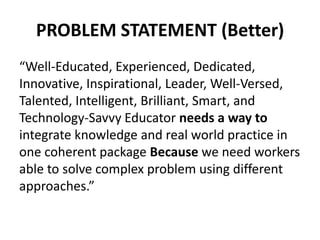
    PROBLEM STATEMENT (Better) “Well-Educated,Experienced, Dedicated, Innovative, Inspirational, Leader, Well-Versed, Talented, Intelligent, Brilliant, Smart, and Technology-Savvy Educator needs a way to integrate knowledge and real world practice in one coherent package Because we need workers able to solve complex problem using different approaches.”
  • 17.
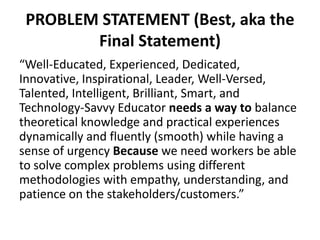
    PROBLEM STATEMENT (Best,aka the Final Statement) “Well-Educated, Experienced, Dedicated, Innovative, Inspirational, Leader, Well-Versed, Talented, Intelligent, Brilliant, Smart, and Technology-Savvy Educator needs a way to balance theoretical knowledge and practical experiences dynamically and fluently (smooth) while having a sense of urgency Because we need workers be able to solve complex problems using different methodologies with empathy, understanding, and patience on the stakeholders/customers.”