Individualized and Personalized QPIs Sped.478/578 Educational Interventions Mary Kloster
Emotional Crisis: Prevention Interventions Support Students Through A  Wrap-Around Intervention Plan Explicit instruction Process modeling Perform feedback Assessment of problem-solving skills Review of mastered skills or materials
Prevent Emotional Crisis Through  Motivation  “There is a direct relationship between motivation and discipline.” Allen Mendler Five Key Processes Emphasizing effort Creating hope Respecting power Building relationships Expressing enthusiasm Motivating Students Who Don’t Care
Attention Deficit and Hyperactive Disorder ADHD Inattentive, impulsive, hyperactive behavior Fidgets Leaves seat  has difficulty playing quietly Talks excessively Blurts out Has trouble sustaining attention Does not seem to listen Not organized
Intervention Strategies for ADHD Encouraging Student Motivation Preventative Classroom Management
Strategy 1 Encouraging Student Motivation Accentuate the positive Make success easy Give variable points Reward good school behavior Try less abstract variable Review the chart every night Make rewards matter Make rewards motivating Make rewards practice Fine tune the chart on a regular basis
Strategy 2 Preventative Classroom Management Effective teaching practices Frequent monitoring Clear rules and procedures Social Praise Organizational Skills Break large tasks into small tasks
Autism Spectrums Disorder “You can think of a person with autism as having an imbalanced set of senses.” (Shore,  professor Adelphi Univ.)  Desperately trying to make sense out of chaos Physical senses exaggerated Some senses too high and some too low Intense sensitivity to sound Communication Delay for some Difficulty expressing how they feel Socialization Don’t know how to socialize Don’t know the unspoken rules  Stimming-- noises, flapping ,echoing phrases Compulsive organization Intellectual obsession
Intervention Strategies for Autism Behavior Modification and Therapy Specialist Teaching Approaches Structure
Strategy 1  Behavior Modification and Therapy Behavior modification- early and  intensive 3 step process Stimulus, response, reward direct instruction; reinforcement techniques, including social praise, material reinforces, and tokens; punishment-oriented techniques, including verbal reprimand, response cost, and time-out. group contingency techniques such as the Good Behavior Game; behavioral contracting Dietary treatment  Auditory integration therapy (designed to reduce sensitivity to particular sound frequencies) Music therapy;  Scotopic sensitivity treatment.
Strategy 2 Specialist Teaching Approaches Specialist teaching approaches include TEACCH; SPELL; Higashi Daily Life TEACCH is an evidence-based service, training, and research program for individuals of all ages and skill levels with autism spectrum disorders. 
Strategy 3 Structure Providing a very clear structure and a set daily routine (including for play). Ensuring the pupil knows the day's program at the start of each day and can make frequent reference to this throughout the day, e.g. providing a 'picture board' with the day's activities 'laid out'.  Teaching what "finished" means and helping the pupil to identify when something has finished and something different has started.  Providing warning of any impending change of routine, or switch of activity.  Using clear and unambiguous language. Avoiding humor/irony, or phrases like "my feet are killing me or it's raining cats and dogs", which will cause bewilderment
Oppositional Defiant  & Conduct Disorders “Our brains determine who we are as individuals, but the way individual brains develop is determined by relationships with others.”( Lang  p. 704 Persistent Disruptive   Behavior Consistently violating the rights of others Arguing with adults Overly aggressive  Persistent temper tantrums Annoying others Vindictiveness Destruction of property
Intervention Strategies for Oppositional Defiant  & Conduct Disorders Behavioral Training and Social Skills Least Intensive Interventions Life Space Crisis Intervention
Behavioral Training and Social Skills Aggression replacement training,  Social skills training techniques,  self- instruction (e.g. anger control training), moral discussions Social skills training, Direct instruction, modeling and rehearsal, coaching,  self-instruction, manipulation of antecedents and consequences
Behavior Planning Least Intensive Interventions   Stanley Fagen Establish individual classroom behavior expectations Identify behavior deviations Identify incompatible desirable behaviors Select behavior intervention strategies
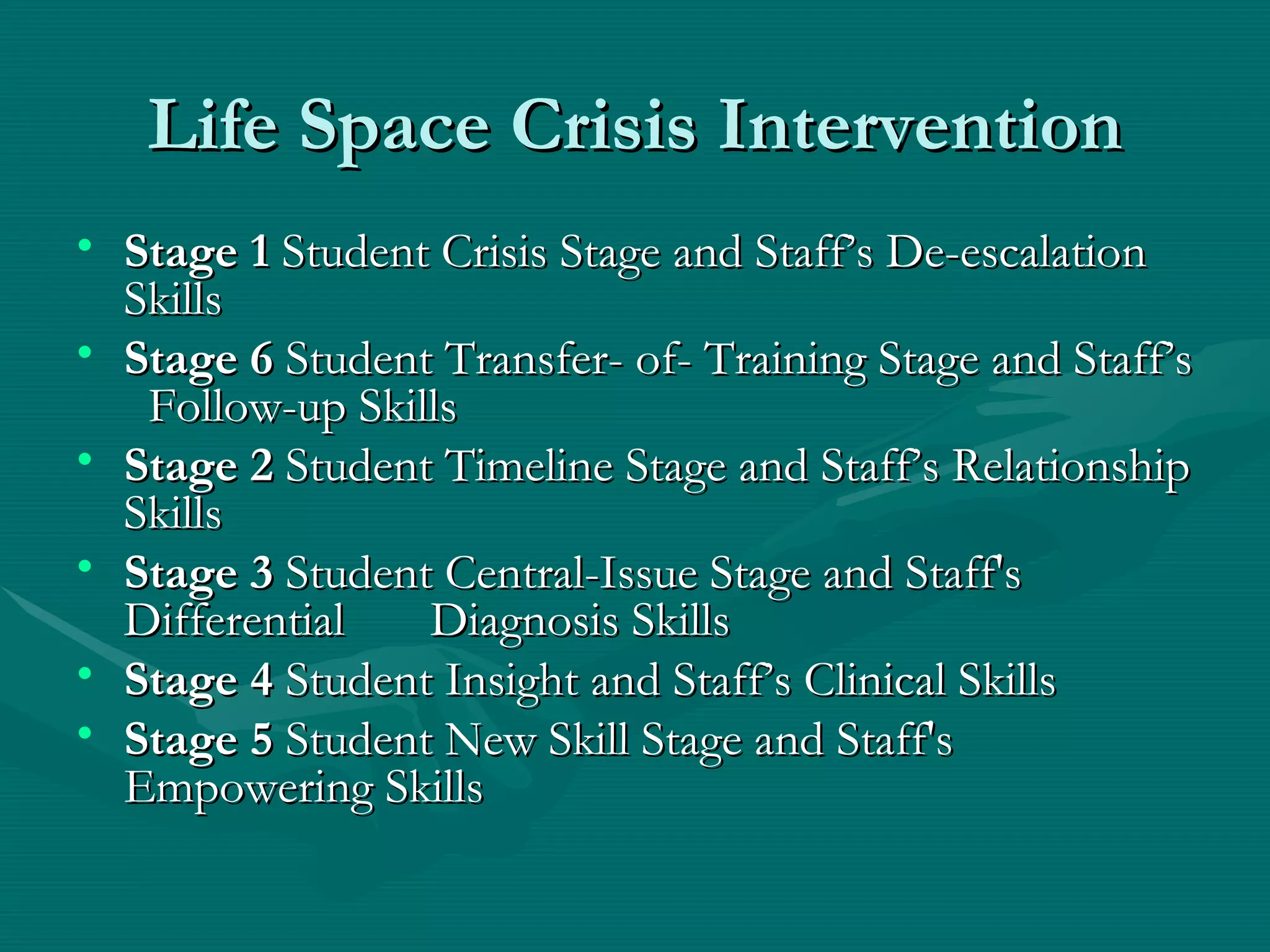
Life Space Crisis Intervention Stage 1  Student Crisis Stage and Staff’s De-escalation Skills Stage 6  Student Transfer- of- Training Stage and Staff’s  Follow-up Skills  Stage 2  Student Timeline Stage and Staff’s Relationship Skills Stage 3  Student Central-Issue Stage and Staff's Differential  Diagnosis Skills Stage 4  Student Insight and Staff’s Clinical Skills Stage 5  Student New Skill Stage and Staff's Empowering Skills
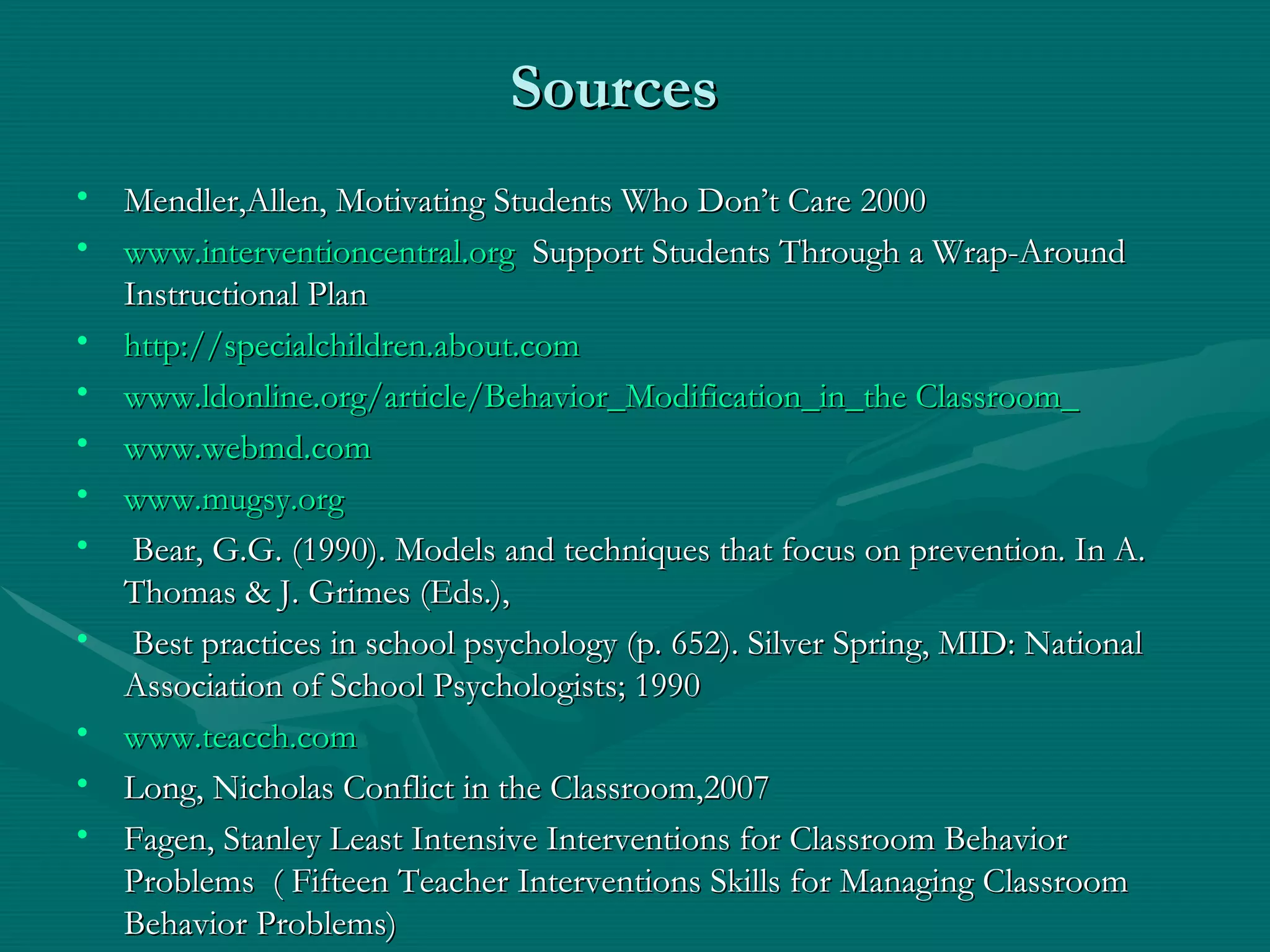
Sources Mendler,Allen, Motivating Students Who Don’t Care 2000 www.interventioncentral.org   Support Students Through a Wrap-Around Instructional Plan http://specialchildren.about.com www.ldonline.org/article/Behavior_Modification_in_the Classroom_ www.webmd.com www.mugsy.org Bear, G.G. (1990). Models and techniques that focus on prevention. In A. Thomas & J. Grimes (Eds.), Best practices in school psychology (p. 652). Silver Spring, MID: National Association of School Psychologists; 1990 www.teacch.com Long, Nicholas Conflict in the Classroom,2007 Fagen, Stanley Least Intensive Interventions for Classroom Behavior Problems  ( Fifteen Teacher Interventions Skills for Managing Classroom Behavior Problems)

Emotional and Behavior Disorders

  • 1.
    Individualized and PersonalizedQPIs Sped.478/578 Educational Interventions Mary Kloster
  • 2.
    Emotional Crisis: PreventionInterventions Support Students Through A Wrap-Around Intervention Plan Explicit instruction Process modeling Perform feedback Assessment of problem-solving skills Review of mastered skills or materials
  • 3.
    Prevent Emotional CrisisThrough Motivation “There is a direct relationship between motivation and discipline.” Allen Mendler Five Key Processes Emphasizing effort Creating hope Respecting power Building relationships Expressing enthusiasm Motivating Students Who Don’t Care
  • 4.
    Attention Deficit andHyperactive Disorder ADHD Inattentive, impulsive, hyperactive behavior Fidgets Leaves seat has difficulty playing quietly Talks excessively Blurts out Has trouble sustaining attention Does not seem to listen Not organized
  • 5.
    Intervention Strategies forADHD Encouraging Student Motivation Preventative Classroom Management
  • 6.
    Strategy 1 EncouragingStudent Motivation Accentuate the positive Make success easy Give variable points Reward good school behavior Try less abstract variable Review the chart every night Make rewards matter Make rewards motivating Make rewards practice Fine tune the chart on a regular basis
  • 7.
    Strategy 2 PreventativeClassroom Management Effective teaching practices Frequent monitoring Clear rules and procedures Social Praise Organizational Skills Break large tasks into small tasks
  • 8.
    Autism Spectrums Disorder“You can think of a person with autism as having an imbalanced set of senses.” (Shore, professor Adelphi Univ.) Desperately trying to make sense out of chaos Physical senses exaggerated Some senses too high and some too low Intense sensitivity to sound Communication Delay for some Difficulty expressing how they feel Socialization Don’t know how to socialize Don’t know the unspoken rules Stimming-- noises, flapping ,echoing phrases Compulsive organization Intellectual obsession
  • 9.
    Intervention Strategies forAutism Behavior Modification and Therapy Specialist Teaching Approaches Structure
  • 10.
    Strategy 1 Behavior Modification and Therapy Behavior modification- early and intensive 3 step process Stimulus, response, reward direct instruction; reinforcement techniques, including social praise, material reinforces, and tokens; punishment-oriented techniques, including verbal reprimand, response cost, and time-out. group contingency techniques such as the Good Behavior Game; behavioral contracting Dietary treatment Auditory integration therapy (designed to reduce sensitivity to particular sound frequencies) Music therapy; Scotopic sensitivity treatment.
  • 11.
    Strategy 2 SpecialistTeaching Approaches Specialist teaching approaches include TEACCH; SPELL; Higashi Daily Life TEACCH is an evidence-based service, training, and research program for individuals of all ages and skill levels with autism spectrum disorders. 
  • 12.
    Strategy 3 StructureProviding a very clear structure and a set daily routine (including for play). Ensuring the pupil knows the day's program at the start of each day and can make frequent reference to this throughout the day, e.g. providing a 'picture board' with the day's activities 'laid out'. Teaching what "finished" means and helping the pupil to identify when something has finished and something different has started. Providing warning of any impending change of routine, or switch of activity. Using clear and unambiguous language. Avoiding humor/irony, or phrases like "my feet are killing me or it's raining cats and dogs", which will cause bewilderment
  • 13.
    Oppositional Defiant & Conduct Disorders “Our brains determine who we are as individuals, but the way individual brains develop is determined by relationships with others.”( Lang p. 704 Persistent Disruptive Behavior Consistently violating the rights of others Arguing with adults Overly aggressive Persistent temper tantrums Annoying others Vindictiveness Destruction of property
  • 14.
    Intervention Strategies forOppositional Defiant & Conduct Disorders Behavioral Training and Social Skills Least Intensive Interventions Life Space Crisis Intervention
  • 15.
    Behavioral Training andSocial Skills Aggression replacement training, Social skills training techniques, self- instruction (e.g. anger control training), moral discussions Social skills training, Direct instruction, modeling and rehearsal, coaching, self-instruction, manipulation of antecedents and consequences
  • 16.
    Behavior Planning LeastIntensive Interventions Stanley Fagen Establish individual classroom behavior expectations Identify behavior deviations Identify incompatible desirable behaviors Select behavior intervention strategies
  • 17.
    Life Space CrisisIntervention Stage 1 Student Crisis Stage and Staff’s De-escalation Skills Stage 6 Student Transfer- of- Training Stage and Staff’s Follow-up Skills Stage 2 Student Timeline Stage and Staff’s Relationship Skills Stage 3 Student Central-Issue Stage and Staff's Differential Diagnosis Skills Stage 4 Student Insight and Staff’s Clinical Skills Stage 5 Student New Skill Stage and Staff's Empowering Skills
  • 18.
    Sources Mendler,Allen, MotivatingStudents Who Don’t Care 2000 www.interventioncentral.org Support Students Through a Wrap-Around Instructional Plan http://specialchildren.about.com www.ldonline.org/article/Behavior_Modification_in_the Classroom_ www.webmd.com www.mugsy.org Bear, G.G. (1990). Models and techniques that focus on prevention. In A. Thomas & J. Grimes (Eds.), Best practices in school psychology (p. 652). Silver Spring, MID: National Association of School Psychologists; 1990 www.teacch.com Long, Nicholas Conflict in the Classroom,2007 Fagen, Stanley Least Intensive Interventions for Classroom Behavior Problems ( Fifteen Teacher Interventions Skills for Managing Classroom Behavior Problems)