School Direct Trainee 
Positive Behaviour 
Management 
18.09.14 
Lisa Gray /Laura Darvill
20 minute reflection time on 
previous training session to 
discuss strategies used, what 
went well and next steps .
Objectives : 
• Acknowledge a link between behaviour and 
learning . 
• Develop a range of approaches to effective 
behaviour management. 
• To Understand different models of behaviour 
• To consider implications for your own practice
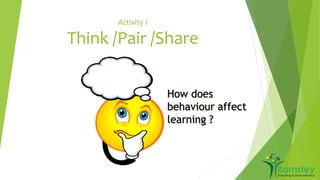
Activity 1 
Think /Pair /Share
Background Information: 
Half of all mental health problems start by the 
age of 14 and are the result of poorly 
developed frontal lobe functioning in the 
brain. 
This occurs during the early years of a child’s 
life. 
75% of children move from secure attachments 
to insecure attachments following separation, 
divorce, trauma, parental substance or alcohol 
misuse, neglect ,abuse or loss .
Stressed out children function like animals and are 
unable to concentrate, learn, enjoy friendships, play 
and problem solve . 
Their thinking becomes narrowed down to threats 
and how to survive therefore triggering the Flight , 
Fight, Freeze mode of the brain. 
Children need positive attachments to thrive and 
sometimes the only positive attachments they have is 
in school . 
It is important to look at the child using an holistic 
approach and not make judgements about their 
behaviour.
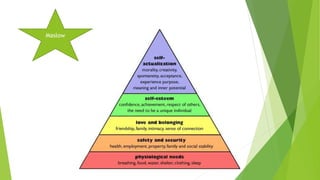
Maslow
Points to Consider : 
• What has this child had to endure before coming to 
school? 
• Do you have any information on the family 
background 
• Are they hungry? 
• Do they have a Special Educational Need
Activity 2 
What behaviour Management 
Strategies have you already seen 
in your school?
Reduce Stress 
• We often hear about stressful or traumatic events being 
‘blocked’ from the brain. 
• Stressful situations will cause the brain to release 
dopamine, but in excess. 
Rewards 
• A degree of ‘predictability’ with our classroom routines and 
establishing a welcoming, purposeful and safe learning 
environment will help in reducing our pupils stress levels. 
• learners should feel some emotional connection to their 
learning. 
• An emotional connection simply means that they care about their 
learning, they see the importance of it and, more importantly, they feel 
rewarded. 
The important thing is that however you reward students, it 
should be planned, fair, transparent and communicated.
Amygdala – ‘fight or flight’ 
• Its function is simply to allow us to survive. 
• The Amygdala calls the shots! Why we can react before we think! 
• Threat and threat perception is a crucial function of the brain and is 
probably the reason why the human race is still here. 
• Threat perception is a very personal thing. 
• Many of our pupils have specific triggers that for them present threat and 
may cause them to react before they think. 
• Knowing your students is crucial! (Boxall, Thrive , Pupil Profiles) 
‘Once the amygdala has stolen the show, there is little we can do to correct the behaviour that 
follows. A student in this state must be calmed down before any further conversations about 
their behaviour can take place’
Models Of 
Behaviour
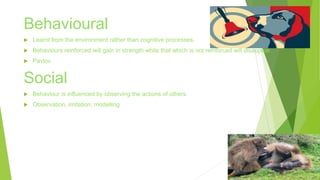
Behavioural 
 Learnt from the environment rather than cognitive processes. 
 Behaviours reinforced will gain in strength while that which is not reinforced will disappear. 
 Pavlov 
Social 
 Behaviour is influenced by observing the actions of others 
 Observation, imitation, modelling
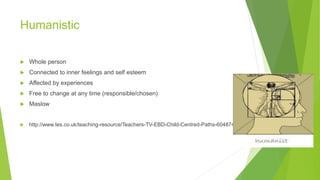
Humanistic 
 Whole person 
 Connected to inner feelings and self esteem 
 Affected by experiences 
 Free to change at any time (responsible/chosen) 
 Maslow 
 http://www.tes.co.uk/teaching-resource/Teachers-TV-EBD-Child-Centred-Paths-6048746/
Physcodynamic 
Problem behaviour occurs as a result of unconscious conflicts in early 
childhood. Attachment patterns developed in infancy continue to have an 
impact throughout the child’s later life and can impact on learning in school. 
Be aware that pupils who have not received good enough care in the early years 
may have attachment anxiety and what unconscious pattern of behaviour the 
child may be bringing in to the classroom 
Strategies : 
• Use interventions that help the child to process unresolved unconscious 
emotions in a safe way eg play therapy, drama therapy, therapeutic 
storywriting. 
• Refer the pupil to a psychodynamic counsellor, possibly through Child and 
Adolescent Mental Health Services (CAMHS)
Role Play
Behavioural 
Focuses on the idea that behaviour is the result of learning from 
the environment rather than the cognitive processes. Behaviours 
which are praised will gain in strength while behaviours that are 
ignored will disappear . 
Strategies : 
• Set up an individual positive behaviour programme with targets 
clearly understood by the pupil. 
• Be consistent: it is the certainty of a response and the follow-up 
that matters, not the severity. 
• Involve parents in rewarding good behaviour – particularly 
effective with younger children.
Humanistic 
Focuses on nurturing emotional needs, communicating rather than punishing 
and establishing good relationships. An explanation for behaviour is offered 
emphasising the uniqueness of the individual and the importance of the self-concept. 
Empathy and unconditional positive regard are the key qualities 
required of someone adopting a humanistic approach. 
Strategies : 
• Listening to the views of pupils; taking opportunities to establish person to 
person relationships between staff and pupils; supporting peer-to-peer 
relationships. 
• Build self-esteem eg blame the behaviour but not the child 
• address the pupil by name; accept the child though not the behaviour; 
remember to ‘catch them getting it right’.
Ecological 
Focuses on the physical-spatial and social environments and their influence 
on behaviour. 
Strategies : 
• Create attractive buildings and learning environments. Consideration of 
the impact of the layout of furniture and seating in the classroom. 
• Think about how seating arrangements may affect certain pupils’ 
behaviour 
• Consider how playgrounds might affect pupils' behaviour eg are there 
any quiet places? Play equipment?
Biological 
Behaviour is a result of biological and biochemical 
processes. 
Strategies : 
• Research basic information about the pupil’s 
specific condition 
• Make sure medication is kept safe and administered 
at the correct times 
• Be aware of times when medication such as Ritalin 
may be wearing off.
Systemic 
The child is seen as being an intrinsic part of a wider social system both 
in and outside of school, and the nature of these overarching systems 
are seen as influencing the behaviour of the individual. 
Consider how the whole school ethos impacts on the behaviour of 
individual children. Encourage the involvement of parents and carers in 
interventions to support behaviour. Be aware of the wider community 
and cultural impact on the individual child. 
Strategies : 
• Consider the impact of the whole school ethos on behaviour 
• Liaise with parents about any issues at home 
• Form links eg through project work with the local community.
Social 
Behaviour is influenced by observing the actions of others. Pupils 
with behavioural difficulties have the opportunity to be in contact 
with other pupils who have good social skills – this is particularly 
helpful when pupils are working in small groups. 
Strategies : 
• Ensure that small groups include some pupils who can model good 
social skills 
• Ensure that the behaviour of staff sets a good example to pupils 
• Praise pupils who are doing ordinary things well 
• Model coping skills eg verbalise your own internal process when 
managing an anxiety-provoking situation.
Cognitive 
Focuses on beliefs, attitudes, expectations and attributions when 
accounting for behaviour. Problem behaviour is seen as a product of 
maladaptive thinking related to processes of self-attribution and 
perceived self-efficacy. 
Strategies : 
• Involve pupils in setting and monitoring their own behaviour targets 
• Involve pupils in reflecting on their own behaviour and in setting and 
monitoring targets 
• Provide strategies for the pupil to self-regulate/self-soothe when 
feeling anxious eg visualisation. 
• Explore how pupils attribute meaning to events and consider ways in 
which to reframe situations and experiences.
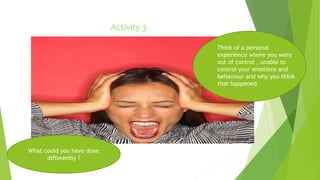
Activity 3 
Think of a personal 
experience where you were 
out of control , unable to 
control your emotions and 
behaviour and why you think 
that happened 
What could you have done 
differently ?
Task to complete for next week : 
Choose 2 pupils from your class to unpick 
why they behave the way they do, giving 
examples of both positive and negative 
behaviours . 
Based on theories discussed today think 
about what factors may have caused them 
to behaviour the way they did?
http://www.tes.co.uk/teaching-resource/ 
Teachers-TV-EBD-Child- 
Centred-Paths-6048746 
lisagray@wcpsandrscc.co.uk 
lDarvill@Barnsley.org

Behaviour twilight 18.09.14

  • 1.
    School Direct Trainee Positive Behaviour Management 18.09.14 Lisa Gray /Laura Darvill
  • 2.
    20 minute reflectiontime on previous training session to discuss strategies used, what went well and next steps .
  • 3.
    Objectives : •Acknowledge a link between behaviour and learning . • Develop a range of approaches to effective behaviour management. • To Understand different models of behaviour • To consider implications for your own practice
  • 4.
    Activity 1 Think/Pair /Share
  • 5.
    Background Information: Halfof all mental health problems start by the age of 14 and are the result of poorly developed frontal lobe functioning in the brain. This occurs during the early years of a child’s life. 75% of children move from secure attachments to insecure attachments following separation, divorce, trauma, parental substance or alcohol misuse, neglect ,abuse or loss .
  • 6.
    Stressed out childrenfunction like animals and are unable to concentrate, learn, enjoy friendships, play and problem solve . Their thinking becomes narrowed down to threats and how to survive therefore triggering the Flight , Fight, Freeze mode of the brain. Children need positive attachments to thrive and sometimes the only positive attachments they have is in school . It is important to look at the child using an holistic approach and not make judgements about their behaviour.
  • 7.
  • 8.
    Points to Consider: • What has this child had to endure before coming to school? • Do you have any information on the family background • Are they hungry? • Do they have a Special Educational Need
  • 9.
    Activity 2 Whatbehaviour Management Strategies have you already seen in your school?
  • 11.
    Reduce Stress •We often hear about stressful or traumatic events being ‘blocked’ from the brain. • Stressful situations will cause the brain to release dopamine, but in excess. Rewards • A degree of ‘predictability’ with our classroom routines and establishing a welcoming, purposeful and safe learning environment will help in reducing our pupils stress levels. • learners should feel some emotional connection to their learning. • An emotional connection simply means that they care about their learning, they see the importance of it and, more importantly, they feel rewarded. The important thing is that however you reward students, it should be planned, fair, transparent and communicated.
  • 12.
    Amygdala – ‘fightor flight’ • Its function is simply to allow us to survive. • The Amygdala calls the shots! Why we can react before we think! • Threat and threat perception is a crucial function of the brain and is probably the reason why the human race is still here. • Threat perception is a very personal thing. • Many of our pupils have specific triggers that for them present threat and may cause them to react before they think. • Knowing your students is crucial! (Boxall, Thrive , Pupil Profiles) ‘Once the amygdala has stolen the show, there is little we can do to correct the behaviour that follows. A student in this state must be calmed down before any further conversations about their behaviour can take place’
  • 13.
  • 14.
    Behavioural  Learntfrom the environment rather than cognitive processes.  Behaviours reinforced will gain in strength while that which is not reinforced will disappear.  Pavlov Social  Behaviour is influenced by observing the actions of others  Observation, imitation, modelling
  • 15.
    Humanistic  Wholeperson  Connected to inner feelings and self esteem  Affected by experiences  Free to change at any time (responsible/chosen)  Maslow  http://www.tes.co.uk/teaching-resource/Teachers-TV-EBD-Child-Centred-Paths-6048746/
  • 16.
    Physcodynamic Problem behaviouroccurs as a result of unconscious conflicts in early childhood. Attachment patterns developed in infancy continue to have an impact throughout the child’s later life and can impact on learning in school. Be aware that pupils who have not received good enough care in the early years may have attachment anxiety and what unconscious pattern of behaviour the child may be bringing in to the classroom Strategies : • Use interventions that help the child to process unresolved unconscious emotions in a safe way eg play therapy, drama therapy, therapeutic storywriting. • Refer the pupil to a psychodynamic counsellor, possibly through Child and Adolescent Mental Health Services (CAMHS)
  • 18.
  • 19.
    Behavioural Focuses onthe idea that behaviour is the result of learning from the environment rather than the cognitive processes. Behaviours which are praised will gain in strength while behaviours that are ignored will disappear . Strategies : • Set up an individual positive behaviour programme with targets clearly understood by the pupil. • Be consistent: it is the certainty of a response and the follow-up that matters, not the severity. • Involve parents in rewarding good behaviour – particularly effective with younger children.
  • 20.
    Humanistic Focuses onnurturing emotional needs, communicating rather than punishing and establishing good relationships. An explanation for behaviour is offered emphasising the uniqueness of the individual and the importance of the self-concept. Empathy and unconditional positive regard are the key qualities required of someone adopting a humanistic approach. Strategies : • Listening to the views of pupils; taking opportunities to establish person to person relationships between staff and pupils; supporting peer-to-peer relationships. • Build self-esteem eg blame the behaviour but not the child • address the pupil by name; accept the child though not the behaviour; remember to ‘catch them getting it right’.
  • 21.
    Ecological Focuses onthe physical-spatial and social environments and their influence on behaviour. Strategies : • Create attractive buildings and learning environments. Consideration of the impact of the layout of furniture and seating in the classroom. • Think about how seating arrangements may affect certain pupils’ behaviour • Consider how playgrounds might affect pupils' behaviour eg are there any quiet places? Play equipment?
  • 22.
    Biological Behaviour isa result of biological and biochemical processes. Strategies : • Research basic information about the pupil’s specific condition • Make sure medication is kept safe and administered at the correct times • Be aware of times when medication such as Ritalin may be wearing off.
  • 23.
    Systemic The childis seen as being an intrinsic part of a wider social system both in and outside of school, and the nature of these overarching systems are seen as influencing the behaviour of the individual. Consider how the whole school ethos impacts on the behaviour of individual children. Encourage the involvement of parents and carers in interventions to support behaviour. Be aware of the wider community and cultural impact on the individual child. Strategies : • Consider the impact of the whole school ethos on behaviour • Liaise with parents about any issues at home • Form links eg through project work with the local community.
  • 24.
    Social Behaviour isinfluenced by observing the actions of others. Pupils with behavioural difficulties have the opportunity to be in contact with other pupils who have good social skills – this is particularly helpful when pupils are working in small groups. Strategies : • Ensure that small groups include some pupils who can model good social skills • Ensure that the behaviour of staff sets a good example to pupils • Praise pupils who are doing ordinary things well • Model coping skills eg verbalise your own internal process when managing an anxiety-provoking situation.
  • 25.
    Cognitive Focuses onbeliefs, attitudes, expectations and attributions when accounting for behaviour. Problem behaviour is seen as a product of maladaptive thinking related to processes of self-attribution and perceived self-efficacy. Strategies : • Involve pupils in setting and monitoring their own behaviour targets • Involve pupils in reflecting on their own behaviour and in setting and monitoring targets • Provide strategies for the pupil to self-regulate/self-soothe when feeling anxious eg visualisation. • Explore how pupils attribute meaning to events and consider ways in which to reframe situations and experiences.
  • 26.
    Activity 3 Thinkof a personal experience where you were out of control , unable to control your emotions and behaviour and why you think that happened What could you have done differently ?
  • 27.
    Task to completefor next week : Choose 2 pupils from your class to unpick why they behave the way they do, giving examples of both positive and negative behaviours . Based on theories discussed today think about what factors may have caused them to behaviour the way they did?
  • 28.

Editor's Notes

  • #4 What is your experience of learning maths at school