Session 5: Roadmap for Recovery 5-
Recovery Stages Matrix IOP 5- Stage 1: Withdrawal Stage 2: Early Abstinence (“Honeymoon”) Stage 3: Protracted Abstinence (“the Wall”) Stage 4: Adjustment/Resolution
Stage 1: Withdrawal Physical detoxification Cravings Depression/anxiety Low energy Irritability Matrix IOP 5- WITHDRAWAL Exhaustion Insomnia Paranoia Memory problems Intense hunger
Withdrawal Relapse Risk Factors Powerful cravings Paranoia Depression Disordered sleep patterns Unstructured time Proximity of triggers Fear of withdrawal symptoms Matrix IOP 5-
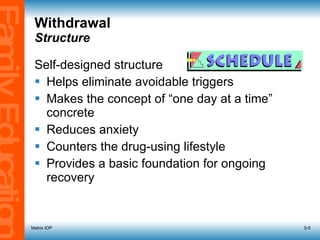
Withdrawal Structure Self-designed structure Helps eliminate avoidable triggers Makes the concept of “one day at a time” concrete Reduces anxiety Counters the drug-using lifestyle Provides a basic foundation for ongoing recovery Matrix IOP 5-
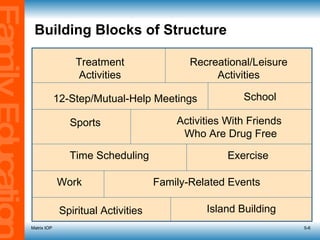
Building Blocks of Structure Matrix IOP 5- Treatment Activities Recreational/Leisure Activities 12-Step/Mutual-Help Meetings   School Sports Activities With Friends  Who Are Drug Free Time Scheduling Exercise Work Family-Related Events Spiritual Activities Island Building
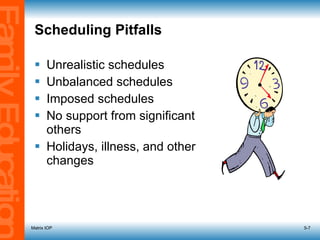
Scheduling Pitfalls Unrealistic schedules Unbalanced schedules Imposed schedules No support from significant  others Holidays, illness, and other  changes Matrix IOP 5-
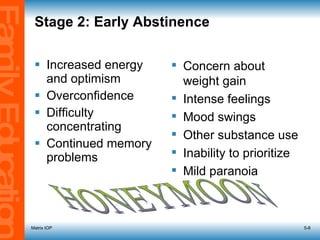
Stage 2: Early Abstinence Increased energy and optimism  Overconfidence  Difficulty concentrating Continued memory problems Matrix IOP 5- Concern about  weight gain Intense feelings Mood swings Other substance use Inability to prioritize Mild paranoia HONEYMOON
Early Abstinence Relapse Risk Factors “ Workaholism” Discontinuation of structure (including treatment) Overconfidence Secondary drug or alcohol use Inability to prioritize Resistance to behavior change Occasional paranoia Matrix IOP 5-
Early Abstinence Triggers and Thought Stopping Matrix IOP 5- Trigger Thought Thought stopping Continued thoughts Use  Cravings
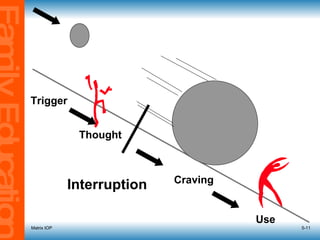
Matrix IOP 5- Interruption Trigger Thought Craving Use
Types of Triggers Triggers can relate to People Places Things Times Emotional states Matrix IOP 5-
Triggers   People Friends who use drugs/dealers Absence of significant other Voices of friends who use drugs/dealers Intimate partners  People discussing drug use Matrix IOP 5-
Triggers  Places Drug dealer’s home Bars and clubs Drug use neighborhoods Work Some street corners Anyplace  associated with use Matrix IOP 5-
Triggers  Things Drug paraphernalia Money/ATMs Movies/TV shows about drugs and alcohol  Sexually explicit magazines/movies Certain music Secondary drug or alcohol use Matrix IOP 5-
Triggers   Times Idle time After work Holidays Birthdays/anniversaries Stressful times Paydays Friday/Saturday nights Matrix IOP 5-
Triggers  Emotional States Anxiety Depression Boredom Fear Sexual arousal  or  deprivation Fatigue Anger Frustration Concern about weight gain Matrix IOP 5-
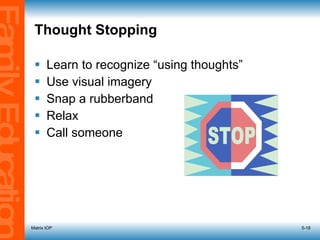
Thought Stopping Learn to recognize “using thoughts” Use visual imagery Snap a rubberband Relax Call someone Matrix IOP 5-
Nontrigger Activities Exercise 12-Step/mutual-help group meetings New recreation/hobby Faith-based or spiritual activities Eating/sleeping Non–drug-oriented movies Structured/monitored periods Matrix IOP 5-
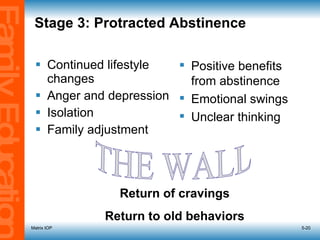
Stage 3: Protracted Abstinence Continued lifestyle changes Anger and depression Isolation Family adjustment Matrix IOP 5- Return   of   cravings Return to old behaviors THE WALL Positive benefits from abstinence Emotional swings Unclear thinking
Protracted Abstinence Relapse Risk Factors Increased emotionality Behavioral “drift” Decreased ability to feel pleasure  Low energy/fatigue Secondary drug use Matrix IOP 5- Breakdown of structure Interpersonal conflict Loss of motivation Insomnia Paranoia Relapse justification
Secondary Drugs and Alcohol Use of a secondary drug or alcohol may lead to relapse to stimulants through   Cortical disinhibition Stimulant craving induction 12-Step philosophy conflict Abstinence violation effect Interference with new behaviors Matrix IOP 5-
Protracted Abstinence Relapse Justification Matrix IOP 5- The addicted brain attempts to provide a  seemingly  rational reason (justification) for behavior that moves a person in recovery closer to a slip.
Relapse Justification Other   People Made Me Do It My wife used so … I was doing fine until he brought home … I went to the beach with my sister and … My brother came over for dinner and  brought some … I wanted to see my friend just once more, and he offered me some … Matrix IOP 5-
Relapse Justification   I Needed It for a Specific Purpose I was getting fat again and needed to control my weight, so I … I couldn’t get the energy I needed without … I can’t have fun without … Life is too boring without … I can’t be comfortable in social situations or meet people without … Matrix IOP 5-
Relapse Justification   I Was Testing Myself I wanted to see whether it would “work better”  now that I’ve been clean awhile. I wanted to see my friends again, and I’m  stronger now. I needed a little money and thought I could sell a  little without using. I wanted to see whether I could use just a little  and no more. I wanted to see whether I could be around it and  say no. I thought I could drink without using. Matrix IOP 5-
Relapse Justification   It   Wasn’t My Fault It was right before my period, and I was depressed. I had an argument with my spouse. My parents were bugging me. My partner was intimate with another person. The weather was gloomy. I was only going to take a hit and … Matrix IOP 5-
Relapse Justification  It Was an Accident I was in a bar, and someone offered me some meth. I was at work, and someone offered … I found some in my car. I went to a movie about … A friend called to see how I was doing. We were talking and decided to get together. Matrix IOP 5-
Relapse Justification   I Felt Bad Life is so boring I may as well use. I was feeling depressed, so … My job wasn’t going well and I was frustrated, so … I was feeling sorry for myself, so I … Recovery is just too hard. Matrix IOP 5-
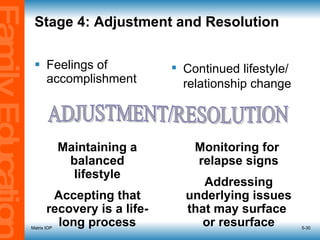
Stage 4: Adjustment and Resolution Feelings of accomplishment Matrix IOP 5- ADJUSTMENT/RESOLUTION Maintaining a balanced lifestyle Accepting that recovery is a life-long process Monitoring for  relapse   signs Addressing underlying issues that may surface  or resurface Continued lifestyle/ relationship change
Adjustment and Resolution Relapse Risk Factors  Secondary drug or alcohol use Feeling “cured” and relaxing vigilance for relapse signs Relaxation of structure Losing recovery momentum/commitment Struggle with accepting addiction and recovery as a life-long process Reemergence of underlying emotional issues Matrix IOP 5-
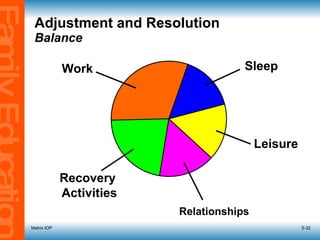
Adjustment and Resolution Balance Matrix IOP 5- Work Recovery  Activities Sleep Leisure Relationships

Relapse prevention 2 2 hours

  • 1.
    Session 5: Roadmapfor Recovery 5-
  • 2.
    Recovery Stages MatrixIOP 5- Stage 1: Withdrawal Stage 2: Early Abstinence (“Honeymoon”) Stage 3: Protracted Abstinence (“the Wall”) Stage 4: Adjustment/Resolution
  • 3.
    Stage 1: WithdrawalPhysical detoxification Cravings Depression/anxiety Low energy Irritability Matrix IOP 5- WITHDRAWAL Exhaustion Insomnia Paranoia Memory problems Intense hunger
  • 4.
    Withdrawal Relapse RiskFactors Powerful cravings Paranoia Depression Disordered sleep patterns Unstructured time Proximity of triggers Fear of withdrawal symptoms Matrix IOP 5-
  • 5.
    Withdrawal Structure Self-designedstructure Helps eliminate avoidable triggers Makes the concept of “one day at a time” concrete Reduces anxiety Counters the drug-using lifestyle Provides a basic foundation for ongoing recovery Matrix IOP 5-
  • 6.
    Building Blocks ofStructure Matrix IOP 5- Treatment Activities Recreational/Leisure Activities 12-Step/Mutual-Help Meetings School Sports Activities With Friends Who Are Drug Free Time Scheduling Exercise Work Family-Related Events Spiritual Activities Island Building
  • 7.
    Scheduling Pitfalls Unrealisticschedules Unbalanced schedules Imposed schedules No support from significant others Holidays, illness, and other changes Matrix IOP 5-
  • 8.
    Stage 2: EarlyAbstinence Increased energy and optimism Overconfidence Difficulty concentrating Continued memory problems Matrix IOP 5- Concern about weight gain Intense feelings Mood swings Other substance use Inability to prioritize Mild paranoia HONEYMOON
  • 9.
    Early Abstinence RelapseRisk Factors “ Workaholism” Discontinuation of structure (including treatment) Overconfidence Secondary drug or alcohol use Inability to prioritize Resistance to behavior change Occasional paranoia Matrix IOP 5-
  • 10.
    Early Abstinence Triggersand Thought Stopping Matrix IOP 5- Trigger Thought Thought stopping Continued thoughts Use Cravings
  • 11.
    Matrix IOP 5-Interruption Trigger Thought Craving Use
  • 12.
    Types of TriggersTriggers can relate to People Places Things Times Emotional states Matrix IOP 5-
  • 13.
    Triggers People Friends who use drugs/dealers Absence of significant other Voices of friends who use drugs/dealers Intimate partners People discussing drug use Matrix IOP 5-
  • 14.
    Triggers PlacesDrug dealer’s home Bars and clubs Drug use neighborhoods Work Some street corners Anyplace associated with use Matrix IOP 5-
  • 15.
    Triggers ThingsDrug paraphernalia Money/ATMs Movies/TV shows about drugs and alcohol Sexually explicit magazines/movies Certain music Secondary drug or alcohol use Matrix IOP 5-
  • 16.
    Triggers Times Idle time After work Holidays Birthdays/anniversaries Stressful times Paydays Friday/Saturday nights Matrix IOP 5-
  • 17.
    Triggers EmotionalStates Anxiety Depression Boredom Fear Sexual arousal or deprivation Fatigue Anger Frustration Concern about weight gain Matrix IOP 5-
  • 18.
    Thought Stopping Learnto recognize “using thoughts” Use visual imagery Snap a rubberband Relax Call someone Matrix IOP 5-
  • 19.
    Nontrigger Activities Exercise12-Step/mutual-help group meetings New recreation/hobby Faith-based or spiritual activities Eating/sleeping Non–drug-oriented movies Structured/monitored periods Matrix IOP 5-
  • 20.
    Stage 3: ProtractedAbstinence Continued lifestyle changes Anger and depression Isolation Family adjustment Matrix IOP 5- Return of cravings Return to old behaviors THE WALL Positive benefits from abstinence Emotional swings Unclear thinking
  • 21.
    Protracted Abstinence RelapseRisk Factors Increased emotionality Behavioral “drift” Decreased ability to feel pleasure Low energy/fatigue Secondary drug use Matrix IOP 5- Breakdown of structure Interpersonal conflict Loss of motivation Insomnia Paranoia Relapse justification
  • 22.
    Secondary Drugs andAlcohol Use of a secondary drug or alcohol may lead to relapse to stimulants through Cortical disinhibition Stimulant craving induction 12-Step philosophy conflict Abstinence violation effect Interference with new behaviors Matrix IOP 5-
  • 23.
    Protracted Abstinence RelapseJustification Matrix IOP 5- The addicted brain attempts to provide a seemingly rational reason (justification) for behavior that moves a person in recovery closer to a slip.
  • 24.
    Relapse Justification Other People Made Me Do It My wife used so … I was doing fine until he brought home … I went to the beach with my sister and … My brother came over for dinner and brought some … I wanted to see my friend just once more, and he offered me some … Matrix IOP 5-
  • 25.
    Relapse Justification I Needed It for a Specific Purpose I was getting fat again and needed to control my weight, so I … I couldn’t get the energy I needed without … I can’t have fun without … Life is too boring without … I can’t be comfortable in social situations or meet people without … Matrix IOP 5-
  • 26.
    Relapse Justification I Was Testing Myself I wanted to see whether it would “work better” now that I’ve been clean awhile. I wanted to see my friends again, and I’m stronger now. I needed a little money and thought I could sell a little without using. I wanted to see whether I could use just a little and no more. I wanted to see whether I could be around it and say no. I thought I could drink without using. Matrix IOP 5-
  • 27.
    Relapse Justification It Wasn’t My Fault It was right before my period, and I was depressed. I had an argument with my spouse. My parents were bugging me. My partner was intimate with another person. The weather was gloomy. I was only going to take a hit and … Matrix IOP 5-
  • 28.
    Relapse Justification It Was an Accident I was in a bar, and someone offered me some meth. I was at work, and someone offered … I found some in my car. I went to a movie about … A friend called to see how I was doing. We were talking and decided to get together. Matrix IOP 5-
  • 29.
    Relapse Justification I Felt Bad Life is so boring I may as well use. I was feeling depressed, so … My job wasn’t going well and I was frustrated, so … I was feeling sorry for myself, so I … Recovery is just too hard. Matrix IOP 5-
  • 30.
    Stage 4: Adjustmentand Resolution Feelings of accomplishment Matrix IOP 5- ADJUSTMENT/RESOLUTION Maintaining a balanced lifestyle Accepting that recovery is a life-long process Monitoring for relapse signs Addressing underlying issues that may surface or resurface Continued lifestyle/ relationship change
  • 31.
    Adjustment and ResolutionRelapse Risk Factors Secondary drug or alcohol use Feeling “cured” and relaxing vigilance for relapse signs Relaxation of structure Losing recovery momentum/commitment Struggle with accepting addiction and recovery as a life-long process Reemergence of underlying emotional issues Matrix IOP 5-
  • 32.
    Adjustment and ResolutionBalance Matrix IOP 5- Work Recovery Activities Sleep Leisure Relationships