CoachingChantelleEnesa & KeliFuimaono
What is Coaching in Sports ?	Coaching is the organised provision of assistance to an individual performer or a group of performers in order to help them develop and improve in their chosen sport. Coaching therefore involves instruction, teaching and training, but it also has additional distinctive features. 				-National Coaching Foundation, 1986
Philosophy on CoachingA philosophy helps guide you everyday and it helps you interpret the events in life and provide directionCoaches without well developed philosophies lack direction and readily succumb to external pressuresPhilosophy is the foundation from which a coach will develop their entire approach to sport psychology- Martens, 1942
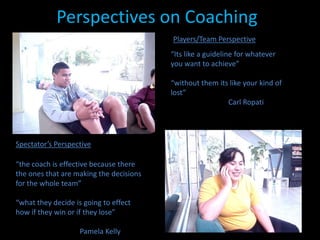
Perspectives on CoachingPlayers/Team Perspective“Its like a guideline for whatever you want to achieve”“without them its like your kind of lost”	              Carl Ropati Spectator’s Perspective “the coach is effective because there the ones that are making the decisions for the whole team”“what they decide is going to effect how if they win or if they lose”		Pamela Kelly
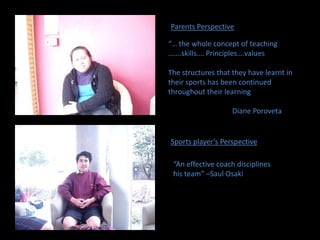
Parents Perspective“… the whole concept of teaching …….skills…. Principles….valuesThe structures that they have learnt in their sports has been continued throughout their learning		Diane Poroveta Sports player’s Perspective“An effective coach disciplines his team” –Saul Osaki
	Coaching is as much about people as it is about technique and tactics. Coaches directly influence athletes by guiding and teaching. The heart of the coaching process is insuring a safe learning environment.  Australian Sports Commission, 2001Coaches abilities are diverse and each coach is at a different development level. However, every coach can always improve. As we continue to coach, we constantly refine and enhance our coaching skills. It is important to judge the effectiveness of that process rather than any particular outcome. If coaches are not achieving success they need to look at changing what they are doing, that is , changing the process.                   Hanrahan& Kidman, 2004
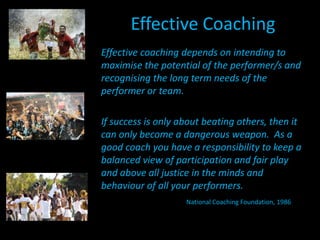
Effective CoachingEffective coaching depends on intending to maximise the potential of the performer/s and recognising the long term needs of the performer or team. If success is only about beating others, then it can only become a dangerous weapon.  As a good coach you have a responsibility to keep a balanced view of participation and fair play and above all justice in the minds and behaviour of all your performers. National Coaching Foundation, 1986
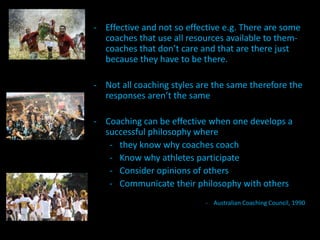
Effective and not so effective e.g. There are some coaches that use all resources available to them- coaches that don’t care and that are there just because they have to be there.
Not all coaching styles are the same therefore the responses aren’t the same
Coaching can be effective when one develops a successful philosophy where
they know why coaches coach
Know why athletes participate
Consider opinions of others
Communicate their philosophy with others
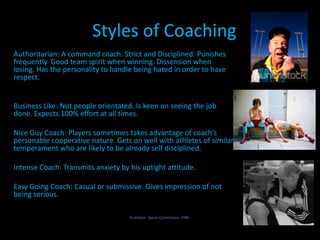
Australian Coaching Council, 1990Styles of Coaching	Authoritarian: A command coach. Strict and Disciplined. Punishes frequently. Good team spirit when winning. Dissension when losing. Has the personality to handle being hated in order to have respect. 	Business Like: Not people orientated. Is keen on seeing the job done. Expects 100% effort at all times. 	Nice Guy Coach: Players sometimes takes advantage of coach’s personable cooperative nature. Gets on well with athletes of similar temperament who are likely to be already self disciplined.	Intense Coach: Transmits anxiety by his uptight attitude. 	Easy Going Coach: Casual or submissive. Gives impression of not being serious. Australian  Sports Commission, 1990.
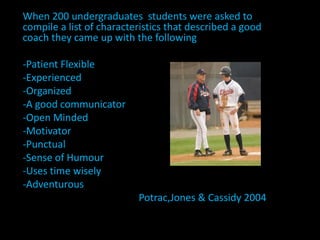
   	When 200 undergraduates  students were asked to compile a list of characteristics that described a good coach they came up with the following	-Patient Flexible 	-Experienced 	-Organized 	-A good communicator  	-Open Minded 	-Motivator 	-Punctual 	-Sense of Humour 	-Uses time wisely 	-Adventurous Potrac,Jones & Cassidy 2004
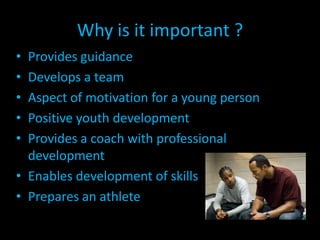
Why is it important ?Provides guidance Develops a teamAspect of motivation for a young personPositive youth developmentProvides a coach with professional developmentEnables development of skillsPrepares an athlete
New Zealand Initiative’sSports and Recreation New ZealandEveryone. Every day. Enjoying and excelling through sport and recreation.To achieve the SPARC vision SPARC has identified 5 main areas. These areas areYoung New Zealanders 0 – 18 Grassroots sportRecreationPartner Capability High Performance SPARC  LeadsAdvocacy, facilitation and bringing the sector together. Providing research, identifying and sharing good practice.InvestInvesting in partners to deliver results.EnableBuilding the capability of our partners – systems, processes and tools. Providing experts and research. Providing sector training and development.SPARC , 2010
	SPARC is the Crown Entity responsible for sport and physical recreation in New Zealand. SPARC was established on 1 January 2003 under the Sport and Recreation New Zealand Act (2002). SPARC ‘S ROLE IN THE GOVERNMENTSPARC provides leadership in research and the development and implementation of policies that recognise the importance of sport and physical recreation to New Zealand. SPARCS DELIVERY MODELSPARC‘s delivery model is based on partnering with key organisations in the sport and recreation sector (primarily national-level sport and recreation organisations and regional sports trusts) to help us achieve our outcomes. SPARC is not primarily a delivery agency, but is responsible for setting direction and providing investment and resources to the sector. The Sports and Recreation Act 2002 was created to promote , encourage, and support physical recreation and sport in NZ. SPARCS functions (as outlined in Section 8 of the act) are to: Invest: target investment to organisations that are the most capable and ready to deliver on our outcomes Lead: provide clear and strong leadership and work in the best interests of the sport and recreation sector through advocacy, policy development and research, and coordination of the sector to be stronger and more effective. Enable: build the capability of our partners by providing staff, resources, research and examples of good practice across the sector – for example, in coaching, governance and management systems, research and monitoring. 					             SPARC , 2010
Sports and Recreation New ZealandThis strategy has been developed for coaches by coaches to meet the needs of allcoaches in New Zealand. It addresses issues associated with the current coachingenvironment and is aligned to athletes’ needs. It will deliver a co-ordinated coachingapproach that links regional and national activities and outcomes.Strategy ObjectivesThis strategy lays the foundations to create a World-Class Coaching Environmentthat meets the needs of New Zealand’s coaches and the athletes they coach.This environment will in turn create world-class coaches.To ensure the success of the strategy, the following three objectives mustbe achieved:Objective One – More TimeIncrease and improve the quality and quantity of time available for coaches to focuson coaching activities and coach education opportunities.Objective Two – IncreasedRecognition and StatusIncrease the recognition and status of coaches to ensure they are valued andthat coaching is seen as a rewarding experience.Objective Three – Improved QualityContinually improve the quality of the coach education process, ensuring thatcoaches have ongoing pathways for further development		SPARC ,  2010
New Zealand Initiatives Raise up ‘n’ RepresentYouth development programme for the YMCA
Was designed to give youth a safe and healthy environment to socialise and achieve

Coaching real 1_

  • 1.
  • 2.
    What is Coachingin Sports ? Coaching is the organised provision of assistance to an individual performer or a group of performers in order to help them develop and improve in their chosen sport. Coaching therefore involves instruction, teaching and training, but it also has additional distinctive features. -National Coaching Foundation, 1986
  • 3.
    Philosophy on CoachingAphilosophy helps guide you everyday and it helps you interpret the events in life and provide directionCoaches without well developed philosophies lack direction and readily succumb to external pressuresPhilosophy is the foundation from which a coach will develop their entire approach to sport psychology- Martens, 1942
  • 4.
    Perspectives on CoachingPlayers/TeamPerspective“Its like a guideline for whatever you want to achieve”“without them its like your kind of lost” Carl Ropati Spectator’s Perspective “the coach is effective because there the ones that are making the decisions for the whole team”“what they decide is going to effect how if they win or if they lose” Pamela Kelly
  • 5.
    Parents Perspective“… thewhole concept of teaching …….skills…. Principles….valuesThe structures that they have learnt in their sports has been continued throughout their learning Diane Poroveta Sports player’s Perspective“An effective coach disciplines his team” –Saul Osaki
  • 6.
    Coaching is asmuch about people as it is about technique and tactics. Coaches directly influence athletes by guiding and teaching. The heart of the coaching process is insuring a safe learning environment. Australian Sports Commission, 2001Coaches abilities are diverse and each coach is at a different development level. However, every coach can always improve. As we continue to coach, we constantly refine and enhance our coaching skills. It is important to judge the effectiveness of that process rather than any particular outcome. If coaches are not achieving success they need to look at changing what they are doing, that is , changing the process. Hanrahan& Kidman, 2004
  • 7.
    Effective CoachingEffective coachingdepends on intending to maximise the potential of the performer/s and recognising the long term needs of the performer or team. If success is only about beating others, then it can only become a dangerous weapon. As a good coach you have a responsibility to keep a balanced view of participation and fair play and above all justice in the minds and behaviour of all your performers. National Coaching Foundation, 1986
  • 8.
    Effective and notso effective e.g. There are some coaches that use all resources available to them- coaches that don’t care and that are there just because they have to be there.
  • 9.
    Not all coachingstyles are the same therefore the responses aren’t the same
  • 10.
    Coaching can beeffective when one develops a successful philosophy where
  • 11.
    they know whycoaches coach
  • 12.
  • 13.
  • 14.
  • 15.
    Australian Coaching Council,1990Styles of Coaching Authoritarian: A command coach. Strict and Disciplined. Punishes frequently. Good team spirit when winning. Dissension when losing. Has the personality to handle being hated in order to have respect. Business Like: Not people orientated. Is keen on seeing the job done. Expects 100% effort at all times. Nice Guy Coach: Players sometimes takes advantage of coach’s personable cooperative nature. Gets on well with athletes of similar temperament who are likely to be already self disciplined. Intense Coach: Transmits anxiety by his uptight attitude. Easy Going Coach: Casual or submissive. Gives impression of not being serious. Australian Sports Commission, 1990.
  • 16.
    When 200 undergraduates students were asked to compile a list of characteristics that described a good coach they came up with the following -Patient Flexible -Experienced -Organized -A good communicator -Open Minded -Motivator -Punctual -Sense of Humour -Uses time wisely -Adventurous Potrac,Jones & Cassidy 2004
  • 17.
    Why is itimportant ?Provides guidance Develops a teamAspect of motivation for a young personPositive youth developmentProvides a coach with professional developmentEnables development of skillsPrepares an athlete
  • 18.
    New Zealand Initiative’sSportsand Recreation New ZealandEveryone. Every day. Enjoying and excelling through sport and recreation.To achieve the SPARC vision SPARC has identified 5 main areas. These areas areYoung New Zealanders 0 – 18 Grassroots sportRecreationPartner Capability High Performance SPARC LeadsAdvocacy, facilitation and bringing the sector together. Providing research, identifying and sharing good practice.InvestInvesting in partners to deliver results.EnableBuilding the capability of our partners – systems, processes and tools. Providing experts and research. Providing sector training and development.SPARC , 2010
  • 19.
    SPARC is theCrown Entity responsible for sport and physical recreation in New Zealand. SPARC was established on 1 January 2003 under the Sport and Recreation New Zealand Act (2002). SPARC ‘S ROLE IN THE GOVERNMENTSPARC provides leadership in research and the development and implementation of policies that recognise the importance of sport and physical recreation to New Zealand. SPARCS DELIVERY MODELSPARC‘s delivery model is based on partnering with key organisations in the sport and recreation sector (primarily national-level sport and recreation organisations and regional sports trusts) to help us achieve our outcomes. SPARC is not primarily a delivery agency, but is responsible for setting direction and providing investment and resources to the sector. The Sports and Recreation Act 2002 was created to promote , encourage, and support physical recreation and sport in NZ. SPARCS functions (as outlined in Section 8 of the act) are to: Invest: target investment to organisations that are the most capable and ready to deliver on our outcomes Lead: provide clear and strong leadership and work in the best interests of the sport and recreation sector through advocacy, policy development and research, and coordination of the sector to be stronger and more effective. Enable: build the capability of our partners by providing staff, resources, research and examples of good practice across the sector – for example, in coaching, governance and management systems, research and monitoring.  SPARC , 2010
  • 20.
    Sports and RecreationNew ZealandThis strategy has been developed for coaches by coaches to meet the needs of allcoaches in New Zealand. It addresses issues associated with the current coachingenvironment and is aligned to athletes’ needs. It will deliver a co-ordinated coachingapproach that links regional and national activities and outcomes.Strategy ObjectivesThis strategy lays the foundations to create a World-Class Coaching Environmentthat meets the needs of New Zealand’s coaches and the athletes they coach.This environment will in turn create world-class coaches.To ensure the success of the strategy, the following three objectives mustbe achieved:Objective One – More TimeIncrease and improve the quality and quantity of time available for coaches to focuson coaching activities and coach education opportunities.Objective Two – IncreasedRecognition and StatusIncrease the recognition and status of coaches to ensure they are valued andthat coaching is seen as a rewarding experience.Objective Three – Improved QualityContinually improve the quality of the coach education process, ensuring thatcoaches have ongoing pathways for further development SPARC , 2010
  • 21.
    New Zealand InitiativesRaise up ‘n’ RepresentYouth development programme for the YMCA
  • 22.
    Was designed togive youth a safe and healthy environment to socialise and achieve

Editor's Notes

  • #4 This would be reason it is that you want to coach it is about knowing yourself so you can pass your knowledge and skills on to others it is also about1 helping your performers or team to grow and develop as individuals2 to help them win3 to help them enjoy themselves and have fun
  • #12 Positive youth development through participation, safe environment to learn skills and be taught
  • #17 Out of school care and recreationsport
  • #18 Related to coaching in the sense that as the co ordinator I had to be responsible for staff that were hired to teach young people games as well as dancing so that they would engage in sport or physical activity and see the postive elements of being activeTherefore in relation to coaching not only was I a coach to my staff but also my staff coached the kids so that they would be able to learn new skills in sports be able to engage in at least 30minutes of sports or play Coaching the kids in sports enabled them to see what sports they really enjoyed and went on further to engage in this sport in a bigger capacity whether it was club or school
  • #19 Facing the Giants: http://www.youtube.com/watch?v=-vB59PkB0eQ&feature=fvw