CLIMATE RESILIENCE
AND INFRASTRUCTURE
0 s
BILOXI-OCEAN SPRINGS BRIDGE AFTER HURRICANE KATRINA (2005)
The hurricane caused $156.3B in damages
INCREASE IN NATURAL DISASTERS
FLOODED BANKS OF THE SEINE (2016)
The May-June flood affecting the northern half
of France caused €1.4B in damages
©Thesupermat–2016-CCBY-SA4.0
INCREASE IN NATURAL DISASTERS
DON MUANG AIRPORT SHUT DOWN BY FLOODING IN THAILAND (2011)
The disaster caused €33B in damages
©SirAlex/Shutterstock.com–2011
INCREASE IN NATURAL DISASTERS
HURRICANE IRMA’S PATH OF DESTRUCTION THROUGH THE CARIBBEAN (2017)
The natural disaster caused $80.8B in damages and killed 105 people (EM-DAT)
©DevastationoftheislandofJostVanDykeafterhurricaneIrma-DFID-UKDepartmentforInternationalDevelopment–2017-CCBY2.0
INCREASE IN NATURAL DISASTERS
I. RESILIENCE: A NECESSITY IN THE
FACE OF CLIMATE CHANGE
II. THE CRITICAL CHALLENGES AHEAD
III. DEVELOPING RESILIENT
SOLUTIONS
I. RESILIENCE:
A NECESSITY IN THE FACE
OF CLIMATE CHANGE
1. A GLOBAL PHENOMENON
WITH LOCAL CONSEQUENCES
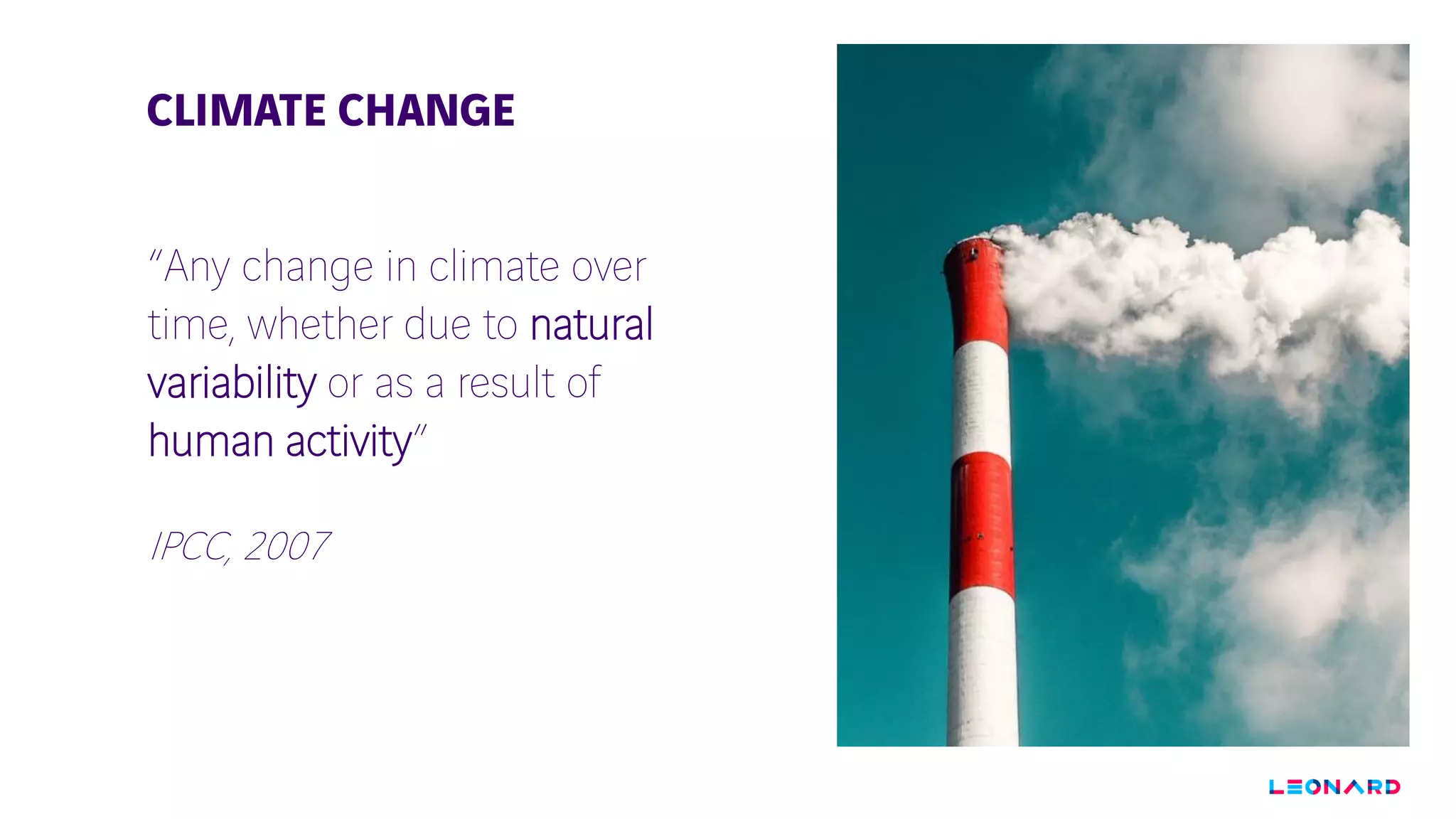
CLIMATE CHANGE
“Any change in climate over
time, whether due to natural
variability or as a result of
human activity”
IPCC, 2007
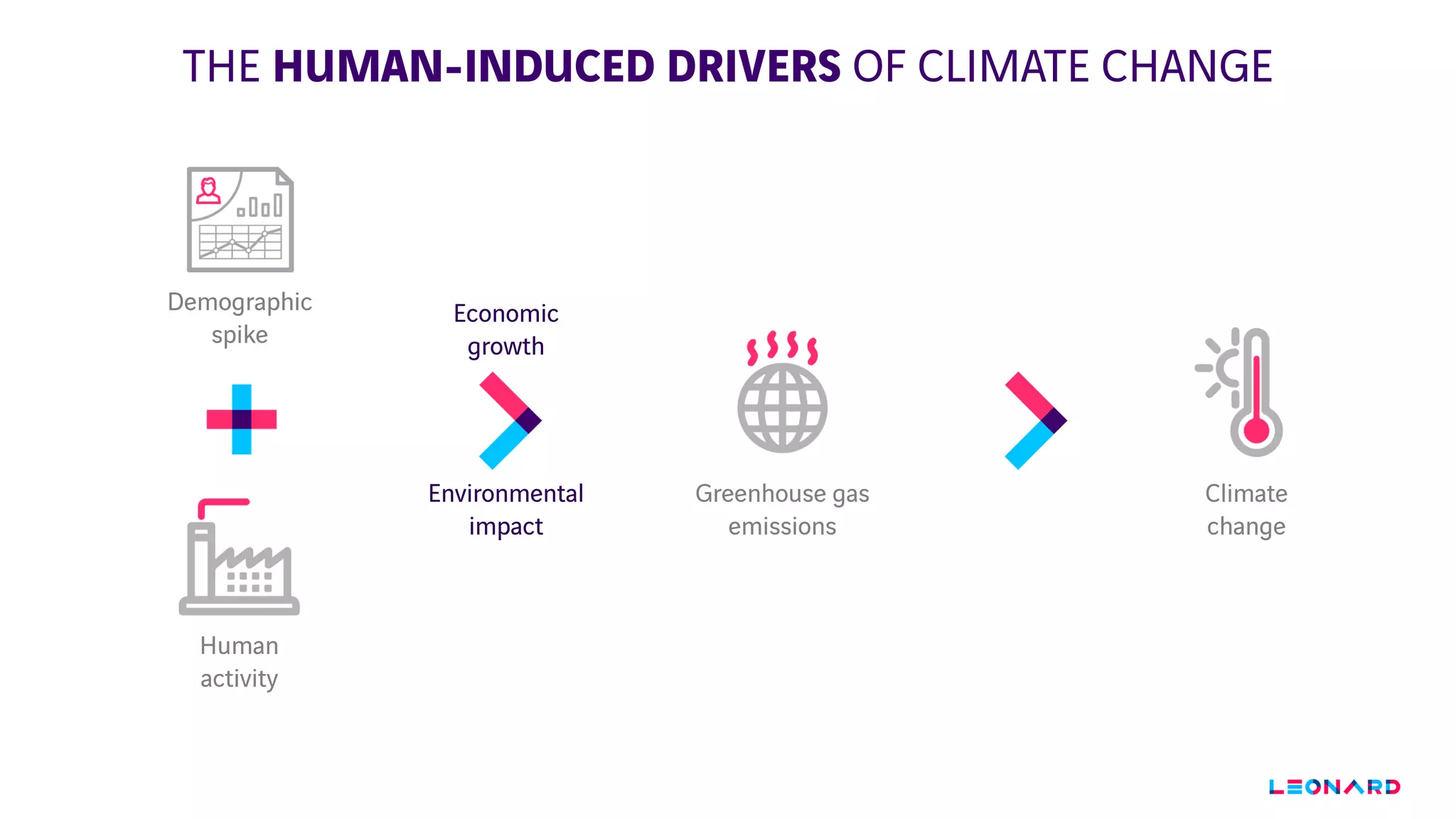
THE HUMAN-INDUCED DRIVERS OF CLIMATE CHANGE
Human
activity
Greenhouse gas
emissions
Climate
change
Demographic
spike
Economic
growth
Environmental
impact
Periodic
climate shocks
Gradual evolution of
climate factors
A GLOBAL PHENOMENON WITH LOCAL CONSEQUENCES
Typology of climate risks
Climate change will affect each region differently
THE GRADUAL EVOLUTION OF CLIMATE FACTORS
Sea level Thermohaline
circulation
Wind patterns Air quality
Air
temperature
Rainfall
patterns
Melting
permafrost
PERIODIC CLIMATE SHOCKS
Flooding Tropical
cyclones
Storms Forest fires Extreme
temperatures
Frost / Thaw DroughtShrink / swell of
clay
Landslide
2. TOWARDS RESILIENCE IN
INFRASTRUCTURE
“Climate change has happened because of
human behavior, therefore it is only natural
that it should be us, as human beings, to
address this issue. It may not be too late if
we take decisive actions today.”
Ban Ki Moon, UN Secretary-General (2007-2016)
Speech at 45th World Economic Forum,
January 23, 2015
©WorldEconomicForum-2008-CCBY-SA2.0
CLIMATE RESILIENCE
Capacity of a system, society or
infrastructure to resist and absorb a
climate disturbance and to return to its
initial state, while reducing its
vulnerability to future disturbances
© Cheonggyecheon – Rich & Cheryl – 2013 - CC BY-NC-SA 2.0
Greenspace reclaims a former
highway in Seoul
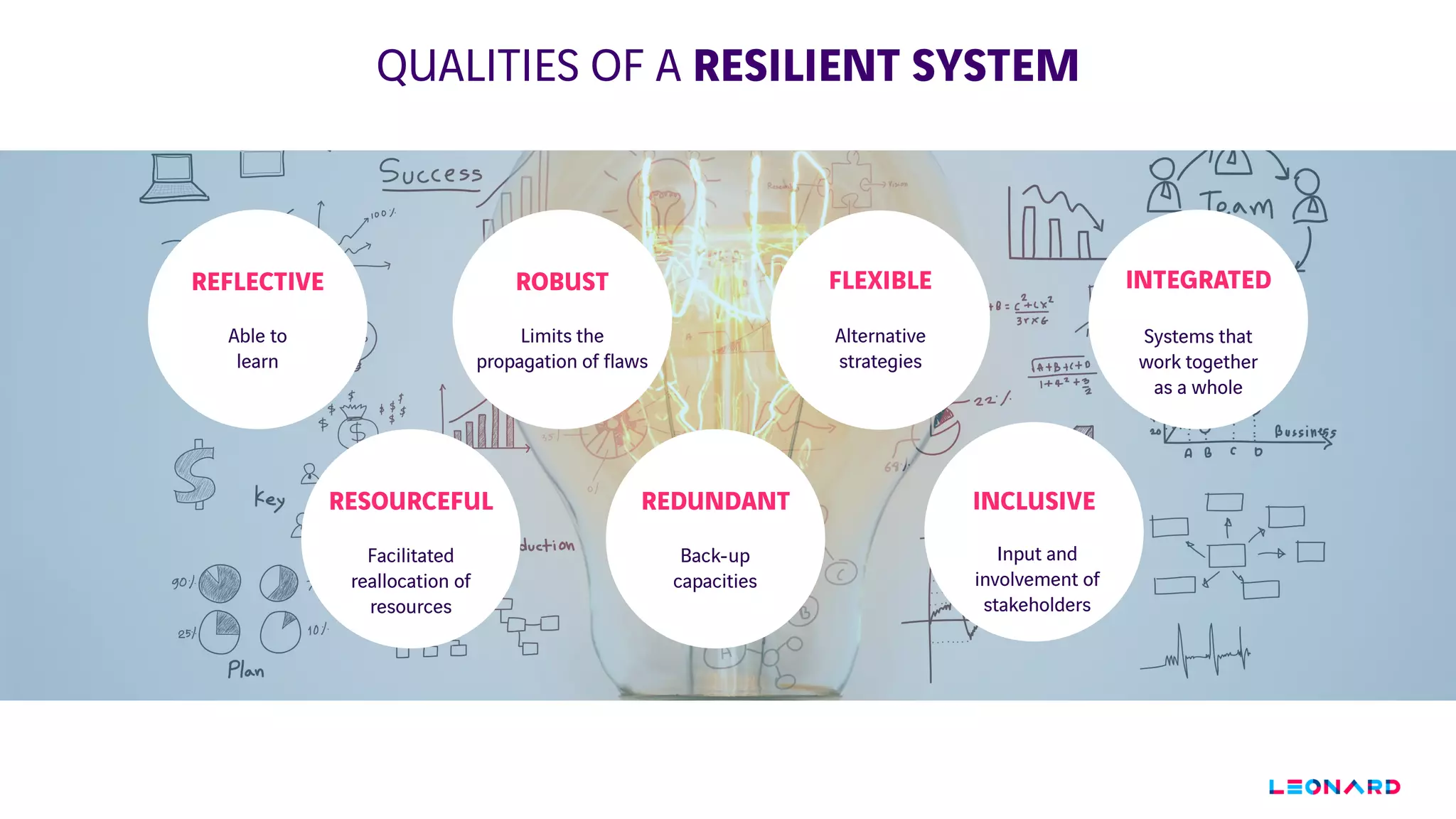
QUALITIES OF A RESILIENT SYSTEM
RESOURCEFUL
Facilitated
reallocation of
resources
REFLECTIVE
Able to
learn
ROBUST
Limits the
propagation of flaws
FLEXIBLE
Alternative
strategies
REDUNDANT
Back-up
capacities
INCLUSIVE
Input and
involvement of
stakeholders
INTEGRATED
Systems that
work together
as a whole
FUNCTIONAL RESILIENCE
Operation in fail-soft mode while ensuring a minimum service level in the
absence of the usual resources
Resistance
Absorption
Recovery
TWO TYPES OF RESILIENT MEASURES
Adaptation
Manage the
inevitable
Attenuation
Avoid the
unmanageable
3. ADAPTATION STRATEGIES
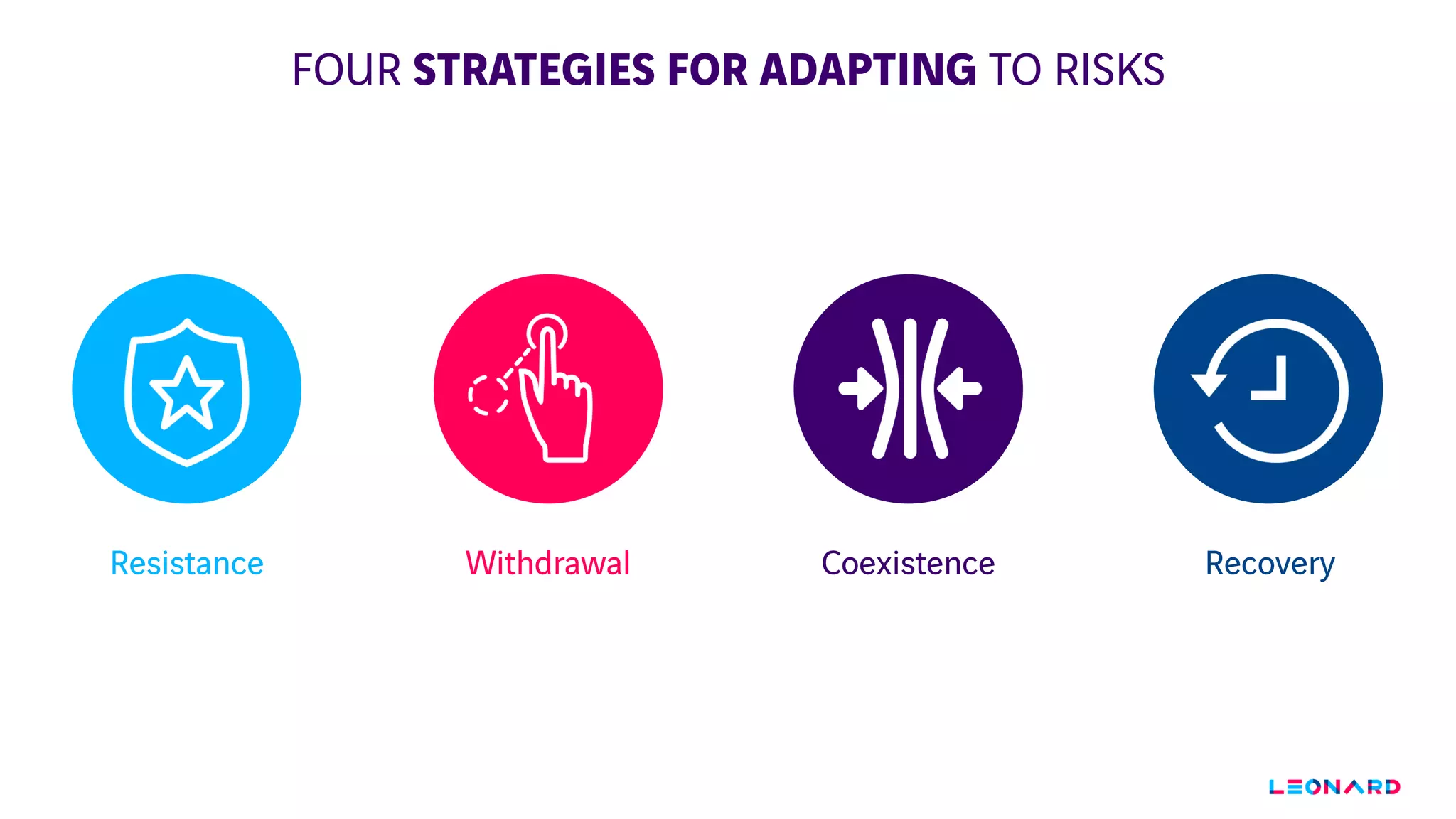
Resistance Withdrawal Coexistence Recovery
FOUR STRATEGIES FOR ADAPTING TO RISKS
Coexistence RecoveryResistance Withdrawal
REINFORCING PROTECTION SYSTEMS AND STRUCTURES AGAINST RISK
Fortifying the Perrotine dyke (Saint-Pierre-d’Oléron, 2017)
©GillesDELACUVELLERIE–PhotothèqueVINCI-2005
ABANDONING A REGION’S DEVELOPMENT
The only house left standing after the Saguenay flood (Quebec, 1994)
Coexistence RecoveryResistance Withdrawal
©0x010C-2016–CCBY4.0
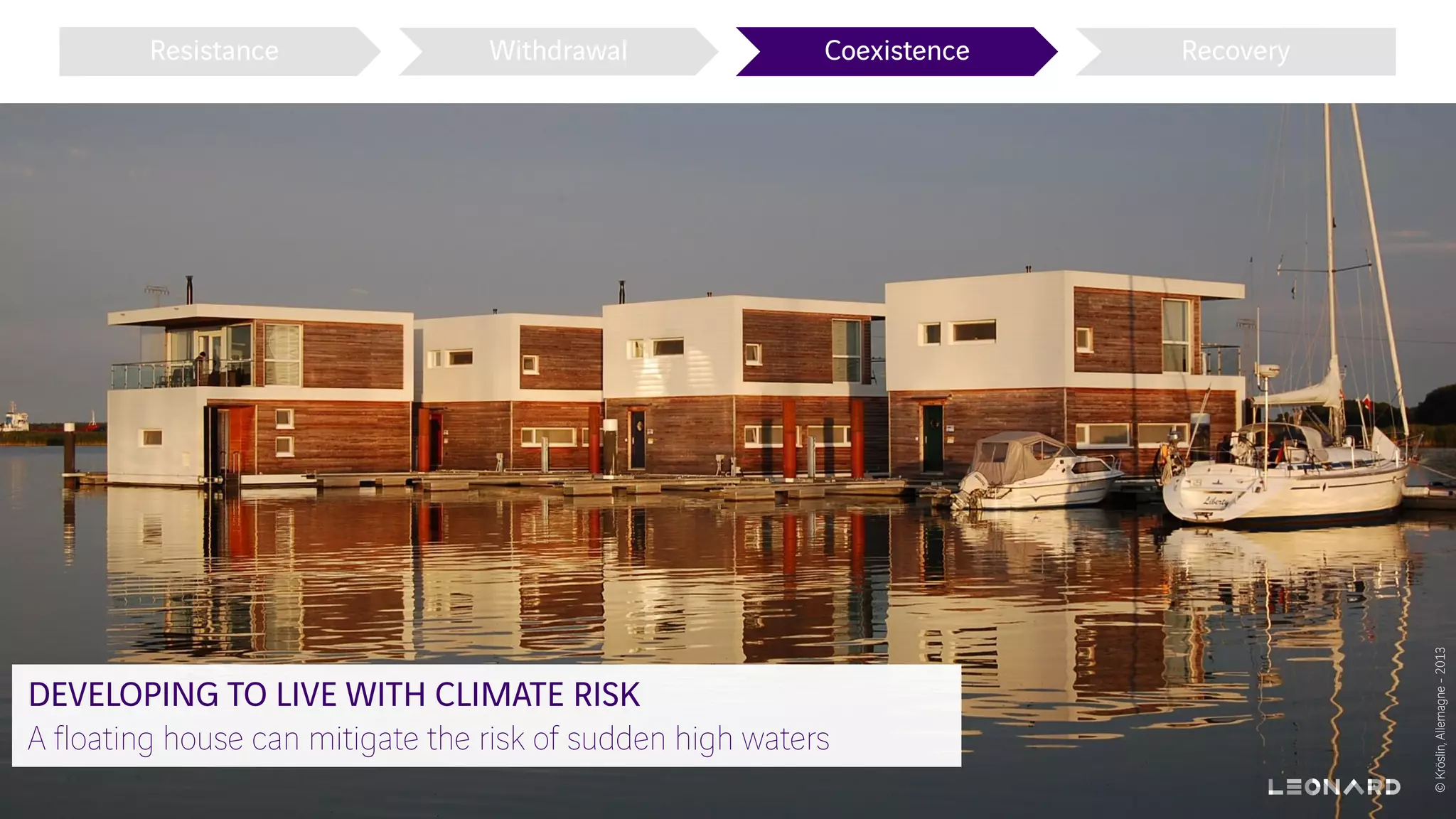
DEVELOPING TO LIVE WITH CLIMATE RISK
A floating house can mitigate the risk of sudden high waters
Coexistence RecoveryResistance Withdrawal
©Kröslin,Allemagne-2013
TWO WAYS OF SUPPORTING POST CRISIS RECOVERY:
“BUILD BACK BETTER” OR “FRAGILE BUT AGILE”
After Irma, six schoolrooms will be rebuilt through the Logelis Build Back Better
strategy (Saint-Martin, 2017)
Coexistence RecoveryResistance Withdrawal
©LavilledeMarigotsurl'îledeSaint-Martin,deuxjoursaprèsl'ouraganIRMA-UIISC1-2017-CCBY-SA4.0
II. THE CRITICAL
CHALLENGES AHEAD
1. GLOBAL CONSEQUENCES
“The warnings about global warming have
been extremely clear for a long time. We
are facing a global climate crisis. It is
deepening. We are entering a period of
consequences.”
Al Gore, Vice President of the United States (1993-2001)
Speech given at the Sierra Club National Convention on
September 9, 2005
©AlGore–SSEE–2016-CCBY-SA4.0
Ecosystem and
biodiversity
Economy Health
Access to
resources
Geopolitical
instability
Climate
migration
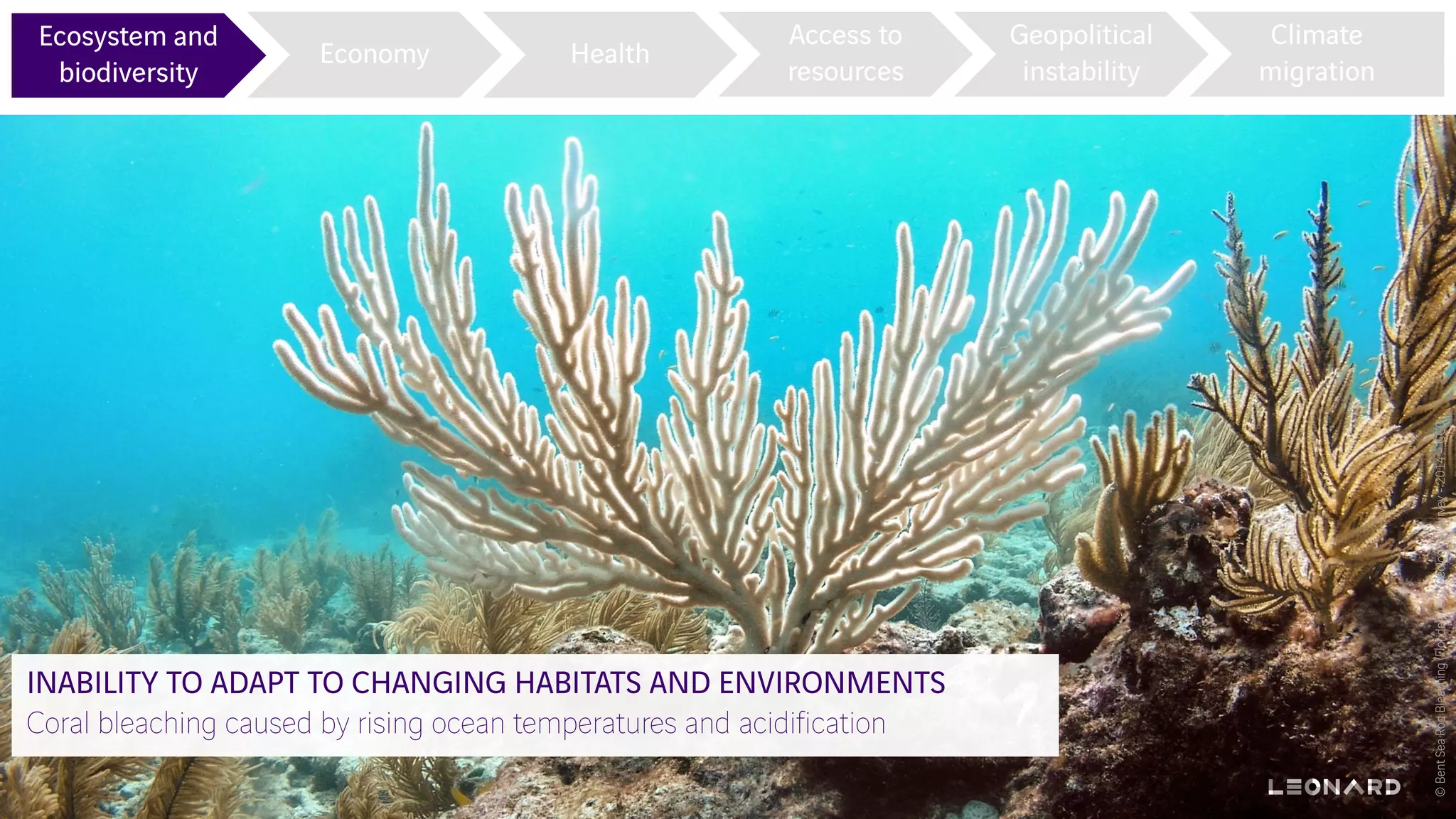
INABILITY TO ADAPT TO CHANGING HABITATS AND ENVIRONMENTS
Coral bleaching caused by rising ocean temperatures and acidification
©BentSeaRodBleaching(Florida)-U.S.GeologicalSurvey-2014–CC0
EACH THREATENED FOOD SOURCE UPSETS THE ENTIRE SUPPLY CHAIN
This applies across every sector: agriculture, fishing, construction, retail, insurance, tourism, etc.
Ecosystem and
biodiversity
Economy Health
Access to
resources
Geopolitical
instability
Climate
migration
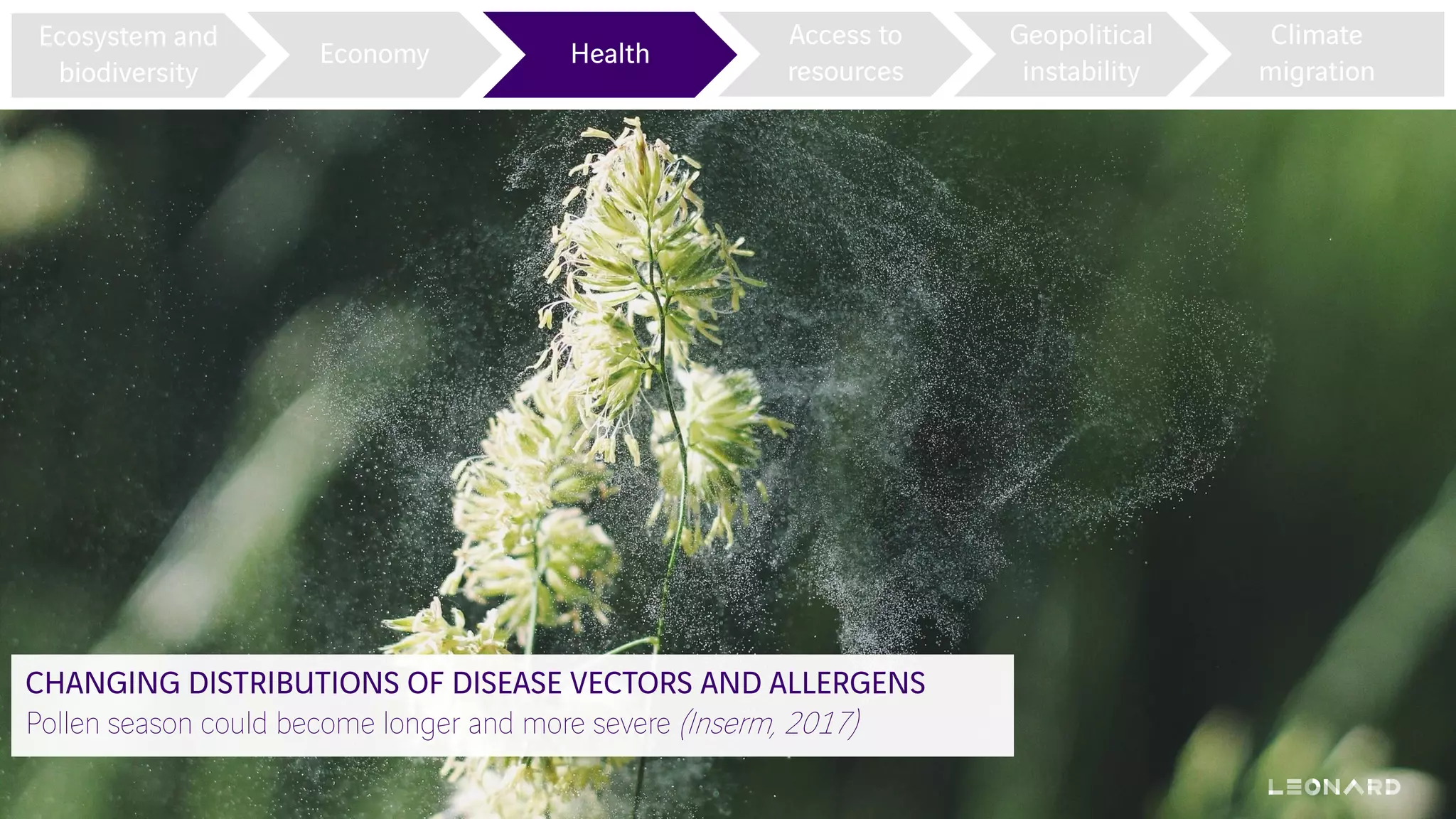
CHANGING DISTRIBUTIONS OF DISEASE VECTORS AND ALLERGENS
Pollen season could become longer and more severe (Inserm, 2017)
Ecosystem and
biodiversity
Economy Health
Access to
resources
Geopolitical
instability
Climate
migration
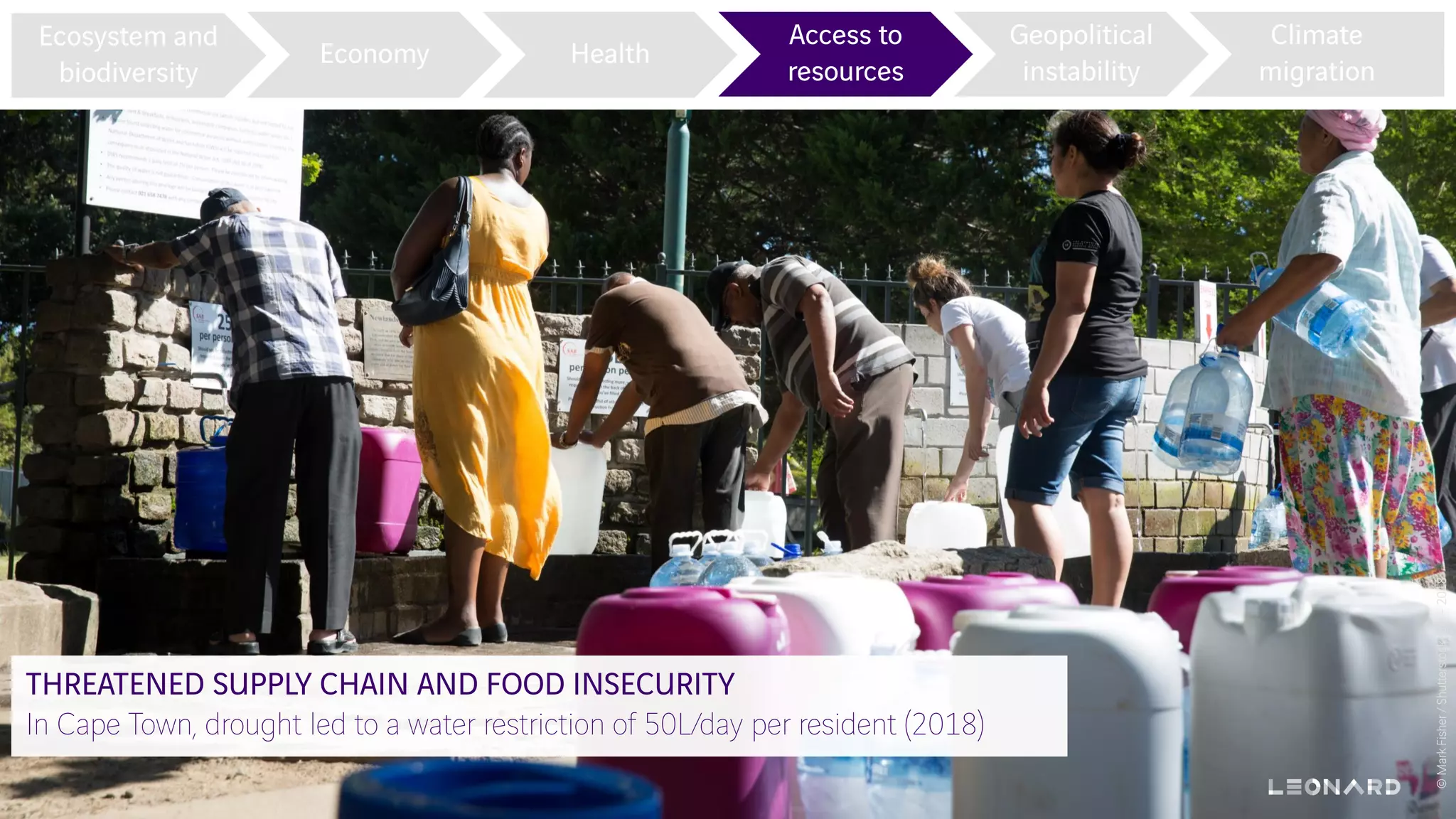
THREATENED SUPPLY CHAIN AND FOOD INSECURITY
In Cape Town, drought led to a water restriction of 50L/day per resident (2018)
Ecosystem and
biodiversity
Economy Health
Access to
resources
Geopolitical
instability
Climate
migration
©MarkFisher/Shutterstock.com-2018
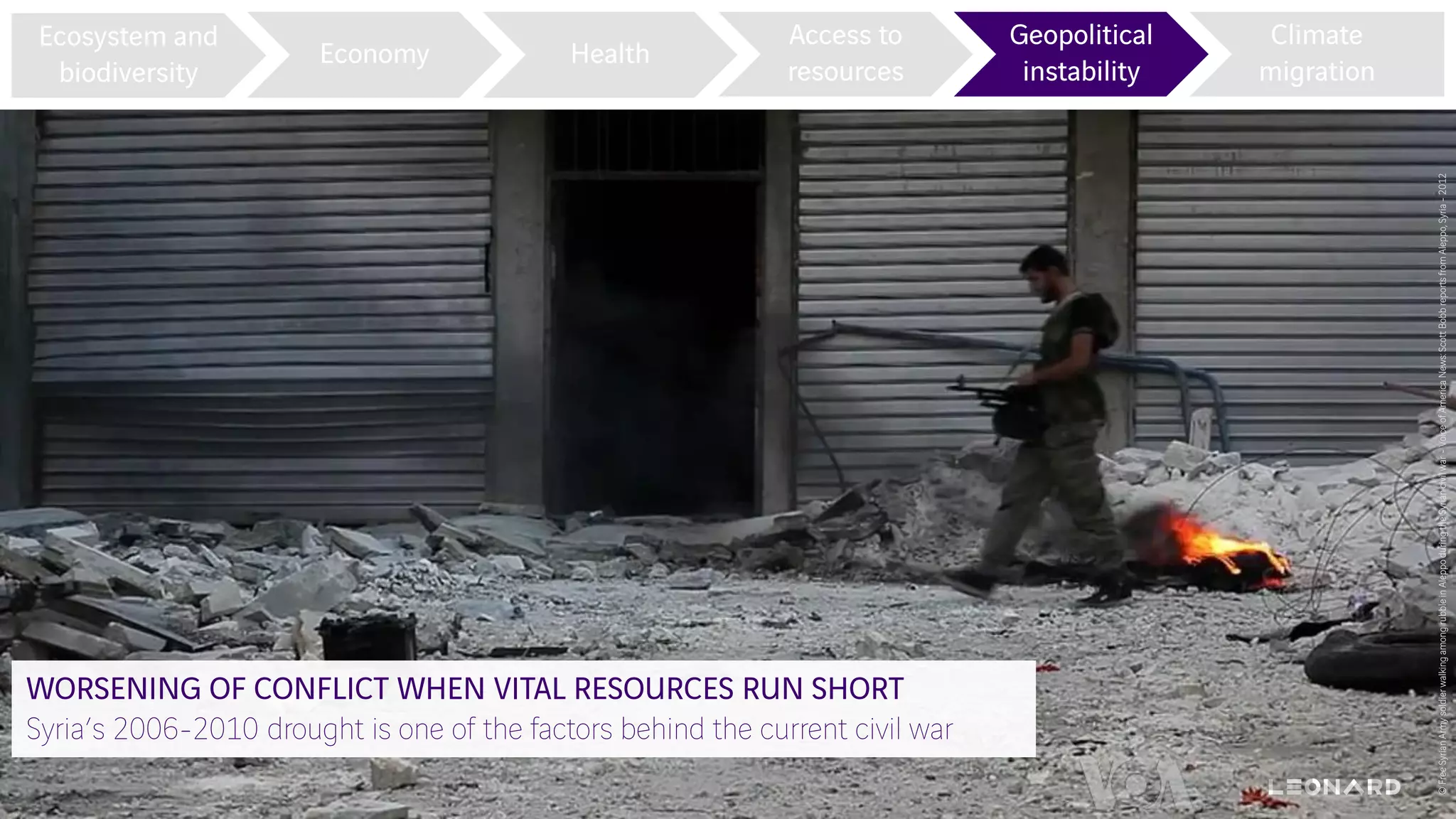
WORSENING OF CONFLICT WHEN VITAL RESOURCES RUN SHORT
Syria’s 2006-2010 drought is one of the factors behind the current civil war
Ecosystem and
biodiversity
Economy Health
Access to
resources
Geopolitical
instability
Climate
migration
©FreeSyrianArmysoldierwalkingamongrubbleinAleppoduringtheSyriancivilwar-VoiceofAmericaNews:ScottBobbreportsfromAleppo,Syria-2012
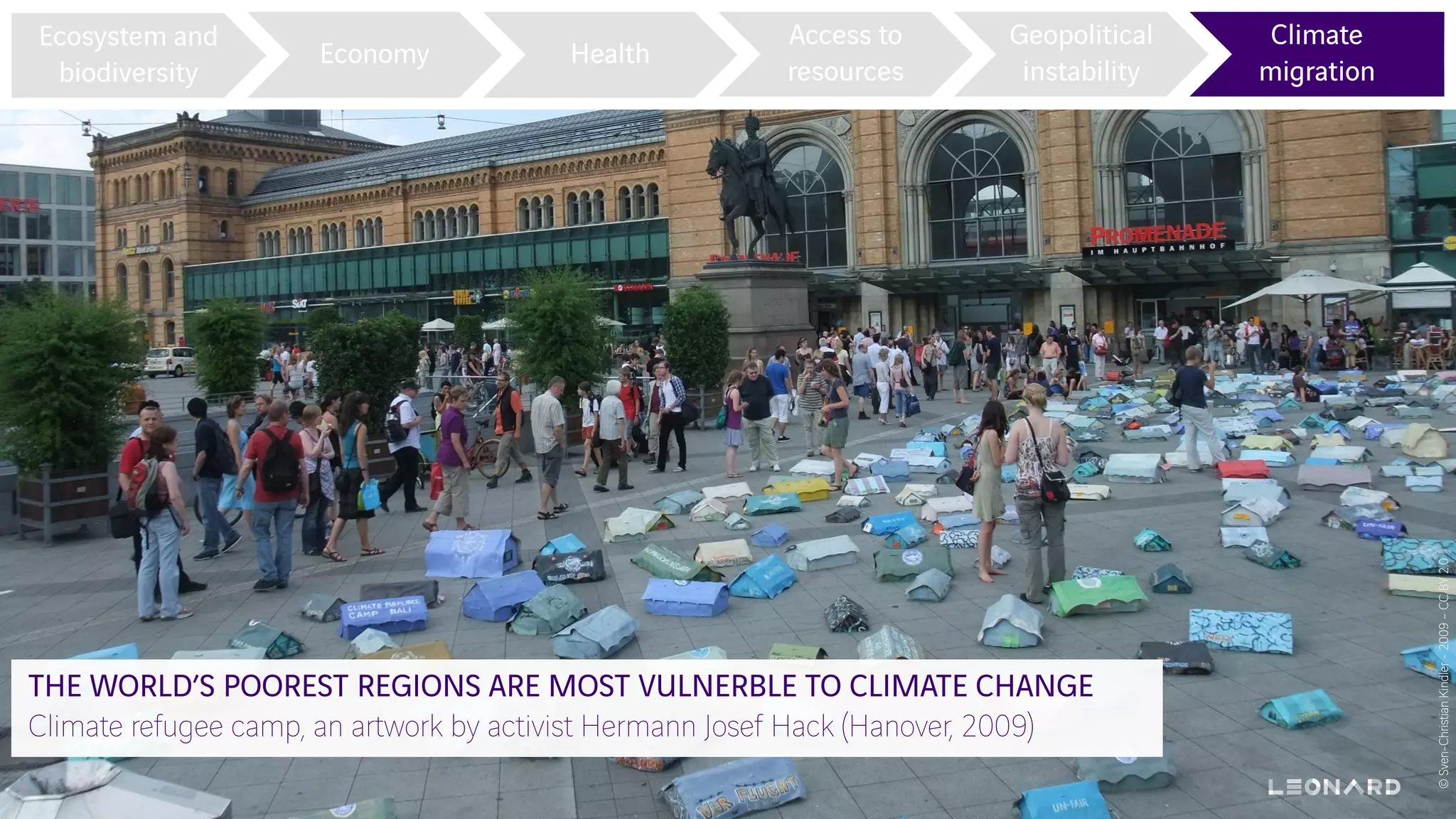
THE WORLD’S POOREST REGIONS ARE MOST VULNERBLE TO CLIMATE CHANGE
Climate refugee camp, an artwork by activist Hermann Josef Hack (Hanover, 2009)
Ecosystem and
biodiversity
Economy Health
Access to
resources
Geopolitical
instability
Climate
migration
©Sven-ChristianKindler-2009–CCBY2.0
2. GROWING VULNERABILITY
ALREADY A HIGH GLOBAL COST
Total cost of
natural disasters
in 2017 (Swiss Re)
330Billion
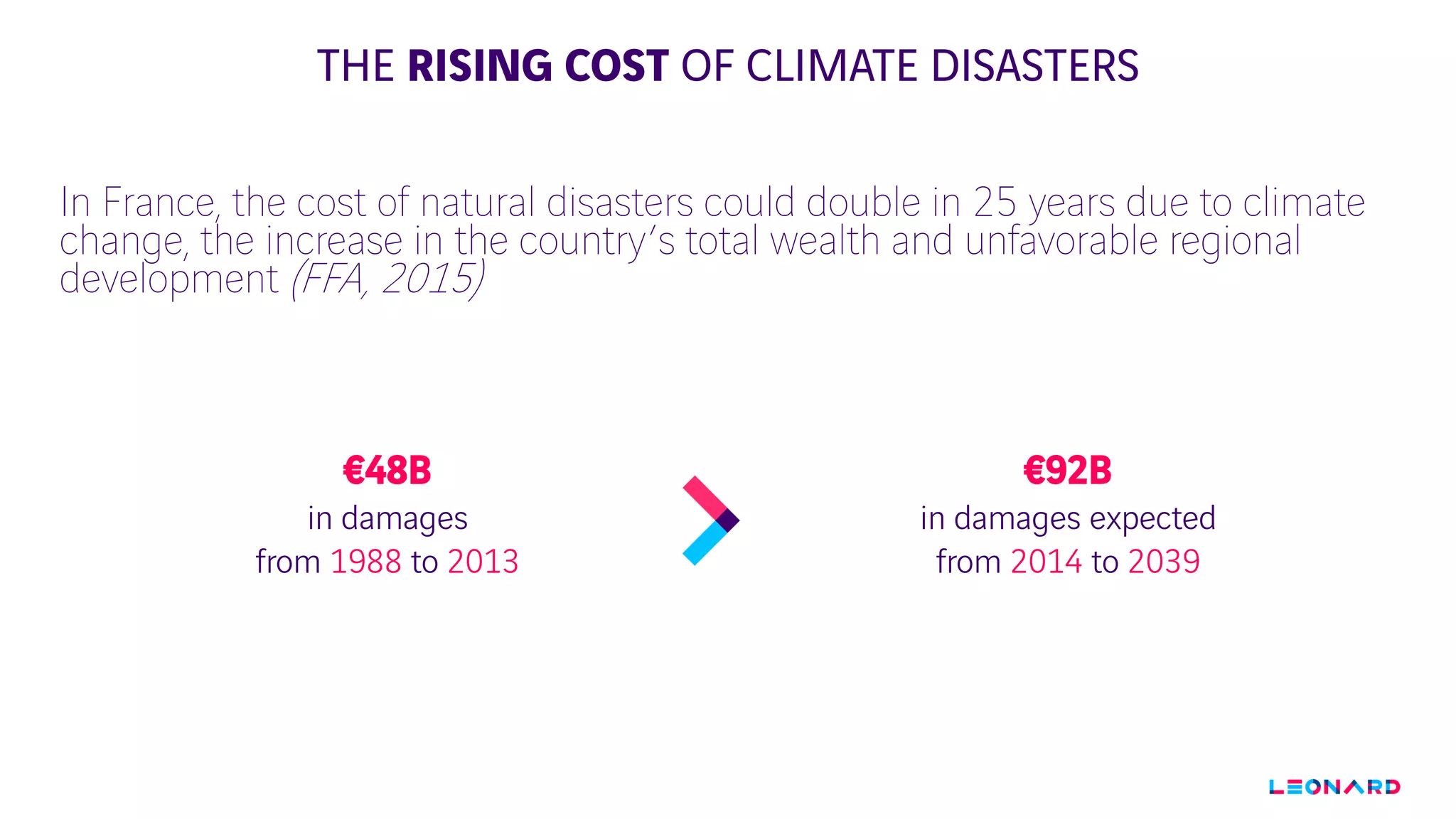
In France, the cost of natural disasters could double in 25 years due to climate
change, the increase in the country’s total wealth and unfavorable regional
development (FFA, 2015)
€48B
in damages
from 1988 to 2013
€92B
in damages expected
from 2014 to 2039
THE RISING COST OF CLIMATE DISASTERS
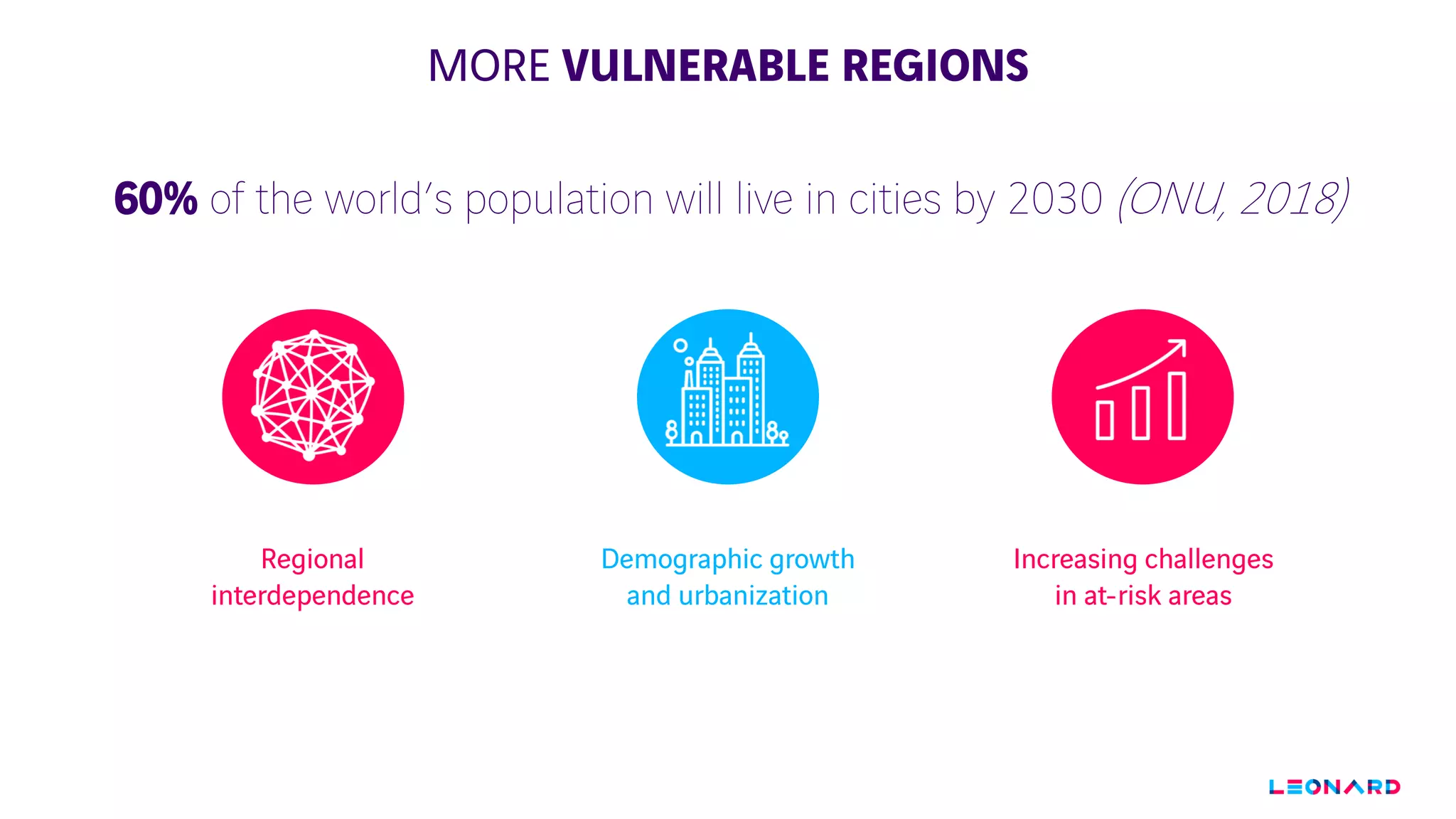
Regional
interdependence
Demographic growth
and urbanization
Increasing challenges
in at-risk areas
MORE VULNERABLE REGIONS
60% of the world’s population will live in cities by 2030 (ONU, 2018)
INFRASTRUCTURE: A CRITICAL COMPONENT OF ADAPTATION
Housing Energy Production Communication
Protection Transport Water & sanitationStorage
75% of infrastructure cities will need in 2050 has not been built
(GIB, 2014)
A unique chance to include resilience in their design: Resilience by design
3. SETBACKS TO ADAPTATION
SETBACKS TO ADAPTATION
Science & technology
Financial
Social & cultural
Governance & institutions
In light of uncertain long-term projections, greater knowledge
and advances in modeling will be needed
Access to funding and implementing adaptation measures is
often costly
Informing stakeholders about climate change and the various
levels of acceptable risk can inhibit the formation of a
common strategy and ability to take responsibility for the
phenomenon
Increasing stakeholders makes it harder to take decisions and
implement regional adaptation strategies
4. ECONOMIC RISKS
A. Operational risks to business continuity
Due to periodic climate shocks
B. Long-term risks to the contract economy
Due to the gradual evolution of climate parameters
A. OPERATIONAL RISKS TO BUSINESS CONTINUITY
DUE TO PERIODIC CLIMATE SHOCKS
Damage to equipment Health and safety Business and worksite
stoppage
Environmental
DAMAGE TO A CONSTRUCTION CRANE BECAUSE OF HURRICANE IRMA (Miami, 2017)
EXTREME WEATHER WILL INCREASE THE PHYSICAL HARDSHIP AND ACCIDENT RISK OF JOBS:
CRAMPING, FROSTBITE, EXHAUSTION, DEHYDRATION OR HEAT EXPOSURE THREATENS
WORKSITE SAFETY
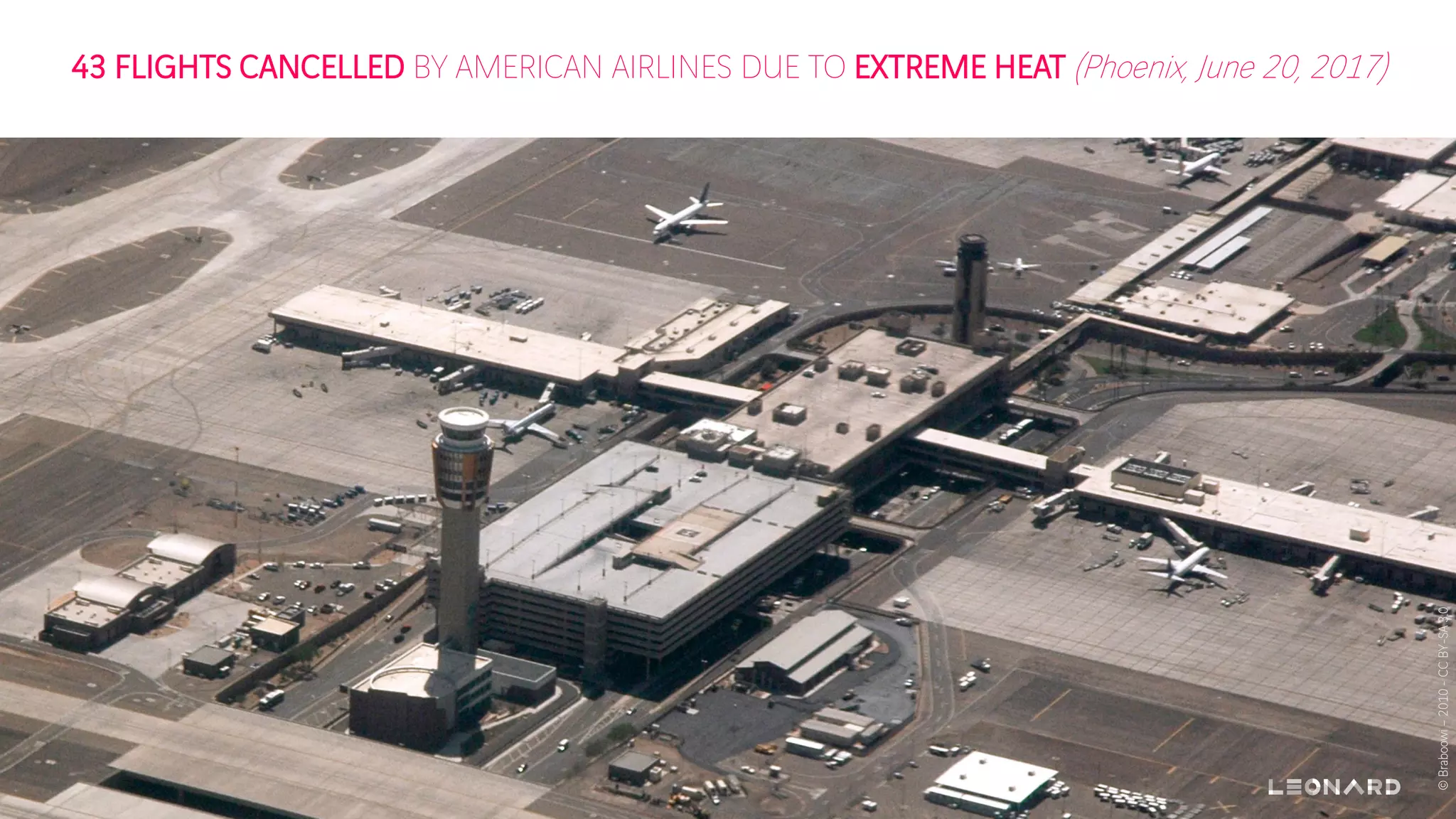
43 FLIGHTS CANCELLED BY AMERICAN AIRLINES DUE TO EXTREME HEAT (Phoenix, June 20, 2017)
©Braboowi–2010-CCBY-SA3.0
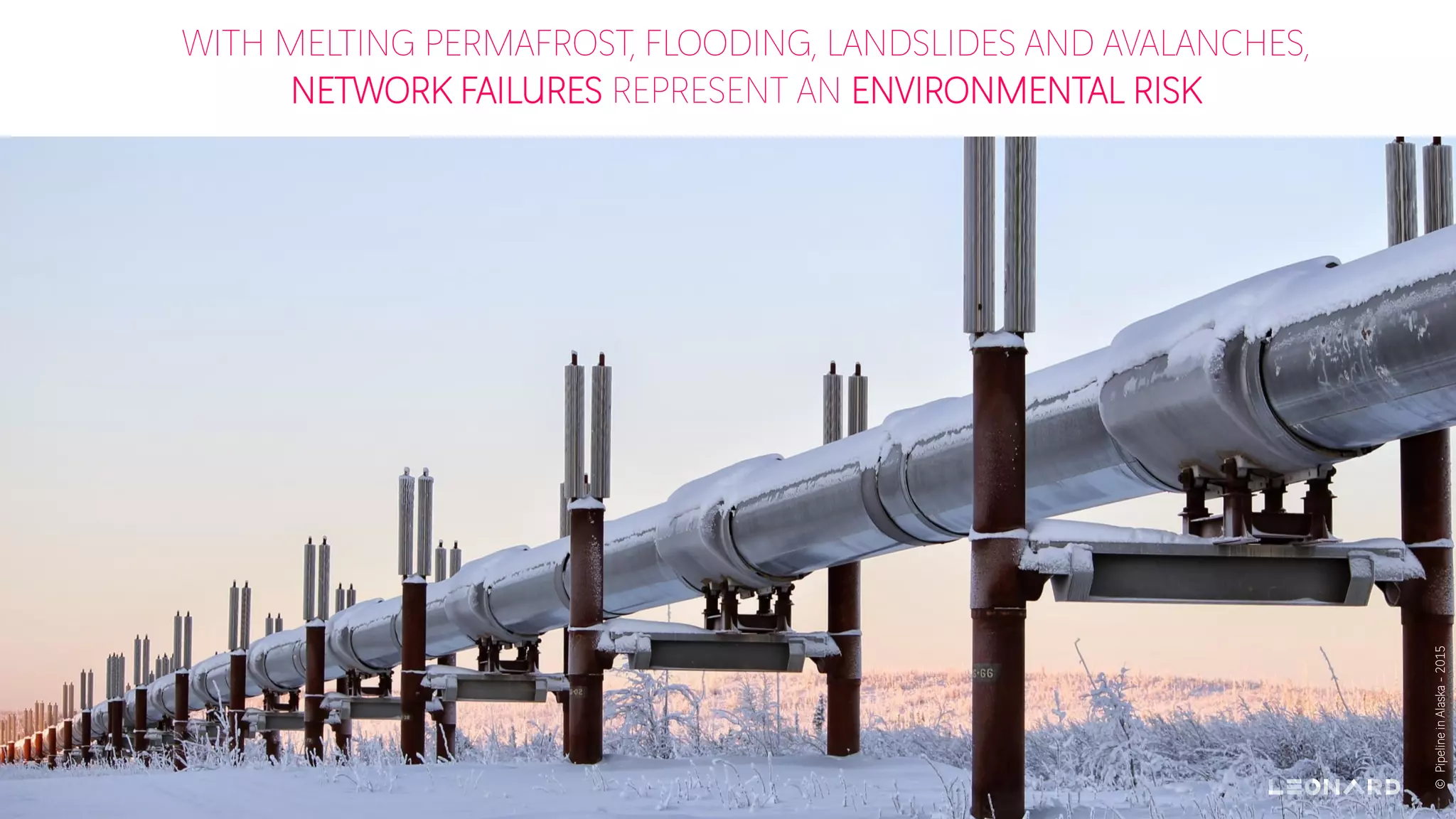
WITH MELTING PERMAFROST, FLOODING, LANDSLIDES AND AVALANCHES,
NETWORK FAILURES REPRESENT AN ENVIRONMENTAL RISK
©PipelineinAlaska-2015
B. LONG-TERM RISKS TO THE CONTRACT ECONOMY
DUE TO THE GRADUAL EVOLUTION OF CLIMATE PARAMETERS
Operation and
maintenance spending
Performance of
structures
Contractual
penalties
Infrastructure
maladjustment
Ineligibility for “green
funding”
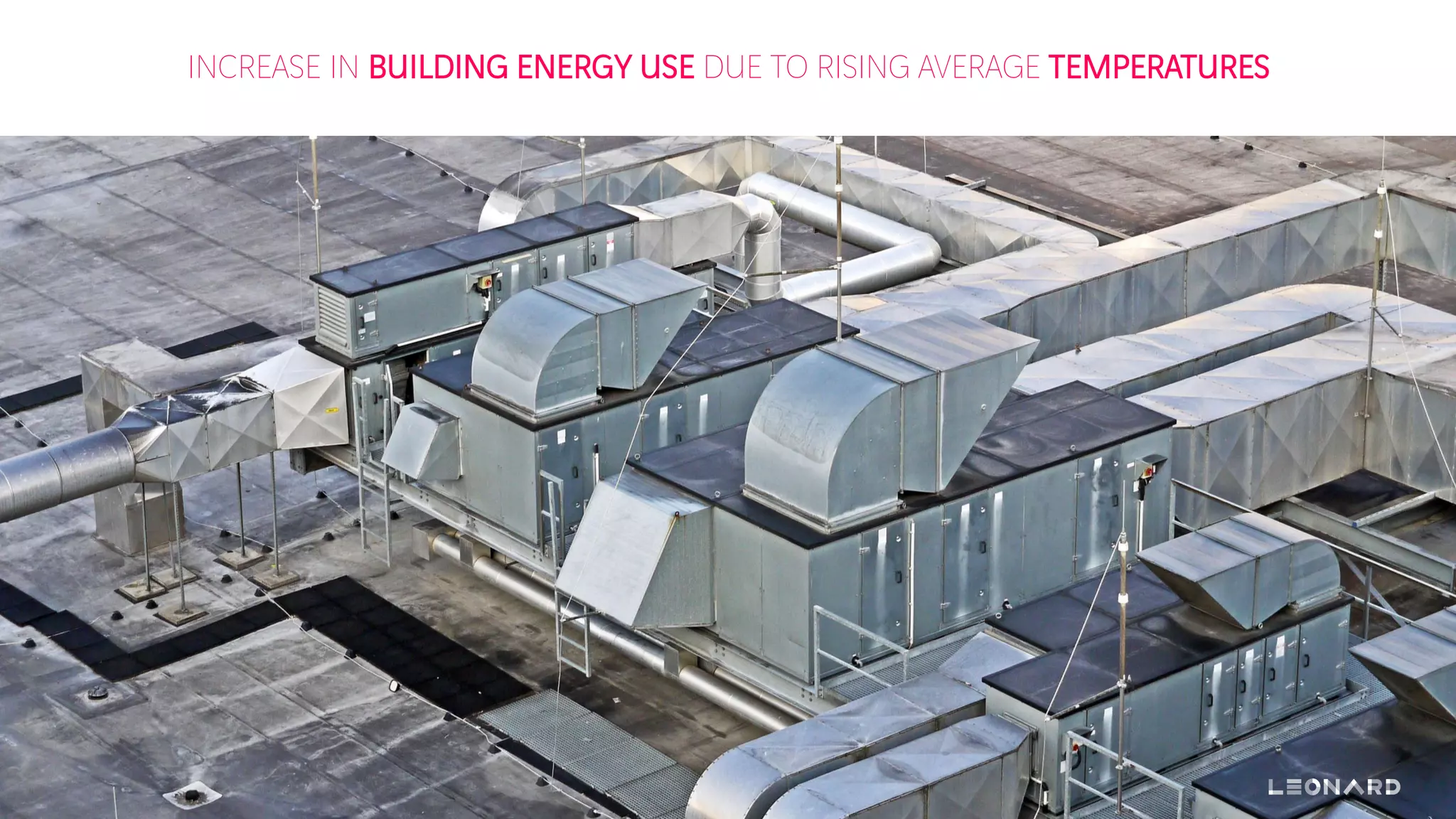
INCREASE IN BUILDING ENERGY USE DUE TO RISING AVERAGE TEMPERATURES
THE LIFESPAN OF STRUCTURES WILL BE ALTERED IF PHENOMENA SUBJECT TO CLIMATE CHANGE
– SUCH AS SHRINK-SWELL CAPACITY OF SOIL – IS NOT ACCOUNTED FOR IN THE DESIGN PHASE
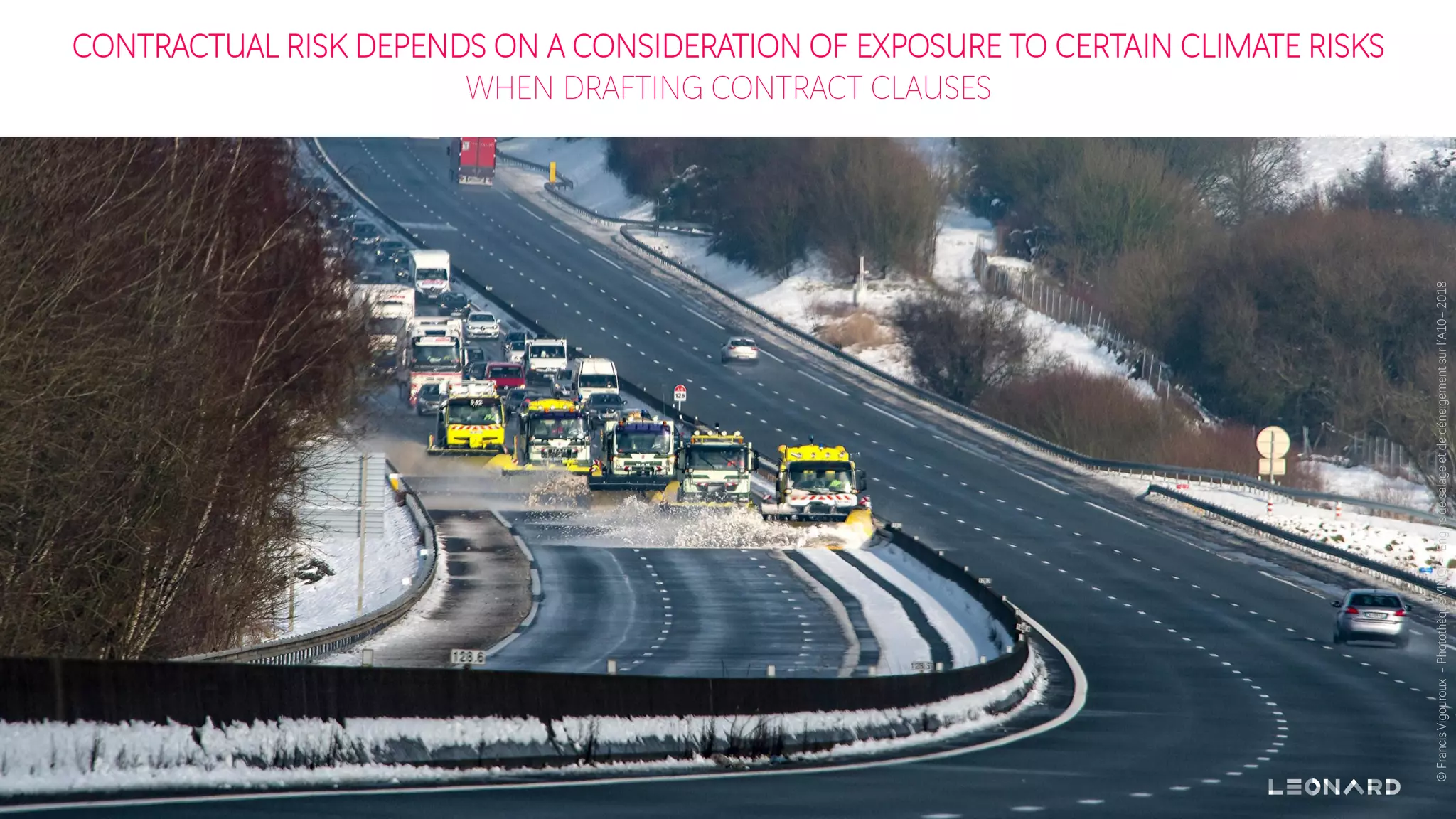
CONTRACTUAL RISK DEPENDS ON A CONSIDERATION OF EXPOSURE TO CERTAIN CLIMATE RISKS
WHEN DRAFTING CONTRACT CLAUSES
©FrancisVigouroux-PhotothèqueVINCI-Enginsdesalageetdedéneigementsurl’A10–2018
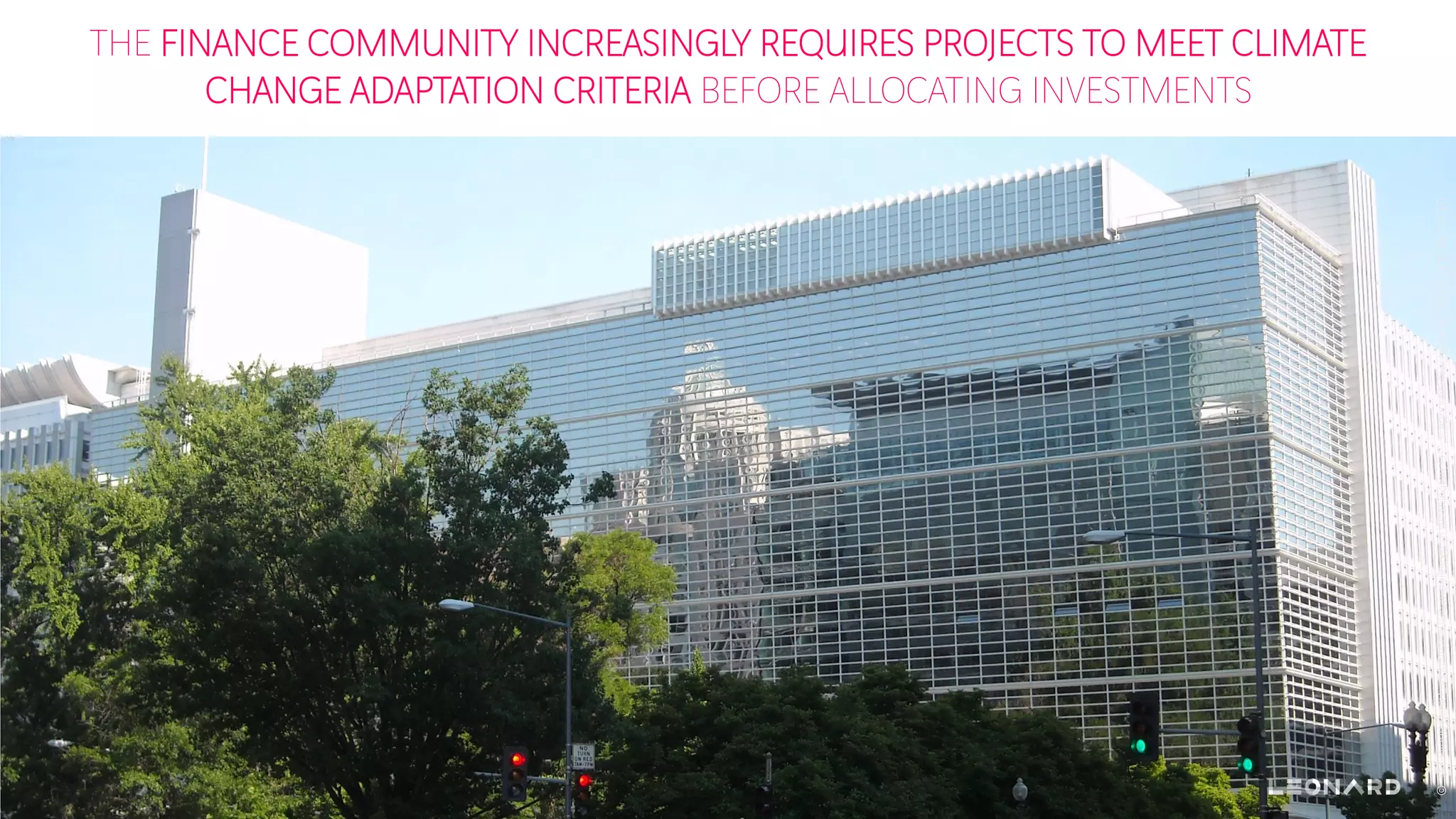
THE FINANCE COMMUNITY INCREASINGLY REQUIRES PROJECTS TO MEET CLIMATE
CHANGE ADAPTATION CRITERIA BEFORE ALLOCATING INVESTMENTS
©TheWorldBankGroupheadquartersbuildingsinWashington,D.C.–AgnosticPreachersKid–2008-CCBY-SA3.0
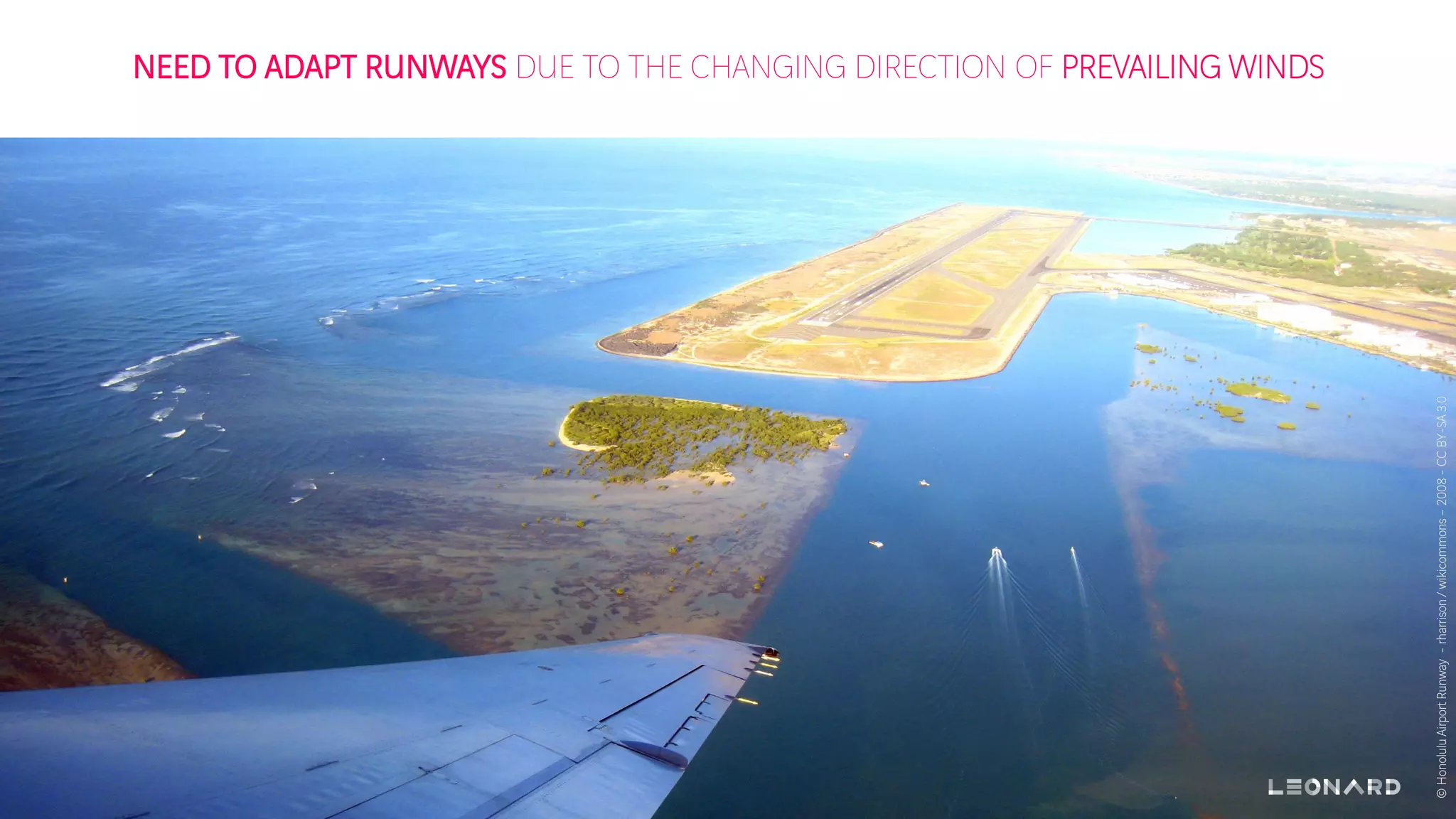
NEED TO ADAPT RUNWAYS DUE TO THE CHANGING DIRECTION OF PREVAILING WINDS
©HonoluluAirportRunway-rharrison/wikicommons–2008-CCBY-SA3.0
DECLINING TRAFFIC AT CERTAIN AIRPORTS CURRENTLY BENEFITTING FROM SEASONAL TOURISM
©AltiportdeCourchevel-2017
III. DEVELOPING
RESILIENCE SOLUTIONS
1. TAKING ACTION TODAY
CONVERGENCE OF INITIATIVES
Insurance
Parametric insurance
Weather derivatives trading
Cat bonds
Institutions
Paris climate agreement
Connected Cities network
Multilateral backers
Standards
Norms
Resilience label for French cities
HQE Resilience
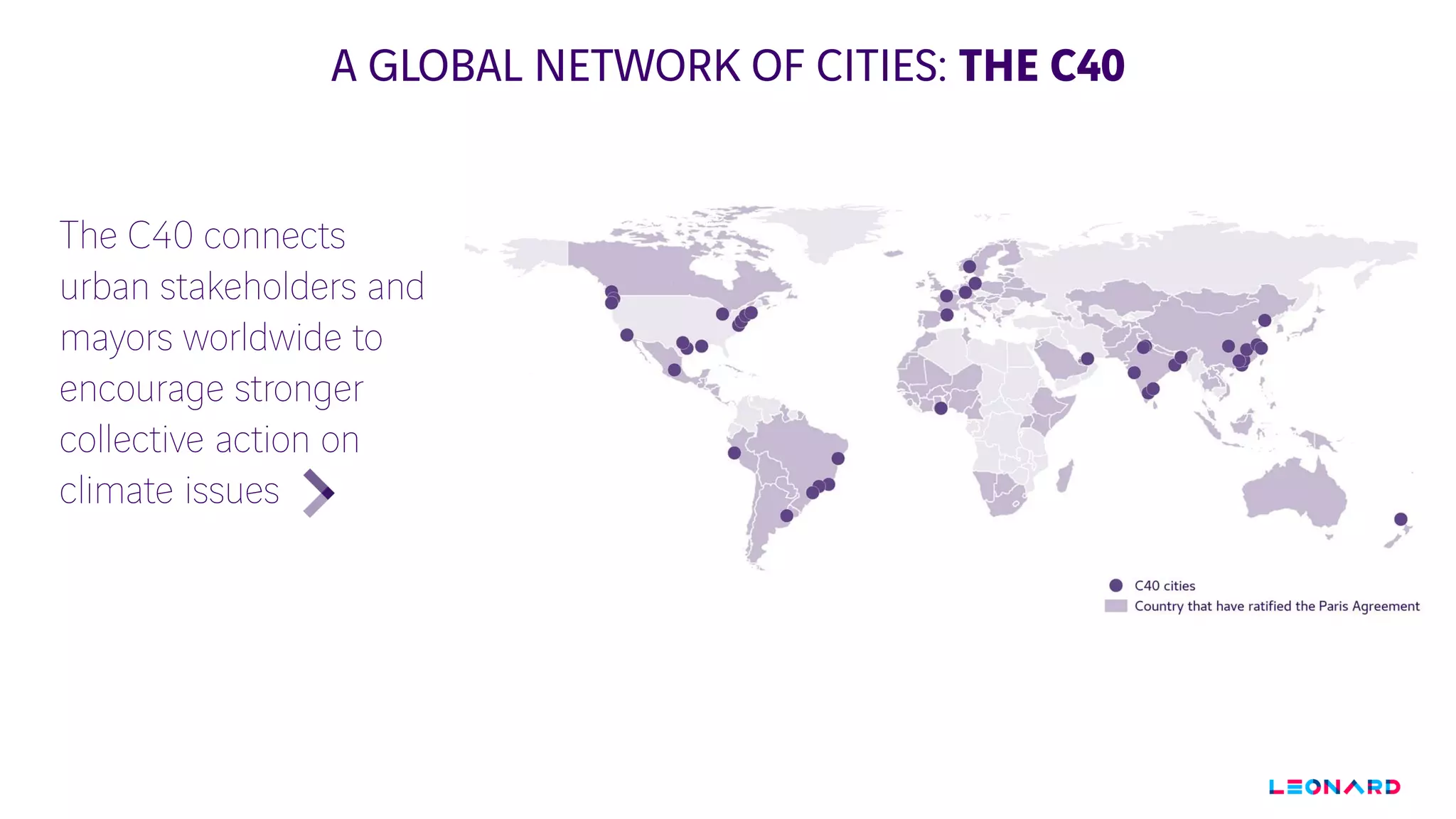
A GLOBAL NETWORK OF CITIES: THE C40
The C40 connects
urban stakeholders and
mayors worldwide to
encourage stronger
collective action on
climate issues
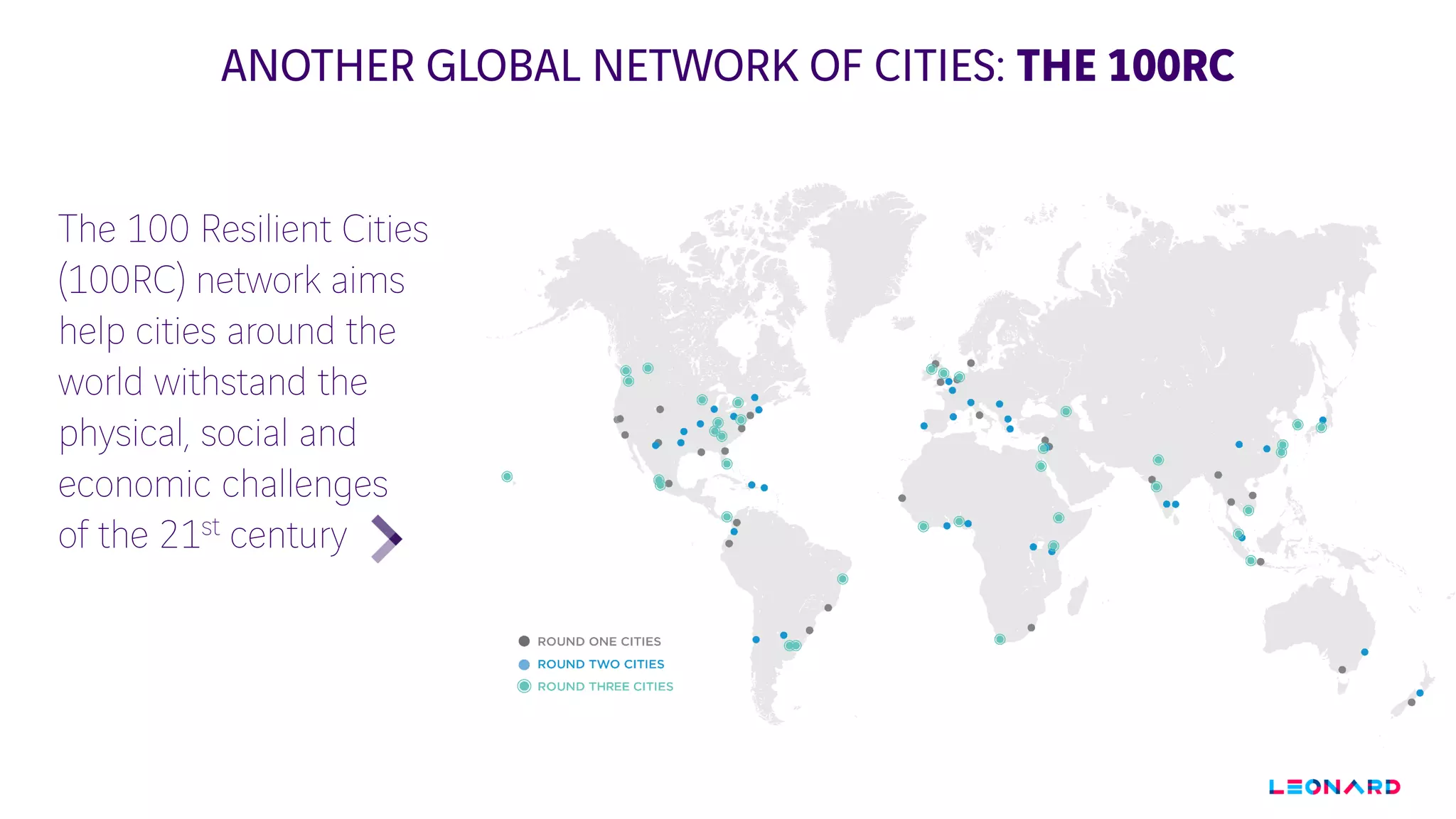
ANOTHER GLOBAL NETWORK OF CITIES: THE 100RC
The 100 Resilient Cities
(100RC) network aims
help cities around the
world withstand the
physical, social and
economic challenges
of the 21st century
AXA GLOBAL PARAMETRICS
COVERS CLIMATE DISTURBANCES
Compensation is paid when a weather
parameter associated with
the customer’s losses reaches a
predetermined threshold
Insurance covering the cost of additional
defrosting for aircraft during prolonged periods
of low temperatures
THE NEW INTERNATIONAL NORM:
ISO 37101
The ISO 37101 norm offers assistance to
municipalities to improve the sustainable,
smart or resilient nature of strategies,
programs and plans
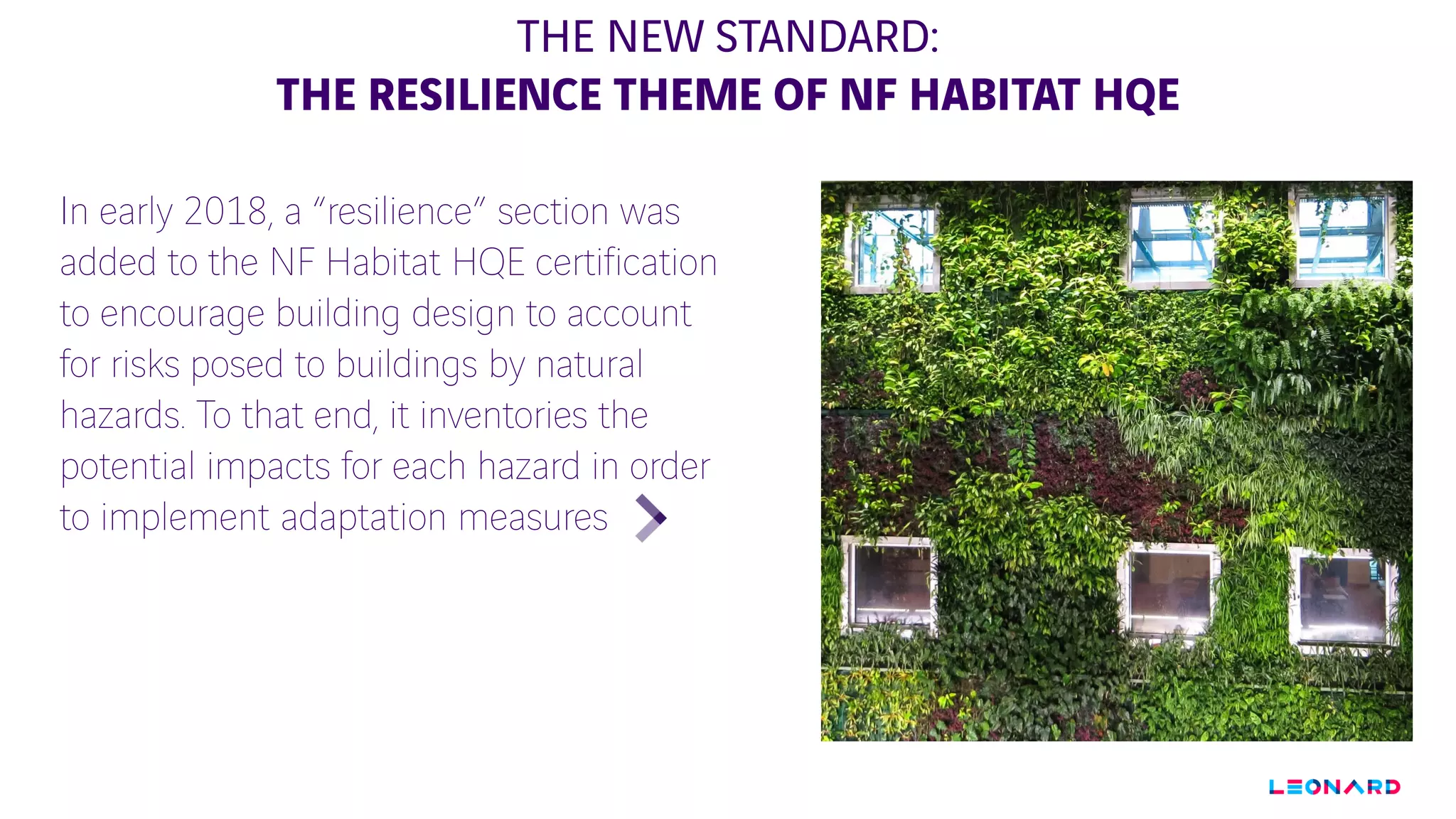
THE NEW STANDARD:
THE RESILIENCE THEME OF NF HABITAT HQE
In early 2018, a “resilience” section was
added to the NF Habitat HQE certification
to encourage building design to account
for risks posed to buildings by natural
hazards. To that end, it inventories the
potential impacts for each hazard in order
to implement adaptation measures
PHOTO A
CHANGER
2. INNOVATIVE SOLUTIONS
FOR INFRASTRUCTURE
RESILIENCE
1. Technical solutions
2. Software development and data processing
3. New lines of resilient services
4. Rethinking urban development
O2D GREEN (O2D ENVIRONMENT) TURF SLAB IS A SUSTAINABLE SOLUTION FOR RAINWATER
INFILTRATION, REDUCING HEAT ISLAND EFFECT AND PRESERVING SOIL BIODIVERSITY
©O2DENVIRONNEMENT
POWER ROAD® MITIGATES URBAN HEAT ISLANDS AND REDUCES SNOW ACCUMULATION ON
ROADWAYS BY STORING SOLAR ENERGY
POROUS ASPHALTS MITIGATE FLOODING BY CREATING ROADS WITH HIGH WATER RETENTION
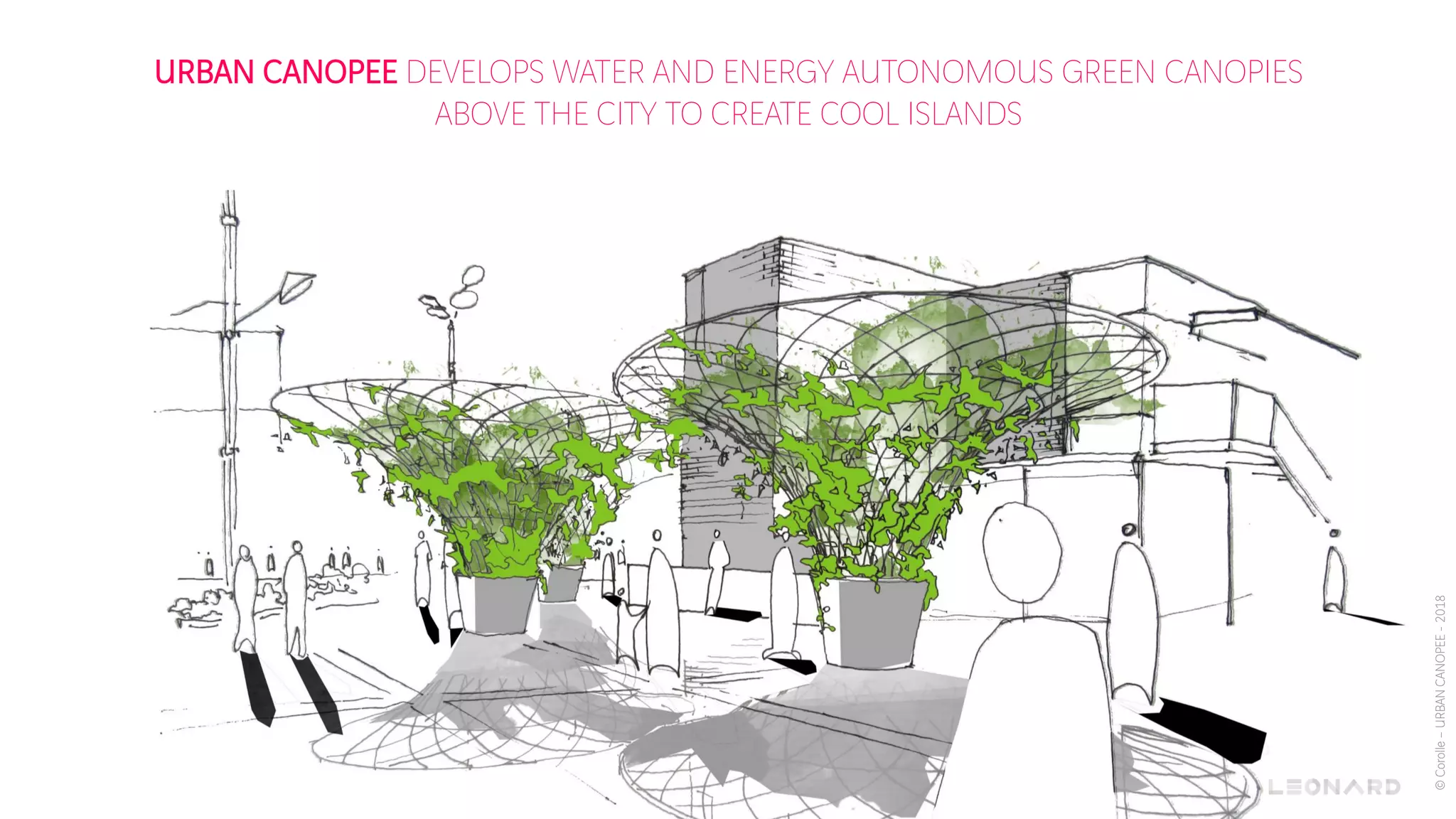
URBAN CANOPEE DEVELOPS WATER AND ENERGY AUTONOMOUS GREEN CANOPIES
ABOVE THE CITY TO CREATE COOL ISLANDS
©Corolle–URBANCANOPEE-2018
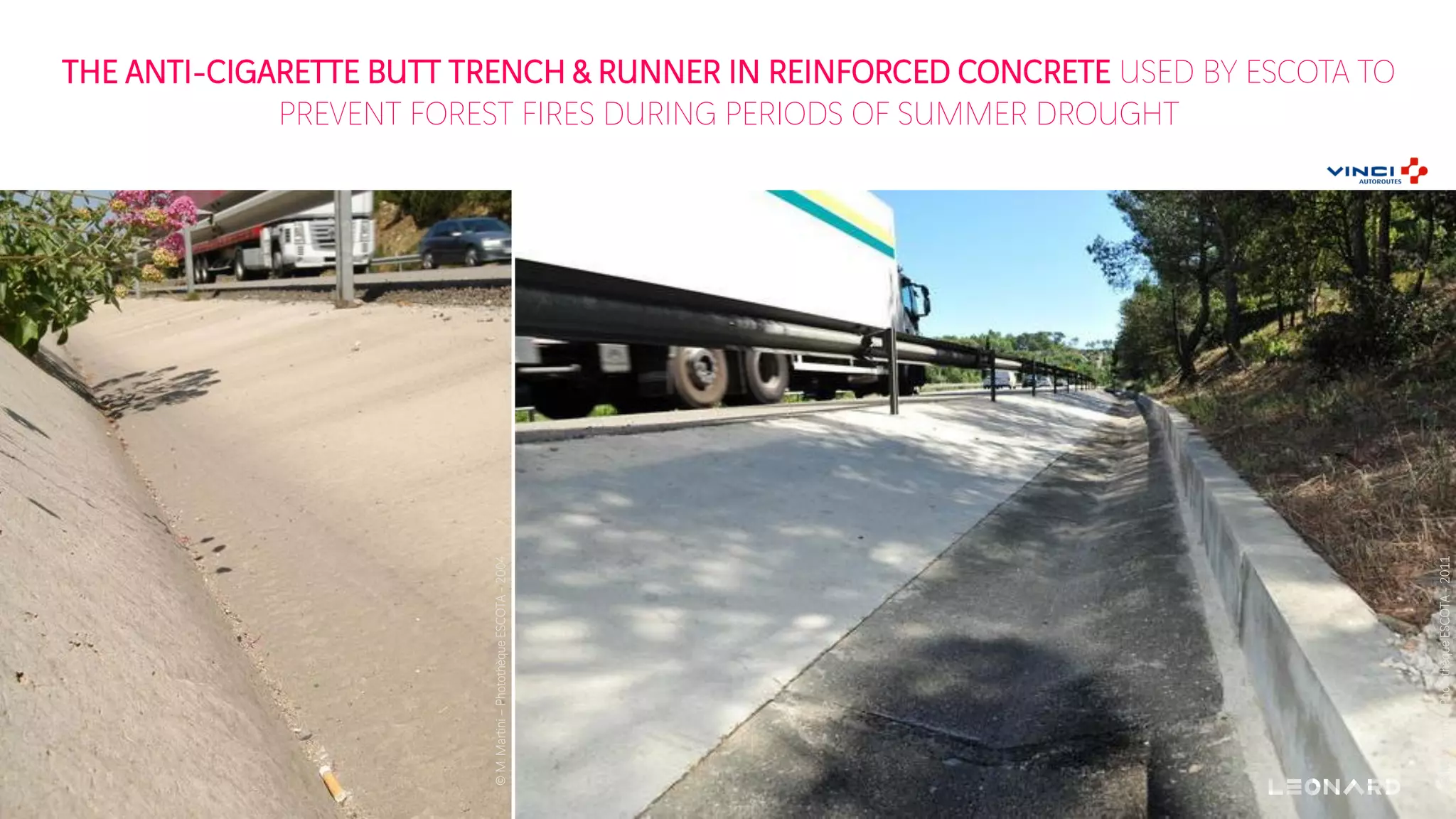
THE ANTI-CIGARETTE BUTT TRENCH & RUNNER IN REINFORCED CONCRETE USED BY ESCOTA TO
PREVENT FOREST FIRES DURING PERIODS OF SUMMER DROUGHT
©M.Martini–PhotothèqueESCOTA-2004
©M.Martini–PhotothèqueESCOTA-2011
LOGELIS, THE MAKER OF “ECOLOW-COST HIGH QUALITY” KIT HOMES HAS ALREADY HELPED
MEET THE URGENT REBUILDING NEEDS IN SAINT-MARTIN
©LavilledeMarigotsurl'îledeSaint-Martin,deuxjoursaprèsl'ouraganIRMA-UIISC1-2017-CCBY-SA4.0
THE RESILIENT TUNNEL PLUG DEVELOPED BY WEST VIRGINIA UNIVERSITY, A GIANT
INFLATABLE BALLOON TO PLUG TUNNELS IN CASE OF FLOODING
©USDepartmentofHomelandSecurity–2018
1. Technical solutions
2. Software development and data processing
3. New lines of resilient services
4. Rethinking urban development
HAND (Hackers Against Natural Disasters) UNITES HACKTIVISTS TO DEVELOP AN ACTION PLAN
AND DECENTRALIZED ORGANIZATION FOR CRISIS SITUATIONS
GEOSCOPE MANAGES DATA IN REAL TIME TO MANAGE RISKS THROUGH PROACTIVE
OVERSIGHT OF STRUCTURES
©PhotothèqueSIXENSE
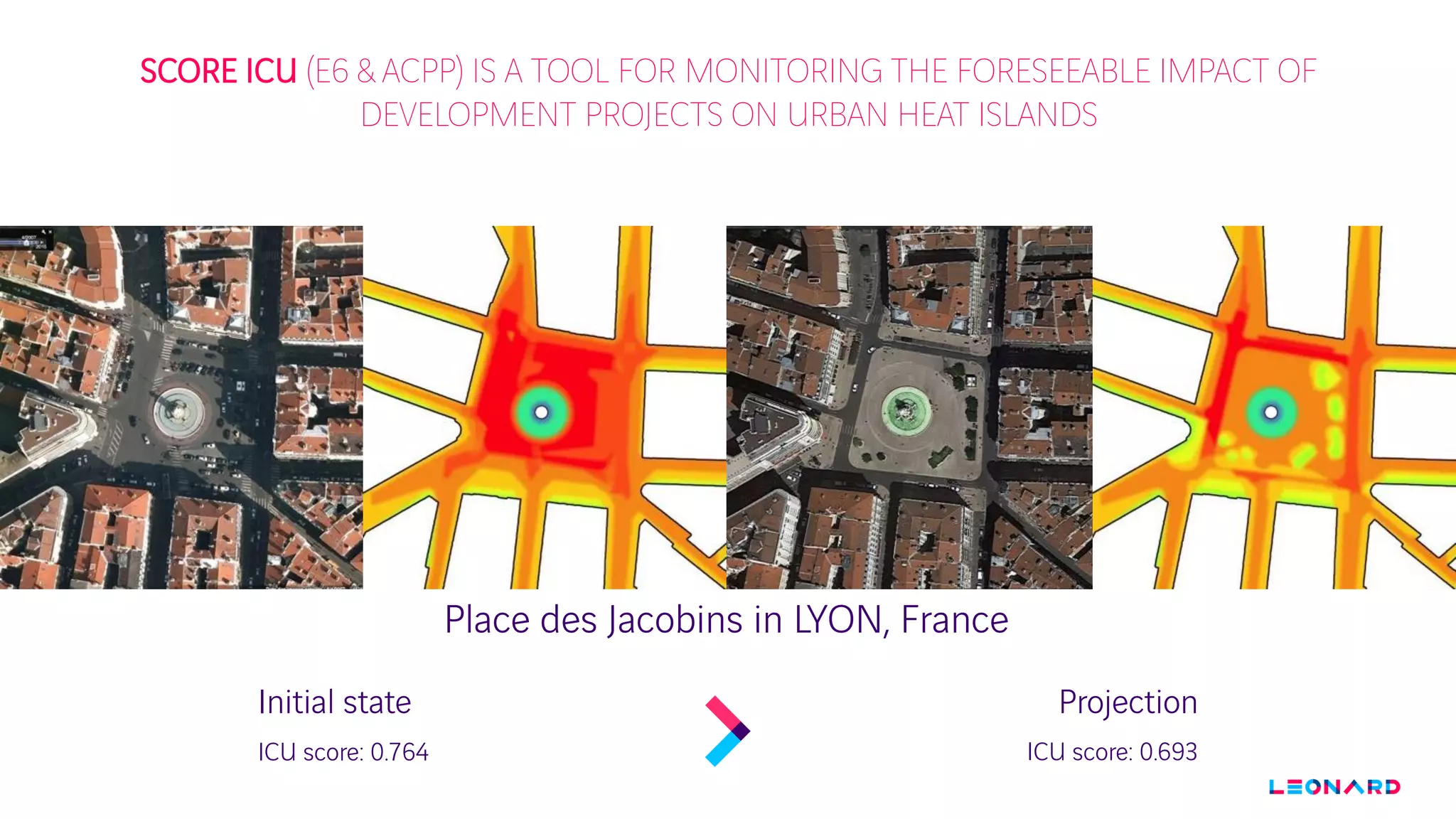
SCORE ICU (E6 & ACPP) IS A TOOL FOR MONITORING THE FORESEEABLE IMPACT OF
DEVELOPMENT PROJECTS ON URBAN HEAT ISLANDS
Place des Jacobins in LYON, France
Initial state
ICU score: 0.764 ICU score: 0.693
Projection
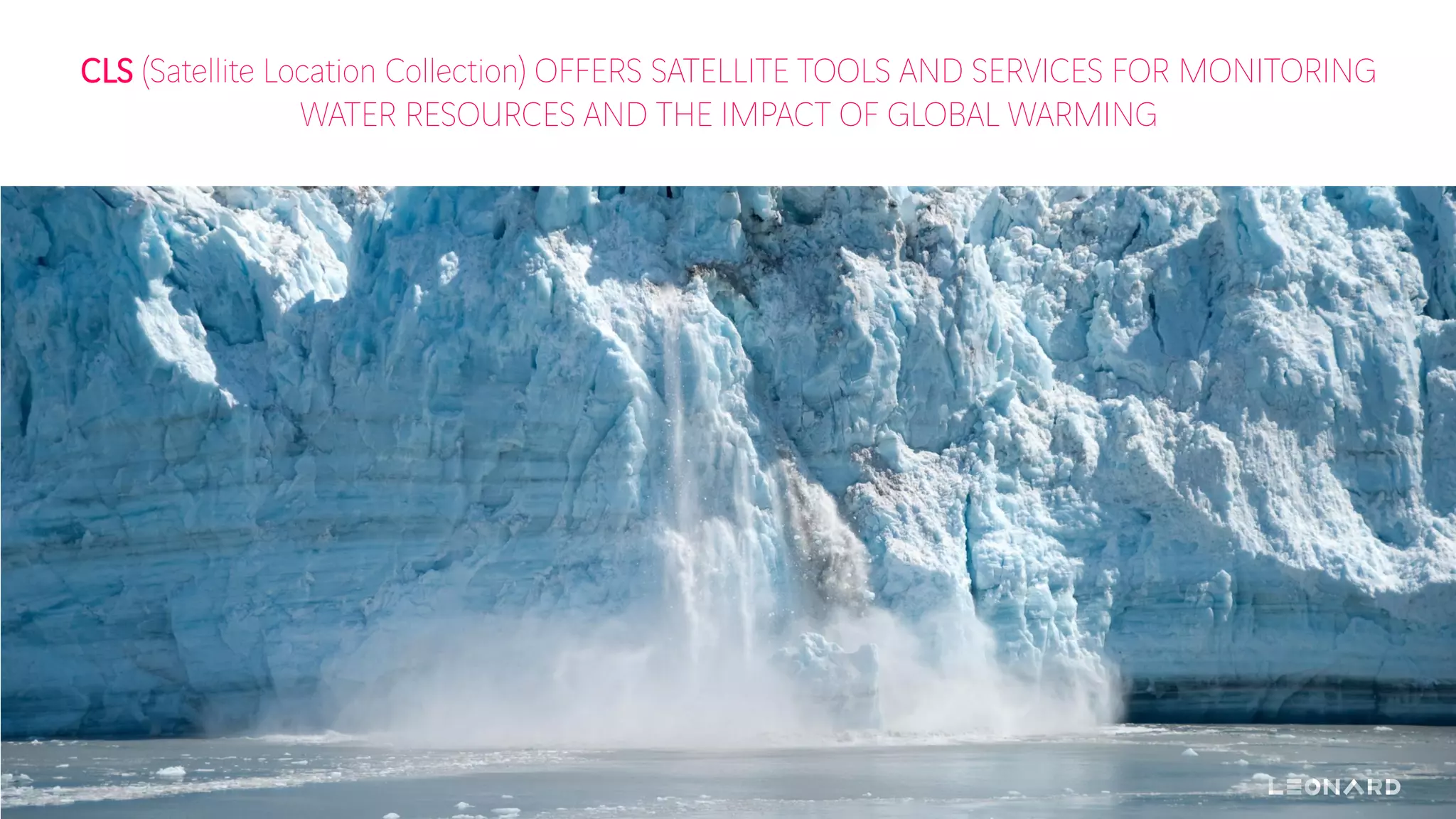
CLS (Satellite Location Collection) OFFERS SATELLITE TOOLS AND SERVICES FOR MONITORING
WATER RESOURCES AND THE IMPACT OF GLOBAL WARMING
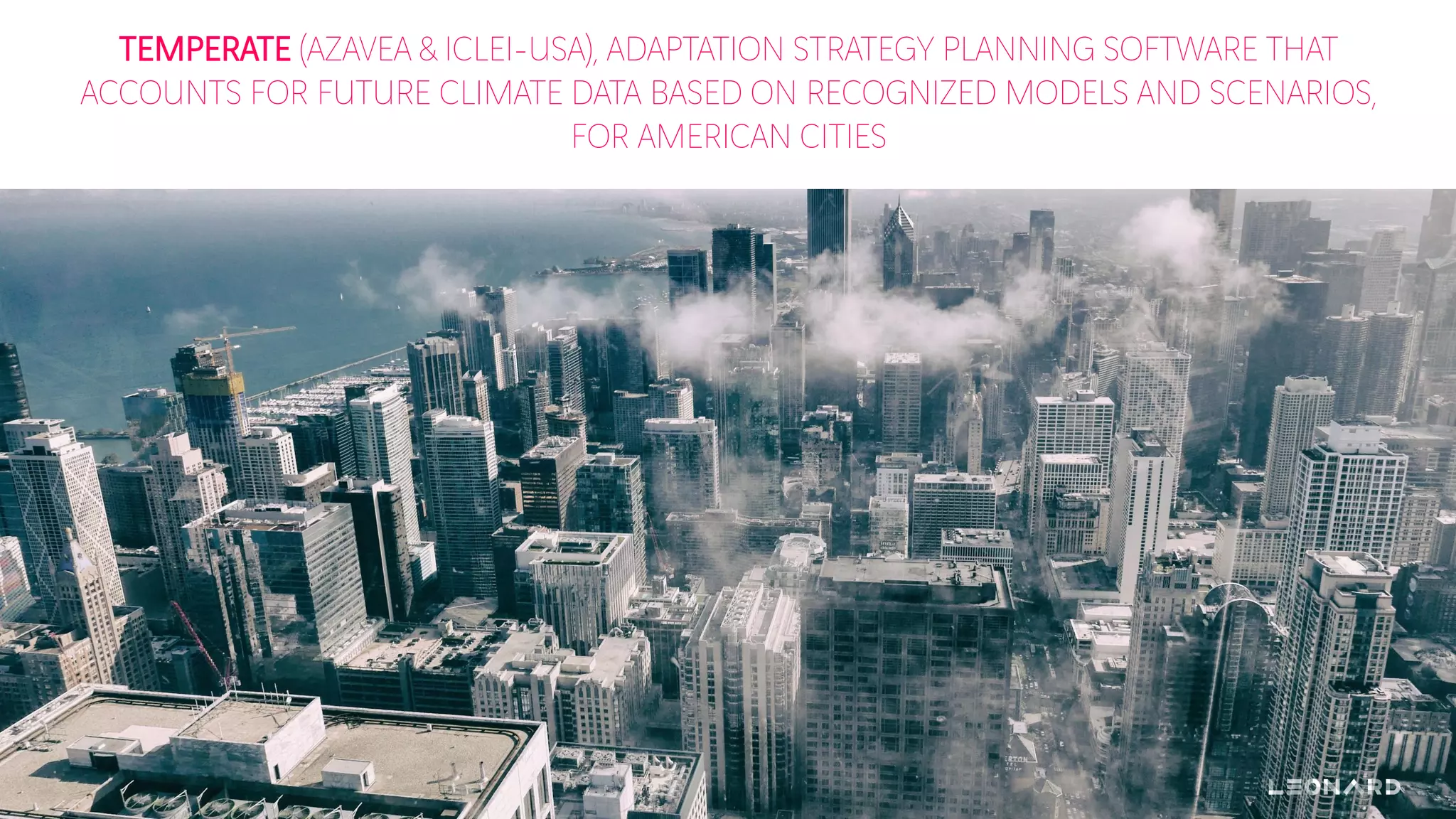
TEMPERATE (AZAVEA & ICLEI-USA), ADAPTATION STRATEGY PLANNING SOFTWARE THAT
ACCOUNTS FOR FUTURE CLIMATE DATA BASED ON RECOGNIZED MODELS AND SCENARIOS,
FOR AMERICAN CITIES
THE PRAGUE FLOOD MODEL, UPDATED REGULARLY, HELPED PUT IN PLACE AN EMERGENCY
PLAN THAT HAS ALREADY AIDED WITH FLOODING IN DOWNTOWN BY LOCATING THE MOST
VULNERABLE POINTS
©Sovovymlyny–Che/Wikicommons-2006–CCBY-SA2.5
OPENCLIMATEGIS (ESGF-COG), OPEN SOURCE SOFTWARE DESIGNED FOR MANIPULATING
GEOSPATIAL CLIMATE DATA
79
©USClimateResilienceToolkit/NOAA
COPERNICUS, THE EU’S EARTH MONITORING PROGRAM, HELPS EUROPEAN COUNTRIES
BOOST THEIR CAPACITY FOR MANAGING RISKS BY IMPROVING THEIR CLIMATE DATA
©CaliforniainflamesbySentinel-2-EuropeanSpaceAgency-ContainsmodifiedCopernicusSentineldata(2017)–CCBY-SA3.0IGO
1. Technical solutions
2. Software development and data processing
3. New lines of resilient services
4. Rethinking urban development
RESALLIENCE, VINCI’S DESIGN OFFICE DEDICATED TO ADAPTING PROJECTS,
INFRASTRUCTURE AND THEIR USES TO CLIMATE CHANGE
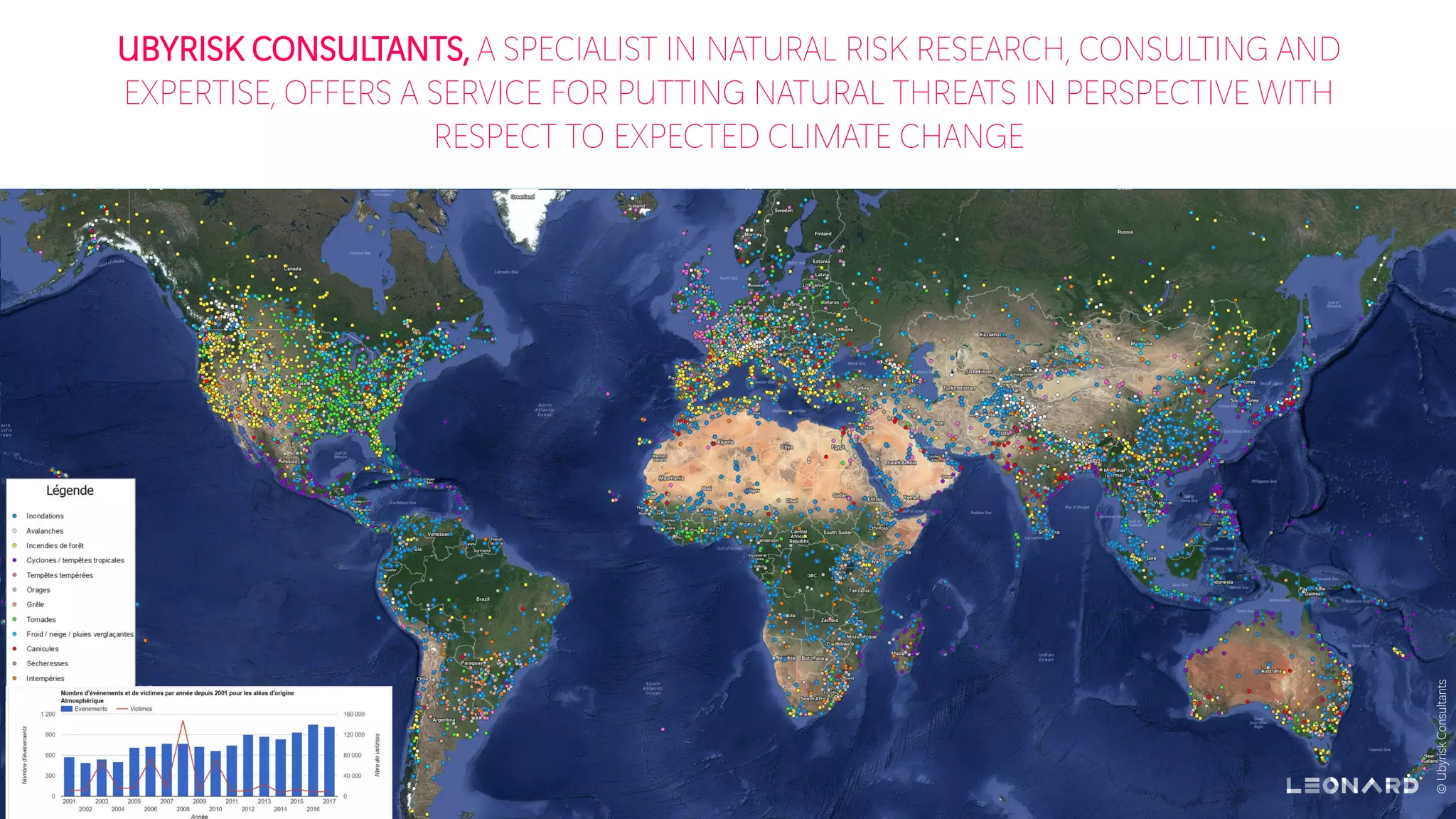
UBYRISK CONSULTANTS, A SPECIALIST IN NATURAL RISK RESEARCH, CONSULTING AND
EXPERTISE, OFFERS A SERVICE FOR PUTTING NATURAL THREATS IN PERSPECTIVE WITH
RESPECT TO EXPECTED CLIMATE CHANGE
Droit et photo en attente : d’ici fin aout/début
septembre
83
©UbyriskConsultants
PREDICT SERVICES HELPS RISK MANAGERS TO MAKE THE RIGHT DECISIONS
BEFORE, DURING AND AFTER CRISIS
©VigieFrance-PredictServices-2015
EQUO VIVO, VINCI CONSTRUCTION’S BRAND DEDICATED TO ECOLOGICAL DEVELOPMENT
PROJECTS : RESTORING BIODIVERSITY - DESIGNING AND COMPLETING ECOLOGICAL
DEVELOPMENT PROJECTS - MAINTAINING ECOLOGICAL CONTINUITY
The ecological restoration of the Hermance
allowed to mitigate flood impacts
©EquoVivo
DHI FRANCE MANAGES WATER ISSUES WHILE TAKING CLIMATE CHANGE INTO ACCOUNT TO
HELP ITS CUSTOMERS IMPLEMENT ADAPTATION STRATEGIES: MANAGING AND ASSESSING
URBAN FLOODS, WATER SHORTAGES, ETC.
URBALIA CONTRIBUTES TO CITY RESILIENCE BY REINFORCING THE ROLE OF NATURE TO
RECREATE FUNCTIONAL ECOSYSTEMS.
©Urbalia
1. Technical solutions
2. Software development and data processing
3. New lines of resilient services
4. Rethinking urban development
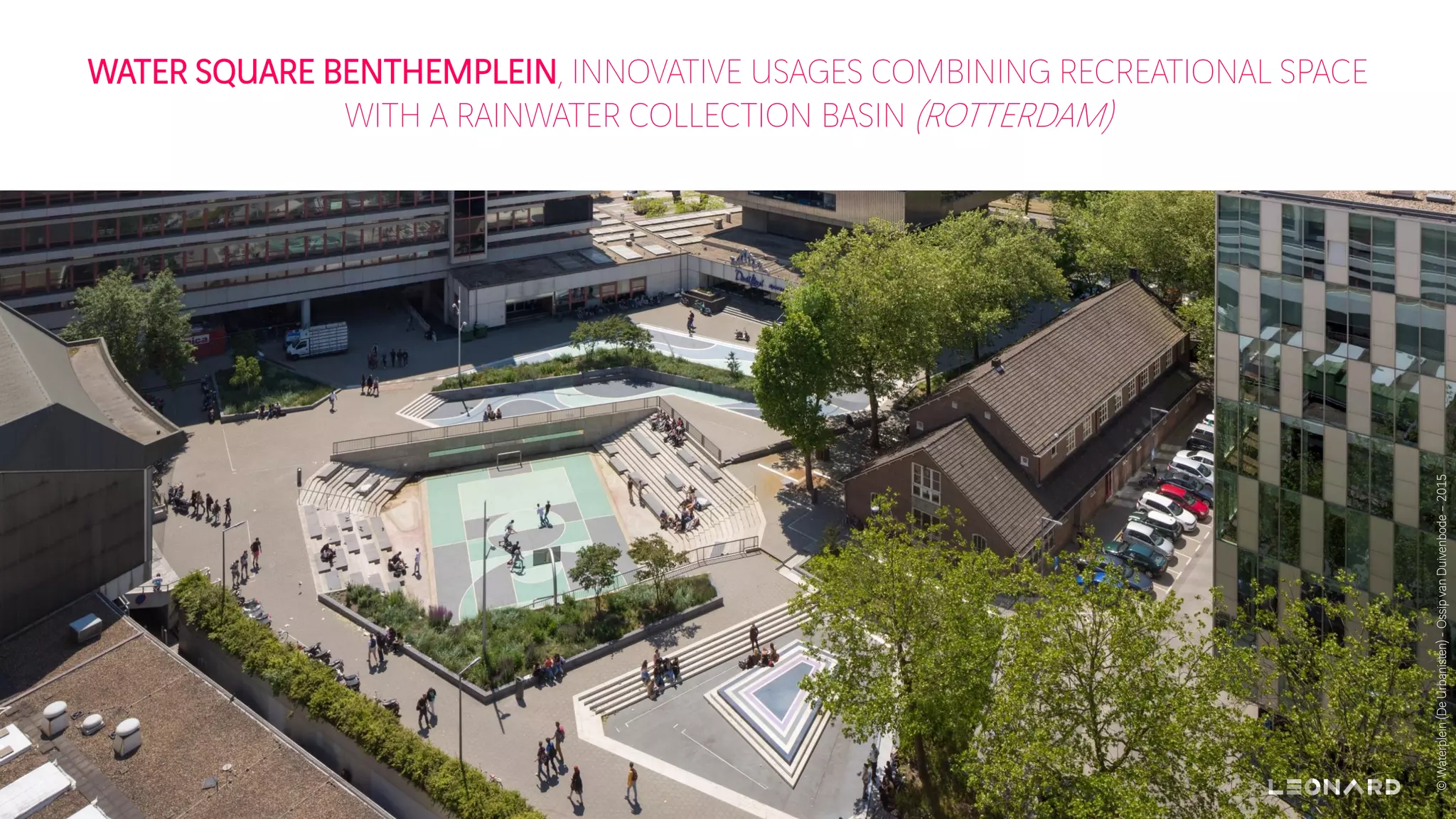
WATER SQUARE BENTHEMPLEIN, INNOVATIVE USAGES COMBINING RECREATIONAL SPACE
WITH A RAINWATER COLLECTION BASIN (ROTTERDAM)
©Waterplein(DeUrbanisten)-OssipvanDuivenbode–2015
MAKOKO FLOATING SCHOOL, MOBILE INFRASTRUCTURE ADAPTABLE
TO CHANGES IN TIDES AND SEA LEVEL (LAGOS)
©NLÉ,IwanBaan,GeorgeOsodi–MakokoFloatingSchool(Nléproject)-2013
GARDENS BY THE BAY HOUSES “SUPERTREES” COVERED WITH VEGETATION THAT SUPPORT
PHOTOVOLTAIC SOLAR CELLS AND A RAINWATER COLLECTION SYSTEM (SINGAPORE)
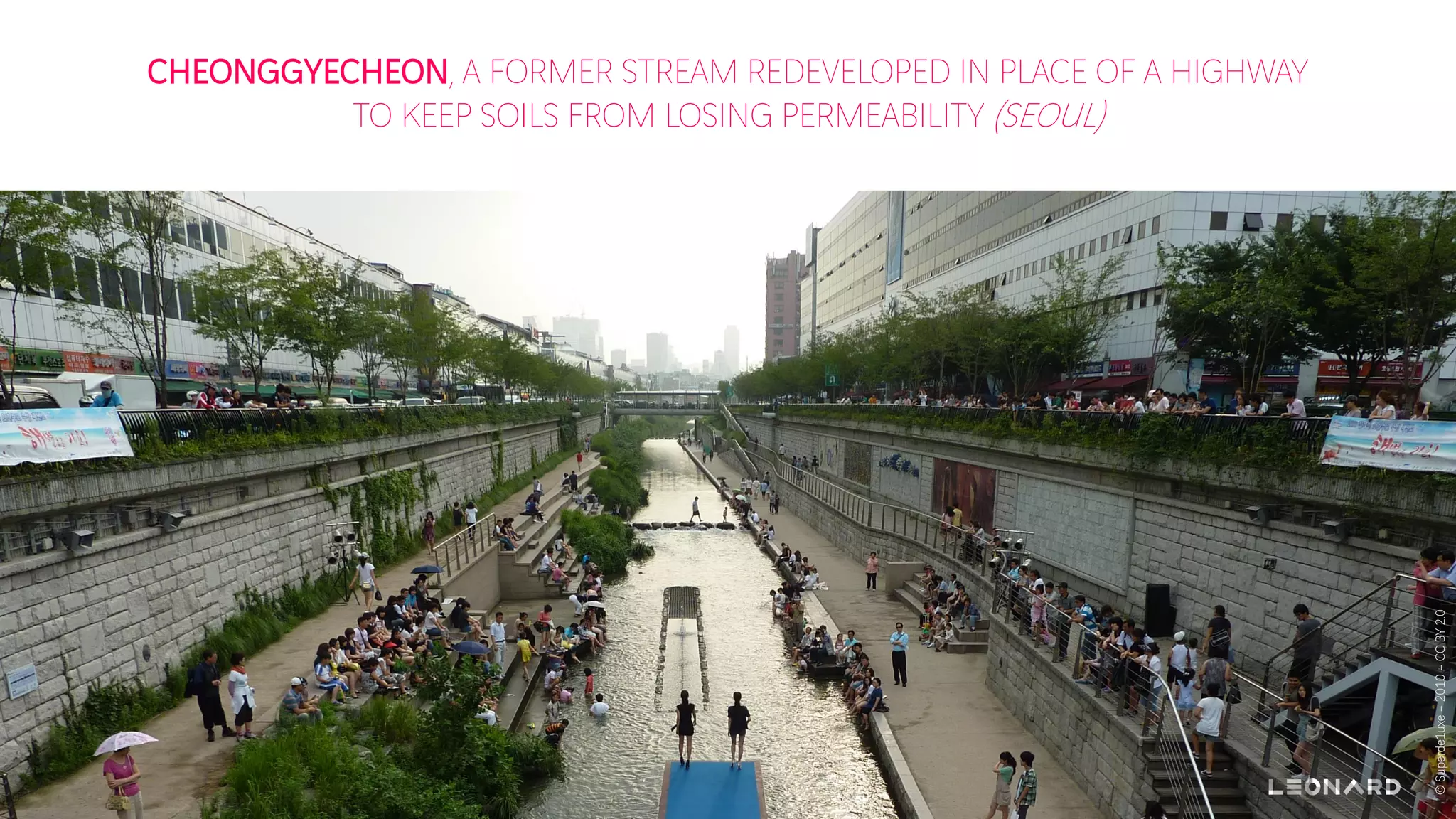
CHEONGGYECHEON, A FORMER STREAM REDEVELOPED IN PLACE OF A HIGHWAY
TO KEEP SOILS FROM LOSING PERMEABILITY (SEOUL)
©Superde1uxe–2010–CCBY2.0
TÅSINGE PLADS SQUARE, A PARK REDEVELOPMENT PROJECT BY TREDJE NATUR
TO ABSORB HEAVY RAINS VIA A COLLECTION NETWORK (COPENHAGEN)
©TåsingeSquareVisualisation-TredjeNatur–2012
IN IOWA, HISTORIC DATA IS USED TO MAKE INFRASTRUCTURE MORE ROBUST BY IDENTIFYING
THE MOST VULNERABLE STRUCTURES AND ADAPTING THEM TO FUTURE FLOODS (USA)
BIG U, THE PROJECT TO REDEVELOP MANHATTAN’S LOWER BANKS INTO NEW LIVING SPACES
TO PROTECT AGAINST FLOODING TIED TO RISING SEA LEVEL AND HURRICANES (NEW-YORK)
©TheBIGTeam/RebuildbyDesign
“Every credible scientific source is telling
us that these impacts will only get worse
if we do not address climate change and
it also tells us that our window of time for
addressing it is closing very soon. To do
this, we need to dramatically increase our
ambitions.”
Patricia Espinosa, Executive Secretary of UN Climate
Change
Opening speech at the Bonn climate change conference on April
30, 2018
©CTBTOPreparatoryCommission(JamesLeynse)–2011-CC-BY-2.0
APPENDIX
CRISIS MANAGEMENT,
CRUCIAL FOR GUARDING
AGAINST HAZARDS
EU SEQUANA 2016
A EUROPE-WIDE CRISIS MANAGEMENT EXERCISE SIMULATING A 10-YEAR FLOOD
IN ILE-DE-FRANCE FROM MARCH 7-18, 2016
Operate the European civil
protection system
Focus attention on flood
phenomenon
Bring together partners and
stakeholders in the Paris region to
improve coordination of their
actions
Result: the May-June 2016 floods, the exercise, which took places
upstream, helped to streamline crisis management procedures
CLIMATE HAZARDS:
THE GRADUAL EVOLUTION
OF CLIMATE PARAMETRS
SEA LEVEL CHANGE
Estimate of global average sea level by 2100 based on 1986-
2005 and according to 4 RCP scenarios.
© Climate Change 2013 : The Physical Science Basis / IPCC – figure 13.11 - 2013
Since the middle 20th century, 13
islands have already been recorded as
lost in the Pacific Ocean. The first
victims were the Solomon Islands and
Micronesia.
The IPCC defines eustatic change of sea level as a change in the
global average sea level due to a variation in the volume of the
world’s oceans
©AtollSikaiana(SolomonIslands)-JohnsonSpaceCenteroftheUnitedStates/NASA–2001
AVERAGE ATMOSPHERIC TEMPERATURE
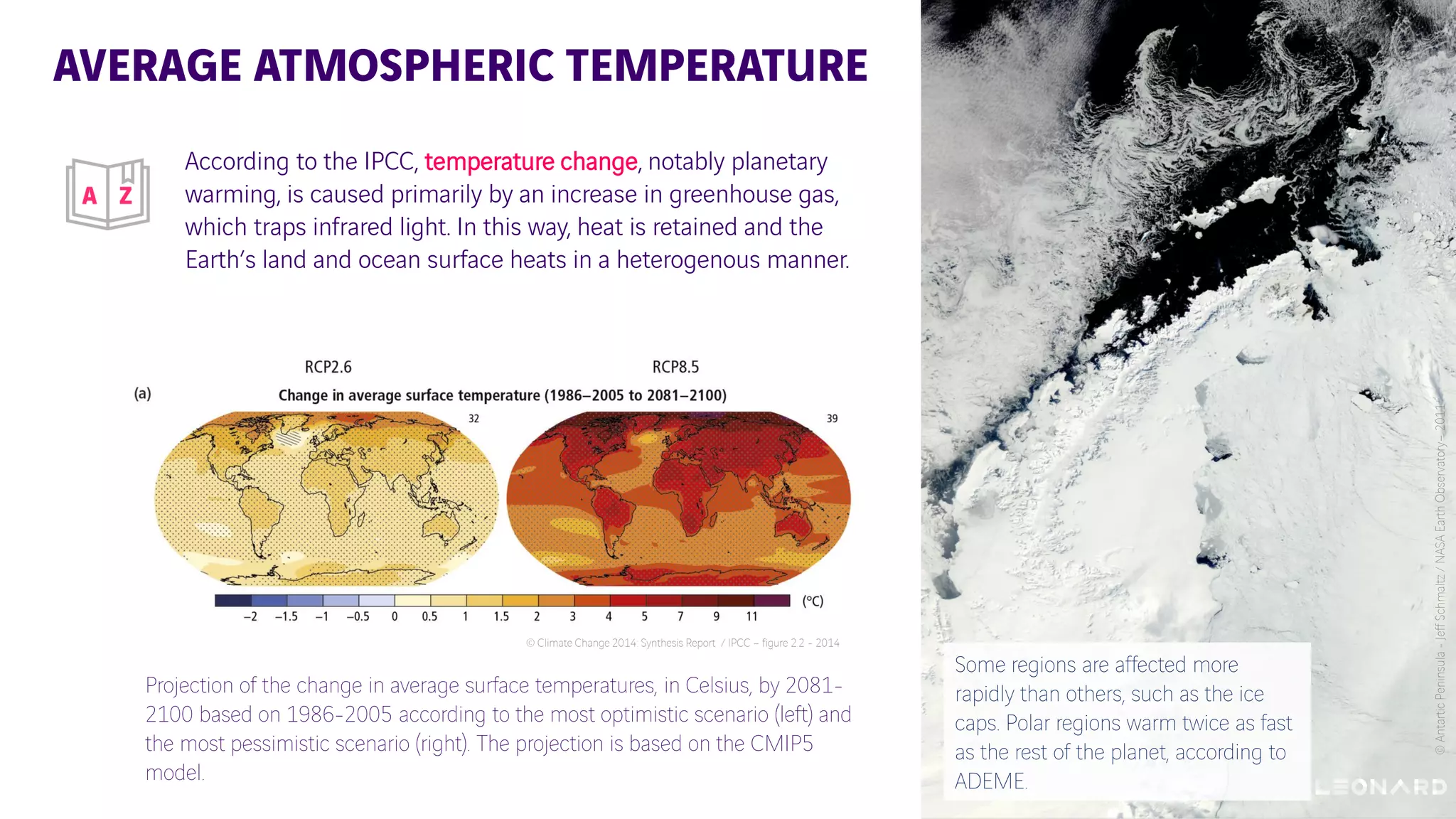
Projection of the change in average surface temperatures, in Celsius, by 2081-
2100 based on 1986-2005 according to the most optimistic scenario (left) and
the most pessimistic scenario (right). The projection is based on the CMIP5
model.
© Climate Change 2014: Synthesis Report / IPCC – figure 2.2 - 2014
Some regions are affected more
rapidly than others, such as the ice
caps. Polar regions warm twice as fast
as the rest of the planet, according to
ADEME.
According to the IPCC, temperature change, notably planetary
warming, is caused primarily by an increase in greenhouse gas,
which traps infrared light. In this way, heat is retained and the
Earth’s land and ocean surface heats in a heterogenous manner.
©AntarticPeninsula-JeffSchmaltz/NASAEarthObservatory–2011
Projection of the percentage change in average annual rainfall on the Earth’s
surface by 2081-2100 based on 1986-2005 according to the most optimistic
scenario (left) and the most pessimistic scenario (right). The projection is based
on the CMIP5 model.
RAINFALL PATTERNS
The IPCC explains changing rainfall patterns by the variation in
atmospheric moisture (warming oceans, melting glaciers, etc.)
via the action of greenhouse gases within the troposphere and
aerosols on the structure of cloud formations.
© Climate Change 2014: Synthesis Report / IPCC – figure 2.2 - 2014
WIND PATTERNS
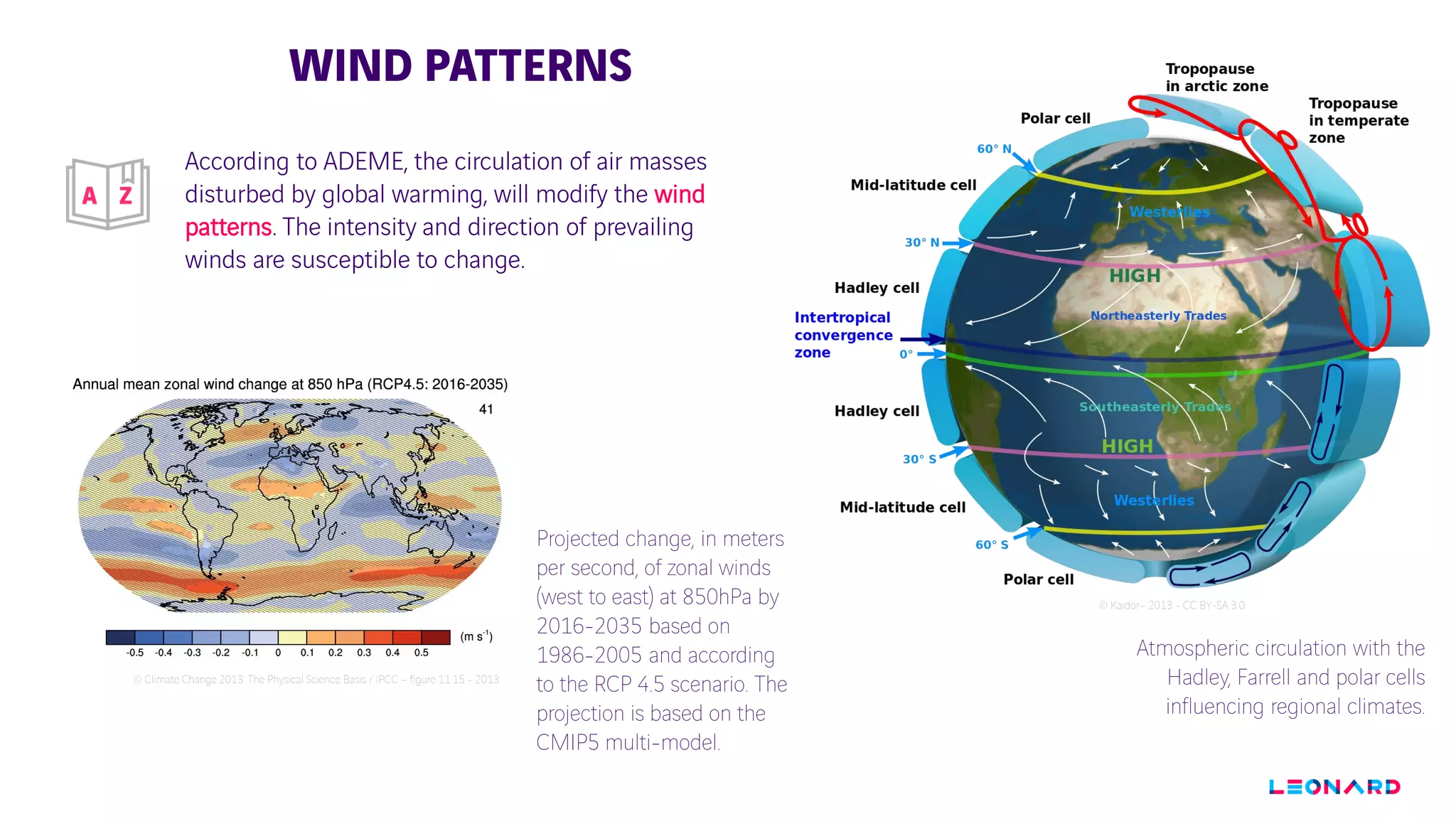
Atmospheric circulation with the
Hadley, Farrell and polar cells
influencing regional climates.
© Kaidor– 2013 - CC BY-SA 3.0
Projected change, in meters
per second, of zonal winds
(west to east) at 850hPa by
2016-2035 based on
1986-2005 and according
to the RCP 4.5 scenario. The
projection is based on the
CMIP5 multi-model.
© Climate Change 2013: The Physical Science Basis / IPCC – figure 11.15 - 2013
According to ADEME, the circulation of air masses
disturbed by global warming, will modify the wind
patterns. The intensity and direction of prevailing
winds are susceptible to change.
MELTING PERMAFROST
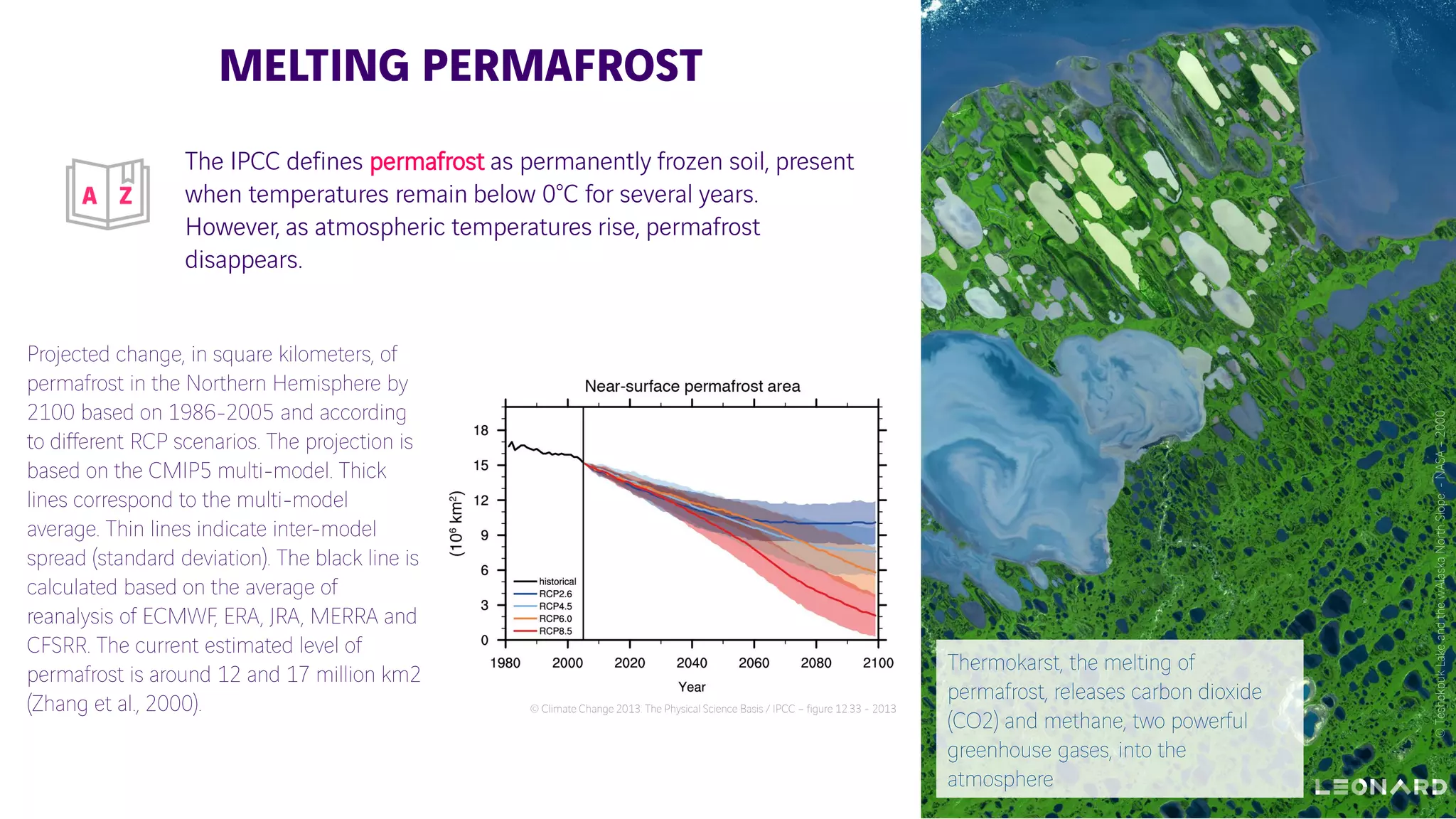
The IPCC defines permafrost as permanently frozen soil, present
when temperatures remain below 0°C for several years.
However, as atmospheric temperatures rise, permafrost
disappears.
Projected change, in square kilometers, of
permafrost in the Northern Hemisphere by
2100 based on 1986-2005 and according
to different RCP scenarios. The projection is
based on the CMIP5 multi-model. Thick
lines correspond to the multi-model
average. Thin lines indicate inter-model
spread (standard deviation). The black line is
calculated based on the average of
reanalysis of ECMWF, ERA, JRA, MERRA and
CFSRR. The current estimated level of
permafrost is around 12 and 17 million km2
(Zhang et al., 2000). © Climate Change 2013: The Physical Science Basis / IPCC – figure 12.33 - 2013
Thermokarst, the melting of
permafrost, releases carbon dioxide
(CO2) and methane, two powerful
greenhouse gases, into the
atmosphere
©TeshekpukLakeandthew:AlaskaNorthSlope.-NASA–2000
CLIMATE HAZARDS:
PERIODIC CLIMATE SHOCKS
FLOODING
© Climate Change 2013: The Physical Science Basis / IPCC – figure 12.26 - 2013
Projected percentage change in the
maximum annual accumulation of
precipitation over five days by
2081-2100 based on 1981-2000
and according to the RCP 8.5
scenario. The 2010 floods in Pakistan killed
1,760 and left 10 million homeless
according to the UN. Damages are
estimated $9.5B according to EM-
DAT.
The French government defines flooding as a temporary
submersion in water of land that is not ordinarily inundated,
regardless of cause. According to the IPCC, that can lead to
flooded rivers, urban runoff, coastal flooding by seawater
inundation or glacial lake outburst flood.
©U.S.ArmySgt.MonicaK.Smith–2010-CC-BY-2.0
TROPICAL CYCLONES
The IPCC defines tropical cyclones as a powerful cyclonic
depression forming above tropical waters. They are
distinguished from weaker systems (often called depressions or
tropical disturbances) by exceeding a wind speed threshold. In
this way, a tropical storm when surface winds reach an average
speed of 18-32 m s-1 per minute. Beyond 32 m s-1, the
tropical cyclone is called a hurricane or typhoon, depending on
the region where it originates.
Hurricane Isabel caused $3.6B in
damages and killed 47 people in 2003
in the Caribbean and eastern seaboard
of the US and Canada, according to
NOAA and NCDC.
©ClimateChange2013:ThePhysicalScienceBasis/IPCC–figure14.17-2013
STORMS
The French government defines storms as atmospheric
disturbances (or depressions) that form when two air masses
with distinct characteristics (temperature, humidity) meet and
cause potentially strong winds. Unlike tropical cyclones, they
may continue to grow in strength while moving across land.
Heavy rain, snow and thunderstorms may accompany the strong
winds.
Sables d'Olonne embankment after the
storm Xynthia in 2010 killed 47 in
France and cost €1.5B in damages
according to the French Federation of
Insurance Companies.
©Freeminder~commonswiki–2010–CCBY-SA2.0
CLIMATE CHANGE, TROPICAL CYCLONES
AND STORMS
Projected percentage change in the
occurrence and intensity of tropical
cyclones by cyclone basin by 2081-2100
based on 2000-2019 according to a
scenario similar to A1B.
Four parameters were taken into
account: percentage variation of (I) the
total annual frequency of tropical storms,
(II) the annual frequency of category 4
and 5 storms, (III) the average lifetime
maximum intensity (LMI) and (IV) the
precipitation rate under 200 km from the
eye of the storm at the time of the LMI.
For each measurement, the solid blue
line is the best estimate of the expected
percentage change and the colored bar
indicates confidence interval of 67%
(probable) for this value. If no metric is
shown, sufficient data is not available to
perform an assessment.© Climate Change 2013: The Physical Science Basis / IPCC – figure 14.17 - 2013
DROUGHT
In Somalia, nomadic livestock farmers are greatly
impacted by 25 years of successive drought and food
crises affecting the entire Horn of Africa.
© Oxfam East Africa – Somaliland Drought– 2012 - CC-BY-2.0
© Climate Change 2013: The Physical Science Basis / IPCC – figure 12.26 - 2013
Projected change in the annual number of consecutive
dry days (with daily precipitation under 1mm) by 2081-
2100 based on 1981-2000 and according to the RCP 8.5
scenario. The projection is based on the CMIP5 model.
The IPCC defines drought as a phenomenon that occurs when
precipitation falls well below the normal recorded rates, causing
a serious water imbalance with potentially devastating affects
on resource production.
112
FOREST FIRES
Dry conditions increase the likelihood of forest fires,
which, together with human activities, can compromise
the forest’s resilience to climate change.
© State Farm – 2007 – CC-BY-2.0
According to the French government, forest
fires occur primarily during drought periods
when plants have a low water content. They
may have natural causes (lightning, volcanic
eruption) or human causes (criminal or
accidental).
San Diego threatened by California’s
forest fires in October 2007. 8 people
died and material damages reached
$2.8B according to EM-DAT.
In December 2017, California was once
again ravaged by 29 forest fires causing
$2.2B in damages (EM-DAT)
© Thomas Fire - Kari Greer / US Forest Service – 2017 – CC BY 2.0
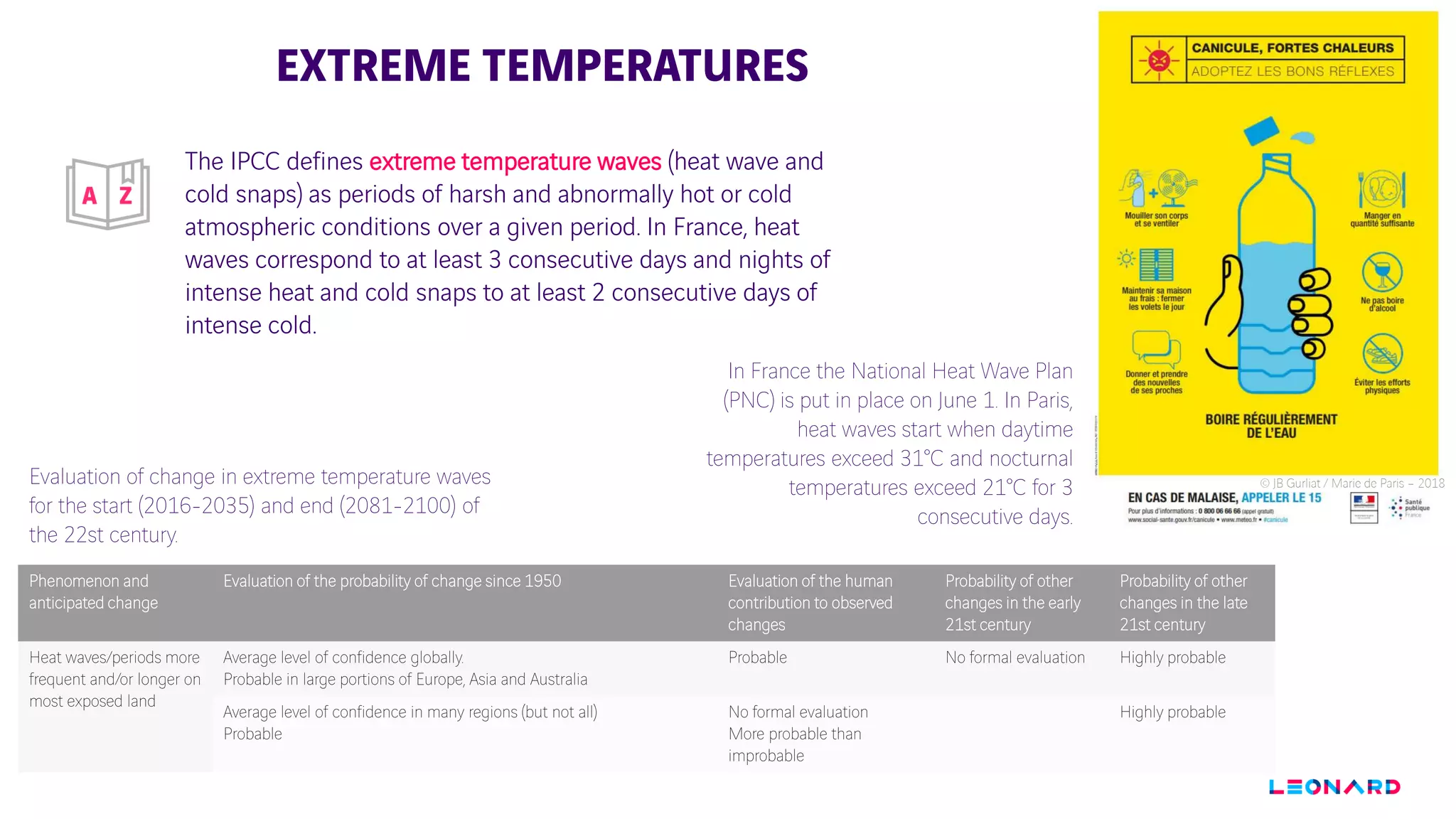
EXTREME TEMPERATURES
In France the National Heat Wave Plan
(PNC) is put in place on June 1. In Paris,
heat waves start when daytime
temperatures exceed 31°C and nocturnal
temperatures exceed 21°C for 3
consecutive days.
Phenomenon and
anticipated change
Evaluation of the probability of change since 1950 Evaluation of the human
contribution to observed
changes
Probability of other
changes in the early
21st century
Probability of other
changes in the late
21st century
Heat waves/periods more
frequent and/or longer on
most exposed land
Average level of confidence globally.
Probable in large portions of Europe, Asia and Australia
Probable No formal evaluation Highly probable
Average level of confidence in many regions (but not all)
Probable
No formal evaluation
More probable than
improbable
Highly probable
Evaluation of change in extreme temperature waves
for the start (2016-2035) and end (2081-2100) of
the 22st century.
© JB Gurliat / Marie de Paris – 2018
The IPCC defines extreme temperature waves (heat wave and
cold snaps) as periods of harsh and abnormally hot or cold
atmospheric conditions over a given period. In France, heat
waves correspond to at least 3 consecutive days and nights of
intense heat and cold snaps to at least 2 consecutive days of
intense cold.
Rising moisture and precipitation in certain regions,
combined with unfavorable land development, may
increase the number of landslides linked to water.
LANDSLIDES
On December 15, 1999, heavy rains caused a
landslide in the state of Vargas in Venezuela,
causing at least 30,000 deaths and $1.8B in
damages according to USGS.
The IPCC defines a landslide as a mass of
material that has moved downhill by gravity,
often assisted by water when the material is
saturated; rapid movement of soil, rock or
debris down a slope.
©L.M.Smith,WaterwaysExperimentStation,U.S.ArmyCorpsofEngineer-1999
THE QUALITIES OF A
RESILIENT SYSTEM
A REFLECTIVE SYSTEM
According to 100RC, reflective people and institutions use
past experiences to inform future decisions and modify
norms and behaviors in turn.
Example:
A reflective planning process is more apt to respond to new circumstances
Source : 100RC
A ROBUST SYSTEM
According to 100RC, a robust project is well designed, built
and managed. It includes measures to ensure that failures are
predictable, safe and not disproportionate to their cause.
Example:
Robust protection infrastructure will not break down in a catastrophic way
when the design thresholds are exceeded
Source : 100RC
A FLEXIBLE SYSTEM
According to 100RC, flexibility refers to the drive and capacity
to adopt alternative strategies in response to changing
circumstances or sudden crises. Systems can be made more
flexible by introducing new technologies or knowledge,
notably by recognizing traditional practices.
Example:
In a period of crisis, cities can reassign city buses for emergency
evacuations.
Source : 100RC
AN INTEGRATED SYSTEM
According to 100RC, integrated processes combine systems
and institutions and can also trigger additional benefits as
long as resources are shared and stakeholders can work
together to achieve greater goals.
Example:
Integrated urban planning enables a city to cope with multidisciplinary
problems, such as an emergency response to catastrophe through
coordination
Source : 100RC
A RESOURCEFUL SYSTEM
According to 100RC, resourceful people and institutions can
recognize other ways to use resources during crises to meet
their needs or achieve their goals
Example:
Although households in the cities of Chile’s central valley use water provided
by municipal networks, service is frequently out after strong earthquakes. In
response, many households have wells to maintain their water supply.
Source : 100RC
A REDUNDANT SYSTEM
According to 100RC, redundancy refers to the reserves
available for coping with disturbances caused by extreme
stress, demand spikes or external events. This includes a
diversity of ways to meet a given need.
Example:
Redundant energy systems deliver several solutions for supplying networks
during demand spikes or service outages
Source : 100RC
AN INCLUSIVE SYSTEM
According to 100RC, inclusive processes focus on expanded
cooperation aiming to create a shared vision and a feeling of
shared ownership in order to build resilient cities
Example:
Advance warnings enable at-risk populations to protect themselves and
minimize human and material damages
Source : 100RC
FOCUS ON FUNCTIONAL RESILIENCE:
THE BUSINESS CONTINUITY PLAN
To be resilient in response to a natural
catastrophe, a business or institution will
need to implement a business continuity
plan (BCP) to maintain a minimum level of
service without its usual human and material
resources.
This includes a strategic document updated
regularly to plan the reaction to adopt in
response to a hazard in order to minimize the
impact on business.
In practice:
• In response to a climate shock like a
tropical cyclone, this may include taking
cover to protect staff, equipment and
installations, while working to restore
priority activities within a short time frame
• In response to a prolonged episode, it may
involve a backup for the portion of the
company that can be backed up
Urban resilience and infrastructure | Emerging Trends #3 _ v2

Urban resilience and infrastructure | Emerging Trends #3 _ v2

  • 1.
  • 2.
    BILOXI-OCEAN SPRINGS BRIDGEAFTER HURRICANE KATRINA (2005) The hurricane caused $156.3B in damages INCREASE IN NATURAL DISASTERS
  • 3.
    FLOODED BANKS OFTHE SEINE (2016) The May-June flood affecting the northern half of France caused €1.4B in damages ©Thesupermat–2016-CCBY-SA4.0 INCREASE IN NATURAL DISASTERS
  • 4.
    DON MUANG AIRPORTSHUT DOWN BY FLOODING IN THAILAND (2011) The disaster caused €33B in damages ©SirAlex/Shutterstock.com–2011 INCREASE IN NATURAL DISASTERS
  • 5.
    HURRICANE IRMA’S PATHOF DESTRUCTION THROUGH THE CARIBBEAN (2017) The natural disaster caused $80.8B in damages and killed 105 people (EM-DAT) ©DevastationoftheislandofJostVanDykeafterhurricaneIrma-DFID-UKDepartmentforInternationalDevelopment–2017-CCBY2.0 INCREASE IN NATURAL DISASTERS
  • 6.
    I. RESILIENCE: ANECESSITY IN THE FACE OF CLIMATE CHANGE II. THE CRITICAL CHALLENGES AHEAD III. DEVELOPING RESILIENT SOLUTIONS
  • 7.
    I. RESILIENCE: A NECESSITYIN THE FACE OF CLIMATE CHANGE
  • 8.
    1. A GLOBALPHENOMENON WITH LOCAL CONSEQUENCES
  • 9.
    CLIMATE CHANGE “Any changein climate over time, whether due to natural variability or as a result of human activity” IPCC, 2007
  • 10.
    THE HUMAN-INDUCED DRIVERSOF CLIMATE CHANGE Human activity Greenhouse gas emissions Climate change Demographic spike Economic growth Environmental impact
  • 11.
    Periodic climate shocks Gradual evolutionof climate factors A GLOBAL PHENOMENON WITH LOCAL CONSEQUENCES Typology of climate risks Climate change will affect each region differently
  • 12.
    THE GRADUAL EVOLUTIONOF CLIMATE FACTORS Sea level Thermohaline circulation Wind patterns Air quality Air temperature Rainfall patterns Melting permafrost
  • 13.
    PERIODIC CLIMATE SHOCKS FloodingTropical cyclones Storms Forest fires Extreme temperatures Frost / Thaw DroughtShrink / swell of clay Landslide
  • 14.
    2. TOWARDS RESILIENCEIN INFRASTRUCTURE
  • 15.
    “Climate change hashappened because of human behavior, therefore it is only natural that it should be us, as human beings, to address this issue. It may not be too late if we take decisive actions today.” Ban Ki Moon, UN Secretary-General (2007-2016) Speech at 45th World Economic Forum, January 23, 2015 ©WorldEconomicForum-2008-CCBY-SA2.0
  • 16.
    CLIMATE RESILIENCE Capacity ofa system, society or infrastructure to resist and absorb a climate disturbance and to return to its initial state, while reducing its vulnerability to future disturbances © Cheonggyecheon – Rich & Cheryl – 2013 - CC BY-NC-SA 2.0 Greenspace reclaims a former highway in Seoul
  • 17.
    QUALITIES OF ARESILIENT SYSTEM RESOURCEFUL Facilitated reallocation of resources REFLECTIVE Able to learn ROBUST Limits the propagation of flaws FLEXIBLE Alternative strategies REDUNDANT Back-up capacities INCLUSIVE Input and involvement of stakeholders INTEGRATED Systems that work together as a whole
  • 18.
    FUNCTIONAL RESILIENCE Operation infail-soft mode while ensuring a minimum service level in the absence of the usual resources Resistance Absorption Recovery
  • 19.
    TWO TYPES OFRESILIENT MEASURES Adaptation Manage the inevitable Attenuation Avoid the unmanageable
  • 20.
  • 21.
    Resistance Withdrawal CoexistenceRecovery FOUR STRATEGIES FOR ADAPTING TO RISKS
  • 22.
    Coexistence RecoveryResistance Withdrawal REINFORCINGPROTECTION SYSTEMS AND STRUCTURES AGAINST RISK Fortifying the Perrotine dyke (Saint-Pierre-d’Oléron, 2017) ©GillesDELACUVELLERIE–PhotothèqueVINCI-2005
  • 23.
    ABANDONING A REGION’SDEVELOPMENT The only house left standing after the Saguenay flood (Quebec, 1994) Coexistence RecoveryResistance Withdrawal ©0x010C-2016–CCBY4.0
  • 24.
    DEVELOPING TO LIVEWITH CLIMATE RISK A floating house can mitigate the risk of sudden high waters Coexistence RecoveryResistance Withdrawal ©Kröslin,Allemagne-2013
  • 25.
    TWO WAYS OFSUPPORTING POST CRISIS RECOVERY: “BUILD BACK BETTER” OR “FRAGILE BUT AGILE” After Irma, six schoolrooms will be rebuilt through the Logelis Build Back Better strategy (Saint-Martin, 2017) Coexistence RecoveryResistance Withdrawal ©LavilledeMarigotsurl'îledeSaint-Martin,deuxjoursaprèsl'ouraganIRMA-UIISC1-2017-CCBY-SA4.0
  • 26.
  • 27.
  • 28.
    “The warnings aboutglobal warming have been extremely clear for a long time. We are facing a global climate crisis. It is deepening. We are entering a period of consequences.” Al Gore, Vice President of the United States (1993-2001) Speech given at the Sierra Club National Convention on September 9, 2005 ©AlGore–SSEE–2016-CCBY-SA4.0
  • 29.
    Ecosystem and biodiversity Economy Health Accessto resources Geopolitical instability Climate migration INABILITY TO ADAPT TO CHANGING HABITATS AND ENVIRONMENTS Coral bleaching caused by rising ocean temperatures and acidification ©BentSeaRodBleaching(Florida)-U.S.GeologicalSurvey-2014–CC0
  • 30.
    EACH THREATENED FOODSOURCE UPSETS THE ENTIRE SUPPLY CHAIN This applies across every sector: agriculture, fishing, construction, retail, insurance, tourism, etc. Ecosystem and biodiversity Economy Health Access to resources Geopolitical instability Climate migration
  • 31.
    CHANGING DISTRIBUTIONS OFDISEASE VECTORS AND ALLERGENS Pollen season could become longer and more severe (Inserm, 2017) Ecosystem and biodiversity Economy Health Access to resources Geopolitical instability Climate migration
  • 32.
    THREATENED SUPPLY CHAINAND FOOD INSECURITY In Cape Town, drought led to a water restriction of 50L/day per resident (2018) Ecosystem and biodiversity Economy Health Access to resources Geopolitical instability Climate migration ©MarkFisher/Shutterstock.com-2018
  • 33.
    WORSENING OF CONFLICTWHEN VITAL RESOURCES RUN SHORT Syria’s 2006-2010 drought is one of the factors behind the current civil war Ecosystem and biodiversity Economy Health Access to resources Geopolitical instability Climate migration ©FreeSyrianArmysoldierwalkingamongrubbleinAleppoduringtheSyriancivilwar-VoiceofAmericaNews:ScottBobbreportsfromAleppo,Syria-2012
  • 34.
    THE WORLD’S POORESTREGIONS ARE MOST VULNERBLE TO CLIMATE CHANGE Climate refugee camp, an artwork by activist Hermann Josef Hack (Hanover, 2009) Ecosystem and biodiversity Economy Health Access to resources Geopolitical instability Climate migration ©Sven-ChristianKindler-2009–CCBY2.0
  • 35.
  • 36.
    ALREADY A HIGHGLOBAL COST Total cost of natural disasters in 2017 (Swiss Re) 330Billion
  • 37.
    In France, thecost of natural disasters could double in 25 years due to climate change, the increase in the country’s total wealth and unfavorable regional development (FFA, 2015) €48B in damages from 1988 to 2013 €92B in damages expected from 2014 to 2039 THE RISING COST OF CLIMATE DISASTERS
  • 38.
    Regional interdependence Demographic growth and urbanization Increasingchallenges in at-risk areas MORE VULNERABLE REGIONS 60% of the world’s population will live in cities by 2030 (ONU, 2018)
  • 39.
    INFRASTRUCTURE: A CRITICALCOMPONENT OF ADAPTATION Housing Energy Production Communication Protection Transport Water & sanitationStorage 75% of infrastructure cities will need in 2050 has not been built (GIB, 2014) A unique chance to include resilience in their design: Resilience by design
  • 40.
    3. SETBACKS TOADAPTATION
  • 41.
    SETBACKS TO ADAPTATION Science& technology Financial Social & cultural Governance & institutions In light of uncertain long-term projections, greater knowledge and advances in modeling will be needed Access to funding and implementing adaptation measures is often costly Informing stakeholders about climate change and the various levels of acceptable risk can inhibit the formation of a common strategy and ability to take responsibility for the phenomenon Increasing stakeholders makes it harder to take decisions and implement regional adaptation strategies
  • 42.
  • 43.
    A. Operational risksto business continuity Due to periodic climate shocks B. Long-term risks to the contract economy Due to the gradual evolution of climate parameters
  • 44.
    A. OPERATIONAL RISKSTO BUSINESS CONTINUITY DUE TO PERIODIC CLIMATE SHOCKS Damage to equipment Health and safety Business and worksite stoppage Environmental
  • 45.
    DAMAGE TO ACONSTRUCTION CRANE BECAUSE OF HURRICANE IRMA (Miami, 2017)
  • 46.
    EXTREME WEATHER WILLINCREASE THE PHYSICAL HARDSHIP AND ACCIDENT RISK OF JOBS: CRAMPING, FROSTBITE, EXHAUSTION, DEHYDRATION OR HEAT EXPOSURE THREATENS WORKSITE SAFETY
  • 47.
    43 FLIGHTS CANCELLEDBY AMERICAN AIRLINES DUE TO EXTREME HEAT (Phoenix, June 20, 2017) ©Braboowi–2010-CCBY-SA3.0
  • 48.
    WITH MELTING PERMAFROST,FLOODING, LANDSLIDES AND AVALANCHES, NETWORK FAILURES REPRESENT AN ENVIRONMENTAL RISK ©PipelineinAlaska-2015
  • 49.
    B. LONG-TERM RISKSTO THE CONTRACT ECONOMY DUE TO THE GRADUAL EVOLUTION OF CLIMATE PARAMETERS Operation and maintenance spending Performance of structures Contractual penalties Infrastructure maladjustment Ineligibility for “green funding”
  • 50.
    INCREASE IN BUILDINGENERGY USE DUE TO RISING AVERAGE TEMPERATURES
  • 51.
    THE LIFESPAN OFSTRUCTURES WILL BE ALTERED IF PHENOMENA SUBJECT TO CLIMATE CHANGE – SUCH AS SHRINK-SWELL CAPACITY OF SOIL – IS NOT ACCOUNTED FOR IN THE DESIGN PHASE
  • 52.
    CONTRACTUAL RISK DEPENDSON A CONSIDERATION OF EXPOSURE TO CERTAIN CLIMATE RISKS WHEN DRAFTING CONTRACT CLAUSES ©FrancisVigouroux-PhotothèqueVINCI-Enginsdesalageetdedéneigementsurl’A10–2018
  • 53.
    THE FINANCE COMMUNITYINCREASINGLY REQUIRES PROJECTS TO MEET CLIMATE CHANGE ADAPTATION CRITERIA BEFORE ALLOCATING INVESTMENTS ©TheWorldBankGroupheadquartersbuildingsinWashington,D.C.–AgnosticPreachersKid–2008-CCBY-SA3.0
  • 54.
    NEED TO ADAPTRUNWAYS DUE TO THE CHANGING DIRECTION OF PREVAILING WINDS ©HonoluluAirportRunway-rharrison/wikicommons–2008-CCBY-SA3.0
  • 55.
    DECLINING TRAFFIC ATCERTAIN AIRPORTS CURRENTLY BENEFITTING FROM SEASONAL TOURISM ©AltiportdeCourchevel-2017
  • 56.
  • 57.
  • 58.
    CONVERGENCE OF INITIATIVES Insurance Parametricinsurance Weather derivatives trading Cat bonds Institutions Paris climate agreement Connected Cities network Multilateral backers Standards Norms Resilience label for French cities HQE Resilience
  • 59.
    A GLOBAL NETWORKOF CITIES: THE C40 The C40 connects urban stakeholders and mayors worldwide to encourage stronger collective action on climate issues
  • 60.
    ANOTHER GLOBAL NETWORKOF CITIES: THE 100RC The 100 Resilient Cities (100RC) network aims help cities around the world withstand the physical, social and economic challenges of the 21st century
  • 61.
    AXA GLOBAL PARAMETRICS COVERSCLIMATE DISTURBANCES Compensation is paid when a weather parameter associated with the customer’s losses reaches a predetermined threshold Insurance covering the cost of additional defrosting for aircraft during prolonged periods of low temperatures
  • 62.
    THE NEW INTERNATIONALNORM: ISO 37101 The ISO 37101 norm offers assistance to municipalities to improve the sustainable, smart or resilient nature of strategies, programs and plans
  • 63.
    THE NEW STANDARD: THERESILIENCE THEME OF NF HABITAT HQE In early 2018, a “resilience” section was added to the NF Habitat HQE certification to encourage building design to account for risks posed to buildings by natural hazards. To that end, it inventories the potential impacts for each hazard in order to implement adaptation measures PHOTO A CHANGER
  • 64.
    2. INNOVATIVE SOLUTIONS FORINFRASTRUCTURE RESILIENCE
  • 65.
    1. Technical solutions 2.Software development and data processing 3. New lines of resilient services 4. Rethinking urban development
  • 66.
    O2D GREEN (O2DENVIRONMENT) TURF SLAB IS A SUSTAINABLE SOLUTION FOR RAINWATER INFILTRATION, REDUCING HEAT ISLAND EFFECT AND PRESERVING SOIL BIODIVERSITY ©O2DENVIRONNEMENT
  • 67.
    POWER ROAD® MITIGATESURBAN HEAT ISLANDS AND REDUCES SNOW ACCUMULATION ON ROADWAYS BY STORING SOLAR ENERGY
  • 68.
    POROUS ASPHALTS MITIGATEFLOODING BY CREATING ROADS WITH HIGH WATER RETENTION
  • 69.
    URBAN CANOPEE DEVELOPSWATER AND ENERGY AUTONOMOUS GREEN CANOPIES ABOVE THE CITY TO CREATE COOL ISLANDS ©Corolle–URBANCANOPEE-2018
  • 70.
    THE ANTI-CIGARETTE BUTTTRENCH & RUNNER IN REINFORCED CONCRETE USED BY ESCOTA TO PREVENT FOREST FIRES DURING PERIODS OF SUMMER DROUGHT ©M.Martini–PhotothèqueESCOTA-2004 ©M.Martini–PhotothèqueESCOTA-2011
  • 71.
    LOGELIS, THE MAKEROF “ECOLOW-COST HIGH QUALITY” KIT HOMES HAS ALREADY HELPED MEET THE URGENT REBUILDING NEEDS IN SAINT-MARTIN ©LavilledeMarigotsurl'îledeSaint-Martin,deuxjoursaprèsl'ouraganIRMA-UIISC1-2017-CCBY-SA4.0
  • 72.
    THE RESILIENT TUNNELPLUG DEVELOPED BY WEST VIRGINIA UNIVERSITY, A GIANT INFLATABLE BALLOON TO PLUG TUNNELS IN CASE OF FLOODING ©USDepartmentofHomelandSecurity–2018
  • 73.
    1. Technical solutions 2.Software development and data processing 3. New lines of resilient services 4. Rethinking urban development
  • 74.
    HAND (Hackers AgainstNatural Disasters) UNITES HACKTIVISTS TO DEVELOP AN ACTION PLAN AND DECENTRALIZED ORGANIZATION FOR CRISIS SITUATIONS
  • 75.
    GEOSCOPE MANAGES DATAIN REAL TIME TO MANAGE RISKS THROUGH PROACTIVE OVERSIGHT OF STRUCTURES ©PhotothèqueSIXENSE
  • 76.
    SCORE ICU (E6& ACPP) IS A TOOL FOR MONITORING THE FORESEEABLE IMPACT OF DEVELOPMENT PROJECTS ON URBAN HEAT ISLANDS Place des Jacobins in LYON, France Initial state ICU score: 0.764 ICU score: 0.693 Projection
  • 77.
    CLS (Satellite LocationCollection) OFFERS SATELLITE TOOLS AND SERVICES FOR MONITORING WATER RESOURCES AND THE IMPACT OF GLOBAL WARMING
  • 78.
    TEMPERATE (AZAVEA &ICLEI-USA), ADAPTATION STRATEGY PLANNING SOFTWARE THAT ACCOUNTS FOR FUTURE CLIMATE DATA BASED ON RECOGNIZED MODELS AND SCENARIOS, FOR AMERICAN CITIES
  • 79.
    THE PRAGUE FLOODMODEL, UPDATED REGULARLY, HELPED PUT IN PLACE AN EMERGENCY PLAN THAT HAS ALREADY AIDED WITH FLOODING IN DOWNTOWN BY LOCATING THE MOST VULNERABLE POINTS ©Sovovymlyny–Che/Wikicommons-2006–CCBY-SA2.5
  • 80.
    OPENCLIMATEGIS (ESGF-COG), OPENSOURCE SOFTWARE DESIGNED FOR MANIPULATING GEOSPATIAL CLIMATE DATA 79 ©USClimateResilienceToolkit/NOAA
  • 81.
    COPERNICUS, THE EU’SEARTH MONITORING PROGRAM, HELPS EUROPEAN COUNTRIES BOOST THEIR CAPACITY FOR MANAGING RISKS BY IMPROVING THEIR CLIMATE DATA ©CaliforniainflamesbySentinel-2-EuropeanSpaceAgency-ContainsmodifiedCopernicusSentineldata(2017)–CCBY-SA3.0IGO
  • 82.
    1. Technical solutions 2.Software development and data processing 3. New lines of resilient services 4. Rethinking urban development
  • 83.
    RESALLIENCE, VINCI’S DESIGNOFFICE DEDICATED TO ADAPTING PROJECTS, INFRASTRUCTURE AND THEIR USES TO CLIMATE CHANGE
  • 84.
    UBYRISK CONSULTANTS, ASPECIALIST IN NATURAL RISK RESEARCH, CONSULTING AND EXPERTISE, OFFERS A SERVICE FOR PUTTING NATURAL THREATS IN PERSPECTIVE WITH RESPECT TO EXPECTED CLIMATE CHANGE Droit et photo en attente : d’ici fin aout/début septembre 83 ©UbyriskConsultants
  • 85.
    PREDICT SERVICES HELPSRISK MANAGERS TO MAKE THE RIGHT DECISIONS BEFORE, DURING AND AFTER CRISIS ©VigieFrance-PredictServices-2015
  • 86.
    EQUO VIVO, VINCICONSTRUCTION’S BRAND DEDICATED TO ECOLOGICAL DEVELOPMENT PROJECTS : RESTORING BIODIVERSITY - DESIGNING AND COMPLETING ECOLOGICAL DEVELOPMENT PROJECTS - MAINTAINING ECOLOGICAL CONTINUITY The ecological restoration of the Hermance allowed to mitigate flood impacts ©EquoVivo
  • 87.
    DHI FRANCE MANAGESWATER ISSUES WHILE TAKING CLIMATE CHANGE INTO ACCOUNT TO HELP ITS CUSTOMERS IMPLEMENT ADAPTATION STRATEGIES: MANAGING AND ASSESSING URBAN FLOODS, WATER SHORTAGES, ETC.
  • 88.
    URBALIA CONTRIBUTES TOCITY RESILIENCE BY REINFORCING THE ROLE OF NATURE TO RECREATE FUNCTIONAL ECOSYSTEMS. ©Urbalia
  • 89.
    1. Technical solutions 2.Software development and data processing 3. New lines of resilient services 4. Rethinking urban development
  • 90.
    WATER SQUARE BENTHEMPLEIN,INNOVATIVE USAGES COMBINING RECREATIONAL SPACE WITH A RAINWATER COLLECTION BASIN (ROTTERDAM) ©Waterplein(DeUrbanisten)-OssipvanDuivenbode–2015
  • 91.
    MAKOKO FLOATING SCHOOL,MOBILE INFRASTRUCTURE ADAPTABLE TO CHANGES IN TIDES AND SEA LEVEL (LAGOS) ©NLÉ,IwanBaan,GeorgeOsodi–MakokoFloatingSchool(Nléproject)-2013
  • 92.
    GARDENS BY THEBAY HOUSES “SUPERTREES” COVERED WITH VEGETATION THAT SUPPORT PHOTOVOLTAIC SOLAR CELLS AND A RAINWATER COLLECTION SYSTEM (SINGAPORE)
  • 93.
    CHEONGGYECHEON, A FORMERSTREAM REDEVELOPED IN PLACE OF A HIGHWAY TO KEEP SOILS FROM LOSING PERMEABILITY (SEOUL) ©Superde1uxe–2010–CCBY2.0
  • 94.
    TÅSINGE PLADS SQUARE,A PARK REDEVELOPMENT PROJECT BY TREDJE NATUR TO ABSORB HEAVY RAINS VIA A COLLECTION NETWORK (COPENHAGEN) ©TåsingeSquareVisualisation-TredjeNatur–2012
  • 95.
    IN IOWA, HISTORICDATA IS USED TO MAKE INFRASTRUCTURE MORE ROBUST BY IDENTIFYING THE MOST VULNERABLE STRUCTURES AND ADAPTING THEM TO FUTURE FLOODS (USA)
  • 96.
    BIG U, THEPROJECT TO REDEVELOP MANHATTAN’S LOWER BANKS INTO NEW LIVING SPACES TO PROTECT AGAINST FLOODING TIED TO RISING SEA LEVEL AND HURRICANES (NEW-YORK) ©TheBIGTeam/RebuildbyDesign
  • 97.
    “Every credible scientificsource is telling us that these impacts will only get worse if we do not address climate change and it also tells us that our window of time for addressing it is closing very soon. To do this, we need to dramatically increase our ambitions.” Patricia Espinosa, Executive Secretary of UN Climate Change Opening speech at the Bonn climate change conference on April 30, 2018 ©CTBTOPreparatoryCommission(JamesLeynse)–2011-CC-BY-2.0
  • 98.
  • 99.
    CRISIS MANAGEMENT, CRUCIAL FORGUARDING AGAINST HAZARDS
  • 100.
    EU SEQUANA 2016 AEUROPE-WIDE CRISIS MANAGEMENT EXERCISE SIMULATING A 10-YEAR FLOOD IN ILE-DE-FRANCE FROM MARCH 7-18, 2016 Operate the European civil protection system Focus attention on flood phenomenon Bring together partners and stakeholders in the Paris region to improve coordination of their actions Result: the May-June 2016 floods, the exercise, which took places upstream, helped to streamline crisis management procedures
  • 101.
    CLIMATE HAZARDS: THE GRADUALEVOLUTION OF CLIMATE PARAMETRS
  • 102.
    SEA LEVEL CHANGE Estimateof global average sea level by 2100 based on 1986- 2005 and according to 4 RCP scenarios. © Climate Change 2013 : The Physical Science Basis / IPCC – figure 13.11 - 2013 Since the middle 20th century, 13 islands have already been recorded as lost in the Pacific Ocean. The first victims were the Solomon Islands and Micronesia. The IPCC defines eustatic change of sea level as a change in the global average sea level due to a variation in the volume of the world’s oceans ©AtollSikaiana(SolomonIslands)-JohnsonSpaceCenteroftheUnitedStates/NASA–2001
  • 103.
    AVERAGE ATMOSPHERIC TEMPERATURE Projectionof the change in average surface temperatures, in Celsius, by 2081- 2100 based on 1986-2005 according to the most optimistic scenario (left) and the most pessimistic scenario (right). The projection is based on the CMIP5 model. © Climate Change 2014: Synthesis Report / IPCC – figure 2.2 - 2014 Some regions are affected more rapidly than others, such as the ice caps. Polar regions warm twice as fast as the rest of the planet, according to ADEME. According to the IPCC, temperature change, notably planetary warming, is caused primarily by an increase in greenhouse gas, which traps infrared light. In this way, heat is retained and the Earth’s land and ocean surface heats in a heterogenous manner. ©AntarticPeninsula-JeffSchmaltz/NASAEarthObservatory–2011
  • 104.
    Projection of thepercentage change in average annual rainfall on the Earth’s surface by 2081-2100 based on 1986-2005 according to the most optimistic scenario (left) and the most pessimistic scenario (right). The projection is based on the CMIP5 model. RAINFALL PATTERNS The IPCC explains changing rainfall patterns by the variation in atmospheric moisture (warming oceans, melting glaciers, etc.) via the action of greenhouse gases within the troposphere and aerosols on the structure of cloud formations. © Climate Change 2014: Synthesis Report / IPCC – figure 2.2 - 2014
  • 105.
    WIND PATTERNS Atmospheric circulationwith the Hadley, Farrell and polar cells influencing regional climates. © Kaidor– 2013 - CC BY-SA 3.0 Projected change, in meters per second, of zonal winds (west to east) at 850hPa by 2016-2035 based on 1986-2005 and according to the RCP 4.5 scenario. The projection is based on the CMIP5 multi-model. © Climate Change 2013: The Physical Science Basis / IPCC – figure 11.15 - 2013 According to ADEME, the circulation of air masses disturbed by global warming, will modify the wind patterns. The intensity and direction of prevailing winds are susceptible to change.
  • 106.
    MELTING PERMAFROST The IPCCdefines permafrost as permanently frozen soil, present when temperatures remain below 0°C for several years. However, as atmospheric temperatures rise, permafrost disappears. Projected change, in square kilometers, of permafrost in the Northern Hemisphere by 2100 based on 1986-2005 and according to different RCP scenarios. The projection is based on the CMIP5 multi-model. Thick lines correspond to the multi-model average. Thin lines indicate inter-model spread (standard deviation). The black line is calculated based on the average of reanalysis of ECMWF, ERA, JRA, MERRA and CFSRR. The current estimated level of permafrost is around 12 and 17 million km2 (Zhang et al., 2000). © Climate Change 2013: The Physical Science Basis / IPCC – figure 12.33 - 2013 Thermokarst, the melting of permafrost, releases carbon dioxide (CO2) and methane, two powerful greenhouse gases, into the atmosphere ©TeshekpukLakeandthew:AlaskaNorthSlope.-NASA–2000
  • 107.
  • 108.
    FLOODING © Climate Change2013: The Physical Science Basis / IPCC – figure 12.26 - 2013 Projected percentage change in the maximum annual accumulation of precipitation over five days by 2081-2100 based on 1981-2000 and according to the RCP 8.5 scenario. The 2010 floods in Pakistan killed 1,760 and left 10 million homeless according to the UN. Damages are estimated $9.5B according to EM- DAT. The French government defines flooding as a temporary submersion in water of land that is not ordinarily inundated, regardless of cause. According to the IPCC, that can lead to flooded rivers, urban runoff, coastal flooding by seawater inundation or glacial lake outburst flood. ©U.S.ArmySgt.MonicaK.Smith–2010-CC-BY-2.0
  • 109.
    TROPICAL CYCLONES The IPCCdefines tropical cyclones as a powerful cyclonic depression forming above tropical waters. They are distinguished from weaker systems (often called depressions or tropical disturbances) by exceeding a wind speed threshold. In this way, a tropical storm when surface winds reach an average speed of 18-32 m s-1 per minute. Beyond 32 m s-1, the tropical cyclone is called a hurricane or typhoon, depending on the region where it originates. Hurricane Isabel caused $3.6B in damages and killed 47 people in 2003 in the Caribbean and eastern seaboard of the US and Canada, according to NOAA and NCDC. ©ClimateChange2013:ThePhysicalScienceBasis/IPCC–figure14.17-2013
  • 110.
    STORMS The French governmentdefines storms as atmospheric disturbances (or depressions) that form when two air masses with distinct characteristics (temperature, humidity) meet and cause potentially strong winds. Unlike tropical cyclones, they may continue to grow in strength while moving across land. Heavy rain, snow and thunderstorms may accompany the strong winds. Sables d'Olonne embankment after the storm Xynthia in 2010 killed 47 in France and cost €1.5B in damages according to the French Federation of Insurance Companies. ©Freeminder~commonswiki–2010–CCBY-SA2.0
  • 111.
    CLIMATE CHANGE, TROPICALCYCLONES AND STORMS Projected percentage change in the occurrence and intensity of tropical cyclones by cyclone basin by 2081-2100 based on 2000-2019 according to a scenario similar to A1B. Four parameters were taken into account: percentage variation of (I) the total annual frequency of tropical storms, (II) the annual frequency of category 4 and 5 storms, (III) the average lifetime maximum intensity (LMI) and (IV) the precipitation rate under 200 km from the eye of the storm at the time of the LMI. For each measurement, the solid blue line is the best estimate of the expected percentage change and the colored bar indicates confidence interval of 67% (probable) for this value. If no metric is shown, sufficient data is not available to perform an assessment.© Climate Change 2013: The Physical Science Basis / IPCC – figure 14.17 - 2013
  • 112.
    DROUGHT In Somalia, nomadiclivestock farmers are greatly impacted by 25 years of successive drought and food crises affecting the entire Horn of Africa. © Oxfam East Africa – Somaliland Drought– 2012 - CC-BY-2.0 © Climate Change 2013: The Physical Science Basis / IPCC – figure 12.26 - 2013 Projected change in the annual number of consecutive dry days (with daily precipitation under 1mm) by 2081- 2100 based on 1981-2000 and according to the RCP 8.5 scenario. The projection is based on the CMIP5 model. The IPCC defines drought as a phenomenon that occurs when precipitation falls well below the normal recorded rates, causing a serious water imbalance with potentially devastating affects on resource production.
  • 113.
    112 FOREST FIRES Dry conditionsincrease the likelihood of forest fires, which, together with human activities, can compromise the forest’s resilience to climate change. © State Farm – 2007 – CC-BY-2.0 According to the French government, forest fires occur primarily during drought periods when plants have a low water content. They may have natural causes (lightning, volcanic eruption) or human causes (criminal or accidental). San Diego threatened by California’s forest fires in October 2007. 8 people died and material damages reached $2.8B according to EM-DAT. In December 2017, California was once again ravaged by 29 forest fires causing $2.2B in damages (EM-DAT) © Thomas Fire - Kari Greer / US Forest Service – 2017 – CC BY 2.0
  • 114.
    EXTREME TEMPERATURES In Francethe National Heat Wave Plan (PNC) is put in place on June 1. In Paris, heat waves start when daytime temperatures exceed 31°C and nocturnal temperatures exceed 21°C for 3 consecutive days. Phenomenon and anticipated change Evaluation of the probability of change since 1950 Evaluation of the human contribution to observed changes Probability of other changes in the early 21st century Probability of other changes in the late 21st century Heat waves/periods more frequent and/or longer on most exposed land Average level of confidence globally. Probable in large portions of Europe, Asia and Australia Probable No formal evaluation Highly probable Average level of confidence in many regions (but not all) Probable No formal evaluation More probable than improbable Highly probable Evaluation of change in extreme temperature waves for the start (2016-2035) and end (2081-2100) of the 22st century. © JB Gurliat / Marie de Paris – 2018 The IPCC defines extreme temperature waves (heat wave and cold snaps) as periods of harsh and abnormally hot or cold atmospheric conditions over a given period. In France, heat waves correspond to at least 3 consecutive days and nights of intense heat and cold snaps to at least 2 consecutive days of intense cold.
  • 115.
    Rising moisture andprecipitation in certain regions, combined with unfavorable land development, may increase the number of landslides linked to water. LANDSLIDES On December 15, 1999, heavy rains caused a landslide in the state of Vargas in Venezuela, causing at least 30,000 deaths and $1.8B in damages according to USGS. The IPCC defines a landslide as a mass of material that has moved downhill by gravity, often assisted by water when the material is saturated; rapid movement of soil, rock or debris down a slope. ©L.M.Smith,WaterwaysExperimentStation,U.S.ArmyCorpsofEngineer-1999
  • 116.
    THE QUALITIES OFA RESILIENT SYSTEM
  • 117.
    A REFLECTIVE SYSTEM Accordingto 100RC, reflective people and institutions use past experiences to inform future decisions and modify norms and behaviors in turn. Example: A reflective planning process is more apt to respond to new circumstances Source : 100RC
  • 118.
    A ROBUST SYSTEM Accordingto 100RC, a robust project is well designed, built and managed. It includes measures to ensure that failures are predictable, safe and not disproportionate to their cause. Example: Robust protection infrastructure will not break down in a catastrophic way when the design thresholds are exceeded Source : 100RC
  • 119.
    A FLEXIBLE SYSTEM Accordingto 100RC, flexibility refers to the drive and capacity to adopt alternative strategies in response to changing circumstances or sudden crises. Systems can be made more flexible by introducing new technologies or knowledge, notably by recognizing traditional practices. Example: In a period of crisis, cities can reassign city buses for emergency evacuations. Source : 100RC
  • 120.
    AN INTEGRATED SYSTEM Accordingto 100RC, integrated processes combine systems and institutions and can also trigger additional benefits as long as resources are shared and stakeholders can work together to achieve greater goals. Example: Integrated urban planning enables a city to cope with multidisciplinary problems, such as an emergency response to catastrophe through coordination Source : 100RC
  • 121.
    A RESOURCEFUL SYSTEM Accordingto 100RC, resourceful people and institutions can recognize other ways to use resources during crises to meet their needs or achieve their goals Example: Although households in the cities of Chile’s central valley use water provided by municipal networks, service is frequently out after strong earthquakes. In response, many households have wells to maintain their water supply. Source : 100RC
  • 122.
    A REDUNDANT SYSTEM Accordingto 100RC, redundancy refers to the reserves available for coping with disturbances caused by extreme stress, demand spikes or external events. This includes a diversity of ways to meet a given need. Example: Redundant energy systems deliver several solutions for supplying networks during demand spikes or service outages Source : 100RC
  • 123.
    AN INCLUSIVE SYSTEM Accordingto 100RC, inclusive processes focus on expanded cooperation aiming to create a shared vision and a feeling of shared ownership in order to build resilient cities Example: Advance warnings enable at-risk populations to protect themselves and minimize human and material damages Source : 100RC
  • 124.
    FOCUS ON FUNCTIONALRESILIENCE: THE BUSINESS CONTINUITY PLAN To be resilient in response to a natural catastrophe, a business or institution will need to implement a business continuity plan (BCP) to maintain a minimum level of service without its usual human and material resources. This includes a strategic document updated regularly to plan the reaction to adopt in response to a hazard in order to minimize the impact on business. In practice: • In response to a climate shock like a tropical cyclone, this may include taking cover to protect staff, equipment and installations, while working to restore priority activities within a short time frame • In response to a prolonged episode, it may involve a backup for the portion of the company that can be backed up