6.3.8 Apply one health approach in
preventing disease of public health
importance
 AT THE END OF THIS SESSION STUDENT MUST BE ABLE TO
• a) Define One Health
• b) Explain One Health approach interface
• c) Describe components of One Health approach
• d) Explain the benefits of One Health approach.
• e) Outline complex health problems requiring One Health
approach (Emerging and re-emerging pandemics, Zoonotic
diseases,Antimicrobial resistance,Environmental health
hazards, Food safety and Disasters)
• f) Identify key stakeholders in addressing complex health
problems of public health importance
• g) Collaborate with key stakeholders in addressing complex
health problems of public health importance
• One Health: is the collaborative effort of multiple
health science professions, together with their
related disciplines, and institutions working locally,
nationally, and globally to attain optimal health for
people, domestic animals, wildlife, plants, and our
environment. One Health as an approach to improve
health and well-being through the prevention of
risks and the mitigation of effects of crises
originating at the interface between humans,
animals, and their various environments
• Health -is a state of complete physical,
mental and social well-being and not merely
the absence of disease or infirmity.
Explain One Health approach interface
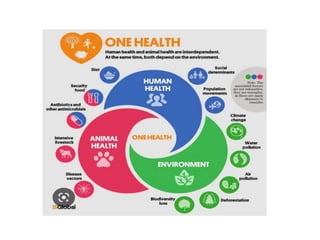
One Health' is an integrated, unifying approach
to balance and optimize the health of people,
animals and the environment.
What is One Health approach?
• One Health is a collaborative, multisectoral,
and transdisciplinary approach—working at
the local, regional, national, and global
levels—with the goal of achieving optimal
health outcomes recognizing the
interconnection between people, animals,
plants, and their shared environment.
Describe components of One Health
approach
• Four different components might be identified
as key elements within the 'One World - One
Health' (OWOH) approach:
 the geographical component,
the ecological one,
the human activities and
the food-agricultural ones
 THE GEOGRAPHICAL COMPONENT
• The globalization of animals and animal products trade and
the barriers reduction within the international movement
of goods are more evident since the last 10 years of the
past century. Many episodes highlighted the importance of
animals and animal products trade in the spread of
infectious diseases in the recent past (Seimenis, 2008;
Davies, 2011).
• Not only infections transmitted by direct contact, such as
FMD(Foot and mouth disease), spread from a continent to
another through animal trade, but also vector-borne
diseases were introduced into free continents by animal
trade, as in the case of the introduction of RVF(rift valley
fever) into Saudi Arabia and then into Yemen (CDC, 2000).
THE ECOLOGICAL COMPONENT
• Many articles dealing with diseases control and
prevention depict wildlife as something ‘other’
than the human and domestic animal. In many
cases, wild animals are considered the reservoirs
of dangerous infections and the main cause of
disease eradication troubles.
• In other cases, wild/natural world is presented as
something to be scared of, in relation to the
emergence of awful epidemic hazards.
the human activities
• In the case of zoonoses,diseases transferred
direct from animals to human being.
 THE FOOD-AGRICULTURAL COMPONENT
• In developed countries, consumers are increasingly
demanding for a comprehensive and integrated food safety
policy (the so-called ‘farm to fork’ approach), which has
consequences both for producers and for control
authorities .
• Feed and food manufacturers, farmers and retailers, in
fact, have the full responsibility of product quality and an
efficient traceability system shall to be put in place to
document the product history along the entire production
chain, from primary raw materials to the final consumable
product (Caporale et al., 2001).
• In addition, control authorities must be able to undertake
proper risk assessments to describe and quantify risks
along the food chain and implement efficient and effective
risk management programmes.
benefits of One Health approach
The One Health approach can:
• Prevent outbreaks of zoonotic disease in
animals and people.
• Improve food safety and security.
• Reduce antibimicrobial-resistant infections
• improve human and animal health.
• Protect global health security.
• Protect biodiversity and conservation.
e) Outline complex health problems
requiring One Health approach
• Emerging and re-emerging pandemics,
• Zoonotic diseases,
• Antimicrobialresistance,
• Environmental health hazards (Water related
hazard,vector borne hazard)
• Food safety and Disasters)
Emerging and reemerging- infectious
diseases
• Emerging infectious diseases are those due to
newly identified and previously unknown
infections which cause public health problems
either locally or internationally.eg covid 19
• Outbreak of previously unknown diseases
• Known disease that are rapidly increasing in
incidence or geographic range in the last two
decades
• Examples of emerging disease
West nile fever,dengue fever,zika virus disease
• Re-emerging infectious diseases are those due
to the reappearance and increase of infections
which are known, but had formerly fallen to
levels so low that they were no longer
considered a public health problem.eg
Malaria,tuberculosis,cholera,influenza and
gonorrhea
Emerging infections can be caused by
• Previously undetected or unknown infectious agents
• Known agents that have spread to new geographic
locations or new populations
• Previously known agents whose role in specific
diseases has previously gone unrecognized.
• Re-emergence of agents whose incidence of disease
had significantly declined in the past, but whose
incidence of disease has reappeared. This class of
diseases is known as re-emerging infectious diseases.

• rapid and intense international travel; covid 19,yelow
fever
• overcrowding in cities with poor sanitation;chorela
• With people traveling much more frequently
and far greater distances than in the past,
living in more densely populated areas, and
coming into closer contact with wild animals,
the potential for emerging infectious diseases
to spread rapidly and cause global epidemics
is a major concern.
• Additionally, there is the potential for diseases
to emerge as a result of deliberate
introduction into human, animal, or plant
populations for terrorist purposes,
E.g Bioterrorism Agents. These diseases
include anthrax, smallpox, and
tularemia.(rabit fever)
• The World Health Organization warned in its
2007 report that infectious diseases are
emerging at a rate that has not been seen
before. Since the 1970s, about 40 infectious
diseases have been discovered, including
severe acute respiratory syndrome(SARS),
Middle East Respiratory Syndrome( MERS),
Ebola, chikungunya, avian flu, swine flu and,
most recently, Zika.
Factors in the Emergence or Re-emergence of
Infectious Diseases
• There are many factors involved in the emergence of
new infectious diseases or the re-emergence of “old”
infectious diseases.
 evolution of pathogens over time,
but many are a result of human behavior and practices.
Consider how the interaction between the human
population and our environment has changed,
especially in the last century. Factors that have
contributed to these changes are population growth,
migration from rural areas to cities, international air
travel, poverty, wars, and destructive ecological
changes due to economic development and land use.
• For an emerging disease to become
established at least two events have to occur –
(1) the infectious agent has to be introduced
into a vulnerable population and
(2) the agent has to have the ability to spread
readily from person-to-person and cause
disease. The infection also has to be able to
sustain itself within the population, that is
more and more people continue to become
infected.
Many emerging diseases arise when infectious
agents in animals are passed to humans (referred
to as zoonoses).
As the human population expands in number and
into new geographical regions, the possibility that
humans will come into close contact with animal
species that are potential hosts of an infectious
agent increases. When that factor is combined
with increases in human density and mobility, it is
easy to see that this combination poses a serious
threat to human health. Unsafe sexual practices
(HIV, Gonorrhoea, Syphilis)
Climate change(Environmental health hazards,)
is increasingly becoming a concern as a factor in
the emergence of infectious diseases.
As Earth's climate warms and habitats are altered,
diseases can spread into new geographic areas.
For example, warming temperatures allow
mosquitoes - and the diseases they transmit - to
expand their range into regions where they
previously have not been found.
Resistance of vectors to pesticides(Food safety
and Disasters)
 antimicrobial resistance.
A factor that is especially important in the re-
emergence of diseases is
antimicrobialresistance - the acquired
resistance of pathogens to antimicrobial
medications such as antibiotics. Bacteria,
viruses, and other microorganisms can change
over time and develop a resistance to the
drugs used to treat diseases caused by the
pathogens. Therefore, drugs that were
effective in the past are no longer useful in
controlling disease.
 Another factor that can cause a disease to re-emerge is
a decline in vaccine coverage,
• so that even when a safe and effective vaccine exists, a
growing number of people choose not to become
vaccinated. This has been a particular problem with the
measles vaccine. Measles, a highly contagious and
serious infection that was eliminated from the U.S.
in 2000 and from the Western Hemisphere in 2016, has
returned in certain areas due to an increase in the
number of people opting to take nonmedical vaccine
exemptions for reasons of personal and philosophical
belief.
Examples of How Diseases Emerge
• Influenza (or flu) is an example of an emerging
disease that is due to both natural and human
factors. Influenza virus is infamous for its
ability to change its genetic information.
• H5N1 virus is very deadly (more than half the
cases have been fatal), but it has not acquired
the ability to pass efficiently between humans
HIV. emerging infectious disease
• An example of an emerging infectious disease
that can be attributed to human practices is HIV.
It is thought that humans were first infected with
HIV through close contact with chimpanzees,
perhaps through bushmeat hunting, in isolated
regions of Africa. It is likely that HIV then spread
from rural regions into cities and then
internationally through air travel. Further factors
in human behavior, such as intravenous drug use,
sexual transmission, and transfer of blood
products before the disease was recognized,
aided the rapid and extensive spread of HIV.
chikungunya
• One instance of a tropical disease that has spread
recently into new areas that may be due, at least in
part, to changing climate is chikungunya. Chikungunya
disease is caused by the chikungunya virus, a relative of
the virus that causes Dengue fever. It is transmitted by
the tiger mosquito, and in the past was confined to
tropical regions around the Indian Ocean. In late
summer of 2007, more than 100 residents of the town
of Ravenna, Italy suffered from a mysterious disease
that produced fever, exhaustion, and severe bone pain.
The outbreak was eventually shown to be caused by
chikungunya virus.
• By 2014, chikungunya outbreaks have been
reported in countries in Europe, Asia, Africa, and
the Americas (Caribbean and Central and South
America). The virus arrived in the United States in
the summer of 2014, although thus far local
transmission of chikungunya virus has been
limited to Florida and Texas. Although
chikungunya virus does not usually cause a fatal
disease, it serves as a warning that other, more
devastating tropical diseases could follow. In fact,
a more serious threat is the recently emergent
Zika virus in the Americas which is associated
with a birth defect known as microcephaly.(small
brain)
Ebola emerging desease
• Finally, the Ebola virus epidemic that emerged in
2014 in West Africa illustrates how a virus that
previously affected only small groups of people,
perhaps a few hundred, can sweep rapidly
through an area to affect tens of thousands, and
become extremely difficult to contain. A
combination of factors including high population
densities, increased travel, closer contact with
wild animals, weak health care systems, and a
slow response led to the worst outbreak of Ebola
the world has ever seen.
Research on Emerging Diseases
• The development of vaccines and
antimicrobial drugs and the
remarkable eradication of smallpox had
created hope that infectious diseases could be
controlled or even eliminated. However, the
current realization that infectious diseases
continue to emerge and re-emerge (including
the possibility of bioterrorism), underscores
the challenges ahead in infectious disease
research.
• To help meet this challenge, research is ongoing
in the Department of Molecular Virology and
Microbiology at Baylor College of Medicine on a
number of emerging and re-emerging diseases,
including influenza, SARS and MERS, dengue,
chikungunya, Zika, tuberculosis, and HIV/AIDS.
This work encompasses both basic research in
trying to understand more thoroughly how these
agents cause disease and how the human
immune system responds to these infections, as
well as more directed research in developing and
evaluating vaccines and other tools to prevent
infection by these agents. In addition, scientists
are studying mechanisms by which bacteria can
acquire antibiotic resistance and ways to combat
drug-resistant infections.
f) Identify key stakeholders in addressing complex
health problems of public health importance
The major stakeholders in the healthcare
system are
• patients,
• physicians,
• employers,
• insurance companies,
• pharmaceutical firms and
• government.
Collaborate with key stakeholders in addressing
complex health problems of public health importance
• Multisector collaboration between state
public health departments and diverse
community partners is increasingly recognized
as important for
promoting positive public health outcomes,
addressing social determinants of health, and
reducing health inequalities
end

ONE HEALTH.pptx

  • 1.
    6.3.8 Apply onehealth approach in preventing disease of public health importance
  • 2.
     AT THEEND OF THIS SESSION STUDENT MUST BE ABLE TO • a) Define One Health • b) Explain One Health approach interface • c) Describe components of One Health approach • d) Explain the benefits of One Health approach. • e) Outline complex health problems requiring One Health approach (Emerging and re-emerging pandemics, Zoonotic diseases,Antimicrobial resistance,Environmental health hazards, Food safety and Disasters) • f) Identify key stakeholders in addressing complex health problems of public health importance • g) Collaborate with key stakeholders in addressing complex health problems of public health importance
  • 4.
    • One Health:is the collaborative effort of multiple health science professions, together with their related disciplines, and institutions working locally, nationally, and globally to attain optimal health for people, domestic animals, wildlife, plants, and our environment. One Health as an approach to improve health and well-being through the prevention of risks and the mitigation of effects of crises originating at the interface between humans, animals, and their various environments
  • 5.
    • Health -isa state of complete physical, mental and social well-being and not merely the absence of disease or infirmity. Explain One Health approach interface One Health' is an integrated, unifying approach to balance and optimize the health of people, animals and the environment.
  • 6.
    What is OneHealth approach? • One Health is a collaborative, multisectoral, and transdisciplinary approach—working at the local, regional, national, and global levels—with the goal of achieving optimal health outcomes recognizing the interconnection between people, animals, plants, and their shared environment.
  • 7.
    Describe components ofOne Health approach • Four different components might be identified as key elements within the 'One World - One Health' (OWOH) approach:  the geographical component, the ecological one, the human activities and the food-agricultural ones
  • 8.
     THE GEOGRAPHICALCOMPONENT • The globalization of animals and animal products trade and the barriers reduction within the international movement of goods are more evident since the last 10 years of the past century. Many episodes highlighted the importance of animals and animal products trade in the spread of infectious diseases in the recent past (Seimenis, 2008; Davies, 2011). • Not only infections transmitted by direct contact, such as FMD(Foot and mouth disease), spread from a continent to another through animal trade, but also vector-borne diseases were introduced into free continents by animal trade, as in the case of the introduction of RVF(rift valley fever) into Saudi Arabia and then into Yemen (CDC, 2000).
  • 9.
    THE ECOLOGICAL COMPONENT •Many articles dealing with diseases control and prevention depict wildlife as something ‘other’ than the human and domestic animal. In many cases, wild animals are considered the reservoirs of dangerous infections and the main cause of disease eradication troubles. • In other cases, wild/natural world is presented as something to be scared of, in relation to the emergence of awful epidemic hazards.
  • 10.
    the human activities •In the case of zoonoses,diseases transferred direct from animals to human being.
  • 11.
     THE FOOD-AGRICULTURALCOMPONENT • In developed countries, consumers are increasingly demanding for a comprehensive and integrated food safety policy (the so-called ‘farm to fork’ approach), which has consequences both for producers and for control authorities . • Feed and food manufacturers, farmers and retailers, in fact, have the full responsibility of product quality and an efficient traceability system shall to be put in place to document the product history along the entire production chain, from primary raw materials to the final consumable product (Caporale et al., 2001). • In addition, control authorities must be able to undertake proper risk assessments to describe and quantify risks along the food chain and implement efficient and effective risk management programmes.
  • 12.
    benefits of OneHealth approach The One Health approach can: • Prevent outbreaks of zoonotic disease in animals and people. • Improve food safety and security. • Reduce antibimicrobial-resistant infections • improve human and animal health. • Protect global health security. • Protect biodiversity and conservation.
  • 13.
    e) Outline complexhealth problems requiring One Health approach • Emerging and re-emerging pandemics, • Zoonotic diseases, • Antimicrobialresistance, • Environmental health hazards (Water related hazard,vector borne hazard) • Food safety and Disasters)
  • 14.
    Emerging and reemerging-infectious diseases • Emerging infectious diseases are those due to newly identified and previously unknown infections which cause public health problems either locally or internationally.eg covid 19 • Outbreak of previously unknown diseases • Known disease that are rapidly increasing in incidence or geographic range in the last two decades
  • 15.
    • Examples ofemerging disease West nile fever,dengue fever,zika virus disease
  • 16.
    • Re-emerging infectiousdiseases are those due to the reappearance and increase of infections which are known, but had formerly fallen to levels so low that they were no longer considered a public health problem.eg Malaria,tuberculosis,cholera,influenza and gonorrhea
  • 17.
    Emerging infections canbe caused by • Previously undetected or unknown infectious agents • Known agents that have spread to new geographic locations or new populations • Previously known agents whose role in specific diseases has previously gone unrecognized. • Re-emergence of agents whose incidence of disease had significantly declined in the past, but whose incidence of disease has reappeared. This class of diseases is known as re-emerging infectious diseases. • rapid and intense international travel; covid 19,yelow fever • overcrowding in cities with poor sanitation;chorela
  • 18.
    • With peopletraveling much more frequently and far greater distances than in the past, living in more densely populated areas, and coming into closer contact with wild animals, the potential for emerging infectious diseases to spread rapidly and cause global epidemics is a major concern.
  • 19.
    • Additionally, thereis the potential for diseases to emerge as a result of deliberate introduction into human, animal, or plant populations for terrorist purposes, E.g Bioterrorism Agents. These diseases include anthrax, smallpox, and tularemia.(rabit fever)
  • 20.
    • The WorldHealth Organization warned in its 2007 report that infectious diseases are emerging at a rate that has not been seen before. Since the 1970s, about 40 infectious diseases have been discovered, including severe acute respiratory syndrome(SARS), Middle East Respiratory Syndrome( MERS), Ebola, chikungunya, avian flu, swine flu and, most recently, Zika.
  • 21.
    Factors in theEmergence or Re-emergence of Infectious Diseases • There are many factors involved in the emergence of new infectious diseases or the re-emergence of “old” infectious diseases.  evolution of pathogens over time, but many are a result of human behavior and practices. Consider how the interaction between the human population and our environment has changed, especially in the last century. Factors that have contributed to these changes are population growth, migration from rural areas to cities, international air travel, poverty, wars, and destructive ecological changes due to economic development and land use.
  • 22.
    • For anemerging disease to become established at least two events have to occur – (1) the infectious agent has to be introduced into a vulnerable population and (2) the agent has to have the ability to spread readily from person-to-person and cause disease. The infection also has to be able to sustain itself within the population, that is more and more people continue to become infected.
  • 23.
    Many emerging diseasesarise when infectious agents in animals are passed to humans (referred to as zoonoses). As the human population expands in number and into new geographical regions, the possibility that humans will come into close contact with animal species that are potential hosts of an infectious agent increases. When that factor is combined with increases in human density and mobility, it is easy to see that this combination poses a serious threat to human health. Unsafe sexual practices (HIV, Gonorrhoea, Syphilis)
  • 24.
    Climate change(Environmental healthhazards,) is increasingly becoming a concern as a factor in the emergence of infectious diseases. As Earth's climate warms and habitats are altered, diseases can spread into new geographic areas. For example, warming temperatures allow mosquitoes - and the diseases they transmit - to expand their range into regions where they previously have not been found. Resistance of vectors to pesticides(Food safety and Disasters)
  • 25.
     antimicrobial resistance. Afactor that is especially important in the re- emergence of diseases is antimicrobialresistance - the acquired resistance of pathogens to antimicrobial medications such as antibiotics. Bacteria, viruses, and other microorganisms can change over time and develop a resistance to the drugs used to treat diseases caused by the pathogens. Therefore, drugs that were effective in the past are no longer useful in controlling disease.
  • 26.
     Another factorthat can cause a disease to re-emerge is a decline in vaccine coverage, • so that even when a safe and effective vaccine exists, a growing number of people choose not to become vaccinated. This has been a particular problem with the measles vaccine. Measles, a highly contagious and serious infection that was eliminated from the U.S. in 2000 and from the Western Hemisphere in 2016, has returned in certain areas due to an increase in the number of people opting to take nonmedical vaccine exemptions for reasons of personal and philosophical belief.
  • 27.
    Examples of HowDiseases Emerge • Influenza (or flu) is an example of an emerging disease that is due to both natural and human factors. Influenza virus is infamous for its ability to change its genetic information. • H5N1 virus is very deadly (more than half the cases have been fatal), but it has not acquired the ability to pass efficiently between humans
  • 28.
    HIV. emerging infectiousdisease • An example of an emerging infectious disease that can be attributed to human practices is HIV. It is thought that humans were first infected with HIV through close contact with chimpanzees, perhaps through bushmeat hunting, in isolated regions of Africa. It is likely that HIV then spread from rural regions into cities and then internationally through air travel. Further factors in human behavior, such as intravenous drug use, sexual transmission, and transfer of blood products before the disease was recognized, aided the rapid and extensive spread of HIV.
  • 29.
    chikungunya • One instanceof a tropical disease that has spread recently into new areas that may be due, at least in part, to changing climate is chikungunya. Chikungunya disease is caused by the chikungunya virus, a relative of the virus that causes Dengue fever. It is transmitted by the tiger mosquito, and in the past was confined to tropical regions around the Indian Ocean. In late summer of 2007, more than 100 residents of the town of Ravenna, Italy suffered from a mysterious disease that produced fever, exhaustion, and severe bone pain. The outbreak was eventually shown to be caused by chikungunya virus.
  • 30.
    • By 2014,chikungunya outbreaks have been reported in countries in Europe, Asia, Africa, and the Americas (Caribbean and Central and South America). The virus arrived in the United States in the summer of 2014, although thus far local transmission of chikungunya virus has been limited to Florida and Texas. Although chikungunya virus does not usually cause a fatal disease, it serves as a warning that other, more devastating tropical diseases could follow. In fact, a more serious threat is the recently emergent Zika virus in the Americas which is associated with a birth defect known as microcephaly.(small brain)
  • 31.
    Ebola emerging desease •Finally, the Ebola virus epidemic that emerged in 2014 in West Africa illustrates how a virus that previously affected only small groups of people, perhaps a few hundred, can sweep rapidly through an area to affect tens of thousands, and become extremely difficult to contain. A combination of factors including high population densities, increased travel, closer contact with wild animals, weak health care systems, and a slow response led to the worst outbreak of Ebola the world has ever seen.
  • 32.
    Research on EmergingDiseases • The development of vaccines and antimicrobial drugs and the remarkable eradication of smallpox had created hope that infectious diseases could be controlled or even eliminated. However, the current realization that infectious diseases continue to emerge and re-emerge (including the possibility of bioterrorism), underscores the challenges ahead in infectious disease research.
  • 33.
    • To helpmeet this challenge, research is ongoing in the Department of Molecular Virology and Microbiology at Baylor College of Medicine on a number of emerging and re-emerging diseases, including influenza, SARS and MERS, dengue, chikungunya, Zika, tuberculosis, and HIV/AIDS. This work encompasses both basic research in trying to understand more thoroughly how these agents cause disease and how the human immune system responds to these infections, as well as more directed research in developing and evaluating vaccines and other tools to prevent infection by these agents. In addition, scientists are studying mechanisms by which bacteria can acquire antibiotic resistance and ways to combat drug-resistant infections.
  • 34.
    f) Identify keystakeholders in addressing complex health problems of public health importance The major stakeholders in the healthcare system are • patients, • physicians, • employers, • insurance companies, • pharmaceutical firms and • government.
  • 35.
    Collaborate with keystakeholders in addressing complex health problems of public health importance • Multisector collaboration between state public health departments and diverse community partners is increasingly recognized as important for promoting positive public health outcomes, addressing social determinants of health, and reducing health inequalities
  • 36.