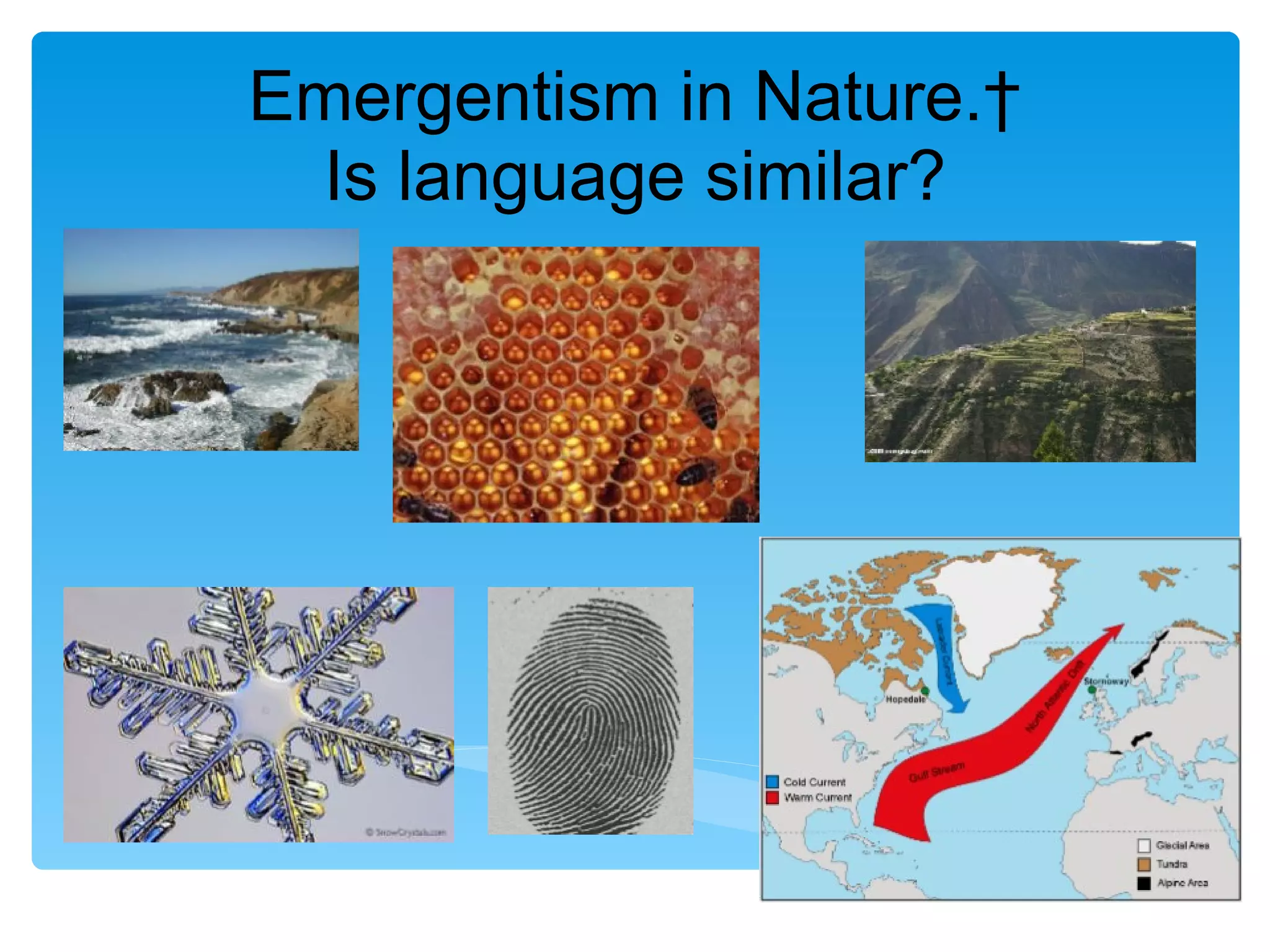
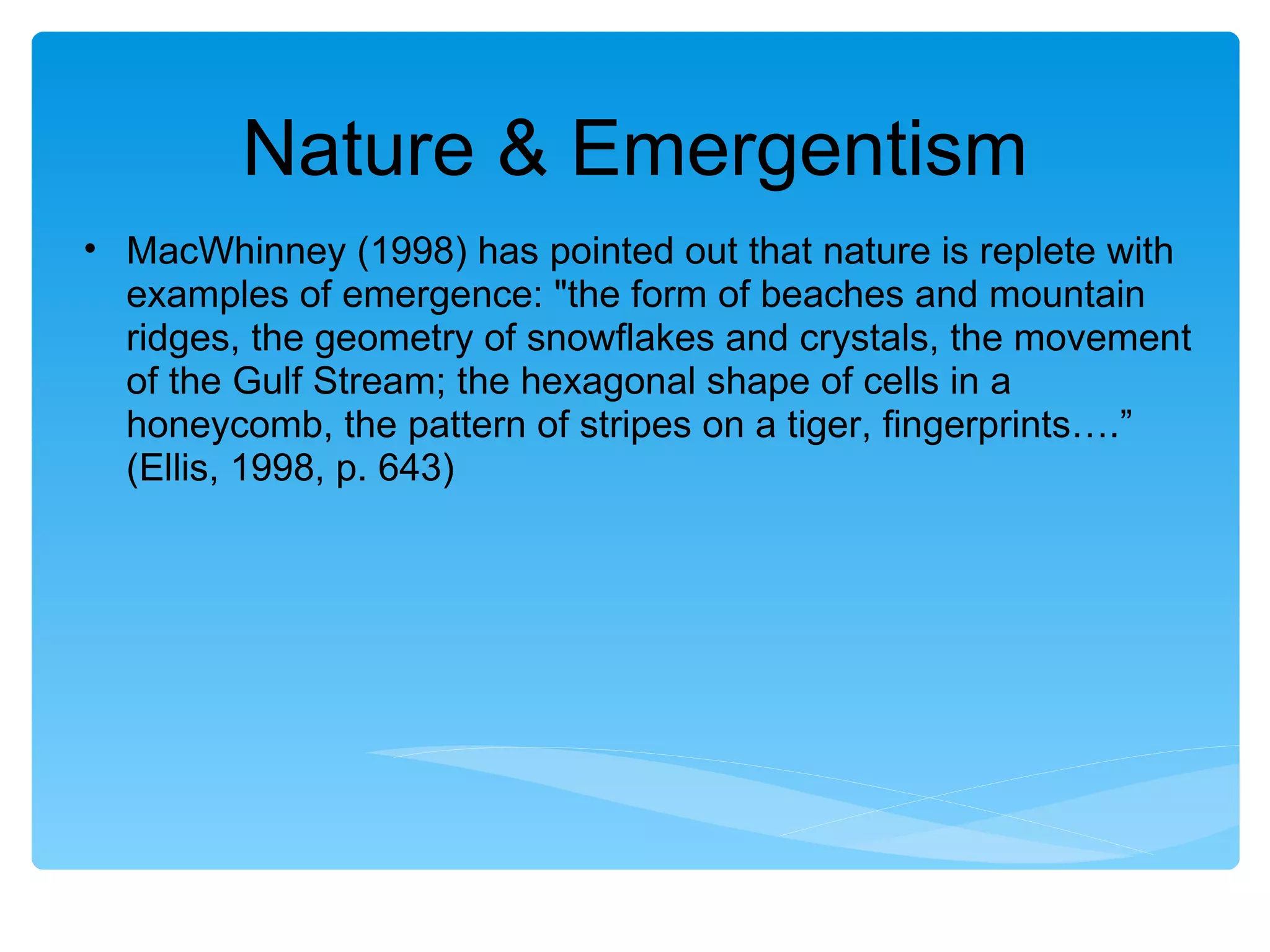
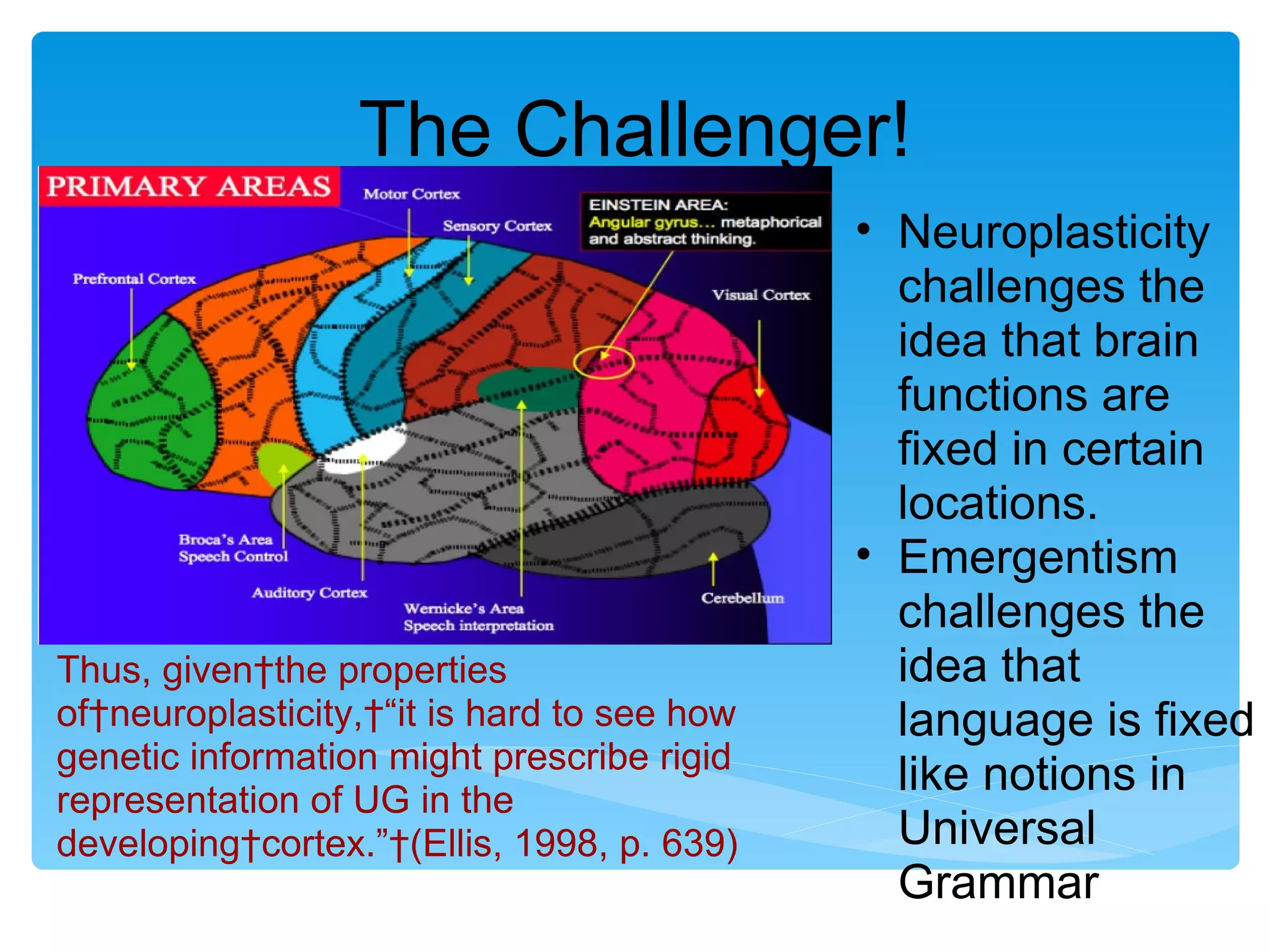
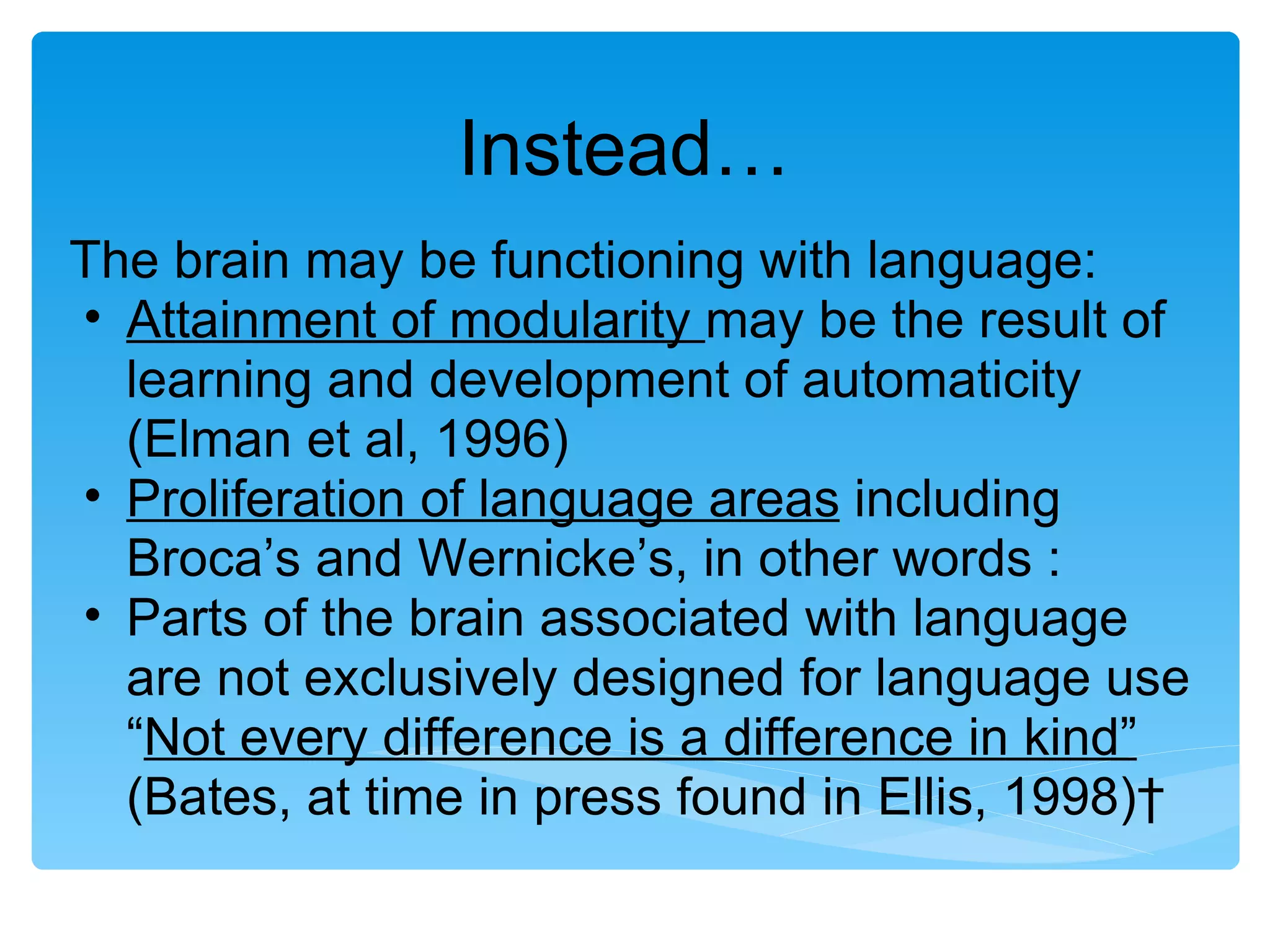
Emergentism in Nature. 
 Is language similar?
Nature & Emergentism
• MacWhinney (1998) has pointed out that nature is replete with
  examples of emergence: "the form of beaches and mountain
  ridges, the geometry of snowflakes and crystals, the movement
  of the Gulf Stream; the hexagonal shape of cells in a
  honeycomb, the pattern of stripes on a tiger, fingerprints….”
  (Ellis, 1998, p. 643)
The Challenger!
                                             • Neuroplasticity
                                               challenges the
                                               idea that brain
                                               functions are
                                               fixed in certain
                                               locations.
                                             • Emergentism
                                               challenges the
Thus, given the properties                     idea that
of neuroplasticity, “it is hard to see how     language is fixed
genetic information might prescribe rigid
representation of UG in the
                                               like notions in
developing cortex.” (Ellis, 1998, p. 639)      Universal
                                               Grammar
Instead…
The brain may be functioning with language:
• Attainment of modularity may be the result of
  learning and development of automaticity
  (Elman et al, 1996)
• Proliferation of language areas including
  Broca’s and Wernicke’s, in other words :
• Parts of the brain associated with language
  are not exclusively designed for language use
  “Not every difference is a difference in kind”
  (Bates, at time in press found in Ellis, 1998) 
What do Emergenists Believe?
• Language: dynamic, complex, non-linear
  system where timing effects outcomes and
  developments. (Ellis, 1998, p.
  642) LIKE TRAFFIC! 
• Simple learning mechanisms in perception,
  motor-action and cognition when exposed to
  language data ARE EAGER TO EXPLOIT the
  functionality of language (p. 657)
What do Emergentists do?
• 1) substitute a process description for a state
  description
  2) study development rather than the final
  state
  3) and focus on the language acquisition
  process (LAP) rater than the language
  acquisition device (LAD)” p. 644
• “Look to connectionism because it provides a
  set of computational tools for exploring the
  conditions under which emergent properties
  arise” p. 645
If not language, then idiolects?: Name that
                 Professor!

 "What dat?"

 "I have heard that some of you are fed the expletive up with group
 work."

 "Some questions are best answered over a glass of wine but that
 one requires a double scotch."

 "If I were Peter Shaw I would have all of us sit in a circle and talk
 about how we feel. But I could never pull that off."

 "It’s the Monterey Way."

 "So, I am very curious to know what you think and how you
 interpreted the grading system, and I would be happy to
 incorporate that if other people also agree."
For additional information and
            fun!   (MacWhinney, 2006)
http://applij.oxfordjournals.org/content/27/4/729.full
 • The TalkBank Project (http://talkbank.org) is now making
    available several large databases on second language
    learning. These databases include transcripts of learners’
    written productions, as well as spoken productions linked to
    audio and/or video.
 • In addition, the CHILDES database (http://childes.psy.cmu.edu)
    now includes 12 in-depth longitudinal studies of childhood
    bilingualism, along with additional cross-sectional data
 • Within the context of online courses in French and Chinese,
    developed by the Pittsburgh Science of Learning Center (
    http://learnlab.org) we are now able to track whole terms of
    online student responses to vocabulary training, pinyin dictation
    for Chinese, tone discrimination, sentence repetition, and other
    methods for training second language skills

Emergentism Presentation

  • 1.
    Emergentism in Nature.  Is language similar?
  • 2.
    Nature & Emergentism •MacWhinney (1998) has pointed out that nature is replete with examples of emergence: "the form of beaches and mountain ridges, the geometry of snowflakes and crystals, the movement of the Gulf Stream; the hexagonal shape of cells in a honeycomb, the pattern of stripes on a tiger, fingerprints….” (Ellis, 1998, p. 643)
  • 3.
    The Challenger! • Neuroplasticity challenges the idea that brain functions are fixed in certain locations. • Emergentism challenges the Thus, given the properties idea that of neuroplasticity, “it is hard to see how language is fixed genetic information might prescribe rigid representation of UG in the like notions in developing cortex.” (Ellis, 1998, p. 639) Universal Grammar
  • 4.
    Instead… The brain maybe functioning with language: • Attainment of modularity may be the result of learning and development of automaticity (Elman et al, 1996) • Proliferation of language areas including Broca’s and Wernicke’s, in other words : • Parts of the brain associated with language are not exclusively designed for language use “Not every difference is a difference in kind” (Bates, at time in press found in Ellis, 1998) 
  • 5.
    What do EmergenistsBelieve? • Language: dynamic, complex, non-linear system where timing effects outcomes and developments. (Ellis, 1998, p. 642) LIKE TRAFFIC!  • Simple learning mechanisms in perception, motor-action and cognition when exposed to language data ARE EAGER TO EXPLOIT the functionality of language (p. 657)
  • 6.
    What do Emergentistsdo? • 1) substitute a process description for a state description 2) study development rather than the final state 3) and focus on the language acquisition process (LAP) rater than the language acquisition device (LAD)” p. 644 • “Look to connectionism because it provides a set of computational tools for exploring the conditions under which emergent properties arise” p. 645
  • 7.
    If not language,then idiolects?: Name that Professor! "What dat?" "I have heard that some of you are fed the expletive up with group work." "Some questions are best answered over a glass of wine but that one requires a double scotch." "If I were Peter Shaw I would have all of us sit in a circle and talk about how we feel. But I could never pull that off." "It’s the Monterey Way." "So, I am very curious to know what you think and how you interpreted the grading system, and I would be happy to incorporate that if other people also agree."
  • 8.
    For additional informationand fun!   (MacWhinney, 2006) http://applij.oxfordjournals.org/content/27/4/729.full • The TalkBank Project (http://talkbank.org) is now making available several large databases on second language learning. These databases include transcripts of learners’ written productions, as well as spoken productions linked to audio and/or video. • In addition, the CHILDES database (http://childes.psy.cmu.edu) now includes 12 in-depth longitudinal studies of childhood bilingualism, along with additional cross-sectional data • Within the context of online courses in French and Chinese, developed by the Pittsburgh Science of Learning Center ( http://learnlab.org) we are now able to track whole terms of online student responses to vocabulary training, pinyin dictation for Chinese, tone discrimination, sentence repetition, and other methods for training second language skills