1
What does AirMatch do differently?
10:00 GMT | 11:00 CEST | 13:00 GST
NOV 28th, 2017
Presenter: SAJIN NAIR
nair@hpe.com
2
Agenda
• Introduction
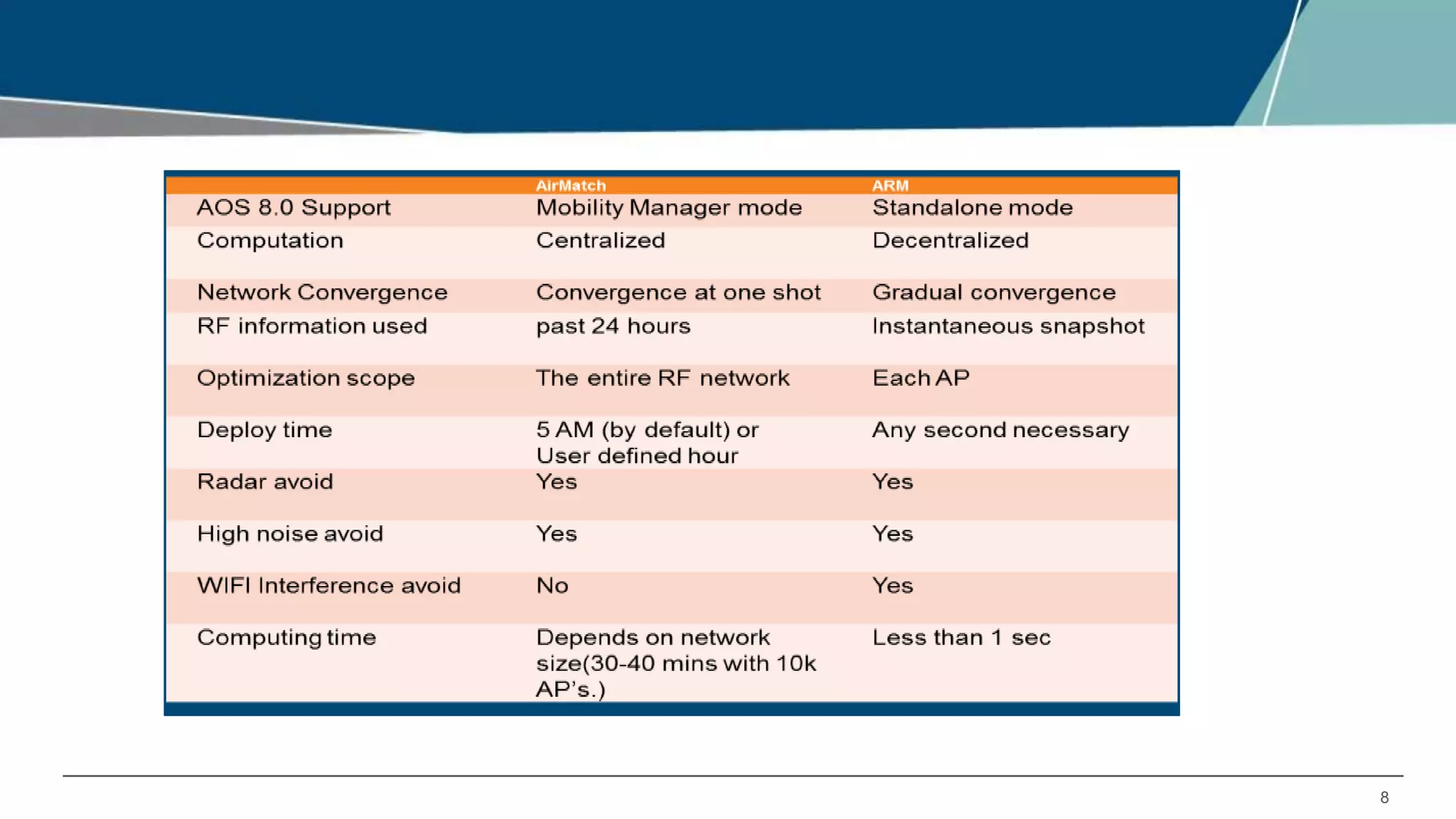
• AirMatch vs ARM
• Setup AirMatch
• Enable AirMatch and Profiles
• AirMatch Optimization
• Workflow
• AirMatch Input Metrics
• Logs
• Troubleshooting
3
Ideal way to solve a Jigsaw puzzle?
4
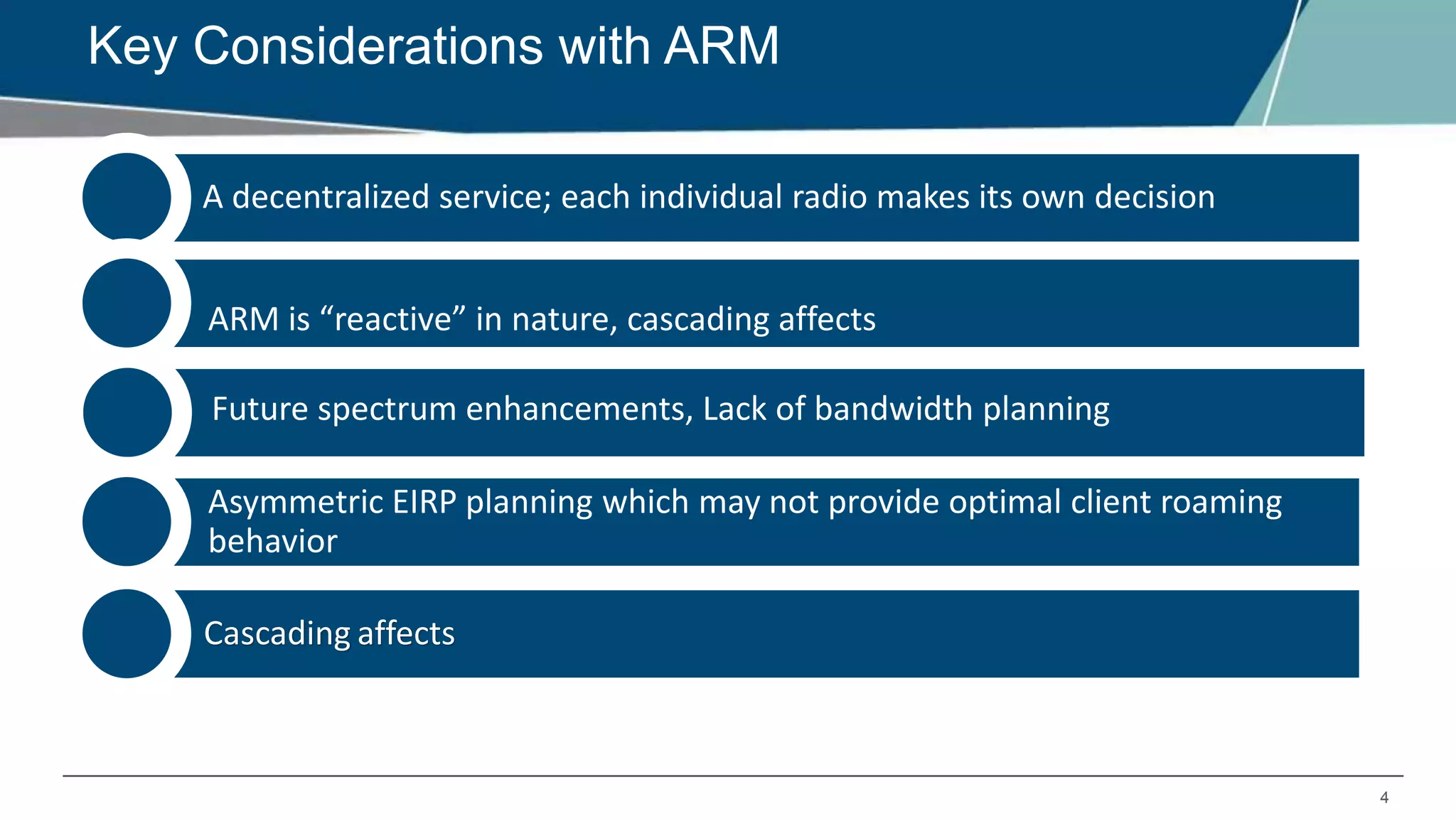
Key Considerations with ARM
A decentralized service; each individual radio makes its own decision
ARM is “reactive” in nature, cascading affects
Future spectrum enhancements, Lack of bandwidth planning
Asymmetric EIRP planning which may not provide optimal client roaming
behavior
Cascading affects
5
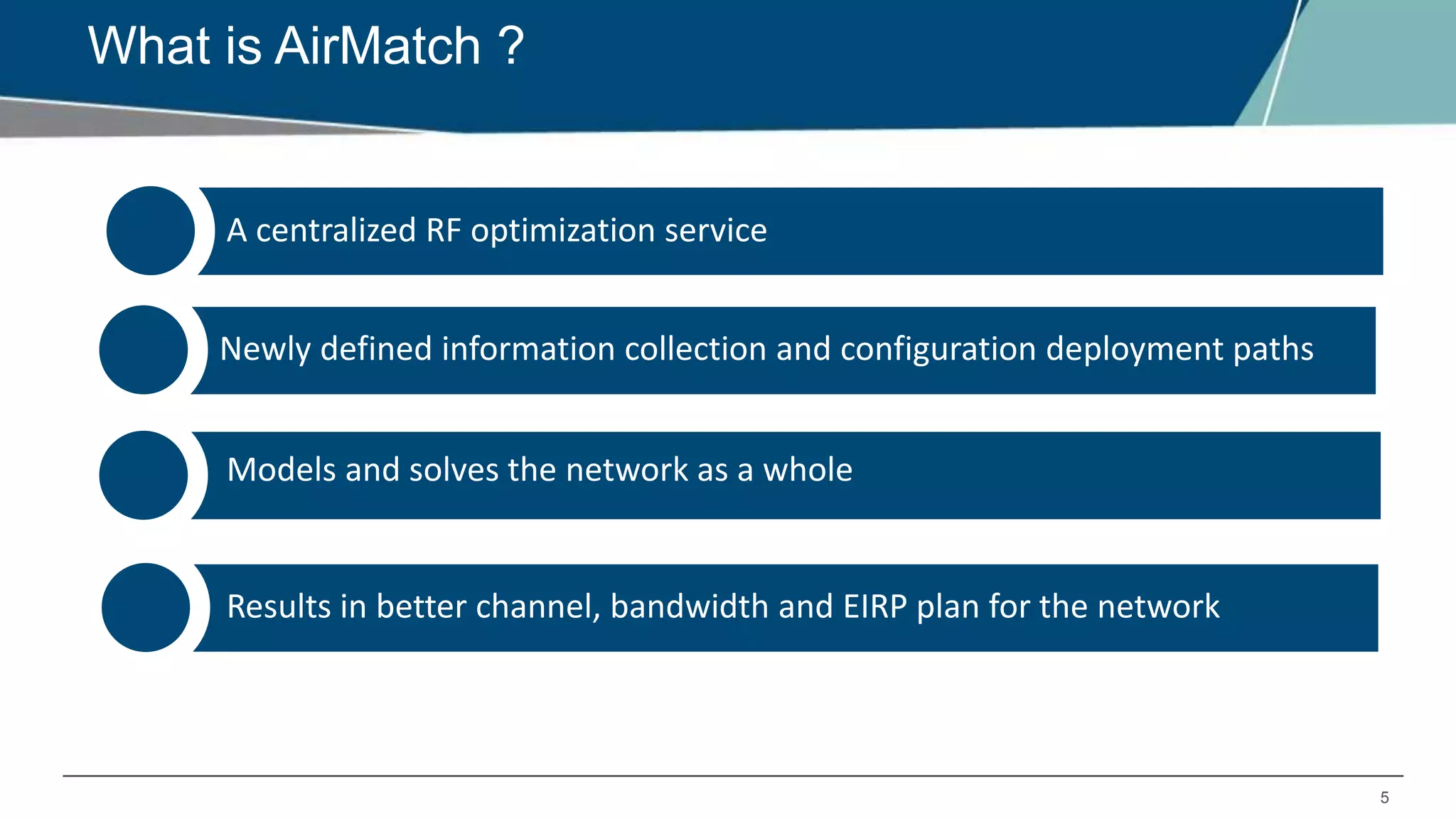
What is AirMatch ?
A centralized RF optimization service
Newly defined information collection and configuration deployment paths
Models and solves the network as a whole
Results in better channel, bandwidth and EIRP plan for the network
6
Advantages of AIRMATCH
• Clean slate RF optimization service
• Long term network stability & Performance
• Holistic view of network
• Different mode of data collection and calculation
• Once a day optimization
• Reactive optimization
7
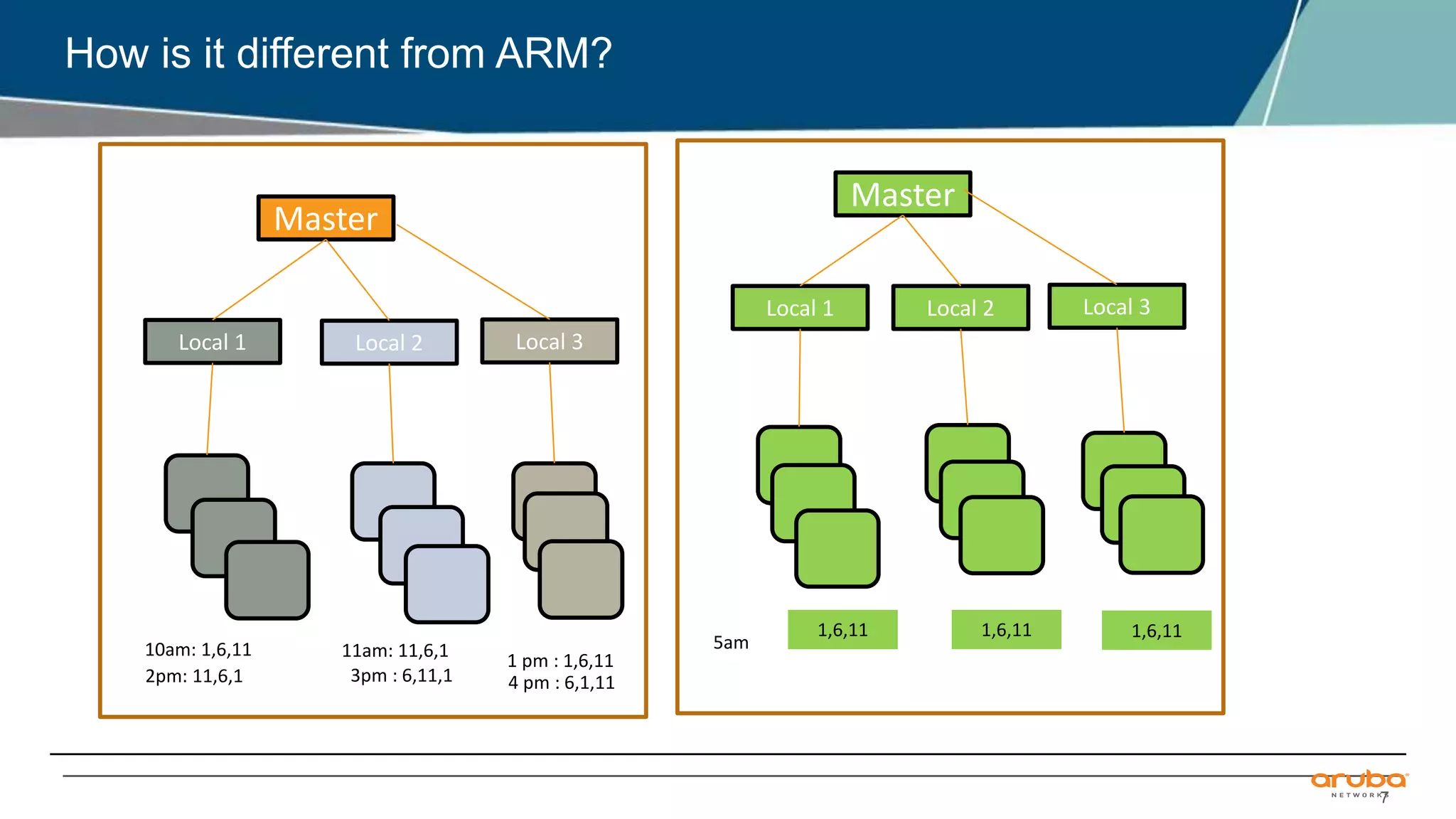
How is it different from ARM?
Master
Local 1 Local 2 Local 3
10am: 1,6,11 11am: 11,6,1
1 pm : 1,6,11
Master
Local 1 Local 2 Local 3
1,6,11 1,6,11 1,6,11
2pm: 11,6,1 3pm : 6,11,1 4 pm : 6,1,11
5am
8
9
HOW AIRMATCH WORKS?
10
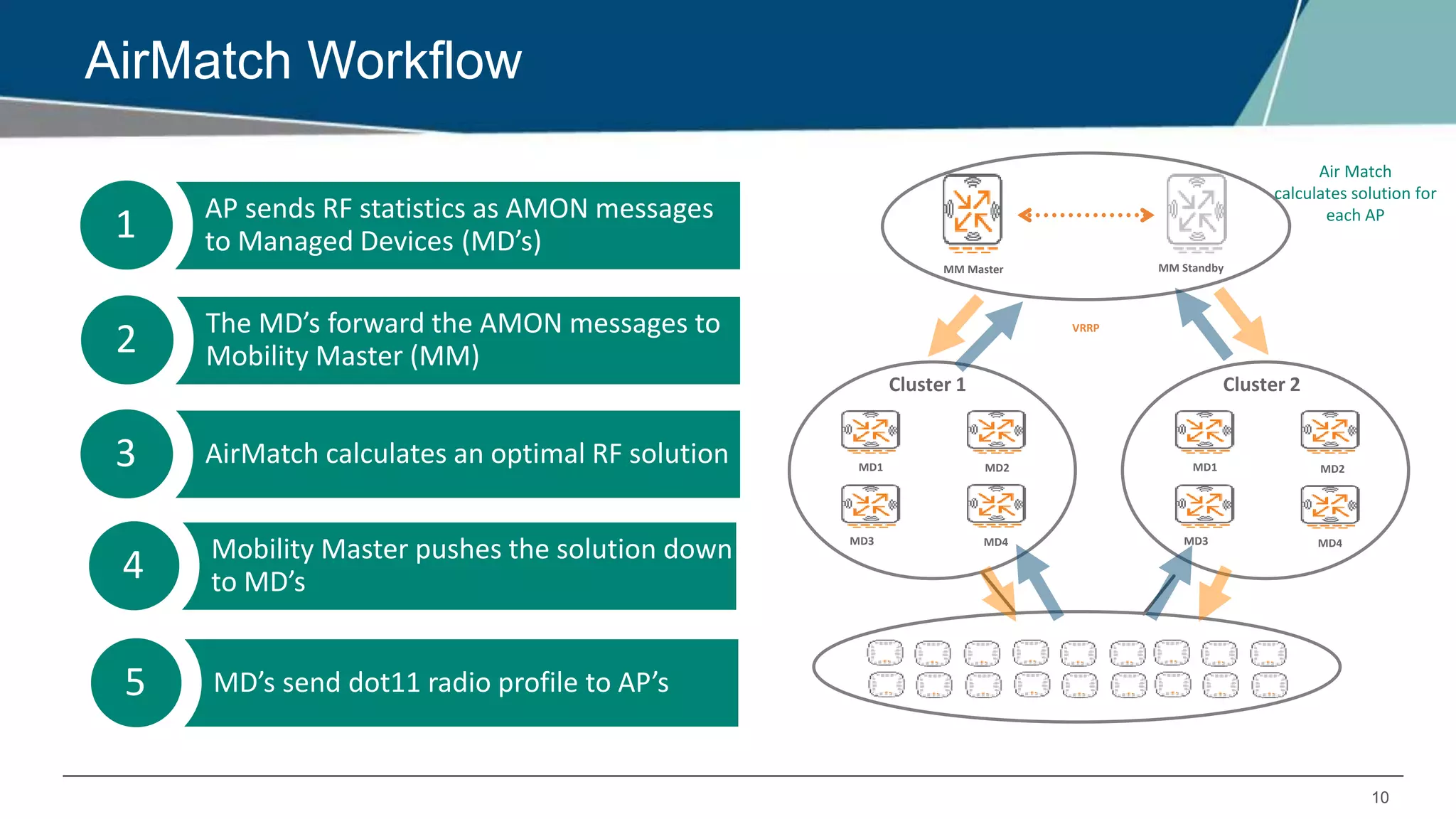
AirMatch Workflow
2 The MD’s forward the AMON messages to
Mobility Master (MM)
3 AirMatch calculates an optimal RF solution
1 AP sends RF statistics as AMON messages
to Managed Devices (MD’s)
4 Mobility Master pushes the solution down
to MD’s
VRRP
MM StandbyMM Master
MD2MD1
MD4MD3
MD2 MD1
MD4MD3
Cluster 1 Cluster 2
Air Match
calculates solution for
each AP
5 MD’s send dot11 radio profile to AP’s
11
AIRMATCH – INPUT METRICS
12
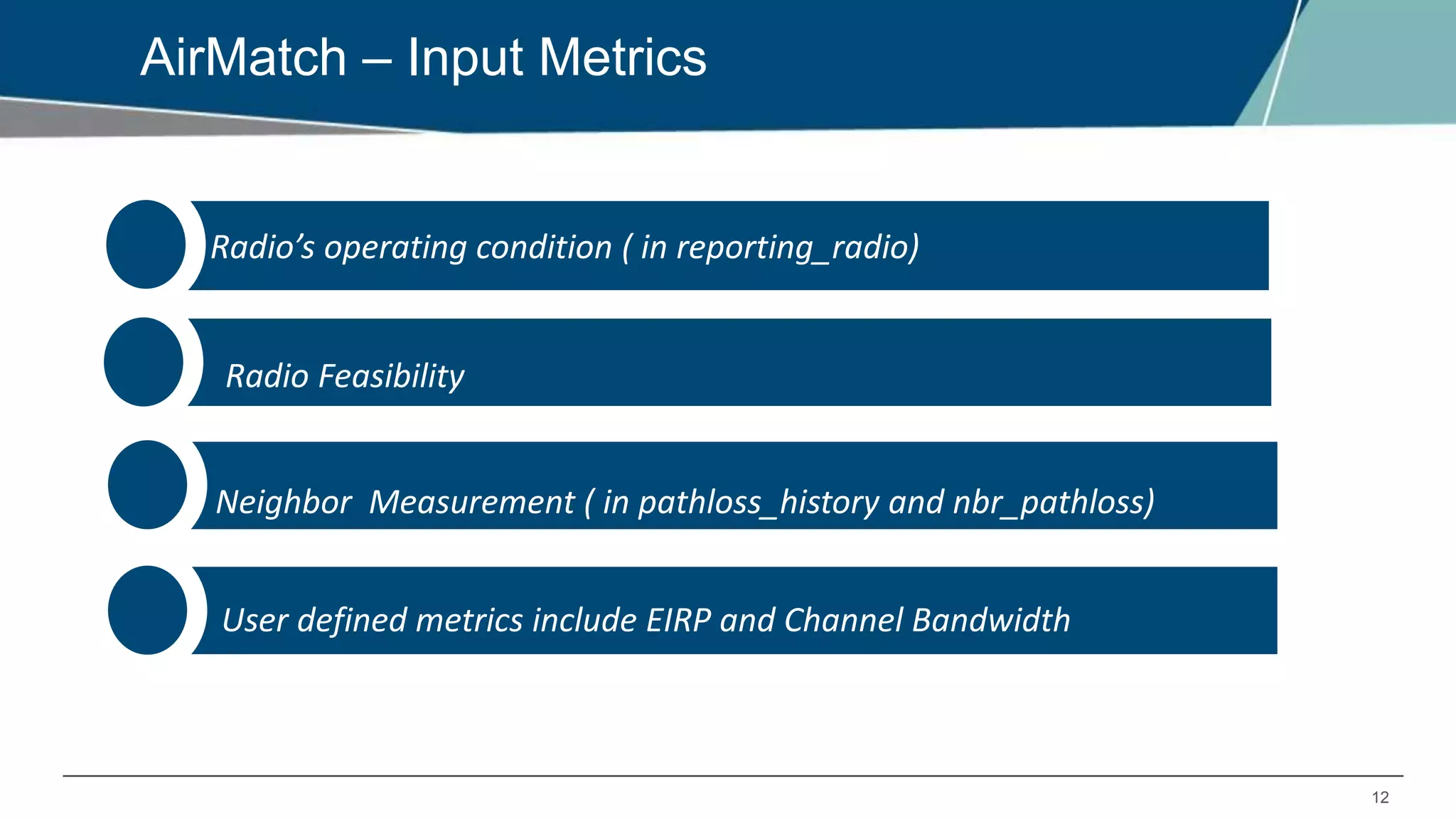
AirMatch – Input Metrics
Radio’s operating condition ( in reporting_radio)
Radio Feasibility
Neighbor Measurement ( in pathloss_history and nbr_pathloss)
User defined metrics include EIRP and Channel Bandwidth
1313
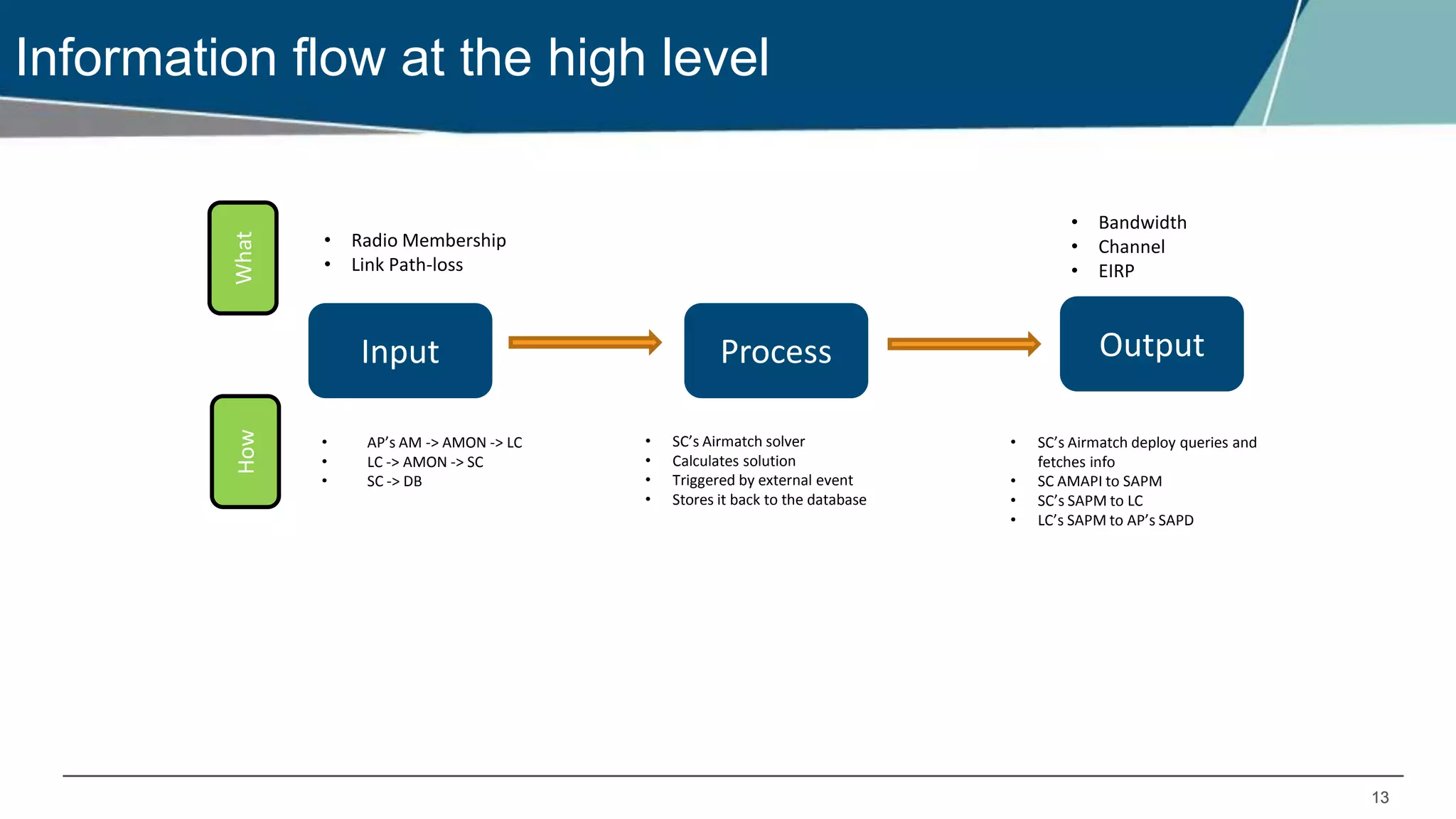
Information flow at the high level
Input Process Output
• AP’s AM -> AMON -> LC
• LC -> AMON -> SC
• SC -> DB
• SC’s Airmatch solver
• Calculates solution
• Triggered by external event
• Stores it back to the database
• SC’s Airmatch deploy queries and
fetches info
• SC AMAPI to SAPM
• SC’s SAPM to LC
• LC’s SAPM to AP’s SAPD
• Bandwidth
• Channel
• EIRP
• Radio Membership
• Link Path-loss
WhatHow
14
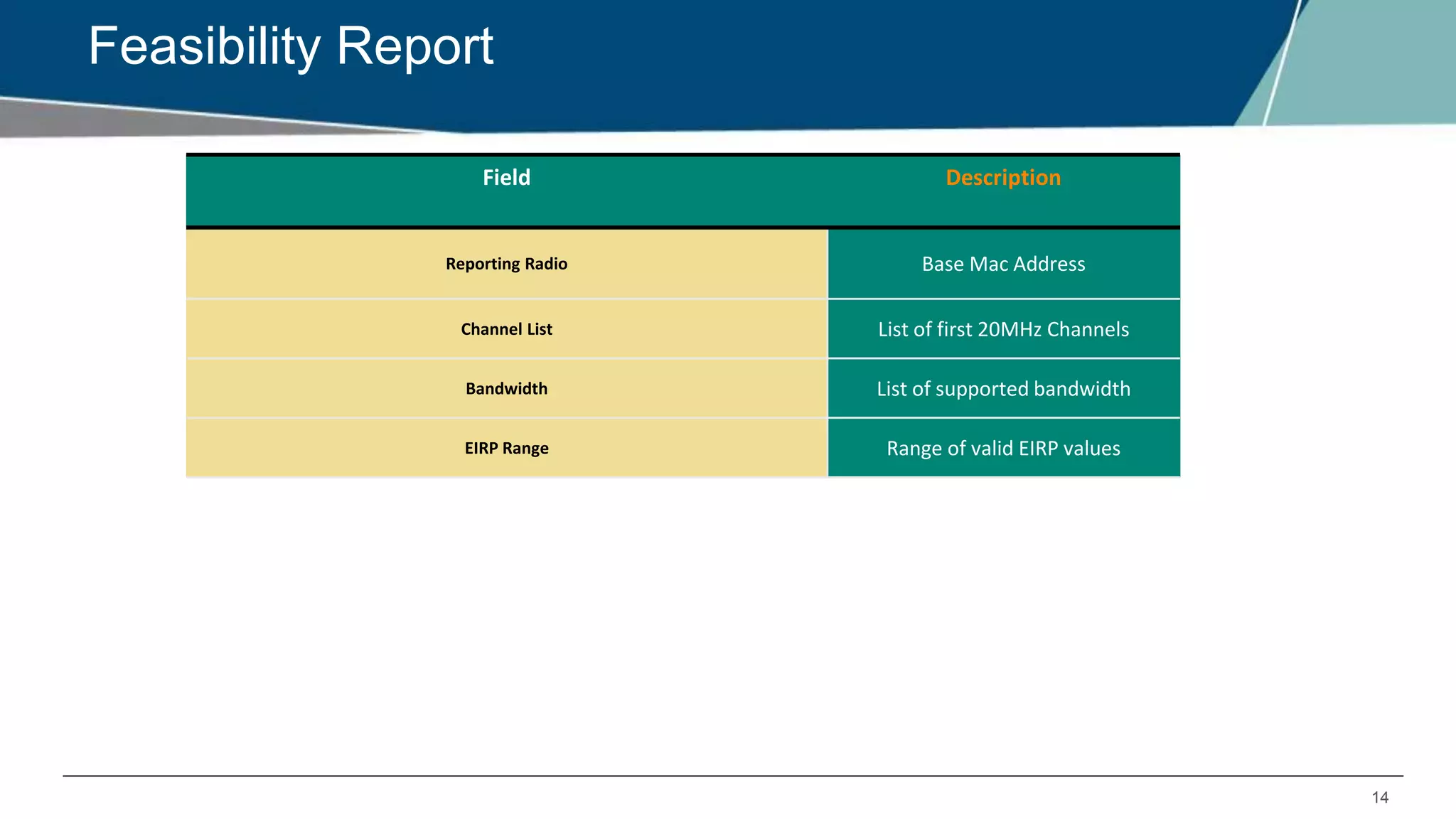
Feasibility Report
Introduces Mobility Controller or Managed Node which is completely
managed by MM using Zero Touch Provisioning unlike 6.x Master-Local
The MM can only be a VM and not a controller
Field Description
Reporting Radio Base Mac Address
Channel List List of first 20MHz Channels
Bandwidth List of supported bandwidth
EIRP Range Range of valid EIRP values
16
TIMING OF RF PLAN CHANGE
8.0.1
17
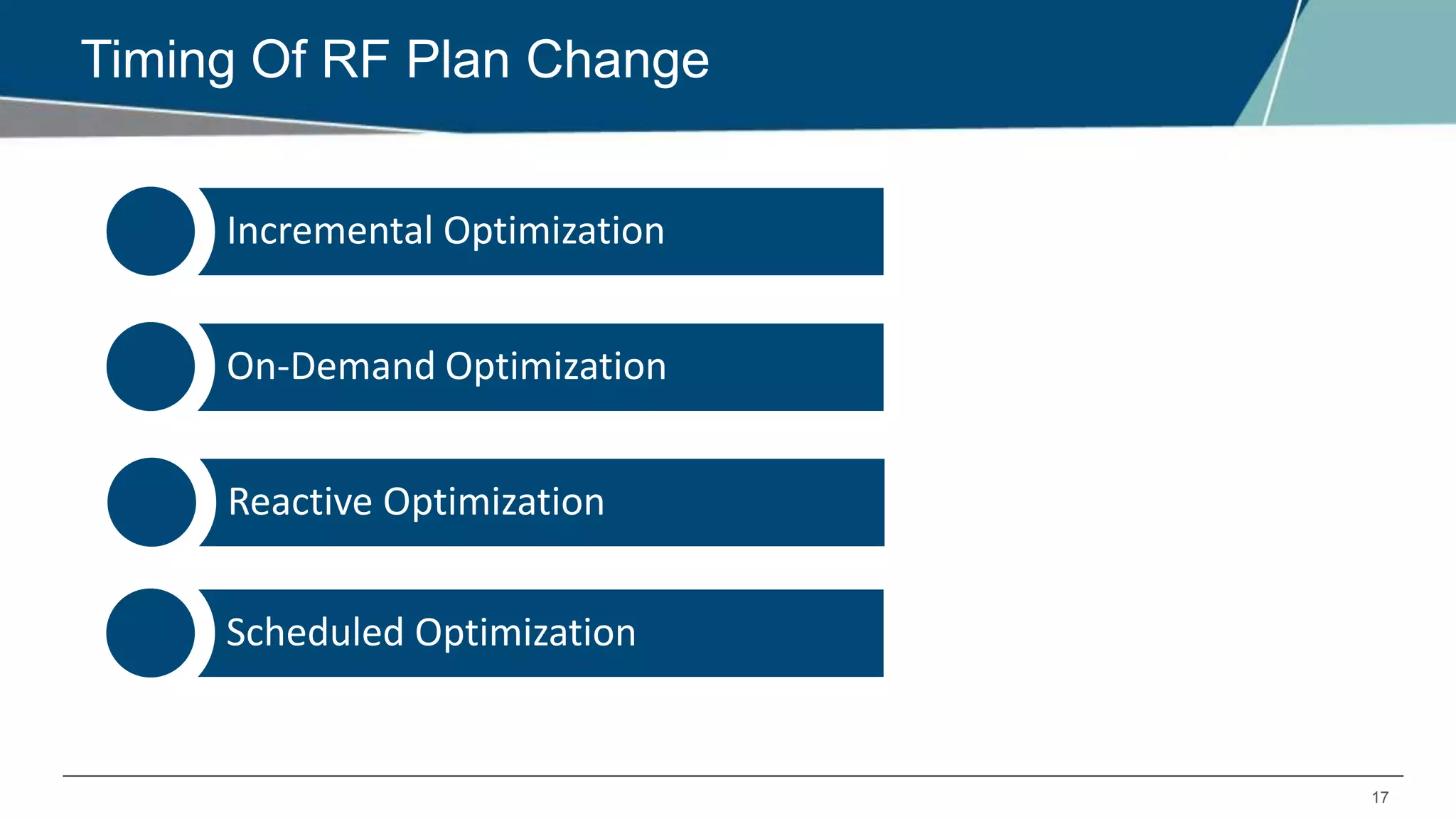
Timing Of RF Plan Change
Incremental Optimization
On-Demand Optimization
Reactive Optimization
Scheduled Optimization
18
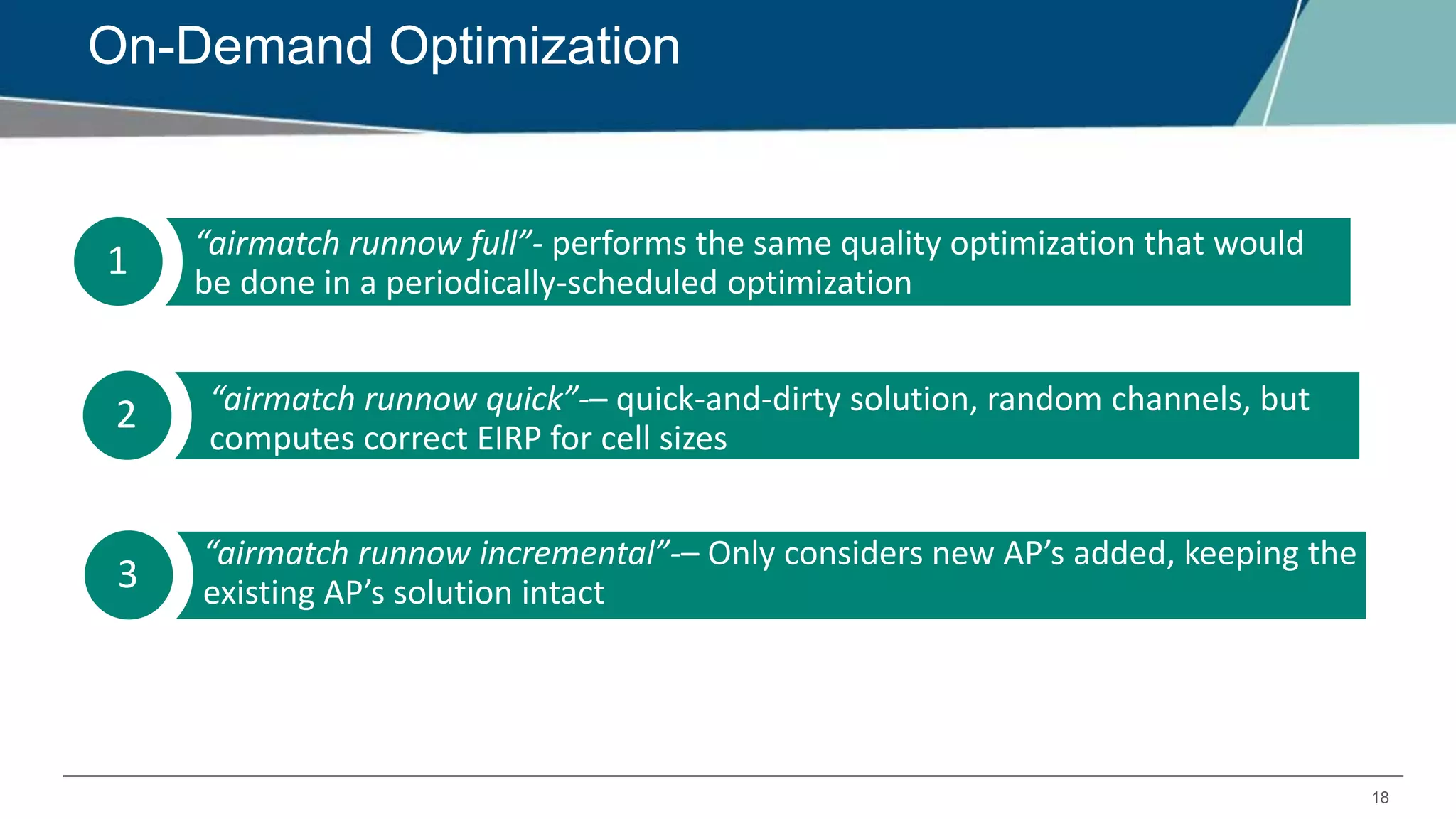
On-Demand Optimization
1 “airmatch runnow full”- performs the same quality optimization that would
be done in a periodically-scheduled optimization
2
3
“airmatch runnow quick”-– quick-and-dirty solution, random channels, but
computes correct EIRP for cell sizes
“airmatch runnow incremental”-– Only considers new AP’s added, keeping the
existing AP’s solution intact
19
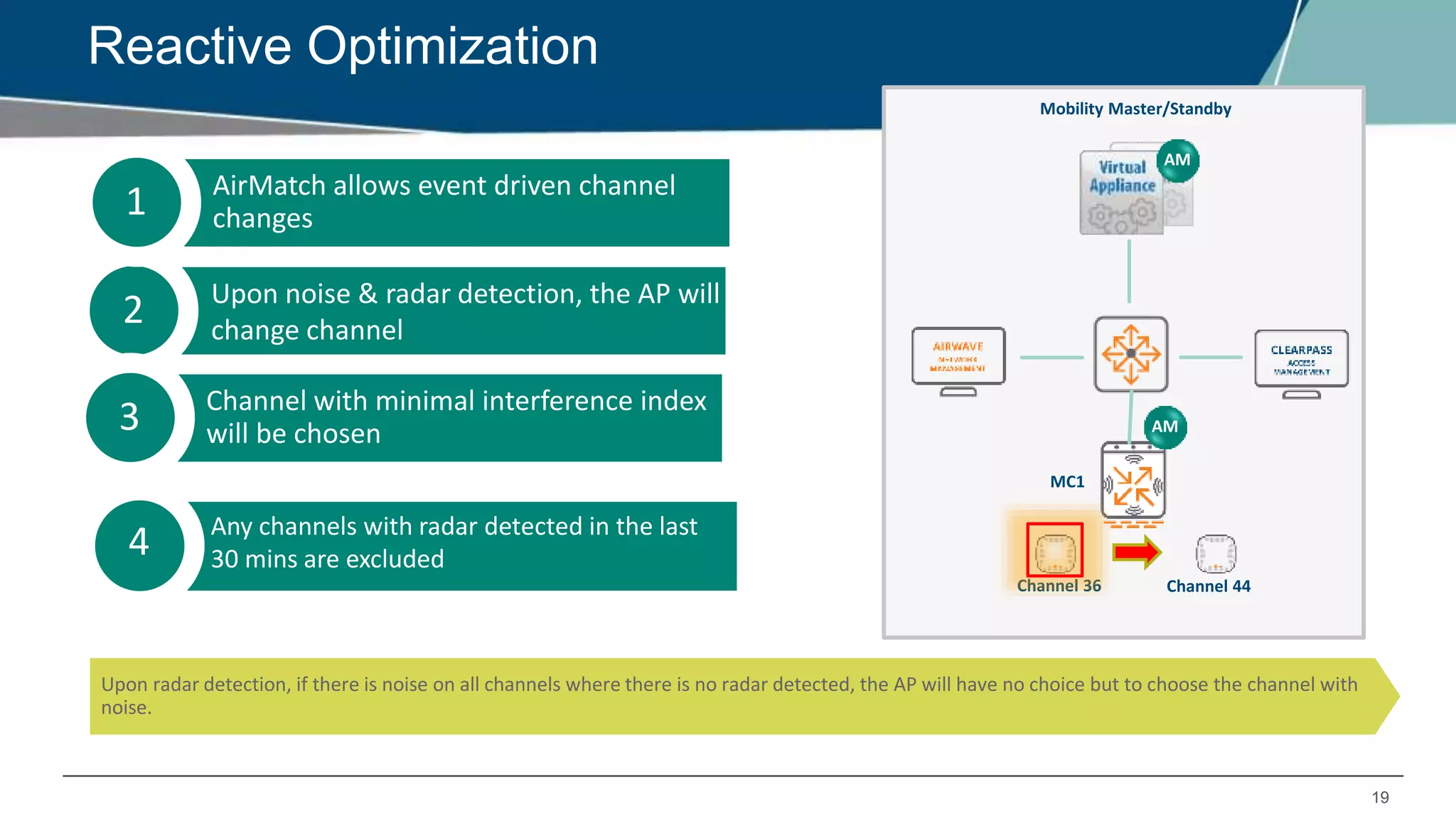
Reactive Optimization
MC1
Mobility Master/Standby
4
2 Upon noise & radar detection, the AP will
change channel
3 Channel with minimal interference index
will be chosen
AM
AM
1 AirMatch allows event driven channel
changes
Channel 36
Upon radar detection, if there is noise on all channels where there is no radar detected, the AP will have no choice but to choose the channel with
noise.
Channel 44
Any channels with radar detected in the last
30 mins are excluded
20
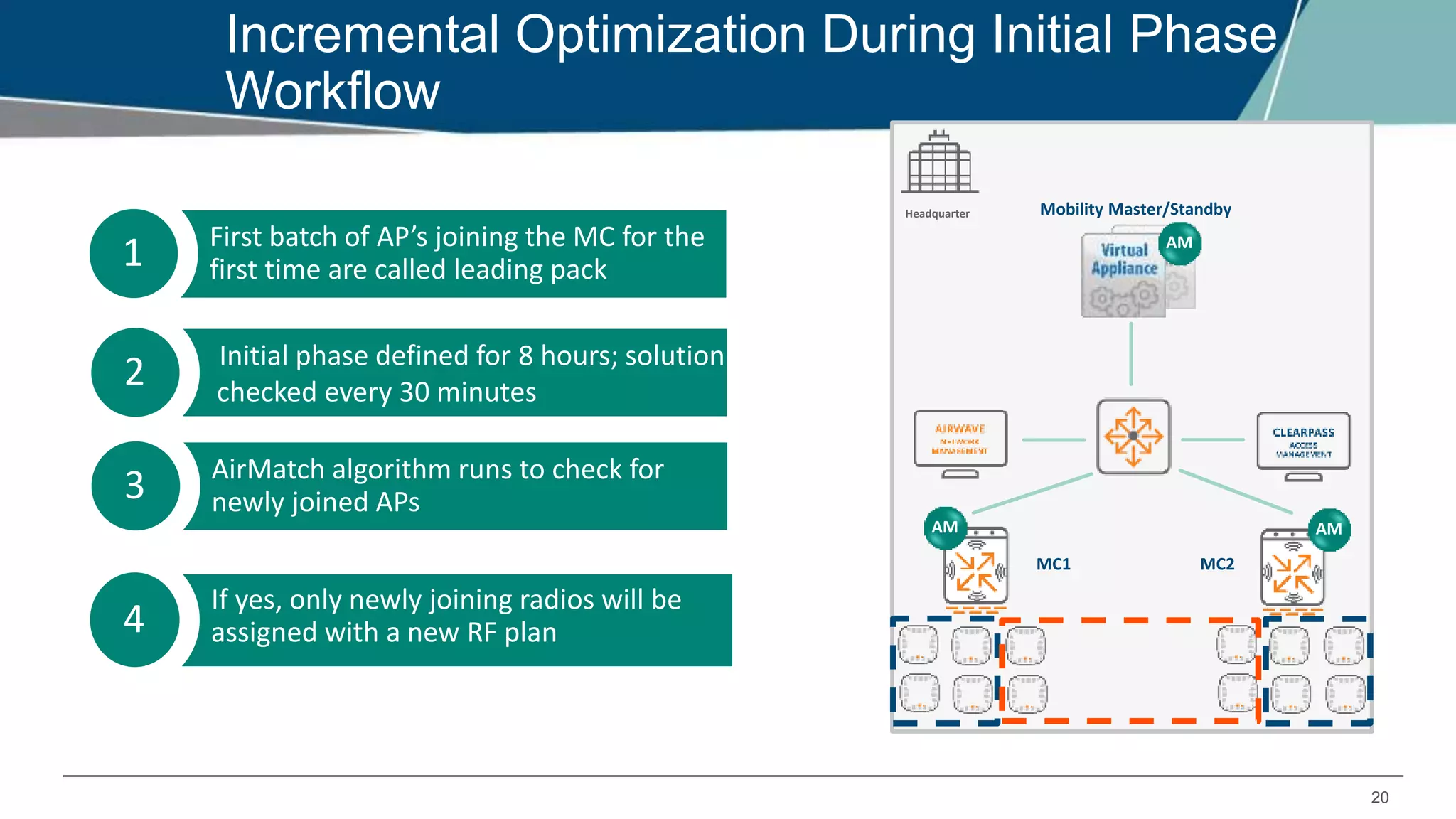
Incremental Optimization During Initial Phase
Workflow
MC1 MC2
Mobility Master/StandbyHeadquarter
4
If yes, only newly joining radios will be
assigned with a new RF plan
2 Initial phase defined for 8 hours; solution
checked every 30 minutes
3 AirMatch algorithm runs to check for
newly joined APs
AM
AM AM
1 First batch of AP’s joining the MC for the
first time are called leading pack
21
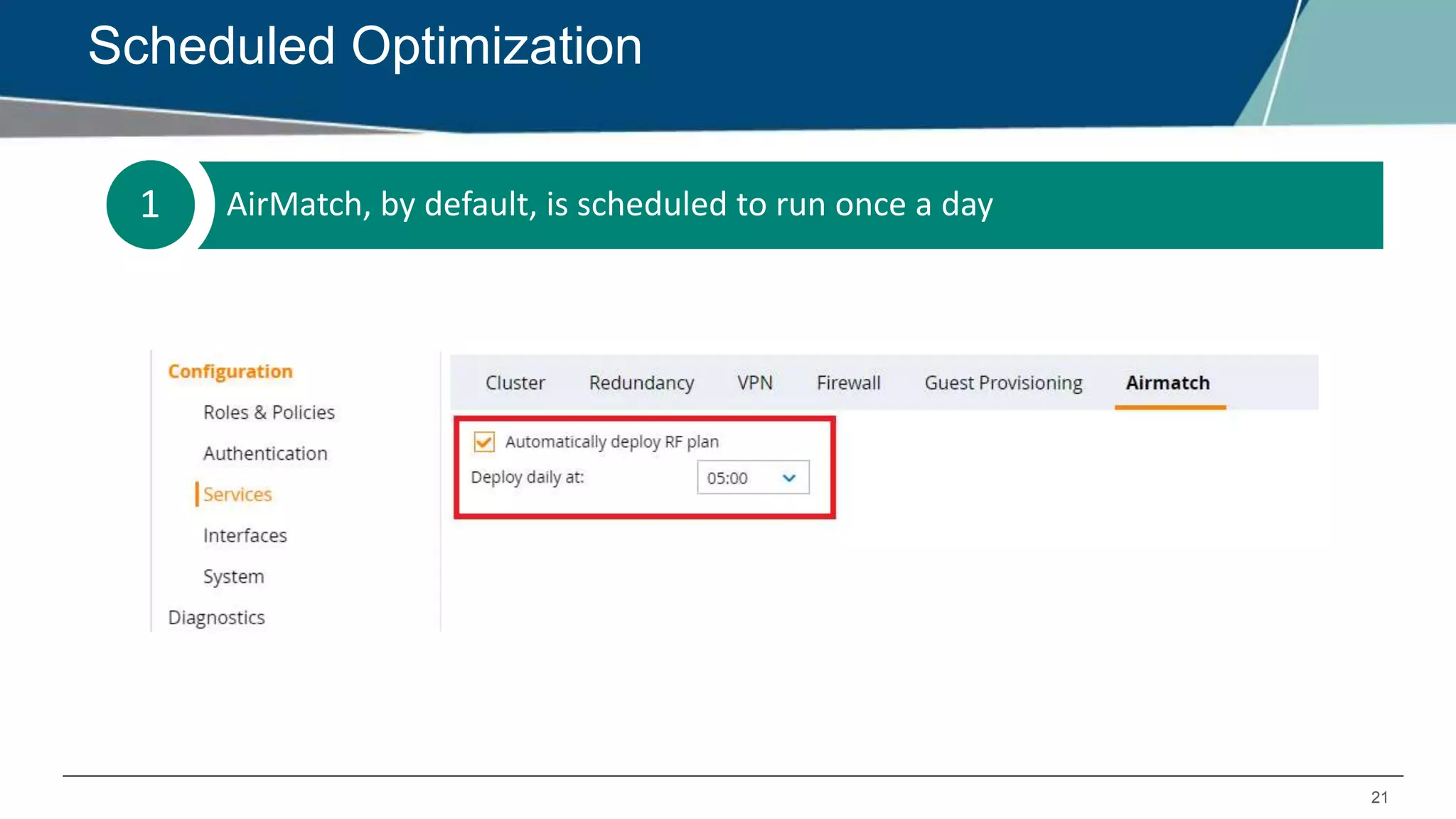
1 AirMatch, by default, is scheduled to run once a day
Controls radio resources such as channels, channel bandwidths and EIRP of a
WLAN
Consumes ‘radio membership’ and ‘link pathloss’
Provides centralized computation
Scheduled Optimization
22
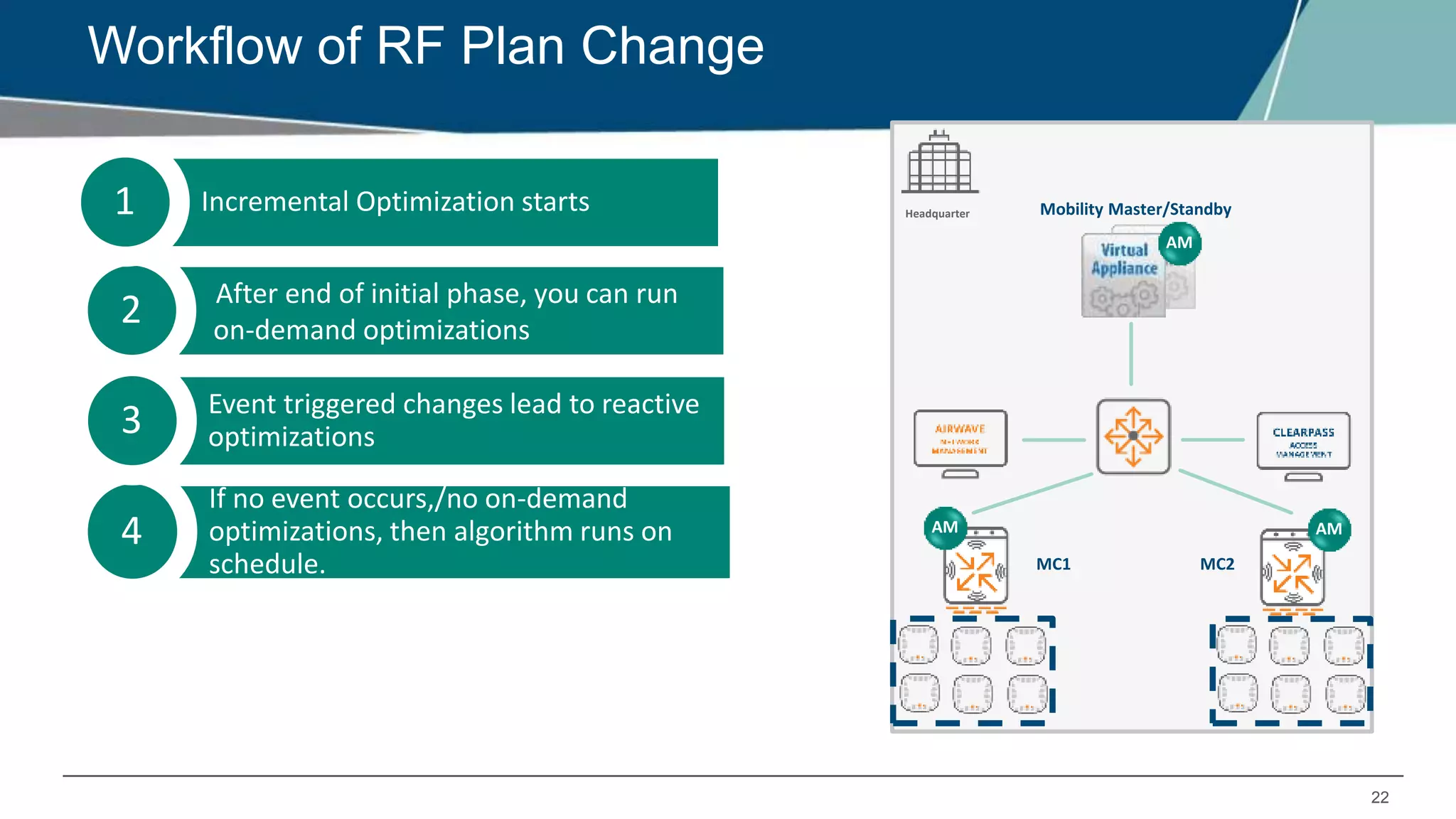
Workflow of RF Plan Change
MC1 MC2
Mobility Master/StandbyHeadquarter
4
If no event occurs,/no on-demand
optimizations, then algorithm runs on
schedule.
2 After end of initial phase, you can run
on-demand optimizations
3 Event triggered changes lead to reactive
optimizations
AM
AM AM
1 Incremental Optimization starts
23
AIRMATCH CONFIGURATION & COMMANDS
24
Airmatch setup
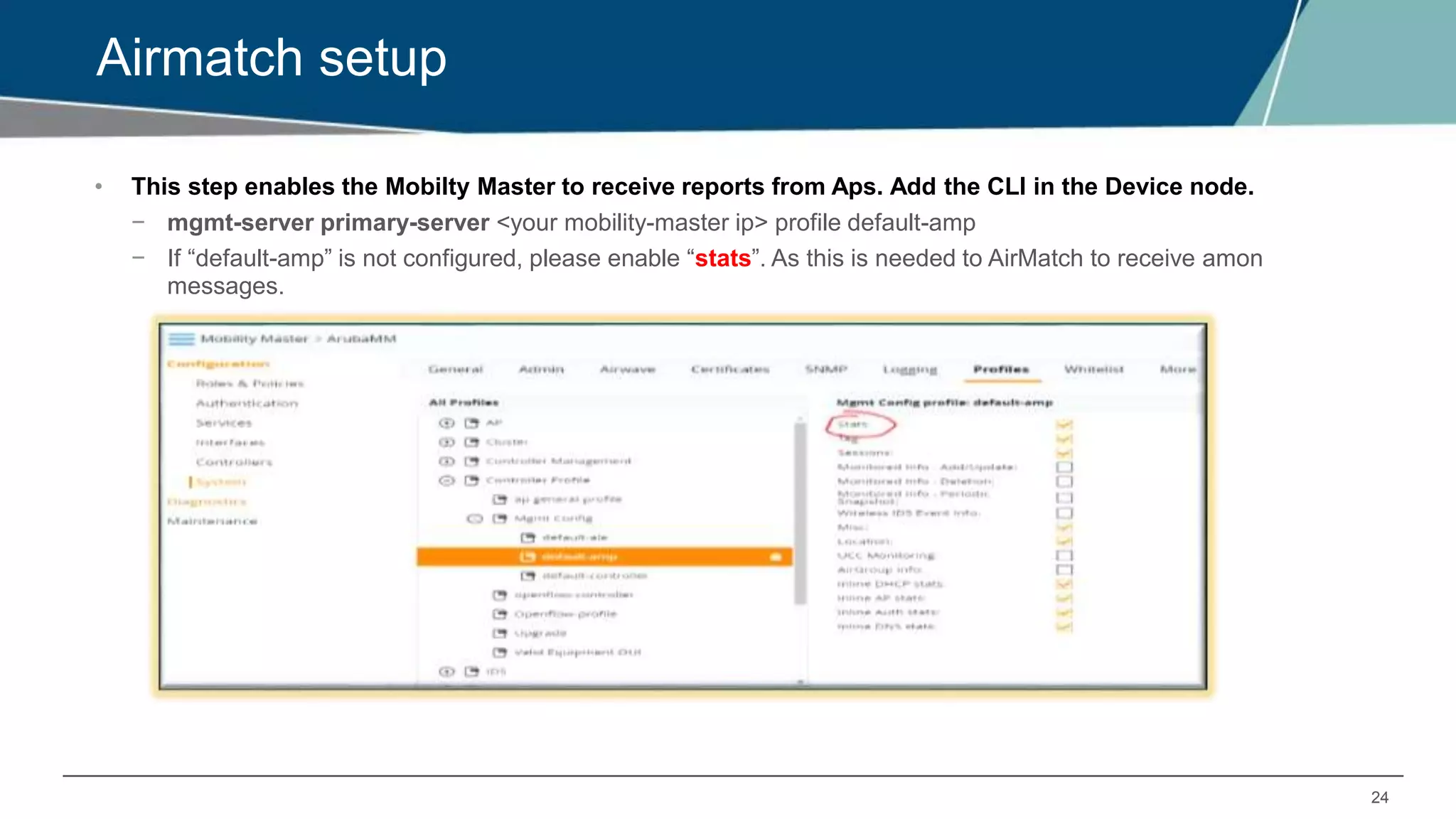
• This step enables the Mobilty Master to receive reports from Aps. Add the CLI in the Device node.
− mgmt-server primary-server <your mobility-master ip> profile default-amp
− If “default-amp” is not configured, please enable “stats”. As this is needed to AirMatch to receive amon
messages.
25
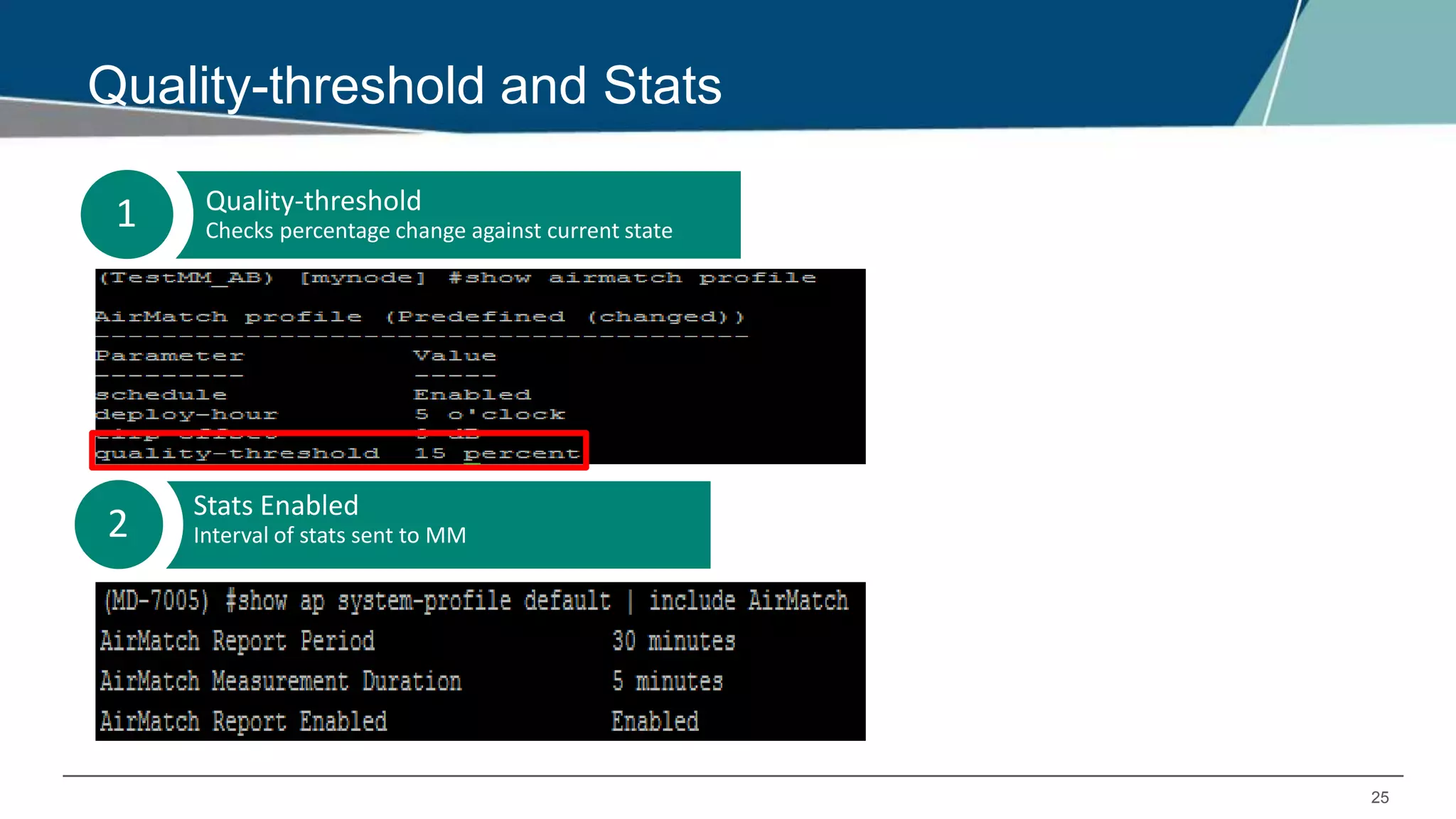
Quality-threshold and Stats
1 Quality-threshold
Checks percentage change against current state
2
Stats Enabled
Interval of stats sent to MM
26
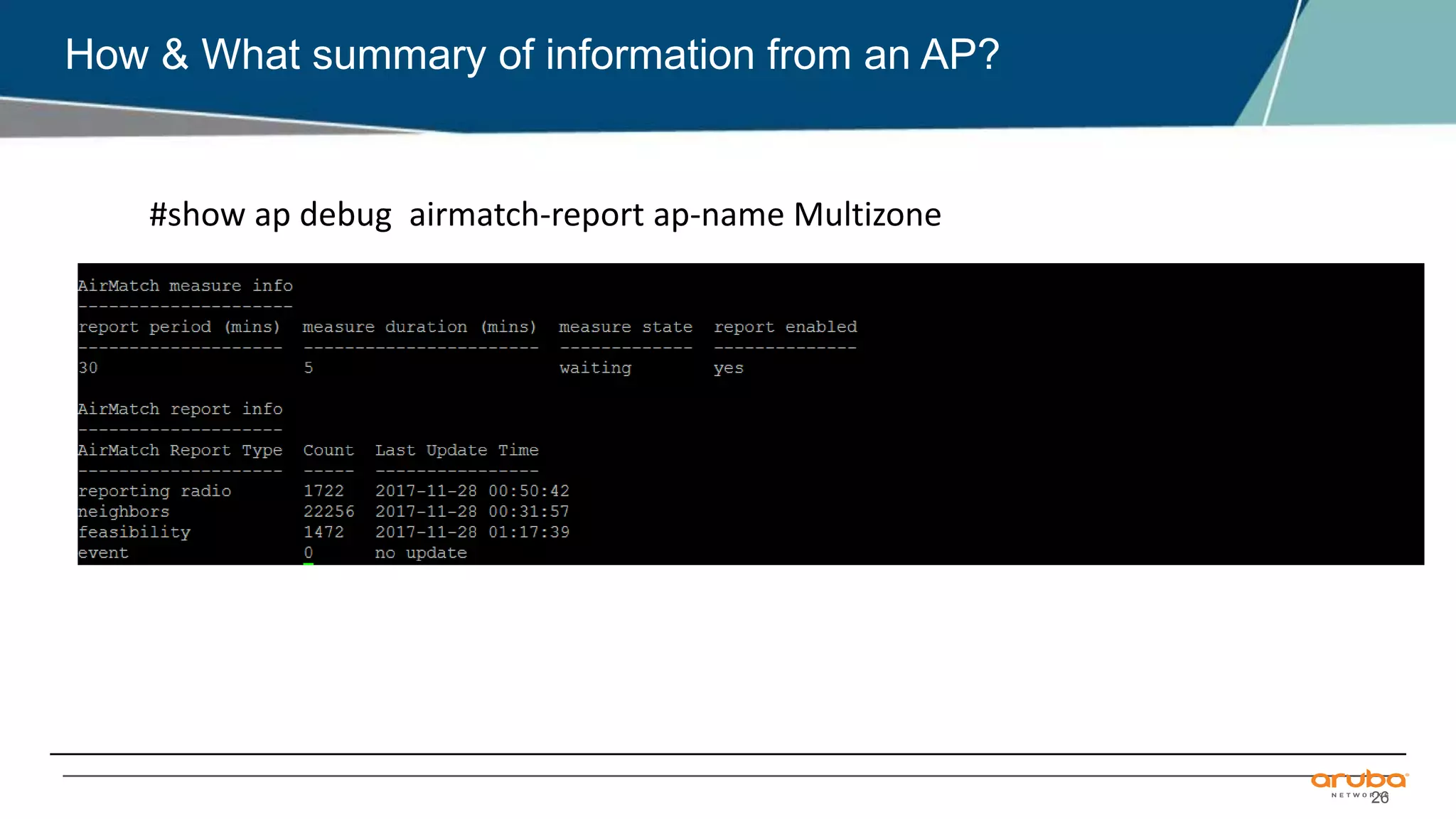
How & What summary of information from an AP?
#show ap debug airmatch-report ap-name Multizone
27
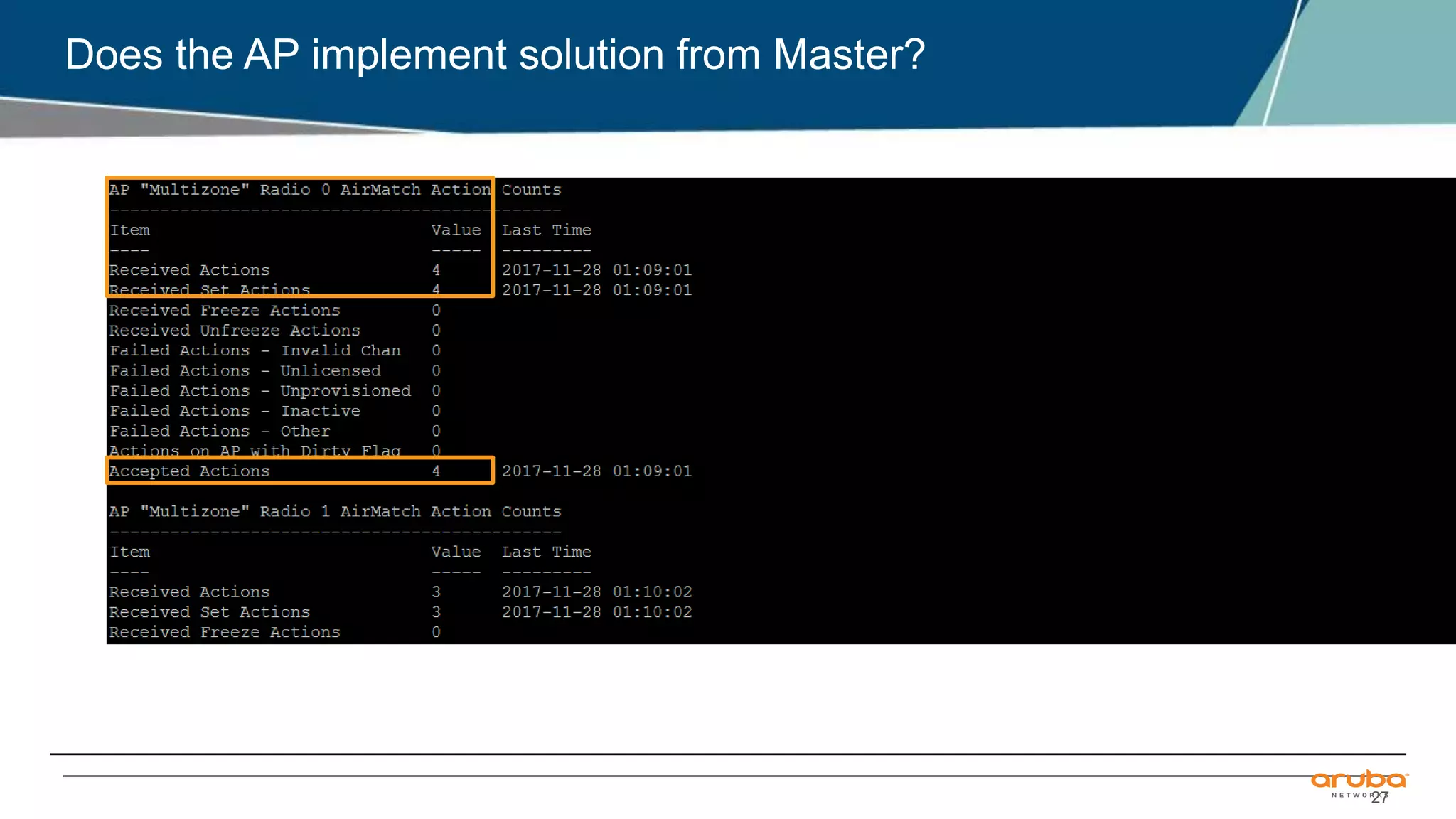
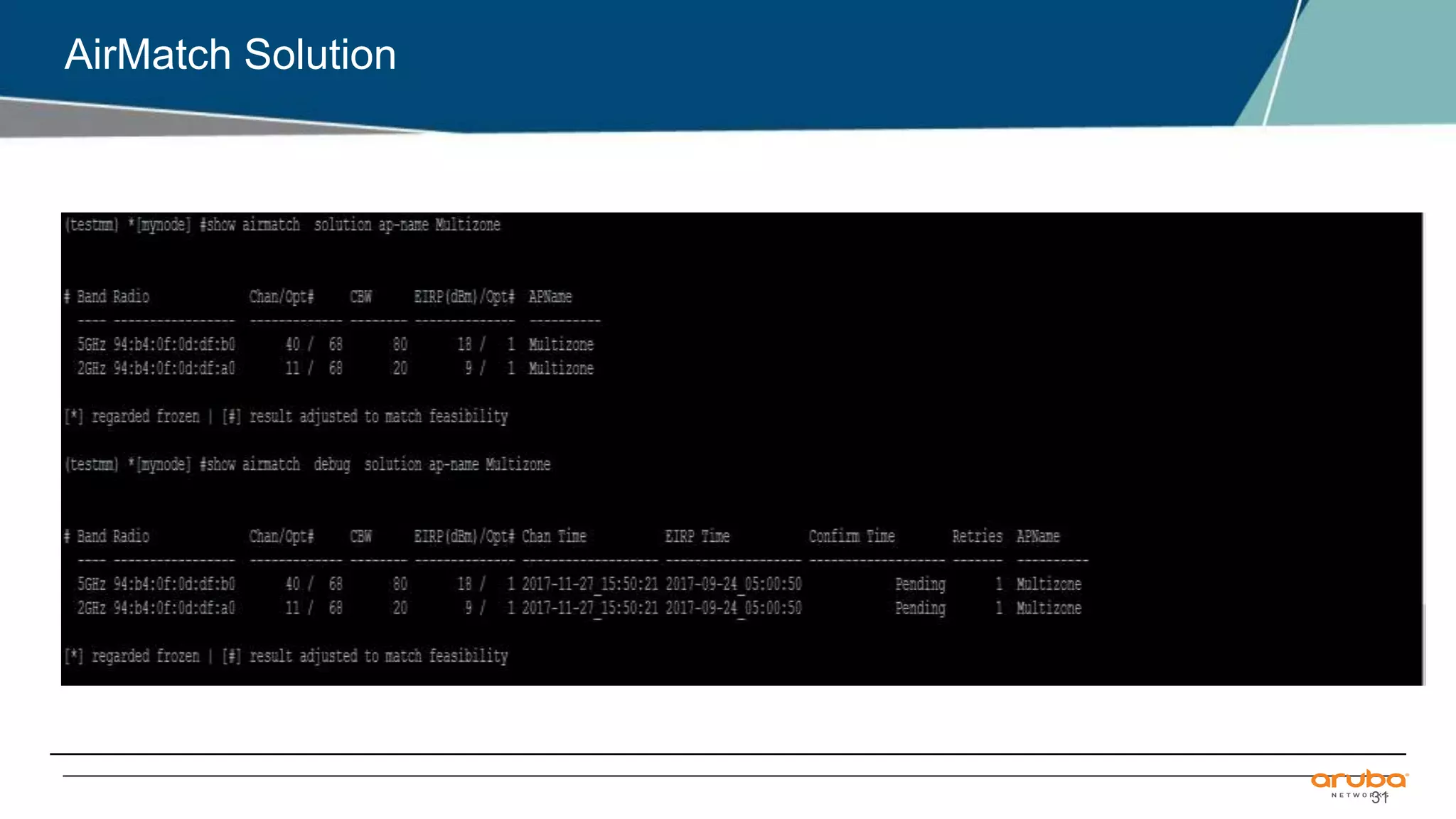
Does the AP implement solution from Master?
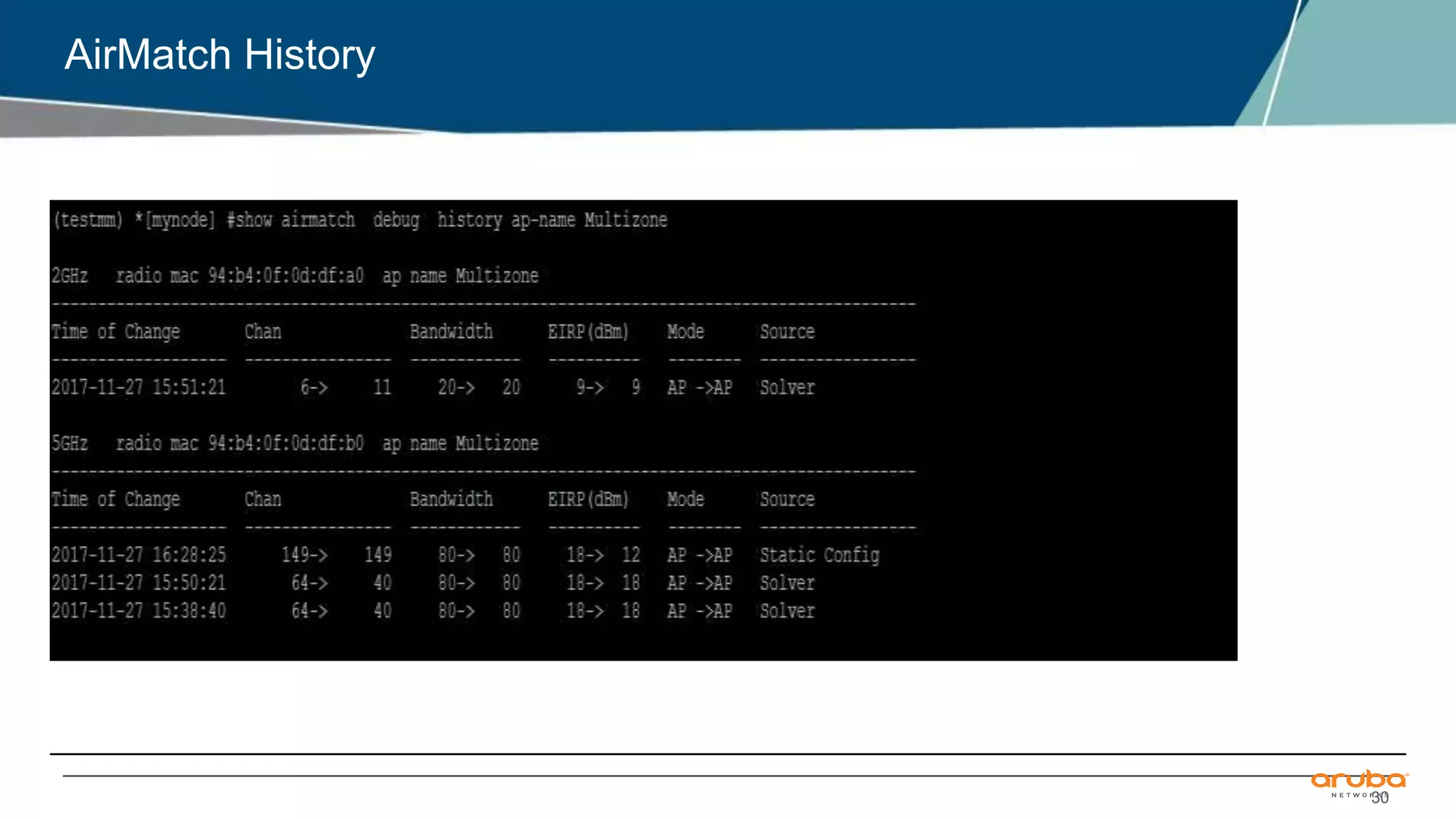
28
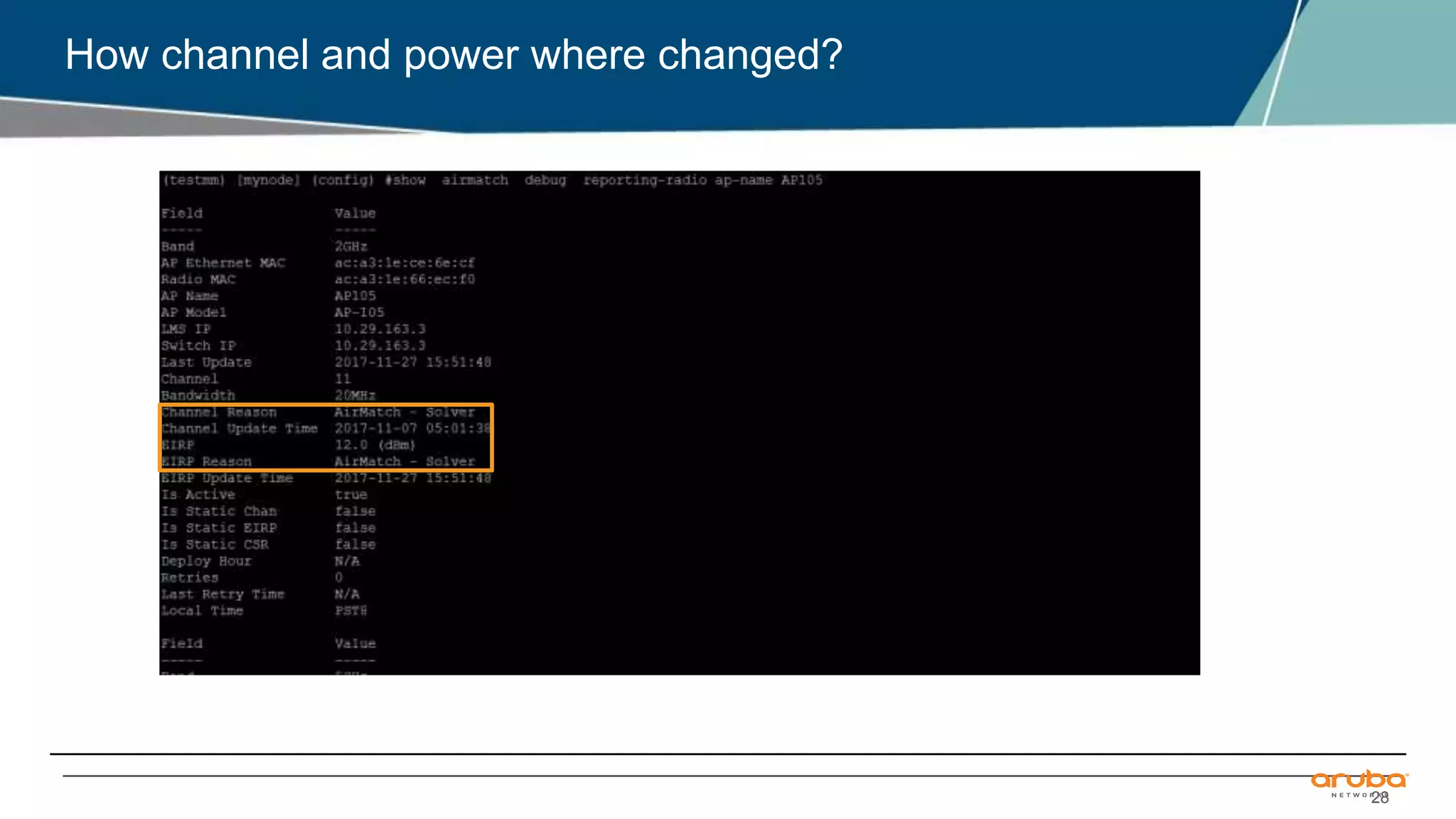
How channel and power where changed?
29
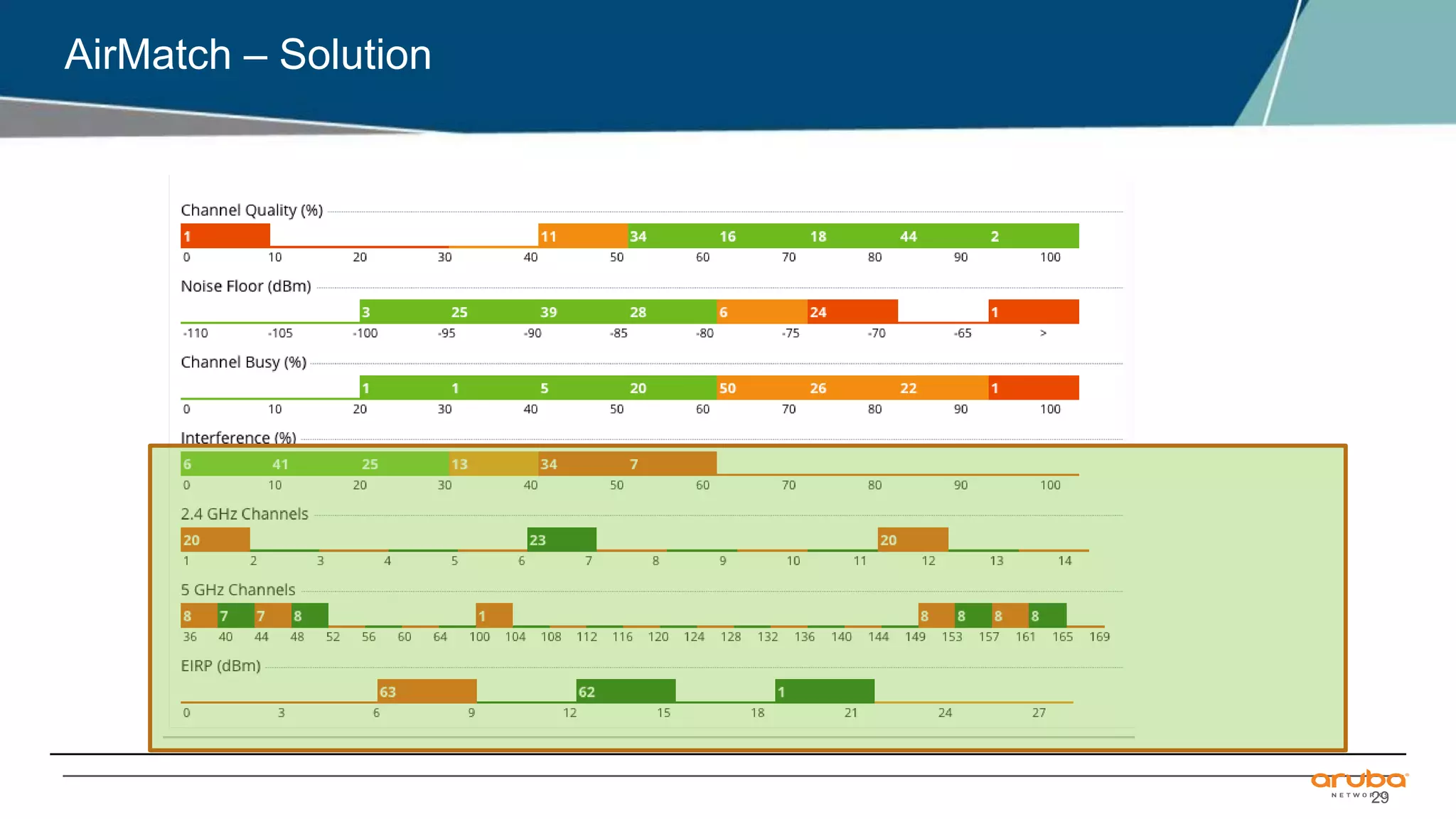
AirMatch – Solution
30
AirMatch History
31
AirMatch Solution
32
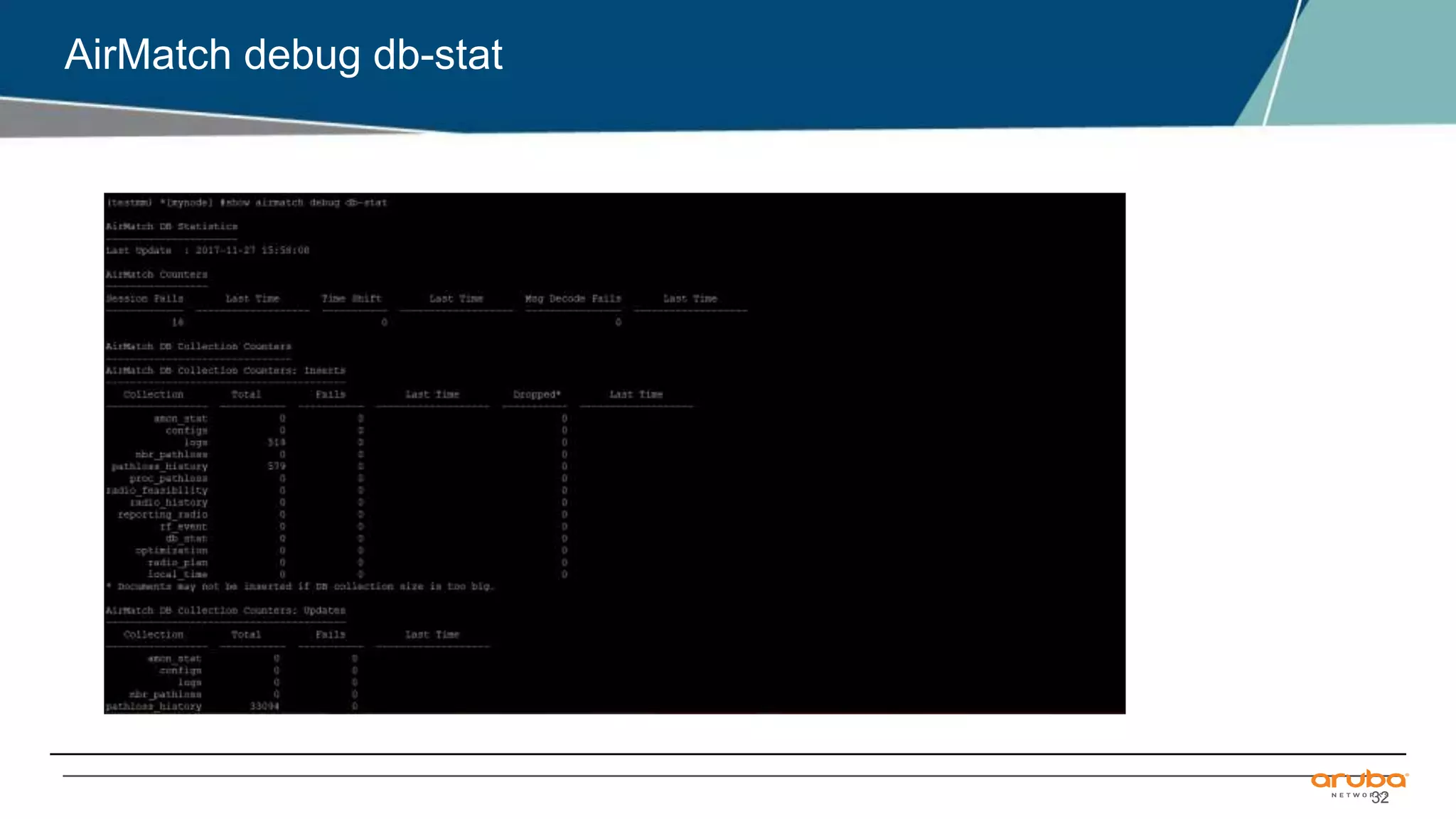
AirMatch debug db-stat
33
Enabling logging & running AirMatch
(testmm) *[mynode] (config) #logging system level debugging
(testmm) *[mynode] (config) #exit
(testmm) *[mynode] #airmatch runnow quick
34
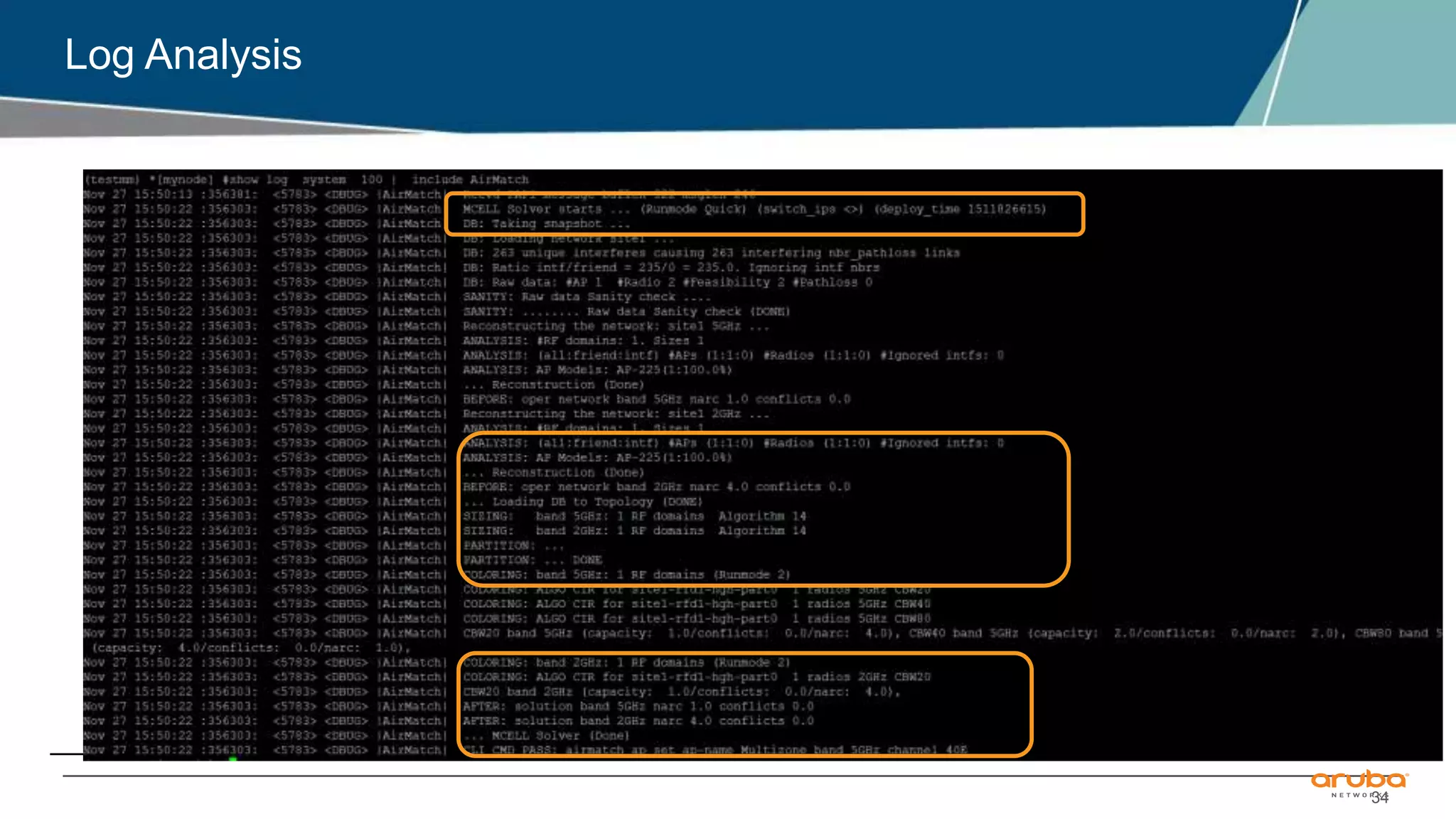
Log Analysis
35
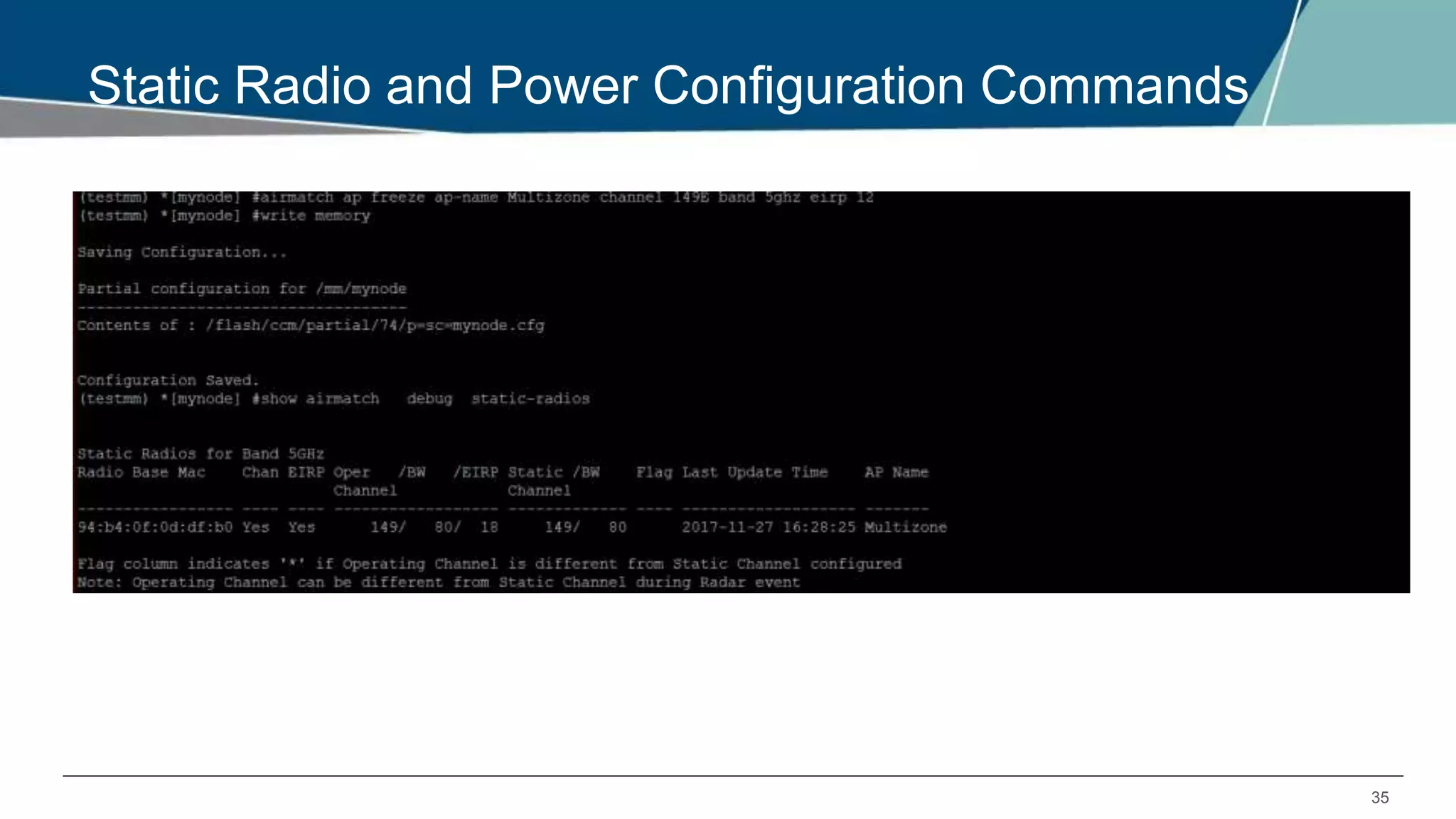
Static Radio and Power Configuration Commands
36
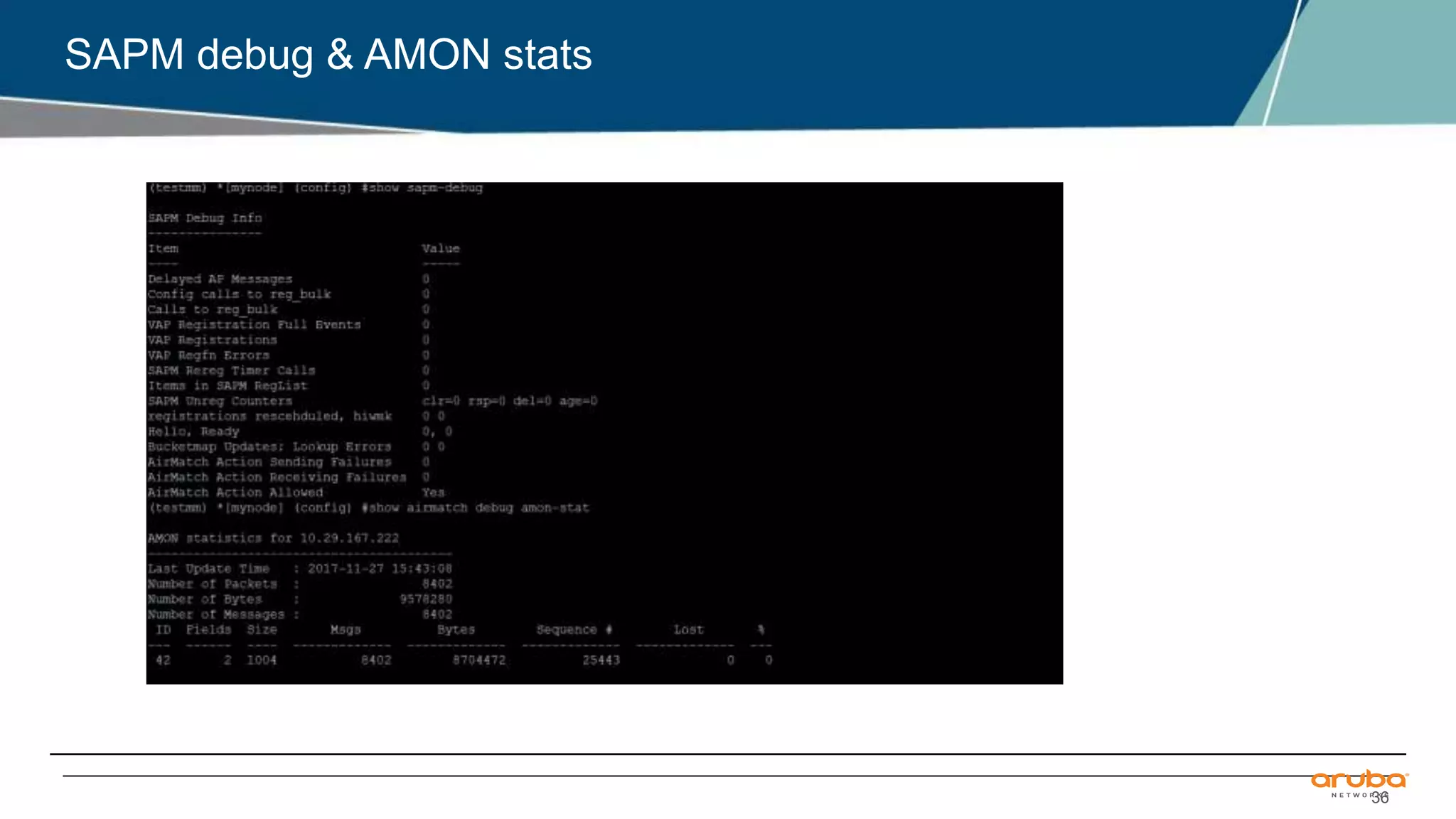
SAPM debug & AMON stats
37
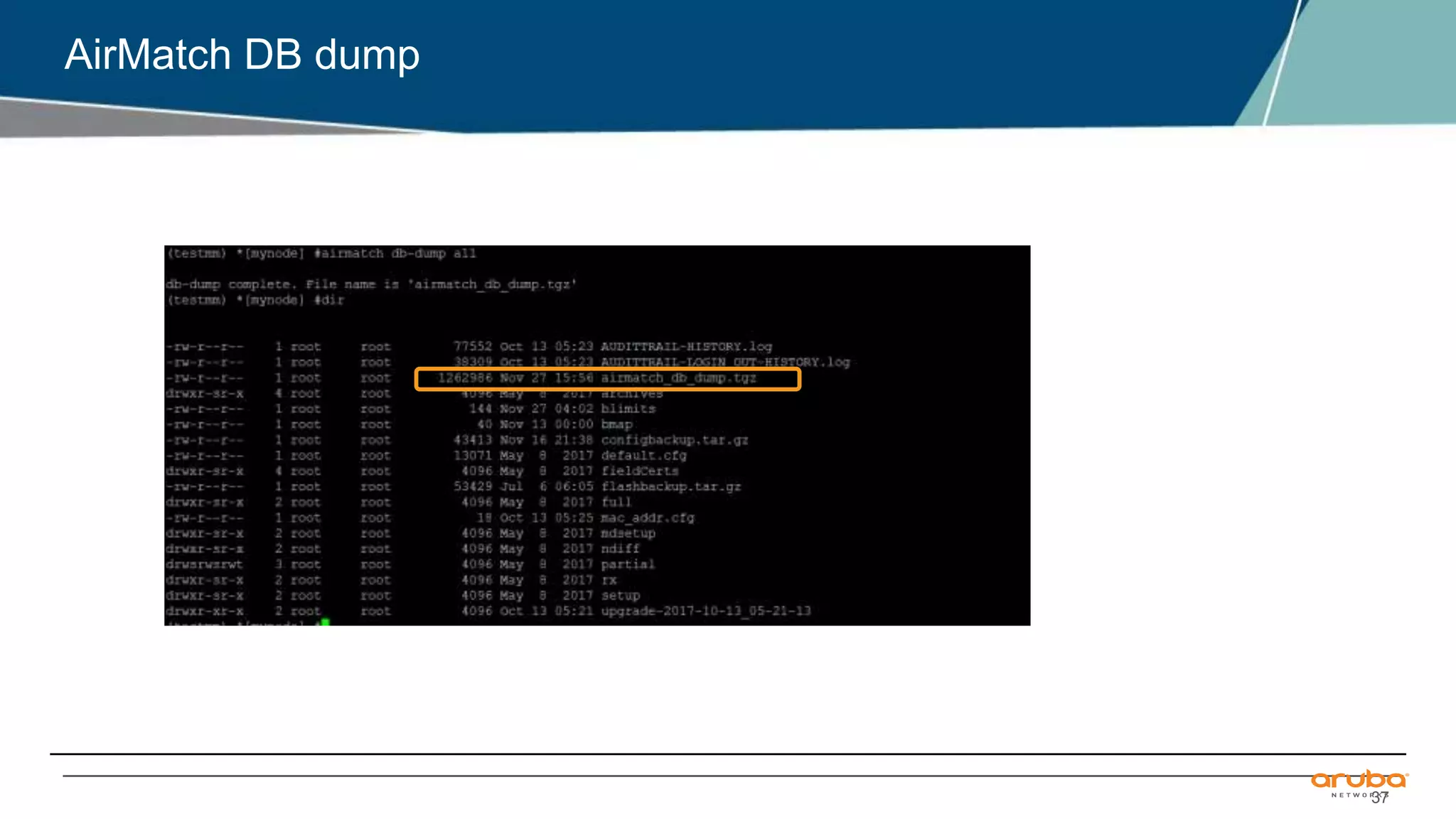
AirMatch DB dump
38
Questions?
39
THANK YOU!

EMEA Airheads - What does AirMatch do differently?v2

  • 1.
    1 What does AirMatchdo differently? 10:00 GMT | 11:00 CEST | 13:00 GST NOV 28th, 2017 Presenter: SAJIN NAIR nair@hpe.com
  • 2.
    2 Agenda • Introduction • AirMatchvs ARM • Setup AirMatch • Enable AirMatch and Profiles • AirMatch Optimization • Workflow • AirMatch Input Metrics • Logs • Troubleshooting
  • 3.
    3 Ideal way tosolve a Jigsaw puzzle?
  • 4.
    4 Key Considerations withARM A decentralized service; each individual radio makes its own decision ARM is “reactive” in nature, cascading affects Future spectrum enhancements, Lack of bandwidth planning Asymmetric EIRP planning which may not provide optimal client roaming behavior Cascading affects
  • 5.
    5 What is AirMatch? A centralized RF optimization service Newly defined information collection and configuration deployment paths Models and solves the network as a whole Results in better channel, bandwidth and EIRP plan for the network
  • 6.
    6 Advantages of AIRMATCH •Clean slate RF optimization service • Long term network stability & Performance • Holistic view of network • Different mode of data collection and calculation • Once a day optimization • Reactive optimization
  • 7.
    7 How is itdifferent from ARM? Master Local 1 Local 2 Local 3 10am: 1,6,11 11am: 11,6,1 1 pm : 1,6,11 Master Local 1 Local 2 Local 3 1,6,11 1,6,11 1,6,11 2pm: 11,6,1 3pm : 6,11,1 4 pm : 6,1,11 5am
  • 8.
  • 9.
  • 10.
    10 AirMatch Workflow 2 TheMD’s forward the AMON messages to Mobility Master (MM) 3 AirMatch calculates an optimal RF solution 1 AP sends RF statistics as AMON messages to Managed Devices (MD’s) 4 Mobility Master pushes the solution down to MD’s VRRP MM StandbyMM Master MD2MD1 MD4MD3 MD2 MD1 MD4MD3 Cluster 1 Cluster 2 Air Match calculates solution for each AP 5 MD’s send dot11 radio profile to AP’s
  • 11.
  • 12.
    12 AirMatch – InputMetrics Radio’s operating condition ( in reporting_radio) Radio Feasibility Neighbor Measurement ( in pathloss_history and nbr_pathloss) User defined metrics include EIRP and Channel Bandwidth
  • 13.
    1313 Information flow atthe high level Input Process Output • AP’s AM -> AMON -> LC • LC -> AMON -> SC • SC -> DB • SC’s Airmatch solver • Calculates solution • Triggered by external event • Stores it back to the database • SC’s Airmatch deploy queries and fetches info • SC AMAPI to SAPM • SC’s SAPM to LC • LC’s SAPM to AP’s SAPD • Bandwidth • Channel • EIRP • Radio Membership • Link Path-loss WhatHow
  • 14.
    14 Feasibility Report Introduces MobilityController or Managed Node which is completely managed by MM using Zero Touch Provisioning unlike 6.x Master-Local The MM can only be a VM and not a controller Field Description Reporting Radio Base Mac Address Channel List List of first 20MHz Channels Bandwidth List of supported bandwidth EIRP Range Range of valid EIRP values
  • 15.
    16 TIMING OF RFPLAN CHANGE 8.0.1
  • 16.
    17 Timing Of RFPlan Change Incremental Optimization On-Demand Optimization Reactive Optimization Scheduled Optimization
  • 17.
    18 On-Demand Optimization 1 “airmatchrunnow full”- performs the same quality optimization that would be done in a periodically-scheduled optimization 2 3 “airmatch runnow quick”-– quick-and-dirty solution, random channels, but computes correct EIRP for cell sizes “airmatch runnow incremental”-– Only considers new AP’s added, keeping the existing AP’s solution intact
  • 18.
    19 Reactive Optimization MC1 Mobility Master/Standby 4 2Upon noise & radar detection, the AP will change channel 3 Channel with minimal interference index will be chosen AM AM 1 AirMatch allows event driven channel changes Channel 36 Upon radar detection, if there is noise on all channels where there is no radar detected, the AP will have no choice but to choose the channel with noise. Channel 44 Any channels with radar detected in the last 30 mins are excluded
  • 19.
    20 Incremental Optimization DuringInitial Phase Workflow MC1 MC2 Mobility Master/StandbyHeadquarter 4 If yes, only newly joining radios will be assigned with a new RF plan 2 Initial phase defined for 8 hours; solution checked every 30 minutes 3 AirMatch algorithm runs to check for newly joined APs AM AM AM 1 First batch of AP’s joining the MC for the first time are called leading pack
  • 20.
    21 1 AirMatch, bydefault, is scheduled to run once a day Controls radio resources such as channels, channel bandwidths and EIRP of a WLAN Consumes ‘radio membership’ and ‘link pathloss’ Provides centralized computation Scheduled Optimization
  • 21.
    22 Workflow of RFPlan Change MC1 MC2 Mobility Master/StandbyHeadquarter 4 If no event occurs,/no on-demand optimizations, then algorithm runs on schedule. 2 After end of initial phase, you can run on-demand optimizations 3 Event triggered changes lead to reactive optimizations AM AM AM 1 Incremental Optimization starts
  • 22.
  • 23.
    24 Airmatch setup • Thisstep enables the Mobilty Master to receive reports from Aps. Add the CLI in the Device node. − mgmt-server primary-server <your mobility-master ip> profile default-amp − If “default-amp” is not configured, please enable “stats”. As this is needed to AirMatch to receive amon messages.
  • 24.
    25 Quality-threshold and Stats 1Quality-threshold Checks percentage change against current state 2 Stats Enabled Interval of stats sent to MM
  • 25.
    26 How & Whatsummary of information from an AP? #show ap debug airmatch-report ap-name Multizone
  • 26.
    27 Does the APimplement solution from Master?
  • 27.
    28 How channel andpower where changed?
  • 28.
  • 29.
  • 30.
  • 31.
  • 32.
    33 Enabling logging &running AirMatch (testmm) *[mynode] (config) #logging system level debugging (testmm) *[mynode] (config) #exit (testmm) *[mynode] #airmatch runnow quick
  • 33.
  • 34.
    35 Static Radio andPower Configuration Commands
  • 35.
    36 SAPM debug &AMON stats
  • 36.
  • 37.
  • 38.

Editor's Notes

  • #6 AirMatch provides unprecedented quality of RF network resource allocation. It consumes the past 24 hours of RF network statistics, and proactively optimizes the network for the next day. The RF plan change is applied in the early mornig to minimize the client disconnection and to maximize the the user experience. To conquer the instantaneous change in RF environment, AirMatch also reacts to detrimental RF events such as radar and high noise. The network under AirMatch will experience the minimum number of channel and EIRP change while network throughput is predictively maximized.
  • #11  AirMatch is Aruba’s next generation automatic RF planning service. This is not only to replace a legacy solution – ARM – automatic channel and EIRP assignment, but also to control the radio’s bandwidth, statistics collection and radar events. ClientMatch and its associated profiles and loggings are not part of Air Match’s project scope, and they shall remain as before.   The AirMatch service runs on AP, MD, and MM with respective functions, forming a big feedback loop of INPUT-PROCESS-OUPUT (IPO). The INPUT stage is to collect detailed RF statistics, controller configuration and radio configuration from AP. The PROCESS stage consumes what INPUT stage provides, and generate an RF solution that specifies new channel, bandwidth, EIRP, and mode of operation per radio. The OUTPUT stage deploys the RF solution to the radio. INPUT stage AP’s AM periodically sends statistics in AMON format to Managed Device MD’s SOS forwards that AMON messages to Mobility Master (Only in 8.0.1, updated in 8.1) The MM’s Airmatch service receives the AMON messages, performs ingress processing, and then stores them to MongoDB.   PROCESS stage AirMatch service in MM calculates the solution based on the info in the DB and stores the solution back to the DB.   OUTPUT stage MM’ SAPM constructs a message and sends the solution as CLI commands down to an MD. The MD receives the config message, converts that to dot11radio profile override, and apply. The AP sapd receives the config from its MD, and apply the change in radio config.
  • #13 Add a 4th bullet for user defined inputs. EIRP and Channel bandwidth. All these are taken as input into the algorithm. reporting radio- these are the feasible solutions. Basically these are the options that you can possibly assign.
  • #16 A neighbor AP is considered a ‘Friend’, if the MC on which it is terminating is managed by the same Mobility Master for which the AirMatch solution is being calculated.
  • #20 -It will choose a channel with the minimal interference index. -Any channels with radar detected in the last 30 mins are excluded. -Any channel with noise detected is also not preferred. -If noise is detected on all channels without radar, it has to choose one with noise -In both case, channel is selected using the interference index. -On changing channel after a radar detection, an AP returns to the home channel after the radar event has expired. -The AP considers a channel not assigned to neighboring radios by using the ARM interference indices. -The AP changes channel on detection of noise and after 30 minutes comes back to the original channel. -If it detects noise again, then it changes channel and then stays there for another 12 hours before returning back
  • #22 AirMatch computes and deploys a new RF plan for the network every 24 hours. The network operator sets the hour-of-day through profile configuration. This the-hour-of-day specifies the start of the deployment. The computation is done beforehand, and the exact start time/end time of the computation is determined dynamically
  • #24 -Use your setup for the demo.
  • #26 The quality-threshold checks for percentage of improvement in the created solution with reference to current network state. If the improvement reaches the threshold limit, it deploy’ s new solution. Else the existing solution remains. Default value is 15%. The quality-threshold would provide percentage details per band under airmatch solution <seq>
  • #36 AirMatch will take into consideration the static assignment for next days plan. On high noise event, AP will not change the channel, but on radar it will even on static assignment.