www.huawei.com
Copyright © 2008 Huawei Technologies Co., Ltd. All rights reserved.
WCDMA RNO
RF Optimization
Copyright © 2008 Huawei Technologies Co., Ltd. All rights reserved.
 This lecture introduces the various stages involved
in optimizing a 3G radio network and focuses
mainly on the RF Optimization phase.
 Step-by-step approach for the analysis of drive
survey data collected by Scanner and test UE is
presented. The analysis is carried out using the
post processing tool.
Review
Copyright © 2008 Huawei Technologies Co., Ltd. All rights reserved.
Review
 RF optimization will be an ongoing activity and will
need to be revisited as traffic increases in the
network and as new sites are deployed.
 In addition, as the network matures, the optimization
process should be enhanced to take into account
statistical data and key performance indicators
collected throughout the network.
Copyright © 2008 Huawei Technologies Co., Ltd. All rights reserved.
Course Contents
Chapter 1 Optimization Phases
Chapter 2 RF Optimization Summary
Chapter 3 RF Analysis Approaches
Chapter 4 Antenna Adjustment Example
Chapter 5 Drop Call Analysis Example
Copyright © 2008 Huawei Technologies Co., Ltd. All rights reserved.
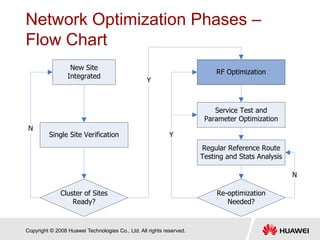
Network Optimization Phases –
Flow Chart
New Site
Integrated
Single Site Verification
RF Optimization
Cluster of Sites
Ready?
Service Test and
Parameter Optimization
Regular Reference Route
Testing and Stats Analysis
Re-optimization
Needed?
Y
N
N
Y
Copyright © 2008 Huawei Technologies Co., Ltd. All rights reserved.
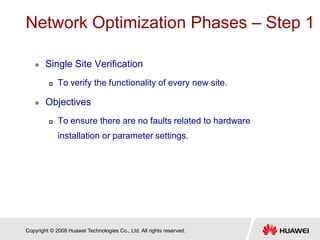
Network Optimization Phases – Step 1
 Single Site Verification
 To verify the functionality of every new site.
 Objectives
 To ensure there are no faults related to hardware
installation or parameter settings.
Copyright © 2008 Huawei Technologies Co., Ltd. All rights reserved.
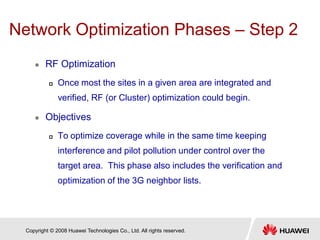
Network Optimization Phases – Step 2
 RF Optimization
 Once most the sites in a given area are integrated and
verified, RF (or Cluster) optimization could begin.
 Objectives
 To optimize coverage while in the same time keeping
interference and pilot pollution under control over the
target area. This phase also includes the verification and
optimization of the 3G neighbor lists.
Copyright © 2008 Huawei Technologies Co., Ltd. All rights reserved.
Network Optimization Phases – Step 3
 Services Testing & Parameters Optimization
 To be conducted in areas of good RF conditions in order
to exclude any coverage issues. Such testing does not
need to be performed for each cell but the drive route
must include different clutter types and environments.
 Objectives
 To assess the performance and identify any need for
specific parameter optimization.
Copyright © 2008 Huawei Technologies Co., Ltd. All rights reserved.
Network Optimization Phases – Step 4
 Regular Reference Route Testing & Stats Analysis
 Constant monitoring and evaluation of the network
performance can be based on drive test as well as traffic
statistic analysis.
 Results of the regular analysis may necessitate re-visits to
the RF optimization and/or parameters’ tuning.
 Objectives
 To identify any new issues that could arise, for example,
as a result of increase in traffic or changes in the
environment.
Copyright © 2008 Huawei Technologies Co., Ltd. All rights reserved.
Course Contents
Chapter 1 Optimization Phases
Chapter 2 RF Optimization Summary
Chapter 3 RF Analysis Approaches
Chapter 4 Antenna Adjustment Example
Chapter 5 Drop Call Analysis Example
Copyright © 2008 Huawei Technologies Co., Ltd. All rights reserved.
RF Optimization - Preparation
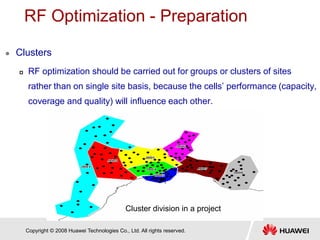
 Clusters
 RF optimization should be carried out for groups or clusters of sites
rather than on single site basis, because the cells’ performance (capacity,
coverage and quality) will influence each other.
Cluster division in a project
Copyright © 2008 Huawei Technologies Co., Ltd. All rights reserved.
RF Optimization - Preparation
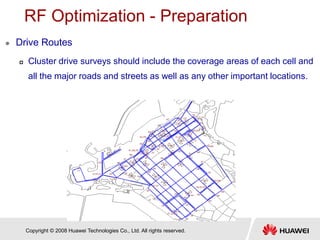
 Drive Routes
 Cluster drive surveys should include the coverage areas of each cell and
all the major roads and streets as well as any other important locations.
Copyright © 2008 Huawei Technologies Co., Ltd. All rights reserved.
RF Optimization - Preparation
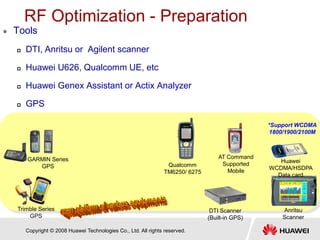
 Tools
 DTI, Anritsu or Agilent scanner
 Huawei U626, Qualcomm UE, etc
 Huawei Genex Assistant or Actix Analyzer
 GPS
GARMIN Series
GPS
DTI Scanner
(Built-in GPS)
Anritsu
Scanner
Trimble Series
GPS
Qualcomm
TM6250/ 6275
AT Command
Supported
Mobile
Huawei
WCDMA/HSDPA
Data card
*Support WCDMA
1800/1900/2100M
Copyright © 2008 Huawei Technologies Co., Ltd. All rights reserved.
RF Optimization - Targets
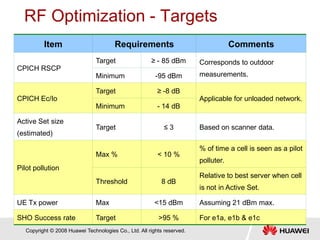
Item Requirements Comments
CPICH RSCP
Target ≥ - 85 dBm Corresponds to outdoor
measurements.Minimum -95 dBm
CPICH Ec/Io
Target ≥ -8 dB
Applicable for unloaded network.
Minimum - 14 dB
Active Set size
(estimated)
Target ≤ 3 Based on scanner data.
Pilot pollution
Max % < 10 %
% of time a cell is seen as a pilot
polluter.
Threshold 8 dB
Relative to best server when cell
is not in Active Set.
UE Tx power Max <15 dBm Assuming 21 dBm max.
SHO Success rate Target >95 % For e1a, e1b & e1c
Copyright © 2008 Huawei Technologies Co., Ltd. All rights reserved.
RF Optimization – Flow Chart
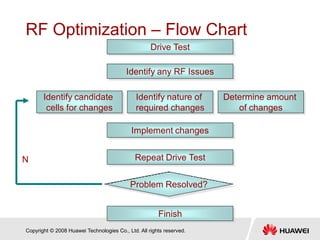
Drive Test
Identify any RF Issues
Identify candidate
cells for changes
Identify nature of
required changes
Determine amount
of changes
Implement changes
Repeat Drive Test
Finish
N
Problem Resolved?
Copyright © 2008 Huawei Technologies Co., Ltd. All rights reserved.
RF Optimization - Solutions
 Antenna down tilt
 Antenna azimuth
 Antenna location
 Antenna height
 Antenna type
 Site location
 New site
Copyright © 2008 Huawei Technologies Co., Ltd. All rights reserved.
Course Contents
Chapter 1 Optimization Phases
Chapter 2 RF Optimization Summary
Chapter 3 RF Analysis Approaches
Chapter 4 Antenna Adjustment Example
Chapter 5 Drop Call Analysis Example
Copyright © 2008 Huawei Technologies Co., Ltd. All rights reserved.
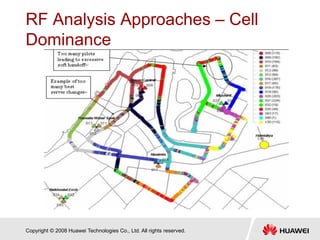
RF Analysis Approaches – Cell Dominance
 Cells with no dominance at all
 A site was not radiating during the drive survey
 Very poor dominance can also be caused by blocking of the
antenna. So a site visit must be made to verify the antenna
clearance.
 Cells with either excessive or poor dominance
 This could be due to a high site or non-optimum antenna down tilts.
 Cells with too large dominance will be causing interference to
adjacent cells resulting in poorer quality and capacity.
Copyright © 2008 Huawei Technologies Co., Ltd. All rights reserved.
 Areas of non-dominance:
 Areas where there is not a single clear dominant cell and
where the best server changes too frequently.
 Result: Excessive number of soft hand off events reducing
the system efficiency and increasing the probability of call
drops.
 UE vs. Scanner Best Serving Cells:
 Comparison between the UE and scanner SC plots.
Significant differences between the plots may indicate a
missing neighbor or failed soft handoff problem.
RF Analysis Approaches – Cell Dominance
Copyright © 2008 Huawei Technologies Co., Ltd. All rights reserved.
RF Analysis Approaches – Cell
Dominance
Copyright © 2008 Huawei Technologies Co., Ltd. All rights reserved.
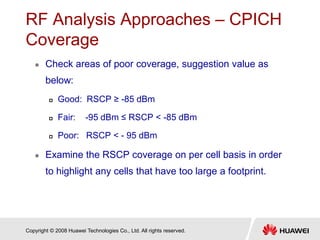
RF Analysis Approaches – CPICH
Coverage
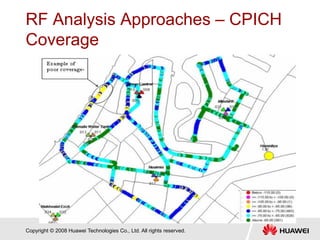
 Check areas of poor coverage, suggestion value as
below:
 Good: RSCP ≥ -85 dBm
 Fair: -95 dBm ≤ RSCP < -85 dBm
 Poor: RSCP < - 95 dBm
 Examine the RSCP coverage on per cell basis in order
to highlight any cells that have too large a footprint.
Copyright © 2008 Huawei Technologies Co., Ltd. All rights reserved.
RF Analysis Approaches – CPICH
Coverage
Copyright © 2008 Huawei Technologies Co., Ltd. All rights reserved.
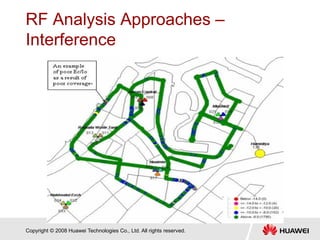
RF Analysis Approaches –
Interference
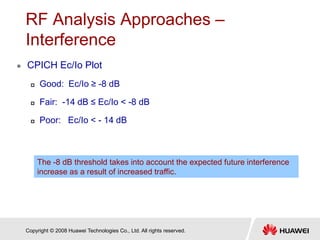
 CPICH Ec/Io Plot
 Good: Ec/Io ≥ -8 dB
 Fair: -14 dB ≤ Ec/Io < -8 dB
 Poor: Ec/Io < - 14 dB
The -8 dB threshold takes into account the expected future interference
increase as a result of increased traffic.
Copyright © 2008 Huawei Technologies Co., Ltd. All rights reserved.
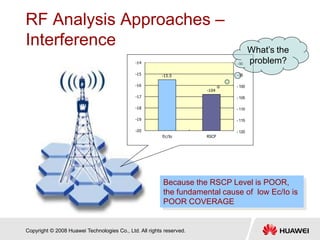
RF Analysis Approaches –
Interference
Because the RSCP Level is POOR,
the fundamental cause of low Ec/Io is
POOR COVERAGE
-15.5
-104
-20
-19
-18
-17
-16
-15
-14
Ec/Io RSCP
- 120
- 115
- 110
- 105
- 100
- 95
- 90
What’s the
problem?
Copyright © 2008 Huawei Technologies Co., Ltd. All rights reserved.
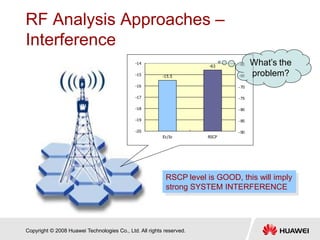
RF Analysis Approaches –
Interference
RSCP level is GOOD, this will imply
strong SYSTEM INTERFERENCE
-15.5
-63
-20
-19
-18
-17
-16
-15
-14
Ec/Io RSCP
- 90
- 85
- 80
- 75
- 70
- 65
- 60 What’s the
problem?
Copyright © 2008 Huawei Technologies Co., Ltd. All rights reserved.
RF Analysis Approaches –
Interference
Copyright © 2008 Huawei Technologies Co., Ltd. All rights reserved.
RF Analysis Approaches – UL
Coverage
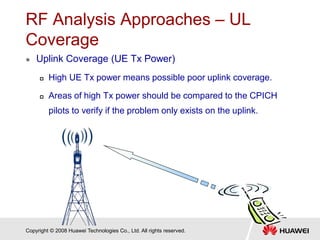
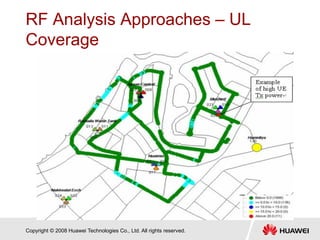
 Uplink Coverage (UE Tx Power)
 High UE Tx power means possible poor uplink coverage.
 Areas of high Tx power should be compared to the CPICH
pilots to verify if the problem only exists on the uplink.
Copyright © 2008 Huawei Technologies Co., Ltd. All rights reserved.
RF Analysis Approaches – UL
Coverage
Copyright © 2008 Huawei Technologies Co., Ltd. All rights reserved.
RF Analysis Approaches – Pilot
Pollution
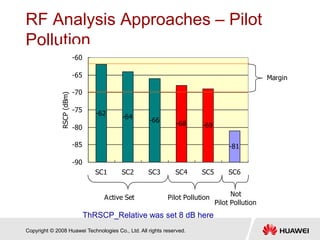
 Pilot Pollution Point Define:
 Within a certain margin (which is called ThRSCP_Relative) to the
best server
 The pilot number (whose strength > best server strength–
ThRSCP_Relative) > ThN (ThN means active set size, normally 3)
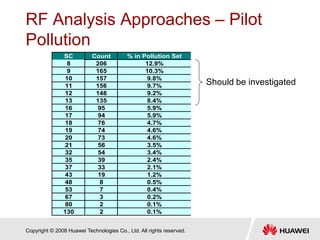
 Cells which are frequently seen as polluters (e.g. >8% time)
should be marked and investigated.
 Pilot Pollution results should be used in conjunction with the
Estimated Active Set Size
Copyright © 2008 Huawei Technologies Co., Ltd. All rights reserved.
RF Analysis Approaches – Pilot
Pollution
-62
-64 -66
-68 -69
-81
-90
-85
-80
-75
-70
-65
-60
SC1 SC2 SC3 SC4 SC5 SC6
RSCP(dBm)
Active Set Pilot Pollution
Margin
Not
Pilot Pollution
ThRSCP_Relative was set 8 dB here
Copyright © 2008 Huawei Technologies Co., Ltd. All rights reserved.
RF Analysis Approaches – Pilot
Pollution
SC Count % in Pollution Set
8 206 12.9%
9 165 10.3%
10 157 9.8%
11 156 9.7%
12 148 9.2%
13 135 8.4%
16 95 5.9%
17 94 5.9%
18 76 4.7%
19 74 4.6%
20 73 4.6%
21 56 3.5%
32 54 3.4%
35 39 2.4%
37 33 2.1%
43 19 1.2%
48 8 0.5%
53 7 0.4%
67 3 0.2%
80 2 0.1%
130 2 0.1%
Should be investigated
Copyright © 2008 Huawei Technologies Co., Ltd. All rights reserved.
RF Analysis Approaches – Pilot
Pollution
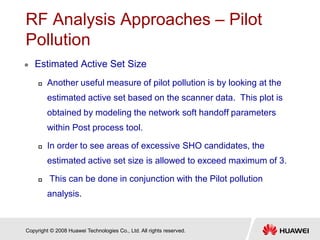
 Estimated Active Set Size
 Another useful measure of pilot pollution is by looking at the
estimated active set based on the scanner data. This plot is
obtained by modeling the network soft handoff parameters
within Post process tool.
 In order to see areas of excessive SHO candidates, the
estimated active set size is allowed to exceed maximum of 3.
 This can be done in conjunction with the Pilot pollution
analysis.
Copyright © 2008 Huawei Technologies Co., Ltd. All rights reserved.
RF Analysis Approaches – Pilot
Pollution
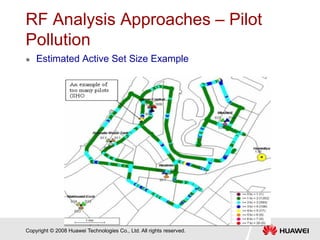
 Estimated Active Set Size Example
Copyright © 2008 Huawei Technologies Co., Ltd. All rights reserved.
RF Analysis Approaches – Neighbor List
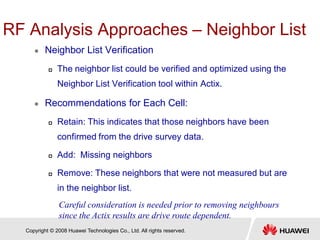
 Neighbor List Verification
 The neighbor list could be verified and optimized using the
Neighbor List Verification tool within Actix.
 Recommendations for Each Cell:
 Retain: This indicates that those neighbors have been
confirmed from the drive survey data.
 Add: Missing neighbors
 Remove: These neighbors that were not measured but are
in the neighbor list.
Careful consideration is needed prior to removing neighbours
since the Actix results are drive route dependent.
Copyright © 2008 Huawei Technologies Co., Ltd. All rights reserved.
RF Analysis Approaches – Neighbor List
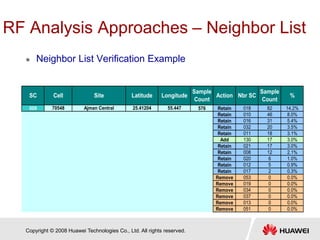
 Neighbor List Verification Example
009 576 Retain 018 82 14.2%
Retain 010 46 8.0%
Retain 016 31 5.4%
Retain 032 20 3.5%
Retain 011 18 3.1%
Add 130 17 3.0%
Retain 021 17 3.0%
Retain 008 12 2.1%
Retain 020 6 1.0%
Retain 012 5 0.9%
Retain 017 2 0.3%
Remove 053 0 0.0%
Remove 019 0 0.0%
Remove 034 0 0.0%
Remove 037 0 0.0%
Remove 013 0 0.0%
Remove 051 0 0.0%
70548 Ajman Central 25.41204 55.447
Nbr SC
Sample
Count
%Latitude Longitude
Sample
Count
ActionSC Cell Site
Copyright © 2008 Huawei Technologies Co., Ltd. All rights reserved.
RF Analysis Approaches – SHO
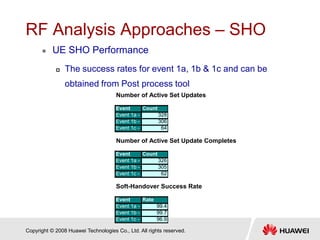
 UE SHO Performance
 The success rates for event 1a, 1b & 1c and can be
obtained from Post process tool
Number of Active Set Updates
Event Count
Event 1a - Cell Addition328
Event 1b - Cell Removal306
Event 1c - Cell Replacement64
Number of Active Set Update Completes
Event Count
Event 1a - Cell Addition326
Event 1b - Cell Removal305
Event 1c - Cell Replacement62
Soft-Handover Success Rate
Event Rate
Event 1a - Cell Addition99.4
Event 1b - Cell Removal99.7
Event 1c - Cell Replacement96.9
Copyright © 2008 Huawei Technologies Co., Ltd. All rights reserved.
RF Analysis Approaches – Drop
Call
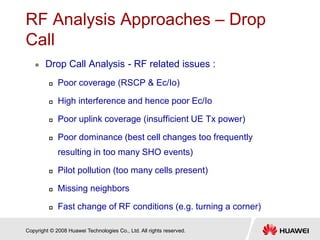
 Drop Call Analysis - RF related issues :
 Poor coverage (RSCP & Ec/Io)
 High interference and hence poor Ec/Io
 Poor uplink coverage (insufficient UE Tx power)
 Poor dominance (best cell changes too frequently
resulting in too many SHO events)
 Pilot pollution (too many cells present)
 Missing neighbors
 Fast change of RF conditions (e.g. turning a corner)
Copyright © 2008 Huawei Technologies Co., Ltd. All rights reserved.
RF Analysis Approaches – Drop
Call
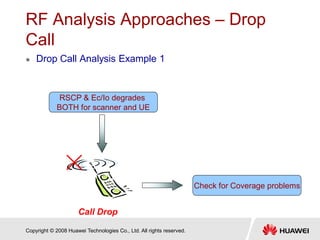
 Drop Call Analysis Example 1
Call Drop
RSCP & Ec/Io degrades
BOTH for scanner and UE
Check for Coverage problems
Copyright © 2008 Huawei Technologies Co., Ltd. All rights reserved.
RF Analysis Approaches – Drop
Call
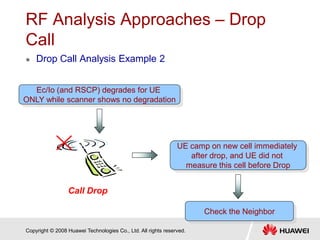
 Drop Call Analysis Example 2
Call Drop
Ec/Io (and RSCP) degrades for UE
ONLY while scanner shows no degradation
UE camp on new cell immediately
after drop, and UE did not
measure this cell before Drop
Check the Neighbor
Copyright © 2008 Huawei Technologies Co., Ltd. All rights reserved.
RF Analysis Approaches – Drop
Call
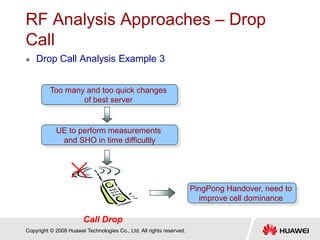
 Drop Call Analysis Example 3
Call Drop
Too many and too quick changes
of best server
UE to perform measurements
and SHO in time difficultly
PingPong Handover, need to
improve cell dominance
Copyright © 2008 Huawei Technologies Co., Ltd. All rights reserved.
Course Contents
Chapter 1 Optimization Phases
Chapter 2 RF Optimization Summary
Chapter 3 RF Analysis Approaches
Chapter 4 Antenna Adjustment Example
Chapter 5 Drop Call Analysis Example
Copyright © 2008 Huawei Technologies Co., Ltd. All rights reserved.
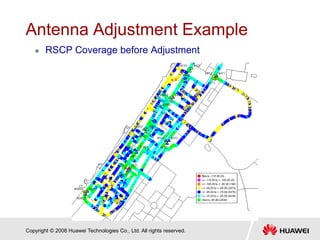
Antenna Adjustment Example
 RSCP Coverage before Adjustment
Copyright © 2008 Huawei Technologies Co., Ltd. All rights reserved.
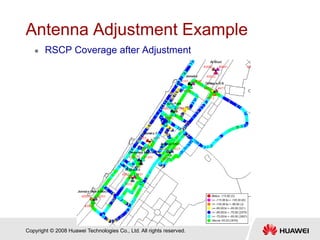
Antenna Adjustment Example
 RSCP Coverage after Adjustment
Copyright © 2008 Huawei Technologies Co., Ltd. All rights reserved.
Antenna Adjustment Example
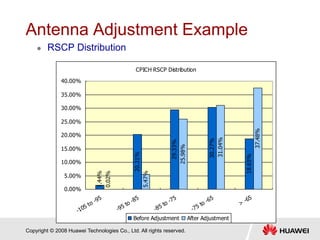
 RSCP Distribution
CPICH RSCP Distribution
1.44%
20.31%
29.33%
30.27%
18.65%
0.02%
5.47%
25.98%
31.04%
37.48%
0.00%
5.00%
10.00%
15.00%
20.00%
25.00%
30.00%
35.00%
40.00%
-105 to -95
-95 to -85
-85 to -75
-75 to -65
>
-65
Before Adjustment After Adjustment
Copyright © 2008 Huawei Technologies Co., Ltd. All rights reserved.
Antenna Adjustment Example
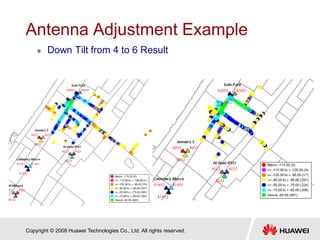
 Down Tilt from 4 to 6 Result
Copyright © 2008 Huawei Technologies Co., Ltd. All rights reserved.
Antenna Adjustment Example
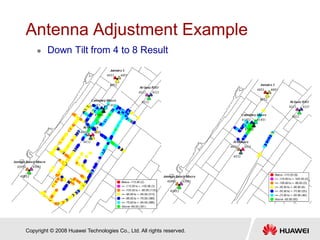
 Down Tilt from 4 to 8 Result
Copyright © 2008 Huawei Technologies Co., Ltd. All rights reserved.
Course Contents
Chapter 1 Optimization Phases
Chapter 2 RF Optimization Summary
Chapter 3 RF Analysis Approaches
Chapter 4 Antenna Adjustment Example
Chapter 5 Drop Call Analysis Example
Copyright © 2008 Huawei Technologies Co., Ltd. All rights reserved.
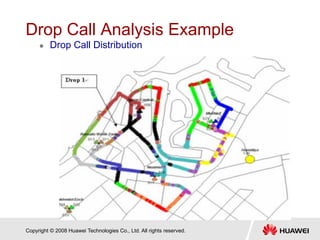
Drop Call Analysis Example
 Drop Call Distribution
Copyright © 2008 Huawei Technologies Co., Ltd. All rights reserved.
Drop Call Analysis Example
 There are total 5 drop calls in the plot.
 The example of drop call 1 is analyzed to show the
process of analysis in the following.
 Drop call 1 occurred at an area of frequent change of
best server as shown by the scanner scrambling code
plot
Copyright © 2008 Huawei Technologies Co., Ltd. All rights reserved.
Drop Call Analysis Example
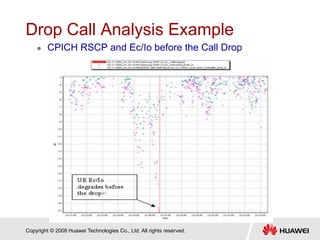
 CPICH RSCP and Ec/Io before the Call Drop
Copyright © 2008 Huawei Technologies Co., Ltd. All rights reserved.
Drop Call Analysis Example
 Compare Ec/Io from both scanner and UE at the time of the
drop as shown in Figure. This clearly shows the UE Ec/Io to
drop to < -21 dB while the scanner remained above -11 dB.
Copyright © 2008 Huawei Technologies Co., Ltd. All rights reserved.
Drop Call Analysis Example
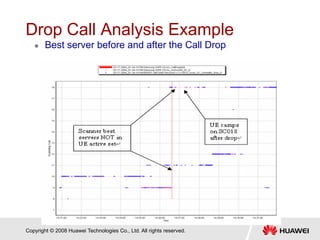
 Best server before and after the Call Drop
Copyright © 2008 Huawei Technologies Co., Ltd. All rights reserved.
Drop Call Analysis Example
 Comparing the best servers from the UE and the
scanner at the time of drop:
 Drop Call 1 (UE vs. scanner best server) shows that for
the scanner and UE SC008 is the best server prior to the
drop. However, about 30 seconds before the drop, the
scanner selected SC018 as the best server while the UE
continued to have only SC009 in its active set resulting in
the drop call. Immediately after the drop, the UE camps on
SC018.
Copyright © 2008 Huawei Technologies Co., Ltd. All rights reserved.
Drop Call Analysis Example
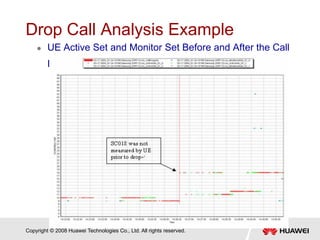
 UE Active Set and Monitor Set Before and After the Call
Drop
Copyright © 2008 Huawei Technologies Co., Ltd. All rights reserved.
Drop Call Analysis Example
 Conclusion
 Examining the UE Active and Monitored set, Figure does not
show SC018 to be measured by the UE prior to the drop.
 This scenario resembles a missing neighbor problem
Copyright © 2008 Huawei Technologies Co., Ltd. All rights reserved.
Drop Call Analysis Example
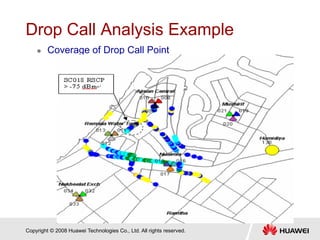
 Coverage of Drop Call Point
Copyright © 2008 Huawei Technologies Co., Ltd. All rights reserved.
Drop Call Analysis Example
 Solution:
 Looking at drop call Figure clearly shows that at the
location of the drop, SC018 should not be the best server.
 Cell SC018 clearly requires some down tilting to control its
interference into the area of Drop 1. To illustrate this,
RSCP coverage of SC018 shows clearly that the cell’s is
extending into a large area. E.g. around the location of
drop call, SC018 RSCP is > -75dBm.
 Add the Missing Neighbors
Thank you
www.huawei.com

Wcdma RNO RF optimization

  • 1.
    www.huawei.com Copyright © 2008Huawei Technologies Co., Ltd. All rights reserved. WCDMA RNO RF Optimization
  • 2.
    Copyright © 2008Huawei Technologies Co., Ltd. All rights reserved.  This lecture introduces the various stages involved in optimizing a 3G radio network and focuses mainly on the RF Optimization phase.  Step-by-step approach for the analysis of drive survey data collected by Scanner and test UE is presented. The analysis is carried out using the post processing tool. Review
  • 3.
    Copyright © 2008Huawei Technologies Co., Ltd. All rights reserved. Review  RF optimization will be an ongoing activity and will need to be revisited as traffic increases in the network and as new sites are deployed.  In addition, as the network matures, the optimization process should be enhanced to take into account statistical data and key performance indicators collected throughout the network.
  • 4.
    Copyright © 2008Huawei Technologies Co., Ltd. All rights reserved. Course Contents Chapter 1 Optimization Phases Chapter 2 RF Optimization Summary Chapter 3 RF Analysis Approaches Chapter 4 Antenna Adjustment Example Chapter 5 Drop Call Analysis Example
  • 5.
    Copyright © 2008Huawei Technologies Co., Ltd. All rights reserved. Network Optimization Phases – Flow Chart New Site Integrated Single Site Verification RF Optimization Cluster of Sites Ready? Service Test and Parameter Optimization Regular Reference Route Testing and Stats Analysis Re-optimization Needed? Y N N Y
  • 6.
    Copyright © 2008Huawei Technologies Co., Ltd. All rights reserved. Network Optimization Phases – Step 1  Single Site Verification  To verify the functionality of every new site.  Objectives  To ensure there are no faults related to hardware installation or parameter settings.
  • 7.
    Copyright © 2008Huawei Technologies Co., Ltd. All rights reserved. Network Optimization Phases – Step 2  RF Optimization  Once most the sites in a given area are integrated and verified, RF (or Cluster) optimization could begin.  Objectives  To optimize coverage while in the same time keeping interference and pilot pollution under control over the target area. This phase also includes the verification and optimization of the 3G neighbor lists.
  • 8.
    Copyright © 2008Huawei Technologies Co., Ltd. All rights reserved. Network Optimization Phases – Step 3  Services Testing & Parameters Optimization  To be conducted in areas of good RF conditions in order to exclude any coverage issues. Such testing does not need to be performed for each cell but the drive route must include different clutter types and environments.  Objectives  To assess the performance and identify any need for specific parameter optimization.
  • 9.
    Copyright © 2008Huawei Technologies Co., Ltd. All rights reserved. Network Optimization Phases – Step 4  Regular Reference Route Testing & Stats Analysis  Constant monitoring and evaluation of the network performance can be based on drive test as well as traffic statistic analysis.  Results of the regular analysis may necessitate re-visits to the RF optimization and/or parameters’ tuning.  Objectives  To identify any new issues that could arise, for example, as a result of increase in traffic or changes in the environment.
  • 10.
    Copyright © 2008Huawei Technologies Co., Ltd. All rights reserved. Course Contents Chapter 1 Optimization Phases Chapter 2 RF Optimization Summary Chapter 3 RF Analysis Approaches Chapter 4 Antenna Adjustment Example Chapter 5 Drop Call Analysis Example
  • 11.
    Copyright © 2008Huawei Technologies Co., Ltd. All rights reserved. RF Optimization - Preparation  Clusters  RF optimization should be carried out for groups or clusters of sites rather than on single site basis, because the cells’ performance (capacity, coverage and quality) will influence each other. Cluster division in a project
  • 12.
    Copyright © 2008Huawei Technologies Co., Ltd. All rights reserved. RF Optimization - Preparation  Drive Routes  Cluster drive surveys should include the coverage areas of each cell and all the major roads and streets as well as any other important locations.
  • 13.
    Copyright © 2008Huawei Technologies Co., Ltd. All rights reserved. RF Optimization - Preparation  Tools  DTI, Anritsu or Agilent scanner  Huawei U626, Qualcomm UE, etc  Huawei Genex Assistant or Actix Analyzer  GPS GARMIN Series GPS DTI Scanner (Built-in GPS) Anritsu Scanner Trimble Series GPS Qualcomm TM6250/ 6275 AT Command Supported Mobile Huawei WCDMA/HSDPA Data card *Support WCDMA 1800/1900/2100M
  • 14.
    Copyright © 2008Huawei Technologies Co., Ltd. All rights reserved. RF Optimization - Targets Item Requirements Comments CPICH RSCP Target ≥ - 85 dBm Corresponds to outdoor measurements.Minimum -95 dBm CPICH Ec/Io Target ≥ -8 dB Applicable for unloaded network. Minimum - 14 dB Active Set size (estimated) Target ≤ 3 Based on scanner data. Pilot pollution Max % < 10 % % of time a cell is seen as a pilot polluter. Threshold 8 dB Relative to best server when cell is not in Active Set. UE Tx power Max <15 dBm Assuming 21 dBm max. SHO Success rate Target >95 % For e1a, e1b & e1c
  • 15.
    Copyright © 2008Huawei Technologies Co., Ltd. All rights reserved. RF Optimization – Flow Chart Drive Test Identify any RF Issues Identify candidate cells for changes Identify nature of required changes Determine amount of changes Implement changes Repeat Drive Test Finish N Problem Resolved?
  • 16.
    Copyright © 2008Huawei Technologies Co., Ltd. All rights reserved. RF Optimization - Solutions  Antenna down tilt  Antenna azimuth  Antenna location  Antenna height  Antenna type  Site location  New site
  • 17.
    Copyright © 2008Huawei Technologies Co., Ltd. All rights reserved. Course Contents Chapter 1 Optimization Phases Chapter 2 RF Optimization Summary Chapter 3 RF Analysis Approaches Chapter 4 Antenna Adjustment Example Chapter 5 Drop Call Analysis Example
  • 18.
    Copyright © 2008Huawei Technologies Co., Ltd. All rights reserved. RF Analysis Approaches – Cell Dominance  Cells with no dominance at all  A site was not radiating during the drive survey  Very poor dominance can also be caused by blocking of the antenna. So a site visit must be made to verify the antenna clearance.  Cells with either excessive or poor dominance  This could be due to a high site or non-optimum antenna down tilts.  Cells with too large dominance will be causing interference to adjacent cells resulting in poorer quality and capacity.
  • 19.
    Copyright © 2008Huawei Technologies Co., Ltd. All rights reserved.  Areas of non-dominance:  Areas where there is not a single clear dominant cell and where the best server changes too frequently.  Result: Excessive number of soft hand off events reducing the system efficiency and increasing the probability of call drops.  UE vs. Scanner Best Serving Cells:  Comparison between the UE and scanner SC plots. Significant differences between the plots may indicate a missing neighbor or failed soft handoff problem. RF Analysis Approaches – Cell Dominance
  • 20.
    Copyright © 2008Huawei Technologies Co., Ltd. All rights reserved. RF Analysis Approaches – Cell Dominance
  • 21.
    Copyright © 2008Huawei Technologies Co., Ltd. All rights reserved. RF Analysis Approaches – CPICH Coverage  Check areas of poor coverage, suggestion value as below:  Good: RSCP ≥ -85 dBm  Fair: -95 dBm ≤ RSCP < -85 dBm  Poor: RSCP < - 95 dBm  Examine the RSCP coverage on per cell basis in order to highlight any cells that have too large a footprint.
  • 22.
    Copyright © 2008Huawei Technologies Co., Ltd. All rights reserved. RF Analysis Approaches – CPICH Coverage
  • 23.
    Copyright © 2008Huawei Technologies Co., Ltd. All rights reserved. RF Analysis Approaches – Interference  CPICH Ec/Io Plot  Good: Ec/Io ≥ -8 dB  Fair: -14 dB ≤ Ec/Io < -8 dB  Poor: Ec/Io < - 14 dB The -8 dB threshold takes into account the expected future interference increase as a result of increased traffic.
  • 24.
    Copyright © 2008Huawei Technologies Co., Ltd. All rights reserved. RF Analysis Approaches – Interference Because the RSCP Level is POOR, the fundamental cause of low Ec/Io is POOR COVERAGE -15.5 -104 -20 -19 -18 -17 -16 -15 -14 Ec/Io RSCP - 120 - 115 - 110 - 105 - 100 - 95 - 90 What’s the problem?
  • 25.
    Copyright © 2008Huawei Technologies Co., Ltd. All rights reserved. RF Analysis Approaches – Interference RSCP level is GOOD, this will imply strong SYSTEM INTERFERENCE -15.5 -63 -20 -19 -18 -17 -16 -15 -14 Ec/Io RSCP - 90 - 85 - 80 - 75 - 70 - 65 - 60 What’s the problem?
  • 26.
    Copyright © 2008Huawei Technologies Co., Ltd. All rights reserved. RF Analysis Approaches – Interference
  • 27.
    Copyright © 2008Huawei Technologies Co., Ltd. All rights reserved. RF Analysis Approaches – UL Coverage  Uplink Coverage (UE Tx Power)  High UE Tx power means possible poor uplink coverage.  Areas of high Tx power should be compared to the CPICH pilots to verify if the problem only exists on the uplink.
  • 28.
    Copyright © 2008Huawei Technologies Co., Ltd. All rights reserved. RF Analysis Approaches – UL Coverage
  • 29.
    Copyright © 2008Huawei Technologies Co., Ltd. All rights reserved. RF Analysis Approaches – Pilot Pollution  Pilot Pollution Point Define:  Within a certain margin (which is called ThRSCP_Relative) to the best server  The pilot number (whose strength > best server strength– ThRSCP_Relative) > ThN (ThN means active set size, normally 3)  Cells which are frequently seen as polluters (e.g. >8% time) should be marked and investigated.  Pilot Pollution results should be used in conjunction with the Estimated Active Set Size
  • 30.
    Copyright © 2008Huawei Technologies Co., Ltd. All rights reserved. RF Analysis Approaches – Pilot Pollution -62 -64 -66 -68 -69 -81 -90 -85 -80 -75 -70 -65 -60 SC1 SC2 SC3 SC4 SC5 SC6 RSCP(dBm) Active Set Pilot Pollution Margin Not Pilot Pollution ThRSCP_Relative was set 8 dB here
  • 31.
    Copyright © 2008Huawei Technologies Co., Ltd. All rights reserved. RF Analysis Approaches – Pilot Pollution SC Count % in Pollution Set 8 206 12.9% 9 165 10.3% 10 157 9.8% 11 156 9.7% 12 148 9.2% 13 135 8.4% 16 95 5.9% 17 94 5.9% 18 76 4.7% 19 74 4.6% 20 73 4.6% 21 56 3.5% 32 54 3.4% 35 39 2.4% 37 33 2.1% 43 19 1.2% 48 8 0.5% 53 7 0.4% 67 3 0.2% 80 2 0.1% 130 2 0.1% Should be investigated
  • 32.
    Copyright © 2008Huawei Technologies Co., Ltd. All rights reserved. RF Analysis Approaches – Pilot Pollution  Estimated Active Set Size  Another useful measure of pilot pollution is by looking at the estimated active set based on the scanner data. This plot is obtained by modeling the network soft handoff parameters within Post process tool.  In order to see areas of excessive SHO candidates, the estimated active set size is allowed to exceed maximum of 3.  This can be done in conjunction with the Pilot pollution analysis.
  • 33.
    Copyright © 2008Huawei Technologies Co., Ltd. All rights reserved. RF Analysis Approaches – Pilot Pollution  Estimated Active Set Size Example
  • 34.
    Copyright © 2008Huawei Technologies Co., Ltd. All rights reserved. RF Analysis Approaches – Neighbor List  Neighbor List Verification  The neighbor list could be verified and optimized using the Neighbor List Verification tool within Actix.  Recommendations for Each Cell:  Retain: This indicates that those neighbors have been confirmed from the drive survey data.  Add: Missing neighbors  Remove: These neighbors that were not measured but are in the neighbor list. Careful consideration is needed prior to removing neighbours since the Actix results are drive route dependent.
  • 35.
    Copyright © 2008Huawei Technologies Co., Ltd. All rights reserved. RF Analysis Approaches – Neighbor List  Neighbor List Verification Example 009 576 Retain 018 82 14.2% Retain 010 46 8.0% Retain 016 31 5.4% Retain 032 20 3.5% Retain 011 18 3.1% Add 130 17 3.0% Retain 021 17 3.0% Retain 008 12 2.1% Retain 020 6 1.0% Retain 012 5 0.9% Retain 017 2 0.3% Remove 053 0 0.0% Remove 019 0 0.0% Remove 034 0 0.0% Remove 037 0 0.0% Remove 013 0 0.0% Remove 051 0 0.0% 70548 Ajman Central 25.41204 55.447 Nbr SC Sample Count %Latitude Longitude Sample Count ActionSC Cell Site
  • 36.
    Copyright © 2008Huawei Technologies Co., Ltd. All rights reserved. RF Analysis Approaches – SHO  UE SHO Performance  The success rates for event 1a, 1b & 1c and can be obtained from Post process tool Number of Active Set Updates Event Count Event 1a - Cell Addition328 Event 1b - Cell Removal306 Event 1c - Cell Replacement64 Number of Active Set Update Completes Event Count Event 1a - Cell Addition326 Event 1b - Cell Removal305 Event 1c - Cell Replacement62 Soft-Handover Success Rate Event Rate Event 1a - Cell Addition99.4 Event 1b - Cell Removal99.7 Event 1c - Cell Replacement96.9
  • 37.
    Copyright © 2008Huawei Technologies Co., Ltd. All rights reserved. RF Analysis Approaches – Drop Call  Drop Call Analysis - RF related issues :  Poor coverage (RSCP & Ec/Io)  High interference and hence poor Ec/Io  Poor uplink coverage (insufficient UE Tx power)  Poor dominance (best cell changes too frequently resulting in too many SHO events)  Pilot pollution (too many cells present)  Missing neighbors  Fast change of RF conditions (e.g. turning a corner)
  • 38.
    Copyright © 2008Huawei Technologies Co., Ltd. All rights reserved. RF Analysis Approaches – Drop Call  Drop Call Analysis Example 1 Call Drop RSCP & Ec/Io degrades BOTH for scanner and UE Check for Coverage problems
  • 39.
    Copyright © 2008Huawei Technologies Co., Ltd. All rights reserved. RF Analysis Approaches – Drop Call  Drop Call Analysis Example 2 Call Drop Ec/Io (and RSCP) degrades for UE ONLY while scanner shows no degradation UE camp on new cell immediately after drop, and UE did not measure this cell before Drop Check the Neighbor
  • 40.
    Copyright © 2008Huawei Technologies Co., Ltd. All rights reserved. RF Analysis Approaches – Drop Call  Drop Call Analysis Example 3 Call Drop Too many and too quick changes of best server UE to perform measurements and SHO in time difficultly PingPong Handover, need to improve cell dominance
  • 41.
    Copyright © 2008Huawei Technologies Co., Ltd. All rights reserved. Course Contents Chapter 1 Optimization Phases Chapter 2 RF Optimization Summary Chapter 3 RF Analysis Approaches Chapter 4 Antenna Adjustment Example Chapter 5 Drop Call Analysis Example
  • 42.
    Copyright © 2008Huawei Technologies Co., Ltd. All rights reserved. Antenna Adjustment Example  RSCP Coverage before Adjustment
  • 43.
    Copyright © 2008Huawei Technologies Co., Ltd. All rights reserved. Antenna Adjustment Example  RSCP Coverage after Adjustment
  • 44.
    Copyright © 2008Huawei Technologies Co., Ltd. All rights reserved. Antenna Adjustment Example  RSCP Distribution CPICH RSCP Distribution 1.44% 20.31% 29.33% 30.27% 18.65% 0.02% 5.47% 25.98% 31.04% 37.48% 0.00% 5.00% 10.00% 15.00% 20.00% 25.00% 30.00% 35.00% 40.00% -105 to -95 -95 to -85 -85 to -75 -75 to -65 > -65 Before Adjustment After Adjustment
  • 45.
    Copyright © 2008Huawei Technologies Co., Ltd. All rights reserved. Antenna Adjustment Example  Down Tilt from 4 to 6 Result
  • 46.
    Copyright © 2008Huawei Technologies Co., Ltd. All rights reserved. Antenna Adjustment Example  Down Tilt from 4 to 8 Result
  • 47.
    Copyright © 2008Huawei Technologies Co., Ltd. All rights reserved. Course Contents Chapter 1 Optimization Phases Chapter 2 RF Optimization Summary Chapter 3 RF Analysis Approaches Chapter 4 Antenna Adjustment Example Chapter 5 Drop Call Analysis Example
  • 48.
    Copyright © 2008Huawei Technologies Co., Ltd. All rights reserved. Drop Call Analysis Example  Drop Call Distribution
  • 49.
    Copyright © 2008Huawei Technologies Co., Ltd. All rights reserved. Drop Call Analysis Example  There are total 5 drop calls in the plot.  The example of drop call 1 is analyzed to show the process of analysis in the following.  Drop call 1 occurred at an area of frequent change of best server as shown by the scanner scrambling code plot
  • 50.
    Copyright © 2008Huawei Technologies Co., Ltd. All rights reserved. Drop Call Analysis Example  CPICH RSCP and Ec/Io before the Call Drop
  • 51.
    Copyright © 2008Huawei Technologies Co., Ltd. All rights reserved. Drop Call Analysis Example  Compare Ec/Io from both scanner and UE at the time of the drop as shown in Figure. This clearly shows the UE Ec/Io to drop to < -21 dB while the scanner remained above -11 dB.
  • 52.
    Copyright © 2008Huawei Technologies Co., Ltd. All rights reserved. Drop Call Analysis Example  Best server before and after the Call Drop
  • 53.
    Copyright © 2008Huawei Technologies Co., Ltd. All rights reserved. Drop Call Analysis Example  Comparing the best servers from the UE and the scanner at the time of drop:  Drop Call 1 (UE vs. scanner best server) shows that for the scanner and UE SC008 is the best server prior to the drop. However, about 30 seconds before the drop, the scanner selected SC018 as the best server while the UE continued to have only SC009 in its active set resulting in the drop call. Immediately after the drop, the UE camps on SC018.
  • 54.
    Copyright © 2008Huawei Technologies Co., Ltd. All rights reserved. Drop Call Analysis Example  UE Active Set and Monitor Set Before and After the Call Drop
  • 55.
    Copyright © 2008Huawei Technologies Co., Ltd. All rights reserved. Drop Call Analysis Example  Conclusion  Examining the UE Active and Monitored set, Figure does not show SC018 to be measured by the UE prior to the drop.  This scenario resembles a missing neighbor problem
  • 56.
    Copyright © 2008Huawei Technologies Co., Ltd. All rights reserved. Drop Call Analysis Example  Coverage of Drop Call Point
  • 57.
    Copyright © 2008Huawei Technologies Co., Ltd. All rights reserved. Drop Call Analysis Example  Solution:  Looking at drop call Figure clearly shows that at the location of the drop, SC018 should not be the best server.  Cell SC018 clearly requires some down tilting to control its interference into the area of Drop 1. To illustrate this, RSCP coverage of SC018 shows clearly that the cell’s is extending into a large area. E.g. around the location of drop call, SC018 RSCP is > -75dBm.  Add the Missing Neighbors
  • 58.