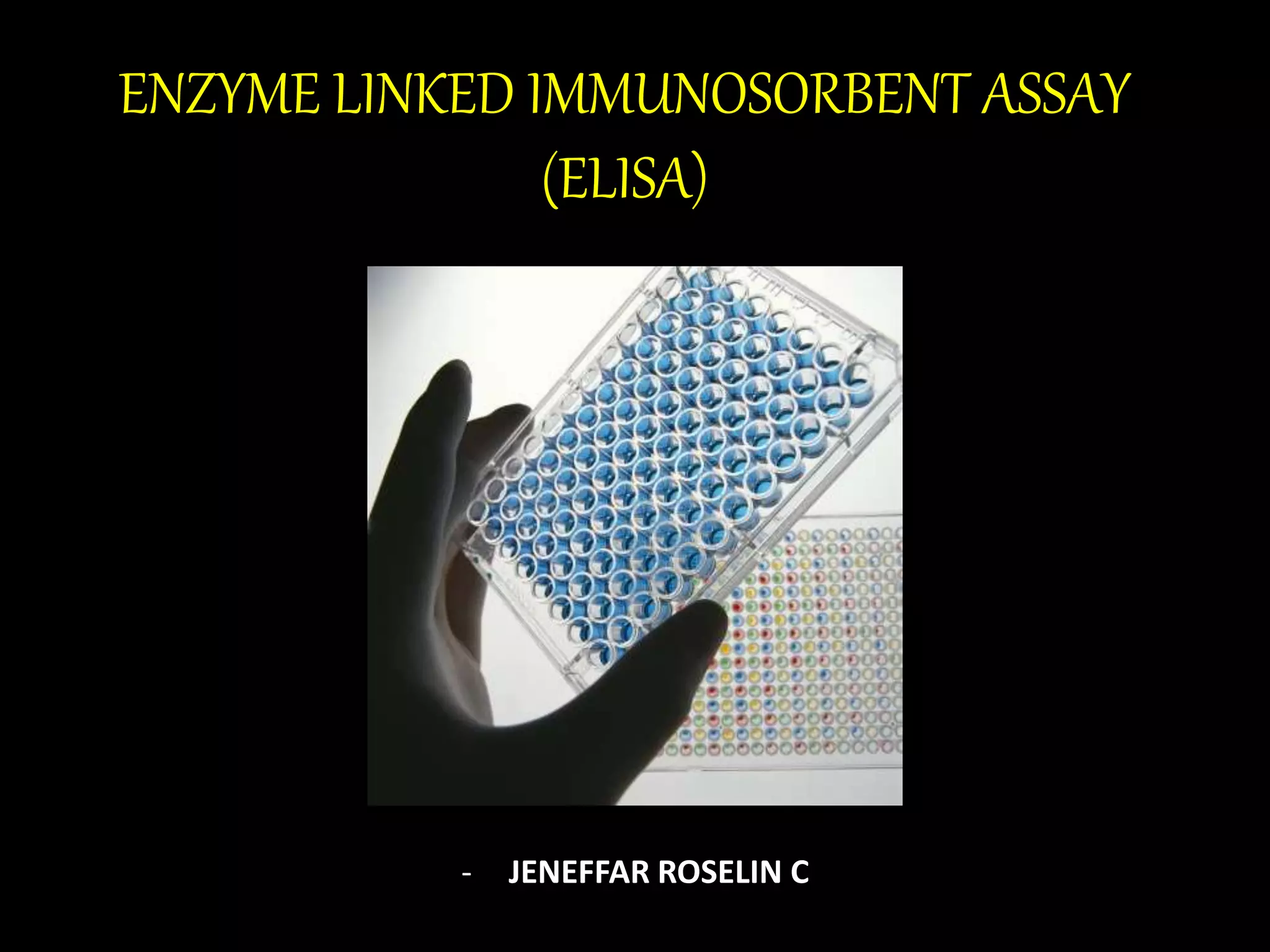
ENZYME LINKED IMMUNOSORBENT ASSAY
(ELISA)
- JENEFFAR ROSELIN C
HISTORY
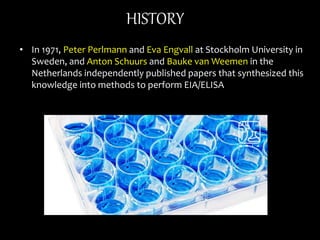
• In 1971, Peter Perlmann and Eva Engvall at Stockholm University in
Sweden, and Anton Schuurs and Bauke van Weemen in the
Netherlands independently published papers that synthesized this
knowledge into methods to perform EIA/ELISA
COMPONENTS OF ELISA
ANALYTE: Substance to be analyzed
ANTIBODY: IgG fraction of serum.
ENZYME: Horse Radish Peroxidase (HRP) MW 44, 000,
glycoprotein with 4 lysine residues.
SUBSTRATE: TMB (3,3',5,5', tetramethylbenzidine) The
enzyme acts as a catalyst to oxidize substrate in the
presence of Hydrogen peroxide to produce a blue color.
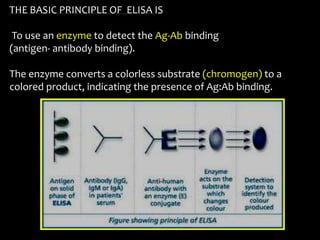
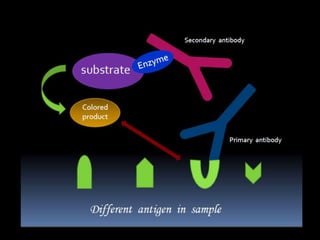
THE BASIC PRINCIPLE OF ELISA IS
To use an enzyme to detect the Ag-Ab binding
(antigen- antibody binding).
The enzyme converts a colorless substrate (chromogen) to a
colored product, indicating the presence of Ag:Ab binding.
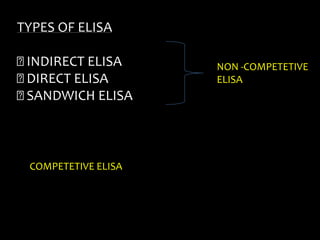
TYPES OF ELISA
INDIRECT ELISA
DIRECT ELISA
SANDWICH ELISA
COMPETETIVE ELISA
NON -COMPETETIVE
ELISA
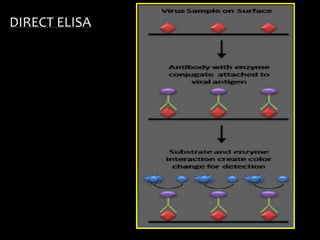
DIRECT ELISA
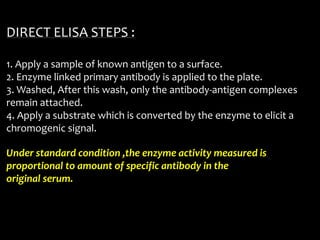
DIRECT ELISA STEPS :
1. Apply a sample of known antigen to a surface.
2. Enzyme linked primary antibody is applied to the plate.
3. Washed, After this wash, only the antibody-antigen complexes
remain attached.
4. Apply a substrate which is converted by the enzyme to elicit a
chromogenic signal.
Under standard condition ,the enzyme activity measured is
proportional to amount of specific antibody in the
original serum.
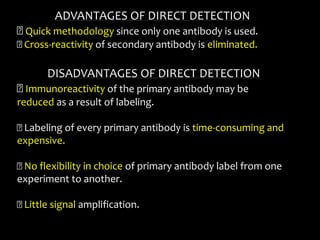
ADVANTAGES OF DIRECT DETECTION
Quick methodology since only one antibody is used.
Cross-reactivity of secondary antibody is eliminated.
DISADVANTAGES OF DIRECT DETECTION
Immunoreactivity of the primary antibody may be
reduced as a result of labeling.
Labeling of every primary antibody is time-consuming and
expensive.
No flexibility in choice of primary antibody label from one
experiment to another.
Little signal amplification.
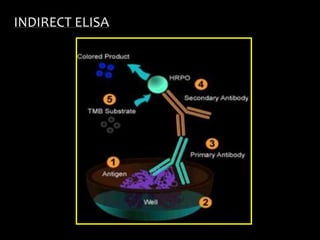
INDIRECT ELISA
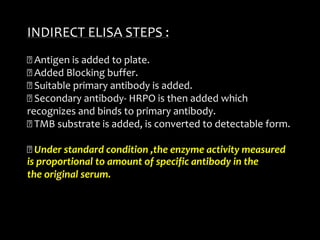
INDIRECT ELISA STEPS :
Antigen is added to plate.
Added Blocking buffer.
Suitable primary antibody is added.
Secondary antibody- HRPO is then added which
recognizes and binds to primary antibody.
TMB substrate is added, is converted to detectable form.
Under standard condition ,the enzyme activity measured
is proportional to amount of specific antibody in the
the original serum.
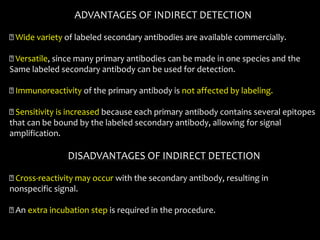
ADVANTAGES OF INDIRECT DETECTION
Wide variety of labeled secondary antibodies are available commercially.
Versatile, since many primary antibodies can be made in one species and the
Same labeled secondary antibody can be used for detection.
Immunoreactivity of the primary antibody is not affected by labeling.
Sensitivity is increased because each primary antibody contains several epitopes
that can be bound by the labeled secondary antibody, allowing for signal
amplification.
DISADVANTAGES OF INDIRECT DETECTION
Cross-reactivity may occur with the secondary antibody, resulting in
nonspecific signal.
An extra incubation step is required in the procedure.
SANDWICH ELISA
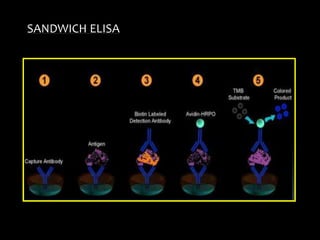
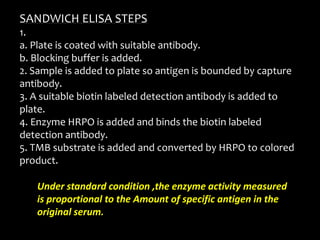
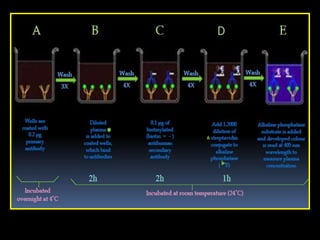
SANDWICH ELISA STEPS
1.
a. Plate is coated with suitable antibody.
b. Blocking buffer is added.
2. Sample is added to plate so antigen is bounded by capture
antibody.
3. A suitable biotin labeled detection antibody is added to
plate.
4. Enzyme HRPO is added and binds the biotin labeled
detection antibody.
5. TMB substrate is added and converted by HRPO to colored
product.
Under standard condition ,the enzyme activity measured
is proportional to the Amount of specific antigen in the
original serum.
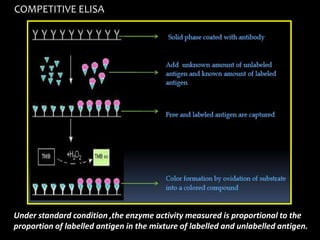
COMPETITIVE ELISA
Under standard condition ,the enzyme activity measured is proportional to the
proportion of labelled antigen in the mixture of labelled and unlabelled antigen.
ADVANTAGES:
Suitable for complex (crude or impure) samples, since
the antigen does not require purification prior to
measurement.
DISADVANTAGES:
Each antigen may require a different method to couple
it to the enzyme.
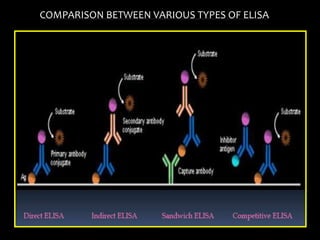
COMPARISON BETWEEN VARIOUS TYPES OF ELISA
The ELISA assay yields three different types of data output:
QUANTITATIVE: ELISA data can be interpreted in comparison to a standard
curve in order to precisely calculate the concentrations of antigen in various
samples.
QUALITATIVE: ELISAs can also be used to achieve a yes or no answer
indicating whether a particular antigen is present in a sample, as compared
to a blank well containing no antigen or an unrelated control antigen.
SEMI-QUANTITATIVE: ELISAs can be used to compare the relative levels of
antigen in assay samples, since the intensity of signal will vary directly with
antigen concentration.
ELISA RESULTS
Screening donated blood for evidence of viral contamination
by
• HIV-1 and HIV-2 (presence of anti-HIV antibodies)
• Hepatitis C (presence of antibodies)
• Hepatitis B (testing for both antibodies and a viral antigen)
Measuring hormone levels
• HCG (as a test for pregnancy)
• LH (determining the time of ovulation)
• TSH, T3 and T4 (for thyroid function)
Detecting infections
• Sexually-transmitted agents like HIV, syphilis and chlamydia
• Hepatitis B and C
• Toxoplasma gondii
Detecting illicit drugs.
Detecting allergens in food and house dust
APPLICATIONS :
THANK YOU

Enzyme linked immunosorbent assay

  • 1.
    ENZYME LINKED IMMUNOSORBENTASSAY (ELISA) - JENEFFAR ROSELIN C
  • 2.
    HISTORY • In 1971,Peter Perlmann and Eva Engvall at Stockholm University in Sweden, and Anton Schuurs and Bauke van Weemen in the Netherlands independently published papers that synthesized this knowledge into methods to perform EIA/ELISA
  • 3.
    COMPONENTS OF ELISA ANALYTE:Substance to be analyzed ANTIBODY: IgG fraction of serum. ENZYME: Horse Radish Peroxidase (HRP) MW 44, 000, glycoprotein with 4 lysine residues. SUBSTRATE: TMB (3,3',5,5', tetramethylbenzidine) The enzyme acts as a catalyst to oxidize substrate in the presence of Hydrogen peroxide to produce a blue color.
  • 4.
    THE BASIC PRINCIPLEOF ELISA IS To use an enzyme to detect the Ag-Ab binding (antigen- antibody binding). The enzyme converts a colorless substrate (chromogen) to a colored product, indicating the presence of Ag:Ab binding.
  • 6.
    TYPES OF ELISA INDIRECTELISA DIRECT ELISA SANDWICH ELISA COMPETETIVE ELISA NON -COMPETETIVE ELISA
  • 7.
  • 8.
    DIRECT ELISA STEPS: 1. Apply a sample of known antigen to a surface. 2. Enzyme linked primary antibody is applied to the plate. 3. Washed, After this wash, only the antibody-antigen complexes remain attached. 4. Apply a substrate which is converted by the enzyme to elicit a chromogenic signal. Under standard condition ,the enzyme activity measured is proportional to amount of specific antibody in the original serum.
  • 9.
    ADVANTAGES OF DIRECTDETECTION Quick methodology since only one antibody is used. Cross-reactivity of secondary antibody is eliminated. DISADVANTAGES OF DIRECT DETECTION Immunoreactivity of the primary antibody may be reduced as a result of labeling. Labeling of every primary antibody is time-consuming and expensive. No flexibility in choice of primary antibody label from one experiment to another. Little signal amplification.
  • 10.
  • 11.
    INDIRECT ELISA STEPS: Antigen is added to plate. Added Blocking buffer. Suitable primary antibody is added. Secondary antibody- HRPO is then added which recognizes and binds to primary antibody. TMB substrate is added, is converted to detectable form. Under standard condition ,the enzyme activity measured is proportional to amount of specific antibody in the the original serum.
  • 12.
    ADVANTAGES OF INDIRECTDETECTION Wide variety of labeled secondary antibodies are available commercially. Versatile, since many primary antibodies can be made in one species and the Same labeled secondary antibody can be used for detection. Immunoreactivity of the primary antibody is not affected by labeling. Sensitivity is increased because each primary antibody contains several epitopes that can be bound by the labeled secondary antibody, allowing for signal amplification. DISADVANTAGES OF INDIRECT DETECTION Cross-reactivity may occur with the secondary antibody, resulting in nonspecific signal. An extra incubation step is required in the procedure.
  • 13.
  • 14.
    SANDWICH ELISA STEPS 1. a.Plate is coated with suitable antibody. b. Blocking buffer is added. 2. Sample is added to plate so antigen is bounded by capture antibody. 3. A suitable biotin labeled detection antibody is added to plate. 4. Enzyme HRPO is added and binds the biotin labeled detection antibody. 5. TMB substrate is added and converted by HRPO to colored product. Under standard condition ,the enzyme activity measured is proportional to the Amount of specific antigen in the original serum.
  • 16.
    COMPETITIVE ELISA Under standardcondition ,the enzyme activity measured is proportional to the proportion of labelled antigen in the mixture of labelled and unlabelled antigen.
  • 17.
    ADVANTAGES: Suitable for complex(crude or impure) samples, since the antigen does not require purification prior to measurement. DISADVANTAGES: Each antigen may require a different method to couple it to the enzyme.
  • 18.
  • 19.
    The ELISA assayyields three different types of data output: QUANTITATIVE: ELISA data can be interpreted in comparison to a standard curve in order to precisely calculate the concentrations of antigen in various samples. QUALITATIVE: ELISAs can also be used to achieve a yes or no answer indicating whether a particular antigen is present in a sample, as compared to a blank well containing no antigen or an unrelated control antigen. SEMI-QUANTITATIVE: ELISAs can be used to compare the relative levels of antigen in assay samples, since the intensity of signal will vary directly with antigen concentration. ELISA RESULTS
  • 20.
    Screening donated bloodfor evidence of viral contamination by • HIV-1 and HIV-2 (presence of anti-HIV antibodies) • Hepatitis C (presence of antibodies) • Hepatitis B (testing for both antibodies and a viral antigen) Measuring hormone levels • HCG (as a test for pregnancy) • LH (determining the time of ovulation) • TSH, T3 and T4 (for thyroid function) Detecting infections • Sexually-transmitted agents like HIV, syphilis and chlamydia • Hepatitis B and C • Toxoplasma gondii Detecting illicit drugs. Detecting allergens in food and house dust APPLICATIONS :
  • 21.