1
Electronic Data Processing
(EDP)
Mr.Anjan Mahanta
LCCT,International Studies Program
2
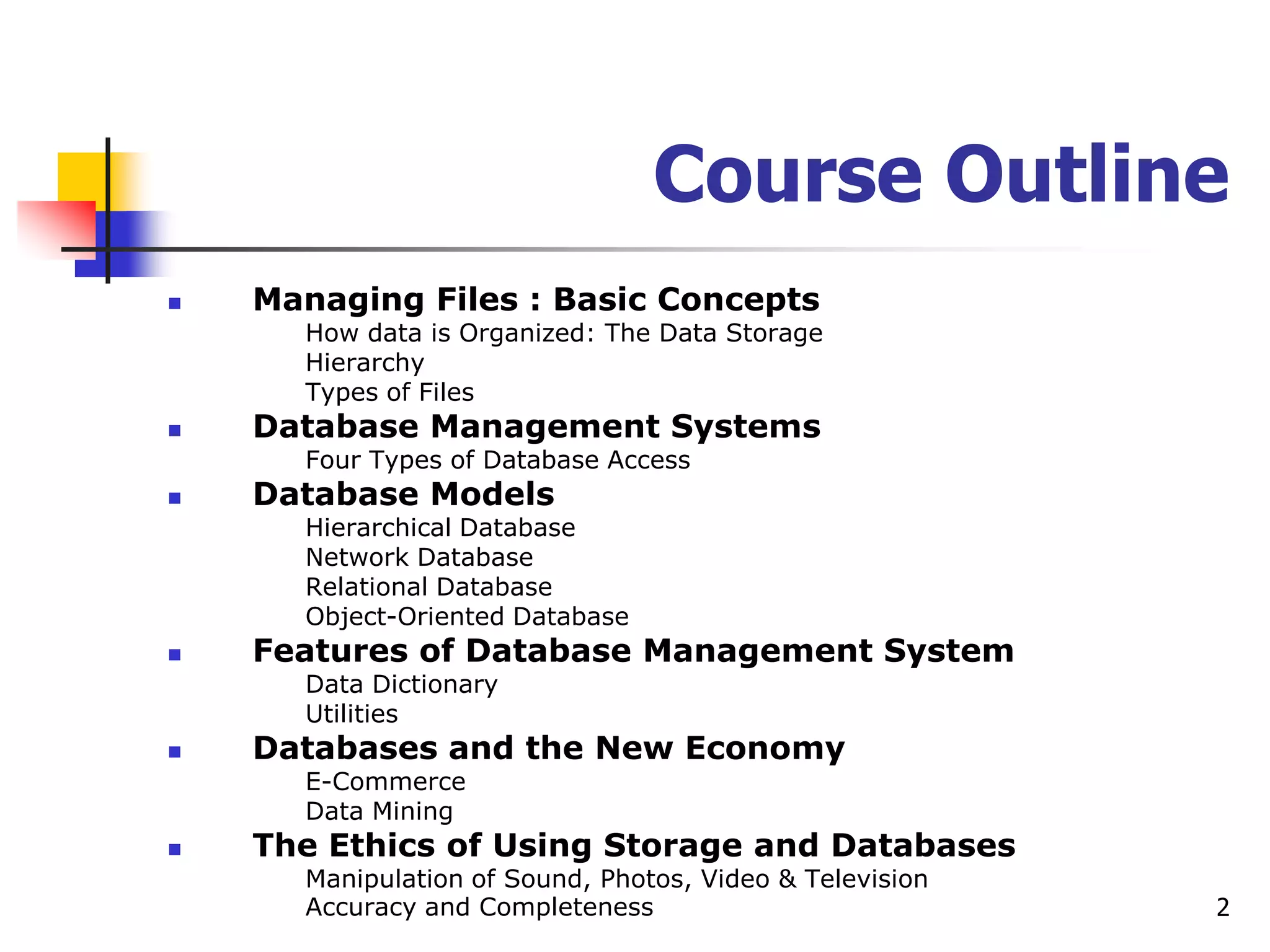
Course Outline
 Managing Files : Basic Concepts
How data is Organized: The Data Storage
Hierarchy
Types of Files
 Database Management Systems
Four Types of Database Access
 Database Models
Hierarchical Database
Network Database
Relational Database
Object-Oriented Database
 Features of Database Management System
Data Dictionary
Utilities
 Databases and the New Economy
E-Commerce
Data Mining
 The Ethics of Using Storage and Databases
Manipulation of Sound, Photos, Video & Television
Accuracy and Completeness
3
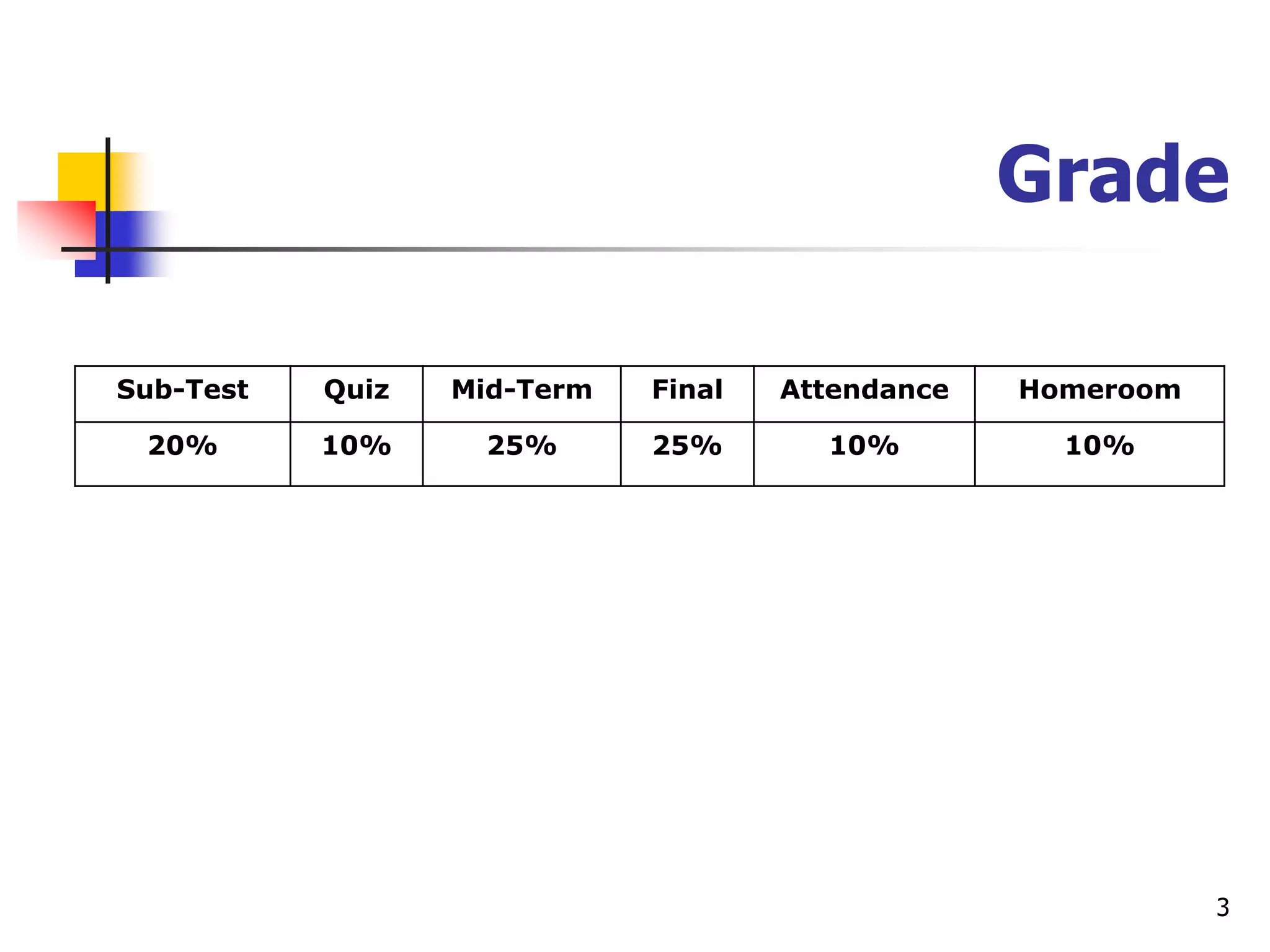
Grade
Sub-Test Quiz Mid-Term Final Attendance Homeroom
20% 10% 25% 25% 10% 10%
4
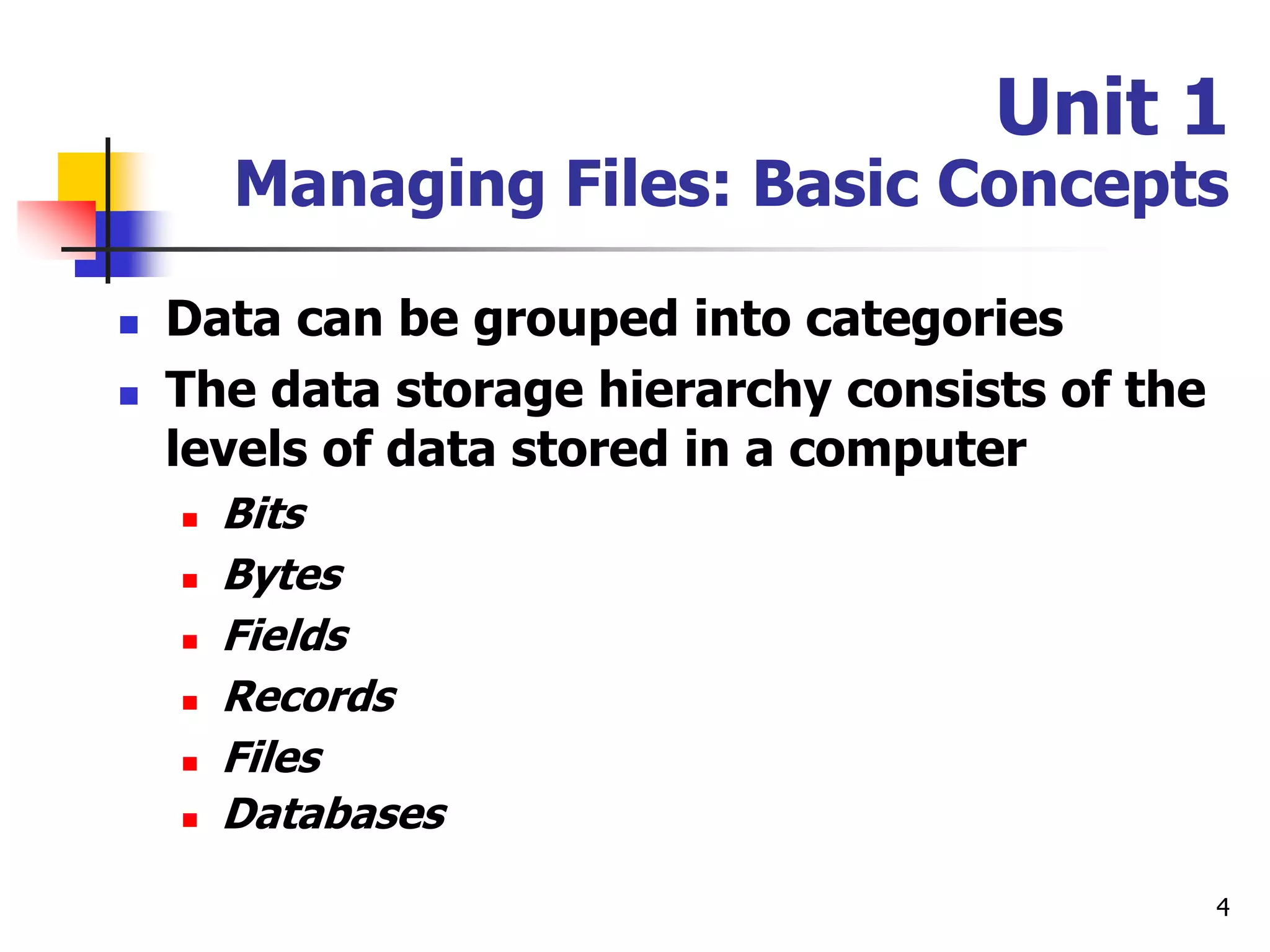
Unit 1
Managing Files: Basic Concepts
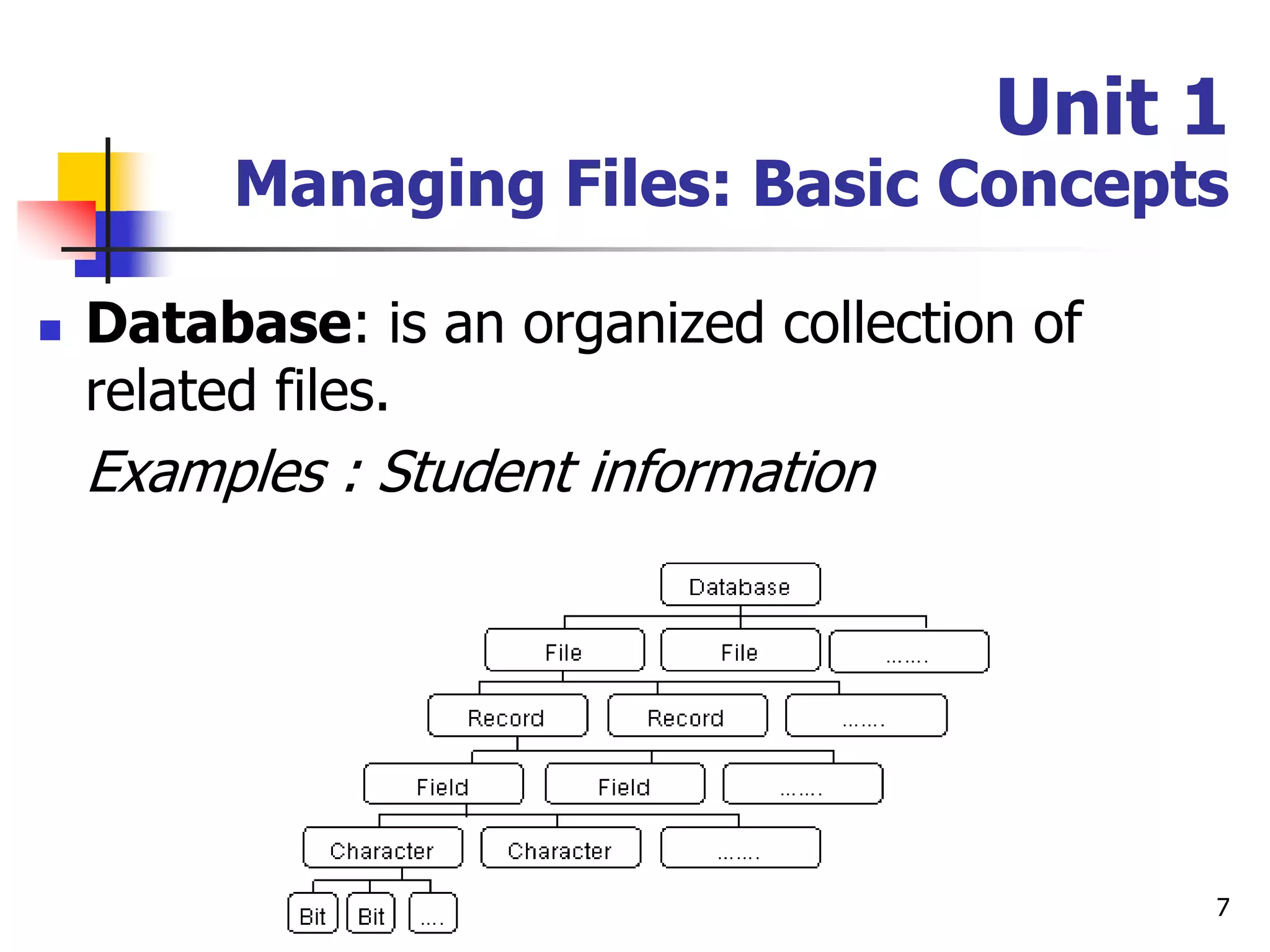
 Data can be grouped into categories
 The data storage hierarchy consists of the
levels of data stored in a computer
 Bits
 Bytes
 Fields
 Records
 Files
 Databases
5
Unit 1
Managing Files: Basic Concepts
 Characters: A character (byte) is a letter,
number, or special character
Examples : A, B, C, 1, 2, 3, #, $, %
 Field: A field is a unit of data consisting of
one or more characters (bytes).
Examples: your name, address
6
Unit 1
Managing Files: Basic Concepts
 Record: A record is a collection of related
fields.
Examples : Student code, name and address
 File: A file is a collection of related records.
Examples: file of students grade information
7
Unit 1
Managing Files: Basic Concepts
 Database: is an organized collection of
related files.
Examples : Student information
8
Unit 1
Managing Files: Basic Concepts
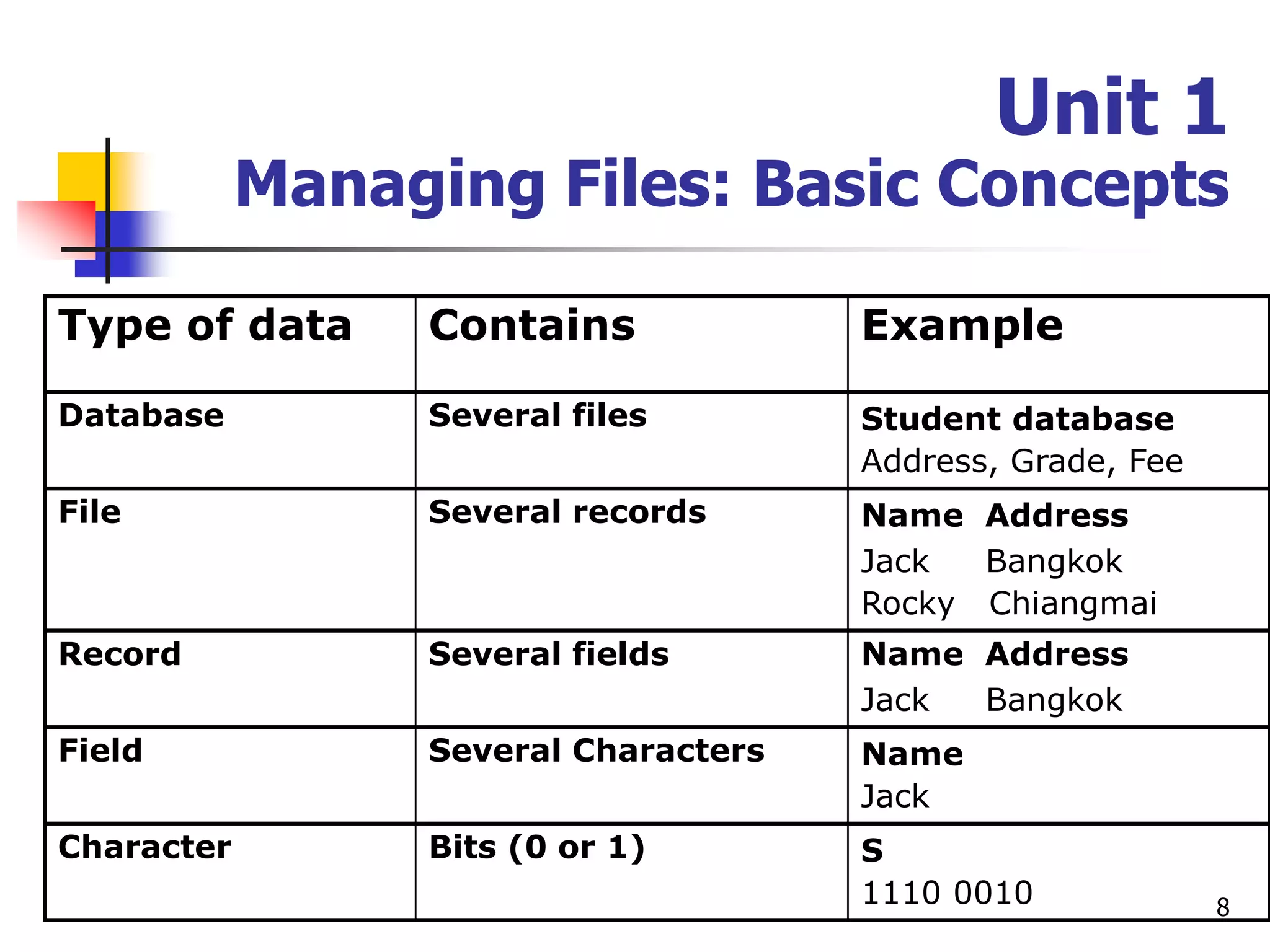
Type of data Contains Example
Database Several files Student database
Address, Grade, Fee
File Several records Name Address
Jack Bangkok
Rocky Chiangmai
Record Several fields Name Address
Jack Bangkok
Field Several Characters Name
Jack
Character Bits (0 or 1) S
1110 0010
9
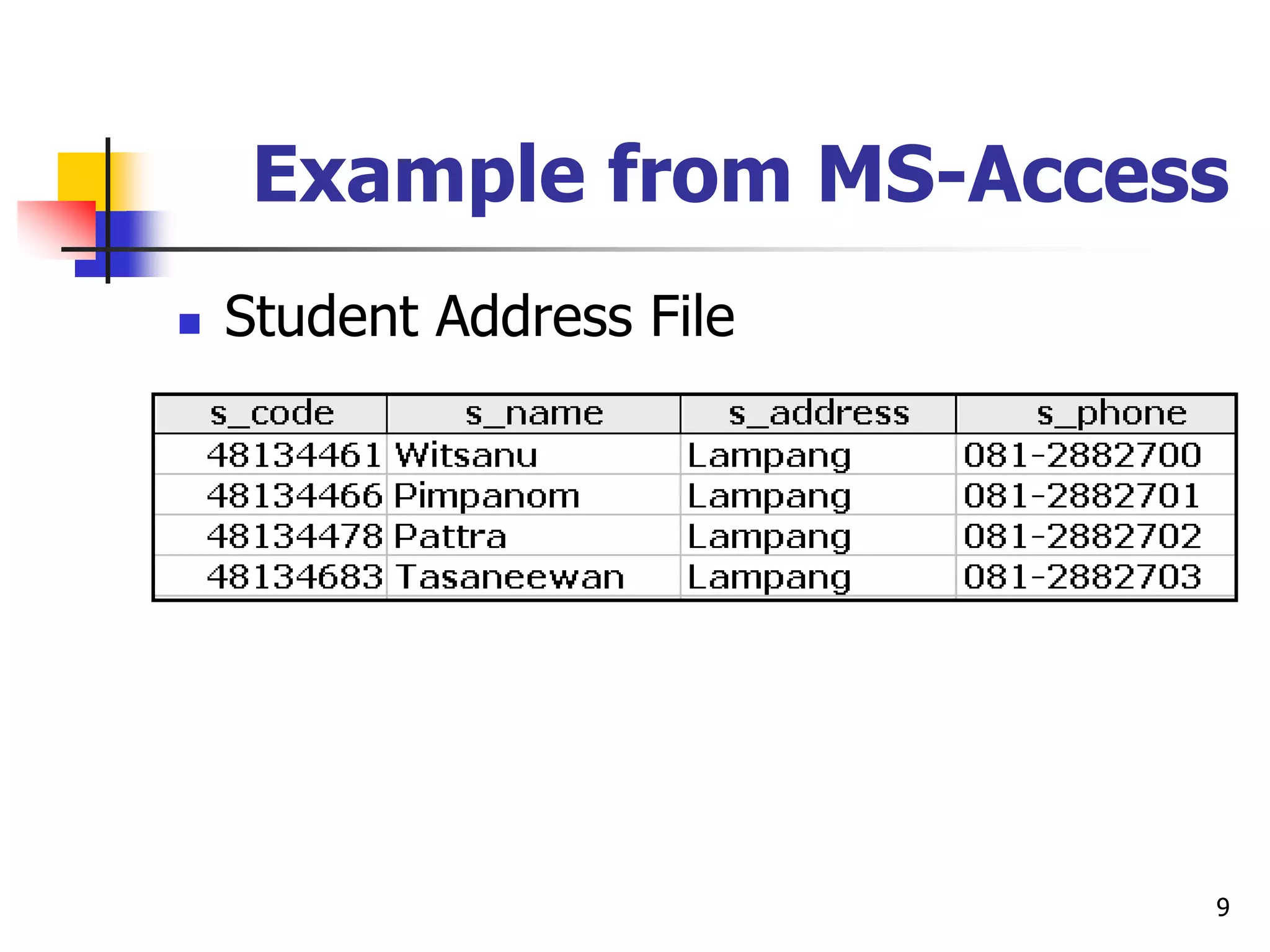
Example from MS-Access
 Student Address File
10
Exercise - 1
 What are databases?
 Write five examples of databases.
 Design one database in details showing
fields and records.
11
Primary Key Field
 A key field uniquely identify a record
 It helps to easily process the database
 Example:
student_code is a key field in a
student database
12
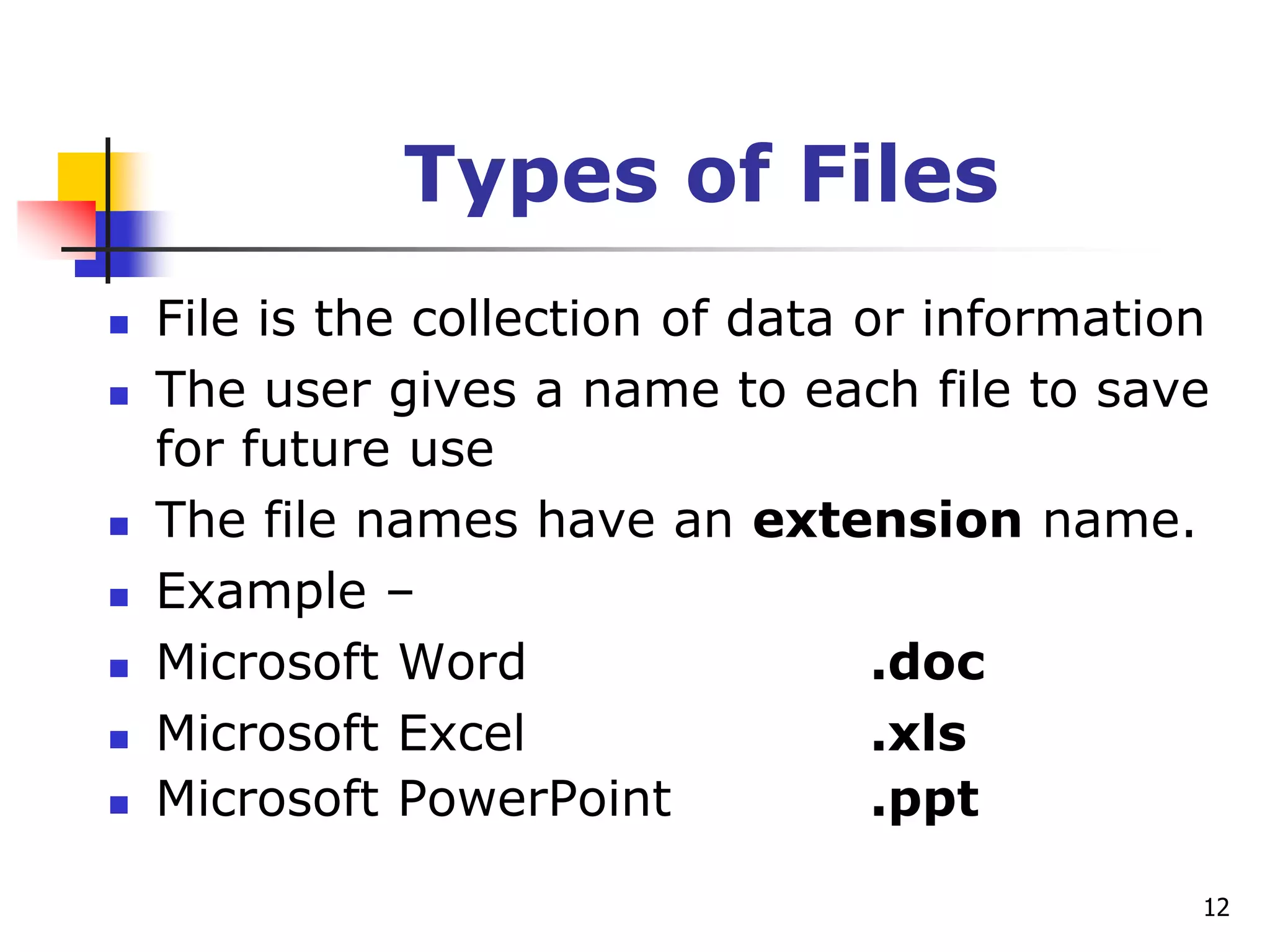
Types of Files
 File is the collection of data or information
 The user gives a name to each file to save
for future use
 The file names have an extension name.
 Example –
 Microsoft Word .doc
 Microsoft Excel .xls
 Microsoft PowerPoint .ppt
13
Types of Files
 There are many types of files but the
most important types are –
Program files
Data files
14
Program Files
 Program files are files containing software
instructions.
 The program files are instruction files written
by a program for a particular application
 They have a file extension. For example –
.bas for BASIC, .pas for Pascal or .jav for Java
 For the processor to use a source file at first it
must be converted to an executable file,
.exe file
15
Data files
 Data files are files that contain data –
words, numbers, pictures, sounds, etc.
 Data files are created by the users.
16
Other types of files
 ASCII files
 .txt
 Image(graphic files)
 .bmp, .gif, .jpg, .pcx, .tif, .wmf
 Audio files
 .wav, .mid, .mp3
 Animation/video files
 .avi, .mpg
 Web files
 .html, .htm, .xml, .php, .asp
17
Exercise
 What is a primary key?
 What is a file?
 What are the types of file?
18
Types of Data Files
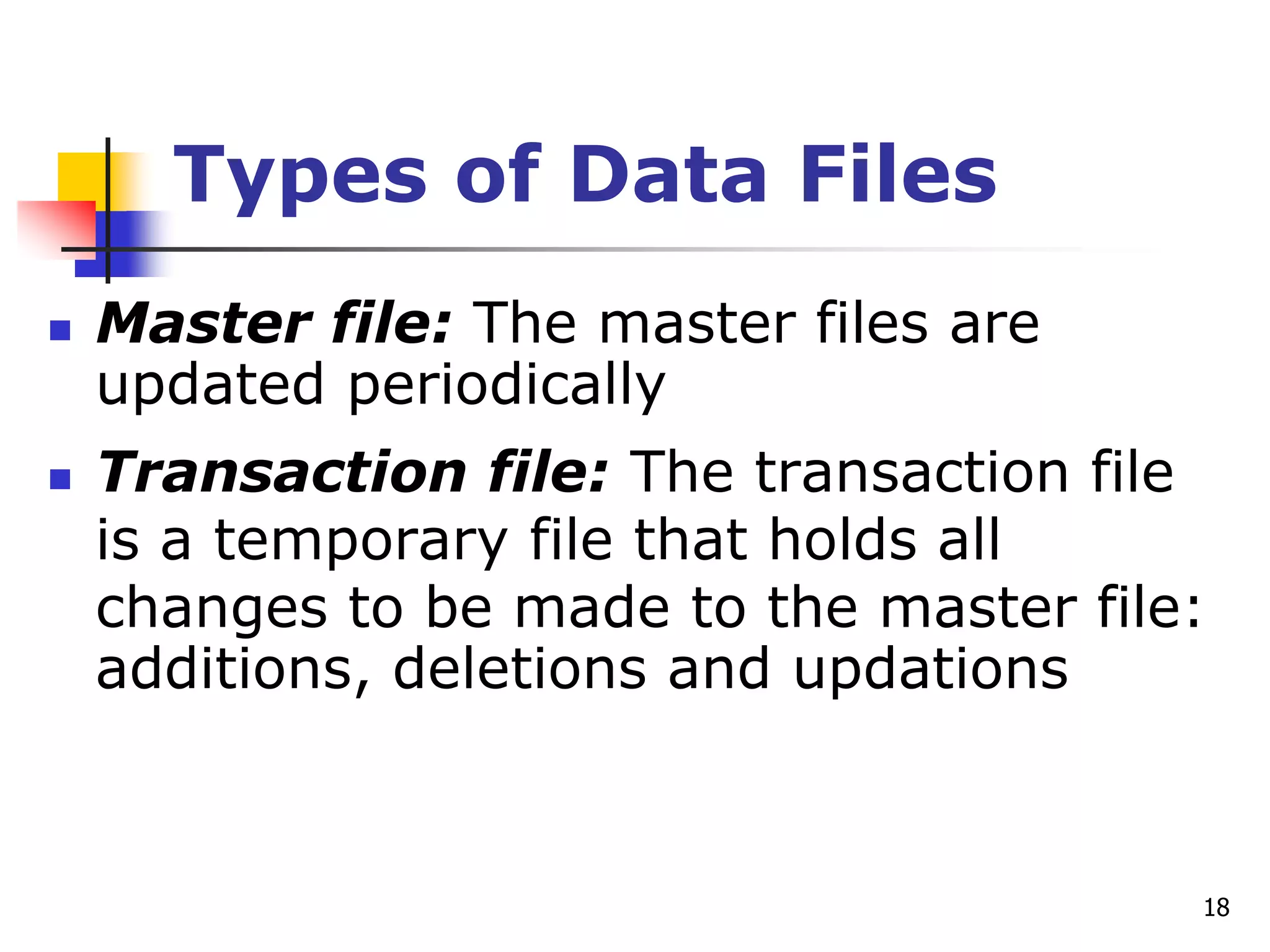
 Master file: The master files are
updated periodically
 Transaction file: The transaction file
is a temporary file that holds all
changes to be made to the master file:
additions, deletions and updations
19
Example
20
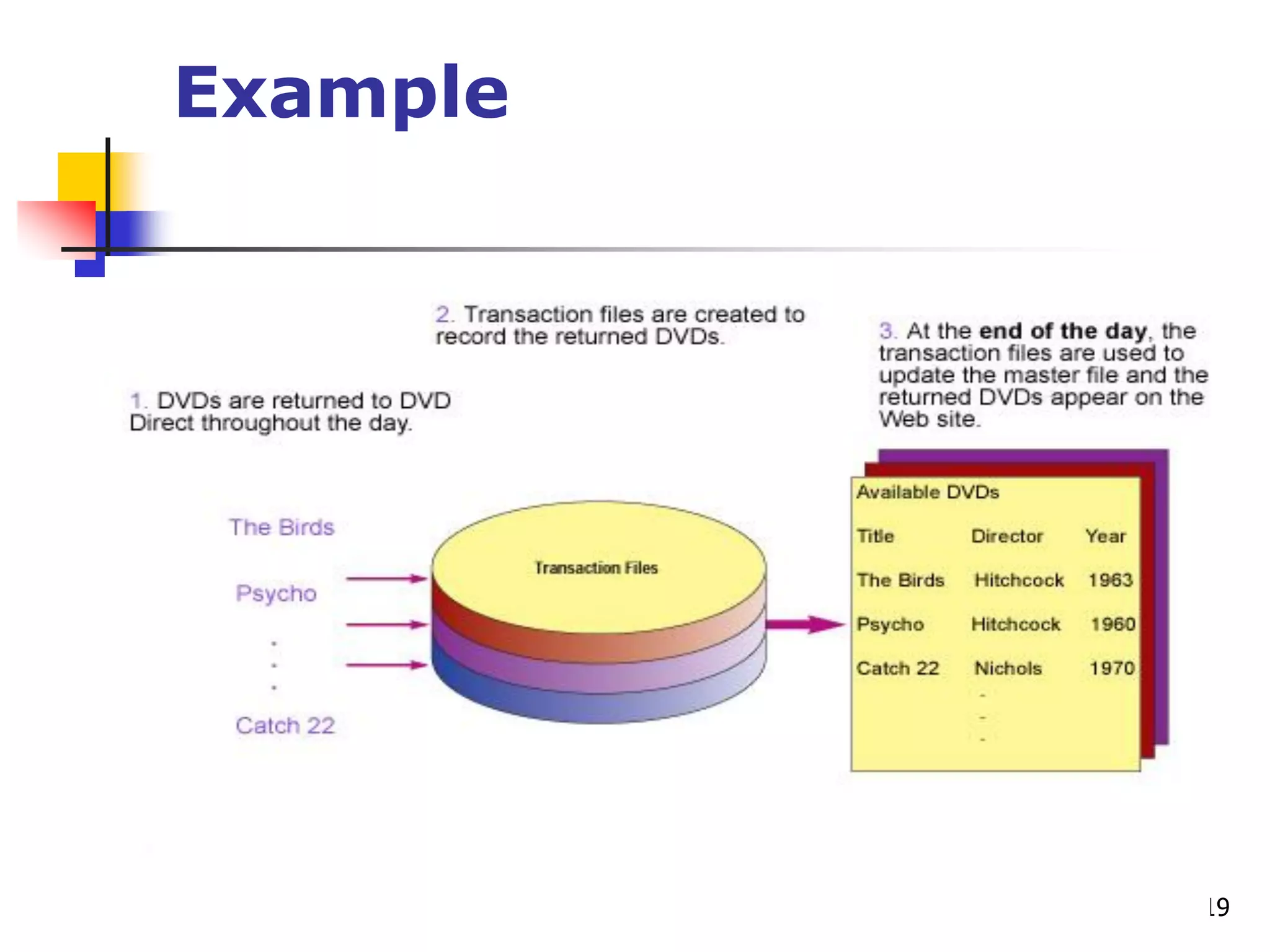
Data Access Methods
21
Data Access Methods
 Sequential Storage: means that data is
stored and retrieved in sequence, in
alphabetically – ascending or descending
order
 Example: A tape cassette
 Advantage: less expensive
 Disadvantage: file searching is slow
22
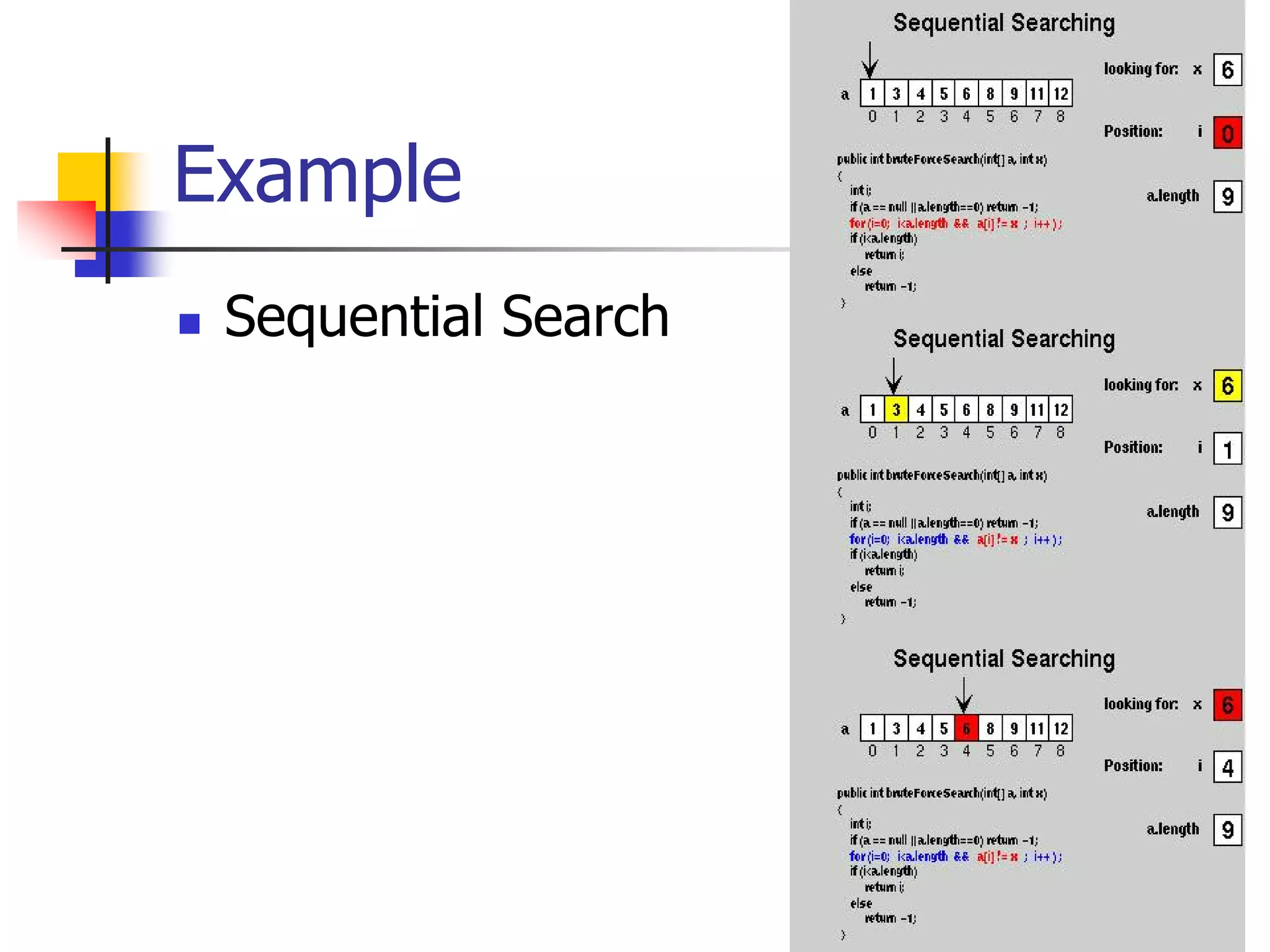
Example
 Sequential Search
23
Data Access Methods
 Direct Access Storage: means that
computer can go directly to the information
you want. It is also known as random.
 Example: A CD Player
 Advantage: faster
 Disadvantage: more expensive
24
Exercise
1. What is a master file?
2. What is a transaction file?
3. What is sequential storage?
4. What is direct access storage?
25
Offline Storage
 Offline storage means that data is not in
the direct control on the CPU. It maybe
saved in a CD.
 The data has to be loaded onto an input
device.
26
Online Storage
 Online storage means that data is
immediately accessible by the CPU.
 You need not wait for a CD.
 Storage is on the disk (direct access storage)
27
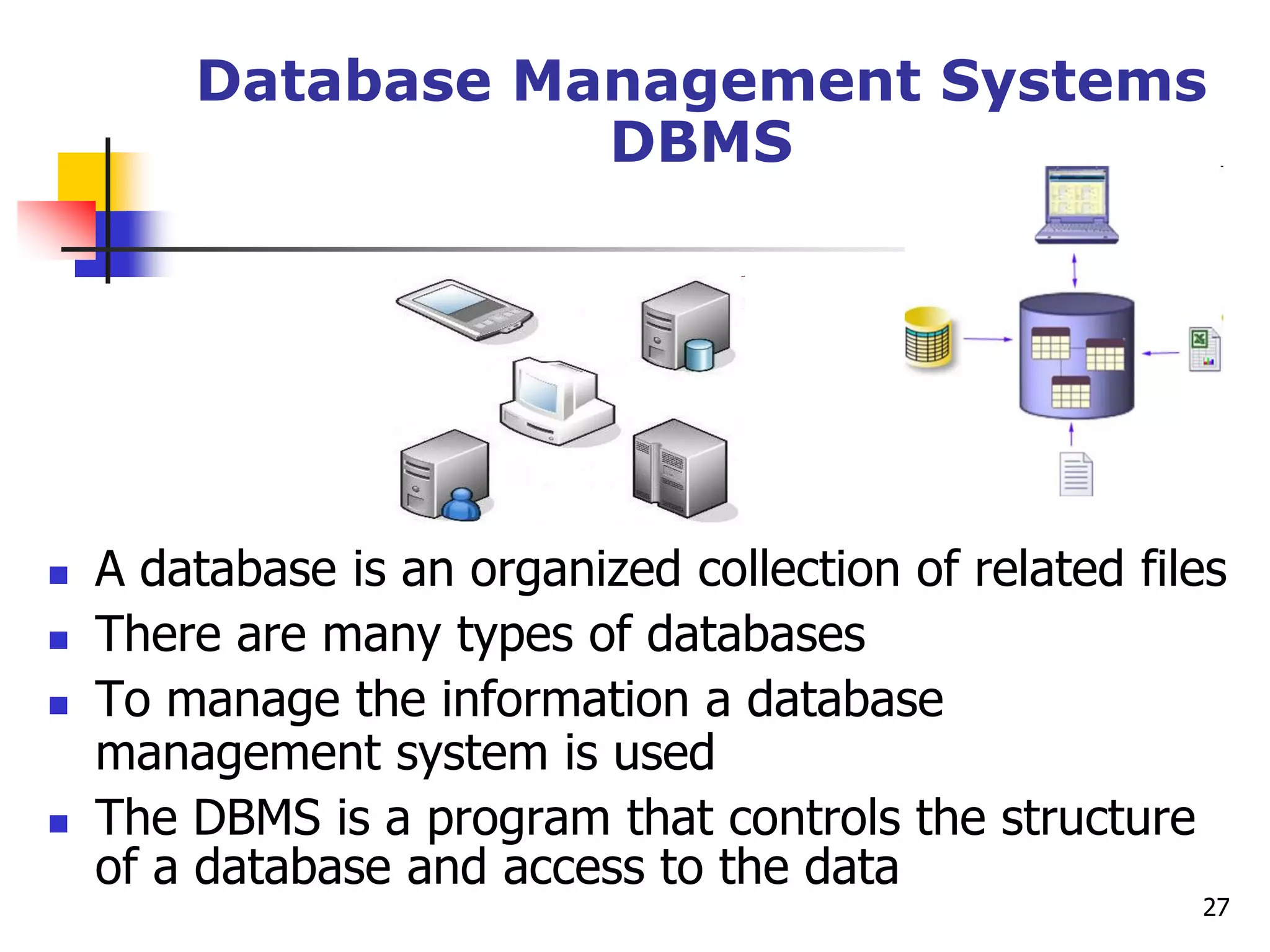
Database Management Systems
DBMS
 A database is an organized collection of related files
 There are many types of databases
 To manage the information a database
management system is used
 The DBMS is a program that controls the structure
of a database and access to the data
28
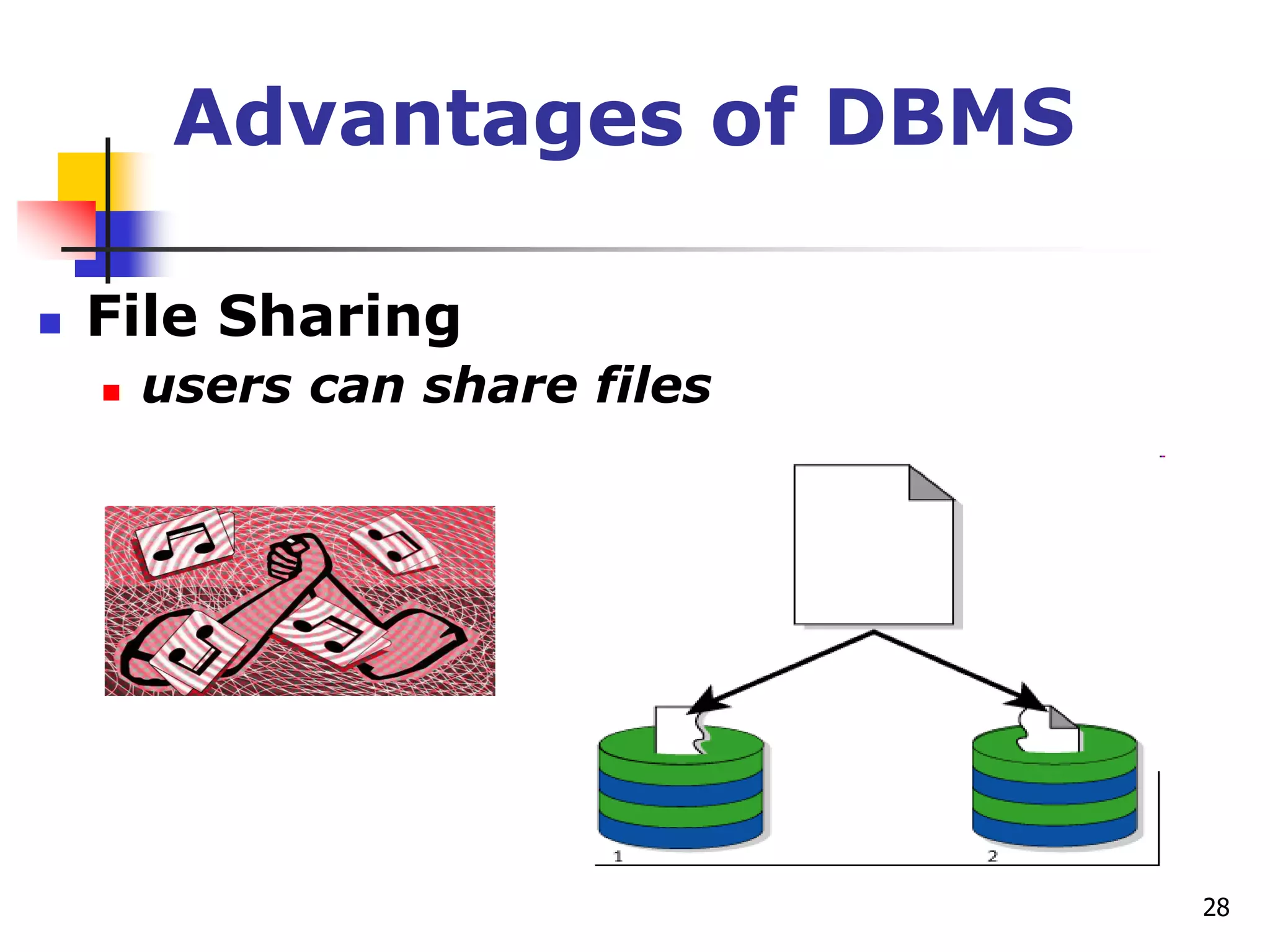
Advantages of DBMS
 File Sharing
 users can share files
29
Advantages of DBMS
 Reduced data redundancy
 prevent duplication
30
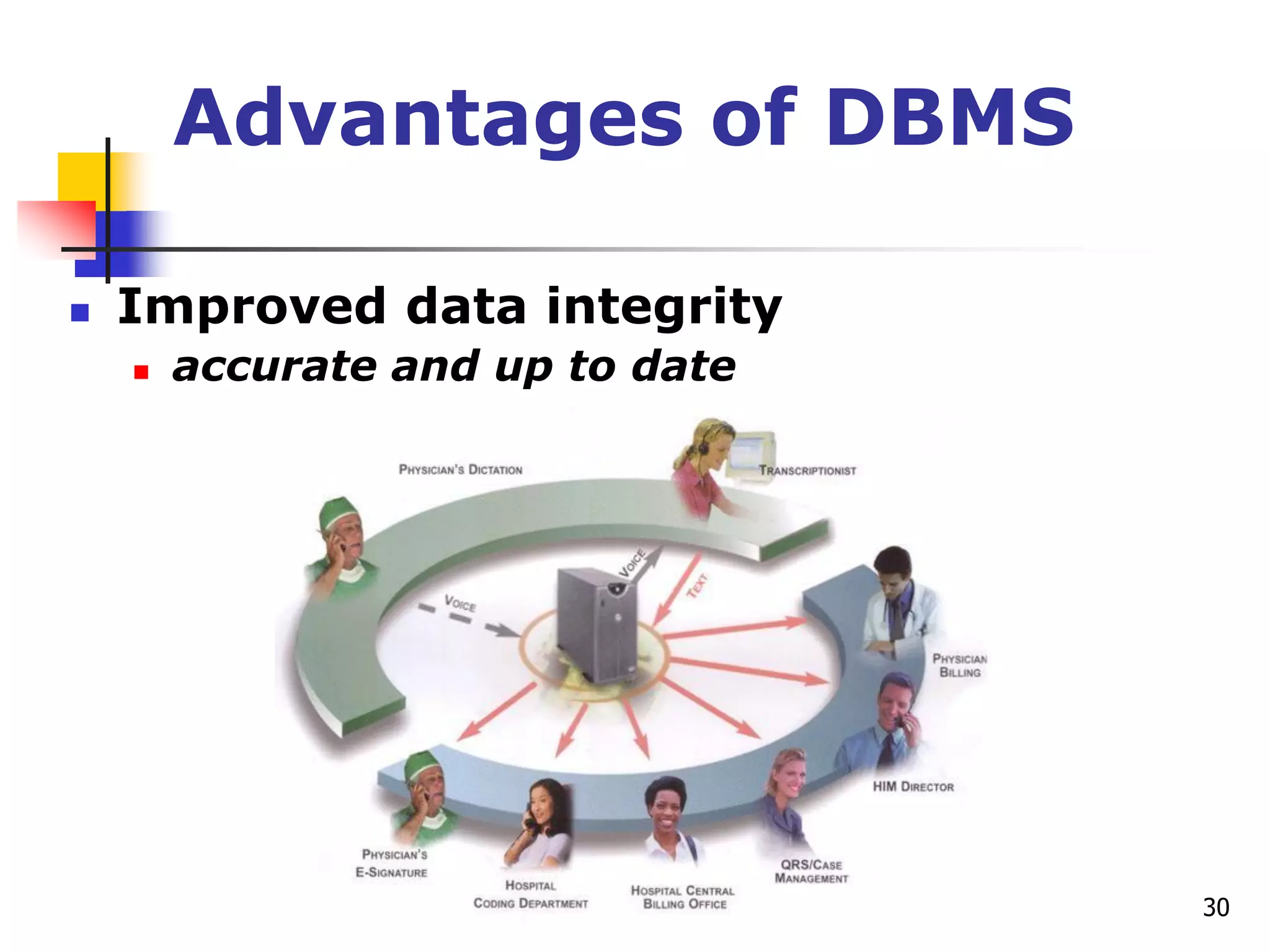
Advantages of DBMS
 Improved data integrity
 accurate and up to date
31
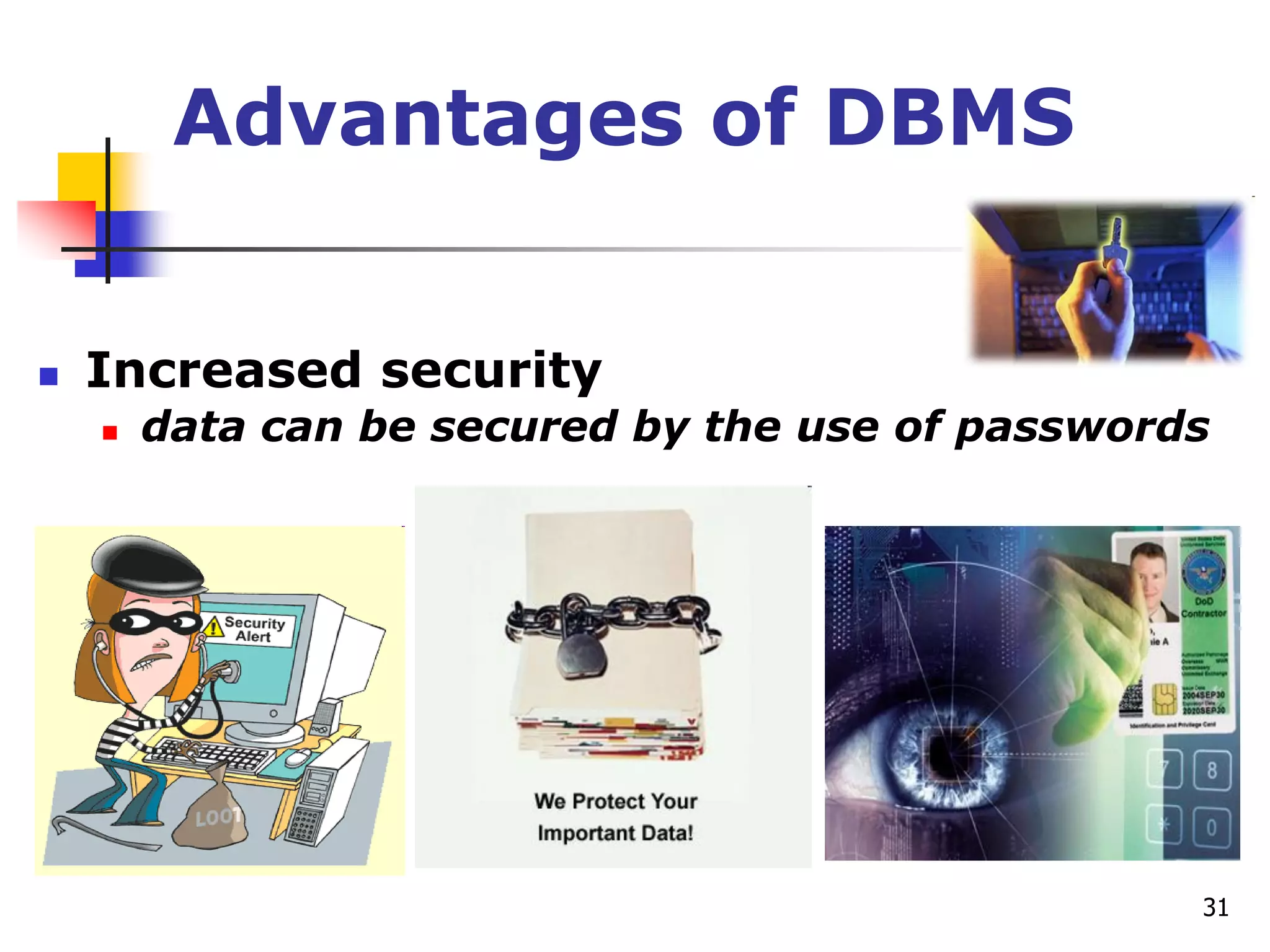
Advantages of DBMS
 Increased security
 data can be secured by the use of passwords
32
Exercise
 What is a Database Management System?
 What are the advantages of DBMS?
33
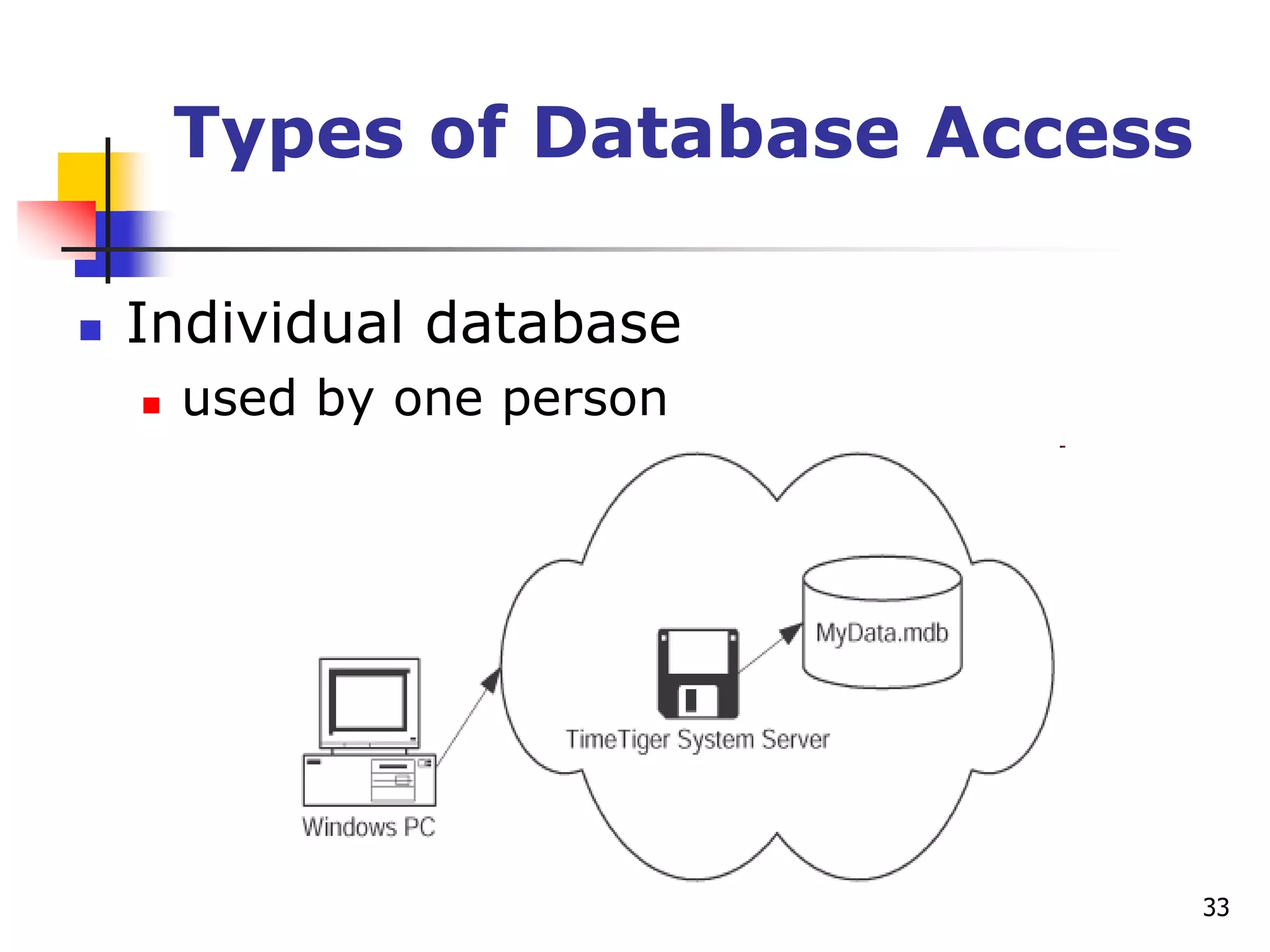
Types of Database Access
 Individual database
 used by one person
34
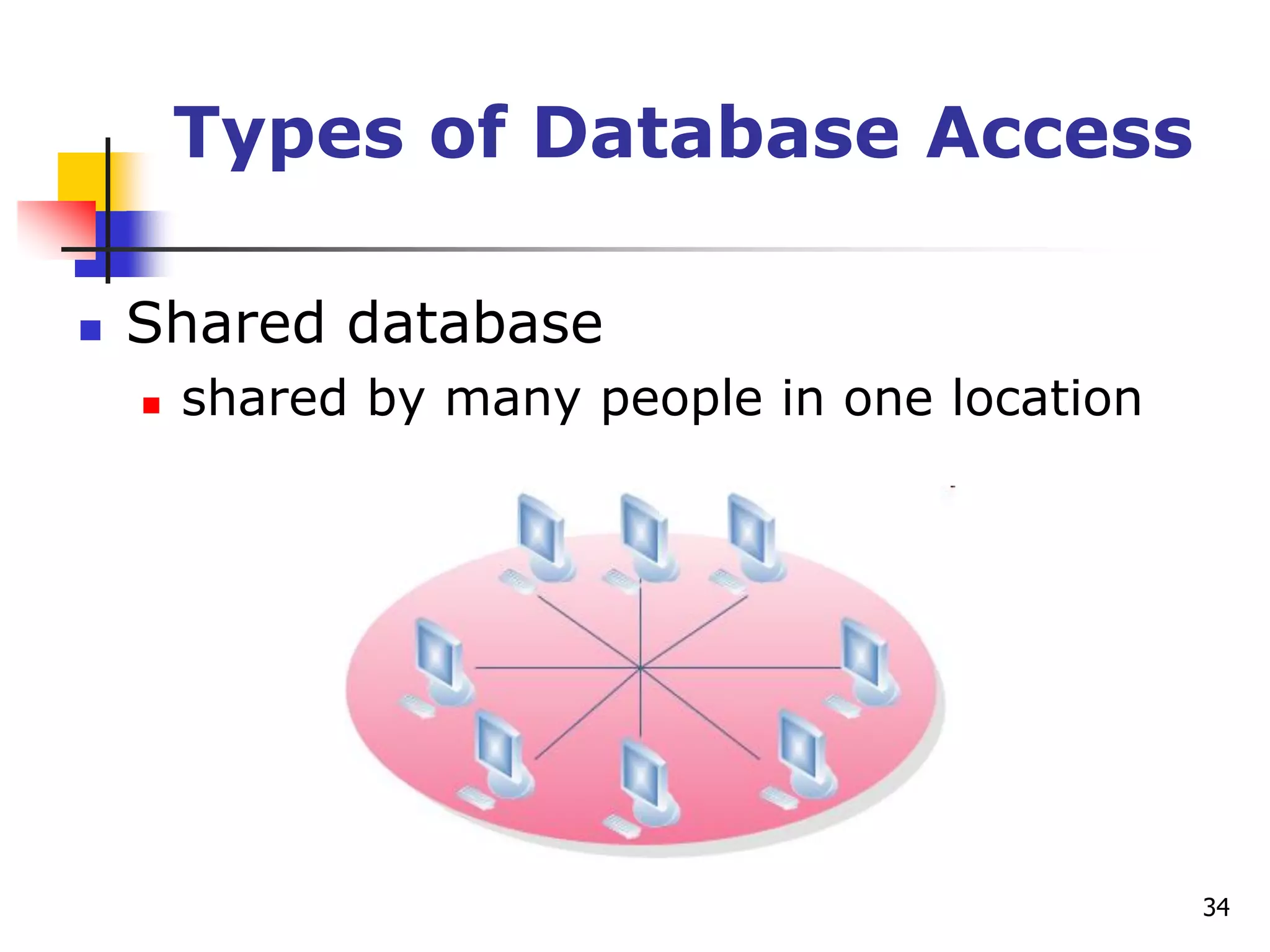
Types of Database Access
 Shared database
 shared by many people in one location
35
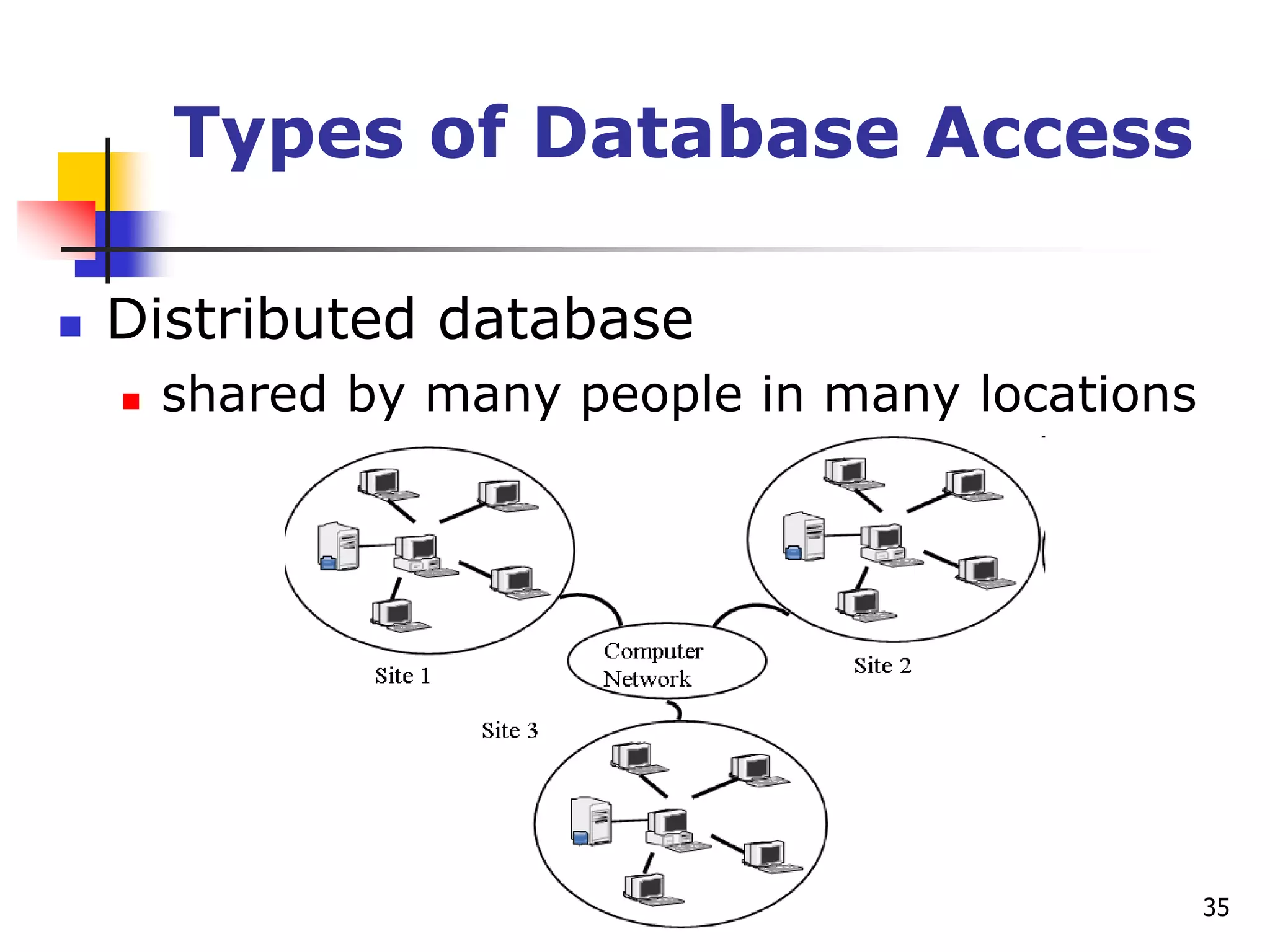
Types of Database Access
 Distributed database
 shared by many people in many locations
36
Types of Database Access
 Public databank
 information for the public
 Yahoo
 Google
 Law
 Shopping
 News
 Games
37
DBA
 The Database Administrator (DBA) coordinates all
related activities and needs for an organization’s
database.
 The DBA determines user access privileges, sets
standards.
 The DBA is responsible for system back up and
recovery.
38
Exercise
 Describe the four types of databases.
 What does a database administrator do?
39
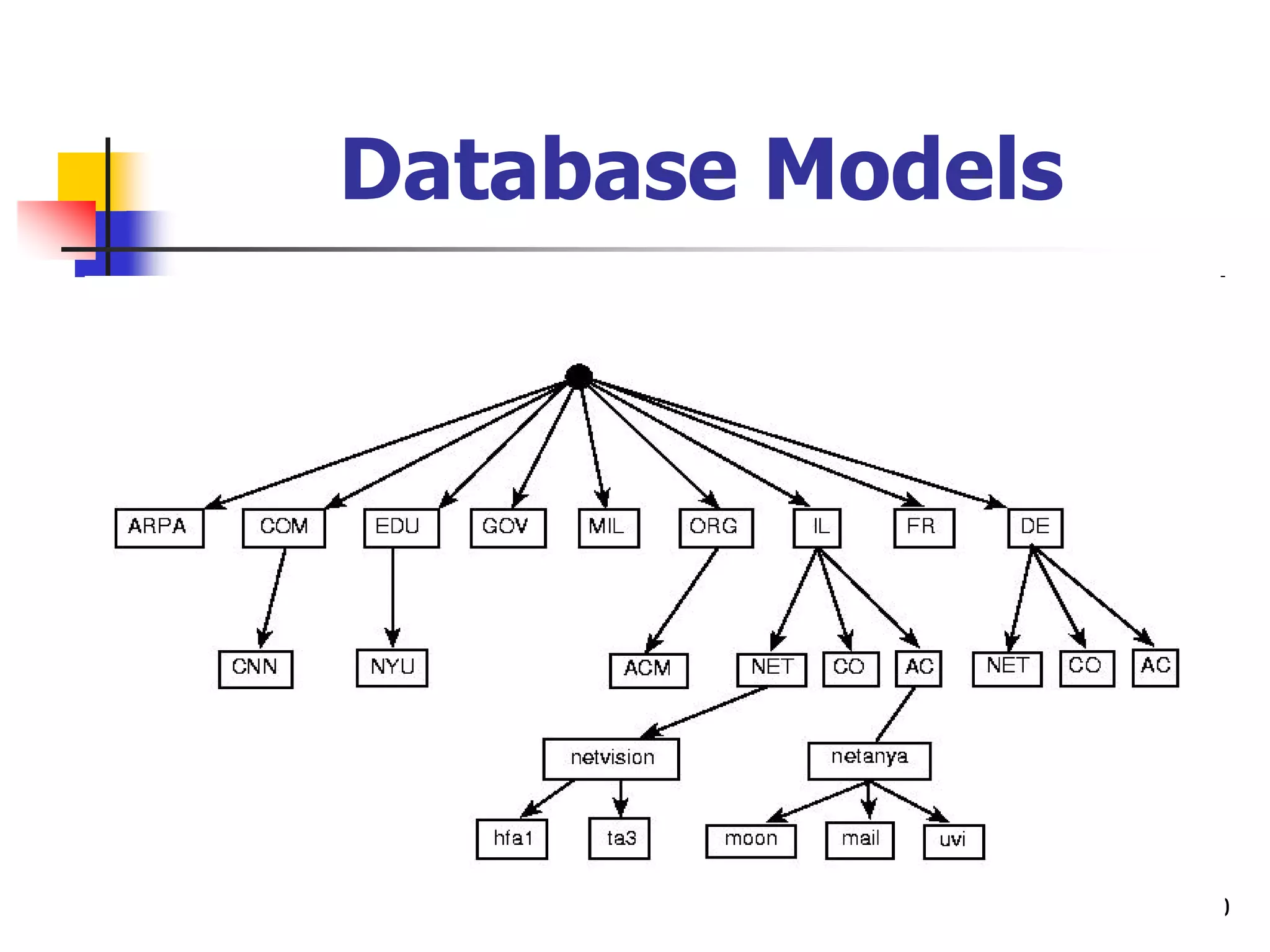
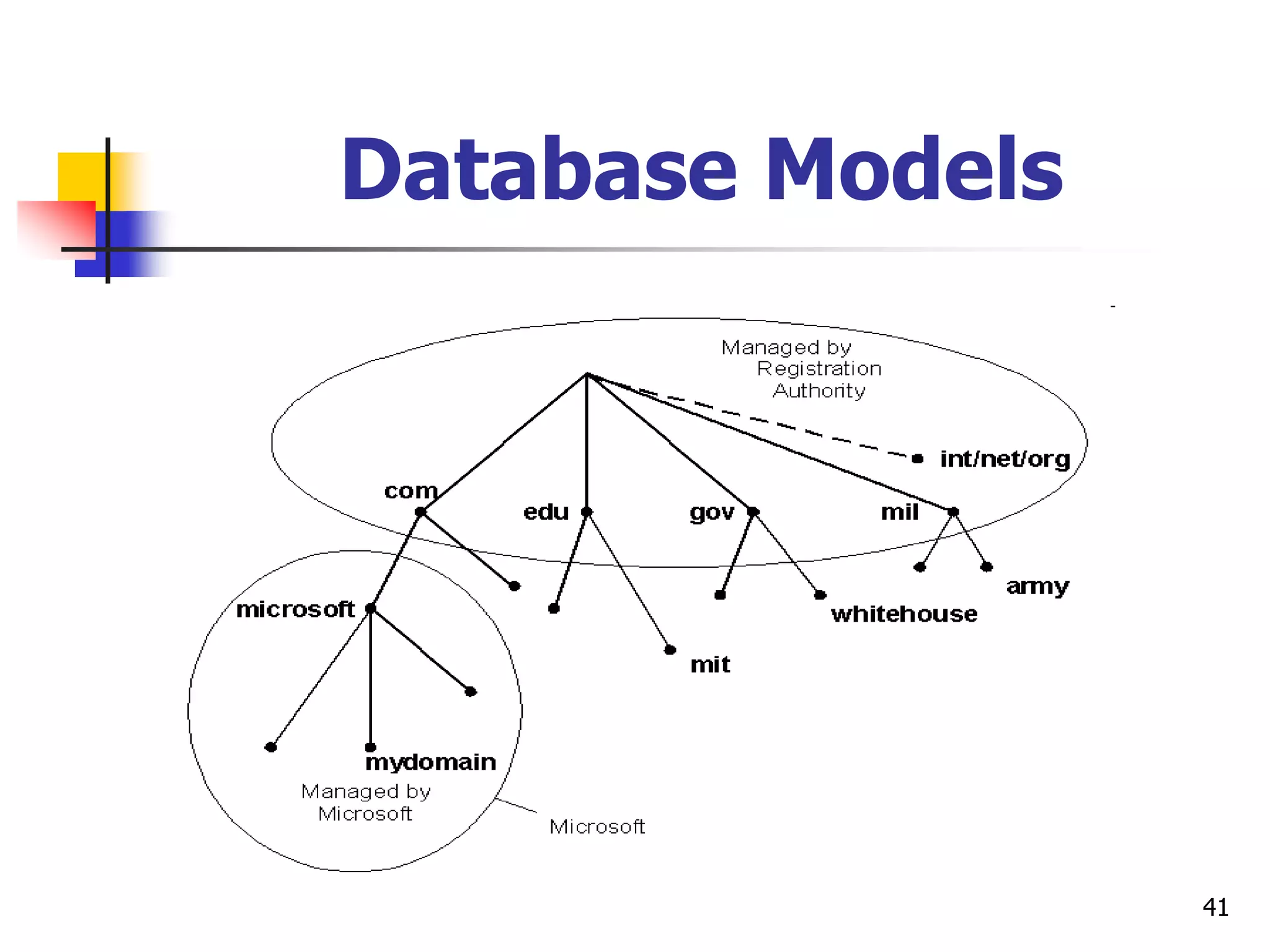
Database Models
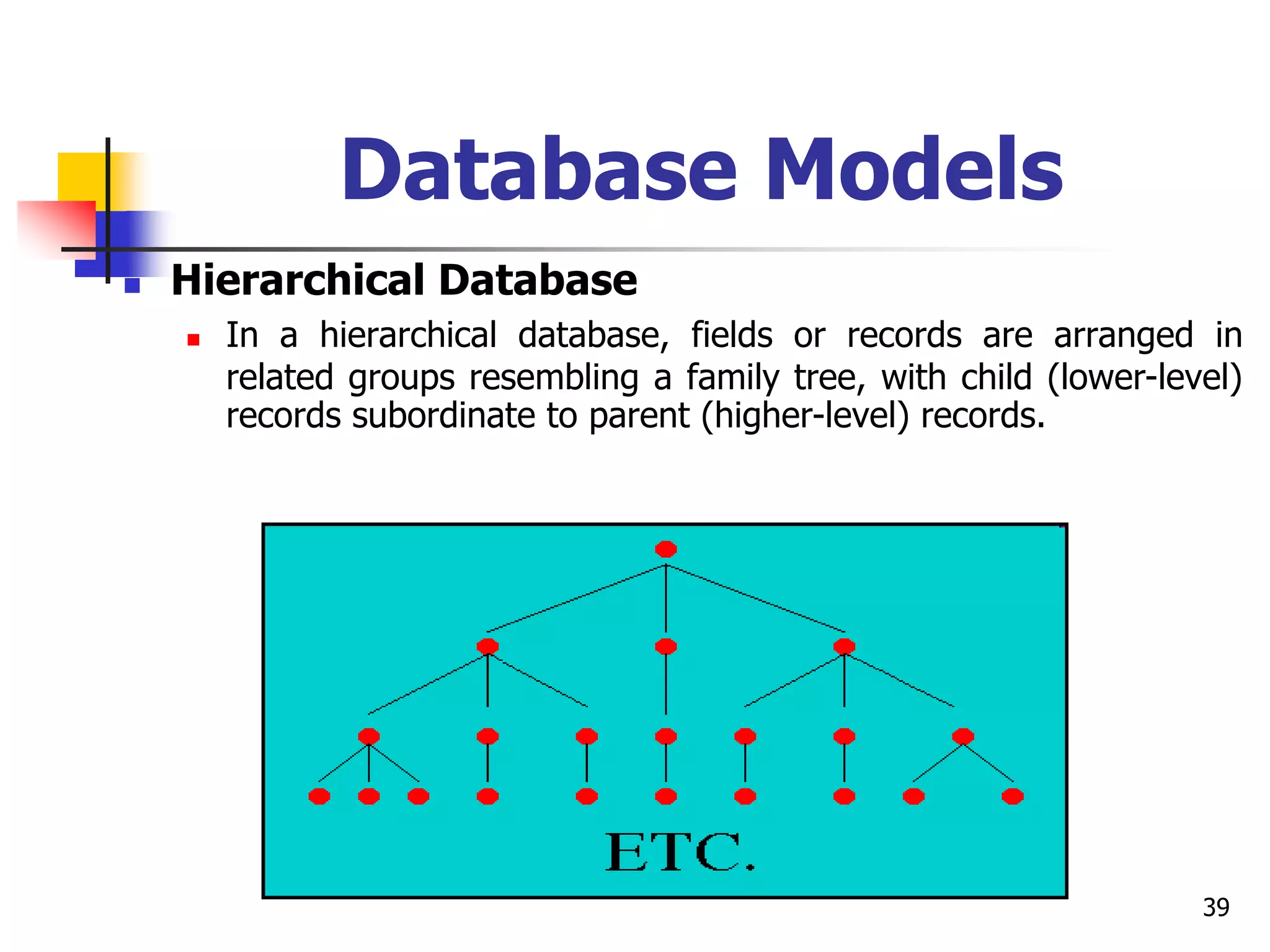
 Hierarchical Database
 In a hierarchical database, fields or records are arranged in
related groups resembling a family tree, with child (lower-level)
records subordinate to parent (higher-level) records.
40
Database Models
41
Database Models
42
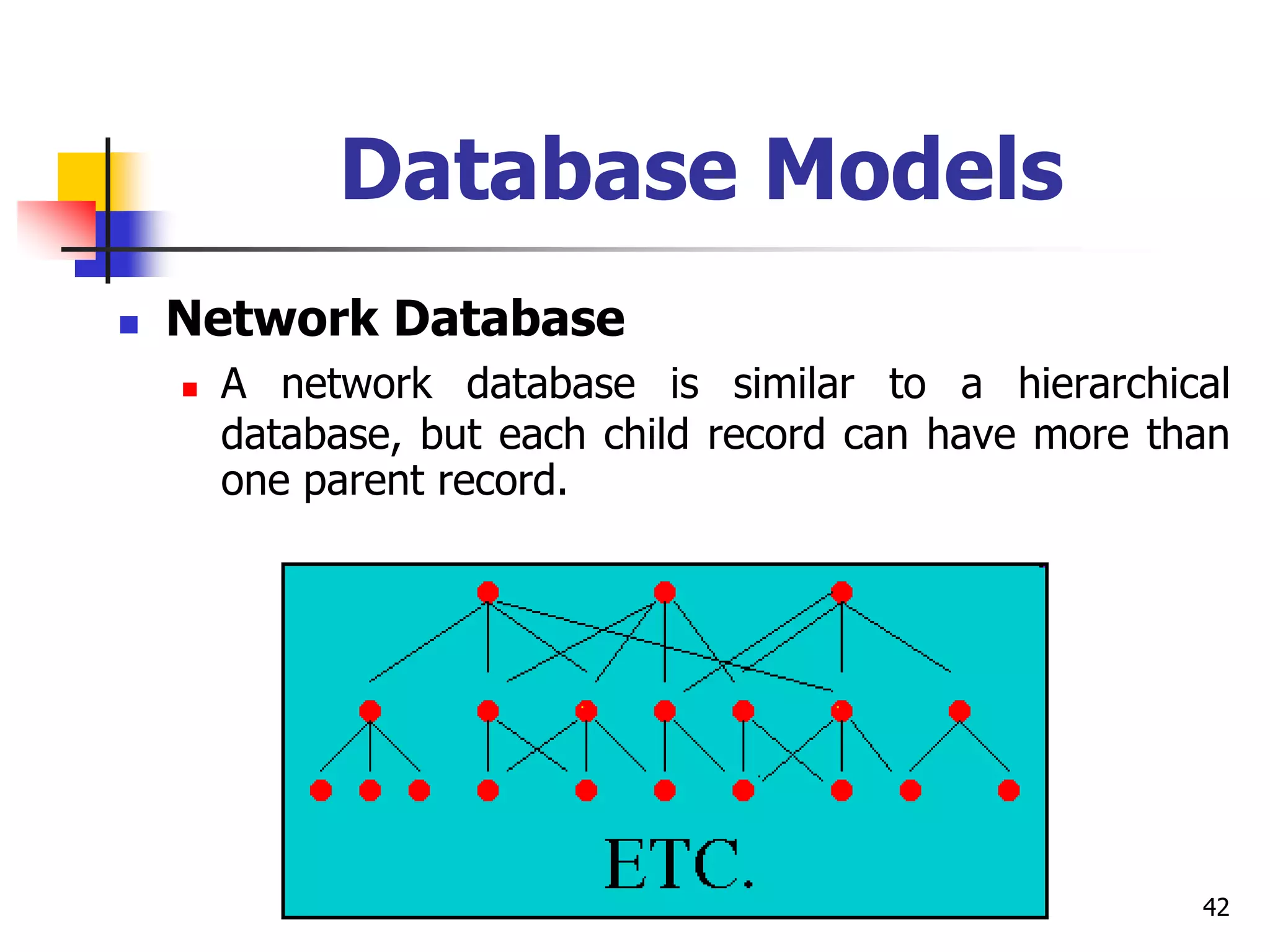
Database Models
 Network Database
 A network database is similar to a hierarchical
database, but each child record can have more than
one parent record.
43
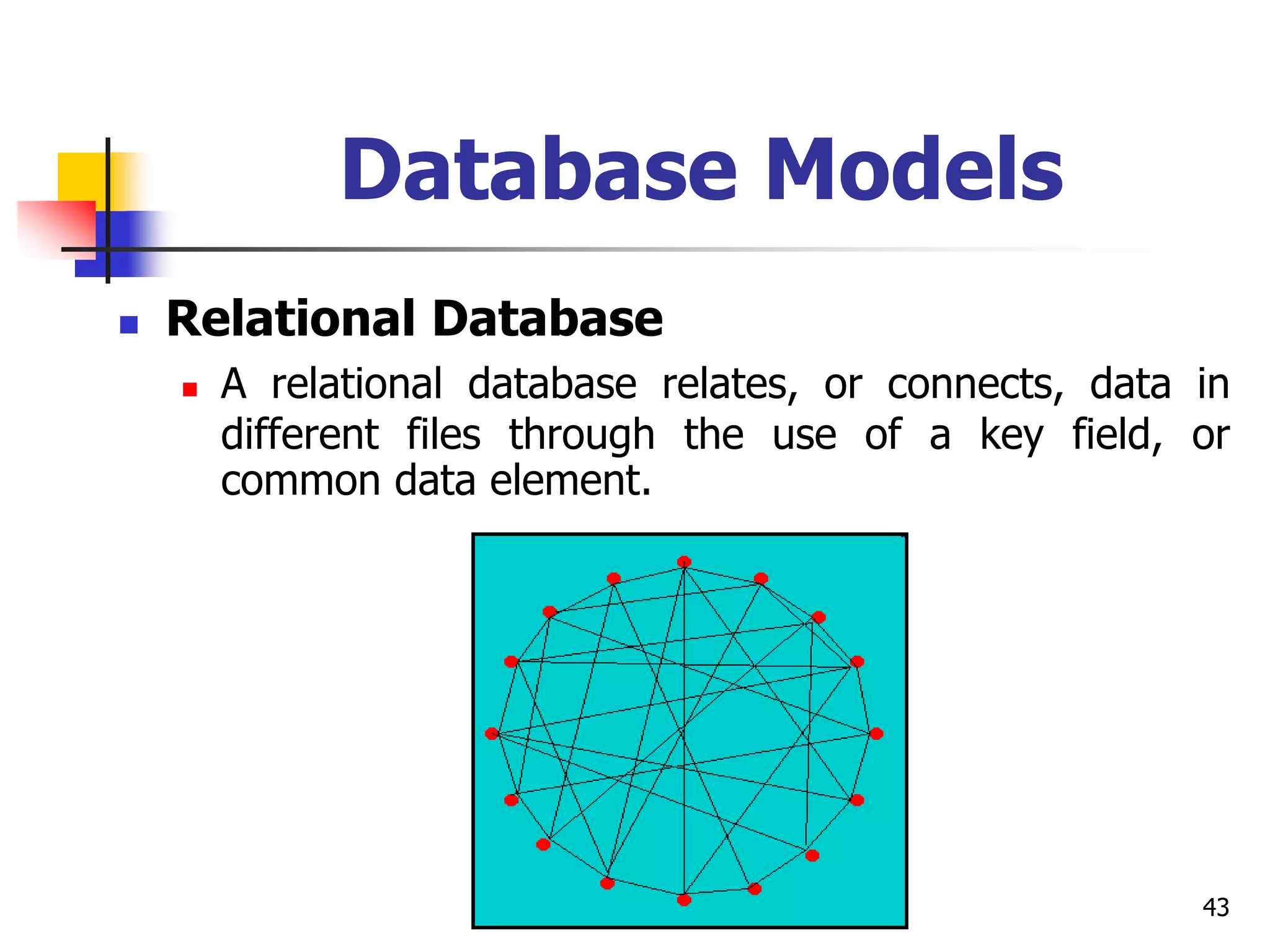
Database Models
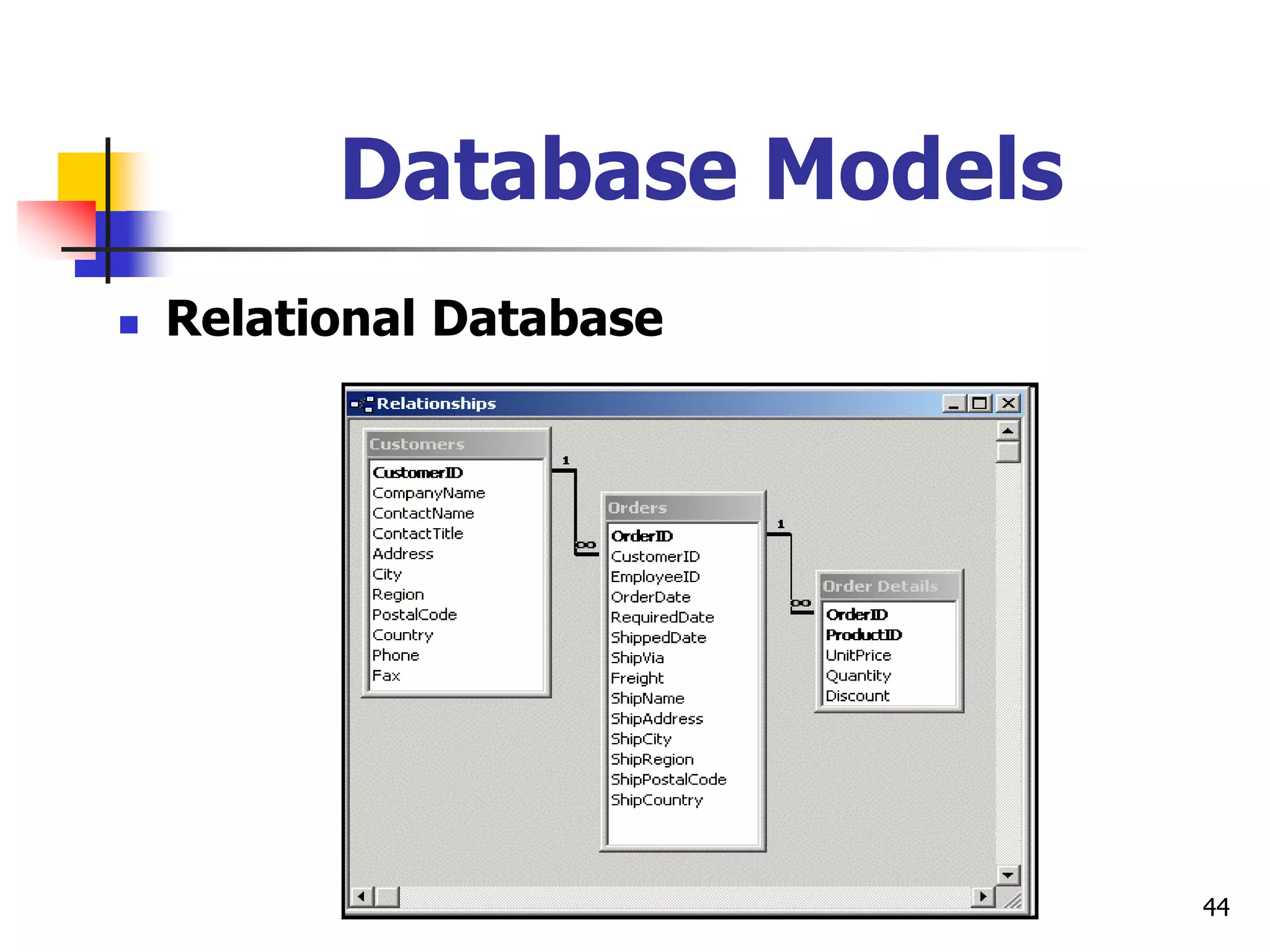
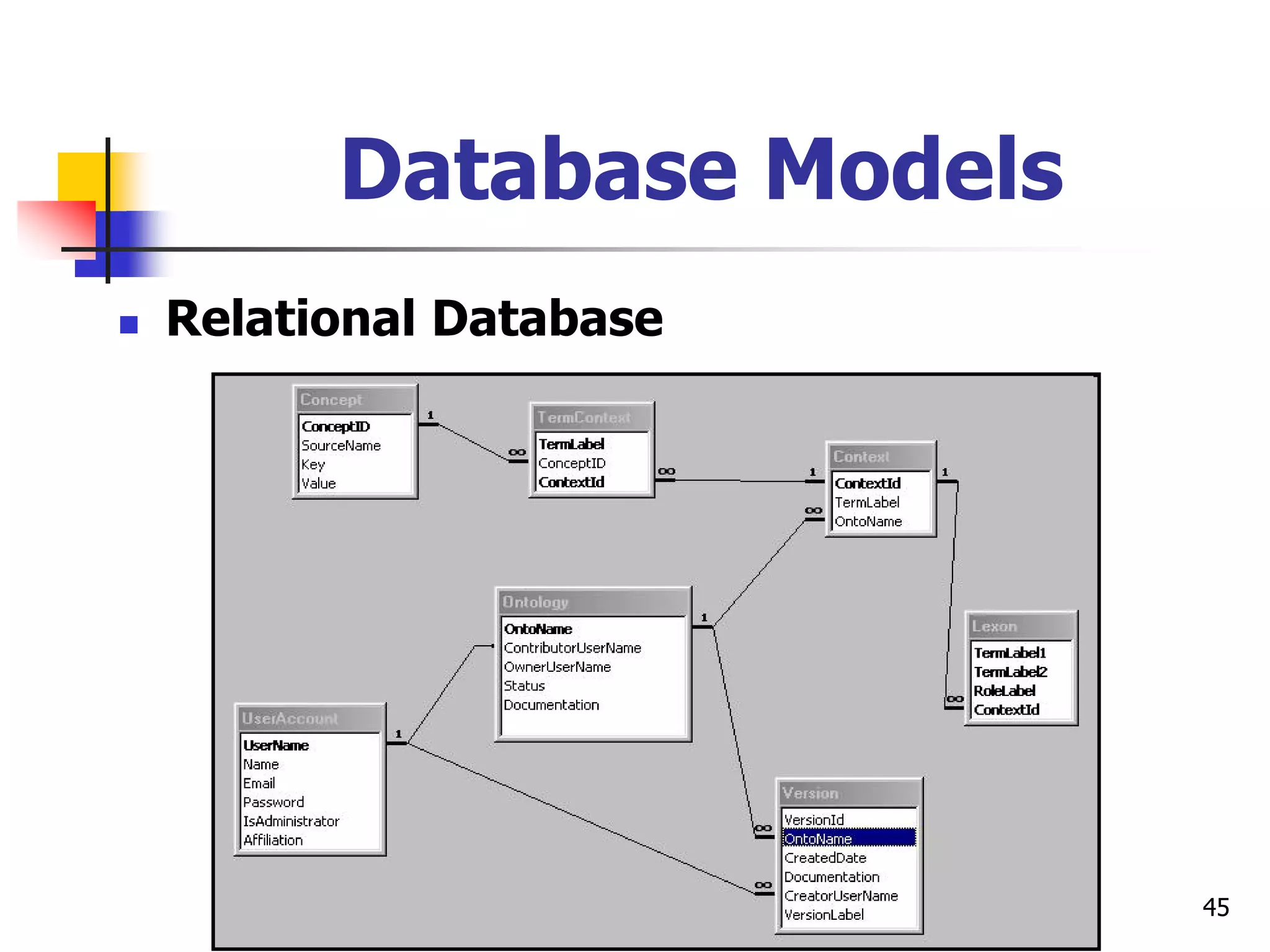
 Relational Database
 A relational database relates, or connects, data in
different files through the use of a key field, or
common data element.
44
Database Models
 Relational Database
45
Database Models
 Relational Database
46
Structured Query Language
SQL
 SQL is the standard language used to
 Create
 Add
 Delete
 Update
relational databases
47
Structured Query Language
SQL
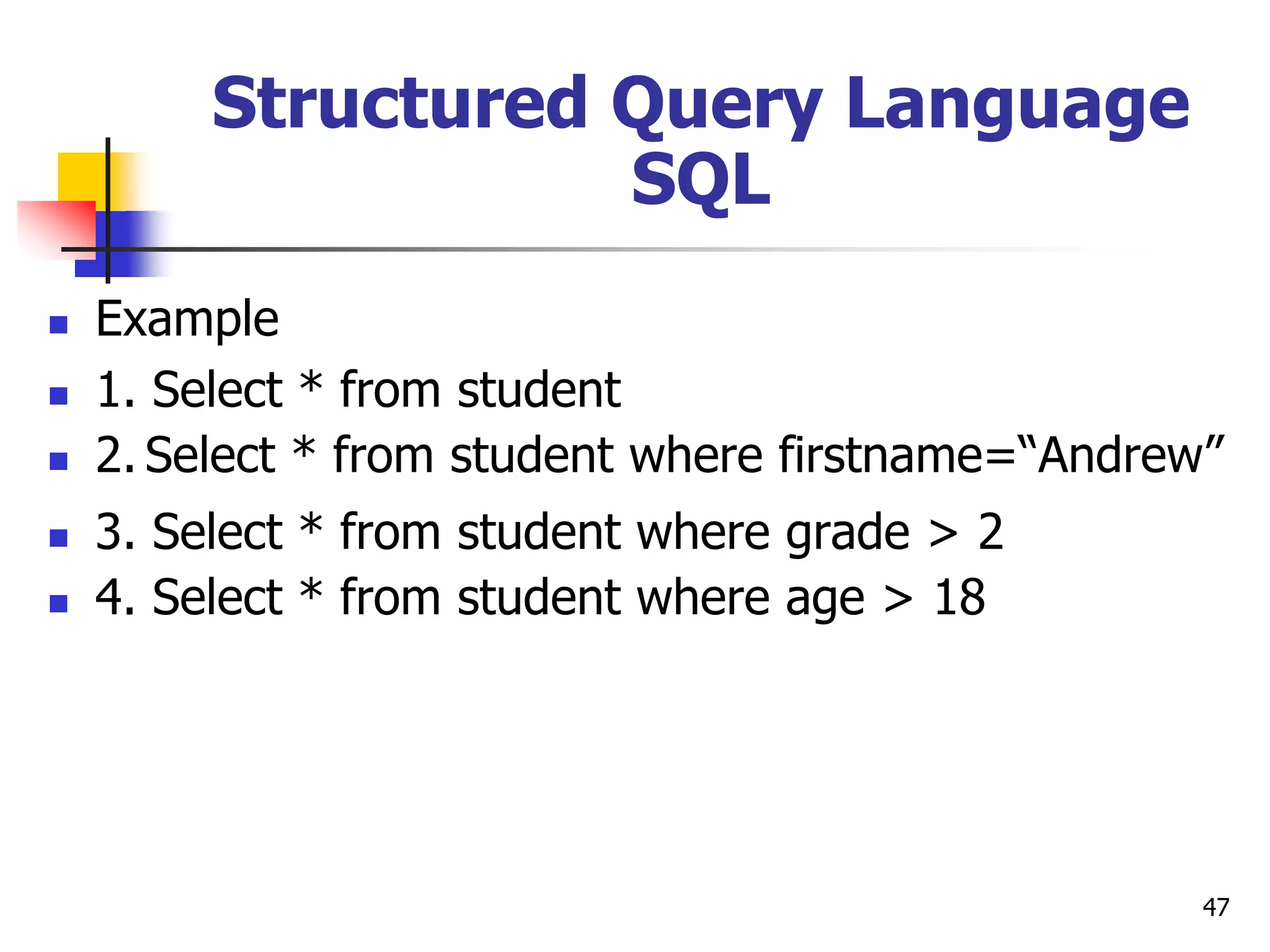
 Example
 1. Select * from student
 2. Select * from student where firstname=“Andrew”
 3. Select * from student where grade > 2
 4. Select * from student where age > 18
48
Object Oriented Database
 An object oriented database uses objects.
An object consists of graphics, audio and
video.
49
Exercise
 What are the four models of database
organization?
 What is SQL?
50
Application Service Provider
ASP
 ASPs allow users to subscribe to various
software applications over the Internet.
 Example in Thailand
 ADSL
51
DBMS Components
 Data Dictionary
 It is a file that stores the definitions of the
structure of data used in the database.
 Example:
Keyword Description
Room_Id The room numbers of the hotel
Check_In The date when the guest check into the hotel
52
DBMS Components
 Utilities
 The DBMS utilities maintains the database by
creating, editing and monitoring data input
 Example
 MS-ACCESS
53
DBMS Components
 Report Generator
 It is a program that creates onscreen or printed
document
 Example
 MS-ACCESS
54
DBMS Components
 Access Security
 It specifies user access privileges
 Example
 MySQL
 ORACLE
55
Exercise
 1.What is data dictionary?
 2.What do DBMS utilities do?
 3.How does access security work?
 4.Explain the four types of system recovery.
56
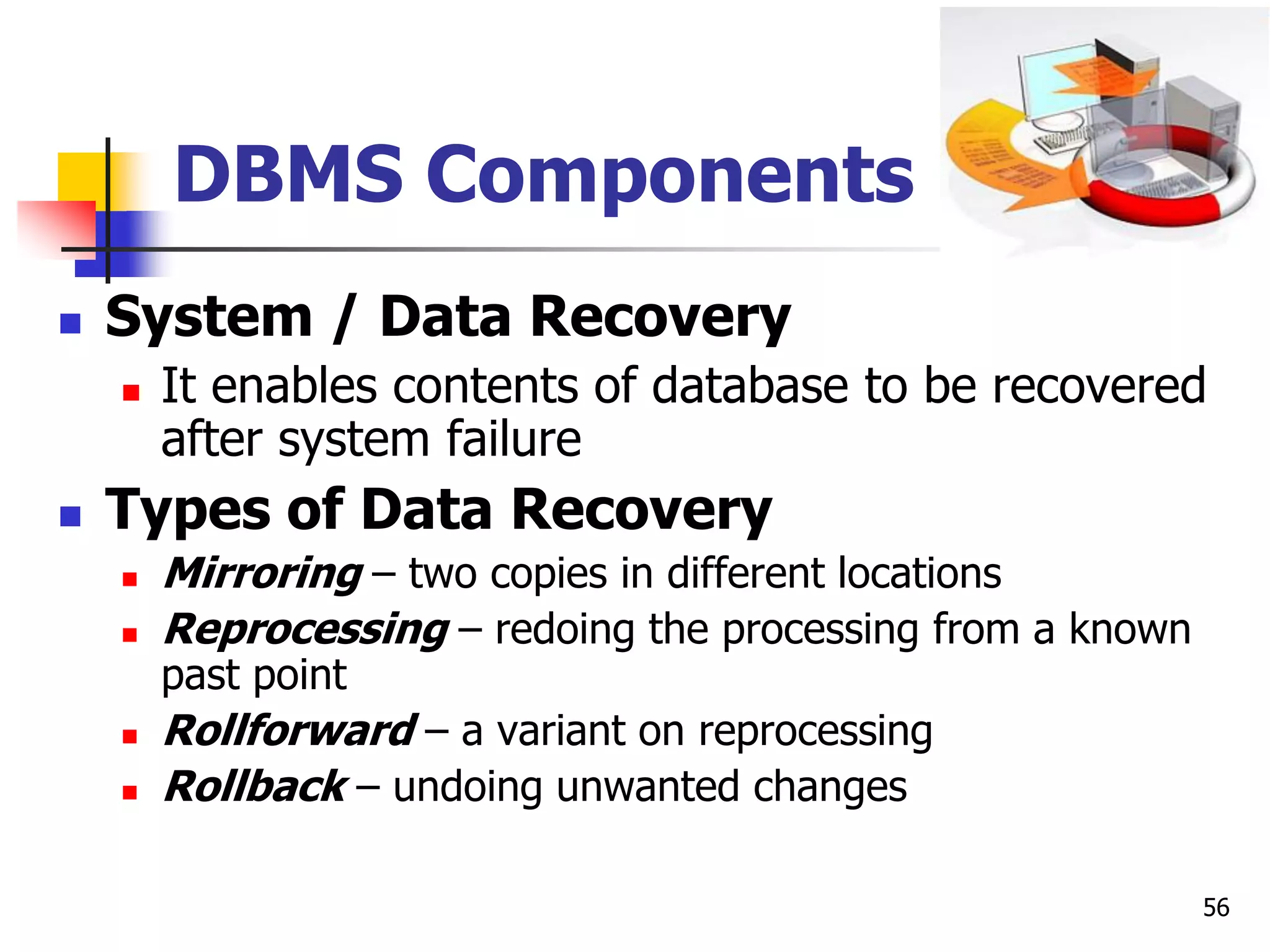
DBMS Components
 System / Data Recovery
 It enables contents of database to be recovered
after system failure
 Types of Data Recovery
 Mirroring – two copies in different locations
 Reprocessing – redoing the processing from a known
past point
 Rollforward – a variant on reprocessing
 Rollback – undoing unwanted changes
57
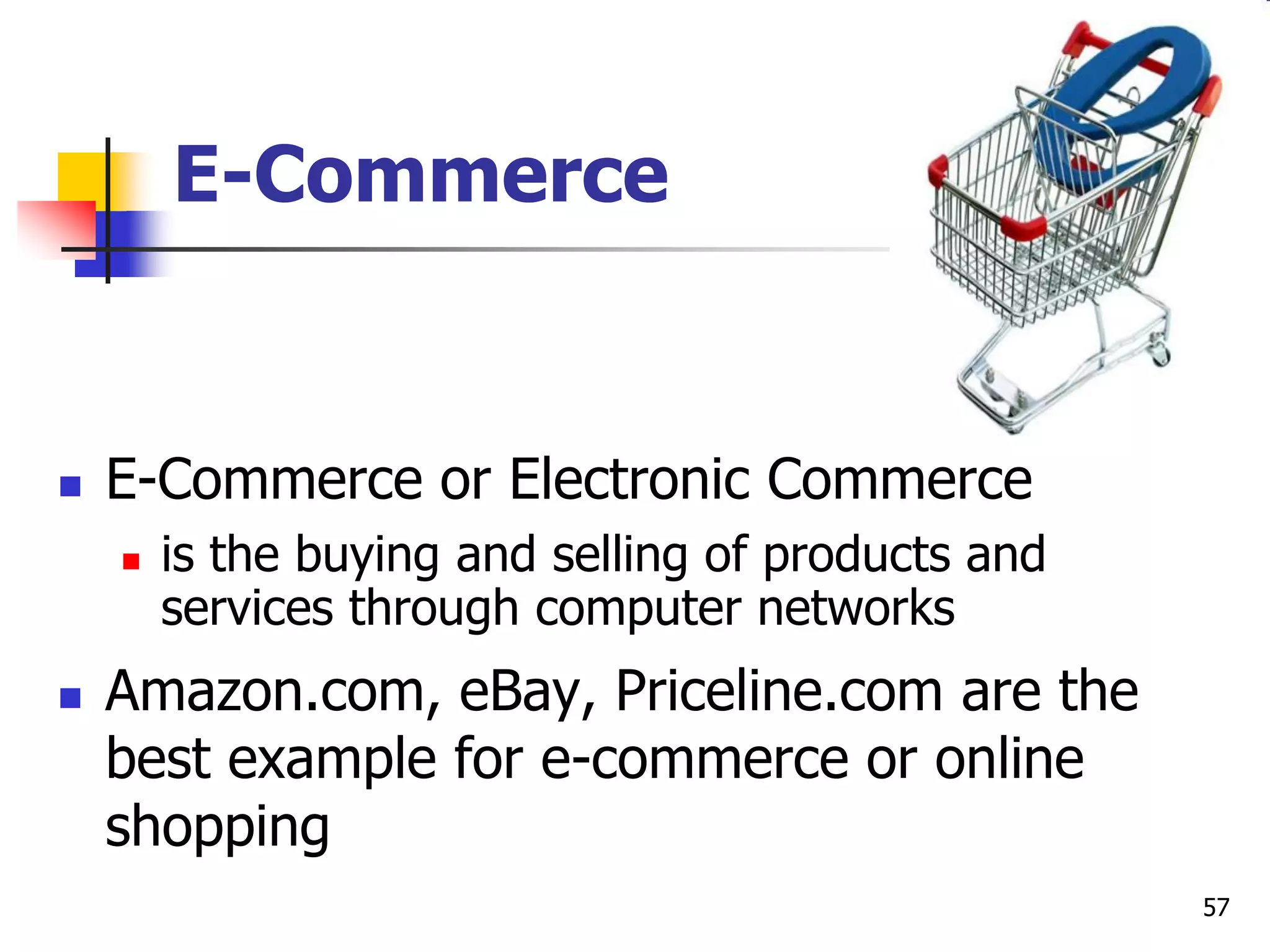
E-Commerce
 E-Commerce or Electronic Commerce
 is the buying and selling of products and
services through computer networks
 Amazon.com, eBay, Priceline.com are the
best example for e-commerce or online
shopping
58
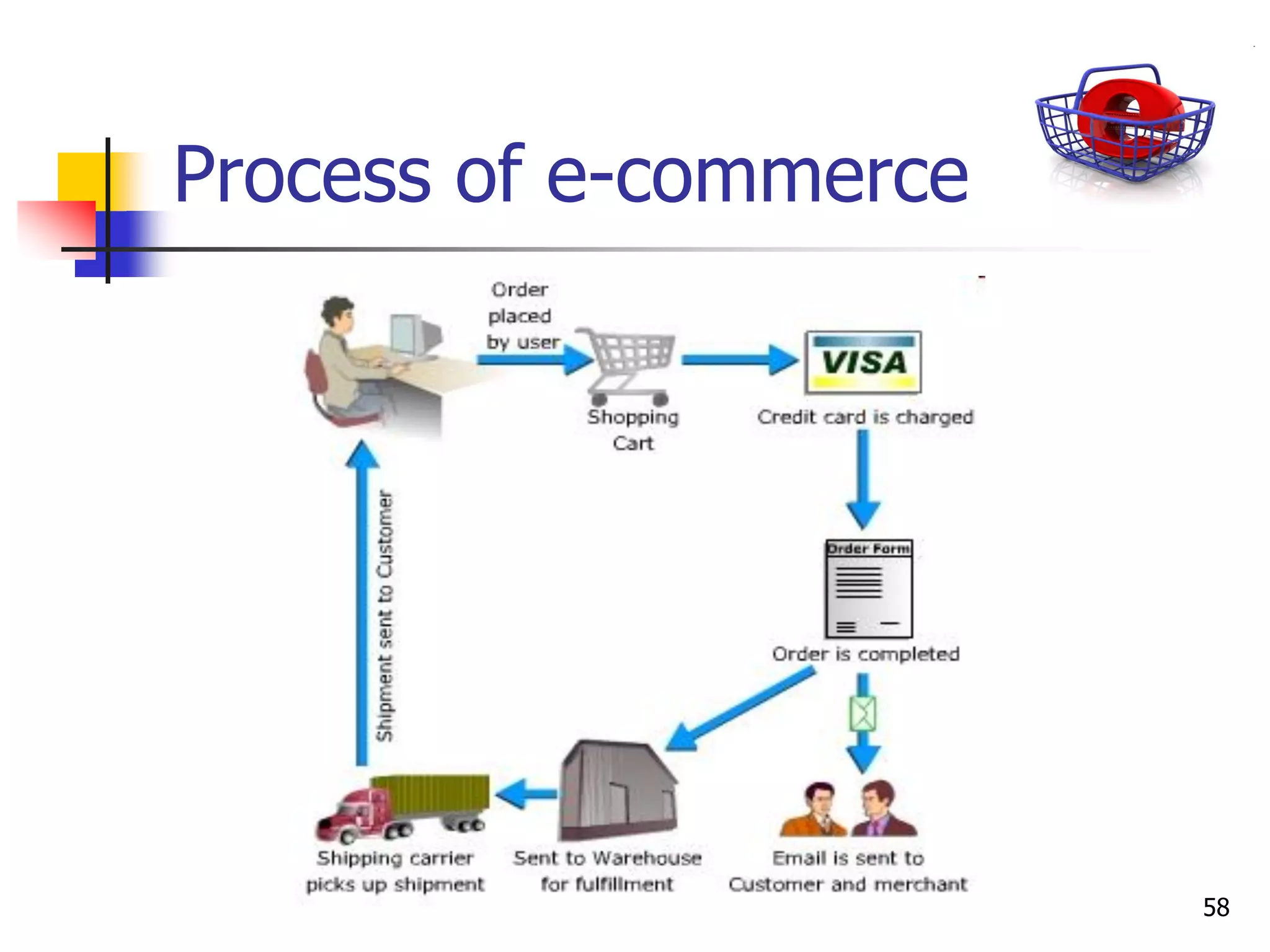
Process of e-commerce
59
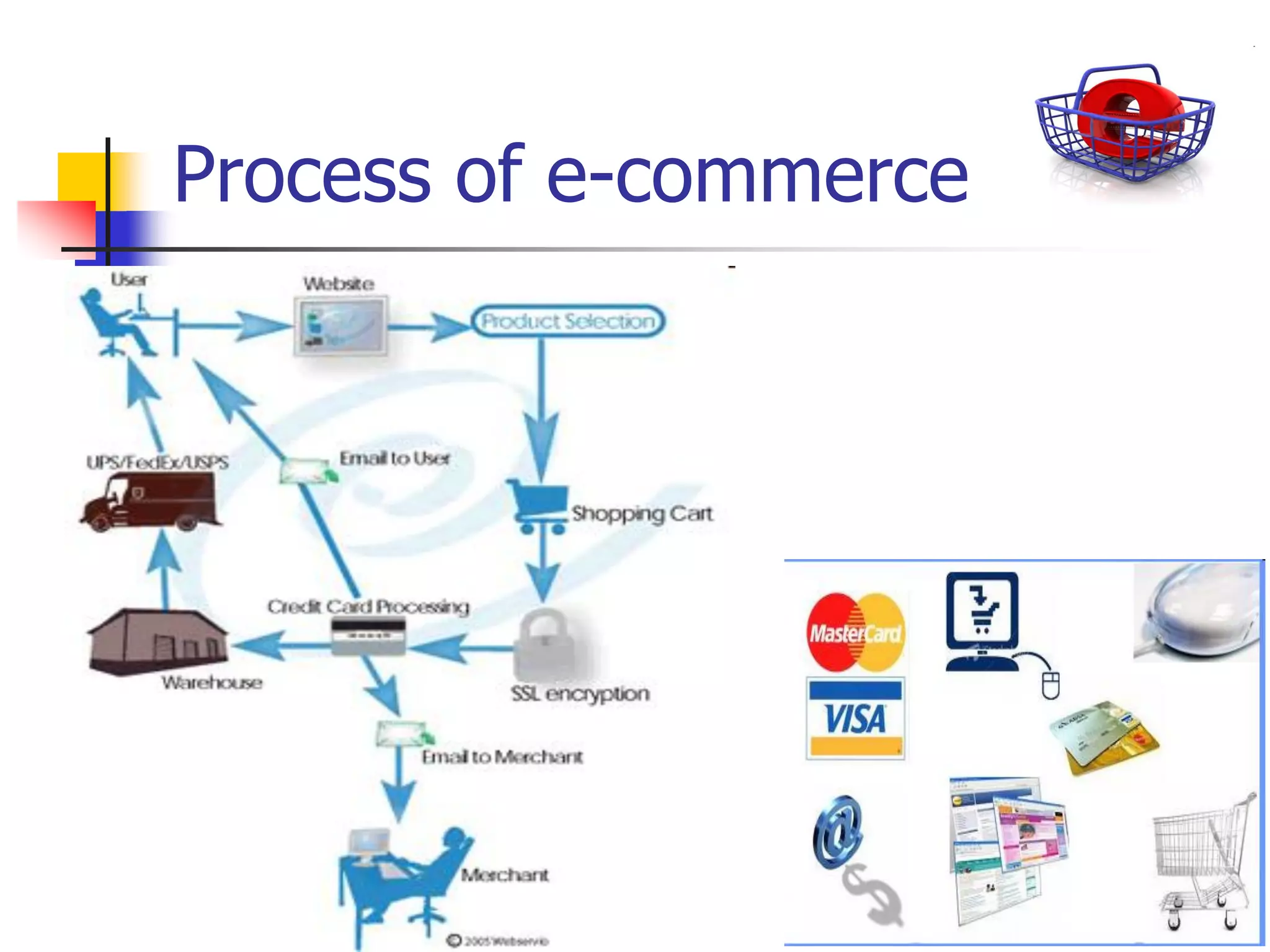
Process of e-commerce
60
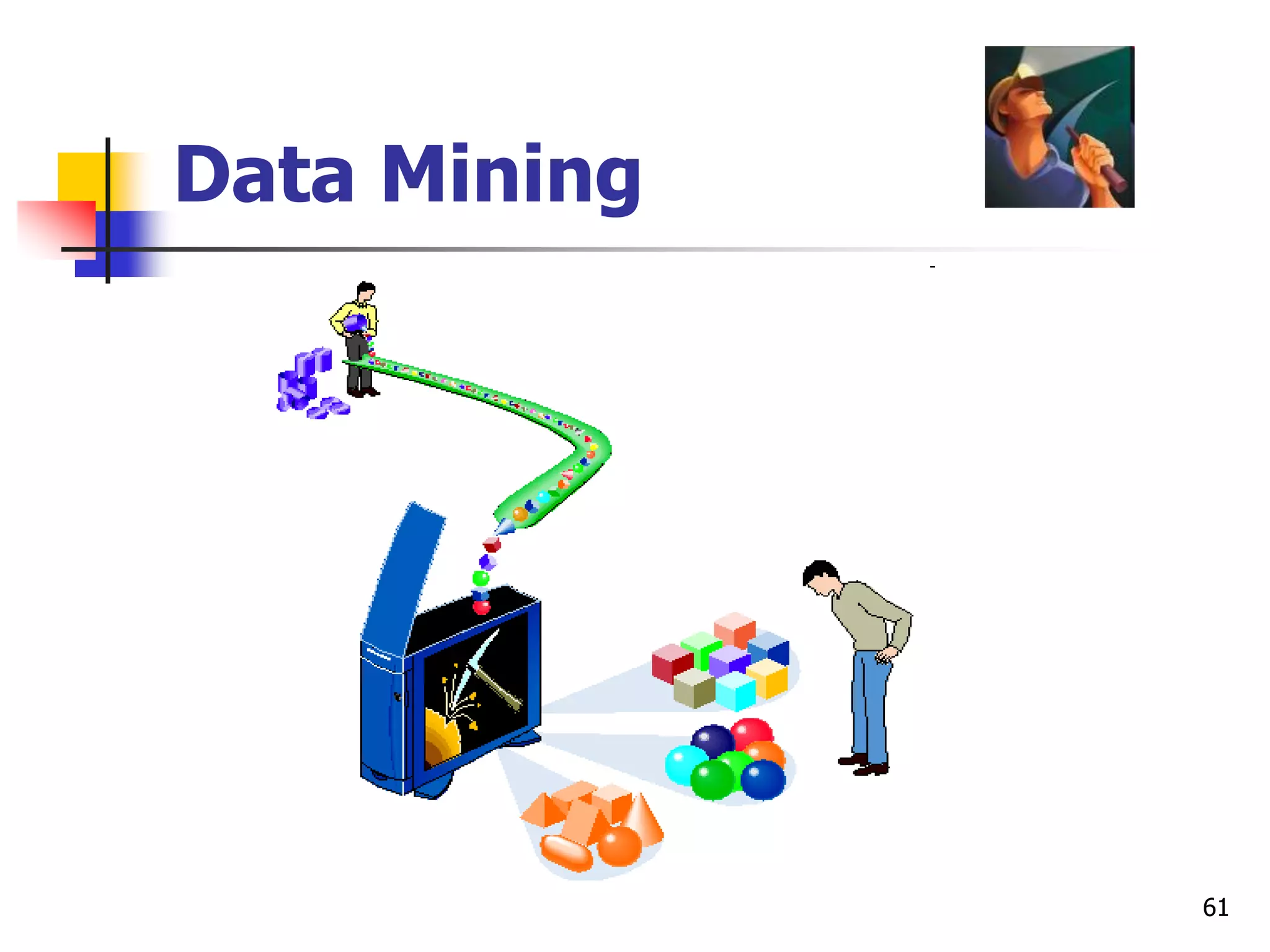
Data Mining
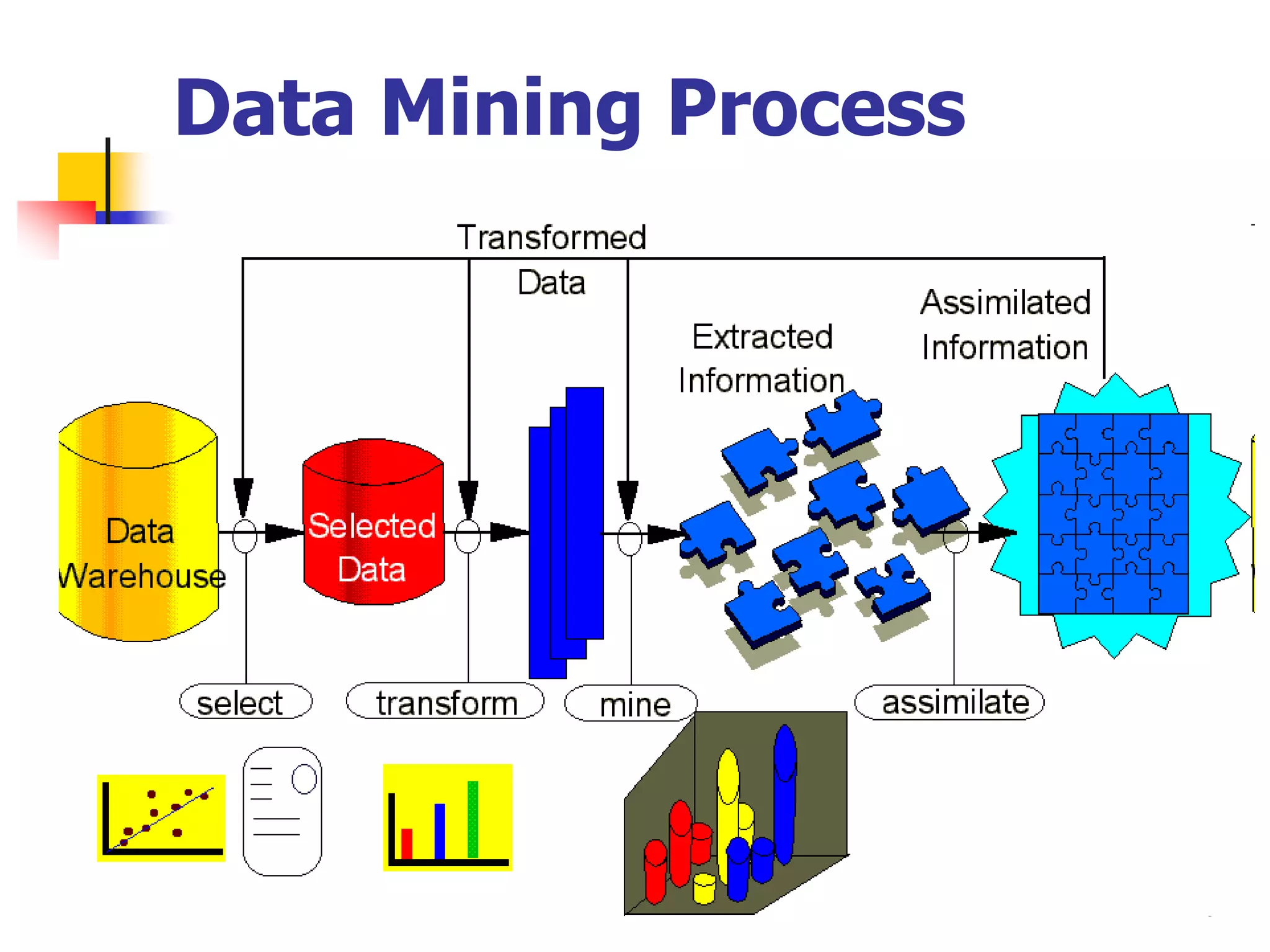
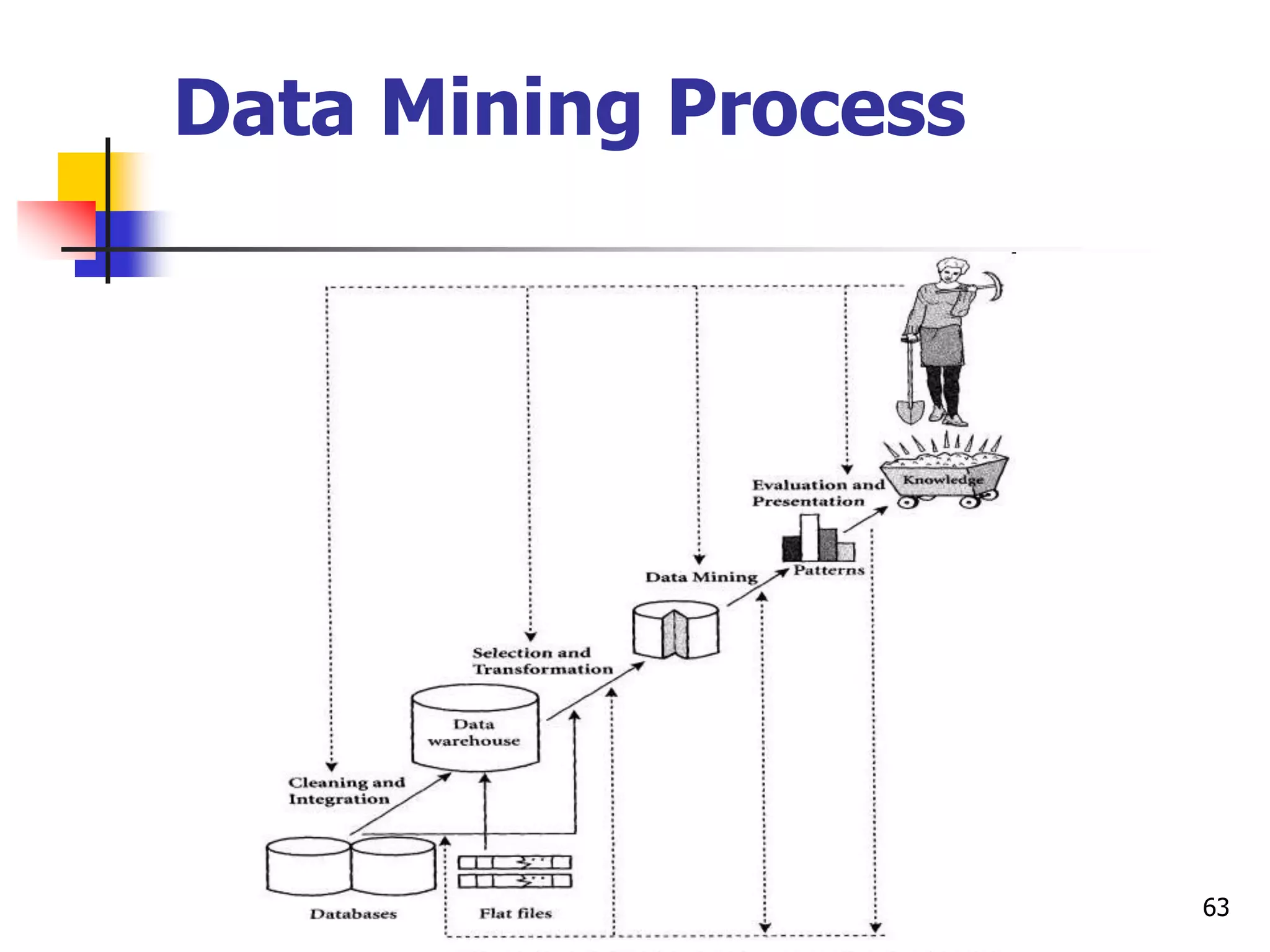
 Data mining (DM) is the computer-assisted process
of sifting through and analyzing vast amounts of
data
 It is used to extract meaning and discover new
knowledge
 It’s main purpose is to describe past trends and
predict future trends
 It can be used to learn customer, marketing,
production and financial data
61
Data Mining
62
Data Mining Process
63
Data Mining Process
64
Applications of Data mining
 Marketing
 Health
 Science
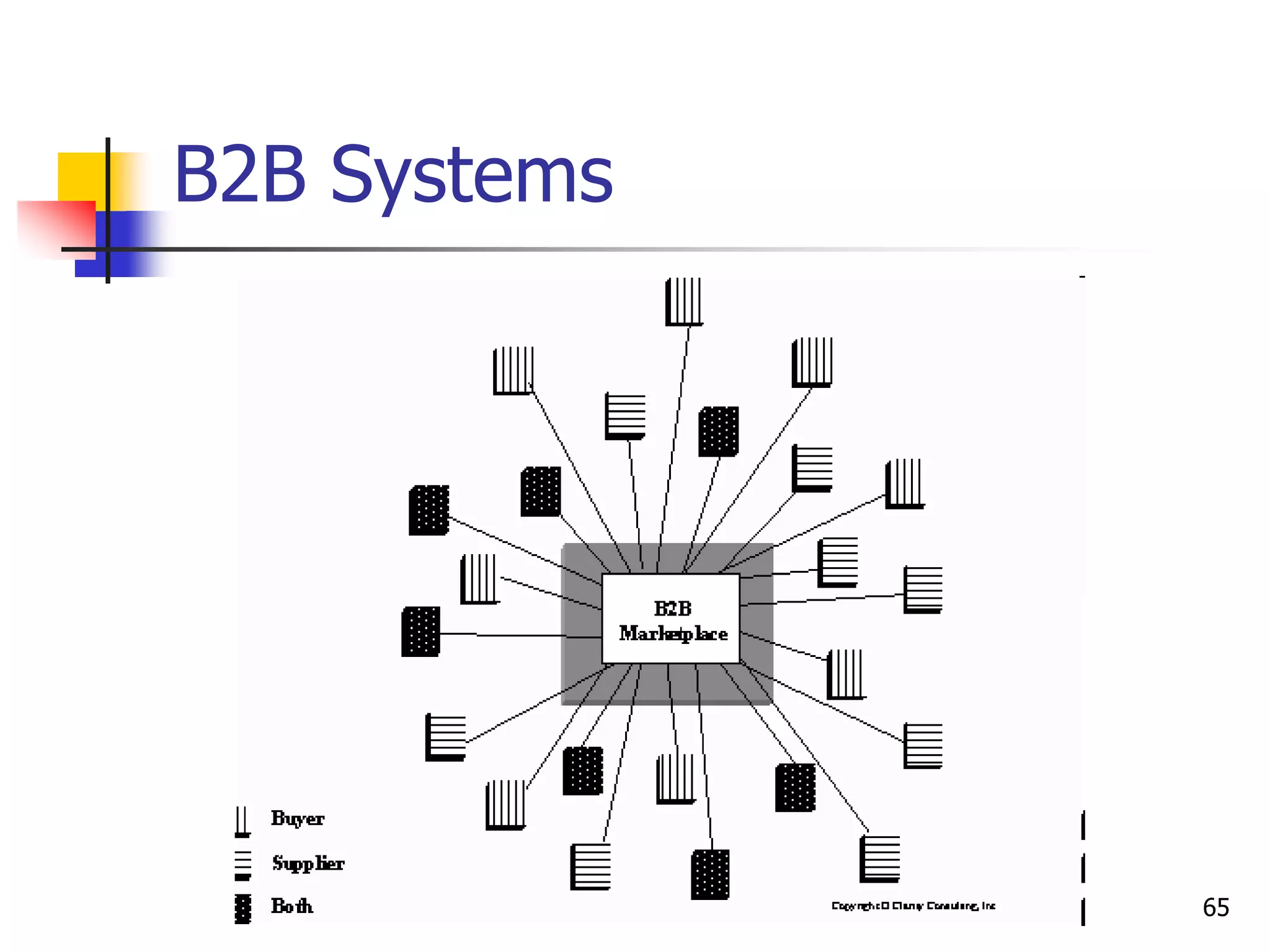
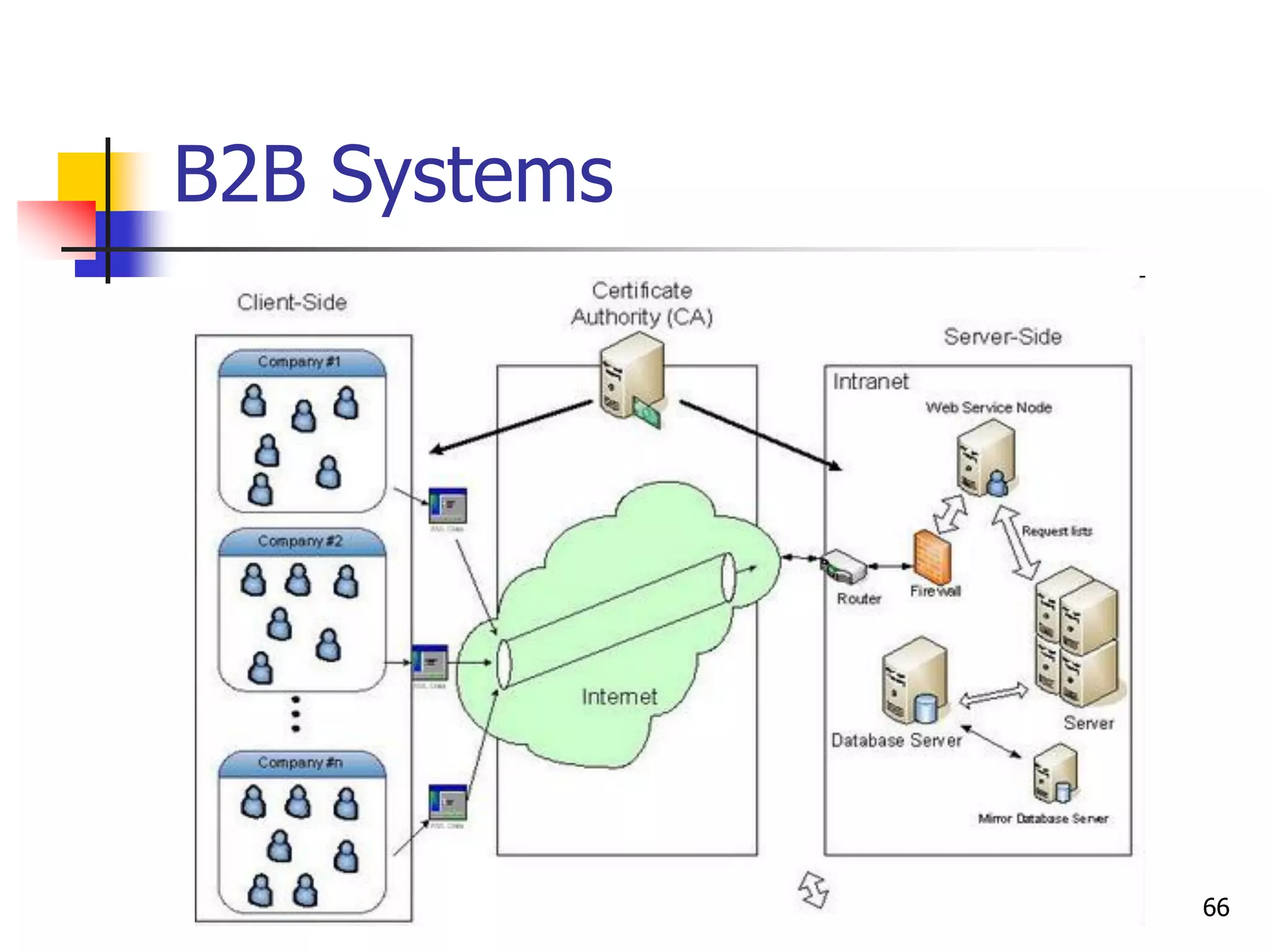
 B2B
 In a business to business (B2B) system, a
business sells to other businesses, using the
Internet to cut transaction costs and increase
efficiencies.
65
B2B Systems
66
B2B Systems
67
Exercise
 What is data mining, and how is it used?
 What is B2B system?
68
The Ethics of Using Databases
 Morphing – transforming one image to
another
 Manipulation of sound
 With the help of new technology a song can be recorded by
the singers at different times and places
 Manipulation of photos
 Editing images
 Manipulation of Videos & Television
 Graphics and animation
69
The Ethics of Using Databases
 Accuracy and Completeness
 Public databanks Nexis/Lexis
 Matters of Privacy
 Privacy is the right of people not to
reveal information about themselves
 Monopolizing Information

Electronic Data Processing

  • 1.
    1 Electronic Data Processing (EDP) Mr.AnjanMahanta LCCT,International Studies Program
  • 2.
    2 Course Outline  ManagingFiles : Basic Concepts How data is Organized: The Data Storage Hierarchy Types of Files  Database Management Systems Four Types of Database Access  Database Models Hierarchical Database Network Database Relational Database Object-Oriented Database  Features of Database Management System Data Dictionary Utilities  Databases and the New Economy E-Commerce Data Mining  The Ethics of Using Storage and Databases Manipulation of Sound, Photos, Video & Television Accuracy and Completeness
  • 3.
    3 Grade Sub-Test Quiz Mid-TermFinal Attendance Homeroom 20% 10% 25% 25% 10% 10%
  • 4.
    4 Unit 1 Managing Files:Basic Concepts  Data can be grouped into categories  The data storage hierarchy consists of the levels of data stored in a computer  Bits  Bytes  Fields  Records  Files  Databases
  • 5.
    5 Unit 1 Managing Files:Basic Concepts  Characters: A character (byte) is a letter, number, or special character Examples : A, B, C, 1, 2, 3, #, $, %  Field: A field is a unit of data consisting of one or more characters (bytes). Examples: your name, address
  • 6.
    6 Unit 1 Managing Files:Basic Concepts  Record: A record is a collection of related fields. Examples : Student code, name and address  File: A file is a collection of related records. Examples: file of students grade information
  • 7.
    7 Unit 1 Managing Files:Basic Concepts  Database: is an organized collection of related files. Examples : Student information
  • 8.
    8 Unit 1 Managing Files:Basic Concepts Type of data Contains Example Database Several files Student database Address, Grade, Fee File Several records Name Address Jack Bangkok Rocky Chiangmai Record Several fields Name Address Jack Bangkok Field Several Characters Name Jack Character Bits (0 or 1) S 1110 0010
  • 9.
    9 Example from MS-Access Student Address File
  • 10.
    10 Exercise - 1 What are databases?  Write five examples of databases.  Design one database in details showing fields and records.
  • 11.
    11 Primary Key Field A key field uniquely identify a record  It helps to easily process the database  Example: student_code is a key field in a student database
  • 12.
    12 Types of Files File is the collection of data or information  The user gives a name to each file to save for future use  The file names have an extension name.  Example –  Microsoft Word .doc  Microsoft Excel .xls  Microsoft PowerPoint .ppt
  • 13.
    13 Types of Files There are many types of files but the most important types are – Program files Data files
  • 14.
    14 Program Files  Programfiles are files containing software instructions.  The program files are instruction files written by a program for a particular application  They have a file extension. For example – .bas for BASIC, .pas for Pascal or .jav for Java  For the processor to use a source file at first it must be converted to an executable file, .exe file
  • 15.
    15 Data files  Datafiles are files that contain data – words, numbers, pictures, sounds, etc.  Data files are created by the users.
  • 16.
    16 Other types offiles  ASCII files  .txt  Image(graphic files)  .bmp, .gif, .jpg, .pcx, .tif, .wmf  Audio files  .wav, .mid, .mp3  Animation/video files  .avi, .mpg  Web files  .html, .htm, .xml, .php, .asp
  • 17.
    17 Exercise  What isa primary key?  What is a file?  What are the types of file?
  • 18.
    18 Types of DataFiles  Master file: The master files are updated periodically  Transaction file: The transaction file is a temporary file that holds all changes to be made to the master file: additions, deletions and updations
  • 19.
  • 20.
  • 21.
    21 Data Access Methods Sequential Storage: means that data is stored and retrieved in sequence, in alphabetically – ascending or descending order  Example: A tape cassette  Advantage: less expensive  Disadvantage: file searching is slow
  • 22.
  • 23.
    23 Data Access Methods Direct Access Storage: means that computer can go directly to the information you want. It is also known as random.  Example: A CD Player  Advantage: faster  Disadvantage: more expensive
  • 24.
    24 Exercise 1. What isa master file? 2. What is a transaction file? 3. What is sequential storage? 4. What is direct access storage?
  • 25.
    25 Offline Storage  Offlinestorage means that data is not in the direct control on the CPU. It maybe saved in a CD.  The data has to be loaded onto an input device.
  • 26.
    26 Online Storage  Onlinestorage means that data is immediately accessible by the CPU.  You need not wait for a CD.  Storage is on the disk (direct access storage)
  • 27.
    27 Database Management Systems DBMS A database is an organized collection of related files  There are many types of databases  To manage the information a database management system is used  The DBMS is a program that controls the structure of a database and access to the data
  • 28.
    28 Advantages of DBMS File Sharing  users can share files
  • 29.
    29 Advantages of DBMS Reduced data redundancy  prevent duplication
  • 30.
    30 Advantages of DBMS Improved data integrity  accurate and up to date
  • 31.
    31 Advantages of DBMS Increased security  data can be secured by the use of passwords
  • 32.
    32 Exercise  What isa Database Management System?  What are the advantages of DBMS?
  • 33.
    33 Types of DatabaseAccess  Individual database  used by one person
  • 34.
    34 Types of DatabaseAccess  Shared database  shared by many people in one location
  • 35.
    35 Types of DatabaseAccess  Distributed database  shared by many people in many locations
  • 36.
    36 Types of DatabaseAccess  Public databank  information for the public  Yahoo  Google  Law  Shopping  News  Games
  • 37.
    37 DBA  The DatabaseAdministrator (DBA) coordinates all related activities and needs for an organization’s database.  The DBA determines user access privileges, sets standards.  The DBA is responsible for system back up and recovery.
  • 38.
    38 Exercise  Describe thefour types of databases.  What does a database administrator do?
  • 39.
    39 Database Models  HierarchicalDatabase  In a hierarchical database, fields or records are arranged in related groups resembling a family tree, with child (lower-level) records subordinate to parent (higher-level) records.
  • 40.
  • 41.
  • 42.
    42 Database Models  NetworkDatabase  A network database is similar to a hierarchical database, but each child record can have more than one parent record.
  • 43.
    43 Database Models  RelationalDatabase  A relational database relates, or connects, data in different files through the use of a key field, or common data element.
  • 44.
  • 45.
  • 46.
    46 Structured Query Language SQL SQL is the standard language used to  Create  Add  Delete  Update relational databases
  • 47.
    47 Structured Query Language SQL Example  1. Select * from student  2. Select * from student where firstname=“Andrew”  3. Select * from student where grade > 2  4. Select * from student where age > 18
  • 48.
    48 Object Oriented Database An object oriented database uses objects. An object consists of graphics, audio and video.
  • 49.
    49 Exercise  What arethe four models of database organization?  What is SQL?
  • 50.
    50 Application Service Provider ASP ASPs allow users to subscribe to various software applications over the Internet.  Example in Thailand  ADSL
  • 51.
    51 DBMS Components  DataDictionary  It is a file that stores the definitions of the structure of data used in the database.  Example: Keyword Description Room_Id The room numbers of the hotel Check_In The date when the guest check into the hotel
  • 52.
    52 DBMS Components  Utilities The DBMS utilities maintains the database by creating, editing and monitoring data input  Example  MS-ACCESS
  • 53.
    53 DBMS Components  ReportGenerator  It is a program that creates onscreen or printed document  Example  MS-ACCESS
  • 54.
    54 DBMS Components  AccessSecurity  It specifies user access privileges  Example  MySQL  ORACLE
  • 55.
    55 Exercise  1.What isdata dictionary?  2.What do DBMS utilities do?  3.How does access security work?  4.Explain the four types of system recovery.
  • 56.
    56 DBMS Components  System/ Data Recovery  It enables contents of database to be recovered after system failure  Types of Data Recovery  Mirroring – two copies in different locations  Reprocessing – redoing the processing from a known past point  Rollforward – a variant on reprocessing  Rollback – undoing unwanted changes
  • 57.
    57 E-Commerce  E-Commerce orElectronic Commerce  is the buying and selling of products and services through computer networks  Amazon.com, eBay, Priceline.com are the best example for e-commerce or online shopping
  • 58.
  • 59.
  • 60.
    60 Data Mining  Datamining (DM) is the computer-assisted process of sifting through and analyzing vast amounts of data  It is used to extract meaning and discover new knowledge  It’s main purpose is to describe past trends and predict future trends  It can be used to learn customer, marketing, production and financial data
  • 61.
  • 62.
  • 63.
  • 64.
    64 Applications of Datamining  Marketing  Health  Science  B2B  In a business to business (B2B) system, a business sells to other businesses, using the Internet to cut transaction costs and increase efficiencies.
  • 65.
  • 66.
  • 67.
    67 Exercise  What isdata mining, and how is it used?  What is B2B system?
  • 68.
    68 The Ethics ofUsing Databases  Morphing – transforming one image to another  Manipulation of sound  With the help of new technology a song can be recorded by the singers at different times and places  Manipulation of photos  Editing images  Manipulation of Videos & Television  Graphics and animation
  • 69.
    69 The Ethics ofUsing Databases  Accuracy and Completeness  Public databanks Nexis/Lexis  Matters of Privacy  Privacy is the right of people not to reveal information about themselves  Monopolizing Information