2nd CHAPTER

Starting Small Business

02/08/14
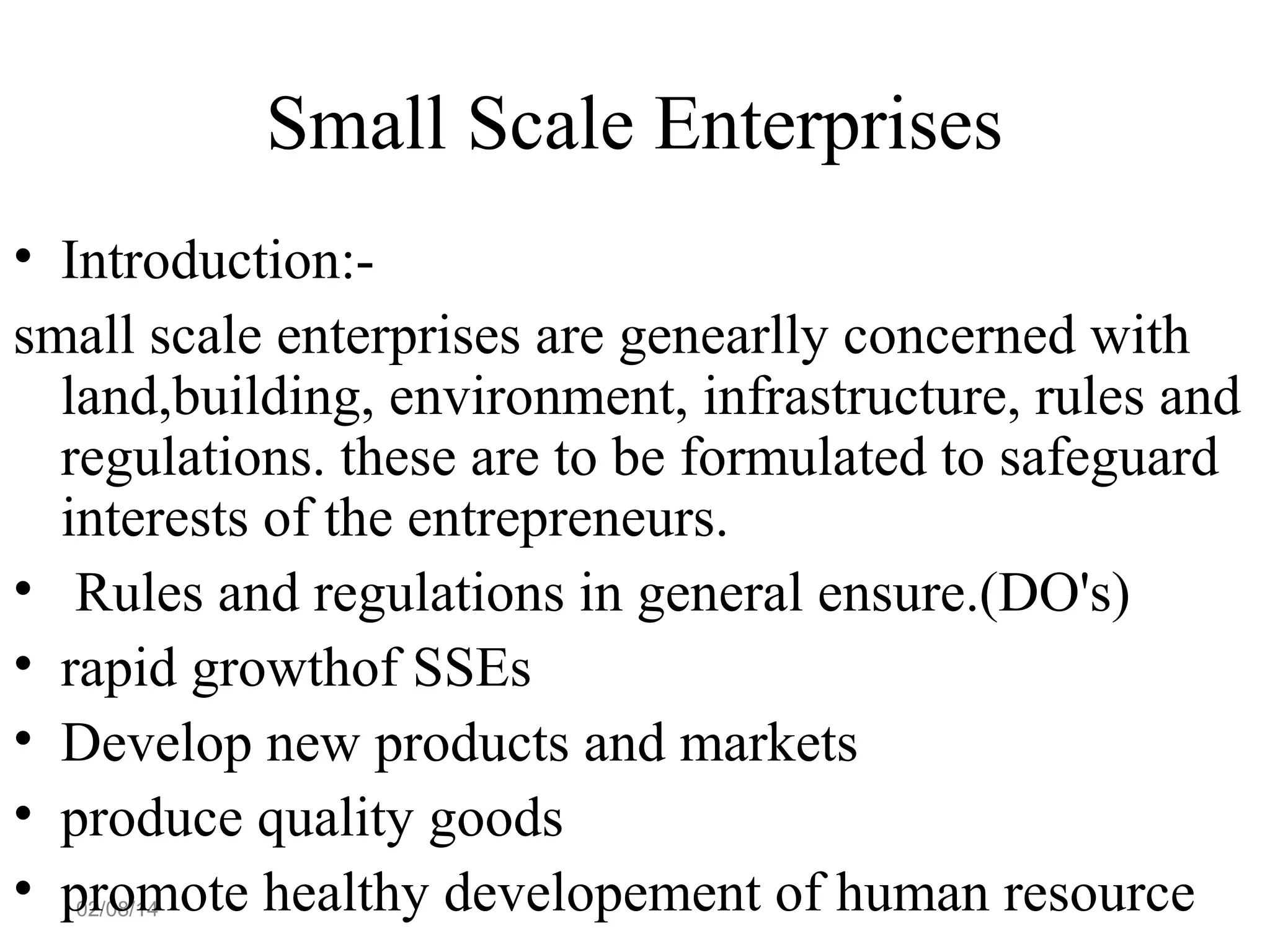
Small Scale Enterprises
• Introduction:small scale enterprises are genearlly concerned with
land,building, environment, infrastructure, rules and
regulations. these are to be formulated to safeguard
interests of the entrepreneurs.
• Rules and regulations in general ensure.(DO's)
• rapid growthof SSEs
• Develop new products and markets
• produce quality goods
• promote healthy developement of human resource
02/08/14
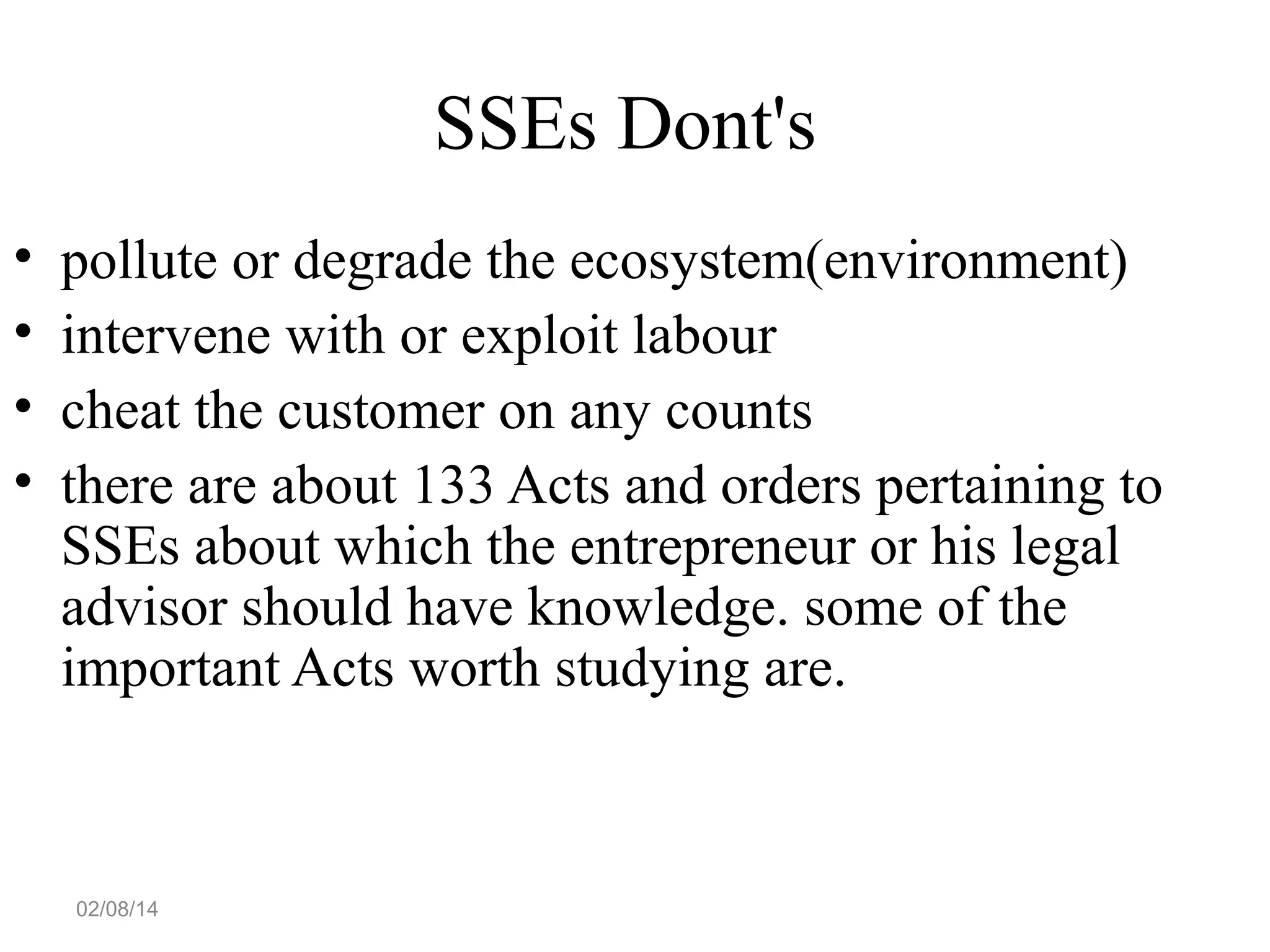
SSEs Dont's
•
•
•
•

pollute or degrade the ecosystem(environment)
intervene with or exploit labour
cheat the customer on any counts
there are about 133 Acts and orders pertaining to
SSEs about which the entrepreneur or his legal
advisor should have knowledge. some of the
important Acts worth studying are.

02/08/14
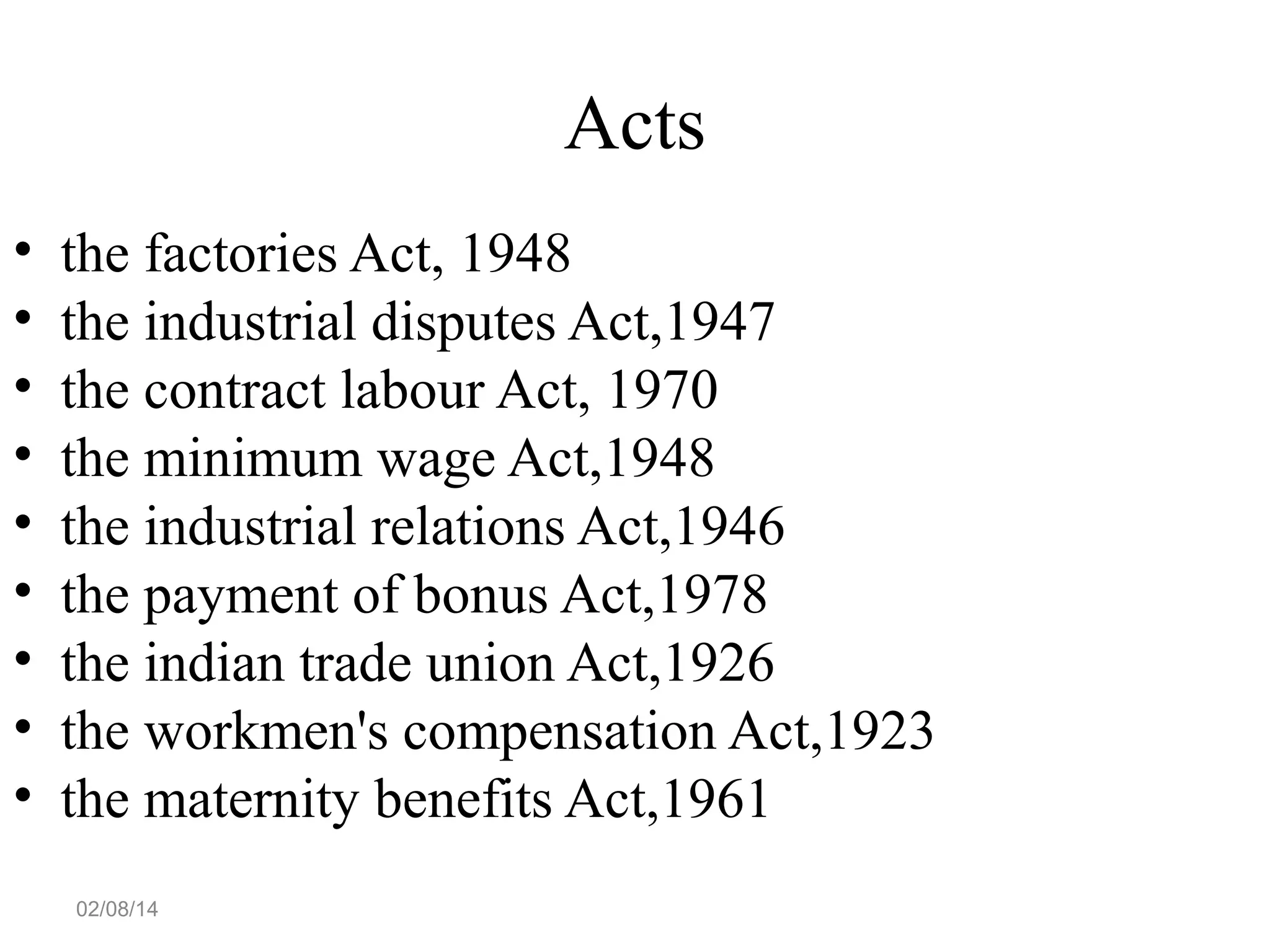
Acts
•
•
•
•
•
•
•
•
•

the factories Act, 1948
the industrial disputes Act,1947
the contract labour Act, 1970
the minimum wage Act,1948
the industrial relations Act,1946
the payment of bonus Act,1978
the indian trade union Act,1926
the workmen's compensation Act,1923
the maternity benefits Act,1961
02/08/14
Contd....
•
•
•
•
•
•
•
•

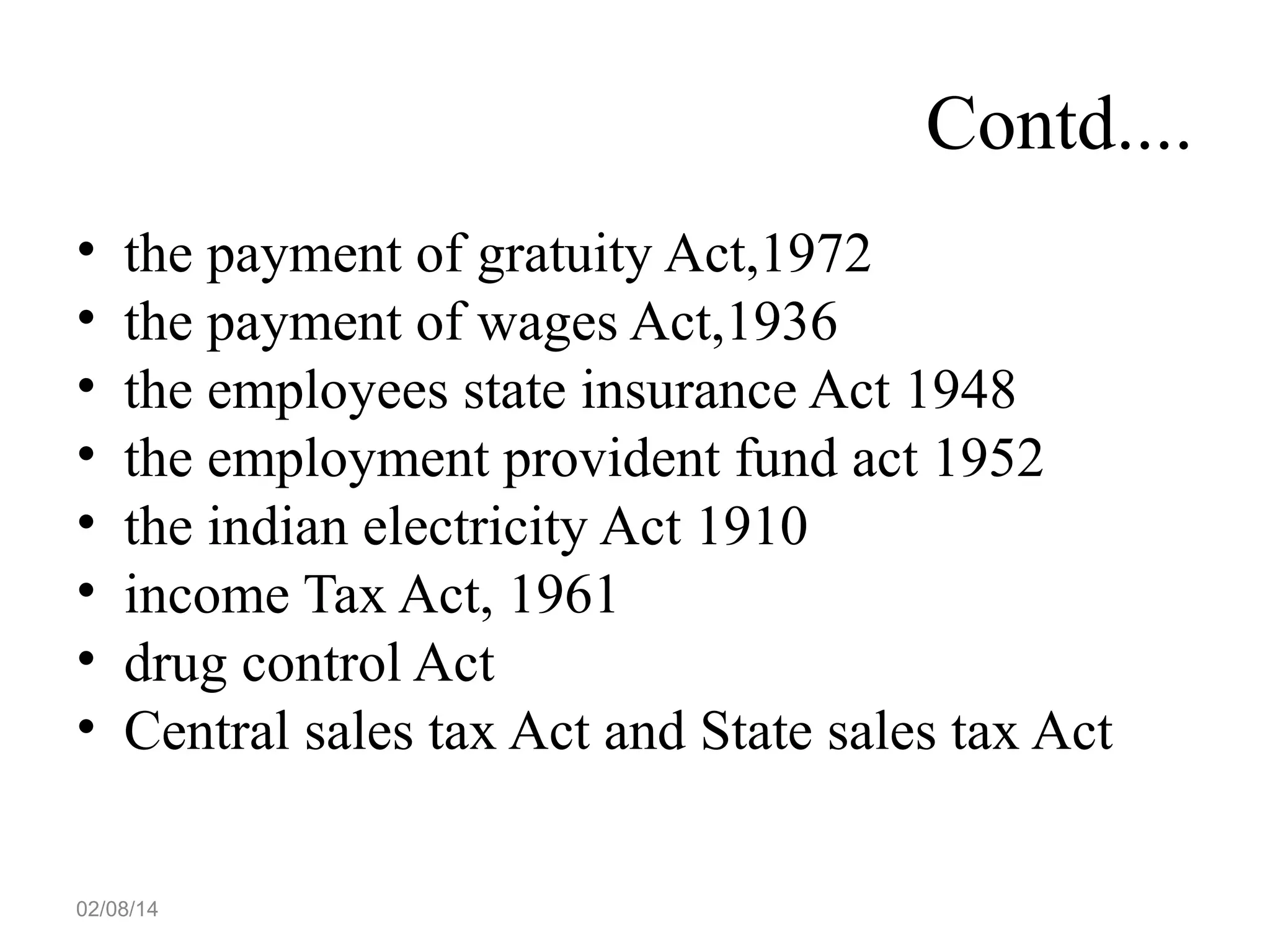
the payment of gratuity Act,1972
the payment of wages Act,1936
the employees state insurance Act 1948
the employment provident fund act 1952
the indian electricity Act 1910
income Tax Act, 1961
drug control Act
Central sales tax Act and State sales tax Act

02/08/14
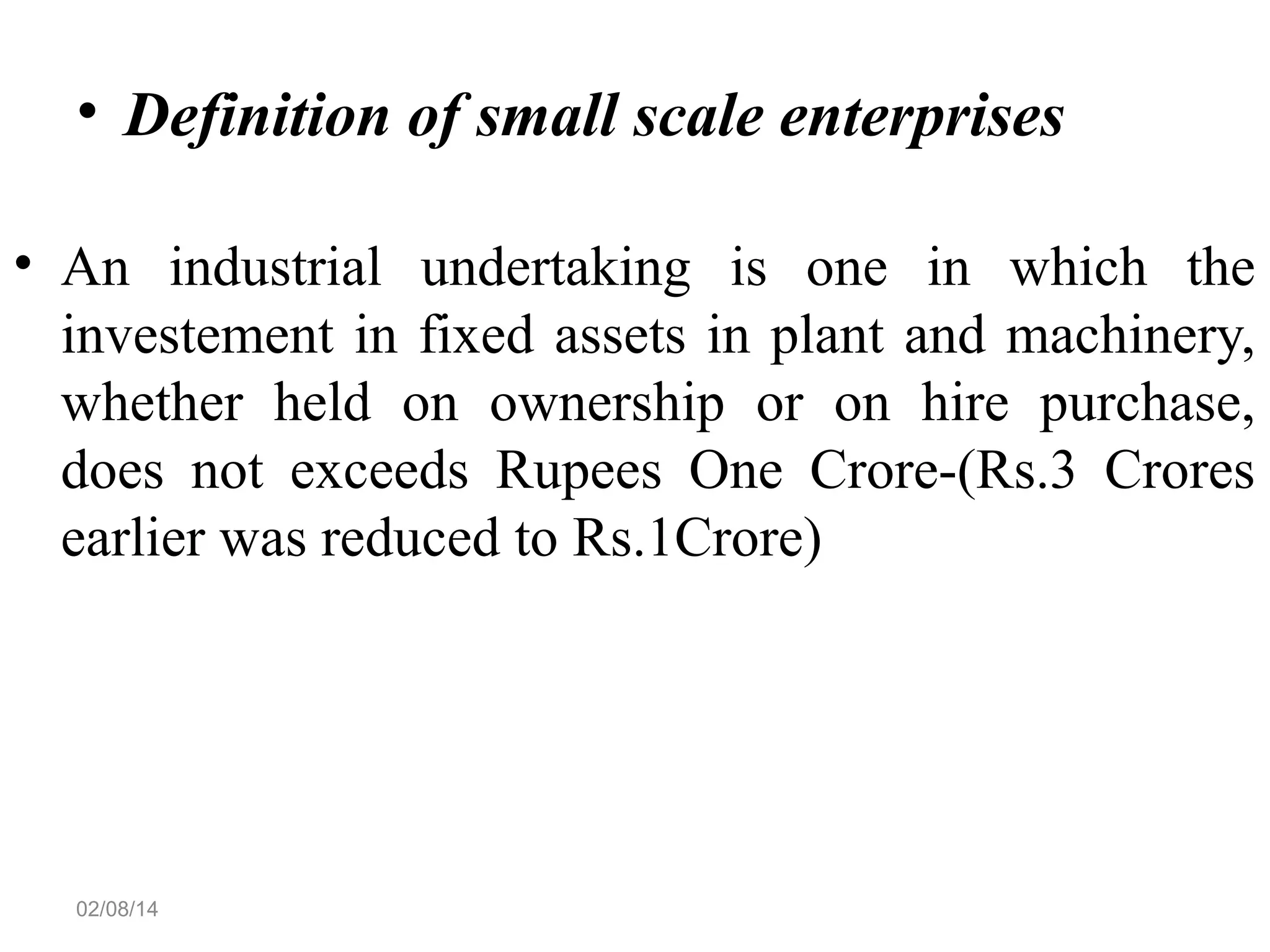
• Definition of small scale enterprises
• An industrial undertaking is one in which the
investement in fixed assets in plant and machinery,
whether held on ownership or on hire purchase,
does not exceeds Rupees One Crore-(Rs.3 Crores
earlier was reduced to Rs.1Crore)

02/08/14
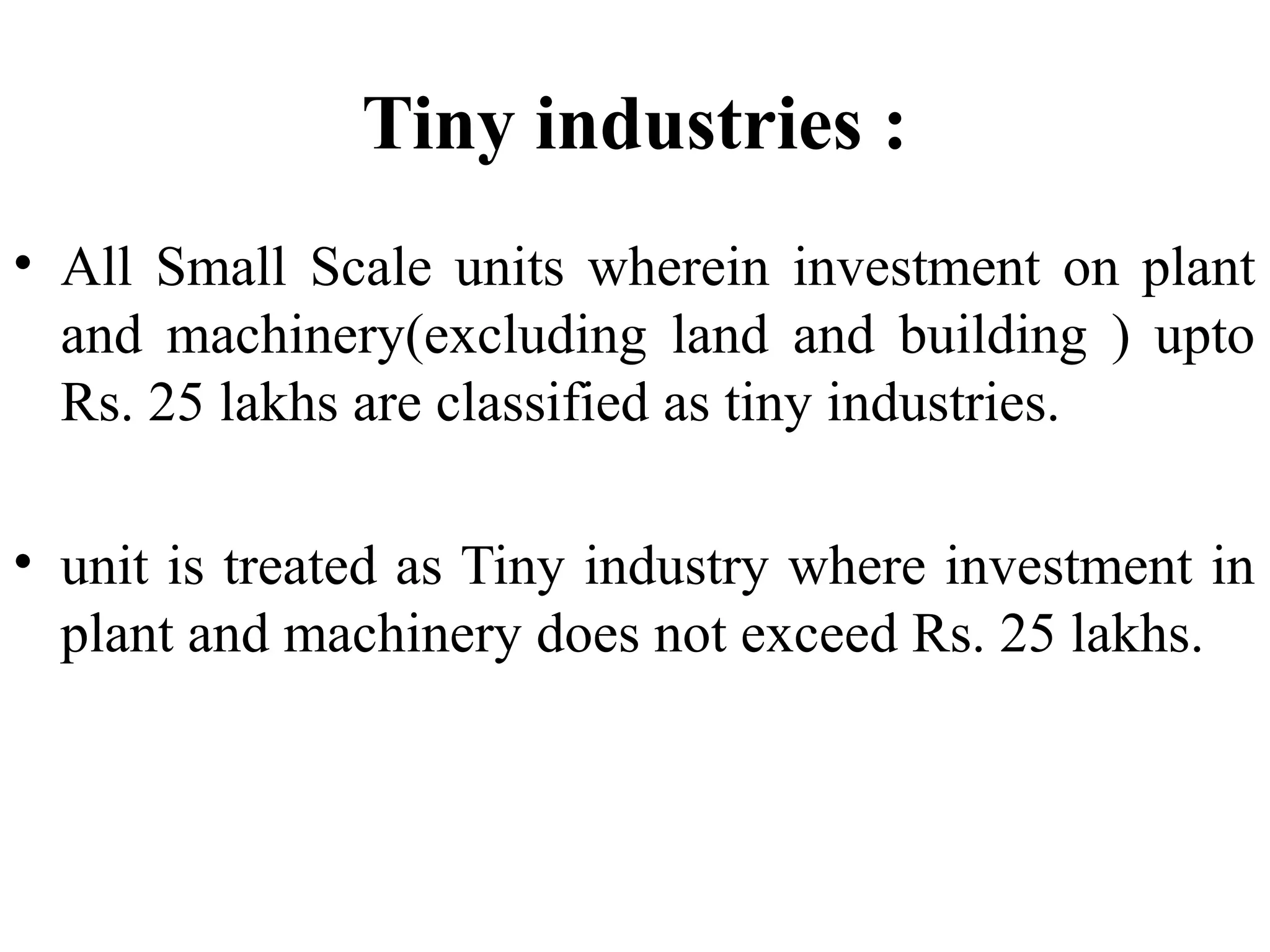
Tiny industries :
• All Small Scale units wherein investment on plant
and machinery(excluding land and building ) upto
Rs. 25 lakhs are classified as tiny industries.
• unit is treated as Tiny industry where investment in
plant and machinery does not exceed Rs. 25 lakhs.
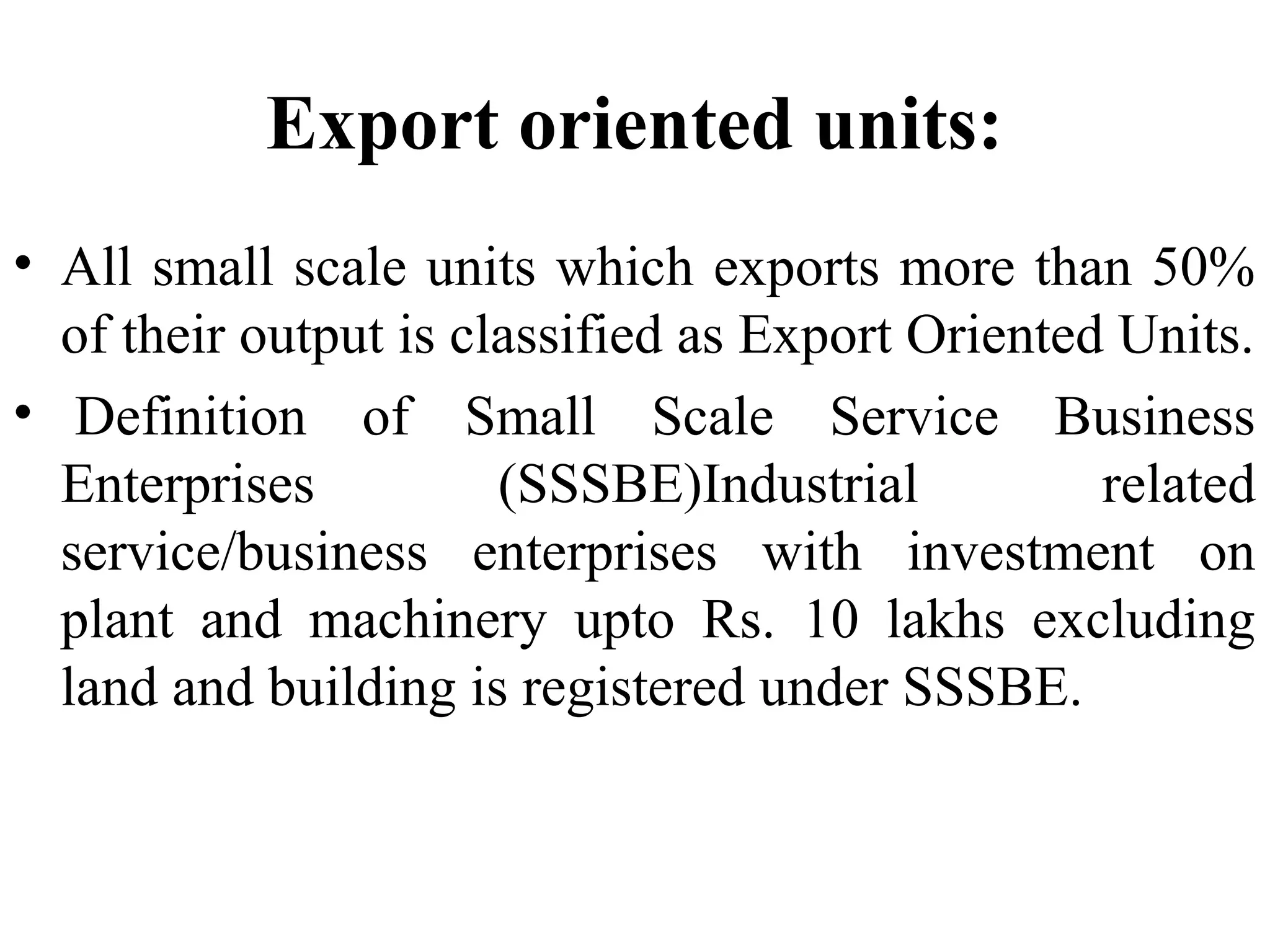
Export oriented units:
• All small scale units which exports more than 50%
of their output is classified as Export Oriented Units.
• Definition of Small Scale Service Business
Enterprises
(SSSBE)Industrial
related
service/business enterprises with investment on
plant and machinery upto Rs. 10 lakhs excluding
land and building is registered under SSSBE.
• Specified activities eligible for SSI Registration up
to Rs. 5 Crores There are certain types of
industries/activities wherein investment on plant and
machinery upto Rs. 5 crores can also be registered
under SSI category and such list of industries are
available in Info-help.
Ancillary industries
• Ancillary industries are those which manufacture
parts and components to be used by larger
industries. Eg- Companies like GE (ancillary)
produce engines for the aircraft industry.
• The ancillary workers in an institution are the
people such as cleaners and cooks whose work
supports the main work of the institution.
Cottage Industries
• An industry where
the
creation
of products and services is home-based, rather than
factory-based. While products and services created
by cottage industry are often unique and distinctive
given the fact that they are usually not massproduced, producers in
this sector often
face
numerous
disadvantages
when
trying
to compete with much larger factory-based
companies
Cottage Industries
• an industry whose labour force consists of
family units or individuals working at home
with their own equipment
• a small and often informally organized
industry
Characteristics of Small Enterprises :
“Small Enterprise is Beautiful” because of its
following Important Characteristics :
1)
A Small Enterprise is generally a “One
Man Show”. Even Small Enterprises which
run by a Partnership Firm or a Private Limited
Company, in most cases, the activities are
mainly carried out by one of the Partners or
Directors. In Practice, the others mainly assist
in providing Capital / Funds.
13

www.Bookspar.com | Website for Students |
VTU - Notes - Question Papers
2) Owner himself / herself is also a Manager of
the Enterprise. Thus, a Small Enterprise is
managed in a personalized manner. The Owner
has First Hand Knowledge of all aspects of the
Enterprise & knows what is actually going on in
the Business. He takes effective participation in all
matters of Business Decision Making.
3) A Small Enterprise has lesser development
Period (the process of early development)
compared to a Large Enterprise. i.e., the period
after which the return on Investment starts.
14

www.Bookspar.com | Website for Students |
VTU - Notes - Question Papers
4) Small Enterprises generally carryout their
operations so as to cater (provide water and food for
cetain peoples) to the Local & Regional Markets.
5) Small Enterprises use
indigenous(originating)resources & therefore can be
located anywhere subject to the availability of these
resources like Raw Materials, Labor, Transport
Facilities etc.
6) They are fairly Labor Intensive with
comparatively smaller Capital Investment than the
Larger Units. That is, for the same Investment, a
Small Enterprise provides more jobs to the people
compared to a Large Enterprise.
15

www.Bookspar.com | Website for Students |
VTU - Notes - Question Papers
7) Using Local Resources, Small Units are
decentralized & dispersed to Rural Areas & Smaller
Towns.
 Thus, the development of Small Enterprises in Rural
Areas & Smaller towns promotes more Balanced
Regional Development & thereby prevents influx of job
seekers from rural areas & smaller towns to bigger cities
& urbanizing centers.
8) They are more flexible to adapt changes like
Diversification to New Products, adopting to New
Production Techniques, substituting New Raw Materials,
Changes in Organization Structure, New Market etc.

16

www.Bookspar.com | Website for Students |
VTU - Notes - Question Papers
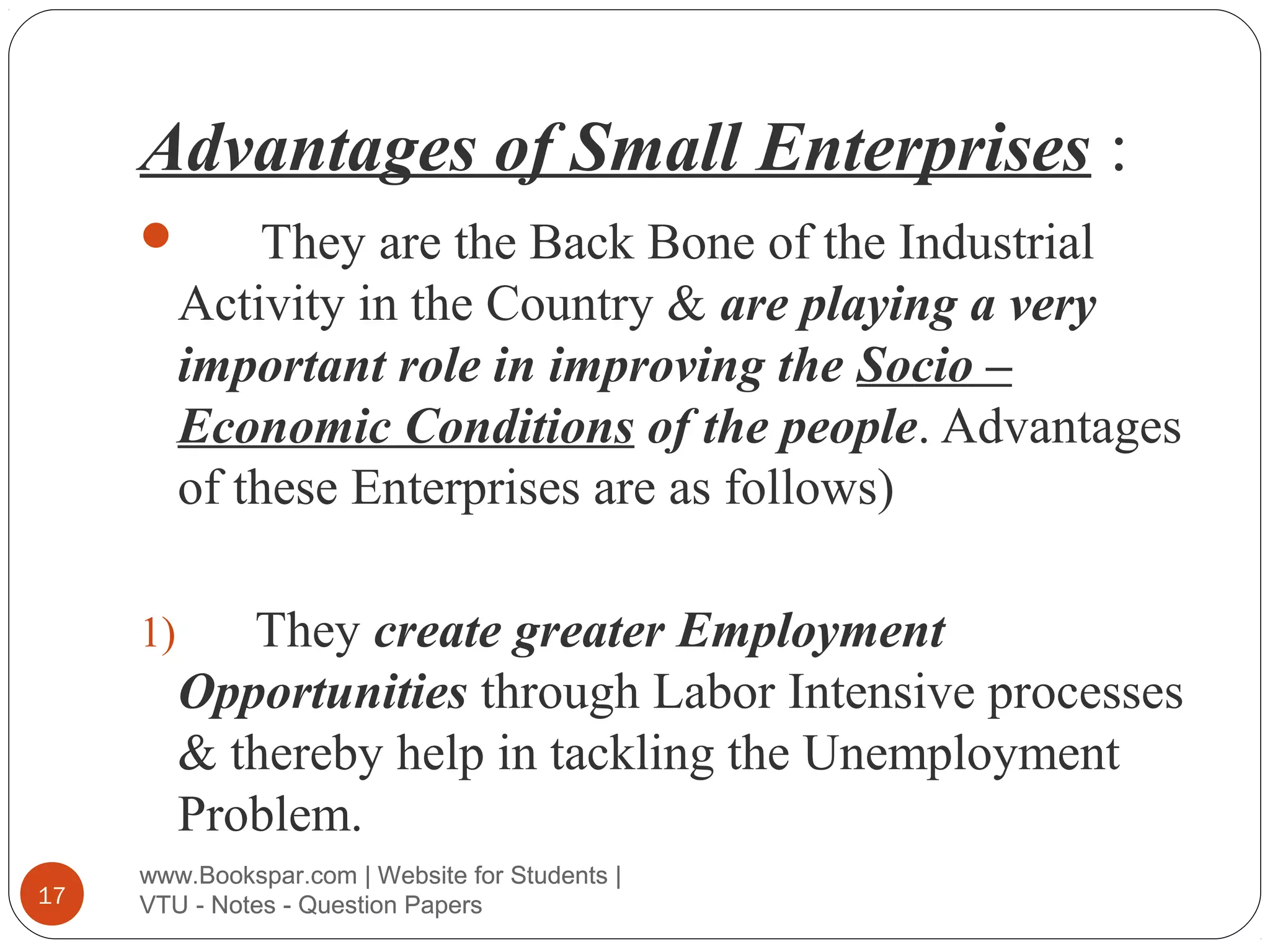
Advantages of Small Enterprises :
They are the Back Bone of the Industrial
Activity in the Country & are playing a very
important role in improving the Socio –
Economic Conditions of the people. Advantages
of these Enterprises are as follows)



1)

17

They create greater Employment
Opportunities through Labor Intensive processes
& thereby help in tackling the Unemployment
Problem.

www.Bookspar.com | Website for Students |
VTU - Notes - Question Papers
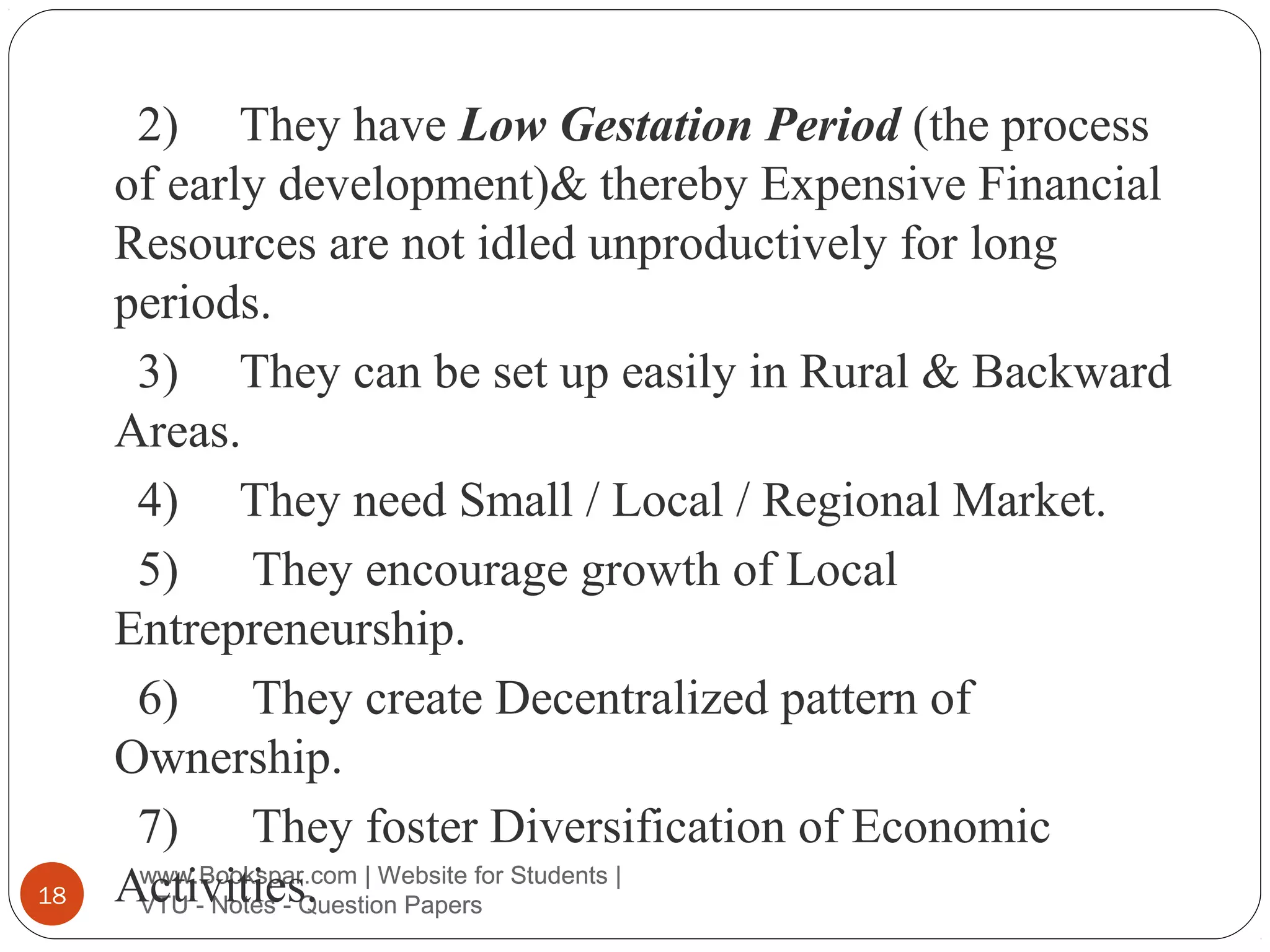
18

2) They have Low Gestation Period (the process
of early development)& thereby Expensive Financial
Resources are not idled unproductively for long
periods.
3) They can be set up easily in Rural & Backward
Areas.
4) They need Small / Local / Regional Market.
5) They encourage growth of Local
Entrepreneurship.
6) They create Decentralized pattern of
Ownership.
7) They foster Diversification of Economic
www.Bookspar.com
Activities. | Website for Students |
VTU - Notes - Question Papers
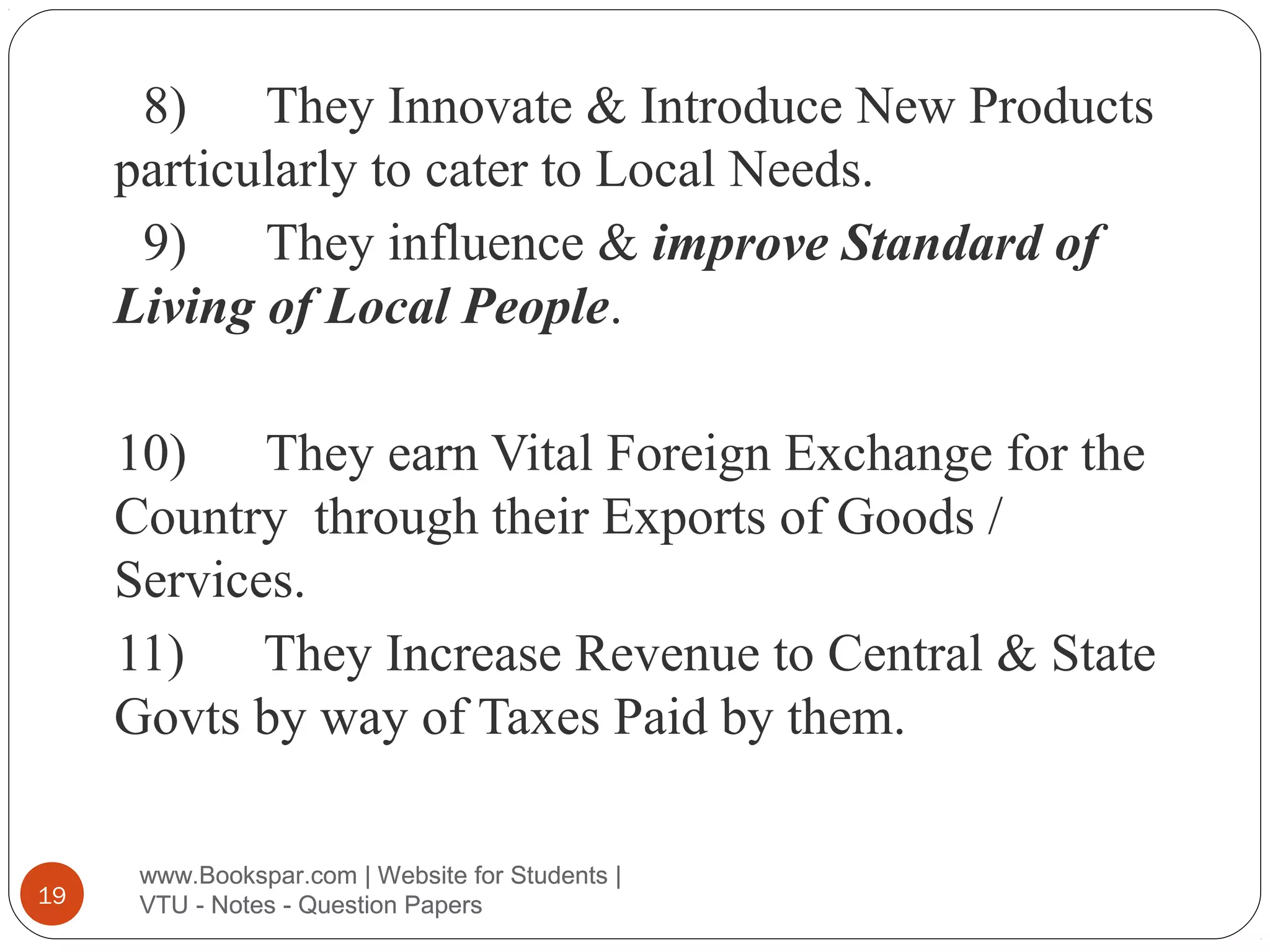
8) They Innovate & Introduce New Products
particularly to cater to Local Needs.
9) They influence & improve Standard of
Living of Local People.
10) They earn Vital Foreign Exchange for the
Country through their Exports of Goods /
Services.
11) They Increase Revenue to Central & State
Govts by way of Taxes Paid by them.

19

www.Bookspar.com | Website for Students |
VTU - Notes - Question Papers
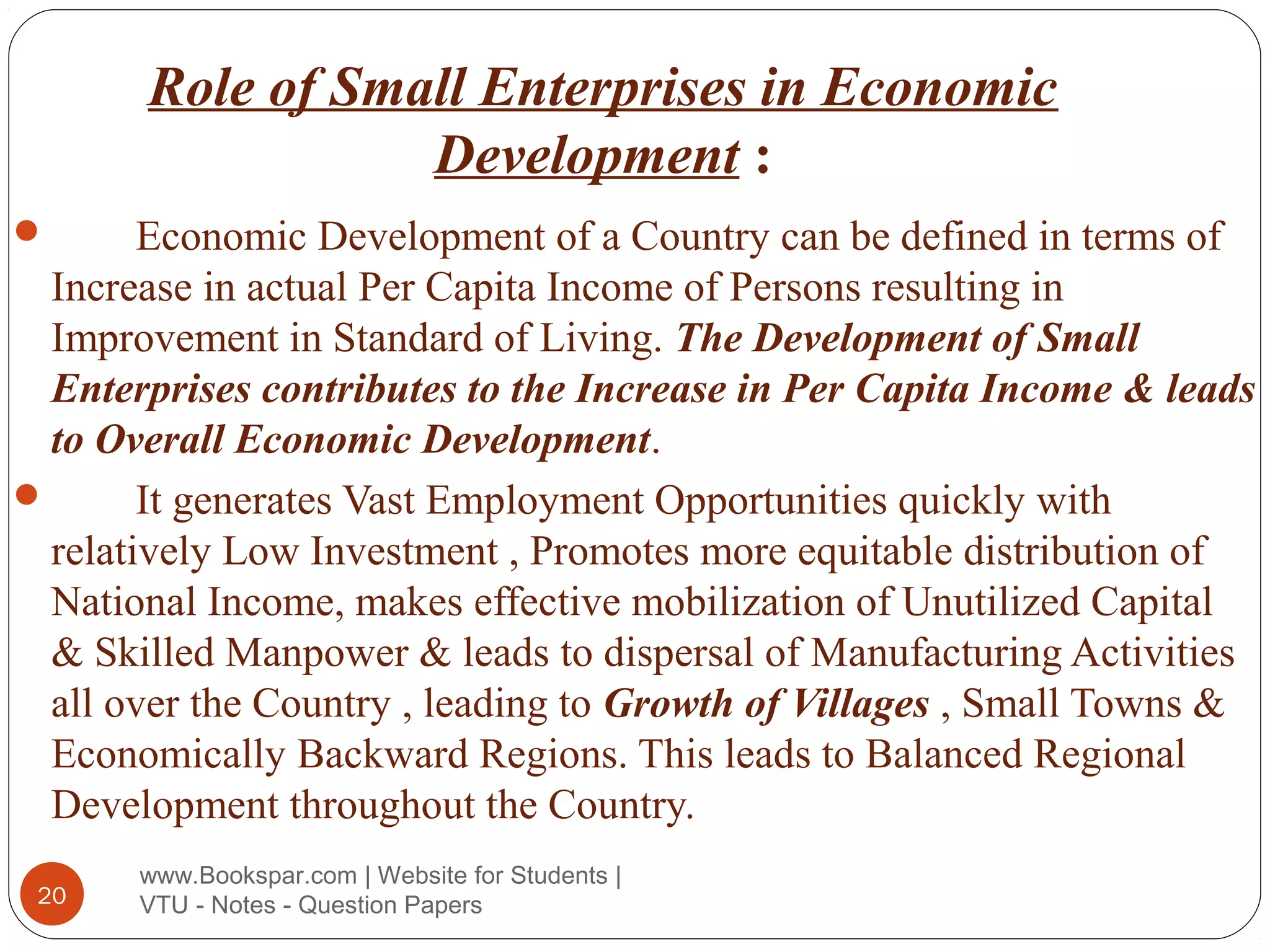
Role of Small Enterprises in Economic
Development :
Economic Development of a Country can be defined in terms of
Increase in actual Per Capita Income of Persons resulting in
Improvement in Standard of Living. The Development of Small
Enterprises contributes to the Increase in Per Capita Income & leads
to Overall Economic Development.

It generates Vast Employment Opportunities quickly with
relatively Low Investment , Promotes more equitable distribution of
National Income, makes effective mobilization of Unutilized Capital
& Skilled Manpower & leads to dispersal of Manufacturing Activities
all over the Country , leading to Growth of Villages , Small Towns &
Economically Backward Regions. This leads to Balanced Regional
Development throughout the Country.


20

www.Bookspar.com | Website for Students |
VTU - Notes - Question Papers
The Role of Small Enterprises in Economic
Development of our Country can be discussed with
reference to the following parameters during the last
Four Decades :



1) Increase in the Number of Small Enterprises.
2) Increase in the Value of Production in Rupee
Terms.
3) Increase in the Number of People
Employed.
4) Increase in the Export Earnings in Rupee
Terms.
21

www.Bookspar.com | Website for Students |
VTU - Notes - Question Papers
The Small Enterprises have registered phenomenal growth in
their Number, Production, Employment & Exports over the Last Four
Decades.
In 1950, there were 16,000 Registered Small Scale Industries &
this has increased to 31.21 Lakh Registered SSI’s during 1998 – 1999.
During 1973 – 74, the Total Value of Production reported by
SSI’s was Rs. 7200 Crores & this has grown phenomenally by about
75 Times to Rs. 5,38,357 Crores during 1998 – 1999.
As regards Employment, about 40 Lakh People were employed
in SSI Sector during 1973 – 1974 & there is a Four Fold Increase in
Employment during 1998 – 1999, that is 175.2 Lakh People were
employed in SSI Sector during 1998 – 1999.

22

www.Bookspar.com | Website for Students |
VTU - Notes - Question Papers
There is a Phenomenal Growth in Exports Revenue
during the last Four Decades. During 1973 -1974, SSI Sector
exported Rs. 393 Crores worth of Goods & Services & this
has grown nearly 150 times to Rs. 57, 488 Crores during
1998 -1999.
As we can see, the SSI Sector has been contributing
tremendously in overall economic development of the
Country by creating Vast Employment Opportunities ,
increased Value of Production, & increased Value of
Exports & Foreign Exchange Earnings.

23

www.Bookspar.com | Website for Students |
VTU - Notes - Question Papers
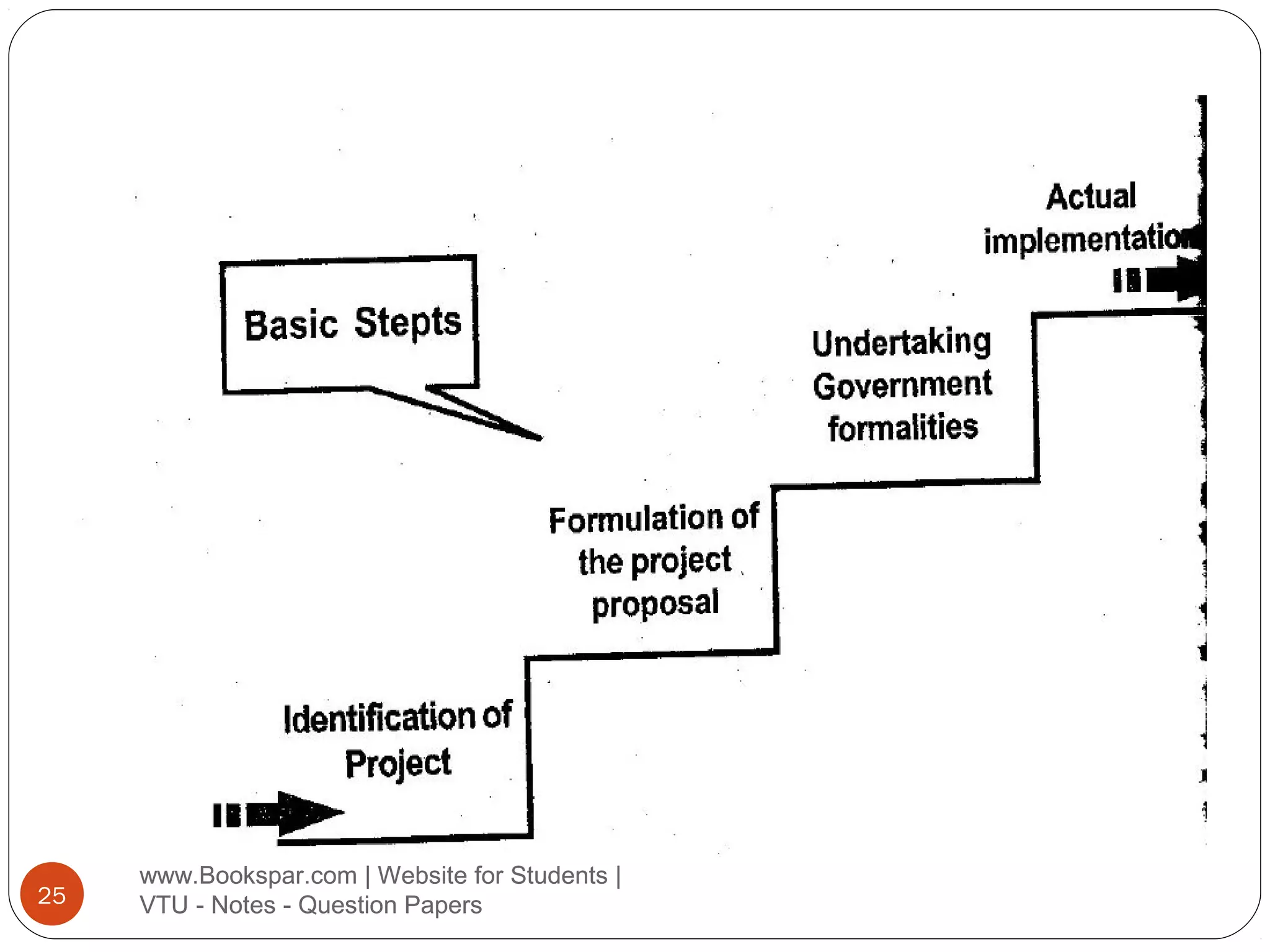
Steps for Starting a Small Industry :

 The Various Basic Steps for Starting a Small

Enterprise is as Given Below :

24

www.Bookspar.com | Website for Students |
VTU - Notes - Question Papers
25

www.Bookspar.com | Website for Students |
VTU - Notes - Question Papers
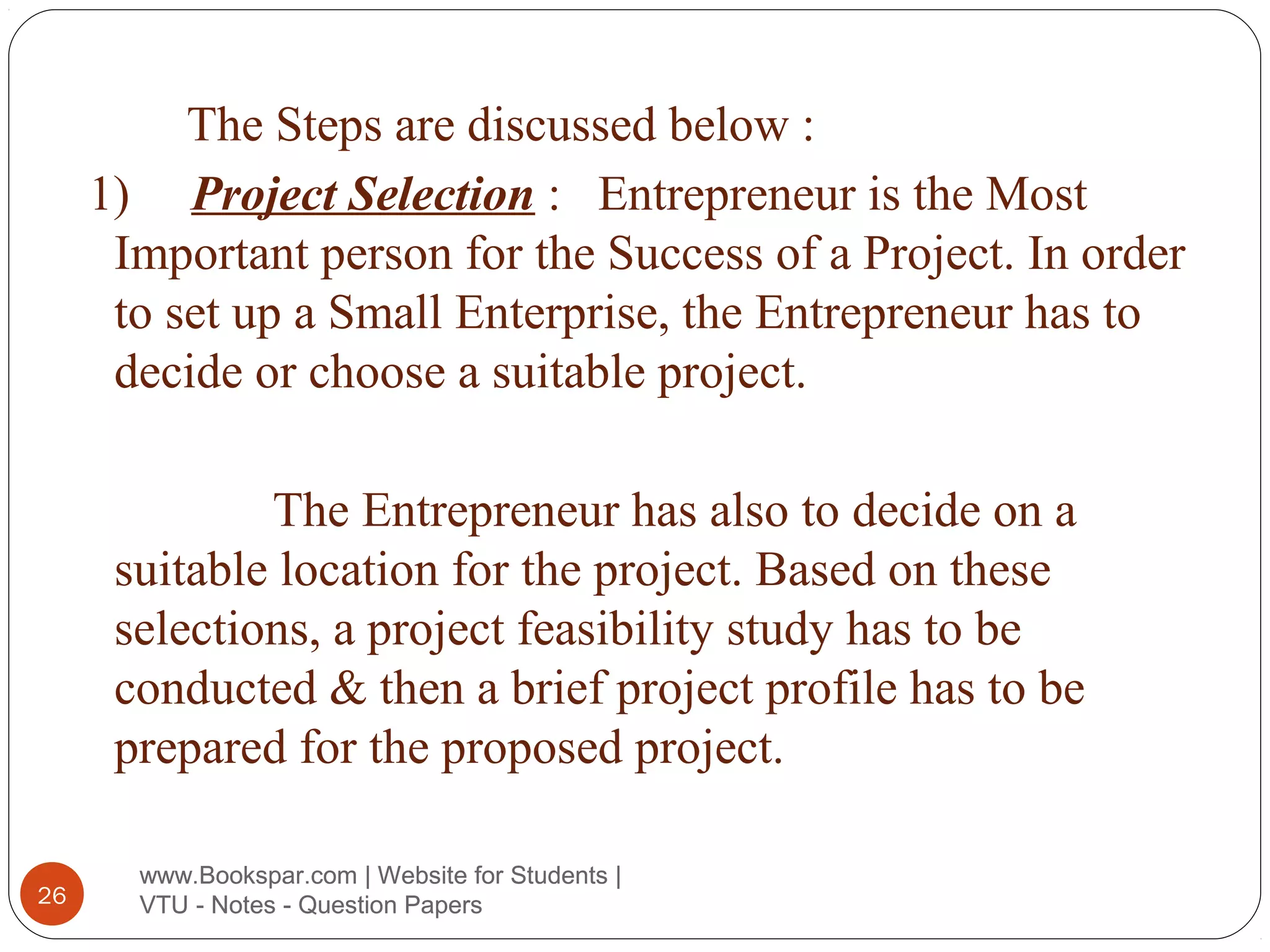
The Steps are discussed below :
1) Project Selection : Entrepreneur is the Most
Important person for the Success of a Project. In order
to set up a Small Enterprise, the Entrepreneur has to
decide or choose a suitable project.
The Entrepreneur has also to decide on a
suitable location for the project. Based on these
selections, a project feasibility study has to be
conducted & then a brief project profile has to be
prepared for the proposed project.
26

www.Bookspar.com | Website for Students |
VTU - Notes - Question Papers
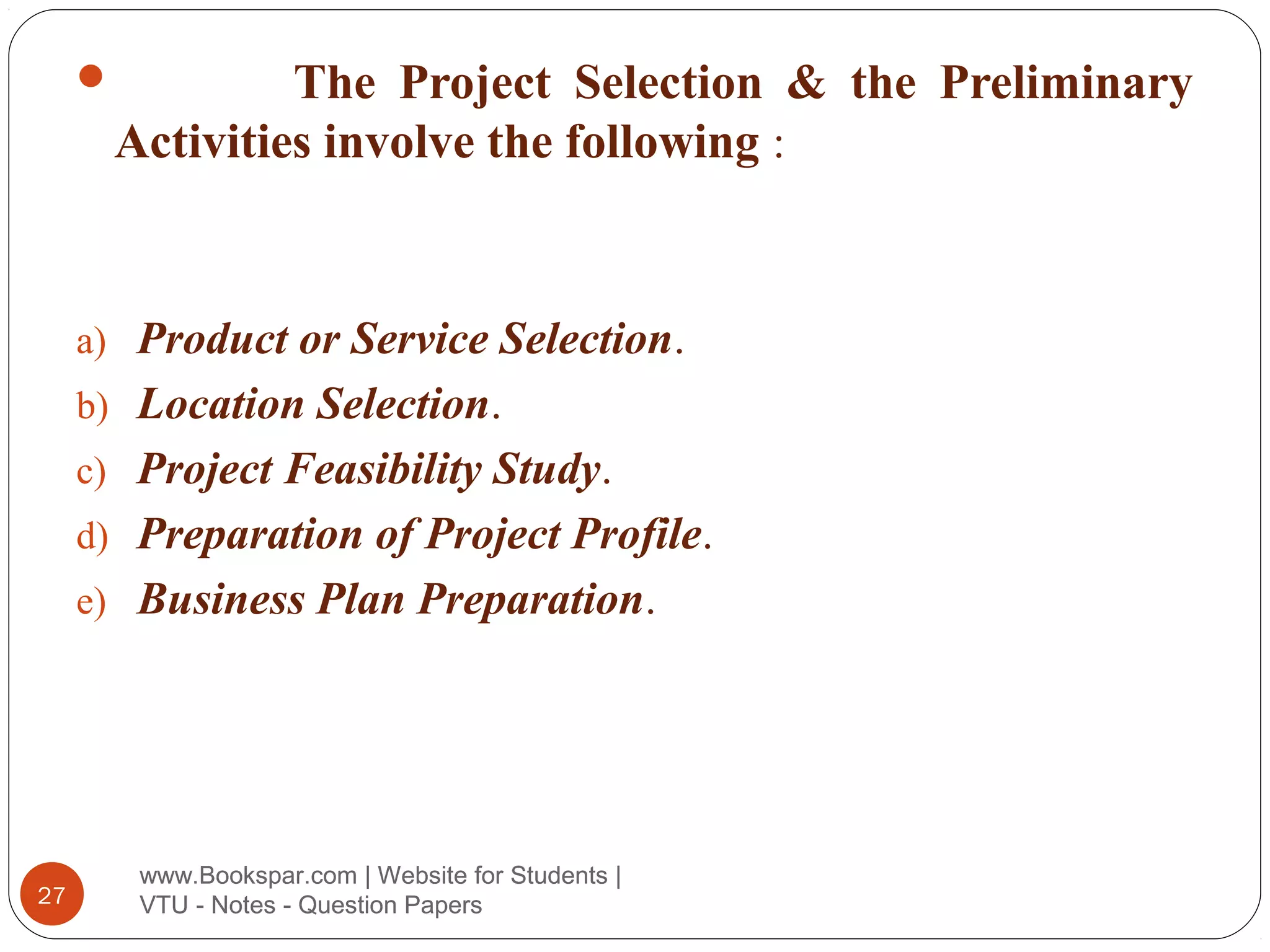
The Project Selection & the Preliminary
Activities involve the following :



a) Product or Service Selection.
b) Location Selection.
c) Project Feasibility Study.
d) Preparation of Project Profile.
e) Business Plan Preparation.

27

www.Bookspar.com | Website for Students |
VTU - Notes - Question Papers
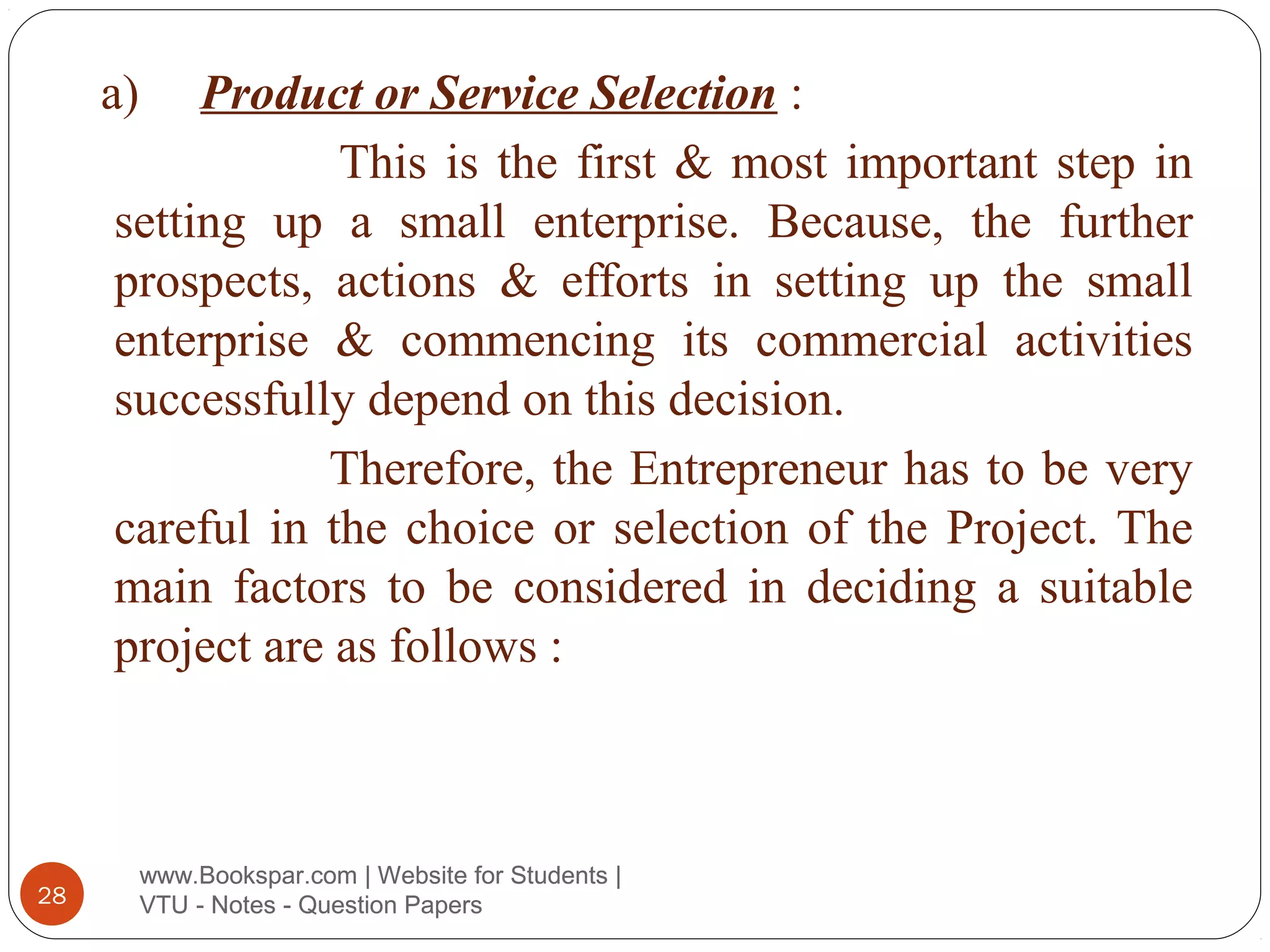
a)

Product or Service Selection :
This is the first & most important step in
setting up a small enterprise. Because, the further
prospects, actions & efforts in setting up the small
enterprise & commencing its commercial activities
successfully depend on this decision.
Therefore, the Entrepreneur has to be very
careful in the choice or selection of the Project. The
main factors to be considered in deciding a suitable
project are as follows :

28

www.Bookspar.com | Website for Students |
VTU - Notes - Question Papers
1) Background & Experience of Entrepreneurs.
2) Availability of the Right Technology & Know – How
for the Project.
3) Marketability of the Product / Service.
4) Investment Capacity (i.e., Financial Resources.)
5) Availability of Plant & Machinery,
6) Availability of Raw Materials.
7) Availability of Proper Infrastructural Facilities Viz.,
Land / Shed, Power, Water, Communication, Transport etc.
8) Availability of right kind of Labor Viz., Skilled, Semi
– Skilled & Unskilled.

29

www.Bookspar.com | Website for Students |
VTU - Notes - Question Papers
Considering all above aspects & taking the help of
Governmental Support Organizations like TECSOK,
(Technical Consultancy Services Organisation of
Karnataka) KIADB, (Karnataka industrial area
development board)
KSSIDC (KARNATAKA STATE SMALL INDUSTRIES
DEVELOPMENT CORPORATION)etc & even private
consultants , the Entrepreneur has to choose & decide the
project for implementation.
b) Location Selection : After deciding on the Project,
the next important decision an Entrepreneur has to make is
about the Location of the Project. There are a Few factors
associated with the same :


30

www.Bookspar.com | Website for Students |
VTU - Notes - Question Papers
1) Nearness or Proximity to Market.
2) Availability of Raw Materials.
3) Availability of Transformation &
Communication Facilities.
4) Availability of Govt Incentives / Concessions.
5) Govt Industrial Policy.
6) Availability of suitable Infrastructural facilities.
7) Availability of Labor.
8) Convenience for the Entrepreneur’s.

31

www.Bookspar.com | Website for Students |
VTU - Notes - Question Papers
c) Project Feasibility Study : The important facts of Project
Feasibility Study are as follows :
1)
Market Analysis is carried out to find out the aggregate demand
of the proposed Product / Service & what would be the Market Share
of the proposed project.
2) Technical Analysis seeks to determine whether the
prerequisites (A prerequisite is a required prior condition)for the
successful commissioning of the Project have been considered &
reasonably good choices have been made with respect to Location,
Size, Process & so on.
3)
Financial Analysis seeks to ascertain whether the proposed
project will be Financially viable in the sense of being able to meet the
burden of Servicing Debt & Satisfy the return on Investment
Expectations of the Promoter’s.
32

www.Bookspar.com | Website for Students |
VTU - Notes - Question Papers
33

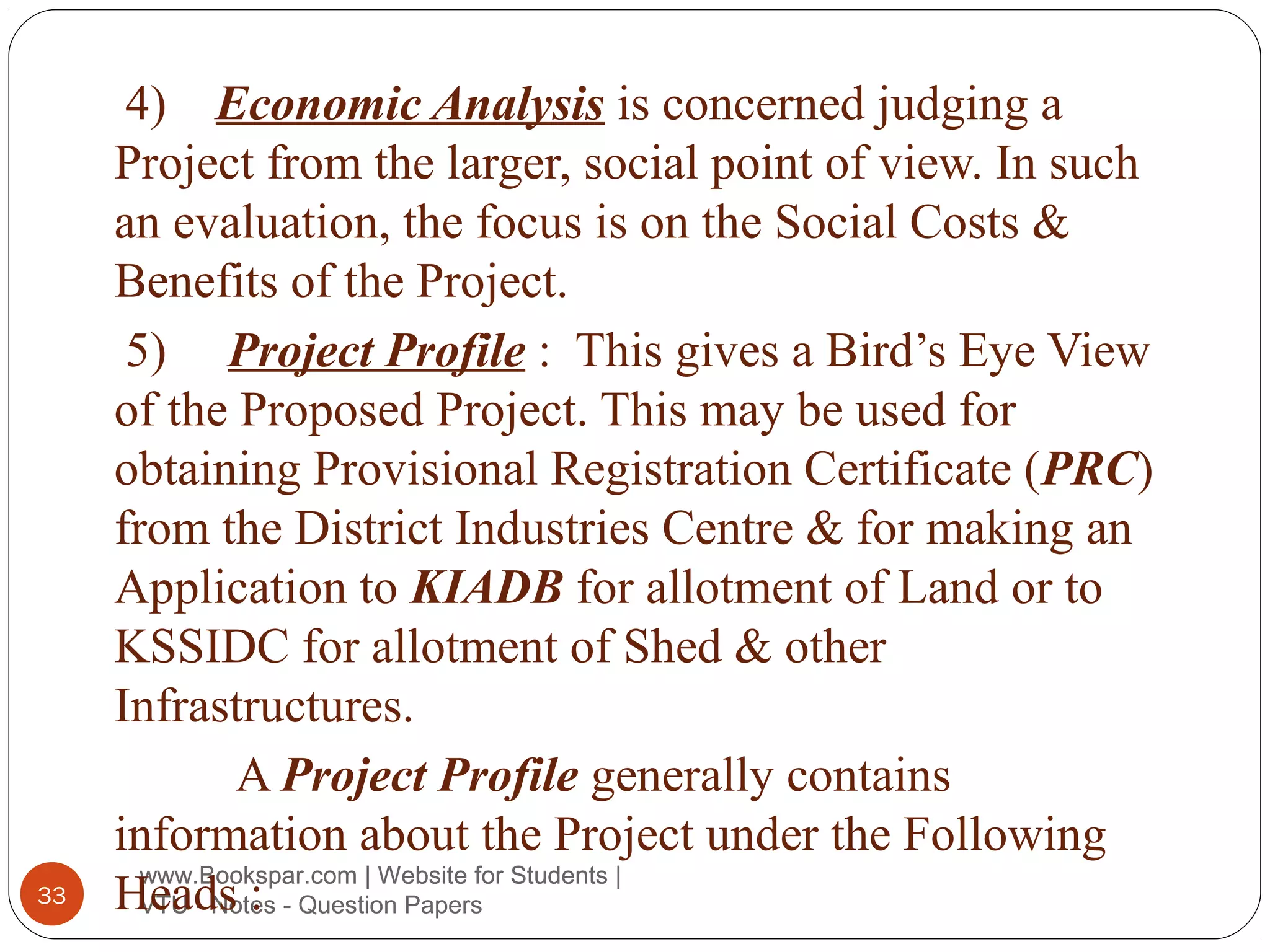
4) Economic Analysis is concerned judging a
Project from the larger, social point of view. In such
an evaluation, the focus is on the Social Costs &
Benefits of the Project.
5) Project Profile : This gives a Bird’s Eye View
of the Proposed Project. This may be used for
obtaining Provisional Registration Certificate (PRC)
from the District Industries Centre & for making an
Application to KIADB for allotment of Land or to
KSSIDC for allotment of Shed & other
Infrastructures.
A Project Profile generally contains
information about the Project under the Following
www.Bookspar.com | Website for Students |
Heads : - Question Papers
VTU - Notes
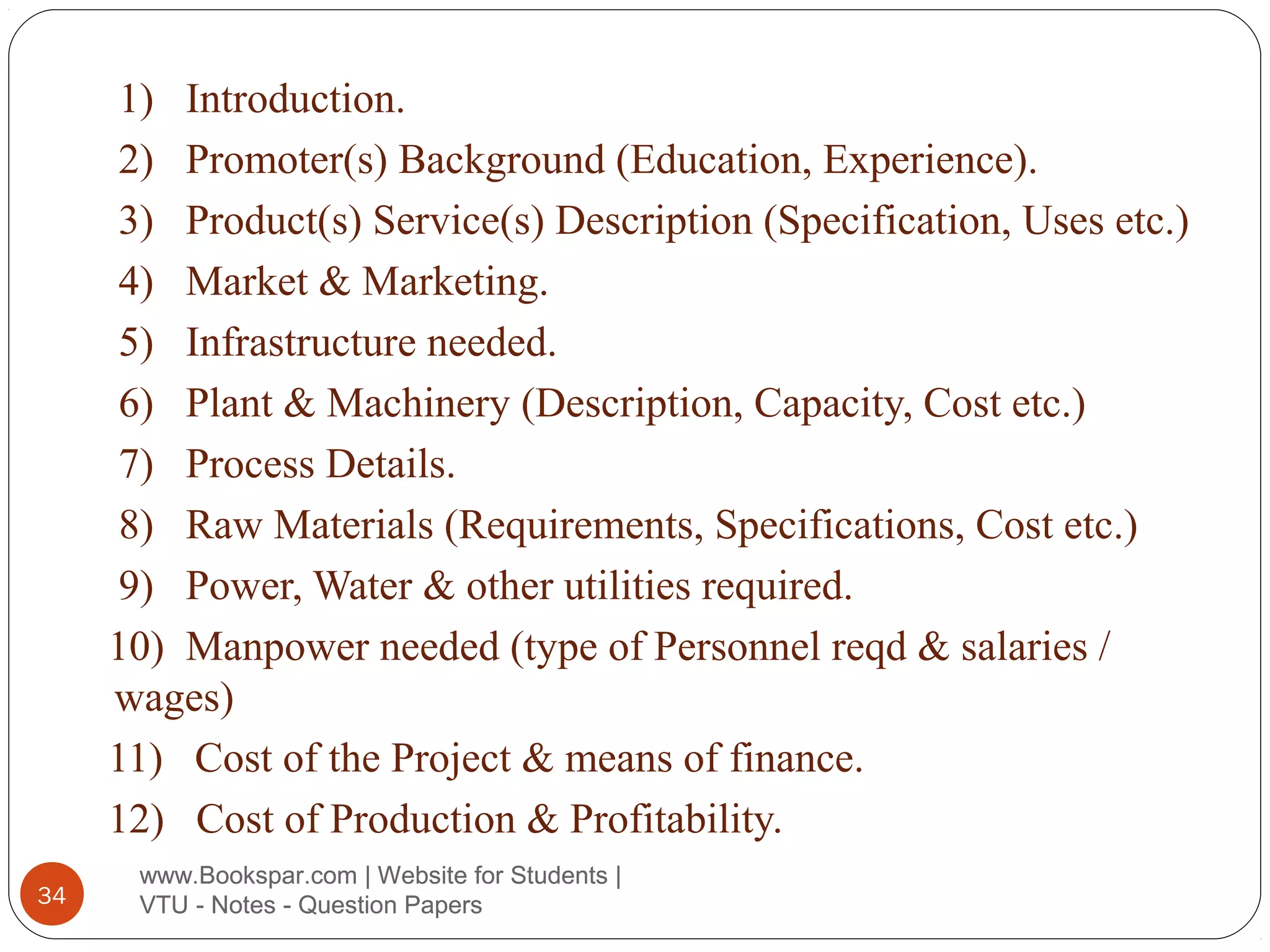
1) Introduction.
2) Promoter(s) Background (Education, Experience).
3) Product(s) Service(s) Description (Specification, Uses etc.)
4) Market & Marketing.
5) Infrastructure needed.
6) Plant & Machinery (Description, Capacity, Cost etc.)
7) Process Details.
8) Raw Materials (Requirements, Specifications, Cost etc.)
9) Power, Water & other utilities required.
10) Manpower needed (type of Personnel reqd & salaries /
wages)
11) Cost of the Project & means of finance.
12) Cost of Production & Profitability.
34

www.Bookspar.com | Website for Students |
VTU - Notes - Question Papers
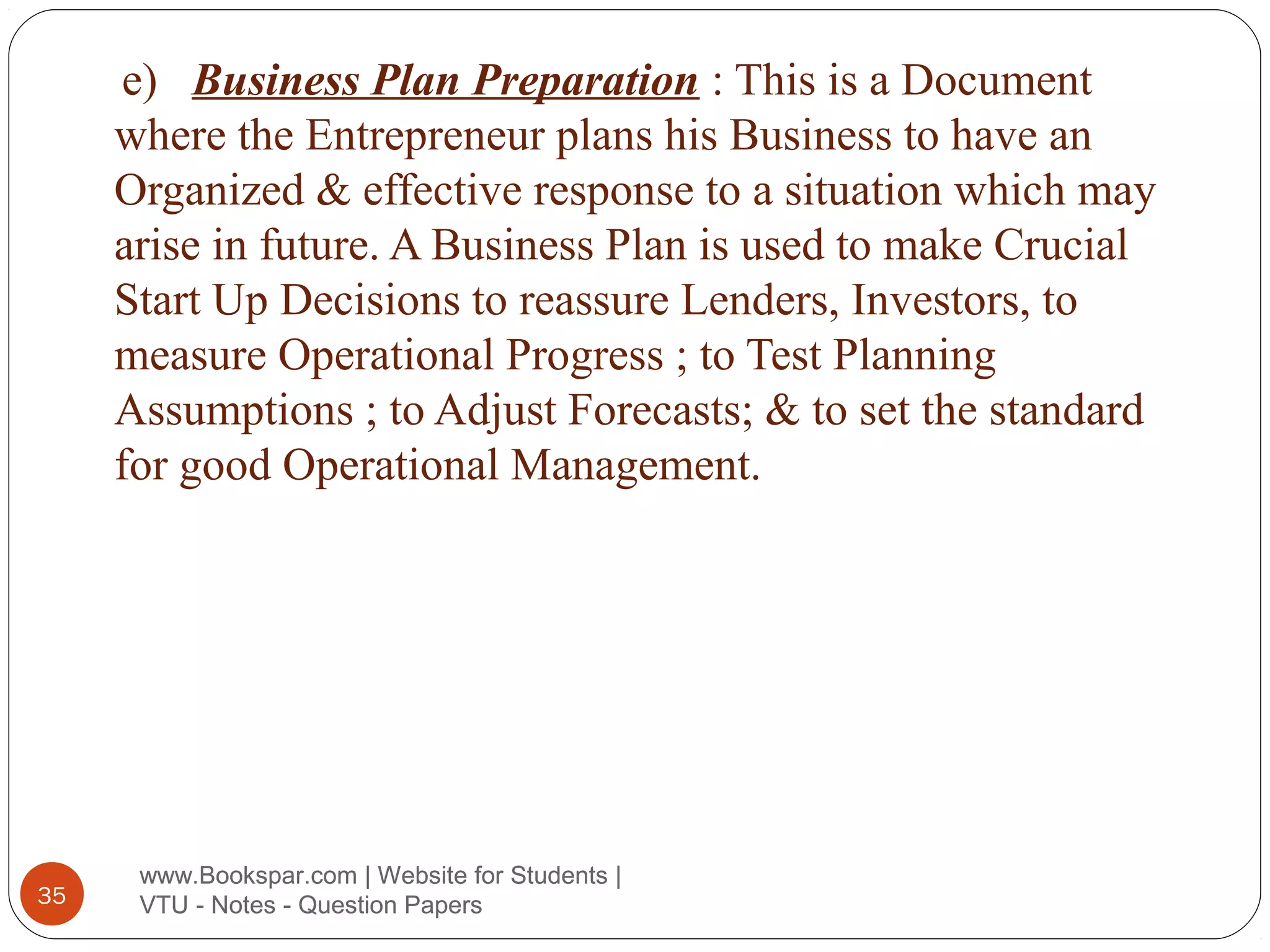
e) Business Plan Preparation : This is a Document
where the Entrepreneur plans his Business to have an
Organized & effective response to a situation which may
arise in future. A Business Plan is used to make Crucial
Start Up Decisions to reassure Lenders, Investors, to
measure Operational Progress ; to Test Planning
Assumptions ; to Adjust Forecasts; & to set the standard
for good Operational Management.

35

www.Bookspar.com | Website for Students |
VTU - Notes - Question Papers
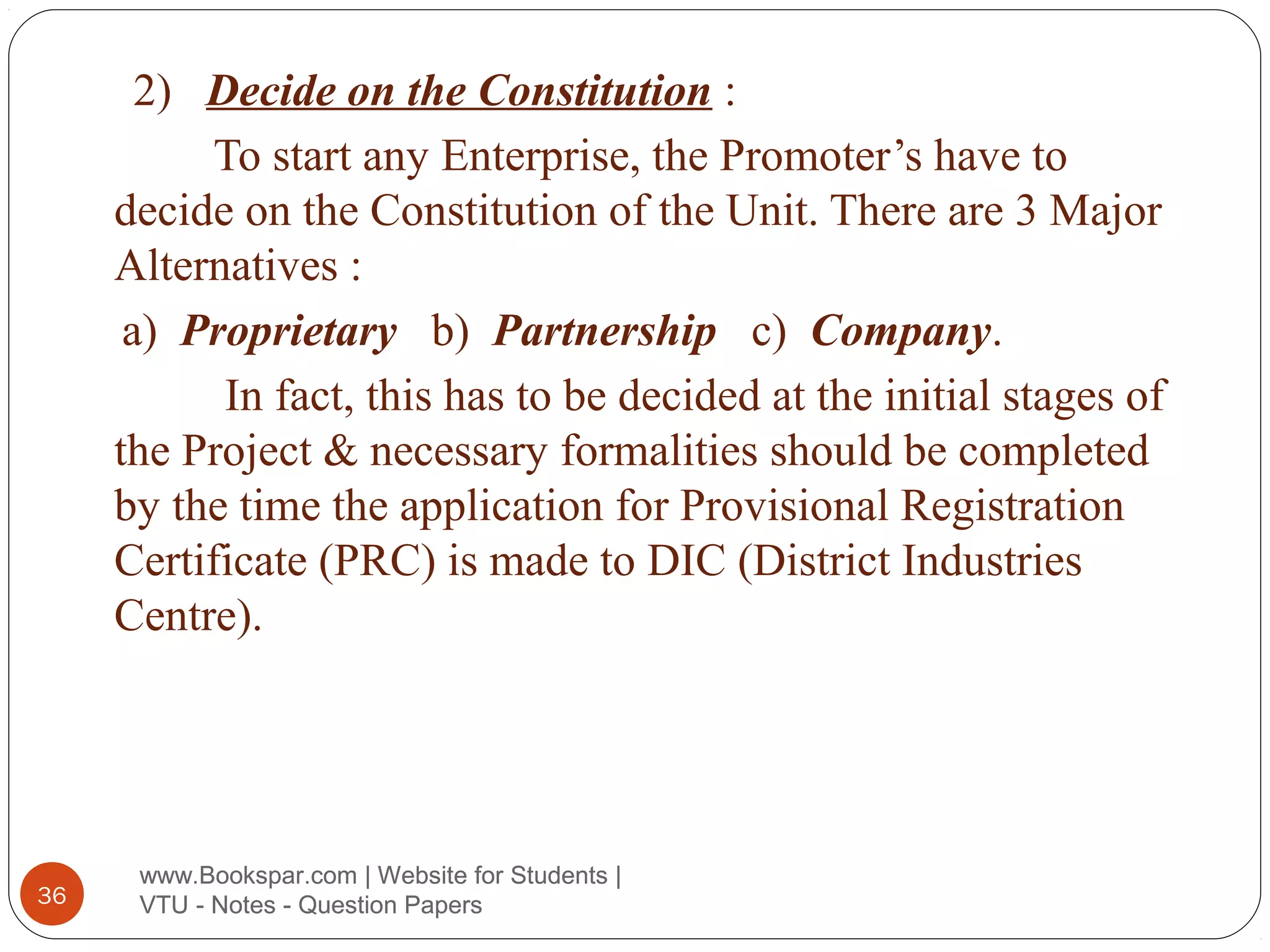
2) Decide on the Constitution :
To start any Enterprise, the Promoter’s have to
decide on the Constitution of the Unit. There are 3 Major
Alternatives :
a) Proprietary b) Partnership c) Company.
In fact, this has to be decided at the initial stages of
the Project & necessary formalities should be completed
by the time the application for Provisional Registration
Certificate (PRC) is made to DIC (District Industries
Centre).

36

www.Bookspar.com | Website for Students |
VTU - Notes - Question Papers
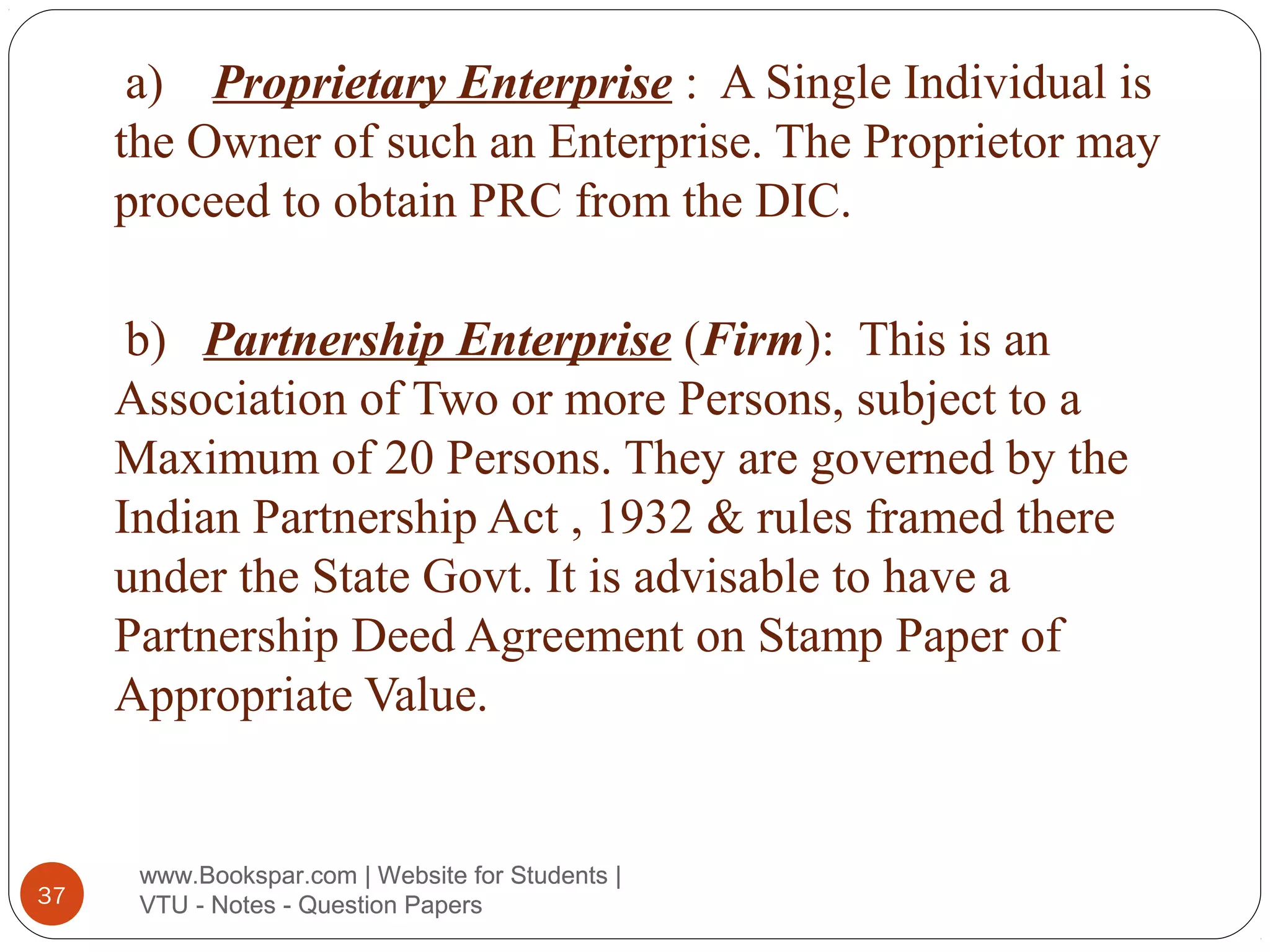
a) Proprietary Enterprise : A Single Individual is
the Owner of such an Enterprise. The Proprietor may
proceed to obtain PRC from the DIC.
b) Partnership Enterprise (Firm): This is an
Association of Two or more Persons, subject to a
Maximum of 20 Persons. They are governed by the
Indian Partnership Act , 1932 & rules framed there
under the State Govt. It is advisable to have a
Partnership Deed Agreement on Stamp Paper of
Appropriate Value.

37

www.Bookspar.com | Website for Students |
VTU - Notes - Question Papers
Registration Formalities of a Partnership Firm :
For Registering a Partnership Firm, an
Application in the prescribed form has to be submitted
to the Registrar of Firms of the District , along with
the authenticated copy of the Partnership deed & the
prescribed fee & must obtain “Form A” & “Form C”
from the Registrar of Firms for having registered the
Partnership Firm.
Assistance of a Chartered Accountant may be
availed for completing the above formalities.

38

www.Bookspar.com | Website for Students |
VTU - Notes - Question Papers
c) Company :
This may be a Private or Public Limited
Company. A Private Limited Company can be
formed with a minimum of 2 Persons & a
Maximum of 50 Persons. A Public Limited
Company can be formed with a Minimum of 7
Persons & Maximum number of Persons is
unlimited. Company is governed by the
Companies Act, 1956.
For Registering the Company, one has to
approach Registrar of Companies of the State.
39

www.Bookspar.com | Website for Students |
VTU - Notes - Question Papers
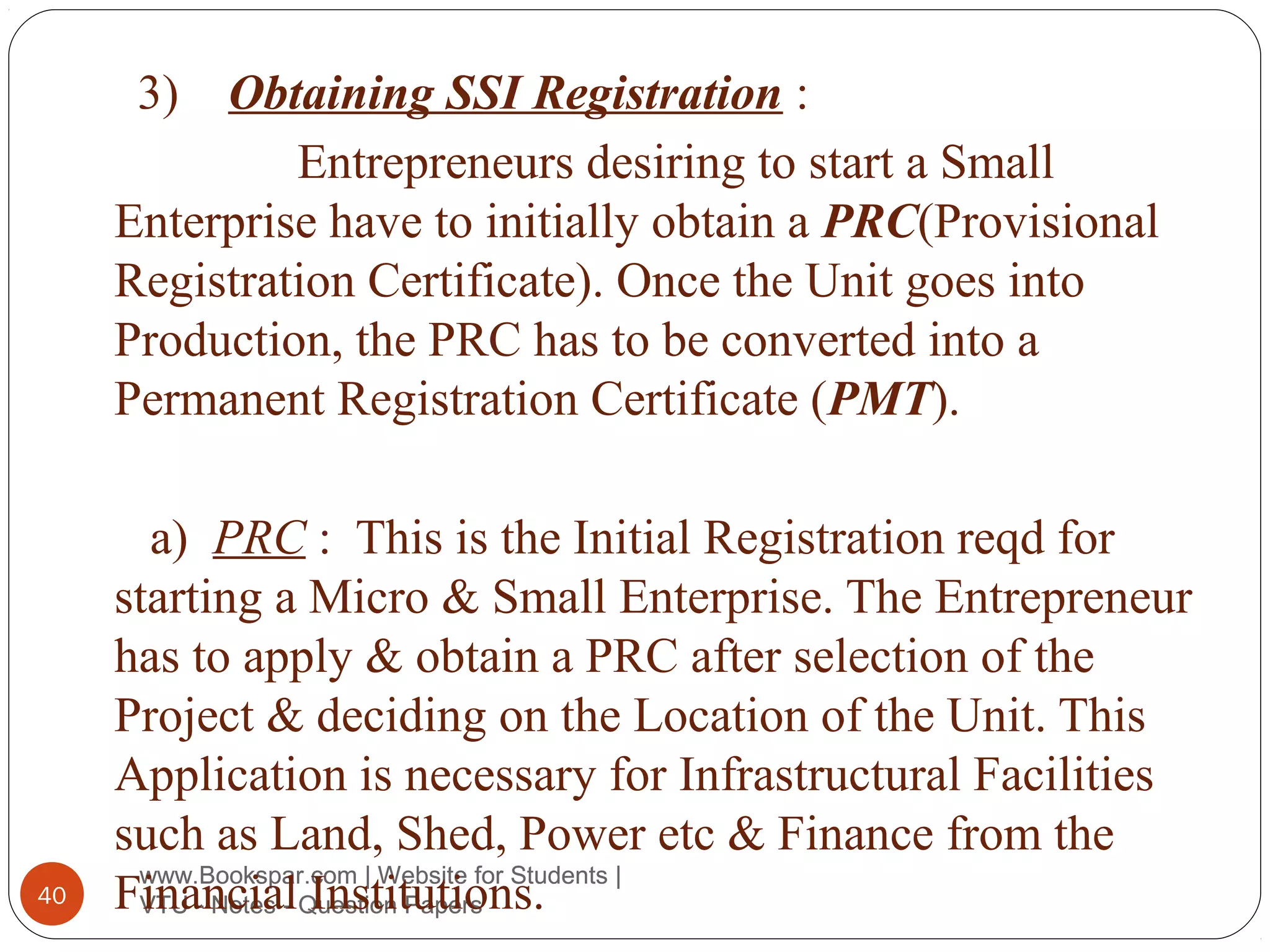
3) Obtaining SSI Registration :
Entrepreneurs desiring to start a Small
Enterprise have to initially obtain a PRC(Provisional
Registration Certificate). Once the Unit goes into
Production, the PRC has to be converted into a
Permanent Registration Certificate (PMT).

40

a) PRC : This is the Initial Registration reqd for
starting a Micro & Small Enterprise. The Entrepreneur
has to apply & obtain a PRC after selection of the
Project & deciding on the Location of the Unit. This
Application is necessary for Infrastructural Facilities
such as Land, Shed, Power etc & Finance from the
www.Bookspar.com | Website for Students |
FinancialQuestion Papers
VTU - Notes - Institutions.
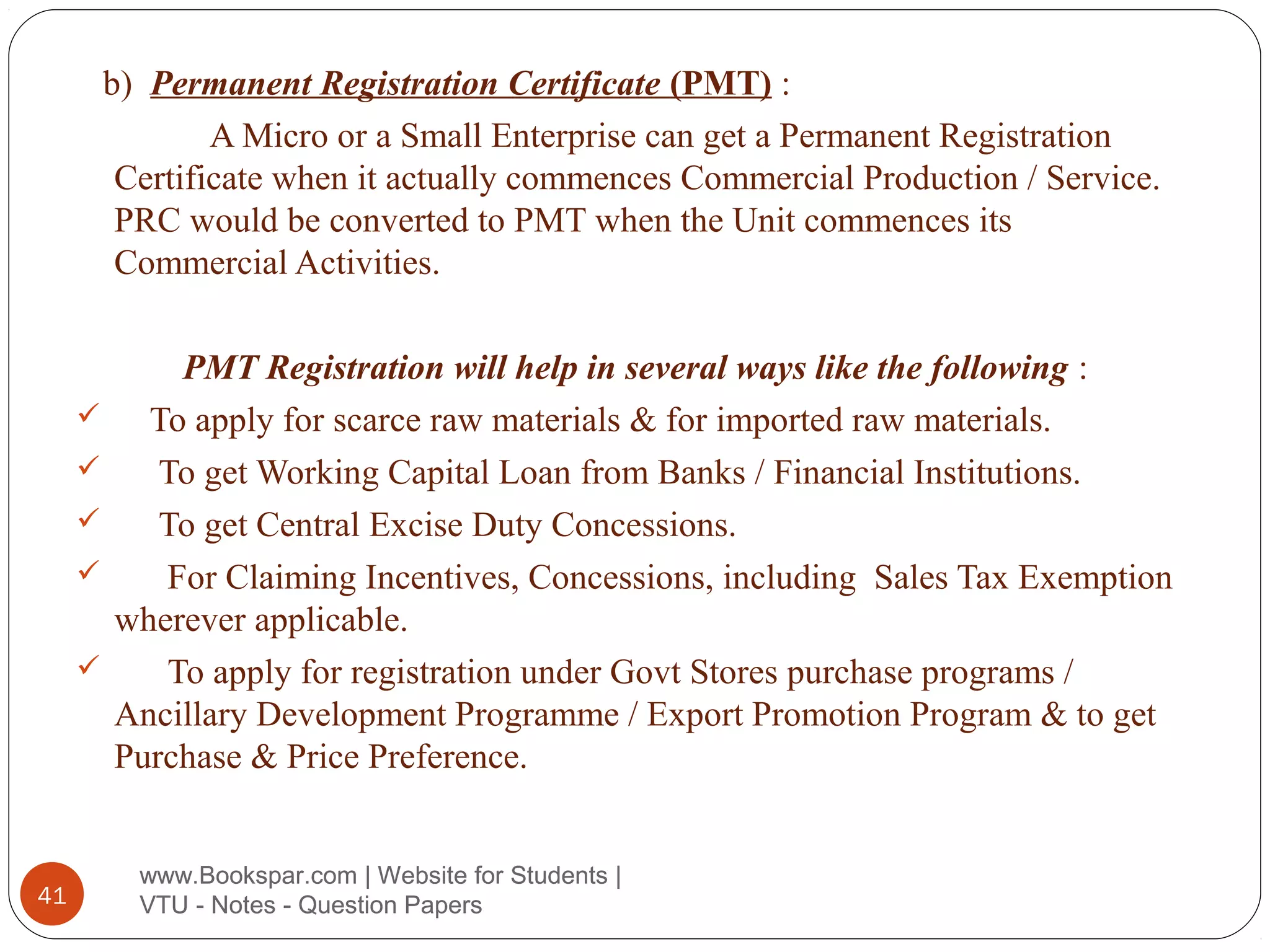
b) Permanent Registration Certificate (PMT) :
A Micro or a Small Enterprise can get a Permanent Registration
Certificate when it actually commences Commercial Production / Service.
PRC would be converted to PMT when the Unit commences its
Commercial Activities.







41

PMT Registration will help in several ways like the following :
To apply for scarce raw materials & for imported raw materials.
To get Working Capital Loan from Banks / Financial Institutions.
To get Central Excise Duty Concessions.
For Claiming Incentives, Concessions, including Sales Tax Exemption
wherever applicable.
To apply for registration under Govt Stores purchase programs /
Ancillary Development Programme / Export Promotion Program & to get
Purchase & Price Preference.
www.Bookspar.com | Website for Students |
VTU - Notes - Question Papers
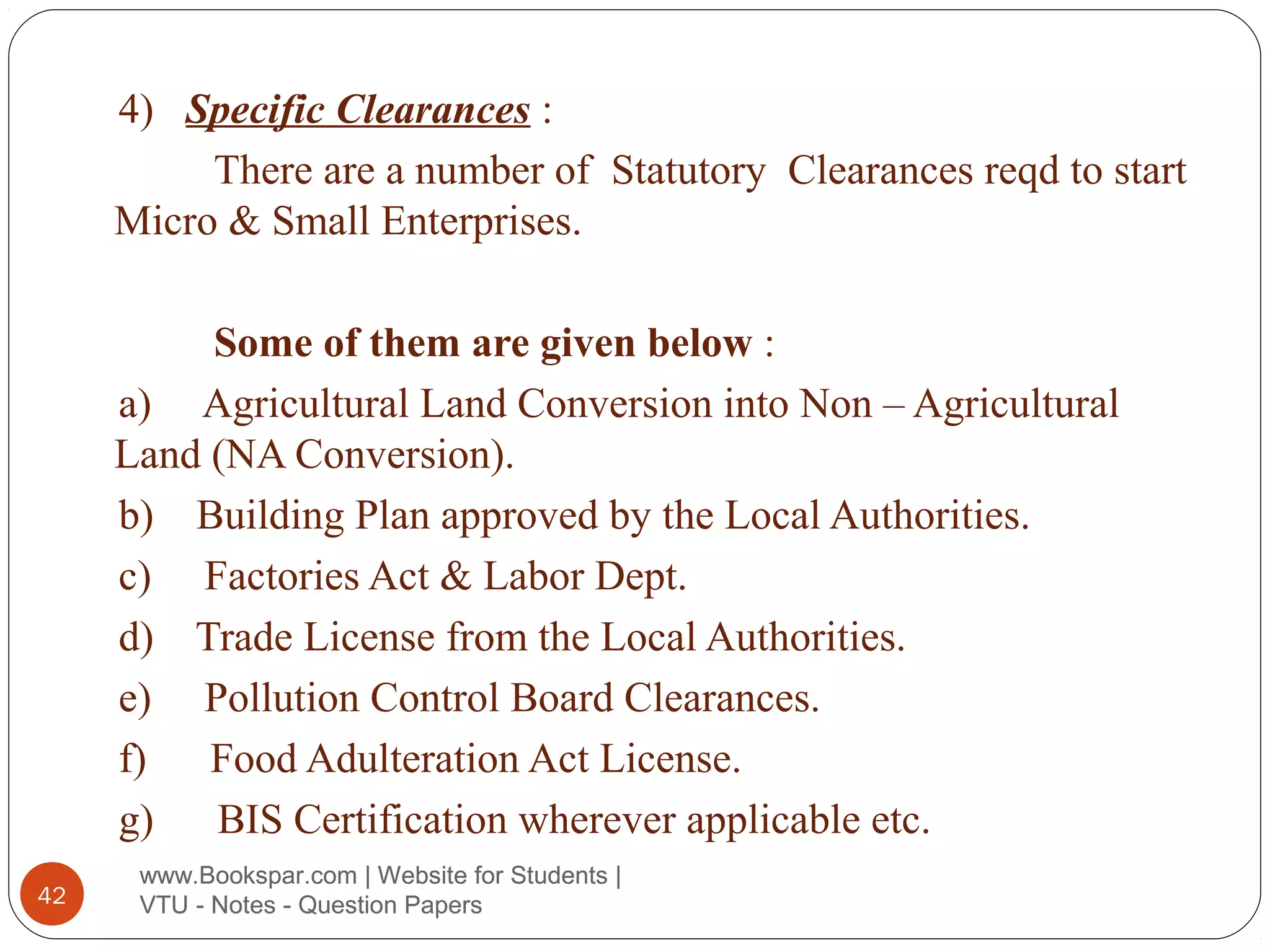
4) Specific Clearances :
There are a number of Statutory Clearances reqd to start
Micro & Small Enterprises.
Some of them are given below :
a) Agricultural Land Conversion into Non – Agricultural
Land (NA Conversion).
b) Building Plan approved by the Local Authorities.
c) Factories Act & Labor Dept.
d) Trade License from the Local Authorities.
e) Pollution Control Board Clearances.
f)
Food Adulteration Act License.
g)
BIS Certification wherever applicable etc.
42

www.Bookspar.com | Website for Students |
VTU - Notes - Question Papers
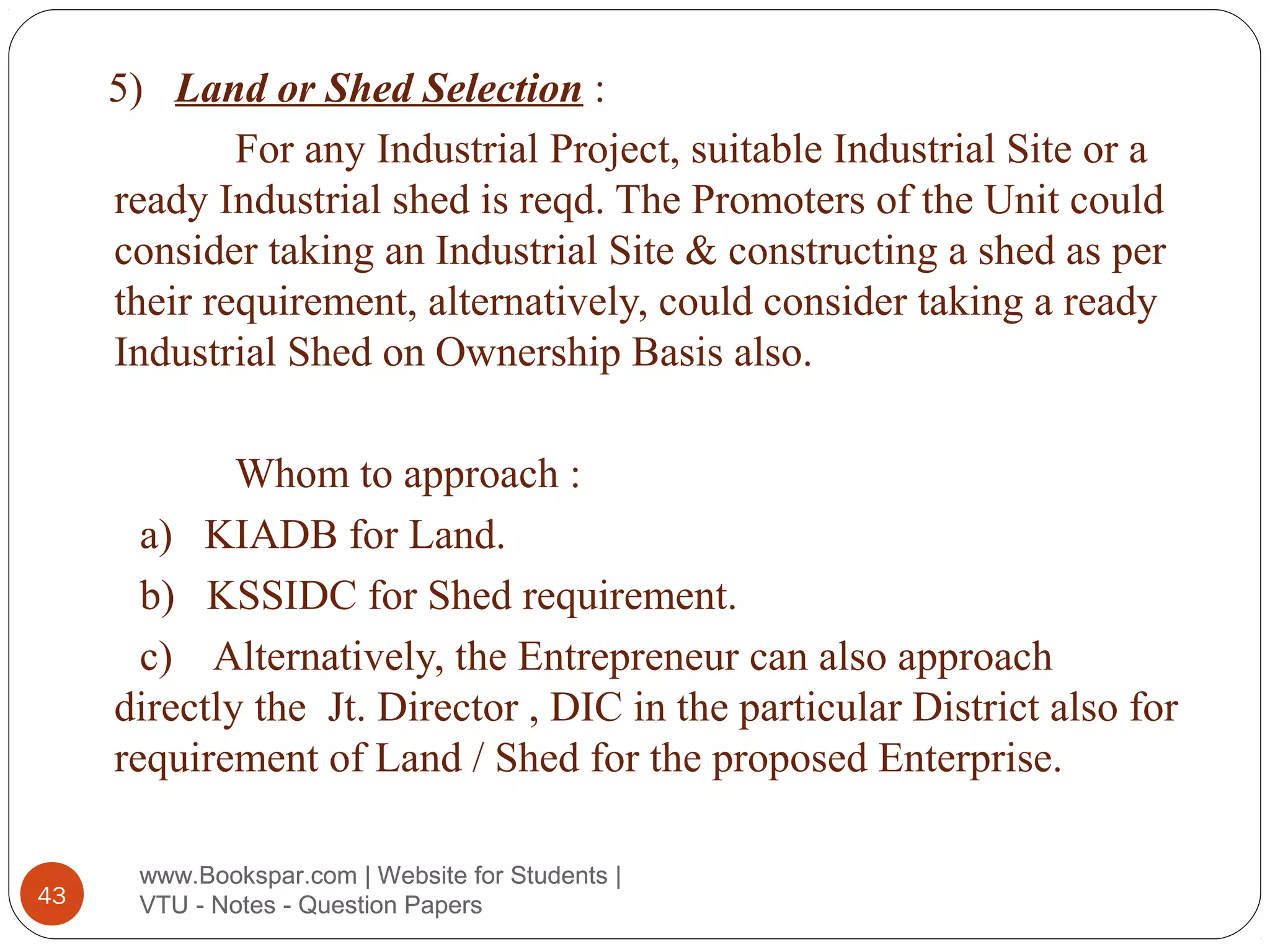
5) Land or Shed Selection :
For any Industrial Project, suitable Industrial Site or a
ready Industrial shed is reqd. The Promoters of the Unit could
consider taking an Industrial Site & constructing a shed as per
their requirement, alternatively, could consider taking a ready
Industrial Shed on Ownership Basis also.
Whom to approach :
a) KIADB for Land.
b) KSSIDC for Shed requirement.
c) Alternatively, the Entrepreneur can also approach
directly the Jt. Director , DIC in the particular District also for
requirement of Land / Shed for the proposed Enterprise.
43

www.Bookspar.com | Website for Students |
VTU - Notes - Question Papers
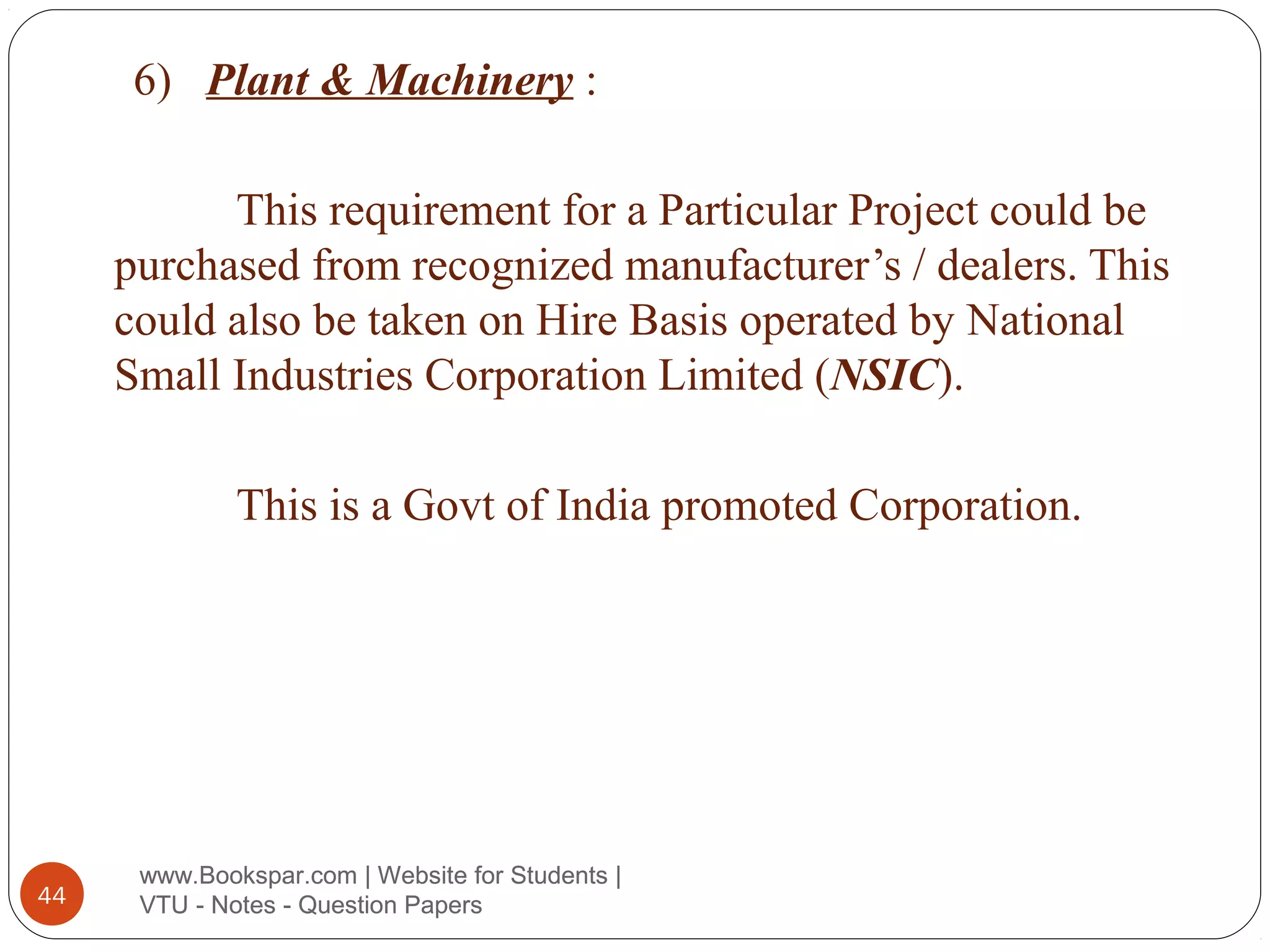
6) Plant & Machinery :
This requirement for a Particular Project could be
purchased from recognized manufacturer’s / dealers. This
could also be taken on Hire Basis operated by National
Small Industries Corporation Limited (NSIC).
This is a Govt of India promoted Corporation.

44

www.Bookspar.com | Website for Students |
VTU - Notes - Question Papers
7)

45

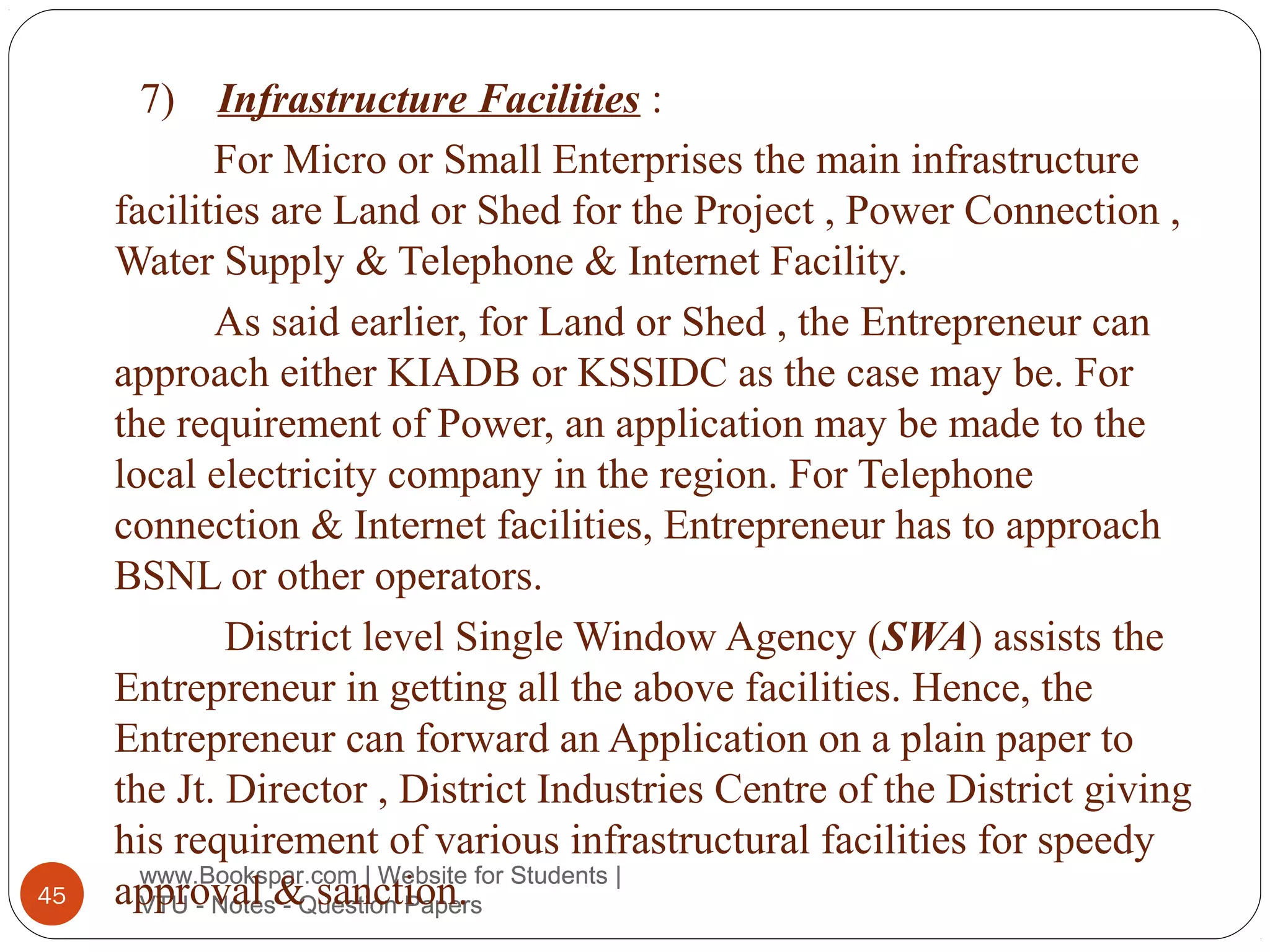
Infrastructure Facilities :
For Micro or Small Enterprises the main infrastructure
facilities are Land or Shed for the Project , Power Connection ,
Water Supply & Telephone & Internet Facility.
As said earlier, for Land or Shed , the Entrepreneur can
approach either KIADB or KSSIDC as the case may be. For
the requirement of Power, an application may be made to the
local electricity company in the region. For Telephone
connection & Internet facilities, Entrepreneur has to approach
BSNL or other operators.
District level Single Window Agency (SWA) assists the
Entrepreneur in getting all the above facilities. Hence, the
Entrepreneur can forward an Application on a plain paper to
the Jt. Director , District Industries Centre of the District giving
his requirement of various infrastructural facilities for speedy
www.Bookspar.com | Website
approval &Question Papersfor Students |
VTU - Notes - sanction.
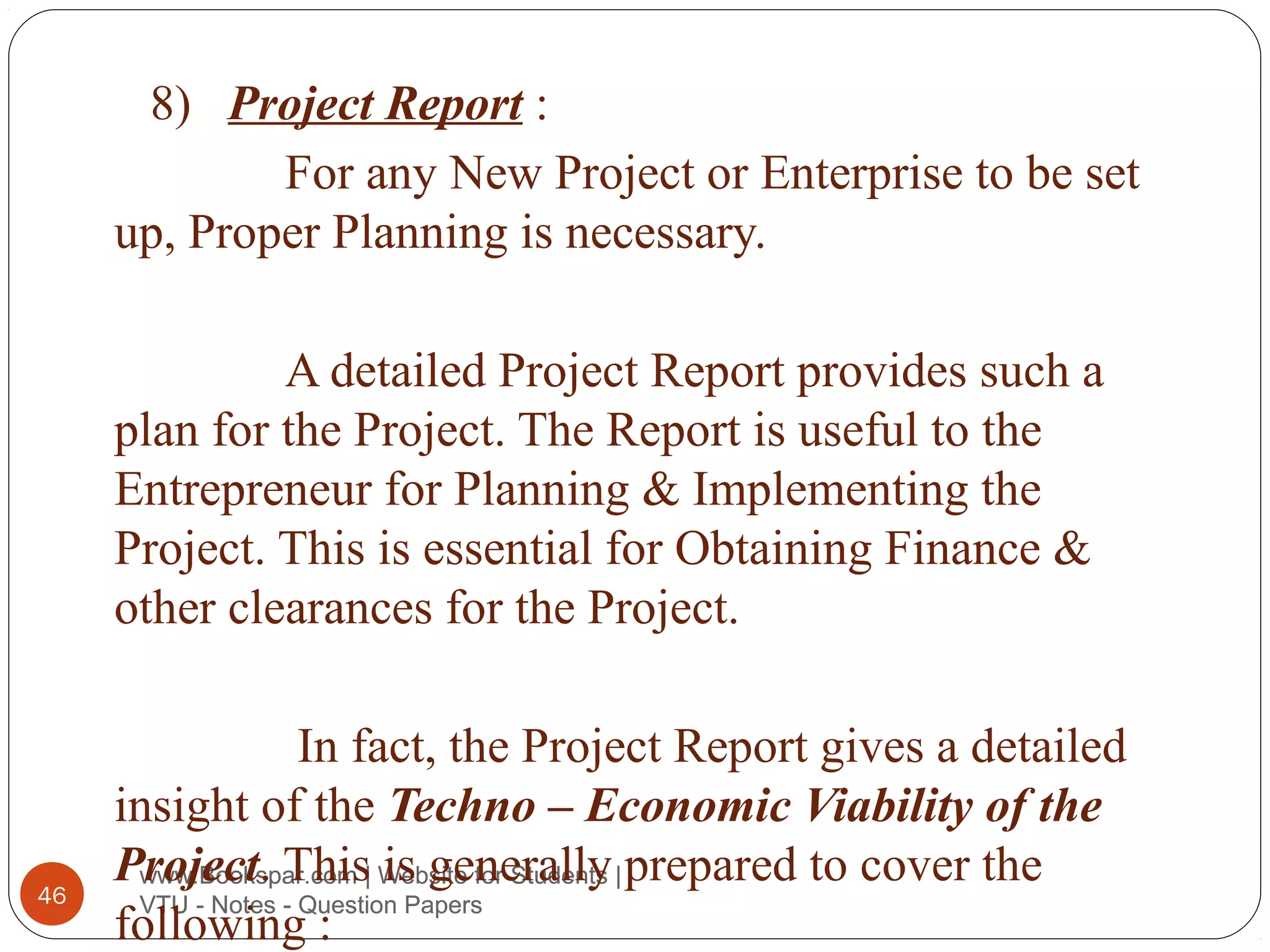
8) Project Report :
For any New Project or Enterprise to be set
up, Proper Planning is necessary.
A detailed Project Report provides such a
plan for the Project. The Report is useful to the
Entrepreneur for Planning & Implementing the
Project. This is essential for Obtaining Finance &
other clearances for the Project.

46

In fact, the Project Report gives a detailed
insight of the Techno – Economic Viability of the
Project. This| Website for Students | prepared to cover the
www.Bookspar.com is generally
VTU - Notes - Question Papers
following :
47

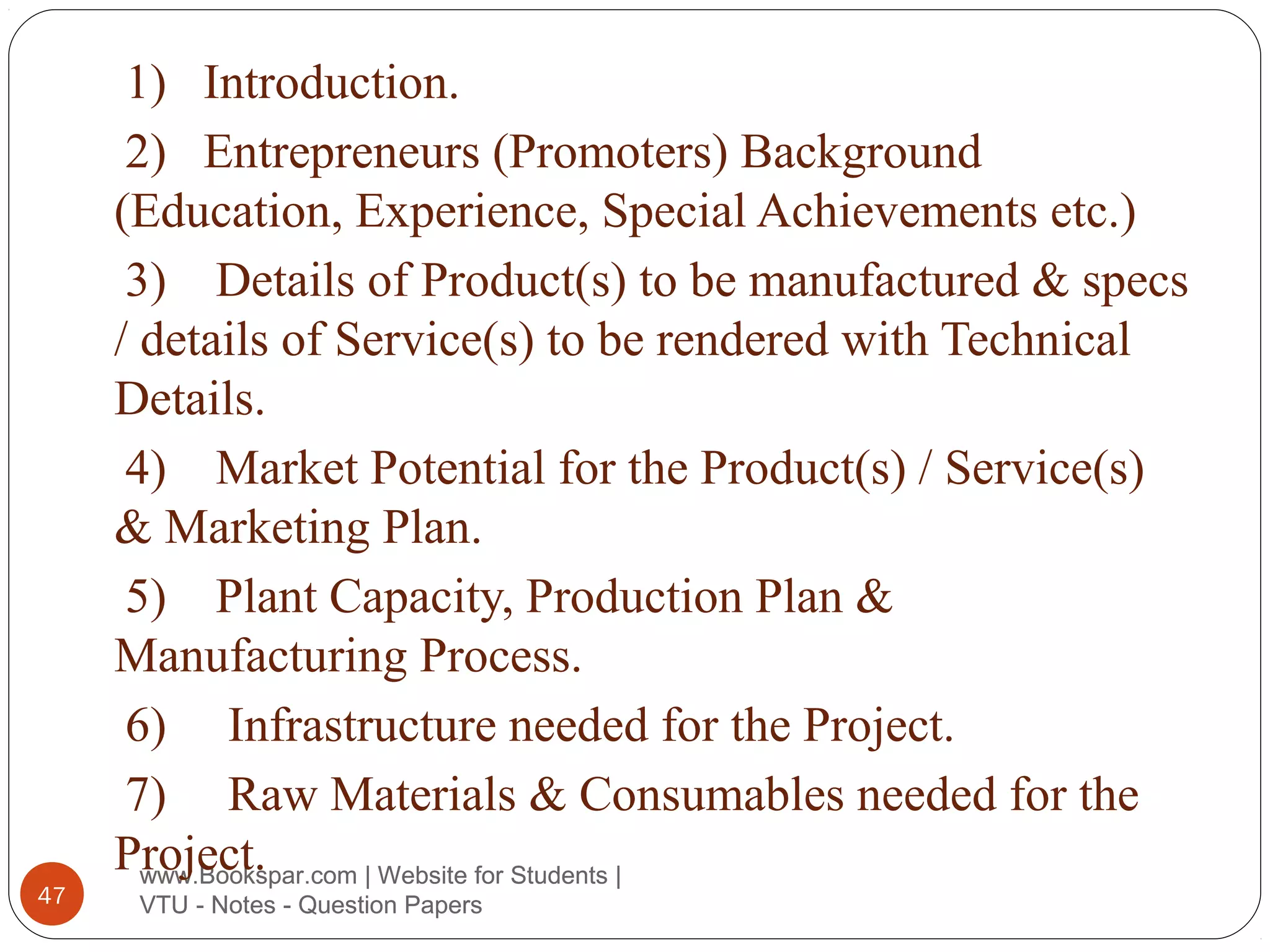
1) Introduction.
2) Entrepreneurs (Promoters) Background
(Education, Experience, Special Achievements etc.)
3) Details of Product(s) to be manufactured & specs
/ details of Service(s) to be rendered with Technical
Details.
4) Market Potential for the Product(s) / Service(s)
& Marketing Plan.
5) Plant Capacity, Production Plan &
Manufacturing Process.
6) Infrastructure needed for the Project.
7) Raw Materials & Consumables needed for the
Project.
www.Bookspar.com | Website for Students |
VTU - Notes - Question Papers
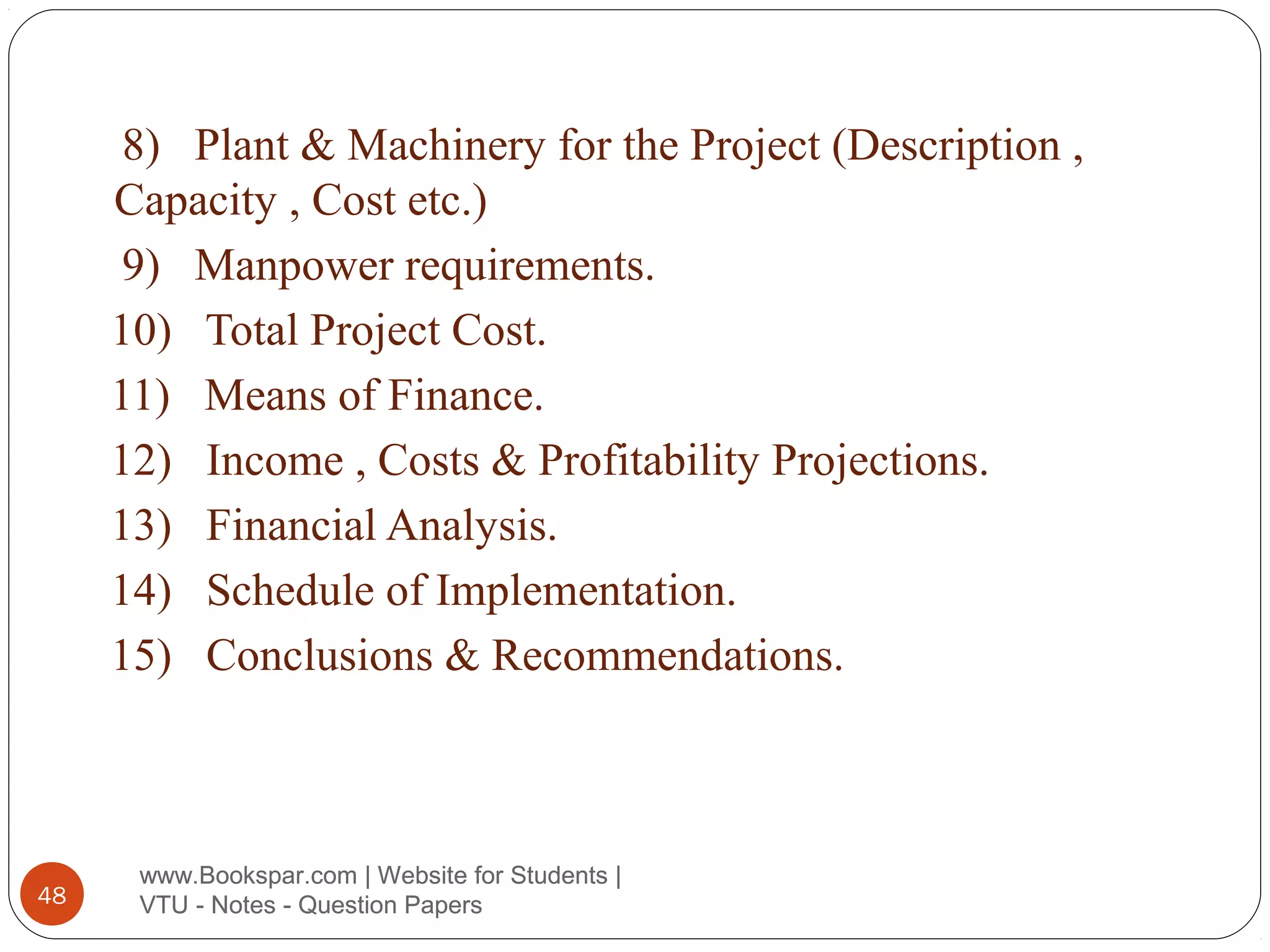
8) Plant & Machinery for the Project (Description ,
Capacity , Cost etc.)
9) Manpower requirements.
10) Total Project Cost.
11) Means of Finance.
12) Income , Costs & Profitability Projections.
13) Financial Analysis.
14) Schedule of Implementation.
15) Conclusions & Recommendations.

48

www.Bookspar.com | Website for Students |
VTU - Notes - Question Papers
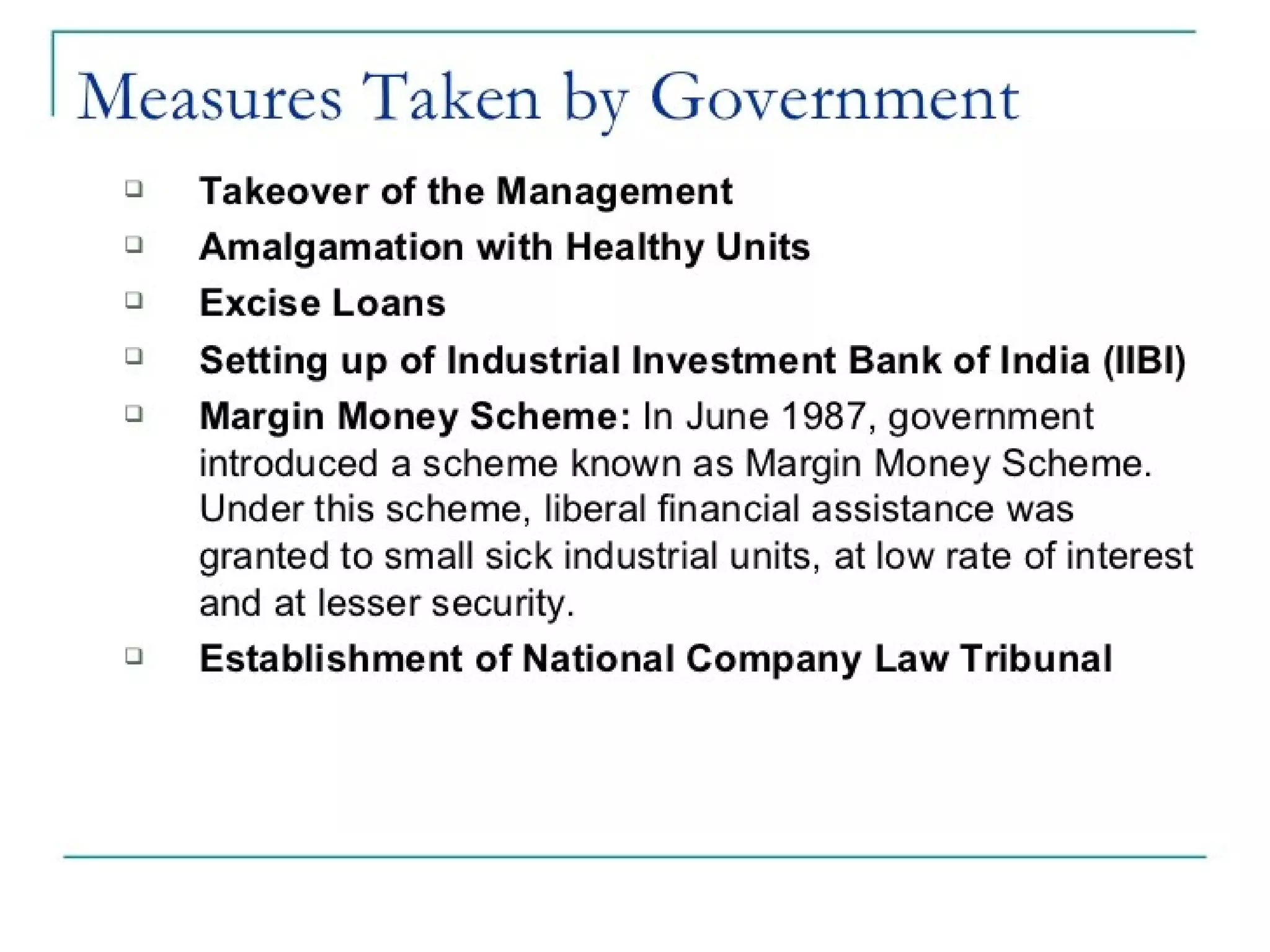
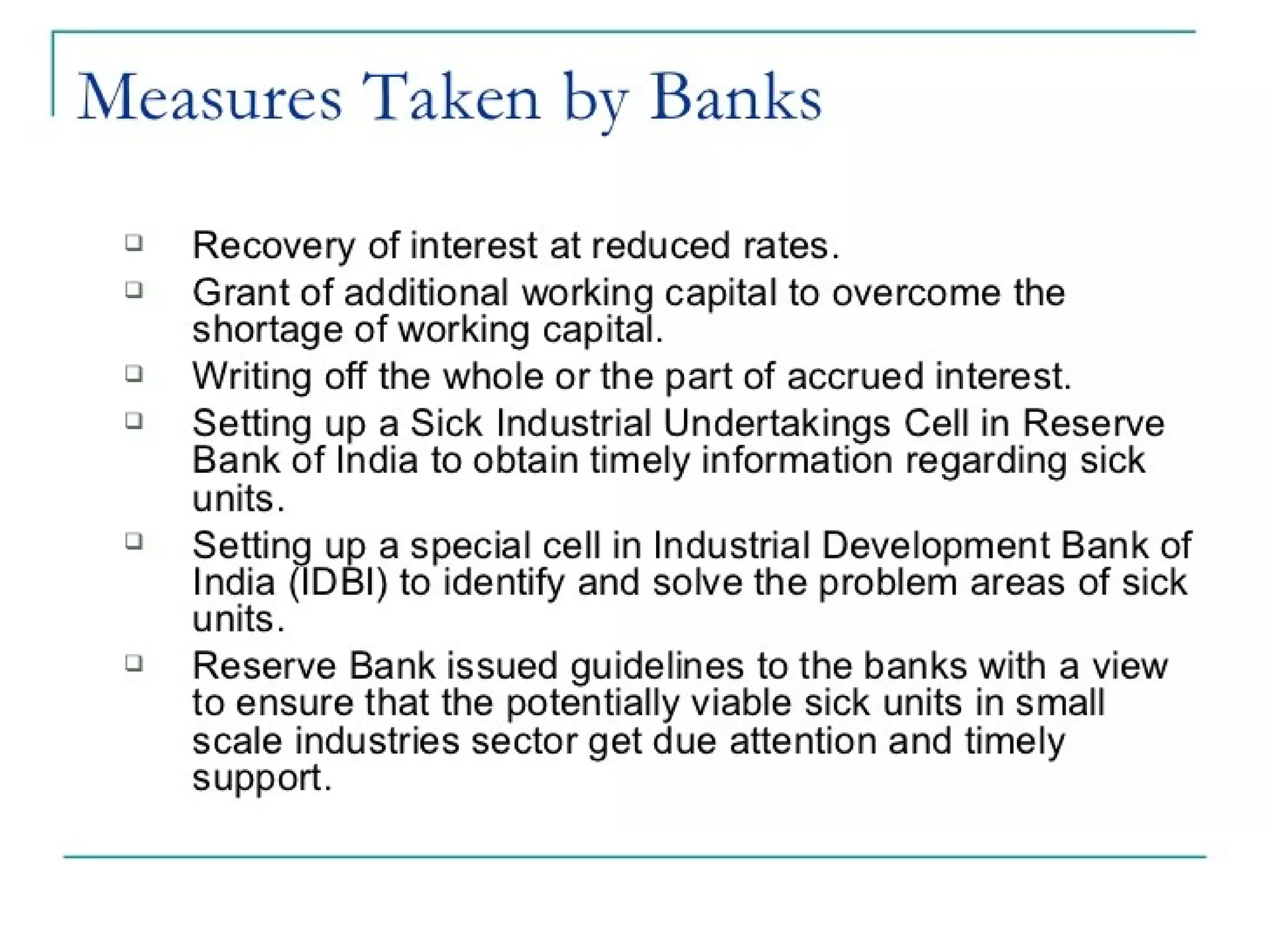
Industrial Sickness

www.Bookspar.com | Website for Students |
VTU - Notes - Question Papers
www.Bookspar.com | Website for Students |
VTU - Notes - Question Papers
www.Bookspar.com | Website for Students |
VTU - Notes - Question Papers
www.Bookspar.com | Website for Students |
VTU - Notes - Question Papers
www.Bookspar.com | Website for Students |
VTU - Notes - Question Papers
www.Bookspar.com | Website for Students |
VTU - Notes - Question Papers
www.Bookspar.com | Website for Students |
VTU - Notes - Question Papers
www.Bookspar.com | Website for Students |
VTU - Notes - Question Papers
www.Bookspar.com | Website for Students |
VTU - Notes - Question Papers
www.Bookspar.com | Website for Students |
VTU - Notes - Question Papers
Thank

you
www.Bookspar.com | Website for Students |
VTU - Notes - Question Papers

2nd chapter Small Scale Enterprises(part 1)

  • 1.
    2nd CHAPTER Starting SmallBusiness 02/08/14
  • 2.
    Small Scale Enterprises •Introduction:small scale enterprises are genearlly concerned with land,building, environment, infrastructure, rules and regulations. these are to be formulated to safeguard interests of the entrepreneurs. • Rules and regulations in general ensure.(DO's) • rapid growthof SSEs • Develop new products and markets • produce quality goods • promote healthy developement of human resource 02/08/14
  • 3.
    SSEs Dont's • • • • pollute ordegrade the ecosystem(environment) intervene with or exploit labour cheat the customer on any counts there are about 133 Acts and orders pertaining to SSEs about which the entrepreneur or his legal advisor should have knowledge. some of the important Acts worth studying are. 02/08/14
  • 4.
    Acts • • • • • • • • • the factories Act,1948 the industrial disputes Act,1947 the contract labour Act, 1970 the minimum wage Act,1948 the industrial relations Act,1946 the payment of bonus Act,1978 the indian trade union Act,1926 the workmen's compensation Act,1923 the maternity benefits Act,1961 02/08/14
  • 5.
    Contd.... • • • • • • • • the payment ofgratuity Act,1972 the payment of wages Act,1936 the employees state insurance Act 1948 the employment provident fund act 1952 the indian electricity Act 1910 income Tax Act, 1961 drug control Act Central sales tax Act and State sales tax Act 02/08/14
  • 6.
    • Definition ofsmall scale enterprises • An industrial undertaking is one in which the investement in fixed assets in plant and machinery, whether held on ownership or on hire purchase, does not exceeds Rupees One Crore-(Rs.3 Crores earlier was reduced to Rs.1Crore) 02/08/14
  • 7.
    Tiny industries : •All Small Scale units wherein investment on plant and machinery(excluding land and building ) upto Rs. 25 lakhs are classified as tiny industries. • unit is treated as Tiny industry where investment in plant and machinery does not exceed Rs. 25 lakhs.
  • 8.
    Export oriented units: •All small scale units which exports more than 50% of their output is classified as Export Oriented Units. • Definition of Small Scale Service Business Enterprises (SSSBE)Industrial related service/business enterprises with investment on plant and machinery upto Rs. 10 lakhs excluding land and building is registered under SSSBE.
  • 9.
    • Specified activitieseligible for SSI Registration up to Rs. 5 Crores There are certain types of industries/activities wherein investment on plant and machinery upto Rs. 5 crores can also be registered under SSI category and such list of industries are available in Info-help.
  • 10.
    Ancillary industries • Ancillaryindustries are those which manufacture parts and components to be used by larger industries. Eg- Companies like GE (ancillary) produce engines for the aircraft industry. • The ancillary workers in an institution are the people such as cleaners and cooks whose work supports the main work of the institution.
  • 11.
    Cottage Industries • Anindustry where the creation of products and services is home-based, rather than factory-based. While products and services created by cottage industry are often unique and distinctive given the fact that they are usually not massproduced, producers in this sector often face numerous disadvantages when trying to compete with much larger factory-based companies
  • 12.
    Cottage Industries • anindustry whose labour force consists of family units or individuals working at home with their own equipment • a small and often informally organized industry
  • 13.
    Characteristics of SmallEnterprises : “Small Enterprise is Beautiful” because of its following Important Characteristics : 1) A Small Enterprise is generally a “One Man Show”. Even Small Enterprises which run by a Partnership Firm or a Private Limited Company, in most cases, the activities are mainly carried out by one of the Partners or Directors. In Practice, the others mainly assist in providing Capital / Funds. 13 www.Bookspar.com | Website for Students | VTU - Notes - Question Papers
  • 14.
    2) Owner himself/ herself is also a Manager of the Enterprise. Thus, a Small Enterprise is managed in a personalized manner. The Owner has First Hand Knowledge of all aspects of the Enterprise & knows what is actually going on in the Business. He takes effective participation in all matters of Business Decision Making. 3) A Small Enterprise has lesser development Period (the process of early development) compared to a Large Enterprise. i.e., the period after which the return on Investment starts. 14 www.Bookspar.com | Website for Students | VTU - Notes - Question Papers
  • 15.
    4) Small Enterprisesgenerally carryout their operations so as to cater (provide water and food for cetain peoples) to the Local & Regional Markets. 5) Small Enterprises use indigenous(originating)resources & therefore can be located anywhere subject to the availability of these resources like Raw Materials, Labor, Transport Facilities etc. 6) They are fairly Labor Intensive with comparatively smaller Capital Investment than the Larger Units. That is, for the same Investment, a Small Enterprise provides more jobs to the people compared to a Large Enterprise. 15 www.Bookspar.com | Website for Students | VTU - Notes - Question Papers
  • 16.
    7) Using LocalResources, Small Units are decentralized & dispersed to Rural Areas & Smaller Towns.  Thus, the development of Small Enterprises in Rural Areas & Smaller towns promotes more Balanced Regional Development & thereby prevents influx of job seekers from rural areas & smaller towns to bigger cities & urbanizing centers. 8) They are more flexible to adapt changes like Diversification to New Products, adopting to New Production Techniques, substituting New Raw Materials, Changes in Organization Structure, New Market etc. 16 www.Bookspar.com | Website for Students | VTU - Notes - Question Papers
  • 17.
    Advantages of SmallEnterprises : They are the Back Bone of the Industrial Activity in the Country & are playing a very important role in improving the Socio – Economic Conditions of the people. Advantages of these Enterprises are as follows)  1) 17 They create greater Employment Opportunities through Labor Intensive processes & thereby help in tackling the Unemployment Problem. www.Bookspar.com | Website for Students | VTU - Notes - Question Papers
  • 18.
    18 2) They haveLow Gestation Period (the process of early development)& thereby Expensive Financial Resources are not idled unproductively for long periods. 3) They can be set up easily in Rural & Backward Areas. 4) They need Small / Local / Regional Market. 5) They encourage growth of Local Entrepreneurship. 6) They create Decentralized pattern of Ownership. 7) They foster Diversification of Economic www.Bookspar.com Activities. | Website for Students | VTU - Notes - Question Papers
  • 19.
    8) They Innovate& Introduce New Products particularly to cater to Local Needs. 9) They influence & improve Standard of Living of Local People. 10) They earn Vital Foreign Exchange for the Country through their Exports of Goods / Services. 11) They Increase Revenue to Central & State Govts by way of Taxes Paid by them. 19 www.Bookspar.com | Website for Students | VTU - Notes - Question Papers
  • 20.
    Role of SmallEnterprises in Economic Development : Economic Development of a Country can be defined in terms of Increase in actual Per Capita Income of Persons resulting in Improvement in Standard of Living. The Development of Small Enterprises contributes to the Increase in Per Capita Income & leads to Overall Economic Development.  It generates Vast Employment Opportunities quickly with relatively Low Investment , Promotes more equitable distribution of National Income, makes effective mobilization of Unutilized Capital & Skilled Manpower & leads to dispersal of Manufacturing Activities all over the Country , leading to Growth of Villages , Small Towns & Economically Backward Regions. This leads to Balanced Regional Development throughout the Country.  20 www.Bookspar.com | Website for Students | VTU - Notes - Question Papers
  • 21.
    The Role ofSmall Enterprises in Economic Development of our Country can be discussed with reference to the following parameters during the last Four Decades :  1) Increase in the Number of Small Enterprises. 2) Increase in the Value of Production in Rupee Terms. 3) Increase in the Number of People Employed. 4) Increase in the Export Earnings in Rupee Terms. 21 www.Bookspar.com | Website for Students | VTU - Notes - Question Papers
  • 22.
    The Small Enterpriseshave registered phenomenal growth in their Number, Production, Employment & Exports over the Last Four Decades. In 1950, there were 16,000 Registered Small Scale Industries & this has increased to 31.21 Lakh Registered SSI’s during 1998 – 1999. During 1973 – 74, the Total Value of Production reported by SSI’s was Rs. 7200 Crores & this has grown phenomenally by about 75 Times to Rs. 5,38,357 Crores during 1998 – 1999. As regards Employment, about 40 Lakh People were employed in SSI Sector during 1973 – 1974 & there is a Four Fold Increase in Employment during 1998 – 1999, that is 175.2 Lakh People were employed in SSI Sector during 1998 – 1999. 22 www.Bookspar.com | Website for Students | VTU - Notes - Question Papers
  • 23.
    There is aPhenomenal Growth in Exports Revenue during the last Four Decades. During 1973 -1974, SSI Sector exported Rs. 393 Crores worth of Goods & Services & this has grown nearly 150 times to Rs. 57, 488 Crores during 1998 -1999. As we can see, the SSI Sector has been contributing tremendously in overall economic development of the Country by creating Vast Employment Opportunities , increased Value of Production, & increased Value of Exports & Foreign Exchange Earnings. 23 www.Bookspar.com | Website for Students | VTU - Notes - Question Papers
  • 24.
    Steps for Startinga Small Industry :  The Various Basic Steps for Starting a Small Enterprise is as Given Below : 24 www.Bookspar.com | Website for Students | VTU - Notes - Question Papers
  • 25.
    25 www.Bookspar.com | Websitefor Students | VTU - Notes - Question Papers
  • 26.
    The Steps arediscussed below : 1) Project Selection : Entrepreneur is the Most Important person for the Success of a Project. In order to set up a Small Enterprise, the Entrepreneur has to decide or choose a suitable project. The Entrepreneur has also to decide on a suitable location for the project. Based on these selections, a project feasibility study has to be conducted & then a brief project profile has to be prepared for the proposed project. 26 www.Bookspar.com | Website for Students | VTU - Notes - Question Papers
  • 27.
    The Project Selection& the Preliminary Activities involve the following :  a) Product or Service Selection. b) Location Selection. c) Project Feasibility Study. d) Preparation of Project Profile. e) Business Plan Preparation. 27 www.Bookspar.com | Website for Students | VTU - Notes - Question Papers
  • 28.
    a) Product or ServiceSelection : This is the first & most important step in setting up a small enterprise. Because, the further prospects, actions & efforts in setting up the small enterprise & commencing its commercial activities successfully depend on this decision. Therefore, the Entrepreneur has to be very careful in the choice or selection of the Project. The main factors to be considered in deciding a suitable project are as follows : 28 www.Bookspar.com | Website for Students | VTU - Notes - Question Papers
  • 29.
    1) Background &Experience of Entrepreneurs. 2) Availability of the Right Technology & Know – How for the Project. 3) Marketability of the Product / Service. 4) Investment Capacity (i.e., Financial Resources.) 5) Availability of Plant & Machinery, 6) Availability of Raw Materials. 7) Availability of Proper Infrastructural Facilities Viz., Land / Shed, Power, Water, Communication, Transport etc. 8) Availability of right kind of Labor Viz., Skilled, Semi – Skilled & Unskilled. 29 www.Bookspar.com | Website for Students | VTU - Notes - Question Papers
  • 30.
    Considering all aboveaspects & taking the help of Governmental Support Organizations like TECSOK, (Technical Consultancy Services Organisation of Karnataka) KIADB, (Karnataka industrial area development board) KSSIDC (KARNATAKA STATE SMALL INDUSTRIES DEVELOPMENT CORPORATION)etc & even private consultants , the Entrepreneur has to choose & decide the project for implementation. b) Location Selection : After deciding on the Project, the next important decision an Entrepreneur has to make is about the Location of the Project. There are a Few factors associated with the same :  30 www.Bookspar.com | Website for Students | VTU - Notes - Question Papers
  • 31.
    1) Nearness orProximity to Market. 2) Availability of Raw Materials. 3) Availability of Transformation & Communication Facilities. 4) Availability of Govt Incentives / Concessions. 5) Govt Industrial Policy. 6) Availability of suitable Infrastructural facilities. 7) Availability of Labor. 8) Convenience for the Entrepreneur’s. 31 www.Bookspar.com | Website for Students | VTU - Notes - Question Papers
  • 32.
    c) Project FeasibilityStudy : The important facts of Project Feasibility Study are as follows : 1) Market Analysis is carried out to find out the aggregate demand of the proposed Product / Service & what would be the Market Share of the proposed project. 2) Technical Analysis seeks to determine whether the prerequisites (A prerequisite is a required prior condition)for the successful commissioning of the Project have been considered & reasonably good choices have been made with respect to Location, Size, Process & so on. 3) Financial Analysis seeks to ascertain whether the proposed project will be Financially viable in the sense of being able to meet the burden of Servicing Debt & Satisfy the return on Investment Expectations of the Promoter’s. 32 www.Bookspar.com | Website for Students | VTU - Notes - Question Papers
  • 33.
    33 4) Economic Analysisis concerned judging a Project from the larger, social point of view. In such an evaluation, the focus is on the Social Costs & Benefits of the Project. 5) Project Profile : This gives a Bird’s Eye View of the Proposed Project. This may be used for obtaining Provisional Registration Certificate (PRC) from the District Industries Centre & for making an Application to KIADB for allotment of Land or to KSSIDC for allotment of Shed & other Infrastructures. A Project Profile generally contains information about the Project under the Following www.Bookspar.com | Website for Students | Heads : - Question Papers VTU - Notes
  • 34.
    1) Introduction. 2) Promoter(s)Background (Education, Experience). 3) Product(s) Service(s) Description (Specification, Uses etc.) 4) Market & Marketing. 5) Infrastructure needed. 6) Plant & Machinery (Description, Capacity, Cost etc.) 7) Process Details. 8) Raw Materials (Requirements, Specifications, Cost etc.) 9) Power, Water & other utilities required. 10) Manpower needed (type of Personnel reqd & salaries / wages) 11) Cost of the Project & means of finance. 12) Cost of Production & Profitability. 34 www.Bookspar.com | Website for Students | VTU - Notes - Question Papers
  • 35.
    e) Business PlanPreparation : This is a Document where the Entrepreneur plans his Business to have an Organized & effective response to a situation which may arise in future. A Business Plan is used to make Crucial Start Up Decisions to reassure Lenders, Investors, to measure Operational Progress ; to Test Planning Assumptions ; to Adjust Forecasts; & to set the standard for good Operational Management. 35 www.Bookspar.com | Website for Students | VTU - Notes - Question Papers
  • 36.
    2) Decide onthe Constitution : To start any Enterprise, the Promoter’s have to decide on the Constitution of the Unit. There are 3 Major Alternatives : a) Proprietary b) Partnership c) Company. In fact, this has to be decided at the initial stages of the Project & necessary formalities should be completed by the time the application for Provisional Registration Certificate (PRC) is made to DIC (District Industries Centre). 36 www.Bookspar.com | Website for Students | VTU - Notes - Question Papers
  • 37.
    a) Proprietary Enterprise: A Single Individual is the Owner of such an Enterprise. The Proprietor may proceed to obtain PRC from the DIC. b) Partnership Enterprise (Firm): This is an Association of Two or more Persons, subject to a Maximum of 20 Persons. They are governed by the Indian Partnership Act , 1932 & rules framed there under the State Govt. It is advisable to have a Partnership Deed Agreement on Stamp Paper of Appropriate Value. 37 www.Bookspar.com | Website for Students | VTU - Notes - Question Papers
  • 38.
    Registration Formalities ofa Partnership Firm : For Registering a Partnership Firm, an Application in the prescribed form has to be submitted to the Registrar of Firms of the District , along with the authenticated copy of the Partnership deed & the prescribed fee & must obtain “Form A” & “Form C” from the Registrar of Firms for having registered the Partnership Firm. Assistance of a Chartered Accountant may be availed for completing the above formalities. 38 www.Bookspar.com | Website for Students | VTU - Notes - Question Papers
  • 39.
    c) Company : Thismay be a Private or Public Limited Company. A Private Limited Company can be formed with a minimum of 2 Persons & a Maximum of 50 Persons. A Public Limited Company can be formed with a Minimum of 7 Persons & Maximum number of Persons is unlimited. Company is governed by the Companies Act, 1956. For Registering the Company, one has to approach Registrar of Companies of the State. 39 www.Bookspar.com | Website for Students | VTU - Notes - Question Papers
  • 40.
    3) Obtaining SSIRegistration : Entrepreneurs desiring to start a Small Enterprise have to initially obtain a PRC(Provisional Registration Certificate). Once the Unit goes into Production, the PRC has to be converted into a Permanent Registration Certificate (PMT). 40 a) PRC : This is the Initial Registration reqd for starting a Micro & Small Enterprise. The Entrepreneur has to apply & obtain a PRC after selection of the Project & deciding on the Location of the Unit. This Application is necessary for Infrastructural Facilities such as Land, Shed, Power etc & Finance from the www.Bookspar.com | Website for Students | FinancialQuestion Papers VTU - Notes - Institutions.
  • 41.
    b) Permanent RegistrationCertificate (PMT) : A Micro or a Small Enterprise can get a Permanent Registration Certificate when it actually commences Commercial Production / Service. PRC would be converted to PMT when the Unit commences its Commercial Activities.      41 PMT Registration will help in several ways like the following : To apply for scarce raw materials & for imported raw materials. To get Working Capital Loan from Banks / Financial Institutions. To get Central Excise Duty Concessions. For Claiming Incentives, Concessions, including Sales Tax Exemption wherever applicable. To apply for registration under Govt Stores purchase programs / Ancillary Development Programme / Export Promotion Program & to get Purchase & Price Preference. www.Bookspar.com | Website for Students | VTU - Notes - Question Papers
  • 42.
    4) Specific Clearances: There are a number of Statutory Clearances reqd to start Micro & Small Enterprises. Some of them are given below : a) Agricultural Land Conversion into Non – Agricultural Land (NA Conversion). b) Building Plan approved by the Local Authorities. c) Factories Act & Labor Dept. d) Trade License from the Local Authorities. e) Pollution Control Board Clearances. f) Food Adulteration Act License. g) BIS Certification wherever applicable etc. 42 www.Bookspar.com | Website for Students | VTU - Notes - Question Papers
  • 43.
    5) Land orShed Selection : For any Industrial Project, suitable Industrial Site or a ready Industrial shed is reqd. The Promoters of the Unit could consider taking an Industrial Site & constructing a shed as per their requirement, alternatively, could consider taking a ready Industrial Shed on Ownership Basis also. Whom to approach : a) KIADB for Land. b) KSSIDC for Shed requirement. c) Alternatively, the Entrepreneur can also approach directly the Jt. Director , DIC in the particular District also for requirement of Land / Shed for the proposed Enterprise. 43 www.Bookspar.com | Website for Students | VTU - Notes - Question Papers
  • 44.
    6) Plant &Machinery : This requirement for a Particular Project could be purchased from recognized manufacturer’s / dealers. This could also be taken on Hire Basis operated by National Small Industries Corporation Limited (NSIC). This is a Govt of India promoted Corporation. 44 www.Bookspar.com | Website for Students | VTU - Notes - Question Papers
  • 45.
    7) 45 Infrastructure Facilities : ForMicro or Small Enterprises the main infrastructure facilities are Land or Shed for the Project , Power Connection , Water Supply & Telephone & Internet Facility. As said earlier, for Land or Shed , the Entrepreneur can approach either KIADB or KSSIDC as the case may be. For the requirement of Power, an application may be made to the local electricity company in the region. For Telephone connection & Internet facilities, Entrepreneur has to approach BSNL or other operators. District level Single Window Agency (SWA) assists the Entrepreneur in getting all the above facilities. Hence, the Entrepreneur can forward an Application on a plain paper to the Jt. Director , District Industries Centre of the District giving his requirement of various infrastructural facilities for speedy www.Bookspar.com | Website approval &Question Papersfor Students | VTU - Notes - sanction.
  • 46.
    8) Project Report: For any New Project or Enterprise to be set up, Proper Planning is necessary. A detailed Project Report provides such a plan for the Project. The Report is useful to the Entrepreneur for Planning & Implementing the Project. This is essential for Obtaining Finance & other clearances for the Project. 46 In fact, the Project Report gives a detailed insight of the Techno – Economic Viability of the Project. This| Website for Students | prepared to cover the www.Bookspar.com is generally VTU - Notes - Question Papers following :
  • 47.
    47 1) Introduction. 2) Entrepreneurs(Promoters) Background (Education, Experience, Special Achievements etc.) 3) Details of Product(s) to be manufactured & specs / details of Service(s) to be rendered with Technical Details. 4) Market Potential for the Product(s) / Service(s) & Marketing Plan. 5) Plant Capacity, Production Plan & Manufacturing Process. 6) Infrastructure needed for the Project. 7) Raw Materials & Consumables needed for the Project. www.Bookspar.com | Website for Students | VTU - Notes - Question Papers
  • 48.
    8) Plant &Machinery for the Project (Description , Capacity , Cost etc.) 9) Manpower requirements. 10) Total Project Cost. 11) Means of Finance. 12) Income , Costs & Profitability Projections. 13) Financial Analysis. 14) Schedule of Implementation. 15) Conclusions & Recommendations. 48 www.Bookspar.com | Website for Students | VTU - Notes - Question Papers
  • 49.
    Industrial Sickness www.Bookspar.com |Website for Students | VTU - Notes - Question Papers
  • 50.
    www.Bookspar.com | Websitefor Students | VTU - Notes - Question Papers
  • 51.
    www.Bookspar.com | Websitefor Students | VTU - Notes - Question Papers
  • 52.
    www.Bookspar.com | Websitefor Students | VTU - Notes - Question Papers
  • 53.
    www.Bookspar.com | Websitefor Students | VTU - Notes - Question Papers
  • 54.
    www.Bookspar.com | Websitefor Students | VTU - Notes - Question Papers
  • 55.
    www.Bookspar.com | Websitefor Students | VTU - Notes - Question Papers
  • 56.
    www.Bookspar.com | Websitefor Students | VTU - Notes - Question Papers
  • 57.
    www.Bookspar.com | Websitefor Students | VTU - Notes - Question Papers
  • 58.
    www.Bookspar.com | Websitefor Students | VTU - Notes - Question Papers
  • 59.
    Thank you www.Bookspar.com | Websitefor Students | VTU - Notes - Question Papers