ASSINGMENT ON POLYMER
ANALYSIS BY MASS SPECTROMETRY
Aadrsh Kumar Tiwari
Department of polymer chemistry
Roll no. - 131021
BBAU LUCKNOW
(a central university)
M.Sc. 3rd semester
CONTENTS
•What is mass spectrometry (MS)? What
information does mass spectrometry provide?
•Where are mass spectrometry used?
•How does a mass spectrometry work?
Sample introduction
Methods of sample ionization
Analysis and separation of sample ions
Detection and recording of sample ions
•Electrospray ionization
Electrospray ionization
Nanospray ionization
Data processing
Polymer analysis by mass spectrometry
What is mass spectrometry (MS)? What
information does mass spectrometry provide?
Mass spectrometry is an analytical tool used for measuring
the molecular mass of a sample.
For large samples, molecular masses can be measured to
within an accuracy of 0.01% of the total molecular mass of the
sample, i.e. within 4 Daltons (Da) or atomic mass units
(amu) error for a sample of 40,000 Da. This is sufficient to
allow minor mass changes to be detected.
For small organic molecules the molecular mass can be
measured to within an accuracy of 5 ppm or less, which is
often sufficient to confirm the molecular formula of a
compound, and is also a standard requirement for publication
in journal.
Structural information can be generated using
certain types of mass spectrometers, usually those
with multiple analyzers which are k/a tandem mass
spectrometers. This is achieved by fragmenting the
sample inside the instrument and analyzing the
products generated. This procedure useful for the
structural elucidation of organic compounds and for
peptide or oligonucleotide sequencing, polymers.
Where are mass spectrometers used?
•Mass spectrometers are used in industry and academia for
both routine and research purposes. The following list is just a
brief summary of the major mass spectrometric applications:
•Macromolecules and Oligomers
•Biotechnology: the analysis of proteins, peptides,
oligonucleotides
•Pharmaceutical: drug discovery, combinatorial chemistry,
pharmacokinetics, drug metabolism
•Clinical: neinatal screening, hemoglobin analysis, drug
testing
How does a mass spectrometer work?
Mass spectrometers can be divide into three fundamental
parts, namely the ionisation source, the analyzer, and the
detector.
The sample has to be introduced into the ionisation source
of the instrument.
Once inside the ionisation source, the sample molecule are
ionized, because ions are easier to manipulate than neutral
molecules.
These ions are extracted into the analyzer region of the
mass spectrometer where they are separated according to
their mass(m) –to- charge (z) ratio(m/z).
Sample introduction
The method of sample introduction to the
ionization source often depends on the ionization
method being used, as well as the type and
complexity of the sample.
The sample can be intrested directly into the
ionisation source, or can undergo some type of
chromatography to the ionization source.
This latter method of sample introduction usually
involves the mass spectrometer being coupled
directly to a high pressure liquid chromatography
(HPLC),gas chromatography (GC), or capillary
electrophoresis(CE).
Methods of sample ionisation
•The ionisation method to be used should depend on
the type of sample under investigation and the mass
spectrometer available.
•Atmospheric pressure chemical ionisation(APCI)
•Chemical ionisation(CI)
•Electron impact (EI)
•Electrospray ionisation (ESI)
•Fast desorptio/field ionisation(FD/FI)
•Matrix assist laser desorption ionisation(MALDI)
Analysis and Separation of Sample Ions
The main function of the mass analyzer is to separate, or resolve,
the ions formed in the ionisation source of the mass spectrometer
according to their mass to charge (m/z)ratio.
•Quadrupoles (QP),
• Time-of flight (TOF),
•Magnetic sectors,
•Fourier transform
•Quadrupole ion traps.
These mass analyzers have different features, including the m/z
range that can be covered, the mass accuracy, and the achievable
resolution.
The compatibility of different analyzers with different ionisation
methods varies. For e.g. , all of the analyzers listed above can be
used in conjunction with electrospray ionisation, whereas MALDI
is not usually coupled to a quadrupole analyzer.
•Tandem (MS-MS) mass spectrometers are
instruments that have more than one analyzer
and so can be used for structural and
sequencing studies. Two , three and four
analyzers have all been incorporated into
commercially available tandem instruments,
and the analyzers do not necessarily have to be
of the same type, in which case the instrument
is a hybrid one. More popular tandem mass
spectrometers include those of the
quadrupole-quadrupole, magnetic sector-
quadrupole, time-of-flight, etc.
Detection and recording of sample ions
•The detector monitors the ion current, amplifies it and
the signal is then transmitted to the data system where it
is recorded in the form of mass spectra.
•The m/z values of the ions are plotted against their
intensities to show the number of components in the
sample, the molecular mass of each component, and the
relative abundance of the various components in the
sample.
•Photomultiplier,
•Electron multiplier
•Micro-channel plate detectors.
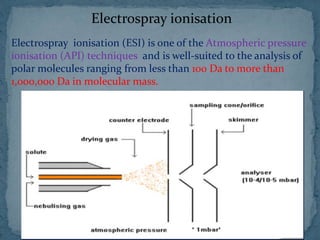
Electrospray ionisation
Electrospray ionisation (ESI) is one of the Atmospheric pressure
ionisation (API) techniques and is well-suited to the analysis of
polar molecules ranging from less than 100 Da to more than
1,000,000 Da in molecular mass.
Nanospray ionisation
•Nanospray ionisation (M. Wilm, M. Mann, Anal.
Chem.,1996,68,1) is a low flow rate version of
electrospray ionisation. A small volume (1-4 microL)
of the sample dissolved in a suitable volatile solvent,
at a concentration of ca. 1-10 pmol/microL, is
transferred into a miniature sample vial. A
reasonably high voltage (ca. 700-2000V) is applied to
the specially manufactured gold-plated vial resulting
in sample ionisation and spraying. The flow rate of
solute and solvent using this procedure is very low,
30-1000 nL/min.
Nanospray ionisation
Different Analyzers
•General: the effect of electromagnetic fields on ions
•All commonly used mass analyzers use electric and magnetic
fields to apply a force on charged particles (ions).
•The relationship b/w forces, mass, and the applied fields can
be summarized in Newton’s second law and the Lorentz
force law:
•F= ma (Newton’s second law)
•F=e(E + v x B) (Lorentz force law)
•Where, F is the force applied to the ion, m is the mass
of the ion, e is the ionic charge, a is the acceleration,
v x B is the vector cross product of the ion velocity and
the applied magnetic field.
Magnetic Sector Mass Spectrometers
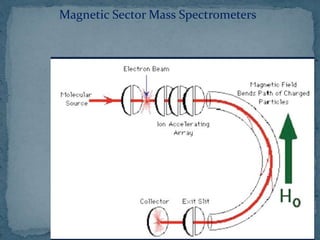
•In a magnetic deflection mass spectrometer, ions leaving
the ion source are accelerated to a high velocity. The ions
then pass through a magnetic sector in which the magnetic
field is applied in a direction perpendicular to the direction
of ion motion. From physics, we know acceleration is applied
perpendicular to the direction of motion of an object travels
in a circular path.
•A magnetic sector alone will separate ions according to
their mass-to-charge ratio.
•However, the resolution will be limited by the fact that ions
leaving the ions source do not all have exactly the same
energy and therefore do not have exactly the same velocity.
•This is analogous to the chromatic aberration in optical
spectroscopy. To achieve better resolution, it is necessary to
add an electric sector that focuses ions according to their
kinetic energy.
•Benefits
•Classical mass spectra
•Very high reproducibility
•Best quantitative performance of all mass
•High resolution
•High sensitivity
•High dynamic range
•Linked scan MS/MS does not require another analyzer
•Limitation
•Not well-suited for pulsed ionization method
•Usually larger and higher cost than other mass analyzers
•Application
•All organic MS analysis methods
•Accurate mass measurements
•Quantitation
•Isotope ratio measurements
Magnetic Sector Mass Spectrometers
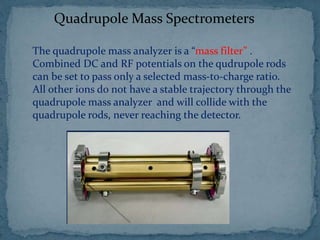
Quadrupole Mass Spectrometers
The quadrupole mass analyzer is a “mass filter” .
Combined DC and RF potentials on the qudrupole rods
can be set to pass only a selected mass-to-charge ratio.
All other ions do not have a stable trajectory through the
quadrupole mass analyzer and will collide with the
quadrupole rods, never reaching the detector.
Benefits
•Classical mass spectra
•Good reproducibility
•Relatively small and low-cost system
•Low energy collision-induced dissociation (CID) MS/MS
spectra in triple quadrupole and hybrid mass spectrometers
have efficient conversion of precursor to product
Limitation
•Limitation resolution
•Peak heights variable as a function of mass (mass
discrimination).peak height vs. mass response must be ‘tuned’.
•Not well suited for pulsed ionization methods
•Low energy collision-induced dissociation (CID) MS/MS
spectra in triple quadrupole and hybrid mass spectrometers
depend strongly on energy, collision gas, pressure, and other
factors.
Application: Majority of bench top GC/MS and LC/MS system
•Triple quadrupole MS/MS system
•Sector / quadrupole hybrid MS/MS system
Polymer Analysis by Mass Spectrometry
Mass spectrometry (MS) has become an indispensable tool for
polymer analysis and has been widely used to study :
polymer structure, polymer composition, molecular weight and
molecular weight distribution, bulk and surface properties,
impurity content, and so on.
MS based on accurate mass measurement and tandem MS
(MS/MS) analysis, can generate rich chemical information that is
highly specific for polymer structure analysis.
MS is also very sensitive, allowing the detection and
identification of minor polymer components or impurities in a
composed polymeric material and any by-product of
polymerization reaction of a desired polymer or additives.
Rapid MS analysis can be done for many polymer samples
where no prior sample treatment or extensive separation is
needed.
MS can potentially provided semi quantitative information
required for determination of the number average molecular
weight and the weight average molecular weight of an
oligomeric distribution of a polymer sample or a
characterization of relative amounts of different components
of a blend.
Some forms of MS can also be used to characterize
polymer surfaces.
Matrix assisted laser desorption ionization (MALDI) and
electrospray ionization (ESI) MS has opened a new era in
mass spectrometric analysis of biomolecules and synthetic
polymer.
ESI can be particularly useful for analyzing high mass
molecules that are easy to form multiply charged gas phase
ions and provide structural information for low molecular
weight oligomers.
In MALDI MS, “weight average” molecular weight and
“number average” molecular weight information can be
directly obtained for polymers of narrow polydispersity with
high precision and speed as well as the determination of end
groups.
For high PD polymers SEC-MALDI has been established for
accurate MW determinations.
MALDI MS can also provide structural information and
copolymer composition information , if the instrumental
resolution is sufficient to resolve oligomers at the molecular
weight range of interest.
Aadrsh kumar tiwari bbau

Aadrsh kumar tiwari bbau

  • 1.
    ASSINGMENT ON POLYMER ANALYSISBY MASS SPECTROMETRY Aadrsh Kumar Tiwari Department of polymer chemistry Roll no. - 131021 BBAU LUCKNOW (a central university) M.Sc. 3rd semester
  • 2.
    CONTENTS •What is massspectrometry (MS)? What information does mass spectrometry provide? •Where are mass spectrometry used? •How does a mass spectrometry work? Sample introduction Methods of sample ionization Analysis and separation of sample ions Detection and recording of sample ions •Electrospray ionization Electrospray ionization Nanospray ionization Data processing Polymer analysis by mass spectrometry
  • 3.
    What is massspectrometry (MS)? What information does mass spectrometry provide? Mass spectrometry is an analytical tool used for measuring the molecular mass of a sample. For large samples, molecular masses can be measured to within an accuracy of 0.01% of the total molecular mass of the sample, i.e. within 4 Daltons (Da) or atomic mass units (amu) error for a sample of 40,000 Da. This is sufficient to allow minor mass changes to be detected. For small organic molecules the molecular mass can be measured to within an accuracy of 5 ppm or less, which is often sufficient to confirm the molecular formula of a compound, and is also a standard requirement for publication in journal.
  • 4.
    Structural information canbe generated using certain types of mass spectrometers, usually those with multiple analyzers which are k/a tandem mass spectrometers. This is achieved by fragmenting the sample inside the instrument and analyzing the products generated. This procedure useful for the structural elucidation of organic compounds and for peptide or oligonucleotide sequencing, polymers.
  • 5.
    Where are massspectrometers used? •Mass spectrometers are used in industry and academia for both routine and research purposes. The following list is just a brief summary of the major mass spectrometric applications: •Macromolecules and Oligomers •Biotechnology: the analysis of proteins, peptides, oligonucleotides •Pharmaceutical: drug discovery, combinatorial chemistry, pharmacokinetics, drug metabolism •Clinical: neinatal screening, hemoglobin analysis, drug testing
  • 6.
    How does amass spectrometer work? Mass spectrometers can be divide into three fundamental parts, namely the ionisation source, the analyzer, and the detector. The sample has to be introduced into the ionisation source of the instrument. Once inside the ionisation source, the sample molecule are ionized, because ions are easier to manipulate than neutral molecules. These ions are extracted into the analyzer region of the mass spectrometer where they are separated according to their mass(m) –to- charge (z) ratio(m/z).
  • 7.
    Sample introduction The methodof sample introduction to the ionization source often depends on the ionization method being used, as well as the type and complexity of the sample. The sample can be intrested directly into the ionisation source, or can undergo some type of chromatography to the ionization source. This latter method of sample introduction usually involves the mass spectrometer being coupled directly to a high pressure liquid chromatography (HPLC),gas chromatography (GC), or capillary electrophoresis(CE).
  • 8.
    Methods of sampleionisation •The ionisation method to be used should depend on the type of sample under investigation and the mass spectrometer available. •Atmospheric pressure chemical ionisation(APCI) •Chemical ionisation(CI) •Electron impact (EI) •Electrospray ionisation (ESI) •Fast desorptio/field ionisation(FD/FI) •Matrix assist laser desorption ionisation(MALDI)
  • 9.
    Analysis and Separationof Sample Ions The main function of the mass analyzer is to separate, or resolve, the ions formed in the ionisation source of the mass spectrometer according to their mass to charge (m/z)ratio. •Quadrupoles (QP), • Time-of flight (TOF), •Magnetic sectors, •Fourier transform •Quadrupole ion traps. These mass analyzers have different features, including the m/z range that can be covered, the mass accuracy, and the achievable resolution. The compatibility of different analyzers with different ionisation methods varies. For e.g. , all of the analyzers listed above can be used in conjunction with electrospray ionisation, whereas MALDI is not usually coupled to a quadrupole analyzer.
  • 10.
    •Tandem (MS-MS) massspectrometers are instruments that have more than one analyzer and so can be used for structural and sequencing studies. Two , three and four analyzers have all been incorporated into commercially available tandem instruments, and the analyzers do not necessarily have to be of the same type, in which case the instrument is a hybrid one. More popular tandem mass spectrometers include those of the quadrupole-quadrupole, magnetic sector- quadrupole, time-of-flight, etc.
  • 11.
    Detection and recordingof sample ions •The detector monitors the ion current, amplifies it and the signal is then transmitted to the data system where it is recorded in the form of mass spectra. •The m/z values of the ions are plotted against their intensities to show the number of components in the sample, the molecular mass of each component, and the relative abundance of the various components in the sample. •Photomultiplier, •Electron multiplier •Micro-channel plate detectors.
  • 12.
    Electrospray ionisation Electrospray ionisation(ESI) is one of the Atmospheric pressure ionisation (API) techniques and is well-suited to the analysis of polar molecules ranging from less than 100 Da to more than 1,000,000 Da in molecular mass.
  • 13.
    Nanospray ionisation •Nanospray ionisation(M. Wilm, M. Mann, Anal. Chem.,1996,68,1) is a low flow rate version of electrospray ionisation. A small volume (1-4 microL) of the sample dissolved in a suitable volatile solvent, at a concentration of ca. 1-10 pmol/microL, is transferred into a miniature sample vial. A reasonably high voltage (ca. 700-2000V) is applied to the specially manufactured gold-plated vial resulting in sample ionisation and spraying. The flow rate of solute and solvent using this procedure is very low, 30-1000 nL/min.
  • 14.
  • 15.
    Different Analyzers •General: theeffect of electromagnetic fields on ions •All commonly used mass analyzers use electric and magnetic fields to apply a force on charged particles (ions). •The relationship b/w forces, mass, and the applied fields can be summarized in Newton’s second law and the Lorentz force law: •F= ma (Newton’s second law) •F=e(E + v x B) (Lorentz force law) •Where, F is the force applied to the ion, m is the mass of the ion, e is the ionic charge, a is the acceleration, v x B is the vector cross product of the ion velocity and the applied magnetic field.
  • 16.
    Magnetic Sector MassSpectrometers •In a magnetic deflection mass spectrometer, ions leaving the ion source are accelerated to a high velocity. The ions then pass through a magnetic sector in which the magnetic field is applied in a direction perpendicular to the direction of ion motion. From physics, we know acceleration is applied perpendicular to the direction of motion of an object travels in a circular path. •A magnetic sector alone will separate ions according to their mass-to-charge ratio. •However, the resolution will be limited by the fact that ions leaving the ions source do not all have exactly the same energy and therefore do not have exactly the same velocity. •This is analogous to the chromatic aberration in optical spectroscopy. To achieve better resolution, it is necessary to add an electric sector that focuses ions according to their kinetic energy.
  • 17.
    •Benefits •Classical mass spectra •Veryhigh reproducibility •Best quantitative performance of all mass •High resolution •High sensitivity •High dynamic range •Linked scan MS/MS does not require another analyzer •Limitation •Not well-suited for pulsed ionization method •Usually larger and higher cost than other mass analyzers •Application •All organic MS analysis methods •Accurate mass measurements •Quantitation •Isotope ratio measurements
  • 18.
    Magnetic Sector MassSpectrometers
  • 19.
    Quadrupole Mass Spectrometers Thequadrupole mass analyzer is a “mass filter” . Combined DC and RF potentials on the qudrupole rods can be set to pass only a selected mass-to-charge ratio. All other ions do not have a stable trajectory through the quadrupole mass analyzer and will collide with the quadrupole rods, never reaching the detector.
  • 20.
    Benefits •Classical mass spectra •Goodreproducibility •Relatively small and low-cost system •Low energy collision-induced dissociation (CID) MS/MS spectra in triple quadrupole and hybrid mass spectrometers have efficient conversion of precursor to product Limitation •Limitation resolution •Peak heights variable as a function of mass (mass discrimination).peak height vs. mass response must be ‘tuned’. •Not well suited for pulsed ionization methods •Low energy collision-induced dissociation (CID) MS/MS spectra in triple quadrupole and hybrid mass spectrometers depend strongly on energy, collision gas, pressure, and other factors. Application: Majority of bench top GC/MS and LC/MS system •Triple quadrupole MS/MS system •Sector / quadrupole hybrid MS/MS system
  • 21.
    Polymer Analysis byMass Spectrometry Mass spectrometry (MS) has become an indispensable tool for polymer analysis and has been widely used to study : polymer structure, polymer composition, molecular weight and molecular weight distribution, bulk and surface properties, impurity content, and so on. MS based on accurate mass measurement and tandem MS (MS/MS) analysis, can generate rich chemical information that is highly specific for polymer structure analysis. MS is also very sensitive, allowing the detection and identification of minor polymer components or impurities in a composed polymeric material and any by-product of polymerization reaction of a desired polymer or additives. Rapid MS analysis can be done for many polymer samples where no prior sample treatment or extensive separation is needed.
  • 22.
    MS can potentiallyprovided semi quantitative information required for determination of the number average molecular weight and the weight average molecular weight of an oligomeric distribution of a polymer sample or a characterization of relative amounts of different components of a blend. Some forms of MS can also be used to characterize polymer surfaces. Matrix assisted laser desorption ionization (MALDI) and electrospray ionization (ESI) MS has opened a new era in mass spectrometric analysis of biomolecules and synthetic polymer. ESI can be particularly useful for analyzing high mass molecules that are easy to form multiply charged gas phase ions and provide structural information for low molecular weight oligomers.
  • 23.
    In MALDI MS,“weight average” molecular weight and “number average” molecular weight information can be directly obtained for polymers of narrow polydispersity with high precision and speed as well as the determination of end groups. For high PD polymers SEC-MALDI has been established for accurate MW determinations. MALDI MS can also provide structural information and copolymer composition information , if the instrumental resolution is sufficient to resolve oligomers at the molecular weight range of interest.