X-ray Diffraction (XRD)
• What is X-ray Diffraction
Properties and generation of X-ray
• Bragg’s Law
• Basics of Crystallography
• XRD Pattern
• Powder Diffraction
• Applications of XRD
http://www.matter.org.uk/diffraction/x-ray/default.htm
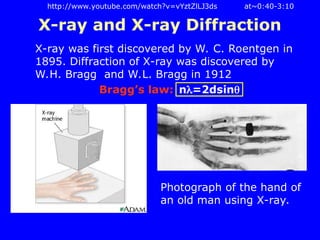
X-ray and X-ray Diffraction
X-ray was first discovered by W. C. Roentgen in
1895. Diffraction of X-ray was discovered by
W.H. Bragg and W.L. Bragg in 1912
Bragg’s law: n=2dsin
Photograph of the hand of
an old man using X-ray.
http://www.youtube.com/watch?v=vYztZlLJ3ds at~0:40-3:10
Properties and Generation of X-ray
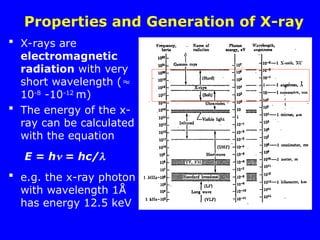
 X-rays are
electromagnetic
radiation with very
short wavelength (
10-8
-10-12
m)
 The energy of the x-
ray can be calculated
with the equation
E = h = hc/
 e.g. the x-ray photon
with wavelength 1Å
has energy 12.5 keV
A Modern Automated
X-ray Diffractometer
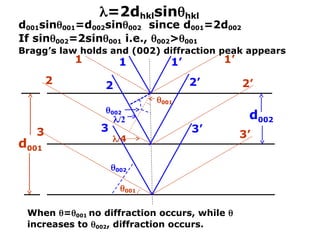
Cost: $560K to 1.6M
X-ray Tube
Sample stage
Detector
http://www.youtube.com/watch?v=lwV5WCBh9a0 to~1:08
Production of X-rays
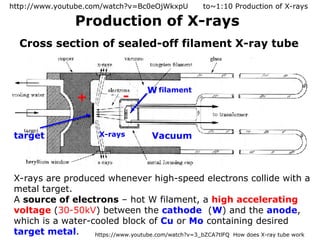
Cross section of sealed-off filament X-ray tube
target X-rays
W
Vacuum
X-rays are produced whenever high-speed electrons collide with a
metal target.
A source of electrons – hot W filament, a high accelerating
voltage (30-50kV) between the cathode (W) and the anode,
which is a water-cooled block of Cu or Mo containing desired
target metal.
http://www.youtube.com/watch?v=Bc0eOjWkxpU to~1:10 Production of X-rays
https://www.youtube.com/watch?v=3_bZCA7tlFQ How does X-ray tube work
filament
+ -
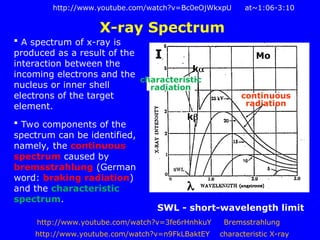
X-ray Spectrum
 A spectrum of x-ray is
produced as a result of the
interaction between the
incoming electrons and the
nucleus or inner shell
electrons of the target
element.
 Two components of the
spectrum can be identified,
namely, the continuous
spectrum caused by
bremsstrahlung (German
word: braking radiation)
and the characteristic
spectrum.
SWL - short-wavelength limit
continuous
radiation
characteristic
radiation
k
k
I

Mo
http://www.youtube.com/watch?v=n9FkLBaktEY characteristic X-ray
http://www.youtube.com/watch?v=Bc0eOjWkxpU at~1:06-3:10
http://www.youtube.com/watch?v=3fe6rHnhkuY Bremsstrahlung
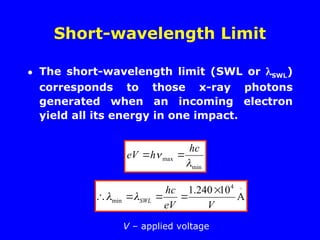
Short-wavelength Limit
• The short-wavelength limit (SWL or SWL)
corresponds to those x-ray photons
generated when an incoming electron
yield all its energy in one impact.
min
max


hc
h
eV 


A
10
240
.
1 4
min
V
eV
hc
SWL




 

V – applied voltage
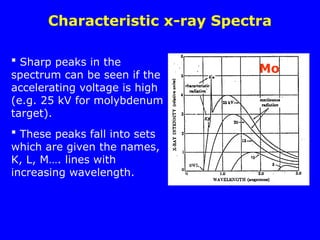
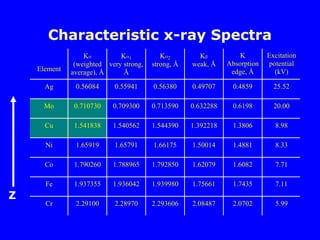
Characteristic x-ray Spectra
 Sharp peaks in the
spectrum can be seen if the
accelerating voltage is high
(e.g. 25 kV for molybdenum
target).
 These peaks fall into sets
which are given the names,
K, L, M…. lines with
increasing wavelength.
Mo
08/21/24
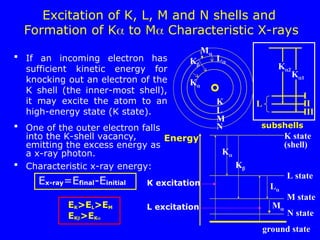
 If an incoming electron has
sufficient kinetic energy for
knocking out an electron of the
K shell (the inner-most shell),
it may excite the atom to an
high-energy state (K state).
 One of the outer electron falls
into the K-shell vacancy,
emitting the excess energy as
a x-ray photon.
 Characteristic x-ray energy:
Ex-ray=Efinal-Einitial
Excitation of K, L, M and N shells and
Formation of K to M Characteristic X-rays
K
L
M
N
K
K
L
Energy K state
(shell)
L state
M state
N state
ground state
K
K
L
L
K1
K2
I
II
III
M
subshells
EK>EL>EM
EK>EK
K excitation
L excitation M
Element
K
(weighted
average), Å
K1
very strong,
Å
K2
strong, Å
K
weak, Å
K
Absorption
edge, Å
Excitation
potential
(kV)
Ag 0.56084 0.55941 0.56380 0.49707 0.4859 25.52
Mo 0.710730 0.709300 0.713590 0.632288 0.6198 20.00
Cu 1.541838 1.540562 1.544390 1.392218 1.3806 8.98
Ni 1.65919 1.65791 1.66175 1.50014 1.4881 8.33
Co 1.790260 1.788965 1.792850 1.62079 1.6082 7.71
Fe 1.937355 1.936042 1.939980 1.75661 1.7435 7.11
Cr 2.29100 2.28970 2.293606 2.08487 2.0702 5.99
Characteristic x-ray Spectra
Z
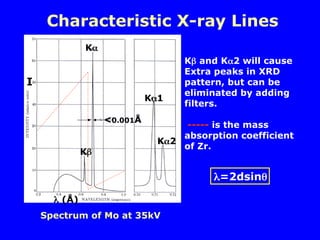
Characteristic X-ray Lines
Spectrum of Mo at 35kV
K1
K
K
I
 (Å)
<0.001Å
K2
K and K2 will cause
Extra peaks in XRD
pattern, but can be
eliminated by adding
filters.
----- is the mass
absorption coefficient
of Zr.
=2dsin
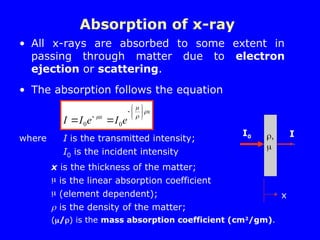
• All x-rays are absorbed to some extent in
passing through matter due to electron
ejection or scattering.
• The absorption follows the equation
where I is the transmitted intensity;
I0 is the incident intensity
x is the thickness of the matter;
 is the linear absorption coefficient
 (element dependent);
 is the density of the matter;
(/) is the mass absorption coefficient (cm2
/gm).
Absorption of x-ray
x
x
e
I
e
I
I



 










 0
0
I0 I
,

x
I
x
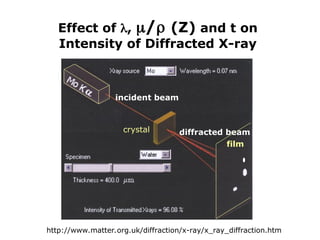
Effect of , / (Z) and t on
Intensity of Diffracted X-ray
incident beam
diffracted beam
film
crystal
http://www.matter.org.uk/diffraction/x-ray/x_ray_diffraction.htm
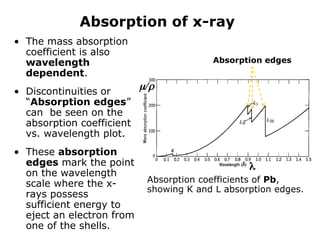
• The mass absorption
coefficient is also
wavelength
dependent.
• Discontinuities or
“Absorption edges”
can be seen on the
absorption coefficient
vs. wavelength plot.
• These absorption
edges mark the point
on the wavelength
scale where the x-
rays possess
sufficient energy to
eject an electron from
one of the shells.
Absorption of x-ray
Absorption coefficients of Pb,
showing K and L absorption edges.

/
Absorption edges
Filtering of X-ray
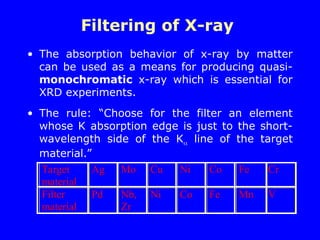
• The absorption behavior of x-ray by matter
can be used as a means for producing quasi-
monochromatic x-ray which is essential for
XRD experiments.
• The rule: “Choose for the filter an element
whose K absorption edge is just to the short-
wavelength side of the K line of the target
material.”
Target
material
Ag Mo Cu Ni Co Fe Cr
Filter
material
Pd Nb,
Zr
Ni Co Fe Mn V
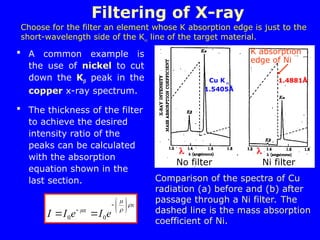
 A common example is
the use of nickel to cut
down the K peak in the
copper x-ray spectrum.
 The thickness of the filter
to achieve the desired
intensity ratio of the
peaks can be calculated
with the absorption
equation shown in the
last section.
Filtering of X-ray
x
x
e
I
e
I
I



 










 0
0
Comparison of the spectra of Cu
radiation (a) before and (b) after
passage through a Ni filter. The
dashed line is the mass absorption
coefficient of Ni.
No filter Ni filter
K absorption
edge of Ni
1.4881Å
Choose for the filter an element whose K absorption edge is just to the
short-wavelength side of the K line of the target material.


Cu K 
1.5405Å
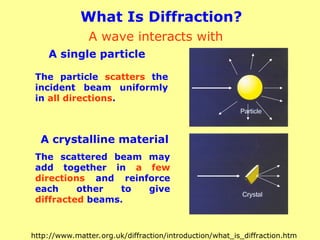
What Is Diffraction?
A wave interacts with
A single particle
A crystalline material
The particle scatters the
incident beam uniformly
in all directions.
The scattered beam may
add together in a few
directions and reinforce
each other to give
diffracted beams.
http://www.matter.org.uk/diffraction/introduction/what_is_diffraction.htm
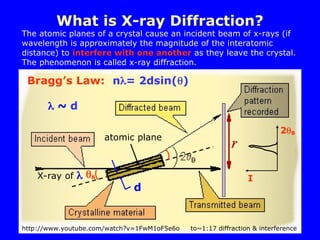
What is X-ray Diffraction?
The atomic planes of a crystal cause an incident beam of x-rays (if
wavelength is approximately the magnitude of the interatomic
distance) to interfere with one another as they leave the crystal.
The phenomenon is called x-ray diffraction.
atomic plane
X-ray of 
d
n= 2dsin()
Bragg’s Law:
B
 ~ d
2B
I
http://www.youtube.com/watch?v=1FwM1oF5e6o to~1:17 diffraction & interference
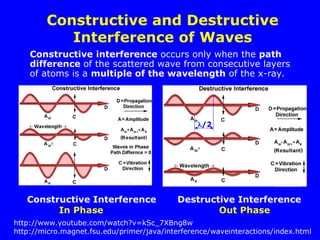
Constructive and Destructive
Interference of Waves
Constructive Interference Destructive Interference
In Phase Out Phase
Constructive interference occurs only when the path
difference of the scattered wave from consecutive layers
of atoms is a multiple of the wavelength of the x-ray.
/2
http://www.youtube.com/watch?v=kSc_7XBng8w
http://micro.magnet.fsu.edu/primer/java/interference/waveinteractions/index.html
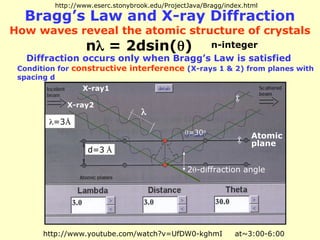
Bragg’s Law and X-ray Diffraction
How waves reveal the atomic structure of crystals
n = 2dsin()
Atomic
plane
d=3 Å
=3Å
=30o
n-integer
X-ray1
X-ray2

2-diffraction angle
Diffraction occurs only when Bragg’s Law is satisfied
Condition for constructive interference (X-rays 1 & 2) from planes with
spacing d
http://www.youtube.com/watch?v=UfDW0-kghmI at~3:00-6:00
http://www.eserc.stonybrook.edu/ProjectJava/Bragg/index.html
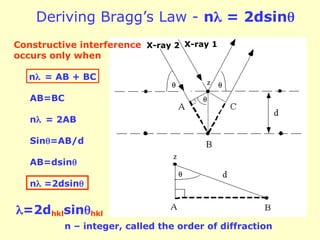
Deriving Bragg’s Law - n = 2dsin
X-ray 1
X-ray 2
Constructive interference
occurs only when
n= AB + BC
AB=BC
n= 2AB
Sin=AB/d
AB=dsin
n =2dsin
=2dhklsinhkl
n – integer, called the order of diffraction
Basics of Crystallography
A crystal consists of a periodic arrangement of the unit cell
into a lattice. The unit cell can contain a single atom or
atoms in a fixed arrangement.
Crystals consist of planes of atoms that are spaced a
distance d apart, but can be resolved into many atomic
planes, each with a different d-spacing.
a,b and c (length) and ,  and  (angles between a,b and c)
are lattice constants or parameters which can be
determined by XRD.
smallest building block
Unit cell (Å)
Lattice
CsCl
d1
d2
d3
a
b
c



z [001]
y [010]
x [100] crystallographic
axes
Single crystal
http://www.youtube.com/watch?v=Rm-i1c7zr6Q&list=TLyPTUJ62VYE4wC1snHSChDl0NGo9IK-Nl
http://www.youtube.com/watch?v=Mm-jqk1TeRY crystal packing in lattices
to~2:25
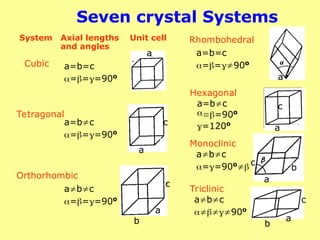
Lattice structures
System Axial lengths Unit cell
and angles
Cubic a=b=c
===90o
a
a
c
Tetragonal
a=bc
===90o
b
a
c
Orthorhombic
abc
===90o
a
Rhombohedral
a=b=c
==90o
Hexagonal
a=bc
=90o
=120o
c
a
b
Monoclinic
abc
==90o

b
a
c
Triclinic
abc
90o
c
Seven crystal Systems
a
Plane Spacings for Seven
Crystal Systems
1
hkl
hkl
hkl
hkl
hkl
hkl
hkl
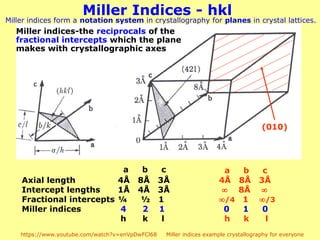
Miller Indices - hkl
(010)
Miller indices-the reciprocals of the
fractional intercepts which the plane
makes with crystallographic axes
Axial length 4Å 8Å 3Å
Intercept lengths 1Å 4Å 3Å
Fractional intercepts ¼ ½ 1
Miller indices 4 2 1
h k l
4Å 8Å 3Å
 8Å 
/4 1 /3
0 1 0
h k l
a b c
a b c
https://www.youtube.com/watch?v=enVpDwFCl68 Miller indices example crystallography for everyone
Miller indices form a notation system in crystallography for planes in crystal lattices.
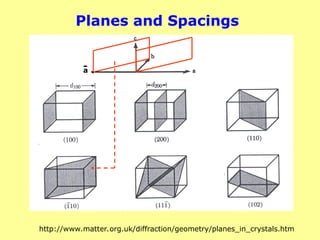
Planes and Spacings
a
-
http://www.matter.org.uk/diffraction/geometry/planes_in_crystals.htm
Indexing of Planes and Directions
a
b
c
a
b
c
(111)
[110]
a direction [uvw]
a set of equivalent
directions <uvw>
<100>:[100],[010],[001]
[100],[010] and [001]
a plane (hkl)
a set of equivalent
planes {hkl}
{110}:(101),(011),(110)
(101),(101),(101),etc.
(110)
[111]
http://www.youtube.com/watch?v=9Rjp9i0H7GQ Directions in crystals
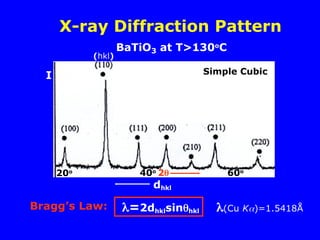
X-ray Diffraction Pattern
2
I Simple Cubic
=2dhklsinhkl
Bragg’s Law: (Cu K)=1.5418Å
BaTiO3 at T>130o
C
dhkl
20o 40o
60o
(hkl)
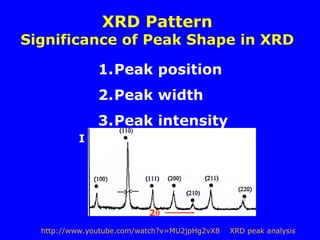
XRD Pattern
Significance of Peak Shape in XRD
1.Peak position
2.Peak width
3.Peak intensity
http://www.youtube.com/watch?v=MU2jpHg2vX8 XRD peak analysis
I
2
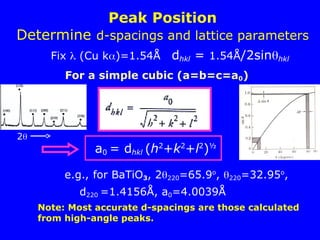
Peak Position
Determine d-spacings and lattice parameters
Fix  (Cu k)=1.54Å dhkl = 1.54Å/2sinhkl
Note: Most accurate d-spacings are those calculated
from high-angle peaks.
For a simple cubic (a=b=c=a0)
a0 = dhkl (h2
+k2
+l2
)½
e.g., for BaTiO3, 2220=65.9o
, 220=32.95o
,
d220 =1.4156Å, a0=4.0039Å
2
Peak Intensity
X-ray intensity: Ihkl  lFhkll2
Fhkl - Structure Factor
Fhkl =  fjexp[2i(huj+kvj+lwj)]
j=1
N
fj – atomic scattering factor
fj  Z, sin/
N – number of atoms in the unit cell,
uj,vj,wj - fractional coordinates of the j
th atom
in the unit cell
Low Z elements may be difficult to detect by XRD
Determine crystal structure and atomic arrangement
in a unit cell
Cubic Structures
a = b = c = a
Simple Cubic Body-centered Cubic Face-centered Cubic
BCC FCC
8 x 1/8 =1 8 x 1/8 + 1 = 2 8 x 1/8 + 6 x 1/2 = 4
1 atom 2 atoms 4 atoms
a
a
a
[001]
z axis
[100]
x
[010]
y
Location: 0,0,0 0,0,0, ½, ½, ½, 0,0,0, ½, ½, 0,
½, 0, ½, 0, ½, ½,
- corner atom, shared with 8 unit cells
- atom at face-center, shared with 2 unit cells
8 unit cells
Structures of Some Common Metals
BCC FCC
a
a
a
[001] axis
[100]
[010]
(001) plane
(002)
h,k,l – integers, Miller indices, (hkl) planes
(001) plane intercept [001] axis with a length of a, l = 1
(002) plane intercept [001] axis with a length of ½ a, l = 2
(010) plane intercept [010] axis with a length of a, k = 1, etc.
(010)
plane
½ a [010]
axis
 = 2dhklsinhkl
Mo Cu
d002 =
d001
d010
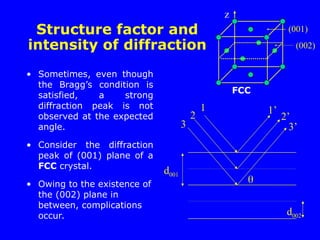
Structure factor and
intensity of diffraction
• Sometimes, even though
the Bragg’s condition is
satisfied, a strong
diffraction peak is not
observed at the expected
angle.
• Consider the diffraction
peak of (001) plane of a
FCC crystal.
• Owing to the existence of
the (002) plane in
between, complications
occur.
d001
d002

1
2
3
1’
2’
3’
z
(001)
(002)
FCC
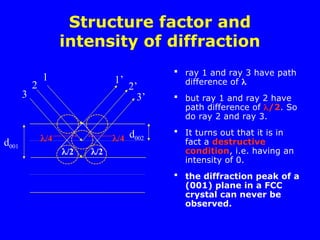
 ray 1 and ray 3 have path
difference of 
 but ray 1 and ray 2 have
path difference of /2. So
do ray 2 and ray 3.
 It turns out that it is in
fact a destructive
condition, i.e. having an
intensity of 0.
 the diffraction peak of a
(001) plane in a FCC
crystal can never be
observed.
Structure factor and
intensity of diffraction
d001
d002
1
2
3
1’
2’
3’
/2 /2
/4 /4
http://emalwww.engin.umich.edu/education_materials/microscopy.html
d001
d002
=2dhklsinhkl
d001sin001=d002sin002 since d001=2d002
If sin002=2sin001 i.e., 002>001
Bragg’s law holds and (002) diffraction peak appears
1
3
2
1’
2’
/4
001
3’
1
2
3
1’
2’
3’
002
/2
001
002
When =001 no diffraction occurs, while 
increases to 002, diffraction occurs.
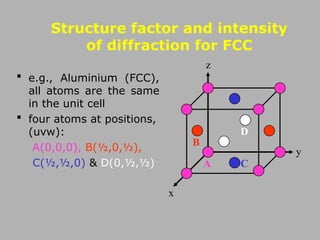
 e.g., Aluminium (FCC),
all atoms are the same
in the unit cell
 four atoms at positions,
(uvw):
A(0,0,0), B(½,0,½),
C(½,½,0) & D(0,½,½)
Structure factor and intensity
of diffraction for FCC
z
x
y
A
B
C
D
For a certain set of plane, (hkl)
F =  f () exp[2i(hu+kv+lw)]
= f ()  exp[2i(hu+kv+lw)]
= f (){exp[2i(0)] + exp[2i(h/2 + l/2)]
+ exp[2i(h/2 + k/2)] + exp[2i(k/2 + l/2)]}
= f (){1 + ei(h+k)
+ ei(k+l)
+ ei(l+h)
}
Since e2ni
= 1 and e(2n+1)i
= -1,
if h, k & l are all odd or all even, then (h+k),
(k+l), and (l+h) are all even and F = 4f;
otherwise, F = 0
Structure factor and intensity of
diffraction for FCC




mixed
l
k,
h,
0
even
all
or
odd
all
l
k,
h,
4 f
F
     
j
j
j lw
kv
hu
i
j
j e
f
F



 




2
A(0,0,0), B(½,0,½),
C(½,½,0) & D(0,½,½)
2i
Ihkl  lFhkll2
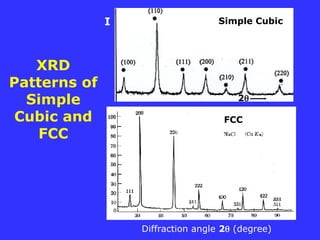
XRD
Patterns of
Simple
Cubic and
FCC
Diffraction angle 2 (degree)
I Simple Cubic
FCC
2
h2
+ k2
+ l2
simple cubic
(any
combination)
FCC
(either all odd
or all even)
BCC
(h + k + l) is
even
1 100 - -
2 110 - 110
3 111 111 -
4 200 200 200
5 210 - -
6 211 - 211
7 - - -
8 220 220 220
9 300, 221 - -
10 310 - 310
11 311 311 -
12 222 222 222
Diffractions Possibly Present for
Cubic Structures
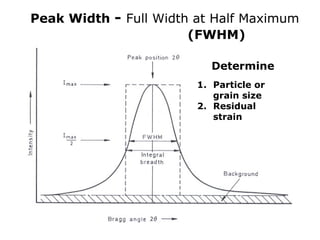
Peak Width - Full Width at Half Maximum
(FWHM)
1. Particle or
grain size
2. Residual
strain
Determine
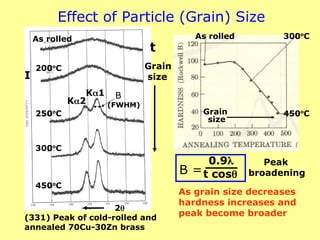
Effect of Particle (Grain) Size
(331) Peak of cold-rolled and
annealed 70Cu-30Zn brass
2
I
K1
K2
As rolled
200o
C
250o
C
300o
C
450o
C
As rolled 300o
C
450o
C
Grain
size
t
B =
0.9
t cos
Peak
broadening
As grain size decreases
hardness increases and
peak become broader
Grain
size
B
(FWHM)
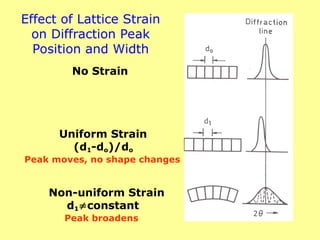
Effect of Lattice Strain
on Diffraction Peak
Position and Width
No Strain
Uniform Strain
(d1-do)/do
Non-uniform Strain
d1constant
Peak moves, no shape changes
Peak broadens
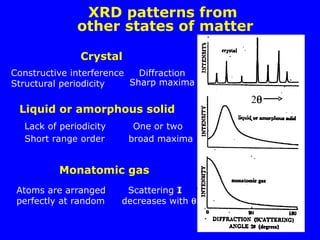
XRD patterns from
other states of matter
Constructive interference
Structural periodicity
Diffraction
Sharp maxima
Crystal
Liquid or amorphous solid
Lack of periodicity One or two
Short range order broad maxima
Monatomic gas
Atoms are arranged Scattering I
perfectly at random decreases with 
2
X-ray Diffraction (XRD)
• What is X-ray Diffraction
Properties and generation of X-ray
• Bragg’s Law
• Basics of Crystallography
• XRD Pattern
• Powder Diffraction
• Applications of XRD
http://www.matter.org.uk/diffraction/x-ray/laue_method.htm
Diffraction of X-rays by Crystals-Laue Method
Back-reflection Laue
Film
X-ray
crystal
crystal Film
Transmission Laue
[001]
http://www.youtube.com/watch?v=UfDW0-kghmI at~1:20-3:00
http://www.youtube.com/watch?v=2JwpHmT6ntU
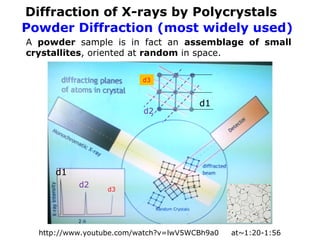
Powder Diffraction (most widely used)
A powder sample is in fact an assemblage of small
crystallites, oriented at random in space.
2
2
Polycrystalline
sample
Powder
sample
crystallite
Diffraction of X-rays by Polycrystals
http://www.youtube.com/watch?v=lwV5WCBh9a0 at~1:20-1:56
d1
d3
d2
d1
d2
d3
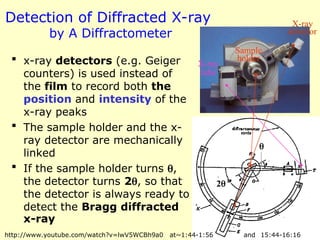
Detection of Diffracted X-ray
by A Diffractometer
 x-ray detectors (e.g. Geiger
counters) is used instead of
the film to record both the
position and intensity of the
x-ray peaks
 The sample holder and the x-
ray detector are mechanically
linked
 If the sample holder turns ,
the detector turns 2, so that
the detector is always ready to
detect the Bragg diffracted
x-ray
X-ray
tube
X-ray
detector
Sample
holder
2

http://www.youtube.com/watch?v=lwV5WCBh9a0 at~1:44-1:56 and 15:44-16:16
Phase Identification
One of the most important uses of XRD
• Obtain XRD pattern
• Measure d-spacings
• Obtain integrated intensities
• Compare data with known standards in
the JCPDS file, which are for random
orientations (there are more than 50,000
JCPDS cards of inorganic materials).
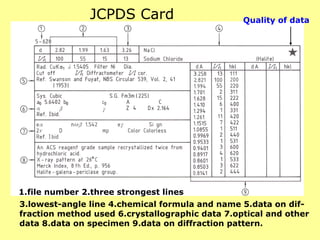
JCPDS Card
1.file number 2.three strongest lines
3.lowest-angle line 4.chemical formula and name 5.data on dif-
fraction method used 6.crystallographic data 7.optical and other
data 8.data on specimen 9.data on diffraction pattern.
Quality of data
Other Applications of XRD
• To identify crystalline phases
• To determine structural properties:
Lattice parameters (10-4
Å), strain, grain size, expitaxy,
phase composition, preferred orientation
order-disorder transformation, thermal expansion
• To measure thickness of thin films and multilayers
• To determine atomic arrangement
• To image and characterize defects
Detection limits: ~3% in a two phase mixture; can be
~0.1% with synchrotron radiation.
Lateral resolution: normally none
XRD is a nondestructive technique
https://www.youtube.com/watch?v=CpJZfeJ4poE phased contrast x-ray imaging
https://www.youtube.com/watch?v=6POi6h4dfVs
Determining strain pole figures from diffraction experiments
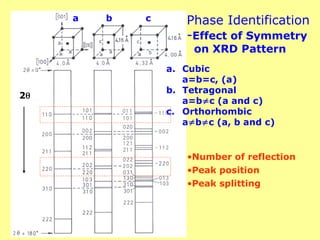
Phase Identification
-Effect of Symmetry
on XRD Pattern
a b c
2
a. Cubic
a=b=c, (a)
b. Tetragonal
a=bc (a and c)
c. Orthorhombic
abc (a, b and c)
•Number of reflection
•Peak position
•Peak splitting
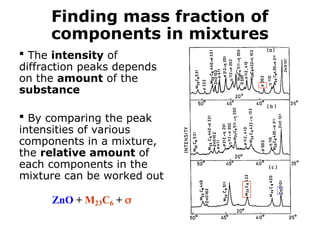
Finding mass fraction of
components in mixtures
 The intensity of
diffraction peaks depends
on the amount of the
substance
 By comparing the peak
intensities of various
components in a mixture,
the relative amount of
each components in the
mixture can be worked out
ZnO + M23C6 + 
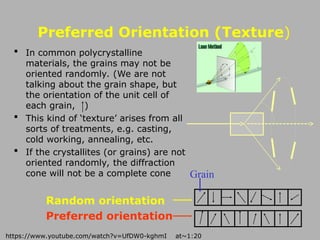
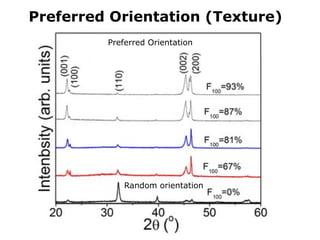
Preferred Orientation (Texture)
 In common polycrystalline
materials, the grains may not be
oriented randomly. (We are not
talking about the grain shape, but
the orientation of the unit cell of
each grain, )
 This kind of ‘texture’ arises from all
sorts of treatments, e.g. casting,
cold working, annealing, etc.
 If the crystallites (or grains) are not
oriented randomly, the diffraction
cone will not be a complete cone
Random orientation
Preferred orientation
Grain
https://www.youtube.com/watch?v=UfDW0-kghmI at~1:20
Preferred Orientation (Texture)
I
(110)
Random orientation
Preferred Orientation
Preferred Orientation (Texture)
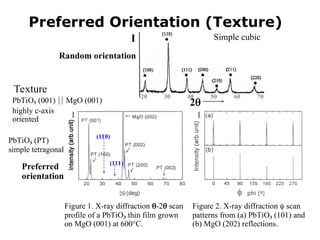
Figure 1. X-ray diffraction -2 scan
profile of a PbTiO3 thin film grown
on MgO (001) at 600°C.
Figure 2. X-ray diffraction  scan
patterns from (a) PbTiO3 (101) and
(b) MgO (202) reflections.
Simple cubic
I
2

I I
20 30 40 50 60 70
PbTiO3 (PT)
simple tetragonal
(110)
(111)
Texture
PbTiO3 (001)  MgO (001)
highly c-axis
oriented
Random orientation
Preferred
orientation
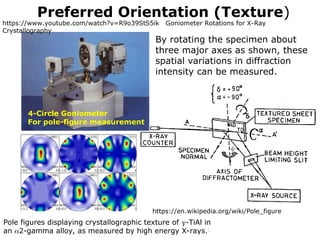
By rotating the specimen about
three major axes as shown, these
spatial variations in diffraction
intensity can be measured.
Preferred Orientation (Texture)

4-Circle Goniometer
For pole-figure measurement
https://www.youtube.com/watch?v=R9o39StS5ik Goniometer Rotations for X-Ray
Crystallography
Pole figures displaying crystallographic texture of -TiAl in
an 2-gamma alloy, as measured by high energy X-rays.[
https://en.wikipedia.org/wiki/Pole_figure
In Situ XRD Studies
• Temperature
• Electric Field
• Pressure
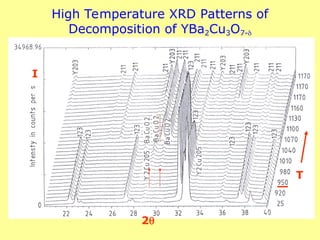
High Temperature XRD Patterns of
Decomposition of YBa2Cu3O7-
T
2
I
In Situ X-ray Diffraction Study of an Electric
Field Induced Phase Transition
Single Crystal Ferroelectric
92%Pb(Zn1/3Nb2/3)O3 -8%PbTiO3
E=6kV/cm
E=10kV/cm
(330)
K1
K2
K1
K2
(330) peak splitting is due to
Presence of <111> domains
Rhombohedral phase
No (330) peak splitting
Tetragonal phase
Specimen Preparation
Double sided tape
Glass slide
Powders: 0.1m < particle size <40 m
Peak broadening less diffraction occurring
Bulks: smooth surface
after polishing, specimens should be
thermal annealed to eliminate any
surface deformation induced during
polishing.
http://www.youtube.com/watch?v=lwV5WCBh9a0 at~2:00-5:10
a b
Next Lecture
Transmission Electron Microscopy
Do review problems for XRD

Lecture presentation on x-ray diffraction.ppt

  • 1.
    X-ray Diffraction (XRD) •What is X-ray Diffraction Properties and generation of X-ray • Bragg’s Law • Basics of Crystallography • XRD Pattern • Powder Diffraction • Applications of XRD http://www.matter.org.uk/diffraction/x-ray/default.htm
  • 2.
    X-ray and X-rayDiffraction X-ray was first discovered by W. C. Roentgen in 1895. Diffraction of X-ray was discovered by W.H. Bragg and W.L. Bragg in 1912 Bragg’s law: n=2dsin Photograph of the hand of an old man using X-ray. http://www.youtube.com/watch?v=vYztZlLJ3ds at~0:40-3:10
  • 3.
    Properties and Generationof X-ray  X-rays are electromagnetic radiation with very short wavelength ( 10-8 -10-12 m)  The energy of the x- ray can be calculated with the equation E = h = hc/  e.g. the x-ray photon with wavelength 1Å has energy 12.5 keV
  • 4.
    A Modern Automated X-rayDiffractometer Cost: $560K to 1.6M X-ray Tube Sample stage Detector http://www.youtube.com/watch?v=lwV5WCBh9a0 to~1:08
  • 5.
    Production of X-rays Crosssection of sealed-off filament X-ray tube target X-rays W Vacuum X-rays are produced whenever high-speed electrons collide with a metal target. A source of electrons – hot W filament, a high accelerating voltage (30-50kV) between the cathode (W) and the anode, which is a water-cooled block of Cu or Mo containing desired target metal. http://www.youtube.com/watch?v=Bc0eOjWkxpU to~1:10 Production of X-rays https://www.youtube.com/watch?v=3_bZCA7tlFQ How does X-ray tube work filament + -
  • 6.
    X-ray Spectrum  Aspectrum of x-ray is produced as a result of the interaction between the incoming electrons and the nucleus or inner shell electrons of the target element.  Two components of the spectrum can be identified, namely, the continuous spectrum caused by bremsstrahlung (German word: braking radiation) and the characteristic spectrum. SWL - short-wavelength limit continuous radiation characteristic radiation k k I  Mo http://www.youtube.com/watch?v=n9FkLBaktEY characteristic X-ray http://www.youtube.com/watch?v=Bc0eOjWkxpU at~1:06-3:10 http://www.youtube.com/watch?v=3fe6rHnhkuY Bremsstrahlung
  • 7.
    Short-wavelength Limit • Theshort-wavelength limit (SWL or SWL) corresponds to those x-ray photons generated when an incoming electron yield all its energy in one impact. min max   hc h eV    A 10 240 . 1 4 min V eV hc SWL        V – applied voltage
  • 8.
    Characteristic x-ray Spectra Sharp peaks in the spectrum can be seen if the accelerating voltage is high (e.g. 25 kV for molybdenum target).  These peaks fall into sets which are given the names, K, L, M…. lines with increasing wavelength. Mo
  • 9.
    08/21/24  If anincoming electron has sufficient kinetic energy for knocking out an electron of the K shell (the inner-most shell), it may excite the atom to an high-energy state (K state).  One of the outer electron falls into the K-shell vacancy, emitting the excess energy as a x-ray photon.  Characteristic x-ray energy: Ex-ray=Efinal-Einitial Excitation of K, L, M and N shells and Formation of K to M Characteristic X-rays K L M N K K L Energy K state (shell) L state M state N state ground state K K L L K1 K2 I II III M subshells EK>EL>EM EK>EK K excitation L excitation M
  • 10.
    Element K (weighted average), Å K1 very strong, Å K2 strong,Å K weak, Å K Absorption edge, Å Excitation potential (kV) Ag 0.56084 0.55941 0.56380 0.49707 0.4859 25.52 Mo 0.710730 0.709300 0.713590 0.632288 0.6198 20.00 Cu 1.541838 1.540562 1.544390 1.392218 1.3806 8.98 Ni 1.65919 1.65791 1.66175 1.50014 1.4881 8.33 Co 1.790260 1.788965 1.792850 1.62079 1.6082 7.71 Fe 1.937355 1.936042 1.939980 1.75661 1.7435 7.11 Cr 2.29100 2.28970 2.293606 2.08487 2.0702 5.99 Characteristic x-ray Spectra Z
  • 11.
    Characteristic X-ray Lines Spectrumof Mo at 35kV K1 K K I  (Å) <0.001Å K2 K and K2 will cause Extra peaks in XRD pattern, but can be eliminated by adding filters. ----- is the mass absorption coefficient of Zr. =2dsin
  • 12.
    • All x-raysare absorbed to some extent in passing through matter due to electron ejection or scattering. • The absorption follows the equation where I is the transmitted intensity; I0 is the incident intensity x is the thickness of the matter;  is the linear absorption coefficient  (element dependent);  is the density of the matter; (/) is the mass absorption coefficient (cm2 /gm). Absorption of x-ray x x e I e I I                 0 0 I0 I ,  x I x
  • 13.
    Effect of ,/ (Z) and t on Intensity of Diffracted X-ray incident beam diffracted beam film crystal http://www.matter.org.uk/diffraction/x-ray/x_ray_diffraction.htm
  • 14.
    • The massabsorption coefficient is also wavelength dependent. • Discontinuities or “Absorption edges” can be seen on the absorption coefficient vs. wavelength plot. • These absorption edges mark the point on the wavelength scale where the x- rays possess sufficient energy to eject an electron from one of the shells. Absorption of x-ray Absorption coefficients of Pb, showing K and L absorption edges.  / Absorption edges
  • 15.
    Filtering of X-ray •The absorption behavior of x-ray by matter can be used as a means for producing quasi- monochromatic x-ray which is essential for XRD experiments. • The rule: “Choose for the filter an element whose K absorption edge is just to the short- wavelength side of the K line of the target material.” Target material Ag Mo Cu Ni Co Fe Cr Filter material Pd Nb, Zr Ni Co Fe Mn V
  • 16.
     A commonexample is the use of nickel to cut down the K peak in the copper x-ray spectrum.  The thickness of the filter to achieve the desired intensity ratio of the peaks can be calculated with the absorption equation shown in the last section. Filtering of X-ray x x e I e I I                 0 0 Comparison of the spectra of Cu radiation (a) before and (b) after passage through a Ni filter. The dashed line is the mass absorption coefficient of Ni. No filter Ni filter K absorption edge of Ni 1.4881Å Choose for the filter an element whose K absorption edge is just to the short-wavelength side of the K line of the target material.   Cu K  1.5405Å
  • 17.
    What Is Diffraction? Awave interacts with A single particle A crystalline material The particle scatters the incident beam uniformly in all directions. The scattered beam may add together in a few directions and reinforce each other to give diffracted beams. http://www.matter.org.uk/diffraction/introduction/what_is_diffraction.htm
  • 18.
    What is X-rayDiffraction? The atomic planes of a crystal cause an incident beam of x-rays (if wavelength is approximately the magnitude of the interatomic distance) to interfere with one another as they leave the crystal. The phenomenon is called x-ray diffraction. atomic plane X-ray of  d n= 2dsin() Bragg’s Law: B  ~ d 2B I http://www.youtube.com/watch?v=1FwM1oF5e6o to~1:17 diffraction & interference
  • 19.
    Constructive and Destructive Interferenceof Waves Constructive Interference Destructive Interference In Phase Out Phase Constructive interference occurs only when the path difference of the scattered wave from consecutive layers of atoms is a multiple of the wavelength of the x-ray. /2 http://www.youtube.com/watch?v=kSc_7XBng8w http://micro.magnet.fsu.edu/primer/java/interference/waveinteractions/index.html
  • 20.
    Bragg’s Law andX-ray Diffraction How waves reveal the atomic structure of crystals n = 2dsin() Atomic plane d=3 Å =3Å =30o n-integer X-ray1 X-ray2  2-diffraction angle Diffraction occurs only when Bragg’s Law is satisfied Condition for constructive interference (X-rays 1 & 2) from planes with spacing d http://www.youtube.com/watch?v=UfDW0-kghmI at~3:00-6:00 http://www.eserc.stonybrook.edu/ProjectJava/Bragg/index.html
  • 21.
    Deriving Bragg’s Law- n = 2dsin X-ray 1 X-ray 2 Constructive interference occurs only when n= AB + BC AB=BC n= 2AB Sin=AB/d AB=dsin n =2dsin =2dhklsinhkl n – integer, called the order of diffraction
  • 22.
    Basics of Crystallography Acrystal consists of a periodic arrangement of the unit cell into a lattice. The unit cell can contain a single atom or atoms in a fixed arrangement. Crystals consist of planes of atoms that are spaced a distance d apart, but can be resolved into many atomic planes, each with a different d-spacing. a,b and c (length) and ,  and  (angles between a,b and c) are lattice constants or parameters which can be determined by XRD. smallest building block Unit cell (Å) Lattice CsCl d1 d2 d3 a b c    z [001] y [010] x [100] crystallographic axes Single crystal http://www.youtube.com/watch?v=Rm-i1c7zr6Q&list=TLyPTUJ62VYE4wC1snHSChDl0NGo9IK-Nl http://www.youtube.com/watch?v=Mm-jqk1TeRY crystal packing in lattices to~2:25 Lattice structures
  • 23.
    System Axial lengthsUnit cell and angles Cubic a=b=c ===90o a a c Tetragonal a=bc ===90o b a c Orthorhombic abc ===90o a Rhombohedral a=b=c ==90o Hexagonal a=bc =90o =120o c a b Monoclinic abc ==90o  b a c Triclinic abc 90o c Seven crystal Systems a
  • 24.
    Plane Spacings forSeven Crystal Systems 1 hkl hkl hkl hkl hkl hkl hkl
  • 25.
    Miller Indices -hkl (010) Miller indices-the reciprocals of the fractional intercepts which the plane makes with crystallographic axes Axial length 4Å 8Å 3Å Intercept lengths 1Å 4Å 3Å Fractional intercepts ¼ ½ 1 Miller indices 4 2 1 h k l 4Å 8Å 3Å  8Å  /4 1 /3 0 1 0 h k l a b c a b c https://www.youtube.com/watch?v=enVpDwFCl68 Miller indices example crystallography for everyone Miller indices form a notation system in crystallography for planes in crystal lattices.
  • 26.
  • 27.
    Indexing of Planesand Directions a b c a b c (111) [110] a direction [uvw] a set of equivalent directions <uvw> <100>:[100],[010],[001] [100],[010] and [001] a plane (hkl) a set of equivalent planes {hkl} {110}:(101),(011),(110) (101),(101),(101),etc. (110) [111] http://www.youtube.com/watch?v=9Rjp9i0H7GQ Directions in crystals
  • 28.
    X-ray Diffraction Pattern 2 ISimple Cubic =2dhklsinhkl Bragg’s Law: (Cu K)=1.5418Å BaTiO3 at T>130o C dhkl 20o 40o 60o (hkl)
  • 29.
    XRD Pattern Significance ofPeak Shape in XRD 1.Peak position 2.Peak width 3.Peak intensity http://www.youtube.com/watch?v=MU2jpHg2vX8 XRD peak analysis I 2
  • 30.
    Peak Position Determine d-spacingsand lattice parameters Fix  (Cu k)=1.54Å dhkl = 1.54Å/2sinhkl Note: Most accurate d-spacings are those calculated from high-angle peaks. For a simple cubic (a=b=c=a0) a0 = dhkl (h2 +k2 +l2 )½ e.g., for BaTiO3, 2220=65.9o , 220=32.95o , d220 =1.4156Å, a0=4.0039Å 2
  • 31.
    Peak Intensity X-ray intensity:Ihkl  lFhkll2 Fhkl - Structure Factor Fhkl =  fjexp[2i(huj+kvj+lwj)] j=1 N fj – atomic scattering factor fj  Z, sin/ N – number of atoms in the unit cell, uj,vj,wj - fractional coordinates of the j th atom in the unit cell Low Z elements may be difficult to detect by XRD Determine crystal structure and atomic arrangement in a unit cell
  • 32.
    Cubic Structures a =b = c = a Simple Cubic Body-centered Cubic Face-centered Cubic BCC FCC 8 x 1/8 =1 8 x 1/8 + 1 = 2 8 x 1/8 + 6 x 1/2 = 4 1 atom 2 atoms 4 atoms a a a [001] z axis [100] x [010] y Location: 0,0,0 0,0,0, ½, ½, ½, 0,0,0, ½, ½, 0, ½, 0, ½, 0, ½, ½, - corner atom, shared with 8 unit cells - atom at face-center, shared with 2 unit cells 8 unit cells
  • 33.
    Structures of SomeCommon Metals BCC FCC a a a [001] axis [100] [010] (001) plane (002) h,k,l – integers, Miller indices, (hkl) planes (001) plane intercept [001] axis with a length of a, l = 1 (002) plane intercept [001] axis with a length of ½ a, l = 2 (010) plane intercept [010] axis with a length of a, k = 1, etc. (010) plane ½ a [010] axis  = 2dhklsinhkl Mo Cu d002 = d001 d010
  • 34.
    Structure factor and intensityof diffraction • Sometimes, even though the Bragg’s condition is satisfied, a strong diffraction peak is not observed at the expected angle. • Consider the diffraction peak of (001) plane of a FCC crystal. • Owing to the existence of the (002) plane in between, complications occur. d001 d002  1 2 3 1’ 2’ 3’ z (001) (002) FCC
  • 35.
     ray 1and ray 3 have path difference of   but ray 1 and ray 2 have path difference of /2. So do ray 2 and ray 3.  It turns out that it is in fact a destructive condition, i.e. having an intensity of 0.  the diffraction peak of a (001) plane in a FCC crystal can never be observed. Structure factor and intensity of diffraction d001 d002 1 2 3 1’ 2’ 3’ /2 /2 /4 /4
  • 36.
    http://emalwww.engin.umich.edu/education_materials/microscopy.html d001 d002 =2dhklsinhkl d001sin001=d002sin002 since d001=2d002 Ifsin002=2sin001 i.e., 002>001 Bragg’s law holds and (002) diffraction peak appears 1 3 2 1’ 2’ /4 001 3’ 1 2 3 1’ 2’ 3’ 002 /2 001 002 When =001 no diffraction occurs, while  increases to 002, diffraction occurs.
  • 37.
     e.g., Aluminium(FCC), all atoms are the same in the unit cell  four atoms at positions, (uvw): A(0,0,0), B(½,0,½), C(½,½,0) & D(0,½,½) Structure factor and intensity of diffraction for FCC z x y A B C D
  • 38.
    For a certainset of plane, (hkl) F =  f () exp[2i(hu+kv+lw)] = f ()  exp[2i(hu+kv+lw)] = f (){exp[2i(0)] + exp[2i(h/2 + l/2)] + exp[2i(h/2 + k/2)] + exp[2i(k/2 + l/2)]} = f (){1 + ei(h+k) + ei(k+l) + ei(l+h) } Since e2ni = 1 and e(2n+1)i = -1, if h, k & l are all odd or all even, then (h+k), (k+l), and (l+h) are all even and F = 4f; otherwise, F = 0 Structure factor and intensity of diffraction for FCC     mixed l k, h, 0 even all or odd all l k, h, 4 f F       j j j lw kv hu i j j e f F          2 A(0,0,0), B(½,0,½), C(½,½,0) & D(0,½,½) 2i Ihkl  lFhkll2
  • 39.
    XRD Patterns of Simple Cubic and FCC Diffractionangle 2 (degree) I Simple Cubic FCC 2
  • 40.
    h2 + k2 + l2 simplecubic (any combination) FCC (either all odd or all even) BCC (h + k + l) is even 1 100 - - 2 110 - 110 3 111 111 - 4 200 200 200 5 210 - - 6 211 - 211 7 - - - 8 220 220 220 9 300, 221 - - 10 310 - 310 11 311 311 - 12 222 222 222 Diffractions Possibly Present for Cubic Structures
  • 41.
    Peak Width -Full Width at Half Maximum (FWHM) 1. Particle or grain size 2. Residual strain Determine
  • 42.
    Effect of Particle(Grain) Size (331) Peak of cold-rolled and annealed 70Cu-30Zn brass 2 I K1 K2 As rolled 200o C 250o C 300o C 450o C As rolled 300o C 450o C Grain size t B = 0.9 t cos Peak broadening As grain size decreases hardness increases and peak become broader Grain size B (FWHM)
  • 43.
    Effect of LatticeStrain on Diffraction Peak Position and Width No Strain Uniform Strain (d1-do)/do Non-uniform Strain d1constant Peak moves, no shape changes Peak broadens
  • 44.
    XRD patterns from otherstates of matter Constructive interference Structural periodicity Diffraction Sharp maxima Crystal Liquid or amorphous solid Lack of periodicity One or two Short range order broad maxima Monatomic gas Atoms are arranged Scattering I perfectly at random decreases with  2
  • 45.
    X-ray Diffraction (XRD) •What is X-ray Diffraction Properties and generation of X-ray • Bragg’s Law • Basics of Crystallography • XRD Pattern • Powder Diffraction • Applications of XRD http://www.matter.org.uk/diffraction/x-ray/laue_method.htm
  • 46.
    Diffraction of X-raysby Crystals-Laue Method Back-reflection Laue Film X-ray crystal crystal Film Transmission Laue [001] http://www.youtube.com/watch?v=UfDW0-kghmI at~1:20-3:00 http://www.youtube.com/watch?v=2JwpHmT6ntU
  • 47.
    Powder Diffraction (mostwidely used) A powder sample is in fact an assemblage of small crystallites, oriented at random in space. 2 2 Polycrystalline sample Powder sample crystallite Diffraction of X-rays by Polycrystals http://www.youtube.com/watch?v=lwV5WCBh9a0 at~1:20-1:56 d1 d3 d2 d1 d2 d3
  • 48.
    Detection of DiffractedX-ray by A Diffractometer  x-ray detectors (e.g. Geiger counters) is used instead of the film to record both the position and intensity of the x-ray peaks  The sample holder and the x- ray detector are mechanically linked  If the sample holder turns , the detector turns 2, so that the detector is always ready to detect the Bragg diffracted x-ray X-ray tube X-ray detector Sample holder 2  http://www.youtube.com/watch?v=lwV5WCBh9a0 at~1:44-1:56 and 15:44-16:16
  • 49.
    Phase Identification One ofthe most important uses of XRD • Obtain XRD pattern • Measure d-spacings • Obtain integrated intensities • Compare data with known standards in the JCPDS file, which are for random orientations (there are more than 50,000 JCPDS cards of inorganic materials).
  • 50.
    JCPDS Card 1.file number2.three strongest lines 3.lowest-angle line 4.chemical formula and name 5.data on dif- fraction method used 6.crystallographic data 7.optical and other data 8.data on specimen 9.data on diffraction pattern. Quality of data
  • 51.
    Other Applications ofXRD • To identify crystalline phases • To determine structural properties: Lattice parameters (10-4 Å), strain, grain size, expitaxy, phase composition, preferred orientation order-disorder transformation, thermal expansion • To measure thickness of thin films and multilayers • To determine atomic arrangement • To image and characterize defects Detection limits: ~3% in a two phase mixture; can be ~0.1% with synchrotron radiation. Lateral resolution: normally none XRD is a nondestructive technique https://www.youtube.com/watch?v=CpJZfeJ4poE phased contrast x-ray imaging https://www.youtube.com/watch?v=6POi6h4dfVs Determining strain pole figures from diffraction experiments
  • 52.
    Phase Identification -Effect ofSymmetry on XRD Pattern a b c 2 a. Cubic a=b=c, (a) b. Tetragonal a=bc (a and c) c. Orthorhombic abc (a, b and c) •Number of reflection •Peak position •Peak splitting
  • 53.
    Finding mass fractionof components in mixtures  The intensity of diffraction peaks depends on the amount of the substance  By comparing the peak intensities of various components in a mixture, the relative amount of each components in the mixture can be worked out ZnO + M23C6 + 
  • 54.
    Preferred Orientation (Texture) In common polycrystalline materials, the grains may not be oriented randomly. (We are not talking about the grain shape, but the orientation of the unit cell of each grain, )  This kind of ‘texture’ arises from all sorts of treatments, e.g. casting, cold working, annealing, etc.  If the crystallites (or grains) are not oriented randomly, the diffraction cone will not be a complete cone Random orientation Preferred orientation Grain https://www.youtube.com/watch?v=UfDW0-kghmI at~1:20
  • 55.
    Preferred Orientation (Texture) I (110) Randomorientation Preferred Orientation
  • 56.
    Preferred Orientation (Texture) Figure1. X-ray diffraction -2 scan profile of a PbTiO3 thin film grown on MgO (001) at 600°C. Figure 2. X-ray diffraction  scan patterns from (a) PbTiO3 (101) and (b) MgO (202) reflections. Simple cubic I 2  I I 20 30 40 50 60 70 PbTiO3 (PT) simple tetragonal (110) (111) Texture PbTiO3 (001)  MgO (001) highly c-axis oriented Random orientation Preferred orientation
  • 57.
    By rotating thespecimen about three major axes as shown, these spatial variations in diffraction intensity can be measured. Preferred Orientation (Texture)  4-Circle Goniometer For pole-figure measurement https://www.youtube.com/watch?v=R9o39StS5ik Goniometer Rotations for X-Ray Crystallography Pole figures displaying crystallographic texture of -TiAl in an 2-gamma alloy, as measured by high energy X-rays.[ https://en.wikipedia.org/wiki/Pole_figure
  • 58.
    In Situ XRDStudies • Temperature • Electric Field • Pressure
  • 59.
    High Temperature XRDPatterns of Decomposition of YBa2Cu3O7- T 2 I
  • 60.
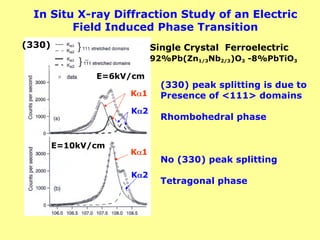
    In Situ X-rayDiffraction Study of an Electric Field Induced Phase Transition Single Crystal Ferroelectric 92%Pb(Zn1/3Nb2/3)O3 -8%PbTiO3 E=6kV/cm E=10kV/cm (330) K1 K2 K1 K2 (330) peak splitting is due to Presence of <111> domains Rhombohedral phase No (330) peak splitting Tetragonal phase
  • 61.
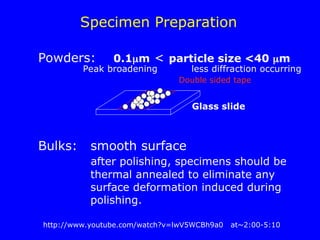
    Specimen Preparation Double sidedtape Glass slide Powders: 0.1m < particle size <40 m Peak broadening less diffraction occurring Bulks: smooth surface after polishing, specimens should be thermal annealed to eliminate any surface deformation induced during polishing. http://www.youtube.com/watch?v=lwV5WCBh9a0 at~2:00-5:10
  • 62.
    a b Next Lecture TransmissionElectron Microscopy Do review problems for XRD

Editor's Notes

  • #2 X-rays were discovered in 1895 by the German physicist Roentgen and were so named because their nature was unknown at the time. Unlike ordinary light, these rays were invisible, but they traveled in straight lines and affected photographic film in the same way as light. On the other hand, they were much more penetrating than light and could easily pass through the human body, wood, quite thick pieces of metal and other “opaque” objects. X-rays are a form of electromagnetic radiation (like light); they are of higher energy, however, and can penetrate the body to form an image on film.
  • #3 h=4.136x10⁻¹⁵ eV sec.
  • #4 http://www.youtube.com/watch?v=lwV5WCBh9a0 at~6:00 how to operate XRD equipment
  • #5 http://www.youtube.com/watch?v=wbbsbE2mQuA How X-ray works The target is always water-cooled to prevent its heating since most of the kinetic energy of the electrons is converted into heat in the target, less than 1 percent being transformed into x-rays. The filament is heated by a filament current of ~3 amp and emits electrons which are rapidly drawn to the target by the high negative voltage between the cathode and anode. A small metal cup maintained at the same negative voltage as the filament repels the electrons and tends to focus them into a narrow region of the target. X-rays are emitted from the focal spot in all directions and escape from the tube through windows in the tube housing. Since the windows must be vacuum tight and yet highly transparent to x-rays, they are usually made of beryllium.
  • #7 Planck constant h=6.63x10⁻³⁴ J.s and speed of light c=3.0x10⁸ m/s Electron charge e=1.6x10⁻¹⁹ C.
  • #9 Since the energy of the emitted x-ray photon is related to the difference in energy between the sharply defined levels of the atom, it is referred as a characteristic x-ray.
  • #12  is dependent on the density,  and thus / is a constant of the materials. Mass absorption is also wavelength dependent.
  • #18 In XRD, X-rays with ~0.5-2Å, is incident on a specimen and is diffracted by crystalline phase in specimen according to Bragg’s Law. The intensity of the diffracted X-ray is measured as a function of the diffraction angle and the specimen orientation. XRD patterns will provide a lot of information about materials structure and properties.
  • #19 http://www.matter.org.uk/diffraction/geometry/superposition_of_waves_exercises.htm For demonstration of constructive and destructive interference of waves.
  • #20 http://www.youtube.com/watch?v=hQUsnMzTdpU When Lambda=0.15nm, path difference between X-rays 1 and 2 equals to nxLambda. Braggs were awarded the Nobel Prize in physics in 1915 for their work in determining Crystal structures beginning with NaCl, ZnS and diamond. Bragg’s law can also be used to explain the interference pattern any beam, e.g., electrons, neutrons, ions and protons with a wavelength similar to the distance between the atomic or molecular structures of interest.
  • #21 What is hkl, basics of crystallography
  • #22 The size and shape of the unit cell can be described by the three vectors, a, b and c. also called the crystallographic axes of the cell. How to define atomic planes?
  • #25 http://en.wikipedia.org/wiki/Miller_index
  • #27 [] square bracket, <> angular bracket, () parenthesis, {} brace
  • #30 Because the value of sin changes very slows with  in the neighborhood of 90o. For this reason, a very accurate value of sin can be obtained from a measurement of  which is itself not particular precise, provided that  is near 90o or diffraction angle 2 is near 180o.
  • #31 In order to describe the intensity of the diffraction peaks of various crystal plane of different unit cells, the Structure Factor is introduced. Table of fj values, as a function of (sin/), for the elements and some ionic states of the elements can be found from references. The summation is over the contents of the unit cell, i.e. the structure factor describes the collective scattering effect of all atoms in a unit cell. F depends on atomic arrangement in a unit cell and orientation of specimen. To calculate F, one has to know the number of atoms present in the unit cell and their locations.
  • #38 e2ni = con(2n) + isin(2n) = 1
  • #41 The smaller FWHM, the better the peak location and phase identification.
  • #43 Measure residual strains or stresses in samples.
  • #48 The focusing circle – X-ray source, sample and detector on same circle, detector moving through 2 theta and sample moving through theta.
  • #50 Intensities are expressed as percentages of I1, the intensity of the strongest line on the pattern. There are about 50,000 JCPDS cards of inorganic materials
  • #51 The Pacific Northwest National Laboratory is developing a range of technologies to broaden the field of explosives detection. Phased contrast X-ray imaging, which uses silicon gratings to detect distortions in the X-ray wave front, may be applicable to mail or luggage scanning for explosives; it can also be used in detecting other contraband, small-parts inspection, or materials characterization. - Uploaded on Feb 9, 2010
  • #57 A pole figure is a graphical representation of the orientation of objects in space. For example, pole figures in the form of stereographic projections are used to represent the orientation distribution of crystallographic lattice planes in crystallography and texture analysis in materials science.
  • #59 Collecting diffraction patterns every few minutes. High temperature reactions can be mapped over hundreds of different temperatures in an overnight run. BaCuO2 start to form at ~950C.
  • #60 O-experimental data and --- fit data