DHANANJAY KUMAR
ROLL NO-1155497
BRANCH-EE 6th. SEM
E-Mail-dhananjay.kumar@outlook.com
What is Electromagnetic Relay?
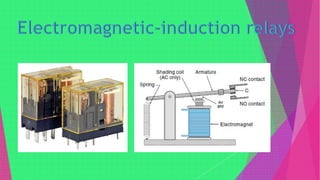
 Electromagnetic relays are those ac relays which
are operated by electromagnetic action.
 It work on the electromagnetic attraction principle or
electro magnetic induction principle
 In Modern electrical protection relays are mainly
micro processor based, but still electromagnetic
relay holds its place. It will take much longer time to
be replaced the all electromagnetic relays by micro
processor based static relays.
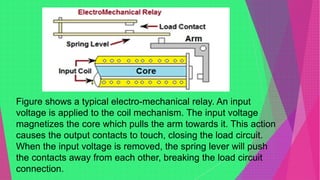
Figure shows a typical electro-mechanical relay. An input
voltage is applied to the coil mechanism. The input voltage
magnetizes the core which pulls the arm towards it. This action
causes the output contacts to touch, closing the load circuit.
When the input voltage is removed, the spring lever will push
the contacts away from each other, breaking the load circuit
connection.
The Principle Behind Electromechanical Relays
A relay is similar to a switch, it is either open or closed.
When the switch is open no current passes through the
relay, the circuit is open, and the load that is connected to
the relay receives no power. When a relay is closed, the
circuit is completed and current passes through the relay
and delivers power to the load.
To open and close a relay an electromagnet is used.
When the coil controlling the electromagnet is given a
voltage, the electromagnet causes the contacts in the relay
to connect and transfer current through the relay.
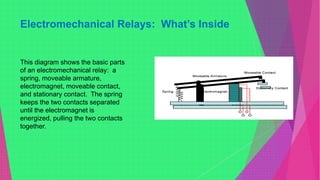
Electromechanical Relays: What’s Inside
This diagram shows the basic parts
of an electromechanical relay: a
spring, moveable armature,
electromagnet, moveable contact,
and stationary contact. The spring
keeps the two contacts separated
until the electromagnet is
energized, pulling the two contacts
together.
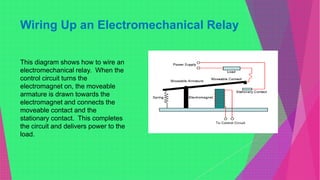
Wiring Up an Electromechanical Relay
This diagram shows how to wire an
electromechanical relay. When the
control circuit turns the
electromagnet on, the moveable
armature is drawn towards the
electromagnet and connects the
moveable contact and the
stationary contact. This completes
the circuit and delivers power to the
load.
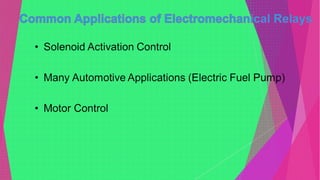
Suppose, there is a need to control a solenoid valve for a water drain application. Control
is to be accomplished with a microcontroller. The solenoid valve requires 120 VAC to
open. Assuming that a 120 VAC power supply is available, how can control of the
solenoid valve be accomplished using a microcontroller that can only supply 5 VDC?
This problem is easily solved using a relay. There are many relays that are turned on
and off with a 5 VDC coil. The relay provides the interface between the microcontroller
and the 120 VAC power supply that is needed to open and close the valve.
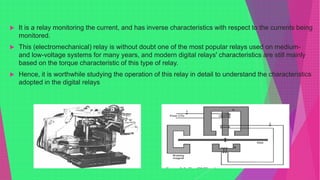
 It is a relay monitoring the current, and has inverse characteristics with respect to the currents being
monitored.
 This (electromechanical) relay is without doubt one of the most popular relays used on medium-
and low-voltage systems for many years, and modern digital relays' characteristics are still mainly
based on the torque characteristic of this type of relay.
 Hence, it is worthwhile studying the operation of this relay in detail to understand the characteristics
adopted in the digital relays
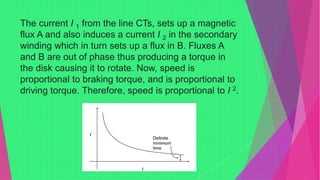
The current I 1 from the line CTs, sets up a magnetic
flux A and also induces a current I 2 in the secondary
winding which in turn sets up a flux in B. Fluxes A
and B are out of phase thus producing a torque in
the disk causing it to rotate. Now, speed is
proportional to braking torque, and is proportional to
driving torque. Therefore, speed is proportional to I 2.
 Contacts can switch AC or DC
 Low initial cost
 Very low contact voltage drop, thus no heat sink is required
 High resistance to voltage transients
 No Off-State leakage current through open contacts
Electromechanical Relay Disadvantages
Short contact life when used for rapid switching
applications or high loads
The contacts wear and thus have limited life
depending on loads
Poor performance when switching high inrush currents
Package Size
Important Specifications of Electromechanical Relays
 Coil Voltage – Voltage required for switching
 Contact Rating – How much current the relay can handle
 Normally Open (NO) or Normally Closed (NC)
Electromechanical relays are an excellent solution to separate
electronic control circuitry and power circuitry.
Electromechanical relays are not the best choice in high
frequency switching applications and do have a limited life due
to wear on the contacts inside the relay. When used in the a
proper application, the electromechanical relay provides safe
and reliable integration between power circuits and control
circuits.

ELECTROMECHENICAL RELAY

  • 1.
    DHANANJAY KUMAR ROLL NO-1155497 BRANCH-EE6th. SEM E-Mail-dhananjay.kumar@outlook.com
  • 2.
    What is ElectromagneticRelay?  Electromagnetic relays are those ac relays which are operated by electromagnetic action.  It work on the electromagnetic attraction principle or electro magnetic induction principle  In Modern electrical protection relays are mainly micro processor based, but still electromagnetic relay holds its place. It will take much longer time to be replaced the all electromagnetic relays by micro processor based static relays.
  • 3.
    Figure shows atypical electro-mechanical relay. An input voltage is applied to the coil mechanism. The input voltage magnetizes the core which pulls the arm towards it. This action causes the output contacts to touch, closing the load circuit. When the input voltage is removed, the spring lever will push the contacts away from each other, breaking the load circuit connection.
  • 6.
    The Principle BehindElectromechanical Relays A relay is similar to a switch, it is either open or closed. When the switch is open no current passes through the relay, the circuit is open, and the load that is connected to the relay receives no power. When a relay is closed, the circuit is completed and current passes through the relay and delivers power to the load. To open and close a relay an electromagnet is used. When the coil controlling the electromagnet is given a voltage, the electromagnet causes the contacts in the relay to connect and transfer current through the relay.
  • 7.
    Electromechanical Relays: What’sInside This diagram shows the basic parts of an electromechanical relay: a spring, moveable armature, electromagnet, moveable contact, and stationary contact. The spring keeps the two contacts separated until the electromagnet is energized, pulling the two contacts together.
  • 8.
    Wiring Up anElectromechanical Relay This diagram shows how to wire an electromechanical relay. When the control circuit turns the electromagnet on, the moveable armature is drawn towards the electromagnet and connects the moveable contact and the stationary contact. This completes the circuit and delivers power to the load.
  • 9.
    Suppose, there isa need to control a solenoid valve for a water drain application. Control is to be accomplished with a microcontroller. The solenoid valve requires 120 VAC to open. Assuming that a 120 VAC power supply is available, how can control of the solenoid valve be accomplished using a microcontroller that can only supply 5 VDC? This problem is easily solved using a relay. There are many relays that are turned on and off with a 5 VDC coil. The relay provides the interface between the microcontroller and the 120 VAC power supply that is needed to open and close the valve.
  • 11.
     It isa relay monitoring the current, and has inverse characteristics with respect to the currents being monitored.  This (electromechanical) relay is without doubt one of the most popular relays used on medium- and low-voltage systems for many years, and modern digital relays' characteristics are still mainly based on the torque characteristic of this type of relay.  Hence, it is worthwhile studying the operation of this relay in detail to understand the characteristics adopted in the digital relays
  • 12.
    The current I1 from the line CTs, sets up a magnetic flux A and also induces a current I 2 in the secondary winding which in turn sets up a flux in B. Fluxes A and B are out of phase thus producing a torque in the disk causing it to rotate. Now, speed is proportional to braking torque, and is proportional to driving torque. Therefore, speed is proportional to I 2.
  • 13.
     Contacts canswitch AC or DC  Low initial cost  Very low contact voltage drop, thus no heat sink is required  High resistance to voltage transients  No Off-State leakage current through open contacts
  • 14.
    Electromechanical Relay Disadvantages Shortcontact life when used for rapid switching applications or high loads The contacts wear and thus have limited life depending on loads Poor performance when switching high inrush currents Package Size
  • 15.
    Important Specifications ofElectromechanical Relays  Coil Voltage – Voltage required for switching  Contact Rating – How much current the relay can handle  Normally Open (NO) or Normally Closed (NC)
  • 16.
    Electromechanical relays arean excellent solution to separate electronic control circuitry and power circuitry. Electromechanical relays are not the best choice in high frequency switching applications and do have a limited life due to wear on the contacts inside the relay. When used in the a proper application, the electromechanical relay provides safe and reliable integration between power circuits and control circuits.