FRONT OFFICE
NAME:- PREMKUMAR BINDE RAM
BRANCH:- ELECTRICAL
COLLEGE:- DEVI MAHALAXMI
POLYTECHNIC
YEAR:- 2ND
3G
ROLL NO:- 25
CLASS H.O.D. PRINCIPAL
TEACHER
Electrical wiring
"Wiring" redirects here. For the software development platform, see Wiring (development
platform).
This article is about building wiring. For power distribution, see Electric power
transmission and Electric power distribution.
Building wiring is the electrical wiring and associated devices such as switches, meters and
light fittings used in buildings or other structures. Electrical wiring uses insulated conductors.
Wires and cables are rated by the circuit voltage, temperature and environmental conditions
(moisture, sunlight, oil, chemicals) in which they can be used, and their maximum current. Wiring
safety codes vary by country, and the International Electrotechnical Commission (IEC) is
attempting to standardise wiring amongst member countries. Colour codes are used to
distinguish line, neutral and earth (ground) wires.
Wiring safety codes.
Wiring safety codes are intended to protect people and property from electrical shock and fire
hazards. Regulations may be established by city, county, provincial/state or national legislation,
usually by adopting a model code (with or without local amendments) produced by a technical
standards-setting organisation, or by a national standard electrical code.
First Electrical codes arose in the 1880s with the commercial introduction of electrical power.
Many conflicting standards existed for the selection of wire sizes and other design rules for
electrical installations.
The first electrical codes in the United States originated in New York in 1881 to regulate
installations of electric lighting. Since 1897 the USNational Fire Protection Association, a private
non-profit association formed by insurance companies, has published the National Electrical
Code (NEC). States, counties or cities often include the NEC in their local building codes by
reference along with local differences. The NEC is modified every three years. It is a consensus
code considering suggestions from interested parties. The proposals are studied by committees
of engineers, tradesmen, manufacturer representatives, fire fighters and other invitees.
Since 1927, the Canadian Standards Association (CSA) has produced the Canadian Safety
Standard for Electrical Installations, which is the basis for provincial electrical codes. The CSA
also produces the Canadian Electrical Code, the 2006 edition of which references IEC
60364 (Electrical Installations for Buildings) and states that the code addresses the fundamental
principles of electrical protection in Section 131. The Canadian code reprints Chapter 13 of IEC
60364, but there are no numerical criteria listed in that chapter to assess the adequacy of any
electrical installation.
Although the US and Canadian national standards deal with the same physical phenomena and
broadly similar objectives, they differ occasionally in technical detail. As part of theNorth
American Free Trade Agreement (NAFTA) program, US and Canadian standards are slowly
converging toward each other, in a process known as harmonisation.
In Germany, DKE (the German Commission for Electrical, Electronic and Information
Technologies of DIN and VDE) is the organisation responsible for the promulgation of electrical
standards and safety specifications. DIN VDE 0100 is the German wiring regulations document
harmonised with IEC 60364.
In the United Kingdom, wiring installations are regulated by the Institution of Engineering and
Technology Requirements for Electrical Installations: IEE Wiring Regulations, BS 7671:
2008, which are harmonised with IEC 60364. The 17th edition (issued in January 2008) includes
new sections for microgeneration and solar photovoltaic systems. The first edition was published
in 1882.
In Australia and New Zealand, the AS/NZS 3000 standard, commonly known as the "wiring
rules", specifies requirements for the selection and installation of electrical equipment, and the
design and testing of such installations. The standard is mandatory in both New Zealand and
Australia; therefore, all electrical work covered by the standard must comply.
In European countries, an attempt has been made to harmonise national wiring standards in
an IEC standard, IEC 60364 Electrical Installations for Buildings. Hence national standards follow
an identical system of sections and chapters. However, this standard is not written in such
language that it can readily be adopted as a national wiring code. Neither is it designed for field
use by electrical tradesmen and inspectors for testing compliance with national wiring standards.
By contrast, national codes, such as the NEC or CSA C22.1, generally exemplify the common
objectives of IEC 60364, but provide specific rules in a form that allows for guidance of those
installing and inspecting electrical systems.
The international standard wire sizes are given in the IEC 60228 standard of the International
Electrotechnical Commission. In North America, the American Wire Gauge standard for wire
sizes is used.
Colour code.
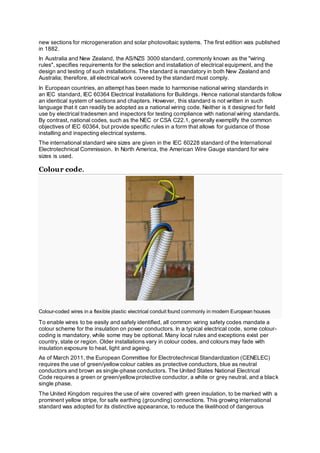
Colour-coded wires in a flexible plastic electrical conduit found commonly in modern European houses
To enable wires to be easily and safely identified, all common wiring safety codes mandate a
colour scheme for the insulation on power conductors. In a typical electrical code, some colour-
coding is mandatory, while some may be optional. Many local rules and exceptions exist per
country, state or region. Older installations vary in colour codes, and colours may fade with
insulation exposure to heat, light and ageing.
As of March 2011, the European Committee for Electrotechnical Standardization (CENELEC)
requires the use of green/yellowcolour cables as protective conductors, blue as neutral
conductors and brown as single-phase conductors. The United States National Electrical
Code requires a green or green/yellowprotective conductor, a white or grey neutral, and a black
single phase.
The United Kingdom requires the use of wire covered with green insulation, to be marked with a
prominent yellow stripe, for safe earthing (grounding) connections. This growing international
standard was adopted for its distinctive appearance, to reduce the likelihood of dangerous
confusion of safety earthing (grounding) wires with other electrical functions, especially by
persons affected by red-green colour blindness.
In the UK, phases could be identified as being live by using coloured indicator lights: red, yellow
and blue. The new cable colours of brown, black and grey do not lend themselves to coloured
indicators. For this reason, three-phase control panels will often use indicator lights of the old
colours.
Other historical wiring methods.
Other methods of securing wiring that are now obsolete include:
 Re-use of existing gas pipes when converting gas light installations to electric lighting.
Insulated conductors were pulled through the pipes that had formerly supplied the gas
lamps. Although used occasionally, this method risked insulation damage from sharp edges
inside the pipe at each joint.
 Wood mouldings with grooves cut for single conductor wires, covered by a wooden cap strip.
These were prohibited in North American electrical codes by 1928. Wooden moulding was
also used to some degree in England, but was never permitted by German and Austrian
rules.
 A system of flexible twin cords supported by glass or porcelain buttons was used near the
turn of the 20th century in Europe, but was soon replaced by other methods.
 During the first years of the 20th century, various patented forms of wiring system such as
Bergman and Peschel tubing were used to protect wiring; these used very thin fiber tubes, or
metal tubes which were also used as return conductors.
Standard wire insulation colours
Flexible cable (e.g., extension, power, and lamp cords)
Region or
country
Phases Neutral
Protective
earth/ground
Argentina,
Australia,
European Union,
South Africa
(IEC 60446)
Australia, New
Zealand (AS/NZS
3000:2007 3.8.3)
,
,
Brazil
,
United States,
Canada metallic brass metallic silver
, ;
, green/yellow
striped
Fixed cable (e.g., in-, on-, or behind-the-wall cables)
Region or
country
Phases Neutral
Protective
earth/ground
Argentina; China;
European Union
(IEC 60446) from
April 2004; the
United Kingdom
from 31 March
2004 (BS 7671);
Hong Kong from
July 2007;
Singapore from
March 2009;
Russia since 2009
(GOST R 50462);
Ukraine, Belarus,
Kazakhstan
,
,
[b]
India, Pakistan;
United Kingdom,
prior to 31 March
2004 (BS 7671);
Hong Kong, prior
to 2009; Malaysia
and Singapore,
prior to February
2011
,
,
 [b]

(previously)
 no
insulation (previously)
Australia, New
Zealand (AS/NZS
3000:2007 3.8.1,
table 3.4)
 ,
,[c]
,
, prohibited; any
other color permitted
 ,
recommended for single phase
 ,
, recommended for
multiphase
,[c]
(since
about 1980 - Stranded
Wire)
(since
about 1966 - Stranded
Wire)
Stranded
Wire - no insulation;
sleeved at the ends
(previously)[d]
Brazil
,
, ,
South Africa
 , ; or
 ,
[b]
United States[e]
,
, for 120, 208, or
240 V
for
120, 208, or
240 V
no
insulation
,
, for 277, or 480 V
metallic brass
for
277, or 480 V
metallic silver
required
for isolated systems
Canada[6][e]
, for
single-phase systems
,
, for three-phase
systems
,
,
no
insulation
, for
isolated single-phase systems
,
, for isolated three-
phase systems
, for
isolated systems
Boxes (e.g., translucent purple) denote markings on wiring terminals.
1. Jump up^ The colours in this table represent the most common and preferred standard colours for w iring;
how ever others may be in use, especially in older installations.
2. ^ Jump up to:a b c
Cables may have an uninsulated PE w hich is sleeved w ith the appropriate identifying
colours at both ends, especially in the UK.
3. ^ Jump up to:a b
Australian and New Zealand w iring standards allow both European and Australian colour
codes. Australian-standard phase colours conflict w ith IEC 60446 colours, w here IEC-60446
supported neutral colour (blue) is an allow ed phase colour in the Australia/New Zealand standard. Care
must be taken w hen determining system used in existing w iring.
4. Jump up^ The protective earth conductor is now separately insulated throughout all cables.
5. ^ Jump up to:a b
Canadian and American w iring practices are very similar, w ith ongoing harmonisation
efforts.
Metal-sheathed wires.
Lead cased electrical wire from a circa 1912 house in Southern England. Two conductors are sheathed in
red and black rubber, the central earth wire is bare. These wires are dangerous because the sheath is
prone to split if repeatedly flexed.
In the United Kingdom, an early form of insulated cable, introduced in 1896, consisted of two
impregnated-paper-insulated conductors in an overall lead sheath. Joints were soldered, and
special fittings were used for lamp holders and switches. These cables were similar to
underground telegraph and telephone cables of the time. Paper-insulated cables proved
unsuitable for interior wiring installations because very careful workmanship was required on the
lead sheaths to ensure moisture did not affect the insulation.
Cables.
Wiring for extremely wet conditions
Armoured cables with two rubber-insulated conductors in a flexible metal sheath were used as
early as 1906, and were considered at the time a better method than open knob-and-tube wiring,
although much more expensive.
The first rubber-insulated cables for building wiring were introduced in 1922 with US patent
1458803, Burley, Harry & Rooney, Henry, "Insulated electric wire", issued 1923-06-12, assigned
to Boston Insulated Wire And Cable.[citation needed]
These were two or more solid copper electrical
wires with rubber insulation, plus woven cotton cloth over each conductor for protection of the
insulation, with an overall woven jacket, usually impregnated with tar as a protection from
moisture. Waxed paper was used as a filler and separator.
Over time, rubber-insulated cables become brittle because of exposure to atmospheric oxygen,
so they must be handled with care and are usually replaced during renovations. When switches,
socket outlets or light fixtures are replaced, the mere act of tightening connections may cause
hardened insulation to flake off the conductors. Rubber insulation further inside the cable often is
in better condition than the insulation exposed at connections, due to reduced exposure to
oxygen.
The sulphur in vulcanised rubber insulation attacked bare copper wire so the conductors were
tinned to prevent this. The conductors reverted to being bare when rubber ceased to be used.
Diagram of a simple electrical cable with three insulated conductors
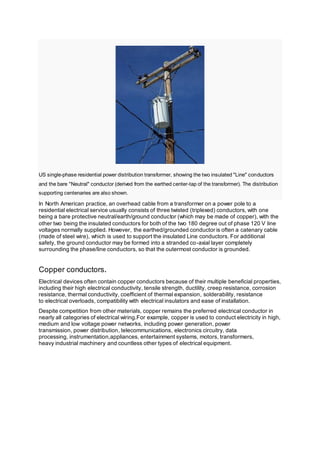
US single-phase residential power distribution transformer, showing the two insulated "Line" conductors
and the bare "Neutral" conductor (derived from the earthed center-tap of the transformer). The distribution
supporting centenaries are also shown.
In North American practice, an overhead cable from a transformer on a power pole to a
residential electrical service usually consists of three twisted (triplexed) conductors, with one
being a bare protective neutral/earth/ground conductor (which may be made of copper), with the
other two being the insulated conductors for both of the two 180 degree out of phase 120 V line
voltages normally supplied. However, the earthed/grounded conductor is often a catenary cable
(made of steel wire), which is used to support the insulated Line conductors. For additional
safety, the ground conductor may be formed into a stranded co-axial layer completely
surrounding the phase/line conductors, so that the outermost conductor is grounded.
Copper conductors.
Electrical devices often contain copper conductors because of their multiple beneficial properties,
including their high electrical conductivity, tensile strength, ductility, creep resistance, corrosion
resistance, thermal conductivity, coefficient of thermal expansion, solderability, resistance
to electrical overloads, compatibility with electrical insulators and ease of installation.
Despite competition from other materials, copper remains the preferred electrical conductor in
nearly all categories of electrical wiring.For example, copper is used to conduct electricity in high,
medium and low voltage power networks, including power generation, power
transmission, power distribution, telecommunications, electronics circuitry, data
processing, instrumentation,appliances, entertainment systems, motors, transformers,
heavy industrial machinery and countless other types of electrical equipment.
Aluminium conductors.
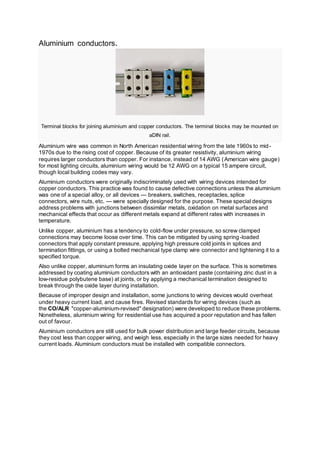
Terminal blocks for joining aluminium and copper conductors. The terminal blocks may be mounted on
aDIN rail.
Aluminium wire was common in North American residential wiring from the late 1960s to mid-
1970s due to the rising cost of copper. Because of its greater resistivity, aluminium wiring
requires larger conductors than copper. For instance, instead of 14 AWG (American wire gauge)
for most lighting circuits, aluminium wiring would be 12 AWG on a typical 15 ampere circuit,
though local building codes may vary.
Aluminium conductors were originally indiscriminately used with wiring devices intended for
copper conductors. This practice was found to cause defective connections unless the aluminium
was one of a special alloy, or all devices — breakers, switches, receptacles, splice
connectors, wire nuts, etc. — were specially designed for the purpose. These special designs
address problems with junctions between dissimilar metals, oxidation on metal surfaces and
mechanical effects that occur as different metals expand at different rates with increases in
temperature.
Unlike copper, aluminium has a tendency to cold-flow under pressure, so screw clamped
connections may become loose over time. This can be mitigated by using spring-loaded
connectors that apply constant pressure, applying high pressure cold joints in splices and
termination fittings, or using a bolted mechanical type clamp wire connector and tightening it to a
specified torque.
Also unlike copper, aluminium forms an insulating oxide layer on the surface. This is sometimes
addressed by coating aluminium conductors with an antioxidant paste (containing zinc dust in a
low-residue polybutene base) at joints, or by applying a mechanical termination designed to
break through the oxide layer during installation.
Because of improper design and installation, some junctions to wiring devices would overheat
under heavy current load, and cause fires. Revised standards for wiring devices (such as
the CO/ALR "copper-aluminium-revised" designation) were developed to reduce these problems.
Nonetheless, aluminium wiring for residential use has acquired a poor reputation and has fallen
out of favour.
Aluminium conductors are still used for bulk power distribution and large feeder circuits, because
they cost less than copper wiring, and weigh less, especially in the large sizes needed for heavy
current loads. Aluminium conductors must be installed with compatible connectors.
Bus bars, bus duct, cable bus.
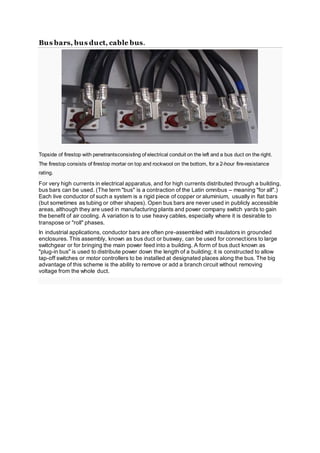
Topside of firestop with penetrantsconsisting of electrical conduit on the left and a bus duct on the right.
The firestop consists of firestop mortar on top and rockwool on the bottom, for a 2-hour fire-resistance
rating.
For very high currents in electrical apparatus, and for high currents distributed through a building,
bus bars can be used. (The term "bus" is a contraction of the Latin omnibus – meaning "for all".)
Each live conductor of such a system is a rigid piece of copper or aluminium, usually in flat bars
(but sometimes as tubing or other shapes). Open bus bars are never used in publicly accessible
areas, although they are used in manufacturing plants and power company switch yards to gain
the benefit of air cooling. A variation is to use heavy cables, especially where it is desirable to
transpose or "roll" phases.
In industrial applications, conductor bars are often pre-assembled with insulators in grounded
enclosures. This assembly, known as bus duct or busway, can be used for connections to large
switchgear or for bringing the main power feed into a building. A form of bus duct known as
"plug-in bus" is used to distribute power down the length of a building; it is constructed to allow
tap-off switches or motor controllers to be installed at designated places along the bus. The big
advantage of this scheme is the ability to remove or add a branch circuit without removing
voltage from the whole duct.

Electrical wiring

  • 1.
  • 2.
    NAME:- PREMKUMAR BINDERAM BRANCH:- ELECTRICAL COLLEGE:- DEVI MAHALAXMI POLYTECHNIC YEAR:- 2ND 3G ROLL NO:- 25 CLASS H.O.D. PRINCIPAL TEACHER
  • 3.
    Electrical wiring "Wiring" redirectshere. For the software development platform, see Wiring (development platform). This article is about building wiring. For power distribution, see Electric power transmission and Electric power distribution. Building wiring is the electrical wiring and associated devices such as switches, meters and light fittings used in buildings or other structures. Electrical wiring uses insulated conductors. Wires and cables are rated by the circuit voltage, temperature and environmental conditions (moisture, sunlight, oil, chemicals) in which they can be used, and their maximum current. Wiring safety codes vary by country, and the International Electrotechnical Commission (IEC) is attempting to standardise wiring amongst member countries. Colour codes are used to distinguish line, neutral and earth (ground) wires. Wiring safety codes. Wiring safety codes are intended to protect people and property from electrical shock and fire hazards. Regulations may be established by city, county, provincial/state or national legislation, usually by adopting a model code (with or without local amendments) produced by a technical standards-setting organisation, or by a national standard electrical code. First Electrical codes arose in the 1880s with the commercial introduction of electrical power. Many conflicting standards existed for the selection of wire sizes and other design rules for electrical installations. The first electrical codes in the United States originated in New York in 1881 to regulate installations of electric lighting. Since 1897 the USNational Fire Protection Association, a private non-profit association formed by insurance companies, has published the National Electrical Code (NEC). States, counties or cities often include the NEC in their local building codes by reference along with local differences. The NEC is modified every three years. It is a consensus code considering suggestions from interested parties. The proposals are studied by committees of engineers, tradesmen, manufacturer representatives, fire fighters and other invitees. Since 1927, the Canadian Standards Association (CSA) has produced the Canadian Safety Standard for Electrical Installations, which is the basis for provincial electrical codes. The CSA also produces the Canadian Electrical Code, the 2006 edition of which references IEC 60364 (Electrical Installations for Buildings) and states that the code addresses the fundamental principles of electrical protection in Section 131. The Canadian code reprints Chapter 13 of IEC 60364, but there are no numerical criteria listed in that chapter to assess the adequacy of any electrical installation. Although the US and Canadian national standards deal with the same physical phenomena and broadly similar objectives, they differ occasionally in technical detail. As part of theNorth American Free Trade Agreement (NAFTA) program, US and Canadian standards are slowly converging toward each other, in a process known as harmonisation. In Germany, DKE (the German Commission for Electrical, Electronic and Information Technologies of DIN and VDE) is the organisation responsible for the promulgation of electrical standards and safety specifications. DIN VDE 0100 is the German wiring regulations document harmonised with IEC 60364. In the United Kingdom, wiring installations are regulated by the Institution of Engineering and Technology Requirements for Electrical Installations: IEE Wiring Regulations, BS 7671: 2008, which are harmonised with IEC 60364. The 17th edition (issued in January 2008) includes
  • 4.
    new sections formicrogeneration and solar photovoltaic systems. The first edition was published in 1882. In Australia and New Zealand, the AS/NZS 3000 standard, commonly known as the "wiring rules", specifies requirements for the selection and installation of electrical equipment, and the design and testing of such installations. The standard is mandatory in both New Zealand and Australia; therefore, all electrical work covered by the standard must comply. In European countries, an attempt has been made to harmonise national wiring standards in an IEC standard, IEC 60364 Electrical Installations for Buildings. Hence national standards follow an identical system of sections and chapters. However, this standard is not written in such language that it can readily be adopted as a national wiring code. Neither is it designed for field use by electrical tradesmen and inspectors for testing compliance with national wiring standards. By contrast, national codes, such as the NEC or CSA C22.1, generally exemplify the common objectives of IEC 60364, but provide specific rules in a form that allows for guidance of those installing and inspecting electrical systems. The international standard wire sizes are given in the IEC 60228 standard of the International Electrotechnical Commission. In North America, the American Wire Gauge standard for wire sizes is used. Colour code. Colour-coded wires in a flexible plastic electrical conduit found commonly in modern European houses To enable wires to be easily and safely identified, all common wiring safety codes mandate a colour scheme for the insulation on power conductors. In a typical electrical code, some colour- coding is mandatory, while some may be optional. Many local rules and exceptions exist per country, state or region. Older installations vary in colour codes, and colours may fade with insulation exposure to heat, light and ageing. As of March 2011, the European Committee for Electrotechnical Standardization (CENELEC) requires the use of green/yellowcolour cables as protective conductors, blue as neutral conductors and brown as single-phase conductors. The United States National Electrical Code requires a green or green/yellowprotective conductor, a white or grey neutral, and a black single phase. The United Kingdom requires the use of wire covered with green insulation, to be marked with a prominent yellow stripe, for safe earthing (grounding) connections. This growing international standard was adopted for its distinctive appearance, to reduce the likelihood of dangerous
  • 5.
    confusion of safetyearthing (grounding) wires with other electrical functions, especially by persons affected by red-green colour blindness. In the UK, phases could be identified as being live by using coloured indicator lights: red, yellow and blue. The new cable colours of brown, black and grey do not lend themselves to coloured indicators. For this reason, three-phase control panels will often use indicator lights of the old colours. Other historical wiring methods. Other methods of securing wiring that are now obsolete include:  Re-use of existing gas pipes when converting gas light installations to electric lighting. Insulated conductors were pulled through the pipes that had formerly supplied the gas lamps. Although used occasionally, this method risked insulation damage from sharp edges inside the pipe at each joint.  Wood mouldings with grooves cut for single conductor wires, covered by a wooden cap strip. These were prohibited in North American electrical codes by 1928. Wooden moulding was also used to some degree in England, but was never permitted by German and Austrian rules.  A system of flexible twin cords supported by glass or porcelain buttons was used near the turn of the 20th century in Europe, but was soon replaced by other methods.  During the first years of the 20th century, various patented forms of wiring system such as Bergman and Peschel tubing were used to protect wiring; these used very thin fiber tubes, or metal tubes which were also used as return conductors. Standard wire insulation colours Flexible cable (e.g., extension, power, and lamp cords) Region or country Phases Neutral Protective earth/ground Argentina, Australia, European Union, South Africa (IEC 60446) Australia, New Zealand (AS/NZS 3000:2007 3.8.3) , , Brazil , United States, Canada metallic brass metallic silver , ; , green/yellow striped
  • 6.
    Fixed cable (e.g.,in-, on-, or behind-the-wall cables) Region or country Phases Neutral Protective earth/ground Argentina; China; European Union (IEC 60446) from April 2004; the United Kingdom from 31 March 2004 (BS 7671); Hong Kong from July 2007; Singapore from March 2009; Russia since 2009 (GOST R 50462); Ukraine, Belarus, Kazakhstan , , [b] India, Pakistan; United Kingdom, prior to 31 March 2004 (BS 7671); Hong Kong, prior to 2009; Malaysia and Singapore, prior to February 2011 , ,  [b]  (previously)  no insulation (previously) Australia, New Zealand (AS/NZS 3000:2007 3.8.1, table 3.4)  , ,[c] , , prohibited; any other color permitted  , recommended for single phase  , , recommended for multiphase ,[c] (since about 1980 - Stranded Wire) (since about 1966 - Stranded Wire) Stranded Wire - no insulation; sleeved at the ends (previously)[d] Brazil , , , South Africa  , ; or  , [b] United States[e] , , for 120, 208, or 240 V for 120, 208, or 240 V no insulation
  • 7.
    , , for 277,or 480 V metallic brass for 277, or 480 V metallic silver required for isolated systems Canada[6][e] , for single-phase systems , , for three-phase systems , , no insulation , for isolated single-phase systems , , for isolated three- phase systems , for isolated systems Boxes (e.g., translucent purple) denote markings on wiring terminals. 1. Jump up^ The colours in this table represent the most common and preferred standard colours for w iring; how ever others may be in use, especially in older installations. 2. ^ Jump up to:a b c Cables may have an uninsulated PE w hich is sleeved w ith the appropriate identifying colours at both ends, especially in the UK. 3. ^ Jump up to:a b Australian and New Zealand w iring standards allow both European and Australian colour codes. Australian-standard phase colours conflict w ith IEC 60446 colours, w here IEC-60446 supported neutral colour (blue) is an allow ed phase colour in the Australia/New Zealand standard. Care must be taken w hen determining system used in existing w iring. 4. Jump up^ The protective earth conductor is now separately insulated throughout all cables. 5. ^ Jump up to:a b Canadian and American w iring practices are very similar, w ith ongoing harmonisation efforts. Metal-sheathed wires. Lead cased electrical wire from a circa 1912 house in Southern England. Two conductors are sheathed in red and black rubber, the central earth wire is bare. These wires are dangerous because the sheath is prone to split if repeatedly flexed.
  • 8.
    In the UnitedKingdom, an early form of insulated cable, introduced in 1896, consisted of two impregnated-paper-insulated conductors in an overall lead sheath. Joints were soldered, and special fittings were used for lamp holders and switches. These cables were similar to underground telegraph and telephone cables of the time. Paper-insulated cables proved unsuitable for interior wiring installations because very careful workmanship was required on the lead sheaths to ensure moisture did not affect the insulation. Cables. Wiring for extremely wet conditions Armoured cables with two rubber-insulated conductors in a flexible metal sheath were used as early as 1906, and were considered at the time a better method than open knob-and-tube wiring, although much more expensive. The first rubber-insulated cables for building wiring were introduced in 1922 with US patent 1458803, Burley, Harry & Rooney, Henry, "Insulated electric wire", issued 1923-06-12, assigned to Boston Insulated Wire And Cable.[citation needed] These were two or more solid copper electrical wires with rubber insulation, plus woven cotton cloth over each conductor for protection of the insulation, with an overall woven jacket, usually impregnated with tar as a protection from moisture. Waxed paper was used as a filler and separator. Over time, rubber-insulated cables become brittle because of exposure to atmospheric oxygen, so they must be handled with care and are usually replaced during renovations. When switches, socket outlets or light fixtures are replaced, the mere act of tightening connections may cause hardened insulation to flake off the conductors. Rubber insulation further inside the cable often is in better condition than the insulation exposed at connections, due to reduced exposure to oxygen. The sulphur in vulcanised rubber insulation attacked bare copper wire so the conductors were tinned to prevent this. The conductors reverted to being bare when rubber ceased to be used. Diagram of a simple electrical cable with three insulated conductors
  • 9.
    US single-phase residentialpower distribution transformer, showing the two insulated "Line" conductors and the bare "Neutral" conductor (derived from the earthed center-tap of the transformer). The distribution supporting centenaries are also shown. In North American practice, an overhead cable from a transformer on a power pole to a residential electrical service usually consists of three twisted (triplexed) conductors, with one being a bare protective neutral/earth/ground conductor (which may be made of copper), with the other two being the insulated conductors for both of the two 180 degree out of phase 120 V line voltages normally supplied. However, the earthed/grounded conductor is often a catenary cable (made of steel wire), which is used to support the insulated Line conductors. For additional safety, the ground conductor may be formed into a stranded co-axial layer completely surrounding the phase/line conductors, so that the outermost conductor is grounded. Copper conductors. Electrical devices often contain copper conductors because of their multiple beneficial properties, including their high electrical conductivity, tensile strength, ductility, creep resistance, corrosion resistance, thermal conductivity, coefficient of thermal expansion, solderability, resistance to electrical overloads, compatibility with electrical insulators and ease of installation. Despite competition from other materials, copper remains the preferred electrical conductor in nearly all categories of electrical wiring.For example, copper is used to conduct electricity in high, medium and low voltage power networks, including power generation, power transmission, power distribution, telecommunications, electronics circuitry, data processing, instrumentation,appliances, entertainment systems, motors, transformers, heavy industrial machinery and countless other types of electrical equipment.
  • 10.
    Aluminium conductors. Terminal blocksfor joining aluminium and copper conductors. The terminal blocks may be mounted on aDIN rail. Aluminium wire was common in North American residential wiring from the late 1960s to mid- 1970s due to the rising cost of copper. Because of its greater resistivity, aluminium wiring requires larger conductors than copper. For instance, instead of 14 AWG (American wire gauge) for most lighting circuits, aluminium wiring would be 12 AWG on a typical 15 ampere circuit, though local building codes may vary. Aluminium conductors were originally indiscriminately used with wiring devices intended for copper conductors. This practice was found to cause defective connections unless the aluminium was one of a special alloy, or all devices — breakers, switches, receptacles, splice connectors, wire nuts, etc. — were specially designed for the purpose. These special designs address problems with junctions between dissimilar metals, oxidation on metal surfaces and mechanical effects that occur as different metals expand at different rates with increases in temperature. Unlike copper, aluminium has a tendency to cold-flow under pressure, so screw clamped connections may become loose over time. This can be mitigated by using spring-loaded connectors that apply constant pressure, applying high pressure cold joints in splices and termination fittings, or using a bolted mechanical type clamp wire connector and tightening it to a specified torque. Also unlike copper, aluminium forms an insulating oxide layer on the surface. This is sometimes addressed by coating aluminium conductors with an antioxidant paste (containing zinc dust in a low-residue polybutene base) at joints, or by applying a mechanical termination designed to break through the oxide layer during installation. Because of improper design and installation, some junctions to wiring devices would overheat under heavy current load, and cause fires. Revised standards for wiring devices (such as the CO/ALR "copper-aluminium-revised" designation) were developed to reduce these problems. Nonetheless, aluminium wiring for residential use has acquired a poor reputation and has fallen out of favour. Aluminium conductors are still used for bulk power distribution and large feeder circuits, because they cost less than copper wiring, and weigh less, especially in the large sizes needed for heavy current loads. Aluminium conductors must be installed with compatible connectors.
  • 11.
    Bus bars, busduct, cable bus. Topside of firestop with penetrantsconsisting of electrical conduit on the left and a bus duct on the right. The firestop consists of firestop mortar on top and rockwool on the bottom, for a 2-hour fire-resistance rating. For very high currents in electrical apparatus, and for high currents distributed through a building, bus bars can be used. (The term "bus" is a contraction of the Latin omnibus – meaning "for all".) Each live conductor of such a system is a rigid piece of copper or aluminium, usually in flat bars (but sometimes as tubing or other shapes). Open bus bars are never used in publicly accessible areas, although they are used in manufacturing plants and power company switch yards to gain the benefit of air cooling. A variation is to use heavy cables, especially where it is desirable to transpose or "roll" phases. In industrial applications, conductor bars are often pre-assembled with insulators in grounded enclosures. This assembly, known as bus duct or busway, can be used for connections to large switchgear or for bringing the main power feed into a building. A form of bus duct known as "plug-in bus" is used to distribute power down the length of a building; it is constructed to allow tap-off switches or motor controllers to be installed at designated places along the bus. The big advantage of this scheme is the ability to remove or add a branch circuit without removing voltage from the whole duct.