Electrical EngineeringTeam #6 Project: 0Team Leader: John SullivanTeam Members: ShaMaula, Karl Laguerre, Chris Pyman
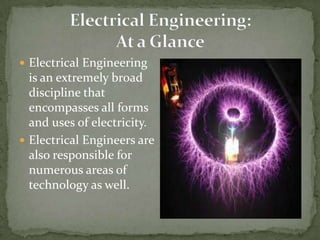
Electrical Engineering:At a GlanceElectrical Engineering is an extremely broad discipline that encompasses all forms and uses of electricity. Electrical Engineers are also responsible for numerous areas of technology as well.
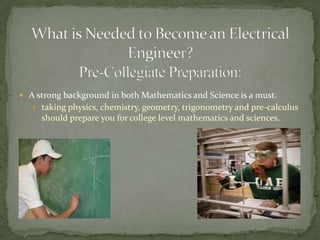
What is Needed to Become an Electrical Engineer?Pre-Collegiate Preparation:A strong background in both Mathematics and Science is a must.taking physics, chemistry, geometry, trigonometry and pre-calculus should prepare you for college level mathematics and sciences.    
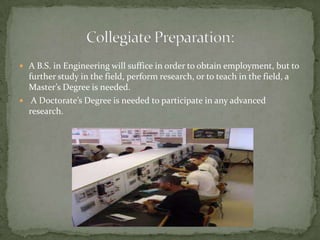
Collegiate Preparation:A B.S. in Engineering will suffice in order to obtain employment, but to further study in the field, perform research, or to teach in the field, a Master’s Degree is needed. A Doctorate’s Degree is needed to participate in any advanced research.
BS from Accreditation Board for Engineering and Technology (ABET) or other accredited 4-year institution in an engineering curriculumCertification as an "engineer-in-training" as a result of an 8-hour NCEES fundamentals of engineering examination4 years of experience under the direction of a licensed professional engineerThen, you may apply to sit for the examination in the state you plan to practice inProfessional Certification (US)
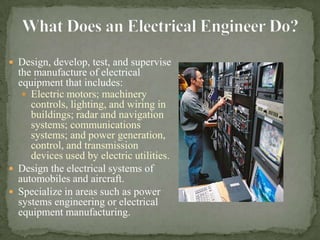
What Does an Electrical Engineer Do?Design, develop, test, and supervise the manufacture of electrical equipment that includes:Electric motors; machinery controls, lighting, and wiring in buildings; radar and navigation systems; communications systems; and power generation, control, and transmission devices used by electric utilities. Design the electrical systems of automobiles and aircraft. Specialize in areas such as power systems engineering or electrical equipment manufacturing.
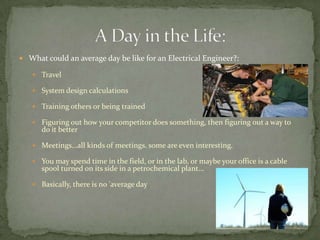
What could an average day be like for an Electrical Engineer?:TravelSystem design calculationsTraining others or being trainedFiguring out how your competitor does something, then figuring out a way to do it betterMeetings...all kinds of meetings. some are even interesting.You may spend time in the field, or in the lab, or maybe your office is a cable spool turned on its side in a petrochemical plant...Basically, there is no 'average dayA Day in the Life:
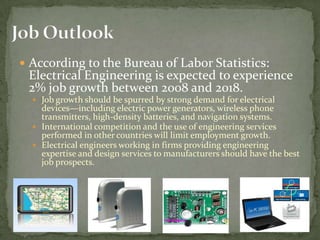
Job OutlookAccording to the Bureau of Labor Statistics: Electrical Engineering is expected to experience 2% job growth between 2008 and 2018.Job growth should be spurred by strong demand for electrical devices—including electric power generators, wireless phone transmitters, high-density batteries, and navigation systems.International competition and the use of engineering services performed in other countries will limit employment growth.Electrical engineers working in firms providing engineering expertise and design services to manufacturers should have the best job prospects.
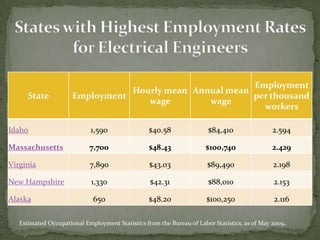
States with Highest Employment Rates for Electrical EngineersEstimated Occupational Employment Statistics from the Bureau of Labor Statistics, as of May 2009.
http://www.bls.gov/oes/current/oes172071.htmhttp://www.careercornerstone.org/pdf/ee/eleceng.pdf http://www.ieeeusa.org/careers/yourcareer.htmlhttp://www.princetonreview.com/Careers.aspx?cid=58http://www.nh.gov/jtboard/pereq.htmSources:

Electrical Engineering

  • 1.
    Electrical EngineeringTeam #6Project: 0Team Leader: John SullivanTeam Members: ShaMaula, Karl Laguerre, Chris Pyman
  • 2.
    Electrical Engineering:At aGlanceElectrical Engineering is an extremely broad discipline that encompasses all forms and uses of electricity. Electrical Engineers are also responsible for numerous areas of technology as well.
  • 3.
    What is Neededto Become an Electrical Engineer?Pre-Collegiate Preparation:A strong background in both Mathematics and Science is a must.taking physics, chemistry, geometry, trigonometry and pre-calculus should prepare you for college level mathematics and sciences.    
  • 4.
    Collegiate Preparation:A B.S.in Engineering will suffice in order to obtain employment, but to further study in the field, perform research, or to teach in the field, a Master’s Degree is needed. A Doctorate’s Degree is needed to participate in any advanced research.
  • 5.
    BS from AccreditationBoard for Engineering and Technology (ABET) or other accredited 4-year institution in an engineering curriculumCertification as an "engineer-in-training" as a result of an 8-hour NCEES fundamentals of engineering examination4 years of experience under the direction of a licensed professional engineerThen, you may apply to sit for the examination in the state you plan to practice inProfessional Certification (US)
  • 6.
    What Does anElectrical Engineer Do?Design, develop, test, and supervise the manufacture of electrical equipment that includes:Electric motors; machinery controls, lighting, and wiring in buildings; radar and navigation systems; communications systems; and power generation, control, and transmission devices used by electric utilities. Design the electrical systems of automobiles and aircraft. Specialize in areas such as power systems engineering or electrical equipment manufacturing.
  • 7.
    What could anaverage day be like for an Electrical Engineer?:TravelSystem design calculationsTraining others or being trainedFiguring out how your competitor does something, then figuring out a way to do it betterMeetings...all kinds of meetings. some are even interesting.You may spend time in the field, or in the lab, or maybe your office is a cable spool turned on its side in a petrochemical plant...Basically, there is no 'average dayA Day in the Life:
  • 8.
    Job OutlookAccording tothe Bureau of Labor Statistics: Electrical Engineering is expected to experience 2% job growth between 2008 and 2018.Job growth should be spurred by strong demand for electrical devices—including electric power generators, wireless phone transmitters, high-density batteries, and navigation systems.International competition and the use of engineering services performed in other countries will limit employment growth.Electrical engineers working in firms providing engineering expertise and design services to manufacturers should have the best job prospects.
  • 9.
    States with HighestEmployment Rates for Electrical EngineersEstimated Occupational Employment Statistics from the Bureau of Labor Statistics, as of May 2009.
  • 10.