Seminar on
Electric Traction
Presented By:
Mr. Shubham Wankhade.
Electrical Engineering (Final year),
K. G. I. T. Darapur.
.
What is electrical traction?
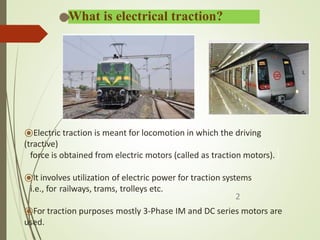
⦿Electric traction is meant for locomotion in which the driving
(tractive)
force is obtained from electric motors (called as traction motors).
⦿It involves utilization of electric power for traction systems
i.e., for railways, trams, trolleys etc.
2
⦿For traction purposes mostly 3-Phase IM and DC series motors are
used.
⦿The year 1881 saw the birth of the first electric Railway run by a
German Engineer Werner Van Siemens using both the rails to carry
the current.
⦿Finding this a little too dangerous, Siemens soon adopted the
overhead electric wires.
⦿Electric traction was introduced on Indian Railways in year 1925 on
1.5 KV DC and the first electric train ran between Bombay's
Victoria Terminus and Kurla, a distance of 9.5 miles.
⦿The first train run using 25kV AC was on December 15, 1959.
3
ABrief History T
o Electric
Traction
⦿Typical Voltages used for electric Traction are 1.5kV DC
and 25kV AC for mainline trains.
⦿Calcutta had an overhead 3kV DC system until the '60s.
⦿The Calcutta Metro uses 750V DC traction with a
third-rail mechanism for delivering the electricity to
the EMU.
⦿The Calcutta trams use 550V DC with an overhead line
(catenary) system with underground return conductors.
⦿The Delhi Metro uses 25kV AC overhead traction with a catenary
system.
4
Voltages Used ForElectricTraction In India
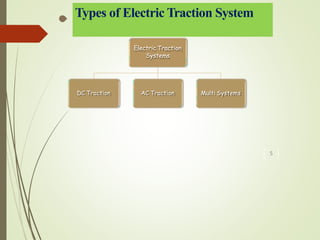
Electric Traction
Systems
DC Traction AC Traction Multi Systems
5
Types of Electric Traction System
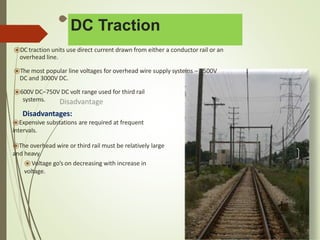
⦿DC traction units use direct current drawn from either a conductor rail or an
overhead line.
⦿The most popular line voltages for overhead wire supply systems – 1500V
DC and 3000V DC.
⦿600V DC–750V DC volt range used for third rail
systems.
Disadvantages:
⦿Expensive substations are required at frequent
intervals.
⦿The overhead wire or third rail must be relatively large
and heavy.
⦿Voltage go’s on decreasing with increase in
voltage.
DC Traction
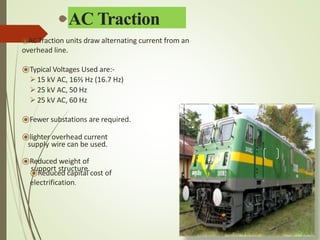
AC Traction
⦿AC Traction units draw alternating current from an
overhead line.
⦿Typical Voltages Used are:-
15 kV AC, 16⅔ Hz (16.7 Hz)
25 kV AC, 50 Hz
25 kV AC, 60 Hz
⦿Fewer substations are required.
⦿lighter overhead current
supply wire can be used.
⦿Reduced weight of
support structure.
⦿Reduced capital cost of
electrification.
Multi Systems
⦿Multi-system trains are used to provide continuous
journeys along routes that are electrified using more than
one system.
⦿One way to accomplish this is by changing locomotives at
the switching stations.
⦿These stations have overhead wires that can be switched from
one voltage
to another.
⦿Another way is to use multi-system locomotives that can
operate under several different voltages and current types.
In Europe, it is common to use four-system locomotives (1.5
kV DC,
3 kV DC, 15 kV 16⅔ Hz AC, 25 kV, 50 Hz AC)
8
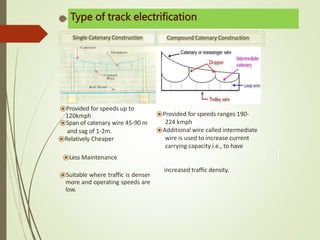
⦿Provided for speeds up to
120kmph
⦿Span of catenary wire 45-90 m
and sag of 1-2m.
⦿Relatively Cheaper
⦿Less Maintenance
⦿Suitable where traffic is denser
more and operating speeds are
low.
Single Catenary Construction Compound Catenary Construction
⦿Provided for speeds ranges 190-
224 kmph
⦿Additional wire called intermediate
wire is used to increase current
carrying capacity i.e., to have
increased traffic density.
Type of track electrification
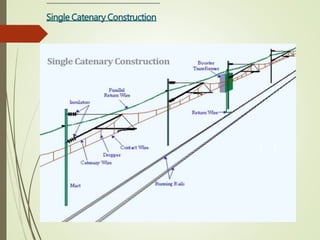
Single Catenary Construction
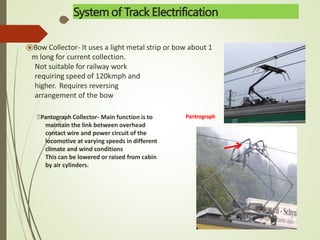
⦿Bow Collector- It uses a light metal strip or bow about 1
m long for current collection.
Not suitable for railway work
requiring speed of 120kmph and
higher. Requires reversing
arrangement of the bow
⦿Pantograph Collector- Main function is to
maintain the link between overhead
contact wire and power circuit of the
locomotive at varying speeds in different
climate and wind conditions
This can be lowered or raised from cabin
by air cylinders.
Pantrograph
System of Track Electrification
1. [1]Traction transformer
2. [2]Traction converter [3]Traction
control
3. Train Control and Monitoring System
4. Traction motor
5. [6]Diesel engine generator
[7]Auxiliary converter
[8]Battery charger
[9]Energy storage
Overview of Traction Engine
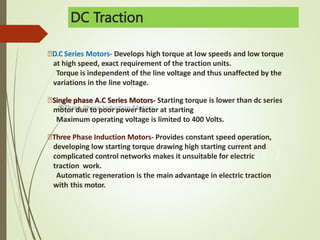
⦿D.C Series Motors- Develops high torque at low speeds and low torque
at high speed, exact requirement of the traction units.
Torque is independent of the line voltage and thus unaffected by the
variations in the line voltage.
⦿Single phase A.C Series Motors- Starting torque is lower than dc series
motor due to poor power factor at starting
Maximum operating voltage is limited to 400 Volts.
⦿Three Phase Induction Motors- Provides constant speed operation,
developing low starting torque drawing high starting current and
complicated control networks makes it unsuitable for electric
traction work.
Automatic regeneration is the main advantage in electric traction
with this motor.
DC Traction
⦿Now a days magnetic traction is being used in bullet trains
operated in Japan with max. speeds of 240-300km/h.
⦿They uses a 25,000 V AC overhead power supply , Bullet Trains have
average arrival time as within six seconds of the scheduled time
including all natural and human accidents and errors.
 ⦿The Automotrice à grande vitesse, AGV is one of the fastest train
 services in world provided in France.
⦿The Chinese CHR3 started in 2004 is running at max. speed of 431km/h.
1
Leading Traction System
⦿High power-to-weight ratio than forms of traction such as diesel or steam
that generate power requiring on board prime mover.
Faster acceleration
Higher practical limit of power
Higher limit of speed
Higher hauling capability
⦿No exhaust fumes or carbon emissions.
⦿Lower running cost of locomotives and multiple units.
⦿Less noise pollution (quieter operation).
⦿Lower power loss at higher altitudes.
⦿Lack of dependence on crude oil as fuel.
Advantages of Electric Traction Systems
Disadvantages
of Electric Traction Systems
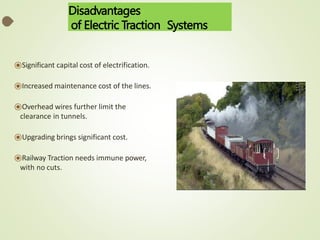
⦿Significant capital cost of electrification.
⦿Increased maintenance cost of the lines.
⦿Overhead wires further limit the
clearance in tunnels.
⦿Upgrading brings significant cost.
⦿Railway Traction needs immune power,
with no cuts.
4/20/2015
Ankit Verma
19

ELECTRICAL TRACTION SYSTEM SW.-1.pptx

  • 1.
    Seminar on Electric Traction PresentedBy: Mr. Shubham Wankhade. Electrical Engineering (Final year), K. G. I. T. Darapur. .
  • 2.
    What is electricaltraction? ⦿Electric traction is meant for locomotion in which the driving (tractive) force is obtained from electric motors (called as traction motors). ⦿It involves utilization of electric power for traction systems i.e., for railways, trams, trolleys etc. 2 ⦿For traction purposes mostly 3-Phase IM and DC series motors are used.
  • 3.
    ⦿The year 1881saw the birth of the first electric Railway run by a German Engineer Werner Van Siemens using both the rails to carry the current. ⦿Finding this a little too dangerous, Siemens soon adopted the overhead electric wires. ⦿Electric traction was introduced on Indian Railways in year 1925 on 1.5 KV DC and the first electric train ran between Bombay's Victoria Terminus and Kurla, a distance of 9.5 miles. ⦿The first train run using 25kV AC was on December 15, 1959. 3 ABrief History T o Electric Traction
  • 4.
    ⦿Typical Voltages usedfor electric Traction are 1.5kV DC and 25kV AC for mainline trains. ⦿Calcutta had an overhead 3kV DC system until the '60s. ⦿The Calcutta Metro uses 750V DC traction with a third-rail mechanism for delivering the electricity to the EMU. ⦿The Calcutta trams use 550V DC with an overhead line (catenary) system with underground return conductors. ⦿The Delhi Metro uses 25kV AC overhead traction with a catenary system. 4 Voltages Used ForElectricTraction In India
  • 5.
    Electric Traction Systems DC TractionAC Traction Multi Systems 5 Types of Electric Traction System
  • 6.
    ⦿DC traction unitsuse direct current drawn from either a conductor rail or an overhead line. ⦿The most popular line voltages for overhead wire supply systems – 1500V DC and 3000V DC. ⦿600V DC–750V DC volt range used for third rail systems. Disadvantages: ⦿Expensive substations are required at frequent intervals. ⦿The overhead wire or third rail must be relatively large and heavy. ⦿Voltage go’s on decreasing with increase in voltage. DC Traction
  • 7.
    AC Traction ⦿AC Tractionunits draw alternating current from an overhead line. ⦿Typical Voltages Used are:- 15 kV AC, 16⅔ Hz (16.7 Hz) 25 kV AC, 50 Hz 25 kV AC, 60 Hz ⦿Fewer substations are required. ⦿lighter overhead current supply wire can be used. ⦿Reduced weight of support structure. ⦿Reduced capital cost of electrification.
  • 8.
    Multi Systems ⦿Multi-system trainsare used to provide continuous journeys along routes that are electrified using more than one system. ⦿One way to accomplish this is by changing locomotives at the switching stations. ⦿These stations have overhead wires that can be switched from one voltage to another. ⦿Another way is to use multi-system locomotives that can operate under several different voltages and current types. In Europe, it is common to use four-system locomotives (1.5 kV DC, 3 kV DC, 15 kV 16⅔ Hz AC, 25 kV, 50 Hz AC) 8
  • 9.
    ⦿Provided for speedsup to 120kmph ⦿Span of catenary wire 45-90 m and sag of 1-2m. ⦿Relatively Cheaper ⦿Less Maintenance ⦿Suitable where traffic is denser more and operating speeds are low. Single Catenary Construction Compound Catenary Construction ⦿Provided for speeds ranges 190- 224 kmph ⦿Additional wire called intermediate wire is used to increase current carrying capacity i.e., to have increased traffic density. Type of track electrification
  • 10.
  • 11.
    ⦿Bow Collector- Ituses a light metal strip or bow about 1 m long for current collection. Not suitable for railway work requiring speed of 120kmph and higher. Requires reversing arrangement of the bow ⦿Pantograph Collector- Main function is to maintain the link between overhead contact wire and power circuit of the locomotive at varying speeds in different climate and wind conditions This can be lowered or raised from cabin by air cylinders. Pantrograph System of Track Electrification
  • 12.
    1. [1]Traction transformer 2.[2]Traction converter [3]Traction control 3. Train Control and Monitoring System 4. Traction motor 5. [6]Diesel engine generator [7]Auxiliary converter [8]Battery charger [9]Energy storage Overview of Traction Engine
  • 13.
    ⦿D.C Series Motors-Develops high torque at low speeds and low torque at high speed, exact requirement of the traction units. Torque is independent of the line voltage and thus unaffected by the variations in the line voltage. ⦿Single phase A.C Series Motors- Starting torque is lower than dc series motor due to poor power factor at starting Maximum operating voltage is limited to 400 Volts. ⦿Three Phase Induction Motors- Provides constant speed operation, developing low starting torque drawing high starting current and complicated control networks makes it unsuitable for electric traction work. Automatic regeneration is the main advantage in electric traction with this motor. DC Traction
  • 14.
    ⦿Now a daysmagnetic traction is being used in bullet trains operated in Japan with max. speeds of 240-300km/h. ⦿They uses a 25,000 V AC overhead power supply , Bullet Trains have average arrival time as within six seconds of the scheduled time including all natural and human accidents and errors.  ⦿The Automotrice à grande vitesse, AGV is one of the fastest train  services in world provided in France. ⦿The Chinese CHR3 started in 2004 is running at max. speed of 431km/h. 1 Leading Traction System
  • 15.
    ⦿High power-to-weight ratiothan forms of traction such as diesel or steam that generate power requiring on board prime mover. Faster acceleration Higher practical limit of power Higher limit of speed Higher hauling capability ⦿No exhaust fumes or carbon emissions. ⦿Lower running cost of locomotives and multiple units. ⦿Less noise pollution (quieter operation). ⦿Lower power loss at higher altitudes. ⦿Lack of dependence on crude oil as fuel. Advantages of Electric Traction Systems
  • 16.
    Disadvantages of Electric TractionSystems ⦿Significant capital cost of electrification. ⦿Increased maintenance cost of the lines. ⦿Overhead wires further limit the clearance in tunnels. ⦿Upgrading brings significant cost. ⦿Railway Traction needs immune power, with no cuts.
  • 17.