The Electric Meter – A Home Activity
        Meter Reading & Estimating Electric Energy Usage
1. For a typical electric meter, the dials are numbered alternately in the clockwise and
counterclockwise directions. Why? Because mechanical gears link adjacent dial pointers,
and turn in opposite directions.

       a. Make a sketch of a set of gears that do this.

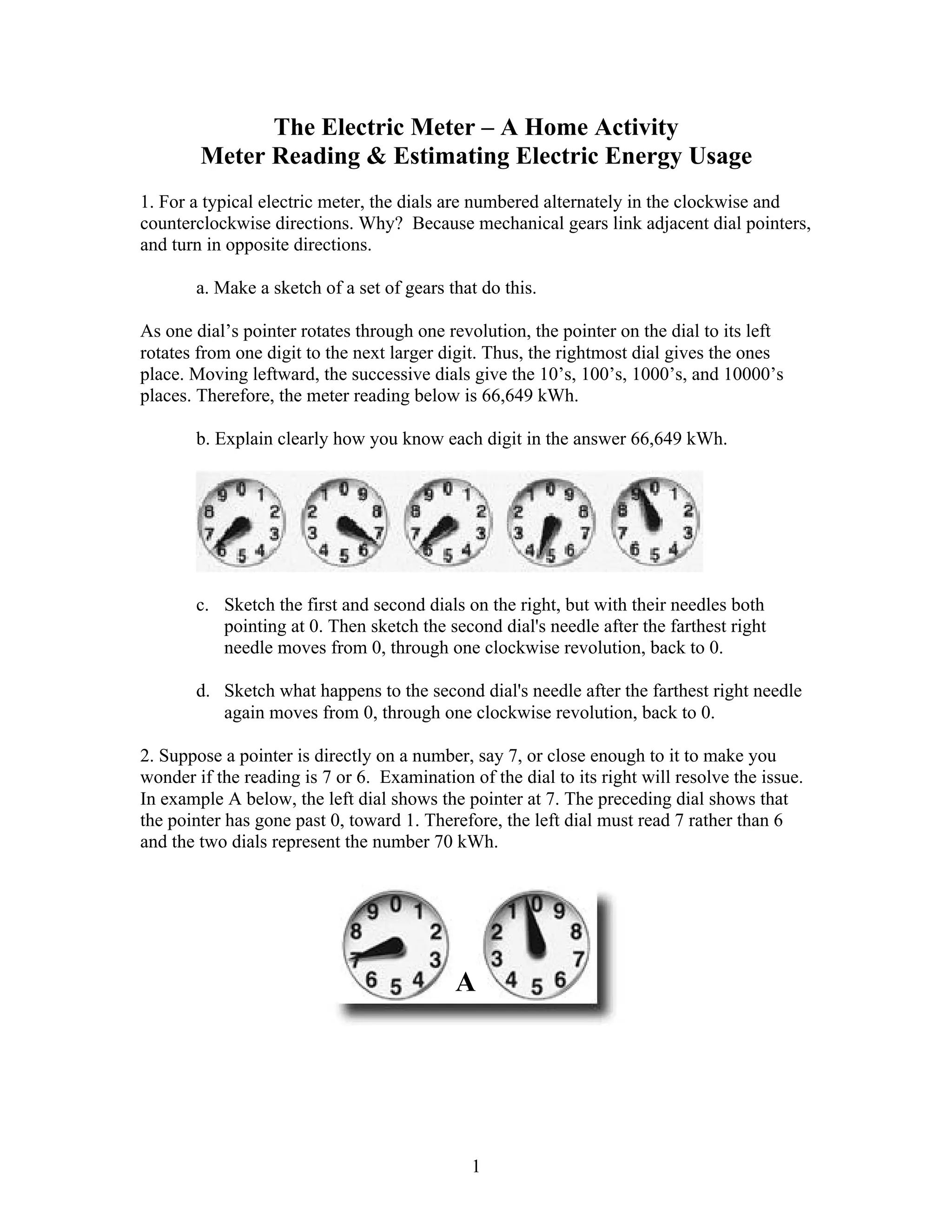
As one dial’s pointer rotates through one revolution, the pointer on the dial to its left
rotates from one digit to the next larger digit. Thus, the rightmost dial gives the ones
place. Moving leftward, the successive dials give the 10’s, 100’s, 1000’s, and 10000’s
places. Therefore, the meter reading below is 66,649 kWh.

       b. Explain clearly how you know each digit in the answer 66,649 kWh.


       c. Sketch the first and second dials on the right, but with their needles both
          pointing at 0. Then sketch the second dial's needle after the farthest right
          needle moves from 0, through one clockwise revolution, back to 0.

       d. Sketch what happens to the second dial's needle after the farthest right needle
          again moves from 0, through one clockwise revolution, back to 0.

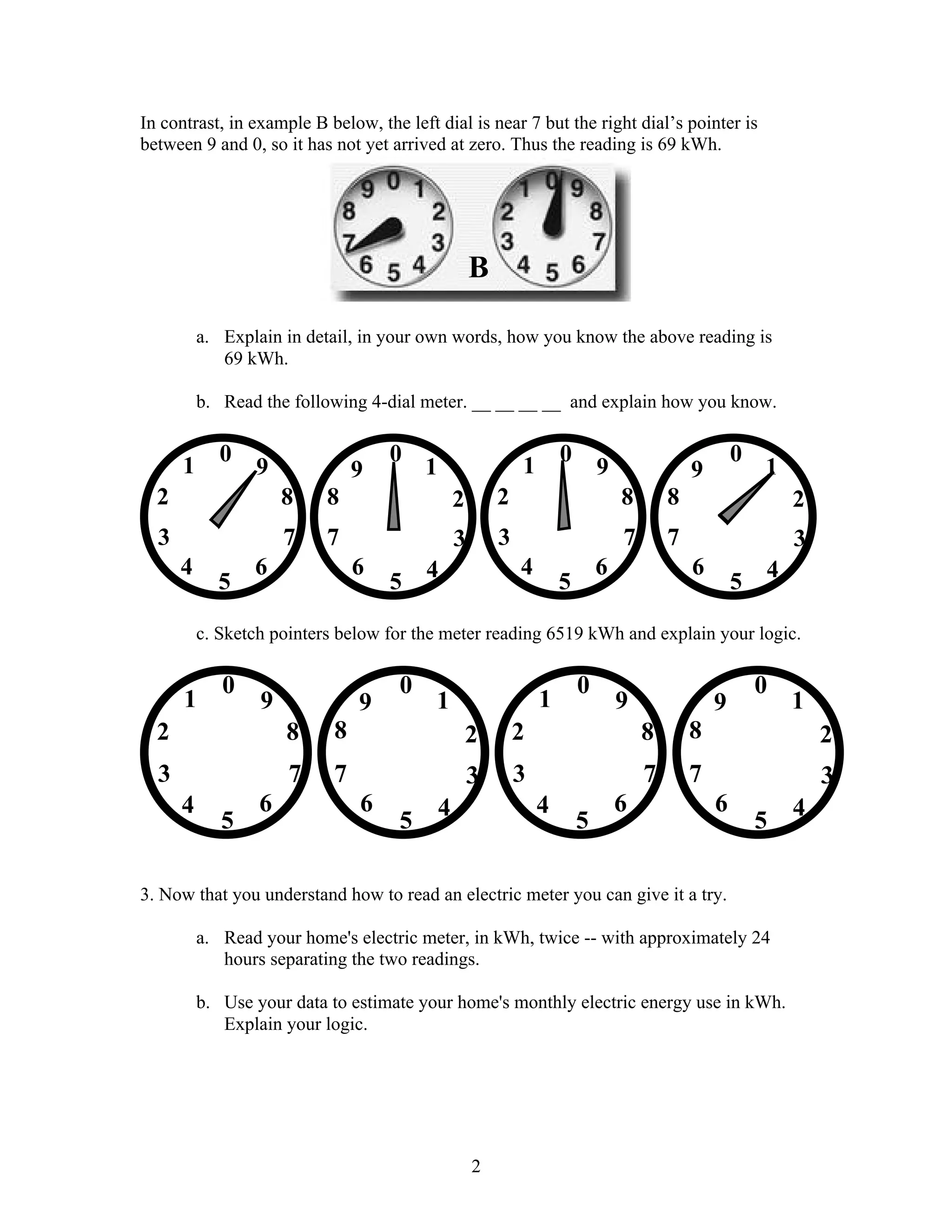
2. Suppose a pointer is directly on a number, say 7, or close enough to it to make you
wonder if the reading is 7 or 6. Examination of the dial to its right will resolve the issue.
In example A below, the left dial shows the pointer at 7. The preceding dial shows that
the pointer has gone past 0, toward 1. Therefore, the left dial must read 7 rather than 6
and the two dials represent the number 70 kWh.


                                            A


                                              1
In contrast, in example B below, the left dial is near 7 but the right dial’s pointer is
between 9 and 0, so it has not yet arrived at zero. Thus the reading is 69 kWh.


                                                    B

          a. Explain in detail, in your own words, how you know the above reading is
             69 kWh.

          b. Read the following 4-dial meter. __ __ __ __ and explain how you know.


      1      0                      0                       1       0                               0
                 9              9       1                                   9               9           1
  2                   8    8                    2       2                       8       8                   2
  3                   7    7                    3       3                       7       7                   3
      4          6              6       4                   4               6               6           4
            5                       5                               5                               5

          c. Sketch pointers below for the meter reading 6519 kWh and explain your logic.

             0                      0                                   0                               0
      1           9             9         1                     1               9               9           1
  2                   8     8                       2       2                       8       8                   2
  3                   7     7                       3       3                       7       7                   3
      4           6             6           4                   4               6               6           4
             5                      5                                   5                               5

3. Now that you understand how to read an electric meter you can give it a try.

          a. Read your home's electric meter, in kWh, twice -- with approximately 24
             hours separating the two readings.

          b. Use your data to estimate your home's monthly electric energy use in kWh.
             Explain your logic.


                                                    2
4. Most electric meters have a rotating disc under the set of dials. A black mark on the
disc’s edge shows when the disc has rotated one full revolution. Meters often show a
code for how much energy is delivered by the electric utility company for one rotation of
the rotating disc. A typical code is Kh 7.2. This not-at-all-obvious code means that one
full rotation of the disc corresponds to 7.2 watt hours of electric energy. It is emphasized
that "Kh" does not literally stand for watt hours, kilohours, or anything else that we know
of, but for some mysterious reason, this terminology is used on electric meters!

By measuring how long it takes for one revolution, we can calculate the rate at which
electric energy is used. The needed formula is Power in watts = (Kh value in watt
hours/revolution)/(time in hours/revolution). Because it is usually convenient to measure
the time in seconds rather than hours, we can do that and then convert seconds to hours
using the conversion 1 hour = 3600 seconds. For instance, 27 seconds = 0.0075 hours.

Example: A meter is marked Kh 7.2. It takes 27 seconds (= ) for one full rotation of the
rotating disc. What is the rate of electrical energy use in watts?

Power = (7.2 watt hours/revolution)/(.0075 hours/revolution) = 960 watts.

Had the meter been marked Kh 3.6 with a 45 second time for one revolution, the power
would have been 288 watts.

       a. Show your calculation for the latter example, explaining your logic.

Suppose a meter is marked Kh7.2. With almost all appliances off, the rotating disc takes
885 seconds to complete one revolution. The refrigerator door is then opened, and the
refrigerator's thermostat causes the refrigerator motor to go on. With the refrigerator on, it
takes the disc 34 seconds to complete a revolution. How much power is drawn by the
refrigerator? Using the same technique as above, the power with the refrigerator OFF can
be seen to be 29 watts (to two digits). With the refrigerator ON, the power is 762 watts.
Therefore the refrigerator's power is 762 - 29 = 733 watts.

       b. Determine YOUR refrigerator's power using the technique shown above.
          Show all calculations and present your reasoning.

       c. Explain how you could measure the power required by an air conditioner.


                                              3

Electric meter reading

  • 1.
    The Electric Meter– A Home Activity Meter Reading & Estimating Electric Energy Usage 1. For a typical electric meter, the dials are numbered alternately in the clockwise and counterclockwise directions. Why? Because mechanical gears link adjacent dial pointers, and turn in opposite directions. a. Make a sketch of a set of gears that do this. As one dial’s pointer rotates through one revolution, the pointer on the dial to its left rotates from one digit to the next larger digit. Thus, the rightmost dial gives the ones place. Moving leftward, the successive dials give the 10’s, 100’s, 1000’s, and 10000’s places. Therefore, the meter reading below is 66,649 kWh. b. Explain clearly how you know each digit in the answer 66,649 kWh. c. Sketch the first and second dials on the right, but with their needles both pointing at 0. Then sketch the second dial's needle after the farthest right needle moves from 0, through one clockwise revolution, back to 0. d. Sketch what happens to the second dial's needle after the farthest right needle again moves from 0, through one clockwise revolution, back to 0. 2. Suppose a pointer is directly on a number, say 7, or close enough to it to make you wonder if the reading is 7 or 6. Examination of the dial to its right will resolve the issue. In example A below, the left dial shows the pointer at 7. The preceding dial shows that the pointer has gone past 0, toward 1. Therefore, the left dial must read 7 rather than 6 and the two dials represent the number 70 kWh. A 1
  • 2.
    In contrast, inexample B below, the left dial is near 7 but the right dial’s pointer is between 9 and 0, so it has not yet arrived at zero. Thus the reading is 69 kWh. B a. Explain in detail, in your own words, how you know the above reading is 69 kWh. b. Read the following 4-dial meter. __ __ __ __ and explain how you know. 1 0 0 1 0 0 9 9 1 9 9 1 2 8 8 2 2 8 8 2 3 7 7 3 3 7 7 3 4 6 6 4 4 6 6 4 5 5 5 5 c. Sketch pointers below for the meter reading 6519 kWh and explain your logic. 0 0 0 0 1 9 9 1 1 9 9 1 2 8 8 2 2 8 8 2 3 7 7 3 3 7 7 3 4 6 6 4 4 6 6 4 5 5 5 5 3. Now that you understand how to read an electric meter you can give it a try. a. Read your home's electric meter, in kWh, twice -- with approximately 24 hours separating the two readings. b. Use your data to estimate your home's monthly electric energy use in kWh. Explain your logic. 2
  • 3.
    4. Most electricmeters have a rotating disc under the set of dials. A black mark on the disc’s edge shows when the disc has rotated one full revolution. Meters often show a code for how much energy is delivered by the electric utility company for one rotation of the rotating disc. A typical code is Kh 7.2. This not-at-all-obvious code means that one full rotation of the disc corresponds to 7.2 watt hours of electric energy. It is emphasized that "Kh" does not literally stand for watt hours, kilohours, or anything else that we know of, but for some mysterious reason, this terminology is used on electric meters! By measuring how long it takes for one revolution, we can calculate the rate at which electric energy is used. The needed formula is Power in watts = (Kh value in watt hours/revolution)/(time in hours/revolution). Because it is usually convenient to measure the time in seconds rather than hours, we can do that and then convert seconds to hours using the conversion 1 hour = 3600 seconds. For instance, 27 seconds = 0.0075 hours. Example: A meter is marked Kh 7.2. It takes 27 seconds (= ) for one full rotation of the rotating disc. What is the rate of electrical energy use in watts? Power = (7.2 watt hours/revolution)/(.0075 hours/revolution) = 960 watts. Had the meter been marked Kh 3.6 with a 45 second time for one revolution, the power would have been 288 watts. a. Show your calculation for the latter example, explaining your logic. Suppose a meter is marked Kh7.2. With almost all appliances off, the rotating disc takes 885 seconds to complete one revolution. The refrigerator door is then opened, and the refrigerator's thermostat causes the refrigerator motor to go on. With the refrigerator on, it takes the disc 34 seconds to complete a revolution. How much power is drawn by the refrigerator? Using the same technique as above, the power with the refrigerator OFF can be seen to be 29 watts (to two digits). With the refrigerator ON, the power is 762 watts. Therefore the refrigerator's power is 762 - 29 = 733 watts. b. Determine YOUR refrigerator's power using the technique shown above. Show all calculations and present your reasoning. c. Explain how you could measure the power required by an air conditioner. 3