Welcome to Mathematics 6 Class!
Mr. Jaypee T. Jonas
Teacher
Meter Reading
(M6ME-IVd-100)
Objectives:
1. Read and interpret electric and water meter readings
Opening Song & Prayer
Presentation
Your electric meter measures the amount of electricity you
use. Just as you purchase kilograms of meat, grams of
milk or liters of gasoline, you buy kilowatt
hours (kWh) of electricity.
Discussion
 In an electromechanical meter you will
notice that there are five dials and
inside each dial is a pointer which indicates the number
number to be read. The pointers will alternately turn
clockwise and counterclockwise. These dials measure
the number of kilowatt-hour (kWh) you use in 1s,10s,
100s, 1000s, and 10 000s.
 To read electric meters:
1. Always read all the dials from right to left, starting
Dial E to Dial A.
Discussion
2. Read the number by the pointer of the dial.
When the pointer is between two numbers,
the lower number is recorded.
3. If the pointer appears to be exactly on a number. Check
the dial to the right to find out the correct reading.
● If the dial on the right has passed zero, then use
the number the pointer is pointing to on the dial
you are reading.
● If the dial has not passed zero, then make use of
the smaller number on the dial you are reading.
Discussion
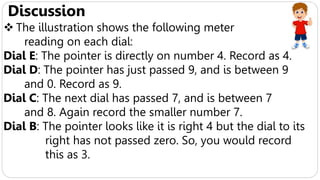
 The illustration shows the following meter
reading on each dial:
Dial E: The pointer is directly on number 4. Record as 4.
Dial D: The pointer has just passed 9, and is between 9
and 0. Record as 9.
Dial C: The next dial has passed 7, and is between 7
and 8. Again record the smaller number 7.
Dial B: The pointer looks like it is right 4 but the dial to its
right has not passed zero. So, you would record
this as 3.
Discussion
Dial A: The pointer is between 5 and 6. Record the
smaller number which the pointer just passed,
which is 5.
 Thus, the electric meter reading is 53794 kWh
(kilowatt-hour).
 Example: Read and interpret the dials on the electric
meter on the next slide.
Discussion
Discussion
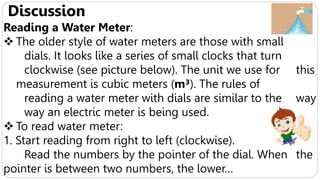
Reading a Water Meter:
 The older style of water meters are those with small
dials. It looks like a series of small clocks that turn
clockwise (see picture below). The unit we use for this
measurement is cubic meters (m³). The rules of
reading a water meter with dials are similar to the way
way an electric meter is being used.
 To read water meter:
1. Start reading from right to left (clockwise).
Read the numbers by the pointer of the dial. When the
pointer is between two numbers, the lower…
Discussion
…number is recorded.
2. When the pointer is directly on the number, look at the
dial to the right. If it has passed zero, use the next higher
number. If the dial has not passed zero, use the lower
number.
3. Record the numbers
from right to left.
Discussion
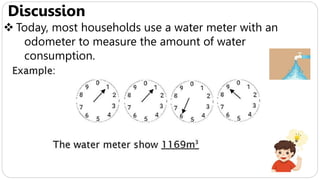
 Today, most households use a water meter with an
odometer to measure the amount of water
consumption.
Discussion
Computing Water and Electric Consumption
 To compute water and electric consumption for a
particular period of time, simply subtract the
previous reading from the present reading.
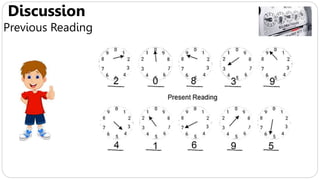
 Example 1: Read and interpret the reading of the
following electric meter. Find the number of the
kilowatt-hour consumed.
Discussion
Previous Reading
Discussion
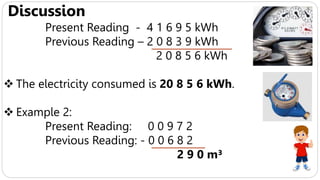
Present Reading - 4 1 6 9 5 kWh
Previous Reading – 2 0 8 3 9 kWh
2 0 8 5 6 kWh
 The electricity consumed is 20 8 5 6 kWh.
 Example 2:
Present Reading: 0 0 9 7 2
Previous Reading: - 0 0 6 8 2
2 9 0 m³
Discussion
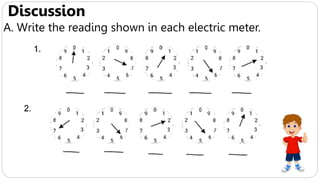
A. Write the reading shown in each electric meter.
Discussion
B. Complete the table by writing the water consumed.
Discussion
C. Calculate the kilowatt-hour used.
Discussion
 Last month, the water meter reading was 1 342 m³. The
following month, it was 1 395 m³. If the basic charge of a
cubic meter is Php 2.62, how much will one pay?
a. How many cubic meters of water were consumed?
1 395 m³ + 1 342 m³ = 53 m³
b. How much will he pay for a month?
53 m³ x Php 2.62 = Php 138.86
c. What is the average cost of water per day for
the whole month?
Php 138.86 ÷ 30 = Php 4.63
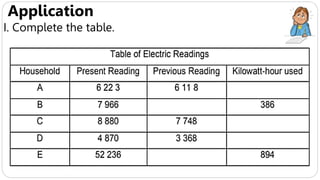
Application
I. Complete the table.
Application
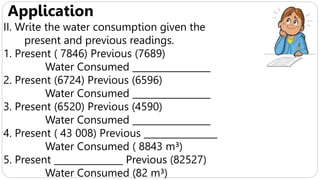
II. Write the water consumption given the
present and previous readings.
1. Present ( 7846) Previous (7689)
Water Consumed _________________
2. Present (6724) Previous (6596)
Water Consumed _________________
3. Present (6520) Previous (4590)
Water Consumed _________________
4. Present ( 43 008) Previous ________________
Water Consumed ( 8843 m³)
5. Present _______________ Previous (82527)
Water Consumed (82 m³)
Generalization
 To compute water and electric consumption for a
particular period of time, simply subtract the
previous reading from the present reading.
Evaluation
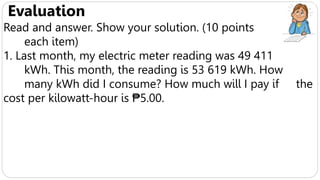
Read and answer. Show your solution. (10 points
each item)
1. Last month, my electric meter reading was 49 411
kWh. This month, the reading is 53 619 kWh. How
many kWh did I consume? How much will I pay if the
cost per kilowatt-hour is ₱5.00.
Evaluation
2. At ₱8.00 per cubic meter of water, how much
was the basic bill for the period of August to
if the meter reading in September was 1450 m³ while the
reading in August was 1480 m³.
Assignment
Solve each problem. Show your solution.
(10 points each item)
1. The current water reading is 9 318 cubic meters and the
previous water reading is 9 229 cubic meters. If each cubic
meter costs ₱6.25. How much is the water bill?
Assignment
2. Ms. Ocampo's family consumed 450 kWh of electricity
April. If the rate is ₱5.50 per kWh, how much will be the
electric bill for the month?

Mathematics-6-Lesson-25 (1).pptx

  • 1.
    Welcome to Mathematics6 Class! Mr. Jaypee T. Jonas Teacher
  • 2.
    Meter Reading (M6ME-IVd-100) Objectives: 1. Readand interpret electric and water meter readings
  • 3.
  • 4.
    Presentation Your electric metermeasures the amount of electricity you use. Just as you purchase kilograms of meat, grams of milk or liters of gasoline, you buy kilowatt hours (kWh) of electricity.
  • 5.
    Discussion  In anelectromechanical meter you will notice that there are five dials and inside each dial is a pointer which indicates the number number to be read. The pointers will alternately turn clockwise and counterclockwise. These dials measure the number of kilowatt-hour (kWh) you use in 1s,10s, 100s, 1000s, and 10 000s.  To read electric meters: 1. Always read all the dials from right to left, starting Dial E to Dial A.
  • 6.
    Discussion 2. Read thenumber by the pointer of the dial. When the pointer is between two numbers, the lower number is recorded. 3. If the pointer appears to be exactly on a number. Check the dial to the right to find out the correct reading. ● If the dial on the right has passed zero, then use the number the pointer is pointing to on the dial you are reading. ● If the dial has not passed zero, then make use of the smaller number on the dial you are reading.
  • 7.
    Discussion  The illustrationshows the following meter reading on each dial: Dial E: The pointer is directly on number 4. Record as 4. Dial D: The pointer has just passed 9, and is between 9 and 0. Record as 9. Dial C: The next dial has passed 7, and is between 7 and 8. Again record the smaller number 7. Dial B: The pointer looks like it is right 4 but the dial to its right has not passed zero. So, you would record this as 3.
  • 8.
    Discussion Dial A: Thepointer is between 5 and 6. Record the smaller number which the pointer just passed, which is 5.  Thus, the electric meter reading is 53794 kWh (kilowatt-hour).  Example: Read and interpret the dials on the electric meter on the next slide.
  • 9.
  • 10.
    Discussion Reading a WaterMeter:  The older style of water meters are those with small dials. It looks like a series of small clocks that turn clockwise (see picture below). The unit we use for this measurement is cubic meters (m³). The rules of reading a water meter with dials are similar to the way way an electric meter is being used.  To read water meter: 1. Start reading from right to left (clockwise). Read the numbers by the pointer of the dial. When the pointer is between two numbers, the lower…
  • 11.
    Discussion …number is recorded. 2.When the pointer is directly on the number, look at the dial to the right. If it has passed zero, use the next higher number. If the dial has not passed zero, use the lower number. 3. Record the numbers from right to left.
  • 12.
    Discussion  Today, mosthouseholds use a water meter with an odometer to measure the amount of water consumption.
  • 13.
    Discussion Computing Water andElectric Consumption  To compute water and electric consumption for a particular period of time, simply subtract the previous reading from the present reading.  Example 1: Read and interpret the reading of the following electric meter. Find the number of the kilowatt-hour consumed.
  • 14.
  • 15.
    Discussion Present Reading -4 1 6 9 5 kWh Previous Reading – 2 0 8 3 9 kWh 2 0 8 5 6 kWh  The electricity consumed is 20 8 5 6 kWh.  Example 2: Present Reading: 0 0 9 7 2 Previous Reading: - 0 0 6 8 2 2 9 0 m³
  • 16.
    Discussion A. Write thereading shown in each electric meter.
  • 17.
    Discussion B. Complete thetable by writing the water consumed.
  • 18.
    Discussion C. Calculate thekilowatt-hour used.
  • 19.
    Discussion  Last month,the water meter reading was 1 342 m³. The following month, it was 1 395 m³. If the basic charge of a cubic meter is Php 2.62, how much will one pay? a. How many cubic meters of water were consumed? 1 395 m³ + 1 342 m³ = 53 m³ b. How much will he pay for a month? 53 m³ x Php 2.62 = Php 138.86 c. What is the average cost of water per day for the whole month? Php 138.86 ÷ 30 = Php 4.63
  • 20.
  • 21.
    Application II. Write thewater consumption given the present and previous readings. 1. Present ( 7846) Previous (7689) Water Consumed _________________ 2. Present (6724) Previous (6596) Water Consumed _________________ 3. Present (6520) Previous (4590) Water Consumed _________________ 4. Present ( 43 008) Previous ________________ Water Consumed ( 8843 m³) 5. Present _______________ Previous (82527) Water Consumed (82 m³)
  • 22.
    Generalization  To computewater and electric consumption for a particular period of time, simply subtract the previous reading from the present reading.
  • 23.
    Evaluation Read and answer.Show your solution. (10 points each item) 1. Last month, my electric meter reading was 49 411 kWh. This month, the reading is 53 619 kWh. How many kWh did I consume? How much will I pay if the cost per kilowatt-hour is ₱5.00.
  • 24.
    Evaluation 2. At ₱8.00per cubic meter of water, how much was the basic bill for the period of August to if the meter reading in September was 1450 m³ while the reading in August was 1480 m³.
  • 25.
    Assignment Solve each problem.Show your solution. (10 points each item) 1. The current water reading is 9 318 cubic meters and the previous water reading is 9 229 cubic meters. If each cubic meter costs ₱6.25. How much is the water bill?
  • 26.
    Assignment 2. Ms. Ocampo'sfamily consumed 450 kWh of electricity April. If the rate is ₱5.50 per kWh, how much will be the electric bill for the month?