Topics covered
Electric Charge
Electric Current
Electric Potential
Electrical Resistance
Ohm’s Law
Series and parallel connection of resistors
Electric Power
Electric Energy & its commercial Unit
Heating Effects of Electric Current
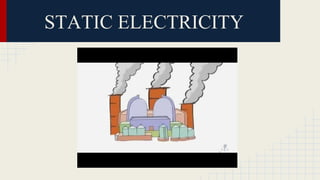
STATIC ELECTRICITY
TYPES OF ELECTRIC CHARGES
There are two types of Electric Charges:
Positive Charges
Negative Charges
By Convention,
The charge acquired by a glass rod is called Positive Charge
The charge acquired by an ebonite rod is called Negative Charge
Opposite charges (or Unlike charges) attract each other.
Similar charges (or Like charges) repel each other.
SI UNITS OF CHARGE
SI Unit of Charge is Coulomb, denoted by C
One Coulomb is that quality of electric charge which exerts a force of
9 * 109 N on an equal charge placed at a distance of 1 metre from it.
Charge possessed by an electron is 1.6 * 10-19 Coulombs
Conductors & Insulators
Substances through which electricity can flow are called Conductors.
Ex: Silver, Copper and Aluminium, etc
Those Substances through which electric charges cannot flow, are called
Insulators.
Ex: Glass, Ebonite, Rubber, most plastics, Paper, Dry wood, Cotton,
Mica, Bakelite, Porcelain, and Dry Air
What makes Substances Conduct
Electricity?
The presence of Free Electrons in a substance makes it a conductor.
The electrons present in insulators are strongly held by the nuclei of their
atoms.
So no free electrons in an insulator which can move from one atom to
another, an insulator does not allow electric charges to flow through it.
Static Electricity ?
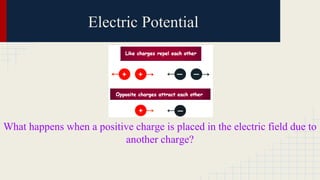
Electric Potential
What happens when a positive charge is placed in the electric field due to
another charge?
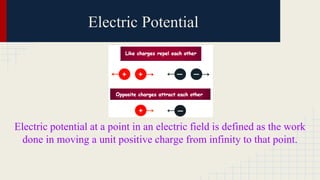
Electric Potential
Electric potential at a point in an electric field is defined as the work
done in moving a unit positive charge from infinity to that point.
Potential Difference
The difference between two points in an electric circuit is defined as the
amount of work done in moving a unit charge from one point to the other
point.
Potential difference = Work done / Quantity of Charge moved
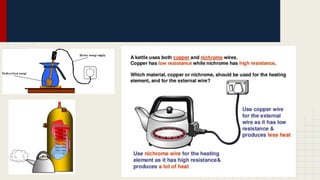
Heating Effects of Electric Current
When an electric current is passed through a high
resistance wire, like nichrome wire, the resistance wire
becomes very hot and produces heat.
This is called as the Heating effects of Electric current
MAGNETIC EFFECTS OF
ELECTRIC CURRENT
Learning Objectives
Magnetic Field and Magnetic Field Lines
Magnetic Field of Earth
Electromagnetism
Magnetic field patterns produced by current carrying
Conductors of various shapes
Electromagnet
Difference between Bar Magnet & an Electromagnet
Magnetism in Human Body
Learning Objectives
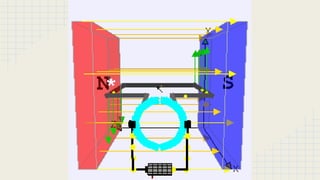
Force on a current carrying conductor placed in a
magnetic field
Kicking Wire Experiment
Fleming’s Left Hand Rule
Principle and working of Electric Motor
Electromagnetic Induction
Fleming’s Right-Hand Rule
Electric Generator- AC & DC Generators
Domestic Electrical Wiring
Magnetic Effect of Electric Current
“An electric current flowing in a wire produces a magnetic
field around it”
Electric Current produces Magnetism
Magnet & Magnetic Field
A magnet is an object which attracts pieces of
iron, steel, nickel and cobalt
The space around a magnet in which magnetic
force is exerted, is called a magnetic field
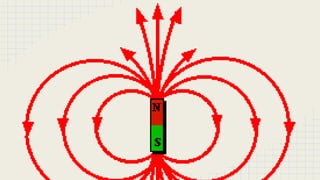
Magnetic Field Lines
The lines drawn in a magnetic field along which a north
magnetic pole would move
The magnetic field lines are also known as magnetic lines
of force
The magnetic field lines always begin from the N-pole of
magnet and end on the S-pole of the magnet
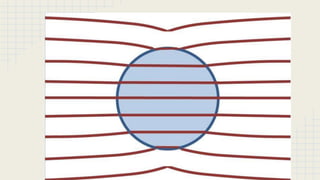
DEMONSTRATION ON MAGNETIC
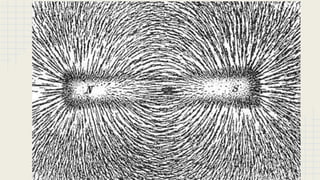
FIELD LINES
Properties of Magnetic Field Lines
The magnetic field lines originate from the North pole of a
magnet and end at its south pole
The magnetic field lines come closer to one another near
the poles of a magnet but they are widely separated at
other places
The magnetic field lines do not intersect one another
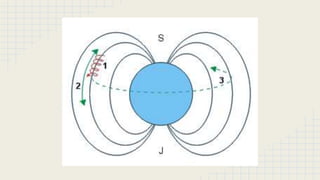
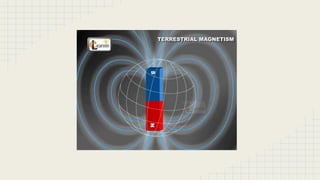
Magnetic Field of Earth
A freely suspended magnet always points in the north-south direction even
in the absence of any other magnetic field.
This suggests that the earth itself behaves as a magnet which causes a
freely suspended magnet to point always in a particular direction
The shape of the earths magnetic field resembles that of an bar magnet
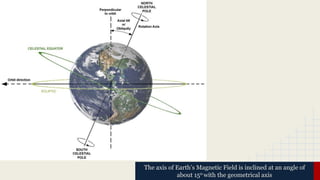
The axis of Earth’s Magnetic Field is inclined at an angle of
about 150 with the geometrical axis
The Earth’s magnetic Field is due to the Magnetic Effect of
Current, which is flowing in the liquid core at the centre of
the earth
Thus, Earth is a huge electromagnet
Why Earth’s Magnetic Field
Questions
1. State any two properties of Magnetic Field lines.
2. (True/False) The axis of earth’s imaginary magnet and the geographical axis
coincide with each other
3. Where do the manufacturers use a magnetic strip in the refrigrator? Why is
this magnetic strip used?
4. Why does a compass needle get deflected when brought near a bar magnet?
ELECTROMAGNETISM
MAGNETIC EFFECTS OF CURRENT
ELECTROMAGNETISM
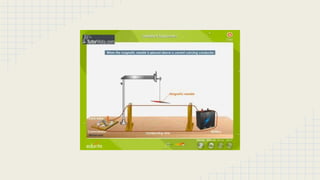
The magnetic effect of current was discovered by oersted in 1820
Oersted found that a wire carrying a current was able to deflect a compass
needle
Compass needle is a tiny magnet which can be deflected only by a magnetic
field
Since, a current carrying wire was able to deflect a compass needle, it was
concluded that a current flowing in a wire always gives rise to a magnetic
field around it
ELECTROMAGNETISM
The importance of magnetic effect of electric current lies in the fact that it
gives rise to mechanical forces
The Electric Motor,
Electric Generator,
Telephone and Radio
All the above devices utilise the magnetic effects of electric current
The magnetic effects of electric current is also called electromagnetism which
means electricity produces magnetism
MAGNETIC FIELD PATTERNS
By current-carrying conductors of various shapes
Magnetic Field due to straight current
carrying wire
Magnetic Field due to straight current
carrying wire
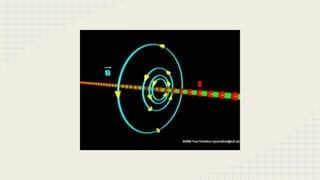
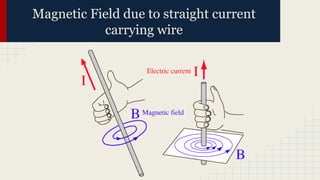
The magnetic field lines around a straight conductor
carrying current are concentric circles whose centres lie
on the wire
The magnitude of magnetic field produced by a straight current carrying
wire at a given point is:
Directly proportional to the current passing in the wire, and
Inversely proportional to the distance of that point from the wire
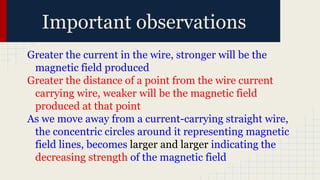
Important observations
Greater the current in the wire, stronger will be the
magnetic field produced
Greater the distance of a point from the wire current
carrying wire, weaker will be the magnetic field
produced at that point
As we move away from a current-carrying straight wire,
the concentric circles around it representing magnetic
field lines, becomes larger and larger indicating the
decreasing strength of the magnetic field
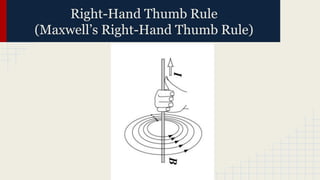
Right-Hand Thumb Rule
(Maxwell’s Right-Hand Thumb Rule)
Direction of Magnetic Field for a straight current
carrying conductor
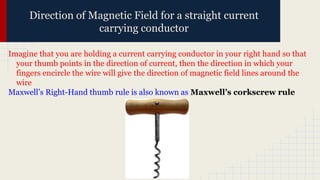
Imagine that you are holding a current carrying conductor in your right hand so that
your thumb points in the direction of current, then the direction in which your
fingers encircle the wire will give the direction of magnetic field lines around the
wire
Maxwell’s Right-Hand thumb rule is also known as Maxwell’s corkscrew rule
Magnetic Field Pattern due to Circular Loop
(Circular Wire)
Important Observations
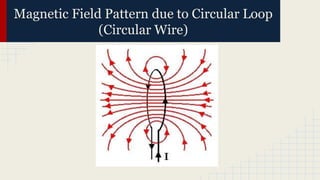
It has been found that the magnetic effect of current increases if instead of
using a straight wire, the wire is converted into a circular loop
Magnetic field lines are circular near the current carrying loop, as we move
away the concentric circles representing magnetic field lines become bigger
and bigger
At the centre of the circular loop, the magnetic field lines are straight
At the centre of the circular loop, all the magnetic field lines are in the same
direction and aid each other, due to which the strength of magnetic field
increases
Important Observations
The magnitude of magnetic field produced by a current-carrying circular loop
at its centre is:
Directly proportional to the current passing through the circular loop and
inversely proportional to the radius of circular loop
How to increase the strength of the magnetic field in
a circular coil ?
The strength of the magnetic field can be increased by taking a
circular coil consisting of a number of turns of insulated copper
wire closely wound together.
If there is a circular coil having n turns, the magnetic field
produced by this current-carrying circular wire will be n times as
large as that produced by a circular loop of a single turn of wire.
Important Observations
The strength of a magnetic field produced by a circular coil carrying current is directly
proportional to both, number of turns (n) and current (I); but inversely proportional to
its radius (r).
The Strength of the magnetic field produced by a current-carrying circular coil can be
increased:
by increasing the number of turns of wire in the coil,
by increasing the current flowing through the coil, and
by decreasing the radius of the coil
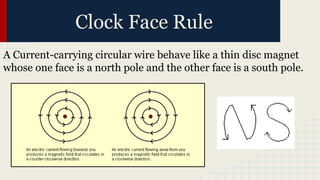
Clock Face Rule
A Current-carrying circular wire behave like a thin disc magnet
whose one face is a north pole and the other face is a south pole.
According to Clock face Rule
If the current in the circular wire is in the clockwise
direction, then that face of the circualar wire will be
South pole
If the current around the face of circular wire flows in the
anticlockwise direction, then that face of the circular
wire will be North pole
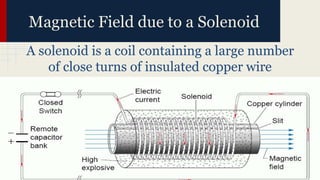
Magnetic Field due to a Solenoid
A solenoid is a coil containing a large number
of close turns of insulated copper wire
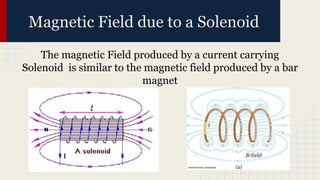
Magnetic Field due to a Solenoid
The magnetic Field produced by a current carrying
Solenoid is similar to the magnetic field produced by a bar
magnet
Important Observations
The lines of the magnetic field pass through the Solenoid and return to the
other end
The magnetic field inside the Solenoid are in the form of parallel straight
lines
This indicates that the strength of the magnetic field is same at all points inside
the solenoid
If the strength of the magnetic field is uniform just same in a region, it is said to
be uniform magnetic field
Thus, magnetic field is uniform inside a currnet carrying Solenoid
Important Observations
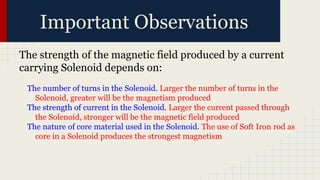
The strength of the magnetic field produced by a current
carrying Solenoid depends on:
The number of turns in the Solenoid. Larger the number of turns in the
Solenoid, greater will be the magnetism produced
The strength of current in the Solenoid. Larger the current passed through
the Solenoid, stronger will be the magnetic field produced
The nature of core material used in the Solenoid. The use of Soft Iron rod as
core in a Solenoid produces the strongest magnetism
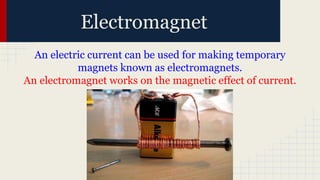
Electromagnet
An electric current can be used for making temporary
magnets known as electromagnets.
An electromagnet works on the magnetic effect of current.
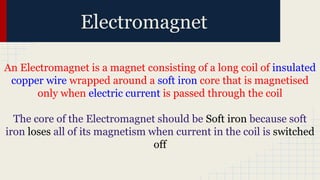
Electromagnet
An Electromagnet is a magnet consisting of a long coil of insulated
copper wire wrapped around a soft iron core that is magnetised
only when electric current is passed through the coil
The core of the Electromagnet should be Soft iron because soft
iron loses all of its magnetism when current in the coil is switched
off
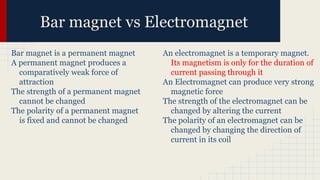
Bar magnet vs Electromagnet
Bar magnet is a permanent magnet
A permanent magnet produces a
comparatively weak force of
attraction
The strength of a permanent magnet
cannot be changed
The polarity of a permanent magnet
is fixed and cannot be changed
An electromagnet is a temporary magnet.
Its magnetism is only for the duration of
current passing through it
An Electromagnet can produce very strong
magnetic force
The strength of the electromagnet can be
changed by altering the current
The polarity of an electromagnet can be
changed by changing the direction of
current in its coil
Permanent magnets are usually made of alloys such as:
Carbon steel, Chromium Steel, Cobalt Steel, Tungsten Steel
and Alnico
Alnico is an alloy of aluminium, nickel, cobalt and iron
Permanent Magnets
Magnetic Fields in Human Body
Extremely weak electric currents are produced in the human body
by the movement of charged particles called ions. These are called
ionic currents.
These create temporary magnetism in the human body. The
magnetism produced in the human body is very very weak
compared to the earth’s magnetic field.
Magnetism in Human Body
The two main organs of the human body where the
magnetic field produced is quite significant are the heart
and the brain
This magnetism forms the basis of a technique called
Magnetic Resonance Imaging (MRI) which is used to
obtain internal parts of our body.
Force on current carrying conductor
placed in a Magnetic Field
Observations from Oersted’s
Experiment
A current-carrying wire exerts a force on a compass needle and deflects it
from its usual north-south position
A current-carrying wire exerts a mechanical force on a magnet, and if the
magnet is free to move, this force can produce a motion in the magnet
A magnet exerts a mechanical force on a current-carrying wire, and if the
wire is free to move, this force can produce a motion in the wire
This can be obtained by applying Newton’s Third Law
Why Force being acted upon a Current
carrying wire in a magnetic field ?
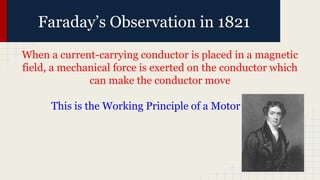
Faraday’s Observation in 1821
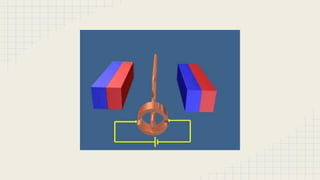
When a current-carrying conductor is placed in a magnetic
field, a mechanical force is exerted on the conductor which
can make the conductor move
This is the Working Principle of a Motor
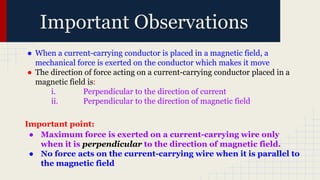
Important Observations
● When a current-carrying conductor is placed in a magnetic field, a
mechanical force is exerted on the conductor which makes it move
● The direction of force acting on a current-carrying conductor placed in a
magnetic field is:
i. Perpendicular to the direction of current
ii. Perpendicular to the direction of magnetic field
Important point:
● Maximum force is exerted on a current-carrying wire only
when it is perpendicular to the direction of magnetic field.
● No force acts on the current-carrying wire when it is parallel to
the magnetic field
Important Observations
The direction of force on a current-carrying conductor placed in a magnetic
field can be reversed by reversing the direction of current flowing in the
conductor
If the direction of current in a conductor and the
direction of magnetic field(in which it is placed), are
known, then the direction of force acting on the
current-carrying conductor can be found out by using
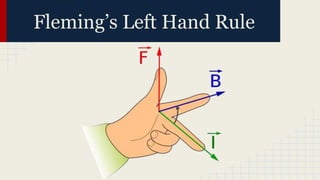
Fleming’s left-hand rule.
Fleming’s Left Hand Rule
Statement
Hold the forefinger, the centre finger and the thumb of your
left hand at right angles to one another.
Adjust your hand in such a way that the forefinger points in
the direction of magnetic field and the centre finger points
in the direction of current in the conductor, then the
direction in which the thumb points gives the direction of
motion of the conductor
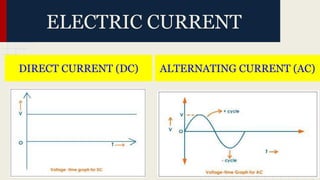
ELECTRIC CURRENT
ALTERNATING CURRENT (AC)DIRECT CURRENT (DC)
Sources of DC & AC
DC
Batteries
Thermocouples
Solar Cells
Dynamo
Direct current is also known as
Galvanic Current
All the electronic devices work
on Direct Current only
AC
AC Generators
All Electrical devices work on
AC Supply
We receive AC supply
Alternating Current can be transmitted
over long distances without much loss
of electrical energy
ADVANTAGES OF AC OVER DC
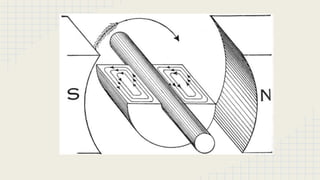
The Electric Motor
Principle, Construction, Working & Applications
THE ELECTRIC MOTOR
A Motor is a device which converts Electrical
energy into Mechanical energy
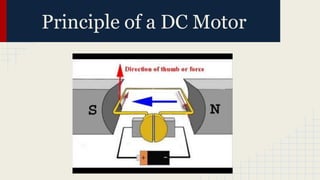
Principle of a DC Motor
Principle of a Motor
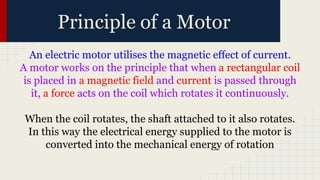
An electric motor utilises the magnetic effect of current.
A motor works on the principle that when a rectangular coil
is placed in a magnetic field and current is passed through
it, a force acts on the coil which rotates it continuously.
When the coil rotates, the shaft attached to it also rotates.
In this way the electrical energy supplied to the motor is
converted into the mechanical energy of rotation
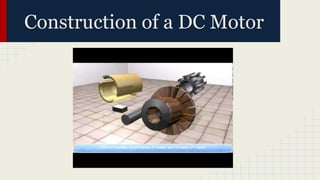
Construction of a DC Motor
Construction of a Motor
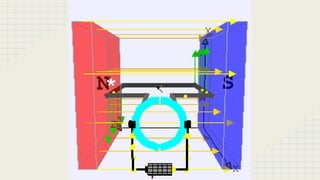
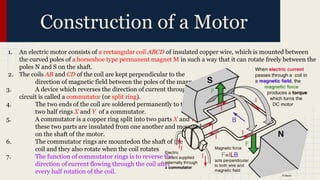
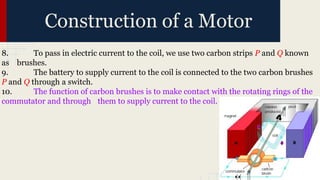
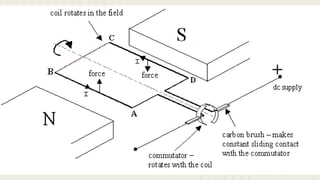
1. An electric motor consists of a rectangular coil ABCD of insulated copper wire, which is mounted between
the curved poles of a horseshoe type permanent magnet M in such a way that it can rotate freely between the
poles N and S on the shaft.
2. The coils AB and CD of the coil are kept perpendicular to the
direction of magnetic field between the poles of the magnet.
3. A device which reverses the direction of current through a
circuit is called a commutator (or split ring).
4. The two ends of the coil are soldered permanently to the
two half rings X and Y of a commutator.
5. A commutator is a copper ring split into two parts X and Y,
these two parts are insulated from one another and mounted
on the shaft of the motor.
6. The commutator rings are mountedon the shaft of the
coil and they also rotate when the coil rotates
7. The function of commutator rings is to reverse the
direction of current flowing through the coil after
every half rotation of the coil.
8. To pass in electric current to the coil, we use two carbon strips P and Q known
as brushes.
9. The battery to supply current to the coil is connected to the two carbon brushes
P and Q through a switch.
10. The function of carbon brushes is to make contact with the rotating rings of the
commutator and through them to supply current to the coil.
Construction of a Motor
Working of a DC Motor
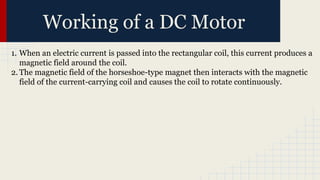
1. When an electric current is passed into the rectangular coil, this current produces a
magnetic field around the coil.
2. The magnetic field of the horseshoe-type magnet then interacts with the magnetic
field of the current-carrying coil and causes the coil to rotate continuously.
APPLICATIONS OF ELECTRIC MOTOR
Every motor has a shaft or spindle which rotates
continuously when current is passed into it.(Into current
carrying conductors)
Electric Motor is used in:
Electric Fans
Washing Machines
Refrigerators
Mixer and Grinder
Electric Cars & many other applications
Lets Test Our Memory
1. What happens when a current-carrying conductor is placed in a magnetic field?
2. When is the force experienced by a current-carrying conductor placed in a magnetic
field largest?
3. In the statement of Fleming’s Left Hand Rule, what do the following represent?
i. Direction of centre finger
ii. Direction of forefinger
iii. Direction of thumb
4. Name the device which converts electrical energy into mechanical energy?
5. What is the role of split rings in an electric motor?
6. What is the function of commutator in an electric motor?
ELECTROMAGNETIC INDUCTION
Electricity from Magnetism
ELECTROMAGNETIC INDUCTION
The production of Electricity from Magnetism is called
Electromagnetic Induction
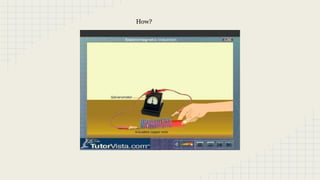
How?
Notes
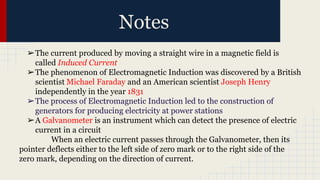
➱The current produced by moving a straight wire in a magnetic field is
called Induced Current
➱The phenomenon of Electromagnetic Induction was discovered by a British
scientist Michael Faraday and an American scientist Joseph Henry
independently in the year 1831
➱The process of Electromagnetic Induction led to the construction of
generators for producing electricity at power stations
➱A Galvanometer is an instrument which can detect the presence of electric
current in a circuit
When an electric current passes through the Galvanometer, then its
pointer deflects either to the left side of zero mark or to the right side of the
zero mark, depending on the direction of current.
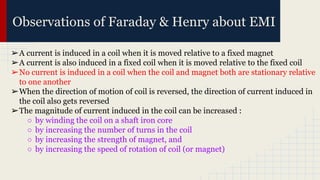
Observations of Faraday & Henry about EMI
➱A current is induced in a coil when it is moved relative to a fixed magnet
➱A current is also induced in a fixed coil when it is moved relative to the fixed coil
➱No current is induced in a coil when the coil and magnet both are stationary relative
to one another
➱When the direction of motion of coil is reversed, the direction of current induced in
the coil also gets reversed
➱The magnitude of current induced in the coil can be increased :
○ by winding the coil on a shaft iron core
○ by increasing the number of turns in the coil
○ by increasing the strength of magnet, and
○ by increasing the speed of rotation of coil (or magnet)
Fleming’s Right-Hand Rule
For the direction of Induced Current
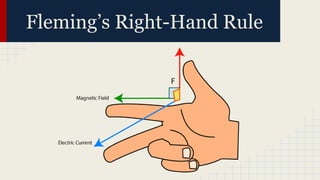
Fleming’s Right-Hand Rule
Statement
Hold the thumb, the forefinger and the centre finger of your
right-hand at right angles to one another.
Adjust your hand in such a way that forefinger points in the
direction of magnetic field, and thumb points in the
direction of motion of conductor, then the direction in
which centre finger points, gives the direction of induced
current in the conductor
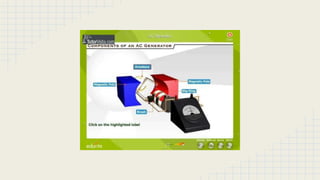
The electrical generator is a machine for producing electric
current or electricity.
This electric generator converts mechanical energy into electrical
energy
Example
Electric Generator
Dynamo
Principle of Electric Generator
Electric Generator is an application of EMI
GENERATORS
AC GENERATORDC GENERATOR
The difference between DC & AC Generators is in their
construction
Domestic Electric Circuits
Domestic Wiring
At the end of Sources of Energy

Electric current and its effects

  • 1.
    Topics covered Electric Charge ElectricCurrent Electric Potential Electrical Resistance Ohm’s Law Series and parallel connection of resistors Electric Power Electric Energy & its commercial Unit Heating Effects of Electric Current
  • 2.
  • 3.
    TYPES OF ELECTRICCHARGES There are two types of Electric Charges: Positive Charges Negative Charges By Convention, The charge acquired by a glass rod is called Positive Charge The charge acquired by an ebonite rod is called Negative Charge Opposite charges (or Unlike charges) attract each other. Similar charges (or Like charges) repel each other.
  • 4.
    SI UNITS OFCHARGE SI Unit of Charge is Coulomb, denoted by C One Coulomb is that quality of electric charge which exerts a force of 9 * 109 N on an equal charge placed at a distance of 1 metre from it. Charge possessed by an electron is 1.6 * 10-19 Coulombs
  • 5.
    Conductors & Insulators Substancesthrough which electricity can flow are called Conductors. Ex: Silver, Copper and Aluminium, etc Those Substances through which electric charges cannot flow, are called Insulators. Ex: Glass, Ebonite, Rubber, most plastics, Paper, Dry wood, Cotton, Mica, Bakelite, Porcelain, and Dry Air
  • 6.
    What makes SubstancesConduct Electricity? The presence of Free Electrons in a substance makes it a conductor. The electrons present in insulators are strongly held by the nuclei of their atoms. So no free electrons in an insulator which can move from one atom to another, an insulator does not allow electric charges to flow through it. Static Electricity ?
  • 7.
    Electric Potential What happenswhen a positive charge is placed in the electric field due to another charge?
  • 8.
    Electric Potential Electric potentialat a point in an electric field is defined as the work done in moving a unit positive charge from infinity to that point.
  • 9.
    Potential Difference The differencebetween two points in an electric circuit is defined as the amount of work done in moving a unit charge from one point to the other point. Potential difference = Work done / Quantity of Charge moved
  • 10.
    Heating Effects ofElectric Current When an electric current is passed through a high resistance wire, like nichrome wire, the resistance wire becomes very hot and produces heat. This is called as the Heating effects of Electric current
  • 12.
  • 13.
    Learning Objectives Magnetic Fieldand Magnetic Field Lines Magnetic Field of Earth Electromagnetism Magnetic field patterns produced by current carrying Conductors of various shapes Electromagnet Difference between Bar Magnet & an Electromagnet Magnetism in Human Body
  • 14.
    Learning Objectives Force ona current carrying conductor placed in a magnetic field Kicking Wire Experiment Fleming’s Left Hand Rule Principle and working of Electric Motor Electromagnetic Induction Fleming’s Right-Hand Rule Electric Generator- AC & DC Generators Domestic Electrical Wiring
  • 15.
    Magnetic Effect ofElectric Current “An electric current flowing in a wire produces a magnetic field around it” Electric Current produces Magnetism
  • 16.
    Magnet & MagneticField A magnet is an object which attracts pieces of iron, steel, nickel and cobalt The space around a magnet in which magnetic force is exerted, is called a magnetic field
  • 18.
    Magnetic Field Lines Thelines drawn in a magnetic field along which a north magnetic pole would move The magnetic field lines are also known as magnetic lines of force The magnetic field lines always begin from the N-pole of magnet and end on the S-pole of the magnet
  • 20.
  • 21.
    Properties of MagneticField Lines The magnetic field lines originate from the North pole of a magnet and end at its south pole The magnetic field lines come closer to one another near the poles of a magnet but they are widely separated at other places The magnetic field lines do not intersect one another
  • 23.
    Magnetic Field ofEarth A freely suspended magnet always points in the north-south direction even in the absence of any other magnetic field. This suggests that the earth itself behaves as a magnet which causes a freely suspended magnet to point always in a particular direction The shape of the earths magnetic field resembles that of an bar magnet
  • 25.
    The axis ofEarth’s Magnetic Field is inclined at an angle of about 150 with the geometrical axis
  • 26.
    The Earth’s magneticField is due to the Magnetic Effect of Current, which is flowing in the liquid core at the centre of the earth Thus, Earth is a huge electromagnet Why Earth’s Magnetic Field
  • 27.
    Questions 1. State anytwo properties of Magnetic Field lines. 2. (True/False) The axis of earth’s imaginary magnet and the geographical axis coincide with each other 3. Where do the manufacturers use a magnetic strip in the refrigrator? Why is this magnetic strip used? 4. Why does a compass needle get deflected when brought near a bar magnet?
  • 29.
  • 30.
    ELECTROMAGNETISM The magnetic effectof current was discovered by oersted in 1820 Oersted found that a wire carrying a current was able to deflect a compass needle Compass needle is a tiny magnet which can be deflected only by a magnetic field Since, a current carrying wire was able to deflect a compass needle, it was concluded that a current flowing in a wire always gives rise to a magnetic field around it
  • 31.
    ELECTROMAGNETISM The importance ofmagnetic effect of electric current lies in the fact that it gives rise to mechanical forces The Electric Motor, Electric Generator, Telephone and Radio All the above devices utilise the magnetic effects of electric current The magnetic effects of electric current is also called electromagnetism which means electricity produces magnetism
  • 33.
    MAGNETIC FIELD PATTERNS Bycurrent-carrying conductors of various shapes
  • 35.
    Magnetic Field dueto straight current carrying wire
  • 36.
    Magnetic Field dueto straight current carrying wire The magnetic field lines around a straight conductor carrying current are concentric circles whose centres lie on the wire The magnitude of magnetic field produced by a straight current carrying wire at a given point is: Directly proportional to the current passing in the wire, and Inversely proportional to the distance of that point from the wire
  • 37.
    Important observations Greater thecurrent in the wire, stronger will be the magnetic field produced Greater the distance of a point from the wire current carrying wire, weaker will be the magnetic field produced at that point As we move away from a current-carrying straight wire, the concentric circles around it representing magnetic field lines, becomes larger and larger indicating the decreasing strength of the magnetic field
  • 38.
  • 39.
    Direction of MagneticField for a straight current carrying conductor Imagine that you are holding a current carrying conductor in your right hand so that your thumb points in the direction of current, then the direction in which your fingers encircle the wire will give the direction of magnetic field lines around the wire Maxwell’s Right-Hand thumb rule is also known as Maxwell’s corkscrew rule
  • 40.
    Magnetic Field Patterndue to Circular Loop (Circular Wire)
  • 41.
    Important Observations It hasbeen found that the magnetic effect of current increases if instead of using a straight wire, the wire is converted into a circular loop Magnetic field lines are circular near the current carrying loop, as we move away the concentric circles representing magnetic field lines become bigger and bigger At the centre of the circular loop, the magnetic field lines are straight At the centre of the circular loop, all the magnetic field lines are in the same direction and aid each other, due to which the strength of magnetic field increases
  • 42.
    Important Observations The magnitudeof magnetic field produced by a current-carrying circular loop at its centre is: Directly proportional to the current passing through the circular loop and inversely proportional to the radius of circular loop
  • 43.
    How to increasethe strength of the magnetic field in a circular coil ? The strength of the magnetic field can be increased by taking a circular coil consisting of a number of turns of insulated copper wire closely wound together. If there is a circular coil having n turns, the magnetic field produced by this current-carrying circular wire will be n times as large as that produced by a circular loop of a single turn of wire.
  • 44.
    Important Observations The strengthof a magnetic field produced by a circular coil carrying current is directly proportional to both, number of turns (n) and current (I); but inversely proportional to its radius (r). The Strength of the magnetic field produced by a current-carrying circular coil can be increased: by increasing the number of turns of wire in the coil, by increasing the current flowing through the coil, and by decreasing the radius of the coil
  • 45.
    Clock Face Rule ACurrent-carrying circular wire behave like a thin disc magnet whose one face is a north pole and the other face is a south pole.
  • 46.
    According to Clockface Rule If the current in the circular wire is in the clockwise direction, then that face of the circualar wire will be South pole If the current around the face of circular wire flows in the anticlockwise direction, then that face of the circular wire will be North pole
  • 47.
    Magnetic Field dueto a Solenoid A solenoid is a coil containing a large number of close turns of insulated copper wire
  • 48.
    Magnetic Field dueto a Solenoid The magnetic Field produced by a current carrying Solenoid is similar to the magnetic field produced by a bar magnet
  • 49.
    Important Observations The linesof the magnetic field pass through the Solenoid and return to the other end The magnetic field inside the Solenoid are in the form of parallel straight lines This indicates that the strength of the magnetic field is same at all points inside the solenoid If the strength of the magnetic field is uniform just same in a region, it is said to be uniform magnetic field Thus, magnetic field is uniform inside a currnet carrying Solenoid
  • 50.
    Important Observations The strengthof the magnetic field produced by a current carrying Solenoid depends on: The number of turns in the Solenoid. Larger the number of turns in the Solenoid, greater will be the magnetism produced The strength of current in the Solenoid. Larger the current passed through the Solenoid, stronger will be the magnetic field produced The nature of core material used in the Solenoid. The use of Soft Iron rod as core in a Solenoid produces the strongest magnetism
  • 51.
    Electromagnet An electric currentcan be used for making temporary magnets known as electromagnets. An electromagnet works on the magnetic effect of current.
  • 52.
    Electromagnet An Electromagnet isa magnet consisting of a long coil of insulated copper wire wrapped around a soft iron core that is magnetised only when electric current is passed through the coil The core of the Electromagnet should be Soft iron because soft iron loses all of its magnetism when current in the coil is switched off
  • 53.
    Bar magnet vsElectromagnet Bar magnet is a permanent magnet A permanent magnet produces a comparatively weak force of attraction The strength of a permanent magnet cannot be changed The polarity of a permanent magnet is fixed and cannot be changed An electromagnet is a temporary magnet. Its magnetism is only for the duration of current passing through it An Electromagnet can produce very strong magnetic force The strength of the electromagnet can be changed by altering the current The polarity of an electromagnet can be changed by changing the direction of current in its coil
  • 54.
    Permanent magnets areusually made of alloys such as: Carbon steel, Chromium Steel, Cobalt Steel, Tungsten Steel and Alnico Alnico is an alloy of aluminium, nickel, cobalt and iron Permanent Magnets
  • 55.
    Magnetic Fields inHuman Body Extremely weak electric currents are produced in the human body by the movement of charged particles called ions. These are called ionic currents. These create temporary magnetism in the human body. The magnetism produced in the human body is very very weak compared to the earth’s magnetic field.
  • 56.
    Magnetism in HumanBody The two main organs of the human body where the magnetic field produced is quite significant are the heart and the brain This magnetism forms the basis of a technique called Magnetic Resonance Imaging (MRI) which is used to obtain internal parts of our body.
  • 57.
    Force on currentcarrying conductor placed in a Magnetic Field
  • 58.
    Observations from Oersted’s Experiment Acurrent-carrying wire exerts a force on a compass needle and deflects it from its usual north-south position A current-carrying wire exerts a mechanical force on a magnet, and if the magnet is free to move, this force can produce a motion in the magnet A magnet exerts a mechanical force on a current-carrying wire, and if the wire is free to move, this force can produce a motion in the wire This can be obtained by applying Newton’s Third Law
  • 59.
    Why Force beingacted upon a Current carrying wire in a magnetic field ?
  • 60.
    Faraday’s Observation in1821 When a current-carrying conductor is placed in a magnetic field, a mechanical force is exerted on the conductor which can make the conductor move This is the Working Principle of a Motor
  • 63.
    Important Observations ● Whena current-carrying conductor is placed in a magnetic field, a mechanical force is exerted on the conductor which makes it move ● The direction of force acting on a current-carrying conductor placed in a magnetic field is: i. Perpendicular to the direction of current ii. Perpendicular to the direction of magnetic field Important point: ● Maximum force is exerted on a current-carrying wire only when it is perpendicular to the direction of magnetic field. ● No force acts on the current-carrying wire when it is parallel to the magnetic field
  • 65.
    Important Observations The directionof force on a current-carrying conductor placed in a magnetic field can be reversed by reversing the direction of current flowing in the conductor If the direction of current in a conductor and the direction of magnetic field(in which it is placed), are known, then the direction of force acting on the current-carrying conductor can be found out by using Fleming’s left-hand rule.
  • 66.
  • 67.
    Statement Hold the forefinger,the centre finger and the thumb of your left hand at right angles to one another. Adjust your hand in such a way that the forefinger points in the direction of magnetic field and the centre finger points in the direction of current in the conductor, then the direction in which the thumb points gives the direction of motion of the conductor
  • 68.
    ELECTRIC CURRENT ALTERNATING CURRENT(AC)DIRECT CURRENT (DC)
  • 69.
    Sources of DC& AC DC Batteries Thermocouples Solar Cells Dynamo Direct current is also known as Galvanic Current All the electronic devices work on Direct Current only AC AC Generators All Electrical devices work on AC Supply We receive AC supply
  • 70.
    Alternating Current canbe transmitted over long distances without much loss of electrical energy ADVANTAGES OF AC OVER DC
  • 71.
    The Electric Motor Principle,Construction, Working & Applications
  • 72.
    THE ELECTRIC MOTOR AMotor is a device which converts Electrical energy into Mechanical energy
  • 73.
  • 74.
    Principle of aMotor An electric motor utilises the magnetic effect of current. A motor works on the principle that when a rectangular coil is placed in a magnetic field and current is passed through it, a force acts on the coil which rotates it continuously. When the coil rotates, the shaft attached to it also rotates. In this way the electrical energy supplied to the motor is converted into the mechanical energy of rotation
  • 75.
  • 77.
    Construction of aMotor 1. An electric motor consists of a rectangular coil ABCD of insulated copper wire, which is mounted between the curved poles of a horseshoe type permanent magnet M in such a way that it can rotate freely between the poles N and S on the shaft. 2. The coils AB and CD of the coil are kept perpendicular to the direction of magnetic field between the poles of the magnet. 3. A device which reverses the direction of current through a circuit is called a commutator (or split ring). 4. The two ends of the coil are soldered permanently to the two half rings X and Y of a commutator. 5. A commutator is a copper ring split into two parts X and Y, these two parts are insulated from one another and mounted on the shaft of the motor. 6. The commutator rings are mountedon the shaft of the coil and they also rotate when the coil rotates 7. The function of commutator rings is to reverse the direction of current flowing through the coil after every half rotation of the coil.
  • 78.
    8. To passin electric current to the coil, we use two carbon strips P and Q known as brushes. 9. The battery to supply current to the coil is connected to the two carbon brushes P and Q through a switch. 10. The function of carbon brushes is to make contact with the rotating rings of the commutator and through them to supply current to the coil. Construction of a Motor
  • 80.
    Working of aDC Motor 1. When an electric current is passed into the rectangular coil, this current produces a magnetic field around the coil. 2. The magnetic field of the horseshoe-type magnet then interacts with the magnetic field of the current-carrying coil and causes the coil to rotate continuously.
  • 81.
    APPLICATIONS OF ELECTRICMOTOR Every motor has a shaft or spindle which rotates continuously when current is passed into it.(Into current carrying conductors) Electric Motor is used in: Electric Fans Washing Machines Refrigerators Mixer and Grinder Electric Cars & many other applications
  • 82.
    Lets Test OurMemory 1. What happens when a current-carrying conductor is placed in a magnetic field? 2. When is the force experienced by a current-carrying conductor placed in a magnetic field largest? 3. In the statement of Fleming’s Left Hand Rule, what do the following represent? i. Direction of centre finger ii. Direction of forefinger iii. Direction of thumb 4. Name the device which converts electrical energy into mechanical energy? 5. What is the role of split rings in an electric motor? 6. What is the function of commutator in an electric motor?
  • 83.
  • 84.
    ELECTROMAGNETIC INDUCTION The productionof Electricity from Magnetism is called Electromagnetic Induction
  • 85.
  • 86.
    Notes ➱The current producedby moving a straight wire in a magnetic field is called Induced Current ➱The phenomenon of Electromagnetic Induction was discovered by a British scientist Michael Faraday and an American scientist Joseph Henry independently in the year 1831 ➱The process of Electromagnetic Induction led to the construction of generators for producing electricity at power stations ➱A Galvanometer is an instrument which can detect the presence of electric current in a circuit When an electric current passes through the Galvanometer, then its pointer deflects either to the left side of zero mark or to the right side of the zero mark, depending on the direction of current.
  • 87.
    Observations of Faraday& Henry about EMI ➱A current is induced in a coil when it is moved relative to a fixed magnet ➱A current is also induced in a fixed coil when it is moved relative to the fixed coil ➱No current is induced in a coil when the coil and magnet both are stationary relative to one another ➱When the direction of motion of coil is reversed, the direction of current induced in the coil also gets reversed ➱The magnitude of current induced in the coil can be increased : ○ by winding the coil on a shaft iron core ○ by increasing the number of turns in the coil ○ by increasing the strength of magnet, and ○ by increasing the speed of rotation of coil (or magnet)
  • 88.
    Fleming’s Right-Hand Rule Forthe direction of Induced Current
  • 89.
  • 90.
    Statement Hold the thumb,the forefinger and the centre finger of your right-hand at right angles to one another. Adjust your hand in such a way that forefinger points in the direction of magnetic field, and thumb points in the direction of motion of conductor, then the direction in which centre finger points, gives the direction of induced current in the conductor
  • 91.
    The electrical generatoris a machine for producing electric current or electricity. This electric generator converts mechanical energy into electrical energy Example Electric Generator Dynamo
  • 92.
    Principle of ElectricGenerator Electric Generator is an application of EMI
  • 93.
    GENERATORS AC GENERATORDC GENERATOR Thedifference between DC & AC Generators is in their construction
  • 95.
  • 96.
    At the endof Sources of Energy