 Economical Importance Of Forests
 Environmental Importance Of Forests
 Ecological Importance Of Forests
 Religious Importance Of Forests
Introductio
n
A forest is a type of ecosystem in which there is high
density of trees occupying a relatively large area of
land. An ecosystem is an ecological unit consisting of a
biotic community together with it’s a biotic
environment. In the case of a forest, trees dominate
the biotic landscape, although there are also other
plants and animals. There are many types of forest,
such as rainforests and temperate hardwood forest.
Forests provide innumerable values to people, provide
aspects that address both physical needs as well as the
internal nature of people .
FOREST PRESERVATION
Environmental activists consider forests as one of
the top 5 natural resources on earth. This is rightly
so, and today, we shall look at how wonderful our
forests are to us, and why we should immediately
stop its' destruction. There is more to forests than
just a massive collection of trees. It is a natural,
complex ecosystem, made up of a wide variety of
trees, that support a massive range of life forms.
Quiet apart from trees, forests also include the soils
that support the trees, the water bodies that run
through them and even the atmosphere (air)
around them. Forests of the world are a natural
wonder that humans have sadly taken for granted.
Forests come in many sizes and forms. For example,
the piece of land with huge trees and many
animals, birds and water bodies running through it
in a part of Kenya can be called a forest. In the same
way, the large belt of thick, evergreen trees running
from Peru to Brazil (called the Amazon Rain
Forest) is also a forest. A good example is the
Amazon Rain Forest.
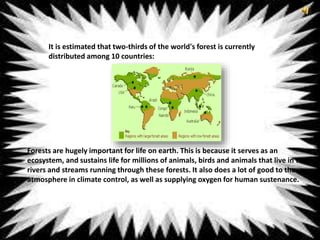
It is estimated that two-thirds of the world's forest is currently
distributed among 10 countries:
Forests are hugely important for life on earth. This is because it serves as an
ecosystem, and sustains life for millions of animals, birds and animals that live in the
rivers and streams running through these forests. It also does a lot of good to the
atmosphere in climate control, as well as supplying oxygen for human sustenance.
…
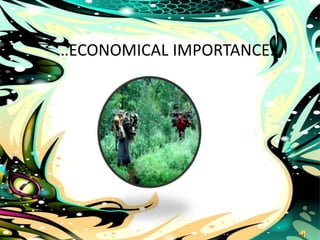
…ECONOMICAL IMPORTANCE…
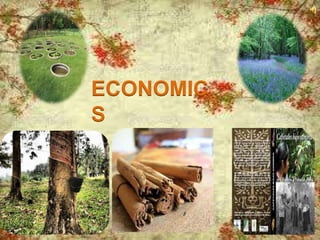
Forests have obvious economic significance
through the provision of timber and wood.
In addition, non-timber products like rubber,
cotton, medicinal products, and food represent
significant economic value.
Even more important is fuel wood and fodder,
especially in developing nations, where people
depend on wood almost entirely for their household
energy.
Given the immense economic benefit of forests,
the demand for commercial timber and other
products is ever increasing.
Already, there are signs of a growing shortage of
tropical hardwoods. This is due to over-harvesting of
timber, but also increasing demands from a growing
human population, agriculture, mining and water
storage.
•Forests accumulate large amounts of standing biomass, and many
are capable of accumulating it at high rates, i.e. they are highly
productive. Such high levels of biomass and tall vertical structures
represent large stores of potential energy that can be converted
to kinetic energy under the right circumstances.
•Two such conversions of great importance are fires and tree falls,
both of which radically alter the biota and the physical
environment where they occur.
•Also, in forests of high productivity, the rapid growth of the trees
themselves induces biotic and environmental changes, although at
a slower rate and lower intensity than relatively
instantaneous disturbances such as fires.
FOREST ECONOMIC THEORY
 Even –Aged Forest Economic Optimization:
Maximize soil expectation value - returns to
the land, given price of inputs and outputs
and a discount rate.
Key results in optimization:
•Stand value decreases with distance to mill.
•Optimal harvest age increases with distance to mill.
The classical Faustian model of optimal forest rotation shows in some
cases a positive relationship between optimal harvest age and distance to
mill, because of the complex interaction between land value, distance to
mill, and stumpage price.
The same model would prescribe that stands growing on lower quality
sites are optimally grown to later ages than stands on high-quality sites.
Also, stands very far from mills have no economic value and are not
economically managed and sometimes not even economically harvested.
The same goes for stands growing on difficult to harvest sites such as
steep slopes or wet soils.
We offer one additional comment. If a stand is close to a mill that
consumes large-diameter material only, then there might be an incentive
for forest managers to not cut the tree until it reaches larger diameters,
since economic value may be maximized this way.
 In a sense, the rate of value increase is higher for those stands, meaning
that it might be optimal to cut the stand at a later age than one far from
such a mill; but this economic incentive hinges on many factors, including
species physical growth rates, the differential between the large diameter
and smaller diameter product market prices, and how being close to that
mill affects land value.
ECONOMIC
S
ECOLOGICAL
IMPORTANCE
THE POLICY ADJUSTMENTS, FOREST MANAGEMENT PROGRAMMES
CONTINUE TO BE DESTABILIZED BY POLICIES THAT ENCOURAGE:
 Inappropriate concession agreements that allow uncontrolled log
harvesting beyond sustainable levels; poorly drafted forestry
regulations that compromise sustainable forest practices; lack of
enforcement of sound regulations; and excessive incentives to
forest product industries resulting in inadequate investment in
wood processing capacity.
 Land tenure policies that encourage deforestation, particularly
tendril rules that assign property rights over public forests to
private parties on condition that such lands are `developed' or
`improved'. Such rules have facilitated small farmer expansion
into forests, and in some countries have been used by wealthy
parties to amass large holdings for speculative reasons.
 Absence of national land-use policy that would guide land
allocation according to land capability and environment impact
considerations, including excisions of forest land for
inappropriate alternative usage.
 Pricing policies and investment priorities biased in favor of
agriculture, and farm policies that favor large farmers over
smallholders all of which ultimately retard the demographic
transition, make rural populations more dependent on natural
forests for subsistence needs, and increase the concentration of
agricultural landholdings.
 Pricing policies and investment priorities biased in favor of agriculture,
and farm policies that favor large farmers over smallholders all of which
ultimately retard the demographic transition, make rural populations more
dependent on natural forests for subsistence needs, and increase the
concentration of agricultural landholdings.
Subsidy programmers that provide financial aid to private investors
through low interest loans and tax breaks that boost the profitability of
agriculture or ranching.
Low logging fees in public forests, and the charges that encourage
licensees to harvest selectively, taking only the most valuable stems.
Consequently, larger areas are harvested to meet timber demands, opening
up more of the forest to shifting cultivators, while severely damaging
residual trees by logging operations.
Policies that lead to inadequate valuation of non-traded forest products
hence most woodland products that have non-market values, including
subsistence production and non-marketable or non-use values based on
ecological, spiritual or aesthetic benefits, remain
PROTECTIVE AND
ENVIRONMENTAL ROLE OF
FORESTS
 The forest can deliver the functions of protection or conservation
expected from it only if it is either in its natural state and under good
natural ecological conditions or, when in use, it is managed in a
sustainable manner.
 Under such conditions, health and vitality are very important. It is the
vitality of forests that allows them to grow with sufficient strength and
vigor in a way that will counter physical forces affecting soils through
water erosion. It is this same vigor that allows a well-structured
architecture and rich foliage that can counter wind erosion.
 The health of forests is fundamental to many of their environmental
functions.
 However, forests are often affected by insects and other pests. They may
be affected by a number of physiological alterations depending on
climate changes, especially droughts. With health, vitality and a proper
state of conservation, management and development secured. the forest
intervenes especially in the following major environmental and
protective functions.
FORESTS IN THE CONSERVATION AND
SUSTAINABLE DEVELOPMENT OF
DRYLANDS
• Trees and forests in dry regions have truly multiple
functions. They provide a number of services that
tend to buffer the harsh conditions and processes
prevailing in dry zones especially in tropical areas.
• The environmental functions of trees and forests
under dry conditions relate to a number of aspects,
including the wellbeing of humans and animals, the
productivity of cropland, the overall protection of
land and water resources and the conservation of
biological diversity.
• Bertha (1997), through Malian examples and lessons
of universal value, has identified the many roles of
forestry in dry lands highlighting prerequisites to, and
results of, well-guided forestry-related activities in
the rehabilitation of natural resources and, especially,
desertification control.
• He mentions the importance of training and technical
advice and extension for rural populations; the
improvement of the knowledge base of resources;
the need for promoting new technologies; the major
involvement of interested people; and the Revolution
of responsibilities to their organizations.
RELIGIOUS IMPORTANCE
THE CULTURAL AND SYMBOLIC IMPORTANCE
OF FOREST RESOURCES
 The variety of cultural values and symbolic functions
ascribed to the forests are as numerous and diverse as the
communities and cultures of the region.
 Physically and mystically forests have defined the
environment of communities in the region throughout time.
 The distinction that has been made between cultural values
and the forest’s functions is actually an artificial one.
 TANGIBLY AND INTANGIBLY, forests feature in all aspects of
culture: language, history, art, religion, medicine,
politics, and even social structure itself.
TANGIBLE AND INTANGIBLE FOREST
 Tangibly and intangibly, forests feature in all aspects of culture: language,
history, art, religion, medicine, politics, and even social structure itself.
 Forest trees may house the spirits of ancestors as well as those of the newborn.
And forests are viewed in both positive and negative lights as sources of evil as
well as power and munificence, as providers for, and hindrances to
development.
 The mystical qualities of specific forest resources often play a crucial role in
traditional healing practices. Forests provide the venue for religious, social, and
healing ceremonies.
 Forest products such as tam-tams and forest foods such as palm wine are used
in many ceremonies.
 Assessing the myriad of symbolic and cultural values of forests goes far beyond
the scope of this study.
 However, this does not diminish their importance in terms of the value people
place on forests and forest
THE TREE’S SIGNIFICANCE AS A LINK TO
CULTURE AND BELIEF
 Forest trees, the links between the sky and earth, often symbolize links
between the spiritual world of ancestors and people. Rituals and
ceremonies which draw on forest symbols often serve to link people
with their cultural heritage, as well as their ancestral past
Calame-Giraule 1969, 1970).
 Trees play a role in all facets and periods of West African peoples’ lives.
The Ubangi (Centre Enrique) plant a tree in the bush for a newborn child.
For female children a fast-growing profuse fruiter is planted.
 The child’s development is linked to the growth of the tree. If tree
growth declines, people fear for the health of the child and a healer is
called upon.
 When the child is sick it is brought to the tree for treatment. When the
tree begins to fruit, the time will have come for the child to marry.
Throughout a person’s life, gifts are occasionally left for the tree. When
someone dies their spirit goes to reside in their personal “birthright”
tree (Vergas1969).
 http://www.eolss.net/sample-chapters/c10/e5-03-01-07.pdf
 http://www.fao.org/docrep/w6251e/w6251e06.htm#topofpage
 http://www.fao.org/docrep/t9450e/t9450e06.htm
 http://planningcommission.nic.in/plans/planrel/fiveyr/10th/volume2/v
2_ch9_1.pdf
 http://wwf.panda.org/about_our_earth/about_forests/importance/
 http://www.infoplease.com/encyclopedia/science/forest-the-
importance-forests.html
 http://encyclopediaofforestry.org/index.php/forest_economics
 https://www.cbd.int/financial/values/g-valueforestpearce.pdf
 http://www.indiaenvironmentportal.org.in/files/forestry%20in%20ancie
nt%20india.pdf
Important of forests

Important of forests

  • 3.
     Economical ImportanceOf Forests  Environmental Importance Of Forests  Ecological Importance Of Forests  Religious Importance Of Forests
  • 4.
    Introductio n A forest isa type of ecosystem in which there is high density of trees occupying a relatively large area of land. An ecosystem is an ecological unit consisting of a biotic community together with it’s a biotic environment. In the case of a forest, trees dominate the biotic landscape, although there are also other plants and animals. There are many types of forest, such as rainforests and temperate hardwood forest. Forests provide innumerable values to people, provide aspects that address both physical needs as well as the internal nature of people .
  • 5.
    FOREST PRESERVATION Environmental activistsconsider forests as one of the top 5 natural resources on earth. This is rightly so, and today, we shall look at how wonderful our forests are to us, and why we should immediately stop its' destruction. There is more to forests than just a massive collection of trees. It is a natural, complex ecosystem, made up of a wide variety of trees, that support a massive range of life forms. Quiet apart from trees, forests also include the soils that support the trees, the water bodies that run through them and even the atmosphere (air) around them. Forests of the world are a natural wonder that humans have sadly taken for granted. Forests come in many sizes and forms. For example, the piece of land with huge trees and many animals, birds and water bodies running through it in a part of Kenya can be called a forest. In the same way, the large belt of thick, evergreen trees running from Peru to Brazil (called the Amazon Rain Forest) is also a forest. A good example is the Amazon Rain Forest.
  • 6.
    It is estimatedthat two-thirds of the world's forest is currently distributed among 10 countries: Forests are hugely important for life on earth. This is because it serves as an ecosystem, and sustains life for millions of animals, birds and animals that live in the rivers and streams running through these forests. It also does a lot of good to the atmosphere in climate control, as well as supplying oxygen for human sustenance.
  • 7.
  • 8.
    Forests have obviouseconomic significance through the provision of timber and wood. In addition, non-timber products like rubber, cotton, medicinal products, and food represent significant economic value. Even more important is fuel wood and fodder, especially in developing nations, where people depend on wood almost entirely for their household energy. Given the immense economic benefit of forests, the demand for commercial timber and other products is ever increasing. Already, there are signs of a growing shortage of tropical hardwoods. This is due to over-harvesting of timber, but also increasing demands from a growing human population, agriculture, mining and water storage.
  • 9.
    •Forests accumulate largeamounts of standing biomass, and many are capable of accumulating it at high rates, i.e. they are highly productive. Such high levels of biomass and tall vertical structures represent large stores of potential energy that can be converted to kinetic energy under the right circumstances. •Two such conversions of great importance are fires and tree falls, both of which radically alter the biota and the physical environment where they occur. •Also, in forests of high productivity, the rapid growth of the trees themselves induces biotic and environmental changes, although at a slower rate and lower intensity than relatively instantaneous disturbances such as fires.
  • 10.
    FOREST ECONOMIC THEORY Even –Aged Forest Economic Optimization: Maximize soil expectation value - returns to the land, given price of inputs and outputs and a discount rate. Key results in optimization: •Stand value decreases with distance to mill. •Optimal harvest age increases with distance to mill.
  • 11.
    The classical Faustianmodel of optimal forest rotation shows in some cases a positive relationship between optimal harvest age and distance to mill, because of the complex interaction between land value, distance to mill, and stumpage price. The same model would prescribe that stands growing on lower quality sites are optimally grown to later ages than stands on high-quality sites. Also, stands very far from mills have no economic value and are not economically managed and sometimes not even economically harvested. The same goes for stands growing on difficult to harvest sites such as steep slopes or wet soils. We offer one additional comment. If a stand is close to a mill that consumes large-diameter material only, then there might be an incentive for forest managers to not cut the tree until it reaches larger diameters, since economic value may be maximized this way.  In a sense, the rate of value increase is higher for those stands, meaning that it might be optimal to cut the stand at a later age than one far from such a mill; but this economic incentive hinges on many factors, including species physical growth rates, the differential between the large diameter and smaller diameter product market prices, and how being close to that mill affects land value.
  • 12.
  • 13.
  • 15.
    THE POLICY ADJUSTMENTS,FOREST MANAGEMENT PROGRAMMES CONTINUE TO BE DESTABILIZED BY POLICIES THAT ENCOURAGE:  Inappropriate concession agreements that allow uncontrolled log harvesting beyond sustainable levels; poorly drafted forestry regulations that compromise sustainable forest practices; lack of enforcement of sound regulations; and excessive incentives to forest product industries resulting in inadequate investment in wood processing capacity.  Land tenure policies that encourage deforestation, particularly tendril rules that assign property rights over public forests to private parties on condition that such lands are `developed' or `improved'. Such rules have facilitated small farmer expansion into forests, and in some countries have been used by wealthy parties to amass large holdings for speculative reasons.  Absence of national land-use policy that would guide land allocation according to land capability and environment impact considerations, including excisions of forest land for inappropriate alternative usage.  Pricing policies and investment priorities biased in favor of agriculture, and farm policies that favor large farmers over smallholders all of which ultimately retard the demographic transition, make rural populations more dependent on natural forests for subsistence needs, and increase the concentration of agricultural landholdings.
  • 16.
     Pricing policiesand investment priorities biased in favor of agriculture, and farm policies that favor large farmers over smallholders all of which ultimately retard the demographic transition, make rural populations more dependent on natural forests for subsistence needs, and increase the concentration of agricultural landholdings. Subsidy programmers that provide financial aid to private investors through low interest loans and tax breaks that boost the profitability of agriculture or ranching. Low logging fees in public forests, and the charges that encourage licensees to harvest selectively, taking only the most valuable stems. Consequently, larger areas are harvested to meet timber demands, opening up more of the forest to shifting cultivators, while severely damaging residual trees by logging operations. Policies that lead to inadequate valuation of non-traded forest products hence most woodland products that have non-market values, including subsistence production and non-marketable or non-use values based on ecological, spiritual or aesthetic benefits, remain
  • 20.
    PROTECTIVE AND ENVIRONMENTAL ROLEOF FORESTS  The forest can deliver the functions of protection or conservation expected from it only if it is either in its natural state and under good natural ecological conditions or, when in use, it is managed in a sustainable manner.  Under such conditions, health and vitality are very important. It is the vitality of forests that allows them to grow with sufficient strength and vigor in a way that will counter physical forces affecting soils through water erosion. It is this same vigor that allows a well-structured architecture and rich foliage that can counter wind erosion.  The health of forests is fundamental to many of their environmental functions.  However, forests are often affected by insects and other pests. They may be affected by a number of physiological alterations depending on climate changes, especially droughts. With health, vitality and a proper state of conservation, management and development secured. the forest intervenes especially in the following major environmental and protective functions.
  • 22.
    FORESTS IN THECONSERVATION AND SUSTAINABLE DEVELOPMENT OF DRYLANDS • Trees and forests in dry regions have truly multiple functions. They provide a number of services that tend to buffer the harsh conditions and processes prevailing in dry zones especially in tropical areas. • The environmental functions of trees and forests under dry conditions relate to a number of aspects, including the wellbeing of humans and animals, the productivity of cropland, the overall protection of land and water resources and the conservation of biological diversity. • Bertha (1997), through Malian examples and lessons of universal value, has identified the many roles of forestry in dry lands highlighting prerequisites to, and results of, well-guided forestry-related activities in the rehabilitation of natural resources and, especially, desertification control. • He mentions the importance of training and technical advice and extension for rural populations; the improvement of the knowledge base of resources; the need for promoting new technologies; the major involvement of interested people; and the Revolution of responsibilities to their organizations.
  • 24.
  • 25.
    THE CULTURAL ANDSYMBOLIC IMPORTANCE OF FOREST RESOURCES  The variety of cultural values and symbolic functions ascribed to the forests are as numerous and diverse as the communities and cultures of the region.  Physically and mystically forests have defined the environment of communities in the region throughout time.  The distinction that has been made between cultural values and the forest’s functions is actually an artificial one.  TANGIBLY AND INTANGIBLY, forests feature in all aspects of culture: language, history, art, religion, medicine, politics, and even social structure itself.
  • 26.
    TANGIBLE AND INTANGIBLEFOREST  Tangibly and intangibly, forests feature in all aspects of culture: language, history, art, religion, medicine, politics, and even social structure itself.  Forest trees may house the spirits of ancestors as well as those of the newborn. And forests are viewed in both positive and negative lights as sources of evil as well as power and munificence, as providers for, and hindrances to development.  The mystical qualities of specific forest resources often play a crucial role in traditional healing practices. Forests provide the venue for religious, social, and healing ceremonies.  Forest products such as tam-tams and forest foods such as palm wine are used in many ceremonies.  Assessing the myriad of symbolic and cultural values of forests goes far beyond the scope of this study.  However, this does not diminish their importance in terms of the value people place on forests and forest
  • 27.
    THE TREE’S SIGNIFICANCEAS A LINK TO CULTURE AND BELIEF  Forest trees, the links between the sky and earth, often symbolize links between the spiritual world of ancestors and people. Rituals and ceremonies which draw on forest symbols often serve to link people with their cultural heritage, as well as their ancestral past Calame-Giraule 1969, 1970).  Trees play a role in all facets and periods of West African peoples’ lives. The Ubangi (Centre Enrique) plant a tree in the bush for a newborn child. For female children a fast-growing profuse fruiter is planted.  The child’s development is linked to the growth of the tree. If tree growth declines, people fear for the health of the child and a healer is called upon.  When the child is sick it is brought to the tree for treatment. When the tree begins to fruit, the time will have come for the child to marry. Throughout a person’s life, gifts are occasionally left for the tree. When someone dies their spirit goes to reside in their personal “birthright” tree (Vergas1969).
  • 29.
     http://www.eolss.net/sample-chapters/c10/e5-03-01-07.pdf  http://www.fao.org/docrep/w6251e/w6251e06.htm#topofpage http://www.fao.org/docrep/t9450e/t9450e06.htm  http://planningcommission.nic.in/plans/planrel/fiveyr/10th/volume2/v 2_ch9_1.pdf  http://wwf.panda.org/about_our_earth/about_forests/importance/  http://www.infoplease.com/encyclopedia/science/forest-the- importance-forests.html  http://encyclopediaofforestry.org/index.php/forest_economics  https://www.cbd.int/financial/values/g-valueforestpearce.pdf  https://www.cbd.int/financial/values/g-valueforestpearce.pdf  http://www.indiaenvironmentportal.org.in/files/forestry%20in%20ancie nt%20india.pdf