Office of the
President of
U.S.A
American Political System (Paper-VIII)
Presidential Election Process
Group 5/SEMESTER VI/ 2021-2022/ T.Y.B.A Pol. Sci. 01
Stages of Presidential Election/ Swarup Jadhav A/66
01
Requirements/ Simran Dhawan A/60
Issues / Pratiksha Verma A/92
Presidential Debate/ Omkar Gaikwad A/62
Role of Media in Election/ Saloni Patkar A/81
02
03
04
05
Contents of the Presentation
02
Office of the
President of
U.S.A
SEMESTER 6/ 2021-2022/ T.Y.B.A Pol. Sci.
5
Election to the Office of President of the Oldest
Democracy, Super-power, Economic Giant, and A
Military Power. An Office of Power and
Responsibility. To hold this Office of Power is to Weild
a Double-Edged Sword, Hence the Leader Who Wields
It Has To Be Supreme in Action, Thought, Speech,
Behaviour, Responsibility and Statesmanship.
Thus the Process to Elect a Person to this Office has to
be Stringent, Smooth and Flawless. This presentation
takes you through the Process of Election of the
President of the United States of America
03
Introduction
SEMESTER 6/ 2021-2022/ T.Y.B.A Pol. Sci.
Office of the
President of
U.S.A
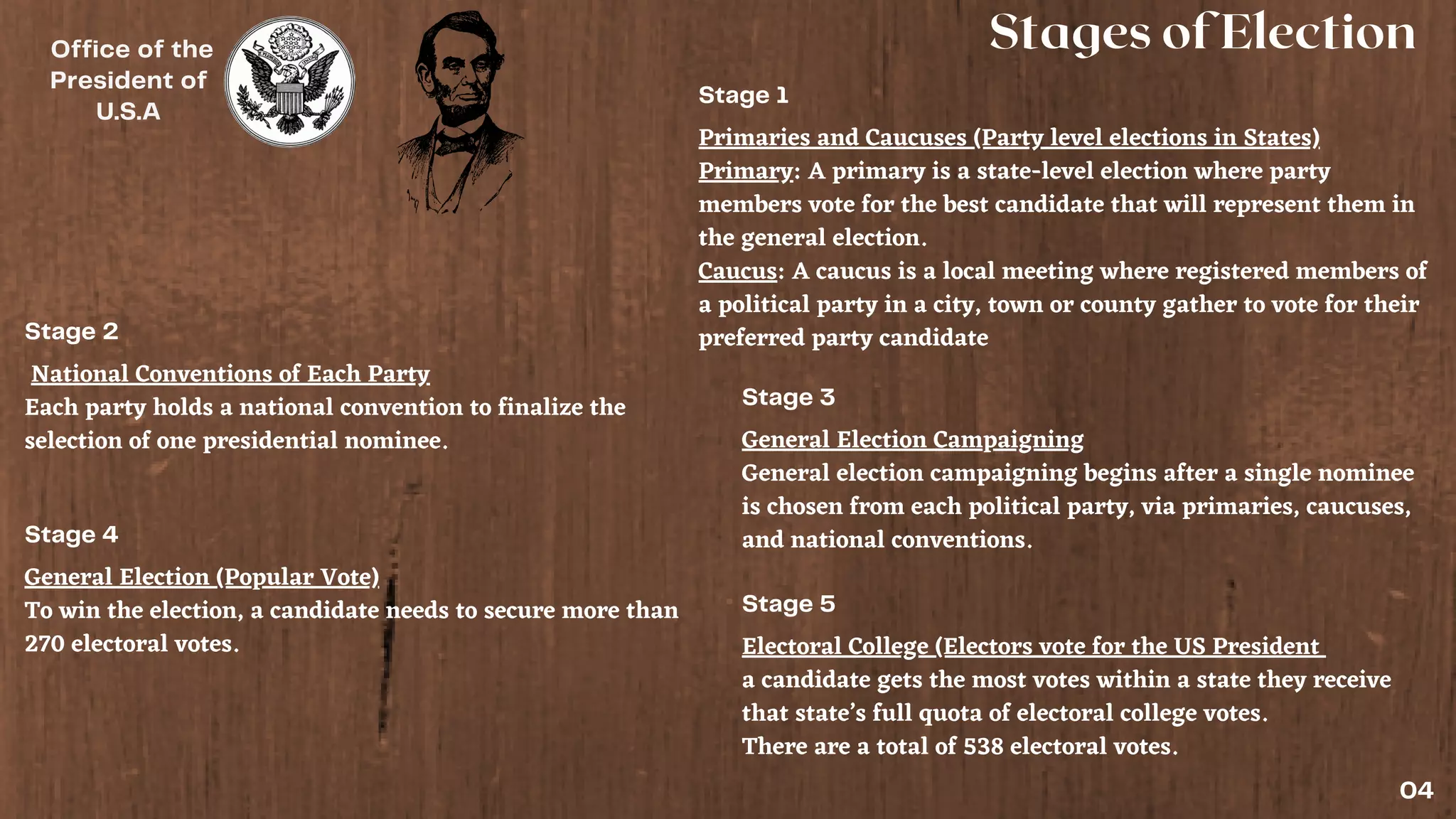
Stages of Election
04
Office of the
President of
U.S.A
Stage 1
Primaries and Caucuses (Party level elections in States)
Primary: A primary is a state-level election where party
members vote for the best candidate that will represent them in
the general election.
Caucus: A caucus is a local meeting where registered members of
a political party in a city, town or county gather to vote for their
preferred party candidate
Stage 2
National Conventions of Each Party
Each party holds a national convention to finalize the
selection of one presidential nominee.
Stage 3
General Election Campaigning
General election campaigning begins after a single nominee
is chosen from each political party, via primaries, caucuses,
and national conventions.
Stage 4
General Election (Popular Vote)
To win the election, a candidate needs to secure more than
270 electoral votes.
Stage 5
Electoral College (Electors vote for the US President
a candidate gets the most votes within a state they receive
that state’s full quota of electoral college votes.
There are a total of 538 electoral votes.
Requirements and Eligibility
05
Office of the
President of
U.S.A
President
The President must:
Be a natural-born citizen of the United States
Be at least 35 years old
A resident of the United States for 14 years
Anyone who meets these requirements can declare their
candidacy for president. Once a candidate raises or spends
more than $5,000 for their campaign, they must register
with the Federal Election Commission.
That includes naming a principal campaign committee to
raise and spend campaign funds.
The Electoral Votes for the majority in the house is 270, with
538 seats in total.
It is important for candidates to campaign in all states, even
ones with smaller populations and fewer electoral votes, in
order to get a total of 270 electoral votes.
Special Situations:
It is possible to win the Electoral College but lose the popular
vote. This happened in 2016, in 2000, and three times in the
1800s.
If no candidate receives the majority of electoral votes, the vote
goes to the House of Representatives. House members choose
the new president from among the top three candidates.
Office of the
President of
U.S.A
06
Presidential Debate
Origin
A tradition that was borne from the Presidential Election Race
between America’s finest President Abraham Lincoln and Stephen A
Douglas. A Tradition that has now become an Event of Importance
in the Presidential Race.
The topics discussed in the debate are often the most controversial
issues of the time, and arguably elections have been nearly decided
by these debates.
First Official Presidential Debate.
The first official Presidential Debate took place in the Election Year
of 1960, between Massachusetts Presidential Candidate John F.
Kennedy (Democrat) Vs. Richard Nixon (Republican).
The People were witness to an intellectual and thoughtful exchange
of ideas in a time when the Civil Rights Movement and the African-
American Rights Movement were in full swing.
Post the Kennedy-Nixon Debate the Presidential debate was not a
part of the Election Race until 1976
Importance of Debate.
The Basic Principle of Democracy is Freedom of Expression and
the duty is of Every Citizen of a Democratic Country to bear
tolerance towards others opinions. Hence the Debate has to be an
integral part of Democracy and the Elections that create the
Leaders of The Democratic Nation.
The basic purpose is to bring forward the policies and opinions of
the Leaders.
Rules and Format
Depending on the agreed format, either the moderator or an
audience member can be the one to ask questions. Typically
there are no opening statements, just closing statements.
A coin toss determines who gets to answer the first question
and who will make their closing remarks first.
Office of the
President of
U.S.A
07
Role of Media in Election
08
Office of the
President of
U.S.A
Educating the masses
Providing a Platform for Election
Campaign
Providing A Platform To Masses For
Voicing Their Opinion
Use of Public/exit polls
Role of new media /social media
Media Bias and False information
1.
2.
3.
4.
5.
6.
Election Issues
09
Office of the
President of
U.S.A
Slavery, Secession, and States’ Rights
The 1860 presidential election turned on a number of issues
including secession; the relationship between the federal
government, states, and territories; and slavery and abolition.
Opposition to Corruption
In 1828, Andrew Jackson campaigned against what he called the
corrupt bargain between John Quincy Adams and Henry Clay
Foreign Policy and Peace
Issues surrounding the aftermath of World War I launched
Warren Harding’s presidency. The wartime boom had collapsed.
Diplomats and politicians were arguing over peace treaties and
the question of America’s entry into the League of Nations.
Gun Control and Gun Rights
The national political debate surrounding mass shootings in the U.S.
has become so predictable in recent years that a frustrating, familiar
pattern emerges when one inevitably happens.
Climate Change
From 16-year-old Greta Thunberg to the Green New Deal, climate
change is in the spotlight, and nearly two-thirds of Americans see
climate change as a crisis or a serious problem.
Immigration
Immigration policy is one of the most divisive issues in this election.
The United States has long been a top destination for foreigners,
attracting roughly 20 per cent of the world’s immigrant population.
Abortion Rights
Abortion has been an issue in presidential campaigns ever since the
1973 Roe v. Wade decision legalizing the procedure nationwide
10
Office of the
President of
U.S.A
https://www.jstor.org/stable/20556862
https://www.loc.gov/classroom-materials/elections/issues-from-past-presidential-campaigns/
https://www.debates.org/
blob:https://web.whatsapp.com/877da0a4-a5ae-47ba-928e-eb5f45f70577
Citations & References
Office of the
President of
U.S.A
11

Presidential Election USA.pdf

  • 1.
    Office of the Presidentof U.S.A American Political System (Paper-VIII) Presidential Election Process Group 5/SEMESTER VI/ 2021-2022/ T.Y.B.A Pol. Sci. 01
  • 2.
    Stages of PresidentialElection/ Swarup Jadhav A/66 01 Requirements/ Simran Dhawan A/60 Issues / Pratiksha Verma A/92 Presidential Debate/ Omkar Gaikwad A/62 Role of Media in Election/ Saloni Patkar A/81 02 03 04 05 Contents of the Presentation 02 Office of the President of U.S.A SEMESTER 6/ 2021-2022/ T.Y.B.A Pol. Sci. 5
  • 3.
    Election to theOffice of President of the Oldest Democracy, Super-power, Economic Giant, and A Military Power. An Office of Power and Responsibility. To hold this Office of Power is to Weild a Double-Edged Sword, Hence the Leader Who Wields It Has To Be Supreme in Action, Thought, Speech, Behaviour, Responsibility and Statesmanship. Thus the Process to Elect a Person to this Office has to be Stringent, Smooth and Flawless. This presentation takes you through the Process of Election of the President of the United States of America 03 Introduction SEMESTER 6/ 2021-2022/ T.Y.B.A Pol. Sci. Office of the President of U.S.A
  • 4.
    Stages of Election 04 Officeof the President of U.S.A Stage 1 Primaries and Caucuses (Party level elections in States) Primary: A primary is a state-level election where party members vote for the best candidate that will represent them in the general election. Caucus: A caucus is a local meeting where registered members of a political party in a city, town or county gather to vote for their preferred party candidate Stage 2 National Conventions of Each Party Each party holds a national convention to finalize the selection of one presidential nominee. Stage 3 General Election Campaigning General election campaigning begins after a single nominee is chosen from each political party, via primaries, caucuses, and national conventions. Stage 4 General Election (Popular Vote) To win the election, a candidate needs to secure more than 270 electoral votes. Stage 5 Electoral College (Electors vote for the US President a candidate gets the most votes within a state they receive that state’s full quota of electoral college votes. There are a total of 538 electoral votes.
  • 5.
    Requirements and Eligibility 05 Officeof the President of U.S.A President The President must: Be a natural-born citizen of the United States Be at least 35 years old A resident of the United States for 14 years Anyone who meets these requirements can declare their candidacy for president. Once a candidate raises or spends more than $5,000 for their campaign, they must register with the Federal Election Commission. That includes naming a principal campaign committee to raise and spend campaign funds. The Electoral Votes for the majority in the house is 270, with 538 seats in total. It is important for candidates to campaign in all states, even ones with smaller populations and fewer electoral votes, in order to get a total of 270 electoral votes. Special Situations: It is possible to win the Electoral College but lose the popular vote. This happened in 2016, in 2000, and three times in the 1800s. If no candidate receives the majority of electoral votes, the vote goes to the House of Representatives. House members choose the new president from among the top three candidates.
  • 6.
    Office of the Presidentof U.S.A 06 Presidential Debate Origin A tradition that was borne from the Presidential Election Race between America’s finest President Abraham Lincoln and Stephen A Douglas. A Tradition that has now become an Event of Importance in the Presidential Race. The topics discussed in the debate are often the most controversial issues of the time, and arguably elections have been nearly decided by these debates. First Official Presidential Debate. The first official Presidential Debate took place in the Election Year of 1960, between Massachusetts Presidential Candidate John F. Kennedy (Democrat) Vs. Richard Nixon (Republican). The People were witness to an intellectual and thoughtful exchange of ideas in a time when the Civil Rights Movement and the African- American Rights Movement were in full swing. Post the Kennedy-Nixon Debate the Presidential debate was not a part of the Election Race until 1976
  • 7.
    Importance of Debate. TheBasic Principle of Democracy is Freedom of Expression and the duty is of Every Citizen of a Democratic Country to bear tolerance towards others opinions. Hence the Debate has to be an integral part of Democracy and the Elections that create the Leaders of The Democratic Nation. The basic purpose is to bring forward the policies and opinions of the Leaders. Rules and Format Depending on the agreed format, either the moderator or an audience member can be the one to ask questions. Typically there are no opening statements, just closing statements. A coin toss determines who gets to answer the first question and who will make their closing remarks first. Office of the President of U.S.A 07
  • 8.
    Role of Mediain Election 08 Office of the President of U.S.A Educating the masses Providing a Platform for Election Campaign Providing A Platform To Masses For Voicing Their Opinion Use of Public/exit polls Role of new media /social media Media Bias and False information 1. 2. 3. 4. 5. 6.
  • 9.
    Election Issues 09 Office ofthe President of U.S.A Slavery, Secession, and States’ Rights The 1860 presidential election turned on a number of issues including secession; the relationship between the federal government, states, and territories; and slavery and abolition. Opposition to Corruption In 1828, Andrew Jackson campaigned against what he called the corrupt bargain between John Quincy Adams and Henry Clay Foreign Policy and Peace Issues surrounding the aftermath of World War I launched Warren Harding’s presidency. The wartime boom had collapsed. Diplomats and politicians were arguing over peace treaties and the question of America’s entry into the League of Nations.
  • 10.
    Gun Control andGun Rights The national political debate surrounding mass shootings in the U.S. has become so predictable in recent years that a frustrating, familiar pattern emerges when one inevitably happens. Climate Change From 16-year-old Greta Thunberg to the Green New Deal, climate change is in the spotlight, and nearly two-thirds of Americans see climate change as a crisis or a serious problem. Immigration Immigration policy is one of the most divisive issues in this election. The United States has long been a top destination for foreigners, attracting roughly 20 per cent of the world’s immigrant population. Abortion Rights Abortion has been an issue in presidential campaigns ever since the 1973 Roe v. Wade decision legalizing the procedure nationwide 10 Office of the President of U.S.A
  • 11.