THE ELECTORAL
PROCESS
Chapter 7
ELECTION TIME

 “A politician thinks of the next election. A statesman, of the next
  generation.”
                            ~James Freeman Clarke


 “Each candidate behaved well in the hope of being judged worthy
  of election. However, this system was disastrous when the city
  had become corrupt. For then it was not the most virtuous but the
  most powerful who stood foe election, and the weak, even if
  virtuous, were too frightened to run for office.”
                                 ~Niccolo Machiavelli
NOMINATION PROCESS
 The critical first step in the electoral process.
 The nomination process narrows the field of possible candidates
  for office.
 NOMINATION-the naming of those who will seek office
    We‟ve seen the nomination process acting as a proponent
      factor for the decentralizing of the two major political parties
 A very real impact on the electorate‟s right to vote
    Limiting the voting stage to TWO choices
       1. Republicans
       2. Democrats
 Those who make it…can have a significant effect in government
NOMINATION PROCESS
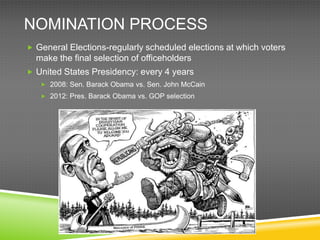
 General Elections-regularly scheduled elections at which voters
  make the final selection of officeholders
 United States Presidency: every 4 years
    2008: Sen. Barack Obama vs. Sen. John McCain
    2012: Pres. Barack Obama vs. GOP selection
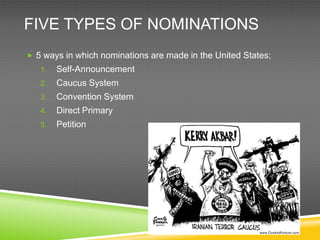
FIVE TYPES OF NOMINATIONS
 5 ways in which nominations are made in the United States;
   1.   Self-Announcement
   2.   Caucus System
   3.   Convention System
   4.   Direct Primary
   5.   Petition
SELF-ANNOUNCEMENT
 The oldest form of the nomination process
    First used in colonial times
    Used at the small town & rural levels
 A person who wants to run for office simply announces that fact.
 Many of the times used by a candidate who failed to win a regular
  party nomination or someone unhappy with the party‟s choice
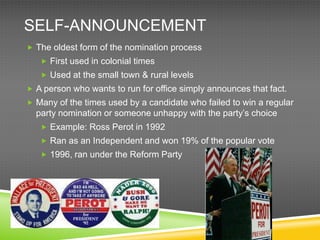
    Example: Ross Perot in 1992
    Ran as an Independent and won 19% of the popular vote
    1996, ran under the Reform Party
THE CAUCUS SYSTEM
 A Caucus-a group of like-minded people who meet to select the
  candidates they will support in an upcoming election
 Caucuses are party meetings by precinct, district, or county,
  where registered party members gather to discuss the candidates
  and to select delegates to the next round of party conventions.
    Caucuses are open to any registered voter in a party, although
      experts say the process is dominated by party activists.
    Any voter registered with a party can participate in a caucus.
    19 states hold caucuses, either for one party or for both
 2008: In the Iowa caucus, delegates (represent voters of a state)
  chosen at the caucus then attend a county convention, where
  delegates are chosen for the state conventions
    Effected the close race between Obama and Clinton
CAUCUS SYSTEM
 Criticism of the caucus system reached its peak in the early
  1820s.
    Election of 1824: the “corrupt bargain,” accused John Quincy
      Adams and Henry Clay of arranging votes
    Jacksonian America: Pres. Jackson supporters saw the
      caucus method as restrictive, making office mainly open to the
      elite and well connected
    “Closed door” elections
    The caucus system today is open to all members of a party
THE CONVENTION
 Jacksonians replaced the caucus system with the National
  Nominating Convention
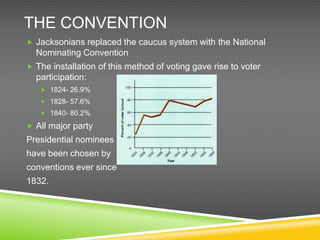
 The installation of this method of voting gave rise to voter
  participation:
    1824- 26.9%
    1828- 57.6%
    1840- 80.2%

 All major party
Presidential nominees
have been chosen by
conventions ever since
1832.
THE CONVENTION
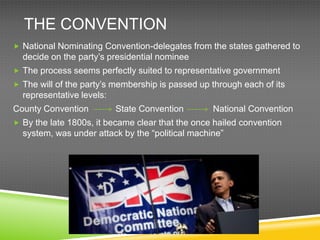
 National Nominating Convention-delegates from the states gathered to
  decide on the party‟s presidential nominee
 The process seems perfectly suited to representative government
 The will of the party‟s membership is passed up through each of its
  representative levels:
County Convention          State Convention       National Convention
 By the late 1800s, it became clear that the once hailed convention
  system, was under attack by the “political machine”
THE DIRECT PRIMARY
 By the 1910s, a nee nomination process emerged—The direct
  primary election
 An intra-party election
ELECTORAL COLLEGE
 http://www.youtube.com/watch?v=ok_VQ8I7g6I
ELECTIONS
Section 2
AMERICAN ELECTIONS
“We always want the best man to win an election. Unfortunately, he
never runs.”
                                       ~Will Rogers

“Sooner will a camel pass through the a needle‟s eye than a great
man be „discovered‟ by an election.”
                                       ~Adolf Hitler


“Democracy is a form of government that substitutes election by the
incompetent many for appointment by the corrupt few.”
                                       ~George Bernard Shaw
THE ADMINISTRATION OF ELECTIONS
 Democratic government cannot succeed without the use of free,
  honest, and accurate elections.
 The universal use of elections as a tool for selecting
  representatives in modern democracies is in contrast with the
  practice in the democratic archetype—ancient Athens.
    Elections were considered an oligarchic institution, where most political offices
      were filled using allotment (officeholders are chosen by a specified group)
    NOW, elections are based off of a “fair electoral system.”

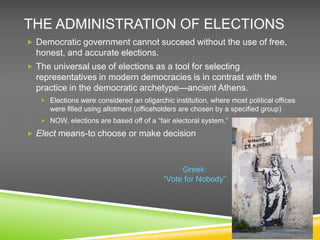
 Elect means-to choose or make decision


                                                Greek:
                                           “Vote for Nobody”
THE ADMINISTRATION OF ELECTIONS
 Elections play a vital role in an active democracy.
 Provisions are set-up in the electoral process to help protect the
  integrity and law.
    We saw these results fulfilled through the several different requirements
      needed in order to vote
EXTENT OF FEDERAL CONTROL
 Elections are held on the State level—not federal.
    Congress has the power to fix the “Times, Places, and Manner of holding
     Elections”
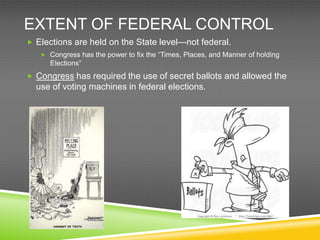
 Congress has required the use of secret ballots and allowed the
  use of voting machines in federal elections.
WHEN ELECTIONS ARE HELD
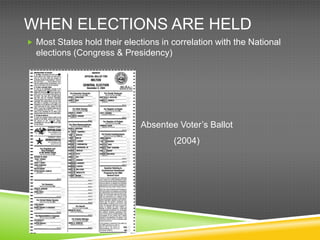
 Most States hold their elections in correlation with the National
  elections (Congress & Presidency)


                              Absentee Voter‟s Ballot
                                      (2004)
EARLY VOTING
 Absentee Voting: a provision allowing voting by those unable to
  get to their regular polling places on election day.
 Usually covers three different groups of people:
   1.   Those too ill/disabled to make it to the polls
   2.   Those who expect to be away
   3.   Those serving in the armed forces
 Mail-in ballots
 Allowing voters to cast heir ballots over a period of extended time
    Over a period of several days
    Still incorporated into the mainstream election
THE COATTAIL EFFECT
 Occurs when a strong candidate running for an office at the top of the
  ballot helps attract voters to other candidates on a party‟s ticket.
    Many of the times, the party of the victorious president candidate will often win many
      seats in Congress as well
    Congressmen are voted “in on the coattails” of the president
    The theory is prevalent at all levels of government
    Often associated with one‟s Party Identification

 1980-84: many Republican candidates obtained Senate, House, and
  Governorship seats by riding on the coattails of President Reagan.
 The proportion of voters choosing House and Presidential candidates of
  different parties increased from 13% in 1952 to more than 40%in the
  elections of 1972, 1980, and 1988.
    Coattail presidencies have become less common in recent years.
        Richard Nixon, Ronald Reagan, George Bush, Barack Obama
CASTING THE BALLOT
 The device by which a voter registers a choice in an election.
 Every State now provides for a secret ballot.
    By law, all ballots are cast in such a manner that others cannot know how a person
      had voted.
 Depending on the type of “voting system”, different ballots can be used.
 Ballot reform was in widespread demand during post-Civil War
  elections
    Political Machines: local party organizations capable of mobilizing or manufacturing
      large numbers of votes on behalf of candidates for political office
    Progressive Era (1893-1917): Progressivists attacked the long ballot, claiming that
      the number of elected offices should be less.
THE FLORIDA RECOUNT (2000)
                The 2000 election: Bush vs. Gore
 Several problems arose with the electoral process at Florida‟s
  voting polls
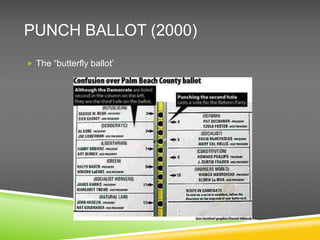
    Punch-card ballot misreading
    “central time zone” closing polls
    Florida State Supreme Court ruling


Florida‟s Electoral Screw-up
http://www.youtube.com/watch?v=jHK1-LA8zEU&feature=related


U.S. Supreme Court Case
http://www.youtube.com/watch?v=7CI2U79ykgA
PUNCH BALLOT (2000)
 The “butterfly ballot‟
THE AUSTRALIAN BALLOT
 First devised in Australia in 1856
    So successful, that it led to its adoption in other countries and nearly all the
        States.
    “Basic Ballot” format

 4 Essential features:
   1.   Printed at the public expense
   2.   List names of all the candidates in the election
   3.   Handed out AT the polls
   4.   Secret ballot
 2 basic varieties: OFFICE-GROUP & PARTY-COLUMN ballots
OFFICE-GROUP BALLOT
 Called the Massachusetts ballot (circa. 1888)
 Candidates for an office are grouped together under the title of
  that office.
 States rotate the names so that [alphabetical] first names don‟t
  have a psychological advantage
 Encourages split-ticket voting
 Decentralization of political parties
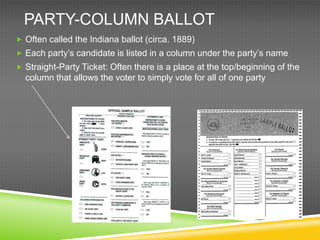
PARTY-COLUMN BALLOT
 Often called the Indiana ballot (circa. 1889)
 Each party‟s candidate is listed in a column under the party‟s name
 Straight-Party Ticket: Often there is a place at the top/beginning of the
  column that allows the voter to simply vote for all of one party
SAMPLE & “BEDSHEET” BALLOTS
 Sample Ballot: mailed to voters as a sample of what election
  ballots will look like at the voting polls, prior to the election date.
    First used in Oregon (circa. 1907)

 “Bedsheet” Ballot: Typical American ballot; frequently listing so
  many offices, candidates, and ballot measures/referendums that
  even voters have a difficult time marking their decisions correctly.
    A lot of criticism has come from these ballots
    Referred to as “ballot fatigue”
        Drop off in voting that can run as high as 20-30%

Chapter 7 the electoral process

  • 1.
  • 2.
    ELECTION TIME  “Apolitician thinks of the next election. A statesman, of the next generation.” ~James Freeman Clarke  “Each candidate behaved well in the hope of being judged worthy of election. However, this system was disastrous when the city had become corrupt. For then it was not the most virtuous but the most powerful who stood foe election, and the weak, even if virtuous, were too frightened to run for office.” ~Niccolo Machiavelli
  • 3.
    NOMINATION PROCESS  Thecritical first step in the electoral process.  The nomination process narrows the field of possible candidates for office.  NOMINATION-the naming of those who will seek office  We‟ve seen the nomination process acting as a proponent factor for the decentralizing of the two major political parties  A very real impact on the electorate‟s right to vote  Limiting the voting stage to TWO choices 1. Republicans 2. Democrats  Those who make it…can have a significant effect in government
  • 4.
    NOMINATION PROCESS  GeneralElections-regularly scheduled elections at which voters make the final selection of officeholders  United States Presidency: every 4 years  2008: Sen. Barack Obama vs. Sen. John McCain  2012: Pres. Barack Obama vs. GOP selection
  • 5.
    FIVE TYPES OFNOMINATIONS  5 ways in which nominations are made in the United States; 1. Self-Announcement 2. Caucus System 3. Convention System 4. Direct Primary 5. Petition
  • 6.
    SELF-ANNOUNCEMENT  The oldestform of the nomination process  First used in colonial times  Used at the small town & rural levels  A person who wants to run for office simply announces that fact.  Many of the times used by a candidate who failed to win a regular party nomination or someone unhappy with the party‟s choice  Example: Ross Perot in 1992  Ran as an Independent and won 19% of the popular vote  1996, ran under the Reform Party
  • 7.
    THE CAUCUS SYSTEM A Caucus-a group of like-minded people who meet to select the candidates they will support in an upcoming election  Caucuses are party meetings by precinct, district, or county, where registered party members gather to discuss the candidates and to select delegates to the next round of party conventions.  Caucuses are open to any registered voter in a party, although experts say the process is dominated by party activists.  Any voter registered with a party can participate in a caucus.  19 states hold caucuses, either for one party or for both  2008: In the Iowa caucus, delegates (represent voters of a state) chosen at the caucus then attend a county convention, where delegates are chosen for the state conventions  Effected the close race between Obama and Clinton
  • 8.
    CAUCUS SYSTEM  Criticismof the caucus system reached its peak in the early 1820s.  Election of 1824: the “corrupt bargain,” accused John Quincy Adams and Henry Clay of arranging votes  Jacksonian America: Pres. Jackson supporters saw the caucus method as restrictive, making office mainly open to the elite and well connected  “Closed door” elections  The caucus system today is open to all members of a party
  • 9.
    THE CONVENTION  Jacksoniansreplaced the caucus system with the National Nominating Convention  The installation of this method of voting gave rise to voter participation:  1824- 26.9%  1828- 57.6%  1840- 80.2%  All major party Presidential nominees have been chosen by conventions ever since 1832.
  • 10.
    THE CONVENTION  NationalNominating Convention-delegates from the states gathered to decide on the party‟s presidential nominee  The process seems perfectly suited to representative government  The will of the party‟s membership is passed up through each of its representative levels: County Convention State Convention National Convention  By the late 1800s, it became clear that the once hailed convention system, was under attack by the “political machine”
  • 11.
    THE DIRECT PRIMARY By the 1910s, a nee nomination process emerged—The direct primary election  An intra-party election
  • 12.
  • 13.
  • 14.
    AMERICAN ELECTIONS “We alwayswant the best man to win an election. Unfortunately, he never runs.” ~Will Rogers “Sooner will a camel pass through the a needle‟s eye than a great man be „discovered‟ by an election.” ~Adolf Hitler “Democracy is a form of government that substitutes election by the incompetent many for appointment by the corrupt few.” ~George Bernard Shaw
  • 15.
    THE ADMINISTRATION OFELECTIONS  Democratic government cannot succeed without the use of free, honest, and accurate elections.  The universal use of elections as a tool for selecting representatives in modern democracies is in contrast with the practice in the democratic archetype—ancient Athens.  Elections were considered an oligarchic institution, where most political offices were filled using allotment (officeholders are chosen by a specified group)  NOW, elections are based off of a “fair electoral system.”  Elect means-to choose or make decision Greek: “Vote for Nobody”
  • 16.
    THE ADMINISTRATION OFELECTIONS  Elections play a vital role in an active democracy.  Provisions are set-up in the electoral process to help protect the integrity and law.  We saw these results fulfilled through the several different requirements needed in order to vote
  • 17.
    EXTENT OF FEDERALCONTROL  Elections are held on the State level—not federal.  Congress has the power to fix the “Times, Places, and Manner of holding Elections”  Congress has required the use of secret ballots and allowed the use of voting machines in federal elections.
  • 18.
    WHEN ELECTIONS AREHELD  Most States hold their elections in correlation with the National elections (Congress & Presidency) Absentee Voter‟s Ballot (2004)
  • 19.
    EARLY VOTING  AbsenteeVoting: a provision allowing voting by those unable to get to their regular polling places on election day.  Usually covers three different groups of people: 1. Those too ill/disabled to make it to the polls 2. Those who expect to be away 3. Those serving in the armed forces  Mail-in ballots  Allowing voters to cast heir ballots over a period of extended time  Over a period of several days  Still incorporated into the mainstream election
  • 20.
    THE COATTAIL EFFECT Occurs when a strong candidate running for an office at the top of the ballot helps attract voters to other candidates on a party‟s ticket.  Many of the times, the party of the victorious president candidate will often win many seats in Congress as well  Congressmen are voted “in on the coattails” of the president  The theory is prevalent at all levels of government  Often associated with one‟s Party Identification  1980-84: many Republican candidates obtained Senate, House, and Governorship seats by riding on the coattails of President Reagan.  The proportion of voters choosing House and Presidential candidates of different parties increased from 13% in 1952 to more than 40%in the elections of 1972, 1980, and 1988.  Coattail presidencies have become less common in recent years.  Richard Nixon, Ronald Reagan, George Bush, Barack Obama
  • 21.
    CASTING THE BALLOT The device by which a voter registers a choice in an election.  Every State now provides for a secret ballot.  By law, all ballots are cast in such a manner that others cannot know how a person had voted.  Depending on the type of “voting system”, different ballots can be used.  Ballot reform was in widespread demand during post-Civil War elections  Political Machines: local party organizations capable of mobilizing or manufacturing large numbers of votes on behalf of candidates for political office  Progressive Era (1893-1917): Progressivists attacked the long ballot, claiming that the number of elected offices should be less.
  • 22.
    THE FLORIDA RECOUNT(2000) The 2000 election: Bush vs. Gore  Several problems arose with the electoral process at Florida‟s voting polls  Punch-card ballot misreading  “central time zone” closing polls  Florida State Supreme Court ruling Florida‟s Electoral Screw-up http://www.youtube.com/watch?v=jHK1-LA8zEU&feature=related U.S. Supreme Court Case http://www.youtube.com/watch?v=7CI2U79ykgA
  • 23.
    PUNCH BALLOT (2000) The “butterfly ballot‟
  • 24.
    THE AUSTRALIAN BALLOT First devised in Australia in 1856  So successful, that it led to its adoption in other countries and nearly all the States.  “Basic Ballot” format  4 Essential features: 1. Printed at the public expense 2. List names of all the candidates in the election 3. Handed out AT the polls 4. Secret ballot  2 basic varieties: OFFICE-GROUP & PARTY-COLUMN ballots
  • 25.
    OFFICE-GROUP BALLOT  Calledthe Massachusetts ballot (circa. 1888)  Candidates for an office are grouped together under the title of that office.  States rotate the names so that [alphabetical] first names don‟t have a psychological advantage  Encourages split-ticket voting  Decentralization of political parties
  • 26.
    PARTY-COLUMN BALLOT  Oftencalled the Indiana ballot (circa. 1889)  Each party‟s candidate is listed in a column under the party‟s name  Straight-Party Ticket: Often there is a place at the top/beginning of the column that allows the voter to simply vote for all of one party
  • 27.
    SAMPLE & “BEDSHEET”BALLOTS  Sample Ballot: mailed to voters as a sample of what election ballots will look like at the voting polls, prior to the election date.  First used in Oregon (circa. 1907)  “Bedsheet” Ballot: Typical American ballot; frequently listing so many offices, candidates, and ballot measures/referendums that even voters have a difficult time marking their decisions correctly.  A lot of criticism has come from these ballots  Referred to as “ballot fatigue”  Drop off in voting that can run as high as 20-30%