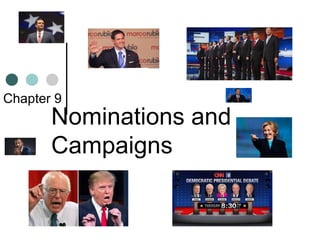
Nominations and
Campaigns
Chapter 9
The Nomination Game
 Nomination: the official endorsement
of a candidate for office by a political
party
 Generally, success requires
momentum, money, and media
attention.
 Campaign Strategy: the master game
plan candidates lay out to guide their
electoral campaign
The Nomination Game
 Deciding to Run
Campaigns are more physically and
emotionally taxing than ever.
Other countries have short
campaigns, generally less than 2
months.
American campaigns are much
longer.
• Whoever is elected president in
November 2016 will have declared their
intention to run in early 2015.
The Nomination Game
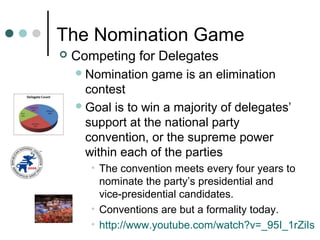
 Competing for Delegates
Nomination game is an elimination
contest
Goal is to win a majority of delegates’
support at the national party
convention, or the supreme power
within each of the parties
• The convention meets every four years to
nominate the party’s presidential and
vice-presidential candidates.
• Conventions are but a formality today.
• http://www.youtube.com/watch?v=_95I_1rZiIs
The Nomination Game
 Competing for Delegates
The Caucus Road
• Caucus: meetings of state party leaders
for selecting delegates to the national
convention
• Organized like a pyramid from local
precincts to the state’s convention
• A handful of states use a caucus—open
to all voters who are registered with a
party
• The Iowa caucus is first and most
important.
• caucuses
1. Local Delegates from
precinct voting
2. County Convention
selects delegates
3. State Convention
select delegates
4. Delegates from state
attend National
Convention
The Nomination Game
 Competing for Delegates
 The Primary Road
• Primary: elections in which voters in a state vote for a
nominee (or delegates pledged to the nominee)
• Began at turn of 20th
century by progressive
reformers
• McGovern-Fraser Commission led to selection of
delegates through primary elections
• Most delegates are chosen through primaries.
• Superdelegates: democratic leaders who
automatically get a delegate slot
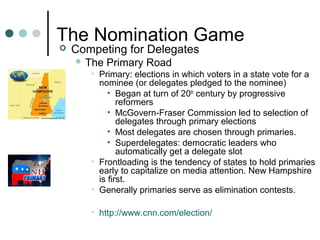
• Frontloading is the tendency of states to hold primaries
early to capitalize on media attention. New Hampshire
is first.
• Generally primaries serve as elimination contests.
• http://www.cnn.com/election/
Discussion
 What are the advantages and
disadvantages to a long campaign
process?
 Do you think it is a good thing or a
bad thing? Why?
The Nomination Game
 Competing for Delegates
 Evaluating the Primary and Caucus System
 Which of the following criticisms is the worst thing
about our primary/caucus system:
• Disproportionate attention to early ones
• Prominent politicians do not run.
• Money plays too big a role.
• Participation in primaries and caucuses is low and
unrepresentative; 20 percent vote in primaries
• The system gives too much power to the media.
The Nomination Game
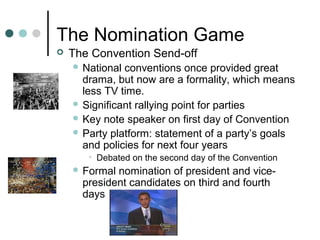
 The Convention Send-off
 National conventions once provided great
drama, but now are a formality, which means
less TV time.
 Significant rallying point for parties
 Key note speaker on first day of Convention
 Party platform: statement of a party’s goals
and policies for next four years
• Debated on the second day of the Convention
 Formal nomination of president and vice-
president candidates on third and fourth
days
Party Platforms
 Party platforms
Keynote speakers
 2004 Keynote Address
 2012 Keynote Address
The Nomination Game
The Campaign Game
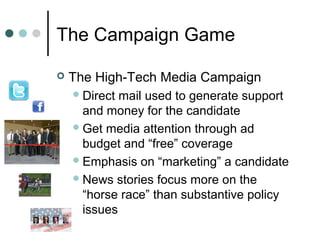
 The High-Tech Media Campaign
Direct mail used to generate support
and money for the candidate
Get media attention through ad
budget and “free” coverage
Emphasis on “marketing” a candidate
News stories focus more on the
“horse race” than substantive policy
issues
The Campaign Game
 Organizing the Campaign
Get a campaign manager
Get a fund-raiser and campaign
counsel
Hire media and campaign consultants
Assemble staff and plan logistics
Get research staff, policy advisors,
and pollsters
Get a good press secretary
Establish a website
Money and Campaigning
 Campaigns are expensive
 Campaigns need money to get their
message out
 Many people and groups who want
things from government are willing to
give $
How much influence
does money buy?...
 How campaign finance works -
YouTube
Money and Campaigning
 The Maze of Campaign Finance Reforms
 Federal Election Campaign Act (1974)
• Created the Federal Election Commission (FEC)
to administer campaign finance laws for federal
elections
• Required disclosure of donor information
• Placed limits on donations
• Contribution Chart
• Placed limits on the amount that individuals could
spend on their own campaign
Money and Campaigning
• Created a system of Public Financing for Presidential
Elections
• Created the Presidential Election Campaign Fund
• Provided partial public financing for presidential primaries
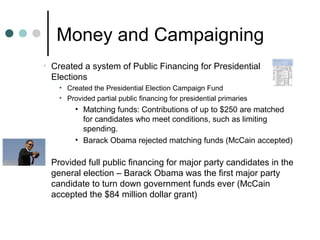
• Matching funds: Contributions of up to $250 are matched
for candidates who meet conditions, such as limiting
spending.
• Barack Obama rejected matching funds (McCain accepted)
• Provided full public financing for major party candidates in the
general election – Barack Obama was the first major party
candidate to turn down government funds ever (McCain
accepted the $84 million dollar grant)
Money and Campaigning
 The Proliferation of PACs
 Political Action Committees (PACs): created
by law in 1974 to allow corporations, labor
unions and other interest groups to donate
money to campaigns; PACs are registered
with and monitored by the FEC.
 $5000 per candidate in both primary/general
 As of 2006 there were 4,217 PACs.
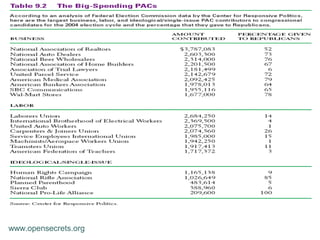
 PACs contributed over $288.6 million to
congressional candidates in 2004.
 PACs donate to candidates who support
their issue.
 PACs do not “buy” candidates, but give to
candidates who support them in the first
place.
Money and Campaigning
www.opensecrets.org
Buckley v. Valeo, 1976
 Challenged the constitutionality of the
1974 campaign reforms
 The SC struck down the portion that
limited how much and individual could
contribute to their own campaigns.
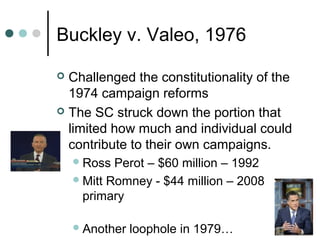
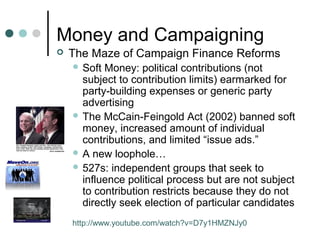
Ross Perot – $60 million – 1992
Mitt Romney - $44 million – 2008
primary
Another loophole in 1979…
Money and Campaigning
 The Maze of Campaign Finance Reforms
 Soft Money: political contributions (not
subject to contribution limits) earmarked for
party-building expenses or generic party
advertising
 The McCain-Feingold Act (2002) banned soft
money, increased amount of individual
contributions, and limited “issue ads.”
 A new loophole…
 527s: independent groups that seek to
influence political process but are not subject
to contribution restricts because they do not
directly seek election of particular candidates
http://www.youtube.com/watch?v=D7y1HMZNJy0
Debate
Side One: There is too much money in
politics and it needs to be regulated
and restricted, or removed
Side Two: Limiting money in politics is a
violation of freedom of speech and
goes against the capitalistic nature of
our society
Citizens United v. FEC, 2008
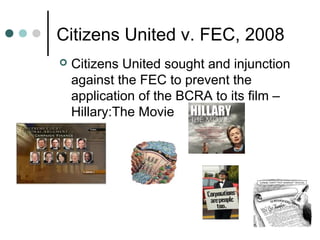
 Citizens United sought and injunction
against the FEC to prevent the
application of the BCRA to its film –
Hillary:The Movie
 Citizens United
Money and Campaigning
 Are Campaigns Too Expensive?
 “Money is the mothers milk of politics”
Fundraising takes a lot of time.
Candidates spend more time raising
money than governing!
Understanding Nominations
and Campaigns
 Are Nominations and Campaigns Too
Democratic?
 Campaigns are open to almost everyone.
 Campaigns consume much time and money.
 Campaigns promote individualism in American
politics.
 Do Big Campaigns Lead to an Increased Scope
of Government?
 Candidates make numerous promises, especially
to state and local interests.
 Hard for politicians to promise to cut size of
government
Summary
 Campaigns are media-oriented and
expensive.
 Delegates are selected through caucuses
and primaries.
 Money and contributions from PACs
regulated by the FEC are essential to
campaigns.
 Campaigns reinforce perceptions but do not
change minds.
Campaign Finance Debate
 Assignment:
 Read pages 284-289
 Read McConnell v. FEC
 Research the McCain-Feingold Law
(BCRA)
 Visit www.opensecrets.org
 Prepare arguments both for and against
campaign finance

Edwardschapter 09 Campaigns and Elections

  • 1.
  • 2.
    The Nomination Game Nomination: the official endorsement of a candidate for office by a political party  Generally, success requires momentum, money, and media attention.  Campaign Strategy: the master game plan candidates lay out to guide their electoral campaign
  • 3.
    The Nomination Game Deciding to Run Campaigns are more physically and emotionally taxing than ever. Other countries have short campaigns, generally less than 2 months. American campaigns are much longer. • Whoever is elected president in November 2016 will have declared their intention to run in early 2015.
  • 4.
    The Nomination Game Competing for Delegates Nomination game is an elimination contest Goal is to win a majority of delegates’ support at the national party convention, or the supreme power within each of the parties • The convention meets every four years to nominate the party’s presidential and vice-presidential candidates. • Conventions are but a formality today. • http://www.youtube.com/watch?v=_95I_1rZiIs
  • 5.
    The Nomination Game Competing for Delegates The Caucus Road • Caucus: meetings of state party leaders for selecting delegates to the national convention • Organized like a pyramid from local precincts to the state’s convention • A handful of states use a caucus—open to all voters who are registered with a party • The Iowa caucus is first and most important. • caucuses 1. Local Delegates from precinct voting 2. County Convention selects delegates 3. State Convention select delegates 4. Delegates from state attend National Convention
  • 6.
    The Nomination Game Competing for Delegates  The Primary Road • Primary: elections in which voters in a state vote for a nominee (or delegates pledged to the nominee) • Began at turn of 20th century by progressive reformers • McGovern-Fraser Commission led to selection of delegates through primary elections • Most delegates are chosen through primaries. • Superdelegates: democratic leaders who automatically get a delegate slot • Frontloading is the tendency of states to hold primaries early to capitalize on media attention. New Hampshire is first. • Generally primaries serve as elimination contests. • http://www.cnn.com/election/
  • 7.
    Discussion  What arethe advantages and disadvantages to a long campaign process?  Do you think it is a good thing or a bad thing? Why?
  • 8.
    The Nomination Game Competing for Delegates  Evaluating the Primary and Caucus System  Which of the following criticisms is the worst thing about our primary/caucus system: • Disproportionate attention to early ones • Prominent politicians do not run. • Money plays too big a role. • Participation in primaries and caucuses is low and unrepresentative; 20 percent vote in primaries • The system gives too much power to the media.
  • 9.
    The Nomination Game The Convention Send-off  National conventions once provided great drama, but now are a formality, which means less TV time.  Significant rallying point for parties  Key note speaker on first day of Convention  Party platform: statement of a party’s goals and policies for next four years • Debated on the second day of the Convention  Formal nomination of president and vice- president candidates on third and fourth days
  • 10.
  • 11.
    Keynote speakers  2004Keynote Address  2012 Keynote Address
  • 12.
  • 13.
    The Campaign Game The High-Tech Media Campaign Direct mail used to generate support and money for the candidate Get media attention through ad budget and “free” coverage Emphasis on “marketing” a candidate News stories focus more on the “horse race” than substantive policy issues
  • 14.
    The Campaign Game Organizing the Campaign Get a campaign manager Get a fund-raiser and campaign counsel Hire media and campaign consultants Assemble staff and plan logistics Get research staff, policy advisors, and pollsters Get a good press secretary Establish a website
  • 16.
    Money and Campaigning Campaigns are expensive  Campaigns need money to get their message out  Many people and groups who want things from government are willing to give $ How much influence does money buy?...
  • 17.
     How campaignfinance works - YouTube
  • 18.
    Money and Campaigning The Maze of Campaign Finance Reforms  Federal Election Campaign Act (1974) • Created the Federal Election Commission (FEC) to administer campaign finance laws for federal elections • Required disclosure of donor information • Placed limits on donations • Contribution Chart • Placed limits on the amount that individuals could spend on their own campaign
  • 19.
    Money and Campaigning •Created a system of Public Financing for Presidential Elections • Created the Presidential Election Campaign Fund • Provided partial public financing for presidential primaries • Matching funds: Contributions of up to $250 are matched for candidates who meet conditions, such as limiting spending. • Barack Obama rejected matching funds (McCain accepted) • Provided full public financing for major party candidates in the general election – Barack Obama was the first major party candidate to turn down government funds ever (McCain accepted the $84 million dollar grant)
  • 20.
    Money and Campaigning The Proliferation of PACs  Political Action Committees (PACs): created by law in 1974 to allow corporations, labor unions and other interest groups to donate money to campaigns; PACs are registered with and monitored by the FEC.  $5000 per candidate in both primary/general  As of 2006 there were 4,217 PACs.  PACs contributed over $288.6 million to congressional candidates in 2004.  PACs donate to candidates who support their issue.  PACs do not “buy” candidates, but give to candidates who support them in the first place.
  • 21.
  • 22.
    Buckley v. Valeo,1976  Challenged the constitutionality of the 1974 campaign reforms  The SC struck down the portion that limited how much and individual could contribute to their own campaigns. Ross Perot – $60 million – 1992 Mitt Romney - $44 million – 2008 primary Another loophole in 1979…
  • 23.
    Money and Campaigning The Maze of Campaign Finance Reforms  Soft Money: political contributions (not subject to contribution limits) earmarked for party-building expenses or generic party advertising  The McCain-Feingold Act (2002) banned soft money, increased amount of individual contributions, and limited “issue ads.”  A new loophole…  527s: independent groups that seek to influence political process but are not subject to contribution restricts because they do not directly seek election of particular candidates http://www.youtube.com/watch?v=D7y1HMZNJy0
  • 24.
    Debate Side One: Thereis too much money in politics and it needs to be regulated and restricted, or removed Side Two: Limiting money in politics is a violation of freedom of speech and goes against the capitalistic nature of our society
  • 25.
    Citizens United v.FEC, 2008  Citizens United sought and injunction against the FEC to prevent the application of the BCRA to its film – Hillary:The Movie
  • 26.
  • 27.
    Money and Campaigning Are Campaigns Too Expensive?  “Money is the mothers milk of politics” Fundraising takes a lot of time. Candidates spend more time raising money than governing!
  • 28.
    Understanding Nominations and Campaigns Are Nominations and Campaigns Too Democratic?  Campaigns are open to almost everyone.  Campaigns consume much time and money.  Campaigns promote individualism in American politics.  Do Big Campaigns Lead to an Increased Scope of Government?  Candidates make numerous promises, especially to state and local interests.  Hard for politicians to promise to cut size of government
  • 29.
    Summary  Campaigns aremedia-oriented and expensive.  Delegates are selected through caucuses and primaries.  Money and contributions from PACs regulated by the FEC are essential to campaigns.  Campaigns reinforce perceptions but do not change minds.
  • 30.
    Campaign Finance Debate Assignment:  Read pages 284-289  Read McConnell v. FEC  Research the McCain-Feingold Law (BCRA)  Visit www.opensecrets.org  Prepare arguments both for and against campaign finance