UNIVERSITY OF MARIBOR
FACULTY OF ELECTRICAL ENGINEERING
AND COMPUTER SCIENCE
2000 Maribor, Smetanova ul. 17
SLOVENIA
E-learning material planning
and preparation
Matjaž Debevc
Metka Zorič Venuti
Živa Peljhan
SOCRATES GRUNDTVIG project
Maribor, May 2003
Publishing: University of Maribor
Faculty of Electrical Engineering and Computer Science
Purpose: Learning material
Title: E-learning material planning and preparation
Authors: Matjaž Debevc, Metka Zorič Venuti, Živa Peljhan
Page numbers: 36
Review: dr. Dean Korošec
Lecturing: Barbara Banovič
Design: Metka Zorič Venuti
Financed by: SOCRATES-GRUNDTVIG project BITEMA
CIP – Kataložni zapis o publikaciji
Univerzitetna knjižnica Maribor
378.018.432:004.738.5(075.8)
DEBEVC, Matjaž
E-learning material planning and preparation / Matjaž Debevc, Metka Zorič Venuti,
Živa Peljhan. – Maribor: Faculty of Electrical Engineering and Computer Science, 2003
ISBN 86-435-0551-X
1. Zorič-Venuti, Metka 2. Peljhan, Živa
COBISS-ID 50504961
Date: May, 2003
Printing: Faculty of Electrical Engineering and Computer Science, Maribor
Number of copies: 50
1
Table of contents
1. Introduction............................................................................. 3
1.1 Distance education with ICT technology ....................................... 3
1.2 What led you to write the learning material for e-learning? ............... 4
1.2.1 What good will it do for you, as the teacher?........................... 4
1.2.2 What good will it do for the student?..................................... 5
2. Do you already have an idea about the formation of learning material? .. 7
2.1 Learning subject with questions for self-verification........................ 8
2.2 Learning in printed or electronic form ......................................... 8
2.3 Reflective action guide ........................................................... 8
3. Who is the material meant for?..................................................... 9
4. The learning material goals definition ...........................................10
5. Structuring subject into learning units...........................................11
5.1 Subject-centered approach ..................................................... 11
5.2 Student-centered approach ..................................................... 11
5.3 Brain storming..................................................................... 12
5.4 A draft contents outline ......................................................... 13
6. The role of the media and the technology ......................................14
7. Reflection about the use of existing learning material .......................17
8. The role of graphic elements, when designing the learning material .....18
8.1 Basic elements of textual design............................................... 18
8.2 Orientations elements ........................................................... 18
8.3 Graphic approach ................................................................. 19
8.4 The use of pictures ............................................................... 20
9. Writing the learning material ......................................................22
9.1 Start................................................................................ 23
9.2 Kernel............................................................................... 25
9.2.1 Activity types................................................................ 26
9.2.2 Activities – why we use them? ............................................ 26
9.2.3 What should the students do during activities? ........................ 26
9.2.4 What kind of student’s responses can we expect? .................... 27
9.2.5 What are student’s benefits from activities?........................... 27
9.2.6 Examples ..................................................................... 29
9.2.7 Reader-friendly style....................................................... 29
2
9.3 Conclusion ......................................................................... 31
9.3.1 Exercises ..................................................................... 31
9.3.2 Expression dictionary....................................................... 33
9.3.3 Literature listing ............................................................ 33
10. Testing and improving .............................................................35
References ................................................................................36
3
1. Introduction
A fast development of information and communication technology (ICT) together with a
rich support of various software (text editors, graphics, voice…) is a constant challenge for
each author of e-learning material. However, we would like to stress two important facts:
Professional quality of learning material stands or fails together with its author.
Writing quality learning material is extremely hard work. The enforcement of
distance learning, together with its need for e-learning material, requires much
more!
Presented guidelines for preparation of learning material could be very helpful for
preparing e- learning material for deaf and hard of hearing people as well. But we must be
aware of some necessary adaptations. First, the voice records will probably be excluded
and we would lay much stress on video shots and other visual ICT. We can use visual
potential of deaf students. We assume that it is highly developed.
In section like this we are going to present some addition requirements for
preparation of learning materials for deaf people.
1.1 Distance education with ICT technology
Distance education is a form of indirect education, where a teacher and a student are
physically or even for a time distance apart. The teacher or the tutor constantly controls
learning success of the student. The learning material is interposed on distance using
various media either in written or in electronic form. In this way, distance education is the
form of indirect education that allows to the students to learn in their domestic
environment. This makes the distance education as a modern form of education, a user-
friendly and adaptive educational process.
4
Recently, in the European environment (and consecutively in our environment), following
expressions are commonly used:
e-education, composed of
e-learning and e-teaching.
1.2 What led you to write the learning material for e-learning?
As a teacher in educational process, you have lost the role of direct knowledge forwarding
in a classroom with lectures or any other for knowledge transmission (face-to-face
teaching). Your pedagogic work is more valuable, since you need to focus your knowledge
on material preparation and organization of distance learning.
It is important to know the use of specific media and closely linked technologies, because
it is essential, when and how you are going to use the specific media.
You have to keep in mind that the student will learn by himself most of the time. He/she
would not have a person beside, who could give an advice, if he/she confronts troubles at
understanding a topic. Access to formation of interactive, multimedia learning material is
very complex field, therefore you need to consider following questions:
What good will it do for you, as the teacher?
What good will it do for the student?
1.2.1 What good will it do for you, as the teacher?
Learning materials for e-learning have many advantages:
They discharge you of the lectures and consecutively from monotone repeating
of similar contents.
Good leaning material in a first place presents a step to a better quality of
teaching and teacher-student relations, but above all to the development of
active student's relation to the learning. This will cause an important change to
your role as a teacher; namely from a teacher that gives the teaching subject,
into a mentor and advisor, who gives the student explanation and support.
5
Your work will become more interesting and quality, because mostly talented
and interested students with well-founded and reasonable questions will turn to
you, what makes a challenge to any teacher. In this way, you as a teacher will
gain precious encouragement for future work and useful information about the
way students work on your subject, what kind of troubles they are confronting
and what kind of encouragement they may need.
Quality learning material has an important role on student's motivation for
learning, and at the same time helps to develop independency and responsibility
in the relation to own education. These are capacities that need to be developed
on each level of education. Therefore, the learning materials for e–education are
often an encouragement for changes in classic education.
Activity No.1
What good will it do for you, as a teacher? Write down, which benefits of the learning
material for e-learning are the most important for you!
1.2.2 What good will it do for the student?
With the learning material for e-learning, the student can learn all the necessary subjects
alone. This brings many advantages as well as more elements of student’s own
responsibility.
Advantages
Opportunity to learn when he/she has the time.
He/she can learn at work, in the study centre, in the library or at home.
He/she states the learning tempo.
He/she has more choices, how he/she is going to study and check his/her
knowledge.
Higher quality of learning subject presentation.
Option to use the media, that best fits to the students and gives the best learning
motivation.
6
Elements of own responsibility
The student, who had decided to learn with the learning material for e-learning, needs to:
take the time, make the plan of work, try hard to understand the subject,
otherwise he/she will not be able to complete the tasks and exercises for
evaluation of the knowledge.
The questions, he/she will prepare for the consultation with the teacher or tutor,
will have to be logical and deep.
Responsibility for his/her success could not be displaced to the teacher or too
small number of lectures and practices, because the entire learning subject will
be captured in the learning material.
Activity No. 2
What good will it do for your student? Write down the benefits of your learning
material for e-learning for your student!
7
2. Do you already have an idea about the formation of
learning material?
The learning material for e-learning does not differ significantly in the contents plan from
the classic, printed material. Its formation is based on same principles, meaning that:
goals need to be set clear,
contents need to be divided into closed chapters or learning units,
learning units need to follow the contents and didactical approach, which allows
quality individual learning to the student.
In comparison with printed textbook, interactive and multimedia learning material for e-
learning exploits all the advantages that ICT offers. Except of textual part, it may contain:
voice records,
video shots,
computer animations,
computer simulations,
interactivity that allows simple and fast return information at exercises and
exams.
Besides the above mentioned standard elements, the learning material may also contain:
material linking, including browsing through the parts of the material using
hyperlinks,
the chance to use prepared packets for CBT - computer based training,
chance to use prepared multimedia CD-packets.
The design of the majority of the learning material for e-learning is based on the
connection:
information + action
This means that they offer information and expect from the student to make something
out of them. In wide sense we distinguish between three designs of the learning material
for e–learning:
learning subject and questions for self-verification at the end (tell-and-test),
lectures in printed or electronic form and
reflective action guide.
8
2.1 Learning subject with questions for self-verification
This is the most basic approach, where the author of learning material prepares several
pages of the learning material and appends questions for self-verification of knowledge
with solutions or correct answers at the end.
2.2 Learning in printed or electronic form
At this type of learning material, the student has a feeling, that the teacher is personally
leading him through the material and is occupied only with him. The learning material
consists of questions and other activities (every few minutes), where the author checks
whether the student understands the subject, knows how to comment it or use it. The
student receives immediate information about his/her understanding of particular part of
the subject, before he/she progresses to the next topic.
2.3 Reflective action guide
Reflective action guide supposes that the majority of the important learning will be done
outside the learning material. The material is prepared in the form of guide for a specific
activity – anywhere – in real situation, maybe in connection with other people, in the
working place, etc. The goal of the guide is to help the student to follow his/her own
project. This may be the development of individual understanding or a reach of particular
practical, motor competence. The goal of the guide could also be that the student knows
to observe the world in a different way and also to act in the new way. Reflective action
guide supports the student to critical consider about why, what and how it works – and to
evaluate the results. It can contain the instructions about how to choose a topic, how to
find data sources, analysis techniques, report forms, role of the tutor,…
In a chapter 2 among presented forms of learning material we suggest to choose
teaching in printed or electronic form (2.2), because in this type of learning
material the students have a feeling that the teacher is leading them. For deaf
and hard of hearing students that it is better because and encourage them
because of poor language skills and many new information.
Activity No. 3
Which approach, maybe a combination of approaches, are you going to choose?
9
3. Who is the material meant for?
One of the basic characteristics of the learning material for e-learning is the individualism
of learning – the students gain the knowledge by themselves. Therefore, you need to
successfully answer following questions:
What are the age, sex and nationality of the students? What is their level of
education, where do they live, what are their cultural habits?
What is the level of motivation for learning? How does the learning subject apply
to their life or work?
What are their working and learning habits? What is their level of activity? Do they
have any past experiences with e-learning?
What precedent knowledge does your subject requires? Are any personal
experiences important for the learning?
Where, when and how will they learn? To what extend does the family support
their learning?
The image you make about the students affects on a wide range of elements that the
learning material relies on:
the method of linking between learning subject with practical examples,
the method of linking on student’s experiences,
the choice of the media.
When writing the explanation and searching for appropriate practical examples for
illustration of the subject, you need to keep the student in mind and accustom yourself to
his/her way of comprehension of ideas, you are describing. The learning material has to
facilitate the learning to the student and illustrate the contents of the subject.
We also suggest to read precisely chapter 3. And thing about deaf individuals and
their language skills. We have to answer following questions:
How good are students at national language?
How good are students at national sign language?
Activity No. 4
Who are your students? Do you know everything about them that is essential for
composition of the learning material for e-learning?
10
4. The learning material goals definition
Similar to each educational programme, the materials for e-learning need to have set clear
goals that the student is supposed to reach.
It is essential to know, what the student should be able to do, when he/she learns
particular subject:
at statistics, the student needs to know how to present end interpret gained data,
at literature, the students should explain the writing style of various period
authors on the basis of text analysis,
at measures, the students will be able to choose appropriate measuring
instruments, carry out the measurement and evaluate the results,
at market communication the goal may be, that the student knows to suggest the
appropriate strategy in given circumstances for introducing the product on the
market.
The goals can be divided into two groups: main goals of the learning material and sub-goals
for single learning units. The goals need to be set clear, because:
they present the red line, where education runs and
are the origin for knowledge evaluation at the end of education.
Many approaches to classification of learning goals exist, however Bloom’s taxonomy of
learning goals is the most known.
Activity No. 5
Write down the main goals for your learning material!
For each main goal try to form sub-goals. Try to operationalise the record of sub-gaols
and use the taxonomy of learning gaols
11
5. Structuring subject into learning units
We assume you have already constructed your main goals and sub-goals of the learning
material. So you are familiar with the knowledge your students will gain after they learn
the subject. Now you have to define the topics or thematic complex and themes, which
the material will contain.
It is important that you, as the author of the material, have clear picture of how much of
new knowledge an average student is able to gain in specified time period, e.g. one week
or one month, depending on the other obligations the student has in life (a job, a
family,…).
The rough draft of the contents of the learning material and learning unit can be
constructed in several ways. We will take a look at some of them.
5.1 Subject-centered approach
Following information can be helpful when constructing the learning material:
analysis of personal understanding of learning subject – with brain-storming, list
formations, diagrams,…
discussion with professionals and possible users of education about individual
themes of learning subject,
analysis of existent materials, appropriate to the student’s level,
review of films, video and audio material and papers in newspaper and magazines,
analysis of various examples of knowledge verifications and exam questions form
the past,
statement of fundamental ideas and principles,
etc.
5.2 Student-centered approach
You should focus on the student - therefore:
Ask your future students what subjects they want to study intensively.
Discuss with future students about their momentary understanding and
comprehension of fundamental ideas of learning subject.
Make inquires about the topics that caused troubles to previous students.
Set and analyze the learning goals.
12
Think about the learning activities, where students have to (or are recommended
to) take part in.
Weigh up in the mind, how you could reasonably determine student’s progress or
gained knowledge as the result of learning.
Weigh up the reports of other teachers about the work of students at related
subjects/classes from past years.
5.3 Brain storming
Rough draft of the contents of the learning unit “Planning”:
13
5.4 A draft contents outline
Maybe you will find more suitable to design the rough draft of contents of the learning
material and division into learning units in the form of thematic fields – kind of table of
contents:
1st
Learning unit
The importance of distance learning
3rd
Learning unit
Didactic origins
- What is distance learning?
- The role of teachers and tutors
- Models
- The role of media and technologies
- Thematic origins
- Pedagogic-psychological origins
- Methodical or specially-didactical
origins
2nd
Learning unit
Models of modern learning technologies
and approaches
4th
Learning unit
The learning material preparation
- Fields of use
- Education networks
- The meaning of the learning material
- Course of preparation
- Design
Among different approaches presented in chapter 5 we would suggest:
student oriented approach, where students will be highly motivated whether
they are previously asked about the topic, and will gain information about
unknown areas.
Activity No. 6
Write down rough draft for your learning material and its dismembering into learning
units in a way that suits you best.
14
6. The role of the media and the technology
Media is defined as communication sources, that each on its own way presents the
knowledge, information or learning material. The role of technologies at distance learning
is to enable the use of the media and to enable the transfer and presentation of knowledge
or information.
Each media uses its own way of presentation of the knowledge or information. E-learning
uses following media and presentations:
textual presentation -› printed media,
audio presentation -› voice media,
video presentation -› visual media,
computer presentation -› combined media or multimedia .
None of the listed media is the most appropriate or the most effective. The media used in
e-education is appropriate, when it has following characteristics:
all students have to know how to use the media and have granted access to it;
accommodation, meaning that the media can be used in a place and on time
suitable to the student;
media has to enable active participation of student at e-education;
chance to link the individual media with other media, what enables the
presentation of mimics and non-verbal manner of expression. This brings the
communication between the students near to the reality. At the same time it
makes the geographical and periodical differences between the students
insignificant.
The market offers various technologies that support audio or video media. Audio
presentation of knowledge support following technologies:
audio tapes ,
radio and
telephone.
Video presentation on the other hand support following technologies:
television transmission,
videotapes,
CD-ROM,
15
satellite transmission,
cable transmission,
microwaves.
How to choose an appropriate media?
In most cases, authors of the learning material choose the media intuitively, based on past
experiences with the learning material for e-learning.
Following reflection may be helpful when deciding upon the most appropriate media:
1. Which parts of learning subject and which gaols can be learned only by
textual material?
2. Now, figure out when use of following media is essential:
voice,
video,
CBT Computer based training,
practical work,
interactivity elements and
cooperation between people?
Beside each stated need, write the appropriate media immediately. At the same
time, check whether media suits to the user and to the education.
In choosing an appropriate media we should also be aware of some adjustment
for the deaf and hard of hearing students and we can′ t leave this only to authors
intuition. Here are some suggestions:
textual presentation -› printed media; we must be aware of writing and
reading skills and adopt text to that level,
audio presentation -› voice media, should be excluded unless we are using
the material for speech learning,
video presentation -› visual media; we can use video to record sign
language interpreter,
16
computer presentation -› combined media or multimedia; we must be
aware that a deaf person can′t concentrate on interpreter, subtitles,
picture at a same time.
We have different materials beside text and it is good that all elements
presented can be translated in sign language. It is interesting that we usually
don′t remember to translate following elements:
instructions how to use learning material,
to get acquainted with goals of the subject,
introductory explanations and overviews,
abstracts, dictionary, FAQ – frequently asked question,
clearer explanations, contrast viewpoints, alternative examples,
illustrations, example studies, exercises with solutions,
activities, recurrent information about activities,
instructions for practical work,
tasks for discussion with tutor, mentor, students, etc.
All elements presented can be translated in sign language as video shots with or
without subtitles.
Activity No. 7
Well, which combination of media best suits to the goals (contents) of your learning
material and to your students?
17
7. Reflection about the use of existing learning material
After you made all the necessary preparation, it is the time to start writing the learning
material. Or maybe not? Maybe exists a material that can be used partly or even as a
whole?
To use the traditional learning material in e-learning, you have to add instructions and
additional material, to ensure to the student:
instructions how to use learning material,
to get acquainted with goals of the subject,
introductory explanations and overviews,
abstracts,
dictionary,
FAQ – frequently asked question,
clearer explanations,
contrast viewpoints, alternative examples,
illustrations,
example studies, exercises with solutions,
activities, feedback about activities,
instructions for practical work,
tasks for discussion with tutor, mentor, students, etc.
Therefore – even if you already have the quality learning material written
in one of the text editors, you still have a lot of work with the
transformation into the learning material for e-learning!
18
8. The role of graphic elements, when designing the
learning material
The graphics plays an important role, when designing the learning material. During the
design, you can use:
basic elements of textual design (different fonts and letter size, colours, shadows,
frames, indent …),
orientation elements,
graphic presentation of the subject,
the use of pictures.
8.1 Basic elements of textual design
Basic elements of text forming are:
bold text is used for headings or emphasis,
italic text can emphasise significant ideas and proverbs or rules,
indent is one of the agents for stressing important areas inside the text,
for emphasis can also be used raster, frames and similar elements.
Try to avoid simultaneous use of different formation elements (e.g. italic and bold text at
the same time).It is applicable to give functionality to a formation style, e.g. important
ideas in italic text, definition in the frames, proverbs indented, ...
8.2 Orientations elements
The learning material for e-learning has to include orientation elements, which help the
student to learn. These are:
side notes and
use of pictographs.
In most cases, two forms of side notes are used:
formal didactic notes and
contextual notes.
The most useful formal didactical notes are: conception, example, definition, hypothesis,
solution, theory, thesis, exercise and abstract.
19
Contextual notes at side should be in a form of headwords and must not reach an extend
of learning text.
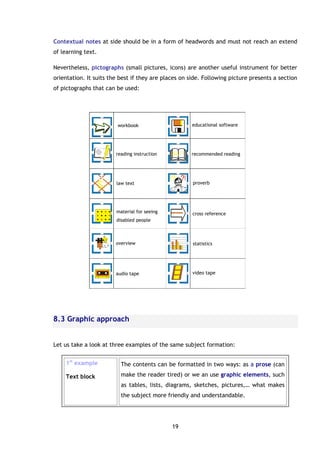
Nevertheless, pictographs (small pictures, icons) are another useful instrument for better
orientation. It suits the best if they are places on side. Following picture presents a section
of pictographs that can be used:
8.3 Graphic approach
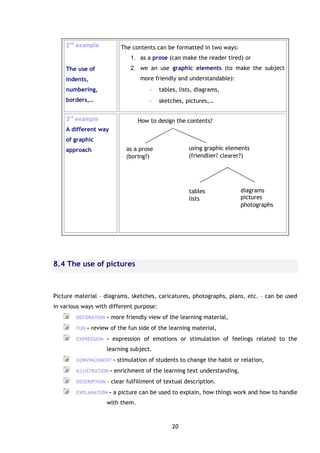
Let us take a look at three examples of the same subject formation:
1st
example
Text block
The contents can be formatted in two ways: as a prose (can
make the reader tired) or we an use graphic elements, such
as tables, lists, diagrams, sketches, pictures,… what makes
the subject more friendly and understandable.
workbook educational software
reading instruction recommended reading
law text proverb
material for seeing
disabled people
cross reference
overview statistics
audio tape video tape
20
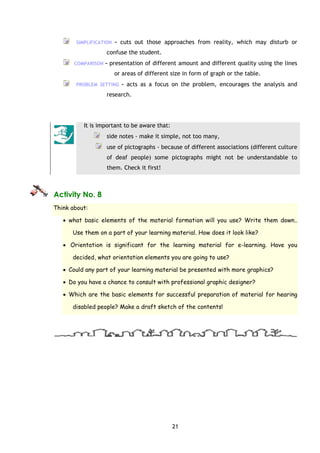
2nd
example
The use of
indents,
numbering,
borders,…
The contents can be formatted in two ways:
1. as a prose (can make the reader tired) or
2. we an use graphic elements (to make the subject
more friendly and understandable):
⋅ tables, lists, diagrams,
⋅ sketches, pictures,…
3rd
example
A different way
of graphic
approach
8.4 The use of pictures
Picture material – diagrams, sketches, caricatures, photographs, plans, etc. – can be used
in various ways with different purpose:
DECORATION – more friendly view of the learning material,
FUN – review of the fun side of the learning material,
EXPRESSION – expression of emotions or stimulation of feelings related to the
learning subject.
CONVINCEMENT – stimulation of students to change the habit or relation,
ILLUSTRATION – enrichment of the learning text understanding,
DESCRIPTION – clear fulfillment of textual description.
EXPLANATION – a picture can be used to explain, how things work and how to handle
with them.
How to design the contents?
as a prose
(boring?)
using graphic elements
(friendlier? clearer?)
tables
lists
diagrams
pictures
photographs
21
SIMPLIFICATION – cuts out those approaches from reality, which may disturb or
confuse the student.
COMPARISON – presentation of different amount and different quality using the lines
or areas of different size in form of graph or the table.
PROBLEM SETTING – acts as a focus on the problem, encourages the analysis and
research.
It is important to be aware that:
side notes - make it simple, not too many,
use of pictographs - because of different associations (different culture
of deaf people) some pictographs might not be understandable to
them. Check it first!
Activity No. 8
Think about:
• what basic elements of the material formation will you use? Write them down..
Use them on a part of your learning material. How does it look like?
• Orientation is significant for the learning material for e-learning. Have you
decided, what orientation elements you are going to use?
• Could any part of your learning material be presented with more graphics?
• Do you have a chance to consult with professional graphic designer?
• Which are the basic elements for successful preparation of material for hearing
disabled people? Make a draft sketch of the contents!
22
9. Writing the learning material
“Finally!” might some of you say. Actually, writing of the learning material takes only 50%
of the time, the author needs to completely prepare the learning material for e-learning.
The other half of time is used for preparation and planning.
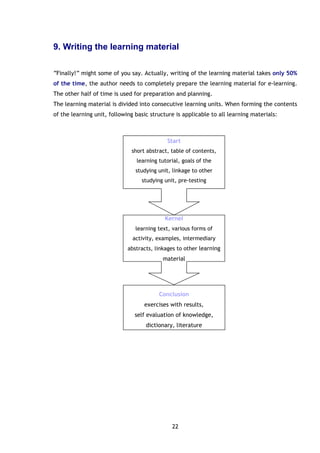
The learning material is divided into consecutive learning units. When forming the contents
of the learning unit, following basic structure is applicable to all learning materials:
Start
short abstract, table of contents,
learning tutorial, goals of the
studying unit, linkage to other
studying unit, pre-testing
Kernel
learning text, various forms of
activity, examples, intermediary
abstracts, linkages to other learning
material
Conclusion
exercises with results,
self evaluation of knowledge,
dictionary, literature
23
9.1 Start
Before you start with presentation, you can offer following additional information to the
student:
1. Short abstract
Make a short presentation of learning unit’s contents so
that the student is aware in what he/she is engaging in.
2. Learning unit goals It is recommended to present the goals of the learning unit
before the learning subject. The advantages of clearly set
goals:
They relieve the communication between the teacher
and the students, because the teachers explain what
they expect from the student and the students know
what they are supposed/expected to learn.
They relieve the knowledge evaluation to the teacher as
well as to the student.
3. Table of contents You can choose between two types of table of contents:
table of contents includes only the concrete learning
units or
table of contents includes all learning units, only that
the concrete learning unit is given with classification to
the last used field in decimal qualification. This view
offers to the students not only the overview of learning
unit they are temporary focused, but also over the
complete learning material
4. Learning tutorial Students sometimes require an extra help in a form of
learning guide:
advice about a learning technique,
about writing and sending of the exercises,
24
about the correct use of didactic elements of the
learning material,
about the use of working material and subsidiary
sources,
about the search of supplementary sources, etc.
5. Information about
the time that the
student will take to
learn the learning
unit
Information about the time that the student will take to
learn the learning unit must consider following:
working on the learning subject ,
exercise solving,
tasks sending,
purchase and the study of supplementary literature ,
various activities (realization of a questionnaire, visit
to a performance, paper abstract,…)
Be realistic at time evaluation!
6. Linkage to the other
learning units
You can mention to the student, which learning unit
includes the subject and whether he/she will need
additional knowledge.
7. Notification about
initial conditions
and required
previous knowledge
The student has to be warned, whether any previous
knowledge, supplementary equipment, previous
preparations, etc. is required for understanding of the
subject. In this way we avoid the unnecessary frustration.
Activity No. 9
Every beginning of learning subject can include the above elements. Does it look more
than enough? In a first place, ensure the first three elements: short abstract, goals
and table of contents.
- - -
Finished?
25
9.2 Kernel
The learning material for e-learning must be adjusted in such a
way that students can learn the subject without external help.
Learning subjects must be carefully tilled also from didactical
viewpoint.
It is very important that the presentation of the learning text is successful. A few didactic
and design auxiliary means can relieve this thankless task. Several didactic means exist
that can be useful at formation of learning subject:
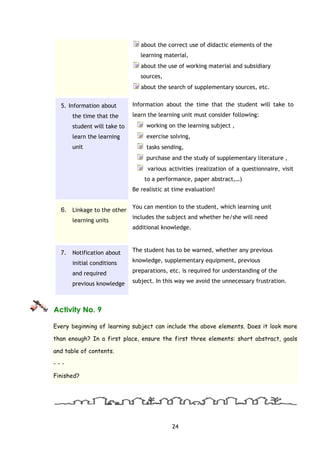
Preceding orientation - repeatedly allow the students a glance into future themes or
direct them to systematic role of themes inside the learning material.
Enter – carefully consider the start of the new thematic field.
Attachment - use the attachment to previous and known facts.
Advanced notifications - refer clear, if you plan to use and deepen the theme in the
future.
Transversal connections – use transversal links to neighboring subject areas.
Do not economize with examples, explanations, intermediate abstracts, rules and
proverbs, various activities and link to other learning materials.
Learning text must be in addition:
a motivation,
written in friendly style and
give student a feeling of safety.
Significant elements of every study are different forms of activities. The student must be
given a chance to work on the learning subject. This will allow him to find out, whether
he/she understood the subject correctly or he/she needs to deepen his/her understanding.
Activities with feedback are playing an essential role at learning.
26
9.2.1 Activity types
Students’ activity can be stimulated in various ways:
with questions and exercises within the learning material – e.g. every few minutes
– where you invite the student to answer the question or do some practical work
before he/she or she continues with next paragraph.
At the end of the learning unit you can set a series of question for self-evaluation
of knowledge.
with final knowledge verification or with extended exercises that require intense
practical or project work.
9.2.2 Activities – why we use them?
Activities help students:
to remember, understand and use thoughts and ideas from the learning material ,
to think with their own head,
to learn with working,
to link learning with their own situation,
to contribute with their own experiences and examples,
to think about their own thoughts and feelings,
to gain additional information not included in given learning material,
to use what they learn at their work and in their personal lives,
to train for specific goals,
to control their own progress,
to discover their own strengths and weaknesses, etc.
9.2.3 What should the students do during activities?
Activities can require from the student:
to review and explain the contents with their own words,
to use what they learned in given examples,
to suggest their own examples,
27
to compare or evaluate new ideas,
to consider how the results agree with their own experiences,
to take different parts,
to use what they have learned,
to research new subject based on what they have learned so far,
to ask and discuss with other people,
to perform practical work, etc.
9.2.4 What kind of student’s responses can we expect?
Various forms of activities can cause various student’s responses. What can we expect from
the student:
to form their answer with their own words (without a written record),
to tick off their answers in the list of queries,
to push the key of computer,
to answer multiple answers,
to underline words or part of the text,
to fill the table,
to fill in the missing part,
to write the word/phrase/number in the frame or to side,
to write the calculation steps,
to add a diagram, table or graph to the calculation,
to draw a table, graph or diagram,
to make a voice record,
to take photos, etc.
9.2.5 What are student’s benefits from activities?
Despite of your best intentions students might not participate in your activities. How to
motivate the students to take part at least in the activities that is in their behalf?
Some advices about formation of activities:
evaluate the responses to key activities,
use the responses to activities as the base of team work,
ensure that activity is closely connected to student’s life/work,
28
ensure the variety of activities,
clearly show, how each of activities contributes to the reach of goal,
explain the student the purpose of the activity,
indicate the time required for particular activity,
suggest the extend of an answer.
Ensure satisfactory transversal information:
correct answer if it exists,
examples of answers, if more options exist,
results of the choice they have done,
responses from other students,
suggestion on how to evaluate their responses,
suggestion on how to receive transversal information from other students,
sympathize with student’s troubles,
encourage them at mistakes they have done,
comment on controversial question, you might face with during the activity.
Try to avoid:
activity on account of activity,
unclear, undefined activities!
Activity No.10
The characteristic of learning materials for e-learning is the sequence
information – action
Therefore think twice about:
• how are you going to construct activities,
• what will students’ tasks be in the activity and
• what will students gain with these activities?
29
9.2.6 Examples
People usually have troubles with understanding of bare abstract ideas. We need clear
examples. Students will better understand and accept the ideas:
if you present them with examples,
if these examples mean something to students,
if they maybe even find them alone or form them during the activity.
Searching for examples is very time consuming work. There is wide spectrum of different
types of examples. To find the example that exactly covers everything what we wrote with
words and equations – all this is a dream of any teacher.
Examples can be of many types:
reference to what students know,
analogies, which show the similarity to what students already know or what they
have already learned,
anecdotes, which illustrate the idea being discussed,
studies of examples and simulation that the student can explore,
pictures – sketches, photographs, diagrams, plans, etc.
caricatures, comics, funny stories (be sure that they are suitable!),
audio and video material – e.g. interview notes, shots of the working process phases
in a factory, in a laboratory, in hospital, etc.
real objects, etc.
9.2.7 Reader-friendly style
Each one of us once received a text, which he/she or she needed to read at least three
times to understand the point of it. And vice versa, a text he/she or she enjoyed reading.
Everything was clear in a second!
Not everything is so black and white, indeed. However, some valid directives exist, which
you should stick to when constructing your learning material.
Conversation style
you can introduce yourself in the beginning,
turn directly to the student (you decide whether you will address student
individually or as a group)
30
use the narration in first person singular,
mention your own experiences in connection with particular learning subject,
use rhetoric questions (for example, “What would you do in this situation?”)
take into consideration the level of your student – when using comparisons,
analogies and examples you need to rely on the student, his/her/her experiences,
his/her/her environment,
consider the option that your students can be of both sexes, different races,
religion, sexual orientation, physical capabilities, and similar.
try to avoid words and examples, which may exclude or even insult any of your
students.
Clear and concise style
express yourself clear and concise,
instead of foreign words use familiar words (if possible),
be careful when you are using slang expressions,
instead of abstract words try to use concrete,
sentences should be short (if possible), not longer than 20 words,
the sentences should have simple structure,
use short paragraphs (not less than three or four paragraphs per page),
the purpose/objective of the text should be clear,
etc.
Activity No.11
Read carefully the contents of your learning unit:
- are there enough examples?
- have all new words clear explanation?
- is the learning subject supported with sufficient activities?
- is the learning text written in friendly style? Does it motivate and stimulate?
- have you offered the student a chance to evaluate his/her/her knowledge and ensure
the feeling of safety?
- and more and more…
31
9.3 Conclusion
At the end of learning unit you can add:
exercises with solutions,
expression dictionary and
literature listing.
9.3.1 Exercises
E-learning distinguishes between two types of exercise:
training exercise, that students check alone using the results enclosed,
exercises to give away, that students usually send for correction and evaluation.
As the training exercises, as well as exercises to give away are important part of the
learning process. At the same time, they establish contact between exercise
correction/evaluation and the solutions.
Training exercises
1. Serve in a first place for information strengthening.
2. For preparation for later exercises to give away and final exams.
3. are supposed to serve students as a medium for mediation of success feeling.
The function of control and measurement of knowledge is hidden in background. Training
exercises should not be too hard, otherwise solutions and the success feeling stay out, but
may not be too easy, because the safety feeling deceives. In addition, the students are not
well prepared for exercises to give away and final exams.
Exercises to give away
At this type of exercises, the testing and measurement of knowledge is brought in the
front. Their didactical value is gained over corrections and evaluation. Incomplete
exercises, sent into evaluation, can be helpful to the student if they are equipped with
appropriate commentary for stimulating more intense work and knowledge holes mending.
When you construct both types of exercises you must be focused to
learning goals: exercises should show to what extend students must reach
these goals.
32
Solutions of exercises
Training exercises reach their value when the students get examples of results,
commented resultss, tips for results and similar. In this way they can check, to what
extend their learning was successful. Therefore all learning units should have enclosed
results of all exercises.
This situation is similar at exercises to give away: it is more useful, if you enclose not only
rough solutions, but also additional commentary, tips, encouragements, information or
sample results.
Correction and evaluation of exercises
When we correct and evaluate results, we can decide upon two methods:
exercises are evaluated by people, who are competent for,
exercises are evaluated automatically - with computer’s help. This is useful for
exercises of objective type – where the student decides among different prepared
answers or writes the result of a calculus (LOTSE, Hot Potato, Questionmark
systems).
The use of both types of evaluation is legitimate at long-term e-learning. On one side, ,
due to the organisational reasons it is inadmissible that no part of the exercises is prepared
for rational and completely machine evaluation. On the other side, we cannot ignore that
exercises with scientific contents (e.g. demonstration of mathematic expressions,
philosophical and humanistic questions) cannot be evaluated with machine evaluation.
Activity No.12
Short exercises for training and self-evaluation of knowledge are an important part of
learning unit, where you need to offer to the student the complete solving procedure.
Does you learning unit include this part?
33
9.3.2 Expression dictionary
All scientific expressions, that are not generally known, must be explained at first
mention. Also mention the pronunciation when needed.
In praxis, many different forms of used marks appear:
The most broadened is the mark list in the form of the dictionary, where the
expressions, that we explain, are listed in an alphabetical order.
Sometimes it is more suitable that expressions we would like to explain, appears
in the order with regard to subjects. Dictionaries of this type are usually
presented in a form of index, which is appended at the end of the text with
reference to the pages in the text.
9.3.3 Literature listing
Each learning unit should, independent of the presence of full literature listing, include at
least a short listing of recommended literature for particular unit, as well as the literature
for deepening the knowledge.
Literature listing should contain following items:
recommended literature in the frame of subject contents,
general additional literature,
introductory literature (for preparation on the subject) and
literature of continuation (for knowledge deepening).
The student could find helpful, if you write a short commentary, why you choose specific
literature, by the title.
Knowing the fact of poor language skills leads us to fact that for deaf and hard of
hearing students writing down the contents, answering the questions can be very
frustrating. They are aware of poor writing and reading skills. We can compare
their knowledge to our knowledge of foreign language.
Because of that we suggest that student:
review and explain the contents in sign language(video shot),
to do all other tasks in sign language.
34
By choosing the examples presenting an abstracts ideas we have to check
whether the deaf and hard of hearing people are familiar with them too. Because
of that it is good to have some knowledge about deaf culture (some jokes don′t
mean anything to deaf student, for example a play on words).
We should have in mind that deaf and hard of hearing students have poor
knowledge of language while writing text material for them. Because of that
we suggest to read precisely chapter 9.2.7 (Friendly writing style) and stick to
those guidelines.
Exercises:
We should be aware that sometimes deaf and hard of hearing students
answer questions without knowledge, relating much on the text (using the
same words). For that reason it is better not to put questions as it is
expected in text (in sequence).
By giving the opportunity to present exercises in sign language we can tell
whether the wrong answer is consequence of bad knowledge or they have
problems with language.
exercises are evaluated automatically - we recommend this way of
evaluation because deaf are usually highly frustrated (their texts have a lot
of mistakes).
Expression dictionary:
All scientific expressions, that are not generally known, must be explained at
first mention. In a dictionary for deaf people it will probably be more unkonwn
words, not just scientific. We suggest that the dictionary include:
Word and sentence from which the word derives, because we can not
explain word in different meanings at the same time.
Video shot with sign language interpreter explaining words.
Activity No.13
Add the dictionary of expression and listing of literature to your learning unit.
35
Finally, you have reached the end of the chapter “Writing the learning material”. But you
haven’t written complete learning material yet. If everything went well, you have only the
draft of one learning unit. How many learning units will your learning material consist of?
In the way you commenced the first unit, you will commence the second and third,…
10. Testing and improving
The first version of the learning material is written. Is it written well? Does it require any
changes? Are the students going to be satisfied with such a formation of the learning
material?
For easier decision on what changes you might have to do, you can get help with:
Questionnaire for the author, where you answer the questions about the goals,
activities, contents, learning structure, presentation and format of the learning
material.
Critical commentary from the professional expert and education performer,
Results of the pilot realisation. It can be executed in a form of direct testing on
the two or three students’ sample, which represents the typical representatives of
population. You can decide for the realisation on the field, where you find 20-30
students, who are ready to go through your learning material in a way that best
suits real circumstances.
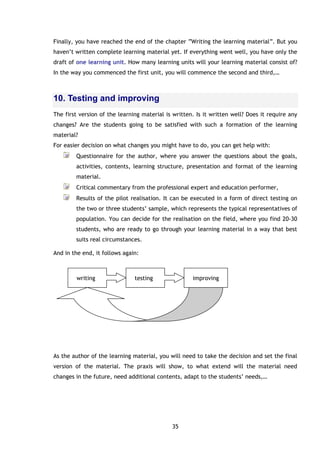
And in the end, it follows again:
As the author of the learning material, you will need to take the decision and set the final
version of the material. The praxis will show, to what extend will the material need
changes in the future, need additional contents, adapt to the students’ needs,…
writing testing improving
36
We can hardly expect that the first version of the learning material will be
without mistakes. Because of poor language skills we will probably forget to
explain some words or our explanation won′t be good enough. We can not
predict everything and because of that it is good to use testing a few deaf
students.
We hope that this material has been useful on your first steps for
construction of the learning material for e-learning. We wish you a great
success at construction of the following materials and that students would
use your material with pleasure. (Authors)
References
1. Gerlič I., Debevc M., Dobnik N., Šmitek B., Korže D. (2001) Načrtovanje in priprava
študijskih gradiv za izobraževanje na daljavo, FERI, Maribor.
2. Derek Rowntree(1999) Preparing Materials for Open, Distance and Flexible
Learning, Kogan Page, London.
3. Derek Rowntree (1994) Exploring Open and Distance Learning, Kogan Page, London.
4. Fred Lockwood (1998) The design an Production of Self-Instructional Materials,
Kogan Page, London.
5. LOLA Student handbook (1999) Workshops, Heriot-Watt University, Edimburg.
6. Lea Bregar(1998) Študij na daljavo in spreminjanje izobraževalne paradigme,
Univerza v Ljubljani, Ekonomska fakulteta, Mednarodna računalniška konferenca
MIRK '98, Piran.
7. Open and distance learning – trends, policy and strategy considerations (2002)
UNESCO.

E-Learning Material Planning and Preparation

  • 1.
    UNIVERSITY OF MARIBOR FACULTYOF ELECTRICAL ENGINEERING AND COMPUTER SCIENCE 2000 Maribor, Smetanova ul. 17 SLOVENIA E-learning material planning and preparation Matjaž Debevc Metka Zorič Venuti Živa Peljhan SOCRATES GRUNDTVIG project Maribor, May 2003
  • 2.
    Publishing: University ofMaribor Faculty of Electrical Engineering and Computer Science Purpose: Learning material Title: E-learning material planning and preparation Authors: Matjaž Debevc, Metka Zorič Venuti, Živa Peljhan Page numbers: 36 Review: dr. Dean Korošec Lecturing: Barbara Banovič Design: Metka Zorič Venuti Financed by: SOCRATES-GRUNDTVIG project BITEMA CIP – Kataložni zapis o publikaciji Univerzitetna knjižnica Maribor 378.018.432:004.738.5(075.8) DEBEVC, Matjaž E-learning material planning and preparation / Matjaž Debevc, Metka Zorič Venuti, Živa Peljhan. – Maribor: Faculty of Electrical Engineering and Computer Science, 2003 ISBN 86-435-0551-X 1. Zorič-Venuti, Metka 2. Peljhan, Živa COBISS-ID 50504961 Date: May, 2003 Printing: Faculty of Electrical Engineering and Computer Science, Maribor Number of copies: 50
  • 3.
    1 Table of contents 1.Introduction............................................................................. 3 1.1 Distance education with ICT technology ....................................... 3 1.2 What led you to write the learning material for e-learning? ............... 4 1.2.1 What good will it do for you, as the teacher?........................... 4 1.2.2 What good will it do for the student?..................................... 5 2. Do you already have an idea about the formation of learning material? .. 7 2.1 Learning subject with questions for self-verification........................ 8 2.2 Learning in printed or electronic form ......................................... 8 2.3 Reflective action guide ........................................................... 8 3. Who is the material meant for?..................................................... 9 4. The learning material goals definition ...........................................10 5. Structuring subject into learning units...........................................11 5.1 Subject-centered approach ..................................................... 11 5.2 Student-centered approach ..................................................... 11 5.3 Brain storming..................................................................... 12 5.4 A draft contents outline ......................................................... 13 6. The role of the media and the technology ......................................14 7. Reflection about the use of existing learning material .......................17 8. The role of graphic elements, when designing the learning material .....18 8.1 Basic elements of textual design............................................... 18 8.2 Orientations elements ........................................................... 18 8.3 Graphic approach ................................................................. 19 8.4 The use of pictures ............................................................... 20 9. Writing the learning material ......................................................22 9.1 Start................................................................................ 23 9.2 Kernel............................................................................... 25 9.2.1 Activity types................................................................ 26 9.2.2 Activities – why we use them? ............................................ 26 9.2.3 What should the students do during activities? ........................ 26 9.2.4 What kind of student’s responses can we expect? .................... 27 9.2.5 What are student’s benefits from activities?........................... 27 9.2.6 Examples ..................................................................... 29 9.2.7 Reader-friendly style....................................................... 29
  • 4.
    2 9.3 Conclusion .........................................................................31 9.3.1 Exercises ..................................................................... 31 9.3.2 Expression dictionary....................................................... 33 9.3.3 Literature listing ............................................................ 33 10. Testing and improving .............................................................35 References ................................................................................36
  • 5.
    3 1. Introduction A fastdevelopment of information and communication technology (ICT) together with a rich support of various software (text editors, graphics, voice…) is a constant challenge for each author of e-learning material. However, we would like to stress two important facts: Professional quality of learning material stands or fails together with its author. Writing quality learning material is extremely hard work. The enforcement of distance learning, together with its need for e-learning material, requires much more! Presented guidelines for preparation of learning material could be very helpful for preparing e- learning material for deaf and hard of hearing people as well. But we must be aware of some necessary adaptations. First, the voice records will probably be excluded and we would lay much stress on video shots and other visual ICT. We can use visual potential of deaf students. We assume that it is highly developed. In section like this we are going to present some addition requirements for preparation of learning materials for deaf people. 1.1 Distance education with ICT technology Distance education is a form of indirect education, where a teacher and a student are physically or even for a time distance apart. The teacher or the tutor constantly controls learning success of the student. The learning material is interposed on distance using various media either in written or in electronic form. In this way, distance education is the form of indirect education that allows to the students to learn in their domestic environment. This makes the distance education as a modern form of education, a user- friendly and adaptive educational process.
  • 6.
    4 Recently, in theEuropean environment (and consecutively in our environment), following expressions are commonly used: e-education, composed of e-learning and e-teaching. 1.2 What led you to write the learning material for e-learning? As a teacher in educational process, you have lost the role of direct knowledge forwarding in a classroom with lectures or any other for knowledge transmission (face-to-face teaching). Your pedagogic work is more valuable, since you need to focus your knowledge on material preparation and organization of distance learning. It is important to know the use of specific media and closely linked technologies, because it is essential, when and how you are going to use the specific media. You have to keep in mind that the student will learn by himself most of the time. He/she would not have a person beside, who could give an advice, if he/she confronts troubles at understanding a topic. Access to formation of interactive, multimedia learning material is very complex field, therefore you need to consider following questions: What good will it do for you, as the teacher? What good will it do for the student? 1.2.1 What good will it do for you, as the teacher? Learning materials for e-learning have many advantages: They discharge you of the lectures and consecutively from monotone repeating of similar contents. Good leaning material in a first place presents a step to a better quality of teaching and teacher-student relations, but above all to the development of active student's relation to the learning. This will cause an important change to your role as a teacher; namely from a teacher that gives the teaching subject, into a mentor and advisor, who gives the student explanation and support.
  • 7.
    5 Your work willbecome more interesting and quality, because mostly talented and interested students with well-founded and reasonable questions will turn to you, what makes a challenge to any teacher. In this way, you as a teacher will gain precious encouragement for future work and useful information about the way students work on your subject, what kind of troubles they are confronting and what kind of encouragement they may need. Quality learning material has an important role on student's motivation for learning, and at the same time helps to develop independency and responsibility in the relation to own education. These are capacities that need to be developed on each level of education. Therefore, the learning materials for e–education are often an encouragement for changes in classic education. Activity No.1 What good will it do for you, as a teacher? Write down, which benefits of the learning material for e-learning are the most important for you! 1.2.2 What good will it do for the student? With the learning material for e-learning, the student can learn all the necessary subjects alone. This brings many advantages as well as more elements of student’s own responsibility. Advantages Opportunity to learn when he/she has the time. He/she can learn at work, in the study centre, in the library or at home. He/she states the learning tempo. He/she has more choices, how he/she is going to study and check his/her knowledge. Higher quality of learning subject presentation. Option to use the media, that best fits to the students and gives the best learning motivation.
  • 8.
    6 Elements of ownresponsibility The student, who had decided to learn with the learning material for e-learning, needs to: take the time, make the plan of work, try hard to understand the subject, otherwise he/she will not be able to complete the tasks and exercises for evaluation of the knowledge. The questions, he/she will prepare for the consultation with the teacher or tutor, will have to be logical and deep. Responsibility for his/her success could not be displaced to the teacher or too small number of lectures and practices, because the entire learning subject will be captured in the learning material. Activity No. 2 What good will it do for your student? Write down the benefits of your learning material for e-learning for your student!
  • 9.
    7 2. Do youalready have an idea about the formation of learning material? The learning material for e-learning does not differ significantly in the contents plan from the classic, printed material. Its formation is based on same principles, meaning that: goals need to be set clear, contents need to be divided into closed chapters or learning units, learning units need to follow the contents and didactical approach, which allows quality individual learning to the student. In comparison with printed textbook, interactive and multimedia learning material for e- learning exploits all the advantages that ICT offers. Except of textual part, it may contain: voice records, video shots, computer animations, computer simulations, interactivity that allows simple and fast return information at exercises and exams. Besides the above mentioned standard elements, the learning material may also contain: material linking, including browsing through the parts of the material using hyperlinks, the chance to use prepared packets for CBT - computer based training, chance to use prepared multimedia CD-packets. The design of the majority of the learning material for e-learning is based on the connection: information + action This means that they offer information and expect from the student to make something out of them. In wide sense we distinguish between three designs of the learning material for e–learning: learning subject and questions for self-verification at the end (tell-and-test), lectures in printed or electronic form and reflective action guide.
  • 10.
    8 2.1 Learning subjectwith questions for self-verification This is the most basic approach, where the author of learning material prepares several pages of the learning material and appends questions for self-verification of knowledge with solutions or correct answers at the end. 2.2 Learning in printed or electronic form At this type of learning material, the student has a feeling, that the teacher is personally leading him through the material and is occupied only with him. The learning material consists of questions and other activities (every few minutes), where the author checks whether the student understands the subject, knows how to comment it or use it. The student receives immediate information about his/her understanding of particular part of the subject, before he/she progresses to the next topic. 2.3 Reflective action guide Reflective action guide supposes that the majority of the important learning will be done outside the learning material. The material is prepared in the form of guide for a specific activity – anywhere – in real situation, maybe in connection with other people, in the working place, etc. The goal of the guide is to help the student to follow his/her own project. This may be the development of individual understanding or a reach of particular practical, motor competence. The goal of the guide could also be that the student knows to observe the world in a different way and also to act in the new way. Reflective action guide supports the student to critical consider about why, what and how it works – and to evaluate the results. It can contain the instructions about how to choose a topic, how to find data sources, analysis techniques, report forms, role of the tutor,… In a chapter 2 among presented forms of learning material we suggest to choose teaching in printed or electronic form (2.2), because in this type of learning material the students have a feeling that the teacher is leading them. For deaf and hard of hearing students that it is better because and encourage them because of poor language skills and many new information. Activity No. 3 Which approach, maybe a combination of approaches, are you going to choose?
  • 11.
    9 3. Who isthe material meant for? One of the basic characteristics of the learning material for e-learning is the individualism of learning – the students gain the knowledge by themselves. Therefore, you need to successfully answer following questions: What are the age, sex and nationality of the students? What is their level of education, where do they live, what are their cultural habits? What is the level of motivation for learning? How does the learning subject apply to their life or work? What are their working and learning habits? What is their level of activity? Do they have any past experiences with e-learning? What precedent knowledge does your subject requires? Are any personal experiences important for the learning? Where, when and how will they learn? To what extend does the family support their learning? The image you make about the students affects on a wide range of elements that the learning material relies on: the method of linking between learning subject with practical examples, the method of linking on student’s experiences, the choice of the media. When writing the explanation and searching for appropriate practical examples for illustration of the subject, you need to keep the student in mind and accustom yourself to his/her way of comprehension of ideas, you are describing. The learning material has to facilitate the learning to the student and illustrate the contents of the subject. We also suggest to read precisely chapter 3. And thing about deaf individuals and their language skills. We have to answer following questions: How good are students at national language? How good are students at national sign language? Activity No. 4 Who are your students? Do you know everything about them that is essential for composition of the learning material for e-learning?
  • 12.
    10 4. The learningmaterial goals definition Similar to each educational programme, the materials for e-learning need to have set clear goals that the student is supposed to reach. It is essential to know, what the student should be able to do, when he/she learns particular subject: at statistics, the student needs to know how to present end interpret gained data, at literature, the students should explain the writing style of various period authors on the basis of text analysis, at measures, the students will be able to choose appropriate measuring instruments, carry out the measurement and evaluate the results, at market communication the goal may be, that the student knows to suggest the appropriate strategy in given circumstances for introducing the product on the market. The goals can be divided into two groups: main goals of the learning material and sub-goals for single learning units. The goals need to be set clear, because: they present the red line, where education runs and are the origin for knowledge evaluation at the end of education. Many approaches to classification of learning goals exist, however Bloom’s taxonomy of learning goals is the most known. Activity No. 5 Write down the main goals for your learning material! For each main goal try to form sub-goals. Try to operationalise the record of sub-gaols and use the taxonomy of learning gaols
  • 13.
    11 5. Structuring subjectinto learning units We assume you have already constructed your main goals and sub-goals of the learning material. So you are familiar with the knowledge your students will gain after they learn the subject. Now you have to define the topics or thematic complex and themes, which the material will contain. It is important that you, as the author of the material, have clear picture of how much of new knowledge an average student is able to gain in specified time period, e.g. one week or one month, depending on the other obligations the student has in life (a job, a family,…). The rough draft of the contents of the learning material and learning unit can be constructed in several ways. We will take a look at some of them. 5.1 Subject-centered approach Following information can be helpful when constructing the learning material: analysis of personal understanding of learning subject – with brain-storming, list formations, diagrams,… discussion with professionals and possible users of education about individual themes of learning subject, analysis of existent materials, appropriate to the student’s level, review of films, video and audio material and papers in newspaper and magazines, analysis of various examples of knowledge verifications and exam questions form the past, statement of fundamental ideas and principles, etc. 5.2 Student-centered approach You should focus on the student - therefore: Ask your future students what subjects they want to study intensively. Discuss with future students about their momentary understanding and comprehension of fundamental ideas of learning subject. Make inquires about the topics that caused troubles to previous students. Set and analyze the learning goals.
  • 14.
    12 Think about thelearning activities, where students have to (or are recommended to) take part in. Weigh up in the mind, how you could reasonably determine student’s progress or gained knowledge as the result of learning. Weigh up the reports of other teachers about the work of students at related subjects/classes from past years. 5.3 Brain storming Rough draft of the contents of the learning unit “Planning”:
  • 15.
    13 5.4 A draftcontents outline Maybe you will find more suitable to design the rough draft of contents of the learning material and division into learning units in the form of thematic fields – kind of table of contents: 1st Learning unit The importance of distance learning 3rd Learning unit Didactic origins - What is distance learning? - The role of teachers and tutors - Models - The role of media and technologies - Thematic origins - Pedagogic-psychological origins - Methodical or specially-didactical origins 2nd Learning unit Models of modern learning technologies and approaches 4th Learning unit The learning material preparation - Fields of use - Education networks - The meaning of the learning material - Course of preparation - Design Among different approaches presented in chapter 5 we would suggest: student oriented approach, where students will be highly motivated whether they are previously asked about the topic, and will gain information about unknown areas. Activity No. 6 Write down rough draft for your learning material and its dismembering into learning units in a way that suits you best.
  • 16.
    14 6. The roleof the media and the technology Media is defined as communication sources, that each on its own way presents the knowledge, information or learning material. The role of technologies at distance learning is to enable the use of the media and to enable the transfer and presentation of knowledge or information. Each media uses its own way of presentation of the knowledge or information. E-learning uses following media and presentations: textual presentation -› printed media, audio presentation -› voice media, video presentation -› visual media, computer presentation -› combined media or multimedia . None of the listed media is the most appropriate or the most effective. The media used in e-education is appropriate, when it has following characteristics: all students have to know how to use the media and have granted access to it; accommodation, meaning that the media can be used in a place and on time suitable to the student; media has to enable active participation of student at e-education; chance to link the individual media with other media, what enables the presentation of mimics and non-verbal manner of expression. This brings the communication between the students near to the reality. At the same time it makes the geographical and periodical differences between the students insignificant. The market offers various technologies that support audio or video media. Audio presentation of knowledge support following technologies: audio tapes , radio and telephone. Video presentation on the other hand support following technologies: television transmission, videotapes, CD-ROM,
  • 17.
    15 satellite transmission, cable transmission, microwaves. Howto choose an appropriate media? In most cases, authors of the learning material choose the media intuitively, based on past experiences with the learning material for e-learning. Following reflection may be helpful when deciding upon the most appropriate media: 1. Which parts of learning subject and which gaols can be learned only by textual material? 2. Now, figure out when use of following media is essential: voice, video, CBT Computer based training, practical work, interactivity elements and cooperation between people? Beside each stated need, write the appropriate media immediately. At the same time, check whether media suits to the user and to the education. In choosing an appropriate media we should also be aware of some adjustment for the deaf and hard of hearing students and we can′ t leave this only to authors intuition. Here are some suggestions: textual presentation -› printed media; we must be aware of writing and reading skills and adopt text to that level, audio presentation -› voice media, should be excluded unless we are using the material for speech learning, video presentation -› visual media; we can use video to record sign language interpreter,
  • 18.
    16 computer presentation -›combined media or multimedia; we must be aware that a deaf person can′t concentrate on interpreter, subtitles, picture at a same time. We have different materials beside text and it is good that all elements presented can be translated in sign language. It is interesting that we usually don′t remember to translate following elements: instructions how to use learning material, to get acquainted with goals of the subject, introductory explanations and overviews, abstracts, dictionary, FAQ – frequently asked question, clearer explanations, contrast viewpoints, alternative examples, illustrations, example studies, exercises with solutions, activities, recurrent information about activities, instructions for practical work, tasks for discussion with tutor, mentor, students, etc. All elements presented can be translated in sign language as video shots with or without subtitles. Activity No. 7 Well, which combination of media best suits to the goals (contents) of your learning material and to your students?
  • 19.
    17 7. Reflection aboutthe use of existing learning material After you made all the necessary preparation, it is the time to start writing the learning material. Or maybe not? Maybe exists a material that can be used partly or even as a whole? To use the traditional learning material in e-learning, you have to add instructions and additional material, to ensure to the student: instructions how to use learning material, to get acquainted with goals of the subject, introductory explanations and overviews, abstracts, dictionary, FAQ – frequently asked question, clearer explanations, contrast viewpoints, alternative examples, illustrations, example studies, exercises with solutions, activities, feedback about activities, instructions for practical work, tasks for discussion with tutor, mentor, students, etc. Therefore – even if you already have the quality learning material written in one of the text editors, you still have a lot of work with the transformation into the learning material for e-learning!
  • 20.
    18 8. The roleof graphic elements, when designing the learning material The graphics plays an important role, when designing the learning material. During the design, you can use: basic elements of textual design (different fonts and letter size, colours, shadows, frames, indent …), orientation elements, graphic presentation of the subject, the use of pictures. 8.1 Basic elements of textual design Basic elements of text forming are: bold text is used for headings or emphasis, italic text can emphasise significant ideas and proverbs or rules, indent is one of the agents for stressing important areas inside the text, for emphasis can also be used raster, frames and similar elements. Try to avoid simultaneous use of different formation elements (e.g. italic and bold text at the same time).It is applicable to give functionality to a formation style, e.g. important ideas in italic text, definition in the frames, proverbs indented, ... 8.2 Orientations elements The learning material for e-learning has to include orientation elements, which help the student to learn. These are: side notes and use of pictographs. In most cases, two forms of side notes are used: formal didactic notes and contextual notes. The most useful formal didactical notes are: conception, example, definition, hypothesis, solution, theory, thesis, exercise and abstract.
  • 21.
    19 Contextual notes atside should be in a form of headwords and must not reach an extend of learning text. Nevertheless, pictographs (small pictures, icons) are another useful instrument for better orientation. It suits the best if they are places on side. Following picture presents a section of pictographs that can be used: 8.3 Graphic approach Let us take a look at three examples of the same subject formation: 1st example Text block The contents can be formatted in two ways: as a prose (can make the reader tired) or we an use graphic elements, such as tables, lists, diagrams, sketches, pictures,… what makes the subject more friendly and understandable. workbook educational software reading instruction recommended reading law text proverb material for seeing disabled people cross reference overview statistics audio tape video tape
  • 22.
    20 2nd example The use of indents, numbering, borders,… Thecontents can be formatted in two ways: 1. as a prose (can make the reader tired) or 2. we an use graphic elements (to make the subject more friendly and understandable): ⋅ tables, lists, diagrams, ⋅ sketches, pictures,… 3rd example A different way of graphic approach 8.4 The use of pictures Picture material – diagrams, sketches, caricatures, photographs, plans, etc. – can be used in various ways with different purpose: DECORATION – more friendly view of the learning material, FUN – review of the fun side of the learning material, EXPRESSION – expression of emotions or stimulation of feelings related to the learning subject. CONVINCEMENT – stimulation of students to change the habit or relation, ILLUSTRATION – enrichment of the learning text understanding, DESCRIPTION – clear fulfillment of textual description. EXPLANATION – a picture can be used to explain, how things work and how to handle with them. How to design the contents? as a prose (boring?) using graphic elements (friendlier? clearer?) tables lists diagrams pictures photographs
  • 23.
    21 SIMPLIFICATION – cutsout those approaches from reality, which may disturb or confuse the student. COMPARISON – presentation of different amount and different quality using the lines or areas of different size in form of graph or the table. PROBLEM SETTING – acts as a focus on the problem, encourages the analysis and research. It is important to be aware that: side notes - make it simple, not too many, use of pictographs - because of different associations (different culture of deaf people) some pictographs might not be understandable to them. Check it first! Activity No. 8 Think about: • what basic elements of the material formation will you use? Write them down.. Use them on a part of your learning material. How does it look like? • Orientation is significant for the learning material for e-learning. Have you decided, what orientation elements you are going to use? • Could any part of your learning material be presented with more graphics? • Do you have a chance to consult with professional graphic designer? • Which are the basic elements for successful preparation of material for hearing disabled people? Make a draft sketch of the contents!
  • 24.
    22 9. Writing thelearning material “Finally!” might some of you say. Actually, writing of the learning material takes only 50% of the time, the author needs to completely prepare the learning material for e-learning. The other half of time is used for preparation and planning. The learning material is divided into consecutive learning units. When forming the contents of the learning unit, following basic structure is applicable to all learning materials: Start short abstract, table of contents, learning tutorial, goals of the studying unit, linkage to other studying unit, pre-testing Kernel learning text, various forms of activity, examples, intermediary abstracts, linkages to other learning material Conclusion exercises with results, self evaluation of knowledge, dictionary, literature
  • 25.
    23 9.1 Start Before youstart with presentation, you can offer following additional information to the student: 1. Short abstract Make a short presentation of learning unit’s contents so that the student is aware in what he/she is engaging in. 2. Learning unit goals It is recommended to present the goals of the learning unit before the learning subject. The advantages of clearly set goals: They relieve the communication between the teacher and the students, because the teachers explain what they expect from the student and the students know what they are supposed/expected to learn. They relieve the knowledge evaluation to the teacher as well as to the student. 3. Table of contents You can choose between two types of table of contents: table of contents includes only the concrete learning units or table of contents includes all learning units, only that the concrete learning unit is given with classification to the last used field in decimal qualification. This view offers to the students not only the overview of learning unit they are temporary focused, but also over the complete learning material 4. Learning tutorial Students sometimes require an extra help in a form of learning guide: advice about a learning technique, about writing and sending of the exercises,
  • 26.
    24 about the correctuse of didactic elements of the learning material, about the use of working material and subsidiary sources, about the search of supplementary sources, etc. 5. Information about the time that the student will take to learn the learning unit Information about the time that the student will take to learn the learning unit must consider following: working on the learning subject , exercise solving, tasks sending, purchase and the study of supplementary literature , various activities (realization of a questionnaire, visit to a performance, paper abstract,…) Be realistic at time evaluation! 6. Linkage to the other learning units You can mention to the student, which learning unit includes the subject and whether he/she will need additional knowledge. 7. Notification about initial conditions and required previous knowledge The student has to be warned, whether any previous knowledge, supplementary equipment, previous preparations, etc. is required for understanding of the subject. In this way we avoid the unnecessary frustration. Activity No. 9 Every beginning of learning subject can include the above elements. Does it look more than enough? In a first place, ensure the first three elements: short abstract, goals and table of contents. - - - Finished?
  • 27.
    25 9.2 Kernel The learningmaterial for e-learning must be adjusted in such a way that students can learn the subject without external help. Learning subjects must be carefully tilled also from didactical viewpoint. It is very important that the presentation of the learning text is successful. A few didactic and design auxiliary means can relieve this thankless task. Several didactic means exist that can be useful at formation of learning subject: Preceding orientation - repeatedly allow the students a glance into future themes or direct them to systematic role of themes inside the learning material. Enter – carefully consider the start of the new thematic field. Attachment - use the attachment to previous and known facts. Advanced notifications - refer clear, if you plan to use and deepen the theme in the future. Transversal connections – use transversal links to neighboring subject areas. Do not economize with examples, explanations, intermediate abstracts, rules and proverbs, various activities and link to other learning materials. Learning text must be in addition: a motivation, written in friendly style and give student a feeling of safety. Significant elements of every study are different forms of activities. The student must be given a chance to work on the learning subject. This will allow him to find out, whether he/she understood the subject correctly or he/she needs to deepen his/her understanding. Activities with feedback are playing an essential role at learning.
  • 28.
    26 9.2.1 Activity types Students’activity can be stimulated in various ways: with questions and exercises within the learning material – e.g. every few minutes – where you invite the student to answer the question or do some practical work before he/she or she continues with next paragraph. At the end of the learning unit you can set a series of question for self-evaluation of knowledge. with final knowledge verification or with extended exercises that require intense practical or project work. 9.2.2 Activities – why we use them? Activities help students: to remember, understand and use thoughts and ideas from the learning material , to think with their own head, to learn with working, to link learning with their own situation, to contribute with their own experiences and examples, to think about their own thoughts and feelings, to gain additional information not included in given learning material, to use what they learn at their work and in their personal lives, to train for specific goals, to control their own progress, to discover their own strengths and weaknesses, etc. 9.2.3 What should the students do during activities? Activities can require from the student: to review and explain the contents with their own words, to use what they learned in given examples, to suggest their own examples,
  • 29.
    27 to compare orevaluate new ideas, to consider how the results agree with their own experiences, to take different parts, to use what they have learned, to research new subject based on what they have learned so far, to ask and discuss with other people, to perform practical work, etc. 9.2.4 What kind of student’s responses can we expect? Various forms of activities can cause various student’s responses. What can we expect from the student: to form their answer with their own words (without a written record), to tick off their answers in the list of queries, to push the key of computer, to answer multiple answers, to underline words or part of the text, to fill the table, to fill in the missing part, to write the word/phrase/number in the frame or to side, to write the calculation steps, to add a diagram, table or graph to the calculation, to draw a table, graph or diagram, to make a voice record, to take photos, etc. 9.2.5 What are student’s benefits from activities? Despite of your best intentions students might not participate in your activities. How to motivate the students to take part at least in the activities that is in their behalf? Some advices about formation of activities: evaluate the responses to key activities, use the responses to activities as the base of team work, ensure that activity is closely connected to student’s life/work,
  • 30.
    28 ensure the varietyof activities, clearly show, how each of activities contributes to the reach of goal, explain the student the purpose of the activity, indicate the time required for particular activity, suggest the extend of an answer. Ensure satisfactory transversal information: correct answer if it exists, examples of answers, if more options exist, results of the choice they have done, responses from other students, suggestion on how to evaluate their responses, suggestion on how to receive transversal information from other students, sympathize with student’s troubles, encourage them at mistakes they have done, comment on controversial question, you might face with during the activity. Try to avoid: activity on account of activity, unclear, undefined activities! Activity No.10 The characteristic of learning materials for e-learning is the sequence information – action Therefore think twice about: • how are you going to construct activities, • what will students’ tasks be in the activity and • what will students gain with these activities?
  • 31.
    29 9.2.6 Examples People usuallyhave troubles with understanding of bare abstract ideas. We need clear examples. Students will better understand and accept the ideas: if you present them with examples, if these examples mean something to students, if they maybe even find them alone or form them during the activity. Searching for examples is very time consuming work. There is wide spectrum of different types of examples. To find the example that exactly covers everything what we wrote with words and equations – all this is a dream of any teacher. Examples can be of many types: reference to what students know, analogies, which show the similarity to what students already know or what they have already learned, anecdotes, which illustrate the idea being discussed, studies of examples and simulation that the student can explore, pictures – sketches, photographs, diagrams, plans, etc. caricatures, comics, funny stories (be sure that they are suitable!), audio and video material – e.g. interview notes, shots of the working process phases in a factory, in a laboratory, in hospital, etc. real objects, etc. 9.2.7 Reader-friendly style Each one of us once received a text, which he/she or she needed to read at least three times to understand the point of it. And vice versa, a text he/she or she enjoyed reading. Everything was clear in a second! Not everything is so black and white, indeed. However, some valid directives exist, which you should stick to when constructing your learning material. Conversation style you can introduce yourself in the beginning, turn directly to the student (you decide whether you will address student individually or as a group)
  • 32.
    30 use the narrationin first person singular, mention your own experiences in connection with particular learning subject, use rhetoric questions (for example, “What would you do in this situation?”) take into consideration the level of your student – when using comparisons, analogies and examples you need to rely on the student, his/her/her experiences, his/her/her environment, consider the option that your students can be of both sexes, different races, religion, sexual orientation, physical capabilities, and similar. try to avoid words and examples, which may exclude or even insult any of your students. Clear and concise style express yourself clear and concise, instead of foreign words use familiar words (if possible), be careful when you are using slang expressions, instead of abstract words try to use concrete, sentences should be short (if possible), not longer than 20 words, the sentences should have simple structure, use short paragraphs (not less than three or four paragraphs per page), the purpose/objective of the text should be clear, etc. Activity No.11 Read carefully the contents of your learning unit: - are there enough examples? - have all new words clear explanation? - is the learning subject supported with sufficient activities? - is the learning text written in friendly style? Does it motivate and stimulate? - have you offered the student a chance to evaluate his/her/her knowledge and ensure the feeling of safety? - and more and more…
  • 33.
    31 9.3 Conclusion At theend of learning unit you can add: exercises with solutions, expression dictionary and literature listing. 9.3.1 Exercises E-learning distinguishes between two types of exercise: training exercise, that students check alone using the results enclosed, exercises to give away, that students usually send for correction and evaluation. As the training exercises, as well as exercises to give away are important part of the learning process. At the same time, they establish contact between exercise correction/evaluation and the solutions. Training exercises 1. Serve in a first place for information strengthening. 2. For preparation for later exercises to give away and final exams. 3. are supposed to serve students as a medium for mediation of success feeling. The function of control and measurement of knowledge is hidden in background. Training exercises should not be too hard, otherwise solutions and the success feeling stay out, but may not be too easy, because the safety feeling deceives. In addition, the students are not well prepared for exercises to give away and final exams. Exercises to give away At this type of exercises, the testing and measurement of knowledge is brought in the front. Their didactical value is gained over corrections and evaluation. Incomplete exercises, sent into evaluation, can be helpful to the student if they are equipped with appropriate commentary for stimulating more intense work and knowledge holes mending. When you construct both types of exercises you must be focused to learning goals: exercises should show to what extend students must reach these goals.
  • 34.
    32 Solutions of exercises Trainingexercises reach their value when the students get examples of results, commented resultss, tips for results and similar. In this way they can check, to what extend their learning was successful. Therefore all learning units should have enclosed results of all exercises. This situation is similar at exercises to give away: it is more useful, if you enclose not only rough solutions, but also additional commentary, tips, encouragements, information or sample results. Correction and evaluation of exercises When we correct and evaluate results, we can decide upon two methods: exercises are evaluated by people, who are competent for, exercises are evaluated automatically - with computer’s help. This is useful for exercises of objective type – where the student decides among different prepared answers or writes the result of a calculus (LOTSE, Hot Potato, Questionmark systems). The use of both types of evaluation is legitimate at long-term e-learning. On one side, , due to the organisational reasons it is inadmissible that no part of the exercises is prepared for rational and completely machine evaluation. On the other side, we cannot ignore that exercises with scientific contents (e.g. demonstration of mathematic expressions, philosophical and humanistic questions) cannot be evaluated with machine evaluation. Activity No.12 Short exercises for training and self-evaluation of knowledge are an important part of learning unit, where you need to offer to the student the complete solving procedure. Does you learning unit include this part?
  • 35.
    33 9.3.2 Expression dictionary Allscientific expressions, that are not generally known, must be explained at first mention. Also mention the pronunciation when needed. In praxis, many different forms of used marks appear: The most broadened is the mark list in the form of the dictionary, where the expressions, that we explain, are listed in an alphabetical order. Sometimes it is more suitable that expressions we would like to explain, appears in the order with regard to subjects. Dictionaries of this type are usually presented in a form of index, which is appended at the end of the text with reference to the pages in the text. 9.3.3 Literature listing Each learning unit should, independent of the presence of full literature listing, include at least a short listing of recommended literature for particular unit, as well as the literature for deepening the knowledge. Literature listing should contain following items: recommended literature in the frame of subject contents, general additional literature, introductory literature (for preparation on the subject) and literature of continuation (for knowledge deepening). The student could find helpful, if you write a short commentary, why you choose specific literature, by the title. Knowing the fact of poor language skills leads us to fact that for deaf and hard of hearing students writing down the contents, answering the questions can be very frustrating. They are aware of poor writing and reading skills. We can compare their knowledge to our knowledge of foreign language. Because of that we suggest that student: review and explain the contents in sign language(video shot), to do all other tasks in sign language.
  • 36.
    34 By choosing theexamples presenting an abstracts ideas we have to check whether the deaf and hard of hearing people are familiar with them too. Because of that it is good to have some knowledge about deaf culture (some jokes don′t mean anything to deaf student, for example a play on words). We should have in mind that deaf and hard of hearing students have poor knowledge of language while writing text material for them. Because of that we suggest to read precisely chapter 9.2.7 (Friendly writing style) and stick to those guidelines. Exercises: We should be aware that sometimes deaf and hard of hearing students answer questions without knowledge, relating much on the text (using the same words). For that reason it is better not to put questions as it is expected in text (in sequence). By giving the opportunity to present exercises in sign language we can tell whether the wrong answer is consequence of bad knowledge or they have problems with language. exercises are evaluated automatically - we recommend this way of evaluation because deaf are usually highly frustrated (their texts have a lot of mistakes). Expression dictionary: All scientific expressions, that are not generally known, must be explained at first mention. In a dictionary for deaf people it will probably be more unkonwn words, not just scientific. We suggest that the dictionary include: Word and sentence from which the word derives, because we can not explain word in different meanings at the same time. Video shot with sign language interpreter explaining words. Activity No.13 Add the dictionary of expression and listing of literature to your learning unit.
  • 37.
    35 Finally, you havereached the end of the chapter “Writing the learning material”. But you haven’t written complete learning material yet. If everything went well, you have only the draft of one learning unit. How many learning units will your learning material consist of? In the way you commenced the first unit, you will commence the second and third,… 10. Testing and improving The first version of the learning material is written. Is it written well? Does it require any changes? Are the students going to be satisfied with such a formation of the learning material? For easier decision on what changes you might have to do, you can get help with: Questionnaire for the author, where you answer the questions about the goals, activities, contents, learning structure, presentation and format of the learning material. Critical commentary from the professional expert and education performer, Results of the pilot realisation. It can be executed in a form of direct testing on the two or three students’ sample, which represents the typical representatives of population. You can decide for the realisation on the field, where you find 20-30 students, who are ready to go through your learning material in a way that best suits real circumstances. And in the end, it follows again: As the author of the learning material, you will need to take the decision and set the final version of the material. The praxis will show, to what extend will the material need changes in the future, need additional contents, adapt to the students’ needs,… writing testing improving
  • 38.
    36 We can hardlyexpect that the first version of the learning material will be without mistakes. Because of poor language skills we will probably forget to explain some words or our explanation won′t be good enough. We can not predict everything and because of that it is good to use testing a few deaf students. We hope that this material has been useful on your first steps for construction of the learning material for e-learning. We wish you a great success at construction of the following materials and that students would use your material with pleasure. (Authors) References 1. Gerlič I., Debevc M., Dobnik N., Šmitek B., Korže D. (2001) Načrtovanje in priprava študijskih gradiv za izobraževanje na daljavo, FERI, Maribor. 2. Derek Rowntree(1999) Preparing Materials for Open, Distance and Flexible Learning, Kogan Page, London. 3. Derek Rowntree (1994) Exploring Open and Distance Learning, Kogan Page, London. 4. Fred Lockwood (1998) The design an Production of Self-Instructional Materials, Kogan Page, London. 5. LOLA Student handbook (1999) Workshops, Heriot-Watt University, Edimburg. 6. Lea Bregar(1998) Študij na daljavo in spreminjanje izobraževalne paradigme, Univerza v Ljubljani, Ekonomska fakulteta, Mednarodna računalniška konferenca MIRK '98, Piran. 7. Open and distance learning – trends, policy and strategy considerations (2002) UNESCO.