W a t e r E n g i n e e r i n g D e s i g n
K u l v e n d r a P a t e l
2 K 1 9 / E N E / 0 5
Rapid Sand Filter
Delhi Technological University
Rapid sand filtration is a technique common in developed countries for treating large quantities of drinking
water. It is a relatively sophisticated process usually requiring power-operated pumps for backwashing or
cleaning the filter bed, and flow control of the filter outlet. A continuously operating filter will usually
require backwashing about every two days when raw water of relatively low turbidity is used. Pretreatment
of the raw water, using chemical flocculation agents in combination with setting tanks, is common where
turbidity is high. Relatively large quantities of filter backwash water, as well as sludge from the settling
process, may be generated and require some form of treatment before discharge to the environment.
Introduction
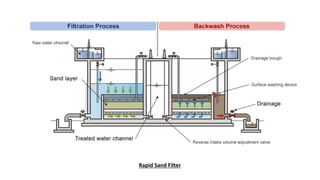
Rapid Sand Filter
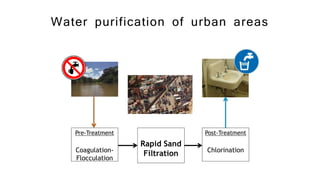
Pre-Treatment
Coagulation-
Flocculation
Rapid Sand
Filtration
Post-Treatment
Chlorination
Water purification of urban areas
Types of Rapid Sand Filters
1. Open Rapid sand filters ( Gravity Filters )
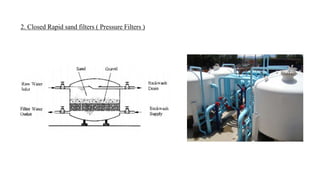
2. Closed Rapid sand filters ( Pressure Filters )
Essential Features
1. Enclosure Tank
 Smaller in size, therefore can be placed under roof
 Rectangular in shape and constructed of concrete or masonry
 Depth – 2.5 to 3.5 m
 Surface area – 20 to 50 𝑚2
 L/B ratio – 1.25 to 1.35
 Designed filtration rate – 3000 to 6000 L/sqm/hr
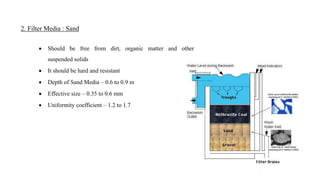
2. Filter Media : Sand
 Should be free from dirt, organic matter and other
suspended solids
 It should be hard and resistant
 Depth of Sand Media – 0.6 to 0.9 m
 Effective size – 0.35 to 0.6 mm
 Uniformity coefficient – 1.2 to 1.7
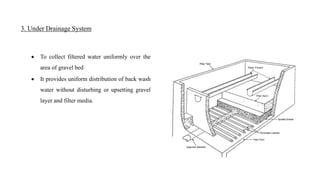
3. Under Drainage System
 To collect filtered water uniformly over the
area of gravel bed
 It provides uniform distribution of back wash
water without disturbing or upsetting gravel
layer and filter media.
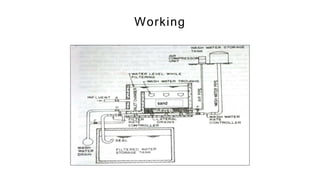
Working
 All valves are kept closed except A and B.
 Valve A is opened to permit water from clarifier
 Valve B is opened to carry filtered water to clear water sump
 Head of 2m over sand bed is maintained
 Designed filtration rate are 3000 to 6000 lit/sqm/hr
 Filter run depends on quality of feed water
 Filter run may range between less than a day to several days
 Objective of backwash is to remove accumulated particles
on the surface and within the filter medium
 Backwash is performed using wash water or air scouring
Working of Rapid Sand Filter
Backwashing
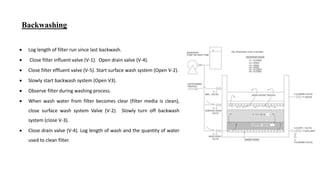
 Log length of filter run since last backwash.
 Close filter influent valve (V-1). Open drain valve (V-4).
 Close filter effluent valve (V-5). Start surface wash system (Open V-2).
 Slowly start backwash system (Open V3).
 Observe filter during washing process.
 When wash water from filter becomes clear (filter media is clean),
close surface wash system Valve (V-2). Slowly turn off backwash
system (close V-3).
 Close drain valve (V-4). Log length of wash and the quantity of water
used to clean filter.
Treatment Efficiencies and Health Aspects
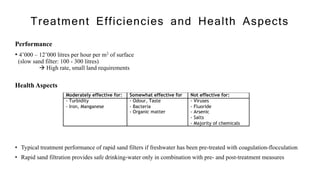
Performance
• 4’000 – 12’000 litres per hour per m2 of surface
(slow sand filter: 100 - 300 litres)
 High rate, small land requirements
Health Aspects
• Typical treatment performance of rapid sand filters if freshwater has been pre-treated with coagulation-flocculation
• Rapid sand filtration provides safe drinking-water only in combination with pre- and post-treatment measures
Construction, Operation and Maintenence
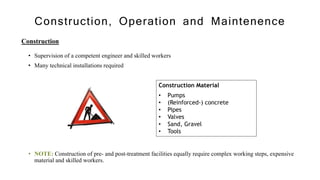
• Supervision of a competent engineer and skilled workers
• Many technical installations required
• NOTE: Construction of pre- and post-treatment facilities equally require complex working steps, expensive
material and skilled workers.
Construction Material
• Pumps
• (Reinforced-) concrete
• Pipes
• Valves
• Sand, Gravel
• Tools
Construction
Operation and Maintenance
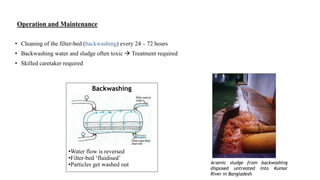
• Cleaning of the filter-bed (backwashing) every 24 – 72 hours
• Backwashing water and sludge often toxic  Treatment required
• Skilled caretaker required
Arsenic sludge from backwashing
disposed untreated into Kumar
River in Bangladesh
Backwashing
•Water flow is reversed
•Filter-bed ‘fluidised’
•Particles get washed out
Advantages
 Highly effective for removal of turbidity
(usually < 0.1-1 NTU)
 High filter rate (4’000 – 12’000 litres per hour
per square metre of surface), small land
requirements
 No limitations regarding initial turbidity levels
(if coagulant or flocculant is available and
correctly applied)
 Cleaning time (backwashing) only takes several
minutes and filters can be put back into
operation instantly
Disadvantages
 Not effective in removing bacteria, viruses, fluoride,
arsenic, salts, odour and organic matter (requires pre-
and post-treatment)
 High capital and operational costs
 Frequent cleaning (backwashing) required (every 24-
72h)
 Skilled supervision essential (e.g. for flow control and
dosage of disinfectant)
 High energy input required
 Backwashing water and sludge needs treatment;
sewage system or stabilisation ponds required
T H A N K Y O U

Rapid sand filter

  • 1.
    W a te r E n g i n e e r i n g D e s i g n K u l v e n d r a P a t e l 2 K 1 9 / E N E / 0 5 Rapid Sand Filter Delhi Technological University
  • 2.
    Rapid sand filtrationis a technique common in developed countries for treating large quantities of drinking water. It is a relatively sophisticated process usually requiring power-operated pumps for backwashing or cleaning the filter bed, and flow control of the filter outlet. A continuously operating filter will usually require backwashing about every two days when raw water of relatively low turbidity is used. Pretreatment of the raw water, using chemical flocculation agents in combination with setting tanks, is common where turbidity is high. Relatively large quantities of filter backwash water, as well as sludge from the settling process, may be generated and require some form of treatment before discharge to the environment. Introduction
  • 3.
  • 4.
  • 5.
    Types of RapidSand Filters 1. Open Rapid sand filters ( Gravity Filters )
  • 6.
    2. Closed Rapidsand filters ( Pressure Filters )
  • 7.
    Essential Features 1. EnclosureTank  Smaller in size, therefore can be placed under roof  Rectangular in shape and constructed of concrete or masonry  Depth – 2.5 to 3.5 m  Surface area – 20 to 50 𝑚2  L/B ratio – 1.25 to 1.35  Designed filtration rate – 3000 to 6000 L/sqm/hr
  • 8.
    2. Filter Media: Sand  Should be free from dirt, organic matter and other suspended solids  It should be hard and resistant  Depth of Sand Media – 0.6 to 0.9 m  Effective size – 0.35 to 0.6 mm  Uniformity coefficient – 1.2 to 1.7
  • 9.
    3. Under DrainageSystem  To collect filtered water uniformly over the area of gravel bed  It provides uniform distribution of back wash water without disturbing or upsetting gravel layer and filter media.
  • 10.
  • 11.
     All valvesare kept closed except A and B.  Valve A is opened to permit water from clarifier  Valve B is opened to carry filtered water to clear water sump  Head of 2m over sand bed is maintained  Designed filtration rate are 3000 to 6000 lit/sqm/hr  Filter run depends on quality of feed water  Filter run may range between less than a day to several days  Objective of backwash is to remove accumulated particles on the surface and within the filter medium  Backwash is performed using wash water or air scouring Working of Rapid Sand Filter
  • 12.
    Backwashing  Log lengthof filter run since last backwash.  Close filter influent valve (V-1). Open drain valve (V-4).  Close filter effluent valve (V-5). Start surface wash system (Open V-2).  Slowly start backwash system (Open V3).  Observe filter during washing process.  When wash water from filter becomes clear (filter media is clean), close surface wash system Valve (V-2). Slowly turn off backwash system (close V-3).  Close drain valve (V-4). Log length of wash and the quantity of water used to clean filter.
  • 13.
    Treatment Efficiencies andHealth Aspects Performance • 4’000 – 12’000 litres per hour per m2 of surface (slow sand filter: 100 - 300 litres)  High rate, small land requirements Health Aspects • Typical treatment performance of rapid sand filters if freshwater has been pre-treated with coagulation-flocculation • Rapid sand filtration provides safe drinking-water only in combination with pre- and post-treatment measures
  • 14.
    Construction, Operation andMaintenence • Supervision of a competent engineer and skilled workers • Many technical installations required • NOTE: Construction of pre- and post-treatment facilities equally require complex working steps, expensive material and skilled workers. Construction Material • Pumps • (Reinforced-) concrete • Pipes • Valves • Sand, Gravel • Tools Construction
  • 15.
    Operation and Maintenance •Cleaning of the filter-bed (backwashing) every 24 – 72 hours • Backwashing water and sludge often toxic  Treatment required • Skilled caretaker required Arsenic sludge from backwashing disposed untreated into Kumar River in Bangladesh Backwashing •Water flow is reversed •Filter-bed ‘fluidised’ •Particles get washed out
  • 16.
    Advantages  Highly effectivefor removal of turbidity (usually < 0.1-1 NTU)  High filter rate (4’000 – 12’000 litres per hour per square metre of surface), small land requirements  No limitations regarding initial turbidity levels (if coagulant or flocculant is available and correctly applied)  Cleaning time (backwashing) only takes several minutes and filters can be put back into operation instantly Disadvantages  Not effective in removing bacteria, viruses, fluoride, arsenic, salts, odour and organic matter (requires pre- and post-treatment)  High capital and operational costs  Frequent cleaning (backwashing) required (every 24- 72h)  Skilled supervision essential (e.g. for flow control and dosage of disinfectant)  High energy input required  Backwashing water and sludge needs treatment; sewage system or stabilisation ponds required
  • 17.
    T H AN K Y O U