“ICDCIT – 2013”
 e-Health Applications
     Prepared & Submitted by

 Deepak Kumar Mohapatra
OVERVIEW
•   Introduction
•   NGN : Next Generation Networks
•   QoS : Quality of Service
•   Mapping
•   Tele-Consultation
•   e-Health Related services
•   m-Health
•   Disease Management Scopes
•   Benefits and Challenges
•   Conclusion and Future Scopes
INTRODUCTION
 e-HEALTH is defined as:
 Application of the Internet and other
  related technologies in the healthcare
  industry to improve the
             o Access
             o Efficiency
             o Effectiveness
             o Quality of treatment
             o Business processes
  utilized by healthcare organizations,
  practitioners, patients and consumers
  with the help of next generation
  networks (NGN) to Improve the health
  status of patients.
WHO defines e-Health as...
e-Health is the cost effective and secure use of
information and communication technologies in
support of the health and health related fields
including healthcare, health surveillance and health
education, knowledge and research.
NGN
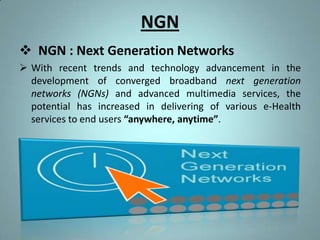
 NGN : Next Generation Networks
 With recent trends and technology advancement in the
  development of converged broadband next generation
  networks (NGNs) and advanced multimedia services, the
  potential has increased in delivering of various e-Health
  services to end users “anywhere, anytime”.
QoS
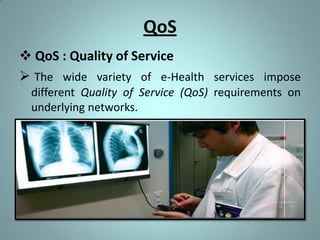
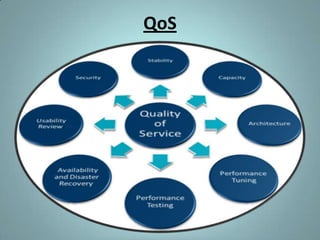
 QoS : Quality of Service
 The wide variety of e-Health services impose
 different Quality of Service (QoS) requirements on
 underlying networks.
QoS
QoS Requirements for e-Health Services

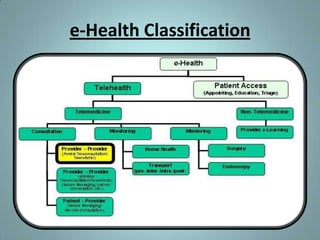
 e-Health Service Classification
 Multimedia Conferencing
 a) Still and Streaming Medical Images
 b) Transmission of Patient Vital Signs
 c) Tele-Robotic System
 d) Research and Education
e-Health Classification
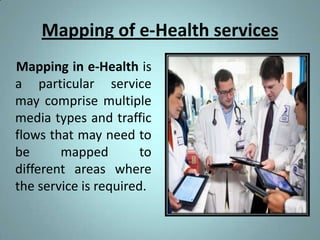
Mapping of e-Health services
Mapping in e-Health is
a particular service
may comprise multiple
media types and traffic
flows that may need to
be      mapped         to
different areas where
the service is required.
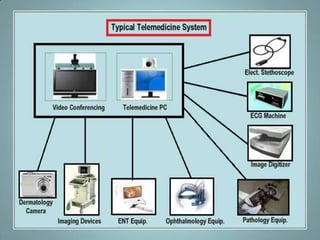
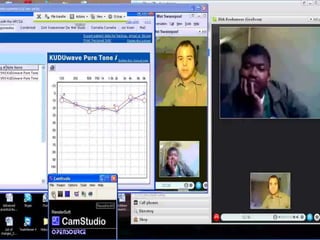
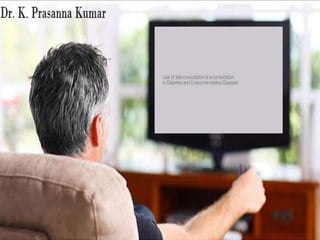
Tele-Consultation
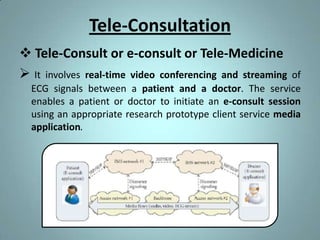
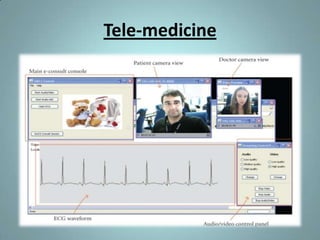
 Tele-Consult or e-consult or Tele-Medicine
 It involves real-time video conferencing and streaming    of
  ECG signals between a patient and a doctor. The service
  enables a patient or doctor to initiate an e-consult session
  using an appropriate research prototype client service media
  application.
Tele-medicine
e-Health Related services
•   Index of available programs and services.
•   Calendar of events.
•   Patient satisfaction surveys.
•   Service provider directories.
•   Patient e-mail services.
•   Health news.
m-Health
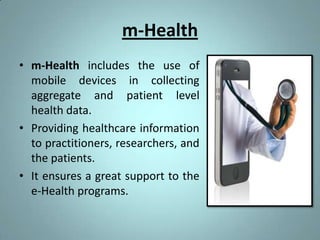
• m-Health includes the use of
  mobile devices in collecting
  aggregate and patient level
  health data.
• Providing healthcare information
  to practitioners, researchers, and
  the patients.
• It ensures a great support to the
  e-Health programs.
Disease management scopes
 Health risks assessment
 Patient support groups
 Online discussion forums
 Moderated chat with guest experts
 comprehensive patient education
 “Ask an expert” triage for patients seeking
 medical advice
 Electronic newsletter subscription
Benefits of e-Health
 Improve communication among healthcare
  stakeholders.
 Facilitate better decision support.
 Reduce medical errors.
 Enhance reporting capabilities.
 Encourage disease prevention and wellness.
e-Health challenges
 6 main areas of e-Health challenges are...

o Information (Inaccurate and Incomplete)
o Human resources (Inadequate or Brain-
  drained)
o Infrastructure
o Quality and security of data.
o Financial and legal issues.
o Authenticity
Conclusion and Future Scope
 Developed research and training in this field.
 Working of Govt. And Private sectors in a
 parallel manner.
 Prioritisation of the information flow with ICT.
 Public support.
 Advancement of technologies.
 Lead a long, healthy and a prosperous life.
References
• Eysenbach G. What is e-health? Journal of Medical
  Internet Research. 2001; 3(2, article e20)
• Vergados DD. Simulation and modeling bandwidth
  control in wireless healthcare information systems.
  Simulation.
• Vouyioukas D, Maglogiannis I, Komnakos D. Emergency
  M-Health services through highspeed 3G systems.
• Java Media Framework API, online link :
  http://java.sun.com/products/java-media/jmf/.
• PhysioBank, http://www.physionet.org/physiobank/.
e-Health Applications

e-Health Applications

  • 1.
    “ICDCIT – 2013” e-Health Applications Prepared & Submitted by Deepak Kumar Mohapatra
  • 2.
    OVERVIEW • Introduction • NGN : Next Generation Networks • QoS : Quality of Service • Mapping • Tele-Consultation • e-Health Related services • m-Health • Disease Management Scopes • Benefits and Challenges • Conclusion and Future Scopes
  • 3.
    INTRODUCTION  e-HEALTH isdefined as:  Application of the Internet and other related technologies in the healthcare industry to improve the o Access o Efficiency o Effectiveness o Quality of treatment o Business processes utilized by healthcare organizations, practitioners, patients and consumers with the help of next generation networks (NGN) to Improve the health status of patients.
  • 4.
    WHO defines e-Healthas... e-Health is the cost effective and secure use of information and communication technologies in support of the health and health related fields including healthcare, health surveillance and health education, knowledge and research.
  • 5.
    NGN  NGN :Next Generation Networks  With recent trends and technology advancement in the development of converged broadband next generation networks (NGNs) and advanced multimedia services, the potential has increased in delivering of various e-Health services to end users “anywhere, anytime”.
  • 6.
    QoS  QoS :Quality of Service  The wide variety of e-Health services impose different Quality of Service (QoS) requirements on underlying networks.
  • 7.
  • 8.
    QoS Requirements fore-Health Services  e-Health Service Classification  Multimedia Conferencing a) Still and Streaming Medical Images b) Transmission of Patient Vital Signs c) Tele-Robotic System d) Research and Education
  • 9.
  • 10.
    Mapping of e-Healthservices Mapping in e-Health is a particular service may comprise multiple media types and traffic flows that may need to be mapped to different areas where the service is required.
  • 11.
    Tele-Consultation  Tele-Consult ore-consult or Tele-Medicine  It involves real-time video conferencing and streaming of ECG signals between a patient and a doctor. The service enables a patient or doctor to initiate an e-consult session using an appropriate research prototype client service media application.
  • 12.
  • 16.
    e-Health Related services • Index of available programs and services. • Calendar of events. • Patient satisfaction surveys. • Service provider directories. • Patient e-mail services. • Health news.
  • 17.
    m-Health • m-Health includesthe use of mobile devices in collecting aggregate and patient level health data. • Providing healthcare information to practitioners, researchers, and the patients. • It ensures a great support to the e-Health programs.
  • 18.
    Disease management scopes Health risks assessment  Patient support groups  Online discussion forums  Moderated chat with guest experts  comprehensive patient education  “Ask an expert” triage for patients seeking medical advice  Electronic newsletter subscription
  • 19.
    Benefits of e-Health Improve communication among healthcare stakeholders.  Facilitate better decision support.  Reduce medical errors.  Enhance reporting capabilities.  Encourage disease prevention and wellness.
  • 20.
    e-Health challenges  6main areas of e-Health challenges are... o Information (Inaccurate and Incomplete) o Human resources (Inadequate or Brain- drained) o Infrastructure o Quality and security of data. o Financial and legal issues. o Authenticity
  • 21.
    Conclusion and FutureScope  Developed research and training in this field.  Working of Govt. And Private sectors in a parallel manner.  Prioritisation of the information flow with ICT.  Public support.  Advancement of technologies.  Lead a long, healthy and a prosperous life.
  • 22.
    References • Eysenbach G.What is e-health? Journal of Medical Internet Research. 2001; 3(2, article e20) • Vergados DD. Simulation and modeling bandwidth control in wireless healthcare information systems. Simulation. • Vouyioukas D, Maglogiannis I, Komnakos D. Emergency M-Health services through highspeed 3G systems. • Java Media Framework API, online link : http://java.sun.com/products/java-media/jmf/. • PhysioBank, http://www.physionet.org/physiobank/.