Telemedicine and e-health
Dr Jim Briggs
University of Portsmouth
jim.briggs@port.ac.uk
Contents
• Definitions
• Types of telemedicine
• Case studies
• E-health
• Other issues
• Further information
Definitions
Telemedicine
E-health
Raw definitions
• Telemedicine:
– medicine at a distance
• cf television
• E-health:
– health services
delivered electronically
• E-commerce
No standard definition
• "To define telemedicine is to have
something in common with Humpty
Dumpty — that is, by making a word to
mean whatever you want it to mean."
[BJHC&IM]
• Google search throws up 13 defns
– http://www.google.com/search?q=define:
Telemedicine
US government
• "The use of medical information
exchanged from one site to another using
electronic communications for the health
and education of patients or providers and
to improve patient care."
– http://cms.hhs.gov/glossary/default.asp (Dept
of Health and Human Services)
ATA one(s)
• "the use of medical information exchanged from one site
to another via electronic communications for the health
and education of the patient or health care provider and
for the purpose of improving and extending the
availability of patient care"
– http://www2.umdnj.edu/omcweb/1998/telemedicine.htm
• "access to medical care for consumers and health
professionals via telecommunications technology"
– http://www.atmeda.org/about/aboutata.htm
• e-health is the "use of the Internet for healthcare"
JMIR
• "e-health is an emerging field in the
intersection of medical informatics, public
health and business, referring to health
services and information delivered or
enhanced through the Internet and related
technologies"
e-health 2002 conference
• e-health is "the leveraging of the information and
communication technology (ICT) to connect
provider and patients and governments; to
educate and inform health care professionals,
managers and consumers; to stimulate
innovation in care delivery and health system
management; and, to improve our health care
system"
TEIS one
• Starting point:
– "The use of Information and Communication
Technology (ICT) to deliver healthcare at a
distance"
TEIS scope
• Telemedicine and e-health are terms that are
applied to the use of Information and
Communication Technologies (ICT) in medicine,
health and social care delivery
– As such, the subject divides into two main areas:
• improvements to existing services in terms of their efficiency
and effectiveness - for example, pathology, radiology,
education and training, and Electronic Patient
• new service delivery development - for example,
teledermatology, teleophthalmology.
TEIS scope
• For our purposes, we define our area of
interest as those applications that:
– use information and communication
technology …
– … to deliver health and/or social care in new
ways …
– … on a person to person basis …
– … where those people are physically apart
Types of telemedicine
CJ Fitch, JS Briggs, RA Beresford, "System
issues for telemedicine systems", Health
Informatics Journal, vol. 7, no. 3/4,
September/December 2001, pp222-230
Characteristics of tm systems
• Interaction style
• Data types
• Equipment
• Action
• Patient numbers
• Duration
Interaction style
• Real-time (synchronous)
– Participants all active at the
same time
– Use any synchronous
technology (e.g. phone)
– Most commonly: video
conferencing
– Less often but becoming
more common: vital signs
monitoring
– May need high bandwidth
• Store-and-forward
(asynchronous)
– Participants do not need to
be active at the same time
– Use any structured form of
message passing
– Most commonly: email
– Less often but becoming
more common: systems
exchanging messages
– May not need high
bandwidth
Data types
• Text
– Patient notes
– Diagnosis
• Image
– X-rays
– Pathology slides
– CT/MRI/… scans
– Audio/video signals
Equipment
• General purpose
– Off the shelf PCs
• Specialist
– Electronic
stethoscopes
– Image capture
equipment
– Image display
equipment (possibly)
Action
• Intervention
– Direct influence on
patient treatment
• Advice
– Indirect influence
– Final decision made
by intermediate party
Patient numbers
• One patient at a time • Multiple patients
– e.g. where a number
of patient cases are
considered at the
same time
Duration
• Timespan over which communication sessions
take place
– single interaction
– single episode of care (multiple interactions over
same problem)
– long-term (multiple episodes)
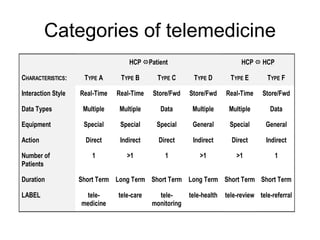
Categories of telemedicine
HCP Patient HCP  HCP
CHARACTERISTICS: TYPE A TYPE B TYPE C TYPE D TYPE E TYPE F
Interaction Style Real-Time Real-Time Store/Fwd Store/Fwd Real-Time Store/Fwd
Data Types Multiple Multiple Data Multiple Multiple Data
Equipment Special Special Special General Special General
Action Direct Indirect Direct Indirect Direct Indirect
Number of
Patients
1 >1 1 >1 >1 1
Duration Short Term Long Term Short Term Long Term Short Term Short Term
LABEL tele-
medicine
tele-care tele-
monitoring
tele-health tele-review tele-referral
Case study: MIU
• Minor Injury Units:
– replacing "unviable" accident & emergency
departments
– nurse led
– deal with "straight-forward" problems
• Linked to central A&E department by video link
to provide expert backup
• Examples:
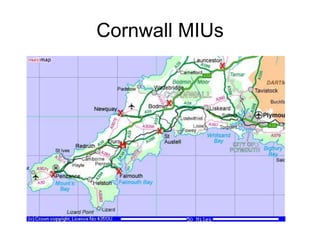
– Cornwall
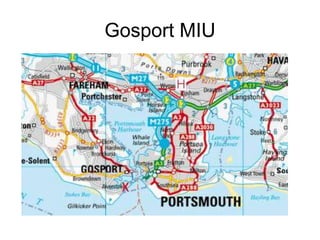
– Portsmouth/Gosport
Cornwall MIUs
Gosport MIU
Case study - ambulance links
• ECG, etc. links from ambulance to hospital
• Expert backup for paramedics
• Reducing "call to needle" time for rural heart
attack patients
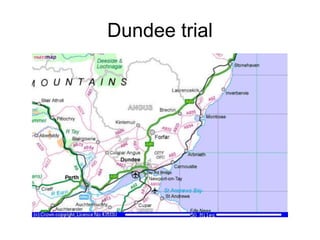
– Dundee study reduced average time from 125 to 52
minutes [Pedley et al; BMJ 2003]
• Also, advance warning to A&E staff of details of
incoming cases
Dundee trial
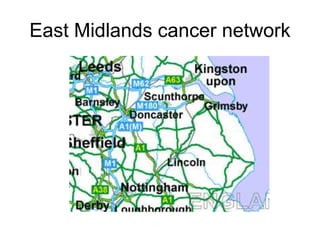
Case study - MDTs
• Multi-disciplinary teams (e.g. in cancer
care) need to discuss patient cases
• Travel costs (i.e. time) prohibitive
• Video-conference links allow staff to meet
at more frequent intervals
East Midlands cancer network
Case study - teledermatology
• Overload on specialist dermatologists - long
waiting lists for referrals
• tds provides commercial service
– specially trained nurses take digital photos
– specialist software routes to consultant
dermatologists (anywhere in UK) for diagnosis
– consultant can work from home
• tds replaces local consultant but not totally
tds sites
• North Manchester
– reduced waiting list from 18 months to 17 days in 6
weeks
• Medway
– dealt with backlog of 3000 patients in 15 weeks
• Expanding into Essex, Hertfordshire and Texas
• http://www.tds-telemed.com/
Case study - WorldCare
• Consortium of 4 big American hospitals
• Provide "second opinion" service
worldwide (20 countries)
– tele-radiology
– tele-pathology
– patient management consultation
• Local physician remains responsible
• http://www.worldcare.com/
Case study - NHS Direct
• Biggest telemedicine project in the world
• Mainly telephone service
• Expanding to:
– web
• online diagnosis for common conditions
• health encyclopaedia
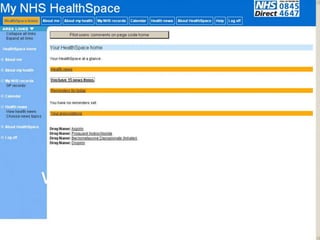
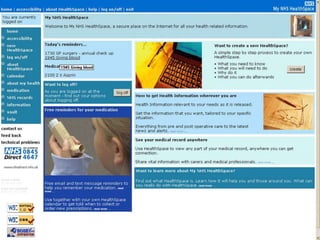
• my NHS healthspace (personal info portal): news, reminders,
knowledge
– digital TV
• http://www.nhsdirect.nhs.uk/
e-health
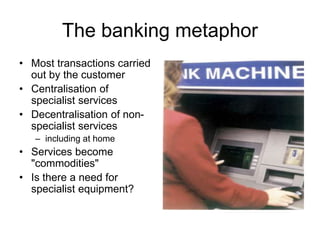
The banking metaphor
• Most transactions carried
out by the customer
• Centralisation of
specialist services
• Decentralisation of non-
specialist services
– including at home
• Services become
"commodities"
• Is there a need for
specialist equipment?
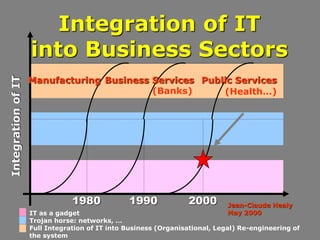
Integration of IT
into Business Sectors
Integration
of
IT
IT as a gadget
Trojan horse: networks, …
Full Integration of IT into Business (Organisational, Legal) Re-engineering of
the system
1980 1990 2000 Jean-Claude Healy
May 2000
(Banks) (Health…)
Manufacturing Business Services Public Services
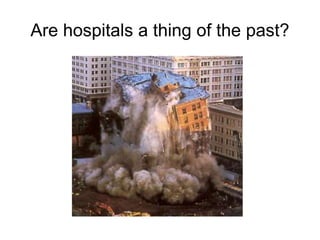
Are hospitals a thing of the past?
e-health blueprint - Malaysia
• Four Flagship Applications
– Tele-Consultation
– Tele-Continuing Medical Education for Health
Professionals
– Mass Customised Personalised Information
and Education
– Lifetime Health Plan
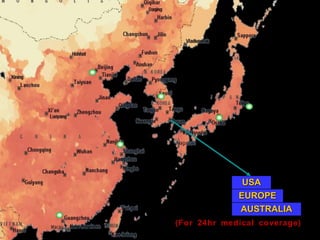
USA
EUROPE
AUSTRALIA
(For 24hr medical coverage)
Telemedicine
links
e-health - Pusan, S Korea
• Medical Tourism
– 2 hours by air for 2 billion people
• 1% with disposable income = 20 million
– Cardiac - Cancer - Mental Health
– Costs can be competitive
– Popular tourist resort for families
Other issues
Ethics
Economics
Success factors
Medico-legal/ethical issues
• Who is (legally) responsible for the patient's
treatment?
• What country's laws apply?
• Where is the clinician licensed to practice?
• Can a correct diagnosis be made by
telemedicine?
• Stanberry B. The Legal and Ethical Aspects of
Telemedicine. Royal Society of Medicine Books,
1998.
Economics of telemedicine
• Infrastructure (network) costs
– getting cheaper
• Equipment costs
– getting smaller and cheaper
• People costs
– access to expertise
– travel by healthcare professionals
– building costs
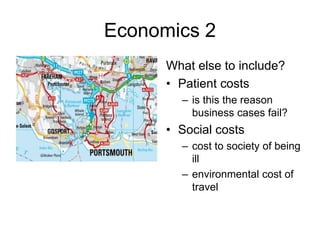
Economics 2
What else to include?
• Patient costs
– is this the reason
business cases fail?
• Social costs
– cost to society of being
ill
– environmental cost of
travel
What makes tm a success?
• Why has telemedicine caught on in some
disciplines and some places, but not in others?
– high-level support
– fortune: right-time, right-place
– mature technology
– evangelists
• Do implementers of tele-X learn from:
– the X literature?
– the telemedicine literature?
Further information
TEIS
• UK Telemedicine and E-health Information
Service
• http://www.teis.port.ac.uk
• http://www.teis.nhs.uk
• Over 2000 records covering:
– telemedicine/e-health activities (>220)
– organisations
– people
– publications
– equipment
TIE
• Telemedicine Information Exchange (US)
• http://tie.telemed.org/
• Covers:
– Extensive bibliography (>14,000 entries)
– Projects
– Events calendar
– Funding sources
– News
CEW
• Confederation of e-health websites (Q)
• http://www.teis.port.ac.uk/orgs/cew/
• Other organisations include:
– UK E-health Association
– Royal Society of Medicine
– IHM/ASSIST
– Norwegian Centre for Telemedicine
– EHTEL
Journals
• Telemedicine:
– Journal of Telemedicine and Telecare
– IEEE Transactions on Information Technology in
Biomedicine
– Telemedicine Journal and e-Health
– Telehealth Practice Report
• Health informatics more generally
– Medical Informatics and the Internet in Medicine
– Health Informatics Journal
– Journal of Medical Internet Research
The end
• jim.briggs@port.ac.uk
• Healthcare Computing Group,
University of Portsmouth
• http://www.disco.port.ac.uk/hcc/
• http://www.teis.port.ac.uk/

telemedicine.ppt

  • 1.
    Telemedicine and e-health DrJim Briggs University of Portsmouth jim.briggs@port.ac.uk
  • 2.
    Contents • Definitions • Typesof telemedicine • Case studies • E-health • Other issues • Further information
  • 3.
  • 4.
    Raw definitions • Telemedicine: –medicine at a distance • cf television • E-health: – health services delivered electronically • E-commerce
  • 5.
    No standard definition •"To define telemedicine is to have something in common with Humpty Dumpty — that is, by making a word to mean whatever you want it to mean." [BJHC&IM] • Google search throws up 13 defns – http://www.google.com/search?q=define: Telemedicine
  • 6.
    US government • "Theuse of medical information exchanged from one site to another using electronic communications for the health and education of patients or providers and to improve patient care." – http://cms.hhs.gov/glossary/default.asp (Dept of Health and Human Services)
  • 7.
    ATA one(s) • "theuse of medical information exchanged from one site to another via electronic communications for the health and education of the patient or health care provider and for the purpose of improving and extending the availability of patient care" – http://www2.umdnj.edu/omcweb/1998/telemedicine.htm • "access to medical care for consumers and health professionals via telecommunications technology" – http://www.atmeda.org/about/aboutata.htm • e-health is the "use of the Internet for healthcare"
  • 8.
    JMIR • "e-health isan emerging field in the intersection of medical informatics, public health and business, referring to health services and information delivered or enhanced through the Internet and related technologies"
  • 9.
    e-health 2002 conference •e-health is "the leveraging of the information and communication technology (ICT) to connect provider and patients and governments; to educate and inform health care professionals, managers and consumers; to stimulate innovation in care delivery and health system management; and, to improve our health care system"
  • 10.
    TEIS one • Startingpoint: – "The use of Information and Communication Technology (ICT) to deliver healthcare at a distance"
  • 11.
    TEIS scope • Telemedicineand e-health are terms that are applied to the use of Information and Communication Technologies (ICT) in medicine, health and social care delivery – As such, the subject divides into two main areas: • improvements to existing services in terms of their efficiency and effectiveness - for example, pathology, radiology, education and training, and Electronic Patient • new service delivery development - for example, teledermatology, teleophthalmology.
  • 12.
    TEIS scope • Forour purposes, we define our area of interest as those applications that: – use information and communication technology … – … to deliver health and/or social care in new ways … – … on a person to person basis … – … where those people are physically apart
  • 13.
    Types of telemedicine CJFitch, JS Briggs, RA Beresford, "System issues for telemedicine systems", Health Informatics Journal, vol. 7, no. 3/4, September/December 2001, pp222-230
  • 14.
    Characteristics of tmsystems • Interaction style • Data types • Equipment • Action • Patient numbers • Duration
  • 15.
    Interaction style • Real-time(synchronous) – Participants all active at the same time – Use any synchronous technology (e.g. phone) – Most commonly: video conferencing – Less often but becoming more common: vital signs monitoring – May need high bandwidth • Store-and-forward (asynchronous) – Participants do not need to be active at the same time – Use any structured form of message passing – Most commonly: email – Less often but becoming more common: systems exchanging messages – May not need high bandwidth
  • 16.
    Data types • Text –Patient notes – Diagnosis • Image – X-rays – Pathology slides – CT/MRI/… scans – Audio/video signals
  • 17.
    Equipment • General purpose –Off the shelf PCs • Specialist – Electronic stethoscopes – Image capture equipment – Image display equipment (possibly)
  • 18.
    Action • Intervention – Directinfluence on patient treatment • Advice – Indirect influence – Final decision made by intermediate party
  • 19.
    Patient numbers • Onepatient at a time • Multiple patients – e.g. where a number of patient cases are considered at the same time
  • 20.
    Duration • Timespan overwhich communication sessions take place – single interaction – single episode of care (multiple interactions over same problem) – long-term (multiple episodes)
  • 21.
    Categories of telemedicine HCPPatient HCP  HCP CHARACTERISTICS: TYPE A TYPE B TYPE C TYPE D TYPE E TYPE F Interaction Style Real-Time Real-Time Store/Fwd Store/Fwd Real-Time Store/Fwd Data Types Multiple Multiple Data Multiple Multiple Data Equipment Special Special Special General Special General Action Direct Indirect Direct Indirect Direct Indirect Number of Patients 1 >1 1 >1 >1 1 Duration Short Term Long Term Short Term Long Term Short Term Short Term LABEL tele- medicine tele-care tele- monitoring tele-health tele-review tele-referral
  • 22.
    Case study: MIU •Minor Injury Units: – replacing "unviable" accident & emergency departments – nurse led – deal with "straight-forward" problems • Linked to central A&E department by video link to provide expert backup • Examples: – Cornwall – Portsmouth/Gosport
  • 23.
  • 24.
  • 25.
    Case study -ambulance links • ECG, etc. links from ambulance to hospital • Expert backup for paramedics • Reducing "call to needle" time for rural heart attack patients – Dundee study reduced average time from 125 to 52 minutes [Pedley et al; BMJ 2003] • Also, advance warning to A&E staff of details of incoming cases
  • 26.
  • 27.
    Case study -MDTs • Multi-disciplinary teams (e.g. in cancer care) need to discuss patient cases • Travel costs (i.e. time) prohibitive • Video-conference links allow staff to meet at more frequent intervals
  • 28.
  • 29.
    Case study -teledermatology • Overload on specialist dermatologists - long waiting lists for referrals • tds provides commercial service – specially trained nurses take digital photos – specialist software routes to consultant dermatologists (anywhere in UK) for diagnosis – consultant can work from home • tds replaces local consultant but not totally
  • 30.
    tds sites • NorthManchester – reduced waiting list from 18 months to 17 days in 6 weeks • Medway – dealt with backlog of 3000 patients in 15 weeks • Expanding into Essex, Hertfordshire and Texas • http://www.tds-telemed.com/
  • 31.
    Case study -WorldCare • Consortium of 4 big American hospitals • Provide "second opinion" service worldwide (20 countries) – tele-radiology – tele-pathology – patient management consultation • Local physician remains responsible • http://www.worldcare.com/
  • 32.
    Case study -NHS Direct • Biggest telemedicine project in the world • Mainly telephone service • Expanding to: – web • online diagnosis for common conditions • health encyclopaedia • my NHS healthspace (personal info portal): news, reminders, knowledge – digital TV • http://www.nhsdirect.nhs.uk/
  • 35.
  • 36.
    The banking metaphor •Most transactions carried out by the customer • Centralisation of specialist services • Decentralisation of non- specialist services – including at home • Services become "commodities" • Is there a need for specialist equipment?
  • 37.
    Integration of IT intoBusiness Sectors Integration of IT IT as a gadget Trojan horse: networks, … Full Integration of IT into Business (Organisational, Legal) Re-engineering of the system 1980 1990 2000 Jean-Claude Healy May 2000 (Banks) (Health…) Manufacturing Business Services Public Services
  • 38.
    Are hospitals athing of the past?
  • 39.
    e-health blueprint -Malaysia • Four Flagship Applications – Tele-Consultation – Tele-Continuing Medical Education for Health Professionals – Mass Customised Personalised Information and Education – Lifetime Health Plan
  • 40.
    USA EUROPE AUSTRALIA (For 24hr medicalcoverage) Telemedicine links
  • 41.
    e-health - Pusan,S Korea • Medical Tourism – 2 hours by air for 2 billion people • 1% with disposable income = 20 million – Cardiac - Cancer - Mental Health – Costs can be competitive – Popular tourist resort for families
  • 42.
  • 43.
    Medico-legal/ethical issues • Whois (legally) responsible for the patient's treatment? • What country's laws apply? • Where is the clinician licensed to practice? • Can a correct diagnosis be made by telemedicine? • Stanberry B. The Legal and Ethical Aspects of Telemedicine. Royal Society of Medicine Books, 1998.
  • 44.
    Economics of telemedicine •Infrastructure (network) costs – getting cheaper • Equipment costs – getting smaller and cheaper • People costs – access to expertise – travel by healthcare professionals – building costs
  • 45.
    Economics 2 What elseto include? • Patient costs – is this the reason business cases fail? • Social costs – cost to society of being ill – environmental cost of travel
  • 46.
    What makes tma success? • Why has telemedicine caught on in some disciplines and some places, but not in others? – high-level support – fortune: right-time, right-place – mature technology – evangelists • Do implementers of tele-X learn from: – the X literature? – the telemedicine literature?
  • 47.
  • 48.
    TEIS • UK Telemedicineand E-health Information Service • http://www.teis.port.ac.uk • http://www.teis.nhs.uk • Over 2000 records covering: – telemedicine/e-health activities (>220) – organisations – people – publications – equipment
  • 49.
    TIE • Telemedicine InformationExchange (US) • http://tie.telemed.org/ • Covers: – Extensive bibliography (>14,000 entries) – Projects – Events calendar – Funding sources – News
  • 50.
    CEW • Confederation ofe-health websites (Q) • http://www.teis.port.ac.uk/orgs/cew/ • Other organisations include: – UK E-health Association – Royal Society of Medicine – IHM/ASSIST – Norwegian Centre for Telemedicine – EHTEL
  • 51.
    Journals • Telemedicine: – Journalof Telemedicine and Telecare – IEEE Transactions on Information Technology in Biomedicine – Telemedicine Journal and e-Health – Telehealth Practice Report • Health informatics more generally – Medical Informatics and the Internet in Medicine – Health Informatics Journal – Journal of Medical Internet Research
  • 52.
    The end • jim.briggs@port.ac.uk •Healthcare Computing Group, University of Portsmouth • http://www.disco.port.ac.uk/hcc/ • http://www.teis.port.ac.uk/