The document provides an overview of health informatics by:
1. Defining key terms like informatics, biomedical informatics, health informatics, and discussing the relationships between related fields.
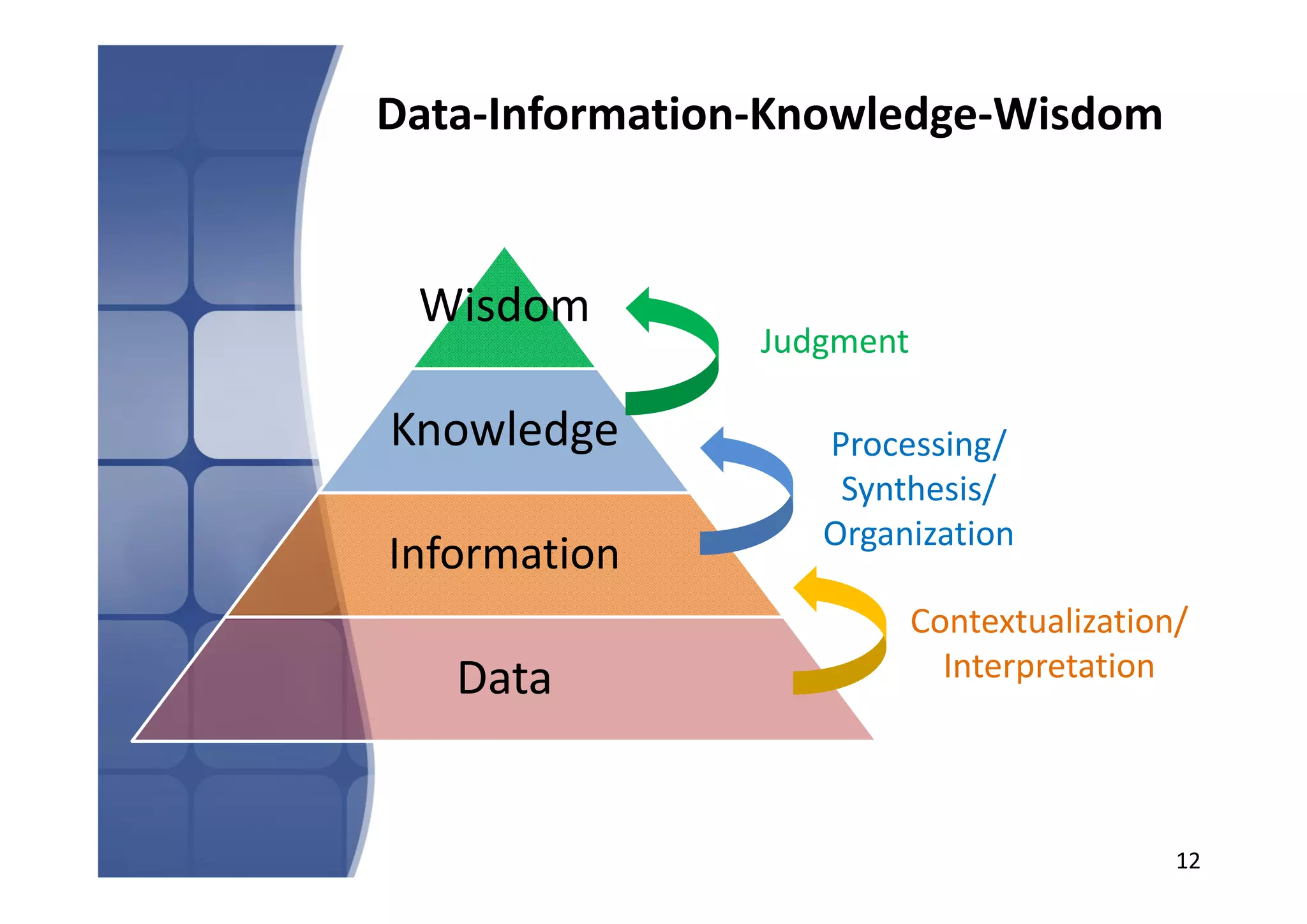
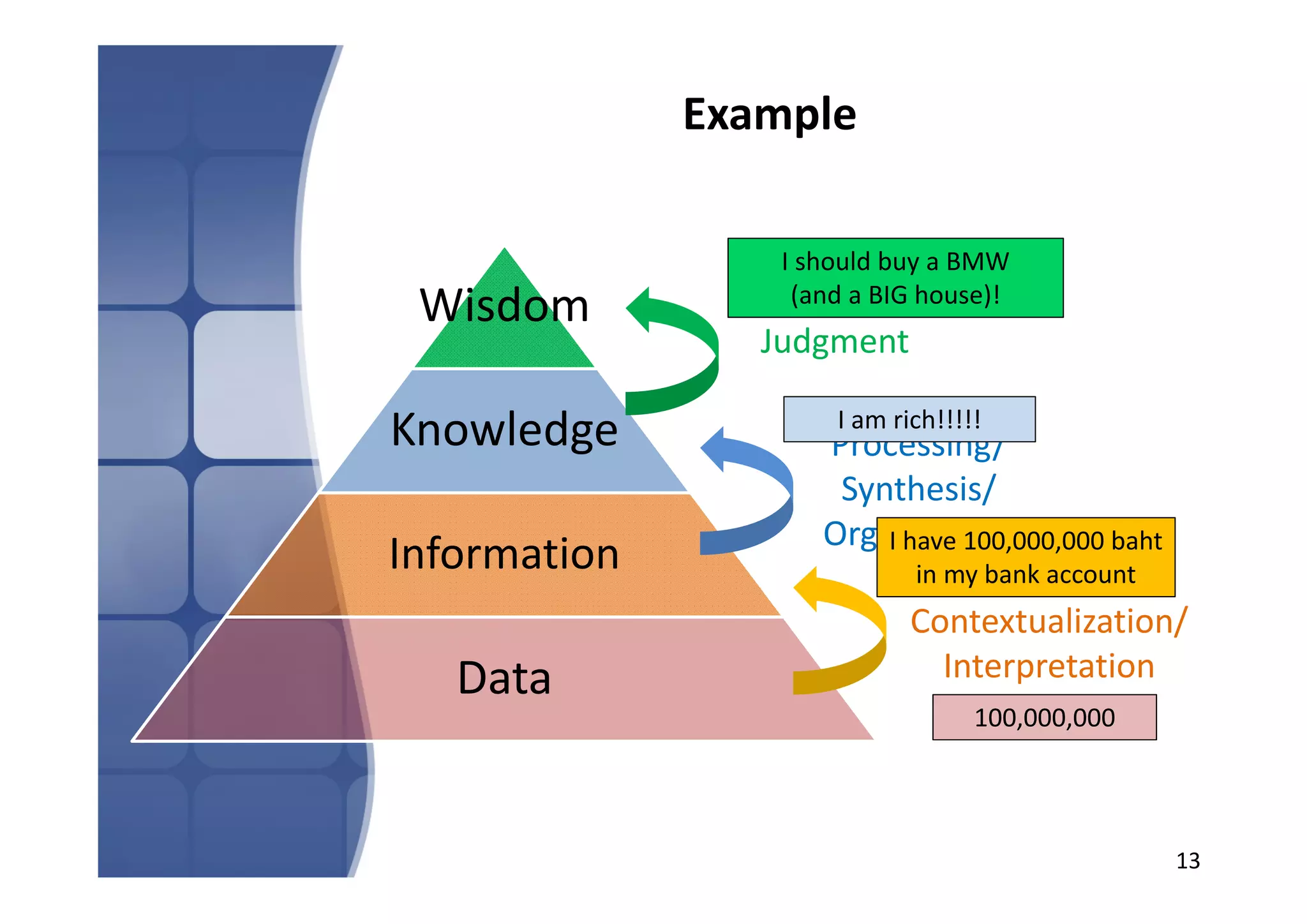
2. Explaining the data-information-knowledge-wisdom hierarchy and providing examples.
3. Describing health informatics as the optimal use of information, aided by technology, to improve health, healthcare, research, and more.
An overview of health informatics, including background of the presenter and session outline.
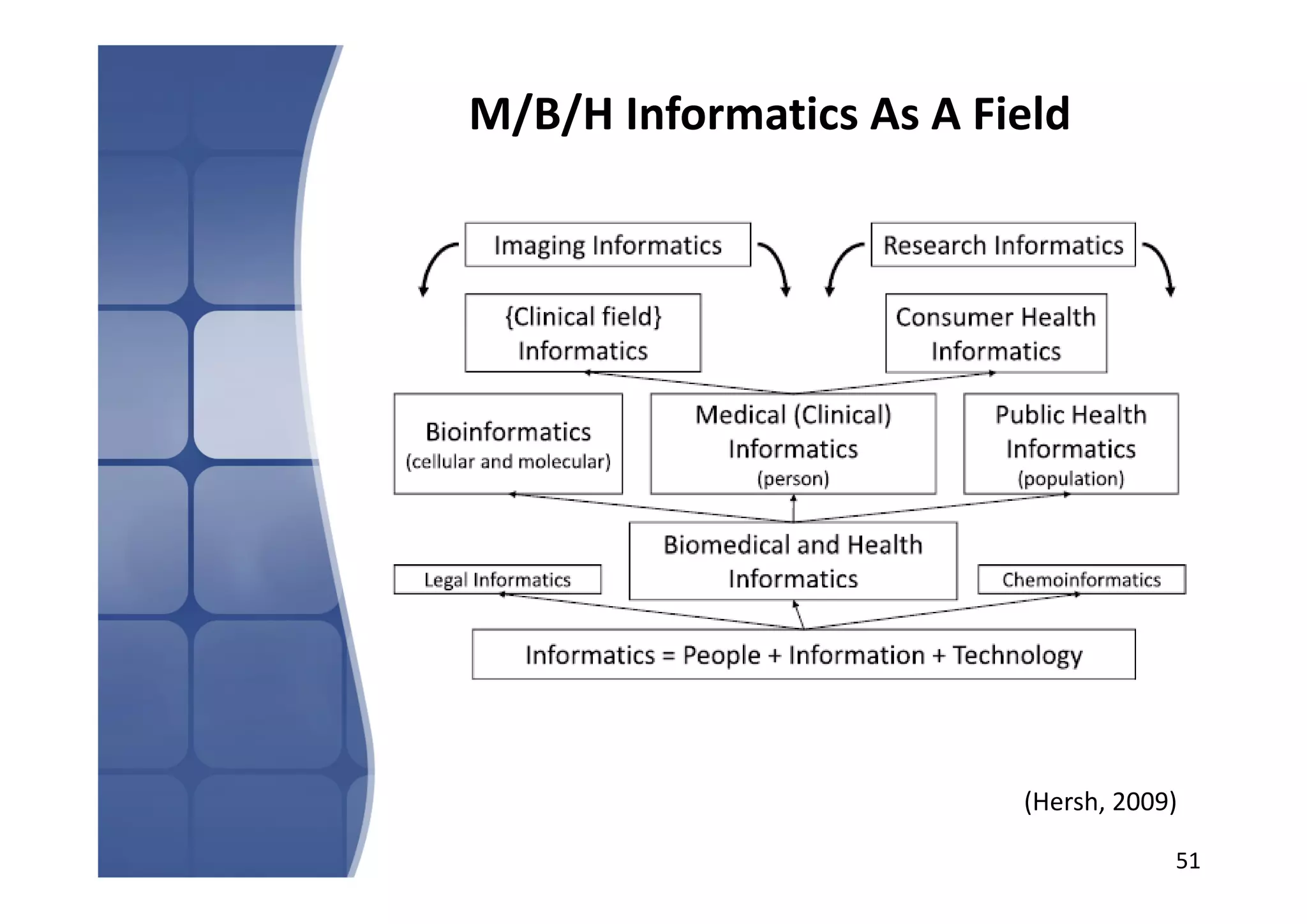
Informatics covers the use of information processing in healthcare, with definitions highlighting its focuses. Describes medical, biomedical, and health informatics emphasizing their focus on information.
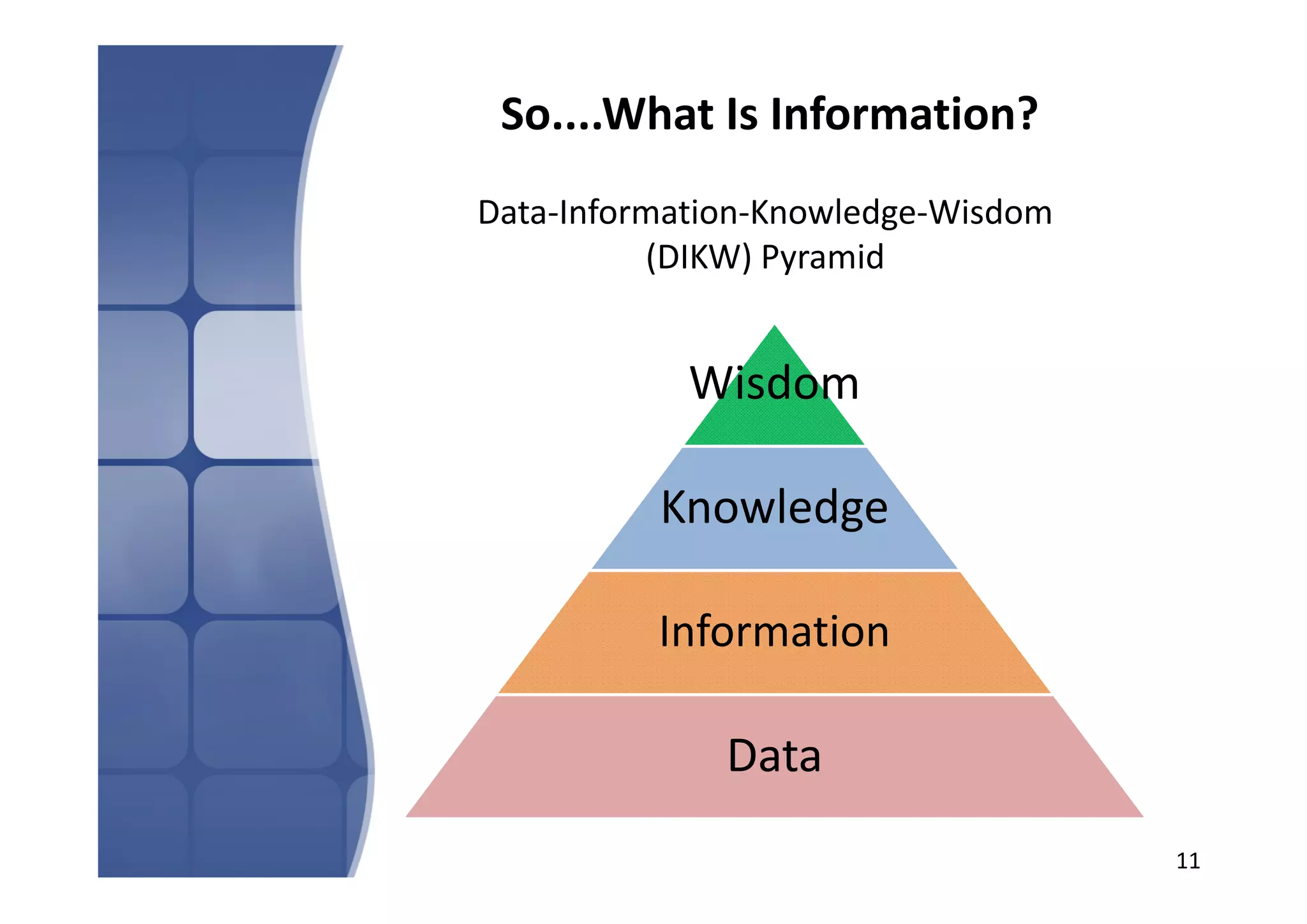
Explains the DIKW pyramid, showcasing how raw data transforms into wisdom through processes.
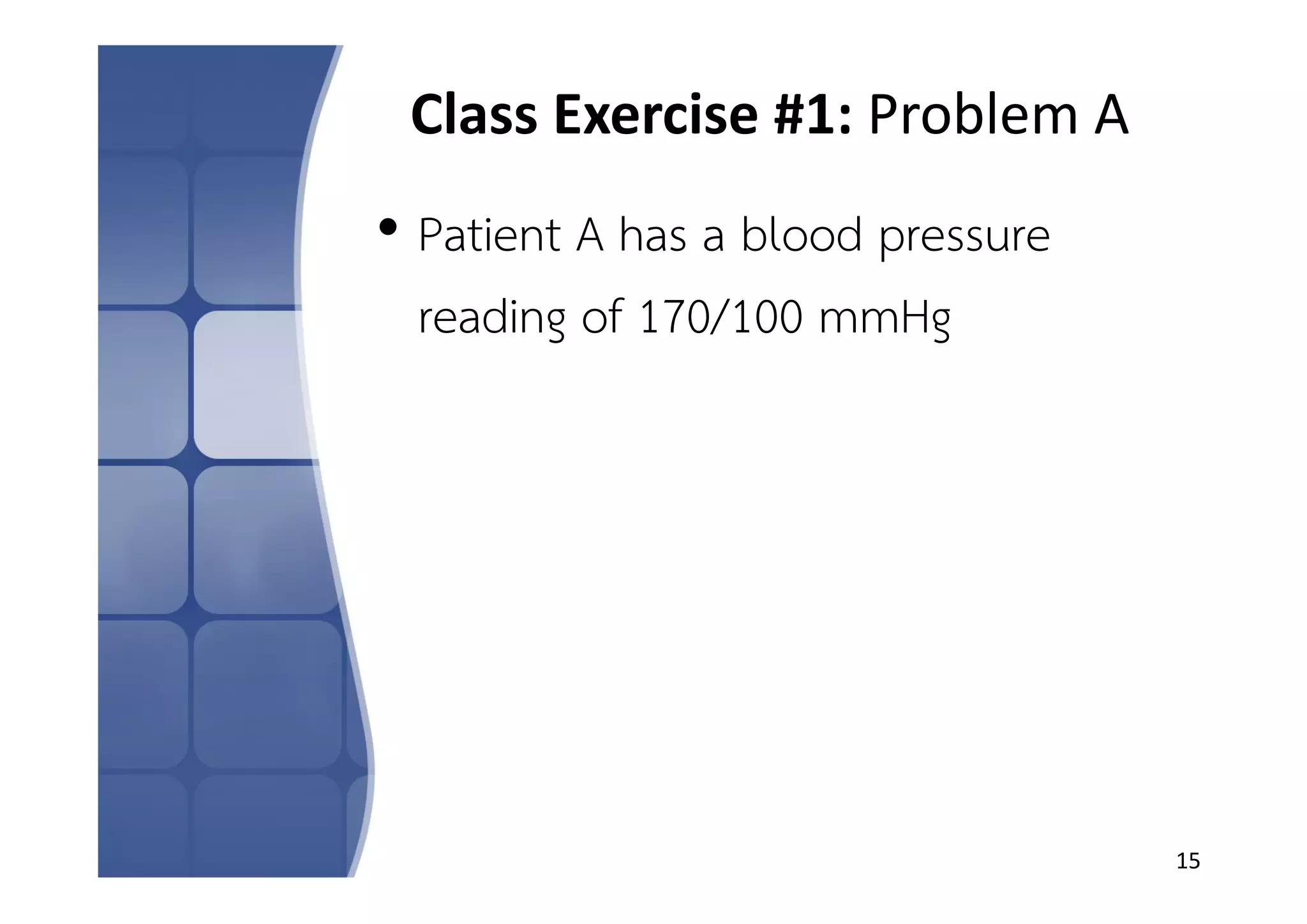
Practical examples and exercises demonstrating DIKW concepts through patient scenarios.
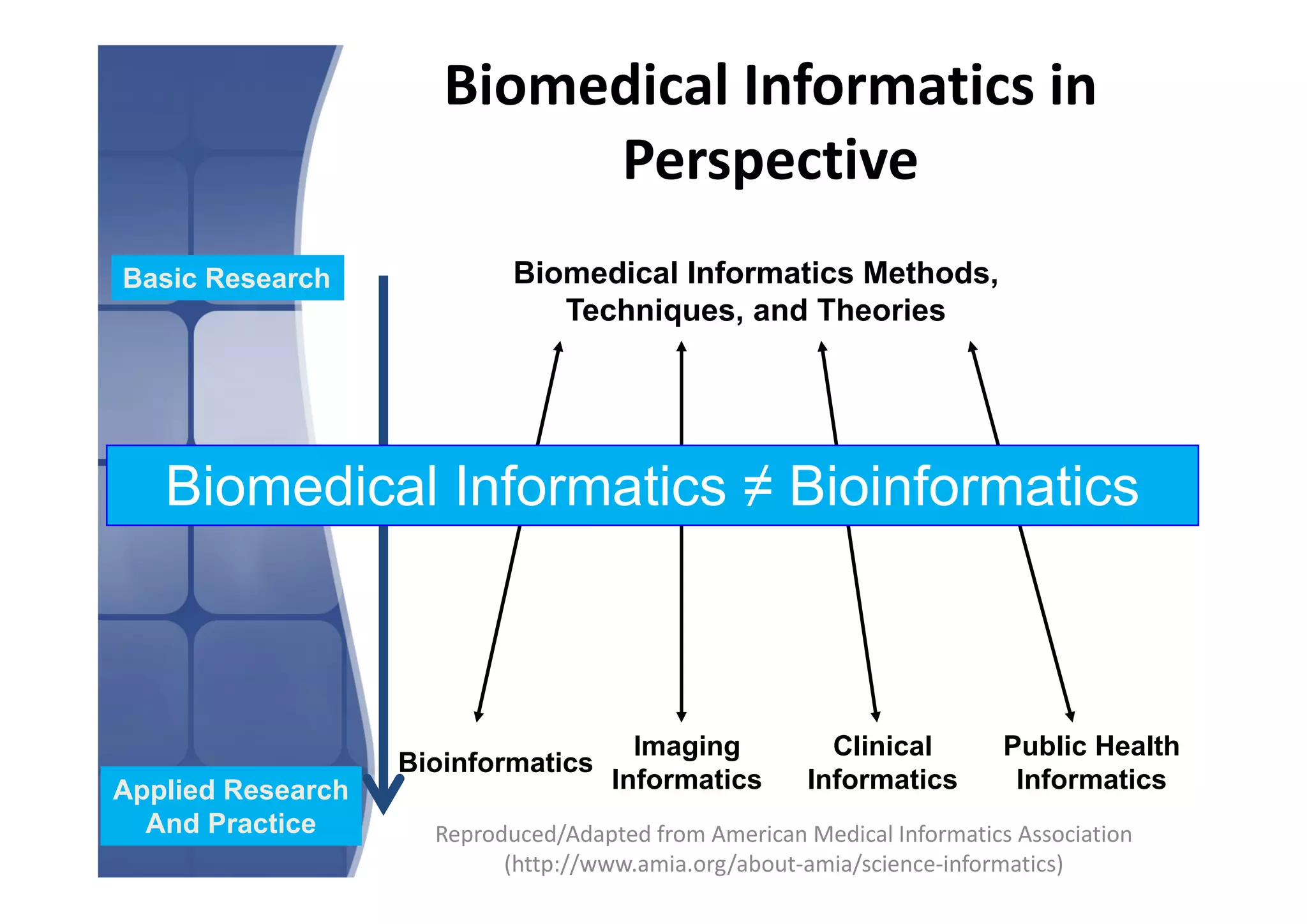
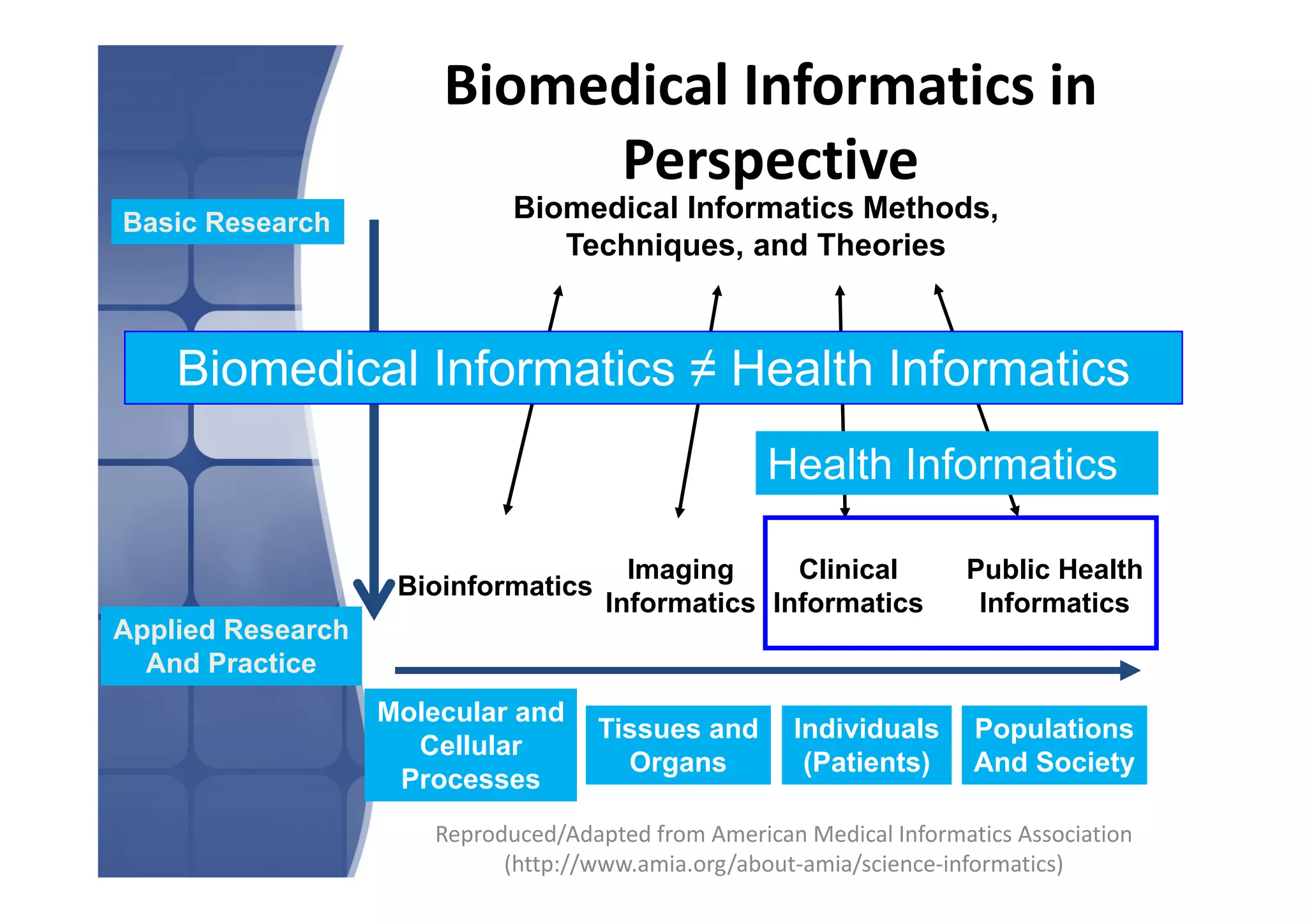
Definition, methodologies, and interdisciplinary nature of biomedical informatics, distinguishing it from health informatics.
Overview of biomedical informatics in practice, including diverse fields and applications.
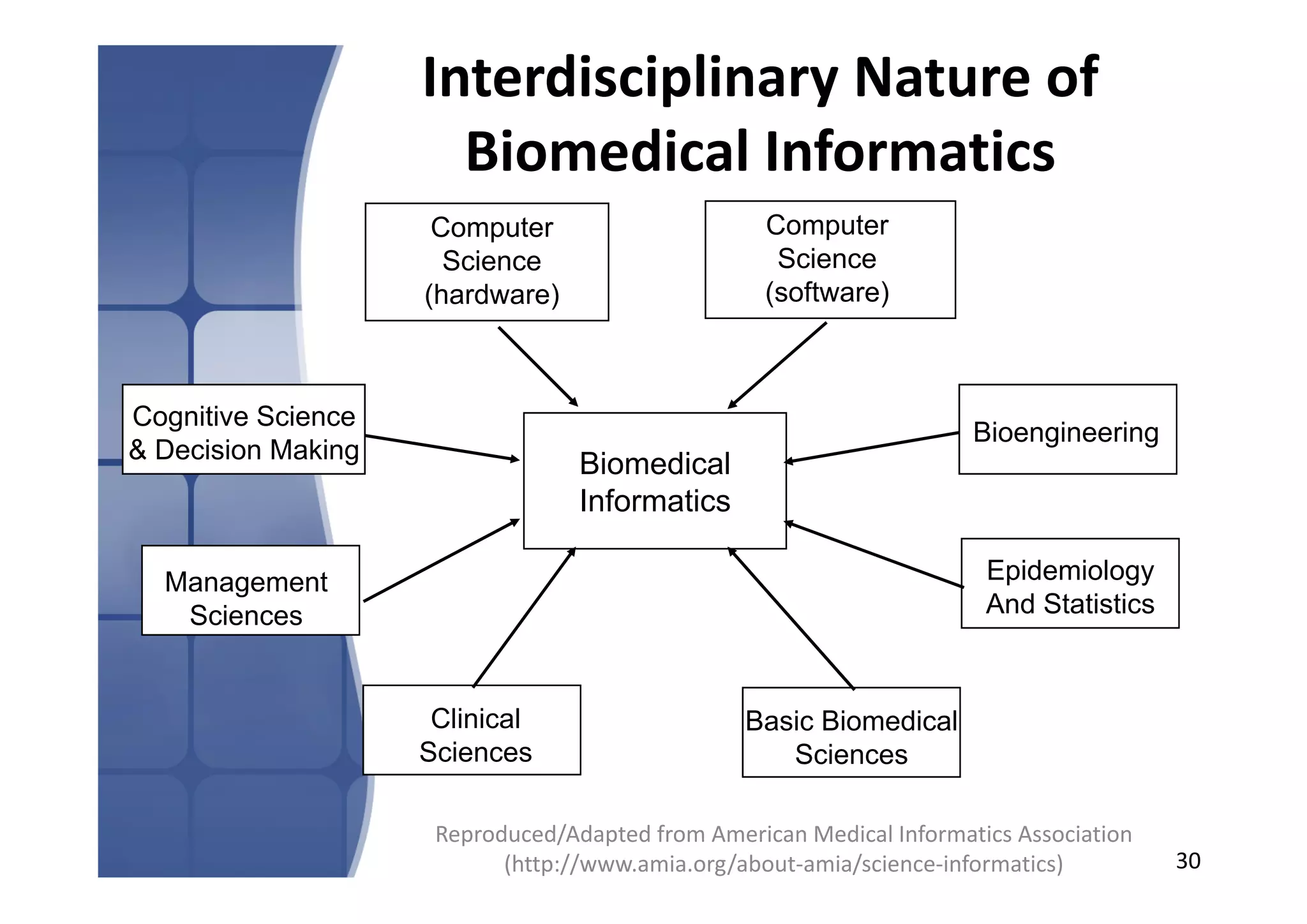
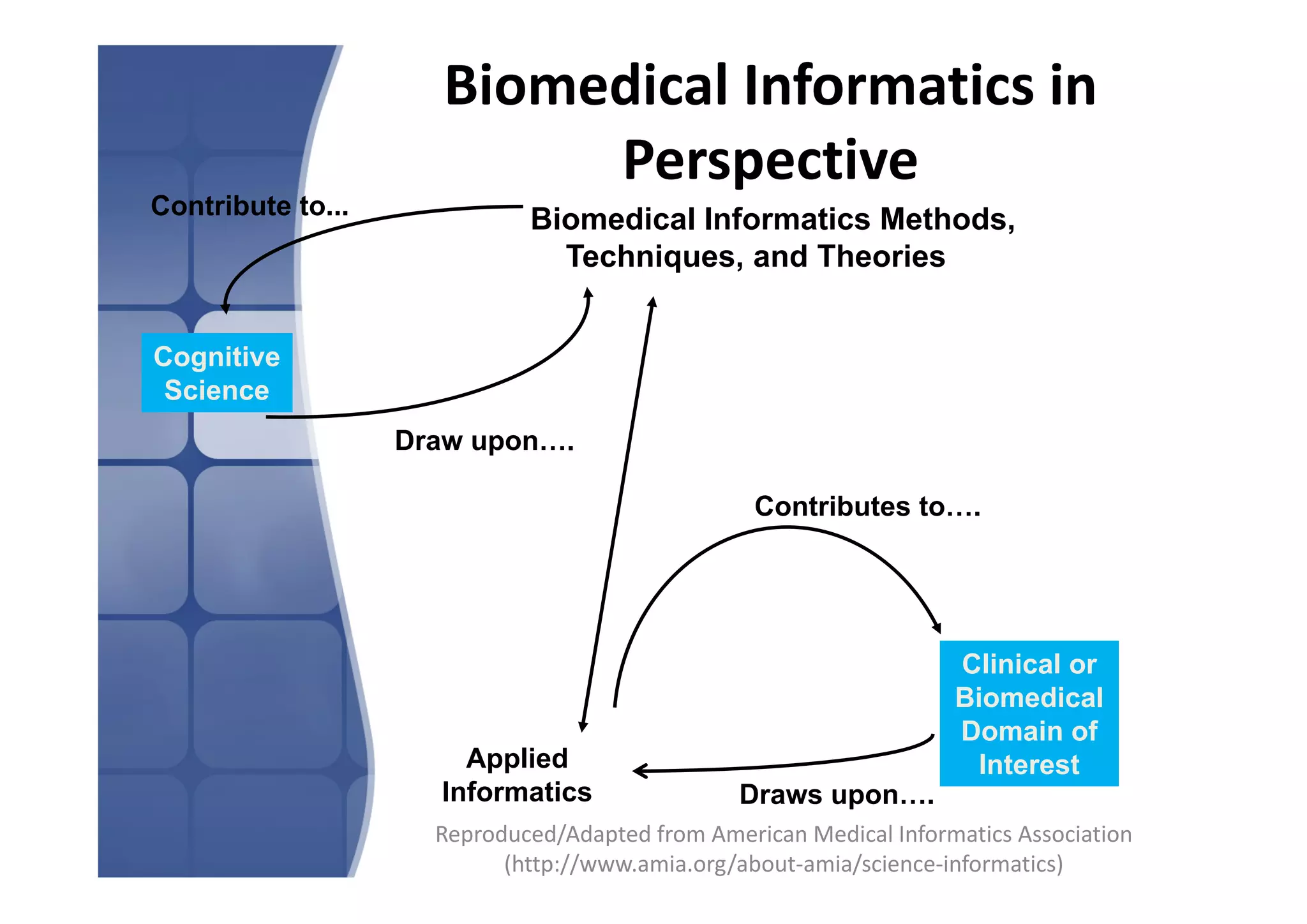
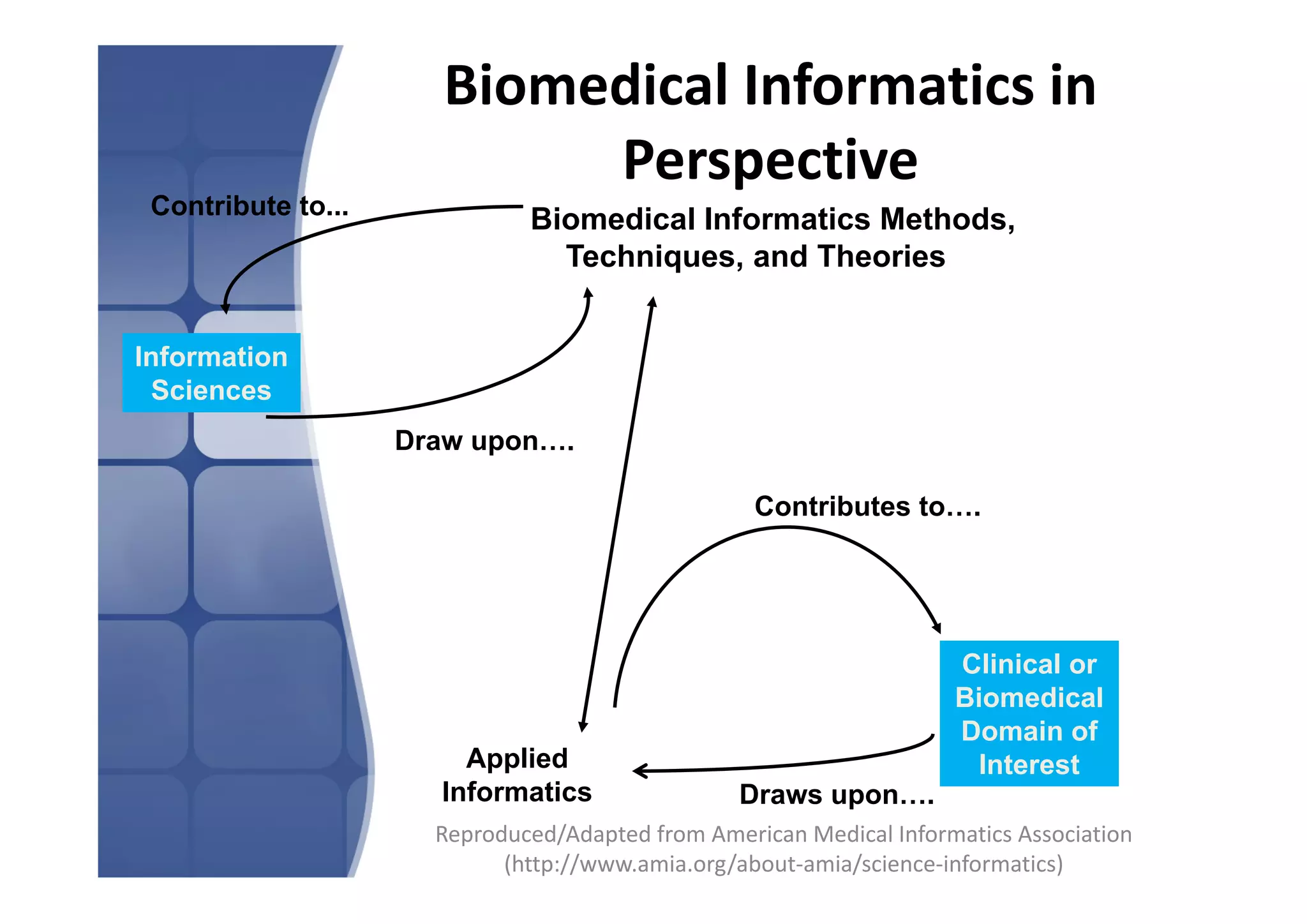
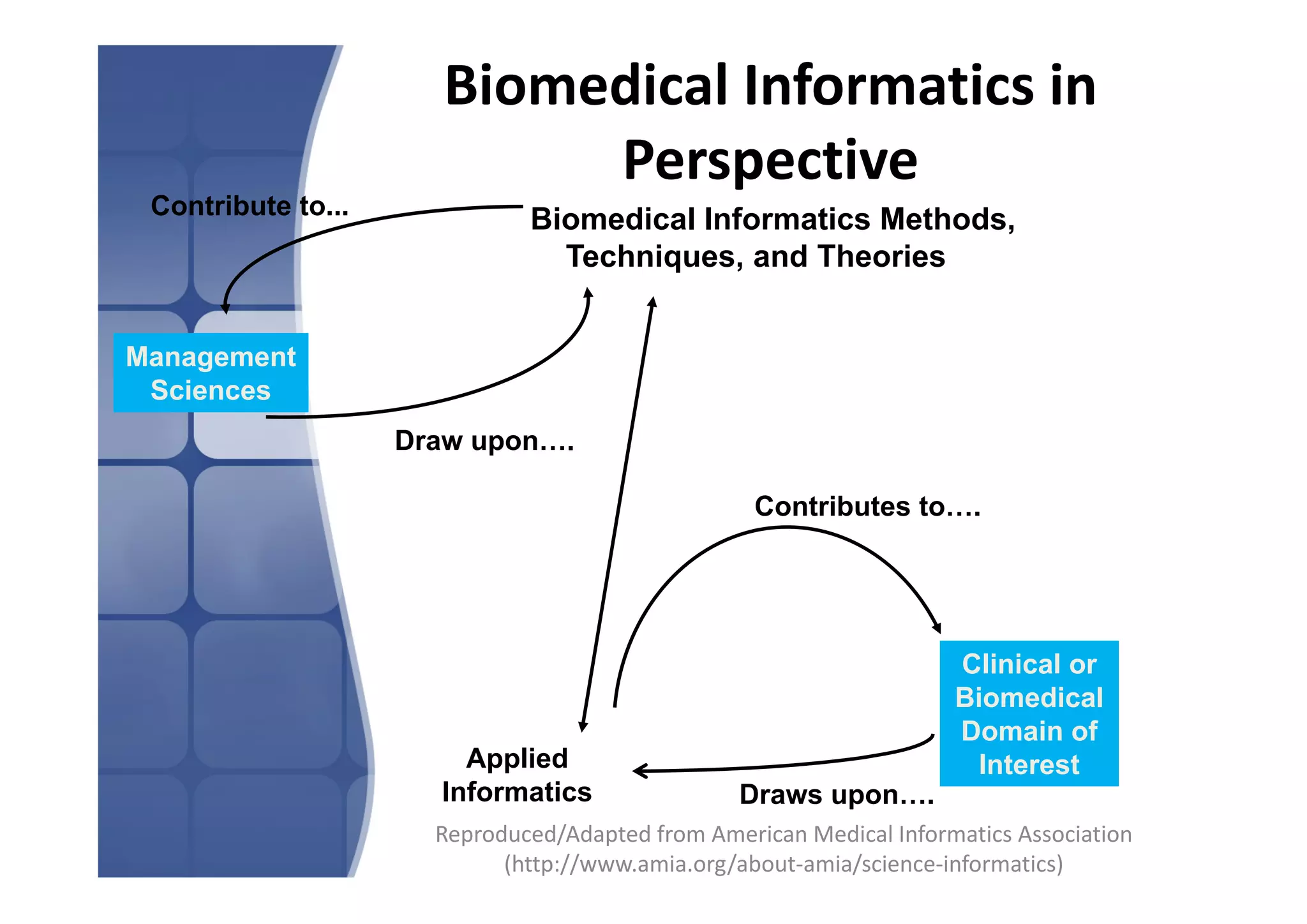
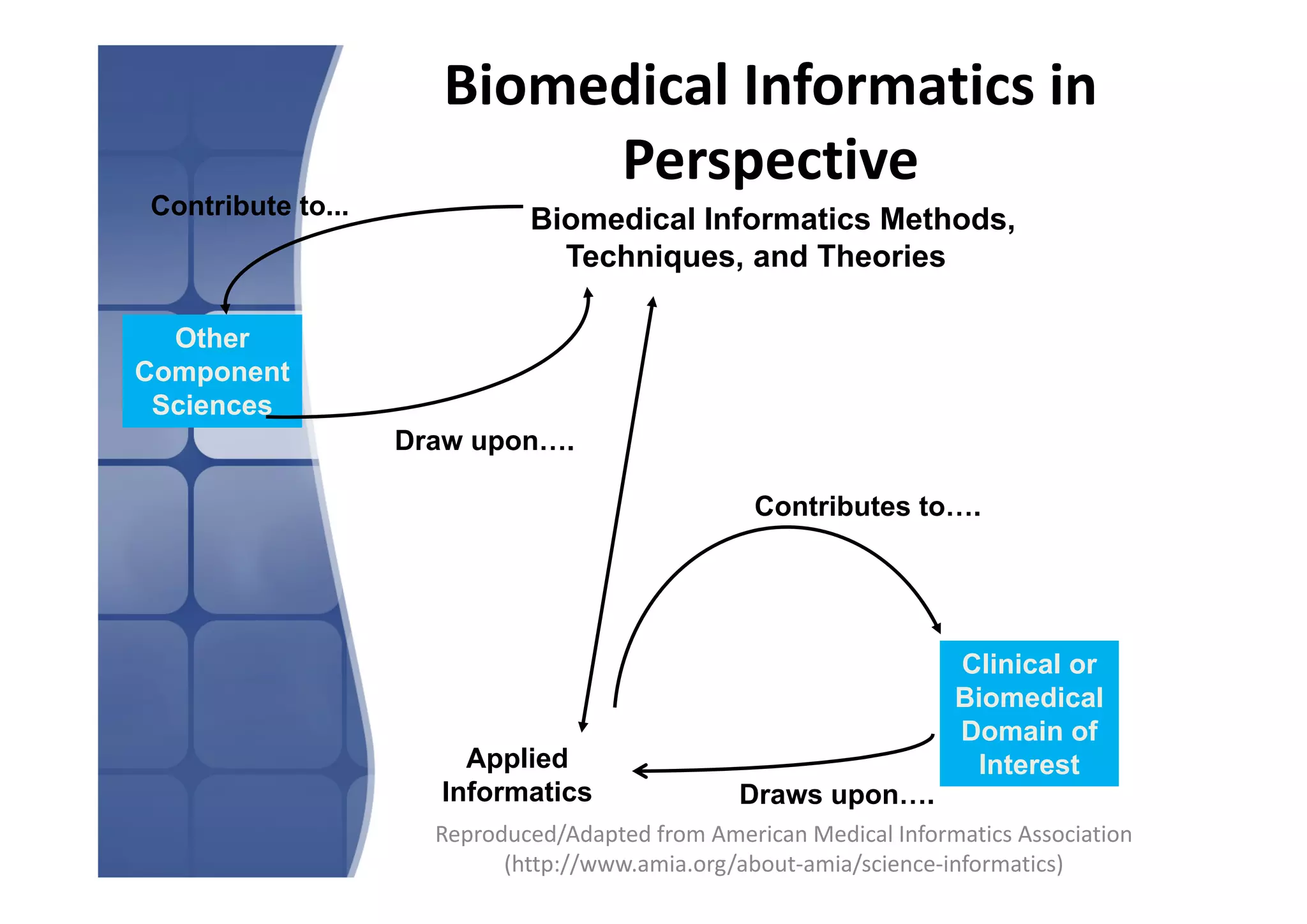
Explores how different scientific disciplines contribute to biomedical informatics and its applications.
Details on educating biomedical informatics professionals and the current workforce landscape in Thailand.
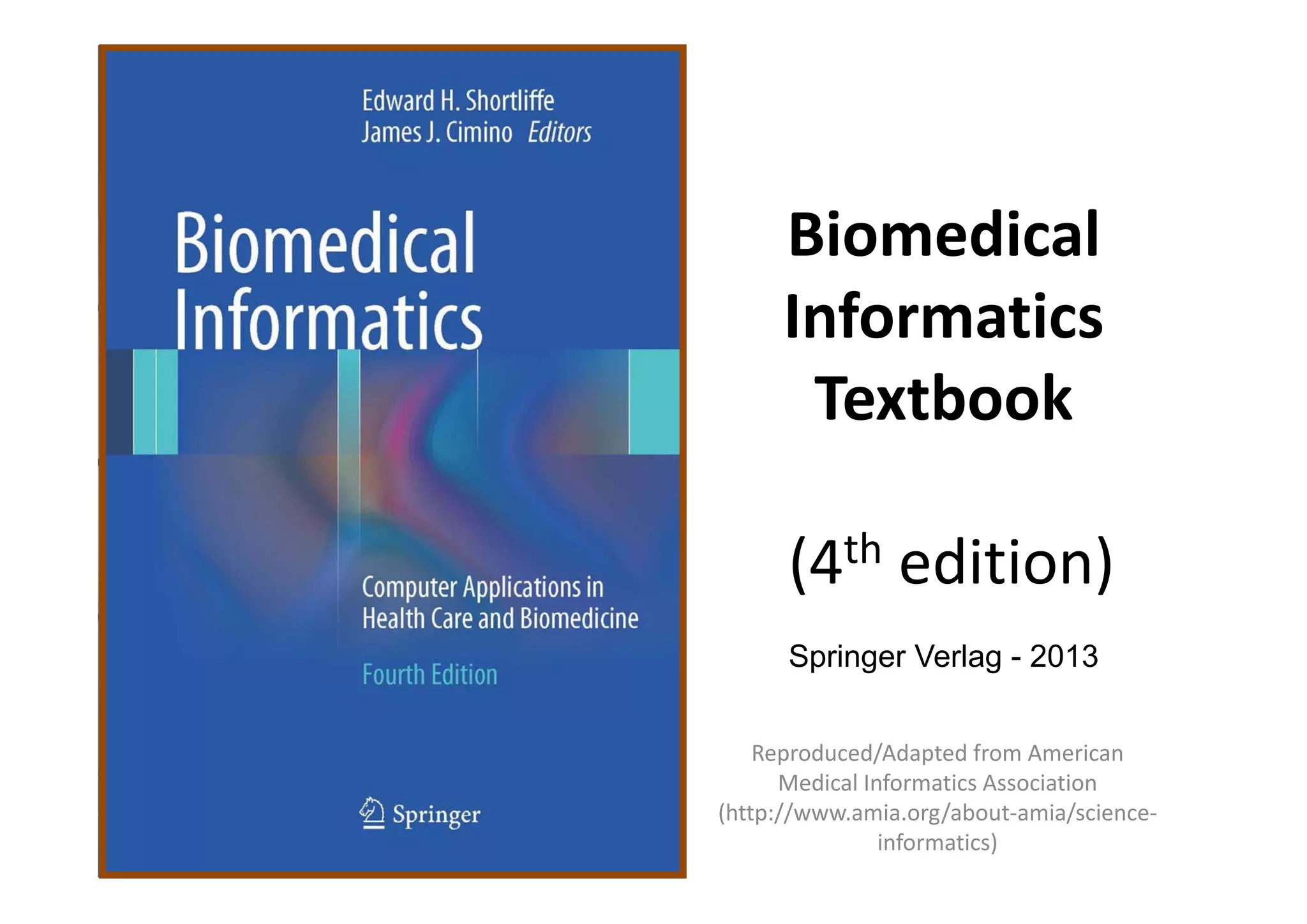
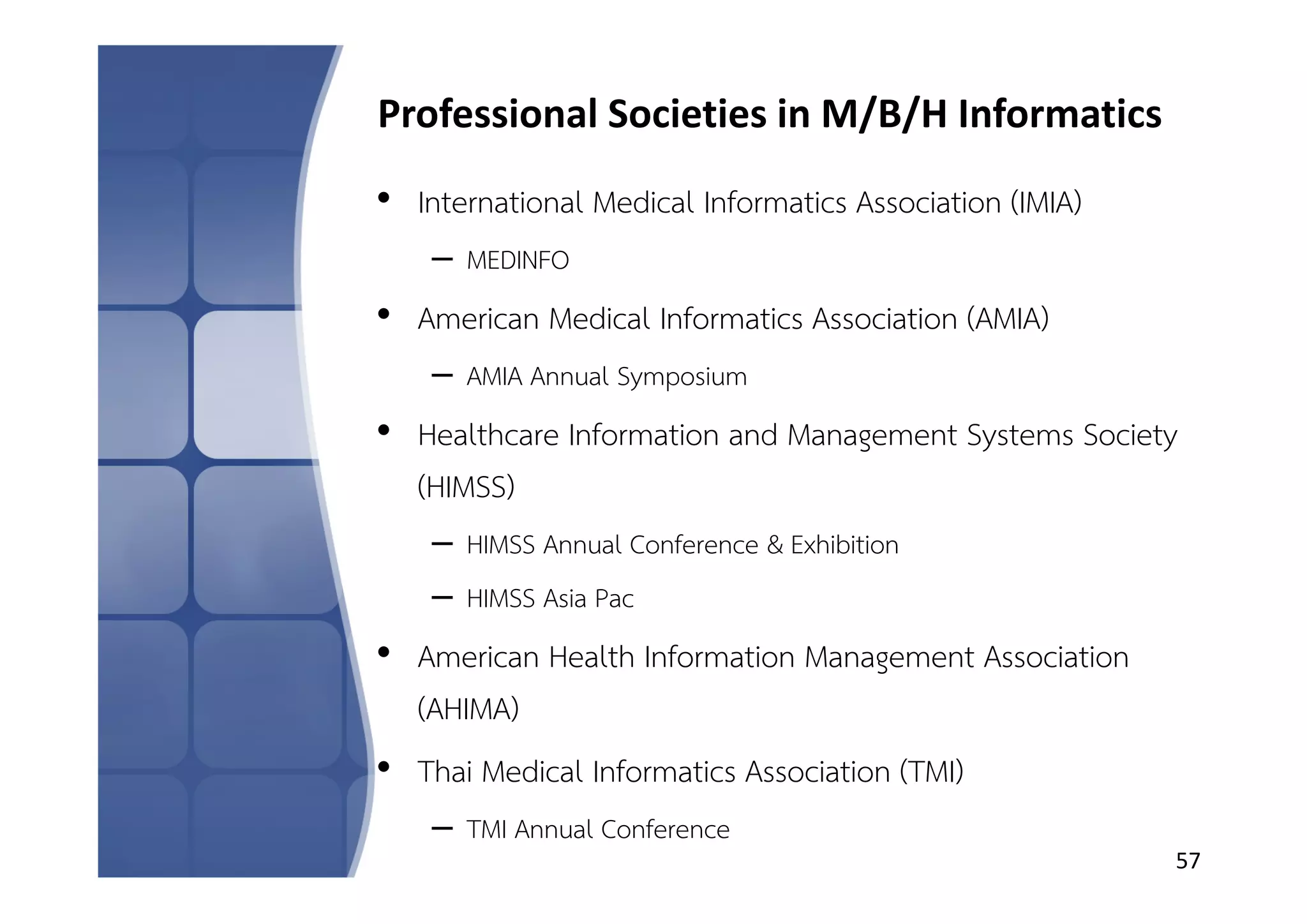
Highlighted books, journals, and online resources essential for biomedical and health informatics.
Concludes with a transition to health IT and references for further reading.
Overview of
HealthInformatics
Nawanan Theera-Ampornpunt, M.D., Ph.D.
Faculty of Medicine Ramathibodi Hospital
For Faculty of Social Sciences & Humanities,
Mahidol University
Except where citing
Sep 7, 2014 other works
2.
2
A FewWords About Me...
2003 Doctor of Medicine (1st-Class Honors) Ramathibodi
2009 M.S. (Health Informatics) University of Minnesota
2011 Ph.D. (Health Informatics) University of Minnesota
Currently
• Deputy Executive Director for Informatics
Chakri Naruebodindra Medical Institute
Faculty of Medicine Ramathibodi Hospital, Mahidol University
Contacts
nawanan.the@mahidol.ac.th
SlideShare.net/Nawanan
www.tc.umn.edu/~theer002
groups.google.com/group/ThaiHealthIT
3.
3
Session Outline
• Overview of Health Informatics
– This presentation
• Overview of Health IT
– Next presentation
4.
4
What Is“Informatics”
• French: informatique = the science and
technology of information processing using
computers (Greenes & Shortliffe, 1990)
• “[T]he discipline focused on the acquisition,
storage, and use of information in a specific
setting or domain” (Hersh, 2009)
• “[T]he science of information”
(Bernstam et al, 2010)
5.
5
Medical Informatics
• “Ancient” term
• Being retired
• Future use discouraged by experts
• Only retained in titles of professional
organizations
Main Problems
• Medical = Doctor? (e.g. not nursing?)
• Medical informatics vs. Clinical informatics
6.
6
Better Terms
• Biomedical informatics
• Health informatics
• Biomedical and Health informatics
A Few Subtleties
• Health informatics suggests the goal is “health”
• Health informatics vs Public health informatics
• Health informatics includes Bioinformatics?
• No clear winner between
Biomedical informatics vs. Health informatics
7.
But What IsM/B/H Informatics Anyway?
• Medical computing/computers in medicine?
• ‘[R]eferring to biomedical informatics as
7
“computers in medicine” is like defining
cardiology as “stethoscopes in medicine”.’
(Bernstam et al, 2010)
• “[T]he field concerned with the cognitive,
information processing, and communication
tasks of medical practice, education, and
research, including the information science and
technology to support these tasks”
(Greenes & Shortliffe, 1990)
8.
8
More Definitionsof M/B/H Informatics
• “[T]he field that is concerned with the optimal
use of information, often aided by the use of
technology, to improve individual health,
health care, public health, and biomedical
research” (Hersh, 2009)
• “[T]he application of the science of
information as data plus meaning to
problems of biomedical interest” (Bernstam et al, 2010)
9.
9
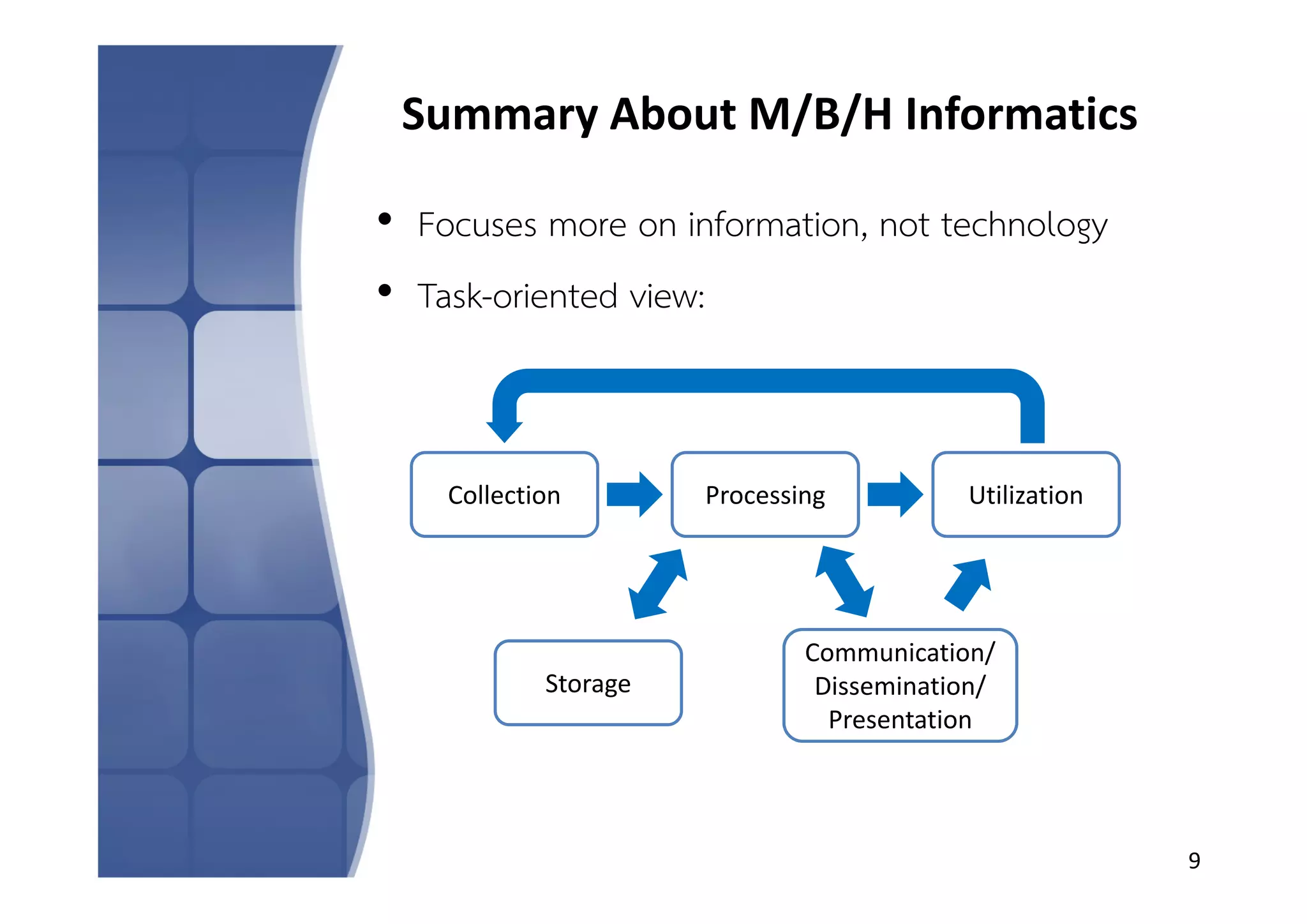
Summary AboutM/B/H Informatics
• Focuses more on information, not technology
• Task-oriented view:
Collection Processing
Storage
Utilization
Communication/
Dissemination/
Presentation
10.
10
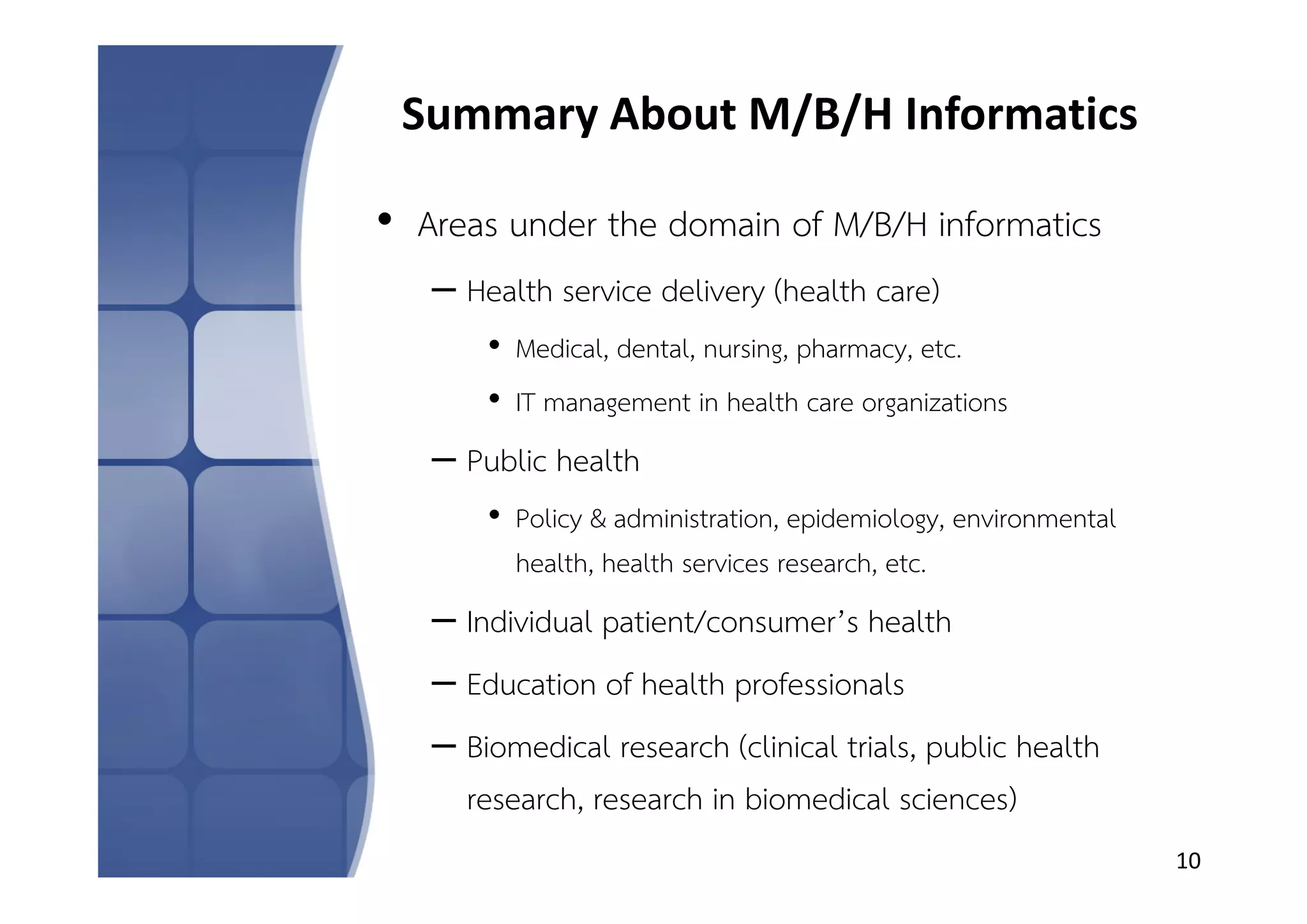
Summary AboutM/B/H Informatics
• Areas under the domain of M/B/H informatics
– Health service delivery (health care)
• Medical, dental, nursing, pharmacy, etc.
• IT management in health care organizations
– Public health
• Policy & administration, epidemiology, environmental
health, health services research, etc.
– Individual patient/consumer’s health
– Education of health professionals
– Biomedical research (clinical trials, public health
research, research in biomedical sciences)
11.
11
So....What IsInformation?
Data‐Information‐Knowledge‐Wisdom
(DIKW) Pyramid
Wisdom
Knowledge
Information
Data
13
Example
Wisdom
Knowledge
Information
Data
I should buy a BMW
(and a BIG house)!
I am rich!!!!!
Processing/
Synthesis/
Organization
I have 100,000,000 baht
in my bank account
Contextualization/
Interpretation
Judgment
100,000,000
14.
Class Exercise #1
Form 3 groups, 3‐4 people each.
From your assigned problem,
identify/exemplify data,
information, knowledge,
and wisdom
15.
15
Class Exercise#1: Problem A
• Patient A has a blood pressure
reading of 170/100 mmHg
16.
16
Class Exercise#1: Problem B
• Patient B is allergic to penicillin. He
was recently prescribed amoxicillin
for his sore throat.
17.
17
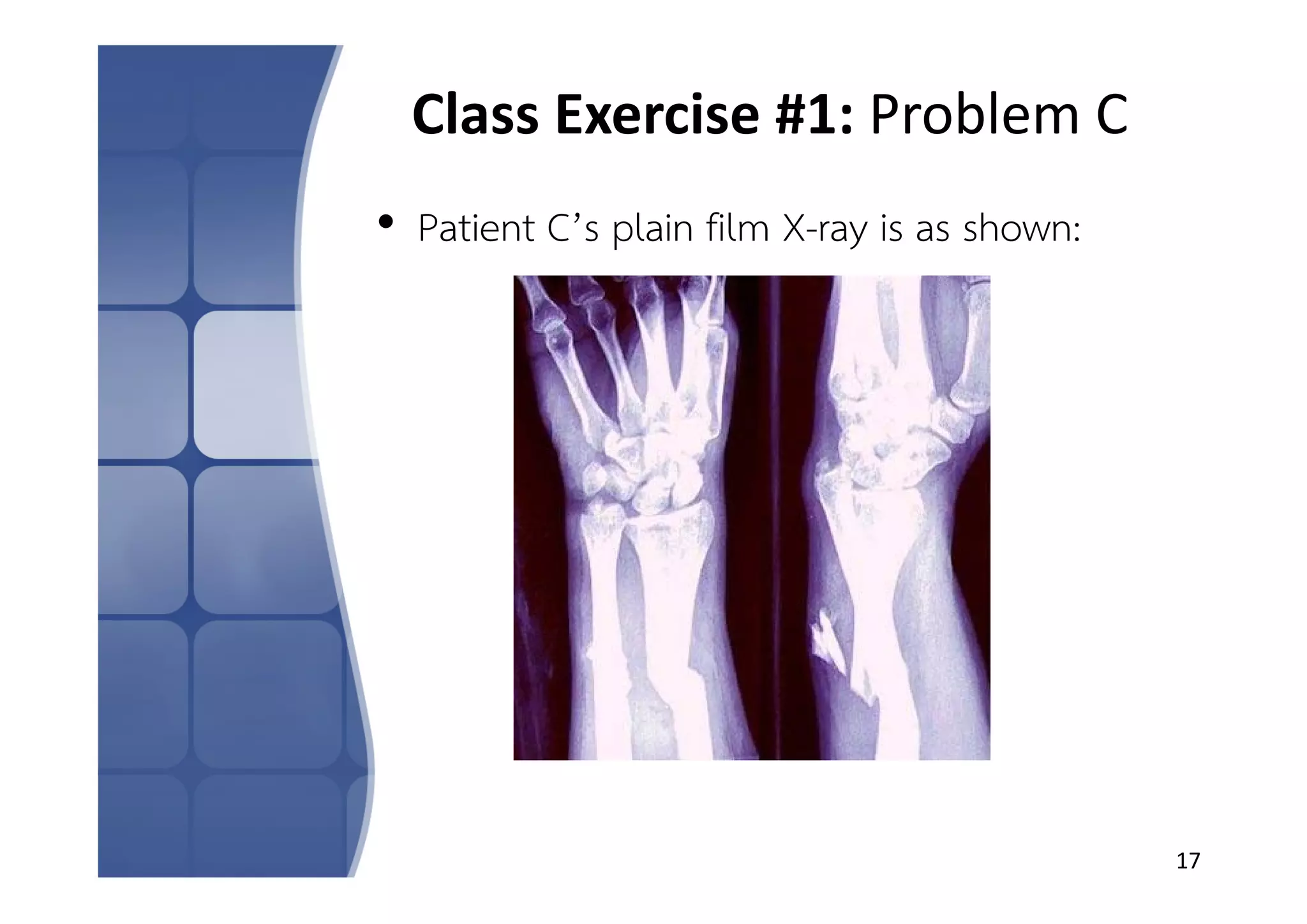
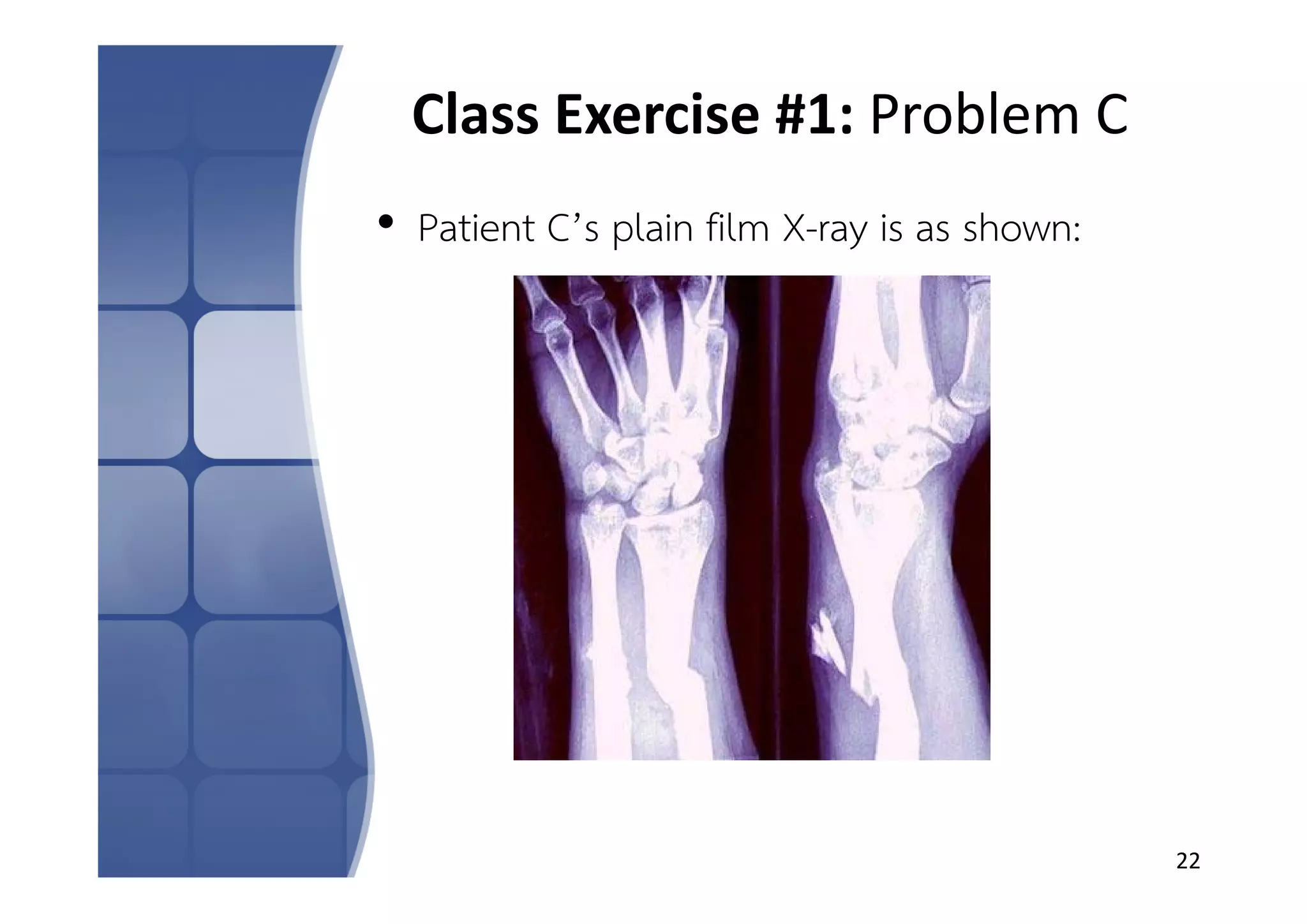
Class Exercise#1: Problem C
• Patient C’s plain film X-ray is as shown:
18.
18
Class Exercise#1: Problem A
• Patient A has a blood pressure
reading of 170/100 mmHg
19.
19
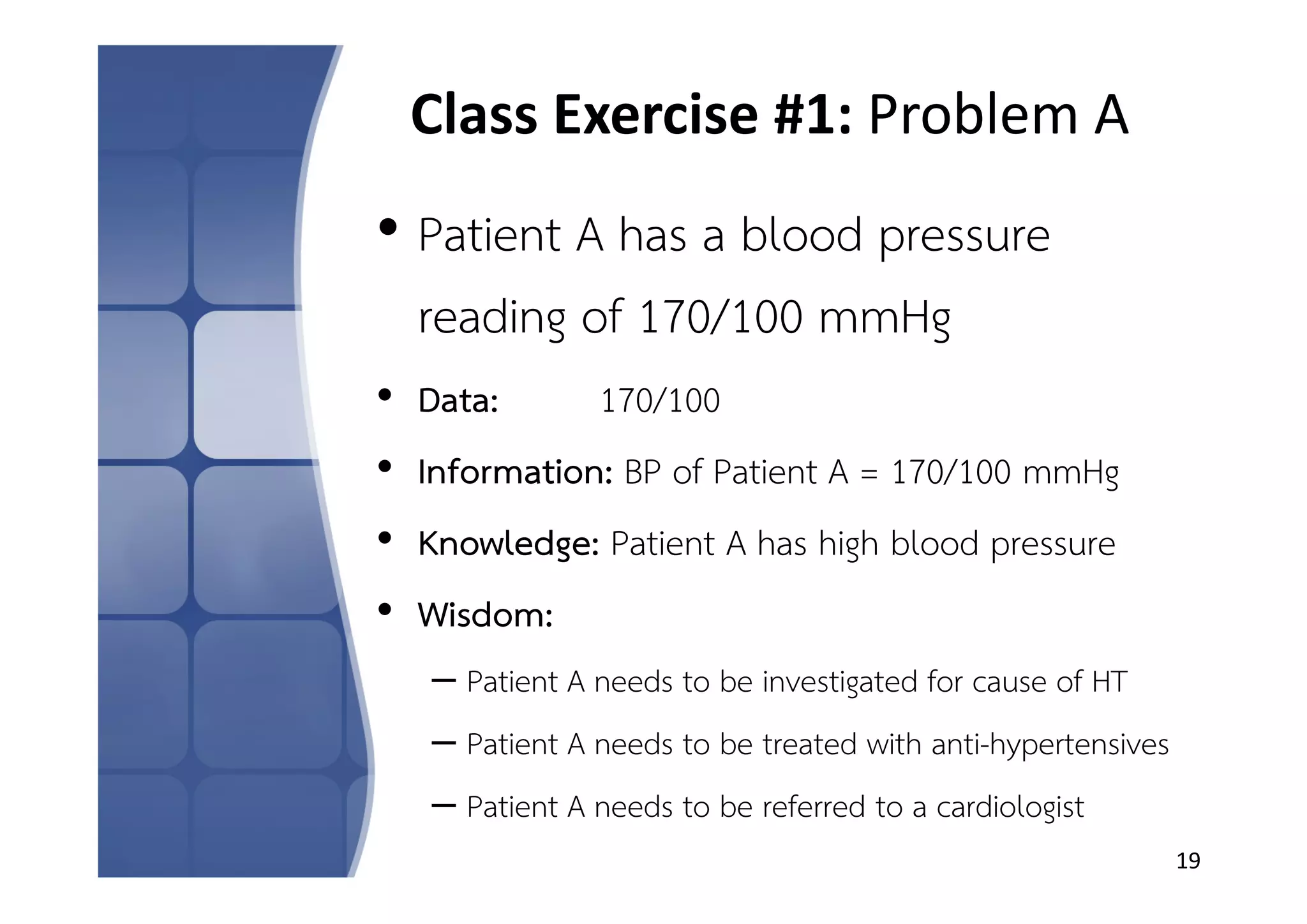
Class Exercise#1: Problem A
• Patient A has a blood pressure
reading of 170/100 mmHg
• Data: 170/100
• Information: BP of Patient A = 170/100 mmHg
• Knowledge: Patient A has high blood pressure
• Wisdom:
– Patient A needs to be investigated for cause of HT
– Patient A needs to be treated with anti-hypertensives
– Patient A needs to be referred to a cardiologist
20.
20
Class Exercise#1: Problem B
• Patient B is allergic to penicillin. He
was recently prescribed amoxicillin
for his sore throat.
21.
Class Exercise #1:Problem B
• Patient B is allergic to penicillin. He was recently
prescribed amoxicillin for his sore throat.
• Data: Penicillin, amoxicillin, sore throat
• Information:
– Patient B has penicillin allergy
– Patient B was prescribed amoxicillin for his sore throat
• Knowledge:
– Patient B may have allergic reaction to his prescription
• Wisdom:
– Patient B should not take amoxicillin!!!
21
22.
22
Class Exercise#1: Problem C
• Patient C’s plain film X-ray is as shown:
23.
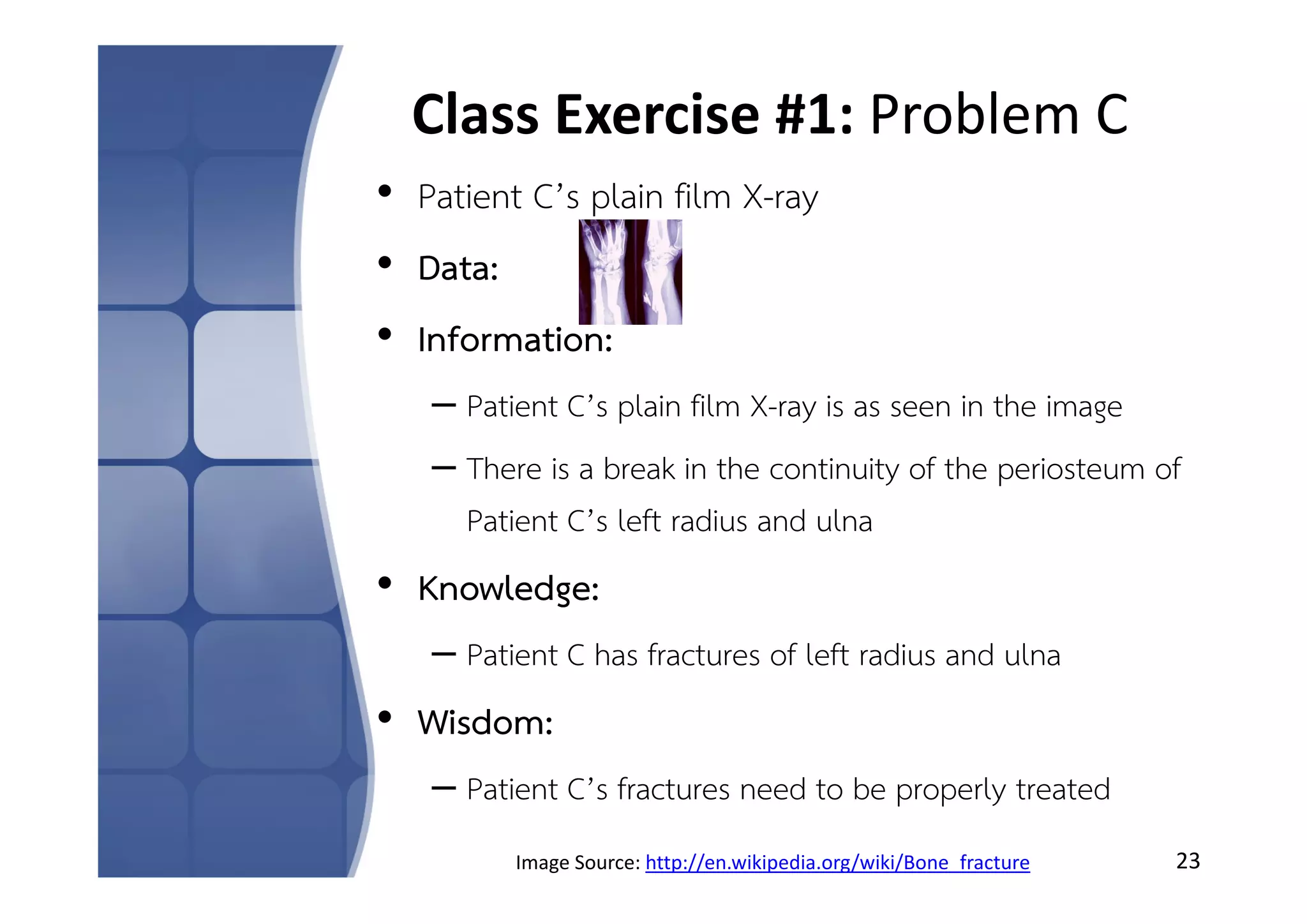
Class Exercise #1:Problem C
• Patient C’s plain film X-ray
• Data:
• Information:
– Patient C’s plain film X-ray is as seen in the image
– There is a break in the continuity of the periosteum of
23
Patient C’s left radius and ulna
• Knowledge:
– Patient C has fractures of left radius and ulna
• Wisdom:
– Patient C’s fractures need to be properly treated
Image Source: http://en.wikipedia.org/wiki/Bone_fracture
24.
Back to EarlierDefinitions of Informatics
M/B/H Informatics is...
• “[T]he field that is concerned with the optimal
24
use of information, often aided by the use of
technology, to improve individual health,
health care, public health, and biomedical
research” (Hersh, 2009)
• “[T]he application of the science of
information as data plus meaning to
problems of biomedical interest” (Bernstam et al, 2010)
Informatics focuses on “I”, not “T”
25.
What is
“BiomedicalInformatics”?
Reproduced/Adapted from American Medical Informatics Association
(http://www.amia.org/about‐amia/science‐informatics)
26.
26
Biomedical Informatics
Biomedical informatics (BMI) is the
interdisciplinary field that studies
and pursues the effective uses of
biomedical data, information, and
knowledge for scientific inquiry,
problem solving, and decision
making, motivated by efforts to
improve human health.
Reproduced/Adapted from American Medical Informatics Association
(http://www.amia.org/about‐amia/science‐informatics)
27.
27
Biomedical Informatics:
Corollaries to the Definition
1. BMI develops, studies and applies
theories, methods and processes
for the generation, storage,
retrieval, use, and sharing of
biomedical data, information, and
knowledge.
2. BMI builds on computing,
communication and information
sciences and technologies and
their application in biomedicine.
Reproduced/Adapted from American Medical Informatics Association
(http://www.amia.org/about‐amia/science‐informatics)
28.
28
Biomedical Informatics:
Corollaries to the Definition
3. BMI investigates and supports reasoning, modeling,
simulation, experimentation and translation across the
spectrum from molecules to populations, dealing with a variety
of biological systems, bridging basic and clinical research and
practice, and the healthcare enterprise.
4. BMI, recognizing that people are the ultimate users of
biomedical information, draws upon the social and behavioral
sciences to inform the design and evaluation of technical
solutions and the evolution of complex economic, ethical,
social, educational, and organizational systems.
Reproduced/Adapted from American Medical Informatics Association
(http://www.amia.org/about‐amia/science‐informatics)
29.
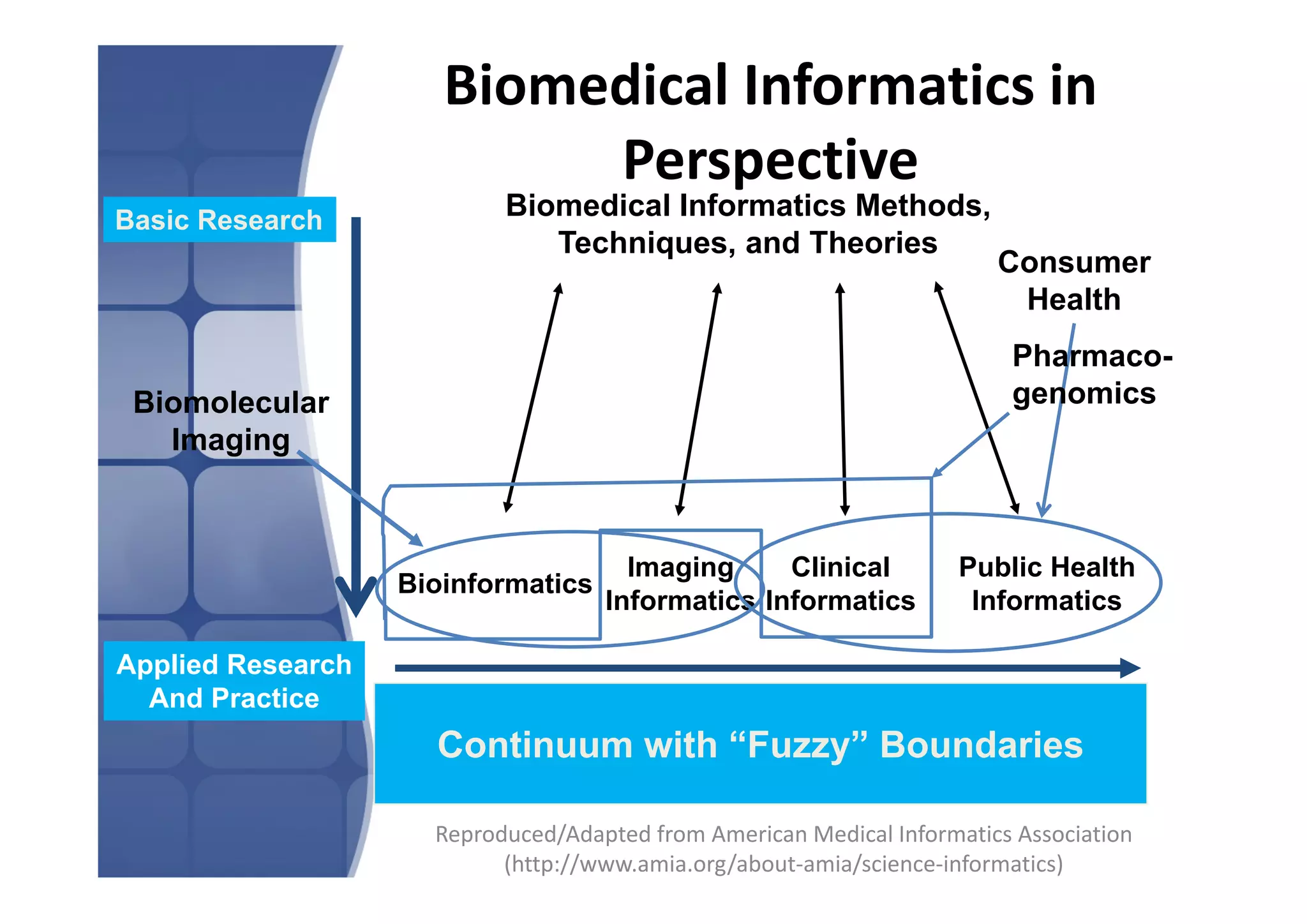
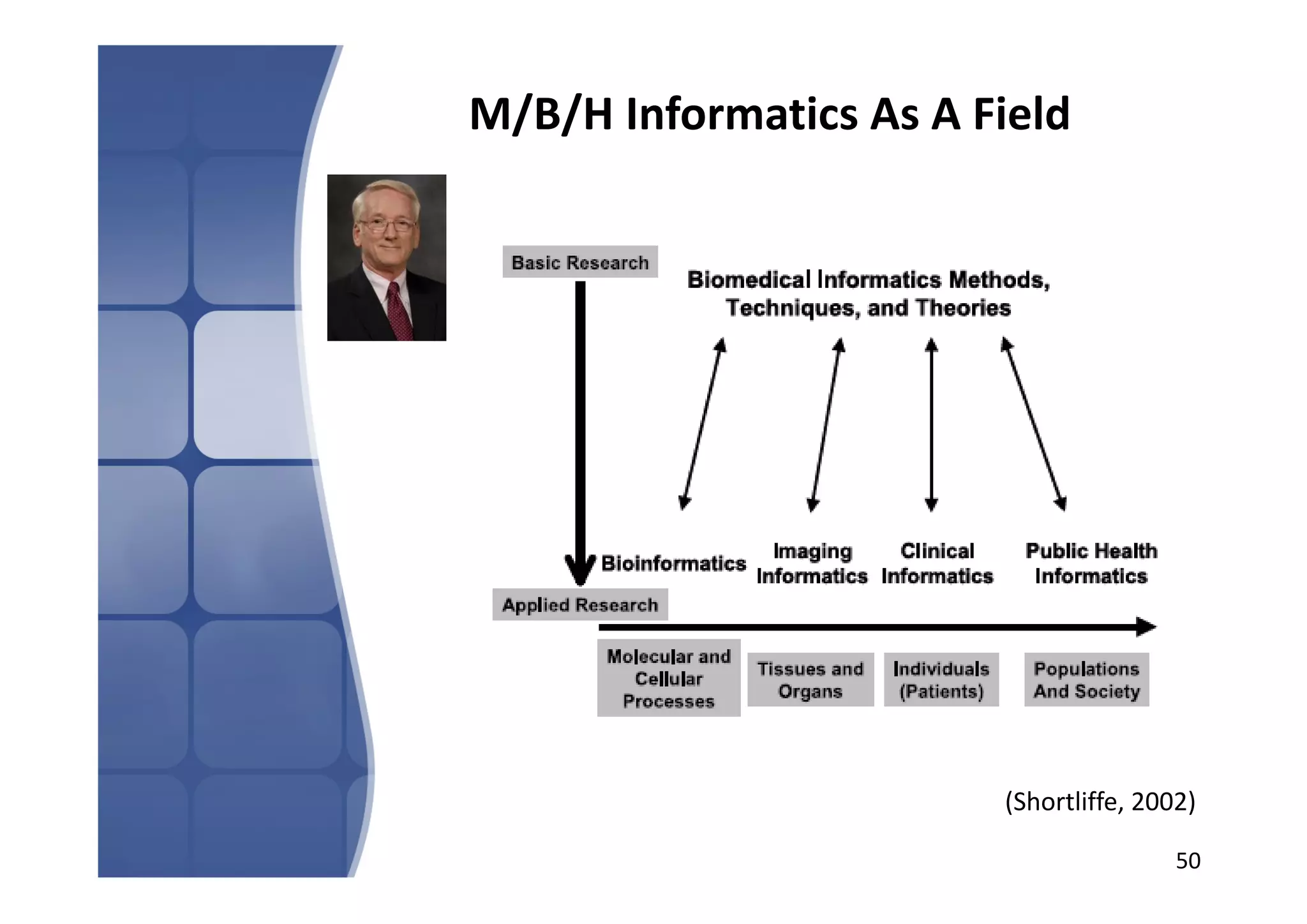
Basic Research
BiomedicalInformatics in
Perspective
Biomedical Informatics ≠ Bioinformatics
Applied Research
And Practice
Biomedical Informatics Methods,
Techniques, and Theories
Bioinformatics Clinical
Informatics
Imaging
Informatics
Public Health
Informatics
Reproduced/Adapted from American Medical Informatics Association
(http://www.amia.org/about‐amia/science‐informatics)
30.
30
Interdisciplinary Natureof
Biomedical Informatics
Biomedical
Informatics
Cognitive Science
& Decision Making
Management
Sciences
Clinical
Sciences
Basic Biomedical
Sciences
Bioengineering
Epidemiology
And Statistics
Computer
Science
(hardware)
Computer
Science
(software)
Reproduced/Adapted from American Medical Informatics Association
(http://www.amia.org/about‐amia/science‐informatics)
31.
Biomedical
Informatics
Textbook
(4th edition)
Springer Verlag - 2013
Reproduced/Adapted from American
Medical Informatics Association
(http://www.amia.org/about‐amia/science‐informatics)
32.
Biomedical Informatics in
Perspective
Basic Research
Biomedical Informatics ≠ Health Informatics
Applied Research
And Practice
Biomedical Informatics Methods,
Techniques, and Theories
Health Informatics
Bioinformatics Imaging
Clinical
Public Health
Informatics
Informatics Informatics
Molecular and
Cellular
Processes
Tissues and
Organs
Individuals
(Patients)
Populations
And Society
Reproduced/Adapted from American Medical Informatics Association
(http://www.amia.org/about‐amia/science‐informatics)
33.
Basic Research
AppliedResearch
And Practice
Biomedical Informatics in
Perspective
Biomedical Informatics Methods,
Techniques, and Theories
Bioinformatics Imaging
Clinical
Public Health
Informatics
Informatics Informatics
Molecular and
Cellular
Processes
Tissues and
Organs
Individuals
(Patients)
Populations
Continuum with “Fuzzy” BounAdnadr iSeosciety
Biomolecular
Imaging
Consumer
Health
Pharmaco-genomics
Reproduced/Adapted from American Medical Informatics Association
(http://www.amia.org/about‐amia/science‐informatics)
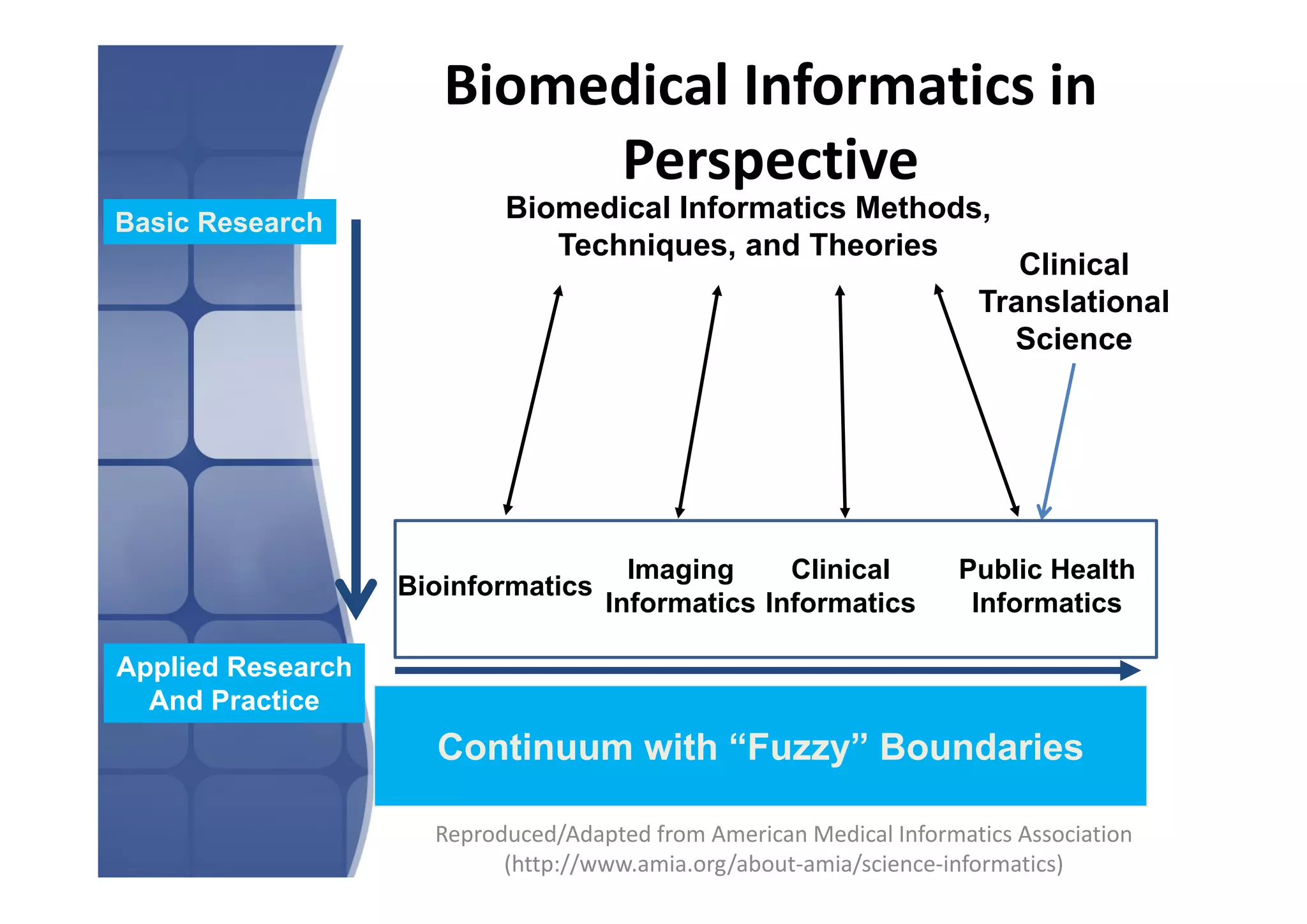
34.
Basic Research
AppliedResearch
And Practice
Biomedical Informatics in
Perspective
Biomedical Informatics Methods,
Techniques, and Theories
Clinical
Translational
Science
Bioinformatics Imaging
Clinical
Public Health
Informatics
Informatics Informatics
Molecular and
Cellular
Processes
Tissues and
Organs
Individuals
(Patients)
Populations
Continuum with “Fuzzy” BounAdnadr iSeosciety
Reproduced/Adapted from American Medical Informatics Association
(http://www.amia.org/about‐amia/science‐informatics)
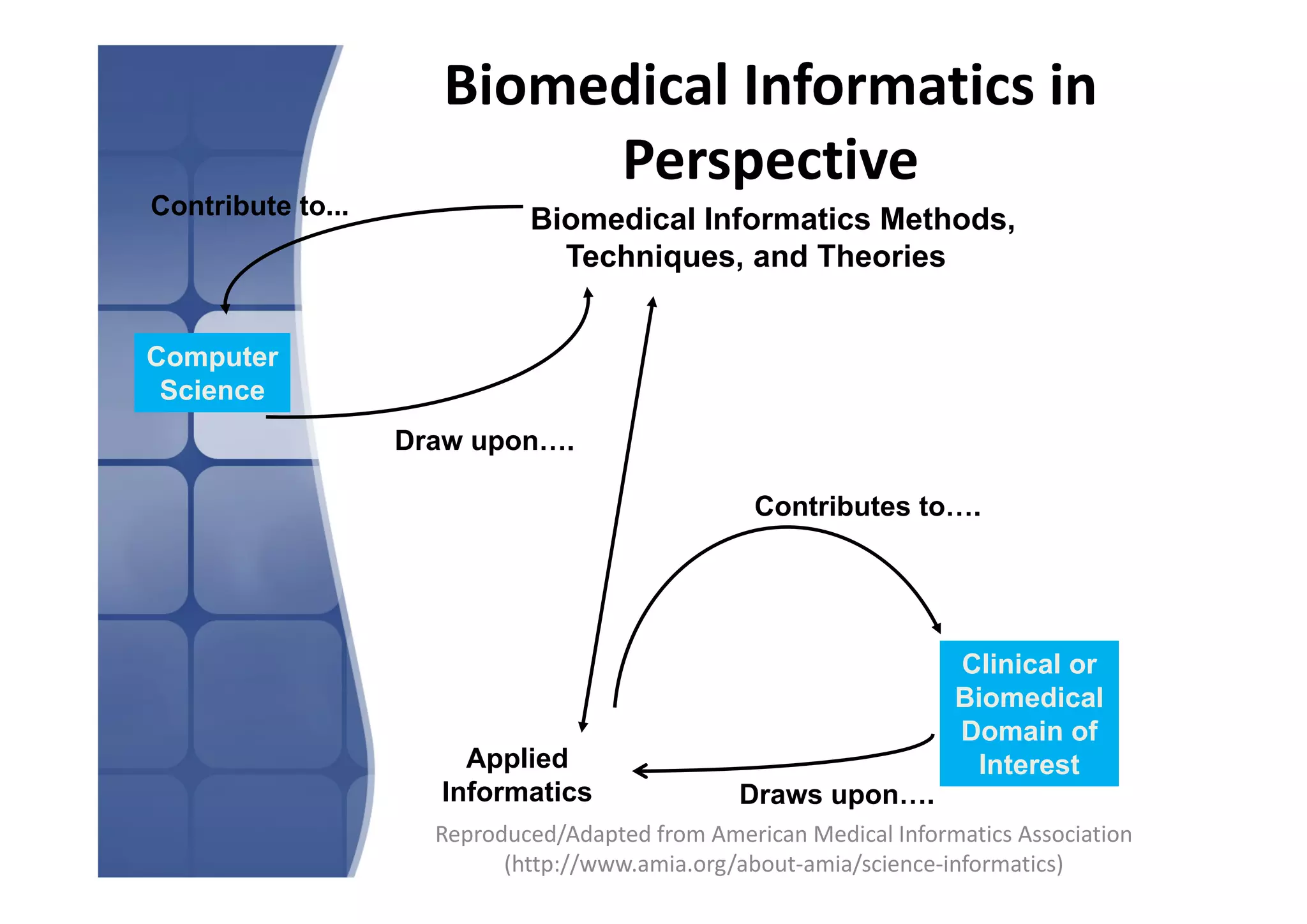
35.
Biomedical Informatics in
Perspective
Biomedical Informatics Methods,
Techniques, and Theories
Applied
Informatics
Contributes to….
Clinical or
Biomedical
Domain of
Interest
Draws upon….
Computer
Science
Draw upon….
Contribute to...
Reproduced/Adapted from American Medical Informatics Association
(http://www.amia.org/about‐amia/science‐informatics)
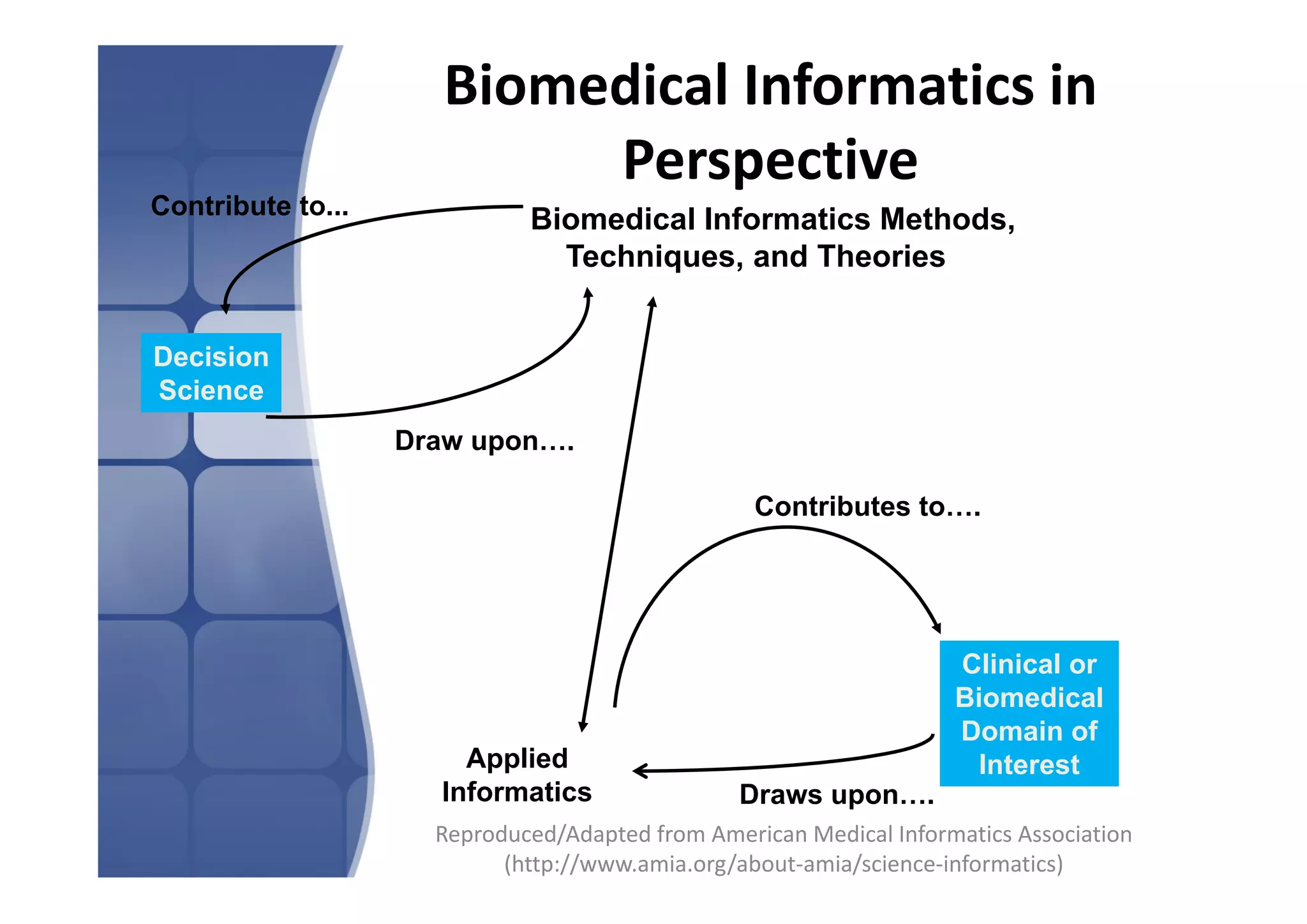
36.
Decision
Science
BiomedicalInformatics in
Perspective
Biomedical Informatics Methods,
Techniques, and Theories
Applied
Informatics
Contributes to….
Clinical or
Biomedical
Domain of
Interest
Draws upon….
Draw upon….
Contribute to...
Reproduced/Adapted from American Medical Informatics Association
(http://www.amia.org/about‐amia/science‐informatics)
37.
Cognitive
Science
BiomedicalInformatics in
Perspective
Biomedical Informatics Methods,
Techniques, and Theories
Applied
Informatics
Contributes to….
Clinical or
Biomedical
Domain of
Interest
Draws upon….
Draw upon….
Contribute to...
Reproduced/Adapted from American Medical Informatics Association
(http://www.amia.org/about‐amia/science‐informatics)
38.
Information
Sciences
BiomedicalInformatics in
Perspective
Biomedical Informatics Methods,
Techniques, and Theories
Applied
Informatics
Contributes to….
Clinical or
Biomedical
Domain of
Interest
Draws upon….
Draw upon….
Contribute to...
Reproduced/Adapted from American Medical Informatics Association
(http://www.amia.org/about‐amia/science‐informatics)
39.
Management
Sciences
BiomedicalInformatics in
Perspective
Biomedical Informatics Methods,
Techniques, and Theories
Applied
Informatics
Contributes to….
Clinical or
Biomedical
Domain of
Interest
Draws upon….
Draw upon….
Contribute to...
Reproduced/Adapted from American Medical Informatics Association
(http://www.amia.org/about‐amia/science‐informatics)
40.
Other
Component
Sciences
Biomedical Informatics in
Perspective
Biomedical Informatics Methods,
Techniques, and Theories
Applied
Informatics
Contributes to….
Clinical or
Biomedical
Domain of
Interest
Draws upon….
Draw upon….
Contribute to...
Reproduced/Adapted from American Medical Informatics Association
(http://www.amia.org/about‐amia/science‐informatics)
41.
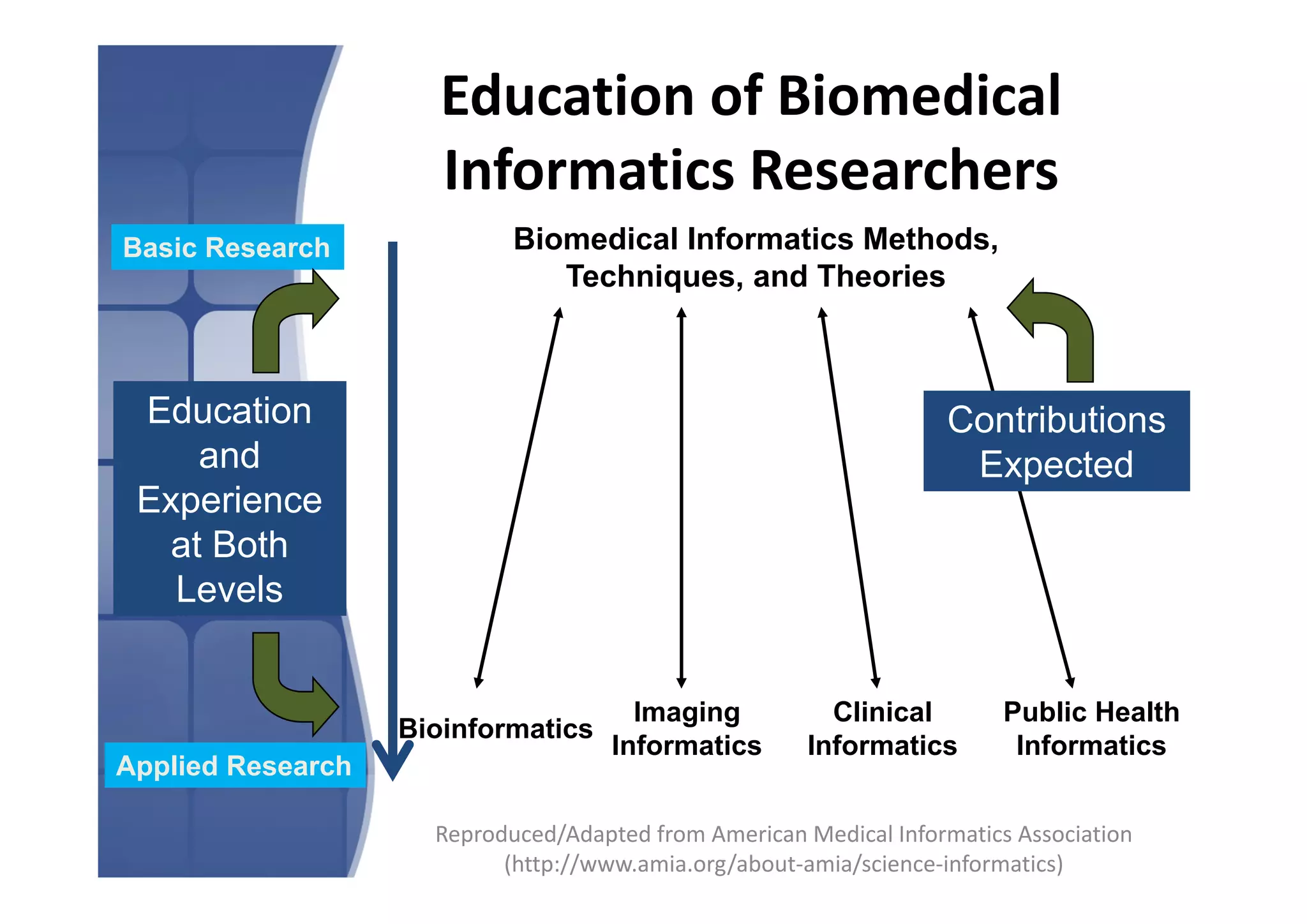
Education of Biomedical
Informatics Researchers
Basic Research
Applied Research
Biomedical Informatics Methods,
Techniques, and Theories
Bioinformatics Imaging
Informatics
Clinical
Informatics
Public Health
Informatics
Education
and
Experience
at Both
Levels
Contributions
Expected
Reproduced/Adapted from American Medical Informatics Association
(http://www.amia.org/about‐amia/science‐informatics)
42.
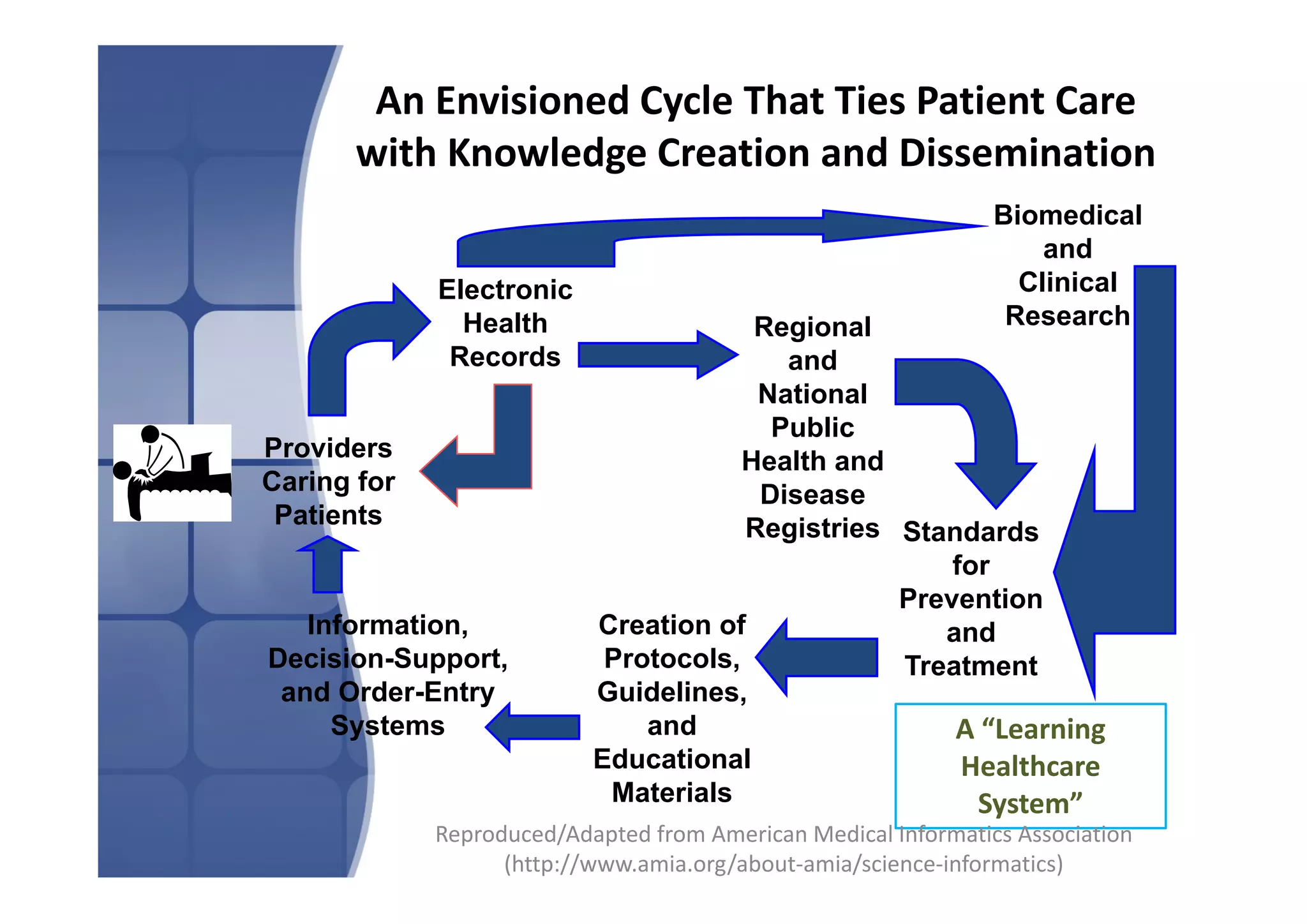
An Envisioned CycleThat Ties Patient Care
with Knowledge Creation and Dissemination
Providers
Caring for
Patients
Electronic
Health
Records
Regional
and
National
Public
Health and
Disease
Registries
Biomedical
and
Clinical
Research
Information,
Decision-Support,
and Order-Entry
Systems
Creation of
Protocols,
Guidelines,
and
Educational
Materials
Standards
for
Prevention
and
Treatment
A “Learning
Healthcare
System”
Reproduced/Adapted from American Medical Informatics Association
(http://www.amia.org/about‐amia/science‐informatics)
43.
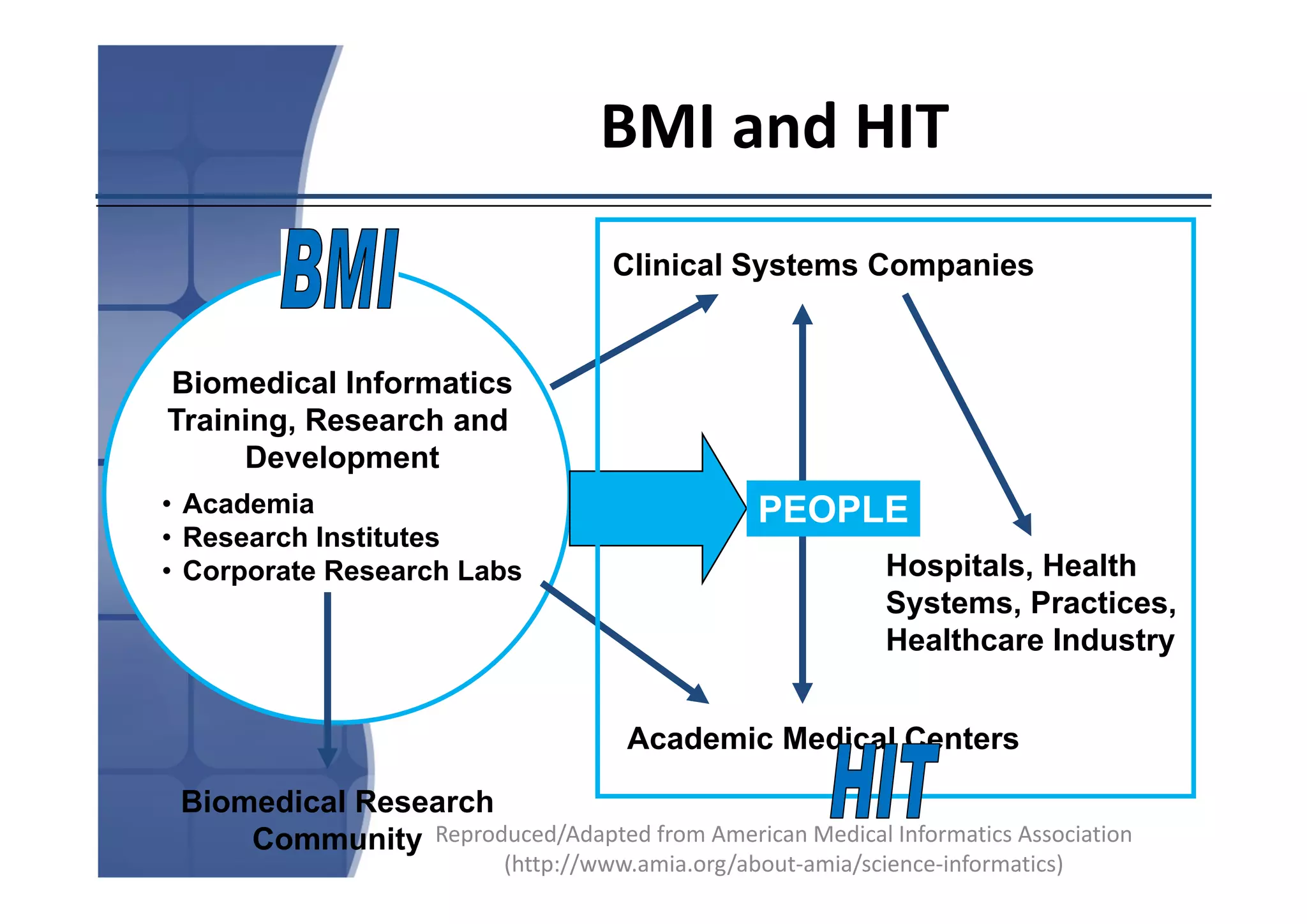
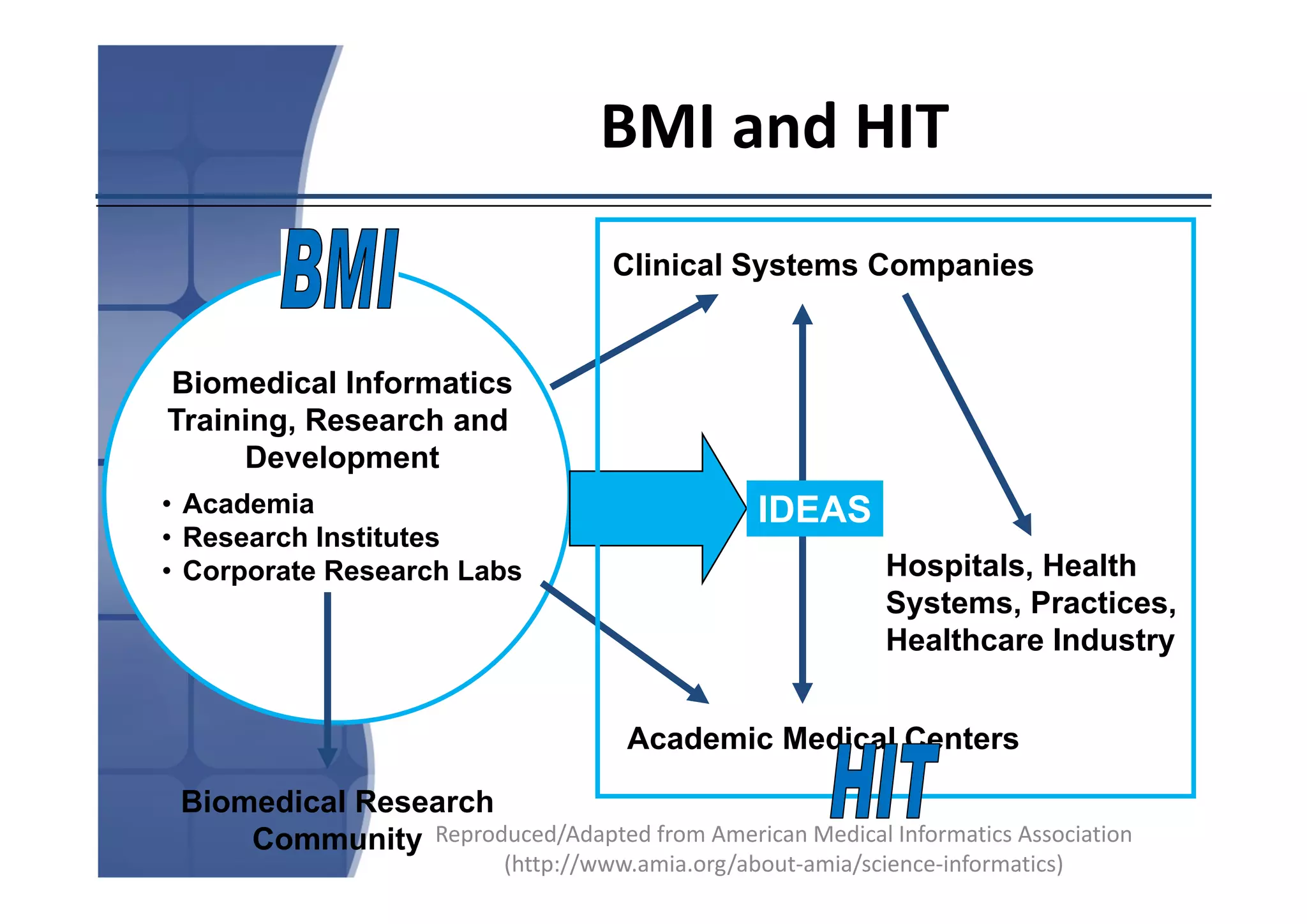
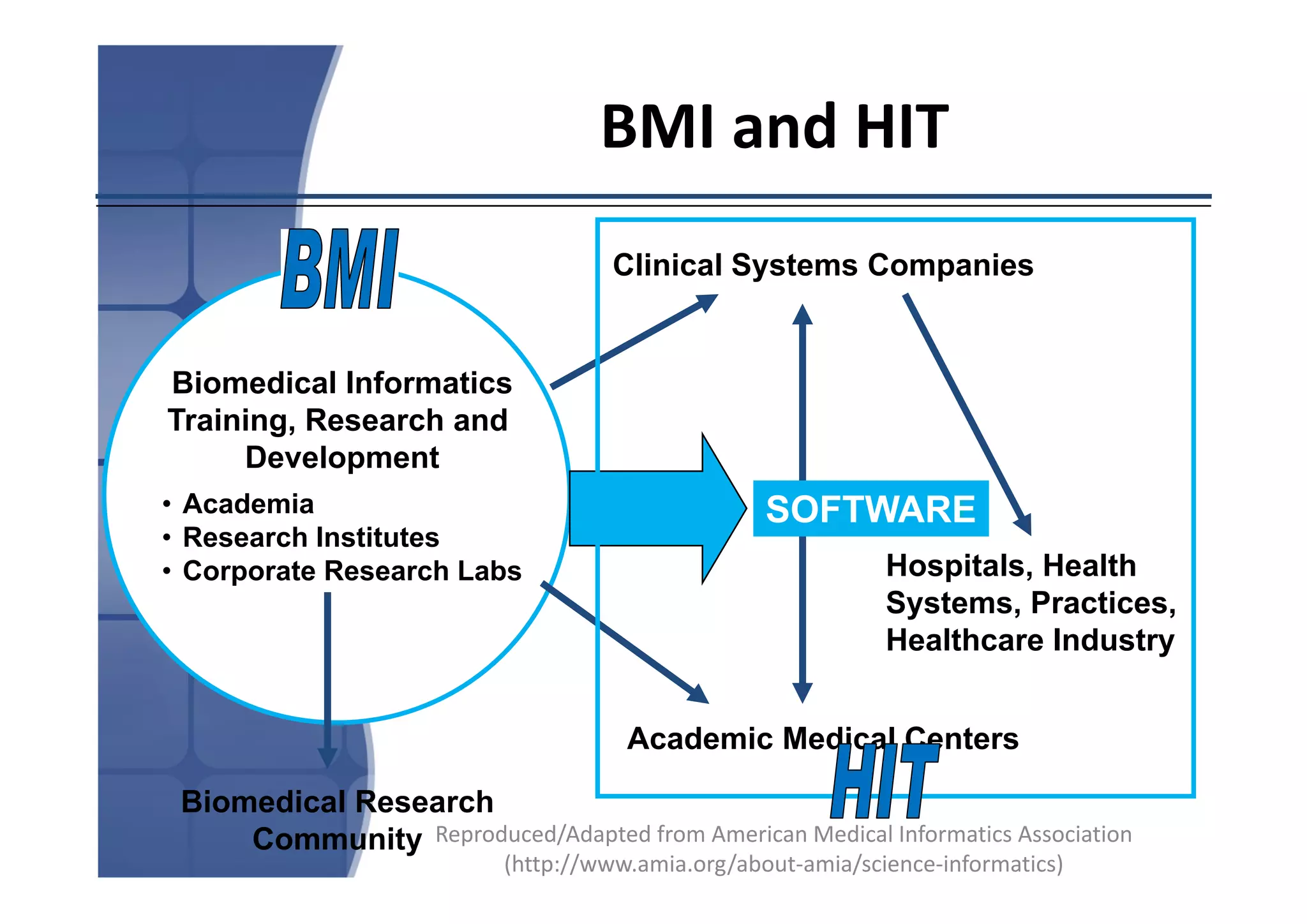
BMI and HIT
Biomedical Informatics
Training, Research and
Development
• Academia
• Research Institutes
• Corporate Research Labs
Clinical Systems Companies
Hospitals, Health
Systems, Practices,
Healthcare Industry
Academic Medical Centers
Biomedical Research
Community
PEOPLE
Reproduced/Adapted from American Medical Informatics Association
(http://www.amia.org/about‐amia/science‐informatics)
44.
BMI and HIT
Biomedical Informatics
Training, Research and
Development
• Academia
• Research Institutes
• Corporate Research Labs
Clinical Systems Companies
Hospitals, Health
Systems, Practices,
Healthcare Industry
Academic Medical Centers
Biomedical Research
Community
IDEAS
Reproduced/Adapted from American Medical Informatics Association
(http://www.amia.org/about‐amia/science‐informatics)
45.
BMI and HIT
Biomedical Informatics
Training, Research and
Development
• Academia
• Research Institutes
• Corporate Research Labs
Clinical Systems Companies
SOFTWARE
Hospitals, Health
Systems, Practices,
Healthcare Industry
Academic Medical Centers
Biomedical Research
Community Reproduced/Adapted from American Medical Informatics Association
(http://www.amia.org/about‐amia/science‐informatics)
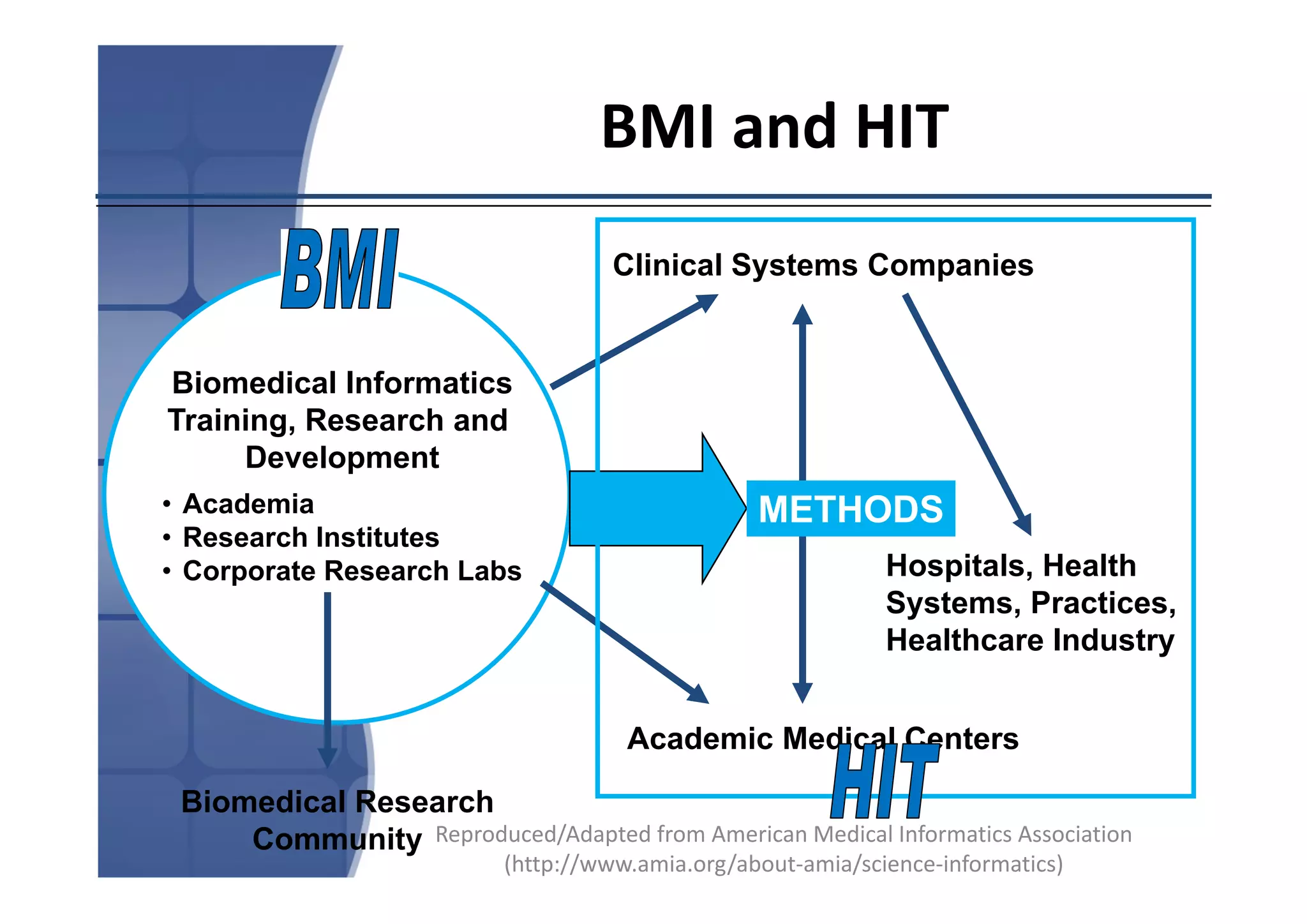
46.
BMI and HIT
Biomedical Informatics
Training, Research and
Development
• Academia
• Research Institutes
• Corporate Research Labs
Clinical Systems Companies
METHODS
Hospitals, Health
Systems, Practices,
Healthcare Industry
Academic Medical Centers
Biomedical Research
Community Reproduced/Adapted from American Medical Informatics Association
(http://www.amia.org/about‐amia/science‐informatics)
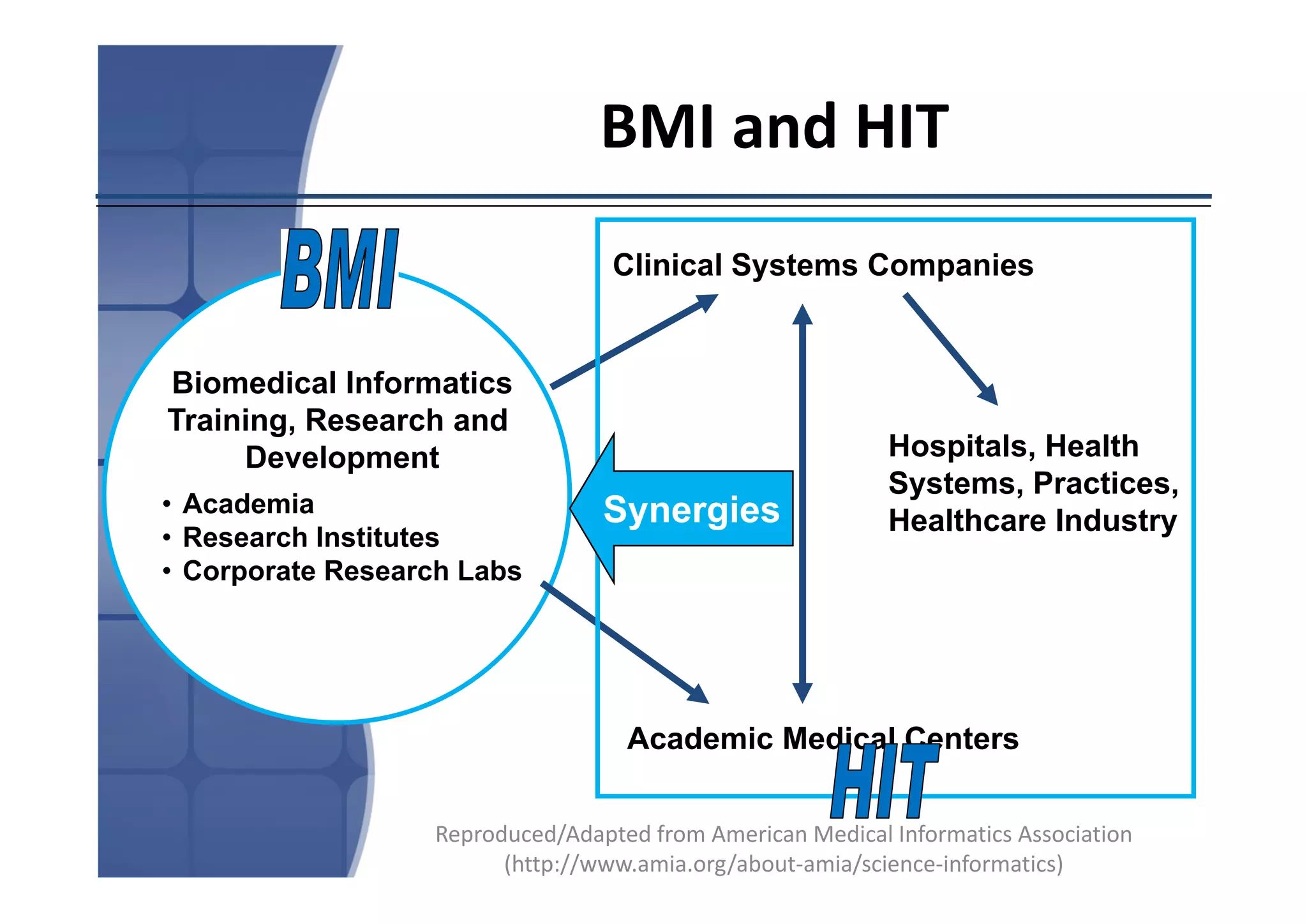
47.
Biomedical Informatics
Training,Research and
Development
• Academia
• Research Institutes
• Corporate Research Labs
BMI and HIT
Clinical Systems Companies
Hospitals, Health
Systems, Practices,
Synergies Healthcare Industry
Academic Medical Centers
Reproduced/Adapted from American Medical Informatics Association
(http://www.amia.org/about‐amia/science‐informatics)
48.
BMI and HIT
Reproduced/Adapted from American Medical Informatics Association
(http://www.amia.org/about‐amia/science‐informatics)
49.
AMIA:
The Professional
Home for Biomedical
and Health Informatics
Reproduced/Adapted from American Medical Informatics Association
(http://www.amia.org/about‐amia/science‐informatics)
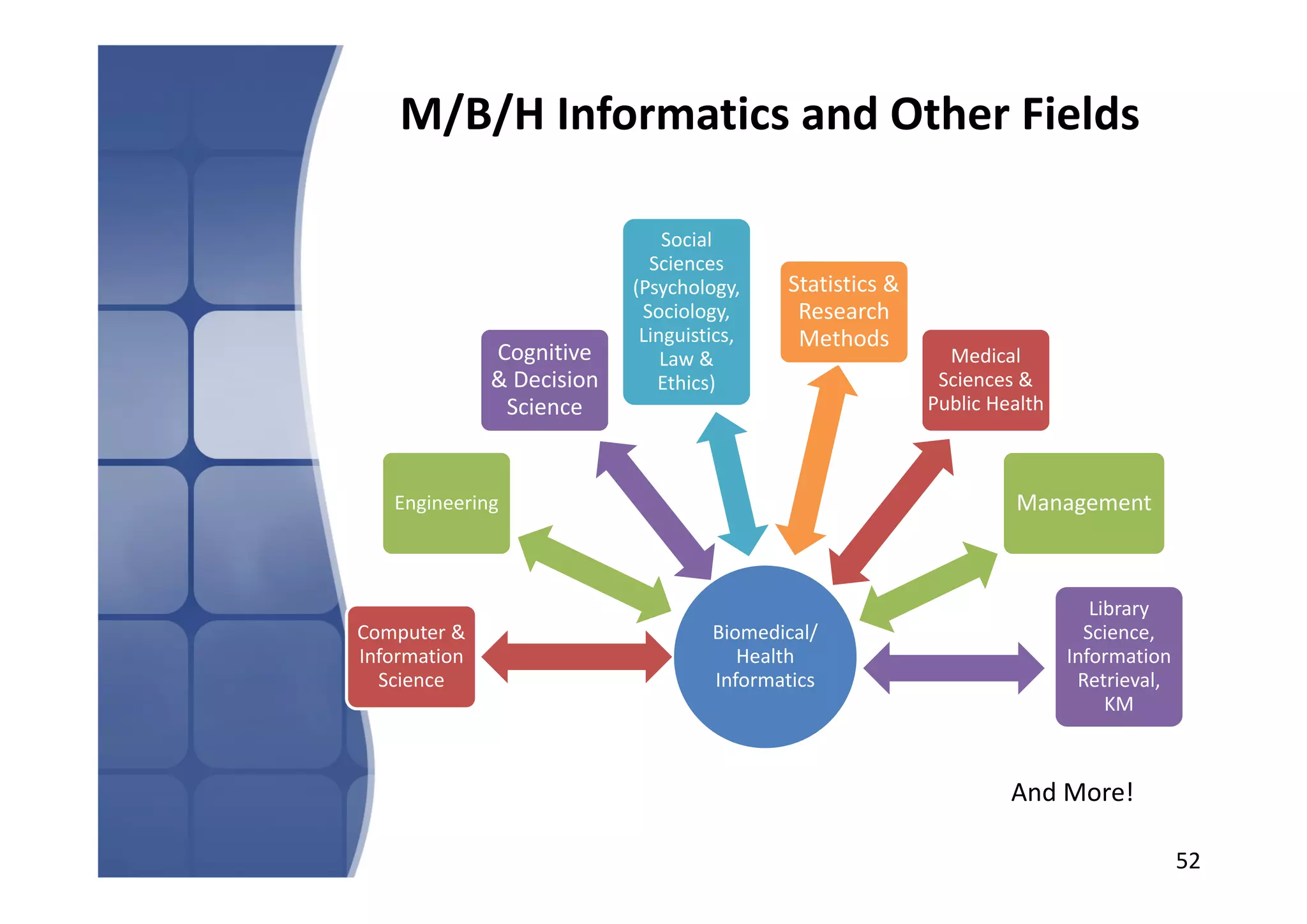
52
M/B/H Informaticsand Other Fields
Biomedical/
Health
Informatics
Engineering
Computer &
Information
Science
Cognitive
& Decision
Science
Social
Sciences
(Psychology,
Sociology,
Linguistics,
Law &
Ethics)
Statistics &
Research
Methods
Medical
Sciences &
Public Health
Management
Library
Science,
Information
Retrieval,
KM
And More!
53.
53
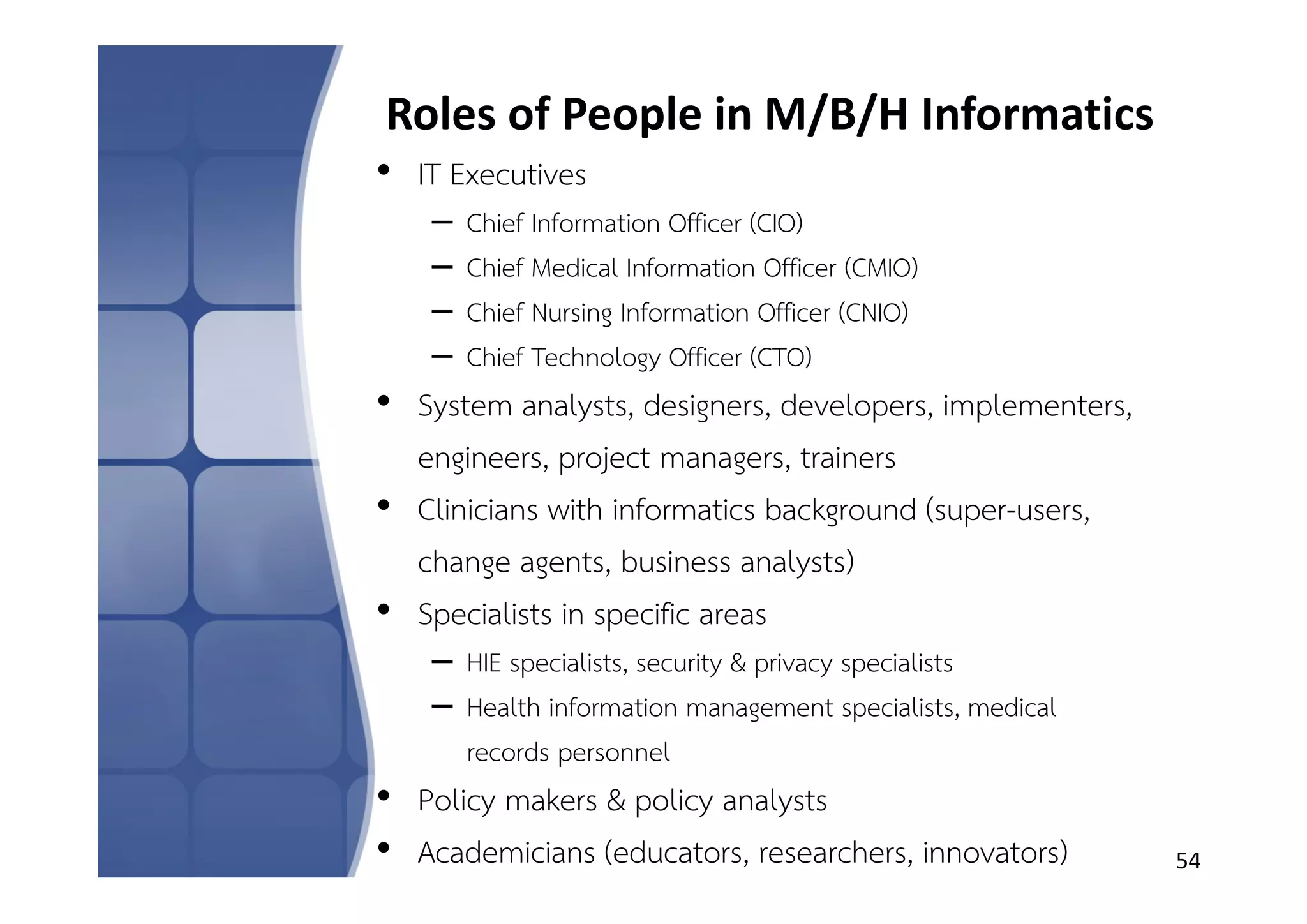
Areas ofPopular Interests (Selected)
• Health IT applications & implementation
– Electronic Health Records (EHRs)
– Computerized Physician Order Entry (CPOE)
– Clinical Decision Support Systems (CDSSs)
– Picture Archiving and Communication Systems (PACS)
– Other hospital IT (nursing, pharmacy, lab, etc.)
– Personal Health Records (PHRs)
– Telemedicine & Telehealth
• eHealth, mHealth, Health Information Exchange (HIE)
• Health IT adoption and use, public policy
• People & organizational (POI), ethical-legal-social (ELSI)
• Consumer health
• Knowledge representation & discovery, NLP
• Standards & Interoperability
• Workforce building & education
54.
54
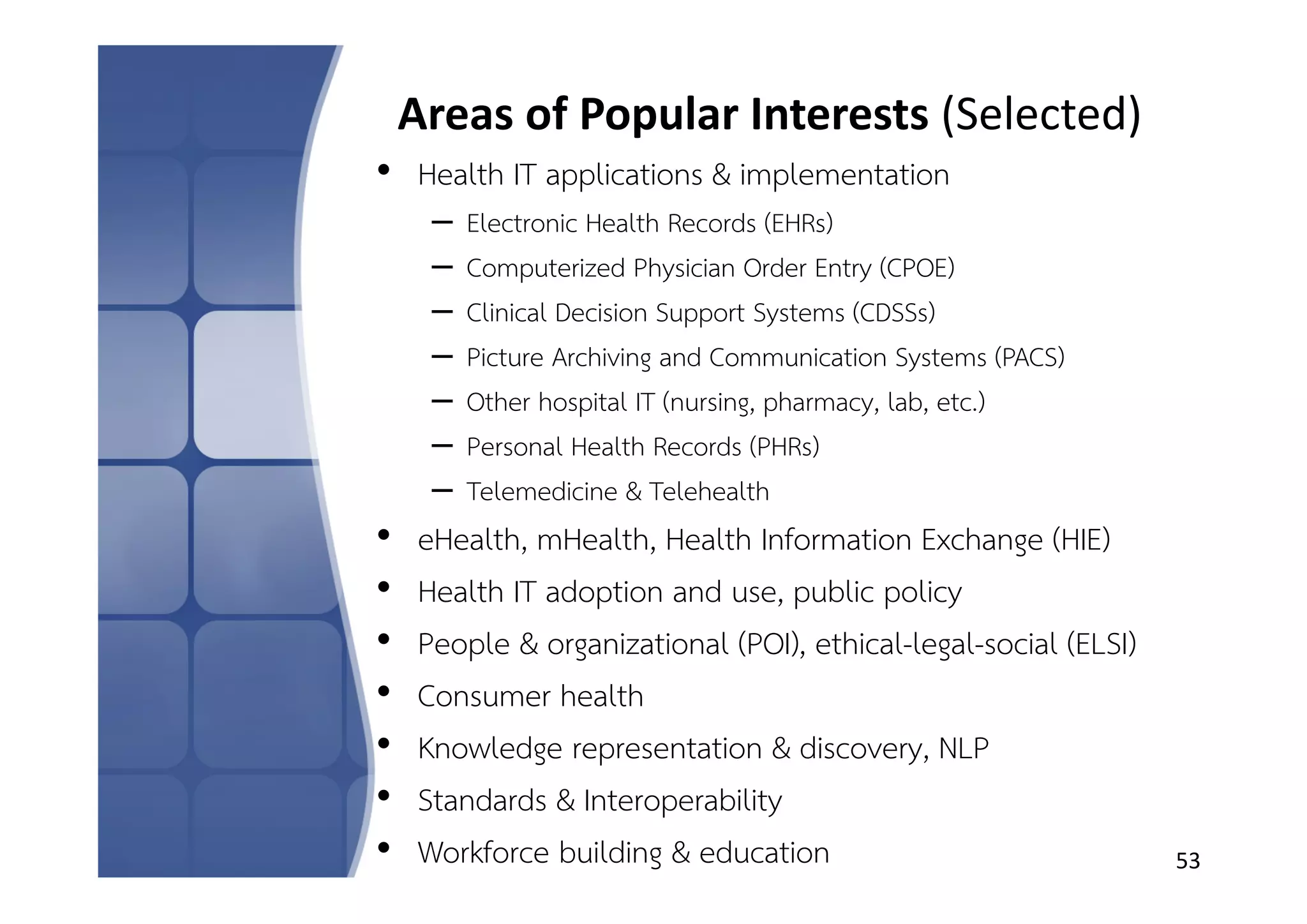
Roles ofPeople in M/B/H Informatics
• IT Executives
– Chief Information Officer (CIO)
– Chief Medical Information Officer (CMIO)
– Chief Nursing Information Officer (CNIO)
– Chief Technology Officer (CTO)
• System analysts, designers, developers, implementers,
engineers, project managers, trainers
• Clinicians with informatics background (super-users,
change agents, business analysts)
• Specialists in specific areas
– HIE specialists, security & privacy specialists
– Health information management specialists, medical
records personnel
• Policy makers & policy analysts
• Academicians (educators, researchers, innovators)
55.
55
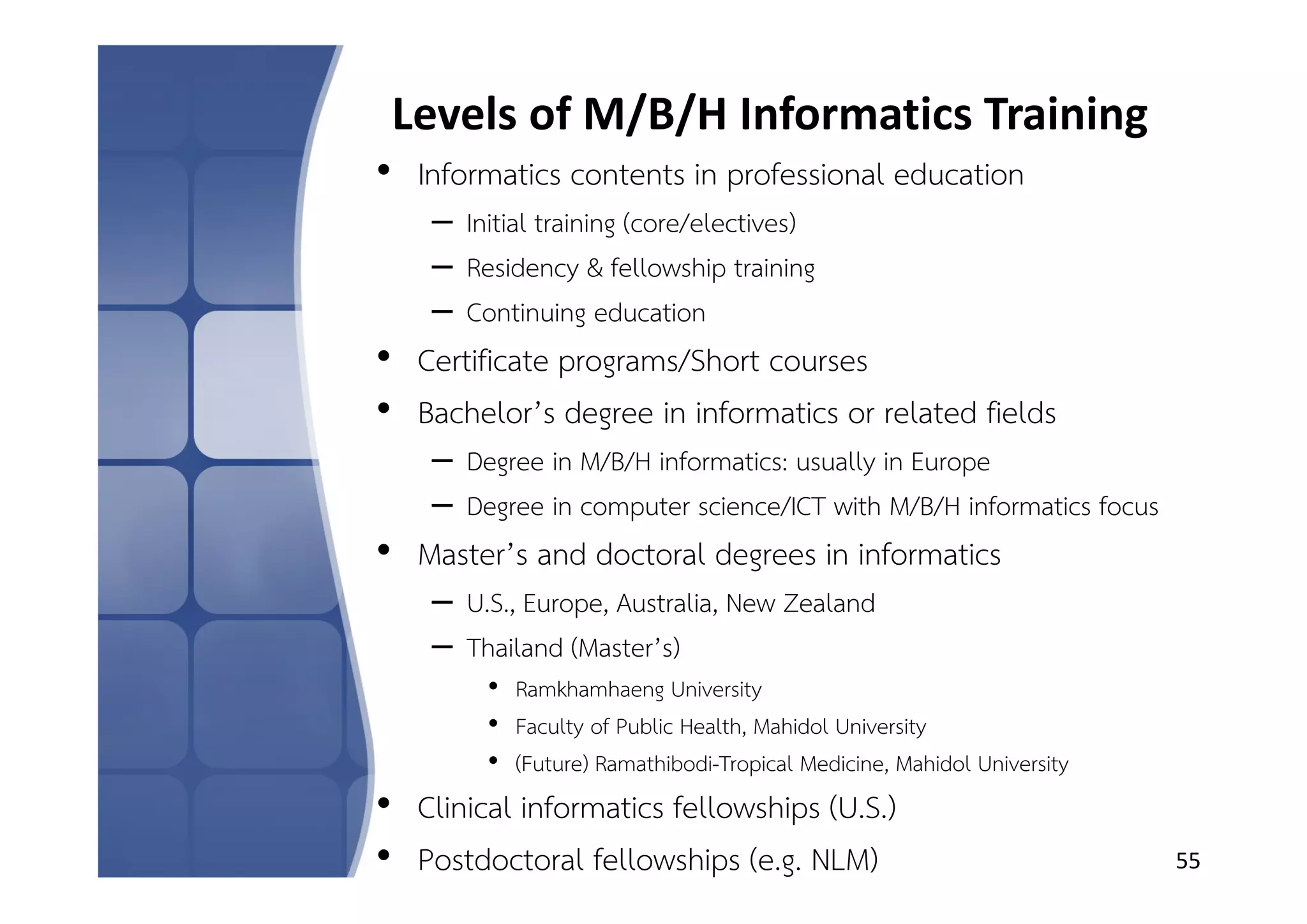
Levels ofM/B/H Informatics Training
• Informatics contents in professional education
– Initial training (core/electives)
– Residency & fellowship training
– Continuing education
• Certificate programs/Short courses
• Bachelor’s degree in informatics or related fields
– Degree in M/B/H informatics: usually in Europe
– Degree in computer science/ICT with M/B/H informatics focus
• Master’s and doctoral degrees in informatics
– U.S., Europe, Australia, New Zealand
– Thailand (Master’s)
• Ramkhamhaeng University
• Faculty of Public Health, Mahidol University
• (Future) Ramathibodi-Tropical Medicine, Mahidol University
• Clinical informatics fellowships (U.S.)
• Postdoctoral fellowships (e.g. NLM)
56.
56
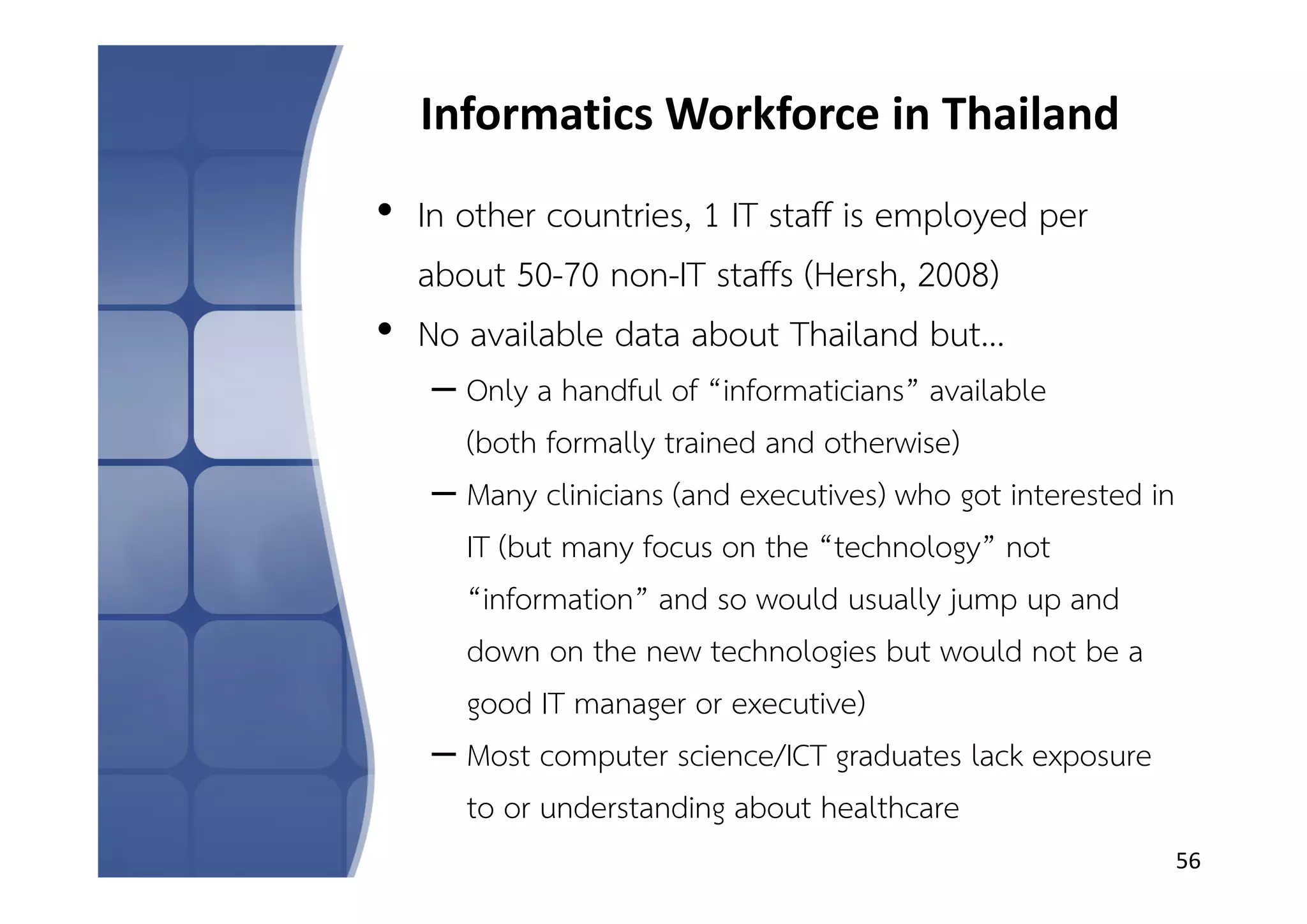
Informatics Workforcein Thailand
• In other countries, 1 IT staff is employed per
about 50-70 non-IT staffs (Hersh, 2008)
• No available data about Thailand but...
– Only a handful of “informaticians” available
(both formally trained and otherwise)
– Many clinicians (and executives) who got interested in
IT (but many focus on the “technology” not
“information” and so would usually jump up and
down on the new technologies but would not be a
good IT manager or executive)
– Most computer science/ICT graduates lack exposure
to or understanding about healthcare
57.
57
Professional Societiesin M/B/H Informatics
• International Medical Informatics Association (IMIA)
– MEDINFO
• American Medical Informatics Association (AMIA)
– AMIA Annual Symposium
• Healthcare Information and Management Systems Society
(HIMSS)
– HIMSS Annual Conference & Exhibition
– HIMSS Asia Pac
• American Health Information Management Association
(AHIMA)
• Thai Medical Informatics Association (TMI)
– TMI Annual Conference
58.
58
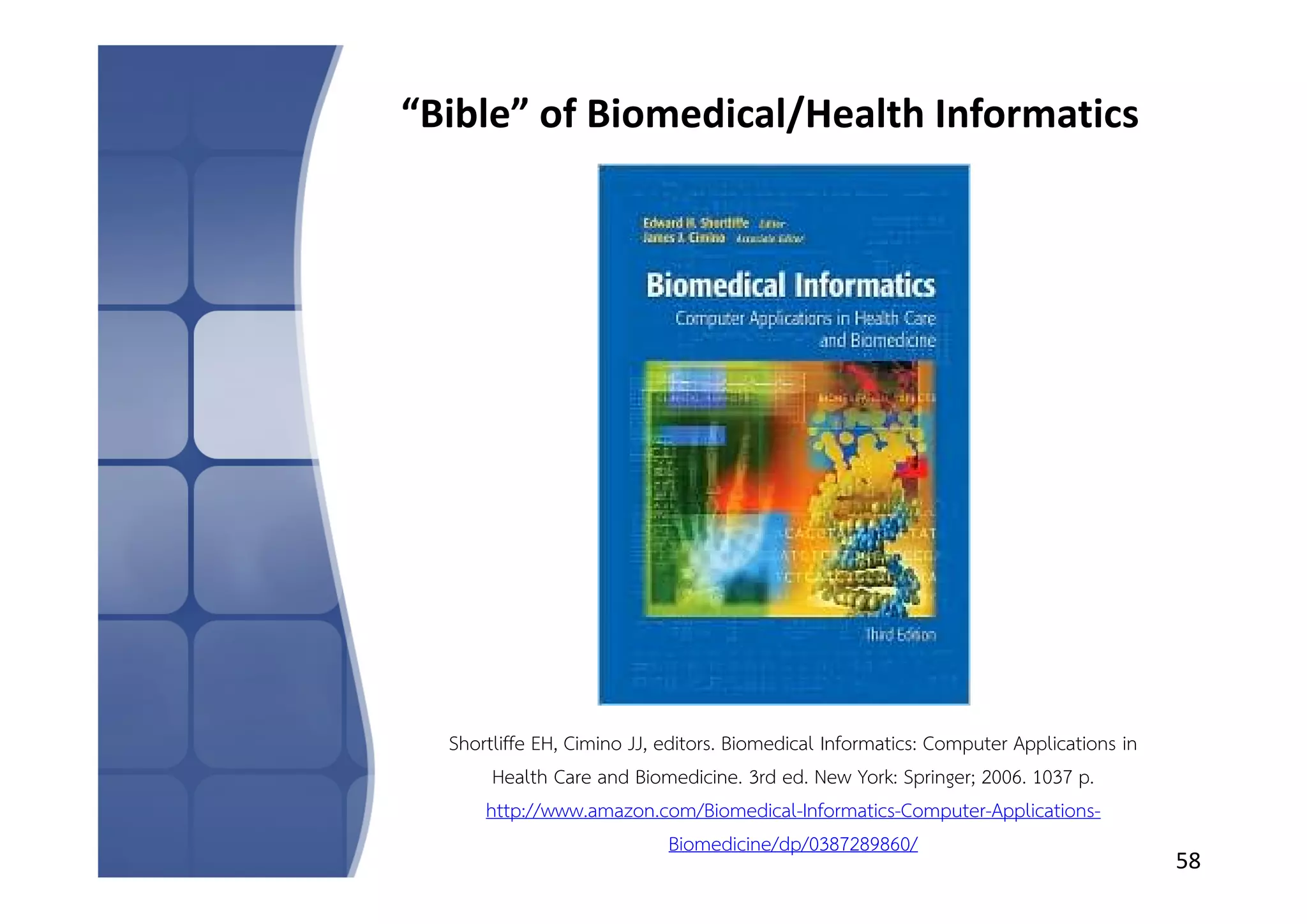
“Bible” ofBiomedical/Health Informatics
Shortliffe EH, Cimino JJ, editors. Biomedical Informatics: Computer Applications in
Health Care and Biomedicine. 3rd ed. New York: Springer; 2006. 1037 p.
http://www.amazon.com/Biomedical-Informatics-Computer-Applications-
Biomedicine/dp/0387289860/
59.
59
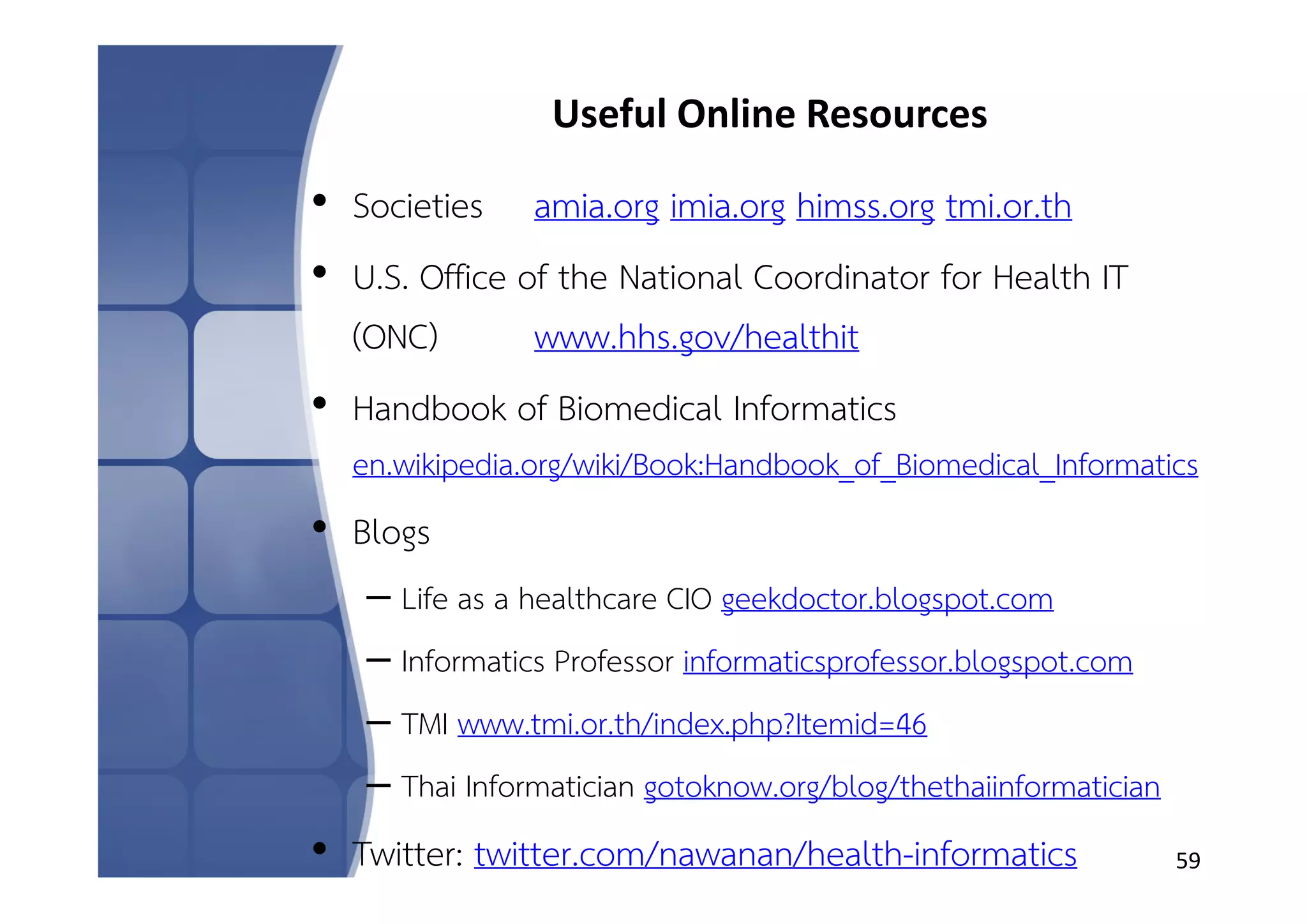
Useful OnlineResources
• Societies amia.org imia.org himss.org tmi.or.th
• U.S. Office of the National Coordinator for Health IT
(ONC) www.hhs.gov/healthit
• Handbook of Biomedical Informatics
en.wikipedia.org/wiki/Book:Handbook_of_Biomedical_Informatics
• Blogs
– Life as a healthcare CIO geekdoctor.blogspot.com
– Informatics Professor informaticsprofessor.blogspot.com
– TMI www.tmi.or.th/index.php?Itemid=46
– Thai Informatician gotoknow.org/blog/thethaiinformatician
• Twitter: twitter.com/nawanan/health-informatics
60.
60
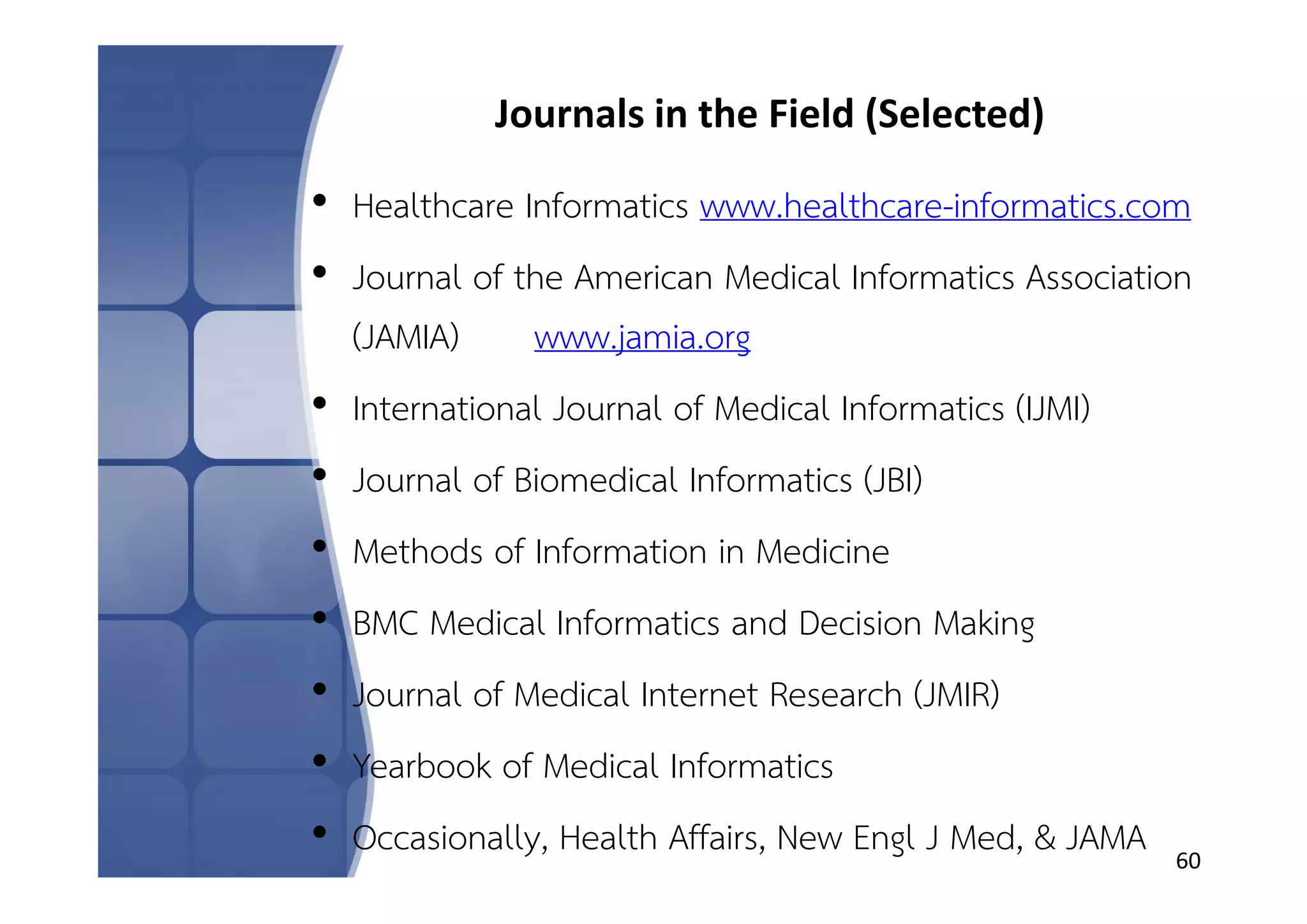
Journals inthe Field (Selected)
• Healthcare Informatics www.healthcare-informatics.com
• Journal of the American Medical Informatics Association
(JAMIA) www.jamia.org
• International Journal of Medical Informatics (IJMI)
• Journal of Biomedical Informatics (JBI)
• Methods of Information in Medicine
• BMC Medical Informatics and Decision Making
• Journal of Medical Internet Research (JMIR)
• Yearbook of Medical Informatics
• Occasionally, Health Affairs, New Engl J Med, & JAMA
62
References
•Bernstam EV, Smith JW, Johnson TR. What is biomedical
informatics? J Biomed Inform. 2010 Feb;43(1):104-10.
• Greenes RA, Shortliffe EH. Medical informatics. An emerging
academic discipline and institutional priority. JAMA. 1990 Feb
23;263(8):1114-1120.
• Hersh W. A stimulus to define informatics and health information
technology. BMC Med Inform Decis Mak. 2009;9:24.
• Hersh W. Health and biomedical informatics: opportunities and
challenges for a twenty-first century profession and its education.
Yearb Med Inform. 2008:157-164.