Best Medical Practice: Customizing The
International Standards II
The 33 Annual Congress of Faculty of Medicine, Tanta University
Public Health & information technology
Dr/ Shimaa M. Saied
M.D
Public health department, Tanta
Faculty Of Medicine
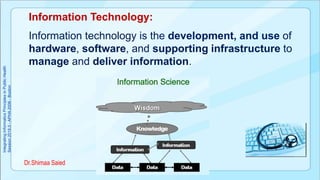
Information Technology:
Information technology is the development, and use of
hardware, software, and supporting infrastructure to
manage and deliver information.
IntegratingInformaticsPrinciplesinPublicHealth
Session2018.0-APHA2006-Boston
Dr.Shimaa Saied
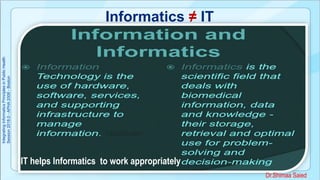
Informatics ≠ IT
IT helps Informatics to work appropriately
IntegratingInformaticsPrinciplesinPublicHealth
Session2018.0-APHA2006-Boston
Dr.Shimaa Saied
Health Informatics
It deals with the resources, devices and methods required
to optimize the acquisition, storage, retrieval and use of
information in health.
Dr.Shimaa Saied
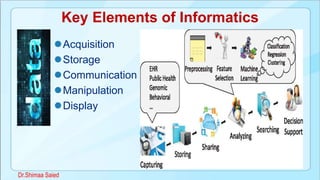
Key Elements of Informatics
Acquisition
Storage
Communication
Manipulation
Display
Dr.Shimaa Saied
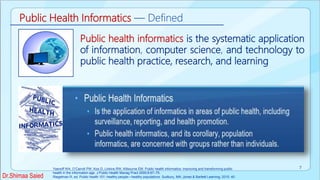
Public health informatics is the systematic application
of information, computer science, and technology to
public health practice, research, and learning
Public Health Informatics — Defined
Yasnoff WA, O’Carroll PW, Koo D, Linkins RW, Kilbourne EM. Public health informatics: improving and transforming public
health in the information age. J Public Health Manag Pract 2000;6:67–75.
Riegelman R, ed. Public health 101: healthy people—healthy populations. Sudbury, MA: Jones & Bartlett Learning; 2010: 40.
7
Dr.Shimaa Saied
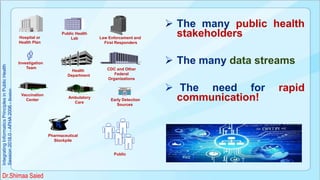
Health
Department
Public Health
Lab
CDC and Other
Federal
Organizations
Public
Vaccination
Center
Ambulatory
Care
Hospital or
Health Plan
Investigation
Team
Law Enforcement and
First Responders
RX
Pharmaceutical
Stockpile
Early Detection
Sources
 The many public health
stakeholders
 The many data streams
 The need for rapid
communication!
IntegratingInformaticsPrinciplesinPublicHealth
Session2018.0-APHA2006-Boston
Dr.Shimaa Saied
Health informatics tools
Health informatics tools include not only computers but
also clinical guidelines, formal medical terminologies,
and information and communication systems.
Dr.Shimaa Saied
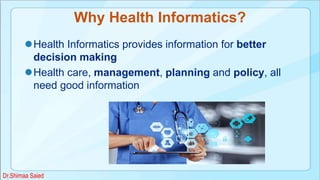
Why Health Informatics?
Health Informatics provides information for better
decision making
Health care, management, planning and policy, all
need good information
Dr.Shimaa Saied
Why Health Informatics?
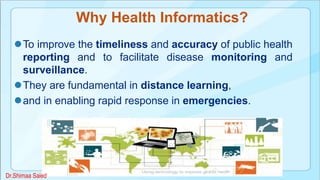
To improve the timeliness and accuracy of public health
reporting and to facilitate disease monitoring and
surveillance.
They are fundamental in distance learning,
and in enabling rapid response in emergencies.
Dr.Shimaa Saied
Dr.Shimaa Saied
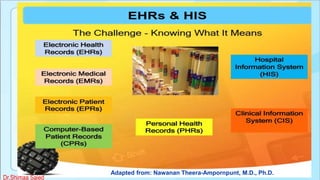
Adapted from: Nawanan Theera-Ampornpunt, M.D., Ph.D.
Dr.Shimaa Saied
Dr.Shimaa Saied
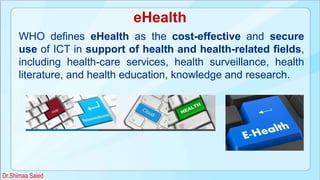
eHealth
WHO defines eHealth as the cost-effective and secure
use of ICT in support of health and health-related fields,
including health-care services, health surveillance, health
literature, and health education, knowledge and research.
Dr.Shimaa Saied
eHealth
eHealth is “the use - in the health sector - of digital data:
transmitted, stored and retrieved electronically for clinical,
educational and administrative purposes, both at the local
site and at a distance”.
Dr.Shimaa Saied
eHealth
Described as a means to ensure that “the right health
information is provided to the right person at the right
place and time in a secure, electronic form to optimise
the quality and efficiency of health care delivery, research,
education and knowledge”.
National E-Health and Information Principal Committee. National E-Health Strategy, 30th
September 2008. Adelaide, Deloitte Touche Tohmatsu, 2008.
Dr.Shimaa Saied
Global Observatory for eHealth:
 Established in early 2005, the GOe is a significant new WHO
initiative; it reflects the Organization’s recognition of the emerging
importance of the use of ICT for health systems and services.
 The Observatory’s mission is to improve health by providing
Member States with strategic information and guidance on effective
practices, policies and standards in eHealth.
 The GOe operates within the eHealth unit of the Department of
Knowledge Management and Sharing (KMS) at WHO in Geneva.
Dr.Shimaa Saied
Global Observatory for eHealth:
 Its objectives are to:
 Provide timely and high-quality evidence and information to
help national governments and international bodies,
 Improve policy, practice and management of eHealth services;
 Raise awareness and commitment of governments and the
private sector to invest in, and advance, eHealth;
Dr.Shimaa Saied
Global Observatory for eHealth:
Objectives (Cont.)
 Collect, analyse and distil eHealth-related knowledge, which will
significantly contribute to the improvement of health using ICT; and
 Disseminate research findings through publication of the GOe
annual report on key eHealth research topics as a reference for
governments and policy-makers as well as theme-based reports on
special topics.
Dr.Shimaa Saied
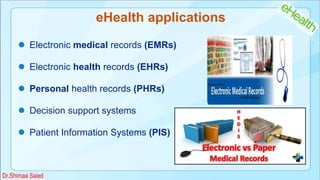
eHealth applications
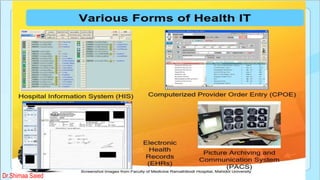
 Electronic medical records (EMRs)
 Electronic health records (EHRs)
 Personal health records (PHRs)
 Decision support systems
 Patient Information Systems (PIS)
Dr.Shimaa Saied
eHealth applications (cont.):
 Chronic disease management services
 Practice, patient and clinical management systems
 Electronic medication services
 Health knowledge resources
 Distance learning for health professionals
(eLearning)
Dr.Shimaa Saied
eHealth applications (cont.):
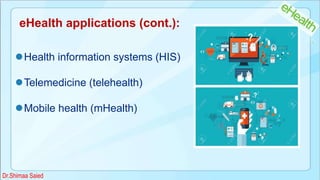
Health information systems (HIS)
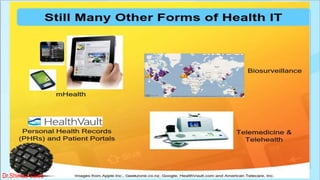
Telemedicine (telehealth)
Mobile health (mHealth)
Dr.Shimaa Saied
Telemedicine (telehealth)
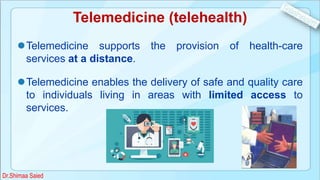
Telemedicine supports the provision of health-care
services at a distance.
Telemedicine enables the delivery of safe and quality care
to individuals living in areas with limited access to
services.
Dr.Shimaa Saied
Telemedicine (telehealth)
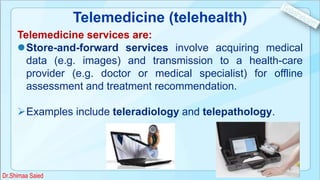
Telemedicine services are:
Store-and-forward services involve acquiring medical
data (e.g. images) and transmission to a health-care
provider (e.g. doctor or medical specialist) for offline
assessment and treatment recommendation.
Examples include teleradiology and telepathology.
Dr.Shimaa Saied
Telemedicine (telehealth) services (cont.):
Remote monitoring services enable health-care
providers to monitor an individual’s condition, using
technologies such as implanted devices and sensors
with wireless or wired connections.
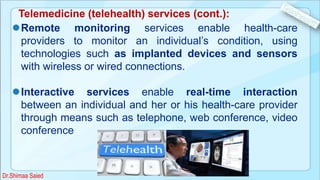
Interactive services enable real-time interaction
between an individual and her or his health-care provider
through means such as telephone, web conference, video
conference
Dr.Shimaa Saied
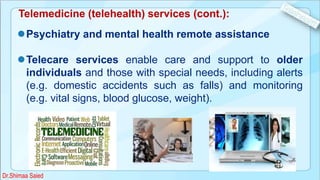
Psychiatry and mental health remote assistance
Telecare services enable care and support to older
individuals and those with special needs, including alerts
(e.g. domestic accidents such as falls) and monitoring
(e.g. vital signs, blood glucose, weight).
Telemedicine (telehealth) services (cont.):
Dr.Shimaa Saied
mHealth
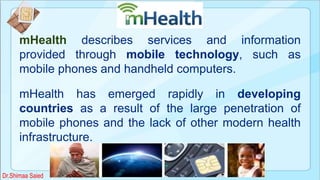
mHealth describes services and information
provided through mobile technology, such as
mobile phones and handheld computers.
mHealth has emerged rapidly in developing
countries as a result of the large penetration of
mobile phones and the lack of other modern health
infrastructure.
Dr.Shimaa Saied
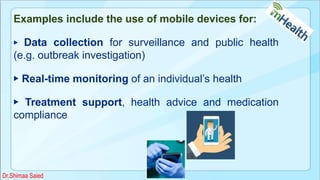
Examples include the use of mobile devices for:
▶ Data collection for surveillance and public health
(e.g. outbreak investigation)
▶ Real-time monitoring of an individual’s health
▶ Treatment support, health advice and medication
compliance
Dr.Shimaa Saied
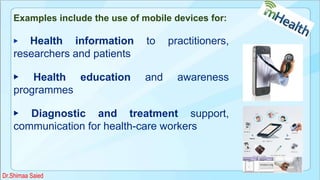
Examples include the use of mobile devices for:
▶ Health information to practitioners,
researchers and patients
▶ Health education and awareness
programmes
▶ Diagnostic and treatment support,
communication for health-care workers
Dr.Shimaa Saied
E-health situation in Egypt
Dr.Shimaa Saied
I. PHC services:
Most of the primary health care units basically use paper
based system. However, they use e-database to keep
death and birth certificate records.
 In Alexandria: 45 out of 75 PHC units implemented e-
health first level (e-records) as backup system.
Dr.Shimaa Saied
II. 2ry & 3ry health care:
 Only 56 out of 88 university hospitals have basic e-health level
e.g Mansoura University Children's Hospital, and on the e-
database side, some trials have been done to achieve a semi -
complete system.
 Regarding the health insurance organization (HIO): only 4 out of
the 39 health insurance hospitals have their own electronic
information system.
Dr.Shimaa Saied
 4 out of 8 oncology centres have websites showing their
services for oncology patients. All the patients’ records from all
oncology centres, are collected periodically and sent to Nasser
institution central database.
 On the other hand, all heart disease institutions have non
interactive e-health information system.
 The most recognized establishment of excellence in this field
in Egypt is the Children Cancer hospital 57357 which uses full e-
health system since 2009.
Dr.Shimaa Saied
III. E-health in Private health Care Sector
 Most of the investment hospitals and clinics implement e-health
first level to keep all patients’ information. The first use of it is in the
billing system.
Source: Ahmed MF, Salama MA, Ahmed SE. E-Health in Egypt: A Brief Review. In Proceedings of the 5th
International Conference on Digital Health 2015 2015 May 18 (pp. 41-42). ACM.
Dr.Shimaa Saied
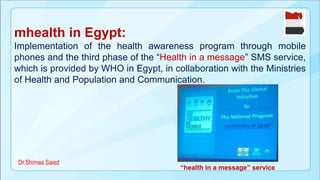
mhealth in Egypt:
Implementation of the health awareness program through mobile
phones and the third phase of the “Health in a message” SMS service,
which is provided by WHO in Egypt, in collaboration with the Ministries
of Health and Population and Communication.
“health in a message” service
Dr.Shimaa Saied
Telemedicine and eHealth applications in Egypt are still not
optimally prevailing due to many common reasons, such
as:
Resistance to change (which faces many of health
informatics applications);
Unclear business model for telemedicine i.e., which
services could be provided, who will pay and how much will
be paid;
E-health situation in Egypt:
Dr.Shimaa Saied
Unavailability of an efficient infrastructure for telemedicine
(high bandwidth and the special equipment) esp. in the rural
areas; and
Unavailability of regulatory bodies for: accrediting
telemedicine eHealth systems and healthcare organization,
issuing best practices and guidelines, certifying the medical
staff, etc.
Telemedicine in Egypt: SWOT analysis and future trends. GMS Medizinische Informatik, Biometrie und
Epidemiologie 2012, Vol. 8(1), ISSN 1860-9171
Dr.Shimaa Saied
CONCLUSION:
Although the health care system in Egypt is expanding
horizontally by having more hospitals, that expansion
should be done vertically as well, by providing the best
service to build more effective system, this could be
achieved by shifting to complete e-health care system.
Dr.Shimaa Saied
Recommendation:
The main recommendation is to encourage and enforce
a national eHealth initiative as any development at this
stage will be more effective in terms of saving money for
the patients, better gain for the stakeholders, and high
quality of public health care delivery service.
Also introduction of Health informatics education into
medical curricula s of a vital importance.
Dr.Shimaasaied@gmail.com

Public Health & information technology

  • 1.
    Best Medical Practice:Customizing The International Standards II The 33 Annual Congress of Faculty of Medicine, Tanta University
  • 2.
    Public Health &information technology Dr/ Shimaa M. Saied M.D Public health department, Tanta Faculty Of Medicine
  • 3.
    Information Technology: Information technologyis the development, and use of hardware, software, and supporting infrastructure to manage and deliver information. IntegratingInformaticsPrinciplesinPublicHealth Session2018.0-APHA2006-Boston Dr.Shimaa Saied
  • 4.
    Informatics ≠ IT IThelps Informatics to work appropriately IntegratingInformaticsPrinciplesinPublicHealth Session2018.0-APHA2006-Boston Dr.Shimaa Saied
  • 5.
    Health Informatics It dealswith the resources, devices and methods required to optimize the acquisition, storage, retrieval and use of information in health. Dr.Shimaa Saied
  • 6.
    Key Elements ofInformatics Acquisition Storage Communication Manipulation Display Dr.Shimaa Saied
  • 7.
    Public health informaticsis the systematic application of information, computer science, and technology to public health practice, research, and learning Public Health Informatics — Defined Yasnoff WA, O’Carroll PW, Koo D, Linkins RW, Kilbourne EM. Public health informatics: improving and transforming public health in the information age. J Public Health Manag Pract 2000;6:67–75. Riegelman R, ed. Public health 101: healthy people—healthy populations. Sudbury, MA: Jones & Bartlett Learning; 2010: 40. 7 Dr.Shimaa Saied
  • 8.
    Health Department Public Health Lab CDC andOther Federal Organizations Public Vaccination Center Ambulatory Care Hospital or Health Plan Investigation Team Law Enforcement and First Responders RX Pharmaceutical Stockpile Early Detection Sources  The many public health stakeholders  The many data streams  The need for rapid communication! IntegratingInformaticsPrinciplesinPublicHealth Session2018.0-APHA2006-Boston Dr.Shimaa Saied
  • 9.
    Health informatics tools Healthinformatics tools include not only computers but also clinical guidelines, formal medical terminologies, and information and communication systems. Dr.Shimaa Saied
  • 10.
    Why Health Informatics? HealthInformatics provides information for better decision making Health care, management, planning and policy, all need good information Dr.Shimaa Saied
  • 11.
    Why Health Informatics? Toimprove the timeliness and accuracy of public health reporting and to facilitate disease monitoring and surveillance. They are fundamental in distance learning, and in enabling rapid response in emergencies. Dr.Shimaa Saied
  • 12.
  • 13.
    Adapted from: NawananTheera-Ampornpunt, M.D., Ph.D. Dr.Shimaa Saied
  • 14.
  • 15.
    eHealth WHO defines eHealthas the cost-effective and secure use of ICT in support of health and health-related fields, including health-care services, health surveillance, health literature, and health education, knowledge and research. Dr.Shimaa Saied
  • 16.
    eHealth eHealth is “theuse - in the health sector - of digital data: transmitted, stored and retrieved electronically for clinical, educational and administrative purposes, both at the local site and at a distance”. Dr.Shimaa Saied
  • 17.
    eHealth Described as ameans to ensure that “the right health information is provided to the right person at the right place and time in a secure, electronic form to optimise the quality and efficiency of health care delivery, research, education and knowledge”. National E-Health and Information Principal Committee. National E-Health Strategy, 30th September 2008. Adelaide, Deloitte Touche Tohmatsu, 2008. Dr.Shimaa Saied
  • 18.
    Global Observatory foreHealth:  Established in early 2005, the GOe is a significant new WHO initiative; it reflects the Organization’s recognition of the emerging importance of the use of ICT for health systems and services.  The Observatory’s mission is to improve health by providing Member States with strategic information and guidance on effective practices, policies and standards in eHealth.  The GOe operates within the eHealth unit of the Department of Knowledge Management and Sharing (KMS) at WHO in Geneva. Dr.Shimaa Saied
  • 19.
    Global Observatory foreHealth:  Its objectives are to:  Provide timely and high-quality evidence and information to help national governments and international bodies,  Improve policy, practice and management of eHealth services;  Raise awareness and commitment of governments and the private sector to invest in, and advance, eHealth; Dr.Shimaa Saied
  • 20.
    Global Observatory foreHealth: Objectives (Cont.)  Collect, analyse and distil eHealth-related knowledge, which will significantly contribute to the improvement of health using ICT; and  Disseminate research findings through publication of the GOe annual report on key eHealth research topics as a reference for governments and policy-makers as well as theme-based reports on special topics. Dr.Shimaa Saied
  • 21.
    eHealth applications  Electronicmedical records (EMRs)  Electronic health records (EHRs)  Personal health records (PHRs)  Decision support systems  Patient Information Systems (PIS) Dr.Shimaa Saied
  • 22.
    eHealth applications (cont.): Chronic disease management services  Practice, patient and clinical management systems  Electronic medication services  Health knowledge resources  Distance learning for health professionals (eLearning) Dr.Shimaa Saied
  • 23.
    eHealth applications (cont.): Healthinformation systems (HIS) Telemedicine (telehealth) Mobile health (mHealth) Dr.Shimaa Saied
  • 24.
    Telemedicine (telehealth) Telemedicine supportsthe provision of health-care services at a distance. Telemedicine enables the delivery of safe and quality care to individuals living in areas with limited access to services. Dr.Shimaa Saied
  • 25.
    Telemedicine (telehealth) Telemedicine servicesare: Store-and-forward services involve acquiring medical data (e.g. images) and transmission to a health-care provider (e.g. doctor or medical specialist) for offline assessment and treatment recommendation. Examples include teleradiology and telepathology. Dr.Shimaa Saied
  • 26.
    Telemedicine (telehealth) services(cont.): Remote monitoring services enable health-care providers to monitor an individual’s condition, using technologies such as implanted devices and sensors with wireless or wired connections. Interactive services enable real-time interaction between an individual and her or his health-care provider through means such as telephone, web conference, video conference Dr.Shimaa Saied
  • 27.
    Psychiatry and mentalhealth remote assistance Telecare services enable care and support to older individuals and those with special needs, including alerts (e.g. domestic accidents such as falls) and monitoring (e.g. vital signs, blood glucose, weight). Telemedicine (telehealth) services (cont.): Dr.Shimaa Saied
  • 28.
    mHealth mHealth describes servicesand information provided through mobile technology, such as mobile phones and handheld computers. mHealth has emerged rapidly in developing countries as a result of the large penetration of mobile phones and the lack of other modern health infrastructure. Dr.Shimaa Saied
  • 29.
    Examples include theuse of mobile devices for: ▶ Data collection for surveillance and public health (e.g. outbreak investigation) ▶ Real-time monitoring of an individual’s health ▶ Treatment support, health advice and medication compliance Dr.Shimaa Saied
  • 30.
    Examples include theuse of mobile devices for: ▶ Health information to practitioners, researchers and patients ▶ Health education and awareness programmes ▶ Diagnostic and treatment support, communication for health-care workers Dr.Shimaa Saied
  • 31.
    E-health situation inEgypt Dr.Shimaa Saied
  • 32.
    I. PHC services: Mostof the primary health care units basically use paper based system. However, they use e-database to keep death and birth certificate records.  In Alexandria: 45 out of 75 PHC units implemented e- health first level (e-records) as backup system. Dr.Shimaa Saied
  • 33.
    II. 2ry &3ry health care:  Only 56 out of 88 university hospitals have basic e-health level e.g Mansoura University Children's Hospital, and on the e- database side, some trials have been done to achieve a semi - complete system.  Regarding the health insurance organization (HIO): only 4 out of the 39 health insurance hospitals have their own electronic information system. Dr.Shimaa Saied
  • 34.
     4 outof 8 oncology centres have websites showing their services for oncology patients. All the patients’ records from all oncology centres, are collected periodically and sent to Nasser institution central database.  On the other hand, all heart disease institutions have non interactive e-health information system.  The most recognized establishment of excellence in this field in Egypt is the Children Cancer hospital 57357 which uses full e- health system since 2009. Dr.Shimaa Saied
  • 35.
    III. E-health inPrivate health Care Sector  Most of the investment hospitals and clinics implement e-health first level to keep all patients’ information. The first use of it is in the billing system. Source: Ahmed MF, Salama MA, Ahmed SE. E-Health in Egypt: A Brief Review. In Proceedings of the 5th International Conference on Digital Health 2015 2015 May 18 (pp. 41-42). ACM. Dr.Shimaa Saied
  • 36.
    mhealth in Egypt: Implementationof the health awareness program through mobile phones and the third phase of the “Health in a message” SMS service, which is provided by WHO in Egypt, in collaboration with the Ministries of Health and Population and Communication. “health in a message” service Dr.Shimaa Saied
  • 37.
    Telemedicine and eHealthapplications in Egypt are still not optimally prevailing due to many common reasons, such as: Resistance to change (which faces many of health informatics applications); Unclear business model for telemedicine i.e., which services could be provided, who will pay and how much will be paid; E-health situation in Egypt: Dr.Shimaa Saied
  • 38.
    Unavailability of anefficient infrastructure for telemedicine (high bandwidth and the special equipment) esp. in the rural areas; and Unavailability of regulatory bodies for: accrediting telemedicine eHealth systems and healthcare organization, issuing best practices and guidelines, certifying the medical staff, etc. Telemedicine in Egypt: SWOT analysis and future trends. GMS Medizinische Informatik, Biometrie und Epidemiologie 2012, Vol. 8(1), ISSN 1860-9171 Dr.Shimaa Saied
  • 39.
    CONCLUSION: Although the healthcare system in Egypt is expanding horizontally by having more hospitals, that expansion should be done vertically as well, by providing the best service to build more effective system, this could be achieved by shifting to complete e-health care system. Dr.Shimaa Saied
  • 40.
    Recommendation: The main recommendationis to encourage and enforce a national eHealth initiative as any development at this stage will be more effective in terms of saving money for the patients, better gain for the stakeholders, and high quality of public health care delivery service. Also introduction of Health informatics education into medical curricula s of a vital importance.
  • 41.