TeAM
YYePG
Digitally signed by TeAM
YYePG
DN: cn=TeAM YYePG,
c=US, o=TeAM YYePG,
ou=TeAM YYePG,
email=yyepg@msn.com
Reason: I attest to the
accuracy and integrity of
this document
Date: 2005.02.07 18:12:50
+08'00'
i
Guide to
Electrical Power
Distribution Systems
Sixth Edition
ii
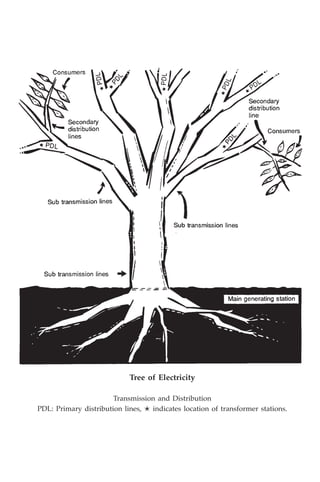
Tree of Electricity
Transmission and Distribution
PDL: Primary distribution lines, ✭ indicates location of transformer stations.
iii
Guide to
Electrical Power
Distribution Systems
Sixth Edition
Anthony J. Pansini, EE, PE
Life Fellow IEEE, Sr. Member ASTM
THE FAIRMONT PRESS, INC.
iv
Library of Congress Cataloging-in-Publication Data
Pansini, Anthony J.
Guide to electrical power distribution systems/Anthony J. Pansini.--6th ed.
p. cm.
Includes index.
ISBN: 0-88173-505-1 (print) — 0-88173-506-X (electronic)
1. Electric power distribution. 2. Electric power transmission. I. Title.
[TK3001.P284 2005]
621.319--dc22
2004056257
Guide to electrical power distribution systems, sixth edition/Anthony J. Pansini
©2005 by The Fairmont Press, Inc. All rights reserved. No part of this publication
may be reproduced or transmitted in any form or by any means, electronic or
mechanical, including photocopy, recording, or any information storage and
retrieval system, without permission in writing from the publisher.
Published by The Fairmont Press, Inc.
700 Indian Trail
Lilburn, GA 30047
tel: 770-925-9388; fax: 770-381-9865
http://www.fairmontpress.com
Distributed by Marcel Dekker/CRC Press
2000 N.W. Corporate Blvd.
Boca Raton, FL 33431
tel: 800-272-7737
http://www.crcpress.com
Printed in the United States of America
10 9 8 7 6 5 4 3 2 1
0-88173-505-1 (The Fairmont Press, Inc.)
0-8493-3666-X (Dekker/CRC Press)
While every effort is made to provide dependable information, the publisher,
authors, and editors cannot be held responsible for any errors or omissions.
v
To my superiors, associates,
colleagues, and subordinates,
from whom—along the way—
I learned much
This page intentionally left blank
vii
Contents
Preface ...................................................................................................ix
Chapter
1. The Transmission and Distribution System .................................... 1
2. Conductor Supports ..............................................................................
3. Insulators and Conductors ...................................................................
4. Line Equipment ......................................................................................
5. Overhead Construction .........................................................................
6. Underground Construction ..................................................................
7. Service Factors ........................................................................................
8. Substations ...............................................................................................
9. Distribution Circuits, Cogeneration and Distributed Generation
10. Essentials of Electricity
Appendix A. Insulation: Porcelain vs. Polymer .........................................
Appendix B. Street Lighting, Constant Current Circuitry.......................
Appendix C. The Grid Coordinate System,
Tying Maps to Computers .....................................................
Appendix D. United States and Metric Relationships ..............................
Index .....................................................................................................................
viii
Figure P-1. Simplified schematic diagram of transition from regulated
to deregulated supply systems.
ix
Preface to the
Sixth Edition
This edition continues the practice of updating its contents to re-
flect changes affecting electric distribution systems. It continues its origi-
nal role of providing information in a non or semi technical manner to
persons working on such systems enabling them to perform their duties
in an enlightened way. This contributes not only to a greater quality of
production, but more importantly, with greater safety to themselves and
the general public, the consumers they serve.
While the effects of deregulation have been more pronounced on
the generation and transmission components of the supply chain, it has
also had an impact on the distribution system with its cogeneration and
distributed generation features.
Improvement in materials and methods continue to contribute to
the economic and environmental betterment enjoyed by consumers.
Predominant among these include the gradual replacement of heavier
porcelain insulators with polymer (plastic) ones, the employment of
insulated bucket vehicles making climbing with the use of spikes a lost
art. Improvements in “solid” type insulation in cables, and more effi-
cient machinery for placing them underground. Thus narrowing the
economic differences between overhead and underground installations.
The distribution system is the most visible part of the supply chain,
and as such the most exposed to the critical observation of its users. It
is, in many cases, the largest investment, maintenance and operation
expense, and the object of interest to government, financial agencies, and
“watch dog” associations of concerned citizens. As such, the desirability
of knowing how and why it is so constituted becomes obvious.
Distribution systems have also been affected by deregulation, al-
though not in the same manner as transmission systems, Figure P-1
(opposite). Where additional transmission or generation was not avail-
able or too great an expense to supply some additional loads, Distrib-
uted Generation made its entry on Distribution Systems. Here, small
generating units usually powered by small gas turbines (although other
x
units such as wind powered, solar, fuel cells, etc. may be involved) are
connected to the system as are cogeneration units, both with possible
hazard to safety.
These notes were begun in the early 1940’s as classroom material,
part of a rapid training program for line personnel. The program was
highly successful, reflected in greater safety and production among
other benefits, and achieved national attention.
Once again, our thanks to our old friends, Ken Smalling and The
Fairmont Press for their help and support.
Anthony J. Pansini
Waco, Texas, 2004
The Transmission and Distribution System 1
1
Chapter 1
The Transmission and
Distribution System
INTRODUCTION
Like any other industry, the electric power system may be thought
of as consisting of three main divisions:
1. manufacture, production or generation, cogeneration,
2. delivery or transmission and distribution,
3. consumption.
The discussions in this book will be limited to the subject of electric
distribution.
POWER TRANSMISSION
Figures 1-1 and 1-2 show a typical transmission and distribution
system in both pictorial and block diagram forms. Although geographi-
cal difficulties, demand variances, and other reasons may make for mi-
nor differences in some transmission and distribution systems, the
voltages chosen here are pretty typical. This is what happens to electric-
ity between the generator and a home, office, store, or factory.
There are many definitions of transmission lines, distribution cir-
cuits, and substations specifying distinctions between them. However,
none of these definitions is universally applicable. To give some idea of
where one ends and the other begins: Transmission may be compared to
bulk delivery of a commodity from factory to regional depots;
subtransmission from the depot to central area warehouses; primary
distribution from area warehouse to local wholesale vendors; secondary
distribution from the vendors to local stores; services from store to con-
sumer.
2 Electrical Power Distribution Systems
Figure 1-1. Typical electrical supply from generator to customer show-
ing transformer applications and typical operating voltages.
The Transmission and Distribution System 3
Figure 1-2. Typical transmission and distribution system.
4 Electrical Power Distribution Systems
In the pictorial rendition, note that the generator produces
20,000 volts. This, however, is raised to 138,000 volts for the long
transmission journey. This power is conducted over 138,000-volt (138
kV) transmission lines to switching stations located in the important
load area served. These steel tower or wood frame lines, which con-
stitute the backbone of the transmission system, span fields and rivers
in direct cross country routes. When the power reaches the switching
stations, it is stepped down to 69,000 volts (69 kV) for transmission in
smaller quantities to the substations in the local load areas. (In some
cases it might be stepped down to 13,800 volts [13.8 kV] for direct
distribution to local areas.) Transmission circuits of such voltages usu-
ally consist of open wires on wood or steel poles and structures in
outlying zones (along highways, for example) where this type of con-
struction is practicable.
Other transmission-line installations can provide an interchange
of power between two or more utility companies to their mutual ad-
vantage. Sometimes, in more densely populated areas, portions of
these transmission lines may consist of high-voltage underground sys-
tems operating at 69,000, 138,000, 220,000, 345,000, 500,000, and
750,000 volts.
WATER-CURRENT ANALOGY
The flow of electric current may be visualized by comparing it with
the flow of water. Where water is made to flow in pipes, electric current
is conducted along wires.
To move a definite amount of water from one point to another in
a given amount of time, either a large-diameter pipe may be used and
a low pressure applied on the water to force it through, or a small-diam-
eter pipe may be used and a high pressure applied to the water to force
it through. While doing this it must be borne in mind that when higher
pressures are used, the pipes must have thicker walls to withstand that
pressure (see Figure 1-3).
The same rule applies to the transmission of electric current. In this
case, the diameter of the pipe corresponds to the diameter of the wire
and the thickness of the pipe walls corresponds to the thickness of the
insulation around the wire, as shown in Figure 1-4.
The Transmission and Distribution System 5
Figure 1-3. Comparison of water flow through different size pipes.
Figure 1-4. Comparison of current flow in different size wires.
THE DISTRIBUTION SYSTEM
At the substations, the incoming power is lowered in voltage for
distribution over the local area. Each substation feeds its local load area
by means of primary distribution feeders, some operating at 2400 volts and
others at 4160 volts and 13,800 volts or higher.
Ordinarily, primary feeders are one to five miles in length; in rural
sections where demands for electricity are relatively light and scattered,
they are sometimes as long as 10 or 12 miles. These circuits are usually
6 Electrical Power Distribution Systems
carried on poles; but in the more densely built-up sections, underground
conduits convey the cables, or the cable may be buried directly in the
ground.
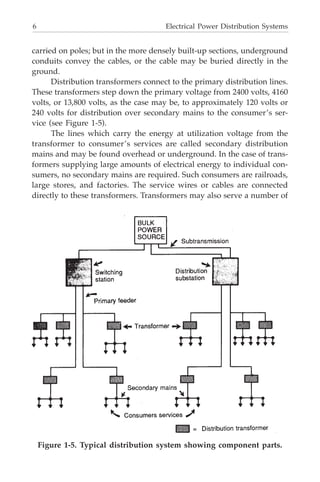
Distribution transformers connect to the primary distribution lines.
These transformers step down the primary voltage from 2400 volts, 4160
volts, or 13,800 volts, as the case may be, to approximately 120 volts or
240 volts for distribution over secondary mains to the consumer’s ser-
vice (see Figure 1-5).
The lines which carry the energy at utilization voltage from the
transformer to consumer’s services are called secondary distribution
mains and may be found overhead or underground. In the case of trans-
formers supplying large amounts of electrical energy to individual con-
sumers, no secondary mains are required. Such consumers are railroads,
large stores, and factories. The service wires or cables are connected
directly to these transformers. Transformers may also serve a number of
Figure 1-5. Typical distribution system showing component parts.
The Transmission and Distribution System 7
consumers and secondary mains; they are located in practically every
street in the area served by utility companies.
Services and meters link the distribution system and the
consumer’s wiring. Energy is tapped from the secondary mains at the
nearest location and carried by the service wires to the consumer’s
building. As it passes on to operate the lights, motors, and various ap-
pliances supplied by the house wiring, it is measured by a highly accu-
rate device known as the watt-hour meter. The watt-hour meter
represents the cash register of the utility company (see Figure 1-6).
DETERMINING DISTRIBUTION VOLTAGES
It was pointed out earlier that low voltages require large conduc-
tors, and high voltages require smaller conductors. This was illustrated
with a water analogy. A small amount of pressure may be applied and
the water will flow through a large pipe, or more pressure may be ap-
plied and the water will flow through a slimmer pipe. This principle is
basic in considering the choice of a voltage (or pressure) for a distribu-
tion system.
There are two general ways of transmitting electric current-over-
head and underground. In both cases, the conductor may be copper or
Figure 1-6. Changes in voltage from generator to consumer. All along
the journey, voltage is helped down from transmission-line level to a
usable level by transformers.
8 Electrical Power Distribution Systems
aluminum, but the insulation in the first instance is usually air, except at
the supports (poles or towers) where it may be porcelain or glass. In
underground transmission, the conductor is usually insulated with rub-
ber, paper, oil, plastic, or other material.
In overhead construction, the cost of the copper or aluminum as
compared to the insulation is relatively high. Therefore, it is desirable
when transmitting large amounts of electric power, to resort to the
higher electrical pressures-or voltages, thereby necessitating slimmer,
less expensive conductors. Low voltages necessitate heavy conductors
which are bulky and expensive to install, as well as intrinsically expen-
sive.
However, there is a limit to how high the voltage may be made and
how thin the conductors. In overhead construction there is the problem
of support-poles or towers. If a conductor is made too thin, it will not be
able to support itself mechanically. Then the cost of additional supports
and pole insulators becomes inordinately high. Underground construc-
tion faces the same economic limitation. In this case, the expense is in-
sulation. Underground a cable must be thoroughly insulated and
sheathed from corrosion. The higher the voltage, the more insulation is
necessary, and the bigger the conductor, the more sheathing is necessary
(see Figure 1-7).
Determining distribution voltages is a matter which requires care-
ful studies. Experts work out the system three or four different ways. For
instance, they figure all the expenses involved in a 4000-volt (4 kV), in
a 34,500-volt (34.5 kV), or a 13,000-volt (13 kV) system.
The approximate costs of necessary equipment, insulators,
switches, and so on, and their maintenance and operation must be care-
fully evaluated. The future with its possibilities of increased demand
must also be taken into consideration.
Safety is the most important factor. The National Electric Safety
Code includes many limitations on a utility company’s choice of voltage.
Some municipal areas also set up their own standards.
The utility company must weigh many factors before determining
a voltage for distribution.
It was mentioned that safety is the most important factor in deter-
mining voltages for distributing electricity. Here’s why! Consider what
happens when a water pipe carrying water at high pressure suddenly
bursts (see Figure 1-8). The consequences may be fatal and damage con-
siderable. The same is true of electrical conductors. Safeguarding the life
The Transmission and Distribution System 9
Figure 1-7. Practical economics affect the size of a transmission line.
10 Electrical Power Distribution Systems
and limb of the public as well as workers is an important responsibility
of the utility company.
Table 1-1 shows typical transmission and distribution system volt-
ages in use at the present time.
Figure 1-8. The danger of high voltages. (a) Pipe rupturing-water spills
over adjacent areas; (b) Rupture of cable insulation causes arcing to
other wires-sometimes causing flame.
Table 1-1. Typical Voltages in Use
————————————————————————————————
Main Sub Primary Distribution
Transmission Transmission Distribution Secondary
————————————————————————————————
69,000 V 13,800 V 2,400 V 120 V
138,000 V 23,000 V 4,160 V 120/240 V
220,000 V 34,500 V 13,800 V 240 V
345,000 V 69,000 V 23,000 V 277/480 V
500,000 V 138,000 V 34,500 V 480 V
750,000 V
————————————————————————————————
The Transmission and Distribution System 11
REVIEW QUESTIONS
1. What are the three main divisions of an electric power system?
2. Distinguish between transmission and distribution.
3. What is the function of a substation?
4. What are the links between the utility company’s facilities and the
consumer’s premises?
5. What are the two ways of distributing electric energy?
6. Compare the flow of water in a pipe with that of electric current
in a wire. What is the relationship between water pressure and
voltage? Pipe diameter and conductor diameter? Thickness of
pipe and insulation?
7. What is electrical pressure called?
8. What are the two most important factors to be considered in
determining a distribution voltage?
9. What changes in the functions of generation and transmission are
due to deregulation?
10. What changes in distribution are associated with deregulation?
12 Electrical Power Distribution Systems
This page intentionally left blank
Conductor Supports 13
13
Chapter 2
Conductor Supports
SUPPORTS FOR OVERHEAD CONSTRUCTION
Conductors need supports to get from one place to another. Sup-
ports may be towers, poles, or other structures. The latter may be made
of steel, concrete, or wood. The choice of a type of support depends on
the terrain to be crossed and the size of conductors and equipment to be
carried. Availability and economy, as well as atmospheric elements de-
termine the choice of material.
Usually steel poles and towers (Figure 2-1) are used for transmis-
sion lines and wood (Figure 2-2) and concrete poles for distribution cir-
cuits. However, this distinction doesn’t always hold true. To meet the
needs of a particular circumstance, wood or concrete poles can be used
to carry transmission lines; and in some instances a steel tower might be
necessary for a distribution circuit.
In general, steel towers are used where exceptional strength and
reliability are required. Given proper care, a steel tower is good indefi-
nitely.
Steel can also be used for poles. Although they are comparatively
expensive, considerations of strength for large spans, crossing railroads
or rivers, for example, make wood undesirable and steel poles, complete
with steel crossarms are necessary.
In the United States, overhead construction more often consists of
wood poles with the conductor wires attached to insulators supported
on wood crossarms. Although steel and concrete poles are also used,
wood has two desirable advantages: initial economy and natural insulat-
ing qualities.
The choice of wood for poles depends on what is available in the
particular section of the country. For example, in the central United
States, poles of northern white cedar are most apt to be found because
it is easily available in Minnesota, Wisconsin, and Michigan. Because of
the preponderance of western red cedar in Washington, Oregon, and
14 Electrical Power Distribution Systems
Figure 2-1. Steel towers.
Idaho, poles of this wood are found on the Pacific coast. Besides cedar,
poles are also made of chestnut or yellow pine. The latter type predomi-
nates in the south and east.
TYPES OF POLES
Cedar is one of the most durable woods in this country. It is light,
strong, has a gradual taper and is fairly straight, although full of small
knots. Before pine poles came into prominence, cedar poles were used
where fine appearance in line construction was required. Chestnut is an
extremely strong, durable wood and it is not quite as full of knots as
cedar, however, chestnut tends to be crooked. The popularity of both
cedar and chestnut in past years was largely attributable to their slow
rate of decay, particularly at the ground line. The continuous presence of
moisture and air, and the chemicals in the soil tend to encourage mouldy
growths which consume the soft inner fibers of wood. This is partially
offset by treating the butt (that portion of the pole buried in the ground)
with a preservative. Although no longer installed, many are in use and
will continue to be used for a relatively long time.
Conductor Supports 15
Long leaf southern yellow pine is very strong, straight, has a
gradual taper and is usually fairly free of knots. Despite its excellent
appearance, the use of pine in the past was limited by its lack of dura-
bility. However, with improvements in wood-preserving methods, yel-
low pine has come to be widely used. Laminated poles for greater
strength are presently being used, particularly for transmission lines,
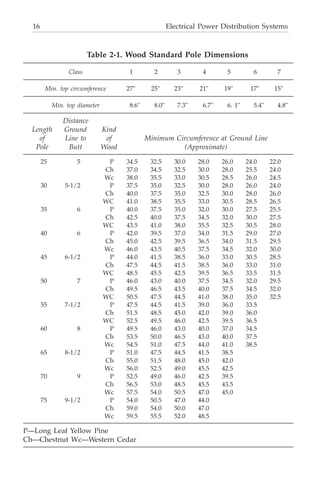
although relatively expensive. Wood pole dimensions are given in Table
2-1.
Metal poles, towers, and structures are subject to rust and corro-
sion and, hence, must be maintained (painted, parts renewed) periodi-
cally. Wood poles and structures decay and are affected by birds and
insects, lineworker’s climbers, weather, and so on, all of which tend to
affect their strength and appearance. To combat decay, poles are in-
Figure 2-2. Wood poles. (a) Pine: straight, strong, gradual taper—knot
free—tendency to decay, offset by treating with preservative, which
gives it shiny appearance—prominent east of the Mississippi. (b)
Cedar: straight, strong, durable—many small knots—fine appear-
ance—slow decay—prominent in West. (c) Chestnut: strong, durable,
but crooked-fewer knots—slow decay—formerly prominent east of
the Mississippi.
16 Electrical Power Distribution Systems
Table 2-1. Wood Standard Pole Dimensions
——————————————————————————————————
Class 1 2 3 4 5 6 7
——————————————————————————————————
Min. top circumference 27" 25" 23" 21" 19" 17" 15"
——————————————————————————————————
Min. top diameter 8.6" 8.0" 7.3" 6.7" 6. 1" 5.4" 4.8"
——————————————————————————————————
Distance
Length Ground Kind
of Line to of Minimum Circumference at Ground Line
Pole Butt Wood (Approximate)
——————————————————————————————————
25 5 P 34.5 32.5 30.0 28.0 26.0 24.0 22.0
Ch 37.0 34.5 32.5 30.0 28.0 25.5 24.0
Wc 38.0 35.5 33.0 30.5 28.5 26.0 24.5
30 5-1/2 P 37.5 35.0 32.5 30.0 28.0 26.0 24.0
Ch 40.0 37.5 35.0 32.5 30.0 28.0 26.0
WC 41.0 38.5 35.5 33.0 30.5 28.5 26.5
35 6 P 40.0 37.5 35.0 32.0 30.0 27.5 25.5
Ch 42.5 40.0 37.5 34.5 32.0 30.0 27.5
WC 43.5 41.0 38.0 35.5 32.5 30.5 28.0
40 6 P 42.0 39.5 37.0 34.0 31.5 29.0 27.0
Ch 45.0 42.5 39.5 36.5 34.0 31.5 29.5
Wc 46.0 43.5 40.5 37.5 34.5 32.0 30.0
45 6-1/2 P 44.0 41.5 38.5 36.0 33.0 30.5 28.5
Ch 47.5 44.5 41.5 38.5 36.0 33.0 31.0
WC 48.5 45.5 42.5 39.5 36.5 33.5 31.5
50 7 P 46.0 43.0 40.0 37.5 34.5 32.0 29.5
Ch 49.5 46.5 43.5 40.0 37.5 34.5 32.0
WC 50.5 47.5 44.5 41.0 38.0 35.0 32.5
55 7-1/2 P 47.5 44.5 41.5 39.0 36.0 33.5
Ch 51.5 48.5 45.0 42.0 39.0 36.0
WC 52.5 49.5 46.0 42.5 39.5 36.5
60 8 P 49.5 46.0 43.0 40.0 37.0 34.5
Ch 53.5 50.0 46.5 43.0 40.0 37.5
Wc 54.5 51.0 47.5 44.0 41.0 38.5
65 8-1/2 P 51.0 47.5 44.5 41.5 38.5
Ch 55.0 51.5 48.0 45.0 42.0
Wc 56.0 52.5 49.0 45.5 42.5
70 9 P 52.5 49.0 46.0 42.5 39.5
Ch 56.5 53.0 48.5 45.5 43.5
Wc 57.5 54.0 50.5 47.0 45.0
75 9-1/2 P 54.0 50.5 47.0 44.0
Ch 59.0 54.0 50.0 47.0
Wc 59.5 55.5 52.0 48.5
——————————————————————————————————
P—Long Leaf Yellow Pine
Ch—Chestnut Wc—Western Cedar
——————————————————————————————————
Conductor Supports 17
spected frequently and treated with preservatives.
The question of appearance of such poles and structures is receiv-
ing more and more attention. In addition to “streamlining” such instal-
lations (as will be discussed later), color has been introduced. For
example, wood poles which were formerly brown or black (the “black
beauties,” oozing creosote), may now be found in green, light blue, tan,
or gray colors.
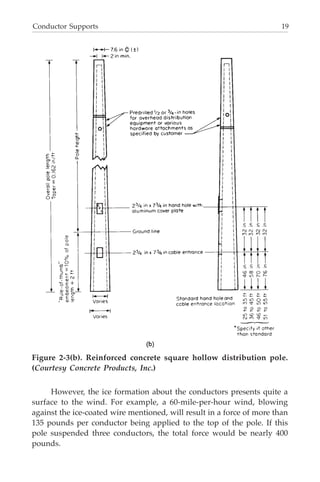
Reinforced concrete poles have become more popular in the United
States in areas where concrete proves more economical. (Design draw-
ings of round and concrete poles are shown in Figures 2-3a and 2-3b and
Tables 2-2a and 2-2b list their dimensions and strengths.) Usually, the
concrete is reinforced with steel, although iron mesh and aluminum can
also be used.
POLE LENGTH
Two factors must be considered in choosing poles: length and
strength required. The length of poles depends on the required clearance
above the surface of the ground, the number of crossarms to be attached,
and other equipment which may be installed (Figure 2-4). Provision
should also be made for future additions of crossarms, transformers, or
other devices. Poles come in standard lengths ranging from 25 to 90 feet
in 5-foot differences; that is, 25 feet, 30 feet, 35 feet, and so on. Special
poles above 90 feet and below 25 feet are also available.
POLE STRENGTH
Required pole strength is determined by the weight of crossarms,
insulators, wires, transformers, and other equipment it must carry, as
well as by ice and wind loadings. All these forces tend to break a pole
at the ground line.
Ice forms about the conductors and other equipment during a
snow or sleet storm (see Figure 2-5). The weight of ice is 57.5 pounds per
cubic foot; thus, if ice about 1 inch thick forms about a conductor 100
feet long, more than 100 pounds will be added to the weight carried by
the poles. While these direct weights may be appreciable, normal wood
poles are more than capable of meeting the ordinary load challenge.
18 Electrical Power Distribution Systems
Figure 2-3(a). Reinforced concrete round hollow distribution pole.
Pole steps optional. (c) Use of top full upper part of pole. (Courtesy
Centrecon, Inc.)
Conductor Supports 19
However, the ice formation about the conductors presents quite a
surface to the wind. For example, a 60-mile-per-hour wind, blowing
against the ice-coated wire mentioned, will result in a force of more than
135 pounds per conductor being applied to the top of the pole. If this
pole suspended three conductors, the total force would be nearly 400
pounds.
Figure 2-3(b). Reinforced concrete square hollow distribution pole.
(Courtesy Concrete Products, Inc.)
20 Electrical Power Distribution Systems
Table 2-2a. Dimensions and Strengths—Round Hollow Concrete Poles
Conductor Supports 21
It also makes a big difference where the conductor is attached on
the pole (see Figure 2-6). A simple illustration of this principle of physics
can be seen in many backyards. If wash is hung on a clothesline attached
to the top of a pliable pole, it is not surprising to see the pole bend. To
keep the pole from bending, the line is attached farther down on the
pole.
The same principle applies to poles which must withstand the
strain of wind and ice-laden conductors. The higher above the ground
the load is applied, the greater will be the tendency for the pole to break
at the ground line.
The forces exerted on a line because of ice and wind will depend
on climatic conditions, which vary in different parts of the country (see
Figure 2-7). In order to safeguard the public welfare, there are published
construction standards called the National Electric Safety Code, which
Table 2-2a. (Continued)
22
Electrical
Power
Distribution
Systems
Table 2-2b. Dimensions and Strengths-Square Hollow Concrete Poles
——————————————————————————————————————————————
E.P.A., ft2
—————————
Concrete strength
lb/in2
Breaking
————————— Ultimate strength Deflection
Overall Pole size- ground-line load per Deflection Pole
pole length, tip/butt, 6000, 7000, moment, 2 ft • below 100 ft - lb, limitations, weight,
ft in standard when specified ft - lb tip, lb in ft - lb lb
——————————————————————————————————————————————
25 7.6/11.65 43.3 45.3 84,000 4540 0.03 4100 2260
30 7.6/12.46 38.7 40.7 132,000 5740 0.03 5000 2880
35 7.6/13.27 33.8 36.2 147,000 5350 0.03 5900 3600
40 7.6/14.08 29.4 31.7 163,000 5090 0.03 6800 4370
45 7.6/14.89 25.7 28.1 178,000 4880 0.06 3850 5225
50 7.6/15.70 22.3 24.7 193,000 4710 0.06 4300 6160
55 7.6/16.51 19.1 21.7 209,000 4590 0.06 4750 7270
——————————————————————————————————————————————
Glossary of Terms
E.RA. Effective projected area, in square feet of transformers, capacitors, streetlight fixtures, and other permanently attached items
which are subject to wind loads. Concrete strength This is a reference to the compressive strength of the concrete in pounds per square
inch as measured by testing representative samples 28 days after casting.
Ultimate ground-line bending moment This is the bending moment applied to the pole which will cause structural failure of the pole.
This is the result of multiplying the load indicated in the column Breaking Strength by a distance 2 feet less than the pole height
(i.e., 2 ft. less than the length of pole above ground). Figures under Ultimate Ground-Line Moment assume embedment of 10 percent
of the pole length plus 2 feet. The figures in this column on technical charts are maximum moments expected to be applied to the
pole. Appropriate safety factors should be used by the designer.
Breaking strength This is the approximate load which, when applied at a point 2 feet below the tip of the pole, will cause structural
failure of the pole. Ground line The point at which an embedded pole enters the ground or is otherwise restrained.
Deflection The variation at the tip of the pole from a vertical line resulting from the application of loads such as equipment, wind,
ice, etc. Ground-line bending moment The product of any load applied at any point on the pole multiplied by its height above ground
line.
Dead loads This refers to the load on a pole resulting from the attachment of transformers and other equipment permanently.
Live loads These are loads applied to the pole as a result of wind, ice, or other loads of a temporary nature.
(Courtesy Concrete Products Inc.)
Conductor Supports 23
divides the United States into three loading districts: heavy, medium,
and light.
In the heavy loading district, designs of pole lines are based on
conductors having a layer of ice (0.5) inch thick, that is, presenting a
surface to the wind of the thickness of the conductor plus 1 inch of ice.
Wind pressure is calculated at 4 pounds per square foot (that of a 60-
mile-per-hour wind) and tension on the conductors is calculated at a
temperature of 0°F (–17.8°C). In the medium loading district, these val-
ues are reduced to a quarter (0.25) inch of ice and a temperature of 15°F
Figure 2-4. Height of poles. Height is dependent on: the number of
crossarms, clearance required above ground, and other equipment to
be attached.
24 Electrical Power Distribution Systems
(–9.4°C). Wind pressure is calculated at the same 4 pounds per square
foot. In the light loading district, no ice is considered, but a wind pres-
sure of 9 pounds per square foot (that of a wind approximately 67-1/2
miles per hour)—and a temperature of 30°F (–2°C) are used for design
purposes.
Note that these standards are minimum. As an extra precaution,
some companies in the heavy and medium districts calculate with a
wind pressure of 8 pounds per square foot and some in the light district
use 12 pounds per square foot.
Another factor which contributes to this bending tendency is the
force applied by the wires at the poles. Normally, equal spans of wires
are suspended from both sides of a pole. However, should the wire span
on one side break, or should there be more wire in the span on one side
than on the other as shown in Figure 2-8, then the uneven pulls will tend
to pull the pole over, again giving the pole a tendency to break at the
ground line. These uneven pulls are counteracted by guys which will be
discussed later.
Figure 2-5. Ice-laden conductors.
Conductor Supports 25
It can be seen that although poles may be the same length, they
may have different thicknesses at the ground line to give them varying
strengths. However, it is not enough for a pole to be thick enough at the
ground line. If it tapers too rapidly, becoming too thin at the top, then
the pole may break at some other point. Therefore, in rating poles for
strength, a minimum thickness or circumference is specified not only at
the ground line, but also at the top. The strength of a pole is expressed
as its class. For wood, these classes are usually numbered from 1 to 10
inclusive, class 1 being the strongest. Some extra heavy poles may be of
Figure 2-6. Effects of applying loads at different points on a pole. (a)
Near the middle, leverage is almost balanced and strain is negligible.
(b) Near the top, strain causes the pole to break.
26 Electrical Power Distribution Systems
class 0, or 00, or even 000. Dimensions are given in Table 2-1 for wood
poles and in Tables 2-2a and 2-2b for concrete.
To describe a pole completely, it is necessary to tell the type of
material it is made of, its length and its class; for example, 35 feet, class
3, pine pole.
POLE DEPTH
Soil conditions, the height of the pole, weight and pull factors must
be considered in deciding how deep a pole must be planted in the
ground (Figure 2-9). Table 2-3 gives approximate setting depths for poles
in particular given conditions.
For example, suppose a pole 60 feet long is necessary to clear struc-
tures or traffic in the path of the conductors. If there are no extra-strain
conditions-for example, the ground is solid, the terrain is flat, and the
spans are equal-this pole need only be planted 8 feet in the ground.
Figure 2-7. Wind and ice load specifications. Map shows territorial
division of the United States with respect to wind and ice loading of
overhead lines. Alaska is in the heavy zone and Hawaii is in the light.
(National Electric Safety Code)
————————————————————————————————
Heavy Medium Light
————————————————————————————————
Radial thickness of ice (inch) 0.5 0.25 0
Horizontal wind pressure in lb/sq ft 4. 4. 9
Temperature (°F) 0. +15 +30
————————————————————————————————
Conductor Supports 27
Figure 2-8. Stronger poles counteract bending tendency. (a) With un-
even spacing, heavier poles are used to compensate extra pull from
longer span. (b) With even spacing, spans balance pulls on each other.
Figure 2-9. Pole depth is determined by pole length, soil conditions,
and weight and pull factor.
28 Electrical Power Distribution Systems
However, if there is an unequal span of wire on one side creating a strain
or if the soil conditions are poor, the pole must be set 8-1/2 feet deep.
POLE GAINS
Gaining is the process of shaving or cutting a pole to receive the
crossarms. In some cases this consists of Cutting a slightly concaved
recess 1/2 inch in depth [see Figure 2-10(a)] so that the arm cannot rock.
The recess in the pole is now considered unnecessary. Instead the
surface of the pole where the crossarm will be attached is merely flat-
tened to present a flat smooth area. This is called “slab gaining,” see
Figure 2-10(b). The cross arm is then fastened to the pole with a through
bolt. Two flat braces are attached to secure the arm. Some poles have two
crossarms mounted one on either side of the pole. These are known as
double arms. When double arms are installed, the pole is gained on one
side only. A double gain would tend to weaken the pole and is unnec-
essary since the tightening of the through-bolt causes the arm on the
back of the pole to bite into the surface.
Pole steps for the lineworker to climb are usually installed at the
same time that the pole is roofed and gained, where these are considered
to be desirable.
Table 2-3 Approximate Typical Pole Setting Depths
————————————————————————————————
Setting Depths Setting Depths at Points
on Straight Lines, of Extra Strain or with
Length of Pole Overall Curbs, and Corners Poor Soil Conditions
————————————————————————————————
30 ft and under 5 ft 0 in. 5 ft 6 in.
35 ft 5 ft 6 in. 6 ft 0 in.
40 ft 6 ft 0 in. 6 ft 6 in.
45 ft 6 ft 6 in. 7 ft 0 in.
50 ft 7 ft 0 in. 7 ft 6 in.
55 ft 7 ft 6 in. 8 ft 0 in.
60 ft 8 ft 0 in. 8 ft 6 in.
65 ft 8 ft 0 in. 8 ft 6 in.
70 ft and over Special Setting Specified
————————————————————————————————
Conductor Supports 29
CROSSARMS
The woods most commonly used for crossarms are Douglas Fir or
Longleaf Southern Pine because of their straight grain and durability.
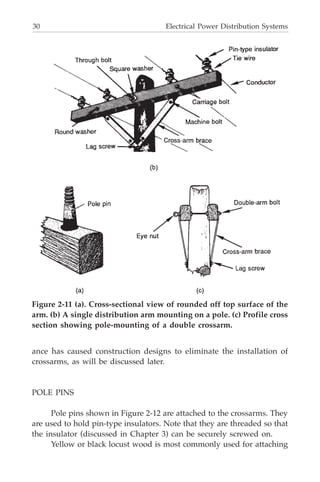
The top surface of the arm is rounded [see Figure 2-11 (a)] so that rain
or melting snow and ice will run off easily.
The usual cross-sectional dimensions for distribution crossarms are
3-1/2 inches by 4-1/2 inches; their length depending on the number and
spacing of the pins. Heavier arms of varying lengths are used for special
purposes, usually for holding the heavier transmission conductors and
insulators. Four-pin [see Figure 2-11 (b)], six-pin, and eight-pin arms are
standard for distribution crossarms, the six-pin arm being the most com-
mon. Where unusually heavy loading is encountered, as at corner or
junction poles, double arms, that is, one on each side of the pole may be
required as shown on Figure 2-11 (c). Again, the emphasis on appear-
Figure 2-10 (a). Recess-gained pole and (b) slab-gained pole. Measure-
ments are for poles 25 to 60 feet long. For poles 65 feet long and over,
slab gain should total 73 inches in length.
30 Electrical Power Distribution Systems
ance has caused construction designs to eliminate the installation of
crossarms, as will be discussed later.
POLE PINS
Pole pins shown in Figure 2-12 are attached to the crossarms. They
are used to hold pin-type insulators. Note that they are threaded so that
the insulator (discussed in Chapter 3) can be securely screwed on.
Yellow or black locust wood is most commonly used for attaching
Figure 2-11 (a). Cross-sectional view of rounded off top surface of the
arm. (b) A single distribution arm mounting on a pole. (c) Profile cross
section showing pole-mounting of a double crossarm.
Conductor Supports 31
the insulators to the crossarms because of its strength and durability;
steel pins are used where greater strength is required.
PIN SPACING
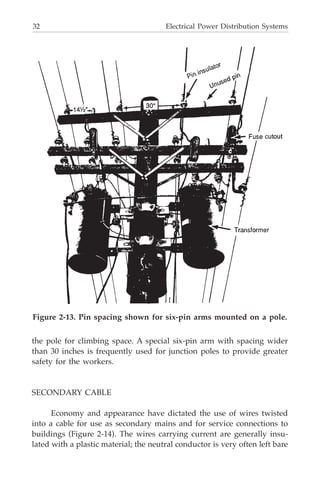
The spacing of the pins (see Figure 2-13) on the crossarms must be
such as to provide enough air space between the conductors to prevent
the electric current from jumping or flashing over from one conductor to
another. Also, sufficient spacing is necessary to prevent contact between
the wires at locations between poles when the wires sway in the wind.
In addition, enough space must be provided to enable workers climbing
through the wires to work safely. The spacing on a standard sixpin arm
is 14-1/2 inches, with 30 inches between the first pins on either side of
Figure 2-12. Pole pins for attaching pin insulators to crossarms.
32 Electrical Power Distribution Systems
the pole for climbing space. A special six-pin arm with spacing wider
than 30 inches is frequently used for junction poles to provide greater
safety for the workers.
SECONDARY CABLE
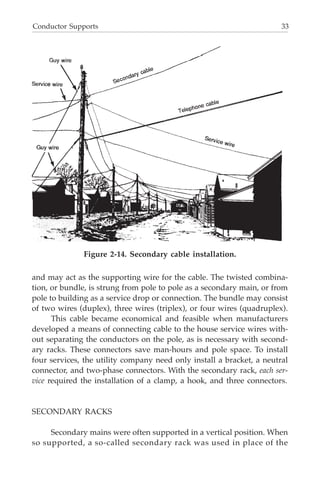
Economy and appearance have dictated the use of wires twisted
into a cable for use as secondary mains and for service connections to
buildings (Figure 2-14). The wires carrying current are generally insu-
lated with a plastic material; the neutral conductor is very often left bare
Figure 2-13. Pin spacing shown for six-pin arms mounted on a pole.
Conductor Supports 33
and may act as the supporting wire for the cable. The twisted combina-
tion, or bundle, is strung from pole to pole as a secondary main, or from
pole to building as a service drop or connection. The bundle may consist
of two wires (duplex), three wires (triplex), or four wires (quadruplex).
This cable became economical and feasible when manufacturers
developed a means of connecting cable to the house service wires with-
out separating the conductors on the pole, as is necessary with second-
ary racks. These connectors save man-hours and pole space. To install
four services, the utility company need only install a bracket, a neutral
connector, and two-phase connectors. With the secondary rack, each ser-
vice required the installation of a clamp, a hook, and three connectors.
SECONDARY RACKS
Secondary mains were often supported in a vertical position. When
so supported, a so-called secondary rack was used in place of the
Figure 2-14. Secondary cable installation.
34 Electrical Power Distribution Systems
crossarm (see Figure 2-15). In this type of support, the conductors are
spaced closely and are strung on one side of the pole. As the electrical
pressure or voltage between these conductors is relatively low, usually
120 or 240 volts, it is not necessary to maintain the same spacing as on
crossarms.
The use of this secondary rack simplifies the installation of service
wires to the consumer’s premises. When a number of services run from
each side of the pole, a second rack is installed on the opposite side for
support of the services on that side.
REVIEW QUESTIONS
1. What are the major components of overhead construction?
Figure 2-15. A secondary rack holding spool insulators. Lineworker
tying wire around insulators on secondary rack.
Conductor Supports 35
2. Conductor supports are made of three materials. Name them.
3. Of what kinds of material are poles generally made?
4. How is pole decay reduced to a minimum?
5. What factors should be considered in determining the length of
poles to be used in overhead construction?
6. What factors should be considered in determining the strength of
the pole required?
7. How is a pole described completely?
8. Define pole gaining.
9. What are the functions of crossarms and pole pins?
10. What is a secondary rack? What are the advantages of secondary
cable?
36 Electrical Power Distribution Systems
This page intentionally left blank
Insulators and Conductors 37
37
Chapter 3
Insulators and Conductors
INSULATORS
Line conductors are electrically insulated from each other as well
as from the pole or tower by nonconductors which are called insulators
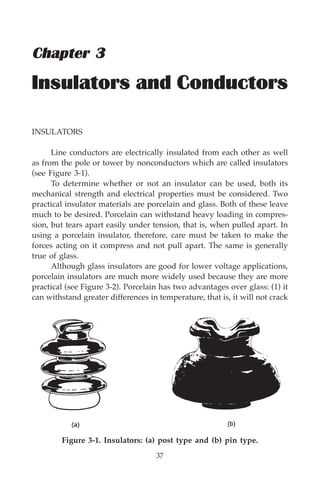
(see Figure 3-1).
To determine whether or not an insulator can be used, both its
mechanical strength and electrical properties must be considered. Two
practical insulator materials are porcelain and glass. Both of these leave
much to be desired. Porcelain can withstand heavy loading in compres-
sion, but tears apart easily under tension, that is, when pulled apart. In
using a porcelain insulator, therefore, care must be taken to make the
forces acting on it compress and not pull apart. The same is generally
true of glass.
Although glass insulators are good for lower voltage applications,
porcelain insulators are much more widely used because they are more
practical (see Figure 3-2). Porcelain has two advantages over glass: (1) it
can withstand greater differences in temperature, that is, it will not crack
Figure 3-1. Insulators: (a) post type and (b) pin type.
38 Electrical Power Distribution Systems
when subjected to very high or very low temperatures; (2) porcelain is
not as brittle as glass and will not break as easily in handling or during
installation.
Polymer insulators are not so restricted and have the advantage
also of being lighter in weight than porcelain or glass.
Pin-Type Insulators
Insulators, in compression, supporting conductors may be classi-
fied as pin type and post type.
The pin-type insulator is designed to be mounted on a pin which
in turn is installed on the crossarm of the pole. The insulator is screwed
on the pin and the electrical conductor is mounted on the insulator (Fig-
ure 3-3). Made of porcelain or glass, the pin insulator can weigh any-
where from 1/2 pound to 90 pounds.
This type of insulator is applicable for rural and urban distribution
circuits, and it is usually constructed as one solid piece of porcelain or
glass. In Figure 3-4, note the grooves for the conductor and for the tie
wires.
Larger, stronger pin-type insulators are used for high-voltage
transmission lines. These differ in construction in that they consist of
two or three pieces of porcelain cemented together. These pieces form
what are called petticoats. They are designed to shed rain and sleet
easily.
Post-type insulators are somewhat similar to pin-type insulators.
They are generally used for higher voltage applications with the height
and number of petticoats being greater for the higher voltages. They
may be mounted horizontally as well as vertically, although their
strength is diminished when mounted horizontally. The insulator is
Figure 3-2. How porcelain reacts to compression and tension forces.
Insulators and Conductors 39
made of one piece of porcelain and its mounting bolt or bracket is an
integral part of the insulator.
Advantage of Pin or Post over Suspension Insulators
The most commonly used insulators are the pin or post type and
the suspension (or hanging) type [see Figure 3-4(c)]. A third type, the
strain insulator, is a variation of the suspension insulator and is de-
signed to sustain extraordinary pulls. Another type, the spool insulator,
is used with secondary racks and on service fittings.
The main advantage of the pin or post-type insulator is that it is
cheaper. Also, the pin or post insulator requires a shorter pole to achieve
the same conductor above the crossarm while the suspension insulator
suspends it below the crossarm.
Figure 3-3. Two styles of low-voltage porcelain insulator.
Figure 3-4 (a). Pin and (b) post-type insulators.
40 Electrical Power Distribution Systems
Figure 3-4 (c) Advantage of pin and post insulators over suspen-
sion insulators. Same conductor height is achieved with shorter pole.
Post-Type Insulators for Armless Construction
Post-type insulators are also used to support conductors of a
polyphase primary circuit (and some transmission lines) without use of
cross arms, as shown in Figure 3-5. This type of installation is employed
where appearance or narrow rights-of-way considerations are impor-
tant.
Overhead Construction Specifications
Refer to Figures 5-25 through 5-31 at the end of Chapter 5 for typi-
cal construction standards of primary line assemblies.
Suspension Insulators
The higher the voltage, the more insulation is needed. Transmis-
sion lines use extremely high voltages, 69,000 to 375,000 volts, for ex-
ample. At these voltages the pin or post-type insulator becomes too
bulky and cumbersome to be practical, and the pin which must hold it
would have to be inordinately long and large. To meet the problem of
insulators for these high voltages, the suspension insulator shown in
Figure 3-6 was developed.
The suspension insulator hangs from the crossarm, as opposed to
the pin insulator which sits on top of it. The line conductor is attached
to its lower end. Because there is no pin problem, any distance can be
put between the suspension insulator and the conductor can be pro-
vided just by adding more insulators to the “string,”
The entire unit of suspension insulators is called a string. How
many insulators this string consists of depends on the voltage, the
weather conditions, the type of transmission construction, and the size
of insulator used. It is important to note that in a string of suspension
insulators one or more insulators can be replaced without replacing the
whole string.
Strain Insulators
Sometimes a line must withstand great strain as shown in Figure
3-7, for instance at a corner, at a sharp curve, or at a dead-end. In such
a circumstance the pull is sustained and insulation is provided by a
strain insulator. On a transmission line, this strain insulator often con-
Insulators and Conductors 41
Figure 3-5. 3 phase 13 kV through line pole armless construction 20 kV
insulators. (Courtesy Long Island Lighting Co.)
42 Electrical Power Distribution Systems
sists of an assembly of suspension insulators. Because of its peculiarly
important job, a strain insulator must have considerable strength as well
as the necessary electrical properties. Although strain insulators come in
many different sizes, they all share the same principle; that is, they are
constructed so that the cable will compress (and not pull apart) the
porcelain.
Strain insulators are sometimes used in guy cables, where it is
necessary to insulate the lower part of the guy cable from the pole for
the safety of people on the ground. This type usually consists of a por-
celain piece pierced with two holes at right angles to each other through
Figure 3-6. Ball and socket-type suspension insulator.
Figure 3-7. How a suspension insulator is used to withstand strain.
Insulators and Conductors 43
which the two ends of the guy wires are looped, in such a manner that
the porcelain between them is in compression, Figure 3-8.
Figure 3-8. Strain insulator used for guy wires. Wires of insulator pull
in opposite directions, resulting in compression.
Spool Insulators
The spool-type insulator, which is easily identified by its shape, is
usually used for secondary mains. The spool insulator may be mounted
on a secondary rack or in a service clamp as shown in Figures 3-9(a) and
3-9(b). Both the secondary low-voltage conductors and the house service
wires are attached to the spool insulator. The use of such insulators has
decreased greatly since the introduction of cabled secondary and service
wires.
The tapered hole of the spool insulator distributes the load more
evenly and minimizes the possibility of breakage when heavily loaded.
The “clevis” which is usually inserted in this hole is a piece of steel
metal with a pin or bolt passing through the bottom.
POLYMER (PLASTIC) INSULATION
In general, any form of porcelain insulation may be replaced with
polymer. Their electrical characteristics are about the same. Mechani-
cally they are also about the same, except porcelain must be used under
compression while polymer may be used both in tension and compres-
sion. Porcelain presently has an advantage in shedding rain, snow and
ice and in its cleansing effects; polymer may allow dirt, salt and other
pollutants to linger on its surface encouraging flashover, something that
can be overcome by adding additional polymer surfaces. Polymer’s
greatest advantage, however, is its comparatively light weight making
for labor savings; and essentially no breakage in handling. For detailed
comparison of the two insulations, refer to Appendix A, Insulation:
Porcelain vs. Polymer.
44 Electrical Power Distribution Systems
CONDUCTORS
Line Conductors
Line conductors may vary in size according to the rated voltage.
The number of conductors strung on a pole depends on the type of cir-
cuits that are used.
Because they strike a happy combination of conductivity and
economy, copper, aluminum, and steel are the most commonly used
conductor materials. Silver is a better conductor than copper; but its
mechanical weakness and high cost eliminate it as a practical conductor
(see Figure 3-10).
On the other hand, there are cheaper metals than copper and alu-
minum; but they would be hopelessly poor conductors. Copper is the
touchstone of conductors. Other conducting materials are compared to
Figure 3-9. Spool insulator (a)
mounted in clamp, and (b) mounted
on a secondary rack.
Insulators and Conductors 45
copper to determine their economic value as electrical conductors.
Aluminum-steel or copper-steel combinations and aluminum have
become popular for conductors in particular circumstances. Aluminum
alloys are also used as conductors.
Copper Conductors
Copper is used in three forms: hard drawn, medium-hard drawn,
and soft drawn (annealed). Hard-drawn copper wire has the greatest
strength of the three and is, therefore, mainly used for transmission cir-
cuits of long spans (200 ft or more). However, its springiness and inflex-
ibility make it hard to work with [see Figure 3-11 (a)].
Soft-drawn wire is the weakest of the three [Figure 3-11 (b)]. Its use
is limited to short spans and for tying conductors to pin-type insulators.
Since it bends easily and is easy to work with, soft-drawn wire is used
widely for services to buildings and some distribution circuits. Practice,
however, has been toward longer distribution circuit spans and use of
medium-hard-drawn copper wire.
Figure 3-10. All conductors are compared to copper. (a) Steel, strong,
but poor conductor. (b) Copper, an all-around good, durable conductor
for its price. (c) Aluminum, light, durable, rust-proof, but only 70% as
good a conductor. (d) Silver, better conductor, too expensive, and
mechanically weak.
46 Electrical Power Distribution Systems
Aluminum and ACSR Conductors
Aluminum is used because of its light weight as illustrated in Fig-
ure 3-12, which is less than one third that of copper. It is only 60 to 80
percent as good a conductor as copper and only half as strong as copper.
For these reasons it is hardly ever used alone, except for short distribu-
tion spans. Usually the aluminum wires are stranded on a core of steel
wire. Such steel reinforced aluminum wire has great strength for the
weight of the conductor and is especially suitable for long spans. Trans-
mission lines often consist of aluminum conductors steel reinforced
(ACSR).
Steel Conductors
Steel wire is rarely used alone. However, where very cheap con-
struction is needed, steel offers an economic advantage. Because steel
wire is three to five times as strong as copper, it permits longer spans
and requires fewer supports. However, steel is only about one tenth as
good a conductor as copper and it rusts rapidly [see Figure 3-13(a)]. This
rusting tendency can be counteracted (so that steel wire will last longer)
by galvanizing, that is, by the application of a coat of zinc to the surface.
Copperweld or Alumoweld Conductors
The main disadvantages of steel are a lack of durability and con-
Figure 3-11 (a). Hard-drawn copper is strong but inflexible and
springy. It is used for long spans. (b) Soft-drawn (annealed) copper is
weak but easy to handle. It is used for service and some distribution
circuits.
(a) (b)
Insulators and Conductors 47
ductivity. On the other hand, steel is cheap, strong, and available. These
advantages made the development of copper-clad or aluminum-clad
steel wire [see Figure 3-13(b)] most attractive to the utility companies. To
give steel wire the conductivity and durability it needs, a coating of
copper is securely applied to its outside. The conductivity of this clad
steel wire can be increased by increasing the coating of copper or alumi-
num. This type of wire, known as Copperweld or Alumoweld is used for
guying purposes and as a conductor on rural lines, where lines are long
and currents are small.
Conductor Stranding
As conductors become larger, they become too rigid for easy han-
dling. Bending can damage a large solid conductor. For these practical
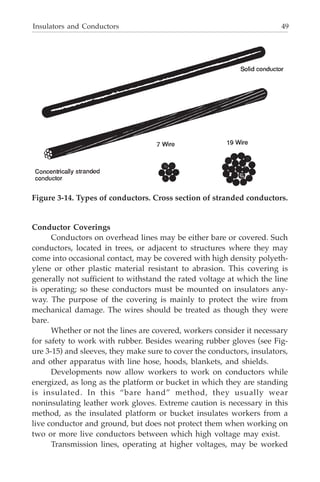
reasons, the stranded conductor was developed (see Figure 3-14). A
stranded conductor consists of a group of wires twisted into a single
Figure 3-12. The advantage of aluminum as a conductor is its light
weight-less than one third the weight of copper.
48 Electrical Power Distribution Systems
conductor. The more wires in the conductor’s cross section, the greater
will be its flexibility. Usually, all the strands are of the same size and
same material (copper, aluminum, or steel). However, manufacturers do
offer stranded conductors combining these metals in different quantities.
Sometimes 3 strands of wire are twisted together. But usually, they
are grouped concentrically around 1 central strand in groups of 6. For
example, a 7-strand conductor consists of 6 strands twisted around 1
central wire. Then 12 strands are laid over those 6 and twisted to make
a 19-strand conductor.
To make a 37-strand conductor, 18 more are placed in the gaps
between these 18. And so the number of strands increases to 61, 91, 127,
and so on.
Other combinations are possible. For example, 9 strands can be
twisted around a 3-strand twist to make a 12-strand wire. Two large
strands can be twisted slightly and then surrounded by 12 twisted
strands making a 14-strand conductor.
Figure 3-13 (a). Comparison of metal conductors. (b) Copperweld or
Alumoweld conductor used for rural distribution and guy wires.
Insulators and Conductors 49
Conductor Coverings
Conductors on overhead lines may be either bare or covered. Such
conductors, located in trees, or adjacent to structures where they may
come into occasional contact, may be covered with high density polyeth-
ylene or other plastic material resistant to abrasion. This covering is
generally not sufficient to withstand the rated voltage at which the line
is operating; so these conductors must be mounted on insulators any-
way. The purpose of the covering is mainly to protect the wire from
mechanical damage. The wires should be treated as though they were
bare.
Whether or not the lines are covered, workers consider it necessary
for safety to work with rubber. Besides wearing rubber gloves (see Fig-
ure 3-15) and sleeves, they make sure to cover the conductors, insulators,
and other apparatus with line hose, hoods, blankets, and shields.
Developments now allow workers to work on conductors while
energized, as long as the platform or bucket in which they are standing
is insulated. In this “bare hand” method, they usually wear
noninsulating leather work gloves. Extreme caution is necessary in this
method, as the insulated platform or bucket insulates workers from a
live conductor and ground, but does not protect them when working on
two or more live conductors between which high voltage may exist.
Transmission lines, operating at higher voltages, may be worked
Figure 3-14. Types of conductors. Cross section of stranded conductors.
50 Electrical Power Distribution Systems
on when energized or de-energized. They are generally situated in open
areas where the danger to the public from fallen wires is negligible. Also,
because the amount of insulation required would make the conductor
bulky and awkward to install, it is desirable to leave high-voltage trans-
mission line conductors bare.
Wire Sizes
In the United States, it is common practice to indicate wire sizes by
gage numbers. The source of these numbers for electrical wire is the
American Wire Gage (AWG) (otherwise known as the Brown & Sharpe
Gage). A small wire is designated by a large number and a large wire by
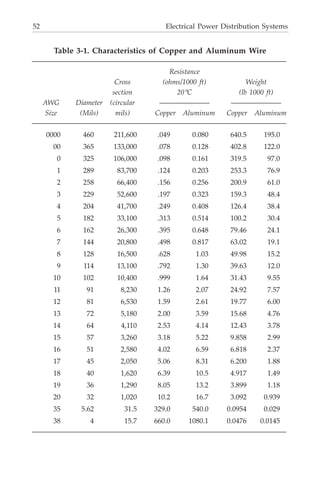
a small number as shown in Figure 3-16. The diameter of a No. 0000
wire is 0.4600 inch or 460 mils; the diameter of a No. 36 wire is 0.0050
inch or 5 mils. There are 38 other sizes between these two extremes. For
example, a No. 8 wire is 0. 1285 inch (128.5 mils) in diameter and a No.
1 wire is 0.2576 (257.6 mils) in diameter.
It has proved convenient to discuss the cross-section area of a wire
in circular mils. A circular mil (cm) is the area of a circle having a diam-
eter of 0.001 inch or 1 mil. Because it is a circular area unit of measure,
it is necessary only to square the number of mils given in the diameter
of a wire to find the number of circular mils in a circle of that diameter.
Figure 3-15. Lineworker working on line conductor.
Insulators and Conductors 51
Thus, a conductor with a 1-mil diameter would have a 1-circular-mil
(cm) cross-section area; a 3-mil diameter wire would have a 9-cm area;
and a 40-mil-diameter wire, a 1600-cm area.
For conductors larger than 0000 (4/0) in size, the wire sizes are
expressed in circular mils; for example, 350,000 cm, 500,000 cm, and so
on. (Sometimes these are expressed as 350 mcm, 500 mcm, etc.)
Characteristics of copper and aluminum wires are listed in Table 3-1.
Tie Wires
Conductors must be held firmly in place on the insulators to keep
them from falling or slipping. On pin insulators, they are usually tied to
the top or side groove of the insulator by means of a piece of wire, called
a tie-wire. On suspension type insulators, conductors are usually held in
place by a clamp or “shoe,” as shown in Figure 3-17(a).
Where conductors must be maintained while energized, and can-
not be touched by hands, they are handled on the ends of sticks called
“hot sticks.” When it is necessary to use these hot sticks, the ends of the
tie wires are looped so that they can be easily wrapped or unwrapped
Figure 3-1. 6 American Standard Wire Gage.
52 Electrical Power Distribution Systems
Table 3-1. Characteristics of Copper and Aluminum Wire
————————————————————————————————
Resistance
Cross (ohms/1000 ft) Weight
section 20°C (lb 1000 ft)
AWG Diameter (circular ——————— ———————
Size (Mils) mils) Copper Aluminum Copper Aluminum
————————————————————————————————
0000 460 211,600 .049 0.080 640.5 195.0
00 365 133,000 .078 0.128 402.8 122.0
0 325 106,000 .098 0.161 319.5 97.0
1 289 83,700 .124 0.203 253.3 76.9
2 258 66,400 .156 0.256 200.9 61.0
3 229 52,600 .197 0.323 159.3 48.4
4 204 41,700 .249 0.408 126.4 38.4
5 182 33,100 .313 0.514 100.2 30.4
6 162 26,300 .395 0.648 79.46 24.1
7 144 20,800 .498 0.817 63.02 19.1
8 128 16,500 .628 1.03 49.98 15.2
9 114 13,100 .792 1.30 39.63 12.0
10 102 10,400 .999 1.64 31.43 9.55
11 91 8,230 1.26 2.07 24.92 7.57
12 81 6,530 1.59 2.61 19.77 6.00
13 72 5,180 2.00 3.59 15.68 4.76
14 64 4,110 2.53 4.14 12.43 3.78
15 57 3,260 3.18 5.22 9.858 2.99
16 51 2,580 4.02 6.59 6.818 2.37
17 45 2,050 5.06 8.31 6.200 1.88
18 40 1,620 6.39 10.5 4.917 1.49
19 36 1,290 8.05 13.2 3.899 1.18
20 32 1,020 10.2 16.7 3.092 0.939
35 5.62 31.5 329.0 540.0 0.0954 0.029
38 4 15.7 660.0 1080.1 0.0476 0.0145
————————————————————————————————
Insulators and Conductors 53
from the insulator (see Figure 3-17(b).
Another type clamp as shown in Figure 3-17(c) is the clamp top
insulator.
Connectors
Conductors are sometimes spliced by overlapping the ends and
twisting the ends together, taking three or four turns. But to insure a
good electrical connection as well as uniformity in workmanship, it is
Figure 3-17. (a) Suspension insulators are attached to conductor by a
shoe. (b) Tic wire for top groove of pin insulator (straightaway). (c)
Clamp-top insulator.
54 Electrical Power Distribution Systems
wise to connect conductors with mechanical connectors. (Different such
connectors are shown in Figure 3-18.) They are often substantial money-
savers.
One type inserts the two ends into a double sleeve. When the two
conductors are parallel and adjacent to each other, the sleeve is then
twisted. With the compression sleeve the conductors are inserted from
both ends until they butt and the sleeve is then crimped in several
places. The “automatic” splice has the conductor ends inserted in each
end where they are gripped by wedges held together by a spring. The
split-bolt or “bug nut” connector is a copper or tin-plated-copper bolt
with a channel cut into the shank; both conductors fit into the channel
and are compressed together by a nut.
Another type of connector used where it is required to connect or
disconnect primary conductors while energized is the “hot-line” clamp
shown in Figure 3-19(a). In order to protect the conductors themselves
from mechanical injury, especially from possible sparking, the clamp is
often applied to a “saddle” installed on the conductor, as shown in Fig-
ure 3-19(b).
Figure 3-18. Mechanical connectors.
Insulators and Conductors 55
REVIEW QUESTIONS
1. What is the function of an insulator?
2. Of what materials are insulators for overhead construction usu-
ally made? What are their electrical and mechanical properties?
3. What different types of insulators are there?
4. What are the main advantages of pin insulators? Of suspension
insulators?
5. Of what materials are overhead line conductors generally made?
6. What characteristics determine a conductor’s value?
7. What are the advantages of aluminum as a conductor? Steel?
8. Why are conductors stranded?
9. How are wire sizes expressed?
10. Name several types of mechanical connectors in use.
Figure 3-19. (a) Live-line or “hot-line” clamp. (Courtesy A. B. Chance
Co.) (b) Hotline saddle. (Courtesy Long Island Lighting Co.)
56 Electrical Power Distribution Systems
This page intentionally left blank
Line Equipment 57
57
Chapter 4
Line Equipment
Besides conductors and insulators, many other pieces of equip-
ment are necessary to get electric power from the generator to a con-
sumer. Figure 4-1 identifies each of these pieces of equipment. Their
functions will be covered in this chapter.
DISTRIBUTION TRANSFORMERS
The distribution transformer shown in Figure 4-2 is certainly the
most important of these pieces of equipment. Without the distribution
transformer, it would be impossible to distribute power over such long
distances. Earlier in this book, we explained that the purpose of a trans-
former is to step up or step down voltage. In the case of the distribution
transformer, the voltage is stepped down from that of the primary mains
of a distribution circuit to that of the secondary mains. In most cases,
this is from 2400, 4160, or 13,800 volts to 120 or 240 volts.
Most distribution transformers consist of (1) a closed-loop mag-
netic core on which are wound two or more separate copper coils, (2) a
tank in which the corecoil assembly is immersed in cooling and insulat-
ing oil, (3) bushings for bringing the incoming and outgoing leads
through the tank or cover.
Bushings
On every distribution transformer, attachments are to be found
which are normally referred to as primary bushings and secondary
bushings (see Figure 4-3).
A bushing is an insulating lining for the hole in the transformer
tank through which the conductor must pass. Primary bushings are al-
ways much larger because the voltage is higher at that point. Sometimes
the primary and secondary bushings are called high-voltage and low-
voltage bushings.
58 Electrical Power Distribution Systems
Bushings may protrude either from the sidewall of the transformer
tank or from its covers. There are three types of bushings; the solid porce-
lain bushing, the oil-filled bushing, and the capacitor type bushing.
Solid porcelain bushings are used for voltages up to 15 kV. A solid
conductor runs through the center of the porcelain form. The conductor
is insulated copper cable or solid conductor terminating in a cap. The
bushing cap has mountings that permit the line cables to be connected
to the transformer winding. The mounting must be so designed that the
cable of the transformer lead can be detached to allow the bushing to be
removed for replacement.
For higher voltage transformers (discussed in the substations sec-
tion), bushings are oil-filled to improve their insulating characteristics
Figure 4-1. Line equipment: (a) distribution transformers, (b) fuse
cutouts, (c) lightning arresters, (d) line voltage regulators, (e) capaci-
tors, (f) switches (air and oil), (g) reclosers.
Line Equipment 59
Figure 4-2. Basic components of a distribution transformer.
Figure 4-.3 Sidewall mounted bushings (solid porcelain). (a) Primary
bushing and (b) secondary bushing.
60 Electrical Power Distribution Systems
within their specified dimensions. The interior portions of the capacitor
bushing are wound with high-grade paper. The oil is replaced with
paper and thin layers of metal foil to improve the distribution of stresses
because of the high voltage. All three types of bushing have an outer
shell of porcelain to contain the insulation inside and to shed rain.
The Tap Changer
It is often necessary to vary the voltage in a transformer winding
(primary) to allow for a varying voltage drop in the feeder (transmis-
sion) lines. In other words, in spite of a varying input, the output must
be nearly constant. Several ways can be used to obtain the desired result.
One method used to adjust the winding ratio of the transformer
uses the no-load tap changer shown in Figure 4-4. A transformer
equipped with a no-load tap changer must always be disconnected from
the circuit before the ratio adjustment can be made. The selector switch
is operated under oil usually placed within the transformer itself; but it
is not designed to be used as a circuit breaker. To change taps on small
distribution transformers, the cover must be removed and an operating
handle is used to make the tap change. For the larger type, one handle
may be brought through the cover and the tap may be changed with a
wheel or even a motor.
Figure 4-4. Tap changer used to adjust the turns ratio of a transformer.
(a) No-load tap change and (b) typical internal wiring of transformer
with tap changer.
Line Equipment 61
If it is necessary to change the taps when the transformer cannot be
disconnected from the circuit, tap changers under-load are used. They
involve the use of an autotransformer and an elaborate switching ar-
rangement. The information regarding the switching sequence must be
furnished with each transformer. Tap changers can function automati-
cally if designed with additional control circuits: automatic tap changes
are used for high-power transformers, and for voltage regulators.
Mounting Distribution Transformers
Distribution transformers are almost always located outdoors
where they are hung from crossarms, mounted on poles directly (see
Figure 4-5) or placed on platforms. In general, transformers up to 75 kVA
size are mounted directly to the pole or on a crossarm and larger size
transformers (or groups of several transformers) are placed on platforms
or mounted on poles in banks or clusters.
How a transformer is mounted is a matter of considerable impor-
tance. Remember that the distribution transformer must stay put and
continue functioning even in the midst of violent winds, pouring rain,
freezing cold, sleet, and snow. Besides weather, there is danger of the
pole itself being hit by a carelessly driven vehicle.
Modern pole-mounted transformers [see Figure 4-6(a)] have two
lugs welded directly on the case. These lugs engage two bolts on the
pole as shown in Figure 46(b) from which the whole apparatus hangs
securely. This method, which is known as direct mounting eliminates the
need for crossarms and hanger irons (as was done in the past), thus
saving a considerable amount of material and labor.
In the past, transformers were hung from crossarms by means of
hanger irons, which were two flat pieces of steel with their top ends bent
into hooks with squared sides (see Figure 4-7). The transformer was
bolted to these pieces of steel, the assembly was raised slightly above the
crossarm and then lowered so that the hooks on the hanger irons would
engage the crossarm. Many such installations still exist.
A transformer should not be mounted on a junction pole (a pole
supporting lines from three or more directions) as this makes working
on such a pole more hazardous for the worker.
Where transformers cannot be mounted on poles because of size or
number, they may be installed on an elevated platform [Figure 4-8(a)] or
a ground-level pad [Figure 4-8(b)]. Platforms are built in any shape or
size required to suit the particular need. They are usually constructed of
62 Electrical Power Distribution Systems
wood, though steel is often used for some of the members. Ground-level
pads are usually made of concrete or reinforced concrete and are very
useful when appearance is a major consideration.
A Conventional Distribution Transformer
Manufacturers produce two types of distribution transformers: the
conventional and the completely self-protected. (CSP is the
Westinghouse trade designation for this latter type. Other manufacturers
Figure 4-5. Modern cluster mounting of distribution transformers on a
pole.
Line Equipment 63
simply call them self-protected transformers.) A conventional distribu-
tion transformer consists only of a case containing the transformer unit
with protective devices, usually a primary fuse cutout and a lightning
arrester, mounted separately on the pole or crossarm (see Figure 4-9).
CSP Distribution Transformers
In the CSP transformer, a weak link or primary protective fuse link
shown in Figure 4-10 is mounted inside the tank with the transformer
unit as also are two circuit breakers for protection on the secondary side
of the transformer. A simple thermal device causes the breakers to open
when a predetermined safe value of temperature is exceeded. The light-
Figure 4-6. Direct pole mounting of
distribution transformers.
64 Electrical Power Distribution Systems
ning arrester is mounted on the outside of the tank. It is apparent that
the CSP transformer makes for simpler, more economic mounting and
neater appearance. What’s more, it is of particular advantage for higher
voltage (13.8 kV) primary distribution systems where connections and
disconnections are made with hot sticks.
Figure 4-7. Hanger-iron method of mounting distribution transform-
ers on poles. (a) T-shaped hanger iron using two crossarms. (b) C-
shaped hanger-iron designed to hold larger transformers. (c) For
smaller transformers, a T-shaped hanger-iron one crossarm and a
kicker are sufficient.
Line Equipment 65
FUSE CUTOUTS
Suppose a circuit is designed to carry 100 A. Should the amperage
climb over that limit, it could eventually melt some of the wires and
cause widespread interruption of service. To prevent this, a weak spot is
intentionally designed into a circuit—a place where overload will regis-
ter and open the circuit almost immediately. This spot is called a fuse. A
fuse consists of a short piece of metal having low melting characteristics
which will melt at a rated temperature.
It is amperage flowing through a conductor that sometimes makes
the conductor hot to touch. This is what the fuse counts on. Should there
be an overload, the fuse melts, thus disconnecting the circuit.
Fuse cutouts go one step further. They may be placed as shown in
Figure 4-11 so as to cut out the section of the circuit that is endangered,
allowing the rest of the circuit to remain energized.
A primary fuse cutout is connected between the primary lines and
Figure 4-8. Mounting of distribution transformers. (a) Platform
mounted and (b) pad mounted.
66 Electrical Power Distribution Systems
the transformer shown in Figure 4-12 to protect the transformer from
overloads and to disconnect the transformer from the primary lines in
case of trouble. A primary line fuse cutout can disconnect any portions
of a primary circuit supplying several distribution transformers, in case
of overload or fault, leaving the rest of the circuit energized.
Although there are several types of fuse cutouts, the principle
upon which each is constructed is the same. A fuse ribbon makes a
connection between two contacts, either the line and the transformer or
the main line and that portion to be protected.
The Door-type Cutout
In the door or box-type cutout shown in Figure 4-13, the fuse is
mounted inside the door in such a manner that when the door closes,
the fuse engages two contacts, one on the top of the box and the other
Figure 4-9. A conventional transformer requires separate mounting of
lightning arresters and fuse cutouts.
Line Equipment 67
Figure 4-10. A “self-protected” transformer. Lightning ar-
resters and circuit breaker are integral parts of its design.
Figure 4-11. Schematic diagram of fused three-
conductor primary line supplying several distri-
bution transformers having individual fuse
cutouts.
68 Electrical Power Distribution Systems
Figure 4-12. Schematic diagram of a single-conductor primary line em-
ploying a fused transformer.
Figure 4-13. Box-type cutout. Open door indicates fuse has blown.
Line Equipment 69
on the bottom. To open this cutout, the door is pulled open and allowed
to hang downward from the box. The fusible element is enclosed in a
fiber tube; when the fuse blows or melts because of excessive current
passing through it, the resultant arc attacks the fiber tube, producing a
gas which blows out the arc. For this reason this type cutout is some-
times also called the expulsion type. In later models, the fuse mounting
is arranged so that the melting of the fusible element causes the door to
drop open, signaling to the worker on the ground that the fuse has
blown. The use of this type cutout is generally limited to circuits oper-
ating at voltages under 5000 volts.
The Open-type Cutout
The open-type cutout (Figure 4-14) is essentially the same as the
door type, except that the fiber tube enclosing the fusible element is
exposed in the open, rather than enclosed in a porcelain box. This ar-
rangement enables larger currents to be interrupted without confining as
much the attendant violent expulsion of gases (which can destroy the
cutout). The tube drops when the fuse blows, indicating that the fuse has
blown. This type cutout is used on distribution circuits operating at
voltages over 5000 volts, although it can be used on lower voltage cir-
cuits.
The Repeater Fuse
When line fuses are used to protect a portion of a primary circuit
as previously described, a repeater fuse may be used. The repeater fuse
shown in Figure 4-15 is usually of the open type and consists of two or
three fuses mechanically arranged so that when the first fuse blows and
drops, the action places the second fuse automatically in the circuit. If
the trouble has been cleared, service will be restored. Should the second
fuse also blow, a third is also automatically connected in the circuit;
when the third fuse blows, the portion of the circuit is finally de-ener-
gized. Repeater fuses hold down to a minimum interruptions in service
caused by temporary faults. These faults may arise from wires swinging
together when improperly sagged, or from tree branches or animals
making momentary contact with the line, or from lightning surges caus-
ing temporary flashover at an insulator.
All of these fused cutouts are mounted on the crossarm or on the
pole by bolts and a steel bracket.
70 Electrical Power Distribution Systems
LIGHTNING OR SURGE ARRESTERS
A lightning arrester is a device that protects transformers and other
electrical apparatus from voltage surges. These surges can occur either
because of lightning or improper switching in the circuit. The lightning
arrester provides a path over which the surge can pass to ground as
shown in Figure 4-16(a), before it has a chance to attack and seriously
damage [see Figure 4-16(b)] the transformer or other equipment.
The elementary lightning arrester consists of an air gap (illustrated
in Figure 4-17) in series with a resistive element. The voltage surge
causes a spark which jumps across the air gap, passes through the resis-
tive element (silicon carbide, for example) which is usually a material
Figure 4-14. Open-type fuse cutout.
Line Equipment 71
that allows a low-resistance path for the high-voltage surge, but presents
a high resistance to the flow of line energy. This material is usually
known as the “valve” element. There are many different types of light-
ning arresters, but they generally have this one principle in common.
There is usually an air gap in series with a resistive element, and what-
ever the resistive (or valve) element is made of, it must act as a conduc-
tor for high-energy surges and also as an insulator toward the line
energy. In other words, the lightning arrester leads off only the surge
energy. Afterwards, there is no chance of the normal line energy being
led into ground.
Valve Arresters
Since all arresters have a series gap and a resistive element, they
differ only in mechanical construction and in the type of resistive ele-
ment used. One type arrester consists of a porcelain cylinder filled with
some suitable material with electrodes at either end (see Figure 4-18).
The series gap assembly is usually at the top. When there is excessive
voltage surge on the line, the spark jumps across the air gap and the
surge energy flows through the material to the ground. As the surge
Figure 4-15. Repeater-type fuse cutout.
72 Electrical Power Distribution Systems
decreases, the resistive power of the material increases so that no line
energy will flow to the ground.
Expulsion-type Arresters
In this type arrester there are two series gaps (shown in Figure 4-
19)—one external and one internal—which are to be bridged by the high
voltage surge. The second gap formed between two internal electrodes
is actually inside a fiber tube which serves to quench the line energy
Figure 4-16. Lightning arresters protect transformers and other equip-
ment. (a) With arrester, surge voltage is drained to ground. (b) With no
arrester, surge voltage causes damage.
Line Equipment 73
when it comes through. (Thus, the valve element in this case is the fiber
tube itself.) When lightning occurs, the gaps are bridged and the high
energy flows harmlessly to ground. However, when the line energy tries
to go through the arcing channel, the fiber tube creates nonconducting
gases which in turn blow the arc and conducting gases out the vent, thus
reestablishing a wall of resistance to the line energy.
VOLTAGE REGULATORS
At this point, voltage regulators for pole-mounting will be dis-
cussed. Later, when substations are discussed, these will be used there
as well.
A voltage regulator is generally used to maintain the voltage of a
line. The primary feeder voltage generally drops when a large load
current is drawn and less voltage is available across the primaries of the
Figure 4-17. Elementary lightning arrester.
74 Electrical Power Distribution Systems
distribution transforms. The regulator maintains the voltage at the
proper rated value at all times.
The principle of operation of a voltage regulator is somewhat simi-
lar to that of a transformer having taps, as previously described. This
form of regulator has two fixed windings, a primary (high-voltage)
winding connecting in shunt or across a line, and a secondary or low-
voltage winding connected in series with the line. The secondary or
series winding is provided with as many taps as necessary (shown in
Figure 4-20) to vary the voltage across this winding. This equipment
operates as a voltage regulator by means of a control circuit which au-
tomatically changes the tap setting on the series winding, while leaving
the voltage applied to the primary (high-voltage) winding alone. The
variable voltage in the series winding can thus be added or subtracted
Figure 4-18. Valve lightning arrester.
Line Equipment 75
from the incoming (or primary) voltage, resulting in an outgoing voltage
which can be kept approximately constant even when the incoming
primary voltage may vary.
Another type, known as the induction-type voltage regulator, ac-
complishes the same effect by having the primary coil rotate, changing
its position in relation to the secondary coil, which in this case has no
taps. (Figure 4-21)
Voltage regulators are either hand or motor-operated. When a
motor is used, it is usually automatically controlled by means of relays.
Figure 4-19. Expulsion lightning arrester.
76 Electrical Power Distribution Systems
Figure 4-20. Voltage regulator. Schematic diagram of tap-changing-
under load (TCUL) regulator.
Figure 4-21. Cutaway view of line-voltage regulator.
Line Equipment 77
CAPACITORS
Should the voltage on a circuit fall below a specified level for some
reason, a device called a capacitor can momentarily maintain the voltage
at line value. Basically, a capacitor serves the same purpose as a storage
tank in a water system. By maintaining the water in a storage tank at a
definite level, the pressure on the water supplied by the system con-
nected to it is maintained evenly.
It is the job of capacitors to keep the power factor as close to 1 as
possible. The power factor is an important essential of electricity which
will be explained later. At this point, let it suffice to say that keeping the
power factor close to 1 is a considerable economic advantage to the
utility company and to the consumer. Inductance is the element in the
circuit which is pulling the power factor below 1. Capacitance is the
enemy of inductance. Therefore, capacitors counteract inductance, keep
the power factor close to 1, and save money for the utility company.
The capacitor usually consists of two conductors separated by an
insulating substance. Among other materials which may be used, a ca-
pacitor can be made of aluminum foil separated by oil-impregnated
paper (see Figure 4-22), or synthetic insulating materials.
Capacitance is the property of a capacitor. Capacitance depends on
the area of the conductors, on the distance between the conductors and
on the type of insulating material used.
Introducing capacitors into a circuit causes the current to lead the
voltage in phase. Introducing inductance (or an inductor) into a circuit
causes the current to lag the voltage in phase. In most power applica-
tions, inductance prevails and reduces the amount of pay-load power
produced by the utility company for a given size of generating equip-
ment. The capacitor counteracts this loss of power and makes power-
production more economical.
Capacitors are mounted on crossarms or platforms (see Figure 4-
23) and are protected with lightning arresters and cutouts, the same as
transformers. Figure 4-24 illustrates the many uses that are made of
capacitors.
SWITCHES
Switches shown in Figure 4-25 are used to interrupt the continuity
of a circuit. They fall into two broad classifications: air switches and oil
78 Electrical Power Distribution Systems
Figure 4-22. A primary capacitor.
vacuum or gas (SF6) switches. As their names imply, air switches are
those whose contacts are opened in air, while the other type switches are
those whose contacts are opened in oil, vacuum, or gas. Oil switches are
usually necessary only in very high-voltage, high-current circuits.
Air switches are further classified as air-break switches and discon-
nect switches.
Air-break Switches
The air-break switch shown in Figure 4-26 has both the blade and
the contact equipped with arcing horns. These are pieces of metal be-
tween which the arc resulting from opening a circuit carrying current is
allowed to form. As the switch opens, these horns are spread farther and
farther apart and the are is lengthened until it finally breaks.
Air-break switches are of many designs. Some are operated from
the ground by a hook on the end of a long insulated stick; some others
through a system of linkages are opened by a crank at the foot of the
Line Equipment 79
pole. Where more than one conductor is opened, there may be several
switches mounted on the same pole. These may be opened singly or
altogether in a “gang” as this system is called. Some switches are
mounted so that the blade opens downward and these may be provided
with latches to keep the knife blade from jarring open.
A modern development of the air-break switch is the load-break
switch shown in Figure 4-27 which breaks the arc inside a fiber tube. As
in the expulsion lightning arrester, the fiber tube produces a gas which
helps to confine the arc and blow it out. There is a possibility that the
unconfined are associated with the horn-type switch might communi-
cate itself to adjacent conductors or structures causing damage and
possible injury. But the load-break switch eliminates this potential haz-
ard.
The important element of the load-break switch is the interrupter
unit shown in Figure 4-27. Naturally, the heart of the unit is the arc-
extinguishing section which consists of a pair of arcing contacts (one
stationary and one movable) and a trailer operating within a fiber bore.
Figure 4-23. Pole-mounted capacitors. (a) Primary and (b) secondary.
80 Electrical Power Distribution Systems
Figure 4-24. How capacitors are used.
Line Equipment 81
The trailer which is made of acrylic resin, follows the contact through
the bore, confining the arc between the fiber wall and itself. The arc is
extinguished by deionizing gases coming from both the fiber and the
acrylic resin.
The disconnect switch (Figure 4-28) is not equipped with arc-
quenching devices and, therefore, should not be used to open circuits
carrying current. This disconnect switch isolates one portion of the cir-
cuit from another and is not intended to be opened while current is
flowing. Air-break switches may be opened under load, but disconnect
switches must not be opened until the circuit is interrupted by some
other means (see Figure 4-29).
Oil Switches
The oil switch has both the blade and the contact mounted in a
tank filled with oil. The switch is usually operated from a handle on the
Figure 4-25. Switches interrupt the continuity of a circuit. (a) Typical
switch, (b) air switch, and (c) oil switches.
82 Electrical Power Distribution Systems
outside of the case. As the switch opens, the arc formed between the
blade and contact is quenched by the oil.
Oil switches may be remote controlled (see Figure 4-30) as well as
manually operated. They are used for capacitor switching, street lighting
control and automatic disconnect in case of power failure.
RECLOSERS
Oil-circuit Reclosers
A recloser consists essentially of an oil switch or breaker actuated
by relays which cause it to open when predetermined current-values
Figure 4-26. Air-break switch in closed position (with arcing horns) (a),
and pole-mounted air-break switch in open position (b).
Line Equipment 83
flow through it. The recloser resembles the repeater fuse cutout de-
scribed previously In many ways. Reclosers are usually connected to
protect portions of primary circuits and may take the place of line fuses.
The switch or breaker is arranged to reclose after a short interval of time
and re-open again should the fault or overload which caused the excess
current-flow persist. Also, the same as the repeater fuse cutout, the
recloser can be set for three or four operations before it locks itself open
for manual operation. It differs from the repeater fuse cutout in that its
Figure 4-27. Load-break air-switch (a), and cutaway view of the inter-
rupter unit (b).
84 Electrical Power Distribution Systems
action is repetitive. In a recloser, there is an operating rod actuated by a
solenoid plunger which opens and closes the contacts, whereas the re-
peater fuse works only when the metal has been melted by overheat.
Figure 4-31 shows a typical single-phase oil-circuit recloser.
However, should it be desirable to delay the action of the recloser,
it can be done by an ingenious timing device. Figure 4-32 illustrates an
oscillogram showing a typical example of a recloser operation. Notice
that the first time it opens and closes, the action is instantaneous requir-
ing only 1.6 cycles. The second time the action is delayed to 2 cycles, the
third time to 6, and the fourth time to 5-1/2 cycles. Then the recloser
locks itself open and a worker must correct the fault and manually close
the mechanism.
Figure 4-28. A disconnect switch.
Figure 4-29. The disconnect switch is never opened under load.
Line Equipment 85
Automated Operation
All of the materials and equipment, assembled properly, make up
the primary circuits that serve a particular area. The operation of the cir-
cuits include such things as the switching of circuits or portions of circuits
(termed sectionalizing) for transferring loads or emergency restoration of
service, for controlling voltage regulators, for switching capacitors and
other manipulations of lines and equipment-operations usually per-
formed manually under centralized control. Where circumstances gener-
ally involving the importance of service continuity, and where justified
economically permit, these operations may be accomplished automati-
cally. The relays that actuate these operations may be controlled by
preprogrammed computers that impart “instructions” via radio, by tele-
phone lines, or by independent circuits established for that purpose.
Figure 4-30. An oil switch can be operated manually or by remote
control. (a) Cutaway view showing switch in open position. (b) Tank
removed showing switch in closed position.
86 Electrical Power Distribution Systems
Figure 4-31. Single-phase oil-circuit recloser.
POLYMER (PLASTIC) INSULATION
In general, any form of porcelain insulation may be replaced with
polymer. Their electrical characteristics are about the same. Mechani-
cally they are also about the same, except porcelain must be used under
compression while polymer may be used both in tension and compres-
sion. Porcelain presently has an advantage in shedding rain, snow and
ice and in its cleansing effects; polymer may allow dirt, salt and other
pollutants to linger on its surface encouraging flashover, something that
can be overcome by adding additional polymer surfaces. Polymer’s
greatest advantage, however, is its comparatively light weight making
for labor savings; and essentially no breakage in handling. For detailed
comparison of the two insulations, refer to Appendix A, Insulation:
Porcelain vs. Polymer.
Line Equipment 87
REVIEW QUESTIONS
1. What is the purpose of a distribution transformer? What are its
essential components?
2. Why is the mounting of a distribution transformer important?
List some of the methods of doing so.
3. What is the difference between a conventional and a self-pro-
tected transformer?
4. What is the function of the fuse cutout?
5. Explain the elementary lightning arrester.
6. List some of the types of lightning arresters and the principles on
which they operate.
7. Why is the capacitor so important to the utility company?
8. What are the two broad classifications of switches?
9. What is the advantage of the “load-break” switch?
10. What is an oil-circuit recloser and how does it operate?
Figure 4-32. Oscillogram showing example of recloser operation.
88 Electrical Power Distribution Systems
This page intentionally left blank
Overhead Construction 89
89
Chapter 5
Overhead Construction
OBSTACLES TO OVERHEAD CONSTRUCTION
We have covered some of the basic elements of overhead construc-
tion-conductors, insulators, the supports which carry them, transform-
ers, lightning arresters, switches, and fuses. Now consider some of the
obstacles that the utility company must overcome when constructing its
overhead lines. Trees, pedestrians, railroads, rivers, weather, and hills all
present problems which must be overcome. Some of these obstacles are
illustrated in Figure 5-1.
CLEARANCES
In constructing overhead distribution lines, the utility company
must consider the terrain as well as man-made obstacles such as rail-
roads (see Figure 5-2). For reasons of safety, the voltage of the wires to
be strung must be considered. The higher the voltage, the farther away
it must be strung from people, traffic, and other wires.
The National Electric Safety Code has set forth specifications gov-
erning these clearances. These specifications usually pertain to “class”
voltage values. Table 5-1 uses these class values rather than actual volt-
ages in use.
Suppose a 15-kV-distribution line must cross a railroad. According
to the specifications given, it must be 30 feet above the ground. In other
words, its minimum clearance is 30 feet. But then, a few blocks away, it
need only cross a well-traveled street. Here the minimum clearance
drops to 22 feet.
Sometimes, wires must cross other wires. Here the voltages of both
must be considered to make certain that there is no overstrain on the
insulation and no flashover. For instance, if a 750-V wire must cross
another 750-V wire, there need only be 2 feet between (see Figure 5-3).
90 Electrical Power Distribution Systems
Figure 5-1. Obstacles to be overcome in designing and constructing an
overhead distribution system.
Figure 5-2. Minimum clearances above ground.
(See also Table 5-2.) However, if one wire should be 110 kV and the other
8.7 kV, requirements call for 6,-1' feet between conductors must be al-
lowed.
Overhead Construction 91
Table 5-1. Minimum Wire Clearances Above Ground or Rails (in
feet)*
————————————————————————————————
Voltages
Guys, ———————————————
Messengers, 0 to 750 to 15,000
Types of Location etc. 750 15,000 to 50,000
————————————————————————————————
When crossing above
railroads 27 27 28 30
streets, roads, alleys 18 18 20 22
private driveways 10 10 20 22
pedestrian walks 15 15 15 17
When wires are along
streets or alleys 18 18 20 22
roads (rural) 15 15 18 20
————————————————————————————————
*Always refer to the latest edition of the National Electric Safety Code (NESC).
Figure 5-3. Minimum clearances between wires.
Tree Wires
Trees are a frequently encountered obstacle to distribution over-
head wiring. Should a tree come in contact with a primary line, it could
act as a ground and short the whole circuit. The abrasion of tree
branches can often damage the conductor insulation.
Where possible, trees are trimmed. Figure 5-4 shows proper way to
trim a tree. Permission for trimming must always be obtained either
92 Electrical Power Distribution Systems
from the owner or from local or state authorities. But permission is not
always granted; so a tree wire is necessary.
This wire has a tough, outer covering which can withstand consid-
erable abrasion. Figure 5-5 shows a plastic-covered wire which is often
used for this purpose. This wire provides partial insulation as well as a
tough covering for wires operating at higher voltage values. There are
also other types of tree wire.
Plastic coverings have come to be widely used in the power utility
industry because they are highly resistant to the action of moisture,
minerals, oils, and numerous organic solvents. It must be remembered
that such coverings are not to be considered as sufficient insulation for
the voltage at which the conductor is operating. The conductor must be
handled as if it were bare. Refer to conductors described in Chapter 3.
SAG
Notice how a conductor is strung between poles. It is not pulled
tight; it sags. In hot weather it sags even more than in cold weather.
Consider the analogy of the clothesline. A tightly strung clothesline
Table 5-2. Minimum Clearances Above Other Wires (in feet)*
————————————————————————————————
Voltages
Services, Between Wires
Commu- Guys, ———————————
Nature of Wires nication, Arrester 0 to 750 to 8700 to
Crossed Over Guys Grounds 750 8700 50,000
————————————————————————————————
Communication circuits 2 2 4 4 6
Aerial supply cables 4 2 2 2 4
Open supply wire
0 to 750 V 4 2 2 2 4
750 to 8700 V 4 4 2 2 4
8700 to 50,000 V 6 4 4 4 4
Services, guys,
arrester grounds 2 2 2 4 4
————————————————————————————————
*Always refer to the latest edition of the National Electric Safety Code (NESC).
Overhead Construction 93
as shown in Figure 5-6(a) puts a much greater strain on the poles which
hold it at either end. Adding the weight of wet clothes to a tightly strung
line might even pull the poles out of place. However, using a little more
rope and allowing the clothesline to dip a little [see Figure 5-6(b)] would
relieve this pull considerably. This dip is what is called sag.
The same applies to stringing wire. When metallic wire is strung
tightly, it produces a greater strain on the insulator pins and on the pole.
Scientific sag is an important factor in stringing wire.
How the Weather Affects Conductors
As previously mentioned, a line sags more in hot weather and less
in cold weather. The reason for this is because conductors expand in hot
weather; in other words the length of the conductor increases as the
temperature increases. It follows that in cold weather the metallic con-
ductor will be shorter than in warm weather. If the wire were strung
without sag, it would snap during cold weather. On the other hand,
there is a chance a wire strung with too much sag would dip below the
Figure 5-4. Where possible, trees are trimmed.
Figure 5-5. Tree wire.
94 Electrical Power Distribution Systems
specified clearance in warm weather (Figure 5-7).
For copper conductors, the change in length within a temperature
range of 100' to 0° is over 5 feet per 1000 feet; for aluminum the change
is almost 7 feet.
Besides the temperature, there are other factors that must be con-
sidered in determining the sag of a conductor; for example, the length
of the span, the weight of the conductors, wind, and ice loading. Also,
conductors must not touch each other when swaying in the wind. Tables
have been drawn up which consider all these factors and help the utility
company determine proper sag.
Figure 5-6. Illustration of sag. (a) A taut line causes strain on poles. (b)
With a properly sagged line, poles can easily withstand strain.
Overhead Construction 95
GUYING POLES
Guys
Earlier great detail was given about how carefully poles are chosen
to carry the load placed on them by the conductors. Careful specifica-
tions have been drawn regarding the length, strength, measurements,
and setting depth of a pole for every individual situation. In spite of all
this care and planning, situations arise where the conductor tries to force
the pole from its normal position. This happens because of abnormal
loads of ice, sleet, snow, and wind as well as because of broken lines,
uneven spans, corners, dead-ends, and hills.
When these cases of strain arise, the pole is strengthened and kept
in position by guys. Guys are braces or cables fastened to the pole. The
most commonly used form of guying is the anchor guy (see Figure 5-8).
Anchor Guys
The major components of an anchor wire, which are illustrated in
Figure 5-9, are the wire, clamps, the anchor, and sometimes a strain
insulator. The wire is usually copperweld, galvanized or bethanized
Figure 5-7. Conductor expansion. (a) Conductors shrink in cold
weather and expand in hot weather. (b) The line must never sag below
the minimum clearance. (c) The line must never be so tight that it
strains the poles.
96 Electrical Power Distribution Systems
steel. The guy is usually firmly attached to the pole by a thimble-eye or
by a guy eye bolt and a stubbing washer.
The wire is held firmly by the clamp while the bolt is being tight-
ened. Strain insulators were once commonly used on guy wires; how-
ever, they are unnecessary in grounded systems (which are more
prevalent).
A guy rod forms a connection between the anchor and the guy
wire.
Guy Guards
In the construction of anchor guys, the safety and welfare of the
public is of primary concern to the utility company. In well-traveled
areas, the part of the guy wire nearest the ground is covered with a
protector or guard. This serves a three-way purpose. (1) The guard
makes the wire more visible to prevent pedestrians from tripping; (2)
should a person walk into a guy wire, there is no chance of being cut by
Figure 5-8. Guys are used to keep poles in position.
Overhead Construction 97
the wire; and (3) it protects the guy wire from damage by cars or van-
dals.
At one time a guy guard consisted chiefly of a round metal tube or
some wooden blocks. The semiopen guard shown in Figure 5-10 was
later developed with rounded edges. This design is cheaper and easier
to install than other types of guy guards.
Sometimes temporary guying is necessary. In other words, there is
a chance that the land where the anchor is planted may later become
“off-limits” to the utility company. For example, a building may be built
there, or the owner may decide to construct a driveway. Whatever the
reason, screw type anchors (see Figure 5-11) are generally used in tem-
porary situations because they are easily retrievable. They need only be
Figure 5-9. Components of an anchor-guy installation.
98 Electrical Power Distribution Systems
screwed back up and they are ready to be used again. Extra large screw
anchors are also used where the soil is swampy or sandy.
Anchors
The value of an anchor is determined by its ability to hold the guy
wire under strain. At one time, logs (called dead-men) were buried in
the ground to anchor the guy wire. Initially, this was a pretty solid an-
chor. However, soil conditions often deteriorated the wood. In any case,
the digging of a hole large enough to bury a log is inordinately expen-
sive.
Today, manufacturers offer a wide variety of anchors-one to suit
every type of ground and every particular situation. Anchors can be
installed securely in the ground from swamp to solid rock (see Figure 5-
12).
Figure 5-10. Guy guards.
Overhead Construction 99
Types of Guys
In situations where an anchor guy is impractical because of cross-
ing a road, a span guy is used. In this form of guying, the guy wire
extends from the top of the pole to be guyed to the top of another pole
across the street, at approximately the same height. A span guy merely
transfers some strain from one pole to another [see Figure 5-13(a)].
Hence, a head guy or anchor guy [see Figure 5-13(b)] is usually used
with a span guy.
The head guy is a variation of the span guy, differing in that the
wire runs to a point somewhere below the top of the sustaining pole.
This type is rarely used in crossing a highway.
Specifications have been set up regarding clearances for guys, just
as for conductors.
When it would be difficult to achieve these clearances, a stub guy
is used [see Figures 5-13(c) and 5-13(d)]. A stub is just a piece of wood
to which the guy wire is attached. The guy must be attached to the stub
at some point 8 feet or more above ground. The stub guy wire must
allow enough clearance for traffic.
Figure 5-11. Screw-type guy anchors (a), and installing anchors (b).
100 Electrical Power Distribution Systems
Figure 5-12. Guy anchors and their installation.
Overhead Construction 101
Should it prove necessary to guy a pole on private property, some
problems may arise. Sometimes owners object to a stub or anchor being
planted on their land, but they may approve of a guy wire being at-
tached to a tree [see Figure 5-13(e)]. This is certainly not recommended
practice, because a live tree is a very undependable sustainer. However,
there are cases where there is no other practical solution.
Where Guys Should Be Used
When a conductor terminates (dead-ends) on a pole, as shown in
Figure 5-14(a), a guy is attached to the pole to counteract the pull of the
conductors. In case of heavy construction where one guy is inadequate,
a guy may be used on the pole next to the last one.
Figure 5-13. How a span guy is used (a) and (b).
102 Electrical Power Distribution Systems
Sometimes there is the problem of a partial dead-end. In other
words, more wires are dead-ended on one side of a crossarm than on the
other. A guy is run from the side of the crossarm undergoing the worst
strain to the adjacent pole [see Figure 5-14(b)].
Corners are treated like dead-ends; however, since the pull on the
pole is in two directions, it is wise to use two guys to counteract the pull
in two directions, counterbalancing the pull of one set of wires [see Fig-
ure 5-14(c)].
When the conductors form an angle, the pole is submitted to an
additional stress. To balance these forces, side guys are attached as
shown in Figure 5-14(d) to the poles to take up the side pull.
Figure 5-13. (c) Straight and (d) raked stub guy.
Figure 5-13. (e) Tree used as stub guy. Not recommended practice.
Overhead Construction 103
When a pole is located on the slope of a hill, a head guy or an
anchor guy can be used to counteract the down-hill pull of conductors
[see Figure 5-14(e)].
When a branch line shoots from a pole, the weight of the branch
conductors causes a side pull. This side pull is counterbalanced by side
guys [see Figure 5-14(f)].
Figure 5-14. (a) Guy installed on terminal or dead-end pole.
Figure 5-14. (b) Crossarm guy compensates unbalanced pull on
crossarm.
104 Electrical Power Distribution Systems
When a line may be subjected to storms or other strong atmo-
spheric disturbances, storm guys are placed at regular intervals in the
line. Generally, four guys are used for this purpose-two line guys and
two side guys. All four guys are fastened to the same pole [see Figure
5-14(g)]. Line guys are attached from one pole to the other, thus doing
away with the necessity for anchors. Should one pole fail, damage will
be limited to the relatively small area between adjacent storm-guyed
poles, rather than have the entire line fall, pole after pole.
Other Methods of Sustaining Poles
Sometimes it is necessary to set poles in marshy or swampy land.
Since the ground does not hold the pole firmly in such a situation, a guy
is necessary. However, it is likely that the use of head or anchor guys
might be impractical or impossible for one reason or another. For ex-
ample, the ground might be too marshy to hold any pole, even a stub;
or there might be no available space for an anchor.
Here are some possible solutions.
Figure 5-14. (c) Two anchor guys sustaining a corner pole.
Figure 5-14. (d) Line making an angle.
Overhead Construction 105
The pole can be propped up with a push-brace [see Figure 5-15(a)].
Before a pole is planted in marshy land, an empty oil drum or a
tube of corrugated iron is set in the ground [see Figure 5-15(b)]. After the
pole is dropped in, the drum may be backfilled with dirt or concrete.
The area necessary for guying can be minimized by using a side-
walk guy [see Figure 5-15(c)].
Cribbing is necessary in marshy land when the pole must resist an
unbalanced load. It is also used in crowded or residential areas when
Figure 5-14. (c) Head guys counteract the pull on poles installed on a
steep hillside.
Figure 5-14. (f) A guy is used to counteract the side pull of a branch
line connection.
106 Electrical Power Distribution Systems
exposed guys would be dangerous, unsightly, or impractical. Cribbing
involves placing logs, stones, or other supports at the bottom of the pole
on one side and near the surface on the earth on the other side [Figure
5-15(d)). These objects counteract the strain being put on the pole from
one direction. As in the case of anchors, utility companies have found it
economical in some cases to replace logs with another cribbing device
called a pole key [see Figure 5-15(e)].
Joint Construction
For economy and appearance, it is often preferable to use one pole
for both power and communication lines (see Figure 5-16). This is
known as joint construction. Besides the power companies, telephone
companies are the biggest users of poles.
Telephone facilities may consist of open wires on crossarms or of
a cable supported on a “messenger.” Besides the power and telephone
companies, the fire department, the police department, the Coast Guard,
the railroad, Western Union, cable TV systems, and even private citizens
may have wires strung on the poles.
All these extra wires add a new factor to the problem of line de-
sign. Sometimes extra heavy poles or additional guying become neces-
sary, especially in the case of telephone cables. Distance must be
Figure 5-14. (g) Two methods of installing storm guys.
Overhead Construction 107
considered carefully between the conductors and equipment of the two
power facilities.
Usually the power companies and the communication companies
draw up contracts which specify the conditions under which both com-
panies may share the same facilities. Usual specifications include a mini-
mum of 40 inches spacing between these facilities.
OVERHEAD CONSTRUCTION SPECIFICATIONS
Some typical construction standards incorporating previous dis-
cussions are shown in Figure 5-17(a) through 5-17(g).
Figure 5-15. Other methods of sustaining poles. (a) Push brace, (b)
concrete-filled barrel, and (c) braced anchor buy.
108 Electrical Power Distribution Systems
Figure 5-15. (d) Cribbing and (e) installing a pole key.
REVIEW QUESTIONS
1. What factors influence the clearance required for overhead lines?
2. What is meant by the sag of a conductor?
3. What factors affect a conductor's sag?
4. Why is it necessary for conductors to be properly sagged?
Overhead Construction 109
Figure 5-16. Joint construction of telephone and electric cables.
5. What are guys and why are they used?
6. What is the most commonly used form of guying? Name some of
its components.
7. Why are guy guards used?
8. List some other ways of sustaining poles.
9. List some situations where guys should be used.
10. What is meant by joint construction?
110 Electrical Power Distribution Systems
Figure 5-17. Typical construction standards for a primary line assem-
bly. (a) Single-conductor pole head, 0° to 20° angles.
Overhead Construction 111
Figure 5-17. (b) Single-conductor pole head, 20° to 60° angles.
112 Electrical Power Distribution Systems
Figure 5-17. (c) Single-conductor pole, 60° to 90° angles.
Overhead Construction 113
Figure 5-17. (d) Three-conductor pole head, 0° and small angles.
114 Electrical Power Distribution Systems
Figure 5-17. (e) Three-conductor pole head, medium angles.
Overhead Construction 115
Figure 5-17. (f) Three-conductor pole head, angles up to 60°.
116 Electrical Power Distribution Systems
Figure 5-17. (g) Three-conductor pole head, 0° to 15° angles; aimless
construction.
Underground Construction 117
117
Chapter 6
Underground
Construction
UNDERGROUND CONSTRUCTION
Where general appearance, economics, congestion, or maintenance
conditions make overhead construction inadvisable, underground con-
struction is specified. While overhead lines have been ordinarily consid-
ered to be less expensive and easier to maintain, developments in
underground cables and construction practices have narrowed the cost
gap to the point where such systems are competitive in urban and sub-
urban residential installations, which constitute the bulk of the distribu-
tion systems.
The conductors used underground (see Figure 6-1) are insulated
for their full length and several of them may be combined under one
outer protective covering. The whole assembly is called an electric cable.
These cables may be buried directly in the ground, or may be installed
in ducts buried in the ground. Concrete or metal markers are often in-
stalled at intervals to show the location of the cables.
In residential areas, such cables may be buried by themselves by
means of a plow or machine digging a narrow furrow. In commercial or
other congested areas, where maintenance repair or replacement of the
cables may be difficult, conduits or ducts and manholes may be installed
underground to contain the cable and other equipment. Figure 6-2 illus-
trates a typical underground setup of a conduit system.
RESIDENTIAL UNDERGROUND CONSTRUCTION
Underground Residential Distribution Layouts
Distribution circuits to residential areas are similar to overhead
designs, except the installation is underground. Primary mains, with
118 Electrical Power Distribution Systems
take-offs, are installed to which are connected the distribution trans-
formers that supply secondary low-voltage (120-240 volt) service to the
consumers. Two general patterns have developed, economy being the
deciding factor in the selection.
One pattern has as the primary supply a distribution transformer
which may feed two or more consumers via secondary mains and ser-
vices (see Figure 6-3).
Another pattern has as the primary supply individual transformers
feeding only one consumer (see Figure 6-4). No secondary mains are
required here, and the service connection to the consumer may be prac-
tically eliminated by placing the transformer adjacent to the consumer’s
service equipment.
The primary supply is of the radial type; that is, the feeders sup-
plying a territory “radiate” from their substation source, much as the
spokes of a wheel. Similarly, as is done in overhead circuits, the spurs or
Figure 6-1. An underground cable.
Figure 6-2. Preparing the installation of an underground conduit sys-
tem.
Underground Construction 119
laterals are connected to the primary main through fuses, so that a fault
on these laterals will not cause an interruption to the entire feeder.
However, as faults on underground systems may be more diffi-
cult to locate and take longer to repair than on overhead systems, the
primary supplies may often be arranged in the pattern of an open-
loop (see Figure 6-5). In this instance, the section of the primary on
which the fault has occurred may be disconnected at both ends and
service re-established by closing the loop at the point where it is nor-
mally left open. Such loops are not normally closed because a fault
on a section of the feed may then cause the fuses at both ends to
blow, leaving the entire area without supply and no knowledge of
where the fault has occurred.
Figure 6-3. Underground residential layout using an area transformer.
120 Electrical Power Distribution Systems
COMMERCIAL UNDERGROUND CONSTRUCTION
Underground Commercial and Industrial Supply
Because commercial and industrial loads are heavier than in resi-
dential areas, three-phase supply is often installed. That is, in place of a
single two-wire—or so-called single-phase—source, a combination cir-
cuit of three such phases-or three-phase—as a source is used. Here, the
return, or neutral, wire of each of the three phases may be consolidated
into one common neutral wire for all of the phases; hence, only four
wires are required instead of six, making for economy.
Again, because these consumers may he located in congested areas
where digging may be difficult, cables and equipment may be installed
in ducts and manholes to facilitate maintenance and replacement.
Figure 6-4. Underground residential layout using individual trans-
formers.
Underground Construction 121
Since some of the operations carried on by consumers of this type
are critical, the reliability of electric supply may be of such importance
as to warrant extra expenditures for firming up the supply. This may be
done by having a second source installed with automatic throw-over
devices (see Figure 6-6) so that should one source of supply fail, the
service may automatically be switched over to the alternate source.
An even more complex, and expensive, method is to create a low-
voltage network by connecting together, through switches called protec-
tors as shown in Figure 6-7, the secondary mains from transformers
supplied by several primary feeders. Here, should one feeder become
de-energized, the power is still supplied from the others without inter-
Figure 6-5. Underground residential layout using open-loop construc-
tion.
122 Electrical Power Distribution Systems
ruptions. The protector on the de-energized feeder automatically opens
to prevent a “feedback” from the other feeders back (through the trans-
former) to the de-energized feeder.
UNDERGROUND CONSTRUCTION—DIRECT BURIAL
Buried Cable
The installation of cable directly in the ground saves the cost of
building conduits and manholes and allows the use of long sections of
cable, thereby eliminating the necessity for a number of splices.
The cable may be buried alone in a trench, or may be buried in a
trench together with other facilities, including telephone cables, gas
mains, water, or sewer systems (see Figure 6-8). Sharing the cost of in-
stalling such facilities jointly contributes greatly to the economy of un-
derground distribution systems. The width and depth of the trench are
dictated by the number and type of facilities to be installed and by
National Electric Safety Code (NESC) requirements; a typical arrange-
ment is shown in Figure 6-9. Where only one cable is involved, to avoid
the cost of digging and backfilling the trench, and to disturb the surface
as little as possible, the cable is sometimes installed by a plow which
furrows the earth to the required depth, lays the cable, and presses the
Figure 6-6. Use of throw-over switch for extra reliability.
Underground Construction 123
sod back in place after the plow has passed. Joints on this underground
cable are buried directly in the ground.
UNDERGROUND CONSTRUCTION—CABLES
Underground Cable Sheath
In underground work, cables must be sheathed for protection from
mechanical injury during installation, from moisture, gasses, chemicals
(see Figure 6-10), and other damaging substances in the soil or atmo-
sphere. Sheathing must have specific properties to meet the varying
Figure 6-7. Secondary underground network. Protector switches are
used to prevent feedback.
124 Electrical Power Distribution Systems
conditions. At one time, almost all cables were lead-sheathed because
lead is almost completely moisture proof and a good mechanical buffer;
but it may be corroded by some chemicals. New types of plastics which
do not deteriorate from exposure to any weather, sunlight, moisture, and
chemicals have largely taken the place of the more expensive and less
flexible lead sheathing. Earlier neoprene, polyethylene, and
polyvinylchloride (PVC) sheaths have given way to plastics com-
pounded to meet the more demanding particular needs of direct-burial
installations.
The other essential parts of a sheathed cable are the conductors and
the insulation.
Figure 6-8. Typical “joint” underground distribution system. Random
burial of gas main, secondary cable, street light cable, and telephone
cable with the primary cable.
Underground Construction 125
Conductors
The conductors are usually made of copper or aluminum and are
stranded, except for the smaller sizes, to make the cable flexible. As the
conductor has to support practically no weight, it is usually made of
Figure 6-9. Plowing cable for an underground system. This machine
digs trench, buries cable, and backfills sod in one operation.
Figure 6-10. Underground cable protection provided by the sheath.
126 Electrical Power Distribution Systems
soft-drawn copper. The size is specified in circular mils or in American
Wire Gage numbers exactly the same as for overhead conductors.
Cables can be either single-conductor or multiple-conductor (see
Figure 6-11); that is, one, two, three, or four conductors may be enclosed
in a single sheath. Putting two or more conductors into one sheath is an
economic measure, as only one cable is handled rather than several
where they are installed in a trench or duct, and only one sheath is
necessary. Where the cable is to be tapped rather frequently, as in service
connections, secondary or primary distribution mains, and street light-
ing facilities, single conductor cables are generally used because of the
ease in making the necessary splices. Multiple-conductor cables are usu-
ally used for mainline portions of primary distribution circuits, or trans-
mission lines, where few or no taps or take-offs exist.
Insulation
Plastics occupy a prominent place in the field of insulation for
cables operating at low and moderate voltages (up to 69,000 volts),
though rubber-mineral compounds may be used for special applications.
For cables of moderate and high voltage application (from 69,000 volts
upward) oil-impregnated paper tape is widely used. Plastic insulation is
applied to the conductor under pressure. Paper insulation is wrapped
around the conductor and impregnated with oil before the sheath is
applied. Sheaths may be of lead, though more frequently, plastics are
being used for this purpose.
Armor
Where cable is buried directly in the ground, it is often constructed
with armor which may consist of galvanized-steel wire wrapped around
the sheath. While this armor primarily serves to protect the cable from
mechanical damage during and after installation, it can also serve as a
return or ground conductor as part of the electric circuit. This is espe-
cially true in the case of lower voltage service or secondary cables.
Submarine Cable
In crossing bodies of water, the ordinary plastic or lead covered
cable is usually protected with a wrapping of tarred jute, and armored
with galvanized-steel wire (see Figure 6-12). The armor wire is usually
more substantial than that for cables buried in the ground, and serves
also as mechanical reinforcement during installation.
Underground Construction 127
Where submarine cable is not likely to be disturbed, it is laid di-
rectly on the bed of the body of water, but where the current or naviga-
tion is likely to disturb it, the cable is laid in a protective trench blown
or dug in the stream bed. Special anchors are sometimes used so that the
force of a vigorously changing tide or moving water cannot shift the
cable. Sometimes, these cables may be encased in concrete (see Figure 6-
13 in the section that follows).
Figure 6-11. Types of cable. (a) Single-conductor cable and (b) three-
conductor cable.
Figure 6-12. Submarine cable.
128 Electrical Power Distribution Systems
UNDERGROUND CONSTRUCTION—DUCTS
Cable in Conduit
Installing cables in underground conduit or duct systems is a more
complex and costly operation than burying them directly in the ground.
Conduits
Underground cable is carried and protected by different types of
ducts or conduits. The most commonly used types of conduit or duct are
shown in Figure 6-13: precast concrete, plastic, fiber, and wrought iron
pipe. The first three are usually used because of their lower cost. Because
wrought iron pipe is comparatively costly, its use is generally limited to
places where the space for conduits is shallow and where rigidity and
strength are required. Conduits installed under roadways or other places
subject to severe loading are sometimes encased in concrete.
Ducts are usually made in sizes from 1 inch to 6 inches (inside
diameters), ranging in steps of 1/2 inch, that is 1, 1-1/2, 2, 2-1/2, and so
on. The size of the duct depends on the size of the cable to be installed
at the present or on any probable size to be installed in the future. It
should always be large enough to make cable installation as easy as
possible.
Very often, in installing conduits, spare ducts as shown in Figure
6-14 are provided for future use. In the illustration, the white-capped
ducts are in use; the black ones are spares.
In installing the duct run (see Figure 6-15), it should be kept free
of bends as much as possible so as to simplify the pulling in of the cable.
For the same reason, the duct runs between manholes should not be too
Figure 6-13. Ducts.
Underground Construction 129
long. If bends are necessary, they should be constructed with the greatest
possible radius. The ducts should also be graded slightly, that is, they
should slope gently toward one or both ends, to allow any water that
may seep into them to drain off.
UNDERGROUND CONSTRUCTION—MAN HOLES
Manholes
A manhole, more accurately termed a splicing chamber or cable
vault, is an opening in the underground system where workers may
enter to install cables or other equipment, and to make connections and
tests.
Manholes provide test points for the various circuits carried
through them. They permit grouping the circuits as desired by the en-
gineer, and they make emergency connections and maintenance possible
and efficient.
Manholes are placed in underground systems to facilitate cable
pulling. The distance between manholes depends on many conditions,
but they are seldom over 500 feet apart. In built-up areas, they are usu-
Figure 6-14. Preparing an instal-
lation of plastic conduits.
Figure 6-15. A method of grading a conduit between manholes.
130 Electrical Power Distribution Systems
ally located near street intersections. In addition to accommodating the
cable or other equipment to be installed, they should be designed so that
the cables may be readily racked around the manhole and they should
allow sufficient space for a splicer to work (see Figure 6-16).
The type, shape, and size of a manhole depends on many condi-
tions—location of manhole, whether at an intersection or in the middle
of a block; size and type of cables to be carried through the manhole;
and location of gas or water pipes, or other subsurface structures. It
should be deep enough to provide working head-room (see Figures 6-17
and 6-18) and drainage for the duct lines. The dimensions of a manhole
are also determined by the number of ducts entering the manhole, the
different levels on which they enter, the type of cable to be racked, and
the length of the splice, as well as by other types of equipment to be
installed (switches, transformers, etc.).
Manholes are generally built of reinforced concrete or brick and the
covers are made of steel. The section leading from the street to the man-
hole proper is usually called the “chimney” or “throat” (see Figure 6-19).
Both manholes and ducts are often precast into the sizes and
shapes desired and installed as integral parts of the underground sys-
tem. This is often the quickest, most economical way to install under-
Figure 6-16. Cables spliced and racked in a manhole.
Underground Construction 131
ground facilities, eliminating the inconveniences that often accompany
the field pouring of concrete, especially in crowded streets and avenues.
Drainage and Waterproofing of Manholes
Water can accumulate at the bottom of manholes. If the soil is
normal, natural drainage will easily occur. However, if there is less than
Figure 6-17. A manhole must provide ample headroom for workers.
Figure 6-18. Cross-sectional views of a straight manhole. (a) Top view
and (b) side view.
132 Electrical Power Distribution Systems
perfect soil, some form of drainage should be provided. Where sewer
connections can be made conveniently, this is usually done. In most
cases where the bottom of the manhole is below the natural water table
or where the earth will not support the manhole structure on the wall
footings alone, it is good practice to provide a concrete floor and a sump
(or well) where the water can collect and drain off into a storm sewer or
some other part of the ground.
In many cases, the bottom of the manhole is excavated and filled
with stones to make a dry well. (See Figure 6-20.)
There are areas where the soil is so moist and the water table so
high that it is wise to make the manholes as waterproof as possible.
Along the waterfront in cities, for example, the manholes are constructed
of water-proofed concrete. For extra protection, the concrete is some-
times painted with a waterproof paint.
Figure 6-19. Looking down a manhole’s “throat” or “chimney”; a
worker splicing a cable.
Underground Construction 133
UNDERGROUND CONSTRUCTION—CABLE INSTALLATION
Pulling Cable through a Conduit
When installing a cable into an underground conduit, it is possible
that the engineer can choose from several conduits. If so, the choice is
made with the following stipulations in mind: (1) avoid unnecessary
cable crossings in the manholes, (2) avoid obstructing other empty ducts,
and (3) keep the cables cool and safely distant from other cables.
After the conduit has been chosen, it must be cleaned. At this point
the pulling line is often installed in the conduit. However, often the
pulling line is placed in the conduit at the time of its original installation.
Manila or steel wire rope are commonly used materials for pulling lines.
Pulling the cable through the conduit requires a reel of cable prop-
erly placed at the feeding end and a winch, capstan, or truck at the
pulling end (see Figure 6-21). Different companies have different means
of attaching the conductor or cable to the pulling line.
To protect the cable from injury during installation, the cable is
usually greased lightly (about 100 lb of grease per mile of cable). The
Figure 6-20. Typical manhole with dry well for drainage of rain water.
134 Electrical Power Distribution Systems
feeding end of the conduit is smooth and it is good practice to pull the
cable slowly.
Joints or Splices
Sections of cables installed in underground ducts are connected in
the manhole to form a continuous length. This connection is called a
joint or splice. Whenever two cables are spliced together, the connection
is called a straight splice. It is possible to connect more than two cables
together; these are known as three-way, four-way, and so on, splices.
Where joints or splices are made in cables buried directly in the
ground, the splice may be also buried directly, or may be protected by
a splice box or chamber surrounding the joint.
Where cables having plastic insulation and sheathing are used, the
splices may utilize prefabricated insulation covers, and the entire opera-
tion simplified, as compared to cables having other insulation and lead
sheaths.
Connections-Terminals
In some instances, particularly where plastic insulated cables of
underground residential systems are involved, cables may be connected
together through a completely insulated terminal block containing a
number of stud connectors, the entire assembly covered with molded
Figure 6-21. Some methods of pulling cable through a duct. (a) Feed-
ing cable into a duct, (b) simple rigging-blocks and wedges, (c) eye
imbedded in manhole well, and (d) use of drumhead.
Underground Construction 135
insulation, as shown in Figure 6-22(a). The conductor is connected to the
stud and the insulation and sheath of the cable are taped to the insula-
tion and molded protection of the insulated terminal block. The terminal
may also consist of molded load-break elbows and bushings, as depicted
in Figure 6-22(b). The conductor is connected to an insulated stud that
fits into an insulated receptacle. The conductor may be disconnected
safely by means of an insulated hook stick that pulls the stud from the
receptacle. The molded terminal may be combined with similar type ter-
minals of transformers and other equipment. These disconnecting de-
vices may serve as test points in finding and isolating faults, in restoring
service after an interruption, and lend flexibility rearranging circuits as
well as energizing and deenergizing primary circuits and equipment.
Cable Racking in Manholes
As the cable expands and contracts, the sheath may crack. That’s
why it is very important to rack the cables in the manhole so that this
movement can take place safely. The best way to accomplish this is to
provide a large reverse curve in the cable passing through the manhole.
This reverse curve, consisting of one or two large radius 90-degree
bends, enables the cable to take up the expansion movements and mini-
mizes the danger of the lead sheath cracking or buckling. This arrange-
ment also minimizes the relative movement between the cable and the
Figure 6-22. (a) Premolded typical “T” splice assembly. (Photo courtesy
of Elastimold, a unit of Thomas & Betts Corporation.)
136 Electrical Power Distribution Systems
joint at the point where the joint is wiped to the cable sheath.
Splices in manholes are usually supported on racks mounted on
the walls. As the splice is a vulnerable spot, the cable ends must not
hang on it; this would tend to pull the splice apart.
Cables should bear some identifying mark (see Figure 6-23) in the
manholes through which they pass. This is usually in the form of a metal
tag tied to the splice. The tags indicate the size, voltage, feeder designa-
tion, and other pertinent information.
Arc-Proofing Cables
Where more than one high-voltage cable passes through a man-
hole, the splices and cables are fire-proofed with a covering of sand and
cement, or some fire proof material. This is to prevent spread of fire or
explosion, should a splice or cable fail, to other cables, with consequent
damage.
First, the cables to be fire-proofed (or arc-proofed) (Figure 6-24) are
formed and racked into their final position. In the situation described,
three single-conductor cables are being arc-proofed together. These are
tied together with twine. If splices are present, the twine is wound only at
the ends, not over the splices. Now two layers of special-reinforced tape
are applied around the bound-together cables. The second layer must be
carefully wound so that the joints occur just between the joints of the first
Figure 6-22. (b) Load-break elbow-type cable tap
assembly. (Courtesy Long Island Lighting Co.)
Underground Construction 137
Figure 6-23. Tagged cables supported on racks in a manhole.
Figure 6-24. Arc-proofing single-conductor cables in a manhole.
layer. Both ends of each layer must be secured with twine.
For safety, a drain wire is wound around the tape and connected
to ground. This is usually a solid soft-drawn #6 copper wire mesh,
wound in the opposite way to that of the insulating tape, with 2 inches
138 Electrical Power Distribution Systems
between turns. At each end, the turns are wrapped closely and enough
left over for connecting to the ground. The insulating-cement (about
3/8-inch thick) is rubbed into the insulating tape, which is wet and
smoothed off the rubber gloves or a trowel. The last step is to connect
the drain wire to ground.
UNDERGROUND CONSTRUCTION—RISERS
Risers and Potheads
It has already been mentioned that the utility company only resorts
to underground construction where it is necessary, where congestion,
maintenance conditions, or appearance make overhead construction
impractical.
Therefore, in a long-distance transmission or distribution system, it
is possible that once the conductors have passed underground through
some crowded area, they may be able to connect to overhead lines in a
more scattered area.
To make this underground-to-overhead connection, the cable is led
out of the manhole and up the side of the pole through a curved length
of pipe. The cable terminates in a pothead or weatherhead (see Figure 6-
25). The whole assembly is known as a riser.
A weatherhead is a simpler underground-overhead connector; but
it can only be used for low voltages, that is, to connect underground
secondary cables to overhead secondary or service wires.
A pothead (shown in Figure 6-26) contains the connection between
an underground cable and an overhead wire. Inside the pothead, all the
conductors wrapped into one cable are separated into two, three, or
more conductors for overhead attachment through a porcelain-encased
terminal for each conductor. These terminals or arms have petticoats the
same as insulators do and serve the same purpose. The sheathed cable
is attached to the pothead by a wiped joint or by a clamping device. The
overhead wires are connected to the terminals. Before this connection is
made, the pot is filled with a liquid insulating compound which must be
allowed to cool before the pothead can be moved.
On distribution lines where the line equipment must be handled
while the line is alive, a disconnecting-type pothead (see Figure 6-27) is
used either for single or multiple-conductor cables (see Figure 6-28).
These potheads also consist of a pot (or container of insulating com-
Underground Construction 139
pound) and of porcelain tubes for the outlets to the overhead lines. They
differ from ordinary potheads in that the tubes are covered with a
weatherproof cap provided with a terminal which is constructed in such
a manner that when the cap is removed, the circuit is interrupted. The
cable terminals thus permit the opening of the line. Such an arrangement
is useful in locating trouble. Potheads also provide a means of restoring
service to a partly faulted line by transferring the supply to an adjoining
main.
With the creation of plastic insulated and sheathed cables, connec-
tions may be made directly to the overhead conductors. The insulation
about the underground conductor is tapered at the end of which a hot-
line clamp may be mounted. Conical rain shields are sometimes in-
stalled at the point where the conductor is attached to the clamp. The
clamp may be operated by means of a hot-line stick in connecting and
disconnecting the cable conductor and the energized overhead conduc-
Figure 6-25. Two potheads connecting two underground cable lines
with two overhead lines.
140 Electrical Power Distribution Systems
tor. Each conductor of a multiconductor cable is handled individually.
The economy, ease, and flexibility of operation compared to pothead
installations are obvious.
OVERHEAD CABLE
Overhead Sheathed Cables
For appearance or to avoid congestion, it is sometimes necessary to
continue circuits by means of sheathed cable suspended on poles. This
cable is supported by means of rings attached to a tightly strung, heavy
steel cable (see Figure 6-29) called a messenger. More recently, instead of
rings, the cable is supported by a wire wrapped around both the cable
Figure 6-26. Cross section of a pothead.
Underground Construction 141
and the messenger by a spinning machine (see Figure 6-30). Bad tree
conditions are another reason for overhead sheathed cables.
Because of the pull imposed on the poles by this tightly strung
messenger, and because of the weight of the cable, the pole line must be
very strongly constructed and heavily guyed. Since there is enough in-
sulation between the conductors and the lead sheath, no insulators are
used for cable work. This cable expands and contracts just as do the
conductors in an overhead system and it will sometimes rub against the
Figure 6-27. Heat shrinkable pothead.
142 Electrical Power Distribution Systems
Figure 6-28. Two single-conductor potheads.
Underground Construction 143
pole. To prevent damage from this rubbing, the cable is sometimes “bel-
lied” out around the pole, as shown in Figure 6-31(a) and (b). Otherwise,
some type of mechanical protectors such as steel plates are used.
REVIEW QUESTIONS
1. What is the advantage of burying power cables and parkway
lighting cable?
2. What are the principal materials used to insulate underground
cables?
3. What are the three main parts of a sheathed cable?
Figure 6-29. A self-supporting aerial cable.
Figure 6-30. A spinning machine wraps wire around a cable and its
messenger.
144 Electrical Power Distribution Systems
4. Name the various kinds of conduits commonly used.
5. What are the functions of a manhole? What are some of the ad-
vantages of precast ducts and manholes?
6. Why are underground cables sheathed?
7. What is the purpose of arc-proofing cables and splices in a man-
hole?
8. What is a riser? A pothead? A weatherhead?
9. What additional materials are used for submarine cable?
10. How are overhead cables suspended between points of support?
Figure 6-31. Cable “bellied” out around a pole.
Service Factors 145
145
Chapter 7
Service Factors
SERVICE FACTORS
If all the lights, irons, washing machines, refrigerators, television
sets, motors, and other equipment in all the consumers’ premises were
to be turned on at one time, it would be impossible for the utility com-
pany to supply the energy necessary to run all these appliances. For a
company to install generators, transformers, transmission and distribu-
tion lines, and other equipment to provide for this total connected load
would be extremely uneconomical since all this equipment will not be
operating at the same time. Therefore, studies are made of the personal
habits of people and the routines of households, offices, stores, and fac-
tories, to determine what probable load the utility company will have to
supply at any one time (see Figure 7-1). Although holidays, the season
of the year, the weather, and many other factors contribute to make such
studies difficult, this effort is necessary to keep the cost of electric service
within everyone’s range. Figure 7-2 illustrates typical peak and off-peak
load periods.
Maximum Demand
The amount of electricity a consumer uses at any given moment is
called his “demand.” It varies from hour to hour. The highest value
which the demand reaches is called the “maximum demand” (see Figure
7-3). It is evident then that this maximum demand for electricity (and
not the actual consumption of electricity) determines the size and type
of equipment necessary to supply the consumer. The higher the maxi-
mum demand, the larger and more expensive must be the apparatus
necessary to carry it, from the watt-hour meter all the way back to the
power house.
The maximum demand may exist for only a very short while or it
may last for a considerable period. For practical purposes it is taken as
the highest 15-minute (or half-hourly or hourly) demand during the
billing period, usually 1 month.
146 Electrical Power Distribution Systems
Load Factor
On this basis, it is clear that the consumer with a large maximum
demand requires a larger investment on the part of the utility company
than one with a small maximum demand. But, before any conclusions
can be drawn as to their relative value as consumers, something must be
known about their consumption of electricity as well as their maximum
demands. If a consumer approaches this maximum demand often dur-
ing the day, his or her consumption of electricity will be large. If the
average demand in a given period of time is taken and compared to the
maximum demand, the percentage is an estimate of the extent to which
the facilities are used. This comparison, known as the load factor (see
Figure 7-4) is actually the ratio between the average demand and the
maximum demand in percent form.
Figure 7-1. Service factors. Very low demand: (a) Consumer A has only
one lamp on—no other appliances running. Higher demand: (b) Con-
sumer B is cooking, washing, and running a TV. (c) The factory
reaches its maximum demand during the day. But most factories are
closed at night when (d) the domestic demand reaches its peak.
Service Factors 147
Figure 7-2. Daily peak load for a typical month. How many kilowatts
a typical utility company supplies consumers in an average month.
Note consistently low peaks on Sunday.
Figure 7-3. The utility company must be equipped to meet the
consumer’s maximum demand.
Even though the capacity of the installation is determined by the
maximum demand, the load factor is of great importance because the
use (and consequently the revenue) from the installation is governed by
the average load. Considering the daily load factor, it is easy to imagine
148 Electrical Power Distribution Systems
two consumers using the same maximum demand but having entirely
different average loads. For instance, one may use this maximum de-
mand steadily for 24 hours—a 100 percent load factor. The other con-
sumer may use that demand for only an hour while the rest of the day
only 10 percent of the maximum demand is used. Both consumers re-
quire the same investment in capacity while using that capacity in an
entirely different manner.
The two consumers shown in the comparative graphs in Figure 7-
5 have the same maximum demand. However, one uses his or her maxi-
mum for 1-1/2 hours—the other for 15 minutes. Their average demands
vary by 15 amperes. Their load factors vary even more considerably,
consumer A having 60 percent and consumer B only 30 percent.
Similarly, consider two houses; one used as a year-’round resi-
dence, the other for only the three summer months. Assume, too, that
both have the same average demands and the same maximum demands;
their load factors will also be the same. However, it is evident that one
will use its installed facilities four times as fruitfully as the other.
Another factor often used is the use factor. This is the same as the
load factor but the capacity installed is used instead of the maximum
demand. It is usually less than the load factor.
Figure 7-4. A consumer’s load demand varies.
Service Factors 149
Load Characteristics
Each use of electrical energy has its own characteristics. The street
lighting load—while it is on—has almost a 100 percent load factor. The
domestic load (for homes) has a very high evening peak and varies
enormously depending on the appliances used (Figure 7-6). Industrial
load curves vary with the specific industry but generally are typified by
two peaks, one in the morning and one in the afternoon.
Annual load curves show less variation than daily load curves. The
peak load for the year, referred to as the system peak, often occurs
during the two weeks before the end of the year, around the Christmas
season. With the widespread use of air-conditioning, this system peak
often occurs during the summer months.
If the average daily load curves taken for a whole year are placed
in a row from January to December, the result is the mountainous graph
shown in Figure 7-7. This “mountain range” is a good indication of
America’s daily electricity-usage behavior patterns. Peaks are always
higher for weekdays than for Saturday and Sunday.
There is a consistent slope from 12 midnight until 3 AM indicating
Figure 7-5. The load factor indicates how two consumers with the
same maximum demand use their facilities in different quantities.
150 Electrical Power Distribution Systems
Figure 7-6. The graph indicates sleeping, working, eating, and playing
habits of a consumer.
Figure 7-7. America’s routine behavior. System demand graphs tell the
story.
Service Factors 151
late workers and night owls going home. The curve is kept up during
the night by the streetlighting load. Early risers account for the moun-
tain rising again around 5 AM. Around 7 AM, the rise is sharp because
of breakfast and transportation to work. By 9 AM, the peak of morning
activity is reached. This slackens as transportation to work slows up.
Noon, being the usual lunch-hour, consistently causes a gulch in
the graphs. Note that the gulch moves back an hour during daylight
saving time. Daily peaks are almost always reached around 7 in the
evening when family activity takes place.
This peak slips down around 9 PM as the family goes to bed.
Daylight saving time causes an exception to this rule because people
stay outdoors later in the day.
Weather and special events cause variations in this pattern. A sum-
mer storm will put the evening load at its winter peak. The evening load
may be extended by some special radio or television program after 9
PM.
Diversity Factor
The time of the maximum demand of each consumer is important.
Consider two houses with the same maximum demand but occurring at
different times. If these two houses were fed from the same feeder, the
demand on the feeder would be less than the sum of the two demands.
This condition is known as diversity. If we compare the actual maximum
demand on the feeder with the sum of the maximum demands of all the
consumers supplied by the feeder (regardless of when they occur), the
relationship, expressed in percent, is known as the diversity factor. The
diversity factor can, therefore, never be less than one and may be as high
as ten or more. The diversity factor of a feeder would be the sum of the
maximum demands of the individual consumers divided by the maxi-
mum demand of the feeder (see Figure 7-8). In a similar manner, it is
possible to compute the diversity factor on a substation, a transmission
line, or a whole utility system.
Diversity factor and load factor are closely related. The smaller the
load factors, the less chance of the maximum demands of two loads
being simultaneous. The domestic load has the highest diversity factor;
but the diversity factor decreases with the increase of appliances. Indus-
trial loads have low diversity factors, usually in the neighborhood of 1.4,
street light practically unity, and other loads vary between these limits.
The actual facilities installed by the utility company provide for the
152 Electrical Power Distribution Systems
maximum probable loads, rather than maximum possible loads in any
portion of the system. Thus, it will be seen that considerable savings in
investment are brought about by taking advantage of all these factors.
Demand Suppression
It has been shown how the maximum demands not only of indi-
vidual consumers, but also of their effect collectively on the maximum
demand, impose on the conductors and equipment of a distribution
system. Measures to reduce these maximum demands result in a lesser
need for costly generating facilities with further reductions realized from
decreased losses in both transmission and distribution systems. And
many of the measures also include reductions in consumers’ consump-
tions by replacement of lighting, heating, air-conditioning, and some
power devices with more efficient units.
In general, the reduction in demands, sometimes also called peak
shaving, is accomplished by dropping interruptible loads, and by control-
ling major load units by means of relays and circuitry that restricts their
coincidental energization. Concentration on large industrial and com-
mercial consumers not only produces larger results but may be more
quickly and easily achieved. Similar measures are taken in the case of
residential consumers. Major appliances such as clothes and dish wash-
ers, air conditioners, water heaters, and so on, may also be wired
through relays so that they do not turn on at the same time. In some
instances, they may be metered separately. These meters, as well as some
of the relays, may be operated by radio signals or other type control at
Figure 7-8. Diversity factor.
Service Factors 153
regularly scheduled time periods or predetermined demand levels. In all
cases, promotional rates (for decreased consumption and demand) may
be employed.
SERVICE WIRES
Services-Overhead
The electrical circuit between the company’s mains and the
consumer’s wiring is called the service. A consumer’s service or service
connection is the set of wires that is tapped onto the secondary mains
and is connected to the consumer’s wiring. These wires are also known
as the service drop. It is the last link of the path over which the electrical
energy is brought to the consumer.
An overhead service (see Figure 7-9) consists of wires or cables
extending from a pole carrying the main to a point on the consumer’s
building. The service may consist of two or more conductors. The con-
Figure 7-9. Overhead secondary service. (a) Concentric or twisted
cable, and (b) open wire.
154 Electrical Power Distribution Systems
ductors may be covered with some insulation and contained together in
a cable or twisted together. The conductors may also be bare or weath-
erproof wire. This latter type is known as an open wire service and in such
installations the wires are supported by the insulators and brackets at-
tached to both the pole and building. In any case, the conductors are
usually supported so there will be no pull on the splice or connection.
Services—Underground
Underground services (see Figure 7-10) consist of plastic or lead
covered cables which extend from the consumer’s service point on his or
her premises to the mains to which they are connected. These mains can
be cables directly buried in the ground, or located in a manhole or splice
box; or they may also be connected to overhead mains on a pole through
a “riser” which runs down the side of the pole. Like overhead services,
they may consist of two or more conductors which may be in the form
of two or more single conductor cables or one multiconductor cable.
These service cables are often installed in a steel or concrete duct, for at
least that portion on the consumer’s premises, for safety reasons.
Sizes of Service Wires
The size of the service conductors depends on the maximum de-
mand of the particular consumer. In order to allow some margin of
safety and to keep the number of different sizes of conductors to a mini-
mum, certain standard sizes of wires are set up to supply certain ranges
of demand (see Figure 7-11). These are given in Table 7-1. Remember
that these sizes are selected not only to carry the load, but to do so
without appreciable loss in pressure or voltage.
WATT-HOUR METERS
The electric meter is essentially a small electric motor, capable of
considerable accuracy. It is connected in the circuit so that the number
of turns of the disc is in direct proportion to the amount of electricity
flowing through the circuit. The number of revolutions of the motor are
counted and recorded on the dials through a system of gears. This sys-
tem of gears and the dials constitute what is known as the register.
When a meter is equipped with just this register, it is known as a
watt-hour meter. This is the type of meter usually installed in residences
Service Factors 155
Figure 7-10. Layout for a typical underground service.
Table 7-1. Recommended Wire Size for Electric Services
————————————————————————————————
Load carry capacity in Amperes
Copper Aluminum ———————————————
(AWG Size) (AWG/Cir. Mils) Overhead Underground
————————————————————————————————
8 6 0 to 75 0 to 40
6 4 0 to 100 0 to 50
3 1 100 to 200 Not used
2 0 100 to 200 50 to 90
0 000 200 to 300 90 to 120
00 0000 300 to 350 90 to 150
0000 336,400 C.M. 350 to 400 150 to 215
————————————————————————————————
(These values are based on thermal limitations of the wire or cable, and are only
approximate.)
156 Electrical Power Distribution Systems
where only the actual consumption of electricity is measured. Although
it would be desirable to measure the maximum demand in these cases,
the expense of the additional equipment is not warranted.
Two types of watt-hour meters (see Figure 7-12) are manufactured:
the so-called A-base type and the “socket” or S type.
A-Base Watt-Hour Meter
The A-base has the terminals of the meter terminating in a block at
the base of the meter and is essentially an indoor type of meter. A sepa-
rate enclosing box is required when it is installed outdoors. The meter
is mounted flush above a meter box through which the service conduc-
tors pass and in which the necessary connections are made. This box is
sealed to prevent energy diversion.
The Socket Watt-Hour Meter
The socket or type S meter shown in Figure 7-13 has its terminals
connected to bayonets or plugs in the back of the meter which fit into
receptacles acting as terminals for the service conductors. No separate
connections to the meter are necessary. The meter sets flush on the
socket and is locked in place with a ring which is sealed. This type
meter, which may be mounted either outdoors or indoors, reduces meter
Figure 7-11. Choosing the proper wire size for a service provides a
margin of safety.
Service Factors 157
installation to simply plugging in the instrument and sealing the ring.
Outdoor meters are coming into wider use as they facilitate reading,
testing, and replacement without disturbing the consumer. The socket
type meter can be quickly replaced, with only a very brief interruption
of service.
Meter Registers
An important part of the meter is the revolution counter from
which the consumers’ bills are determined. These registers are made in
two types: the conventional dial type, and the cyclometer type.
In the dial type, the revolutions are counted on four dials (see Fig-
ure 7-14): the one at the extreme right registers units of electricity con-
sumed. The second dial from the right is actuated by the one at the
extreme right through a set of gears having a ratio of 10:1, so that it
makes 1 complete turn for every 10 turns made by the one on the ex-
treme right. Similarly, the third dial from the right is actuated by the dial
second from the right through another 10:1 ratio set of gears—so that it
makes 1 turn for every 10 made by the dial second from the right and
for every 100 made by the dial at the extreme right. Again, the left hand
dial or the dial fourth from the right is actuated by the dial third from
the right through another 10: 1 ratio set of gears—so that it makes 1 turn
Figure 7-12. Two types of watt-hour meters. (a) A-base and (b) socket
S-type.
158 Electrical Power Distribution Systems
for every 10 made by the dial third from the right, 100 made by the dial
second from the right, and 1000 made by the dial at the extreme right.
Some registers have five dials where the left dial makes 1 turn for every
10,000 made by the dial at the extreme right.
Hence, the register measures the units of electricity passing
through the meter: reading the right hand dial first, the number nearest
the pointer is read; then the dial second from the right is read in the
same manner giving the number of ten units measured; then the dial
third from the right in the same manner giving the number of hundred
units measured; and, finally the first dial or fourth from the right is read
in the same manner giving the number of thousand units measured.
In the cyclometer type register (shown in Figure 7-15), although the
action is the same as in the conventional type, the dial faces are replaced
Figure 7-13. The socket watt-hour meter is easy to install.
Service Factors 159
Figure 7-14. The dial register.
Figure 7-15. A cyclometer register
simplifies meter reading.
by wheels which indicate numbers directly, making possible the reading
of the meter directly, from left to right. This simplifies reading of the
meter and takes some of the mystery out of the meter for the average
consumer.
Billing is accomplished by taking the difference in readings of the
meter at two successive times at an interval of usually one month. The
difference in readings indicates the amount of electricity (in kilowatt
hours) used by the consumer in that period. This is multiplied by the
appropriate rate and the bill is rendered to the consumer (see Figure 7-
16).
160 Electrical Power Distribution Systems
Watt-Hour Demand Meters
For large consumers, it is profitable to measure the actual maxi-
mum demand. This is done by adding another dial and set of gears to
the watt-hour meter, converting it to a demand meter. There are two
hands on this dial, one of which is connected to the actuating mecha-
nism and the other just “floats,” being pushed along by the first hand.
The first hand measures the number of revolutions made in a standard
period of time—15 minutes (in special instances a half-hour or an hour).
At the end of this period, another mechanism operates to return the first
hand to zero and the process starts all over. In the meantime, the second
hand having been pushed by the first hand, remains at the last place
before the first hand is returned to zero. Hence, the second hand mea-
sures the maximum demand of the consumer. A meter equipped with
only this second type of gear set and dial is known as a demand meter
(see Figure 7-17). Where a meter is equipped with both sets of gears and
dials, it is known as a watt-hour demand meter.
In reading this type of meter for billing purposes, the regular four
dials are read for the kilowatt hour consumption and then the floating
hand is read for the kilowatt demand. Through a lever protruding
through the case, this floating hand is returned to zero each time the
meter is read, preparing it to register the maximum demand for the next
metering period; this lever is locked to prevent tampering.
Since a record of this maximum demand value is lost as soon as the
floating hand is returned to zero, a cumulative type of demand register
has been developed, which translates this reading of the floating hand
to another set of dials on another register similar to the one measuring
consumption. The demand reading on this register stays put, being
Figure 7-16. A typical monthly bill rendered to a residential consumer.
Service Factors 161
available for checking, until the meter
is next read, when the lever or
plunger which returns the “floating”
hand to zero causes the new maxi-
mum demand to be added to the
original reading: the new reading will
then be greater than the previous one
by the current period’s maximum de-
mand.
SERVICE EQUIPMENT
When the meter is placed in-
doors, the service conductors coming into the consumers’ premises ter-
minate in a cut-out box. This is merely a point at which the service wires
can be disconnected from the house wiring. It may be a switch and each
conductor may or may not be fused. From this point, the wires extend
to another box associated with the meter. This second box holds the
terminals for the meter and a special switch which permits testing the
meter without interrupting service. Where only one meter of small size
is installed, the service cut-out box, the meter terminal, and test box may
be combined in one cabinet. In any case, these boxes are all locked with
a seal which must be broken when they are opened. This is done to
prevent the theft of electricity by by-passing or tampering with the
meter. In more recent installations, the positions of these two boxes are
reversed, the box associated with the meter comes first and the switch
box next (see Figure 7-18).
The equipment to this point, with the exception of the meter, may
or may not be owned by the consumer. In all cases, however, the utility
company owns the meter.
The service from this point is then connected to a distribution
panel which supplies the circuit to the various parts of the consumer’s
premises. These circuits are usually protected at the distribution panel
[see Figure 7-19(a)] so that in the event of an overload, or an accidental
short circuit in one of the circuits, only a fuse or breaker will operate and
service to the remaining parts of the consumers’ premises will not be
interrupted. Most installations today provide that this panel may be
contained in the same box as the switch.
Figure 7-17. The register of a
demand meter—for large
consumers.
162 Electrical Power Distribution Systems
When the meter is placed outdoors, there is no need for the box
providing a point to connect or test the meter. The remaining distribu-
tion panel is still required and is usually installed inside the consumer’s
premises.
For safety purposes, one conductor is connected to ground, usually
to a driven rod or pipe or other metallic structure [see Figure 7-19(b)].
This is done so that if an accidental contact of an energized conductor
takes place, the energy is conducted to the ground and possibility of
electric shock reduced. For this reason, a fuse is never placed in the cir-
cuit of this “neutral” or ground conductor.
REMOTE METER READING AND DEMAND CONTROL
Electronic developments that have made e-mail (and the Internet)
inexpensive and universal means of communication have also made
practical the remote reading of consumer’s meters. Periodic inquiry
Figure 7-18. An enclosed switch box.
Service Factors 163
automatically sent to each consumer identifies their meter and records
the dial consumption and other data, transmitting them to the computer
center where they may be automatically processed, producing the bill
sent to the consumer.
In some cases, usually commercial or industrial consumers, where
it is desired to hold down their demands by arranging their individual
loads not to coincide, and where practical to be scheduled for off peak
hours (usually evening and early morning hours), the same means of
communication is used to operate relays and switches to accomplish this
purpose, often employing the same meter reading facilities.
REVIEW QUESTIONS
1. What is meant by maximum demand?
2. Define load-factor; diversity factor. How are they determined?
Figure 7-19. (a) An exposed switch box and (b) grounding a meter wire
is a safety measure.
164 Electrical Power Distribution Systems
3. What is an electric service?
4. What data about the load is used to determine the size of service
wires or cables?
5. Describe an overhead service and its installation; also, an under-
ground service and its installation.
6. What is the function of the electric watt-hour meter?
7. What is the difference between the conventional dial and the
cyclometer types of registers?
8. What is the function of the demand meter?
9. What is the purpose of the cumulative register associated with the
demand meter?
10. What other equipment complete the consumer’s service require-
ments?
Substations 165
165
Chapter 8
Substations
FUNCTIONS OF A SUBSTATION
Substations serve as sources of energy supply for the local areas
of distribution in which they are located. Their main functions as
shown in Figure 8-1 are to receive energy transmitted at high voltage
from the generating stations, reduce the voltage to a value appropri-
ate for local use, and provide facilities for switching. Substations have
some additional functions. They provide points where safety devices
may be installed to disconnect circuits or equipment in the event of
trouble. Voltage on the outgoing distribution feeders can be regulated
at a substation. A substation is a convenient place to make measure-
ments to check the operation of various parts of the system. Street
lighting equipment as well as on-and-off controls for street lights can
be installed in a substation though this is a diminishing function.
Some substations are simply switching stations where different
connections can be made between various transmission lines.
TYPES OF SUBSTATIONS
Some substations are entirely enclosed in buildings as shown in
Figure 8-2(a), while others are built entirely in the open [see Figure 8-
2(b)], for example, unit substations. In this type, all the equipment is
assembled into one metal clad unit usually enclosed by a fence. Other
substations have step-down transformers, high-voltage switches and oil
circuit breakers, and lightning arresters located just outside the substa-
tion building within which are located the distribution and street light-
ing facilities.
Sites for substations are generally selected so that the stations will
be as near as possible to the load center of the distribution areas which
they are intended to serve. Availability of land, cost, local zoning laws,
166 Electrical Power Distribution Systems
future load growth, and taxes are just a few of the many factors which
must be considered before a site is ultimately chosen.
Substations may have an operator in attendance (see Figure 8-3)
part or all of the day, or they may be entirely unattended. In unat-
tended substations, all equipment function automatically, or may be
operated by remote control from an attended substation or from a
control center.
UNIT SUBSTATIONS
Utility companies at one time concentrated many feeders into a
few big, attended distribution substations. Each one of these substa-
tions had to be individually engineered and there was little standard-
ization.
However, the unit substation offers considerable economy in in-
vestment and installation. These factory-built, metal-enclosed units
which usually supply only a few feeders give the system a high degree
of standardization (see Figure 8-4).
Figure 8-1. Some functions of a substation.
Substations 167
METAL-CLAD SWITCHGEAR
In some types of modern substations, the circuit breakers, discon-
necting switches, buses, measuring instruments, and relays associated
with the distribution circuits are enclosed in metal cabinets (see Figure
8-5), one for each circuit, providing fire and explosion protection be-
tween cabinets. The number of cabinets so mounted together vary with
the number of circuits involved. This makes a neater appearance, and
lessens the expense necessary to protect this equipment from the
weather. Also, these compartments are all prewired at the factory and
result in economy in such installations.
Figure 8-2. Substation types: (a) indoor and (b) outdoor.
168 Electrical Power Distribution Systems
SUBSTATION EQUIPMENT
Transformers
Transformers for changing the voltage from that of the incoming
supply to that of the outgoing distribution feeders operate on the same
principle as do distribution transformers and are constructed in substan-
tially the same manner. They are usually filled with oil and are cooled
either by the surrounding atmosphere or by air blasts obtained from fans
trained on them. Some also circulate the oil for additional cooling.
Because of the high voltages imposed on the incoming side, there
is an elaborate electrical connection going through the cover which is
called a bushing.
Figure 8-3. A control center may operate several substations by remote
control.
Substations 169
The supply circuit is connected to the terminals of the primary
winding and the outgoing distribution feeders connected to the termi-
nals of the secondary winding. Substation transformers (see Figure 8-6)
are generally used to reduce the voltage to a lower value for distribution
and utilization. They can also be used in some situations to step up
voltage.
Regulators
The functioning of a regulator was previously discussed in the
section on line equipment. However, mention of its basic principle is
repeated here.
A regulator, shown in Figure 8-7, is really a transformer with a
variable ratio. When the outgoing voltage becomes too high or too low
for any reason, this apparatus automatically adjusts the ratio of transfor-
mation to bring the voltage back to the predetermined value. The adjust-
ment in ratio is accomplished by tapping the windings, varying the ratio
by connecting to the several taps. The unit is filled with oil and is cooled
Figure 8-4. A unit substation is conveniently installed.
170 Electrical Power Distribution Systems
much in the same manner as a transformer. A panel mounted in front of
the regulator contains the relays and the other equipment which control
the operation of the regulator.
Circuit Breakers
Oil circuit breakers (Figure 8-8) are used to interrupt circuits while
current is flowing through them. The making and breaking of contacts are
done under oil. As explained previously, the oil serves to quench the arc
when the circuit is opened. The operation of the breaker is very rapid
when opening. As with the transformer, the high voltage connections are
made through bushings. Circuit breakers of this type are usually ar-
ranged for remote electrical control from a suitably located switchboard.
Figure 8-5. Metal-clad switch-
gear. (a) Installing a circuit
breaker in an indoor substation
and (b) adjusting a control in an
outdoor substation.
Substations 171
Some circuit breakers have no oil, but put out the arc by a blast of
compressed air. These are called air circuit breakers. Another type en-
closes the contacts in a vacuum or a gas (sulfur hexafluoride, SF6) which
interrupts the conductive path of the arc.
Air-Break and Disconnect Switches
The operation of switches was discussed in detail in Chap. 4. Some
are mounted on an outdoor steel structure called a rack (see Figure 8-9),
while some may be mounted indoors on the switchboard panels. They
are usually installed on both sides of a piece of equipment, to effectively
de-energize it for maintenance.
The Switchboard
This is usually a panel or group of panels made of some insulat-
ing material on the front of which are mounted the various meters,
relays, controls, and indicators for the proper operation of transform-
Figure 8-6. A substation transformer.
172 Electrical Power Distribution Systems
ers, circuit breakers, and other equipment located in the substation.
The switchboard shown in Figure 8-10 contains all the equipment
necessary for controlling, protecting, and recording what goes on in a
substation.
Measuring Instruments
Various instruments are mounted on the switchboard to indicate
to the operator what voltage is impressed on the various incoming
and outgoing feeders as well as on various pieces of equipment, and
the current and power that flows through this equipment (see Figure
8-11). The instrument that measures voltage is called a voltmeter; that
which measures current is known as an ammeter; and that which mea-
sures power is called a wattmeter. These instruments may be either
indicating or recording. An indicating instrument indicates the quan-
tity at a particular moment, usually by position of the needle on the
scale. A recording instrument not only indicates the present value of
Figure 8-7. A substation voltage regulator.
Substations 173
Figure 8-8. Substation oil-circuit breaker.
the quantity, but also records past values over a period of time. This
is usually done by tracing a line on a chart or graph.
Relays
A relay is a low-powered device used to activate a high-powered
device. In a transmission or distribution system, it is the job of relays to
give the tripping commands to the right circuit breakers.
Relays (Figure 8-12) protect the feeders and the equipment from
damage in the event of fault. In effect, these relays are measuring instru-
ments, similar to those in Figure 8-11, but equipped with auxiliary con-
tacts which operate when the quantities flowing through them exceed or
go below some predetermined value. When these contacts operate, they
in turn actuate mechanisms which usually operate switches or circuit
breakers, or in the case of the regulator, operate the motor to restore
voltage to the desired level. Modern relays employ electronic circuitry.
174 Electrical Power Distribution Systems
Bus Bars
Bus bar (bus, for short) is a term used for a main bar or conductor
carrying an electric current to which many connections may be made.
Buses are merely convenient means of connecting switches and
other equipment into various arrangements. The usual arrangement of
connections in most substations permits working on almost any piece of
equipment without interruption to incoming or outgoing feeders.
Figure 8-9. Air-break switches. (a) Mounted on a substation rack. (b)
Detailed drawing of an air-break switch.
Substations 175
Some of the arrangements provide two buses to which the incom-
ing or outgoing feeders and the principal equipment may be connected.
One bus is usually called the main bus and the other auxiliary or transfer
bus. The main bus may have a more elaborate system of instruments,
relays, and so on, associated with it. The switches which permit feeders
or equipment to be connected to one bus or the other are usually called
selector or transfer switches. Bus bars come in a variety of sizes and
shapes, shown in Figure 8-13.
Substation Layout
The equipment and apparatus described may be connected to-
gether as shown in the typical layout of Figure 8-14(a). Description of
symbols used is shown in Figure 8-14(b).
Figure 8-10. Substation switchboard.
176 Electrical Power Distribution Systems
POLYMER (PLASTIC) INSULATION
In general, any form of porcelain insulation may be replaced with
polymer. Their electrical characteristics are about the same. Mechani-
cally they are also about the same, except porcelain must be used under
compression while polymer may be used both in tension and compres-
sion. Porcelain presently has an advantage in shedding rain, snow and
ice and in its cleansing effects; polymer may allow dirt, salt and other
pollutants to linger on its surface encouraging flashover, something that
can be overcome by adding additional polymer surfaces. Polymer’s
greatest advantage, however, is its comparatively light weight making
for labor savings; and essentially no breakage in handling. For detailed
comparison of the two insulations, refer to Appendix A, Insulation:
Porcelain vs. Polymer.
Figure 8-11. Indicating instruments used in a substation.
Substations 177
Figure 8-12. A substation employs many relays. (a) An over-current
relay and (b) an over-voltage relay.
REVIEW QUESTIONS
1. What is the main function of a substation? What are some of its
other functions?
2. What important factor influences the location of substations?
What other factors also receive consideration?
3. What is the advantage of the unit substation?
4. Where and why is metal-clad switchgear used?
5. What is the function of a regulator?
6. What do substation transformers do?
7. What does a circuit breaker do?
8. What are the functions of air-break switches and disconnects?
9. What is the value of a relay? How does it function in a substa-
tion?
10. How may bus bars vary?
178 Electrical Power Distribution Systems
Figure 8-13. Typical types of bus bars in a substation.
Substations 179
Figure 8-14. (a) Typical arrangement of a substation.
180 Electrical Power Distribution Systems
Figure 8-14. (b) Standard symbols for equipment.
Substations 181
Figure 8-15. Arrangement of Distribution feeder Buses at Substations.
(Courtesy Westinghouse electric Co.)
182 Electrical Power Distribution Systems
This page intentionally left blank
Distribution Circuits, Cogeneration and Distributed Generation 183
183
Chapter 9
Distribution Circuits,
Cogeneration and
Distributed Generation
Distribution circuits generally consist of two parts Figure 9-1: the
primary circuit operating at a relatively high pressure or voltage that
carries the electric supply to the area here it is to be used. The secondary
circuit receives the supply from the primary through transformers that
reduce its pressure or voltage to values low enough to deliver the prod-
uct safely to consumers Typical primary circuit voltages are 2400, 4160,
7620, 13800 and 23000 volts; secondary circuit voltages approximate 120
and 240 volts.
THE PRIMARY CIRCUIT
Should a fault occur on the circuit shown, Figure 9-2a, a large
current will flow to the fault that, if permitted to flow, will eventually
burn the conductor apart, ‘clearing’ the fault, but with hazards to the
public. Relays at the substation, however, will sense this large ‘fault’
current and operate to open the circuit breaker deenergizing the entire
Figure 9-1. Schematic diagram showing connections of transformers
between primary feeder and secondary circuits in a distribution sys-
tem.
184 Electrical Power Distribution Systems
circuit leaving consumers without power until repairs are made. This is
a basic circuit known as a ‘radial’ circuit.
LOOP CIRCUITS
To shorten the time of outage, the circuit may have a number of
sectionalizing switches as shown in Figure 9-2b, allowing parts to be
connected to other unfaulted circuits, restoring service to some consum-
ers. If the circuit is made into a loop, Figure 9-3a, with both ends con-
nected to its source through one or two circuit breakers, the fault can be
confined to the one section on which the fault occurred by opening the
sectionalizing switches on both ends of the faulted section and closing
the one or two breakers at the substation. In the closed loop type of
circuit, the fault current flowing to the fault is divided into two parts,
flowing in each side of the fault. This may sometime be too small to
achieve positive operation of the relays to open the breaker or breakers.
If the loop now be deliberately open at some point, the entire fault cur-
rent will flow through the branch between the fault and the substation
breaker, assuring its positive operation. The two ends of the circuit at the
open point are connected together through a circuit breaker set to close
Figure 9-2. a-Schematic diagram of radial type circuits, showing sev-
eral methods of sectionalizing.
a) Manual
sectionalizing
b) Automatic
sectionalizing
c) Compromise
less expensive
arrangement
▲ ▲
▼
▲
▼ ▼
▼ ▼ ▼
▼
▼
▼
c o c o c o
•
•
•
• • • • •
•
•
•
•
Distribution Circuits, Cogeneration and Distributed Generation 185
automatically when one end is deenergized (or this may be accom-
plished manually with only a sectionalizing switch). All of the loop cir-
cuit will now be restored to service except the faulted section.
The sectionalizing switches may all be circuit breakers, Figure 9-3b,
opening and closing automatically. Since circuit breakers are expensive
compared to line switches, arrangements employing fewer breakers may
be employed, as shown in Figure 9-3c, with a lessened degree of reliabil-
ity for some consumers.
PRIMARY NETWORK
Where higher reliability is desired than from radial or loop circuits
(such as commercial and industrial complexes where the units may not
be spaced close together), the radial primary circuits are tied together
Figure 9-2. b-Radial primary feeder with protective and sectionalized
devices.
SOURCE ARRESTERS AT CIRCUIT BREAKER.
LOSERS AND DISTRIBUTION TRANSFORMERS
SHOWN.
ADJACENT
FEEDER
DISTRIBUTION
TRANSFORMERS
R
R
R
R
ADJACENT
FEEDER
ADJACENT
FEEDER
SUBSTATION
BUS
RECLOSER
FUSES
NC NO
NC
NO
NO
NC
CB
▲
▼ ▼
▼
▼
▲
▲
R
•
•
•
•
▲
•
•
•
•
•
•
•
•
•
•
•
•
NC
186 Electrical Power Distribution Systems
Figure 9-3. Schematic diagrams—loop circuits (one circuit breaker ar-
rangement shown in Figure 9-1a(c) also applies).
(a) Manual sectionalizing.
•
•
• •
▼ ▼
▼
•
• •
▼ ▼
▼
•
•
▲
•
(b) Automatic sectionalizing.
NO
SUBSTATION
BUS
NC
• •
•
• •
NO
SUBSTATION
BUS
NC
PILOT
WIRE
(c) Compromize sectionalizing less expensive.
Distribution Circuits, Cogeneration and Distributed Generation 187
into a network. The network is supplied from a number of transformers
or substations supplied in turn by subtransmission and transmission
lines. Circuit breakers between the transformers and grid act as network
protectors to protect the network from faults on the incoming high volt-
age lines. Figure 9-4. The high cost of operating such a system in provid-
ing for load growth and the high potential hazard involved with the
enormous fault currents handled by the circuit breakers have led to their
replacement by low voltage secondary ‘spot’ networks, though some
primary networks may still be in operation.
SECONDARY CIRCUITS
The secondary circuits supplied through transformers from the
primary systems are also affected by faults on their associated primary
Figure 9-4. Typical primary-network arrangement using breakers.
188 Electrical Power Distribution Systems
supply, whether from a radial, closed or open loop circuit.
Where additional expense may be justified to achieve a higher
degree of reliability, the secondary circuits of the several primary circuits
may be connected together to form a network, Figure 9-5 so that service
to any consumer will not be affected when a primary circuit, or any part
of it, may become deenergized for whatever reason. The secondary net-
work is connected through switches, called network protectors, through
transformers connected to their primary group supply circuits. These
switches, or protectors, are programmed to open when the current flow-
ing through them reverses direction. This, so that current flow from the
network may not supply fault current to a fault on any of the primary
supply circuits.
Figure 9-5. One-line diagram of a secondary network (From EEI Under-
ground Reference Book)
Distribution Circuits, Cogeneration and Distributed Generation 189
The low voltage secondary network is also employed in serving
large individual loads requiring a high degree of reliability; these are
known as spot networks, Figure 9-6.
VOLTAGE REGULATION
The voltage variation at the consumer’s service will depend on the
current flowing from the source, the transmission and distribution sys-
tems right to the consumers service, The drop or difference in voltage
from when the consumer’s load is light on none to that when the con-
sumers load is heaviest is referred to as voltage regulation, Figure 9-7.
COGENERATION
As a measure to conserve fuel, while at the same time helping to
reduce the utility’s financial investment in generating facilities (also
sometimes difficult to locate because of environmental problems), gen-
erating facilities owned and operated by large consumers, may be con-
nected directly to the utility’s transmission and distribution lines,
usually as a substation-type installation. Not only must necessary pro-
tective devices be installed, but they are generally under the supervision
of the utility’s coordinator or system operator. The cogenerating con-
sumers sell their excess energy availability in the form of electricity to
the utility; in some states, this sale is mandated by law.
Strict control of such installations is necessary as they may present
a hazard to people working on the associated transmission and distribu-
tion lines. The line on which work is being done may be de-energized,
Figure 9-6. Typical spot network.
190 Electrical Power Distribution Systems
but, unless the strict control is maintained, accidental re-energizing of
the line may occur through the consumer closing the tying circuit
breaker in error, or substandard protective equipment may fail. The line
workers should take special precautions, usually by applying multiple
grounds to the line on which they are to work. A one-line diagram of
electric connections and protective devices is shown in Figure 9-8.
Cogeneration permits connection of consumer owned and oper-
ated generating facilities to the utility’s lines. Necessary protective de-
vices must be installed and the unit coordinated and controlled by the
utility. Cogeneration may present a hazard to workers performing work
on the line they may believe de-energized. Multiple grounds should be
placed on the line before work is begun.
PARALLELING THE SYSTEMS
Paralleling the consumer’s generation facilities with those of the
utility requires that additional protection equipment be installed at the
Figure 9-7. Allocation of voltage drops on distribution systems (Cour-
tesy Long Island Lighting Co.)
Distribution Circuits, Cogeneration and Distributed Generation 191
cogenerator’s facilities. The principal features of this additional protec-
tion include:
1. Automatic synchronizing of the generator output with the utility,
2. Relaying to prevent the closing of the circuit breaker to the utility
system until the cogenerator’s generator is open, for protection of
that generator,
3. Relaying to open the circuit breaker to the utility system on loss of
power in the utility system,
4. Relaying to open the circuit breaker to the utility system on a
ground fault on the utility system,
5. Relaying to control the cogenerator’s generator circuit breaker to
provide generator overcurrent protection, phase current balance
protection, reverse power protection, under and over-frequency
protection, and under and overvoltage protection,
6. Control of engine governor equipment for speed, generator phase
match, and generator load.
Figure 9-8. One-line diagram showing protection relaying for con-
sumer cogeneration. (Courtesy Long Island Lighting Co.)
192 Electrical Power Distribution Systems
The electrical connections and indicated protection are shown on
the one-line diagram on Figure 9-8.
DISTRIBUTED GENERATION
A smaller version of cogeneration, known as distributed genera-
tion, was developed to be connected to the distribution systems at stra-
tegic points. These mainly consisted of small units, generally driven by
small gas turbines, but may include wind, solar, fuel cell, and other
experimental units; these may be both utility and consumer owned.
These units, and some cogeneration units, are not usually competitive
with utility owned larger units that have the advantage of scale.
Some cogeneration and distributed generation units may impact
negatively on the safety of operations. Although standards for the selec-
tion, installation, and maintenance of equipment to connect and discon-
nect these units from the system to which they supply electric energy are
furnished the consumer by the utility, these standards are not always
followed, particularly those related to maintenance. This constitutes a
hazard to persons who may be working on the systems; believing them
to be deenergized, they may be the victims of an improper, unan-
nounced, connection, energizing the systems to which they are con-
nected. Similarly, should a fault develop on the utility system to which
they are connected and the equipment fail to disconnect their generation
from the system, overloads, fires and explosions may occur. Further,
while they are under the supervision of the System Operator, they tend
to dilute his attention to other events.
REMOTE METER READING AND DEMAND CONTROL
Electronic developments that have made e-mail (and the internet)
inexpensive and universal means of communication have also made
practical the remote reading of consumer’s meters. Periodic inquiry
automatically sent to each consumer identifies their meter and records
the dial consumption and other data, transmitting it to the computer
center where it may be automatically processed, producing the bill sent
to the consumer.
In some cases, usually commercial and industrial consumers,
Distribution Circuits, Cogeneration and Distributed Generation 193
where it is desired to hold down their demands by arranging their loads
not to coincide, and where practical to be scheduled for off peak hours
(usually evening and early morning hours), the same means of commu-
nication is used to operate relays and switches to accomplish this pur-
pose, often employing the same meter reading facilities.
REVIEW QUESTIONS
1. Of what parts does a distribution circuit consist?
2. What are the functions of the primary circuit? Of the secondary
circuit?
3. What are some typical primary circuit voltages?
4. Name three kinds of distribution circuits.
5. What is the function of the opening in an open loop circuit?
6. What is a secondary network, and why?
7. What is the function of a network protector?
8. What is meant by cogeneration?
9. What special precautions should be taken in connecting cogenera-
tion and distributed generation units to the distribution system?
10. What safety measures should be taken when cogeneration and
distributed generation units are shut down?
194 Electrical Power Distribution Systems
This page intentionally left blank
Essentials of Electricity 195
195
Chapter 10
Essentials of Electricity
ELECTRICITY
When “electricity,” is mentioned, it reflects broadly a form of en-
ergy that can perform many different kinds of work, the end result of
which may be as varied as are the users of heat, light, mechanical, and
chemical energy.
Electric current in a wire, on the other hand, identifies electricity in
motion in a wire, just as the reference to “flow of water in a pipe” im-
mediately identifies water in motion in a pipe (see Figure 10-1). Al-
though comparison is made between electric current and water flow, the
impression should not be had that electricity is a weightless fluid.
Strange as it may seem, “electric current” in a wire is the simultaneous
motion in the same direction of innumerable extremely small “particles
of electricity” called electrons.
These electrons are already in the wire, but their normal motion is
random, that is, as many are moving in one direction as in the other, so
that there is no net movement in one direction, hence, there is no electric
current.
In fact, when “electric pressure,” which is referred to as “voltage,”
is applied, all that is done is to change the random motion of the elec-
trons in the wire to a directed or controlled motion. (The correct meaning
of voltage is level of electric pressure). By directed motion, what is meant
is that all of the electrons move in the same direction.
Conductors and Insulators
The basis of all the concepts in the field of electricity is the electron
theory. This states that all matter is composed of tiny units called atoms.
These in turn subdivide into even smaller particles called protons, elec-
trons, and neutrons. An atom is illustrated in Figure 10-2(a) as having a
nucleus containing neutrons (having no electrical charge), and protons
196 Electrical Power Distribution Systems
(having a positive electric charge). Around this nucleus spin electrons
(having a negative electric charge) in various orbits. The electrons in the
outer orbit of the atom may leave that orbit and move from atom to
atom in a substance. These electrons are called free electrons, and nor-
mally move in all different directions. However, when a voltage is ap-
plied across a wire, the free electrons flow in one general direction,
called the current flow. Materials having many free electrons are called
conductors, and for a given amount of voltage will provide a large cur-
rent flow.
Materials having few free electrons [see Figure 10-2(b)] are called
insulators and for a given amount of voltage will provide little or no
current flow. Typical good electrical conductors are copper and alumi-
num; good insulators are mica, porcelain, glass, and wood.
Resistance
Resistance is essentially the opposition offered by a substance to the
flow of electric current. Remember that a conductor is made of a mate-
rial whose atomic structure has a large number of free electrons. Because
of the greater number of free electrons in their atomic structure, some
conductors allow electric current to flow more readily than others. Re-
Figure 10-1. Comparison of water and electric currents. (a) Flow iden-
tifies water in motion. (b) Electric current identifies electricity in
motion.
Essentials of Electricity 197
sistance in a conductor is similar to friction in a pipe. A pipe with a
smooth inside surface conducts water with little loss of pressure or hin-
drance to the flow. But if the pipe is rough inside, the pressure and flow
are reduced. Similarly, a good conductor allows electricity to flow with
little opposition or resistance and with a small loss of electrical pressure
or voltage. A poor conductor offers a large resistance to electric current
and this causes a large loss of pressure or voltage. Just as the length and
cross section of the pipe affect the flow of water so it is with conductors
of electric current: the greater the length, the greater the resistance; the
greater the cross-sectional area, the smaller the resistance (see Figure 10-
3). Additionally the material of which the conductor is made also affects
the resistance. The energy used in overcoming resistance is converted
into heat that is why some conductors are found to be warm when
touched.
The Electric Circuit
Electric current flows only when wires or metallic conductors form
Figure 10-2. (a) The atom. An atom consists of a nucleus containing
protons and neutrons around which planetary electrons revolve in
orbits. (b) Comparison of conductor and insulator.
198 Electrical Power Distribution Systems
a closed path. These closed paths can be arranged in several ways—in
series, parallel, and series-parallel—and are referred to as circuits, or
electric circuits. A series circuit [see Figure 10-4(a)] is formed by connect-
ing a storage battery to a number of lamps connected as shown. If for
any reason one of the lamps goes out, there is no longer a closed electric
circuit and current will not flow.
If the same storage battery is taken and the lamps are connected
across each other, a parallel circuit is formed, shown in Figure 10-4(b). In
this arrangement should any one lamp go out, the remainder will re-
main lit. By combining lamps in series with those in parallel the series-
parallel circuit is formed, shown in Figure 10-4(c). In this circuit, the
series section has all the characteristics of the series circuit, and the
parallel section has the characteristics of the parallel circuit.
Difference of Pressure—
Difference of Potential-Voltage
In a water system that is made up of a water pump, water pipes,
and a valve (to turn the water on and off), water will flow only when the
pump is working. A pump enables a flow of water by virtue of the fact
that it creates a difference in pressure, causing the water to flow from a
point in the pipe at high pressure to a point in the pipe at a lower pres-
Figure 10-3. Resistance.
Essentials of Electricity 199
sure. Thus, with the pump rotating and with the valve of the water pipe
turned on, a steady flow of water will be obtained. If the pump rotates
and if the valve is in the “off” position, a relatively large amount of
pressure is built up near the valve; but no water will flow.
The water system just discussed can be compared to an electric
system (see Figure 10-5), replacing the pump with a generator, the pipe
with a conductor, and the valve with a switch to turn the electric current
on and off. By analogy, to obtain current flow in the electrical system, the
generator must be rotating and the switch must be placed in the on
position. Rotating the generator creates a “difference of electric pres-
sure,” also called difference of potential, at the terminals of the genera-
Figure 10-4. Lamps maybe connected to form, (a) a series circuit, (b) a
parallel circuit, and (c) a series-parallel circuit.
200 Electrical Power Distribution Systems
tor. This is the difference of electric pressure which will cause the elec-
trons in the conductor to move, that is, cause the current to flow in a
conductor. If the switch is placed in the off position, while the generator
is rotating, electric pressure or potential will be built up near the switch
terminals but no electric current will flow.
Electrical Quantities
Resistance, the opposition offered by a substance to the flow of
current; current, the flow of electrons through a conductor; and voltage,
the electrical pressure that forces current to flow through a resistance, all
have been discussed. These can now be discussed further regarding the
quantities or units in which each are measured. Resistance is measured
in ohms, current in amperes, and voltage in volts. These may be tied to-
gether with the basic statement that one ampere of current will flow
through a resistance of one ohm when a voltage of one volt is applied
across the resistance [see Figure 10-6(a)].
The unit of electrical power is the watt, with 746 watts considered
equal to one horsepower. The watt is equal to the current in a dc circuit
multiplied by the voltage applied to the circuit. Thus, if 100 amperes
flow in a circuit in which there is a 10-volt battery, the battery is supply-
ing 1000 watts of power. Another way of saying this is that the load is
consuming 1000 watts.
Electrical power consumed in the home or industry is measured in
Figure 10-5. Voltage is a measure of difference of potential.
Essentials of Electricity 201
terms of watt-hours. This is equal to the power consumed by a circuit
multiplied by the number of hours in which it was consumed. The in-
strument that measures this is called a watt-hour meter, and electric bills
are calculated on the basis of readings made on this meter [Figure 10-
6(b)].
While the basic units used in the measurement of electrical quan-
tities are the ohm, volt, ampere, and watt, these units often appear in
such large quantities that it would be inconvenient to speak in terms of
the basic unit. For example, approximately 6 volts may be obtained from
a storage battery, and 117 volts from a house electrical receptacle. How-
ever, when discussing high-voltage transformers and transmission lines
terms of 10,000 V, 50,000 V, and sometimes voltage in excess of 100,000
V are used. To simplify this, the prefix “kilo” is generally used for large
quantities. This indicates that the number should be multiplied by 1000.
Thus, a 10-kilovolt (kV) transformer is rated as being capable of han-
dling 10,000 V; similarly, 60 kV, 60 kW, and so on. In general notation,
abbreviate kilo and simply refer to “k,” hence, kV, kW, and so on.
Another commonly used prefix is the term “mega” or “meg”
which indicates that the number associated with it must be multiplied
by 1,000,000. In general use this term is too large to be associated with
either current or voltage, but is often used in connection with insulators
in such expressions as 1 megohm or 50 megohms.
Figure 10-6. Electrical quantities. (a) The power in this circuit is: 1 volt
×
×
×
×
× 1 ampere 1 watt. (b) In 1000 hours, a watt-hour meter would read 1
kilowatt hour.
202 Electrical Power Distribution Systems
Two other prefixes sometimes used are “mil” and “milli” for one
thousandth of some quantity, and “micro” for one millionth of some
quantity. Examples of these are millivolt for 0.001 V and microvolt (μV)
for 0. 000001 V. Actually, these various prefixes represent nothing more
than a “shorthand” notation; they make the task of discussing very large
or very small quantities easier. Figure 10-7 illustrates the shorthand
notations.
Ohm’s Law
The relationship of current, voltage, and resistance must be consid-
ered in every electric circuit. Direct current will flow only in a closed
circuit, one which provides a continuous conducting path from the nega-
tive to the positive terminal of the voltage source. The way the electro-
motive force (emf), E, is distributed through the circuit and the
relationships of voltage, current, and resistance, are contained in Ohm’s
law, which states that the current in an electric circuit is directly proportional
to the voltage and inversely proportional to the resistance.
This law may be expressed by the equation
1. I = E/R or current equals the voltage divided by the resistance.
From which equations 2 and 3 may be derived:
2. R = E/I, or resistance equals the voltage divided by the cur-
rent.
Figure 10-7. Shorthand notation.
Essentials of Electricity 203
3. E = IR, or the voltage is equal to the product of the current
times the resistance.
For example: with a battery voltage of 12 volts (shown on the
voltmeter) and a resistance of 3 ohms, the amperes may be found as
follows:
I = E/R
I = 12 volts ÷ 3 ohms
I = 4 amperes or 4 A
Figure 10-8 illustrates pictorially the relationships between E, I, and R.
Alternating Current
So far, we have discussed the transfer of energy from one point to
another point, both through the medium of water and electricity circu-
lating continuously in a circuit in one direction.
Now, consider what happens when the pump in Figure 10-9 is
actuated from an outside source of power. Water in pipe B will be
pushed in one direction causing a flow of water or current in that direc-
tion. Assuming the valve is open, the water will push the piston in the
water motor in the same direction. Now, as the piston of the pump
moves in the opposite direction, water in pipe A will be pushed, causing
a flow of water in the direction of the water motor. The water will push
the piston of the water motor in the direction opposite to that previously
Figure 10-8. Pictorial representation of E, I, R, and Ohm’s Law.
204 Electrical Power Distribution Systems
moved. Thus, an oscillating, or to-and-fro, motion is transmitted from
one end of the circuit to the other. The piston water motor can then be
used to drive machinery.
It is seen, therefore, that complete circulation of water or electricity
is not necessary to transmit energy from one point to another. In this
method, currents alternate their direction periodically, first flowing in
one direction in a pipe, and then in the other. In electric circuits, this is
called an alternating current (ac) system to distinguish it from the con-
tinuous or direct current (dc) system. Utility companies almost always
use alternating current for their distribution systems.
Power in an AC Circuit
To obtain the power in a dc circuit, the voltage in volts is simply
multiplied by the current in amperes. Thus, the power in watts is ob-
tained. The electrical energy in the dc circuit is transformed into heat at
the rate of P = 12R, where P is power, I is current in amperes, and R is
resistance in ohms.
The power consumed in the ac circuit is the average of all the
values of instantaneous power or the rate at which electrical energy is
transformed into heat or mechanical energy for a complete cycle. To find
the power value, the instantaneous voltage and current value are mul-
Figure 10-9. Water analogy of alternating current. A pumping system
in which the energy of motion is transferred by water.
Essentials of Electricity 205
tiplied and the power value for each instant is plotted on a graph. The
power curve obtained shows the value of instantaneous power as a
function of time. The average of the instantaneous power obtained from
the curve is the average power absorbed in the circuit. In an ac circuit
which contains resistance only, the average power is equal to I, the
maximum instantaneous power. The average power value of such a cir-
cuit is equal to the product E effective × I effective. (E is voltage and I
is current.)
The effective value of ac is that value that produces the same
amount of work as an equivalent amount of dc. When the ac circuit
contains resistance only, the product E effective × I effective (the power
in watts) is the same as in the corresponding dc circuit. In ac circuits
which contain inductance and capacitance, the product E effective × I
effective is not equal to the power in watts but is called the apparent
power expressed in volt-amperes. The power in watts for these circuits
is equal to 12R or E2/R. This is also called the true power of the circuit,
and it is absorbed in the resistive part of the circuit.
The ratio between the true power in watts and the apparent power
in volt-amperes is called the power factor of the circuit. For the theoretical
circuit shown in Figure 10-10, containing resistance only, the power fac-
tor is equal to 1. Practically, the power factor is always less than 1 be-
cause all circuits contain inductance and capacitance in some degree. It
is in the interest of the utility company and of the consumer to maintain
a power factor as close to 1 as possible.
Electromagnetic Induction—Alternating Current
If a conductor which is part of a closed circuit is moved through a
Figure 10-10. Power in an ac circuit. Circuit containing resistance only.
206 Electrical Power Distribution Systems
magnetic field, an electric current will flow in the conductor. The current
results from what is called the induced electromotive force (emf). But this
happens only if the directions (1) of the current, (2) of the magnetic field,
and (3) of the motion are at right angles to each other.
If a loop of wire as illustrated in Figure 10-11 is rotated at uniform
speed in a magnetic field, a voltage is induced in the conductor that
makes up the loop. By measuring the voltage for different positions of
the loops and recording the angular position of the loop, the waveform
of the induced voltage is obtained. This waveform is called a sine wave.
Note that the instantaneous values of the voltage change continuously
from zero to maximum, from maximum back to zero, from zero to a
minimum, and from the minimum back to zero, thus completing one
cycle. The maximum, or the minimum of the voltage wave, is called the
amplitude of the voltage, and the number of cycles per second the fre-
quency of the wave. The part of the curve from zero-to-maximum back to
zero is called an alternation. Such a waveform is an example of the form
of voltage and current in the alternating current circuit.
Magnetic Field Around a Conductor
When an electric current flows through a conductor, a magnetic
Figure 10-11. Sine-wave voltage is induced in coil as it rotates in
magnetic field.
Essentials of Electricity 207
field is created. The lines of force of this magnetic field form concentric
circles around the conductor (see Figure 10-12) with the strength of this
field depending on the amount of current flowing in the conductor. If
the conductor is wound in a coil formed of many turns as shown in
Figure 10-13, there will be an increase in the number of the lines of force
because now each turn of the coil aids every other turn in strengthening
the magnetic field.
An increase in the lines of force, or strength of the magnetic field,
may be further obtained by winding the coil around a closed iron core
(see Figure 10-14). This occurs because the iron core provides an easy
path (compared to air) for the lines of force of the magnetic field.
Figure 10-12. Current carrying conductor surrounded by a magnetic
field.
Figure 10-13. Magnetic field is strengthened by forming a coil.
Figure 10-14. Magnetic field is further strengthened by winding coil
around an iron core.
208 Electrical Power Distribution Systems
Polyphase Voltage
The generation of a sine wave just described was the result of ro-
tating a coil of wire in the magnetic field set up by two poles of a mag-
net. In many cases it is more efficient and more economical to generate
a voltage by using many coils, each electrically insulated from each
other. When this is done, each coil produces a sine wave and the output
of such a generator appears as a series of sine waves each slightly dis-
placed. A sine wave may be divided into 360 degrees, and called a com-
plete cycle. Using this idea, if three coils are rotated in the magnetic
field, and if they are separated by 120 degrees, the sine-wave output will
be a series of sine waves each separated by 120 degrees [see Figure 10-
15(a) and 10-15(b)]. This is called three-phase voltage as against single-
phase voltage when a single coil is used.
In practice, the use of single or three-phase voltage is a matter of
Figure 10-15. Polyphase voltage. (a) Simplified diagram of 3-phase
generator and (b) output waveform of 3-phase generator.
Essentials of Electricity 209
considerable importance. However, in the basic discussion of the equip-
ment and concepts involved in power distribution, the phase of the
generated electricity is of no great importance, except on a few occasions
where the reader will find it mentioned.
Induced Voltages
If another coil is wound on the same iron core, the lines of force of
the magnetic field created by the current flowing through the first coil
cut through the turns of the second coil. The closer the two coils are, the
greater will be the number of lines of force that intercept the turns of the
second coil. If a voltmeter is connected across the second coil the meter
will show a deflection every time the switch is closed or opened. The
voltage that is measured in this second coil is called an induced voltage
(see Figure 10-16).
From this is derived a very important law of electricity: Whenever
magnetic lines of force cut through a conductor, a voltage is generated or in-
duced in that conductor. Since there is no change in the current flow while
the switch is closed or open, no voltage is induced into the second coil
during this time. Suppose the dc battery is replaced with a source of
alternating current. This will produce a current flow that is continually
changing in value, which in turn produces a continuously changing
magnetic field. The voltmeter will now read a continuous alternating
current. There are now the ingredients of a device called a transformer.
The coil to which the ac voltage is applied is called the primary, with the
second coil on the core called the secondary.
HOW THE TRANSFORMER WORKS
The Transformer
Fundamentally, as shown in Figure 10-17, a transformer consists of
two or more windings placed on a common iron core. All transformers
have a primary winding and one or more secondary windings. The core
of a transformer is made of laminated iron and links the coils of insu-
lated wire that are wound around it. There is no electrical connection
between the primary and the secondary; the coupling between them is
through magnetic fields. This is why transformers are sometimes used
for no other purpose than to isolate one circuit from another electrically.
When this is done, the transformer used for this purpose is called an
210 Electrical Power Distribution Systems
isolating transformer.
The winding that is connected to the source of power is called the
primary, and the winding connected to the load is called the secondary.
The essential function of the conventional power transformer is to trans-
fer power from the primary to the secondary with a minimum of losses.
In the process of transferring energy from primary to secondary, the
voltage delivered to the load may be made higher or lower than the
primary voltage. The load may be some household appliance, an indus-
trial electrical device, or even another transformer.
Step-Up and Step-Down Transformers
Transformers are wound to be as close to 100 percent efficient as
possible. That is, all the power in the primary should be transferred to
the secondary. This is done by selecting the proper core material, wind-
ing the primary and secondary close to each other, and a number of
other careful designs.
Thus, assuming 100 percent transformer efficiency, it can then be
Figure 10-16. Induced voltage. (a) When switch is opened or closed,
the voltmeter will deflect. (b) Voltmeter reads continuous ac voltage.
Essentials of Electricity 211
assumed that the relationship between the primary and secondary volt-
ages will be the same as the relationship between their turns. If the sec-
ondary has more turns than the primary it can be said that the
transformer is operating as a step-up transformer; if the secondary has
fewer turns than the primary we say that the transformer is operating as
a step-down transformer.
Figure 10-18 gives a representation of an autotransformer together
with a conventional transformer. The autotransformer is somewhat dif-
ferent from the conventional transformer in that portions of the primary
and secondary are common, or make use of the same turns. However, like
all other transformers, the autotransformer does have the basic primary
and secondary windings.
Turns Ratio
Whether a transformer is of a step-up or step-down type the power
in the primary is equal to the power in the secondary. Thus, if the load
draws 1000 watts, the product of voltage and current in the primary is
also equal to 1000 watts. Another important principle is the fact that the
primary and secondary voltages are in the same ratio as their turns. If
the secondary has twice the turns of the primary, the secondary voltage
will be twice as great as that of the primary. Figure 10-19 illustrates the
significance of turns ratio.
Figure 10-17. The basic transformer.
212 Electrical Power Distribution Systems
Transformer Rating
The nameplate on a transformer (see Figure 10-20) gives all the
pertinent information required for the proper operation and mainte-
nance of the unit. The capacity of a transformer (or any other piece of
electrical equipment) is limited by the permissible temperature rise dur-
ing operation. The heat generated in a transformer is determined by
both the current and the voltage. Of more importance is the kilovolt-
ampere rating of the transformer. This indicates the maximum power on
which the transformer is designed to operate under normal conditions
(when the current and voltage are “in phase”). Other information gen-
erally given is the phase (single-phase, three-phase, etc.), the primary
and secondary voltages, frequency, the permitted temperature rise, and
the cooling requirements—which include the number of gallons of fluid
that the cooling tanks may hold. Primary and secondary currents may be
stated at full load.
Depending on the type of transformer and its special applications,
there may be other types of identifications for various gages, tempera-
ture indication, pressure, drains, and various valves.
Thus, it can be seen that while the transformer consists primarily
Figure 10-18. Comparison of (a) a conventional transformer and (b) an
autotransformer.
Essentials of Electricity 213
Figure 10-19. (a) The step-up and (b) step-down transformers.
of a primary and a secondary winding, there are many other points to
take into consideration when selecting a transformer for a particular use.
Methods of Transformer Cooling
The wasted energy in the form of heat generated in transformers
due to unpreventable iron and copper losses must be carried away to
214 Electrical Power Distribution Systems
prevent excessive rise of temperature and injury to the insulation about
the conductors. The cooling method used must be capable of maintain-
ing a sufficiently low average temperature. It must also be capable of
preventing an excessive temperature rise in any portion of the trans-
former, and the formation of “hot spots.” This is accomplished, for ex-
ample, by submerging the core and coils of the transformer in oil, and
allowing free circulation for the oil [Figure 10-21(a)]. Sometimes, for
reasons of safety, the use of oil as a cooling agent is prohibited. (Oil can
be a fire hazard.) In these situations, special fluids, known as “askarels”
can be used in place of oil. However, when using these substitutes, the
varnishes which are generally applied to the insulation of the coils must
be chosen carefully. For indoor use, in clean, dry locations, open dry-
type air cooling can be used [see Figure 10-21 (b)]. For outdoor or indoor,
use, a sealed dry type can be obtained.
Some transformers are cooled by other means: (a) by forced air or
air blast, (b) by a combination of forced oil and forced air, and (c) in
some special applications, by water cooling.
REVIEW QUESTIONS
1. Define electric current.
2. Name two materials that make good typical electrical conductors,
Figure 10-20. Transformer nameplate.
Essentials of Electricity 215
and two materials that make good electrical insulators.
3. What is meant by resistance to electrical current?
4. Name three types of electric circuits.
5. What is meant by the term “difference of potential”?
6. What are the units used to measure electrical voltage, current,
resistance, and power.
7. Explain the use of the prefixes: micro, kilo, mega; use the volt as
a base unit.
8. State the three forms of Ohm’s law.
9. What is the power factor of an alternating-current circuit?
10. Explain the turns ratio of a transformer.
Figure 10-21. Methods of cooling transformers. (a) Oil-filled and (b)
air-cooled dry type.
216 Electrical Power Distribution Systems
This page intentionally left blank
Insulation: Porcelain vs. Polymer 217
217
Appendix A
Insulation:
Porcelain Vs. Polymer
For many years, porcelain for insulation purposes on lines and
equipment has exercised a virtual monopoly. It was perhaps inevitable
that plastics, successful as insulation for conductors since the early
1950’s, should supplant porcelain as insulation for other applications in
the electric power field.
The positive properties of porcelain are chiefly its high insulation
value and its great strength under compression. Its negative features are
its weight (low strength to weight ratio) and its tendency to fragmenta-
tion under stress. Much of the strength of a porcelain insulator is con-
sumed in supporting its own weight. Figure A-1a&b.
In contrast, the so-called polymer not only has equally high insu-
lation value, but acceptable strength under both compression and ten-
sion. It also has better water and sleet shedding properties, hence
handles contamination more effectively, and is less prone to damage or
destruction from vandalism. It is very much lighter in weight than por-
celain (better strength to weight ratio), therefore more easily handled.
Figure A-2, Table A-1.
Economically, costs of porcelain and polymer materials are very
competitive, but the handling factors very much favor the polymer.
Polymer insulation is generally associated with a mechanically
stronger insulation, such as high strength fiberglass. The fiberglass insu-
lation serves as an internal structure around which the polymer insula-
tion is attached, usually in the form (and function) of petticoats
(sometimes also referred to as bands, water shedders; but for compari-
son purposes, however, here only the term petticoat will be used). The
insulation value of the Polymer petticoats is equal to or greater than that
of the fiberglass to which it is attached.
The internal fiberglass structure may take the form of a rod (or
shaft), a tube, cylinder, or other shape. It has a high comparable com-
218 Electrical Power Distribution Systems
Figure A-1 a. Ball and socket
type suspension insulator.
Figure A-1 b. Pin-type insulator.
pression strength as a solid and its tensile strength, equally high, is fur-
ther improved by stranding and aligning around a fiber center. The
polymer petticoats are installed around the fiberglass insulation and
sealed to prevent moisture or contamination from entering between the
petticoats and fiberglass; Figure A-3. The metal fittings at either end are
crimped directly to the fiberglass, developing a high percentage of the
inherent strength of the fiberglass. It should be noted that fiberglass with
an elastometric (plastic) covering has been used for insulation purposes
since the early 1920’s.
The polymer petticoats serve the same function as the petticoats
associated with porcelain insulators, that of providing a greater path for
electric leakage between the energized conductors (terminals, buses,
Insulation: Porcelain vs. Polymer 219
Table A-1. Polymer insulation weight advantage
————————————————————————————————
Porcelain Polymer Percent
Product Type Voltage Weight Weight Weight
(kV) (lbs) (lbs) Reduction
————————————————————————————————
Insulator Distribution 15 9.5 2.4 74.7
Arrester Distribution 15 6.0 3.8 36.7
Post Insulator Transmission 69 82.5 27.2 67.0
Suspension Transmission 138 119.0 8.0 93.2
Intermediate
Arrester Substation 69 124.0 28.0 77.4
Station
Arrester Substation 138 280.0 98.9 64.7
————————————————————————————————
Figure A-2. A variety of typical Polymer insulator shapes. (Courtesy
Hubbell Power Systems)
220 Electrical Power Distribution Systems
etc.) and the supporting structures. In inclement weather, this involves
the shedding of rain water or sleet as readily as possible to maintain as
much as possible the electric resistance between the energized element
and the supporting structure, so that the leakage of electrical current
between these two points be kept as low as possible to prevent flashover
and possible damage or destruction of the insulator. Tables A-2a&b.
When the insulator becomes wet, and especially in a contaminated
environment, leakage currents begin to flow on the surface; if the cur-
rent becomes high enough, an external flashover takes place. The rate at
which the insulation dries is critical. The relationship between the outer
petticoat diameter and the core is known as the form factor. The leak-
age current generates heat (I2R) on the surface of the insulator (eddy
currents). In addition to the effects of the leakage current, the rate at
which the petticoat insulation will dry depends on a number of factors.
Starting with its contamination before becoming wet, the temperature
and humidity of the atmosphere and wind velocity following the cessa-
tion of the inclement weather. In areas where extreme contamination
may occur (such as some industrial areas or proximity to ocean salt
spray), the polymer petticoats may be alternated in different sizes, Fig-
ure A-4, to obtain greater distance between the outer edges of the pet-
ticoats across which flashover might occur. When dry, the leakage
current (approximately) ceases and the line voltage is supported across
dry petticoats, preventing flashover of the insulator. It is obviously im-
practical to design and manufacture comparable porcelain insulators as
thin as polymers and having the same form factor. Table A-3.
Figure A-3. Polymer insulator showing fiberglass rod in-
sulation and sealing (Courtesy Hubbell Power Systems).
Insulation: Porcelain vs. Polymer 221
Table A-2a. Polymer improvement over porcelain (Courtesy Hubbell
Power Systems)
————————————————————————————————
Watts Loss Reduction*
(watts per insulator string)
————————————————————————————————
Voltage Relative Humidity
kV 30% 50% 70% 90% 100%
————————————————————————————————
69 0.6- 0.8 0.9 1.0 4.0
138 1.0 2.4 4.5 7.2 8.0
230 1.0 2.5 5.7 14.0 29.0
345 2.5 4.2 8.5 15.0 30.0
500 2.8 7.8 11.5 33.0 56.0
————————————————————————————————
*Power loss measurements under dynamic humidity conditions on I-
strings.
In addition, in porcelain insulators, the active insulating segment is
usually small and, when subjected to lightning or surge voltage stresses,
may be punctured. In subsequent similar circumstances, it may break-
down completely, not only causing flashover between the energized el-
ement and the supporting structure, but may explode causing porcelain
fragmentation in the process; the one-piece fiberglass insulator will not
experience puncture.
The polymer suitable for high voltage application consists of these
materials:
1. Ethylene Propylene Monomer (EPM)
2. Ethylene Propylene Diene Monomer (EPDM)
3. Silicone Rubber (SR)
Both EPM and EPDM, jointly referred to as EP, are known for their
inherent resistance to tracking and corrosion, and for their physical
properties, SR offers good contamination performance and resistance to
Ultra Violet (UV) sun rays. The result of combining these is a product
that achieves the water repellent feature (hydrophobic) of silicone and
the electromechanical advantages of EP rubber.
222
Electrical
Power
Distribution
Systems
Table A-2b. Polymer Distribution Arrester Leakage Distance Advantage (Courtesy Hubbell Power
Systems)
——————————————————————————————————————————————
Standard Standard Special Special Standard Standard
MCOV Porcelain Porcelain Porcelain Porcelain Polymer Polymer
Leakage Height Leakage Height Leakage Height
Distance (in) (inches) Distance (in) (inches) Distance (in) (inches)
——————————————————————————————————————————————
8.4 9.0 9.4 18.3 15.9 15.4 5.5
15.3 18.3 15.9 22.0 20.0 26.0 8.5
22.0 22.0 20.0 29.0 28.9 52.0 17.2
——————————————————————————————————————————————
Insulation:
Porcelain
vs.
Polymer
223
Table A-3. Comparison of Contamination Performance of Polymer versus Porcelain Housed Intermediate Class
Arresters (Courtesy Hubbell Power Systems)
———————————————————————————————————————————————————
Partial 5 Hr. Slurry Test
Wetting Maximum Current After
Test Slurry Number
———————————————————————————————————————————————————
MCOV Housing Housing Max. Max. 5 10 15 20
(kV) Material Leakage Current Disc.
Distance (in) (mA crest) Temps. (°C)
———————————————————————————————————————————————————
57 Polymer 81 <1 <38 35 42 44 44
66 Porcelain 54 68 >163 — — — —
84 Polymer 109 <1 <38 50 52 60 60
98 Porcelain 122.4 18 <82 143 160 175 185
———————————————————————————————————————————————————
Tested using the 5-hour uniform slurry test procedure. This test consists of applying a uniform coating of standard
400 ohm-cm slurry to the test arrester. Within 30 seconds, MCOV is applied for 15 minutes, during which time the
surface leakage currents cause the surface to dry. Slurry applications are repeated for a total of 20 test cycles. After
the 20th test cycle, MCOV is applied to the arrester for 30 to 60 minutes to demonstrate thermal stability Surface
leakage currents were measured at the end of the 5th, 10th, 15th and 20th test cycles.
224 Electrical Power Distribution Systems
Different polymer materials may be combined to produce a poly-
mer with special properties; for example, a silicone EPDM is highly re-
sistant to industrial type pollution and ocean salt.
The advantageous strength to weight ratio of polymer as compared
to porcelain makes possible lighter structures and overall costs as well as
permitting more compact designs, resulting in narrower right-of-way
requirements and smaller station layouts. The reduction in handling,
shipping, packaging, storage, preparation and assembly, all with less
breakage, are obvious—these, in addition
to the superior electromechanical perfor-
mance.
Fiberglass insulation with its poly-
mer petticoats is supplanting porcelain in
bushings associated with transformers,
voltage regulators, capacitors, switchgear,
circuit breakers, bus supports, instrument
transformers, lightning or surge arresters,
and other applications. The metallic rod
or conductor inside the bushing body
may be inserted in a fiberglass tube and
sealed to prevent moisture or contamina-
tion entering between the conductor and
the fiberglass tube around which the
polymer petticoats are attached. More of-
ten, the fiberglass insulation is molded
around the conductor, and the polymer
petticoats attached in a similar fashion as
in insulators. Figure A-5.
Lightning or surge arrester elements
are enclosed in an insulated casing. Under
severe operating conditions, or as a result
of multiple operations, the pressure gen-
erated within the casing may rise to the
point where pressure relief ratings are ex-
ceeded. The arrester then may fail, with or
Figure A-4. Polymer insulator arrangement areas of high contamina-
tion where flashover between petticoat edges is possible (Courtesy
Hubbe) Power Systems)
Insulation: Porcelain vs. Polymer 225
Figure A-5. Typical porcelain bushings that may be replaced with
polymers. (a) Typical oil-filled bushing for 69 kV transformer.
226 Electrical Power Distribution Systems
Figure A-5(b). Sidewall-mounted bushing.
Figure A-5(c).
Insulation: Porcelain vs. Polymer 227
Figure A-5(d). Bushing applications that may be
replaced with polymers.
Figure A-5(e).
228 Electrical Power Distribution Systems
Figure A-5f. More porcelain insulation that may be replaced with
polymers.
without external flashover, Figure A-6, exploding and violently expel-
ling fragments of the casing as well as the internal components, causing
possible injury to personnel and damage to surrounding structures. The
action represents a race between pressures building up within the casing
and an arcing or flashover outside the casing. The ‘length’ of the casing
of the arrester limits its ability to vent safely. The use of polymer insu-
lation for the casing permits puncturing to occur, without the fragmen-
tation that may accompany breakdown and failure of porcelain.
Summarizing, the advantages of polymers over porcelain include:
• Polymer insulation offers benefits in shedding rain water or sleet,
particularly in contaminated environments.
• Polymer products weigh significantly less than their porcelain
counterparts, particularly line insulators, resulting in cost savings
in structures, construction and installation costs. Table A-4.
Insulation:
Porcelain
vs.
Polymer
229
Figure A-6. Polymer and porcelain cased arresters.
230
Electrical
Power
Distribution
Systems
Figure A-6 (cont’d). Polymer and porcelain cased arresters.
Insulation: Porcelain vs. Polymer 231
Table A-4. Example—10 Miles, 345 kV, 250 Strings of Insulators
————————————————————————————————
Porcelain - 4500 bells, 52-3, 13.5 lbs. ea., total 60,760 lbs.
750 crates at 3.1 cu. ft. = 2,325 cu. ft.
Insulator cost = $51.760 ($11.60/bell)
Polymers - 250 units, 14.4 lbs. ea., total 3 600 lbs.
5 crates at 75 cu. ft. = 375 cu. ft.
Insulator cost = $51.750
Savings
———————
1. Storage space at receiving point (3 mos.)
porcelain - 580 sq. ft.; polymer - 100 sq. ft . ................ 480 sq. ft. $ 60.00
2. Off-load, re-load at receiving point; porcelain -
10 man-hrs.; polymer - 2 man-hrs. ............................... 8 man-hrs. $120.00
3. Breakage - off-loading, storage; re-load-
porcelain - 1 percent; polymer - 0 ................................... 1 percent $517.50
4. Truck - receiving point to tower sites (5 miles);
porcelain- 1.00/cwt.; polymer .50/cwt .............................. $589.50 $589.50
5. Off load at tower site porcelain -
5 man-hrs.; polymer - 1 man-hr . ................................. 4 man-hrs. $60.00
6. Unpack at tower site; porcelain -
50 crates/hour, 25 man-hrs.; polymer -
50 insulators/hour, 5 man-hrs . .................................. 20 man-hrs. $300.00
7. Breakage - off-loading through string assembly
& cleaning porcelain - 1 percent: polymer - 0 .............. 1 percent $517.50
8. Assemble strings, attach blocks porcelain -
40 man-hrs.; polymer - 8 man-hrs . ........................... 32 man-hrs. $480.00
9. Clean insulators; porcelain-10 min./string;
polymer - 3 min./string ................................................ 29 man-hrs. $435.00
10. Lift string into place (2 men); porcelain -
5 min./string; polymer - 2 min./string ..................... 25 man-hrs. $375.00
11. Install & connect to tower (2 men); porcelain -
5 min./string polymer - 2 min./string ...................... 25 man-hrs. $375.00
12. Breakage - lifting & installation;
porcelain - 0.5 percent; polymer - 0 ............................. 0.5 percent $258.75
13. Cleanup packaging materials at jobsite;
porcelain - 6 man-hrs.; polymer - 1.5 man-hrs . ..... 4.5 man-hrs. $67.50
(Courtesy Hubbell Power Systems)
232 Electrical Power Distribution Systems
• Polymer insulators and surge arresters are resistant to damage re-
sulting from installation and to damage from vandalism. The lack
of flying fragments when a polymer insulator is shot deprives the
vandal from his satisfaction with a spectacular event and should
discourage insulators as convenient targets.
• Polymer arresters allow for multiple operations (such as may result
from station circuit reclosings), without violently failing. Figure A-
6.
• Polymer insulators permit increased conductor (and static wire)
line tensions, resulting in lower construction designs by permitting
longer spans, fewer towers or lower tower heights.
• Polymer one-piece insulators, lacking the flexibility of porcelain
strings and the firm attachment of the conductor it support are said
to produce a tendency to dampen galloping lines.
Although polymer insulation has become increasingly utilized
over the past several decades, there are literally millions of porcelain
insulated installations in this country alone; economics does not permit
their wholesale replacement. Advantage is taken of maintenance and re-
construction of such facilities to make the change to polymers.
Much of the data and illustrations are courtesy of Hubbell Power
systems, and is herewith duly acknowledged with thanks.
Street Lighting 233
233
Appendix B
Street Lighting
Constant Current
Circuitry
STREET LIGHTING
Besides lighting homes, factories, and offices, it is the job of the util-
ity company or local governing bodies to illuminate the streets and high-
ways of the area it serves. In performing this job, as in every other, the aim
is to supply the best possible service for the least possible expense.
The first and most important purpose of street lighting is safety-
safety from traffic accidents and crime. Street lighting also adds consid-
erably to the beauty of a town street or a highway. All in all, good street
lighting spells comfort and convenience for the residents of a commu-
nity (Figure B-1) or the users of highways.
The factors which the utility company must consider in planning a
streetlighting system are many.
1. How much light is needed.
2. Types of structures along the road: homes or businesses.
3. Design of the road.
4. How much traffic passes by.
5. Crime potential.
Studies have proved conclusively that good street lighting consid-
erably reduces traffic accidents and crime rates. It also improves retail
business.
The Street-Lighting Fixture
The sight of a street or highway lighting fixture is certainly famil-
iar. Generally, a street light consists of a post (wood, iron, aluminum, or
234 Electrical Power Distribution Systems
concrete) (see Figure B-2), with an attached fixture which supports a
lamp. Many times, the lamp is enclosed in diffusing glassware. This is
to make for proper distribution of light. Here again, the utility company
must consider safety. It is good lighting practice to prevent any glare
effect. That’s why these globes or glass-paneled fixtures are so impor-
tant. The height and brilliancy of the unit, as well as the spacing between
the units determine the intensity of illumination which will be pro-
duced. This will vary, of course, at different points between the lighting
units. Many recent types of fixtures also contain a photocell, which is
discussed later.
Street-Lighting Patterns
A street-lighting engineer can make light diffuse at any angle, de-
pending on the area to be illuminated, the spacing between the units,
and the mounting height of the luminaire. Although most of the light is
directed to the road, there are many situations where the sidewalk must
be comparably illuminated. The pendant (or hanging) type luminaire is
most frequently used. The effectiveness of a pendant luminaire is con-
siderable since it is usually hung right over the road.
Figure B-1. The purpose of street lighting is safety from traffic acci-
dents and crime.
Street Lighting 235
There are actually five different patterns of street-light diffusion
shown in Figure B-3, differentiated by the degree of the diffusion angle.
Type I consists simply of a light hung at an intersection. Type II is
mounted at the side of a street and diffuses light at a 65 degree angle.
Type III is also mounted on the side of a street; but in this case light is
diffused at a 45 degree angle. In the asymmetric pattern (Type IV), light
is diffused on both sides at a 90 degree angle and all the way across the
street. The idea of the symmetric pattern (Type V) is to light up the
whole intersection, roads, and corners alike.
MULTIPLE STREET LIGHTING
Street-Lighting Circuits
As will be explained again later in this book, the two fundamental
Figure B-2. Street-lighting fixtures. (a) An upright street light and (b)
a pendant street light.
236 Electrical Power Distribution Systems
types of electric circuit are the multiple or parallel circuit and the series
circuit. Other types are a combination of these. Both of these types of
circuits are used for street lighting, and they are commonly referred to
as multiple lighting and series lighting.
The series street-light system is rapidly being replaced by the
multiple system with photoelectric control of individual or groups of
street lights. However, as there are many of these series street-light
systems still in existence, a description of this system will be included
here.
Multiple Lighting
A parallel or multiple circuit may be likened to the rungs of a
ladder as shown in Figure B-4(a). The rungs would represent the de-
vices connected in the circuit and the sides represent the circuits ap-
plying a common pressure. Consider the water system shown in
Figure B-4(b). The water is pumped from a source where its pressure
is raised to give it the necessary pressure. When the valve is opened,
the pump raises the pressure and sends it into the top pipe. When
Figure B-3. Street-lighting patterns.
Street Lighting 237
the valve associated with the first waterwheel is opened, the water
under pressure turns the waterwheel which does some work. The
water is collected and returned through the lower pipe, where it is
returned to the pump, again raised in pressure, and so on around
again.
The same action takes place when the valve associated with the
second waterwheel is opened, the third waterwheel, and so on. In this
type water system, the pressure applied to each of the several
waterwheels is the same, but the current of water flowing through the
pump is the sum of the currents flowing through each of the
waterwheels.
Similarly, a multiple street-lighting system consists of a group of
lamps in multiple connected to the secondary street mains through re-
lays or time switches. The relay or time switch may be connected to
control only the lamp at the post or pole on which it is located or it may
control a number of lamps. Figure B-5 is a simplified diagram of a typi-
cal control arrangement.
Figure B-4. (a) A multiple circuit is like a ladder. (b) Water analogy of
a multiple circuit.
238 Electrical Power Distribution Systems
SERIES STREET LIGHTING
Series Lighting
To understand the series electric circuit, consider the water system
shown in Figure B-6. The water is pumped from a source where its
pressure is raised to give it the necessary force to travel around the
system shown. When the valve is turned on, the water flows through the
top pipe to spigot No. 1 where the outrushing water turns the
waterwheel and does some work. As it falls into the collecting reservoir,
the pressure of the water is reduced by the amount of pressure necessary
to turn the first waterwheel. The remaining pressure pushes the water
on to the second waterwheel where the same action is repeated. And
again, the action is repeated to the third, and so on, until finally, the
water pressure is all used up and the pressure drops to zero. The water
then is collected in the bottom pipe, where the pump picks it up and the
cycle is repeated. In this system, the pressure lost in turning each of the
Figure B-5. Multiple street-lighting circuit showing control arrange-
ment.
Street Lighting 239
several waterwheels may be different, but the sum of these pressure-
losses totals up to the pressure applied by the pump. The current of
water is the same through each waterwheel.
Similarly, the series street-lighting circuit is operated by connecting
the lamps in series. Since the lamps are connected in series, the same
current passes through each lamp, even though the brilliance of light
output for the various lamps may be different. It is obvious that the
more lamps connected in the circuit, the greater the applied pressure or
voltage will have to be to maintain a fixed current flowing through the
circuit; similarly, the fewer lamps, the less the voltage.
All the parts of a series circuit are connected in succession, like
beads on a string, so that whatever current passes through one of the
parts passes through all of the parts. A typical series circuit is illustrated
in Figure B-7.
The amount of light produced by such a series light depends on
the length of the filament; the thickness for different light output lamps
is the same. The greater amount of light required, the longer will be the
filament. Lamps for series circuits are usually rated in lumens or “candle-
power,” that is units of light output rather than in units of electrical
input. For larger size lamps, thicker size filaments are used which are
designed for operation at 15 and 20 amperes. Ordinary lamps are de-
signed for optimum operation when 6.6 amperes flow through them.
Figure B-6. Water analogy of a series circuit.
240 Electrical Power Distribution Systems
Film Disc Cutout
In the water circuit illustrated, it should be noted that if there is a
break in any of the connecting pipes, the water will drain out and the
action stops. A closed valve causes the same halt in action.
Similarly, if one of the lamps in a series circuit were to burn out, the
circuit would be interrupted and all the lights would go out. If the cur-
rent were to be allowed to flow into a burned out lamp in a series circuit,
it would be “dead-ended” there and not allowed to go any further. What
is needed is a device to automatically “detour” the current on to the
other lamps when one blows.
Such a device is known as a film disc cutout and is installed between
the prongs of the series socket as shown in Figure B-8. It consists essen-
tially of a thin piece of paper or insulation. Under normal conditions
while current flows through the lamps, the pressure or voltage between
the prongs of the lamp is insufficient to break down the piece of paper
which is now acting as an insulator. However, when the lamp burns out,
current can no longer flow and the pressure or voltage builds up on the
prongs of the lamp, until the film of paper is punctured [see Figure B-
8(b)]. Thus, the circuit is automatically closed, the burned out lamp
being short-circuited and the rest of the lamps in the circuit remain lit.
A socket for series lighting is shown in Figure B-8(c). The prongs
and the film cutout are indicated. For multiple lighting, a socket of the
Figure B-7. Series street-lighting circuit.
Street Lighting 241
ordinary type, such as is found in household lamps is used. However, it
may be larger in dimension than the household socket, and is then
known as a Mogul socket.
The Constant-current Transformer
The lamps used in a series street-lighting circuit require a constant
current. Most lamps are designed to carry a current of 6.6 amperes. Any
change in this current value might cause flickering light, and therefore,
produce poor illumination. As the number of lamps in a series circuit
burn out and are then short circuited, the resistance of the circuit
changes and the current in the circuit will fluctuate provided the applied
voltage remains constant. Therefore, a good streetlighting circuit re-
quires the use of a transformer which will automatically vary the voltage
so that the current will remain constant.
Although many different mechanisms have been developed for the
constant-current transformer, they all do essentially the same thing. The
secondary coil moves up and down to vary the magnetic field.
The primary coil is usually fixed and the secondary floats (see
Figure B-9). The latter is balanced by a weight which is proportional
to the repulsion force of the rated current. If more than the rated sec-
ondary current flows, the repulsion becomes greater than the weight
and pushes the secondary farther away from the primary. This auto-
matically produces a greater leakage flux, which in turn, automati-
Figure B-8. Film disc cutout (a) acts as an insulator when lamp is lit,
(b) is punctured and acts as a conductor when lamp burns out. (c) A
series socket (phantom view) showing film disc cutout.
242 Electrical Power Distribution Systems
cally lowers the voltage, thus automatically lowering the current to its
rated value again.
CIRCUIT CONTROL
Astronomical Time Switch
The series circuit may be controlled at the substation. Here the
circuit is turned on or off at the proper lighting times either by hand or
by means of an astronomical time switch (see Figure B-10). This is merely
a switch actuated by a relay which opens or closes its contacts in accor-
dance with the hours of sunrise and sunset. These hours are reflected in
the shape of a cam which is driven by a small electric motor. As it turns,
it allows contacts to be made or broken, regulated by the shape of the
cam. These may be replaced by photocell controlled relays similar to
those located in the field.
The distinction between series and multiple lighting is that the
series lamps are designed to operate on circuits regulated for constant
current while multiple lamps are designed to operate on low-voltage
circuits regulated for constant voltage.
Figure B-9. Constant-current transformer.
Street Lighting 243
Photocell-Controlled Relay
On and off control of street lights is often accomplished through
the use of a photoelectric-controlled relay. Older systems use a photo-
tube [Figure B-11 (a)], which consists basically of a pair of electrodes
contained in an evacuated envelope. When properly connected into a
circuit, these electrodes allow more current to flow in the tube as the
intensity of the incident light increases. The phototube circuit is inte-
grated with a control circuit which incorporates a relay. When the cur-
rent in the phototube circuit reaches a predetermined value, the relay in
the control circuit functions and causes the lights to go out. As the day
darkens, the reverse action takes place. The current in the phototube
circuit decreases until another predetermined value is reached. Then the
relay in the control circuit functions and the lights are turned on.
Newer systems use a solid-state photocell [Figure B-11 (b)] instead
of a phototube. The operation is essentially the same as that of the pho-
Figure B-10. Astronomical time switch.
244 Electrical Power Distribution Systems
totube system, but the use of a photocell reduces maintenance because
the life of a photocell is very much longer than that of a phototube.
Street-Lighting Accessories
Street lights may be installed on steel, aluminum, or concrete stan-
dards, usually fed from underground cables. More often they are at-
tached to some fixture or bracket attached to a pole. The shapes and
types of fixtures vary widely.
Street-light lamps, without any equipment, in general emit light in
all directions. Upward light may be of value in certain business areas
where the facades of buildings so illuminated act as secondary sources
of light, reduce glare, and are generally pleasing in appearance. How-
ever, in most cases it is desirable to modify the distribution of light from
the lamps and three general types of equipment are
Figure B-11. Photoelectric-controlled relays. (a) Phototube and (b) pho-
tocell.
Street Lighting 245
1. reflectors,
2. refractors,
3. diffusing glassware.
Lamps may be equipped with reflectors only, refractors only, or
diffusing globes only. They may also be equipped with any combination
of these three or with all three. The three devices are sometimes incor-
porated into one unit (see Figure B-12).
A reflector (Figure B-13) is practically opaque; the light rays hitting
its surface are stopped and redirected in the desired direction. A reflector
may be of porcelain, enameled porcelain, metal, silvered glass, and sil-
vered or other plated metals. There are various shapes of reflectors de-
signed to give different types of light distribution.
A refractor (Figure B-14) is transparent; the light rays hitting its
surface are bent and pass through in the desired direction. In the ordi-
nary lamp, a large portion of the light is emitted in directions away from
the street, and is wasted in so far as street illumination is concerned. It
is the function of the refractor to intercept a large share of this light and
Figure B-12. A pendant luminaire having a reflector, a refractor, and
diffusing glassware.
246 Electrical Power Distribution Systems
to redirect it on the street surface.
This builds up the illumination
around the street light fixture and
utilizes the light more efficiently.
Glassware is used for various
purposes. It may be used for protec-
tion to the lamp, or it may be used,
as in most cases, in order to de-
crease the brilliancy of the light
source and make the globe itself act
as a secondary light source. In per-
forming the latter function, diffus-
ing glass is used (Figure B-15). This
glass is usually rippled in some way, to diffuse the light and make a large,
even light source. To reduce damage from vandalism, glass is often re-
placed by clear plastic.
STREET-LIGHTING LAMPS
Street-lighting Lamps
The usual lamp used in
street-lighting circuits is of the
regular incandescent type
similar to those found in the
home. In this type, light is
given off from a piece of wire
(filament) heated white hot.
The amount of light which
can be obtained from this
type lamp is limited by its physical dimensions and the manufacturing
facilities.
The important elements of the incandescent lamp shown in Fig-
ure B-16, (or bulb, as we call it in the home) are the tungsten fila-
ment, a mandrel on which this filament is wound, and inert gases
which cool the filament to cut down on evaporation and carry any
tungsten which does evaporate to the top of the lamp. The reader has
often noticed that an incandescent bulb gets a dark spot on top after
long use. This is the evaporated tungsten. The gas is usually a nitro-
Figure B-13. A fluted reflector.
Figure B-14. One type of refractor.
Street Lighting 247
gen-argon combination.
To obtain more illumination from devices and still maintain
practical dimensions, other types of lighting have been developed.
Fluorescent lamps shown in Figure B-17(a) usually one or more tubes
4 feet in length, similar to those found in stores, factories, and other
establishments, are used along boulevards, in tunnels, parking lots
and other special situations where brilliant lighting is required. These
lamps are connected for multiple circuits. A coating of fluorescent ma-
terial applied to the inside of the glass tube is made to glow and give
off light when acted on by rays, somewhat similar to x-rays, pro-
Figure B-15. Diffusing glassware prevents glare, is usually rippled,
and comes in many different shapes. (a) Upright fixture (underground
wired) and (b) pendant fixtures (overhead wired).
248 Electrical Power Distribution Systems
duced by the flow of electricity.
The fluorescent lamp unit generally consists of 2 electrodes, one
at either end of the tube. These electrodes emit and receive, receive
and emit electrons between them in an operation that resembles a
tennis match. A drop of mercury [see Figure B-17(b)] is added inside
the tube to make it start or light up initially. A “ballast” device is in-
cluded in the circuit to permit the electrodes to reach sufficient volt-
age to start the arc going across the tube. Fluorescent tubes can be
made to shed other colors besides the well known blue-white.
Discharge Lamps
Where high-intensity illumination is required (along highways,
for example) a discharge lamp fits the bill. The primary advantage of
a gaseous discharge lamp is that it can give out much more light for
its size than an incandescent lamp of comparable size. Sodium and
mercury are commonly used materials for discharge lamps (see Fig-
ure B-18). Designers have discovered that all-around these are the
most economical chemicals with respect to supplying the proper tem-
perature, voltage, and pressure.
In the mercury-vapor lamp, the mercury is vaporized by the
current flowing through the lamp. (Again the current is controlled by
Figure B-16. Basic construction of the incandescent lamp,
Street Lighting 249
Figure B-17. Fluorescent light, (a) Physical appearance and (b) basic
construction.
Figure B-18. Discharge lamps. The sodium-vapor lamp gives off a yel-
low-orange light. The mercury-vapor lamp gives off a green-blue light.
250 Electrical Power Distribution Systems
a ballast.) When the current continues through the gaseous mercury,
the gas gives off great amounts of concentrated green-blue light.
With sodium, the principle of operation is the same, but the light
produced is a highly intense yellow-orange. Discharge lamps are usually
designed for multiple-circuit operation. Other materials are also used
and are generally included in the class of halogen lamps.
The Grid Coordinate System: Tying Maps to Computers 251
251
Appendix C
The Grid
Coordinate System:
Tying Maps to Computers*
Anthony J. Pansini, E.E., P.E.
(The quality of electric service is, importantly, determined by the rapid-
ity of restoration to normal during contingency conditions. This consid-
eration is intimately tied to economics that, in turn, affects the design,
construction, and operation of utility systems. Here, the ability to locate
facilities and obtain data constitutes perhaps the greatest contribution to
the quality of service.)
INTRODUCTION
The grid coordinate system is the key that ties together two impor-
tant tools, maps and computers. Maps are a necessity for the better
operation of many enterprises, especially of utility systems. Their effec-
tiveness can be increased manyfold by adding to their information data
contained in other files. Much of the latter data are now organized and
stored in computer-oriented files-on punched cards and on magnetic
tapes, drums, disks, and cells. Generally, these data can be retrieved
almost instantly by CRTs (cathode ray tubes) or printouts. The link that
makes the correlation of data contained on the maps and in the files
practical is the grid coordinate system.
Essentially, the grid coordinate system divides any particular area
served into any number of small areas in a grid pattern. By superimpos-
*Reprinted (with modifications) from Consulting Engineer, 8 January 1975, vol. 44, no. 1,
pp. 51-55. C) by Technical Publishing, a company of the Dun & Bradstreet Corporation,
1975. All rights reserved.
252 Electrical Power Distribution Systems
ing on a map a system of grid lines, and assigning numbers to each of
the vertical and horizontal spacings, it is possible to define any of the
small areas by two simple numbers. These numbers are not selected at
random, but have some meaning. Like any graph, these two coordinates
represent measurements from a reference point; in this respect they are
similar to navigation’s latitude and longitude measurements.
Further subdivision of the basic grid areas into a series of smaller
grids is possible, each having a decimal relation with the previous one
(i.e., by dividing each horizontal and vertical space into tenths, each
resultant area will be one hundredth of the area considered). By using
more detailed maps of smaller scale, it is possible to define smaller and
smaller areas simply by carrying out the coordinate numbers to further
decimals. For practical purposes, each of these grid areas should mea-
sure perhaps not more than 25 feet by 25 feet (preferably less, say 10 feet
by 10 feet) and should be identified by a numeral of some 6 to 12 digits.
For example, by dividing by 10, an area of 1,000,000 feet by
1,000,000 feet (equivalent to some 190 square miles) can be divided into
100 smaller areas of 100,000 feet by 100,000 feet each, identified by two
digits, one horizontal and one vertical. This smaller area can again be
subdivided into 100 smaller areas of 10,000 feet by 10,000 feet each,
identified by two more digits, or a total or four with reference to the
basic 1,000,000 feet square area. Breaking down further into 1000- by
1000 feet squares and repeating the process allows these new grids to be
identified by two more digits, or a total or six. Again dividing by 10 into
units of 100 feet by 100 feet, and adding two more digits, produces a
total of eight digits to identify this grid size. One more division produces
grids of 10 feet by 10 feet and two more digits in the identifying number-
for a total of 10 digits, not an excessive number to be handled for the
grid size under consideration; see Figure A-1.
This process may be carried further where applications requiring
smaller areas are desirable; however, each further breakdown not only
reduces the accuracy of the measurements, but also adds to the number
of digits, which soon becomes unmanageable. Experience indicates that
a “comfortable” system should contain 10 digits or fewer for normal
usages.
While the decimal relation has been mentioned, other relations can
be used, such as sixths, eighths, and so on, or combinations, such as
eighths and tenths, and others.
The Grid Coordinate System: Tying Maps to Computers 253
Figure C-1. Development of a grid coordinate system.
254 Electrical Power Distribution Systems
Standard References
The grid pattern applicable to each of the several scale maps may be
printed directly on each map as light background lines, perhaps even in a
different color, or printed on the back of the maps when they are repro-
duced. Alternately, a grid overlay can be applied to each map to be used
when it is necessary to determine a grid coordinate for an item on the
map. The actual grid number need not be printed on every item on every
map unless desired. Such numbers assigned to key locations on each map
normally suffice; the others may be determined from the grid background
or overlay. To maintain their permanence and to minimize distortion from
expansion and contraction because of changing humidity and tempera-
ture, the maps should be printed on a material such as Mylar, a translu-
cent polyester-base plastic film; this is especially true of the base maps
from which others of different scales and purposes are derived.
As much as practical, the data on the maps should be uncluttered
and as legible as possible. It may be desirable in some instances to pro-
vide two or more maps (of the same scale) for several purposes; marks
for coordinating these several maps, should it be necessary, may be in-
cluded on each of the maps.
Maps may be further uncluttered by deliberately removing as
much of the information on them as appears desirable and practical and
consigning such information to files readily accessible by computer. In
many instances, this information already is included or duplicated in
such files, but may need to be labeled with the appropriate grid coordi-
nate number. The use of CRTs and printouts makes this information
available at will.
The grid coordinate number corresponding to the location of an
item in question is added to its record and now becomes its computer
address.
COORDINATE DATA HANDLING
As implied earlier, the grid coordinate system provides an easy
and simple but, more important, a very rapid means of obtaining data
from files through the use of the computer. In some respects, it assigns
addresses to data in the same way as the ZIP code system in use by the
postal service. The manner in which the grid number may be used is
illustrated in the following examples; for convenience they refer to elec-
tric utility systems, although obviously they apply equally well to other
The Grid Coordinate System: Tying Maps to Computers 255
endeavors employing maps and records.
Data contained on maps and records generally apply to the con-
sumers served and the facilities installed to serve them. While maps
depict (by area) the geographic and functional (electrical) interrelation-
ship between these several components, the records supply a continuing
history (by location) of each component item (consumers and facilities).
In the case of consumers, such data may include, in addition to the
grid coordinate number, the name and post office address. Also a history
of electric consumption (and demand where applicable), billing, and
other pertinent data over a continuing period, usually 18 or 24 months.
There may also be data on the consumer’s major appliances; also the
data and work order number of original connection and subsequent
changes. The grid coordinate number of the transformer from which the
consumer is supplied is included, as well as that for the pole or under-
ground facility from which the service to the consumer is taken. Some-
times interruption data may be included. Other data may include
telephone number, tax district, access details, hazards (including ani-
mals), dates of connection or reconnection, insurance claims, easements,
meter data, meter reading route, test data, credit rating, and other per-
tinent information. Only a small portion of these data are shown on
maps, usually in the form of symbols or code letters and numerals. In
the case of facilities, such data may include, in addition to the grid co-
ordinate number, location information, size and kind of facility (e.g.,
pole, wire, transformer, etc.). date installed or changed, repairs or re-
placements made (including reason therefor, usually coded), original
cost, work order numbers, crew or personnel doing work, construction
standard reference, accident reports, insurance claims, operating record,
test data, tax district, and other pertinent information. Similarly, only a
small portion of these data are shown on maps, usually in the form of
symbols or code letters and numerals.
Data from other sources also may be filed by grid number for
correlation with consumer and facility information for a variety of pur-
poses. Such data may include government census data; police records of
crime, accidents, and vandalism; fire and health records; pollution mea-
surements; public planning; construction and rehabilitation plans; zon-
ing restrictions; rights-of-way and easement locations; legal data; plat
and survey data; tax district; and such other information that may affect
or be useful in carrying out utility operations.
Obviously, all these data, whether pertaining to the consumer or to
256 Electrical Power Distribution Systems
the utility’s facilities, are not necessarily contained on one map or in one
record only; indeed, there may be several maps and records involved,
each containing certain amounts of specialized or functionally related
data. All, however, may be correlated through the grid coordinate system.
Data Retrieval
Data contained in the files may be retrieved by means of the com-
puter and may be presented visually by means of CRTs for one-time
instant use, or by printouts and automatic plotting for repeated use over
an indefinite time period. Data presented may be the exact original data
as contained in one or more files, or extracted data obtained as a result
of correlating data residing in one or more files, or a combination of
both; such extracted data may or may not be retained in separate files for
future use.
These data may be retrieved for an individual consumer or an
individual item of plant facilities, or may be other data for a particular
area, small or large. The various specific purposes determine what data
are to be retrieved and how they are to be presented. They also deter-
mine the programs and equipment required. Data thus retrieved then
are used with data contained on the map to help in forming the deci-
sions required. The decisions may include new data that can be reen-
tered in the files as updating material, that can be plotted or printed for
exhibit purposes, or that can be re-entered on maps for updating or
expanding the material thereon; all of these may be done by means of
the computer.
The grid coordinate number is applied to utility facilities for ease
of location and positive identification in the field. In the case of electric
utilities, these may include services, meters, poles, towers, manholes,
pull boxes, transformers, transformer enclosures, switches, disconnects,
fuses, lightning arresters, capacitors, regulators, boosters, streetlights, air
pollution analyzers, and other equipment and apparatus; also the loca-
tion of laterals on the transmission and distribution circuits.
OTHER APPLICATIONS
Similarly, for gas utilities, the applications of grid coordinate num-
bers may include mains, services, meters, regulators, valves, sumps, test
pits, and other equipment; also the location of boosters, laterals, and
The Grid Coordinate System: Tying Maps to Computers 257
nodes on the gas systems. For water systems, they may include mains,
services, meters, valves, dams, weirs, pumps, irrigation channels, and
other facilities. For telephone and telegraph communication systems,
including CATV circuits, they may include mains, services, terminals,
repeaters, microwave reflectors, and other items including poles, man-
holes, and special items.
Grid coordinate numbers also may find application in many other
lines of endeavor; highway systems, railway systems, oil fields, social
surveys (police, health, income, population distribution, etc.), market
surveys (banks and industries), municipal planning and land use stud-
ies, nonclassical archaeology, geophysical studies, and others where
such means of location identification may prove practical.
The use of grid coordinates facilitates positive identification in the
field; the numbers are posted systematically on facilities, such as
streetlight or traffic standards, poles, and structures, and at corners or
other prominent locations.
An atlas, consisting of a grid overlay on a geographical map, aids
the field forces in locating consumers and plant facilities and provides a
common basis for communication between office and field operating
personnel.
With the national consensus apparently pointing to an ultimate
metric system for the United States for conform with world standards,
the adoption of a grid coordinate system provides an excellent opportu-
nity for its introduction with a minimum of conversion effort.
With the advent of the computer, it was inevitable that the grid
coordinate system should be developed to provide a simple means of
addressing the computer. The grid number provides the link between
the map and the vast amount of data managed by the computer. This
happy marriage of two powerful tools results not only in better opera-
tions but in improved economy as well. It is a must in the modernization
of operations in many enterprises and especially in utility systems.
258 Electrical Power Distribution Systems
This page intentionally left blank
United States and Metric Relationships 259
259
Appendix D
United States and
Metric Relationships
————————————————————————————————
U.S. to Metric Metric to U.S.
————————————————————————————————
Length
1 inch = 25.4 rum 1 millimetre = 0.03937 inch
1 inch = 2.54 cm 1 centimeter = 0.3937 inch
1 inch = 0.0254 m 1 metre = 39.37 inch
1 foot = 0.3048 m 1 metre = 3.2808 feet
1 yard = 0.9144 m 1 metre = 1.094 yard
1 mile = 1.609 km 1 kilometre, = 0.6214 mile
Surface
1 inch2
= 645.2 mm2
1 millimetre2
= 0.00155 inch2
1 inch2
= 6.452 cm2
1 centimetre2
= 0. 155 inch2
1 foot2
= 0.0929 m2
1 metre2
= 10.764 foot2
1 yard2
= 0.8361 m2
1 metre2
= 1. 196 yard 2
1 acre = 0.4047 hectare 1 hectare = 2.471 acres
1 mile2
= 258.99 hectare 1 hectare = 0.00386 mi2
1 mile2
= 2.59 km2
1 kilometre2
= 0.3861 mile2
Volume
1 inch3
= 16.39 cm3
1 centimetre3
= 0.061 inch 3
1 foot3
= 0.0283 m3
1 metre3
= 35.314 foot3
1 yard3
= 0.7645 m3
1 metre3
= 1.308 yard3
1 foot3
= 28.32 litres 1 litre = 0.0353 foot3
1 inch3
= 0.0164 litre 1 litre = 61.023 inch3
260 Electrical Power Distribution Systems
————————————————————————————————
U.S. to Metric Metric to U.S.
————————————————————————————————
Volume (continued)
1 quart = 0.9463 litre 1 litre = 1.0567 quarts
1 gallon = 3.7854 litres 1 litre = 0.2642 gallons
1 gallon = 0.0038 m3
1 metre 3
= 264.17 gallons
Weight
1 ounce = 28.35 grams 1 gram = 0.0353 ounce
1 pound = 0.4536 kg 1 kilogram = 2.2046 lb*
1 net ton = 0.9072 T (metric) 1 Ton (metric) = 1.1023 net tons**
Compound units
1 lb/ft = 1.4882 kg/m 1 kilogram/metre = 0.6720 lb/ft
1 lb/in2
= 0.0703 kg/m2
1 k g/cm2
= 14.223 lb/in2
1 lb/ft2
= 4.8825 kg/m2
1 kg/m2
= 0.2048 lb/ft2
1 lb/ft3
= 16.0192 kg/m3
1 kg/m3
= 0.0624 lb/ft3
1 ft-lb = 0. 1383 kg-m 1 kg-m = 7.233 ft-lbs
1 hp = 0.746 kW 1 kW = 1.340 hp
1 ft-lb/in2
= 0.0215 kg-m/cm2
1 kg-cm/m2
= 46.58 ft-lb/in2
Temperature
1 degree F = 5/9 degree C 1 degree C = 9/5 degree F
Temp °F = 9/5°C + 32 Temp °C = 5/9(°F – 32)
————————————————————————————————
*Avoirdupois
**1 ton = 2000 lb
Index 261
261
A
ac circuit 204
alternating current 203, 205
alternation 206
aluminum foil 77
Alumoweld 47
amperes 200
amplitude of the voltage 206
anchor guy 95
anchors 98
apparent power 205
armor 126
arrester
explosion-type 72
valve 71
auxiliary 175
B
bus bar 174
bushings 57
secondary 57
C
cables 32, 128
arc-proofing 136
overhead or sheathed 141
racking 135
submarine 126
capacitors 77
circuit breakers 170
circuits
distribution 183
loop 184
primary 183
secondary 187
clearances 89
closed path 198
cogeneration 190, 192
conductor supports 13
conductors 37, 44, 125, 196
aluminum 46
copper 45
coverings 49
steel 46
conduits 128
connectors 54
controlled motion 195
copper 45, 46
Copperweld 47
crossarms 29
current 200
flow 196
D
dc circuit 204
demand control 192
demand suppression 152
directed motion 195
distributed generation 192
distribution circuits 183
distribution transformer 57, 118
conventional 62
Index
262 Electrical Power Distribution Systems
mounting 61
distribution voltages 8
diversity factor 151
door-type cutout 66
drainage 132
E
electric circuits 198
electric current 4
electric distribution 1
electric power system 1
electricity 195
electromagnetic induction 205
electron theory 195
electrons 195
F
fires and explosions 192
free electrons 196
fuel cell 192
fuse cutout 65
G
gas turbines 192
guy wire 96
guys 95
types of 99
I
induced voltages 209
insulation 126
insulator
pin-type 38
strain 39
suspension 39
insulators 37, 196
post-type 38
spool-type 43
strain 42
J
joint construction 106
joints 134
L
lightning arrester 70
line equipment 57
load characteristics 149
load factor 148
loop circuits 184
M
magnetic field 206
manholes 131
maximum demand 145
measurement of electrical quanti-
ties 201
metal-clad switchgear 167
N
National Electric Safety Code 89
network 187
neutrons 195
O
ohms 200
Ohm’s Law 202
oil-impregnated paper 77
open wire service 154
open-type cutout 69
opposition 196
overhead construction 89
P
peak shaving 152
pin spacing 31
pole pins 30
poles 17, 26
types of 14
Index 263
polymer 86, 176
polyphase voltage 208
porcelain cylinder 71
porcelain insulation 43, 86
pothead 138
power factor 77, 205
power transmission 1
primary 209
primary circuit 183
primary distribution feeders 5
probable loads 152
protons 195
R
racks 33
secondary 39
radial primary circuits 185
random motion 195
reclosers 83
register 154
regulators 169
relay 173
remote demand control 163
remote meter reading 162, 192
repeater fuse 69
residential areas 117
resistance 196, 200
S
secondary 209
secondary bushings 58
secondary circuits 187
secondary racks 39
selector 175
service conductors 161
service drop 153
service factors 145
services 153
overhead 153
underground 154
solar 192
splices 134
stranded conductor 47
substations 165
equipment 168
unit 166
surge arrester 70
suspension insulator 39
switchboard 172
switches 77
air-break 78
oil 81
T
terminals 135
transfer bus 175
transfer switches 175
transformers 61, 168, 209
cooling 213
rating 212
trees 91
true power 205
U
underground construction 117
cable installation 133
cables 123
commercial 120
direct burial 122
ducts 128
manholes 129
residential 117
risers 138
use factor 148
V
voltage 200
voltage regulation 189
264 Electrical Power Distribution Systems
voltage regulator 73
voltage surges 70
voltages 7
W
water current 4
waterproof paint 132
watt-hour meter 154
watt-hour meters
A-base 156
demand 159
socket 156
weather 93
wind 192
wire sizes 50

E-guide_to_electrical_power_distribution_systems.pdf

  • 2.
    TeAM YYePG Digitally signed byTeAM YYePG DN: cn=TeAM YYePG, c=US, o=TeAM YYePG, ou=TeAM YYePG, email=yyepg@msn.com Reason: I attest to the accuracy and integrity of this document Date: 2005.02.07 18:12:50 +08'00'
  • 3.
  • 4.
    ii Tree of Electricity Transmissionand Distribution PDL: Primary distribution lines, ✭ indicates location of transformer stations.
  • 5.
    iii Guide to Electrical Power DistributionSystems Sixth Edition Anthony J. Pansini, EE, PE Life Fellow IEEE, Sr. Member ASTM THE FAIRMONT PRESS, INC.
  • 6.
    iv Library of CongressCataloging-in-Publication Data Pansini, Anthony J. Guide to electrical power distribution systems/Anthony J. Pansini.--6th ed. p. cm. Includes index. ISBN: 0-88173-505-1 (print) — 0-88173-506-X (electronic) 1. Electric power distribution. 2. Electric power transmission. I. Title. [TK3001.P284 2005] 621.319--dc22 2004056257 Guide to electrical power distribution systems, sixth edition/Anthony J. Pansini ©2005 by The Fairmont Press, Inc. All rights reserved. No part of this publication may be reproduced or transmitted in any form or by any means, electronic or mechanical, including photocopy, recording, or any information storage and retrieval system, without permission in writing from the publisher. Published by The Fairmont Press, Inc. 700 Indian Trail Lilburn, GA 30047 tel: 770-925-9388; fax: 770-381-9865 http://www.fairmontpress.com Distributed by Marcel Dekker/CRC Press 2000 N.W. Corporate Blvd. Boca Raton, FL 33431 tel: 800-272-7737 http://www.crcpress.com Printed in the United States of America 10 9 8 7 6 5 4 3 2 1 0-88173-505-1 (The Fairmont Press, Inc.) 0-8493-3666-X (Dekker/CRC Press) While every effort is made to provide dependable information, the publisher, authors, and editors cannot be held responsible for any errors or omissions.
  • 7.
    v To my superiors,associates, colleagues, and subordinates, from whom—along the way— I learned much
  • 8.
  • 9.
    vii Contents Preface ...................................................................................................ix Chapter 1. TheTransmission and Distribution System .................................... 1 2. Conductor Supports .............................................................................. 3. Insulators and Conductors ................................................................... 4. Line Equipment ...................................................................................... 5. Overhead Construction ......................................................................... 6. Underground Construction .................................................................. 7. Service Factors ........................................................................................ 8. Substations ............................................................................................... 9. Distribution Circuits, Cogeneration and Distributed Generation 10. Essentials of Electricity Appendix A. Insulation: Porcelain vs. Polymer ......................................... Appendix B. Street Lighting, Constant Current Circuitry....................... Appendix C. The Grid Coordinate System, Tying Maps to Computers ..................................................... Appendix D. United States and Metric Relationships .............................. Index .....................................................................................................................
  • 10.
    viii Figure P-1. Simplifiedschematic diagram of transition from regulated to deregulated supply systems.
  • 11.
    ix Preface to the SixthEdition This edition continues the practice of updating its contents to re- flect changes affecting electric distribution systems. It continues its origi- nal role of providing information in a non or semi technical manner to persons working on such systems enabling them to perform their duties in an enlightened way. This contributes not only to a greater quality of production, but more importantly, with greater safety to themselves and the general public, the consumers they serve. While the effects of deregulation have been more pronounced on the generation and transmission components of the supply chain, it has also had an impact on the distribution system with its cogeneration and distributed generation features. Improvement in materials and methods continue to contribute to the economic and environmental betterment enjoyed by consumers. Predominant among these include the gradual replacement of heavier porcelain insulators with polymer (plastic) ones, the employment of insulated bucket vehicles making climbing with the use of spikes a lost art. Improvements in “solid” type insulation in cables, and more effi- cient machinery for placing them underground. Thus narrowing the economic differences between overhead and underground installations. The distribution system is the most visible part of the supply chain, and as such the most exposed to the critical observation of its users. It is, in many cases, the largest investment, maintenance and operation expense, and the object of interest to government, financial agencies, and “watch dog” associations of concerned citizens. As such, the desirability of knowing how and why it is so constituted becomes obvious. Distribution systems have also been affected by deregulation, al- though not in the same manner as transmission systems, Figure P-1 (opposite). Where additional transmission or generation was not avail- able or too great an expense to supply some additional loads, Distrib- uted Generation made its entry on Distribution Systems. Here, small generating units usually powered by small gas turbines (although other
  • 12.
    x units such aswind powered, solar, fuel cells, etc. may be involved) are connected to the system as are cogeneration units, both with possible hazard to safety. These notes were begun in the early 1940’s as classroom material, part of a rapid training program for line personnel. The program was highly successful, reflected in greater safety and production among other benefits, and achieved national attention. Once again, our thanks to our old friends, Ken Smalling and The Fairmont Press for their help and support. Anthony J. Pansini Waco, Texas, 2004
  • 13.
    The Transmission andDistribution System 1 1 Chapter 1 The Transmission and Distribution System INTRODUCTION Like any other industry, the electric power system may be thought of as consisting of three main divisions: 1. manufacture, production or generation, cogeneration, 2. delivery or transmission and distribution, 3. consumption. The discussions in this book will be limited to the subject of electric distribution. POWER TRANSMISSION Figures 1-1 and 1-2 show a typical transmission and distribution system in both pictorial and block diagram forms. Although geographi- cal difficulties, demand variances, and other reasons may make for mi- nor differences in some transmission and distribution systems, the voltages chosen here are pretty typical. This is what happens to electric- ity between the generator and a home, office, store, or factory. There are many definitions of transmission lines, distribution cir- cuits, and substations specifying distinctions between them. However, none of these definitions is universally applicable. To give some idea of where one ends and the other begins: Transmission may be compared to bulk delivery of a commodity from factory to regional depots; subtransmission from the depot to central area warehouses; primary distribution from area warehouse to local wholesale vendors; secondary distribution from the vendors to local stores; services from store to con- sumer.
  • 14.
    2 Electrical PowerDistribution Systems Figure 1-1. Typical electrical supply from generator to customer show- ing transformer applications and typical operating voltages.
  • 15.
    The Transmission andDistribution System 3 Figure 1-2. Typical transmission and distribution system.
  • 16.
    4 Electrical PowerDistribution Systems In the pictorial rendition, note that the generator produces 20,000 volts. This, however, is raised to 138,000 volts for the long transmission journey. This power is conducted over 138,000-volt (138 kV) transmission lines to switching stations located in the important load area served. These steel tower or wood frame lines, which con- stitute the backbone of the transmission system, span fields and rivers in direct cross country routes. When the power reaches the switching stations, it is stepped down to 69,000 volts (69 kV) for transmission in smaller quantities to the substations in the local load areas. (In some cases it might be stepped down to 13,800 volts [13.8 kV] for direct distribution to local areas.) Transmission circuits of such voltages usu- ally consist of open wires on wood or steel poles and structures in outlying zones (along highways, for example) where this type of con- struction is practicable. Other transmission-line installations can provide an interchange of power between two or more utility companies to their mutual ad- vantage. Sometimes, in more densely populated areas, portions of these transmission lines may consist of high-voltage underground sys- tems operating at 69,000, 138,000, 220,000, 345,000, 500,000, and 750,000 volts. WATER-CURRENT ANALOGY The flow of electric current may be visualized by comparing it with the flow of water. Where water is made to flow in pipes, electric current is conducted along wires. To move a definite amount of water from one point to another in a given amount of time, either a large-diameter pipe may be used and a low pressure applied on the water to force it through, or a small-diam- eter pipe may be used and a high pressure applied to the water to force it through. While doing this it must be borne in mind that when higher pressures are used, the pipes must have thicker walls to withstand that pressure (see Figure 1-3). The same rule applies to the transmission of electric current. In this case, the diameter of the pipe corresponds to the diameter of the wire and the thickness of the pipe walls corresponds to the thickness of the insulation around the wire, as shown in Figure 1-4.
  • 17.
    The Transmission andDistribution System 5 Figure 1-3. Comparison of water flow through different size pipes. Figure 1-4. Comparison of current flow in different size wires. THE DISTRIBUTION SYSTEM At the substations, the incoming power is lowered in voltage for distribution over the local area. Each substation feeds its local load area by means of primary distribution feeders, some operating at 2400 volts and others at 4160 volts and 13,800 volts or higher. Ordinarily, primary feeders are one to five miles in length; in rural sections where demands for electricity are relatively light and scattered, they are sometimes as long as 10 or 12 miles. These circuits are usually
  • 18.
    6 Electrical PowerDistribution Systems carried on poles; but in the more densely built-up sections, underground conduits convey the cables, or the cable may be buried directly in the ground. Distribution transformers connect to the primary distribution lines. These transformers step down the primary voltage from 2400 volts, 4160 volts, or 13,800 volts, as the case may be, to approximately 120 volts or 240 volts for distribution over secondary mains to the consumer’s ser- vice (see Figure 1-5). The lines which carry the energy at utilization voltage from the transformer to consumer’s services are called secondary distribution mains and may be found overhead or underground. In the case of trans- formers supplying large amounts of electrical energy to individual con- sumers, no secondary mains are required. Such consumers are railroads, large stores, and factories. The service wires or cables are connected directly to these transformers. Transformers may also serve a number of Figure 1-5. Typical distribution system showing component parts.
  • 19.
    The Transmission andDistribution System 7 consumers and secondary mains; they are located in practically every street in the area served by utility companies. Services and meters link the distribution system and the consumer’s wiring. Energy is tapped from the secondary mains at the nearest location and carried by the service wires to the consumer’s building. As it passes on to operate the lights, motors, and various ap- pliances supplied by the house wiring, it is measured by a highly accu- rate device known as the watt-hour meter. The watt-hour meter represents the cash register of the utility company (see Figure 1-6). DETERMINING DISTRIBUTION VOLTAGES It was pointed out earlier that low voltages require large conduc- tors, and high voltages require smaller conductors. This was illustrated with a water analogy. A small amount of pressure may be applied and the water will flow through a large pipe, or more pressure may be ap- plied and the water will flow through a slimmer pipe. This principle is basic in considering the choice of a voltage (or pressure) for a distribu- tion system. There are two general ways of transmitting electric current-over- head and underground. In both cases, the conductor may be copper or Figure 1-6. Changes in voltage from generator to consumer. All along the journey, voltage is helped down from transmission-line level to a usable level by transformers.
  • 20.
    8 Electrical PowerDistribution Systems aluminum, but the insulation in the first instance is usually air, except at the supports (poles or towers) where it may be porcelain or glass. In underground transmission, the conductor is usually insulated with rub- ber, paper, oil, plastic, or other material. In overhead construction, the cost of the copper or aluminum as compared to the insulation is relatively high. Therefore, it is desirable when transmitting large amounts of electric power, to resort to the higher electrical pressures-or voltages, thereby necessitating slimmer, less expensive conductors. Low voltages necessitate heavy conductors which are bulky and expensive to install, as well as intrinsically expen- sive. However, there is a limit to how high the voltage may be made and how thin the conductors. In overhead construction there is the problem of support-poles or towers. If a conductor is made too thin, it will not be able to support itself mechanically. Then the cost of additional supports and pole insulators becomes inordinately high. Underground construc- tion faces the same economic limitation. In this case, the expense is in- sulation. Underground a cable must be thoroughly insulated and sheathed from corrosion. The higher the voltage, the more insulation is necessary, and the bigger the conductor, the more sheathing is necessary (see Figure 1-7). Determining distribution voltages is a matter which requires care- ful studies. Experts work out the system three or four different ways. For instance, they figure all the expenses involved in a 4000-volt (4 kV), in a 34,500-volt (34.5 kV), or a 13,000-volt (13 kV) system. The approximate costs of necessary equipment, insulators, switches, and so on, and their maintenance and operation must be care- fully evaluated. The future with its possibilities of increased demand must also be taken into consideration. Safety is the most important factor. The National Electric Safety Code includes many limitations on a utility company’s choice of voltage. Some municipal areas also set up their own standards. The utility company must weigh many factors before determining a voltage for distribution. It was mentioned that safety is the most important factor in deter- mining voltages for distributing electricity. Here’s why! Consider what happens when a water pipe carrying water at high pressure suddenly bursts (see Figure 1-8). The consequences may be fatal and damage con- siderable. The same is true of electrical conductors. Safeguarding the life
  • 21.
    The Transmission andDistribution System 9 Figure 1-7. Practical economics affect the size of a transmission line.
  • 22.
    10 Electrical PowerDistribution Systems and limb of the public as well as workers is an important responsibility of the utility company. Table 1-1 shows typical transmission and distribution system volt- ages in use at the present time. Figure 1-8. The danger of high voltages. (a) Pipe rupturing-water spills over adjacent areas; (b) Rupture of cable insulation causes arcing to other wires-sometimes causing flame. Table 1-1. Typical Voltages in Use ———————————————————————————————— Main Sub Primary Distribution Transmission Transmission Distribution Secondary ———————————————————————————————— 69,000 V 13,800 V 2,400 V 120 V 138,000 V 23,000 V 4,160 V 120/240 V 220,000 V 34,500 V 13,800 V 240 V 345,000 V 69,000 V 23,000 V 277/480 V 500,000 V 138,000 V 34,500 V 480 V 750,000 V ————————————————————————————————
  • 23.
    The Transmission andDistribution System 11 REVIEW QUESTIONS 1. What are the three main divisions of an electric power system? 2. Distinguish between transmission and distribution. 3. What is the function of a substation? 4. What are the links between the utility company’s facilities and the consumer’s premises? 5. What are the two ways of distributing electric energy? 6. Compare the flow of water in a pipe with that of electric current in a wire. What is the relationship between water pressure and voltage? Pipe diameter and conductor diameter? Thickness of pipe and insulation? 7. What is electrical pressure called? 8. What are the two most important factors to be considered in determining a distribution voltage? 9. What changes in the functions of generation and transmission are due to deregulation? 10. What changes in distribution are associated with deregulation?
  • 24.
    12 Electrical PowerDistribution Systems This page intentionally left blank
  • 25.
    Conductor Supports 13 13 Chapter2 Conductor Supports SUPPORTS FOR OVERHEAD CONSTRUCTION Conductors need supports to get from one place to another. Sup- ports may be towers, poles, or other structures. The latter may be made of steel, concrete, or wood. The choice of a type of support depends on the terrain to be crossed and the size of conductors and equipment to be carried. Availability and economy, as well as atmospheric elements de- termine the choice of material. Usually steel poles and towers (Figure 2-1) are used for transmis- sion lines and wood (Figure 2-2) and concrete poles for distribution cir- cuits. However, this distinction doesn’t always hold true. To meet the needs of a particular circumstance, wood or concrete poles can be used to carry transmission lines; and in some instances a steel tower might be necessary for a distribution circuit. In general, steel towers are used where exceptional strength and reliability are required. Given proper care, a steel tower is good indefi- nitely. Steel can also be used for poles. Although they are comparatively expensive, considerations of strength for large spans, crossing railroads or rivers, for example, make wood undesirable and steel poles, complete with steel crossarms are necessary. In the United States, overhead construction more often consists of wood poles with the conductor wires attached to insulators supported on wood crossarms. Although steel and concrete poles are also used, wood has two desirable advantages: initial economy and natural insulat- ing qualities. The choice of wood for poles depends on what is available in the particular section of the country. For example, in the central United States, poles of northern white cedar are most apt to be found because it is easily available in Minnesota, Wisconsin, and Michigan. Because of the preponderance of western red cedar in Washington, Oregon, and
  • 26.
    14 Electrical PowerDistribution Systems Figure 2-1. Steel towers. Idaho, poles of this wood are found on the Pacific coast. Besides cedar, poles are also made of chestnut or yellow pine. The latter type predomi- nates in the south and east. TYPES OF POLES Cedar is one of the most durable woods in this country. It is light, strong, has a gradual taper and is fairly straight, although full of small knots. Before pine poles came into prominence, cedar poles were used where fine appearance in line construction was required. Chestnut is an extremely strong, durable wood and it is not quite as full of knots as cedar, however, chestnut tends to be crooked. The popularity of both cedar and chestnut in past years was largely attributable to their slow rate of decay, particularly at the ground line. The continuous presence of moisture and air, and the chemicals in the soil tend to encourage mouldy growths which consume the soft inner fibers of wood. This is partially offset by treating the butt (that portion of the pole buried in the ground) with a preservative. Although no longer installed, many are in use and will continue to be used for a relatively long time.
  • 27.
    Conductor Supports 15 Longleaf southern yellow pine is very strong, straight, has a gradual taper and is usually fairly free of knots. Despite its excellent appearance, the use of pine in the past was limited by its lack of dura- bility. However, with improvements in wood-preserving methods, yel- low pine has come to be widely used. Laminated poles for greater strength are presently being used, particularly for transmission lines, although relatively expensive. Wood pole dimensions are given in Table 2-1. Metal poles, towers, and structures are subject to rust and corro- sion and, hence, must be maintained (painted, parts renewed) periodi- cally. Wood poles and structures decay and are affected by birds and insects, lineworker’s climbers, weather, and so on, all of which tend to affect their strength and appearance. To combat decay, poles are in- Figure 2-2. Wood poles. (a) Pine: straight, strong, gradual taper—knot free—tendency to decay, offset by treating with preservative, which gives it shiny appearance—prominent east of the Mississippi. (b) Cedar: straight, strong, durable—many small knots—fine appear- ance—slow decay—prominent in West. (c) Chestnut: strong, durable, but crooked-fewer knots—slow decay—formerly prominent east of the Mississippi.
  • 28.
    16 Electrical PowerDistribution Systems Table 2-1. Wood Standard Pole Dimensions —————————————————————————————————— Class 1 2 3 4 5 6 7 —————————————————————————————————— Min. top circumference 27" 25" 23" 21" 19" 17" 15" —————————————————————————————————— Min. top diameter 8.6" 8.0" 7.3" 6.7" 6. 1" 5.4" 4.8" —————————————————————————————————— Distance Length Ground Kind of Line to of Minimum Circumference at Ground Line Pole Butt Wood (Approximate) —————————————————————————————————— 25 5 P 34.5 32.5 30.0 28.0 26.0 24.0 22.0 Ch 37.0 34.5 32.5 30.0 28.0 25.5 24.0 Wc 38.0 35.5 33.0 30.5 28.5 26.0 24.5 30 5-1/2 P 37.5 35.0 32.5 30.0 28.0 26.0 24.0 Ch 40.0 37.5 35.0 32.5 30.0 28.0 26.0 WC 41.0 38.5 35.5 33.0 30.5 28.5 26.5 35 6 P 40.0 37.5 35.0 32.0 30.0 27.5 25.5 Ch 42.5 40.0 37.5 34.5 32.0 30.0 27.5 WC 43.5 41.0 38.0 35.5 32.5 30.5 28.0 40 6 P 42.0 39.5 37.0 34.0 31.5 29.0 27.0 Ch 45.0 42.5 39.5 36.5 34.0 31.5 29.5 Wc 46.0 43.5 40.5 37.5 34.5 32.0 30.0 45 6-1/2 P 44.0 41.5 38.5 36.0 33.0 30.5 28.5 Ch 47.5 44.5 41.5 38.5 36.0 33.0 31.0 WC 48.5 45.5 42.5 39.5 36.5 33.5 31.5 50 7 P 46.0 43.0 40.0 37.5 34.5 32.0 29.5 Ch 49.5 46.5 43.5 40.0 37.5 34.5 32.0 WC 50.5 47.5 44.5 41.0 38.0 35.0 32.5 55 7-1/2 P 47.5 44.5 41.5 39.0 36.0 33.5 Ch 51.5 48.5 45.0 42.0 39.0 36.0 WC 52.5 49.5 46.0 42.5 39.5 36.5 60 8 P 49.5 46.0 43.0 40.0 37.0 34.5 Ch 53.5 50.0 46.5 43.0 40.0 37.5 Wc 54.5 51.0 47.5 44.0 41.0 38.5 65 8-1/2 P 51.0 47.5 44.5 41.5 38.5 Ch 55.0 51.5 48.0 45.0 42.0 Wc 56.0 52.5 49.0 45.5 42.5 70 9 P 52.5 49.0 46.0 42.5 39.5 Ch 56.5 53.0 48.5 45.5 43.5 Wc 57.5 54.0 50.5 47.0 45.0 75 9-1/2 P 54.0 50.5 47.0 44.0 Ch 59.0 54.0 50.0 47.0 Wc 59.5 55.5 52.0 48.5 —————————————————————————————————— P—Long Leaf Yellow Pine Ch—Chestnut Wc—Western Cedar ——————————————————————————————————
  • 29.
    Conductor Supports 17 spectedfrequently and treated with preservatives. The question of appearance of such poles and structures is receiv- ing more and more attention. In addition to “streamlining” such instal- lations (as will be discussed later), color has been introduced. For example, wood poles which were formerly brown or black (the “black beauties,” oozing creosote), may now be found in green, light blue, tan, or gray colors. Reinforced concrete poles have become more popular in the United States in areas where concrete proves more economical. (Design draw- ings of round and concrete poles are shown in Figures 2-3a and 2-3b and Tables 2-2a and 2-2b list their dimensions and strengths.) Usually, the concrete is reinforced with steel, although iron mesh and aluminum can also be used. POLE LENGTH Two factors must be considered in choosing poles: length and strength required. The length of poles depends on the required clearance above the surface of the ground, the number of crossarms to be attached, and other equipment which may be installed (Figure 2-4). Provision should also be made for future additions of crossarms, transformers, or other devices. Poles come in standard lengths ranging from 25 to 90 feet in 5-foot differences; that is, 25 feet, 30 feet, 35 feet, and so on. Special poles above 90 feet and below 25 feet are also available. POLE STRENGTH Required pole strength is determined by the weight of crossarms, insulators, wires, transformers, and other equipment it must carry, as well as by ice and wind loadings. All these forces tend to break a pole at the ground line. Ice forms about the conductors and other equipment during a snow or sleet storm (see Figure 2-5). The weight of ice is 57.5 pounds per cubic foot; thus, if ice about 1 inch thick forms about a conductor 100 feet long, more than 100 pounds will be added to the weight carried by the poles. While these direct weights may be appreciable, normal wood poles are more than capable of meeting the ordinary load challenge.
  • 30.
    18 Electrical PowerDistribution Systems Figure 2-3(a). Reinforced concrete round hollow distribution pole. Pole steps optional. (c) Use of top full upper part of pole. (Courtesy Centrecon, Inc.)
  • 31.
    Conductor Supports 19 However,the ice formation about the conductors presents quite a surface to the wind. For example, a 60-mile-per-hour wind, blowing against the ice-coated wire mentioned, will result in a force of more than 135 pounds per conductor being applied to the top of the pole. If this pole suspended three conductors, the total force would be nearly 400 pounds. Figure 2-3(b). Reinforced concrete square hollow distribution pole. (Courtesy Concrete Products, Inc.)
  • 32.
    20 Electrical PowerDistribution Systems Table 2-2a. Dimensions and Strengths—Round Hollow Concrete Poles
  • 33.
    Conductor Supports 21 Italso makes a big difference where the conductor is attached on the pole (see Figure 2-6). A simple illustration of this principle of physics can be seen in many backyards. If wash is hung on a clothesline attached to the top of a pliable pole, it is not surprising to see the pole bend. To keep the pole from bending, the line is attached farther down on the pole. The same principle applies to poles which must withstand the strain of wind and ice-laden conductors. The higher above the ground the load is applied, the greater will be the tendency for the pole to break at the ground line. The forces exerted on a line because of ice and wind will depend on climatic conditions, which vary in different parts of the country (see Figure 2-7). In order to safeguard the public welfare, there are published construction standards called the National Electric Safety Code, which Table 2-2a. (Continued)
  • 34.
    22 Electrical Power Distribution Systems Table 2-2b. Dimensionsand Strengths-Square Hollow Concrete Poles —————————————————————————————————————————————— E.P.A., ft2 ————————— Concrete strength lb/in2 Breaking ————————— Ultimate strength Deflection Overall Pole size- ground-line load per Deflection Pole pole length, tip/butt, 6000, 7000, moment, 2 ft • below 100 ft - lb, limitations, weight, ft in standard when specified ft - lb tip, lb in ft - lb lb —————————————————————————————————————————————— 25 7.6/11.65 43.3 45.3 84,000 4540 0.03 4100 2260 30 7.6/12.46 38.7 40.7 132,000 5740 0.03 5000 2880 35 7.6/13.27 33.8 36.2 147,000 5350 0.03 5900 3600 40 7.6/14.08 29.4 31.7 163,000 5090 0.03 6800 4370 45 7.6/14.89 25.7 28.1 178,000 4880 0.06 3850 5225 50 7.6/15.70 22.3 24.7 193,000 4710 0.06 4300 6160 55 7.6/16.51 19.1 21.7 209,000 4590 0.06 4750 7270 —————————————————————————————————————————————— Glossary of Terms E.RA. Effective projected area, in square feet of transformers, capacitors, streetlight fixtures, and other permanently attached items which are subject to wind loads. Concrete strength This is a reference to the compressive strength of the concrete in pounds per square inch as measured by testing representative samples 28 days after casting. Ultimate ground-line bending moment This is the bending moment applied to the pole which will cause structural failure of the pole. This is the result of multiplying the load indicated in the column Breaking Strength by a distance 2 feet less than the pole height (i.e., 2 ft. less than the length of pole above ground). Figures under Ultimate Ground-Line Moment assume embedment of 10 percent of the pole length plus 2 feet. The figures in this column on technical charts are maximum moments expected to be applied to the pole. Appropriate safety factors should be used by the designer. Breaking strength This is the approximate load which, when applied at a point 2 feet below the tip of the pole, will cause structural failure of the pole. Ground line The point at which an embedded pole enters the ground or is otherwise restrained. Deflection The variation at the tip of the pole from a vertical line resulting from the application of loads such as equipment, wind, ice, etc. Ground-line bending moment The product of any load applied at any point on the pole multiplied by its height above ground line. Dead loads This refers to the load on a pole resulting from the attachment of transformers and other equipment permanently. Live loads These are loads applied to the pole as a result of wind, ice, or other loads of a temporary nature. (Courtesy Concrete Products Inc.)
  • 35.
    Conductor Supports 23 dividesthe United States into three loading districts: heavy, medium, and light. In the heavy loading district, designs of pole lines are based on conductors having a layer of ice (0.5) inch thick, that is, presenting a surface to the wind of the thickness of the conductor plus 1 inch of ice. Wind pressure is calculated at 4 pounds per square foot (that of a 60- mile-per-hour wind) and tension on the conductors is calculated at a temperature of 0°F (–17.8°C). In the medium loading district, these val- ues are reduced to a quarter (0.25) inch of ice and a temperature of 15°F Figure 2-4. Height of poles. Height is dependent on: the number of crossarms, clearance required above ground, and other equipment to be attached.
  • 36.
    24 Electrical PowerDistribution Systems (–9.4°C). Wind pressure is calculated at the same 4 pounds per square foot. In the light loading district, no ice is considered, but a wind pres- sure of 9 pounds per square foot (that of a wind approximately 67-1/2 miles per hour)—and a temperature of 30°F (–2°C) are used for design purposes. Note that these standards are minimum. As an extra precaution, some companies in the heavy and medium districts calculate with a wind pressure of 8 pounds per square foot and some in the light district use 12 pounds per square foot. Another factor which contributes to this bending tendency is the force applied by the wires at the poles. Normally, equal spans of wires are suspended from both sides of a pole. However, should the wire span on one side break, or should there be more wire in the span on one side than on the other as shown in Figure 2-8, then the uneven pulls will tend to pull the pole over, again giving the pole a tendency to break at the ground line. These uneven pulls are counteracted by guys which will be discussed later. Figure 2-5. Ice-laden conductors.
  • 37.
    Conductor Supports 25 Itcan be seen that although poles may be the same length, they may have different thicknesses at the ground line to give them varying strengths. However, it is not enough for a pole to be thick enough at the ground line. If it tapers too rapidly, becoming too thin at the top, then the pole may break at some other point. Therefore, in rating poles for strength, a minimum thickness or circumference is specified not only at the ground line, but also at the top. The strength of a pole is expressed as its class. For wood, these classes are usually numbered from 1 to 10 inclusive, class 1 being the strongest. Some extra heavy poles may be of Figure 2-6. Effects of applying loads at different points on a pole. (a) Near the middle, leverage is almost balanced and strain is negligible. (b) Near the top, strain causes the pole to break.
  • 38.
    26 Electrical PowerDistribution Systems class 0, or 00, or even 000. Dimensions are given in Table 2-1 for wood poles and in Tables 2-2a and 2-2b for concrete. To describe a pole completely, it is necessary to tell the type of material it is made of, its length and its class; for example, 35 feet, class 3, pine pole. POLE DEPTH Soil conditions, the height of the pole, weight and pull factors must be considered in deciding how deep a pole must be planted in the ground (Figure 2-9). Table 2-3 gives approximate setting depths for poles in particular given conditions. For example, suppose a pole 60 feet long is necessary to clear struc- tures or traffic in the path of the conductors. If there are no extra-strain conditions-for example, the ground is solid, the terrain is flat, and the spans are equal-this pole need only be planted 8 feet in the ground. Figure 2-7. Wind and ice load specifications. Map shows territorial division of the United States with respect to wind and ice loading of overhead lines. Alaska is in the heavy zone and Hawaii is in the light. (National Electric Safety Code) ———————————————————————————————— Heavy Medium Light ———————————————————————————————— Radial thickness of ice (inch) 0.5 0.25 0 Horizontal wind pressure in lb/sq ft 4. 4. 9 Temperature (°F) 0. +15 +30 ————————————————————————————————
  • 39.
    Conductor Supports 27 Figure2-8. Stronger poles counteract bending tendency. (a) With un- even spacing, heavier poles are used to compensate extra pull from longer span. (b) With even spacing, spans balance pulls on each other. Figure 2-9. Pole depth is determined by pole length, soil conditions, and weight and pull factor.
  • 40.
    28 Electrical PowerDistribution Systems However, if there is an unequal span of wire on one side creating a strain or if the soil conditions are poor, the pole must be set 8-1/2 feet deep. POLE GAINS Gaining is the process of shaving or cutting a pole to receive the crossarms. In some cases this consists of Cutting a slightly concaved recess 1/2 inch in depth [see Figure 2-10(a)] so that the arm cannot rock. The recess in the pole is now considered unnecessary. Instead the surface of the pole where the crossarm will be attached is merely flat- tened to present a flat smooth area. This is called “slab gaining,” see Figure 2-10(b). The cross arm is then fastened to the pole with a through bolt. Two flat braces are attached to secure the arm. Some poles have two crossarms mounted one on either side of the pole. These are known as double arms. When double arms are installed, the pole is gained on one side only. A double gain would tend to weaken the pole and is unnec- essary since the tightening of the through-bolt causes the arm on the back of the pole to bite into the surface. Pole steps for the lineworker to climb are usually installed at the same time that the pole is roofed and gained, where these are considered to be desirable. Table 2-3 Approximate Typical Pole Setting Depths ———————————————————————————————— Setting Depths Setting Depths at Points on Straight Lines, of Extra Strain or with Length of Pole Overall Curbs, and Corners Poor Soil Conditions ———————————————————————————————— 30 ft and under 5 ft 0 in. 5 ft 6 in. 35 ft 5 ft 6 in. 6 ft 0 in. 40 ft 6 ft 0 in. 6 ft 6 in. 45 ft 6 ft 6 in. 7 ft 0 in. 50 ft 7 ft 0 in. 7 ft 6 in. 55 ft 7 ft 6 in. 8 ft 0 in. 60 ft 8 ft 0 in. 8 ft 6 in. 65 ft 8 ft 0 in. 8 ft 6 in. 70 ft and over Special Setting Specified ————————————————————————————————
  • 41.
    Conductor Supports 29 CROSSARMS Thewoods most commonly used for crossarms are Douglas Fir or Longleaf Southern Pine because of their straight grain and durability. The top surface of the arm is rounded [see Figure 2-11 (a)] so that rain or melting snow and ice will run off easily. The usual cross-sectional dimensions for distribution crossarms are 3-1/2 inches by 4-1/2 inches; their length depending on the number and spacing of the pins. Heavier arms of varying lengths are used for special purposes, usually for holding the heavier transmission conductors and insulators. Four-pin [see Figure 2-11 (b)], six-pin, and eight-pin arms are standard for distribution crossarms, the six-pin arm being the most com- mon. Where unusually heavy loading is encountered, as at corner or junction poles, double arms, that is, one on each side of the pole may be required as shown on Figure 2-11 (c). Again, the emphasis on appear- Figure 2-10 (a). Recess-gained pole and (b) slab-gained pole. Measure- ments are for poles 25 to 60 feet long. For poles 65 feet long and over, slab gain should total 73 inches in length.
  • 42.
    30 Electrical PowerDistribution Systems ance has caused construction designs to eliminate the installation of crossarms, as will be discussed later. POLE PINS Pole pins shown in Figure 2-12 are attached to the crossarms. They are used to hold pin-type insulators. Note that they are threaded so that the insulator (discussed in Chapter 3) can be securely screwed on. Yellow or black locust wood is most commonly used for attaching Figure 2-11 (a). Cross-sectional view of rounded off top surface of the arm. (b) A single distribution arm mounting on a pole. (c) Profile cross section showing pole-mounting of a double crossarm.
  • 43.
    Conductor Supports 31 theinsulators to the crossarms because of its strength and durability; steel pins are used where greater strength is required. PIN SPACING The spacing of the pins (see Figure 2-13) on the crossarms must be such as to provide enough air space between the conductors to prevent the electric current from jumping or flashing over from one conductor to another. Also, sufficient spacing is necessary to prevent contact between the wires at locations between poles when the wires sway in the wind. In addition, enough space must be provided to enable workers climbing through the wires to work safely. The spacing on a standard sixpin arm is 14-1/2 inches, with 30 inches between the first pins on either side of Figure 2-12. Pole pins for attaching pin insulators to crossarms.
  • 44.
    32 Electrical PowerDistribution Systems the pole for climbing space. A special six-pin arm with spacing wider than 30 inches is frequently used for junction poles to provide greater safety for the workers. SECONDARY CABLE Economy and appearance have dictated the use of wires twisted into a cable for use as secondary mains and for service connections to buildings (Figure 2-14). The wires carrying current are generally insu- lated with a plastic material; the neutral conductor is very often left bare Figure 2-13. Pin spacing shown for six-pin arms mounted on a pole.
  • 45.
    Conductor Supports 33 andmay act as the supporting wire for the cable. The twisted combina- tion, or bundle, is strung from pole to pole as a secondary main, or from pole to building as a service drop or connection. The bundle may consist of two wires (duplex), three wires (triplex), or four wires (quadruplex). This cable became economical and feasible when manufacturers developed a means of connecting cable to the house service wires with- out separating the conductors on the pole, as is necessary with second- ary racks. These connectors save man-hours and pole space. To install four services, the utility company need only install a bracket, a neutral connector, and two-phase connectors. With the secondary rack, each ser- vice required the installation of a clamp, a hook, and three connectors. SECONDARY RACKS Secondary mains were often supported in a vertical position. When so supported, a so-called secondary rack was used in place of the Figure 2-14. Secondary cable installation.
  • 46.
    34 Electrical PowerDistribution Systems crossarm (see Figure 2-15). In this type of support, the conductors are spaced closely and are strung on one side of the pole. As the electrical pressure or voltage between these conductors is relatively low, usually 120 or 240 volts, it is not necessary to maintain the same spacing as on crossarms. The use of this secondary rack simplifies the installation of service wires to the consumer’s premises. When a number of services run from each side of the pole, a second rack is installed on the opposite side for support of the services on that side. REVIEW QUESTIONS 1. What are the major components of overhead construction? Figure 2-15. A secondary rack holding spool insulators. Lineworker tying wire around insulators on secondary rack.
  • 47.
    Conductor Supports 35 2.Conductor supports are made of three materials. Name them. 3. Of what kinds of material are poles generally made? 4. How is pole decay reduced to a minimum? 5. What factors should be considered in determining the length of poles to be used in overhead construction? 6. What factors should be considered in determining the strength of the pole required? 7. How is a pole described completely? 8. Define pole gaining. 9. What are the functions of crossarms and pole pins? 10. What is a secondary rack? What are the advantages of secondary cable?
  • 48.
    36 Electrical PowerDistribution Systems This page intentionally left blank
  • 49.
    Insulators and Conductors37 37 Chapter 3 Insulators and Conductors INSULATORS Line conductors are electrically insulated from each other as well as from the pole or tower by nonconductors which are called insulators (see Figure 3-1). To determine whether or not an insulator can be used, both its mechanical strength and electrical properties must be considered. Two practical insulator materials are porcelain and glass. Both of these leave much to be desired. Porcelain can withstand heavy loading in compres- sion, but tears apart easily under tension, that is, when pulled apart. In using a porcelain insulator, therefore, care must be taken to make the forces acting on it compress and not pull apart. The same is generally true of glass. Although glass insulators are good for lower voltage applications, porcelain insulators are much more widely used because they are more practical (see Figure 3-2). Porcelain has two advantages over glass: (1) it can withstand greater differences in temperature, that is, it will not crack Figure 3-1. Insulators: (a) post type and (b) pin type.
  • 50.
    38 Electrical PowerDistribution Systems when subjected to very high or very low temperatures; (2) porcelain is not as brittle as glass and will not break as easily in handling or during installation. Polymer insulators are not so restricted and have the advantage also of being lighter in weight than porcelain or glass. Pin-Type Insulators Insulators, in compression, supporting conductors may be classi- fied as pin type and post type. The pin-type insulator is designed to be mounted on a pin which in turn is installed on the crossarm of the pole. The insulator is screwed on the pin and the electrical conductor is mounted on the insulator (Fig- ure 3-3). Made of porcelain or glass, the pin insulator can weigh any- where from 1/2 pound to 90 pounds. This type of insulator is applicable for rural and urban distribution circuits, and it is usually constructed as one solid piece of porcelain or glass. In Figure 3-4, note the grooves for the conductor and for the tie wires. Larger, stronger pin-type insulators are used for high-voltage transmission lines. These differ in construction in that they consist of two or three pieces of porcelain cemented together. These pieces form what are called petticoats. They are designed to shed rain and sleet easily. Post-type insulators are somewhat similar to pin-type insulators. They are generally used for higher voltage applications with the height and number of petticoats being greater for the higher voltages. They may be mounted horizontally as well as vertically, although their strength is diminished when mounted horizontally. The insulator is Figure 3-2. How porcelain reacts to compression and tension forces.
  • 51.
    Insulators and Conductors39 made of one piece of porcelain and its mounting bolt or bracket is an integral part of the insulator. Advantage of Pin or Post over Suspension Insulators The most commonly used insulators are the pin or post type and the suspension (or hanging) type [see Figure 3-4(c)]. A third type, the strain insulator, is a variation of the suspension insulator and is de- signed to sustain extraordinary pulls. Another type, the spool insulator, is used with secondary racks and on service fittings. The main advantage of the pin or post-type insulator is that it is cheaper. Also, the pin or post insulator requires a shorter pole to achieve the same conductor above the crossarm while the suspension insulator suspends it below the crossarm. Figure 3-3. Two styles of low-voltage porcelain insulator. Figure 3-4 (a). Pin and (b) post-type insulators.
  • 52.
    40 Electrical PowerDistribution Systems Figure 3-4 (c) Advantage of pin and post insulators over suspen- sion insulators. Same conductor height is achieved with shorter pole. Post-Type Insulators for Armless Construction Post-type insulators are also used to support conductors of a polyphase primary circuit (and some transmission lines) without use of cross arms, as shown in Figure 3-5. This type of installation is employed where appearance or narrow rights-of-way considerations are impor- tant. Overhead Construction Specifications Refer to Figures 5-25 through 5-31 at the end of Chapter 5 for typi- cal construction standards of primary line assemblies. Suspension Insulators The higher the voltage, the more insulation is needed. Transmis- sion lines use extremely high voltages, 69,000 to 375,000 volts, for ex- ample. At these voltages the pin or post-type insulator becomes too bulky and cumbersome to be practical, and the pin which must hold it would have to be inordinately long and large. To meet the problem of insulators for these high voltages, the suspension insulator shown in Figure 3-6 was developed. The suspension insulator hangs from the crossarm, as opposed to the pin insulator which sits on top of it. The line conductor is attached to its lower end. Because there is no pin problem, any distance can be put between the suspension insulator and the conductor can be pro- vided just by adding more insulators to the “string,” The entire unit of suspension insulators is called a string. How many insulators this string consists of depends on the voltage, the weather conditions, the type of transmission construction, and the size of insulator used. It is important to note that in a string of suspension insulators one or more insulators can be replaced without replacing the whole string. Strain Insulators Sometimes a line must withstand great strain as shown in Figure 3-7, for instance at a corner, at a sharp curve, or at a dead-end. In such a circumstance the pull is sustained and insulation is provided by a strain insulator. On a transmission line, this strain insulator often con-
  • 53.
    Insulators and Conductors41 Figure 3-5. 3 phase 13 kV through line pole armless construction 20 kV insulators. (Courtesy Long Island Lighting Co.)
  • 54.
    42 Electrical PowerDistribution Systems sists of an assembly of suspension insulators. Because of its peculiarly important job, a strain insulator must have considerable strength as well as the necessary electrical properties. Although strain insulators come in many different sizes, they all share the same principle; that is, they are constructed so that the cable will compress (and not pull apart) the porcelain. Strain insulators are sometimes used in guy cables, where it is necessary to insulate the lower part of the guy cable from the pole for the safety of people on the ground. This type usually consists of a por- celain piece pierced with two holes at right angles to each other through Figure 3-6. Ball and socket-type suspension insulator. Figure 3-7. How a suspension insulator is used to withstand strain.
  • 55.
    Insulators and Conductors43 which the two ends of the guy wires are looped, in such a manner that the porcelain between them is in compression, Figure 3-8. Figure 3-8. Strain insulator used for guy wires. Wires of insulator pull in opposite directions, resulting in compression. Spool Insulators The spool-type insulator, which is easily identified by its shape, is usually used for secondary mains. The spool insulator may be mounted on a secondary rack or in a service clamp as shown in Figures 3-9(a) and 3-9(b). Both the secondary low-voltage conductors and the house service wires are attached to the spool insulator. The use of such insulators has decreased greatly since the introduction of cabled secondary and service wires. The tapered hole of the spool insulator distributes the load more evenly and minimizes the possibility of breakage when heavily loaded. The “clevis” which is usually inserted in this hole is a piece of steel metal with a pin or bolt passing through the bottom. POLYMER (PLASTIC) INSULATION In general, any form of porcelain insulation may be replaced with polymer. Their electrical characteristics are about the same. Mechani- cally they are also about the same, except porcelain must be used under compression while polymer may be used both in tension and compres- sion. Porcelain presently has an advantage in shedding rain, snow and ice and in its cleansing effects; polymer may allow dirt, salt and other pollutants to linger on its surface encouraging flashover, something that can be overcome by adding additional polymer surfaces. Polymer’s greatest advantage, however, is its comparatively light weight making for labor savings; and essentially no breakage in handling. For detailed comparison of the two insulations, refer to Appendix A, Insulation: Porcelain vs. Polymer.
  • 56.
    44 Electrical PowerDistribution Systems CONDUCTORS Line Conductors Line conductors may vary in size according to the rated voltage. The number of conductors strung on a pole depends on the type of cir- cuits that are used. Because they strike a happy combination of conductivity and economy, copper, aluminum, and steel are the most commonly used conductor materials. Silver is a better conductor than copper; but its mechanical weakness and high cost eliminate it as a practical conductor (see Figure 3-10). On the other hand, there are cheaper metals than copper and alu- minum; but they would be hopelessly poor conductors. Copper is the touchstone of conductors. Other conducting materials are compared to Figure 3-9. Spool insulator (a) mounted in clamp, and (b) mounted on a secondary rack.
  • 57.
    Insulators and Conductors45 copper to determine their economic value as electrical conductors. Aluminum-steel or copper-steel combinations and aluminum have become popular for conductors in particular circumstances. Aluminum alloys are also used as conductors. Copper Conductors Copper is used in three forms: hard drawn, medium-hard drawn, and soft drawn (annealed). Hard-drawn copper wire has the greatest strength of the three and is, therefore, mainly used for transmission cir- cuits of long spans (200 ft or more). However, its springiness and inflex- ibility make it hard to work with [see Figure 3-11 (a)]. Soft-drawn wire is the weakest of the three [Figure 3-11 (b)]. Its use is limited to short spans and for tying conductors to pin-type insulators. Since it bends easily and is easy to work with, soft-drawn wire is used widely for services to buildings and some distribution circuits. Practice, however, has been toward longer distribution circuit spans and use of medium-hard-drawn copper wire. Figure 3-10. All conductors are compared to copper. (a) Steel, strong, but poor conductor. (b) Copper, an all-around good, durable conductor for its price. (c) Aluminum, light, durable, rust-proof, but only 70% as good a conductor. (d) Silver, better conductor, too expensive, and mechanically weak.
  • 58.
    46 Electrical PowerDistribution Systems Aluminum and ACSR Conductors Aluminum is used because of its light weight as illustrated in Fig- ure 3-12, which is less than one third that of copper. It is only 60 to 80 percent as good a conductor as copper and only half as strong as copper. For these reasons it is hardly ever used alone, except for short distribu- tion spans. Usually the aluminum wires are stranded on a core of steel wire. Such steel reinforced aluminum wire has great strength for the weight of the conductor and is especially suitable for long spans. Trans- mission lines often consist of aluminum conductors steel reinforced (ACSR). Steel Conductors Steel wire is rarely used alone. However, where very cheap con- struction is needed, steel offers an economic advantage. Because steel wire is three to five times as strong as copper, it permits longer spans and requires fewer supports. However, steel is only about one tenth as good a conductor as copper and it rusts rapidly [see Figure 3-13(a)]. This rusting tendency can be counteracted (so that steel wire will last longer) by galvanizing, that is, by the application of a coat of zinc to the surface. Copperweld or Alumoweld Conductors The main disadvantages of steel are a lack of durability and con- Figure 3-11 (a). Hard-drawn copper is strong but inflexible and springy. It is used for long spans. (b) Soft-drawn (annealed) copper is weak but easy to handle. It is used for service and some distribution circuits. (a) (b)
  • 59.
    Insulators and Conductors47 ductivity. On the other hand, steel is cheap, strong, and available. These advantages made the development of copper-clad or aluminum-clad steel wire [see Figure 3-13(b)] most attractive to the utility companies. To give steel wire the conductivity and durability it needs, a coating of copper is securely applied to its outside. The conductivity of this clad steel wire can be increased by increasing the coating of copper or alumi- num. This type of wire, known as Copperweld or Alumoweld is used for guying purposes and as a conductor on rural lines, where lines are long and currents are small. Conductor Stranding As conductors become larger, they become too rigid for easy han- dling. Bending can damage a large solid conductor. For these practical reasons, the stranded conductor was developed (see Figure 3-14). A stranded conductor consists of a group of wires twisted into a single Figure 3-12. The advantage of aluminum as a conductor is its light weight-less than one third the weight of copper.
  • 60.
    48 Electrical PowerDistribution Systems conductor. The more wires in the conductor’s cross section, the greater will be its flexibility. Usually, all the strands are of the same size and same material (copper, aluminum, or steel). However, manufacturers do offer stranded conductors combining these metals in different quantities. Sometimes 3 strands of wire are twisted together. But usually, they are grouped concentrically around 1 central strand in groups of 6. For example, a 7-strand conductor consists of 6 strands twisted around 1 central wire. Then 12 strands are laid over those 6 and twisted to make a 19-strand conductor. To make a 37-strand conductor, 18 more are placed in the gaps between these 18. And so the number of strands increases to 61, 91, 127, and so on. Other combinations are possible. For example, 9 strands can be twisted around a 3-strand twist to make a 12-strand wire. Two large strands can be twisted slightly and then surrounded by 12 twisted strands making a 14-strand conductor. Figure 3-13 (a). Comparison of metal conductors. (b) Copperweld or Alumoweld conductor used for rural distribution and guy wires.
  • 61.
    Insulators and Conductors49 Conductor Coverings Conductors on overhead lines may be either bare or covered. Such conductors, located in trees, or adjacent to structures where they may come into occasional contact, may be covered with high density polyeth- ylene or other plastic material resistant to abrasion. This covering is generally not sufficient to withstand the rated voltage at which the line is operating; so these conductors must be mounted on insulators any- way. The purpose of the covering is mainly to protect the wire from mechanical damage. The wires should be treated as though they were bare. Whether or not the lines are covered, workers consider it necessary for safety to work with rubber. Besides wearing rubber gloves (see Fig- ure 3-15) and sleeves, they make sure to cover the conductors, insulators, and other apparatus with line hose, hoods, blankets, and shields. Developments now allow workers to work on conductors while energized, as long as the platform or bucket in which they are standing is insulated. In this “bare hand” method, they usually wear noninsulating leather work gloves. Extreme caution is necessary in this method, as the insulated platform or bucket insulates workers from a live conductor and ground, but does not protect them when working on two or more live conductors between which high voltage may exist. Transmission lines, operating at higher voltages, may be worked Figure 3-14. Types of conductors. Cross section of stranded conductors.
  • 62.
    50 Electrical PowerDistribution Systems on when energized or de-energized. They are generally situated in open areas where the danger to the public from fallen wires is negligible. Also, because the amount of insulation required would make the conductor bulky and awkward to install, it is desirable to leave high-voltage trans- mission line conductors bare. Wire Sizes In the United States, it is common practice to indicate wire sizes by gage numbers. The source of these numbers for electrical wire is the American Wire Gage (AWG) (otherwise known as the Brown & Sharpe Gage). A small wire is designated by a large number and a large wire by a small number as shown in Figure 3-16. The diameter of a No. 0000 wire is 0.4600 inch or 460 mils; the diameter of a No. 36 wire is 0.0050 inch or 5 mils. There are 38 other sizes between these two extremes. For example, a No. 8 wire is 0. 1285 inch (128.5 mils) in diameter and a No. 1 wire is 0.2576 (257.6 mils) in diameter. It has proved convenient to discuss the cross-section area of a wire in circular mils. A circular mil (cm) is the area of a circle having a diam- eter of 0.001 inch or 1 mil. Because it is a circular area unit of measure, it is necessary only to square the number of mils given in the diameter of a wire to find the number of circular mils in a circle of that diameter. Figure 3-15. Lineworker working on line conductor.
  • 63.
    Insulators and Conductors51 Thus, a conductor with a 1-mil diameter would have a 1-circular-mil (cm) cross-section area; a 3-mil diameter wire would have a 9-cm area; and a 40-mil-diameter wire, a 1600-cm area. For conductors larger than 0000 (4/0) in size, the wire sizes are expressed in circular mils; for example, 350,000 cm, 500,000 cm, and so on. (Sometimes these are expressed as 350 mcm, 500 mcm, etc.) Characteristics of copper and aluminum wires are listed in Table 3-1. Tie Wires Conductors must be held firmly in place on the insulators to keep them from falling or slipping. On pin insulators, they are usually tied to the top or side groove of the insulator by means of a piece of wire, called a tie-wire. On suspension type insulators, conductors are usually held in place by a clamp or “shoe,” as shown in Figure 3-17(a). Where conductors must be maintained while energized, and can- not be touched by hands, they are handled on the ends of sticks called “hot sticks.” When it is necessary to use these hot sticks, the ends of the tie wires are looped so that they can be easily wrapped or unwrapped Figure 3-1. 6 American Standard Wire Gage.
  • 64.
    52 Electrical PowerDistribution Systems Table 3-1. Characteristics of Copper and Aluminum Wire ———————————————————————————————— Resistance Cross (ohms/1000 ft) Weight section 20°C (lb 1000 ft) AWG Diameter (circular ——————— ——————— Size (Mils) mils) Copper Aluminum Copper Aluminum ———————————————————————————————— 0000 460 211,600 .049 0.080 640.5 195.0 00 365 133,000 .078 0.128 402.8 122.0 0 325 106,000 .098 0.161 319.5 97.0 1 289 83,700 .124 0.203 253.3 76.9 2 258 66,400 .156 0.256 200.9 61.0 3 229 52,600 .197 0.323 159.3 48.4 4 204 41,700 .249 0.408 126.4 38.4 5 182 33,100 .313 0.514 100.2 30.4 6 162 26,300 .395 0.648 79.46 24.1 7 144 20,800 .498 0.817 63.02 19.1 8 128 16,500 .628 1.03 49.98 15.2 9 114 13,100 .792 1.30 39.63 12.0 10 102 10,400 .999 1.64 31.43 9.55 11 91 8,230 1.26 2.07 24.92 7.57 12 81 6,530 1.59 2.61 19.77 6.00 13 72 5,180 2.00 3.59 15.68 4.76 14 64 4,110 2.53 4.14 12.43 3.78 15 57 3,260 3.18 5.22 9.858 2.99 16 51 2,580 4.02 6.59 6.818 2.37 17 45 2,050 5.06 8.31 6.200 1.88 18 40 1,620 6.39 10.5 4.917 1.49 19 36 1,290 8.05 13.2 3.899 1.18 20 32 1,020 10.2 16.7 3.092 0.939 35 5.62 31.5 329.0 540.0 0.0954 0.029 38 4 15.7 660.0 1080.1 0.0476 0.0145 ————————————————————————————————
  • 65.
    Insulators and Conductors53 from the insulator (see Figure 3-17(b). Another type clamp as shown in Figure 3-17(c) is the clamp top insulator. Connectors Conductors are sometimes spliced by overlapping the ends and twisting the ends together, taking three or four turns. But to insure a good electrical connection as well as uniformity in workmanship, it is Figure 3-17. (a) Suspension insulators are attached to conductor by a shoe. (b) Tic wire for top groove of pin insulator (straightaway). (c) Clamp-top insulator.
  • 66.
    54 Electrical PowerDistribution Systems wise to connect conductors with mechanical connectors. (Different such connectors are shown in Figure 3-18.) They are often substantial money- savers. One type inserts the two ends into a double sleeve. When the two conductors are parallel and adjacent to each other, the sleeve is then twisted. With the compression sleeve the conductors are inserted from both ends until they butt and the sleeve is then crimped in several places. The “automatic” splice has the conductor ends inserted in each end where they are gripped by wedges held together by a spring. The split-bolt or “bug nut” connector is a copper or tin-plated-copper bolt with a channel cut into the shank; both conductors fit into the channel and are compressed together by a nut. Another type of connector used where it is required to connect or disconnect primary conductors while energized is the “hot-line” clamp shown in Figure 3-19(a). In order to protect the conductors themselves from mechanical injury, especially from possible sparking, the clamp is often applied to a “saddle” installed on the conductor, as shown in Fig- ure 3-19(b). Figure 3-18. Mechanical connectors.
  • 67.
    Insulators and Conductors55 REVIEW QUESTIONS 1. What is the function of an insulator? 2. Of what materials are insulators for overhead construction usu- ally made? What are their electrical and mechanical properties? 3. What different types of insulators are there? 4. What are the main advantages of pin insulators? Of suspension insulators? 5. Of what materials are overhead line conductors generally made? 6. What characteristics determine a conductor’s value? 7. What are the advantages of aluminum as a conductor? Steel? 8. Why are conductors stranded? 9. How are wire sizes expressed? 10. Name several types of mechanical connectors in use. Figure 3-19. (a) Live-line or “hot-line” clamp. (Courtesy A. B. Chance Co.) (b) Hotline saddle. (Courtesy Long Island Lighting Co.)
  • 68.
    56 Electrical PowerDistribution Systems This page intentionally left blank
  • 69.
    Line Equipment 57 57 Chapter4 Line Equipment Besides conductors and insulators, many other pieces of equip- ment are necessary to get electric power from the generator to a con- sumer. Figure 4-1 identifies each of these pieces of equipment. Their functions will be covered in this chapter. DISTRIBUTION TRANSFORMERS The distribution transformer shown in Figure 4-2 is certainly the most important of these pieces of equipment. Without the distribution transformer, it would be impossible to distribute power over such long distances. Earlier in this book, we explained that the purpose of a trans- former is to step up or step down voltage. In the case of the distribution transformer, the voltage is stepped down from that of the primary mains of a distribution circuit to that of the secondary mains. In most cases, this is from 2400, 4160, or 13,800 volts to 120 or 240 volts. Most distribution transformers consist of (1) a closed-loop mag- netic core on which are wound two or more separate copper coils, (2) a tank in which the corecoil assembly is immersed in cooling and insulat- ing oil, (3) bushings for bringing the incoming and outgoing leads through the tank or cover. Bushings On every distribution transformer, attachments are to be found which are normally referred to as primary bushings and secondary bushings (see Figure 4-3). A bushing is an insulating lining for the hole in the transformer tank through which the conductor must pass. Primary bushings are al- ways much larger because the voltage is higher at that point. Sometimes the primary and secondary bushings are called high-voltage and low- voltage bushings.
  • 70.
    58 Electrical PowerDistribution Systems Bushings may protrude either from the sidewall of the transformer tank or from its covers. There are three types of bushings; the solid porce- lain bushing, the oil-filled bushing, and the capacitor type bushing. Solid porcelain bushings are used for voltages up to 15 kV. A solid conductor runs through the center of the porcelain form. The conductor is insulated copper cable or solid conductor terminating in a cap. The bushing cap has mountings that permit the line cables to be connected to the transformer winding. The mounting must be so designed that the cable of the transformer lead can be detached to allow the bushing to be removed for replacement. For higher voltage transformers (discussed in the substations sec- tion), bushings are oil-filled to improve their insulating characteristics Figure 4-1. Line equipment: (a) distribution transformers, (b) fuse cutouts, (c) lightning arresters, (d) line voltage regulators, (e) capaci- tors, (f) switches (air and oil), (g) reclosers.
  • 71.
    Line Equipment 59 Figure4-2. Basic components of a distribution transformer. Figure 4-.3 Sidewall mounted bushings (solid porcelain). (a) Primary bushing and (b) secondary bushing.
  • 72.
    60 Electrical PowerDistribution Systems within their specified dimensions. The interior portions of the capacitor bushing are wound with high-grade paper. The oil is replaced with paper and thin layers of metal foil to improve the distribution of stresses because of the high voltage. All three types of bushing have an outer shell of porcelain to contain the insulation inside and to shed rain. The Tap Changer It is often necessary to vary the voltage in a transformer winding (primary) to allow for a varying voltage drop in the feeder (transmis- sion) lines. In other words, in spite of a varying input, the output must be nearly constant. Several ways can be used to obtain the desired result. One method used to adjust the winding ratio of the transformer uses the no-load tap changer shown in Figure 4-4. A transformer equipped with a no-load tap changer must always be disconnected from the circuit before the ratio adjustment can be made. The selector switch is operated under oil usually placed within the transformer itself; but it is not designed to be used as a circuit breaker. To change taps on small distribution transformers, the cover must be removed and an operating handle is used to make the tap change. For the larger type, one handle may be brought through the cover and the tap may be changed with a wheel or even a motor. Figure 4-4. Tap changer used to adjust the turns ratio of a transformer. (a) No-load tap change and (b) typical internal wiring of transformer with tap changer.
  • 73.
    Line Equipment 61 Ifit is necessary to change the taps when the transformer cannot be disconnected from the circuit, tap changers under-load are used. They involve the use of an autotransformer and an elaborate switching ar- rangement. The information regarding the switching sequence must be furnished with each transformer. Tap changers can function automati- cally if designed with additional control circuits: automatic tap changes are used for high-power transformers, and for voltage regulators. Mounting Distribution Transformers Distribution transformers are almost always located outdoors where they are hung from crossarms, mounted on poles directly (see Figure 4-5) or placed on platforms. In general, transformers up to 75 kVA size are mounted directly to the pole or on a crossarm and larger size transformers (or groups of several transformers) are placed on platforms or mounted on poles in banks or clusters. How a transformer is mounted is a matter of considerable impor- tance. Remember that the distribution transformer must stay put and continue functioning even in the midst of violent winds, pouring rain, freezing cold, sleet, and snow. Besides weather, there is danger of the pole itself being hit by a carelessly driven vehicle. Modern pole-mounted transformers [see Figure 4-6(a)] have two lugs welded directly on the case. These lugs engage two bolts on the pole as shown in Figure 46(b) from which the whole apparatus hangs securely. This method, which is known as direct mounting eliminates the need for crossarms and hanger irons (as was done in the past), thus saving a considerable amount of material and labor. In the past, transformers were hung from crossarms by means of hanger irons, which were two flat pieces of steel with their top ends bent into hooks with squared sides (see Figure 4-7). The transformer was bolted to these pieces of steel, the assembly was raised slightly above the crossarm and then lowered so that the hooks on the hanger irons would engage the crossarm. Many such installations still exist. A transformer should not be mounted on a junction pole (a pole supporting lines from three or more directions) as this makes working on such a pole more hazardous for the worker. Where transformers cannot be mounted on poles because of size or number, they may be installed on an elevated platform [Figure 4-8(a)] or a ground-level pad [Figure 4-8(b)]. Platforms are built in any shape or size required to suit the particular need. They are usually constructed of
  • 74.
    62 Electrical PowerDistribution Systems wood, though steel is often used for some of the members. Ground-level pads are usually made of concrete or reinforced concrete and are very useful when appearance is a major consideration. A Conventional Distribution Transformer Manufacturers produce two types of distribution transformers: the conventional and the completely self-protected. (CSP is the Westinghouse trade designation for this latter type. Other manufacturers Figure 4-5. Modern cluster mounting of distribution transformers on a pole.
  • 75.
    Line Equipment 63 simplycall them self-protected transformers.) A conventional distribu- tion transformer consists only of a case containing the transformer unit with protective devices, usually a primary fuse cutout and a lightning arrester, mounted separately on the pole or crossarm (see Figure 4-9). CSP Distribution Transformers In the CSP transformer, a weak link or primary protective fuse link shown in Figure 4-10 is mounted inside the tank with the transformer unit as also are two circuit breakers for protection on the secondary side of the transformer. A simple thermal device causes the breakers to open when a predetermined safe value of temperature is exceeded. The light- Figure 4-6. Direct pole mounting of distribution transformers.
  • 76.
    64 Electrical PowerDistribution Systems ning arrester is mounted on the outside of the tank. It is apparent that the CSP transformer makes for simpler, more economic mounting and neater appearance. What’s more, it is of particular advantage for higher voltage (13.8 kV) primary distribution systems where connections and disconnections are made with hot sticks. Figure 4-7. Hanger-iron method of mounting distribution transform- ers on poles. (a) T-shaped hanger iron using two crossarms. (b) C- shaped hanger-iron designed to hold larger transformers. (c) For smaller transformers, a T-shaped hanger-iron one crossarm and a kicker are sufficient.
  • 77.
    Line Equipment 65 FUSECUTOUTS Suppose a circuit is designed to carry 100 A. Should the amperage climb over that limit, it could eventually melt some of the wires and cause widespread interruption of service. To prevent this, a weak spot is intentionally designed into a circuit—a place where overload will regis- ter and open the circuit almost immediately. This spot is called a fuse. A fuse consists of a short piece of metal having low melting characteristics which will melt at a rated temperature. It is amperage flowing through a conductor that sometimes makes the conductor hot to touch. This is what the fuse counts on. Should there be an overload, the fuse melts, thus disconnecting the circuit. Fuse cutouts go one step further. They may be placed as shown in Figure 4-11 so as to cut out the section of the circuit that is endangered, allowing the rest of the circuit to remain energized. A primary fuse cutout is connected between the primary lines and Figure 4-8. Mounting of distribution transformers. (a) Platform mounted and (b) pad mounted.
  • 78.
    66 Electrical PowerDistribution Systems the transformer shown in Figure 4-12 to protect the transformer from overloads and to disconnect the transformer from the primary lines in case of trouble. A primary line fuse cutout can disconnect any portions of a primary circuit supplying several distribution transformers, in case of overload or fault, leaving the rest of the circuit energized. Although there are several types of fuse cutouts, the principle upon which each is constructed is the same. A fuse ribbon makes a connection between two contacts, either the line and the transformer or the main line and that portion to be protected. The Door-type Cutout In the door or box-type cutout shown in Figure 4-13, the fuse is mounted inside the door in such a manner that when the door closes, the fuse engages two contacts, one on the top of the box and the other Figure 4-9. A conventional transformer requires separate mounting of lightning arresters and fuse cutouts.
  • 79.
    Line Equipment 67 Figure4-10. A “self-protected” transformer. Lightning ar- resters and circuit breaker are integral parts of its design. Figure 4-11. Schematic diagram of fused three- conductor primary line supplying several distri- bution transformers having individual fuse cutouts.
  • 80.
    68 Electrical PowerDistribution Systems Figure 4-12. Schematic diagram of a single-conductor primary line em- ploying a fused transformer. Figure 4-13. Box-type cutout. Open door indicates fuse has blown.
  • 81.
    Line Equipment 69 onthe bottom. To open this cutout, the door is pulled open and allowed to hang downward from the box. The fusible element is enclosed in a fiber tube; when the fuse blows or melts because of excessive current passing through it, the resultant arc attacks the fiber tube, producing a gas which blows out the arc. For this reason this type cutout is some- times also called the expulsion type. In later models, the fuse mounting is arranged so that the melting of the fusible element causes the door to drop open, signaling to the worker on the ground that the fuse has blown. The use of this type cutout is generally limited to circuits oper- ating at voltages under 5000 volts. The Open-type Cutout The open-type cutout (Figure 4-14) is essentially the same as the door type, except that the fiber tube enclosing the fusible element is exposed in the open, rather than enclosed in a porcelain box. This ar- rangement enables larger currents to be interrupted without confining as much the attendant violent expulsion of gases (which can destroy the cutout). The tube drops when the fuse blows, indicating that the fuse has blown. This type cutout is used on distribution circuits operating at voltages over 5000 volts, although it can be used on lower voltage cir- cuits. The Repeater Fuse When line fuses are used to protect a portion of a primary circuit as previously described, a repeater fuse may be used. The repeater fuse shown in Figure 4-15 is usually of the open type and consists of two or three fuses mechanically arranged so that when the first fuse blows and drops, the action places the second fuse automatically in the circuit. If the trouble has been cleared, service will be restored. Should the second fuse also blow, a third is also automatically connected in the circuit; when the third fuse blows, the portion of the circuit is finally de-ener- gized. Repeater fuses hold down to a minimum interruptions in service caused by temporary faults. These faults may arise from wires swinging together when improperly sagged, or from tree branches or animals making momentary contact with the line, or from lightning surges caus- ing temporary flashover at an insulator. All of these fused cutouts are mounted on the crossarm or on the pole by bolts and a steel bracket.
  • 82.
    70 Electrical PowerDistribution Systems LIGHTNING OR SURGE ARRESTERS A lightning arrester is a device that protects transformers and other electrical apparatus from voltage surges. These surges can occur either because of lightning or improper switching in the circuit. The lightning arrester provides a path over which the surge can pass to ground as shown in Figure 4-16(a), before it has a chance to attack and seriously damage [see Figure 4-16(b)] the transformer or other equipment. The elementary lightning arrester consists of an air gap (illustrated in Figure 4-17) in series with a resistive element. The voltage surge causes a spark which jumps across the air gap, passes through the resis- tive element (silicon carbide, for example) which is usually a material Figure 4-14. Open-type fuse cutout.
  • 83.
    Line Equipment 71 thatallows a low-resistance path for the high-voltage surge, but presents a high resistance to the flow of line energy. This material is usually known as the “valve” element. There are many different types of light- ning arresters, but they generally have this one principle in common. There is usually an air gap in series with a resistive element, and what- ever the resistive (or valve) element is made of, it must act as a conduc- tor for high-energy surges and also as an insulator toward the line energy. In other words, the lightning arrester leads off only the surge energy. Afterwards, there is no chance of the normal line energy being led into ground. Valve Arresters Since all arresters have a series gap and a resistive element, they differ only in mechanical construction and in the type of resistive ele- ment used. One type arrester consists of a porcelain cylinder filled with some suitable material with electrodes at either end (see Figure 4-18). The series gap assembly is usually at the top. When there is excessive voltage surge on the line, the spark jumps across the air gap and the surge energy flows through the material to the ground. As the surge Figure 4-15. Repeater-type fuse cutout.
  • 84.
    72 Electrical PowerDistribution Systems decreases, the resistive power of the material increases so that no line energy will flow to the ground. Expulsion-type Arresters In this type arrester there are two series gaps (shown in Figure 4- 19)—one external and one internal—which are to be bridged by the high voltage surge. The second gap formed between two internal electrodes is actually inside a fiber tube which serves to quench the line energy Figure 4-16. Lightning arresters protect transformers and other equip- ment. (a) With arrester, surge voltage is drained to ground. (b) With no arrester, surge voltage causes damage.
  • 85.
    Line Equipment 73 whenit comes through. (Thus, the valve element in this case is the fiber tube itself.) When lightning occurs, the gaps are bridged and the high energy flows harmlessly to ground. However, when the line energy tries to go through the arcing channel, the fiber tube creates nonconducting gases which in turn blow the arc and conducting gases out the vent, thus reestablishing a wall of resistance to the line energy. VOLTAGE REGULATORS At this point, voltage regulators for pole-mounting will be dis- cussed. Later, when substations are discussed, these will be used there as well. A voltage regulator is generally used to maintain the voltage of a line. The primary feeder voltage generally drops when a large load current is drawn and less voltage is available across the primaries of the Figure 4-17. Elementary lightning arrester.
  • 86.
    74 Electrical PowerDistribution Systems distribution transforms. The regulator maintains the voltage at the proper rated value at all times. The principle of operation of a voltage regulator is somewhat simi- lar to that of a transformer having taps, as previously described. This form of regulator has two fixed windings, a primary (high-voltage) winding connecting in shunt or across a line, and a secondary or low- voltage winding connected in series with the line. The secondary or series winding is provided with as many taps as necessary (shown in Figure 4-20) to vary the voltage across this winding. This equipment operates as a voltage regulator by means of a control circuit which au- tomatically changes the tap setting on the series winding, while leaving the voltage applied to the primary (high-voltage) winding alone. The variable voltage in the series winding can thus be added or subtracted Figure 4-18. Valve lightning arrester.
  • 87.
    Line Equipment 75 fromthe incoming (or primary) voltage, resulting in an outgoing voltage which can be kept approximately constant even when the incoming primary voltage may vary. Another type, known as the induction-type voltage regulator, ac- complishes the same effect by having the primary coil rotate, changing its position in relation to the secondary coil, which in this case has no taps. (Figure 4-21) Voltage regulators are either hand or motor-operated. When a motor is used, it is usually automatically controlled by means of relays. Figure 4-19. Expulsion lightning arrester.
  • 88.
    76 Electrical PowerDistribution Systems Figure 4-20. Voltage regulator. Schematic diagram of tap-changing- under load (TCUL) regulator. Figure 4-21. Cutaway view of line-voltage regulator.
  • 89.
    Line Equipment 77 CAPACITORS Shouldthe voltage on a circuit fall below a specified level for some reason, a device called a capacitor can momentarily maintain the voltage at line value. Basically, a capacitor serves the same purpose as a storage tank in a water system. By maintaining the water in a storage tank at a definite level, the pressure on the water supplied by the system con- nected to it is maintained evenly. It is the job of capacitors to keep the power factor as close to 1 as possible. The power factor is an important essential of electricity which will be explained later. At this point, let it suffice to say that keeping the power factor close to 1 is a considerable economic advantage to the utility company and to the consumer. Inductance is the element in the circuit which is pulling the power factor below 1. Capacitance is the enemy of inductance. Therefore, capacitors counteract inductance, keep the power factor close to 1, and save money for the utility company. The capacitor usually consists of two conductors separated by an insulating substance. Among other materials which may be used, a ca- pacitor can be made of aluminum foil separated by oil-impregnated paper (see Figure 4-22), or synthetic insulating materials. Capacitance is the property of a capacitor. Capacitance depends on the area of the conductors, on the distance between the conductors and on the type of insulating material used. Introducing capacitors into a circuit causes the current to lead the voltage in phase. Introducing inductance (or an inductor) into a circuit causes the current to lag the voltage in phase. In most power applica- tions, inductance prevails and reduces the amount of pay-load power produced by the utility company for a given size of generating equip- ment. The capacitor counteracts this loss of power and makes power- production more economical. Capacitors are mounted on crossarms or platforms (see Figure 4- 23) and are protected with lightning arresters and cutouts, the same as transformers. Figure 4-24 illustrates the many uses that are made of capacitors. SWITCHES Switches shown in Figure 4-25 are used to interrupt the continuity of a circuit. They fall into two broad classifications: air switches and oil
  • 90.
    78 Electrical PowerDistribution Systems Figure 4-22. A primary capacitor. vacuum or gas (SF6) switches. As their names imply, air switches are those whose contacts are opened in air, while the other type switches are those whose contacts are opened in oil, vacuum, or gas. Oil switches are usually necessary only in very high-voltage, high-current circuits. Air switches are further classified as air-break switches and discon- nect switches. Air-break Switches The air-break switch shown in Figure 4-26 has both the blade and the contact equipped with arcing horns. These are pieces of metal be- tween which the arc resulting from opening a circuit carrying current is allowed to form. As the switch opens, these horns are spread farther and farther apart and the are is lengthened until it finally breaks. Air-break switches are of many designs. Some are operated from the ground by a hook on the end of a long insulated stick; some others through a system of linkages are opened by a crank at the foot of the
  • 91.
    Line Equipment 79 pole.Where more than one conductor is opened, there may be several switches mounted on the same pole. These may be opened singly or altogether in a “gang” as this system is called. Some switches are mounted so that the blade opens downward and these may be provided with latches to keep the knife blade from jarring open. A modern development of the air-break switch is the load-break switch shown in Figure 4-27 which breaks the arc inside a fiber tube. As in the expulsion lightning arrester, the fiber tube produces a gas which helps to confine the arc and blow it out. There is a possibility that the unconfined are associated with the horn-type switch might communi- cate itself to adjacent conductors or structures causing damage and possible injury. But the load-break switch eliminates this potential haz- ard. The important element of the load-break switch is the interrupter unit shown in Figure 4-27. Naturally, the heart of the unit is the arc- extinguishing section which consists of a pair of arcing contacts (one stationary and one movable) and a trailer operating within a fiber bore. Figure 4-23. Pole-mounted capacitors. (a) Primary and (b) secondary.
  • 92.
    80 Electrical PowerDistribution Systems Figure 4-24. How capacitors are used.
  • 93.
    Line Equipment 81 Thetrailer which is made of acrylic resin, follows the contact through the bore, confining the arc between the fiber wall and itself. The arc is extinguished by deionizing gases coming from both the fiber and the acrylic resin. The disconnect switch (Figure 4-28) is not equipped with arc- quenching devices and, therefore, should not be used to open circuits carrying current. This disconnect switch isolates one portion of the cir- cuit from another and is not intended to be opened while current is flowing. Air-break switches may be opened under load, but disconnect switches must not be opened until the circuit is interrupted by some other means (see Figure 4-29). Oil Switches The oil switch has both the blade and the contact mounted in a tank filled with oil. The switch is usually operated from a handle on the Figure 4-25. Switches interrupt the continuity of a circuit. (a) Typical switch, (b) air switch, and (c) oil switches.
  • 94.
    82 Electrical PowerDistribution Systems outside of the case. As the switch opens, the arc formed between the blade and contact is quenched by the oil. Oil switches may be remote controlled (see Figure 4-30) as well as manually operated. They are used for capacitor switching, street lighting control and automatic disconnect in case of power failure. RECLOSERS Oil-circuit Reclosers A recloser consists essentially of an oil switch or breaker actuated by relays which cause it to open when predetermined current-values Figure 4-26. Air-break switch in closed position (with arcing horns) (a), and pole-mounted air-break switch in open position (b).
  • 95.
    Line Equipment 83 flowthrough it. The recloser resembles the repeater fuse cutout de- scribed previously In many ways. Reclosers are usually connected to protect portions of primary circuits and may take the place of line fuses. The switch or breaker is arranged to reclose after a short interval of time and re-open again should the fault or overload which caused the excess current-flow persist. Also, the same as the repeater fuse cutout, the recloser can be set for three or four operations before it locks itself open for manual operation. It differs from the repeater fuse cutout in that its Figure 4-27. Load-break air-switch (a), and cutaway view of the inter- rupter unit (b).
  • 96.
    84 Electrical PowerDistribution Systems action is repetitive. In a recloser, there is an operating rod actuated by a solenoid plunger which opens and closes the contacts, whereas the re- peater fuse works only when the metal has been melted by overheat. Figure 4-31 shows a typical single-phase oil-circuit recloser. However, should it be desirable to delay the action of the recloser, it can be done by an ingenious timing device. Figure 4-32 illustrates an oscillogram showing a typical example of a recloser operation. Notice that the first time it opens and closes, the action is instantaneous requir- ing only 1.6 cycles. The second time the action is delayed to 2 cycles, the third time to 6, and the fourth time to 5-1/2 cycles. Then the recloser locks itself open and a worker must correct the fault and manually close the mechanism. Figure 4-28. A disconnect switch. Figure 4-29. The disconnect switch is never opened under load.
  • 97.
    Line Equipment 85 AutomatedOperation All of the materials and equipment, assembled properly, make up the primary circuits that serve a particular area. The operation of the cir- cuits include such things as the switching of circuits or portions of circuits (termed sectionalizing) for transferring loads or emergency restoration of service, for controlling voltage regulators, for switching capacitors and other manipulations of lines and equipment-operations usually per- formed manually under centralized control. Where circumstances gener- ally involving the importance of service continuity, and where justified economically permit, these operations may be accomplished automati- cally. The relays that actuate these operations may be controlled by preprogrammed computers that impart “instructions” via radio, by tele- phone lines, or by independent circuits established for that purpose. Figure 4-30. An oil switch can be operated manually or by remote control. (a) Cutaway view showing switch in open position. (b) Tank removed showing switch in closed position.
  • 98.
    86 Electrical PowerDistribution Systems Figure 4-31. Single-phase oil-circuit recloser. POLYMER (PLASTIC) INSULATION In general, any form of porcelain insulation may be replaced with polymer. Their electrical characteristics are about the same. Mechani- cally they are also about the same, except porcelain must be used under compression while polymer may be used both in tension and compres- sion. Porcelain presently has an advantage in shedding rain, snow and ice and in its cleansing effects; polymer may allow dirt, salt and other pollutants to linger on its surface encouraging flashover, something that can be overcome by adding additional polymer surfaces. Polymer’s greatest advantage, however, is its comparatively light weight making for labor savings; and essentially no breakage in handling. For detailed comparison of the two insulations, refer to Appendix A, Insulation: Porcelain vs. Polymer.
  • 99.
    Line Equipment 87 REVIEWQUESTIONS 1. What is the purpose of a distribution transformer? What are its essential components? 2. Why is the mounting of a distribution transformer important? List some of the methods of doing so. 3. What is the difference between a conventional and a self-pro- tected transformer? 4. What is the function of the fuse cutout? 5. Explain the elementary lightning arrester. 6. List some of the types of lightning arresters and the principles on which they operate. 7. Why is the capacitor so important to the utility company? 8. What are the two broad classifications of switches? 9. What is the advantage of the “load-break” switch? 10. What is an oil-circuit recloser and how does it operate? Figure 4-32. Oscillogram showing example of recloser operation.
  • 100.
    88 Electrical PowerDistribution Systems This page intentionally left blank
  • 101.
    Overhead Construction 89 89 Chapter5 Overhead Construction OBSTACLES TO OVERHEAD CONSTRUCTION We have covered some of the basic elements of overhead construc- tion-conductors, insulators, the supports which carry them, transform- ers, lightning arresters, switches, and fuses. Now consider some of the obstacles that the utility company must overcome when constructing its overhead lines. Trees, pedestrians, railroads, rivers, weather, and hills all present problems which must be overcome. Some of these obstacles are illustrated in Figure 5-1. CLEARANCES In constructing overhead distribution lines, the utility company must consider the terrain as well as man-made obstacles such as rail- roads (see Figure 5-2). For reasons of safety, the voltage of the wires to be strung must be considered. The higher the voltage, the farther away it must be strung from people, traffic, and other wires. The National Electric Safety Code has set forth specifications gov- erning these clearances. These specifications usually pertain to “class” voltage values. Table 5-1 uses these class values rather than actual volt- ages in use. Suppose a 15-kV-distribution line must cross a railroad. According to the specifications given, it must be 30 feet above the ground. In other words, its minimum clearance is 30 feet. But then, a few blocks away, it need only cross a well-traveled street. Here the minimum clearance drops to 22 feet. Sometimes, wires must cross other wires. Here the voltages of both must be considered to make certain that there is no overstrain on the insulation and no flashover. For instance, if a 750-V wire must cross another 750-V wire, there need only be 2 feet between (see Figure 5-3).
  • 102.
    90 Electrical PowerDistribution Systems Figure 5-1. Obstacles to be overcome in designing and constructing an overhead distribution system. Figure 5-2. Minimum clearances above ground. (See also Table 5-2.) However, if one wire should be 110 kV and the other 8.7 kV, requirements call for 6,-1' feet between conductors must be al- lowed.
  • 103.
    Overhead Construction 91 Table5-1. Minimum Wire Clearances Above Ground or Rails (in feet)* ———————————————————————————————— Voltages Guys, ——————————————— Messengers, 0 to 750 to 15,000 Types of Location etc. 750 15,000 to 50,000 ———————————————————————————————— When crossing above railroads 27 27 28 30 streets, roads, alleys 18 18 20 22 private driveways 10 10 20 22 pedestrian walks 15 15 15 17 When wires are along streets or alleys 18 18 20 22 roads (rural) 15 15 18 20 ———————————————————————————————— *Always refer to the latest edition of the National Electric Safety Code (NESC). Figure 5-3. Minimum clearances between wires. Tree Wires Trees are a frequently encountered obstacle to distribution over- head wiring. Should a tree come in contact with a primary line, it could act as a ground and short the whole circuit. The abrasion of tree branches can often damage the conductor insulation. Where possible, trees are trimmed. Figure 5-4 shows proper way to trim a tree. Permission for trimming must always be obtained either
  • 104.
    92 Electrical PowerDistribution Systems from the owner or from local or state authorities. But permission is not always granted; so a tree wire is necessary. This wire has a tough, outer covering which can withstand consid- erable abrasion. Figure 5-5 shows a plastic-covered wire which is often used for this purpose. This wire provides partial insulation as well as a tough covering for wires operating at higher voltage values. There are also other types of tree wire. Plastic coverings have come to be widely used in the power utility industry because they are highly resistant to the action of moisture, minerals, oils, and numerous organic solvents. It must be remembered that such coverings are not to be considered as sufficient insulation for the voltage at which the conductor is operating. The conductor must be handled as if it were bare. Refer to conductors described in Chapter 3. SAG Notice how a conductor is strung between poles. It is not pulled tight; it sags. In hot weather it sags even more than in cold weather. Consider the analogy of the clothesline. A tightly strung clothesline Table 5-2. Minimum Clearances Above Other Wires (in feet)* ———————————————————————————————— Voltages Services, Between Wires Commu- Guys, ——————————— Nature of Wires nication, Arrester 0 to 750 to 8700 to Crossed Over Guys Grounds 750 8700 50,000 ———————————————————————————————— Communication circuits 2 2 4 4 6 Aerial supply cables 4 2 2 2 4 Open supply wire 0 to 750 V 4 2 2 2 4 750 to 8700 V 4 4 2 2 4 8700 to 50,000 V 6 4 4 4 4 Services, guys, arrester grounds 2 2 2 4 4 ———————————————————————————————— *Always refer to the latest edition of the National Electric Safety Code (NESC).
  • 105.
    Overhead Construction 93 asshown in Figure 5-6(a) puts a much greater strain on the poles which hold it at either end. Adding the weight of wet clothes to a tightly strung line might even pull the poles out of place. However, using a little more rope and allowing the clothesline to dip a little [see Figure 5-6(b)] would relieve this pull considerably. This dip is what is called sag. The same applies to stringing wire. When metallic wire is strung tightly, it produces a greater strain on the insulator pins and on the pole. Scientific sag is an important factor in stringing wire. How the Weather Affects Conductors As previously mentioned, a line sags more in hot weather and less in cold weather. The reason for this is because conductors expand in hot weather; in other words the length of the conductor increases as the temperature increases. It follows that in cold weather the metallic con- ductor will be shorter than in warm weather. If the wire were strung without sag, it would snap during cold weather. On the other hand, there is a chance a wire strung with too much sag would dip below the Figure 5-4. Where possible, trees are trimmed. Figure 5-5. Tree wire.
  • 106.
    94 Electrical PowerDistribution Systems specified clearance in warm weather (Figure 5-7). For copper conductors, the change in length within a temperature range of 100' to 0° is over 5 feet per 1000 feet; for aluminum the change is almost 7 feet. Besides the temperature, there are other factors that must be con- sidered in determining the sag of a conductor; for example, the length of the span, the weight of the conductors, wind, and ice loading. Also, conductors must not touch each other when swaying in the wind. Tables have been drawn up which consider all these factors and help the utility company determine proper sag. Figure 5-6. Illustration of sag. (a) A taut line causes strain on poles. (b) With a properly sagged line, poles can easily withstand strain.
  • 107.
    Overhead Construction 95 GUYINGPOLES Guys Earlier great detail was given about how carefully poles are chosen to carry the load placed on them by the conductors. Careful specifica- tions have been drawn regarding the length, strength, measurements, and setting depth of a pole for every individual situation. In spite of all this care and planning, situations arise where the conductor tries to force the pole from its normal position. This happens because of abnormal loads of ice, sleet, snow, and wind as well as because of broken lines, uneven spans, corners, dead-ends, and hills. When these cases of strain arise, the pole is strengthened and kept in position by guys. Guys are braces or cables fastened to the pole. The most commonly used form of guying is the anchor guy (see Figure 5-8). Anchor Guys The major components of an anchor wire, which are illustrated in Figure 5-9, are the wire, clamps, the anchor, and sometimes a strain insulator. The wire is usually copperweld, galvanized or bethanized Figure 5-7. Conductor expansion. (a) Conductors shrink in cold weather and expand in hot weather. (b) The line must never sag below the minimum clearance. (c) The line must never be so tight that it strains the poles.
  • 108.
    96 Electrical PowerDistribution Systems steel. The guy is usually firmly attached to the pole by a thimble-eye or by a guy eye bolt and a stubbing washer. The wire is held firmly by the clamp while the bolt is being tight- ened. Strain insulators were once commonly used on guy wires; how- ever, they are unnecessary in grounded systems (which are more prevalent). A guy rod forms a connection between the anchor and the guy wire. Guy Guards In the construction of anchor guys, the safety and welfare of the public is of primary concern to the utility company. In well-traveled areas, the part of the guy wire nearest the ground is covered with a protector or guard. This serves a three-way purpose. (1) The guard makes the wire more visible to prevent pedestrians from tripping; (2) should a person walk into a guy wire, there is no chance of being cut by Figure 5-8. Guys are used to keep poles in position.
  • 109.
    Overhead Construction 97 thewire; and (3) it protects the guy wire from damage by cars or van- dals. At one time a guy guard consisted chiefly of a round metal tube or some wooden blocks. The semiopen guard shown in Figure 5-10 was later developed with rounded edges. This design is cheaper and easier to install than other types of guy guards. Sometimes temporary guying is necessary. In other words, there is a chance that the land where the anchor is planted may later become “off-limits” to the utility company. For example, a building may be built there, or the owner may decide to construct a driveway. Whatever the reason, screw type anchors (see Figure 5-11) are generally used in tem- porary situations because they are easily retrievable. They need only be Figure 5-9. Components of an anchor-guy installation.
  • 110.
    98 Electrical PowerDistribution Systems screwed back up and they are ready to be used again. Extra large screw anchors are also used where the soil is swampy or sandy. Anchors The value of an anchor is determined by its ability to hold the guy wire under strain. At one time, logs (called dead-men) were buried in the ground to anchor the guy wire. Initially, this was a pretty solid an- chor. However, soil conditions often deteriorated the wood. In any case, the digging of a hole large enough to bury a log is inordinately expen- sive. Today, manufacturers offer a wide variety of anchors-one to suit every type of ground and every particular situation. Anchors can be installed securely in the ground from swamp to solid rock (see Figure 5- 12). Figure 5-10. Guy guards.
  • 111.
    Overhead Construction 99 Typesof Guys In situations where an anchor guy is impractical because of cross- ing a road, a span guy is used. In this form of guying, the guy wire extends from the top of the pole to be guyed to the top of another pole across the street, at approximately the same height. A span guy merely transfers some strain from one pole to another [see Figure 5-13(a)]. Hence, a head guy or anchor guy [see Figure 5-13(b)] is usually used with a span guy. The head guy is a variation of the span guy, differing in that the wire runs to a point somewhere below the top of the sustaining pole. This type is rarely used in crossing a highway. Specifications have been set up regarding clearances for guys, just as for conductors. When it would be difficult to achieve these clearances, a stub guy is used [see Figures 5-13(c) and 5-13(d)]. A stub is just a piece of wood to which the guy wire is attached. The guy must be attached to the stub at some point 8 feet or more above ground. The stub guy wire must allow enough clearance for traffic. Figure 5-11. Screw-type guy anchors (a), and installing anchors (b).
  • 112.
    100 Electrical PowerDistribution Systems Figure 5-12. Guy anchors and their installation.
  • 113.
    Overhead Construction 101 Shouldit prove necessary to guy a pole on private property, some problems may arise. Sometimes owners object to a stub or anchor being planted on their land, but they may approve of a guy wire being at- tached to a tree [see Figure 5-13(e)]. This is certainly not recommended practice, because a live tree is a very undependable sustainer. However, there are cases where there is no other practical solution. Where Guys Should Be Used When a conductor terminates (dead-ends) on a pole, as shown in Figure 5-14(a), a guy is attached to the pole to counteract the pull of the conductors. In case of heavy construction where one guy is inadequate, a guy may be used on the pole next to the last one. Figure 5-13. How a span guy is used (a) and (b).
  • 114.
    102 Electrical PowerDistribution Systems Sometimes there is the problem of a partial dead-end. In other words, more wires are dead-ended on one side of a crossarm than on the other. A guy is run from the side of the crossarm undergoing the worst strain to the adjacent pole [see Figure 5-14(b)]. Corners are treated like dead-ends; however, since the pull on the pole is in two directions, it is wise to use two guys to counteract the pull in two directions, counterbalancing the pull of one set of wires [see Fig- ure 5-14(c)]. When the conductors form an angle, the pole is submitted to an additional stress. To balance these forces, side guys are attached as shown in Figure 5-14(d) to the poles to take up the side pull. Figure 5-13. (c) Straight and (d) raked stub guy. Figure 5-13. (e) Tree used as stub guy. Not recommended practice.
  • 115.
    Overhead Construction 103 Whena pole is located on the slope of a hill, a head guy or an anchor guy can be used to counteract the down-hill pull of conductors [see Figure 5-14(e)]. When a branch line shoots from a pole, the weight of the branch conductors causes a side pull. This side pull is counterbalanced by side guys [see Figure 5-14(f)]. Figure 5-14. (a) Guy installed on terminal or dead-end pole. Figure 5-14. (b) Crossarm guy compensates unbalanced pull on crossarm.
  • 116.
    104 Electrical PowerDistribution Systems When a line may be subjected to storms or other strong atmo- spheric disturbances, storm guys are placed at regular intervals in the line. Generally, four guys are used for this purpose-two line guys and two side guys. All four guys are fastened to the same pole [see Figure 5-14(g)]. Line guys are attached from one pole to the other, thus doing away with the necessity for anchors. Should one pole fail, damage will be limited to the relatively small area between adjacent storm-guyed poles, rather than have the entire line fall, pole after pole. Other Methods of Sustaining Poles Sometimes it is necessary to set poles in marshy or swampy land. Since the ground does not hold the pole firmly in such a situation, a guy is necessary. However, it is likely that the use of head or anchor guys might be impractical or impossible for one reason or another. For ex- ample, the ground might be too marshy to hold any pole, even a stub; or there might be no available space for an anchor. Here are some possible solutions. Figure 5-14. (c) Two anchor guys sustaining a corner pole. Figure 5-14. (d) Line making an angle.
  • 117.
    Overhead Construction 105 Thepole can be propped up with a push-brace [see Figure 5-15(a)]. Before a pole is planted in marshy land, an empty oil drum or a tube of corrugated iron is set in the ground [see Figure 5-15(b)]. After the pole is dropped in, the drum may be backfilled with dirt or concrete. The area necessary for guying can be minimized by using a side- walk guy [see Figure 5-15(c)]. Cribbing is necessary in marshy land when the pole must resist an unbalanced load. It is also used in crowded or residential areas when Figure 5-14. (c) Head guys counteract the pull on poles installed on a steep hillside. Figure 5-14. (f) A guy is used to counteract the side pull of a branch line connection.
  • 118.
    106 Electrical PowerDistribution Systems exposed guys would be dangerous, unsightly, or impractical. Cribbing involves placing logs, stones, or other supports at the bottom of the pole on one side and near the surface on the earth on the other side [Figure 5-15(d)). These objects counteract the strain being put on the pole from one direction. As in the case of anchors, utility companies have found it economical in some cases to replace logs with another cribbing device called a pole key [see Figure 5-15(e)]. Joint Construction For economy and appearance, it is often preferable to use one pole for both power and communication lines (see Figure 5-16). This is known as joint construction. Besides the power companies, telephone companies are the biggest users of poles. Telephone facilities may consist of open wires on crossarms or of a cable supported on a “messenger.” Besides the power and telephone companies, the fire department, the police department, the Coast Guard, the railroad, Western Union, cable TV systems, and even private citizens may have wires strung on the poles. All these extra wires add a new factor to the problem of line de- sign. Sometimes extra heavy poles or additional guying become neces- sary, especially in the case of telephone cables. Distance must be Figure 5-14. (g) Two methods of installing storm guys.
  • 119.
    Overhead Construction 107 consideredcarefully between the conductors and equipment of the two power facilities. Usually the power companies and the communication companies draw up contracts which specify the conditions under which both com- panies may share the same facilities. Usual specifications include a mini- mum of 40 inches spacing between these facilities. OVERHEAD CONSTRUCTION SPECIFICATIONS Some typical construction standards incorporating previous dis- cussions are shown in Figure 5-17(a) through 5-17(g). Figure 5-15. Other methods of sustaining poles. (a) Push brace, (b) concrete-filled barrel, and (c) braced anchor buy.
  • 120.
    108 Electrical PowerDistribution Systems Figure 5-15. (d) Cribbing and (e) installing a pole key. REVIEW QUESTIONS 1. What factors influence the clearance required for overhead lines? 2. What is meant by the sag of a conductor? 3. What factors affect a conductor's sag? 4. Why is it necessary for conductors to be properly sagged?
  • 121.
    Overhead Construction 109 Figure5-16. Joint construction of telephone and electric cables. 5. What are guys and why are they used? 6. What is the most commonly used form of guying? Name some of its components. 7. Why are guy guards used? 8. List some other ways of sustaining poles. 9. List some situations where guys should be used. 10. What is meant by joint construction?
  • 122.
    110 Electrical PowerDistribution Systems Figure 5-17. Typical construction standards for a primary line assem- bly. (a) Single-conductor pole head, 0° to 20° angles.
  • 123.
    Overhead Construction 111 Figure5-17. (b) Single-conductor pole head, 20° to 60° angles.
  • 124.
    112 Electrical PowerDistribution Systems Figure 5-17. (c) Single-conductor pole, 60° to 90° angles.
  • 125.
    Overhead Construction 113 Figure5-17. (d) Three-conductor pole head, 0° and small angles.
  • 126.
    114 Electrical PowerDistribution Systems Figure 5-17. (e) Three-conductor pole head, medium angles.
  • 127.
    Overhead Construction 115 Figure5-17. (f) Three-conductor pole head, angles up to 60°.
  • 128.
    116 Electrical PowerDistribution Systems Figure 5-17. (g) Three-conductor pole head, 0° to 15° angles; aimless construction.
  • 129.
    Underground Construction 117 117 Chapter6 Underground Construction UNDERGROUND CONSTRUCTION Where general appearance, economics, congestion, or maintenance conditions make overhead construction inadvisable, underground con- struction is specified. While overhead lines have been ordinarily consid- ered to be less expensive and easier to maintain, developments in underground cables and construction practices have narrowed the cost gap to the point where such systems are competitive in urban and sub- urban residential installations, which constitute the bulk of the distribu- tion systems. The conductors used underground (see Figure 6-1) are insulated for their full length and several of them may be combined under one outer protective covering. The whole assembly is called an electric cable. These cables may be buried directly in the ground, or may be installed in ducts buried in the ground. Concrete or metal markers are often in- stalled at intervals to show the location of the cables. In residential areas, such cables may be buried by themselves by means of a plow or machine digging a narrow furrow. In commercial or other congested areas, where maintenance repair or replacement of the cables may be difficult, conduits or ducts and manholes may be installed underground to contain the cable and other equipment. Figure 6-2 illus- trates a typical underground setup of a conduit system. RESIDENTIAL UNDERGROUND CONSTRUCTION Underground Residential Distribution Layouts Distribution circuits to residential areas are similar to overhead designs, except the installation is underground. Primary mains, with
  • 130.
    118 Electrical PowerDistribution Systems take-offs, are installed to which are connected the distribution trans- formers that supply secondary low-voltage (120-240 volt) service to the consumers. Two general patterns have developed, economy being the deciding factor in the selection. One pattern has as the primary supply a distribution transformer which may feed two or more consumers via secondary mains and ser- vices (see Figure 6-3). Another pattern has as the primary supply individual transformers feeding only one consumer (see Figure 6-4). No secondary mains are required here, and the service connection to the consumer may be prac- tically eliminated by placing the transformer adjacent to the consumer’s service equipment. The primary supply is of the radial type; that is, the feeders sup- plying a territory “radiate” from their substation source, much as the spokes of a wheel. Similarly, as is done in overhead circuits, the spurs or Figure 6-1. An underground cable. Figure 6-2. Preparing the installation of an underground conduit sys- tem.
  • 131.
    Underground Construction 119 lateralsare connected to the primary main through fuses, so that a fault on these laterals will not cause an interruption to the entire feeder. However, as faults on underground systems may be more diffi- cult to locate and take longer to repair than on overhead systems, the primary supplies may often be arranged in the pattern of an open- loop (see Figure 6-5). In this instance, the section of the primary on which the fault has occurred may be disconnected at both ends and service re-established by closing the loop at the point where it is nor- mally left open. Such loops are not normally closed because a fault on a section of the feed may then cause the fuses at both ends to blow, leaving the entire area without supply and no knowledge of where the fault has occurred. Figure 6-3. Underground residential layout using an area transformer.
  • 132.
    120 Electrical PowerDistribution Systems COMMERCIAL UNDERGROUND CONSTRUCTION Underground Commercial and Industrial Supply Because commercial and industrial loads are heavier than in resi- dential areas, three-phase supply is often installed. That is, in place of a single two-wire—or so-called single-phase—source, a combination cir- cuit of three such phases-or three-phase—as a source is used. Here, the return, or neutral, wire of each of the three phases may be consolidated into one common neutral wire for all of the phases; hence, only four wires are required instead of six, making for economy. Again, because these consumers may he located in congested areas where digging may be difficult, cables and equipment may be installed in ducts and manholes to facilitate maintenance and replacement. Figure 6-4. Underground residential layout using individual trans- formers.
  • 133.
    Underground Construction 121 Sincesome of the operations carried on by consumers of this type are critical, the reliability of electric supply may be of such importance as to warrant extra expenditures for firming up the supply. This may be done by having a second source installed with automatic throw-over devices (see Figure 6-6) so that should one source of supply fail, the service may automatically be switched over to the alternate source. An even more complex, and expensive, method is to create a low- voltage network by connecting together, through switches called protec- tors as shown in Figure 6-7, the secondary mains from transformers supplied by several primary feeders. Here, should one feeder become de-energized, the power is still supplied from the others without inter- Figure 6-5. Underground residential layout using open-loop construc- tion.
  • 134.
    122 Electrical PowerDistribution Systems ruptions. The protector on the de-energized feeder automatically opens to prevent a “feedback” from the other feeders back (through the trans- former) to the de-energized feeder. UNDERGROUND CONSTRUCTION—DIRECT BURIAL Buried Cable The installation of cable directly in the ground saves the cost of building conduits and manholes and allows the use of long sections of cable, thereby eliminating the necessity for a number of splices. The cable may be buried alone in a trench, or may be buried in a trench together with other facilities, including telephone cables, gas mains, water, or sewer systems (see Figure 6-8). Sharing the cost of in- stalling such facilities jointly contributes greatly to the economy of un- derground distribution systems. The width and depth of the trench are dictated by the number and type of facilities to be installed and by National Electric Safety Code (NESC) requirements; a typical arrange- ment is shown in Figure 6-9. Where only one cable is involved, to avoid the cost of digging and backfilling the trench, and to disturb the surface as little as possible, the cable is sometimes installed by a plow which furrows the earth to the required depth, lays the cable, and presses the Figure 6-6. Use of throw-over switch for extra reliability.
  • 135.
    Underground Construction 123 sodback in place after the plow has passed. Joints on this underground cable are buried directly in the ground. UNDERGROUND CONSTRUCTION—CABLES Underground Cable Sheath In underground work, cables must be sheathed for protection from mechanical injury during installation, from moisture, gasses, chemicals (see Figure 6-10), and other damaging substances in the soil or atmo- sphere. Sheathing must have specific properties to meet the varying Figure 6-7. Secondary underground network. Protector switches are used to prevent feedback.
  • 136.
    124 Electrical PowerDistribution Systems conditions. At one time, almost all cables were lead-sheathed because lead is almost completely moisture proof and a good mechanical buffer; but it may be corroded by some chemicals. New types of plastics which do not deteriorate from exposure to any weather, sunlight, moisture, and chemicals have largely taken the place of the more expensive and less flexible lead sheathing. Earlier neoprene, polyethylene, and polyvinylchloride (PVC) sheaths have given way to plastics com- pounded to meet the more demanding particular needs of direct-burial installations. The other essential parts of a sheathed cable are the conductors and the insulation. Figure 6-8. Typical “joint” underground distribution system. Random burial of gas main, secondary cable, street light cable, and telephone cable with the primary cable.
  • 137.
    Underground Construction 125 Conductors Theconductors are usually made of copper or aluminum and are stranded, except for the smaller sizes, to make the cable flexible. As the conductor has to support practically no weight, it is usually made of Figure 6-9. Plowing cable for an underground system. This machine digs trench, buries cable, and backfills sod in one operation. Figure 6-10. Underground cable protection provided by the sheath.
  • 138.
    126 Electrical PowerDistribution Systems soft-drawn copper. The size is specified in circular mils or in American Wire Gage numbers exactly the same as for overhead conductors. Cables can be either single-conductor or multiple-conductor (see Figure 6-11); that is, one, two, three, or four conductors may be enclosed in a single sheath. Putting two or more conductors into one sheath is an economic measure, as only one cable is handled rather than several where they are installed in a trench or duct, and only one sheath is necessary. Where the cable is to be tapped rather frequently, as in service connections, secondary or primary distribution mains, and street light- ing facilities, single conductor cables are generally used because of the ease in making the necessary splices. Multiple-conductor cables are usu- ally used for mainline portions of primary distribution circuits, or trans- mission lines, where few or no taps or take-offs exist. Insulation Plastics occupy a prominent place in the field of insulation for cables operating at low and moderate voltages (up to 69,000 volts), though rubber-mineral compounds may be used for special applications. For cables of moderate and high voltage application (from 69,000 volts upward) oil-impregnated paper tape is widely used. Plastic insulation is applied to the conductor under pressure. Paper insulation is wrapped around the conductor and impregnated with oil before the sheath is applied. Sheaths may be of lead, though more frequently, plastics are being used for this purpose. Armor Where cable is buried directly in the ground, it is often constructed with armor which may consist of galvanized-steel wire wrapped around the sheath. While this armor primarily serves to protect the cable from mechanical damage during and after installation, it can also serve as a return or ground conductor as part of the electric circuit. This is espe- cially true in the case of lower voltage service or secondary cables. Submarine Cable In crossing bodies of water, the ordinary plastic or lead covered cable is usually protected with a wrapping of tarred jute, and armored with galvanized-steel wire (see Figure 6-12). The armor wire is usually more substantial than that for cables buried in the ground, and serves also as mechanical reinforcement during installation.
  • 139.
    Underground Construction 127 Wheresubmarine cable is not likely to be disturbed, it is laid di- rectly on the bed of the body of water, but where the current or naviga- tion is likely to disturb it, the cable is laid in a protective trench blown or dug in the stream bed. Special anchors are sometimes used so that the force of a vigorously changing tide or moving water cannot shift the cable. Sometimes, these cables may be encased in concrete (see Figure 6- 13 in the section that follows). Figure 6-11. Types of cable. (a) Single-conductor cable and (b) three- conductor cable. Figure 6-12. Submarine cable.
  • 140.
    128 Electrical PowerDistribution Systems UNDERGROUND CONSTRUCTION—DUCTS Cable in Conduit Installing cables in underground conduit or duct systems is a more complex and costly operation than burying them directly in the ground. Conduits Underground cable is carried and protected by different types of ducts or conduits. The most commonly used types of conduit or duct are shown in Figure 6-13: precast concrete, plastic, fiber, and wrought iron pipe. The first three are usually used because of their lower cost. Because wrought iron pipe is comparatively costly, its use is generally limited to places where the space for conduits is shallow and where rigidity and strength are required. Conduits installed under roadways or other places subject to severe loading are sometimes encased in concrete. Ducts are usually made in sizes from 1 inch to 6 inches (inside diameters), ranging in steps of 1/2 inch, that is 1, 1-1/2, 2, 2-1/2, and so on. The size of the duct depends on the size of the cable to be installed at the present or on any probable size to be installed in the future. It should always be large enough to make cable installation as easy as possible. Very often, in installing conduits, spare ducts as shown in Figure 6-14 are provided for future use. In the illustration, the white-capped ducts are in use; the black ones are spares. In installing the duct run (see Figure 6-15), it should be kept free of bends as much as possible so as to simplify the pulling in of the cable. For the same reason, the duct runs between manholes should not be too Figure 6-13. Ducts.
  • 141.
    Underground Construction 129 long.If bends are necessary, they should be constructed with the greatest possible radius. The ducts should also be graded slightly, that is, they should slope gently toward one or both ends, to allow any water that may seep into them to drain off. UNDERGROUND CONSTRUCTION—MAN HOLES Manholes A manhole, more accurately termed a splicing chamber or cable vault, is an opening in the underground system where workers may enter to install cables or other equipment, and to make connections and tests. Manholes provide test points for the various circuits carried through them. They permit grouping the circuits as desired by the en- gineer, and they make emergency connections and maintenance possible and efficient. Manholes are placed in underground systems to facilitate cable pulling. The distance between manholes depends on many conditions, but they are seldom over 500 feet apart. In built-up areas, they are usu- Figure 6-14. Preparing an instal- lation of plastic conduits. Figure 6-15. A method of grading a conduit between manholes.
  • 142.
    130 Electrical PowerDistribution Systems ally located near street intersections. In addition to accommodating the cable or other equipment to be installed, they should be designed so that the cables may be readily racked around the manhole and they should allow sufficient space for a splicer to work (see Figure 6-16). The type, shape, and size of a manhole depends on many condi- tions—location of manhole, whether at an intersection or in the middle of a block; size and type of cables to be carried through the manhole; and location of gas or water pipes, or other subsurface structures. It should be deep enough to provide working head-room (see Figures 6-17 and 6-18) and drainage for the duct lines. The dimensions of a manhole are also determined by the number of ducts entering the manhole, the different levels on which they enter, the type of cable to be racked, and the length of the splice, as well as by other types of equipment to be installed (switches, transformers, etc.). Manholes are generally built of reinforced concrete or brick and the covers are made of steel. The section leading from the street to the man- hole proper is usually called the “chimney” or “throat” (see Figure 6-19). Both manholes and ducts are often precast into the sizes and shapes desired and installed as integral parts of the underground sys- tem. This is often the quickest, most economical way to install under- Figure 6-16. Cables spliced and racked in a manhole.
  • 143.
    Underground Construction 131 groundfacilities, eliminating the inconveniences that often accompany the field pouring of concrete, especially in crowded streets and avenues. Drainage and Waterproofing of Manholes Water can accumulate at the bottom of manholes. If the soil is normal, natural drainage will easily occur. However, if there is less than Figure 6-17. A manhole must provide ample headroom for workers. Figure 6-18. Cross-sectional views of a straight manhole. (a) Top view and (b) side view.
  • 144.
    132 Electrical PowerDistribution Systems perfect soil, some form of drainage should be provided. Where sewer connections can be made conveniently, this is usually done. In most cases where the bottom of the manhole is below the natural water table or where the earth will not support the manhole structure on the wall footings alone, it is good practice to provide a concrete floor and a sump (or well) where the water can collect and drain off into a storm sewer or some other part of the ground. In many cases, the bottom of the manhole is excavated and filled with stones to make a dry well. (See Figure 6-20.) There are areas where the soil is so moist and the water table so high that it is wise to make the manholes as waterproof as possible. Along the waterfront in cities, for example, the manholes are constructed of water-proofed concrete. For extra protection, the concrete is some- times painted with a waterproof paint. Figure 6-19. Looking down a manhole’s “throat” or “chimney”; a worker splicing a cable.
  • 145.
    Underground Construction 133 UNDERGROUNDCONSTRUCTION—CABLE INSTALLATION Pulling Cable through a Conduit When installing a cable into an underground conduit, it is possible that the engineer can choose from several conduits. If so, the choice is made with the following stipulations in mind: (1) avoid unnecessary cable crossings in the manholes, (2) avoid obstructing other empty ducts, and (3) keep the cables cool and safely distant from other cables. After the conduit has been chosen, it must be cleaned. At this point the pulling line is often installed in the conduit. However, often the pulling line is placed in the conduit at the time of its original installation. Manila or steel wire rope are commonly used materials for pulling lines. Pulling the cable through the conduit requires a reel of cable prop- erly placed at the feeding end and a winch, capstan, or truck at the pulling end (see Figure 6-21). Different companies have different means of attaching the conductor or cable to the pulling line. To protect the cable from injury during installation, the cable is usually greased lightly (about 100 lb of grease per mile of cable). The Figure 6-20. Typical manhole with dry well for drainage of rain water.
  • 146.
    134 Electrical PowerDistribution Systems feeding end of the conduit is smooth and it is good practice to pull the cable slowly. Joints or Splices Sections of cables installed in underground ducts are connected in the manhole to form a continuous length. This connection is called a joint or splice. Whenever two cables are spliced together, the connection is called a straight splice. It is possible to connect more than two cables together; these are known as three-way, four-way, and so on, splices. Where joints or splices are made in cables buried directly in the ground, the splice may be also buried directly, or may be protected by a splice box or chamber surrounding the joint. Where cables having plastic insulation and sheathing are used, the splices may utilize prefabricated insulation covers, and the entire opera- tion simplified, as compared to cables having other insulation and lead sheaths. Connections-Terminals In some instances, particularly where plastic insulated cables of underground residential systems are involved, cables may be connected together through a completely insulated terminal block containing a number of stud connectors, the entire assembly covered with molded Figure 6-21. Some methods of pulling cable through a duct. (a) Feed- ing cable into a duct, (b) simple rigging-blocks and wedges, (c) eye imbedded in manhole well, and (d) use of drumhead.
  • 147.
    Underground Construction 135 insulation,as shown in Figure 6-22(a). The conductor is connected to the stud and the insulation and sheath of the cable are taped to the insula- tion and molded protection of the insulated terminal block. The terminal may also consist of molded load-break elbows and bushings, as depicted in Figure 6-22(b). The conductor is connected to an insulated stud that fits into an insulated receptacle. The conductor may be disconnected safely by means of an insulated hook stick that pulls the stud from the receptacle. The molded terminal may be combined with similar type ter- minals of transformers and other equipment. These disconnecting de- vices may serve as test points in finding and isolating faults, in restoring service after an interruption, and lend flexibility rearranging circuits as well as energizing and deenergizing primary circuits and equipment. Cable Racking in Manholes As the cable expands and contracts, the sheath may crack. That’s why it is very important to rack the cables in the manhole so that this movement can take place safely. The best way to accomplish this is to provide a large reverse curve in the cable passing through the manhole. This reverse curve, consisting of one or two large radius 90-degree bends, enables the cable to take up the expansion movements and mini- mizes the danger of the lead sheath cracking or buckling. This arrange- ment also minimizes the relative movement between the cable and the Figure 6-22. (a) Premolded typical “T” splice assembly. (Photo courtesy of Elastimold, a unit of Thomas & Betts Corporation.)
  • 148.
    136 Electrical PowerDistribution Systems joint at the point where the joint is wiped to the cable sheath. Splices in manholes are usually supported on racks mounted on the walls. As the splice is a vulnerable spot, the cable ends must not hang on it; this would tend to pull the splice apart. Cables should bear some identifying mark (see Figure 6-23) in the manholes through which they pass. This is usually in the form of a metal tag tied to the splice. The tags indicate the size, voltage, feeder designa- tion, and other pertinent information. Arc-Proofing Cables Where more than one high-voltage cable passes through a man- hole, the splices and cables are fire-proofed with a covering of sand and cement, or some fire proof material. This is to prevent spread of fire or explosion, should a splice or cable fail, to other cables, with consequent damage. First, the cables to be fire-proofed (or arc-proofed) (Figure 6-24) are formed and racked into their final position. In the situation described, three single-conductor cables are being arc-proofed together. These are tied together with twine. If splices are present, the twine is wound only at the ends, not over the splices. Now two layers of special-reinforced tape are applied around the bound-together cables. The second layer must be carefully wound so that the joints occur just between the joints of the first Figure 6-22. (b) Load-break elbow-type cable tap assembly. (Courtesy Long Island Lighting Co.)
  • 149.
    Underground Construction 137 Figure6-23. Tagged cables supported on racks in a manhole. Figure 6-24. Arc-proofing single-conductor cables in a manhole. layer. Both ends of each layer must be secured with twine. For safety, a drain wire is wound around the tape and connected to ground. This is usually a solid soft-drawn #6 copper wire mesh, wound in the opposite way to that of the insulating tape, with 2 inches
  • 150.
    138 Electrical PowerDistribution Systems between turns. At each end, the turns are wrapped closely and enough left over for connecting to the ground. The insulating-cement (about 3/8-inch thick) is rubbed into the insulating tape, which is wet and smoothed off the rubber gloves or a trowel. The last step is to connect the drain wire to ground. UNDERGROUND CONSTRUCTION—RISERS Risers and Potheads It has already been mentioned that the utility company only resorts to underground construction where it is necessary, where congestion, maintenance conditions, or appearance make overhead construction impractical. Therefore, in a long-distance transmission or distribution system, it is possible that once the conductors have passed underground through some crowded area, they may be able to connect to overhead lines in a more scattered area. To make this underground-to-overhead connection, the cable is led out of the manhole and up the side of the pole through a curved length of pipe. The cable terminates in a pothead or weatherhead (see Figure 6- 25). The whole assembly is known as a riser. A weatherhead is a simpler underground-overhead connector; but it can only be used for low voltages, that is, to connect underground secondary cables to overhead secondary or service wires. A pothead (shown in Figure 6-26) contains the connection between an underground cable and an overhead wire. Inside the pothead, all the conductors wrapped into one cable are separated into two, three, or more conductors for overhead attachment through a porcelain-encased terminal for each conductor. These terminals or arms have petticoats the same as insulators do and serve the same purpose. The sheathed cable is attached to the pothead by a wiped joint or by a clamping device. The overhead wires are connected to the terminals. Before this connection is made, the pot is filled with a liquid insulating compound which must be allowed to cool before the pothead can be moved. On distribution lines where the line equipment must be handled while the line is alive, a disconnecting-type pothead (see Figure 6-27) is used either for single or multiple-conductor cables (see Figure 6-28). These potheads also consist of a pot (or container of insulating com-
  • 151.
    Underground Construction 139 pound)and of porcelain tubes for the outlets to the overhead lines. They differ from ordinary potheads in that the tubes are covered with a weatherproof cap provided with a terminal which is constructed in such a manner that when the cap is removed, the circuit is interrupted. The cable terminals thus permit the opening of the line. Such an arrangement is useful in locating trouble. Potheads also provide a means of restoring service to a partly faulted line by transferring the supply to an adjoining main. With the creation of plastic insulated and sheathed cables, connec- tions may be made directly to the overhead conductors. The insulation about the underground conductor is tapered at the end of which a hot- line clamp may be mounted. Conical rain shields are sometimes in- stalled at the point where the conductor is attached to the clamp. The clamp may be operated by means of a hot-line stick in connecting and disconnecting the cable conductor and the energized overhead conduc- Figure 6-25. Two potheads connecting two underground cable lines with two overhead lines.
  • 152.
    140 Electrical PowerDistribution Systems tor. Each conductor of a multiconductor cable is handled individually. The economy, ease, and flexibility of operation compared to pothead installations are obvious. OVERHEAD CABLE Overhead Sheathed Cables For appearance or to avoid congestion, it is sometimes necessary to continue circuits by means of sheathed cable suspended on poles. This cable is supported by means of rings attached to a tightly strung, heavy steel cable (see Figure 6-29) called a messenger. More recently, instead of rings, the cable is supported by a wire wrapped around both the cable Figure 6-26. Cross section of a pothead.
  • 153.
    Underground Construction 141 andthe messenger by a spinning machine (see Figure 6-30). Bad tree conditions are another reason for overhead sheathed cables. Because of the pull imposed on the poles by this tightly strung messenger, and because of the weight of the cable, the pole line must be very strongly constructed and heavily guyed. Since there is enough in- sulation between the conductors and the lead sheath, no insulators are used for cable work. This cable expands and contracts just as do the conductors in an overhead system and it will sometimes rub against the Figure 6-27. Heat shrinkable pothead.
  • 154.
    142 Electrical PowerDistribution Systems Figure 6-28. Two single-conductor potheads.
  • 155.
    Underground Construction 143 pole.To prevent damage from this rubbing, the cable is sometimes “bel- lied” out around the pole, as shown in Figure 6-31(a) and (b). Otherwise, some type of mechanical protectors such as steel plates are used. REVIEW QUESTIONS 1. What is the advantage of burying power cables and parkway lighting cable? 2. What are the principal materials used to insulate underground cables? 3. What are the three main parts of a sheathed cable? Figure 6-29. A self-supporting aerial cable. Figure 6-30. A spinning machine wraps wire around a cable and its messenger.
  • 156.
    144 Electrical PowerDistribution Systems 4. Name the various kinds of conduits commonly used. 5. What are the functions of a manhole? What are some of the ad- vantages of precast ducts and manholes? 6. Why are underground cables sheathed? 7. What is the purpose of arc-proofing cables and splices in a man- hole? 8. What is a riser? A pothead? A weatherhead? 9. What additional materials are used for submarine cable? 10. How are overhead cables suspended between points of support? Figure 6-31. Cable “bellied” out around a pole.
  • 157.
    Service Factors 145 145 Chapter7 Service Factors SERVICE FACTORS If all the lights, irons, washing machines, refrigerators, television sets, motors, and other equipment in all the consumers’ premises were to be turned on at one time, it would be impossible for the utility com- pany to supply the energy necessary to run all these appliances. For a company to install generators, transformers, transmission and distribu- tion lines, and other equipment to provide for this total connected load would be extremely uneconomical since all this equipment will not be operating at the same time. Therefore, studies are made of the personal habits of people and the routines of households, offices, stores, and fac- tories, to determine what probable load the utility company will have to supply at any one time (see Figure 7-1). Although holidays, the season of the year, the weather, and many other factors contribute to make such studies difficult, this effort is necessary to keep the cost of electric service within everyone’s range. Figure 7-2 illustrates typical peak and off-peak load periods. Maximum Demand The amount of electricity a consumer uses at any given moment is called his “demand.” It varies from hour to hour. The highest value which the demand reaches is called the “maximum demand” (see Figure 7-3). It is evident then that this maximum demand for electricity (and not the actual consumption of electricity) determines the size and type of equipment necessary to supply the consumer. The higher the maxi- mum demand, the larger and more expensive must be the apparatus necessary to carry it, from the watt-hour meter all the way back to the power house. The maximum demand may exist for only a very short while or it may last for a considerable period. For practical purposes it is taken as the highest 15-minute (or half-hourly or hourly) demand during the billing period, usually 1 month.
  • 158.
    146 Electrical PowerDistribution Systems Load Factor On this basis, it is clear that the consumer with a large maximum demand requires a larger investment on the part of the utility company than one with a small maximum demand. But, before any conclusions can be drawn as to their relative value as consumers, something must be known about their consumption of electricity as well as their maximum demands. If a consumer approaches this maximum demand often dur- ing the day, his or her consumption of electricity will be large. If the average demand in a given period of time is taken and compared to the maximum demand, the percentage is an estimate of the extent to which the facilities are used. This comparison, known as the load factor (see Figure 7-4) is actually the ratio between the average demand and the maximum demand in percent form. Figure 7-1. Service factors. Very low demand: (a) Consumer A has only one lamp on—no other appliances running. Higher demand: (b) Con- sumer B is cooking, washing, and running a TV. (c) The factory reaches its maximum demand during the day. But most factories are closed at night when (d) the domestic demand reaches its peak.
  • 159.
    Service Factors 147 Figure7-2. Daily peak load for a typical month. How many kilowatts a typical utility company supplies consumers in an average month. Note consistently low peaks on Sunday. Figure 7-3. The utility company must be equipped to meet the consumer’s maximum demand. Even though the capacity of the installation is determined by the maximum demand, the load factor is of great importance because the use (and consequently the revenue) from the installation is governed by the average load. Considering the daily load factor, it is easy to imagine
  • 160.
    148 Electrical PowerDistribution Systems two consumers using the same maximum demand but having entirely different average loads. For instance, one may use this maximum de- mand steadily for 24 hours—a 100 percent load factor. The other con- sumer may use that demand for only an hour while the rest of the day only 10 percent of the maximum demand is used. Both consumers re- quire the same investment in capacity while using that capacity in an entirely different manner. The two consumers shown in the comparative graphs in Figure 7- 5 have the same maximum demand. However, one uses his or her maxi- mum for 1-1/2 hours—the other for 15 minutes. Their average demands vary by 15 amperes. Their load factors vary even more considerably, consumer A having 60 percent and consumer B only 30 percent. Similarly, consider two houses; one used as a year-’round resi- dence, the other for only the three summer months. Assume, too, that both have the same average demands and the same maximum demands; their load factors will also be the same. However, it is evident that one will use its installed facilities four times as fruitfully as the other. Another factor often used is the use factor. This is the same as the load factor but the capacity installed is used instead of the maximum demand. It is usually less than the load factor. Figure 7-4. A consumer’s load demand varies.
  • 161.
    Service Factors 149 LoadCharacteristics Each use of electrical energy has its own characteristics. The street lighting load—while it is on—has almost a 100 percent load factor. The domestic load (for homes) has a very high evening peak and varies enormously depending on the appliances used (Figure 7-6). Industrial load curves vary with the specific industry but generally are typified by two peaks, one in the morning and one in the afternoon. Annual load curves show less variation than daily load curves. The peak load for the year, referred to as the system peak, often occurs during the two weeks before the end of the year, around the Christmas season. With the widespread use of air-conditioning, this system peak often occurs during the summer months. If the average daily load curves taken for a whole year are placed in a row from January to December, the result is the mountainous graph shown in Figure 7-7. This “mountain range” is a good indication of America’s daily electricity-usage behavior patterns. Peaks are always higher for weekdays than for Saturday and Sunday. There is a consistent slope from 12 midnight until 3 AM indicating Figure 7-5. The load factor indicates how two consumers with the same maximum demand use their facilities in different quantities.
  • 162.
    150 Electrical PowerDistribution Systems Figure 7-6. The graph indicates sleeping, working, eating, and playing habits of a consumer. Figure 7-7. America’s routine behavior. System demand graphs tell the story.
  • 163.
    Service Factors 151 lateworkers and night owls going home. The curve is kept up during the night by the streetlighting load. Early risers account for the moun- tain rising again around 5 AM. Around 7 AM, the rise is sharp because of breakfast and transportation to work. By 9 AM, the peak of morning activity is reached. This slackens as transportation to work slows up. Noon, being the usual lunch-hour, consistently causes a gulch in the graphs. Note that the gulch moves back an hour during daylight saving time. Daily peaks are almost always reached around 7 in the evening when family activity takes place. This peak slips down around 9 PM as the family goes to bed. Daylight saving time causes an exception to this rule because people stay outdoors later in the day. Weather and special events cause variations in this pattern. A sum- mer storm will put the evening load at its winter peak. The evening load may be extended by some special radio or television program after 9 PM. Diversity Factor The time of the maximum demand of each consumer is important. Consider two houses with the same maximum demand but occurring at different times. If these two houses were fed from the same feeder, the demand on the feeder would be less than the sum of the two demands. This condition is known as diversity. If we compare the actual maximum demand on the feeder with the sum of the maximum demands of all the consumers supplied by the feeder (regardless of when they occur), the relationship, expressed in percent, is known as the diversity factor. The diversity factor can, therefore, never be less than one and may be as high as ten or more. The diversity factor of a feeder would be the sum of the maximum demands of the individual consumers divided by the maxi- mum demand of the feeder (see Figure 7-8). In a similar manner, it is possible to compute the diversity factor on a substation, a transmission line, or a whole utility system. Diversity factor and load factor are closely related. The smaller the load factors, the less chance of the maximum demands of two loads being simultaneous. The domestic load has the highest diversity factor; but the diversity factor decreases with the increase of appliances. Indus- trial loads have low diversity factors, usually in the neighborhood of 1.4, street light practically unity, and other loads vary between these limits. The actual facilities installed by the utility company provide for the
  • 164.
    152 Electrical PowerDistribution Systems maximum probable loads, rather than maximum possible loads in any portion of the system. Thus, it will be seen that considerable savings in investment are brought about by taking advantage of all these factors. Demand Suppression It has been shown how the maximum demands not only of indi- vidual consumers, but also of their effect collectively on the maximum demand, impose on the conductors and equipment of a distribution system. Measures to reduce these maximum demands result in a lesser need for costly generating facilities with further reductions realized from decreased losses in both transmission and distribution systems. And many of the measures also include reductions in consumers’ consump- tions by replacement of lighting, heating, air-conditioning, and some power devices with more efficient units. In general, the reduction in demands, sometimes also called peak shaving, is accomplished by dropping interruptible loads, and by control- ling major load units by means of relays and circuitry that restricts their coincidental energization. Concentration on large industrial and com- mercial consumers not only produces larger results but may be more quickly and easily achieved. Similar measures are taken in the case of residential consumers. Major appliances such as clothes and dish wash- ers, air conditioners, water heaters, and so on, may also be wired through relays so that they do not turn on at the same time. In some instances, they may be metered separately. These meters, as well as some of the relays, may be operated by radio signals or other type control at Figure 7-8. Diversity factor.
  • 165.
    Service Factors 153 regularlyscheduled time periods or predetermined demand levels. In all cases, promotional rates (for decreased consumption and demand) may be employed. SERVICE WIRES Services-Overhead The electrical circuit between the company’s mains and the consumer’s wiring is called the service. A consumer’s service or service connection is the set of wires that is tapped onto the secondary mains and is connected to the consumer’s wiring. These wires are also known as the service drop. It is the last link of the path over which the electrical energy is brought to the consumer. An overhead service (see Figure 7-9) consists of wires or cables extending from a pole carrying the main to a point on the consumer’s building. The service may consist of two or more conductors. The con- Figure 7-9. Overhead secondary service. (a) Concentric or twisted cable, and (b) open wire.
  • 166.
    154 Electrical PowerDistribution Systems ductors may be covered with some insulation and contained together in a cable or twisted together. The conductors may also be bare or weath- erproof wire. This latter type is known as an open wire service and in such installations the wires are supported by the insulators and brackets at- tached to both the pole and building. In any case, the conductors are usually supported so there will be no pull on the splice or connection. Services—Underground Underground services (see Figure 7-10) consist of plastic or lead covered cables which extend from the consumer’s service point on his or her premises to the mains to which they are connected. These mains can be cables directly buried in the ground, or located in a manhole or splice box; or they may also be connected to overhead mains on a pole through a “riser” which runs down the side of the pole. Like overhead services, they may consist of two or more conductors which may be in the form of two or more single conductor cables or one multiconductor cable. These service cables are often installed in a steel or concrete duct, for at least that portion on the consumer’s premises, for safety reasons. Sizes of Service Wires The size of the service conductors depends on the maximum de- mand of the particular consumer. In order to allow some margin of safety and to keep the number of different sizes of conductors to a mini- mum, certain standard sizes of wires are set up to supply certain ranges of demand (see Figure 7-11). These are given in Table 7-1. Remember that these sizes are selected not only to carry the load, but to do so without appreciable loss in pressure or voltage. WATT-HOUR METERS The electric meter is essentially a small electric motor, capable of considerable accuracy. It is connected in the circuit so that the number of turns of the disc is in direct proportion to the amount of electricity flowing through the circuit. The number of revolutions of the motor are counted and recorded on the dials through a system of gears. This sys- tem of gears and the dials constitute what is known as the register. When a meter is equipped with just this register, it is known as a watt-hour meter. This is the type of meter usually installed in residences
  • 167.
    Service Factors 155 Figure7-10. Layout for a typical underground service. Table 7-1. Recommended Wire Size for Electric Services ———————————————————————————————— Load carry capacity in Amperes Copper Aluminum ——————————————— (AWG Size) (AWG/Cir. Mils) Overhead Underground ———————————————————————————————— 8 6 0 to 75 0 to 40 6 4 0 to 100 0 to 50 3 1 100 to 200 Not used 2 0 100 to 200 50 to 90 0 000 200 to 300 90 to 120 00 0000 300 to 350 90 to 150 0000 336,400 C.M. 350 to 400 150 to 215 ———————————————————————————————— (These values are based on thermal limitations of the wire or cable, and are only approximate.)
  • 168.
    156 Electrical PowerDistribution Systems where only the actual consumption of electricity is measured. Although it would be desirable to measure the maximum demand in these cases, the expense of the additional equipment is not warranted. Two types of watt-hour meters (see Figure 7-12) are manufactured: the so-called A-base type and the “socket” or S type. A-Base Watt-Hour Meter The A-base has the terminals of the meter terminating in a block at the base of the meter and is essentially an indoor type of meter. A sepa- rate enclosing box is required when it is installed outdoors. The meter is mounted flush above a meter box through which the service conduc- tors pass and in which the necessary connections are made. This box is sealed to prevent energy diversion. The Socket Watt-Hour Meter The socket or type S meter shown in Figure 7-13 has its terminals connected to bayonets or plugs in the back of the meter which fit into receptacles acting as terminals for the service conductors. No separate connections to the meter are necessary. The meter sets flush on the socket and is locked in place with a ring which is sealed. This type meter, which may be mounted either outdoors or indoors, reduces meter Figure 7-11. Choosing the proper wire size for a service provides a margin of safety.
  • 169.
    Service Factors 157 installationto simply plugging in the instrument and sealing the ring. Outdoor meters are coming into wider use as they facilitate reading, testing, and replacement without disturbing the consumer. The socket type meter can be quickly replaced, with only a very brief interruption of service. Meter Registers An important part of the meter is the revolution counter from which the consumers’ bills are determined. These registers are made in two types: the conventional dial type, and the cyclometer type. In the dial type, the revolutions are counted on four dials (see Fig- ure 7-14): the one at the extreme right registers units of electricity con- sumed. The second dial from the right is actuated by the one at the extreme right through a set of gears having a ratio of 10:1, so that it makes 1 complete turn for every 10 turns made by the one on the ex- treme right. Similarly, the third dial from the right is actuated by the dial second from the right through another 10:1 ratio set of gears—so that it makes 1 turn for every 10 made by the dial second from the right and for every 100 made by the dial at the extreme right. Again, the left hand dial or the dial fourth from the right is actuated by the dial third from the right through another 10: 1 ratio set of gears—so that it makes 1 turn Figure 7-12. Two types of watt-hour meters. (a) A-base and (b) socket S-type.
  • 170.
    158 Electrical PowerDistribution Systems for every 10 made by the dial third from the right, 100 made by the dial second from the right, and 1000 made by the dial at the extreme right. Some registers have five dials where the left dial makes 1 turn for every 10,000 made by the dial at the extreme right. Hence, the register measures the units of electricity passing through the meter: reading the right hand dial first, the number nearest the pointer is read; then the dial second from the right is read in the same manner giving the number of ten units measured; then the dial third from the right in the same manner giving the number of hundred units measured; and, finally the first dial or fourth from the right is read in the same manner giving the number of thousand units measured. In the cyclometer type register (shown in Figure 7-15), although the action is the same as in the conventional type, the dial faces are replaced Figure 7-13. The socket watt-hour meter is easy to install.
  • 171.
    Service Factors 159 Figure7-14. The dial register. Figure 7-15. A cyclometer register simplifies meter reading. by wheels which indicate numbers directly, making possible the reading of the meter directly, from left to right. This simplifies reading of the meter and takes some of the mystery out of the meter for the average consumer. Billing is accomplished by taking the difference in readings of the meter at two successive times at an interval of usually one month. The difference in readings indicates the amount of electricity (in kilowatt hours) used by the consumer in that period. This is multiplied by the appropriate rate and the bill is rendered to the consumer (see Figure 7- 16).
  • 172.
    160 Electrical PowerDistribution Systems Watt-Hour Demand Meters For large consumers, it is profitable to measure the actual maxi- mum demand. This is done by adding another dial and set of gears to the watt-hour meter, converting it to a demand meter. There are two hands on this dial, one of which is connected to the actuating mecha- nism and the other just “floats,” being pushed along by the first hand. The first hand measures the number of revolutions made in a standard period of time—15 minutes (in special instances a half-hour or an hour). At the end of this period, another mechanism operates to return the first hand to zero and the process starts all over. In the meantime, the second hand having been pushed by the first hand, remains at the last place before the first hand is returned to zero. Hence, the second hand mea- sures the maximum demand of the consumer. A meter equipped with only this second type of gear set and dial is known as a demand meter (see Figure 7-17). Where a meter is equipped with both sets of gears and dials, it is known as a watt-hour demand meter. In reading this type of meter for billing purposes, the regular four dials are read for the kilowatt hour consumption and then the floating hand is read for the kilowatt demand. Through a lever protruding through the case, this floating hand is returned to zero each time the meter is read, preparing it to register the maximum demand for the next metering period; this lever is locked to prevent tampering. Since a record of this maximum demand value is lost as soon as the floating hand is returned to zero, a cumulative type of demand register has been developed, which translates this reading of the floating hand to another set of dials on another register similar to the one measuring consumption. The demand reading on this register stays put, being Figure 7-16. A typical monthly bill rendered to a residential consumer.
  • 173.
    Service Factors 161 availablefor checking, until the meter is next read, when the lever or plunger which returns the “floating” hand to zero causes the new maxi- mum demand to be added to the original reading: the new reading will then be greater than the previous one by the current period’s maximum de- mand. SERVICE EQUIPMENT When the meter is placed in- doors, the service conductors coming into the consumers’ premises ter- minate in a cut-out box. This is merely a point at which the service wires can be disconnected from the house wiring. It may be a switch and each conductor may or may not be fused. From this point, the wires extend to another box associated with the meter. This second box holds the terminals for the meter and a special switch which permits testing the meter without interrupting service. Where only one meter of small size is installed, the service cut-out box, the meter terminal, and test box may be combined in one cabinet. In any case, these boxes are all locked with a seal which must be broken when they are opened. This is done to prevent the theft of electricity by by-passing or tampering with the meter. In more recent installations, the positions of these two boxes are reversed, the box associated with the meter comes first and the switch box next (see Figure 7-18). The equipment to this point, with the exception of the meter, may or may not be owned by the consumer. In all cases, however, the utility company owns the meter. The service from this point is then connected to a distribution panel which supplies the circuit to the various parts of the consumer’s premises. These circuits are usually protected at the distribution panel [see Figure 7-19(a)] so that in the event of an overload, or an accidental short circuit in one of the circuits, only a fuse or breaker will operate and service to the remaining parts of the consumers’ premises will not be interrupted. Most installations today provide that this panel may be contained in the same box as the switch. Figure 7-17. The register of a demand meter—for large consumers.
  • 174.
    162 Electrical PowerDistribution Systems When the meter is placed outdoors, there is no need for the box providing a point to connect or test the meter. The remaining distribu- tion panel is still required and is usually installed inside the consumer’s premises. For safety purposes, one conductor is connected to ground, usually to a driven rod or pipe or other metallic structure [see Figure 7-19(b)]. This is done so that if an accidental contact of an energized conductor takes place, the energy is conducted to the ground and possibility of electric shock reduced. For this reason, a fuse is never placed in the cir- cuit of this “neutral” or ground conductor. REMOTE METER READING AND DEMAND CONTROL Electronic developments that have made e-mail (and the Internet) inexpensive and universal means of communication have also made practical the remote reading of consumer’s meters. Periodic inquiry Figure 7-18. An enclosed switch box.
  • 175.
    Service Factors 163 automaticallysent to each consumer identifies their meter and records the dial consumption and other data, transmitting them to the computer center where they may be automatically processed, producing the bill sent to the consumer. In some cases, usually commercial or industrial consumers, where it is desired to hold down their demands by arranging their individual loads not to coincide, and where practical to be scheduled for off peak hours (usually evening and early morning hours), the same means of communication is used to operate relays and switches to accomplish this purpose, often employing the same meter reading facilities. REVIEW QUESTIONS 1. What is meant by maximum demand? 2. Define load-factor; diversity factor. How are they determined? Figure 7-19. (a) An exposed switch box and (b) grounding a meter wire is a safety measure.
  • 176.
    164 Electrical PowerDistribution Systems 3. What is an electric service? 4. What data about the load is used to determine the size of service wires or cables? 5. Describe an overhead service and its installation; also, an under- ground service and its installation. 6. What is the function of the electric watt-hour meter? 7. What is the difference between the conventional dial and the cyclometer types of registers? 8. What is the function of the demand meter? 9. What is the purpose of the cumulative register associated with the demand meter? 10. What other equipment complete the consumer’s service require- ments?
  • 177.
    Substations 165 165 Chapter 8 Substations FUNCTIONSOF A SUBSTATION Substations serve as sources of energy supply for the local areas of distribution in which they are located. Their main functions as shown in Figure 8-1 are to receive energy transmitted at high voltage from the generating stations, reduce the voltage to a value appropri- ate for local use, and provide facilities for switching. Substations have some additional functions. They provide points where safety devices may be installed to disconnect circuits or equipment in the event of trouble. Voltage on the outgoing distribution feeders can be regulated at a substation. A substation is a convenient place to make measure- ments to check the operation of various parts of the system. Street lighting equipment as well as on-and-off controls for street lights can be installed in a substation though this is a diminishing function. Some substations are simply switching stations where different connections can be made between various transmission lines. TYPES OF SUBSTATIONS Some substations are entirely enclosed in buildings as shown in Figure 8-2(a), while others are built entirely in the open [see Figure 8- 2(b)], for example, unit substations. In this type, all the equipment is assembled into one metal clad unit usually enclosed by a fence. Other substations have step-down transformers, high-voltage switches and oil circuit breakers, and lightning arresters located just outside the substa- tion building within which are located the distribution and street light- ing facilities. Sites for substations are generally selected so that the stations will be as near as possible to the load center of the distribution areas which they are intended to serve. Availability of land, cost, local zoning laws,
  • 178.
    166 Electrical PowerDistribution Systems future load growth, and taxes are just a few of the many factors which must be considered before a site is ultimately chosen. Substations may have an operator in attendance (see Figure 8-3) part or all of the day, or they may be entirely unattended. In unat- tended substations, all equipment function automatically, or may be operated by remote control from an attended substation or from a control center. UNIT SUBSTATIONS Utility companies at one time concentrated many feeders into a few big, attended distribution substations. Each one of these substa- tions had to be individually engineered and there was little standard- ization. However, the unit substation offers considerable economy in in- vestment and installation. These factory-built, metal-enclosed units which usually supply only a few feeders give the system a high degree of standardization (see Figure 8-4). Figure 8-1. Some functions of a substation.
  • 179.
    Substations 167 METAL-CLAD SWITCHGEAR Insome types of modern substations, the circuit breakers, discon- necting switches, buses, measuring instruments, and relays associated with the distribution circuits are enclosed in metal cabinets (see Figure 8-5), one for each circuit, providing fire and explosion protection be- tween cabinets. The number of cabinets so mounted together vary with the number of circuits involved. This makes a neater appearance, and lessens the expense necessary to protect this equipment from the weather. Also, these compartments are all prewired at the factory and result in economy in such installations. Figure 8-2. Substation types: (a) indoor and (b) outdoor.
  • 180.
    168 Electrical PowerDistribution Systems SUBSTATION EQUIPMENT Transformers Transformers for changing the voltage from that of the incoming supply to that of the outgoing distribution feeders operate on the same principle as do distribution transformers and are constructed in substan- tially the same manner. They are usually filled with oil and are cooled either by the surrounding atmosphere or by air blasts obtained from fans trained on them. Some also circulate the oil for additional cooling. Because of the high voltages imposed on the incoming side, there is an elaborate electrical connection going through the cover which is called a bushing. Figure 8-3. A control center may operate several substations by remote control.
  • 181.
    Substations 169 The supplycircuit is connected to the terminals of the primary winding and the outgoing distribution feeders connected to the termi- nals of the secondary winding. Substation transformers (see Figure 8-6) are generally used to reduce the voltage to a lower value for distribution and utilization. They can also be used in some situations to step up voltage. Regulators The functioning of a regulator was previously discussed in the section on line equipment. However, mention of its basic principle is repeated here. A regulator, shown in Figure 8-7, is really a transformer with a variable ratio. When the outgoing voltage becomes too high or too low for any reason, this apparatus automatically adjusts the ratio of transfor- mation to bring the voltage back to the predetermined value. The adjust- ment in ratio is accomplished by tapping the windings, varying the ratio by connecting to the several taps. The unit is filled with oil and is cooled Figure 8-4. A unit substation is conveniently installed.
  • 182.
    170 Electrical PowerDistribution Systems much in the same manner as a transformer. A panel mounted in front of the regulator contains the relays and the other equipment which control the operation of the regulator. Circuit Breakers Oil circuit breakers (Figure 8-8) are used to interrupt circuits while current is flowing through them. The making and breaking of contacts are done under oil. As explained previously, the oil serves to quench the arc when the circuit is opened. The operation of the breaker is very rapid when opening. As with the transformer, the high voltage connections are made through bushings. Circuit breakers of this type are usually ar- ranged for remote electrical control from a suitably located switchboard. Figure 8-5. Metal-clad switch- gear. (a) Installing a circuit breaker in an indoor substation and (b) adjusting a control in an outdoor substation.
  • 183.
    Substations 171 Some circuitbreakers have no oil, but put out the arc by a blast of compressed air. These are called air circuit breakers. Another type en- closes the contacts in a vacuum or a gas (sulfur hexafluoride, SF6) which interrupts the conductive path of the arc. Air-Break and Disconnect Switches The operation of switches was discussed in detail in Chap. 4. Some are mounted on an outdoor steel structure called a rack (see Figure 8-9), while some may be mounted indoors on the switchboard panels. They are usually installed on both sides of a piece of equipment, to effectively de-energize it for maintenance. The Switchboard This is usually a panel or group of panels made of some insulat- ing material on the front of which are mounted the various meters, relays, controls, and indicators for the proper operation of transform- Figure 8-6. A substation transformer.
  • 184.
    172 Electrical PowerDistribution Systems ers, circuit breakers, and other equipment located in the substation. The switchboard shown in Figure 8-10 contains all the equipment necessary for controlling, protecting, and recording what goes on in a substation. Measuring Instruments Various instruments are mounted on the switchboard to indicate to the operator what voltage is impressed on the various incoming and outgoing feeders as well as on various pieces of equipment, and the current and power that flows through this equipment (see Figure 8-11). The instrument that measures voltage is called a voltmeter; that which measures current is known as an ammeter; and that which mea- sures power is called a wattmeter. These instruments may be either indicating or recording. An indicating instrument indicates the quan- tity at a particular moment, usually by position of the needle on the scale. A recording instrument not only indicates the present value of Figure 8-7. A substation voltage regulator.
  • 185.
    Substations 173 Figure 8-8.Substation oil-circuit breaker. the quantity, but also records past values over a period of time. This is usually done by tracing a line on a chart or graph. Relays A relay is a low-powered device used to activate a high-powered device. In a transmission or distribution system, it is the job of relays to give the tripping commands to the right circuit breakers. Relays (Figure 8-12) protect the feeders and the equipment from damage in the event of fault. In effect, these relays are measuring instru- ments, similar to those in Figure 8-11, but equipped with auxiliary con- tacts which operate when the quantities flowing through them exceed or go below some predetermined value. When these contacts operate, they in turn actuate mechanisms which usually operate switches or circuit breakers, or in the case of the regulator, operate the motor to restore voltage to the desired level. Modern relays employ electronic circuitry.
  • 186.
    174 Electrical PowerDistribution Systems Bus Bars Bus bar (bus, for short) is a term used for a main bar or conductor carrying an electric current to which many connections may be made. Buses are merely convenient means of connecting switches and other equipment into various arrangements. The usual arrangement of connections in most substations permits working on almost any piece of equipment without interruption to incoming or outgoing feeders. Figure 8-9. Air-break switches. (a) Mounted on a substation rack. (b) Detailed drawing of an air-break switch.
  • 187.
    Substations 175 Some ofthe arrangements provide two buses to which the incom- ing or outgoing feeders and the principal equipment may be connected. One bus is usually called the main bus and the other auxiliary or transfer bus. The main bus may have a more elaborate system of instruments, relays, and so on, associated with it. The switches which permit feeders or equipment to be connected to one bus or the other are usually called selector or transfer switches. Bus bars come in a variety of sizes and shapes, shown in Figure 8-13. Substation Layout The equipment and apparatus described may be connected to- gether as shown in the typical layout of Figure 8-14(a). Description of symbols used is shown in Figure 8-14(b). Figure 8-10. Substation switchboard.
  • 188.
    176 Electrical PowerDistribution Systems POLYMER (PLASTIC) INSULATION In general, any form of porcelain insulation may be replaced with polymer. Their electrical characteristics are about the same. Mechani- cally they are also about the same, except porcelain must be used under compression while polymer may be used both in tension and compres- sion. Porcelain presently has an advantage in shedding rain, snow and ice and in its cleansing effects; polymer may allow dirt, salt and other pollutants to linger on its surface encouraging flashover, something that can be overcome by adding additional polymer surfaces. Polymer’s greatest advantage, however, is its comparatively light weight making for labor savings; and essentially no breakage in handling. For detailed comparison of the two insulations, refer to Appendix A, Insulation: Porcelain vs. Polymer. Figure 8-11. Indicating instruments used in a substation.
  • 189.
    Substations 177 Figure 8-12.A substation employs many relays. (a) An over-current relay and (b) an over-voltage relay. REVIEW QUESTIONS 1. What is the main function of a substation? What are some of its other functions? 2. What important factor influences the location of substations? What other factors also receive consideration? 3. What is the advantage of the unit substation? 4. Where and why is metal-clad switchgear used? 5. What is the function of a regulator? 6. What do substation transformers do? 7. What does a circuit breaker do? 8. What are the functions of air-break switches and disconnects? 9. What is the value of a relay? How does it function in a substa- tion? 10. How may bus bars vary?
  • 190.
    178 Electrical PowerDistribution Systems Figure 8-13. Typical types of bus bars in a substation.
  • 191.
    Substations 179 Figure 8-14.(a) Typical arrangement of a substation.
  • 192.
    180 Electrical PowerDistribution Systems Figure 8-14. (b) Standard symbols for equipment.
  • 193.
    Substations 181 Figure 8-15.Arrangement of Distribution feeder Buses at Substations. (Courtesy Westinghouse electric Co.)
  • 194.
    182 Electrical PowerDistribution Systems This page intentionally left blank
  • 195.
    Distribution Circuits, Cogenerationand Distributed Generation 183 183 Chapter 9 Distribution Circuits, Cogeneration and Distributed Generation Distribution circuits generally consist of two parts Figure 9-1: the primary circuit operating at a relatively high pressure or voltage that carries the electric supply to the area here it is to be used. The secondary circuit receives the supply from the primary through transformers that reduce its pressure or voltage to values low enough to deliver the prod- uct safely to consumers Typical primary circuit voltages are 2400, 4160, 7620, 13800 and 23000 volts; secondary circuit voltages approximate 120 and 240 volts. THE PRIMARY CIRCUIT Should a fault occur on the circuit shown, Figure 9-2a, a large current will flow to the fault that, if permitted to flow, will eventually burn the conductor apart, ‘clearing’ the fault, but with hazards to the public. Relays at the substation, however, will sense this large ‘fault’ current and operate to open the circuit breaker deenergizing the entire Figure 9-1. Schematic diagram showing connections of transformers between primary feeder and secondary circuits in a distribution sys- tem.
  • 196.
    184 Electrical PowerDistribution Systems circuit leaving consumers without power until repairs are made. This is a basic circuit known as a ‘radial’ circuit. LOOP CIRCUITS To shorten the time of outage, the circuit may have a number of sectionalizing switches as shown in Figure 9-2b, allowing parts to be connected to other unfaulted circuits, restoring service to some consum- ers. If the circuit is made into a loop, Figure 9-3a, with both ends con- nected to its source through one or two circuit breakers, the fault can be confined to the one section on which the fault occurred by opening the sectionalizing switches on both ends of the faulted section and closing the one or two breakers at the substation. In the closed loop type of circuit, the fault current flowing to the fault is divided into two parts, flowing in each side of the fault. This may sometime be too small to achieve positive operation of the relays to open the breaker or breakers. If the loop now be deliberately open at some point, the entire fault cur- rent will flow through the branch between the fault and the substation breaker, assuring its positive operation. The two ends of the circuit at the open point are connected together through a circuit breaker set to close Figure 9-2. a-Schematic diagram of radial type circuits, showing sev- eral methods of sectionalizing. a) Manual sectionalizing b) Automatic sectionalizing c) Compromise less expensive arrangement ▲ ▲ ▼ ▲ ▼ ▼ ▼ ▼ ▼ ▼ ▼ ▼ c o c o c o • • • • • • • • • • • •
  • 197.
    Distribution Circuits, Cogenerationand Distributed Generation 185 automatically when one end is deenergized (or this may be accom- plished manually with only a sectionalizing switch). All of the loop cir- cuit will now be restored to service except the faulted section. The sectionalizing switches may all be circuit breakers, Figure 9-3b, opening and closing automatically. Since circuit breakers are expensive compared to line switches, arrangements employing fewer breakers may be employed, as shown in Figure 9-3c, with a lessened degree of reliabil- ity for some consumers. PRIMARY NETWORK Where higher reliability is desired than from radial or loop circuits (such as commercial and industrial complexes where the units may not be spaced close together), the radial primary circuits are tied together Figure 9-2. b-Radial primary feeder with protective and sectionalized devices. SOURCE ARRESTERS AT CIRCUIT BREAKER. LOSERS AND DISTRIBUTION TRANSFORMERS SHOWN. ADJACENT FEEDER DISTRIBUTION TRANSFORMERS R R R R ADJACENT FEEDER ADJACENT FEEDER SUBSTATION BUS RECLOSER FUSES NC NO NC NO NO NC CB ▲ ▼ ▼ ▼ ▼ ▲ ▲ R • • • • ▲ • • • • • • • • • • • • NC
  • 198.
    186 Electrical PowerDistribution Systems Figure 9-3. Schematic diagrams—loop circuits (one circuit breaker ar- rangement shown in Figure 9-1a(c) also applies). (a) Manual sectionalizing. • • • • ▼ ▼ ▼ • • • ▼ ▼ ▼ • • ▲ • (b) Automatic sectionalizing. NO SUBSTATION BUS NC • • • • • NO SUBSTATION BUS NC PILOT WIRE (c) Compromize sectionalizing less expensive.
  • 199.
    Distribution Circuits, Cogenerationand Distributed Generation 187 into a network. The network is supplied from a number of transformers or substations supplied in turn by subtransmission and transmission lines. Circuit breakers between the transformers and grid act as network protectors to protect the network from faults on the incoming high volt- age lines. Figure 9-4. The high cost of operating such a system in provid- ing for load growth and the high potential hazard involved with the enormous fault currents handled by the circuit breakers have led to their replacement by low voltage secondary ‘spot’ networks, though some primary networks may still be in operation. SECONDARY CIRCUITS The secondary circuits supplied through transformers from the primary systems are also affected by faults on their associated primary Figure 9-4. Typical primary-network arrangement using breakers.
  • 200.
    188 Electrical PowerDistribution Systems supply, whether from a radial, closed or open loop circuit. Where additional expense may be justified to achieve a higher degree of reliability, the secondary circuits of the several primary circuits may be connected together to form a network, Figure 9-5 so that service to any consumer will not be affected when a primary circuit, or any part of it, may become deenergized for whatever reason. The secondary net- work is connected through switches, called network protectors, through transformers connected to their primary group supply circuits. These switches, or protectors, are programmed to open when the current flow- ing through them reverses direction. This, so that current flow from the network may not supply fault current to a fault on any of the primary supply circuits. Figure 9-5. One-line diagram of a secondary network (From EEI Under- ground Reference Book)
  • 201.
    Distribution Circuits, Cogenerationand Distributed Generation 189 The low voltage secondary network is also employed in serving large individual loads requiring a high degree of reliability; these are known as spot networks, Figure 9-6. VOLTAGE REGULATION The voltage variation at the consumer’s service will depend on the current flowing from the source, the transmission and distribution sys- tems right to the consumers service, The drop or difference in voltage from when the consumer’s load is light on none to that when the con- sumers load is heaviest is referred to as voltage regulation, Figure 9-7. COGENERATION As a measure to conserve fuel, while at the same time helping to reduce the utility’s financial investment in generating facilities (also sometimes difficult to locate because of environmental problems), gen- erating facilities owned and operated by large consumers, may be con- nected directly to the utility’s transmission and distribution lines, usually as a substation-type installation. Not only must necessary pro- tective devices be installed, but they are generally under the supervision of the utility’s coordinator or system operator. The cogenerating con- sumers sell their excess energy availability in the form of electricity to the utility; in some states, this sale is mandated by law. Strict control of such installations is necessary as they may present a hazard to people working on the associated transmission and distribu- tion lines. The line on which work is being done may be de-energized, Figure 9-6. Typical spot network.
  • 202.
    190 Electrical PowerDistribution Systems but, unless the strict control is maintained, accidental re-energizing of the line may occur through the consumer closing the tying circuit breaker in error, or substandard protective equipment may fail. The line workers should take special precautions, usually by applying multiple grounds to the line on which they are to work. A one-line diagram of electric connections and protective devices is shown in Figure 9-8. Cogeneration permits connection of consumer owned and oper- ated generating facilities to the utility’s lines. Necessary protective de- vices must be installed and the unit coordinated and controlled by the utility. Cogeneration may present a hazard to workers performing work on the line they may believe de-energized. Multiple grounds should be placed on the line before work is begun. PARALLELING THE SYSTEMS Paralleling the consumer’s generation facilities with those of the utility requires that additional protection equipment be installed at the Figure 9-7. Allocation of voltage drops on distribution systems (Cour- tesy Long Island Lighting Co.)
  • 203.
    Distribution Circuits, Cogenerationand Distributed Generation 191 cogenerator’s facilities. The principal features of this additional protec- tion include: 1. Automatic synchronizing of the generator output with the utility, 2. Relaying to prevent the closing of the circuit breaker to the utility system until the cogenerator’s generator is open, for protection of that generator, 3. Relaying to open the circuit breaker to the utility system on loss of power in the utility system, 4. Relaying to open the circuit breaker to the utility system on a ground fault on the utility system, 5. Relaying to control the cogenerator’s generator circuit breaker to provide generator overcurrent protection, phase current balance protection, reverse power protection, under and over-frequency protection, and under and overvoltage protection, 6. Control of engine governor equipment for speed, generator phase match, and generator load. Figure 9-8. One-line diagram showing protection relaying for con- sumer cogeneration. (Courtesy Long Island Lighting Co.)
  • 204.
    192 Electrical PowerDistribution Systems The electrical connections and indicated protection are shown on the one-line diagram on Figure 9-8. DISTRIBUTED GENERATION A smaller version of cogeneration, known as distributed genera- tion, was developed to be connected to the distribution systems at stra- tegic points. These mainly consisted of small units, generally driven by small gas turbines, but may include wind, solar, fuel cell, and other experimental units; these may be both utility and consumer owned. These units, and some cogeneration units, are not usually competitive with utility owned larger units that have the advantage of scale. Some cogeneration and distributed generation units may impact negatively on the safety of operations. Although standards for the selec- tion, installation, and maintenance of equipment to connect and discon- nect these units from the system to which they supply electric energy are furnished the consumer by the utility, these standards are not always followed, particularly those related to maintenance. This constitutes a hazard to persons who may be working on the systems; believing them to be deenergized, they may be the victims of an improper, unan- nounced, connection, energizing the systems to which they are con- nected. Similarly, should a fault develop on the utility system to which they are connected and the equipment fail to disconnect their generation from the system, overloads, fires and explosions may occur. Further, while they are under the supervision of the System Operator, they tend to dilute his attention to other events. REMOTE METER READING AND DEMAND CONTROL Electronic developments that have made e-mail (and the internet) inexpensive and universal means of communication have also made practical the remote reading of consumer’s meters. Periodic inquiry automatically sent to each consumer identifies their meter and records the dial consumption and other data, transmitting it to the computer center where it may be automatically processed, producing the bill sent to the consumer. In some cases, usually commercial and industrial consumers,
  • 205.
    Distribution Circuits, Cogenerationand Distributed Generation 193 where it is desired to hold down their demands by arranging their loads not to coincide, and where practical to be scheduled for off peak hours (usually evening and early morning hours), the same means of commu- nication is used to operate relays and switches to accomplish this pur- pose, often employing the same meter reading facilities. REVIEW QUESTIONS 1. Of what parts does a distribution circuit consist? 2. What are the functions of the primary circuit? Of the secondary circuit? 3. What are some typical primary circuit voltages? 4. Name three kinds of distribution circuits. 5. What is the function of the opening in an open loop circuit? 6. What is a secondary network, and why? 7. What is the function of a network protector? 8. What is meant by cogeneration? 9. What special precautions should be taken in connecting cogenera- tion and distributed generation units to the distribution system? 10. What safety measures should be taken when cogeneration and distributed generation units are shut down?
  • 206.
    194 Electrical PowerDistribution Systems This page intentionally left blank
  • 207.
    Essentials of Electricity195 195 Chapter 10 Essentials of Electricity ELECTRICITY When “electricity,” is mentioned, it reflects broadly a form of en- ergy that can perform many different kinds of work, the end result of which may be as varied as are the users of heat, light, mechanical, and chemical energy. Electric current in a wire, on the other hand, identifies electricity in motion in a wire, just as the reference to “flow of water in a pipe” im- mediately identifies water in motion in a pipe (see Figure 10-1). Al- though comparison is made between electric current and water flow, the impression should not be had that electricity is a weightless fluid. Strange as it may seem, “electric current” in a wire is the simultaneous motion in the same direction of innumerable extremely small “particles of electricity” called electrons. These electrons are already in the wire, but their normal motion is random, that is, as many are moving in one direction as in the other, so that there is no net movement in one direction, hence, there is no electric current. In fact, when “electric pressure,” which is referred to as “voltage,” is applied, all that is done is to change the random motion of the elec- trons in the wire to a directed or controlled motion. (The correct meaning of voltage is level of electric pressure). By directed motion, what is meant is that all of the electrons move in the same direction. Conductors and Insulators The basis of all the concepts in the field of electricity is the electron theory. This states that all matter is composed of tiny units called atoms. These in turn subdivide into even smaller particles called protons, elec- trons, and neutrons. An atom is illustrated in Figure 10-2(a) as having a nucleus containing neutrons (having no electrical charge), and protons
  • 208.
    196 Electrical PowerDistribution Systems (having a positive electric charge). Around this nucleus spin electrons (having a negative electric charge) in various orbits. The electrons in the outer orbit of the atom may leave that orbit and move from atom to atom in a substance. These electrons are called free electrons, and nor- mally move in all different directions. However, when a voltage is ap- plied across a wire, the free electrons flow in one general direction, called the current flow. Materials having many free electrons are called conductors, and for a given amount of voltage will provide a large cur- rent flow. Materials having few free electrons [see Figure 10-2(b)] are called insulators and for a given amount of voltage will provide little or no current flow. Typical good electrical conductors are copper and alumi- num; good insulators are mica, porcelain, glass, and wood. Resistance Resistance is essentially the opposition offered by a substance to the flow of electric current. Remember that a conductor is made of a mate- rial whose atomic structure has a large number of free electrons. Because of the greater number of free electrons in their atomic structure, some conductors allow electric current to flow more readily than others. Re- Figure 10-1. Comparison of water and electric currents. (a) Flow iden- tifies water in motion. (b) Electric current identifies electricity in motion.
  • 209.
    Essentials of Electricity197 sistance in a conductor is similar to friction in a pipe. A pipe with a smooth inside surface conducts water with little loss of pressure or hin- drance to the flow. But if the pipe is rough inside, the pressure and flow are reduced. Similarly, a good conductor allows electricity to flow with little opposition or resistance and with a small loss of electrical pressure or voltage. A poor conductor offers a large resistance to electric current and this causes a large loss of pressure or voltage. Just as the length and cross section of the pipe affect the flow of water so it is with conductors of electric current: the greater the length, the greater the resistance; the greater the cross-sectional area, the smaller the resistance (see Figure 10- 3). Additionally the material of which the conductor is made also affects the resistance. The energy used in overcoming resistance is converted into heat that is why some conductors are found to be warm when touched. The Electric Circuit Electric current flows only when wires or metallic conductors form Figure 10-2. (a) The atom. An atom consists of a nucleus containing protons and neutrons around which planetary electrons revolve in orbits. (b) Comparison of conductor and insulator.
  • 210.
    198 Electrical PowerDistribution Systems a closed path. These closed paths can be arranged in several ways—in series, parallel, and series-parallel—and are referred to as circuits, or electric circuits. A series circuit [see Figure 10-4(a)] is formed by connect- ing a storage battery to a number of lamps connected as shown. If for any reason one of the lamps goes out, there is no longer a closed electric circuit and current will not flow. If the same storage battery is taken and the lamps are connected across each other, a parallel circuit is formed, shown in Figure 10-4(b). In this arrangement should any one lamp go out, the remainder will re- main lit. By combining lamps in series with those in parallel the series- parallel circuit is formed, shown in Figure 10-4(c). In this circuit, the series section has all the characteristics of the series circuit, and the parallel section has the characteristics of the parallel circuit. Difference of Pressure— Difference of Potential-Voltage In a water system that is made up of a water pump, water pipes, and a valve (to turn the water on and off), water will flow only when the pump is working. A pump enables a flow of water by virtue of the fact that it creates a difference in pressure, causing the water to flow from a point in the pipe at high pressure to a point in the pipe at a lower pres- Figure 10-3. Resistance.
  • 211.
    Essentials of Electricity199 sure. Thus, with the pump rotating and with the valve of the water pipe turned on, a steady flow of water will be obtained. If the pump rotates and if the valve is in the “off” position, a relatively large amount of pressure is built up near the valve; but no water will flow. The water system just discussed can be compared to an electric system (see Figure 10-5), replacing the pump with a generator, the pipe with a conductor, and the valve with a switch to turn the electric current on and off. By analogy, to obtain current flow in the electrical system, the generator must be rotating and the switch must be placed in the on position. Rotating the generator creates a “difference of electric pres- sure,” also called difference of potential, at the terminals of the genera- Figure 10-4. Lamps maybe connected to form, (a) a series circuit, (b) a parallel circuit, and (c) a series-parallel circuit.
  • 212.
    200 Electrical PowerDistribution Systems tor. This is the difference of electric pressure which will cause the elec- trons in the conductor to move, that is, cause the current to flow in a conductor. If the switch is placed in the off position, while the generator is rotating, electric pressure or potential will be built up near the switch terminals but no electric current will flow. Electrical Quantities Resistance, the opposition offered by a substance to the flow of current; current, the flow of electrons through a conductor; and voltage, the electrical pressure that forces current to flow through a resistance, all have been discussed. These can now be discussed further regarding the quantities or units in which each are measured. Resistance is measured in ohms, current in amperes, and voltage in volts. These may be tied to- gether with the basic statement that one ampere of current will flow through a resistance of one ohm when a voltage of one volt is applied across the resistance [see Figure 10-6(a)]. The unit of electrical power is the watt, with 746 watts considered equal to one horsepower. The watt is equal to the current in a dc circuit multiplied by the voltage applied to the circuit. Thus, if 100 amperes flow in a circuit in which there is a 10-volt battery, the battery is supply- ing 1000 watts of power. Another way of saying this is that the load is consuming 1000 watts. Electrical power consumed in the home or industry is measured in Figure 10-5. Voltage is a measure of difference of potential.
  • 213.
    Essentials of Electricity201 terms of watt-hours. This is equal to the power consumed by a circuit multiplied by the number of hours in which it was consumed. The in- strument that measures this is called a watt-hour meter, and electric bills are calculated on the basis of readings made on this meter [Figure 10- 6(b)]. While the basic units used in the measurement of electrical quan- tities are the ohm, volt, ampere, and watt, these units often appear in such large quantities that it would be inconvenient to speak in terms of the basic unit. For example, approximately 6 volts may be obtained from a storage battery, and 117 volts from a house electrical receptacle. How- ever, when discussing high-voltage transformers and transmission lines terms of 10,000 V, 50,000 V, and sometimes voltage in excess of 100,000 V are used. To simplify this, the prefix “kilo” is generally used for large quantities. This indicates that the number should be multiplied by 1000. Thus, a 10-kilovolt (kV) transformer is rated as being capable of han- dling 10,000 V; similarly, 60 kV, 60 kW, and so on. In general notation, abbreviate kilo and simply refer to “k,” hence, kV, kW, and so on. Another commonly used prefix is the term “mega” or “meg” which indicates that the number associated with it must be multiplied by 1,000,000. In general use this term is too large to be associated with either current or voltage, but is often used in connection with insulators in such expressions as 1 megohm or 50 megohms. Figure 10-6. Electrical quantities. (a) The power in this circuit is: 1 volt × × × × × 1 ampere 1 watt. (b) In 1000 hours, a watt-hour meter would read 1 kilowatt hour.
  • 214.
    202 Electrical PowerDistribution Systems Two other prefixes sometimes used are “mil” and “milli” for one thousandth of some quantity, and “micro” for one millionth of some quantity. Examples of these are millivolt for 0.001 V and microvolt (μV) for 0. 000001 V. Actually, these various prefixes represent nothing more than a “shorthand” notation; they make the task of discussing very large or very small quantities easier. Figure 10-7 illustrates the shorthand notations. Ohm’s Law The relationship of current, voltage, and resistance must be consid- ered in every electric circuit. Direct current will flow only in a closed circuit, one which provides a continuous conducting path from the nega- tive to the positive terminal of the voltage source. The way the electro- motive force (emf), E, is distributed through the circuit and the relationships of voltage, current, and resistance, are contained in Ohm’s law, which states that the current in an electric circuit is directly proportional to the voltage and inversely proportional to the resistance. This law may be expressed by the equation 1. I = E/R or current equals the voltage divided by the resistance. From which equations 2 and 3 may be derived: 2. R = E/I, or resistance equals the voltage divided by the cur- rent. Figure 10-7. Shorthand notation.
  • 215.
    Essentials of Electricity203 3. E = IR, or the voltage is equal to the product of the current times the resistance. For example: with a battery voltage of 12 volts (shown on the voltmeter) and a resistance of 3 ohms, the amperes may be found as follows: I = E/R I = 12 volts ÷ 3 ohms I = 4 amperes or 4 A Figure 10-8 illustrates pictorially the relationships between E, I, and R. Alternating Current So far, we have discussed the transfer of energy from one point to another point, both through the medium of water and electricity circu- lating continuously in a circuit in one direction. Now, consider what happens when the pump in Figure 10-9 is actuated from an outside source of power. Water in pipe B will be pushed in one direction causing a flow of water or current in that direc- tion. Assuming the valve is open, the water will push the piston in the water motor in the same direction. Now, as the piston of the pump moves in the opposite direction, water in pipe A will be pushed, causing a flow of water in the direction of the water motor. The water will push the piston of the water motor in the direction opposite to that previously Figure 10-8. Pictorial representation of E, I, R, and Ohm’s Law.
  • 216.
    204 Electrical PowerDistribution Systems moved. Thus, an oscillating, or to-and-fro, motion is transmitted from one end of the circuit to the other. The piston water motor can then be used to drive machinery. It is seen, therefore, that complete circulation of water or electricity is not necessary to transmit energy from one point to another. In this method, currents alternate their direction periodically, first flowing in one direction in a pipe, and then in the other. In electric circuits, this is called an alternating current (ac) system to distinguish it from the con- tinuous or direct current (dc) system. Utility companies almost always use alternating current for their distribution systems. Power in an AC Circuit To obtain the power in a dc circuit, the voltage in volts is simply multiplied by the current in amperes. Thus, the power in watts is ob- tained. The electrical energy in the dc circuit is transformed into heat at the rate of P = 12R, where P is power, I is current in amperes, and R is resistance in ohms. The power consumed in the ac circuit is the average of all the values of instantaneous power or the rate at which electrical energy is transformed into heat or mechanical energy for a complete cycle. To find the power value, the instantaneous voltage and current value are mul- Figure 10-9. Water analogy of alternating current. A pumping system in which the energy of motion is transferred by water.
  • 217.
    Essentials of Electricity205 tiplied and the power value for each instant is plotted on a graph. The power curve obtained shows the value of instantaneous power as a function of time. The average of the instantaneous power obtained from the curve is the average power absorbed in the circuit. In an ac circuit which contains resistance only, the average power is equal to I, the maximum instantaneous power. The average power value of such a cir- cuit is equal to the product E effective × I effective. (E is voltage and I is current.) The effective value of ac is that value that produces the same amount of work as an equivalent amount of dc. When the ac circuit contains resistance only, the product E effective × I effective (the power in watts) is the same as in the corresponding dc circuit. In ac circuits which contain inductance and capacitance, the product E effective × I effective is not equal to the power in watts but is called the apparent power expressed in volt-amperes. The power in watts for these circuits is equal to 12R or E2/R. This is also called the true power of the circuit, and it is absorbed in the resistive part of the circuit. The ratio between the true power in watts and the apparent power in volt-amperes is called the power factor of the circuit. For the theoretical circuit shown in Figure 10-10, containing resistance only, the power fac- tor is equal to 1. Practically, the power factor is always less than 1 be- cause all circuits contain inductance and capacitance in some degree. It is in the interest of the utility company and of the consumer to maintain a power factor as close to 1 as possible. Electromagnetic Induction—Alternating Current If a conductor which is part of a closed circuit is moved through a Figure 10-10. Power in an ac circuit. Circuit containing resistance only.
  • 218.
    206 Electrical PowerDistribution Systems magnetic field, an electric current will flow in the conductor. The current results from what is called the induced electromotive force (emf). But this happens only if the directions (1) of the current, (2) of the magnetic field, and (3) of the motion are at right angles to each other. If a loop of wire as illustrated in Figure 10-11 is rotated at uniform speed in a magnetic field, a voltage is induced in the conductor that makes up the loop. By measuring the voltage for different positions of the loops and recording the angular position of the loop, the waveform of the induced voltage is obtained. This waveform is called a sine wave. Note that the instantaneous values of the voltage change continuously from zero to maximum, from maximum back to zero, from zero to a minimum, and from the minimum back to zero, thus completing one cycle. The maximum, or the minimum of the voltage wave, is called the amplitude of the voltage, and the number of cycles per second the fre- quency of the wave. The part of the curve from zero-to-maximum back to zero is called an alternation. Such a waveform is an example of the form of voltage and current in the alternating current circuit. Magnetic Field Around a Conductor When an electric current flows through a conductor, a magnetic Figure 10-11. Sine-wave voltage is induced in coil as it rotates in magnetic field.
  • 219.
    Essentials of Electricity207 field is created. The lines of force of this magnetic field form concentric circles around the conductor (see Figure 10-12) with the strength of this field depending on the amount of current flowing in the conductor. If the conductor is wound in a coil formed of many turns as shown in Figure 10-13, there will be an increase in the number of the lines of force because now each turn of the coil aids every other turn in strengthening the magnetic field. An increase in the lines of force, or strength of the magnetic field, may be further obtained by winding the coil around a closed iron core (see Figure 10-14). This occurs because the iron core provides an easy path (compared to air) for the lines of force of the magnetic field. Figure 10-12. Current carrying conductor surrounded by a magnetic field. Figure 10-13. Magnetic field is strengthened by forming a coil. Figure 10-14. Magnetic field is further strengthened by winding coil around an iron core.
  • 220.
    208 Electrical PowerDistribution Systems Polyphase Voltage The generation of a sine wave just described was the result of ro- tating a coil of wire in the magnetic field set up by two poles of a mag- net. In many cases it is more efficient and more economical to generate a voltage by using many coils, each electrically insulated from each other. When this is done, each coil produces a sine wave and the output of such a generator appears as a series of sine waves each slightly dis- placed. A sine wave may be divided into 360 degrees, and called a com- plete cycle. Using this idea, if three coils are rotated in the magnetic field, and if they are separated by 120 degrees, the sine-wave output will be a series of sine waves each separated by 120 degrees [see Figure 10- 15(a) and 10-15(b)]. This is called three-phase voltage as against single- phase voltage when a single coil is used. In practice, the use of single or three-phase voltage is a matter of Figure 10-15. Polyphase voltage. (a) Simplified diagram of 3-phase generator and (b) output waveform of 3-phase generator.
  • 221.
    Essentials of Electricity209 considerable importance. However, in the basic discussion of the equip- ment and concepts involved in power distribution, the phase of the generated electricity is of no great importance, except on a few occasions where the reader will find it mentioned. Induced Voltages If another coil is wound on the same iron core, the lines of force of the magnetic field created by the current flowing through the first coil cut through the turns of the second coil. The closer the two coils are, the greater will be the number of lines of force that intercept the turns of the second coil. If a voltmeter is connected across the second coil the meter will show a deflection every time the switch is closed or opened. The voltage that is measured in this second coil is called an induced voltage (see Figure 10-16). From this is derived a very important law of electricity: Whenever magnetic lines of force cut through a conductor, a voltage is generated or in- duced in that conductor. Since there is no change in the current flow while the switch is closed or open, no voltage is induced into the second coil during this time. Suppose the dc battery is replaced with a source of alternating current. This will produce a current flow that is continually changing in value, which in turn produces a continuously changing magnetic field. The voltmeter will now read a continuous alternating current. There are now the ingredients of a device called a transformer. The coil to which the ac voltage is applied is called the primary, with the second coil on the core called the secondary. HOW THE TRANSFORMER WORKS The Transformer Fundamentally, as shown in Figure 10-17, a transformer consists of two or more windings placed on a common iron core. All transformers have a primary winding and one or more secondary windings. The core of a transformer is made of laminated iron and links the coils of insu- lated wire that are wound around it. There is no electrical connection between the primary and the secondary; the coupling between them is through magnetic fields. This is why transformers are sometimes used for no other purpose than to isolate one circuit from another electrically. When this is done, the transformer used for this purpose is called an
  • 222.
    210 Electrical PowerDistribution Systems isolating transformer. The winding that is connected to the source of power is called the primary, and the winding connected to the load is called the secondary. The essential function of the conventional power transformer is to trans- fer power from the primary to the secondary with a minimum of losses. In the process of transferring energy from primary to secondary, the voltage delivered to the load may be made higher or lower than the primary voltage. The load may be some household appliance, an indus- trial electrical device, or even another transformer. Step-Up and Step-Down Transformers Transformers are wound to be as close to 100 percent efficient as possible. That is, all the power in the primary should be transferred to the secondary. This is done by selecting the proper core material, wind- ing the primary and secondary close to each other, and a number of other careful designs. Thus, assuming 100 percent transformer efficiency, it can then be Figure 10-16. Induced voltage. (a) When switch is opened or closed, the voltmeter will deflect. (b) Voltmeter reads continuous ac voltage.
  • 223.
    Essentials of Electricity211 assumed that the relationship between the primary and secondary volt- ages will be the same as the relationship between their turns. If the sec- ondary has more turns than the primary it can be said that the transformer is operating as a step-up transformer; if the secondary has fewer turns than the primary we say that the transformer is operating as a step-down transformer. Figure 10-18 gives a representation of an autotransformer together with a conventional transformer. The autotransformer is somewhat dif- ferent from the conventional transformer in that portions of the primary and secondary are common, or make use of the same turns. However, like all other transformers, the autotransformer does have the basic primary and secondary windings. Turns Ratio Whether a transformer is of a step-up or step-down type the power in the primary is equal to the power in the secondary. Thus, if the load draws 1000 watts, the product of voltage and current in the primary is also equal to 1000 watts. Another important principle is the fact that the primary and secondary voltages are in the same ratio as their turns. If the secondary has twice the turns of the primary, the secondary voltage will be twice as great as that of the primary. Figure 10-19 illustrates the significance of turns ratio. Figure 10-17. The basic transformer.
  • 224.
    212 Electrical PowerDistribution Systems Transformer Rating The nameplate on a transformer (see Figure 10-20) gives all the pertinent information required for the proper operation and mainte- nance of the unit. The capacity of a transformer (or any other piece of electrical equipment) is limited by the permissible temperature rise dur- ing operation. The heat generated in a transformer is determined by both the current and the voltage. Of more importance is the kilovolt- ampere rating of the transformer. This indicates the maximum power on which the transformer is designed to operate under normal conditions (when the current and voltage are “in phase”). Other information gen- erally given is the phase (single-phase, three-phase, etc.), the primary and secondary voltages, frequency, the permitted temperature rise, and the cooling requirements—which include the number of gallons of fluid that the cooling tanks may hold. Primary and secondary currents may be stated at full load. Depending on the type of transformer and its special applications, there may be other types of identifications for various gages, tempera- ture indication, pressure, drains, and various valves. Thus, it can be seen that while the transformer consists primarily Figure 10-18. Comparison of (a) a conventional transformer and (b) an autotransformer.
  • 225.
    Essentials of Electricity213 Figure 10-19. (a) The step-up and (b) step-down transformers. of a primary and a secondary winding, there are many other points to take into consideration when selecting a transformer for a particular use. Methods of Transformer Cooling The wasted energy in the form of heat generated in transformers due to unpreventable iron and copper losses must be carried away to
  • 226.
    214 Electrical PowerDistribution Systems prevent excessive rise of temperature and injury to the insulation about the conductors. The cooling method used must be capable of maintain- ing a sufficiently low average temperature. It must also be capable of preventing an excessive temperature rise in any portion of the trans- former, and the formation of “hot spots.” This is accomplished, for ex- ample, by submerging the core and coils of the transformer in oil, and allowing free circulation for the oil [Figure 10-21(a)]. Sometimes, for reasons of safety, the use of oil as a cooling agent is prohibited. (Oil can be a fire hazard.) In these situations, special fluids, known as “askarels” can be used in place of oil. However, when using these substitutes, the varnishes which are generally applied to the insulation of the coils must be chosen carefully. For indoor use, in clean, dry locations, open dry- type air cooling can be used [see Figure 10-21 (b)]. For outdoor or indoor, use, a sealed dry type can be obtained. Some transformers are cooled by other means: (a) by forced air or air blast, (b) by a combination of forced oil and forced air, and (c) in some special applications, by water cooling. REVIEW QUESTIONS 1. Define electric current. 2. Name two materials that make good typical electrical conductors, Figure 10-20. Transformer nameplate.
  • 227.
    Essentials of Electricity215 and two materials that make good electrical insulators. 3. What is meant by resistance to electrical current? 4. Name three types of electric circuits. 5. What is meant by the term “difference of potential”? 6. What are the units used to measure electrical voltage, current, resistance, and power. 7. Explain the use of the prefixes: micro, kilo, mega; use the volt as a base unit. 8. State the three forms of Ohm’s law. 9. What is the power factor of an alternating-current circuit? 10. Explain the turns ratio of a transformer. Figure 10-21. Methods of cooling transformers. (a) Oil-filled and (b) air-cooled dry type.
  • 228.
    216 Electrical PowerDistribution Systems This page intentionally left blank
  • 229.
    Insulation: Porcelain vs.Polymer 217 217 Appendix A Insulation: Porcelain Vs. Polymer For many years, porcelain for insulation purposes on lines and equipment has exercised a virtual monopoly. It was perhaps inevitable that plastics, successful as insulation for conductors since the early 1950’s, should supplant porcelain as insulation for other applications in the electric power field. The positive properties of porcelain are chiefly its high insulation value and its great strength under compression. Its negative features are its weight (low strength to weight ratio) and its tendency to fragmenta- tion under stress. Much of the strength of a porcelain insulator is con- sumed in supporting its own weight. Figure A-1a&b. In contrast, the so-called polymer not only has equally high insu- lation value, but acceptable strength under both compression and ten- sion. It also has better water and sleet shedding properties, hence handles contamination more effectively, and is less prone to damage or destruction from vandalism. It is very much lighter in weight than por- celain (better strength to weight ratio), therefore more easily handled. Figure A-2, Table A-1. Economically, costs of porcelain and polymer materials are very competitive, but the handling factors very much favor the polymer. Polymer insulation is generally associated with a mechanically stronger insulation, such as high strength fiberglass. The fiberglass insu- lation serves as an internal structure around which the polymer insula- tion is attached, usually in the form (and function) of petticoats (sometimes also referred to as bands, water shedders; but for compari- son purposes, however, here only the term petticoat will be used). The insulation value of the Polymer petticoats is equal to or greater than that of the fiberglass to which it is attached. The internal fiberglass structure may take the form of a rod (or shaft), a tube, cylinder, or other shape. It has a high comparable com-
  • 230.
    218 Electrical PowerDistribution Systems Figure A-1 a. Ball and socket type suspension insulator. Figure A-1 b. Pin-type insulator. pression strength as a solid and its tensile strength, equally high, is fur- ther improved by stranding and aligning around a fiber center. The polymer petticoats are installed around the fiberglass insulation and sealed to prevent moisture or contamination from entering between the petticoats and fiberglass; Figure A-3. The metal fittings at either end are crimped directly to the fiberglass, developing a high percentage of the inherent strength of the fiberglass. It should be noted that fiberglass with an elastometric (plastic) covering has been used for insulation purposes since the early 1920’s. The polymer petticoats serve the same function as the petticoats associated with porcelain insulators, that of providing a greater path for electric leakage between the energized conductors (terminals, buses,
  • 231.
    Insulation: Porcelain vs.Polymer 219 Table A-1. Polymer insulation weight advantage ———————————————————————————————— Porcelain Polymer Percent Product Type Voltage Weight Weight Weight (kV) (lbs) (lbs) Reduction ———————————————————————————————— Insulator Distribution 15 9.5 2.4 74.7 Arrester Distribution 15 6.0 3.8 36.7 Post Insulator Transmission 69 82.5 27.2 67.0 Suspension Transmission 138 119.0 8.0 93.2 Intermediate Arrester Substation 69 124.0 28.0 77.4 Station Arrester Substation 138 280.0 98.9 64.7 ———————————————————————————————— Figure A-2. A variety of typical Polymer insulator shapes. (Courtesy Hubbell Power Systems)
  • 232.
    220 Electrical PowerDistribution Systems etc.) and the supporting structures. In inclement weather, this involves the shedding of rain water or sleet as readily as possible to maintain as much as possible the electric resistance between the energized element and the supporting structure, so that the leakage of electrical current between these two points be kept as low as possible to prevent flashover and possible damage or destruction of the insulator. Tables A-2a&b. When the insulator becomes wet, and especially in a contaminated environment, leakage currents begin to flow on the surface; if the cur- rent becomes high enough, an external flashover takes place. The rate at which the insulation dries is critical. The relationship between the outer petticoat diameter and the core is known as the form factor. The leak- age current generates heat (I2R) on the surface of the insulator (eddy currents). In addition to the effects of the leakage current, the rate at which the petticoat insulation will dry depends on a number of factors. Starting with its contamination before becoming wet, the temperature and humidity of the atmosphere and wind velocity following the cessa- tion of the inclement weather. In areas where extreme contamination may occur (such as some industrial areas or proximity to ocean salt spray), the polymer petticoats may be alternated in different sizes, Fig- ure A-4, to obtain greater distance between the outer edges of the pet- ticoats across which flashover might occur. When dry, the leakage current (approximately) ceases and the line voltage is supported across dry petticoats, preventing flashover of the insulator. It is obviously im- practical to design and manufacture comparable porcelain insulators as thin as polymers and having the same form factor. Table A-3. Figure A-3. Polymer insulator showing fiberglass rod in- sulation and sealing (Courtesy Hubbell Power Systems).
  • 233.
    Insulation: Porcelain vs.Polymer 221 Table A-2a. Polymer improvement over porcelain (Courtesy Hubbell Power Systems) ———————————————————————————————— Watts Loss Reduction* (watts per insulator string) ———————————————————————————————— Voltage Relative Humidity kV 30% 50% 70% 90% 100% ———————————————————————————————— 69 0.6- 0.8 0.9 1.0 4.0 138 1.0 2.4 4.5 7.2 8.0 230 1.0 2.5 5.7 14.0 29.0 345 2.5 4.2 8.5 15.0 30.0 500 2.8 7.8 11.5 33.0 56.0 ———————————————————————————————— *Power loss measurements under dynamic humidity conditions on I- strings. In addition, in porcelain insulators, the active insulating segment is usually small and, when subjected to lightning or surge voltage stresses, may be punctured. In subsequent similar circumstances, it may break- down completely, not only causing flashover between the energized el- ement and the supporting structure, but may explode causing porcelain fragmentation in the process; the one-piece fiberglass insulator will not experience puncture. The polymer suitable for high voltage application consists of these materials: 1. Ethylene Propylene Monomer (EPM) 2. Ethylene Propylene Diene Monomer (EPDM) 3. Silicone Rubber (SR) Both EPM and EPDM, jointly referred to as EP, are known for their inherent resistance to tracking and corrosion, and for their physical properties, SR offers good contamination performance and resistance to Ultra Violet (UV) sun rays. The result of combining these is a product that achieves the water repellent feature (hydrophobic) of silicone and the electromechanical advantages of EP rubber.
  • 234.
    222 Electrical Power Distribution Systems Table A-2b. PolymerDistribution Arrester Leakage Distance Advantage (Courtesy Hubbell Power Systems) —————————————————————————————————————————————— Standard Standard Special Special Standard Standard MCOV Porcelain Porcelain Porcelain Porcelain Polymer Polymer Leakage Height Leakage Height Leakage Height Distance (in) (inches) Distance (in) (inches) Distance (in) (inches) —————————————————————————————————————————————— 8.4 9.0 9.4 18.3 15.9 15.4 5.5 15.3 18.3 15.9 22.0 20.0 26.0 8.5 22.0 22.0 20.0 29.0 28.9 52.0 17.2 ——————————————————————————————————————————————
  • 235.
    Insulation: Porcelain vs. Polymer 223 Table A-3. Comparisonof Contamination Performance of Polymer versus Porcelain Housed Intermediate Class Arresters (Courtesy Hubbell Power Systems) ——————————————————————————————————————————————————— Partial 5 Hr. Slurry Test Wetting Maximum Current After Test Slurry Number ——————————————————————————————————————————————————— MCOV Housing Housing Max. Max. 5 10 15 20 (kV) Material Leakage Current Disc. Distance (in) (mA crest) Temps. (°C) ——————————————————————————————————————————————————— 57 Polymer 81 <1 <38 35 42 44 44 66 Porcelain 54 68 >163 — — — — 84 Polymer 109 <1 <38 50 52 60 60 98 Porcelain 122.4 18 <82 143 160 175 185 ——————————————————————————————————————————————————— Tested using the 5-hour uniform slurry test procedure. This test consists of applying a uniform coating of standard 400 ohm-cm slurry to the test arrester. Within 30 seconds, MCOV is applied for 15 minutes, during which time the surface leakage currents cause the surface to dry. Slurry applications are repeated for a total of 20 test cycles. After the 20th test cycle, MCOV is applied to the arrester for 30 to 60 minutes to demonstrate thermal stability Surface leakage currents were measured at the end of the 5th, 10th, 15th and 20th test cycles.
  • 236.
    224 Electrical PowerDistribution Systems Different polymer materials may be combined to produce a poly- mer with special properties; for example, a silicone EPDM is highly re- sistant to industrial type pollution and ocean salt. The advantageous strength to weight ratio of polymer as compared to porcelain makes possible lighter structures and overall costs as well as permitting more compact designs, resulting in narrower right-of-way requirements and smaller station layouts. The reduction in handling, shipping, packaging, storage, preparation and assembly, all with less breakage, are obvious—these, in addition to the superior electromechanical perfor- mance. Fiberglass insulation with its poly- mer petticoats is supplanting porcelain in bushings associated with transformers, voltage regulators, capacitors, switchgear, circuit breakers, bus supports, instrument transformers, lightning or surge arresters, and other applications. The metallic rod or conductor inside the bushing body may be inserted in a fiberglass tube and sealed to prevent moisture or contamina- tion entering between the conductor and the fiberglass tube around which the polymer petticoats are attached. More of- ten, the fiberglass insulation is molded around the conductor, and the polymer petticoats attached in a similar fashion as in insulators. Figure A-5. Lightning or surge arrester elements are enclosed in an insulated casing. Under severe operating conditions, or as a result of multiple operations, the pressure gen- erated within the casing may rise to the point where pressure relief ratings are ex- ceeded. The arrester then may fail, with or Figure A-4. Polymer insulator arrangement areas of high contamina- tion where flashover between petticoat edges is possible (Courtesy Hubbe) Power Systems)
  • 237.
    Insulation: Porcelain vs.Polymer 225 Figure A-5. Typical porcelain bushings that may be replaced with polymers. (a) Typical oil-filled bushing for 69 kV transformer.
  • 238.
    226 Electrical PowerDistribution Systems Figure A-5(b). Sidewall-mounted bushing. Figure A-5(c).
  • 239.
    Insulation: Porcelain vs.Polymer 227 Figure A-5(d). Bushing applications that may be replaced with polymers. Figure A-5(e).
  • 240.
    228 Electrical PowerDistribution Systems Figure A-5f. More porcelain insulation that may be replaced with polymers. without external flashover, Figure A-6, exploding and violently expel- ling fragments of the casing as well as the internal components, causing possible injury to personnel and damage to surrounding structures. The action represents a race between pressures building up within the casing and an arcing or flashover outside the casing. The ‘length’ of the casing of the arrester limits its ability to vent safely. The use of polymer insu- lation for the casing permits puncturing to occur, without the fragmen- tation that may accompany breakdown and failure of porcelain. Summarizing, the advantages of polymers over porcelain include: • Polymer insulation offers benefits in shedding rain water or sleet, particularly in contaminated environments. • Polymer products weigh significantly less than their porcelain counterparts, particularly line insulators, resulting in cost savings in structures, construction and installation costs. Table A-4.
  • 241.
  • 242.
  • 243.
    Insulation: Porcelain vs.Polymer 231 Table A-4. Example—10 Miles, 345 kV, 250 Strings of Insulators ———————————————————————————————— Porcelain - 4500 bells, 52-3, 13.5 lbs. ea., total 60,760 lbs. 750 crates at 3.1 cu. ft. = 2,325 cu. ft. Insulator cost = $51.760 ($11.60/bell) Polymers - 250 units, 14.4 lbs. ea., total 3 600 lbs. 5 crates at 75 cu. ft. = 375 cu. ft. Insulator cost = $51.750 Savings ——————— 1. Storage space at receiving point (3 mos.) porcelain - 580 sq. ft.; polymer - 100 sq. ft . ................ 480 sq. ft. $ 60.00 2. Off-load, re-load at receiving point; porcelain - 10 man-hrs.; polymer - 2 man-hrs. ............................... 8 man-hrs. $120.00 3. Breakage - off-loading, storage; re-load- porcelain - 1 percent; polymer - 0 ................................... 1 percent $517.50 4. Truck - receiving point to tower sites (5 miles); porcelain- 1.00/cwt.; polymer .50/cwt .............................. $589.50 $589.50 5. Off load at tower site porcelain - 5 man-hrs.; polymer - 1 man-hr . ................................. 4 man-hrs. $60.00 6. Unpack at tower site; porcelain - 50 crates/hour, 25 man-hrs.; polymer - 50 insulators/hour, 5 man-hrs . .................................. 20 man-hrs. $300.00 7. Breakage - off-loading through string assembly & cleaning porcelain - 1 percent: polymer - 0 .............. 1 percent $517.50 8. Assemble strings, attach blocks porcelain - 40 man-hrs.; polymer - 8 man-hrs . ........................... 32 man-hrs. $480.00 9. Clean insulators; porcelain-10 min./string; polymer - 3 min./string ................................................ 29 man-hrs. $435.00 10. Lift string into place (2 men); porcelain - 5 min./string; polymer - 2 min./string ..................... 25 man-hrs. $375.00 11. Install & connect to tower (2 men); porcelain - 5 min./string polymer - 2 min./string ...................... 25 man-hrs. $375.00 12. Breakage - lifting & installation; porcelain - 0.5 percent; polymer - 0 ............................. 0.5 percent $258.75 13. Cleanup packaging materials at jobsite; porcelain - 6 man-hrs.; polymer - 1.5 man-hrs . ..... 4.5 man-hrs. $67.50 (Courtesy Hubbell Power Systems)
  • 244.
    232 Electrical PowerDistribution Systems • Polymer insulators and surge arresters are resistant to damage re- sulting from installation and to damage from vandalism. The lack of flying fragments when a polymer insulator is shot deprives the vandal from his satisfaction with a spectacular event and should discourage insulators as convenient targets. • Polymer arresters allow for multiple operations (such as may result from station circuit reclosings), without violently failing. Figure A- 6. • Polymer insulators permit increased conductor (and static wire) line tensions, resulting in lower construction designs by permitting longer spans, fewer towers or lower tower heights. • Polymer one-piece insulators, lacking the flexibility of porcelain strings and the firm attachment of the conductor it support are said to produce a tendency to dampen galloping lines. Although polymer insulation has become increasingly utilized over the past several decades, there are literally millions of porcelain insulated installations in this country alone; economics does not permit their wholesale replacement. Advantage is taken of maintenance and re- construction of such facilities to make the change to polymers. Much of the data and illustrations are courtesy of Hubbell Power systems, and is herewith duly acknowledged with thanks.
  • 245.
    Street Lighting 233 233 AppendixB Street Lighting Constant Current Circuitry STREET LIGHTING Besides lighting homes, factories, and offices, it is the job of the util- ity company or local governing bodies to illuminate the streets and high- ways of the area it serves. In performing this job, as in every other, the aim is to supply the best possible service for the least possible expense. The first and most important purpose of street lighting is safety- safety from traffic accidents and crime. Street lighting also adds consid- erably to the beauty of a town street or a highway. All in all, good street lighting spells comfort and convenience for the residents of a commu- nity (Figure B-1) or the users of highways. The factors which the utility company must consider in planning a streetlighting system are many. 1. How much light is needed. 2. Types of structures along the road: homes or businesses. 3. Design of the road. 4. How much traffic passes by. 5. Crime potential. Studies have proved conclusively that good street lighting consid- erably reduces traffic accidents and crime rates. It also improves retail business. The Street-Lighting Fixture The sight of a street or highway lighting fixture is certainly famil- iar. Generally, a street light consists of a post (wood, iron, aluminum, or
  • 246.
    234 Electrical PowerDistribution Systems concrete) (see Figure B-2), with an attached fixture which supports a lamp. Many times, the lamp is enclosed in diffusing glassware. This is to make for proper distribution of light. Here again, the utility company must consider safety. It is good lighting practice to prevent any glare effect. That’s why these globes or glass-paneled fixtures are so impor- tant. The height and brilliancy of the unit, as well as the spacing between the units determine the intensity of illumination which will be pro- duced. This will vary, of course, at different points between the lighting units. Many recent types of fixtures also contain a photocell, which is discussed later. Street-Lighting Patterns A street-lighting engineer can make light diffuse at any angle, de- pending on the area to be illuminated, the spacing between the units, and the mounting height of the luminaire. Although most of the light is directed to the road, there are many situations where the sidewalk must be comparably illuminated. The pendant (or hanging) type luminaire is most frequently used. The effectiveness of a pendant luminaire is con- siderable since it is usually hung right over the road. Figure B-1. The purpose of street lighting is safety from traffic acci- dents and crime.
  • 247.
    Street Lighting 235 Thereare actually five different patterns of street-light diffusion shown in Figure B-3, differentiated by the degree of the diffusion angle. Type I consists simply of a light hung at an intersection. Type II is mounted at the side of a street and diffuses light at a 65 degree angle. Type III is also mounted on the side of a street; but in this case light is diffused at a 45 degree angle. In the asymmetric pattern (Type IV), light is diffused on both sides at a 90 degree angle and all the way across the street. The idea of the symmetric pattern (Type V) is to light up the whole intersection, roads, and corners alike. MULTIPLE STREET LIGHTING Street-Lighting Circuits As will be explained again later in this book, the two fundamental Figure B-2. Street-lighting fixtures. (a) An upright street light and (b) a pendant street light.
  • 248.
    236 Electrical PowerDistribution Systems types of electric circuit are the multiple or parallel circuit and the series circuit. Other types are a combination of these. Both of these types of circuits are used for street lighting, and they are commonly referred to as multiple lighting and series lighting. The series street-light system is rapidly being replaced by the multiple system with photoelectric control of individual or groups of street lights. However, as there are many of these series street-light systems still in existence, a description of this system will be included here. Multiple Lighting A parallel or multiple circuit may be likened to the rungs of a ladder as shown in Figure B-4(a). The rungs would represent the de- vices connected in the circuit and the sides represent the circuits ap- plying a common pressure. Consider the water system shown in Figure B-4(b). The water is pumped from a source where its pressure is raised to give it the necessary pressure. When the valve is opened, the pump raises the pressure and sends it into the top pipe. When Figure B-3. Street-lighting patterns.
  • 249.
    Street Lighting 237 thevalve associated with the first waterwheel is opened, the water under pressure turns the waterwheel which does some work. The water is collected and returned through the lower pipe, where it is returned to the pump, again raised in pressure, and so on around again. The same action takes place when the valve associated with the second waterwheel is opened, the third waterwheel, and so on. In this type water system, the pressure applied to each of the several waterwheels is the same, but the current of water flowing through the pump is the sum of the currents flowing through each of the waterwheels. Similarly, a multiple street-lighting system consists of a group of lamps in multiple connected to the secondary street mains through re- lays or time switches. The relay or time switch may be connected to control only the lamp at the post or pole on which it is located or it may control a number of lamps. Figure B-5 is a simplified diagram of a typi- cal control arrangement. Figure B-4. (a) A multiple circuit is like a ladder. (b) Water analogy of a multiple circuit.
  • 250.
    238 Electrical PowerDistribution Systems SERIES STREET LIGHTING Series Lighting To understand the series electric circuit, consider the water system shown in Figure B-6. The water is pumped from a source where its pressure is raised to give it the necessary force to travel around the system shown. When the valve is turned on, the water flows through the top pipe to spigot No. 1 where the outrushing water turns the waterwheel and does some work. As it falls into the collecting reservoir, the pressure of the water is reduced by the amount of pressure necessary to turn the first waterwheel. The remaining pressure pushes the water on to the second waterwheel where the same action is repeated. And again, the action is repeated to the third, and so on, until finally, the water pressure is all used up and the pressure drops to zero. The water then is collected in the bottom pipe, where the pump picks it up and the cycle is repeated. In this system, the pressure lost in turning each of the Figure B-5. Multiple street-lighting circuit showing control arrange- ment.
  • 251.
    Street Lighting 239 severalwaterwheels may be different, but the sum of these pressure- losses totals up to the pressure applied by the pump. The current of water is the same through each waterwheel. Similarly, the series street-lighting circuit is operated by connecting the lamps in series. Since the lamps are connected in series, the same current passes through each lamp, even though the brilliance of light output for the various lamps may be different. It is obvious that the more lamps connected in the circuit, the greater the applied pressure or voltage will have to be to maintain a fixed current flowing through the circuit; similarly, the fewer lamps, the less the voltage. All the parts of a series circuit are connected in succession, like beads on a string, so that whatever current passes through one of the parts passes through all of the parts. A typical series circuit is illustrated in Figure B-7. The amount of light produced by such a series light depends on the length of the filament; the thickness for different light output lamps is the same. The greater amount of light required, the longer will be the filament. Lamps for series circuits are usually rated in lumens or “candle- power,” that is units of light output rather than in units of electrical input. For larger size lamps, thicker size filaments are used which are designed for operation at 15 and 20 amperes. Ordinary lamps are de- signed for optimum operation when 6.6 amperes flow through them. Figure B-6. Water analogy of a series circuit.
  • 252.
    240 Electrical PowerDistribution Systems Film Disc Cutout In the water circuit illustrated, it should be noted that if there is a break in any of the connecting pipes, the water will drain out and the action stops. A closed valve causes the same halt in action. Similarly, if one of the lamps in a series circuit were to burn out, the circuit would be interrupted and all the lights would go out. If the cur- rent were to be allowed to flow into a burned out lamp in a series circuit, it would be “dead-ended” there and not allowed to go any further. What is needed is a device to automatically “detour” the current on to the other lamps when one blows. Such a device is known as a film disc cutout and is installed between the prongs of the series socket as shown in Figure B-8. It consists essen- tially of a thin piece of paper or insulation. Under normal conditions while current flows through the lamps, the pressure or voltage between the prongs of the lamp is insufficient to break down the piece of paper which is now acting as an insulator. However, when the lamp burns out, current can no longer flow and the pressure or voltage builds up on the prongs of the lamp, until the film of paper is punctured [see Figure B- 8(b)]. Thus, the circuit is automatically closed, the burned out lamp being short-circuited and the rest of the lamps in the circuit remain lit. A socket for series lighting is shown in Figure B-8(c). The prongs and the film cutout are indicated. For multiple lighting, a socket of the Figure B-7. Series street-lighting circuit.
  • 253.
    Street Lighting 241 ordinarytype, such as is found in household lamps is used. However, it may be larger in dimension than the household socket, and is then known as a Mogul socket. The Constant-current Transformer The lamps used in a series street-lighting circuit require a constant current. Most lamps are designed to carry a current of 6.6 amperes. Any change in this current value might cause flickering light, and therefore, produce poor illumination. As the number of lamps in a series circuit burn out and are then short circuited, the resistance of the circuit changes and the current in the circuit will fluctuate provided the applied voltage remains constant. Therefore, a good streetlighting circuit re- quires the use of a transformer which will automatically vary the voltage so that the current will remain constant. Although many different mechanisms have been developed for the constant-current transformer, they all do essentially the same thing. The secondary coil moves up and down to vary the magnetic field. The primary coil is usually fixed and the secondary floats (see Figure B-9). The latter is balanced by a weight which is proportional to the repulsion force of the rated current. If more than the rated sec- ondary current flows, the repulsion becomes greater than the weight and pushes the secondary farther away from the primary. This auto- matically produces a greater leakage flux, which in turn, automati- Figure B-8. Film disc cutout (a) acts as an insulator when lamp is lit, (b) is punctured and acts as a conductor when lamp burns out. (c) A series socket (phantom view) showing film disc cutout.
  • 254.
    242 Electrical PowerDistribution Systems cally lowers the voltage, thus automatically lowering the current to its rated value again. CIRCUIT CONTROL Astronomical Time Switch The series circuit may be controlled at the substation. Here the circuit is turned on or off at the proper lighting times either by hand or by means of an astronomical time switch (see Figure B-10). This is merely a switch actuated by a relay which opens or closes its contacts in accor- dance with the hours of sunrise and sunset. These hours are reflected in the shape of a cam which is driven by a small electric motor. As it turns, it allows contacts to be made or broken, regulated by the shape of the cam. These may be replaced by photocell controlled relays similar to those located in the field. The distinction between series and multiple lighting is that the series lamps are designed to operate on circuits regulated for constant current while multiple lamps are designed to operate on low-voltage circuits regulated for constant voltage. Figure B-9. Constant-current transformer.
  • 255.
    Street Lighting 243 Photocell-ControlledRelay On and off control of street lights is often accomplished through the use of a photoelectric-controlled relay. Older systems use a photo- tube [Figure B-11 (a)], which consists basically of a pair of electrodes contained in an evacuated envelope. When properly connected into a circuit, these electrodes allow more current to flow in the tube as the intensity of the incident light increases. The phototube circuit is inte- grated with a control circuit which incorporates a relay. When the cur- rent in the phototube circuit reaches a predetermined value, the relay in the control circuit functions and causes the lights to go out. As the day darkens, the reverse action takes place. The current in the phototube circuit decreases until another predetermined value is reached. Then the relay in the control circuit functions and the lights are turned on. Newer systems use a solid-state photocell [Figure B-11 (b)] instead of a phototube. The operation is essentially the same as that of the pho- Figure B-10. Astronomical time switch.
  • 256.
    244 Electrical PowerDistribution Systems totube system, but the use of a photocell reduces maintenance because the life of a photocell is very much longer than that of a phototube. Street-Lighting Accessories Street lights may be installed on steel, aluminum, or concrete stan- dards, usually fed from underground cables. More often they are at- tached to some fixture or bracket attached to a pole. The shapes and types of fixtures vary widely. Street-light lamps, without any equipment, in general emit light in all directions. Upward light may be of value in certain business areas where the facades of buildings so illuminated act as secondary sources of light, reduce glare, and are generally pleasing in appearance. How- ever, in most cases it is desirable to modify the distribution of light from the lamps and three general types of equipment are Figure B-11. Photoelectric-controlled relays. (a) Phototube and (b) pho- tocell.
  • 257.
    Street Lighting 245 1.reflectors, 2. refractors, 3. diffusing glassware. Lamps may be equipped with reflectors only, refractors only, or diffusing globes only. They may also be equipped with any combination of these three or with all three. The three devices are sometimes incor- porated into one unit (see Figure B-12). A reflector (Figure B-13) is practically opaque; the light rays hitting its surface are stopped and redirected in the desired direction. A reflector may be of porcelain, enameled porcelain, metal, silvered glass, and sil- vered or other plated metals. There are various shapes of reflectors de- signed to give different types of light distribution. A refractor (Figure B-14) is transparent; the light rays hitting its surface are bent and pass through in the desired direction. In the ordi- nary lamp, a large portion of the light is emitted in directions away from the street, and is wasted in so far as street illumination is concerned. It is the function of the refractor to intercept a large share of this light and Figure B-12. A pendant luminaire having a reflector, a refractor, and diffusing glassware.
  • 258.
    246 Electrical PowerDistribution Systems to redirect it on the street surface. This builds up the illumination around the street light fixture and utilizes the light more efficiently. Glassware is used for various purposes. It may be used for protec- tion to the lamp, or it may be used, as in most cases, in order to de- crease the brilliancy of the light source and make the globe itself act as a secondary light source. In per- forming the latter function, diffus- ing glass is used (Figure B-15). This glass is usually rippled in some way, to diffuse the light and make a large, even light source. To reduce damage from vandalism, glass is often re- placed by clear plastic. STREET-LIGHTING LAMPS Street-lighting Lamps The usual lamp used in street-lighting circuits is of the regular incandescent type similar to those found in the home. In this type, light is given off from a piece of wire (filament) heated white hot. The amount of light which can be obtained from this type lamp is limited by its physical dimensions and the manufacturing facilities. The important elements of the incandescent lamp shown in Fig- ure B-16, (or bulb, as we call it in the home) are the tungsten fila- ment, a mandrel on which this filament is wound, and inert gases which cool the filament to cut down on evaporation and carry any tungsten which does evaporate to the top of the lamp. The reader has often noticed that an incandescent bulb gets a dark spot on top after long use. This is the evaporated tungsten. The gas is usually a nitro- Figure B-13. A fluted reflector. Figure B-14. One type of refractor.
  • 259.
    Street Lighting 247 gen-argoncombination. To obtain more illumination from devices and still maintain practical dimensions, other types of lighting have been developed. Fluorescent lamps shown in Figure B-17(a) usually one or more tubes 4 feet in length, similar to those found in stores, factories, and other establishments, are used along boulevards, in tunnels, parking lots and other special situations where brilliant lighting is required. These lamps are connected for multiple circuits. A coating of fluorescent ma- terial applied to the inside of the glass tube is made to glow and give off light when acted on by rays, somewhat similar to x-rays, pro- Figure B-15. Diffusing glassware prevents glare, is usually rippled, and comes in many different shapes. (a) Upright fixture (underground wired) and (b) pendant fixtures (overhead wired).
  • 260.
    248 Electrical PowerDistribution Systems duced by the flow of electricity. The fluorescent lamp unit generally consists of 2 electrodes, one at either end of the tube. These electrodes emit and receive, receive and emit electrons between them in an operation that resembles a tennis match. A drop of mercury [see Figure B-17(b)] is added inside the tube to make it start or light up initially. A “ballast” device is in- cluded in the circuit to permit the electrodes to reach sufficient volt- age to start the arc going across the tube. Fluorescent tubes can be made to shed other colors besides the well known blue-white. Discharge Lamps Where high-intensity illumination is required (along highways, for example) a discharge lamp fits the bill. The primary advantage of a gaseous discharge lamp is that it can give out much more light for its size than an incandescent lamp of comparable size. Sodium and mercury are commonly used materials for discharge lamps (see Fig- ure B-18). Designers have discovered that all-around these are the most economical chemicals with respect to supplying the proper tem- perature, voltage, and pressure. In the mercury-vapor lamp, the mercury is vaporized by the current flowing through the lamp. (Again the current is controlled by Figure B-16. Basic construction of the incandescent lamp,
  • 261.
    Street Lighting 249 FigureB-17. Fluorescent light, (a) Physical appearance and (b) basic construction. Figure B-18. Discharge lamps. The sodium-vapor lamp gives off a yel- low-orange light. The mercury-vapor lamp gives off a green-blue light.
  • 262.
    250 Electrical PowerDistribution Systems a ballast.) When the current continues through the gaseous mercury, the gas gives off great amounts of concentrated green-blue light. With sodium, the principle of operation is the same, but the light produced is a highly intense yellow-orange. Discharge lamps are usually designed for multiple-circuit operation. Other materials are also used and are generally included in the class of halogen lamps.
  • 263.
    The Grid CoordinateSystem: Tying Maps to Computers 251 251 Appendix C The Grid Coordinate System: Tying Maps to Computers* Anthony J. Pansini, E.E., P.E. (The quality of electric service is, importantly, determined by the rapid- ity of restoration to normal during contingency conditions. This consid- eration is intimately tied to economics that, in turn, affects the design, construction, and operation of utility systems. Here, the ability to locate facilities and obtain data constitutes perhaps the greatest contribution to the quality of service.) INTRODUCTION The grid coordinate system is the key that ties together two impor- tant tools, maps and computers. Maps are a necessity for the better operation of many enterprises, especially of utility systems. Their effec- tiveness can be increased manyfold by adding to their information data contained in other files. Much of the latter data are now organized and stored in computer-oriented files-on punched cards and on magnetic tapes, drums, disks, and cells. Generally, these data can be retrieved almost instantly by CRTs (cathode ray tubes) or printouts. The link that makes the correlation of data contained on the maps and in the files practical is the grid coordinate system. Essentially, the grid coordinate system divides any particular area served into any number of small areas in a grid pattern. By superimpos- *Reprinted (with modifications) from Consulting Engineer, 8 January 1975, vol. 44, no. 1, pp. 51-55. C) by Technical Publishing, a company of the Dun & Bradstreet Corporation, 1975. All rights reserved.
  • 264.
    252 Electrical PowerDistribution Systems ing on a map a system of grid lines, and assigning numbers to each of the vertical and horizontal spacings, it is possible to define any of the small areas by two simple numbers. These numbers are not selected at random, but have some meaning. Like any graph, these two coordinates represent measurements from a reference point; in this respect they are similar to navigation’s latitude and longitude measurements. Further subdivision of the basic grid areas into a series of smaller grids is possible, each having a decimal relation with the previous one (i.e., by dividing each horizontal and vertical space into tenths, each resultant area will be one hundredth of the area considered). By using more detailed maps of smaller scale, it is possible to define smaller and smaller areas simply by carrying out the coordinate numbers to further decimals. For practical purposes, each of these grid areas should mea- sure perhaps not more than 25 feet by 25 feet (preferably less, say 10 feet by 10 feet) and should be identified by a numeral of some 6 to 12 digits. For example, by dividing by 10, an area of 1,000,000 feet by 1,000,000 feet (equivalent to some 190 square miles) can be divided into 100 smaller areas of 100,000 feet by 100,000 feet each, identified by two digits, one horizontal and one vertical. This smaller area can again be subdivided into 100 smaller areas of 10,000 feet by 10,000 feet each, identified by two more digits, or a total or four with reference to the basic 1,000,000 feet square area. Breaking down further into 1000- by 1000 feet squares and repeating the process allows these new grids to be identified by two more digits, or a total or six. Again dividing by 10 into units of 100 feet by 100 feet, and adding two more digits, produces a total of eight digits to identify this grid size. One more division produces grids of 10 feet by 10 feet and two more digits in the identifying number- for a total of 10 digits, not an excessive number to be handled for the grid size under consideration; see Figure A-1. This process may be carried further where applications requiring smaller areas are desirable; however, each further breakdown not only reduces the accuracy of the measurements, but also adds to the number of digits, which soon becomes unmanageable. Experience indicates that a “comfortable” system should contain 10 digits or fewer for normal usages. While the decimal relation has been mentioned, other relations can be used, such as sixths, eighths, and so on, or combinations, such as eighths and tenths, and others.
  • 265.
    The Grid CoordinateSystem: Tying Maps to Computers 253 Figure C-1. Development of a grid coordinate system.
  • 266.
    254 Electrical PowerDistribution Systems Standard References The grid pattern applicable to each of the several scale maps may be printed directly on each map as light background lines, perhaps even in a different color, or printed on the back of the maps when they are repro- duced. Alternately, a grid overlay can be applied to each map to be used when it is necessary to determine a grid coordinate for an item on the map. The actual grid number need not be printed on every item on every map unless desired. Such numbers assigned to key locations on each map normally suffice; the others may be determined from the grid background or overlay. To maintain their permanence and to minimize distortion from expansion and contraction because of changing humidity and tempera- ture, the maps should be printed on a material such as Mylar, a translu- cent polyester-base plastic film; this is especially true of the base maps from which others of different scales and purposes are derived. As much as practical, the data on the maps should be uncluttered and as legible as possible. It may be desirable in some instances to pro- vide two or more maps (of the same scale) for several purposes; marks for coordinating these several maps, should it be necessary, may be in- cluded on each of the maps. Maps may be further uncluttered by deliberately removing as much of the information on them as appears desirable and practical and consigning such information to files readily accessible by computer. In many instances, this information already is included or duplicated in such files, but may need to be labeled with the appropriate grid coordi- nate number. The use of CRTs and printouts makes this information available at will. The grid coordinate number corresponding to the location of an item in question is added to its record and now becomes its computer address. COORDINATE DATA HANDLING As implied earlier, the grid coordinate system provides an easy and simple but, more important, a very rapid means of obtaining data from files through the use of the computer. In some respects, it assigns addresses to data in the same way as the ZIP code system in use by the postal service. The manner in which the grid number may be used is illustrated in the following examples; for convenience they refer to elec- tric utility systems, although obviously they apply equally well to other
  • 267.
    The Grid CoordinateSystem: Tying Maps to Computers 255 endeavors employing maps and records. Data contained on maps and records generally apply to the con- sumers served and the facilities installed to serve them. While maps depict (by area) the geographic and functional (electrical) interrelation- ship between these several components, the records supply a continuing history (by location) of each component item (consumers and facilities). In the case of consumers, such data may include, in addition to the grid coordinate number, the name and post office address. Also a history of electric consumption (and demand where applicable), billing, and other pertinent data over a continuing period, usually 18 or 24 months. There may also be data on the consumer’s major appliances; also the data and work order number of original connection and subsequent changes. The grid coordinate number of the transformer from which the consumer is supplied is included, as well as that for the pole or under- ground facility from which the service to the consumer is taken. Some- times interruption data may be included. Other data may include telephone number, tax district, access details, hazards (including ani- mals), dates of connection or reconnection, insurance claims, easements, meter data, meter reading route, test data, credit rating, and other per- tinent information. Only a small portion of these data are shown on maps, usually in the form of symbols or code letters and numerals. In the case of facilities, such data may include, in addition to the grid co- ordinate number, location information, size and kind of facility (e.g., pole, wire, transformer, etc.). date installed or changed, repairs or re- placements made (including reason therefor, usually coded), original cost, work order numbers, crew or personnel doing work, construction standard reference, accident reports, insurance claims, operating record, test data, tax district, and other pertinent information. Similarly, only a small portion of these data are shown on maps, usually in the form of symbols or code letters and numerals. Data from other sources also may be filed by grid number for correlation with consumer and facility information for a variety of pur- poses. Such data may include government census data; police records of crime, accidents, and vandalism; fire and health records; pollution mea- surements; public planning; construction and rehabilitation plans; zon- ing restrictions; rights-of-way and easement locations; legal data; plat and survey data; tax district; and such other information that may affect or be useful in carrying out utility operations. Obviously, all these data, whether pertaining to the consumer or to
  • 268.
    256 Electrical PowerDistribution Systems the utility’s facilities, are not necessarily contained on one map or in one record only; indeed, there may be several maps and records involved, each containing certain amounts of specialized or functionally related data. All, however, may be correlated through the grid coordinate system. Data Retrieval Data contained in the files may be retrieved by means of the com- puter and may be presented visually by means of CRTs for one-time instant use, or by printouts and automatic plotting for repeated use over an indefinite time period. Data presented may be the exact original data as contained in one or more files, or extracted data obtained as a result of correlating data residing in one or more files, or a combination of both; such extracted data may or may not be retained in separate files for future use. These data may be retrieved for an individual consumer or an individual item of plant facilities, or may be other data for a particular area, small or large. The various specific purposes determine what data are to be retrieved and how they are to be presented. They also deter- mine the programs and equipment required. Data thus retrieved then are used with data contained on the map to help in forming the deci- sions required. The decisions may include new data that can be reen- tered in the files as updating material, that can be plotted or printed for exhibit purposes, or that can be re-entered on maps for updating or expanding the material thereon; all of these may be done by means of the computer. The grid coordinate number is applied to utility facilities for ease of location and positive identification in the field. In the case of electric utilities, these may include services, meters, poles, towers, manholes, pull boxes, transformers, transformer enclosures, switches, disconnects, fuses, lightning arresters, capacitors, regulators, boosters, streetlights, air pollution analyzers, and other equipment and apparatus; also the loca- tion of laterals on the transmission and distribution circuits. OTHER APPLICATIONS Similarly, for gas utilities, the applications of grid coordinate num- bers may include mains, services, meters, regulators, valves, sumps, test pits, and other equipment; also the location of boosters, laterals, and
  • 269.
    The Grid CoordinateSystem: Tying Maps to Computers 257 nodes on the gas systems. For water systems, they may include mains, services, meters, valves, dams, weirs, pumps, irrigation channels, and other facilities. For telephone and telegraph communication systems, including CATV circuits, they may include mains, services, terminals, repeaters, microwave reflectors, and other items including poles, man- holes, and special items. Grid coordinate numbers also may find application in many other lines of endeavor; highway systems, railway systems, oil fields, social surveys (police, health, income, population distribution, etc.), market surveys (banks and industries), municipal planning and land use stud- ies, nonclassical archaeology, geophysical studies, and others where such means of location identification may prove practical. The use of grid coordinates facilitates positive identification in the field; the numbers are posted systematically on facilities, such as streetlight or traffic standards, poles, and structures, and at corners or other prominent locations. An atlas, consisting of a grid overlay on a geographical map, aids the field forces in locating consumers and plant facilities and provides a common basis for communication between office and field operating personnel. With the national consensus apparently pointing to an ultimate metric system for the United States for conform with world standards, the adoption of a grid coordinate system provides an excellent opportu- nity for its introduction with a minimum of conversion effort. With the advent of the computer, it was inevitable that the grid coordinate system should be developed to provide a simple means of addressing the computer. The grid number provides the link between the map and the vast amount of data managed by the computer. This happy marriage of two powerful tools results not only in better opera- tions but in improved economy as well. It is a must in the modernization of operations in many enterprises and especially in utility systems.
  • 270.
    258 Electrical PowerDistribution Systems This page intentionally left blank
  • 271.
    United States andMetric Relationships 259 259 Appendix D United States and Metric Relationships ———————————————————————————————— U.S. to Metric Metric to U.S. ———————————————————————————————— Length 1 inch = 25.4 rum 1 millimetre = 0.03937 inch 1 inch = 2.54 cm 1 centimeter = 0.3937 inch 1 inch = 0.0254 m 1 metre = 39.37 inch 1 foot = 0.3048 m 1 metre = 3.2808 feet 1 yard = 0.9144 m 1 metre = 1.094 yard 1 mile = 1.609 km 1 kilometre, = 0.6214 mile Surface 1 inch2 = 645.2 mm2 1 millimetre2 = 0.00155 inch2 1 inch2 = 6.452 cm2 1 centimetre2 = 0. 155 inch2 1 foot2 = 0.0929 m2 1 metre2 = 10.764 foot2 1 yard2 = 0.8361 m2 1 metre2 = 1. 196 yard 2 1 acre = 0.4047 hectare 1 hectare = 2.471 acres 1 mile2 = 258.99 hectare 1 hectare = 0.00386 mi2 1 mile2 = 2.59 km2 1 kilometre2 = 0.3861 mile2 Volume 1 inch3 = 16.39 cm3 1 centimetre3 = 0.061 inch 3 1 foot3 = 0.0283 m3 1 metre3 = 35.314 foot3 1 yard3 = 0.7645 m3 1 metre3 = 1.308 yard3 1 foot3 = 28.32 litres 1 litre = 0.0353 foot3 1 inch3 = 0.0164 litre 1 litre = 61.023 inch3
  • 272.
    260 Electrical PowerDistribution Systems ———————————————————————————————— U.S. to Metric Metric to U.S. ———————————————————————————————— Volume (continued) 1 quart = 0.9463 litre 1 litre = 1.0567 quarts 1 gallon = 3.7854 litres 1 litre = 0.2642 gallons 1 gallon = 0.0038 m3 1 metre 3 = 264.17 gallons Weight 1 ounce = 28.35 grams 1 gram = 0.0353 ounce 1 pound = 0.4536 kg 1 kilogram = 2.2046 lb* 1 net ton = 0.9072 T (metric) 1 Ton (metric) = 1.1023 net tons** Compound units 1 lb/ft = 1.4882 kg/m 1 kilogram/metre = 0.6720 lb/ft 1 lb/in2 = 0.0703 kg/m2 1 k g/cm2 = 14.223 lb/in2 1 lb/ft2 = 4.8825 kg/m2 1 kg/m2 = 0.2048 lb/ft2 1 lb/ft3 = 16.0192 kg/m3 1 kg/m3 = 0.0624 lb/ft3 1 ft-lb = 0. 1383 kg-m 1 kg-m = 7.233 ft-lbs 1 hp = 0.746 kW 1 kW = 1.340 hp 1 ft-lb/in2 = 0.0215 kg-m/cm2 1 kg-cm/m2 = 46.58 ft-lb/in2 Temperature 1 degree F = 5/9 degree C 1 degree C = 9/5 degree F Temp °F = 9/5°C + 32 Temp °C = 5/9(°F – 32) ———————————————————————————————— *Avoirdupois **1 ton = 2000 lb
  • 273.
    Index 261 261 A ac circuit204 alternating current 203, 205 alternation 206 aluminum foil 77 Alumoweld 47 amperes 200 amplitude of the voltage 206 anchor guy 95 anchors 98 apparent power 205 armor 126 arrester explosion-type 72 valve 71 auxiliary 175 B bus bar 174 bushings 57 secondary 57 C cables 32, 128 arc-proofing 136 overhead or sheathed 141 racking 135 submarine 126 capacitors 77 circuit breakers 170 circuits distribution 183 loop 184 primary 183 secondary 187 clearances 89 closed path 198 cogeneration 190, 192 conductor supports 13 conductors 37, 44, 125, 196 aluminum 46 copper 45 coverings 49 steel 46 conduits 128 connectors 54 controlled motion 195 copper 45, 46 Copperweld 47 crossarms 29 current 200 flow 196 D dc circuit 204 demand control 192 demand suppression 152 directed motion 195 distributed generation 192 distribution circuits 183 distribution transformer 57, 118 conventional 62 Index
  • 274.
    262 Electrical PowerDistribution Systems mounting 61 distribution voltages 8 diversity factor 151 door-type cutout 66 drainage 132 E electric circuits 198 electric current 4 electric distribution 1 electric power system 1 electricity 195 electromagnetic induction 205 electron theory 195 electrons 195 F fires and explosions 192 free electrons 196 fuel cell 192 fuse cutout 65 G gas turbines 192 guy wire 96 guys 95 types of 99 I induced voltages 209 insulation 126 insulator pin-type 38 strain 39 suspension 39 insulators 37, 196 post-type 38 spool-type 43 strain 42 J joint construction 106 joints 134 L lightning arrester 70 line equipment 57 load characteristics 149 load factor 148 loop circuits 184 M magnetic field 206 manholes 131 maximum demand 145 measurement of electrical quanti- ties 201 metal-clad switchgear 167 N National Electric Safety Code 89 network 187 neutrons 195 O ohms 200 Ohm’s Law 202 oil-impregnated paper 77 open wire service 154 open-type cutout 69 opposition 196 overhead construction 89 P peak shaving 152 pin spacing 31 pole pins 30 poles 17, 26 types of 14
  • 275.
    Index 263 polymer 86,176 polyphase voltage 208 porcelain cylinder 71 porcelain insulation 43, 86 pothead 138 power factor 77, 205 power transmission 1 primary 209 primary circuit 183 primary distribution feeders 5 probable loads 152 protons 195 R racks 33 secondary 39 radial primary circuits 185 random motion 195 reclosers 83 register 154 regulators 169 relay 173 remote demand control 163 remote meter reading 162, 192 repeater fuse 69 residential areas 117 resistance 196, 200 S secondary 209 secondary bushings 58 secondary circuits 187 secondary racks 39 selector 175 service conductors 161 service drop 153 service factors 145 services 153 overhead 153 underground 154 solar 192 splices 134 stranded conductor 47 substations 165 equipment 168 unit 166 surge arrester 70 suspension insulator 39 switchboard 172 switches 77 air-break 78 oil 81 T terminals 135 transfer bus 175 transfer switches 175 transformers 61, 168, 209 cooling 213 rating 212 trees 91 true power 205 U underground construction 117 cable installation 133 cables 123 commercial 120 direct burial 122 ducts 128 manholes 129 residential 117 risers 138 use factor 148 V voltage 200 voltage regulation 189
  • 276.
    264 Electrical PowerDistribution Systems voltage regulator 73 voltage surges 70 voltages 7 W water current 4 waterproof paint 132 watt-hour meter 154 watt-hour meters A-base 156 demand 159 socket 156 weather 93 wind 192 wire sizes 50