ERASMUS+
Knowledge Alliance
Scientific foundations training and
entrepreneurship activities in the domain of ICT –
enabled Governance
Workshop II: Gov 3.0 Curriculum Development
Alexander Ronzhyn, NEGZ
Gabriela Viale Pereira, DUK
Frank Danielsen, AGDER
Dimitris Sarantis, UNU-EGOV
Soumaya Ben Dhaou, UNU-EGOV
Harris Alexopoulos, UAEGEAN-DGRC
The 8th Samos 2018 Summit On ICT-enabled Governance : “Government 3.0"
Workshop Structure
§ Task Presentation (15 minutes)
§ Workshop Objectives (10 minutes)
§Fill in the questionnaire (20 minutes)
§ Workshop Topics / Questions - Discussion (45 minutes)
20/07/2018ERASMUS+ Knowledge Alliance: GOV 3.0 2
PART I : The task
Gov 3.0 Partnership
Gov 3.0: Goals
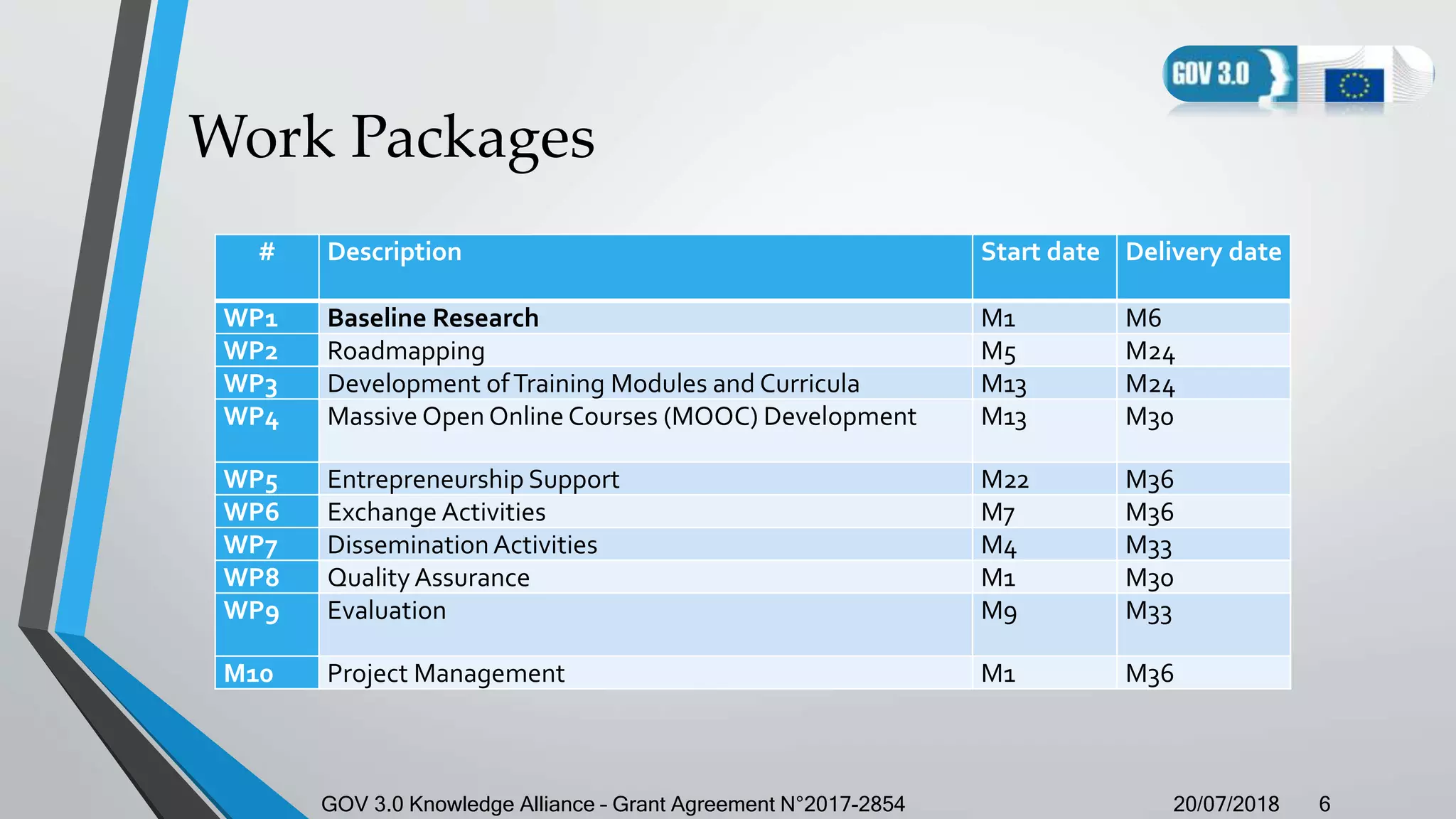
Work Packages
# Description Start date Delivery date
WP1 Baseline Research Μ1 Μ6
WP2 Roadmapping Μ5 Μ24
WP3 Development ofTraining Modules and Curricula M13 M24
WP4 Massive Open Online Courses (MOOC) Development M13 M30
WP5 Entrepreneurship Support M22 M36
WP6 Exchange Activities M7 M36
WP7 Dissemination Activities M4 M33
WP8 Quality Assurance M1 M30
WP9 Evaluation M9 M33
M10 Project Management M1 M36
20/07/2018GOV 3.0 Knowledge Alliance – Grant Agreement N°2017-2854 6
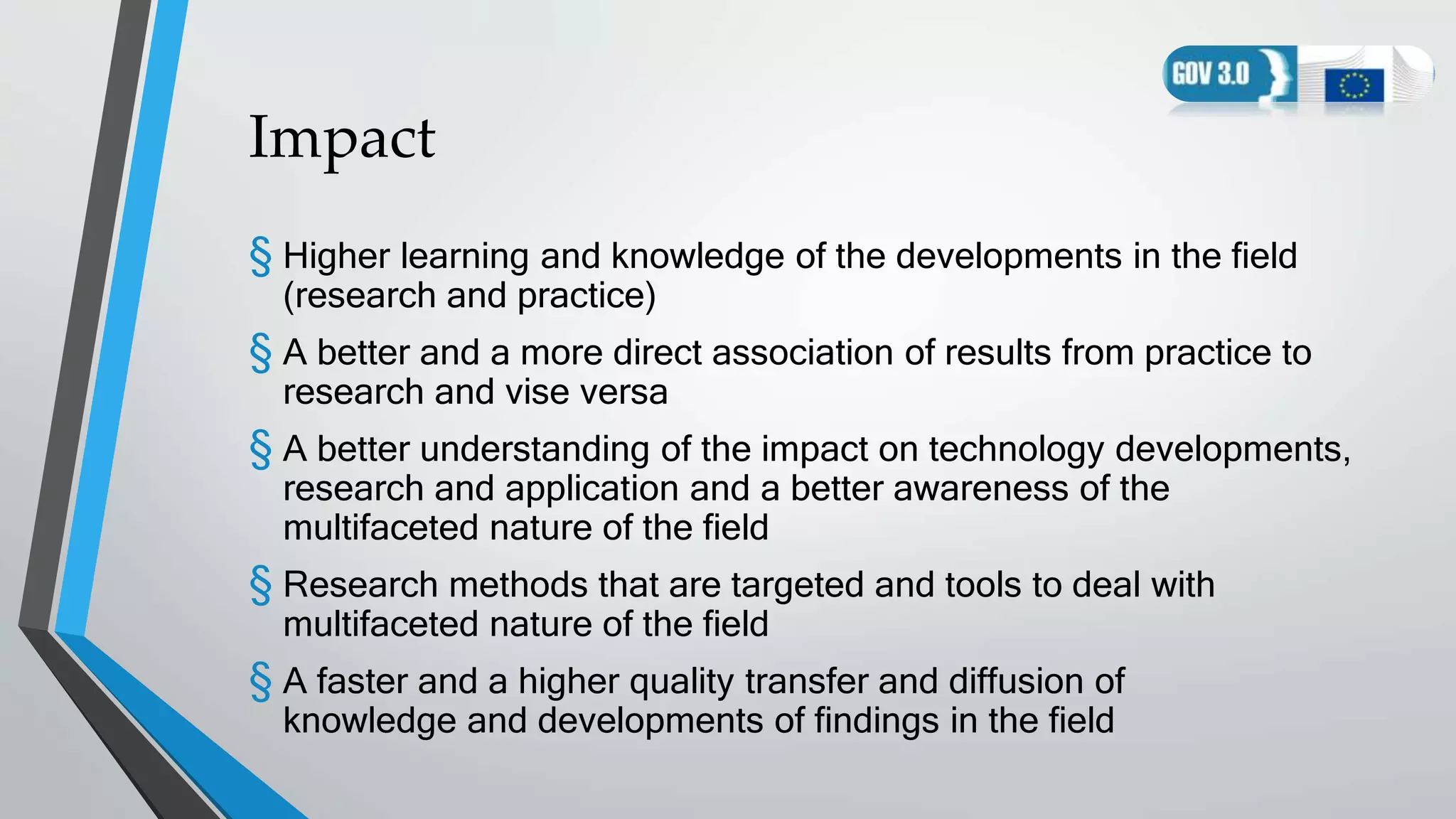
Impact
§ Higher learning and knowledge of the developments in the field
(research and practice)
§ A better and a more direct association of results from practice to
research and vise versa
§ A better understanding of the impact on technology developments,
research and application and a better awareness of the
multifaceted nature of the field
§ Research methods that are targeted and tools to deal with
multifaceted nature of the field
§ A faster and a higher quality transfer and diffusion of
knowledge and developments of findings in the field
What would success look like?
organisations reached by the project through mailing lists 3000
unique visitors of the web site (during the project) 15000
publications in esteemed journals and conferences 60
workshops organised by the project 15
conferences co-organised by the project 8
participants reached by workshops and conferences organised by the projects 1500
external events (workshops and conferences attended by the project, where presentations
are made)
30
Social Media followers (Linkedin, Twitter, Facebook, Google+) of the project 1000
online training modules within the project MOOC 15
training modules defined at Master or pre-graduate or executive curriculum 30
press releases to be issued by the project 3
electronic newsletters to be published by the project 12
Public Sector organisations to be engaged by the project (external to the consortium) 50
scientific communities (management, public administration, ICT, etc.) to be engaged 10
PhD, Master and Graduate students to be exchanged through short term visits among
project partners
16
international competitions for entrepreneurship to be conducted by the project 2
joint research proposals to be submitted by project partners in the area of Open and
Collaborative Governance
3
Work Package 1
§Work package 1 intends to:
set a worldwide baseline for the entire project in terms of
knowledge already generated in the field of ICT-enabled
governance
identify the needs that the training material developed will have to
target.
§Task 1: Mapping the status of Electronic Governance
research and practice worldwide
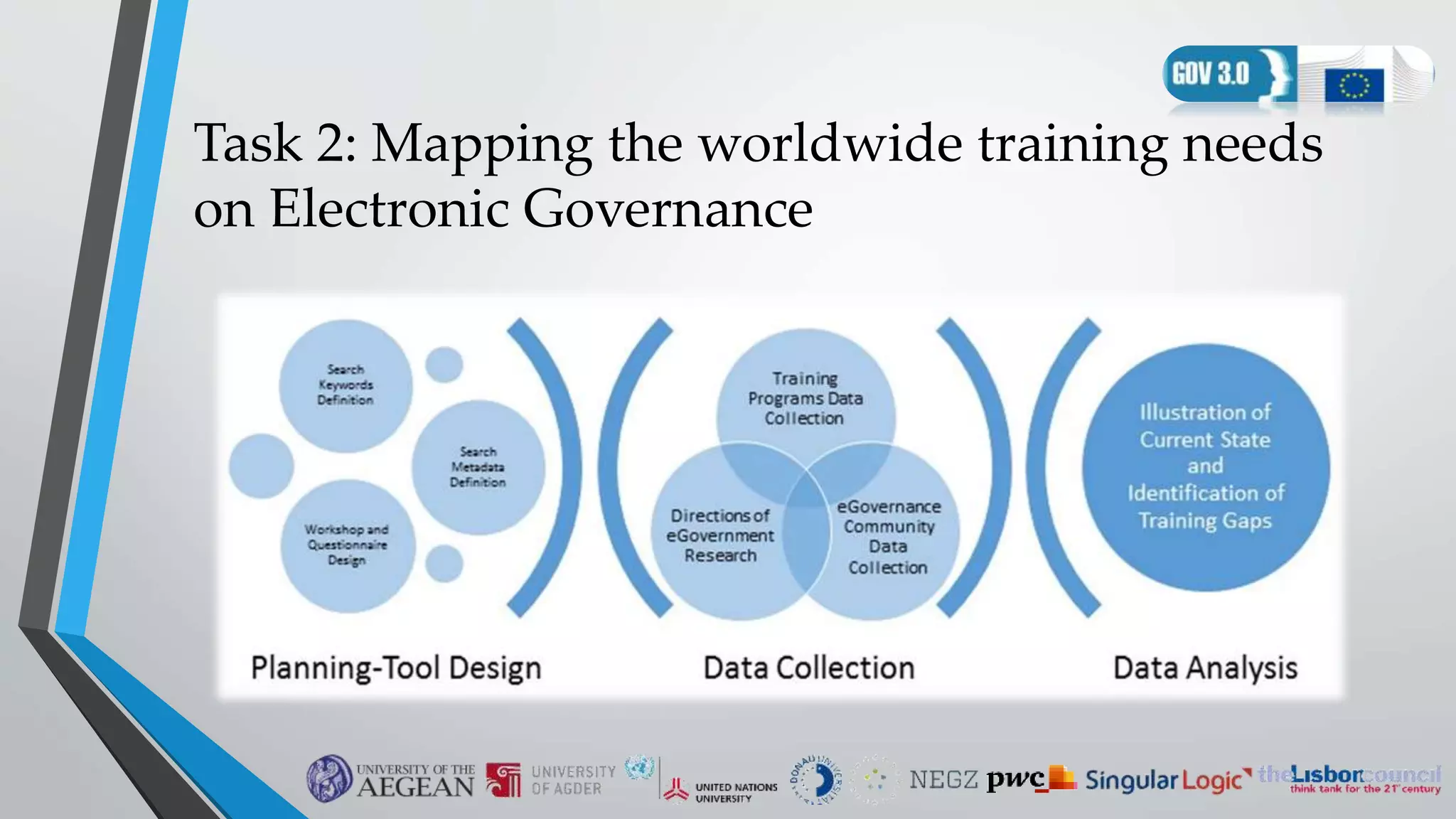
§Task 2: Mapping the worldwide training needs on Electronic
Governance
20/07/2018ERASMUS+ Knowledge Alliance: GOV 3.0 9
Task 2: Mapping the worldwide training needs
on Electronic Governance
PART II : Workshop Objectives
Workshop Objectives
20/07/2018ERASMUS+ Knowledge Alliance: GOV 3.0 12
Mapping the worldwide training needs on Electronic
Governance
The main focus of this workshop is to identify
1. The online training modules that will be developed in
MOOC
2. The training modules defined at Master or pre-
graduate or executive curriculum
PART III : Fill in the questionnaire
Training needs in e-Government questionnaire
§ https://www.questionpro.com/a/TakeSurvey?tt=r2fBxHz/CBE%3D
PART IV : Workshop Topics / Questions -
Discussion
1. What are the current training needs and which of
them are covered by existing curricula?
§ How do the current training programs in eGovernment and
eParticipation correspond to the state of the art in the domain?
§ Is there a need to focus more on the emerging Government 3.0
technologies in the education programs?
20/07/2018ERASMUS+ Knowledge Alliance: GOV 3.0 16
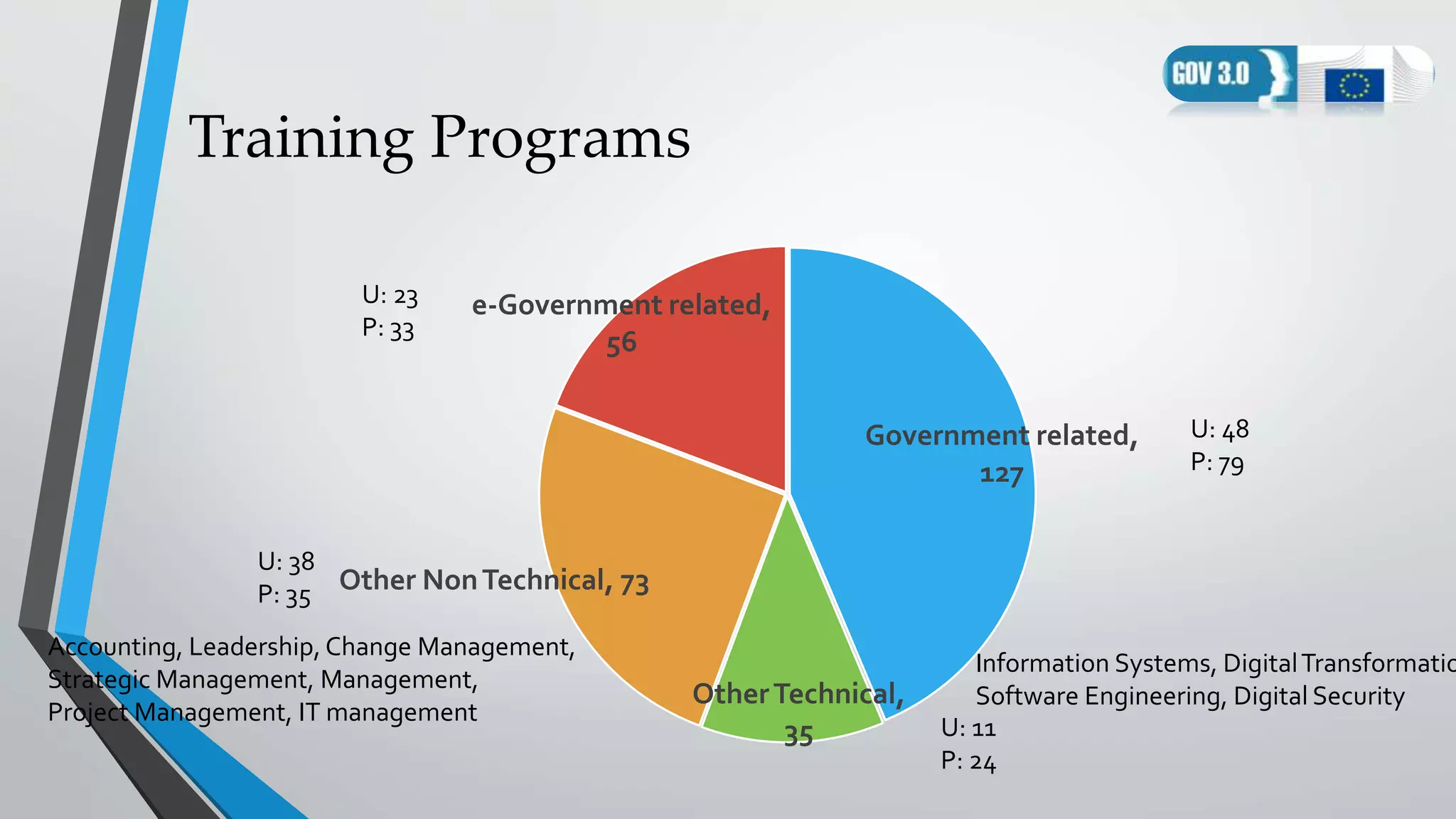
Training Programs
Government related,
127
OtherTechnical,
35
Other NonTechnical, 73
e-Government related,
56
U: 48
P: 79
U: 38
P: 35
U: 11
P: 24
U: 23
P: 33
Information Systems, DigitalTransformatio
Software Engineering, Digital Security
Accounting, Leadership, Change Management,
Strategic Management, Management,
Project Management, IT management
Training Programs
Government related, 127
OtherTechnical, 35
Other NonTechnical, 73
e-Government related, 56
U: 48
P: 79
U: 38
P: 35
U: 11
P: 24
U: 23
P: 33
2. What type of program will answer to the definition
of eGovernment 3.0?
§ What type of content should be found?
§ How should it be delivered? (online, class, joint program, executive
MBA, erasmus network, in job training etc.)
20/07/2018ERASMUS+ Knowledge Alliance: GOV 3.0 19
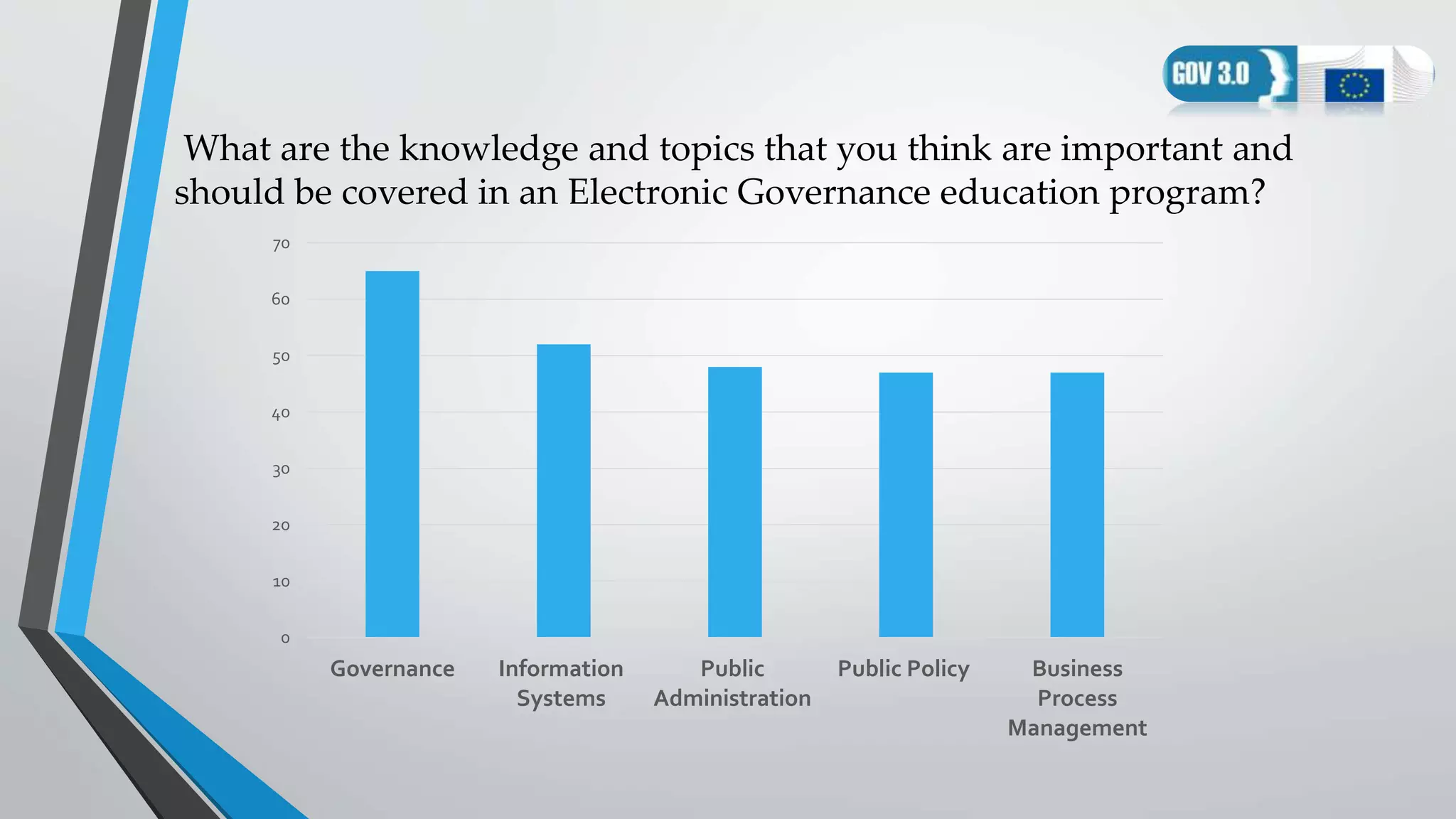
What are the knowledge and topics that you think are important and
should be covered in an Electronic Governance education program?
0
10
20
30
40
50
60
70
Governance Information
Systems
Public
Administration
Public Policy Business
Process
Management
Teaching Method
§ Lectures-Contact Sessions-Seminars- On-Site-Traditional-Class 91
§ Online 13
§ Distance 6
§ Group discussions 3
§ Dual Mode (Online and Local Support) 2
§ Workshops 2
§ Group assignments / Problem-based studies 2
§ Home assignments / Individual Assignments 2
§ Class teaching and distance 1
§ Internship with industry/ government in e-Governance projects1
§ Study visits 1
3. For whom is this eGovenment 3.0 Master addressed
in priority?
§ What are the expectations and needs in terms of capacity building for
eGovenment 3.0?
§ What type of skills should be highlighted by this program?
20/07/2018ERASMUS+ Knowledge Alliance: GOV 3.0 22
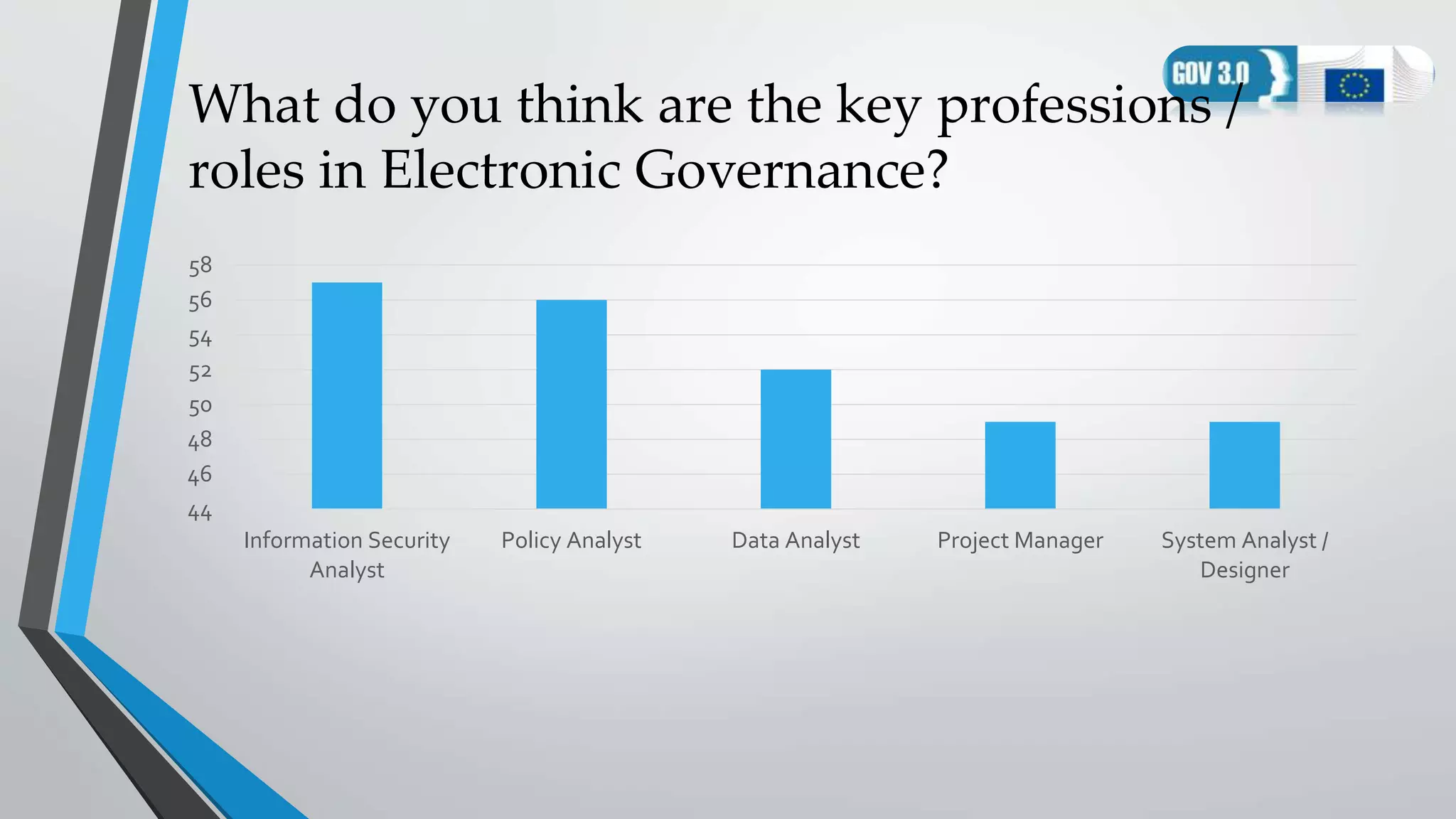
What do you think are the key professions /
roles in Electronic Governance?
44
46
48
50
52
54
56
58
Information Security
Analyst
Policy Analyst Data Analyst Project Manager System Analyst /
Designer
What do you think are the needed skills in
Electronic Governance?
72
73
74
75
76
77
78
79
80
81
4. Which are the courses that should be included in
an Electronic Governance program at graduate
level?
20/07/2018ERASMUS+ Knowledge Alliance: GOV 3.0 25
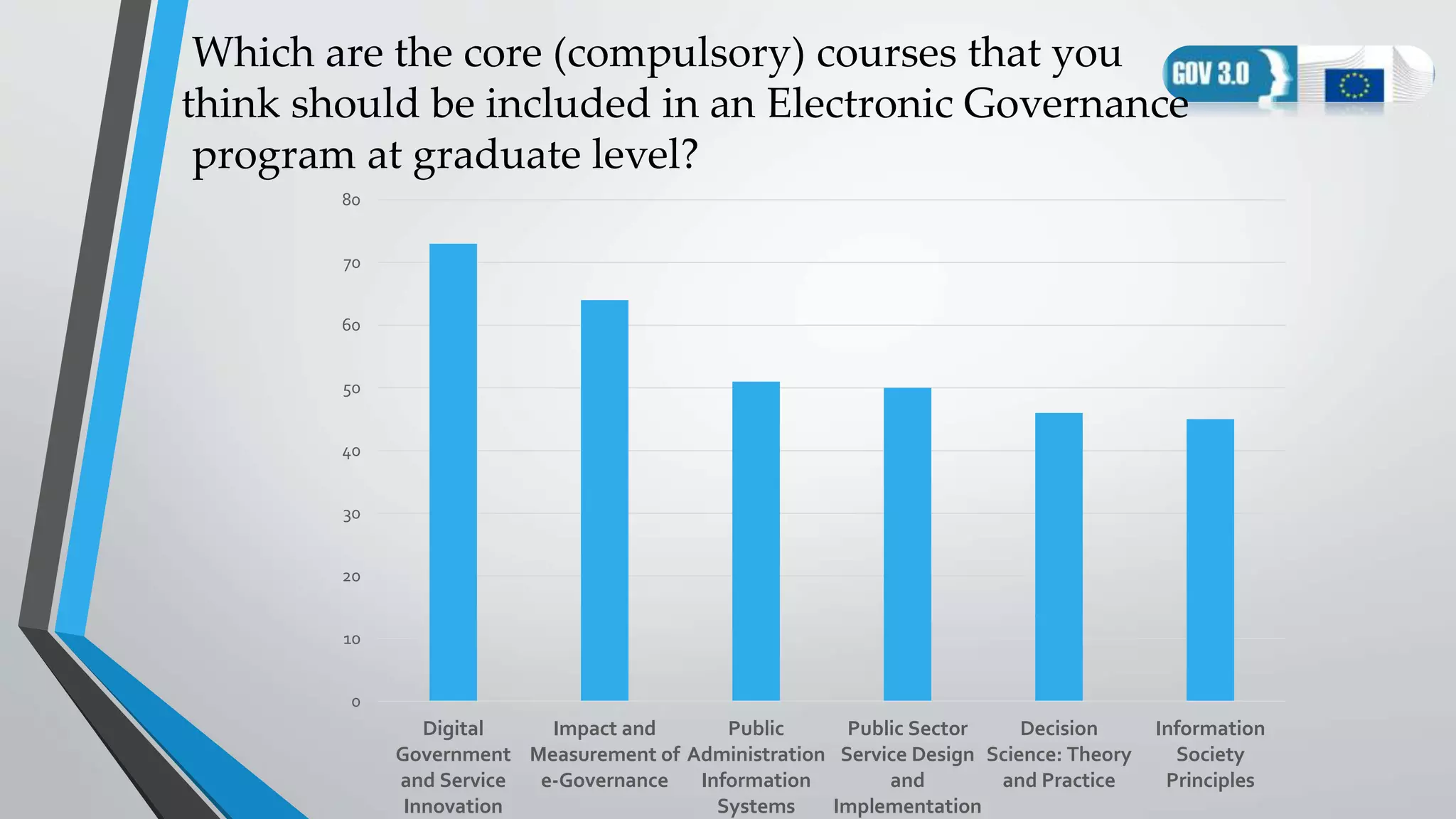
Which are the core (compulsory) courses that you
think should be included in an Electronic Governance
program at graduate level?
0
10
20
30
40
50
60
70
80
Digital
Government
and Service
Innovation
Impact and
Measurement of
e-Governance
Public
Administration
Information
Systems
Public Sector
Service Design
and
Implementation
Decision
Science: Theory
and Practice
Information
Society
Principles
5. Which specific innovative modules (part of a
larger course that focuses on a single topic)
would you suggest to be included in e-
Governance courses?
20/07/2018ERASMUS+ Knowledge Alliance: GOV 3.0 27
§ How they should be provided and organised?
§ What type of pedagogy should be applied for them? (the method and
practice of teaching)
Which specific innovative modules (part of a larger
course that focuses on a single topic) would you suggest to be
included in e-Governance courses?
48
50
52
54
56
58
60
62
eGovernment
Strategy
Data Analytics eGovernment
Assessment
Smart Governance
/ Government
Big Data Transparency and
Trust in Decision
Making
6. What type of learning outcome do we expect from
an eGovenment 3.0 program?
§ What are the objectives?
§ Is it relevant to define specializations in the eGovernment 3.0
program?
20/07/2018ERASMUS+ Knowledge Alliance: GOV 3.0 29
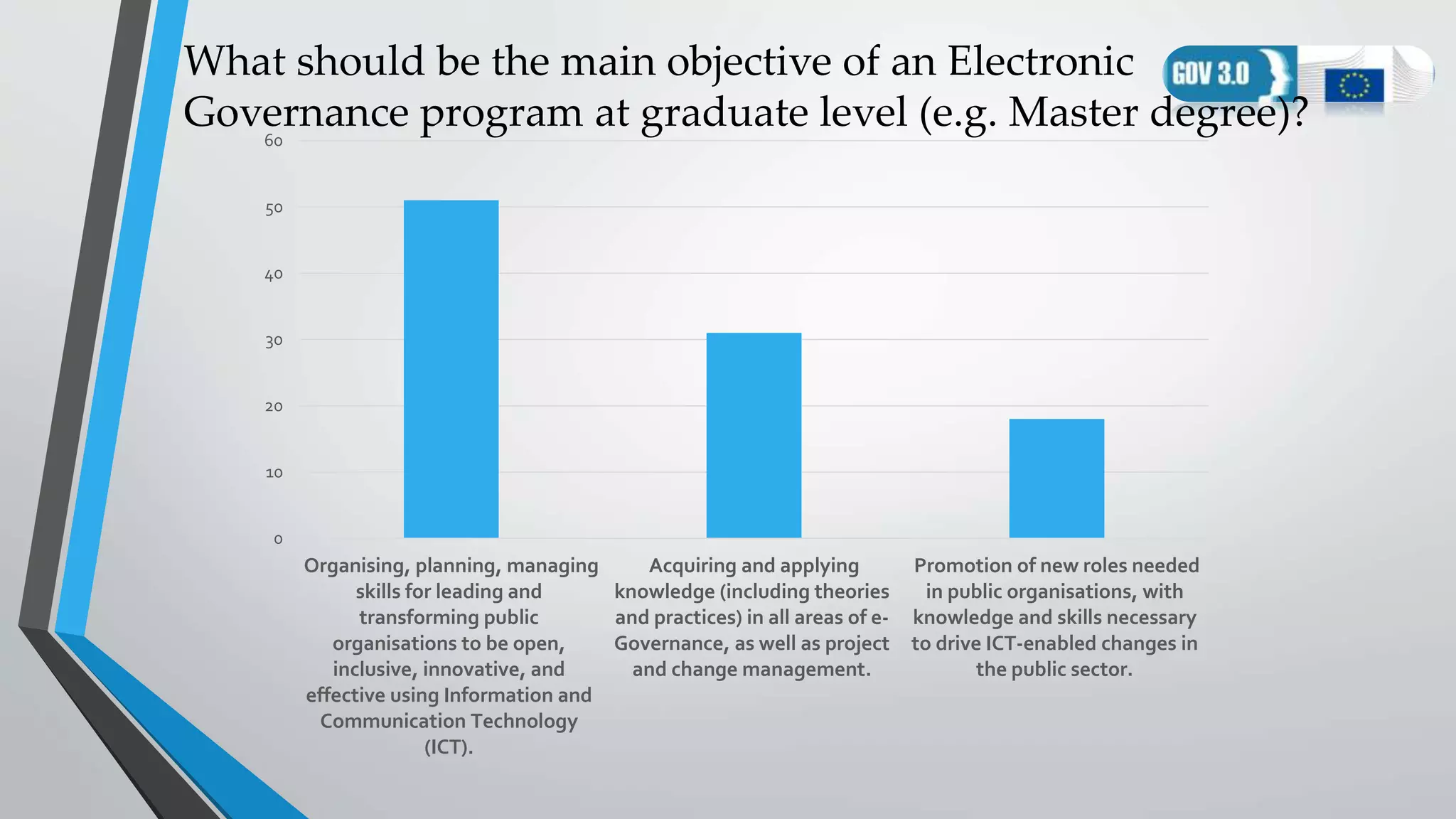
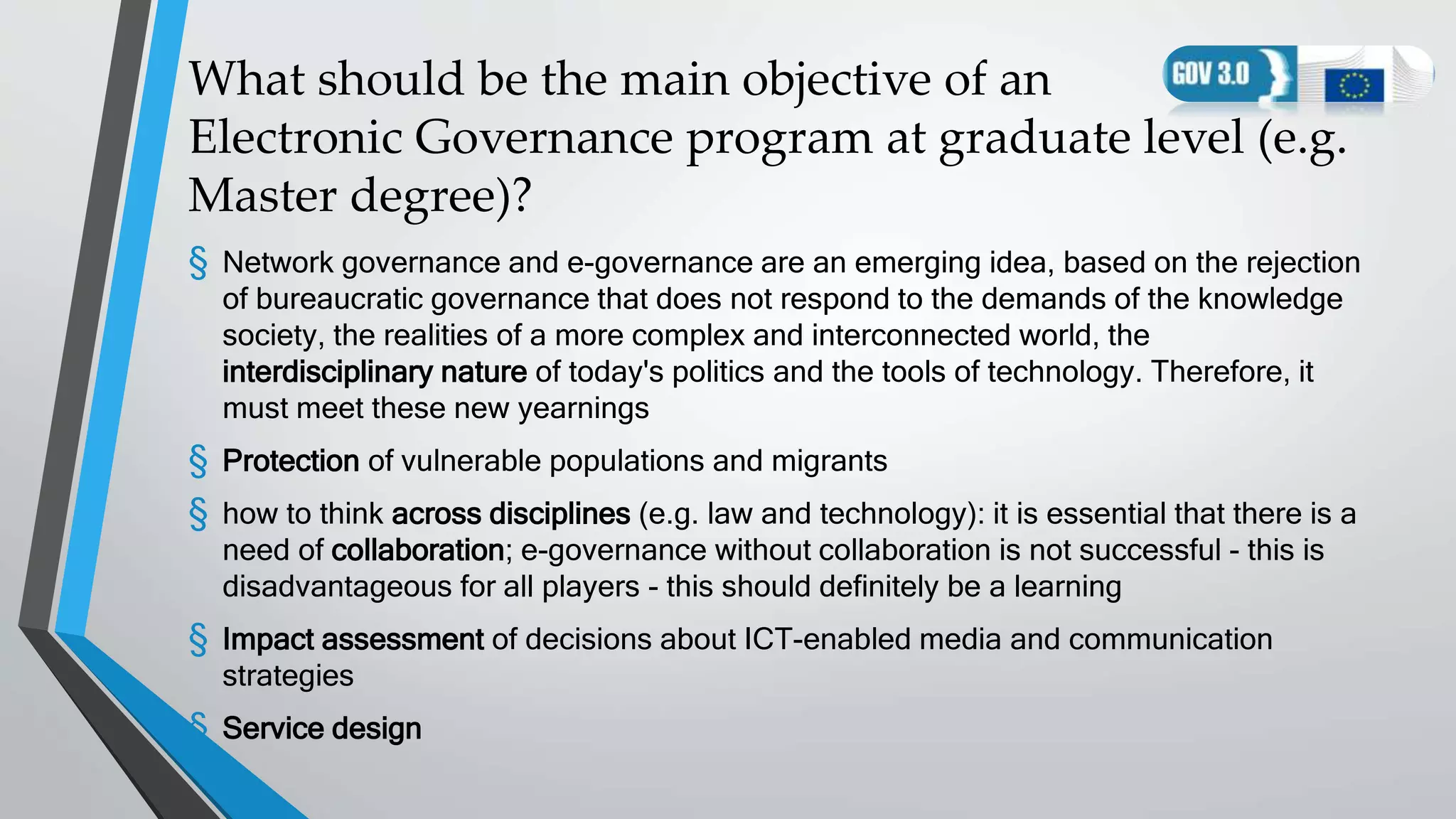
What should be the main objective of an Electronic
Governance program at graduate level (e.g. Master degree)?
0
10
20
30
40
50
60
Organising, planning, managing
skills for leading and
transforming public
organisations to be open,
inclusive, innovative, and
effective using Information and
Communication Technology
(ICT).
Acquiring and applying
knowledge (including theories
and practices) in all areas of e-
Governance, as well as project
and change management.
Promotion of new roles needed
in public organisations, with
knowledge and skills necessary
to drive ICT-enabled changes in
the public sector.
What should be the main objective of an
Electronic Governance program at graduate level (e.g.
Master degree)?
§ Network governance and e-governance are an emerging idea, based on the rejection
of bureaucratic governance that does not respond to the demands of the knowledge
society, the realities of a more complex and interconnected world, the
interdisciplinary nature of today's politics and the tools of technology. Therefore, it
must meet these new yearnings
§ Protection of vulnerable populations and migrants
§ how to think across disciplines (e.g. law and technology): it is essential that there is a
need of collaboration; e-governance without collaboration is not successful - this is
disadvantageous for all players - this should definitely be a learning
§ Impact assessment of decisions about ICT-enabled media and communication
strategies
§ Service design
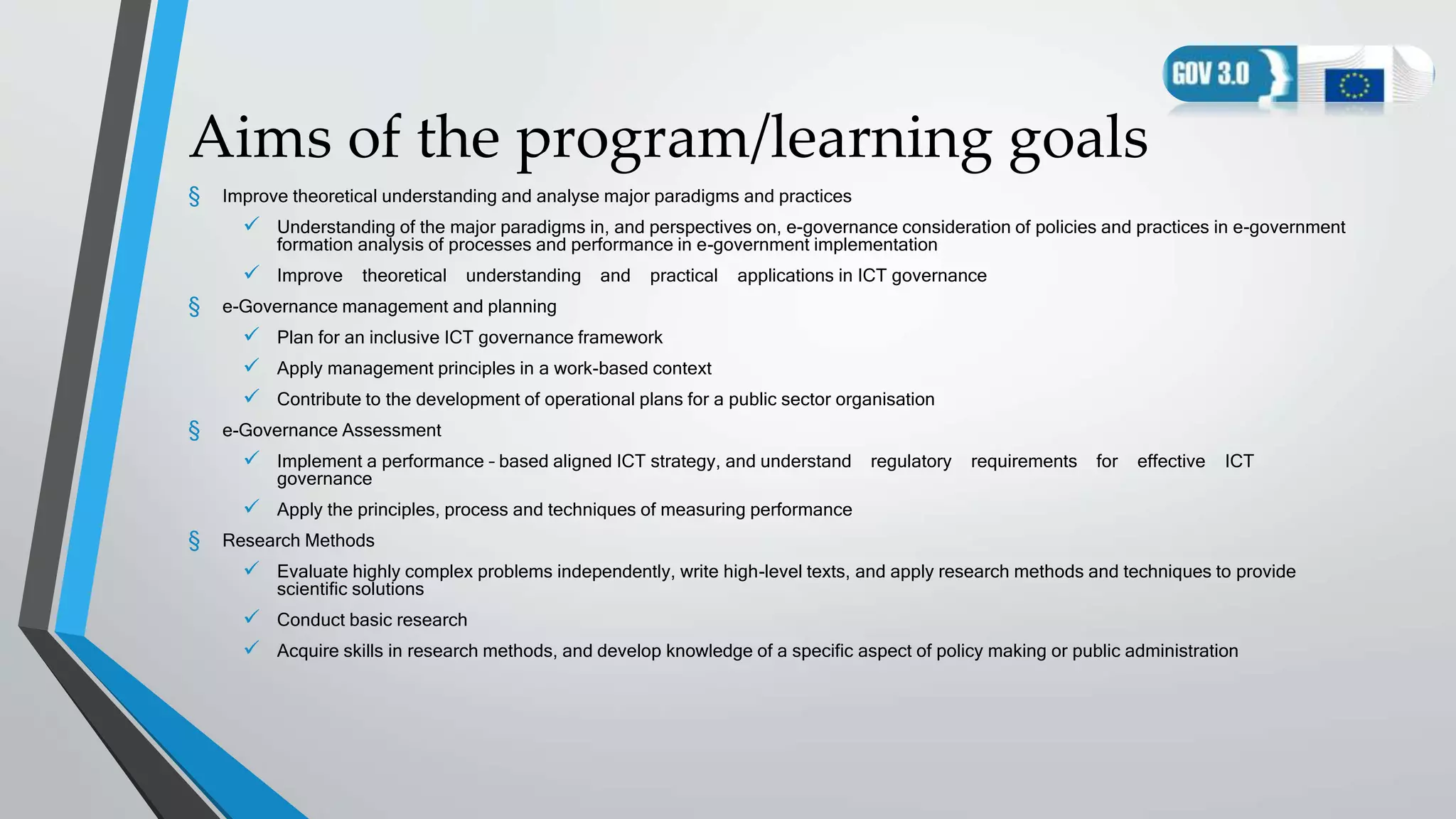
Aims of the program/learning goals
§ Improve theoretical understanding and analyse major paradigms and practices
 Understanding of the major paradigms in, and perspectives on, e-governance consideration of policies and practices in e-government
formation analysis of processes and performance in e-government implementation
 Improve theoretical understanding and practical applications in ICT governance
§ e-Governance management and planning
 Plan for an inclusive ICT governance framework
 Apply management principles in a work-based context
 Contribute to the development of operational plans for a public sector organisation
§ e-Governance Assessment
 Implement a performance – based aligned ICT strategy, and understand regulatory requirements for effective ICT
governance
 Apply the principles, process and techniques of measuring performance
§ Research Methods
 Evaluate highly complex problems independently, write high-level texts, and apply research methods and techniques to provide
scientific solutions
 Conduct basic research
 Acquire skills in research methods, and develop knowledge of a specific aspect of policy making or public administration
Aims of the program/learning goals
§ Sectorial Specialisation
 Specialises in separate sub-disciplines. Advanced Public Policy Management, Advanced Human Resource
Management, and Advanced Public Financial Management.
 Offers a global vision on the phenomenon of smart cities, the impact of new technologies in the public sector and
the latest methodologies applied to the development of new services for citizens.
§ General Skills
 Provide qualifying learners with: substantive, theoretical and intellectual knowledge, cognitive and research
skills such as critical reasoning, data mining and processing, problem solving, interpretation, analytical and
evaluative skills; communication skills and a normative basis in line with internationally accepted dimensions of
“good governance”.
 Acquire skills in written communication, planning, budgeting, decision-making, and collaboration
 Collect, analyse, organise and critically evaluate information.
§ Decision Making
 Examine the relevant tools required to make sense of raw information and enhance effective decision-making, set
priorities and target needed interventions
 Apply tools for setting strategic direction
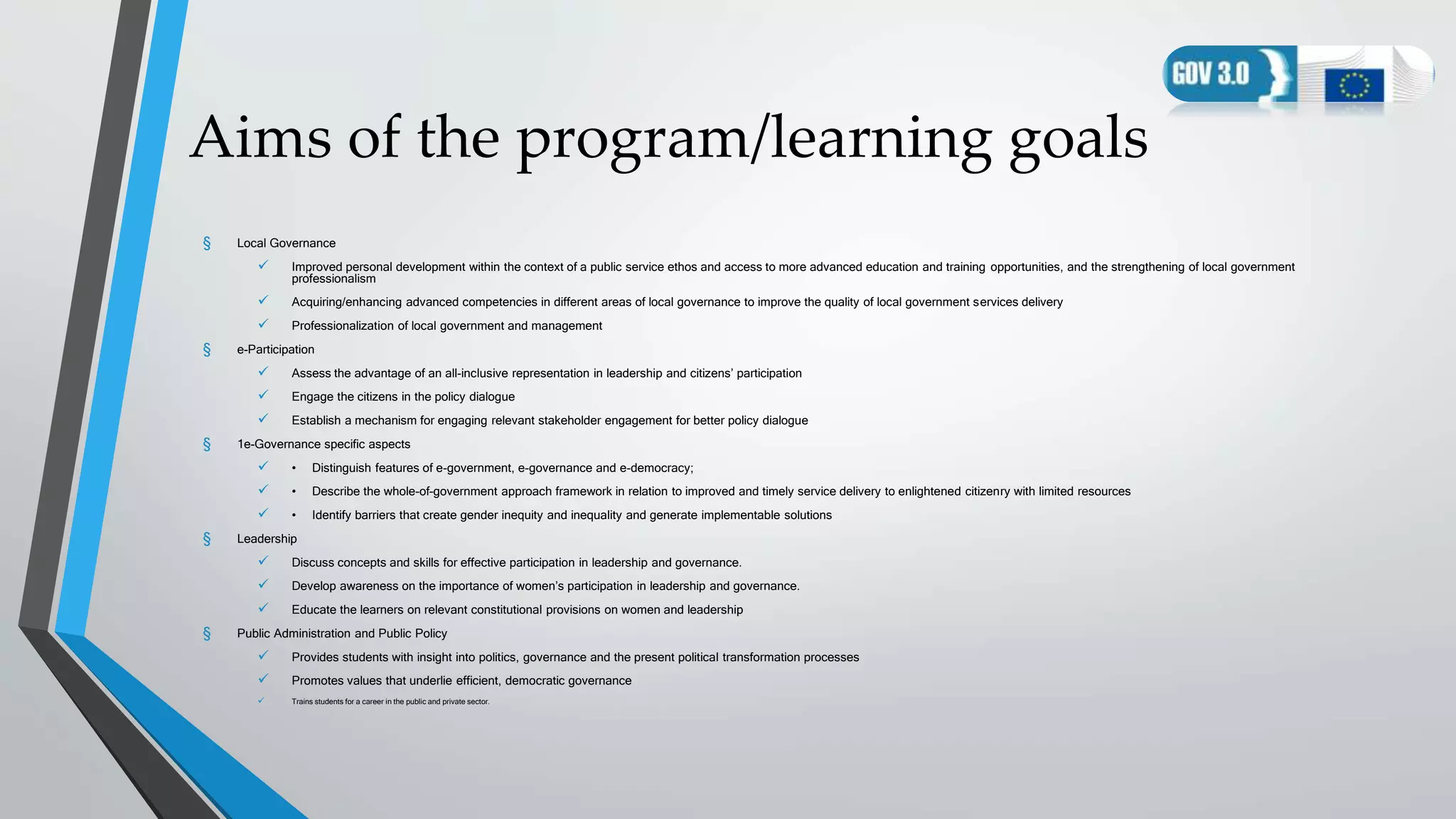
Aims of the program/learning goals
§ Local Governance
 Improved personal development within the context of a public service ethos and access to more advanced education and training opportunities, and the strengthening of local government
professionalism
 Acquiring/enhancing advanced competencies in different areas of local governance to improve the quality of local government services delivery
 Professionalization of local government and management
§ e-Participation
 Assess the advantage of an all-inclusive representation in leadership and citizens’ participation
 Engage the citizens in the policy dialogue
 Establish a mechanism for engaging relevant stakeholder engagement for better policy dialogue
§ 1e-Governance specific aspects
 • Distinguish features of e-government, e-governance and e-democracy;
 • Describe the whole-of–government approach framework in relation to improved and timely service delivery to enlightened citizenry with limited resources
 • Identify barriers that create gender inequity and inequality and generate implementable solutions
§ Leadership
 Discuss concepts and skills for effective participation in leadership and governance.
 Develop awareness on the importance of women’s participation in leadership and governance.
 Educate the learners on relevant constitutional provisions on women and leadership
§ Public Administration and Public Policy
 Provides students with insight into politics, governance and the present political transformation processes
 Promotes values that underlie efficient, democratic governance
 Trains students for a career in the public and private sector.
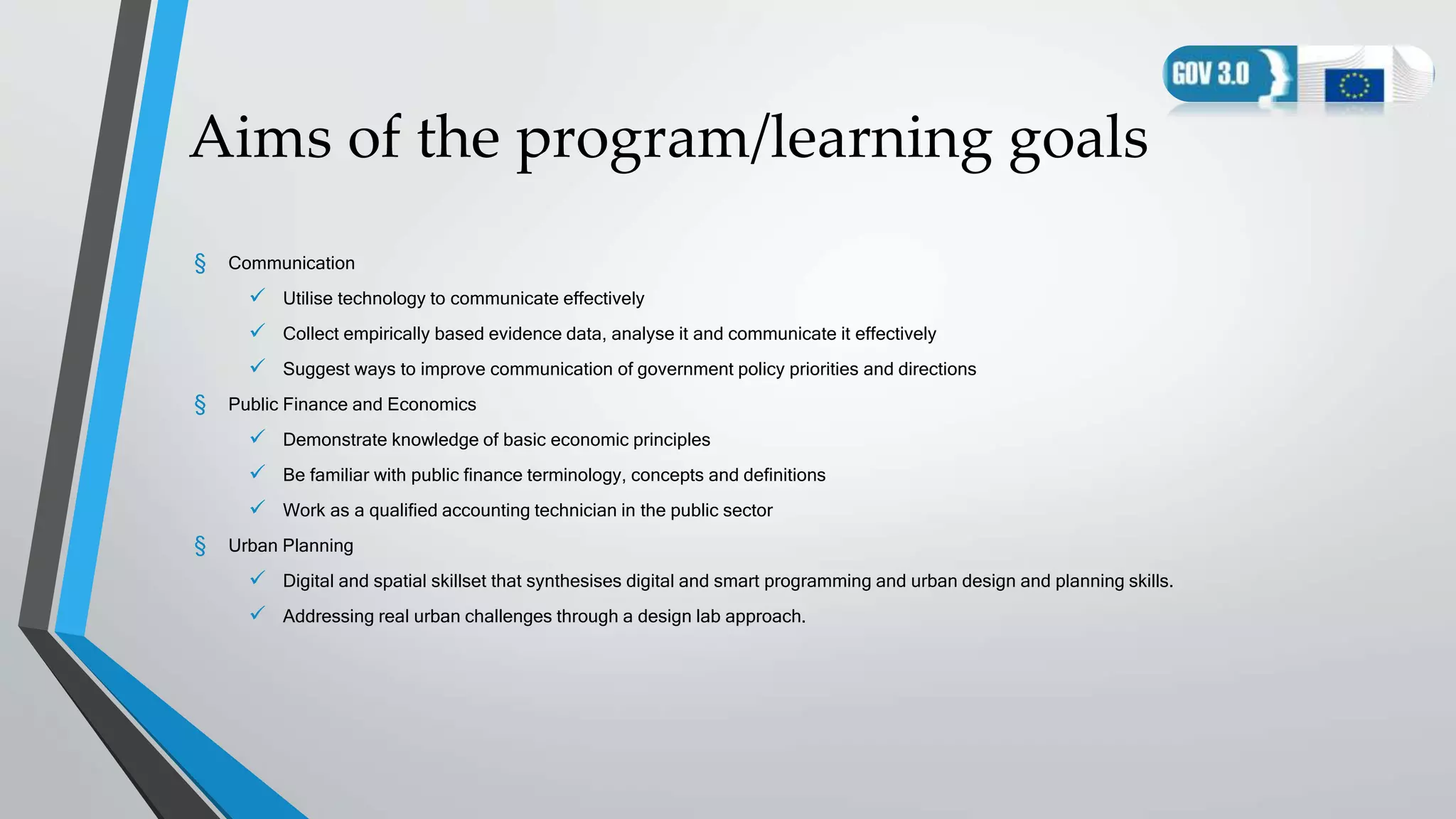
Aims of the program/learning goals
§ Communication
 Utilise technology to communicate effectively
 Collect empirically based evidence data, analyse it and communicate it effectively
 Suggest ways to improve communication of government policy priorities and directions
§ Public Finance and Economics
 Demonstrate knowledge of basic economic principles
 Be familiar with public finance terminology, concepts and definitions
 Work as a qualified accounting technician in the public sector
§ Urban Planning
 Digital and spatial skillset that synthesises digital and smart programming and urban design and planning skills.
 Addressing real urban challenges through a design lab approach.
7. Is there any relevant training program to
eGovenment 3.0?
Next Steps
§ Explore/Focus e-Government programs in more detail especially their
courses
 Categorizing in fields (e.g. PA, CS, Management) clusters (Security, Social Media,
Data, etc.)
 Rank clusters according to programs
§ Bridge task 1 and task 2. Find out(ask them) which research areas
from task 1 are covered from existing e-Government programs and
specifically from which courses.
 And if not, are they planning them. In which courses?
Contact us:
 Website: https://gov30.eu
 Twitter: @Government_30
Dimitris Sarantis
Soumaya Ben Dhaou

e-Government Assessment

  • 1.
    ERASMUS+ Knowledge Alliance Scientific foundationstraining and entrepreneurship activities in the domain of ICT – enabled Governance Workshop II: Gov 3.0 Curriculum Development Alexander Ronzhyn, NEGZ Gabriela Viale Pereira, DUK Frank Danielsen, AGDER Dimitris Sarantis, UNU-EGOV Soumaya Ben Dhaou, UNU-EGOV Harris Alexopoulos, UAEGEAN-DGRC The 8th Samos 2018 Summit On ICT-enabled Governance : “Government 3.0"
  • 2.
    Workshop Structure § TaskPresentation (15 minutes) § Workshop Objectives (10 minutes) §Fill in the questionnaire (20 minutes) § Workshop Topics / Questions - Discussion (45 minutes) 20/07/2018ERASMUS+ Knowledge Alliance: GOV 3.0 2
  • 3.
    PART I :The task
  • 4.
  • 5.
  • 6.
    Work Packages # DescriptionStart date Delivery date WP1 Baseline Research Μ1 Μ6 WP2 Roadmapping Μ5 Μ24 WP3 Development ofTraining Modules and Curricula M13 M24 WP4 Massive Open Online Courses (MOOC) Development M13 M30 WP5 Entrepreneurship Support M22 M36 WP6 Exchange Activities M7 M36 WP7 Dissemination Activities M4 M33 WP8 Quality Assurance M1 M30 WP9 Evaluation M9 M33 M10 Project Management M1 M36 20/07/2018GOV 3.0 Knowledge Alliance – Grant Agreement N°2017-2854 6
  • 7.
    Impact § Higher learningand knowledge of the developments in the field (research and practice) § A better and a more direct association of results from practice to research and vise versa § A better understanding of the impact on technology developments, research and application and a better awareness of the multifaceted nature of the field § Research methods that are targeted and tools to deal with multifaceted nature of the field § A faster and a higher quality transfer and diffusion of knowledge and developments of findings in the field
  • 8.
    What would successlook like? organisations reached by the project through mailing lists 3000 unique visitors of the web site (during the project) 15000 publications in esteemed journals and conferences 60 workshops organised by the project 15 conferences co-organised by the project 8 participants reached by workshops and conferences organised by the projects 1500 external events (workshops and conferences attended by the project, where presentations are made) 30 Social Media followers (Linkedin, Twitter, Facebook, Google+) of the project 1000 online training modules within the project MOOC 15 training modules defined at Master or pre-graduate or executive curriculum 30 press releases to be issued by the project 3 electronic newsletters to be published by the project 12 Public Sector organisations to be engaged by the project (external to the consortium) 50 scientific communities (management, public administration, ICT, etc.) to be engaged 10 PhD, Master and Graduate students to be exchanged through short term visits among project partners 16 international competitions for entrepreneurship to be conducted by the project 2 joint research proposals to be submitted by project partners in the area of Open and Collaborative Governance 3
  • 9.
    Work Package 1 §Workpackage 1 intends to: set a worldwide baseline for the entire project in terms of knowledge already generated in the field of ICT-enabled governance identify the needs that the training material developed will have to target. §Task 1: Mapping the status of Electronic Governance research and practice worldwide §Task 2: Mapping the worldwide training needs on Electronic Governance 20/07/2018ERASMUS+ Knowledge Alliance: GOV 3.0 9
  • 10.
    Task 2: Mappingthe worldwide training needs on Electronic Governance
  • 11.
    PART II :Workshop Objectives
  • 12.
    Workshop Objectives 20/07/2018ERASMUS+ KnowledgeAlliance: GOV 3.0 12 Mapping the worldwide training needs on Electronic Governance The main focus of this workshop is to identify 1. The online training modules that will be developed in MOOC 2. The training modules defined at Master or pre- graduate or executive curriculum
  • 13.
    PART III :Fill in the questionnaire
  • 14.
    Training needs ine-Government questionnaire § https://www.questionpro.com/a/TakeSurvey?tt=r2fBxHz/CBE%3D
  • 15.
    PART IV :Workshop Topics / Questions - Discussion
  • 16.
    1. What arethe current training needs and which of them are covered by existing curricula? § How do the current training programs in eGovernment and eParticipation correspond to the state of the art in the domain? § Is there a need to focus more on the emerging Government 3.0 technologies in the education programs? 20/07/2018ERASMUS+ Knowledge Alliance: GOV 3.0 16
  • 17.
    Training Programs Government related, 127 OtherTechnical, 35 OtherNonTechnical, 73 e-Government related, 56 U: 48 P: 79 U: 38 P: 35 U: 11 P: 24 U: 23 P: 33 Information Systems, DigitalTransformatio Software Engineering, Digital Security Accounting, Leadership, Change Management, Strategic Management, Management, Project Management, IT management
  • 18.
    Training Programs Government related,127 OtherTechnical, 35 Other NonTechnical, 73 e-Government related, 56 U: 48 P: 79 U: 38 P: 35 U: 11 P: 24 U: 23 P: 33
  • 19.
    2. What typeof program will answer to the definition of eGovernment 3.0? § What type of content should be found? § How should it be delivered? (online, class, joint program, executive MBA, erasmus network, in job training etc.) 20/07/2018ERASMUS+ Knowledge Alliance: GOV 3.0 19
  • 20.
    What are theknowledge and topics that you think are important and should be covered in an Electronic Governance education program? 0 10 20 30 40 50 60 70 Governance Information Systems Public Administration Public Policy Business Process Management
  • 21.
    Teaching Method § Lectures-ContactSessions-Seminars- On-Site-Traditional-Class 91 § Online 13 § Distance 6 § Group discussions 3 § Dual Mode (Online and Local Support) 2 § Workshops 2 § Group assignments / Problem-based studies 2 § Home assignments / Individual Assignments 2 § Class teaching and distance 1 § Internship with industry/ government in e-Governance projects1 § Study visits 1
  • 22.
    3. For whomis this eGovenment 3.0 Master addressed in priority? § What are the expectations and needs in terms of capacity building for eGovenment 3.0? § What type of skills should be highlighted by this program? 20/07/2018ERASMUS+ Knowledge Alliance: GOV 3.0 22
  • 23.
    What do youthink are the key professions / roles in Electronic Governance? 44 46 48 50 52 54 56 58 Information Security Analyst Policy Analyst Data Analyst Project Manager System Analyst / Designer
  • 24.
    What do youthink are the needed skills in Electronic Governance? 72 73 74 75 76 77 78 79 80 81
  • 25.
    4. Which arethe courses that should be included in an Electronic Governance program at graduate level? 20/07/2018ERASMUS+ Knowledge Alliance: GOV 3.0 25
  • 26.
    Which are thecore (compulsory) courses that you think should be included in an Electronic Governance program at graduate level? 0 10 20 30 40 50 60 70 80 Digital Government and Service Innovation Impact and Measurement of e-Governance Public Administration Information Systems Public Sector Service Design and Implementation Decision Science: Theory and Practice Information Society Principles
  • 27.
    5. Which specificinnovative modules (part of a larger course that focuses on a single topic) would you suggest to be included in e- Governance courses? 20/07/2018ERASMUS+ Knowledge Alliance: GOV 3.0 27 § How they should be provided and organised? § What type of pedagogy should be applied for them? (the method and practice of teaching)
  • 28.
    Which specific innovativemodules (part of a larger course that focuses on a single topic) would you suggest to be included in e-Governance courses? 48 50 52 54 56 58 60 62 eGovernment Strategy Data Analytics eGovernment Assessment Smart Governance / Government Big Data Transparency and Trust in Decision Making
  • 29.
    6. What typeof learning outcome do we expect from an eGovenment 3.0 program? § What are the objectives? § Is it relevant to define specializations in the eGovernment 3.0 program? 20/07/2018ERASMUS+ Knowledge Alliance: GOV 3.0 29
  • 30.
    What should bethe main objective of an Electronic Governance program at graduate level (e.g. Master degree)? 0 10 20 30 40 50 60 Organising, planning, managing skills for leading and transforming public organisations to be open, inclusive, innovative, and effective using Information and Communication Technology (ICT). Acquiring and applying knowledge (including theories and practices) in all areas of e- Governance, as well as project and change management. Promotion of new roles needed in public organisations, with knowledge and skills necessary to drive ICT-enabled changes in the public sector.
  • 31.
    What should bethe main objective of an Electronic Governance program at graduate level (e.g. Master degree)? § Network governance and e-governance are an emerging idea, based on the rejection of bureaucratic governance that does not respond to the demands of the knowledge society, the realities of a more complex and interconnected world, the interdisciplinary nature of today's politics and the tools of technology. Therefore, it must meet these new yearnings § Protection of vulnerable populations and migrants § how to think across disciplines (e.g. law and technology): it is essential that there is a need of collaboration; e-governance without collaboration is not successful - this is disadvantageous for all players - this should definitely be a learning § Impact assessment of decisions about ICT-enabled media and communication strategies § Service design
  • 32.
    Aims of theprogram/learning goals § Improve theoretical understanding and analyse major paradigms and practices  Understanding of the major paradigms in, and perspectives on, e-governance consideration of policies and practices in e-government formation analysis of processes and performance in e-government implementation  Improve theoretical understanding and practical applications in ICT governance § e-Governance management and planning  Plan for an inclusive ICT governance framework  Apply management principles in a work-based context  Contribute to the development of operational plans for a public sector organisation § e-Governance Assessment  Implement a performance – based aligned ICT strategy, and understand regulatory requirements for effective ICT governance  Apply the principles, process and techniques of measuring performance § Research Methods  Evaluate highly complex problems independently, write high-level texts, and apply research methods and techniques to provide scientific solutions  Conduct basic research  Acquire skills in research methods, and develop knowledge of a specific aspect of policy making or public administration
  • 33.
    Aims of theprogram/learning goals § Sectorial Specialisation  Specialises in separate sub-disciplines. Advanced Public Policy Management, Advanced Human Resource Management, and Advanced Public Financial Management.  Offers a global vision on the phenomenon of smart cities, the impact of new technologies in the public sector and the latest methodologies applied to the development of new services for citizens. § General Skills  Provide qualifying learners with: substantive, theoretical and intellectual knowledge, cognitive and research skills such as critical reasoning, data mining and processing, problem solving, interpretation, analytical and evaluative skills; communication skills and a normative basis in line with internationally accepted dimensions of “good governance”.  Acquire skills in written communication, planning, budgeting, decision-making, and collaboration  Collect, analyse, organise and critically evaluate information. § Decision Making  Examine the relevant tools required to make sense of raw information and enhance effective decision-making, set priorities and target needed interventions  Apply tools for setting strategic direction
  • 34.
    Aims of theprogram/learning goals § Local Governance  Improved personal development within the context of a public service ethos and access to more advanced education and training opportunities, and the strengthening of local government professionalism  Acquiring/enhancing advanced competencies in different areas of local governance to improve the quality of local government services delivery  Professionalization of local government and management § e-Participation  Assess the advantage of an all-inclusive representation in leadership and citizens’ participation  Engage the citizens in the policy dialogue  Establish a mechanism for engaging relevant stakeholder engagement for better policy dialogue § 1e-Governance specific aspects  • Distinguish features of e-government, e-governance and e-democracy;  • Describe the whole-of–government approach framework in relation to improved and timely service delivery to enlightened citizenry with limited resources  • Identify barriers that create gender inequity and inequality and generate implementable solutions § Leadership  Discuss concepts and skills for effective participation in leadership and governance.  Develop awareness on the importance of women’s participation in leadership and governance.  Educate the learners on relevant constitutional provisions on women and leadership § Public Administration and Public Policy  Provides students with insight into politics, governance and the present political transformation processes  Promotes values that underlie efficient, democratic governance  Trains students for a career in the public and private sector.
  • 35.
    Aims of theprogram/learning goals § Communication  Utilise technology to communicate effectively  Collect empirically based evidence data, analyse it and communicate it effectively  Suggest ways to improve communication of government policy priorities and directions § Public Finance and Economics  Demonstrate knowledge of basic economic principles  Be familiar with public finance terminology, concepts and definitions  Work as a qualified accounting technician in the public sector § Urban Planning  Digital and spatial skillset that synthesises digital and smart programming and urban design and planning skills.  Addressing real urban challenges through a design lab approach.
  • 36.
    7. Is thereany relevant training program to eGovenment 3.0?
  • 37.
    Next Steps § Explore/Focuse-Government programs in more detail especially their courses  Categorizing in fields (e.g. PA, CS, Management) clusters (Security, Social Media, Data, etc.)  Rank clusters according to programs § Bridge task 1 and task 2. Find out(ask them) which research areas from task 1 are covered from existing e-Government programs and specifically from which courses.  And if not, are they planning them. In which courses?
  • 38.
    Contact us:  Website:https://gov30.eu  Twitter: @Government_30 Dimitris Sarantis Soumaya Ben Dhaou

Editor's Notes

  • #18 What does it imply regarding should we concentrate only in MSc or think also other options
  • #19 What does it imply regarding should we concentrate only in MSc or think also other options
  • #26 Bring the results from questionnaire
  • #30 I will bring the aims When we will be doing the clustering should it be a general PA and a specialiasations