Workshop
Digital Governance Science Base:
Domain Structure and Neighboring Domains
Yannis Charalabidis
Professor of Digital Governance
University of the Aegean
yannisx@aegean.gr
Zoi Lachana
Researcher, Ph.D. Candidate
University of the Aegean
zoi@aegean.gr
Panos Keramidis
Student
University of the Aegean
icsd16067@icsd.aegean.gr
PART A
INTRODUCTION TO DGSB INITIATIVE
(Workshop number #09 on the subject)
Why do we need a “science base” for Digital Governance?
 There are hints, since Plato times, that governance has to be treated as a
science
– Plato, Politikos: “… the science of governance, this most difficult but also the most
important of all …”
 There are a lot to be gained, by systematically organizing knowledge and
practice in this important domain, for administration and societies: minimization
of solution time and cost, maximization of administration productivity, avoidance
of failure, better quality of life for citizens
 The neighboring of the Digital Governance domain with other, well – formulated
scientific domains like computer science, management science or law, brings
more value to the experiment
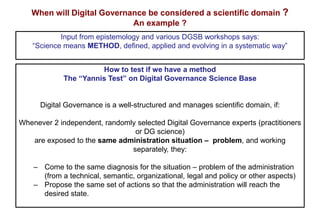
When will Digital Governance be considered a scientific domain ?
An example ?
How to test if we have a method
The “Yannis Test” on Digital Governance Science Base
Digital Governance is a well-structured and manages scientific domain, if:
Whenever 2 independent, randomly selected Digital Governance experts (practitioners
or DG science)
are exposed to the same administration situation – problem, and working
separately, they:
‒ Come to the same diagnosis for the situation – problem of the administration
(from a technical, semantic, organizational, legal and policy or other aspects)
‒ Propose the same set of actions so that the administration will reach the
desired state.
Input from epistemology and various DGSB workshops says:
“Science means METHOD, defined, applied and evolving in a systematic way”
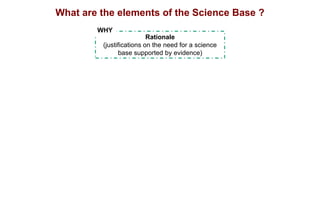
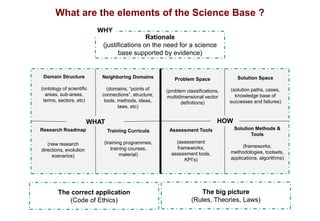
What are the elements of the Science Base ?
Rationale
(justifications on the need for a science
base supported by evidence)
WHY
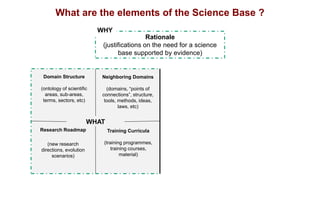
What are the elements of the Science Base ?

Research Roadmap
(new research
directions, evolution
scenarios)
Domain Structure
(ontology of scientific
areas, sub-areas,
terms, sectors, etc)
Neighboring Domains
(domains, “points of
connections”, structure,
tools, methods, ideas,
laws, etc)
Training Curricula
(training programmes,
training courses,
material)
WHAT
Solution Space
(solution paths, cases,
knowledge base of
successes and failures)
Problem Space
(problem classifications,
multidimensional vector
definitions)
Assessment Tools
(assessment
frameworks,
assessment tools,
KPI’s)
Solution Methods &
Tools
(frameworks,
methodologies, toolsets,
applications, algorithms)
HOW
Rationale
(justifications on the need for a science
base supported by evidence)
WHY
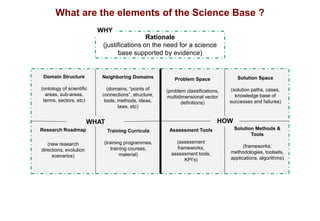
What are the elements of the Science Base ?

Research Roadmap
(new research
directions, evolution
scenarios)
Domain Structure
(ontology of scientific
areas, sub-areas,
terms, sectors, etc)
Neighboring Domains
(domains, “points of
connections”, structure,
tools, methods, ideas,
laws, etc)
Training Curricula
(training programmes,
training courses,
material)
WHAT
Solution Space
(solution paths, cases,
knowledge base of
successes and failures)
Problem Space
(problem classifications,
multidimensional vector
definitions)
Assessment Tools
(assessment
frameworks,
assessment tools,
KPI’s)
Solution Methods &
Tools
(frameworks,
methodologies, toolsets,
applications, algorithms)
HOW
Rationale
(justifications on the need for a science
base supported by evidence)
WHY
What are the elements of the Science Base ?

Research Roadmap
(new research
directions, evolution
scenarios)
Domain Structure
(ontology of scientific
areas, sub-areas,
terms, sectors, etc)
Neighboring Domains
(domains, “points of
connections”, structure,
tools, methods, ideas,
laws, etc)
Training Curricula
(training programmes,
training courses,
material)
WHAT
Solution Space
(solution paths, cases,
knowledge base of
successes and failures)
Problem Space
(problem classifications,
multidimensional vector
definitions)
Assessment Tools
(assessment
frameworks,
assessment tools,
KPI’s)
Solution Methods &
Tools
(frameworks,
methodologies, toolsets,
applications, algorithms)
HOW
The big picture
(Rules, Theories, Laws)
Rationale
(justifications on the need for a science
base supported by evidence)
WHY
The correct application
(Code of Ethics)
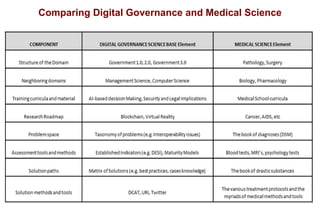
Comparing Digital Governance and Medical Science
PART B
ON DIGITAL GOVERNANCE DOMAIN
STRUCTURE
(Workshop number #03 on the subject)
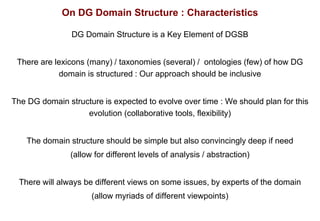
On DG Domain Structure : Characteristics
DG Domain Structure is a Key Element of DGSB
There are lexicons (many) / taxonomies (several) / ontologies (few) of how DG
domain is structured : Our approach should be inclusive
The DG domain structure is expected to evolve over time : We should plan for this
evolution (collaborative tools, flexibility)
The domain structure should be simple but also convincingly deep if need
(allow for different levels of analysis / abstraction)
There will always be different views on some issues, by experts of the domain
(allow myriads of different viewpoints)
Domain Structure - Areas
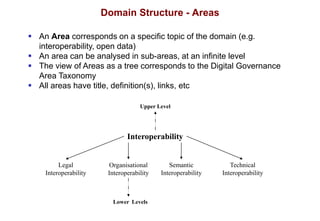
 An Area corresponds on a specific topic of the domain (e.g.
interoperability, open data)
 An area can be analysed in sub-areas, at an infinite level
 The view of Areas as a tree corresponds to the Digital Governance
Area Taxonomy
 All areas have title, definition(s), links, etc
Upper Level
Interoperability
Legal
Interoperability
Organisational
Interoperability
Semantic
Interoperability
Technical
Interoperability
Lower Levels
Domain Structure - Streams
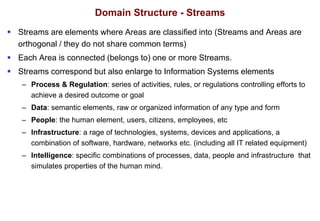
 Streams are elements where Areas are classified into (Streams and Areas are
orthogonal / they do not share common terms)
 Each Area is connected (belongs to) one or more Streams.
 Streams correspond but also enlarge to Information Systems elements
– Process & Regulation: series of activities, rules, or regulations controlling efforts to
achieve a desired outcome or goal
– Data: semantic elements, raw or organized information of any type and form
– People: the human element, users, citizens, employees, etc
– Infrastructure: a rage of technologies, systems, devices and applications, a
combination of software, hardware, networks etc. (including all IT related equipment)
– Intelligence: specific combinations of processes, data, people and infrastructure that
simulates properties of the human mind.
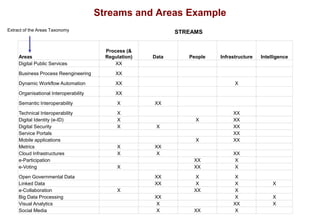
Streams and Areas Example
Areas
Process (&
Regulation) Data People Infrastructure Intelligence
Digital Public Services XX
Business Process Reengineering XX
Dynamic Workflow Automation XX X
Organisational Interoperability XX
Semantic Interoperability X XX
Technical Interoperability X XX
Digital Identity (e-ID) X X XX
Digital Security X X XX
Service Portals XX
Mobile applications X XX
Metrics X XX
Cloud Infrastructures X X XX
e-Participation XX X
e-Voting X XX X
Open Governmental Data XX X X
Linked Data XX X X X
e-Collaboration X XX X
Big Data Processing XX X X
Visual Analytics X XX X
Social Media X XX X
Extract of the Areas Taxonomy STREAMS
Additional Domain Structure Elements
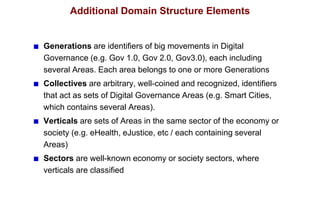
Generations are identifiers of big movements in Digital
Governance (e.g. Gov 1.0, Gov 2.0, Gov3.0), each including
several Areas. Each area belongs to one or more Generations
Collectives are arbitrary, well-coined and recognized, identifiers
that act as sets of Digital Governance Areas (e.g. Smart Cities,
which contains several Areas).
Verticals are sets of Areas in the same sector of the economy or
society (e.g. eHealth, eJustice, etc / each containing several
Areas)
Sectors are well-known economy or society sectors, where
verticals are classified
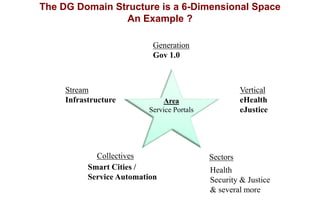
The DG Domain Structure is a 6-Dimensional Space
An Example ?
Smart Cities /
Service Automation
Collectives
Area
Service Portals
Stream
Infrastructure
Generation
Gov 1.0
Vertical
eHealth
eJustice
Health
Security & Justice
& several more
Sectors
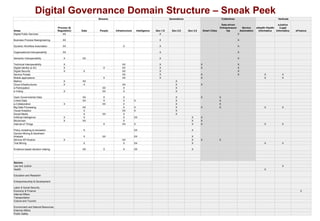
Digital Governance Domain Structure – Sneak Peek
Streams Generations Collectives Verticals
Areas
Process (&
Regulation) Data People Infrastructure Intelligence Gov 1.0 Gov 2.0 Gov 3.0 Smart Cities
Data-driven
Entrepreneurs
hip
Service
Automation
eHealth /Health
Informatics
eJustice
/Legal
Informatics eFinance
Digital Public Services XX X X
Business Process Reengineering XX X X
Dynamic Workflow Automation XX X X X
Organisational Interoperability XX X X
Semantic Interoperability X XX X X
Technical Interoperability X XX X X X
Digital Identity (e-ID) X X XX X X X
Digital Security X X XX X X
Service Portals XX X X X X X
Mobile applications X XX X X X X
Metrics X XX X
Cloud Infrastructures X X XX X X
e-Participation XX X X
e-Voting X XX X X
Open Governmental Data XX X X X X X
Linked Data XX X X X X X
e-Collaboration X XX X X X
Big Data Processing XX X X X X X X X
Visual Analytics X XX X X
Social Media X XX X X
Artificial Intelligence X X X XX X X
Blockchain X XX X X X
Internet of Things X XX X X X X X
Policy modelling & simulation X XX X
Opinion Mining & Sentiment
Analysis X XX XX X
Service API-fication X XX X X X
Text Mining X X XX X X X
Evidence-based decision making XX X X XX X
Sectors
Law and Justice X
Health X
Education and Research
Entrepreneurship & Development
Labor & Social Security
Economy & Finance X
Internal Affairs
Transportation
Culture and Tourism
Environment and Natural Resources
External Affairs
Public Safety
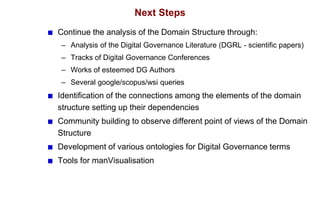
Next Steps
Continue the analysis of the Domain Structure through:
– Analysis of the Digital Governance Literature (DGRL - scientific papers)
– Tracks of Digital Governance Conferences
– Works of esteemed DG Authors
– Several google/scopus/wsi queries
Identification of the connections among the elements of the domain
structure setting up their dependencies
Community building to observe different point of views of the Domain
Structure
Development of various ontologies for Digital Governance terms
Tools for manVisualisation
PART C
DGSB NEIGHBORING DOMAINS
(Workshop number #05 on the subject)
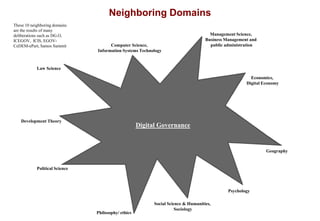
Neighboring Domains
Digital Governance
Computer Science,
Information Systems Technology
Management Science,
Business Management and
public administration
Economics,
Digital Economy
Geography
Psychology
Social Science & Humanities,
Sociology
Philosophy/ ethics
Political Science
Development Theory
Law Science
These 10 neighboring domains
are the results of many
deliberations such as DG.O,
ICEGOV, ICIS, EGOV-
CeDEM-ePart, Samos Summit
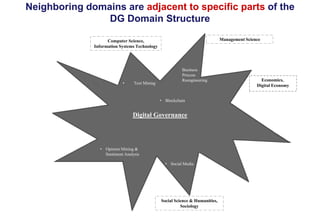
Neighboring domains are adjacent to specific parts of the
DG Domain Structure
Digital Governance
• Social Media
Business
Process
Reengineering
• Blockchain
• Text Mining
Social Science & Humanities,
Sociology
Management ScienceComputer Science,
Information Systems Technology
• Opinion Mining &
Sentiment Analysis
Economics,
Digital Economy
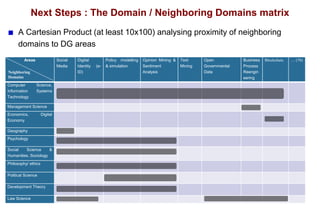
Next Steps : The Domain / Neighboring Domains matrix
A Cartesian Product (at least 10x100) analysing proximity of neighboring
domains to DG areas
Areas Social
Media
Digital
Identity (e-
ID)
Policy modelling
& simulation
Opinion Mining &
Sentiment
Analysis
Text
Mining
Open
Governmental
Data
Business
Process
Reengin
eering
Blockchain … (70)
Computer Science,
Information Systems
Technology
Management Science
Economics, Digital
Economy
Geography
Psychology
Social Science &
Humanities, Sociology
Philosophy/ ethics
Political Science
Development Theory
Law Science
Neighboring
Domains
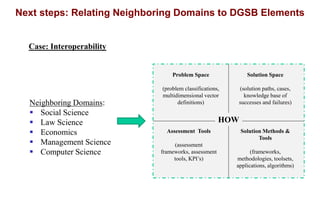
Next steps: Relating Neighboring Domains to DGSB Elements
HOW
Problem Space
(problem classifications,
multidimensional vector
definitions)
Solution Space
(solution paths, cases,
knowledge base of
successes and failures)
Assessment Tools
(assessment
frameworks, assessment
tools, KPI’s)
Solution Methods &
Tools
(frameworks,
methodologies, toolsets,
applications, algorithms)
Case: Interoperability
Neighboring Domains:
 Social Science
 Law Science
 Economics
 Management Science
 Computer Science
PART D
THE QUESTIONNAIRE
(Workshop number #04 on the subject)

DGSB Domain Structure samos2020summit

  • 1.
    Workshop Digital Governance ScienceBase: Domain Structure and Neighboring Domains Yannis Charalabidis Professor of Digital Governance University of the Aegean yannisx@aegean.gr Zoi Lachana Researcher, Ph.D. Candidate University of the Aegean zoi@aegean.gr Panos Keramidis Student University of the Aegean icsd16067@icsd.aegean.gr
  • 2.
    PART A INTRODUCTION TODGSB INITIATIVE (Workshop number #09 on the subject)
  • 3.
    Why do weneed a “science base” for Digital Governance?  There are hints, since Plato times, that governance has to be treated as a science – Plato, Politikos: “… the science of governance, this most difficult but also the most important of all …”  There are a lot to be gained, by systematically organizing knowledge and practice in this important domain, for administration and societies: minimization of solution time and cost, maximization of administration productivity, avoidance of failure, better quality of life for citizens  The neighboring of the Digital Governance domain with other, well – formulated scientific domains like computer science, management science or law, brings more value to the experiment
  • 4.
    When will DigitalGovernance be considered a scientific domain ? An example ? How to test if we have a method The “Yannis Test” on Digital Governance Science Base Digital Governance is a well-structured and manages scientific domain, if: Whenever 2 independent, randomly selected Digital Governance experts (practitioners or DG science) are exposed to the same administration situation – problem, and working separately, they: ‒ Come to the same diagnosis for the situation – problem of the administration (from a technical, semantic, organizational, legal and policy or other aspects) ‒ Propose the same set of actions so that the administration will reach the desired state. Input from epistemology and various DGSB workshops says: “Science means METHOD, defined, applied and evolving in a systematic way”
  • 5.
    What are theelements of the Science Base ? Rationale (justifications on the need for a science base supported by evidence) WHY
  • 6.
    What are theelements of the Science Base ?  Research Roadmap (new research directions, evolution scenarios) Domain Structure (ontology of scientific areas, sub-areas, terms, sectors, etc) Neighboring Domains (domains, “points of connections”, structure, tools, methods, ideas, laws, etc) Training Curricula (training programmes, training courses, material) WHAT Solution Space (solution paths, cases, knowledge base of successes and failures) Problem Space (problem classifications, multidimensional vector definitions) Assessment Tools (assessment frameworks, assessment tools, KPI’s) Solution Methods & Tools (frameworks, methodologies, toolsets, applications, algorithms) HOW Rationale (justifications on the need for a science base supported by evidence) WHY
  • 7.
    What are theelements of the Science Base ?  Research Roadmap (new research directions, evolution scenarios) Domain Structure (ontology of scientific areas, sub-areas, terms, sectors, etc) Neighboring Domains (domains, “points of connections”, structure, tools, methods, ideas, laws, etc) Training Curricula (training programmes, training courses, material) WHAT Solution Space (solution paths, cases, knowledge base of successes and failures) Problem Space (problem classifications, multidimensional vector definitions) Assessment Tools (assessment frameworks, assessment tools, KPI’s) Solution Methods & Tools (frameworks, methodologies, toolsets, applications, algorithms) HOW Rationale (justifications on the need for a science base supported by evidence) WHY
  • 8.
    What are theelements of the Science Base ?  Research Roadmap (new research directions, evolution scenarios) Domain Structure (ontology of scientific areas, sub-areas, terms, sectors, etc) Neighboring Domains (domains, “points of connections”, structure, tools, methods, ideas, laws, etc) Training Curricula (training programmes, training courses, material) WHAT Solution Space (solution paths, cases, knowledge base of successes and failures) Problem Space (problem classifications, multidimensional vector definitions) Assessment Tools (assessment frameworks, assessment tools, KPI’s) Solution Methods & Tools (frameworks, methodologies, toolsets, applications, algorithms) HOW The big picture (Rules, Theories, Laws) Rationale (justifications on the need for a science base supported by evidence) WHY The correct application (Code of Ethics)
  • 9.
    Comparing Digital Governanceand Medical Science
  • 10.
    PART B ON DIGITALGOVERNANCE DOMAIN STRUCTURE (Workshop number #03 on the subject)
  • 11.
    On DG DomainStructure : Characteristics DG Domain Structure is a Key Element of DGSB There are lexicons (many) / taxonomies (several) / ontologies (few) of how DG domain is structured : Our approach should be inclusive The DG domain structure is expected to evolve over time : We should plan for this evolution (collaborative tools, flexibility) The domain structure should be simple but also convincingly deep if need (allow for different levels of analysis / abstraction) There will always be different views on some issues, by experts of the domain (allow myriads of different viewpoints)
  • 12.
    Domain Structure -Areas  An Area corresponds on a specific topic of the domain (e.g. interoperability, open data)  An area can be analysed in sub-areas, at an infinite level  The view of Areas as a tree corresponds to the Digital Governance Area Taxonomy  All areas have title, definition(s), links, etc Upper Level Interoperability Legal Interoperability Organisational Interoperability Semantic Interoperability Technical Interoperability Lower Levels
  • 13.
    Domain Structure -Streams  Streams are elements where Areas are classified into (Streams and Areas are orthogonal / they do not share common terms)  Each Area is connected (belongs to) one or more Streams.  Streams correspond but also enlarge to Information Systems elements – Process & Regulation: series of activities, rules, or regulations controlling efforts to achieve a desired outcome or goal – Data: semantic elements, raw or organized information of any type and form – People: the human element, users, citizens, employees, etc – Infrastructure: a rage of technologies, systems, devices and applications, a combination of software, hardware, networks etc. (including all IT related equipment) – Intelligence: specific combinations of processes, data, people and infrastructure that simulates properties of the human mind.
  • 14.
    Streams and AreasExample Areas Process (& Regulation) Data People Infrastructure Intelligence Digital Public Services XX Business Process Reengineering XX Dynamic Workflow Automation XX X Organisational Interoperability XX Semantic Interoperability X XX Technical Interoperability X XX Digital Identity (e-ID) X X XX Digital Security X X XX Service Portals XX Mobile applications X XX Metrics X XX Cloud Infrastructures X X XX e-Participation XX X e-Voting X XX X Open Governmental Data XX X X Linked Data XX X X X e-Collaboration X XX X Big Data Processing XX X X Visual Analytics X XX X Social Media X XX X Extract of the Areas Taxonomy STREAMS
  • 15.
    Additional Domain StructureElements Generations are identifiers of big movements in Digital Governance (e.g. Gov 1.0, Gov 2.0, Gov3.0), each including several Areas. Each area belongs to one or more Generations Collectives are arbitrary, well-coined and recognized, identifiers that act as sets of Digital Governance Areas (e.g. Smart Cities, which contains several Areas). Verticals are sets of Areas in the same sector of the economy or society (e.g. eHealth, eJustice, etc / each containing several Areas) Sectors are well-known economy or society sectors, where verticals are classified
  • 16.
    The DG DomainStructure is a 6-Dimensional Space An Example ? Smart Cities / Service Automation Collectives Area Service Portals Stream Infrastructure Generation Gov 1.0 Vertical eHealth eJustice Health Security & Justice & several more Sectors
  • 17.
    Digital Governance DomainStructure – Sneak Peek Streams Generations Collectives Verticals Areas Process (& Regulation) Data People Infrastructure Intelligence Gov 1.0 Gov 2.0 Gov 3.0 Smart Cities Data-driven Entrepreneurs hip Service Automation eHealth /Health Informatics eJustice /Legal Informatics eFinance Digital Public Services XX X X Business Process Reengineering XX X X Dynamic Workflow Automation XX X X X Organisational Interoperability XX X X Semantic Interoperability X XX X X Technical Interoperability X XX X X X Digital Identity (e-ID) X X XX X X X Digital Security X X XX X X Service Portals XX X X X X X Mobile applications X XX X X X X Metrics X XX X Cloud Infrastructures X X XX X X e-Participation XX X X e-Voting X XX X X Open Governmental Data XX X X X X X Linked Data XX X X X X X e-Collaboration X XX X X X Big Data Processing XX X X X X X X X Visual Analytics X XX X X Social Media X XX X X Artificial Intelligence X X X XX X X Blockchain X XX X X X Internet of Things X XX X X X X X Policy modelling & simulation X XX X Opinion Mining & Sentiment Analysis X XX XX X Service API-fication X XX X X X Text Mining X X XX X X X Evidence-based decision making XX X X XX X Sectors Law and Justice X Health X Education and Research Entrepreneurship & Development Labor & Social Security Economy & Finance X Internal Affairs Transportation Culture and Tourism Environment and Natural Resources External Affairs Public Safety
  • 18.
    Next Steps Continue theanalysis of the Domain Structure through: – Analysis of the Digital Governance Literature (DGRL - scientific papers) – Tracks of Digital Governance Conferences – Works of esteemed DG Authors – Several google/scopus/wsi queries Identification of the connections among the elements of the domain structure setting up their dependencies Community building to observe different point of views of the Domain Structure Development of various ontologies for Digital Governance terms Tools for manVisualisation
  • 19.
    PART C DGSB NEIGHBORINGDOMAINS (Workshop number #05 on the subject)
  • 20.
    Neighboring Domains Digital Governance ComputerScience, Information Systems Technology Management Science, Business Management and public administration Economics, Digital Economy Geography Psychology Social Science & Humanities, Sociology Philosophy/ ethics Political Science Development Theory Law Science These 10 neighboring domains are the results of many deliberations such as DG.O, ICEGOV, ICIS, EGOV- CeDEM-ePart, Samos Summit
  • 21.
    Neighboring domains areadjacent to specific parts of the DG Domain Structure Digital Governance • Social Media Business Process Reengineering • Blockchain • Text Mining Social Science & Humanities, Sociology Management ScienceComputer Science, Information Systems Technology • Opinion Mining & Sentiment Analysis Economics, Digital Economy
  • 22.
    Next Steps :The Domain / Neighboring Domains matrix A Cartesian Product (at least 10x100) analysing proximity of neighboring domains to DG areas Areas Social Media Digital Identity (e- ID) Policy modelling & simulation Opinion Mining & Sentiment Analysis Text Mining Open Governmental Data Business Process Reengin eering Blockchain … (70) Computer Science, Information Systems Technology Management Science Economics, Digital Economy Geography Psychology Social Science & Humanities, Sociology Philosophy/ ethics Political Science Development Theory Law Science Neighboring Domains
  • 23.
    Next steps: RelatingNeighboring Domains to DGSB Elements HOW Problem Space (problem classifications, multidimensional vector definitions) Solution Space (solution paths, cases, knowledge base of successes and failures) Assessment Tools (assessment frameworks, assessment tools, KPI’s) Solution Methods & Tools (frameworks, methodologies, toolsets, applications, algorithms) Case: Interoperability Neighboring Domains:  Social Science  Law Science  Economics  Management Science  Computer Science
  • 24.
    PART D THE QUESTIONNAIRE (Workshopnumber #04 on the subject)

Editor's Notes