
LEAN GOVERNMENT
What Leaders Need to Do
 to Lead From the Front
Creating Your Agency Game Plan
LESSONS IN LEADERSHIP SERIES
          March 20, 2013
“Today we begin a multi-year
  effort to bring disruptive
 change to Olympia, starting
    with the very core of
    how we do business.”


          2
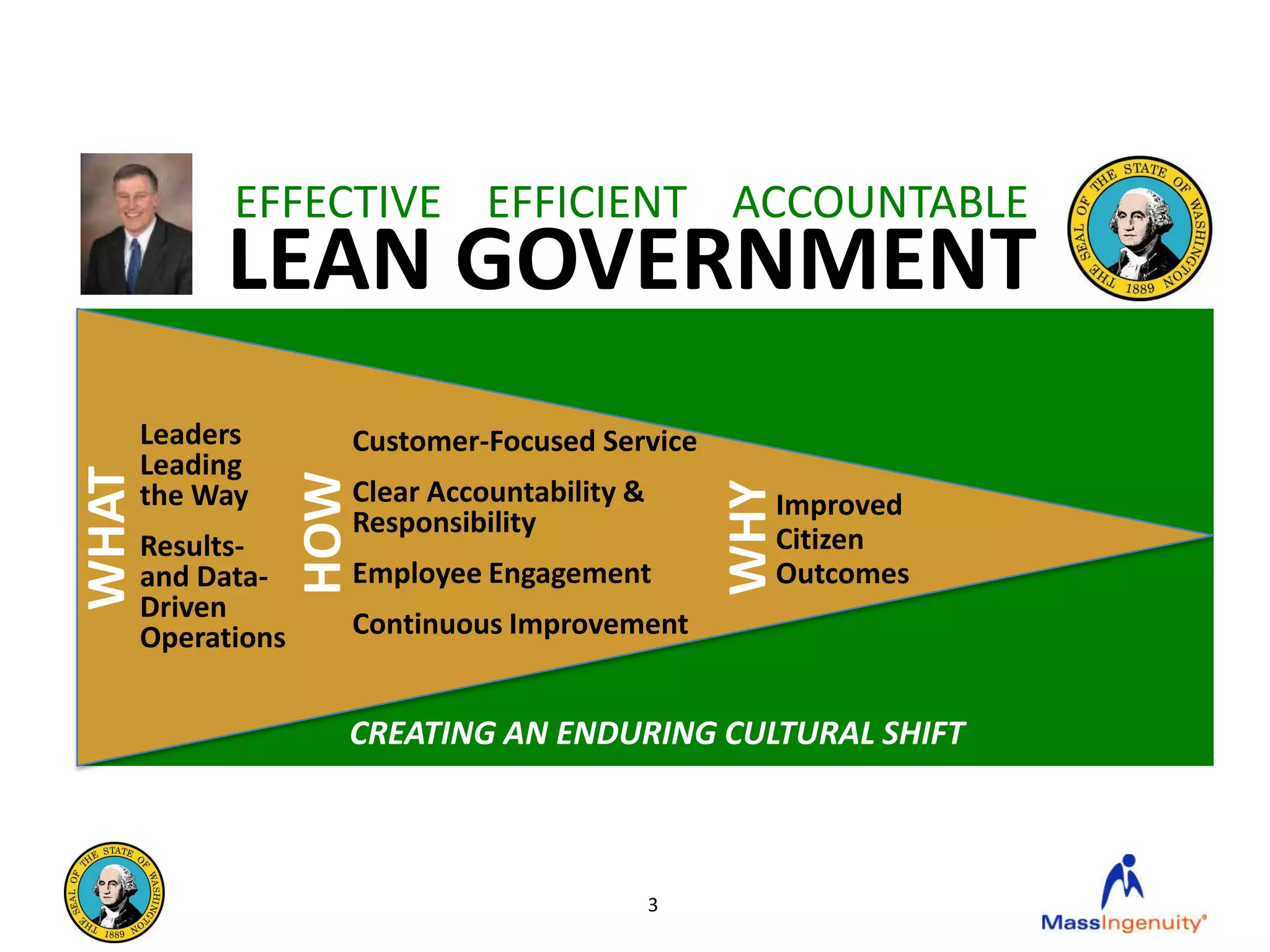
EFFECTIVE EFFICIENT ACCOUNTABLE
            LEAN GOVERNMENT
       Leaders        Customer-Focused Service
       Leading
WHAT


                    HOW

                      Clear Accountability &


                                                   WHY
       the Way                                       Improved
                      Responsibility
       Results-                                      Citizen
       and Data-      Employee Engagement            Outcomes
       Driven
       Operations     Continuous Improvement


                      CREATING AN ENDURING CULTURAL SHIFT


                                               3
PRESENTING


     4
Marcie Frost
DIRECTOR, DEPARTMENT OF RETIREMENT SYSTEMS

        • 20-years public leadership, &
          planning & operations
        • A career noted for a focus on
          outcomes, strategy and alignment
        • Three years into major customer-
          focused/team engagement
          transformation at DRS


                     5
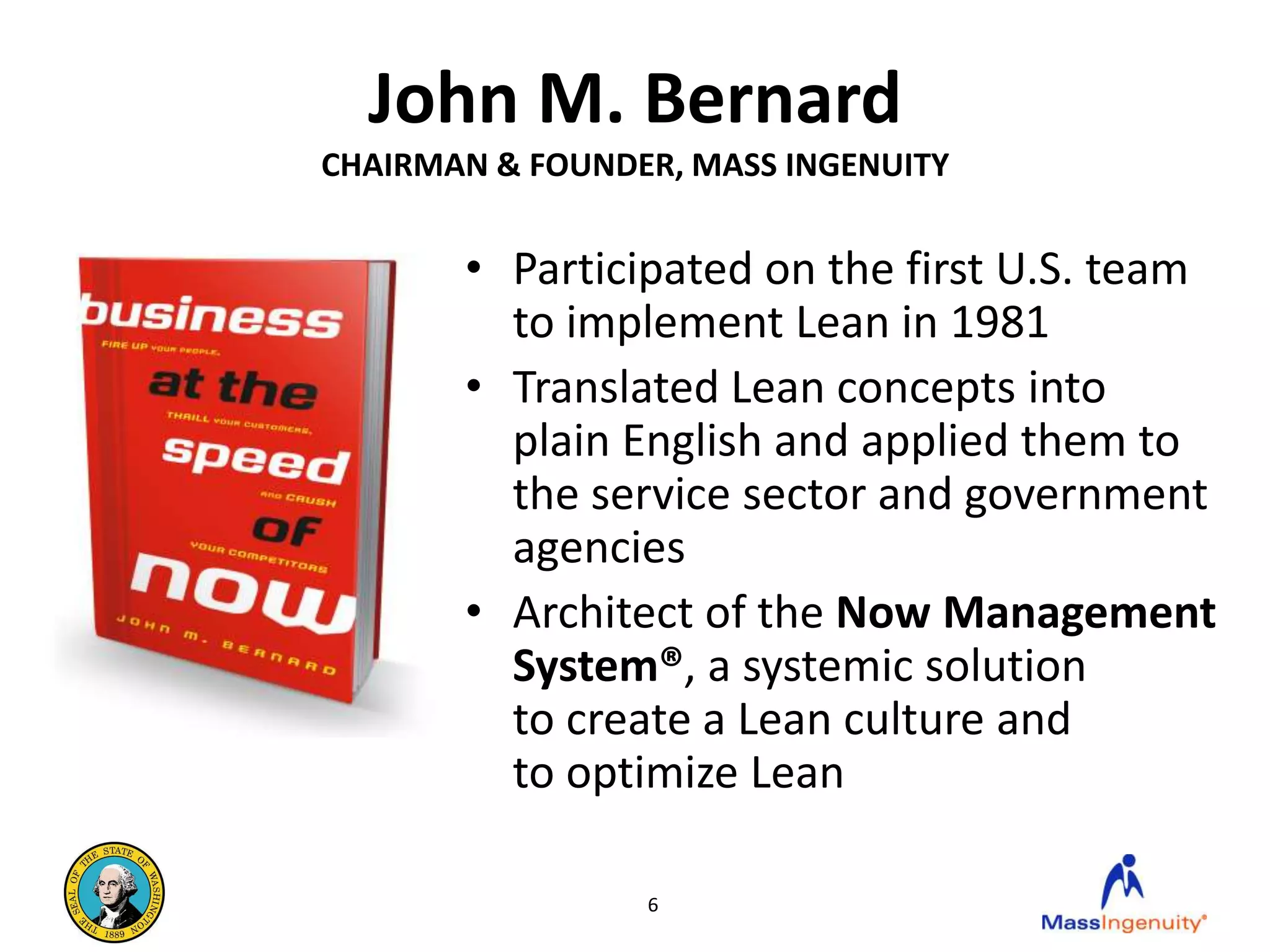
John M. Bernard
CHAIRMAN & FOUNDER, MASS INGENUITY


       • Participated on the first U.S. team
         to implement Lean in 1981
       • Translated Lean concepts into
         plain English and applied them to
         the service sector and government
         agencies
       • Architect of the Now Management
         System®, a systemic solution
         to create a Lean culture and
         to optimize Lean

                 6
7
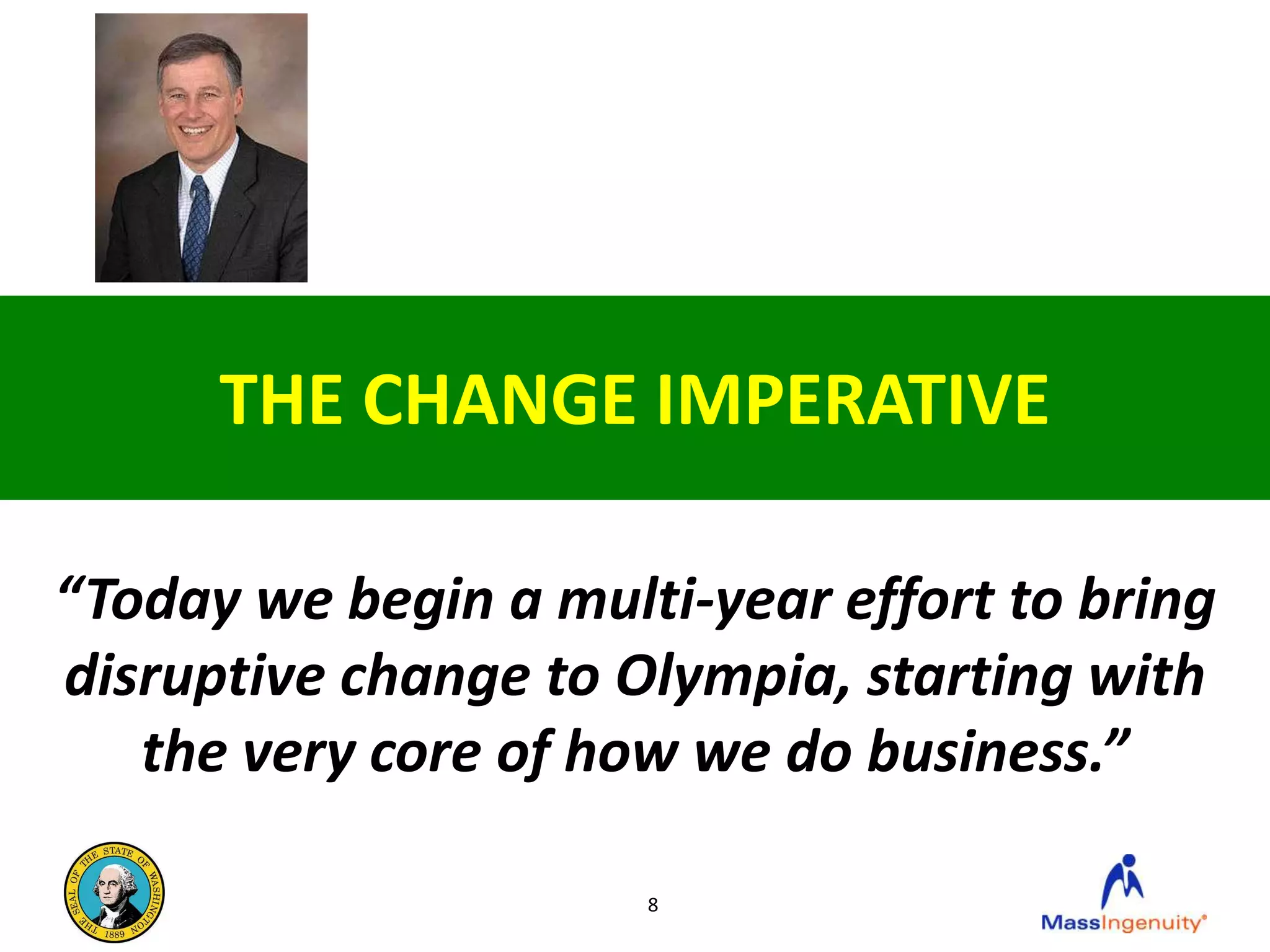
THE CHANGE IMPERATIVE

“Today we begin a multi-year effort to bring
disruptive change to Olympia, starting with
   the very core of how we do business.”

                      8
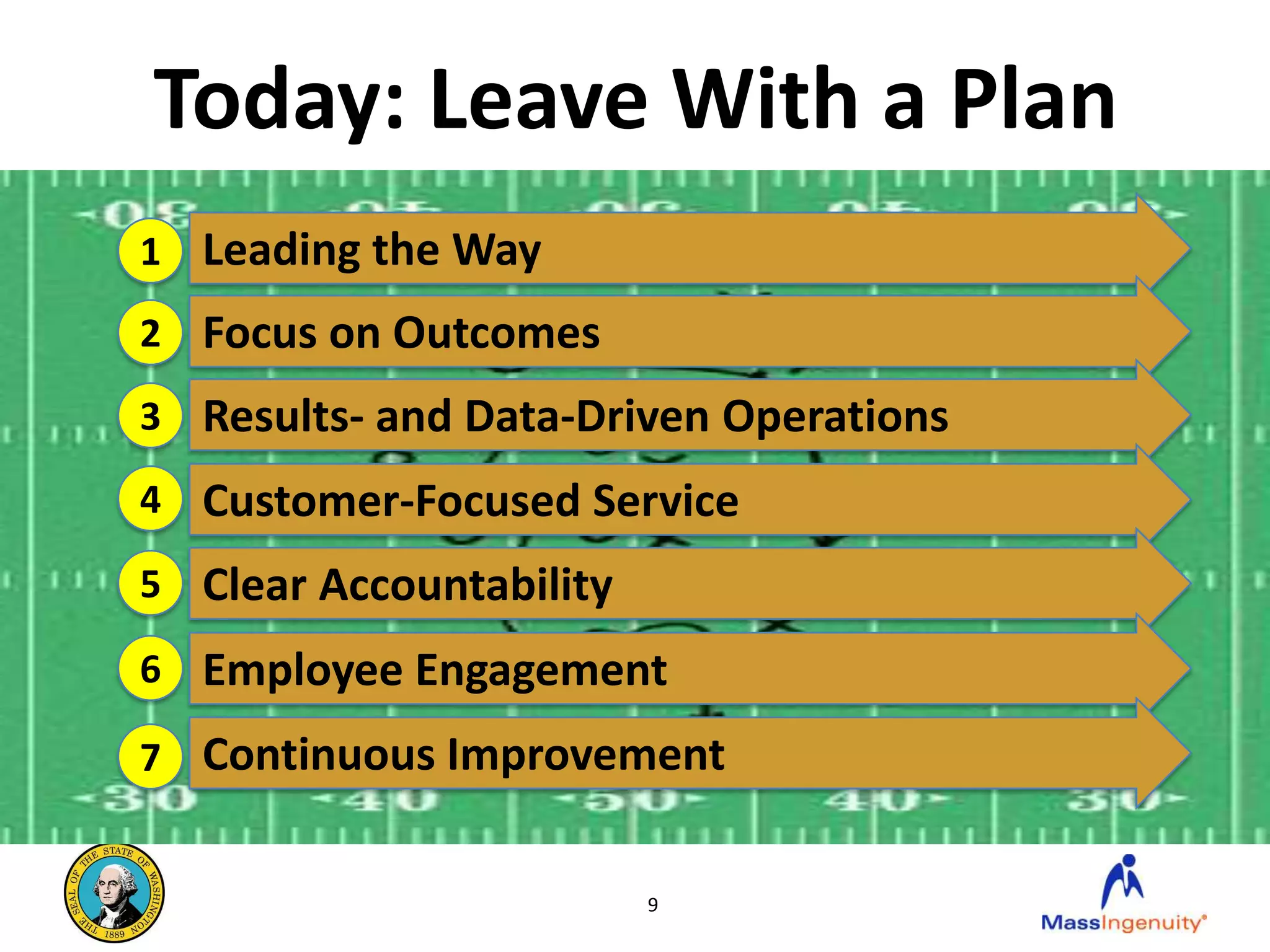
Today: Leave With a Plan
1 Leading the Way
2 Focus on Outcomes
3 Results- and Data-Driven Operations
4 Customer-Focused Service
5 Clear Accountability

6 Employee Engagement

7 Continuous Improvement


                         9
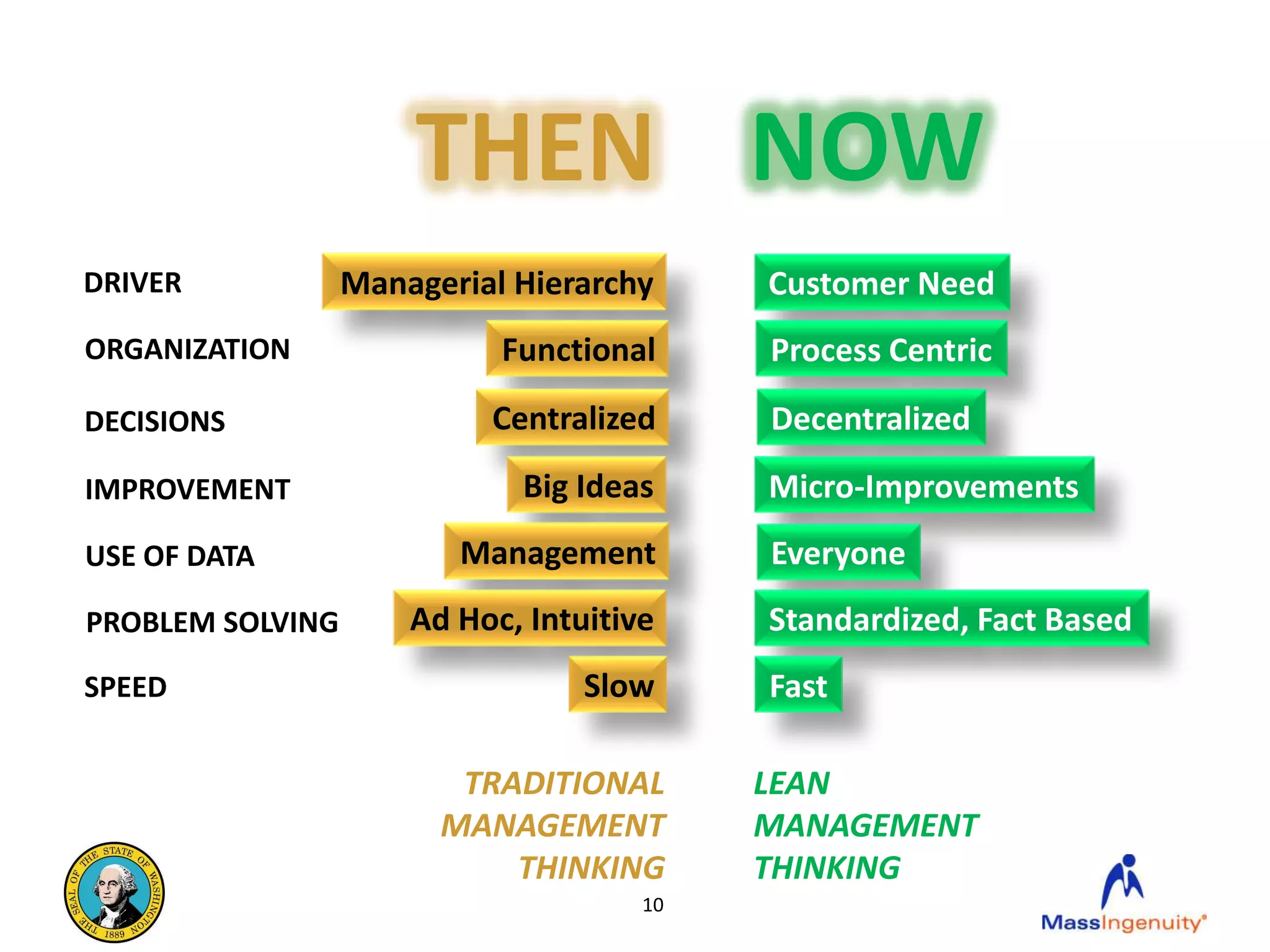
THEN NOW
DRIVER            Managerial Hierarchy     Customer Need
ORGANIZATION                Functional     Process Centric
DECISIONS                  Centralized     Decentralized
IMPROVEMENT                  Big Ideas     Micro-Improvements
USE OF DATA              Management        Everyone
PROBLEM SOLVING       Ad Hoc, Intuitive    Standardized, Fact Based
SPEED                             Slow     Fast

                         TRADITIONAL       LEAN
                        MANAGEMENT         MANAGEMENT
                            THINKING       THINKING
                                      10
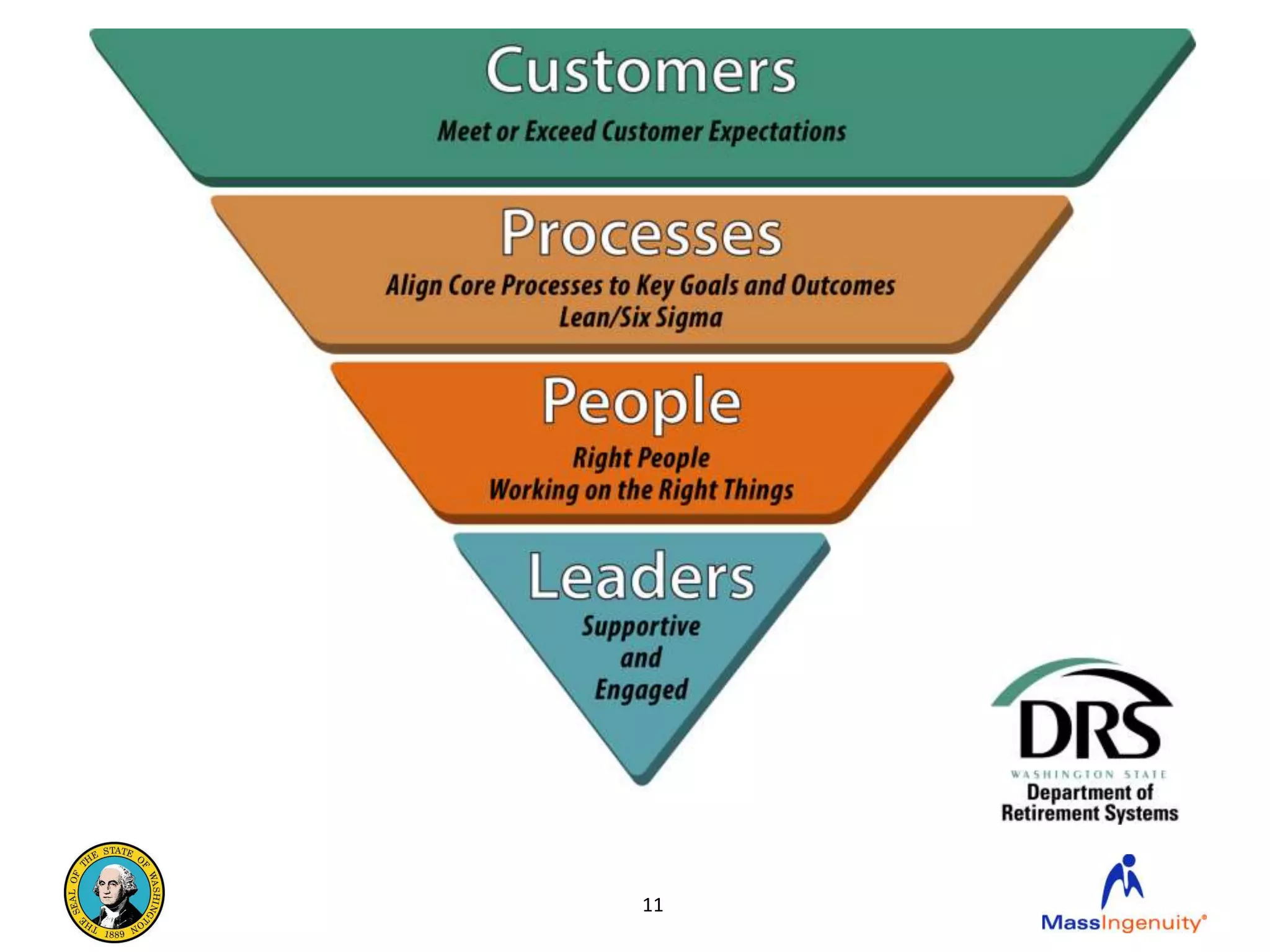
11
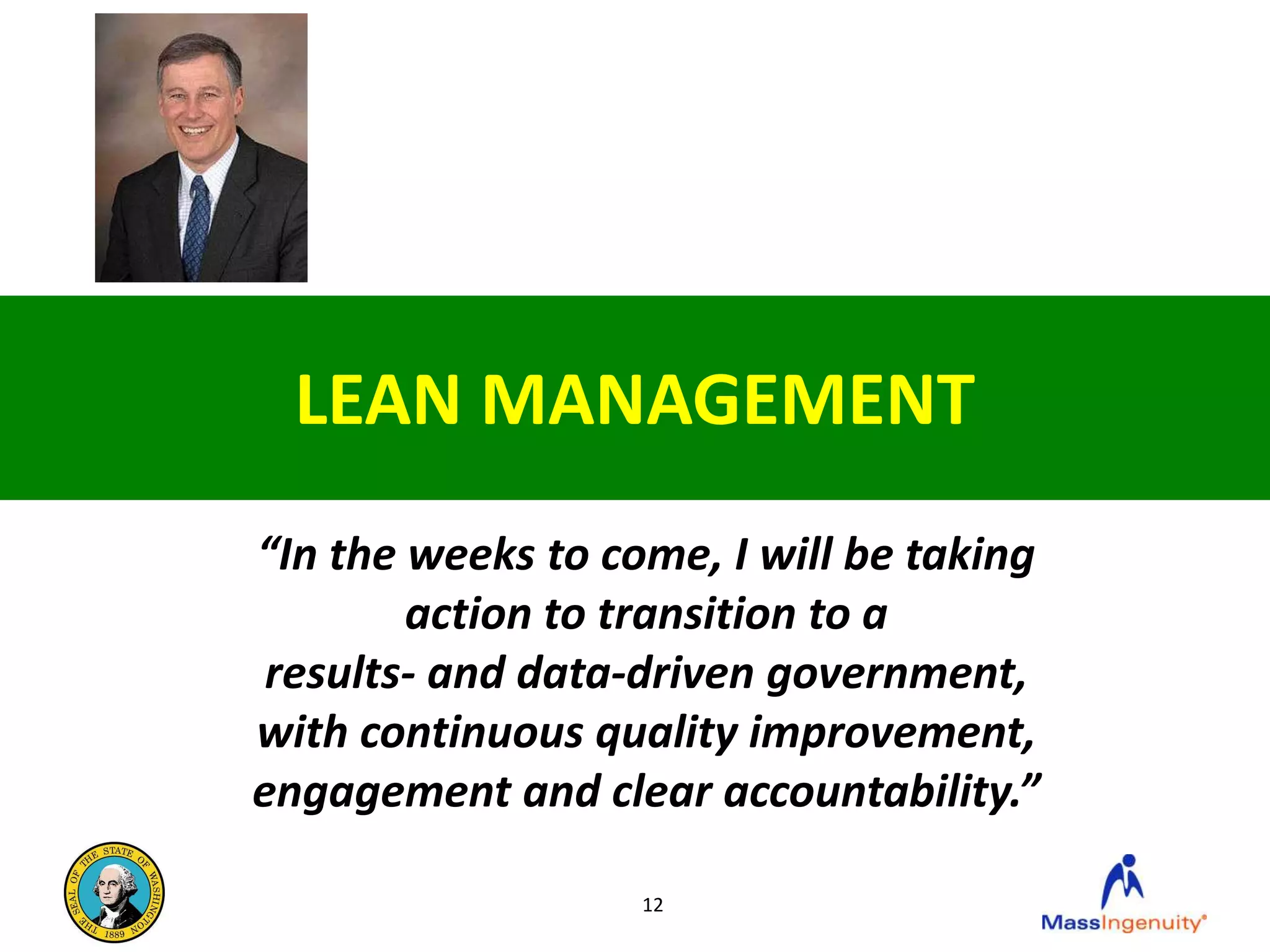
LEAN MANAGEMENT
“In the weeks to come, I will be taking
        action to transition to a
 results- and data-driven government,
with continuous quality improvement,
engagement and clear accountability.”

                   12
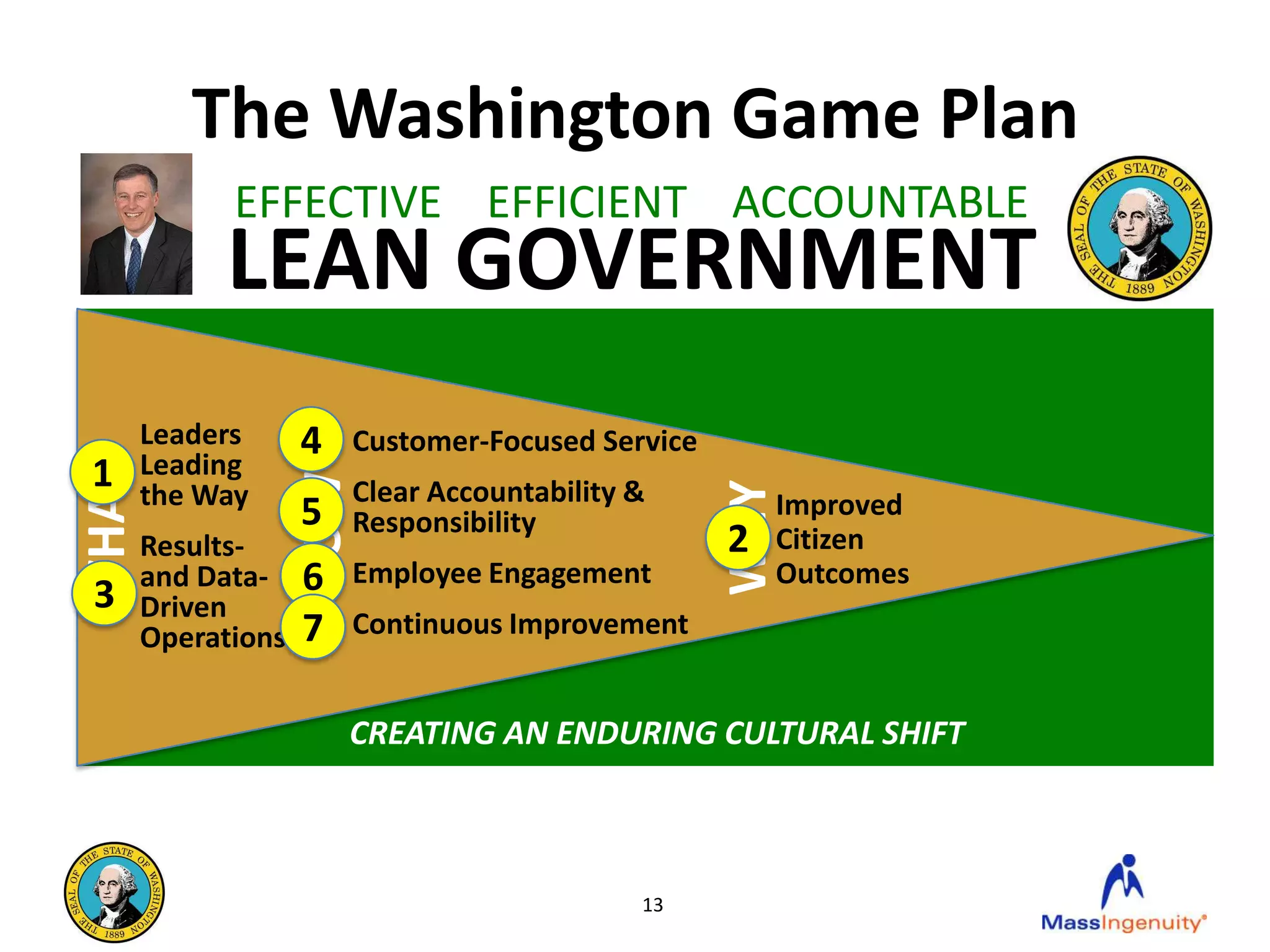
The Washington Game Plan
             EFFECTIVE EFFICIENT ACCOUNTABLE
            LEAN GOVERNMENT
       Leaders      4   Customer-Focused Service
1      Leading
WHAT


                    HOW

                        Clear Accountability &


                                                   WHY
       the Way                                         Improved
                    5   Responsibility
       Results-                                    2   Citizen
3      and Data-    6   Employee Engagement            Outcomes
       Driven
       Operations   7   Continuous Improvement


                        CREATING AN ENDURING CULTURAL SHIFT


                                             13
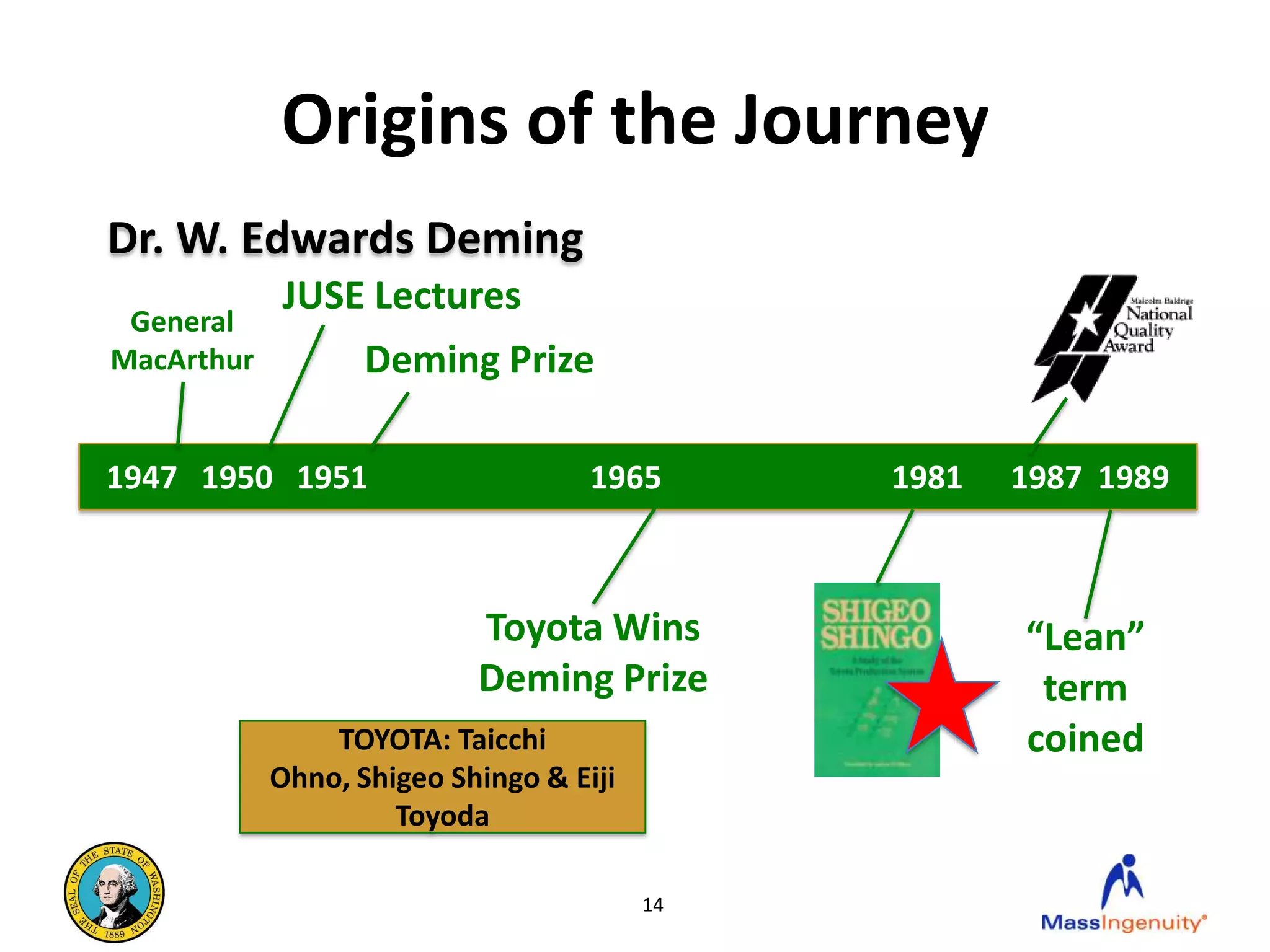
Origins of the Journey
Dr. W. Edwards Deming
            JUSE Lectures
 General
MacArthur          Deming Prize

1947 1950 1951                      1965      1981   1987 1989


                           Toyota Wins               “Lean”
                           Deming Prize               term
                TOYOTA: Taicchi                      coined
            Ohno, Shigeo Shingo & Eiji
                     Toyoda

                                         14
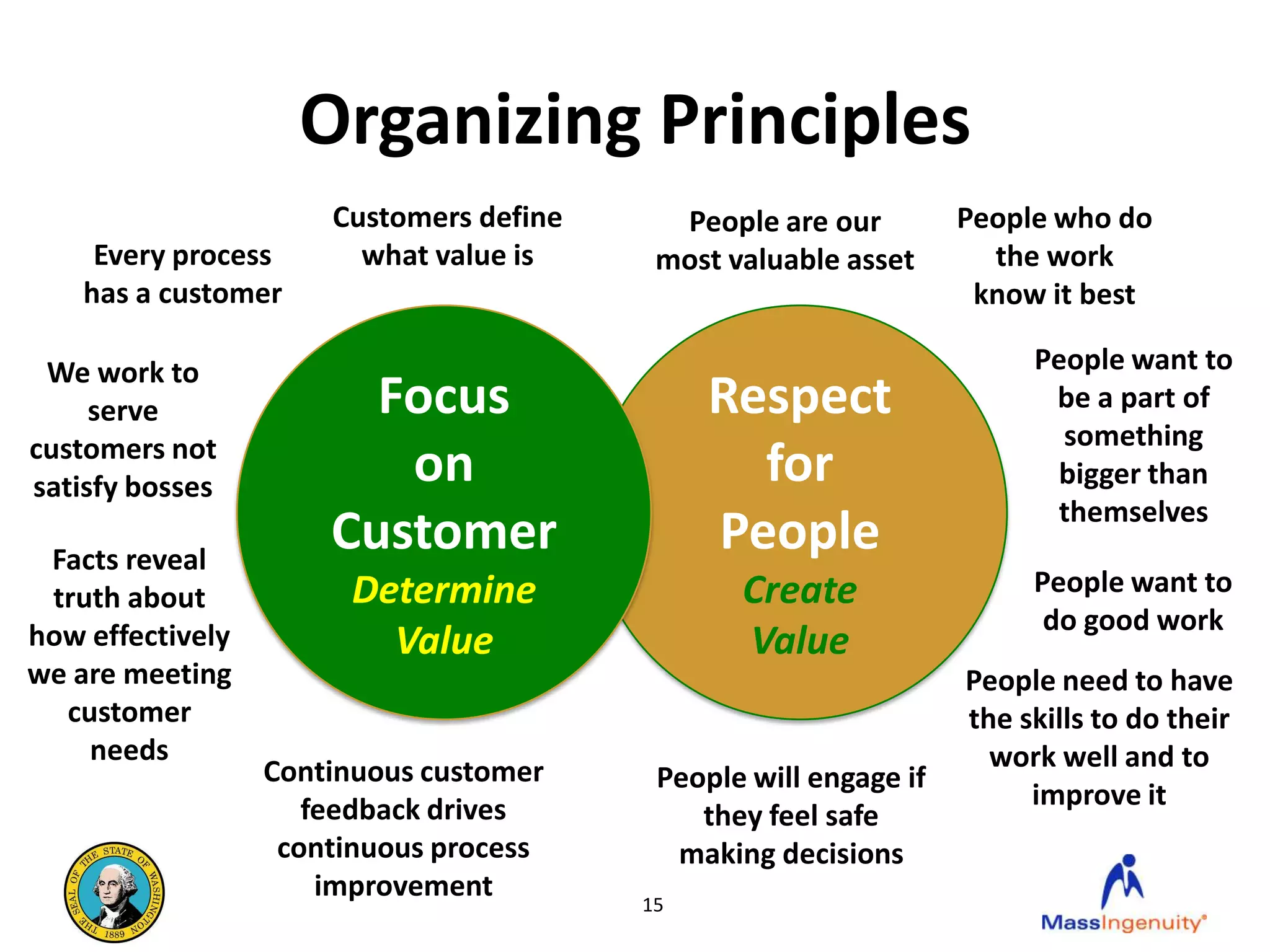
Organizing Principles
                      Customers define     People are our         People who do
     Every process      what value is     most valuable asset       the work
    has a customer                                                 know it best

 We work to                                                            People want to
     serve              Focus                 Respect                   be a part of
customers not                                                            something
satisfy bosses           on                     for                      bigger than
                                                                         themselves
 Facts reveal
                      Customer                People
 truth about           Determine                Create                 People want to
how effectively                                                         do good work
                         Value                  Value
we are meeting                                                    People need to have
  customer                                                        the skills to do their
    needs                                                           work well and to
                  Continuous customer     People will engage if
                     feedback drives                                   improve it
                                             they feel safe
                   continuous process      making decisions
                      improvement
                                         15
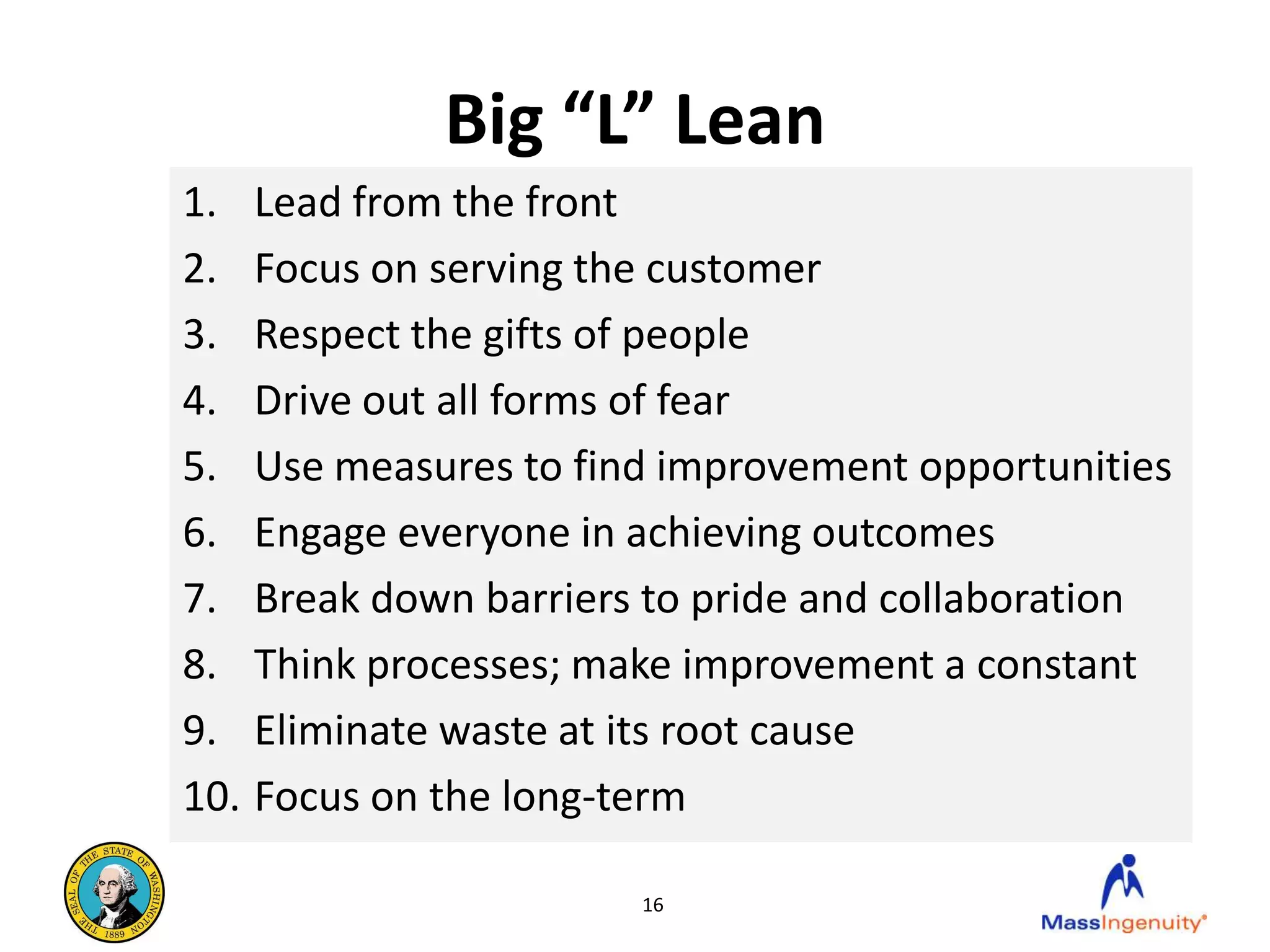
Big “L” Lean
1. Lead from the front
2. Focus on serving the customer
3. Respect the gifts of people
4. Drive out all forms of fear
5. Use measures to find improvement opportunities
6. Engage everyone in achieving outcomes
7. Break down barriers to pride and collaboration
8. Think processes; make improvement a constant
9. Eliminate waste at its root cause
10. Focus on the long-term

                      16
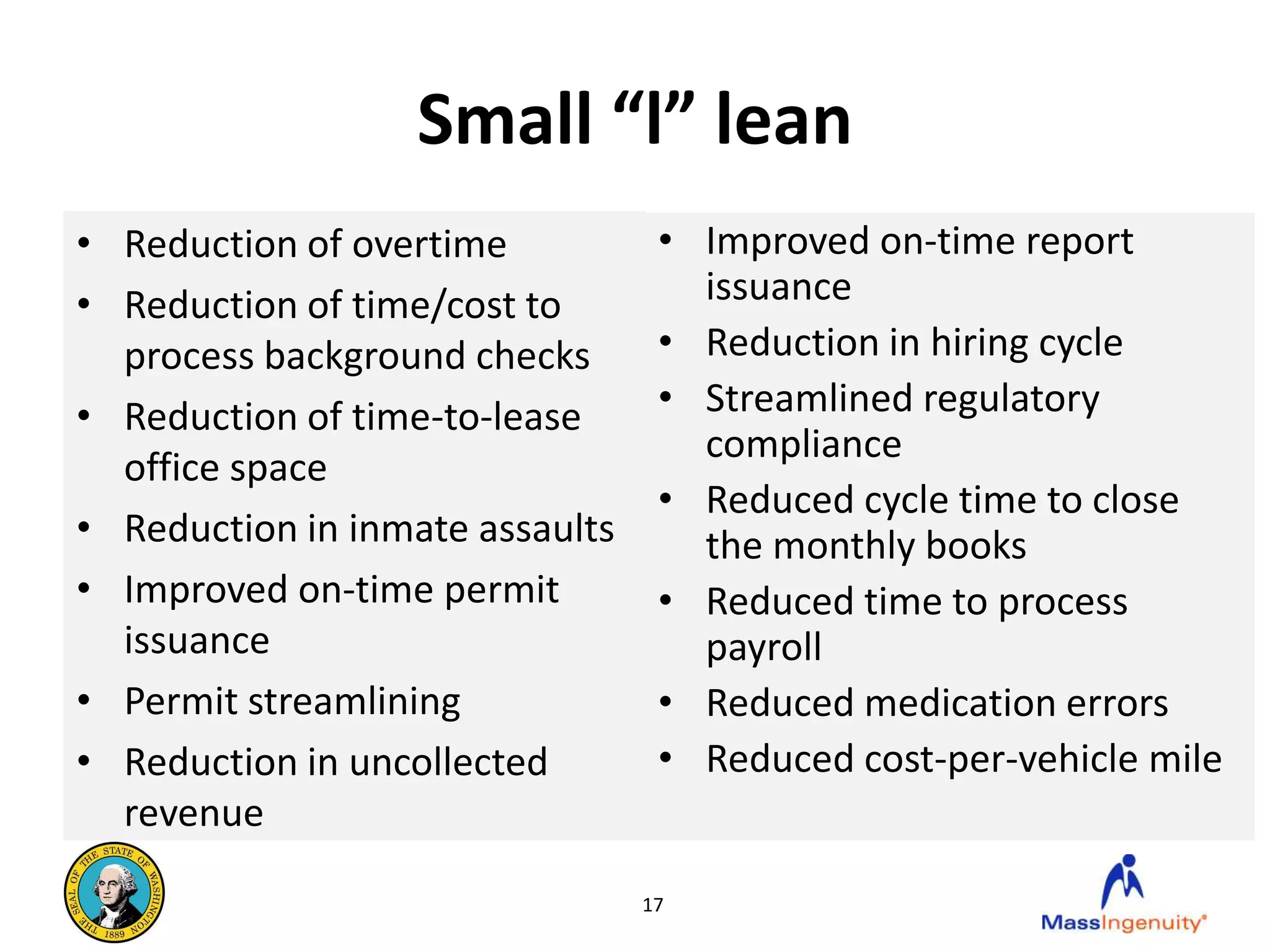
Small “l” lean
• Reduction of overtime           • Improved on-time report
• Reduction of time/cost to         issuance
  process background checks       • Reduction in hiring cycle
• Reduction of time-to-lease      • Streamlined regulatory
                                    compliance
  office space
                                  • Reduced cycle time to close
• Reduction in inmate assaults      the monthly books
• Improved on-time permit         • Reduced time to process
  issuance                          payroll
• Permit streamlining             • Reduced medication errors
• Reduction in uncollected        • Reduced cost-per-vehicle mile
  revenue

                                 17
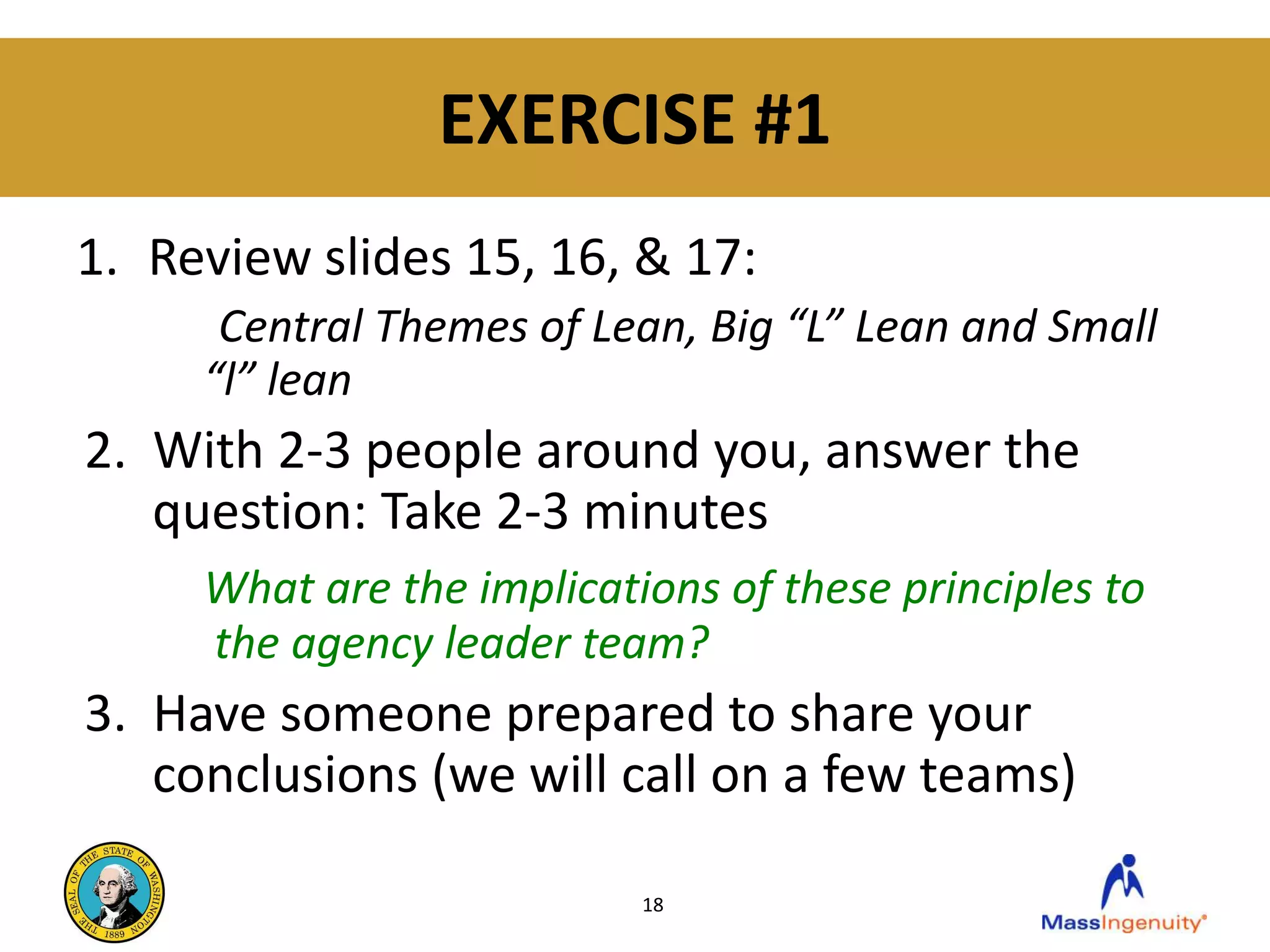
EXERCISE #1
1. Review slides 15, 16, & 17:
      Central Themes of Lean, Big “L” Lean and Small
     “l” lean
2. With 2-3 people around you, answer the
   question: Take 2-3 minutes
     What are the implications of these principles to
     the agency leader team?
3. Have someone prepared to share your
   conclusions (we will call on a few teams)

                           18
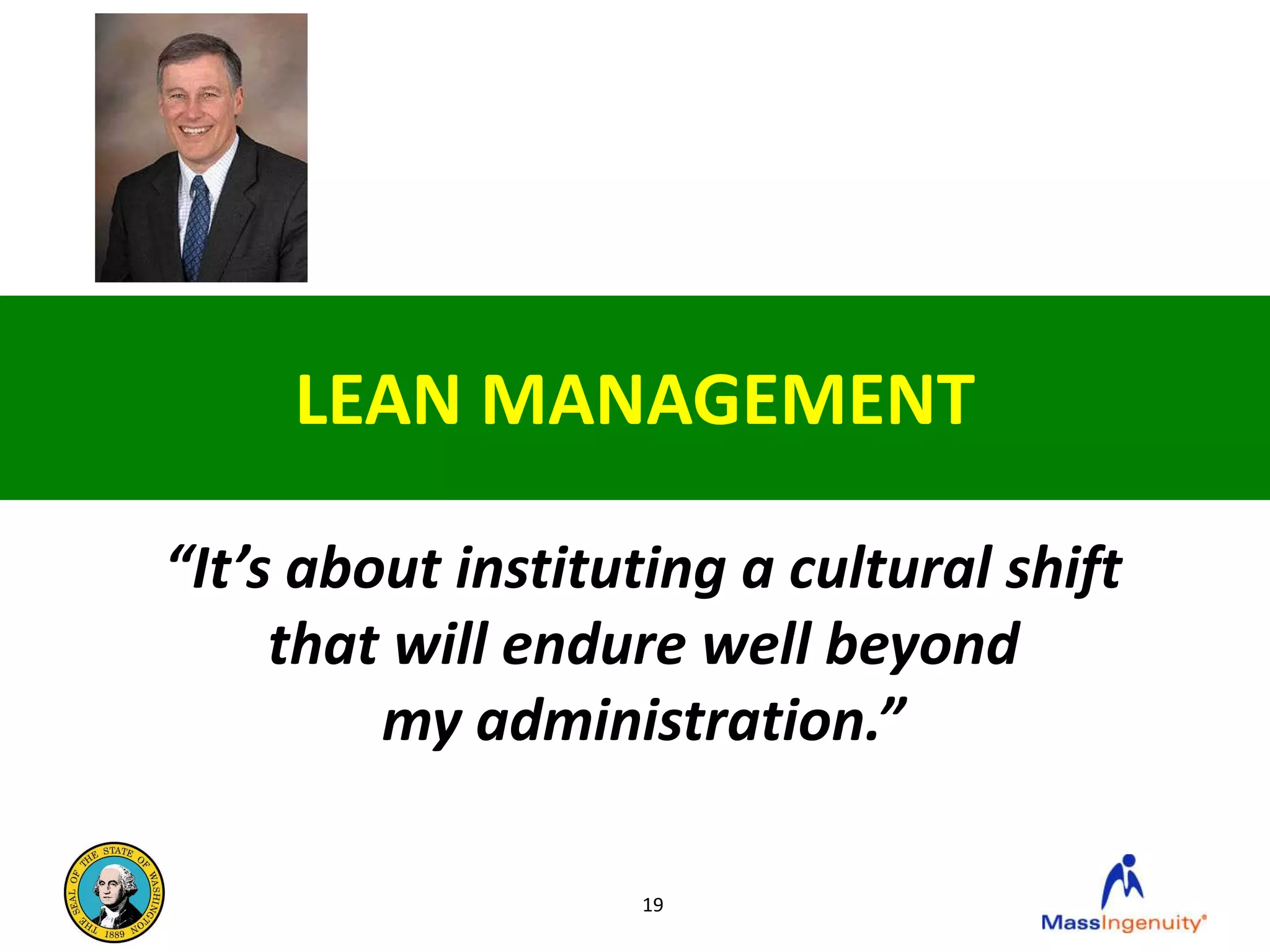
LEAN MANAGEMENT

“It’s about instituting a cultural shift
     that will endure well beyond
         my administration.”

                   19
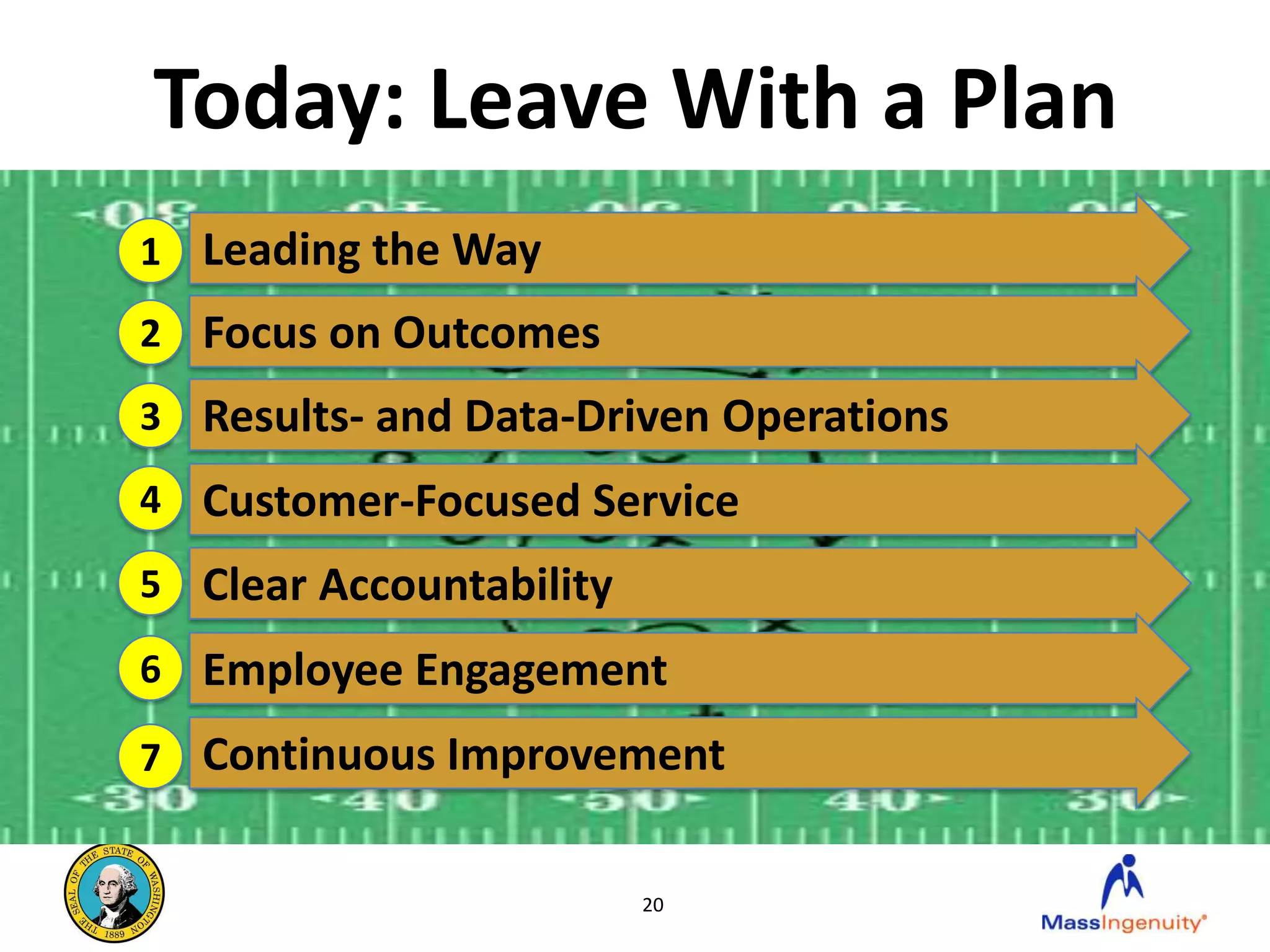
Today: Leave With a Plan
1 Leading the Way
2 Focus on Outcomes
3 Results- and Data-Driven Operations
4 Customer-Focused Service
5 Clear Accountability

6 Employee Engagement

7 Continuous Improvement


                         20
THE PLAYBOOK
          1. Leading the Way
1. Lead the learning
2. Assess your management waste
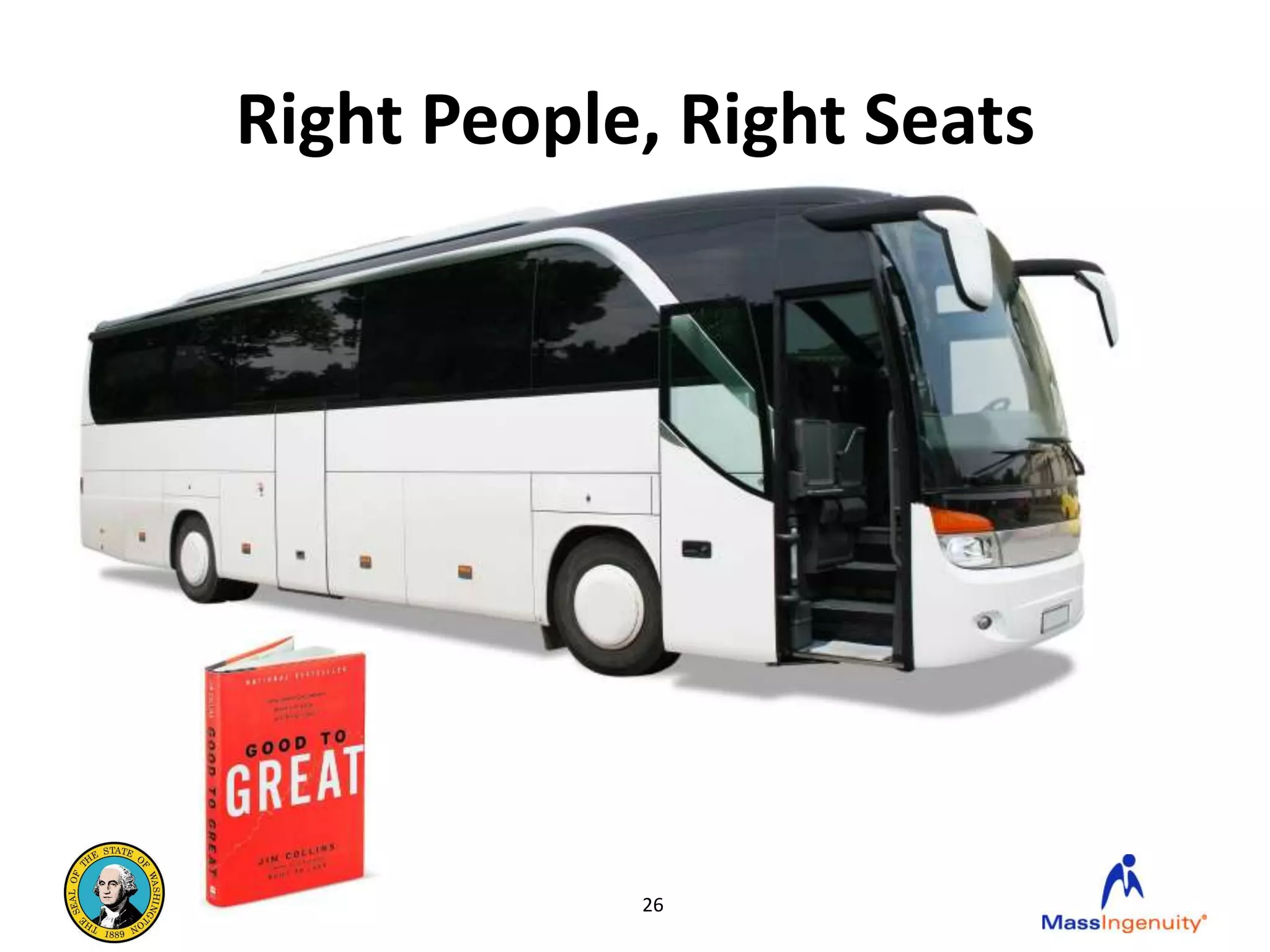
3. Get the right leaders on the bus and in the
   right seats
4. Prepare the culture


                        21
Lead the Learning
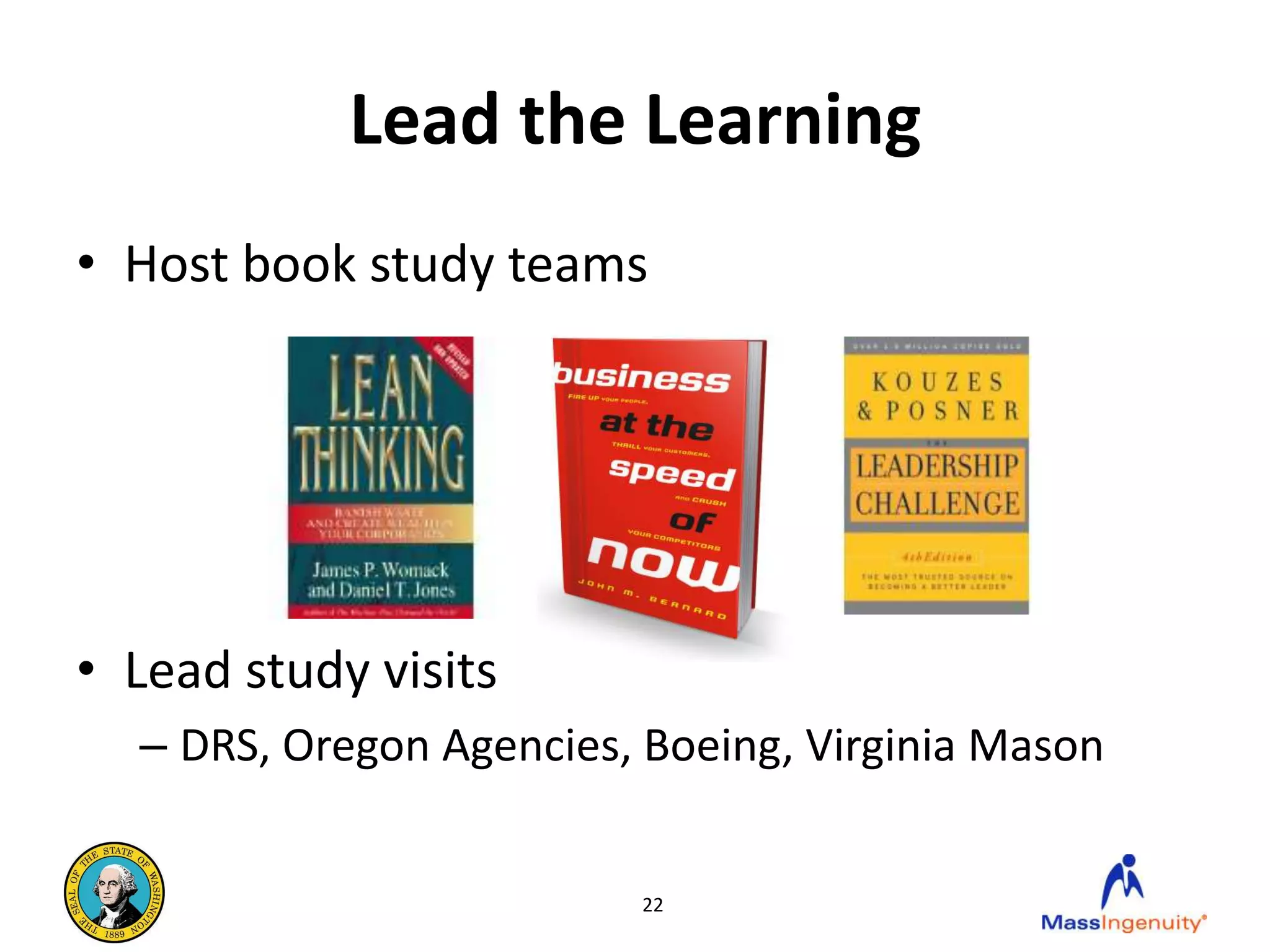
• Host book study teams


• Lead study visits
  – DRS, Oregon Agencies, Boeing, Virginia Mason


                         22
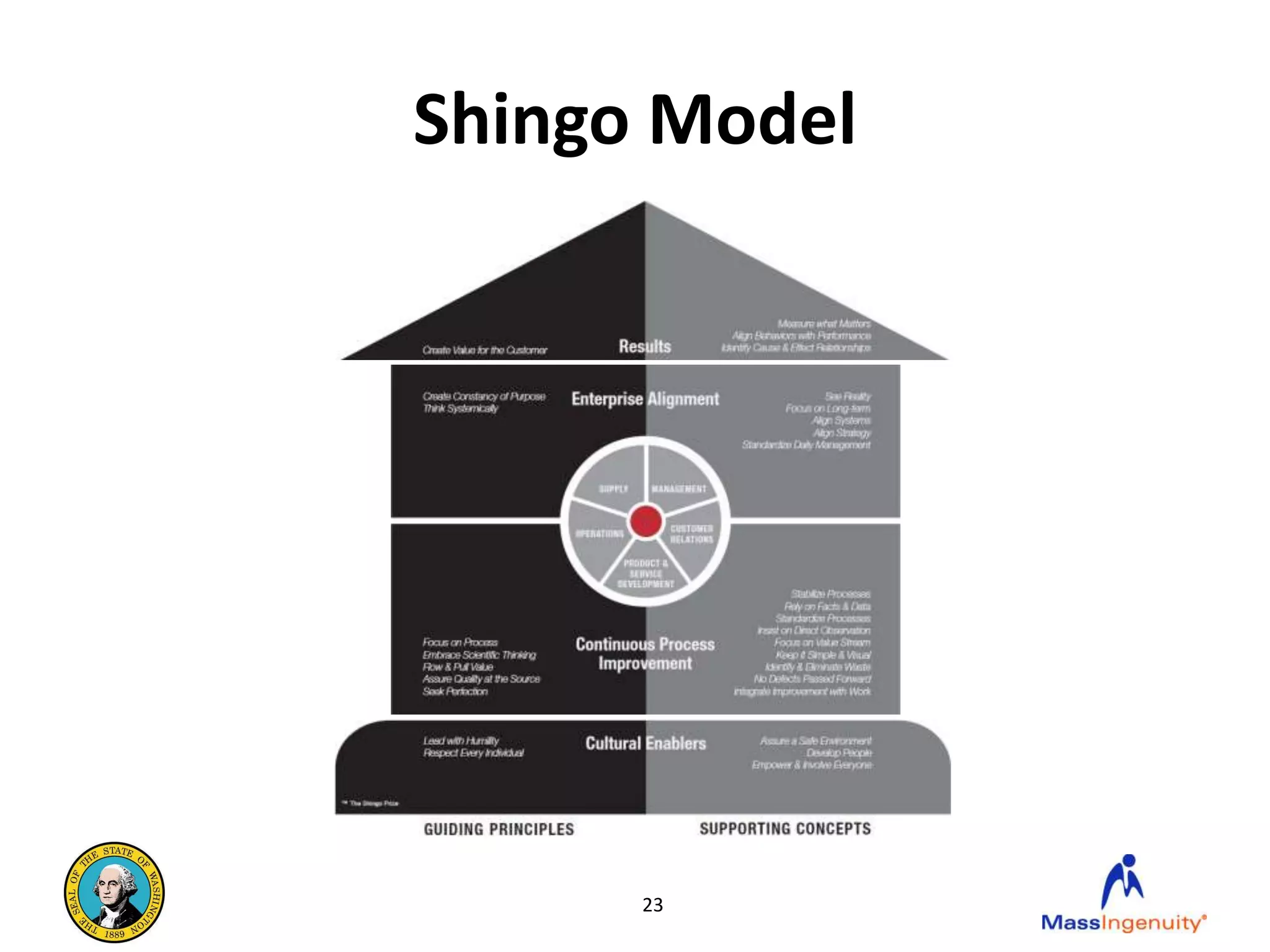
Shingo Model


      23
Remove Management Waste
             1. Unclear Direction

7   Deadly
    Sins
    of
Management
             2. No Line-of-Sight
             3. Unclear Accountability
             4. Inconsistent Language
             5. Poor Issue Transparency
             6. Inappropriate Resources
             7. Inadequate Tools/Skills
                   24
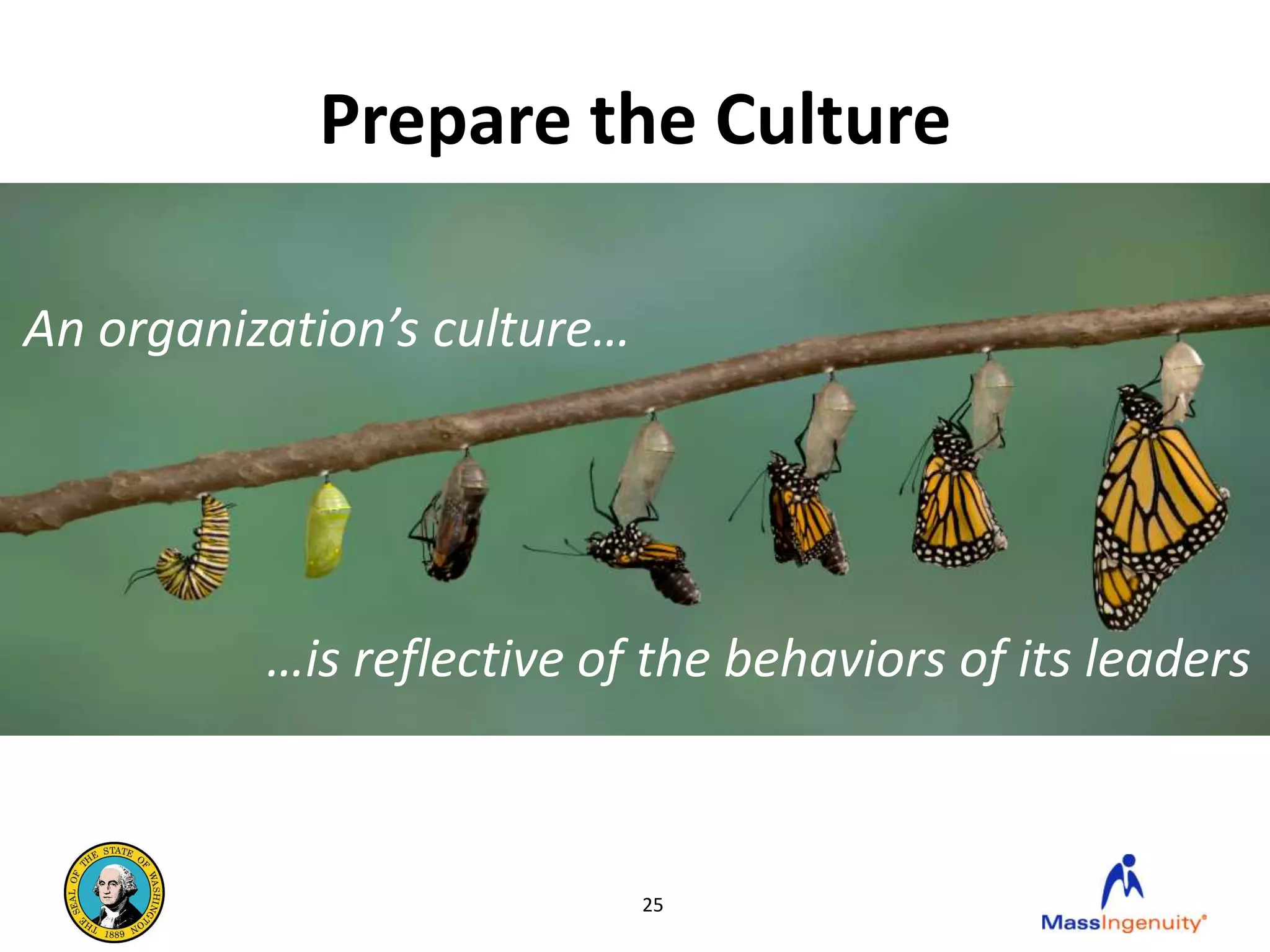
Prepare the Culture

An organization’s culture…


          …is reflective of the behaviors of its leaders


                             25
Right People, Right Seats


            26
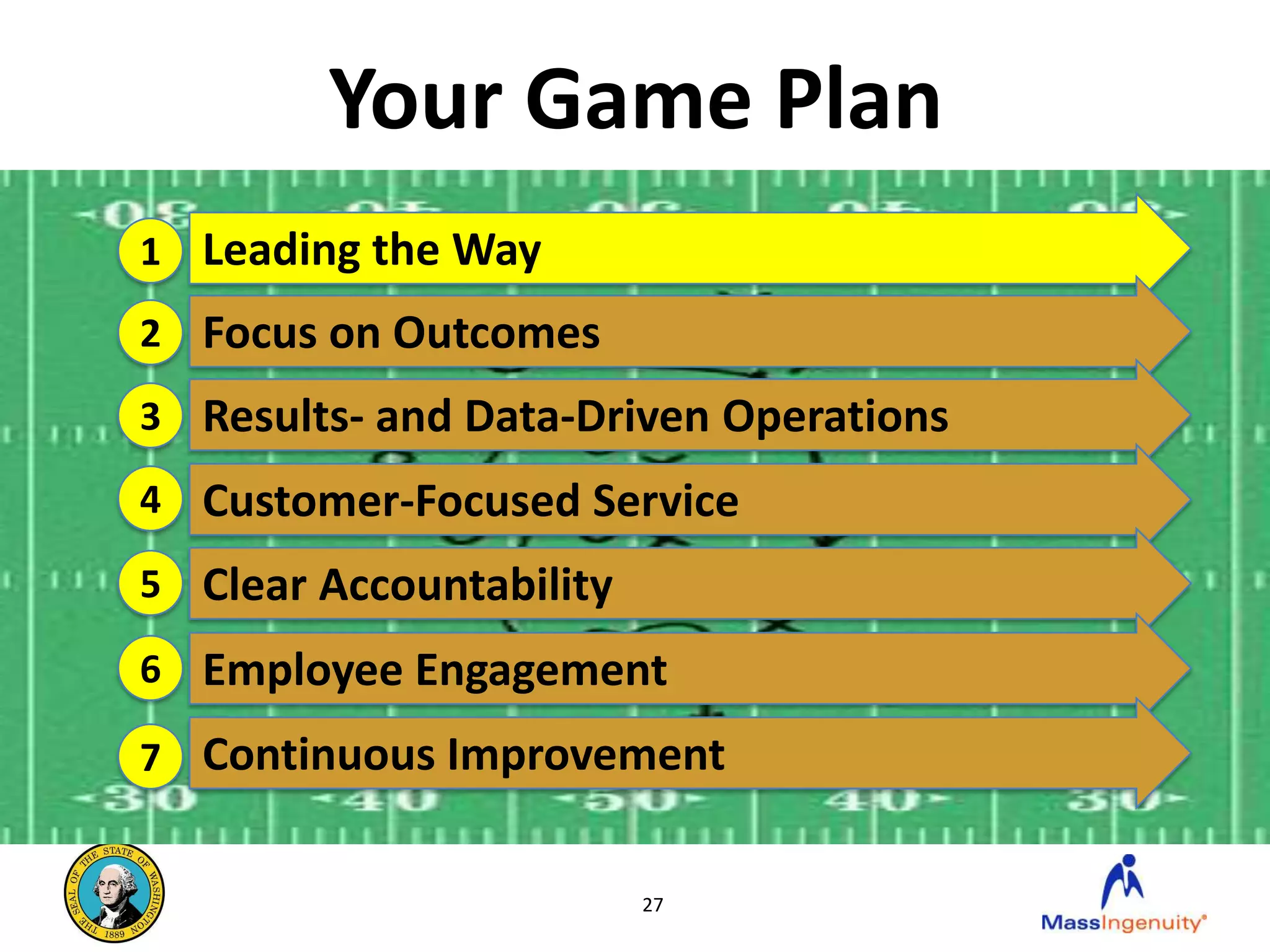
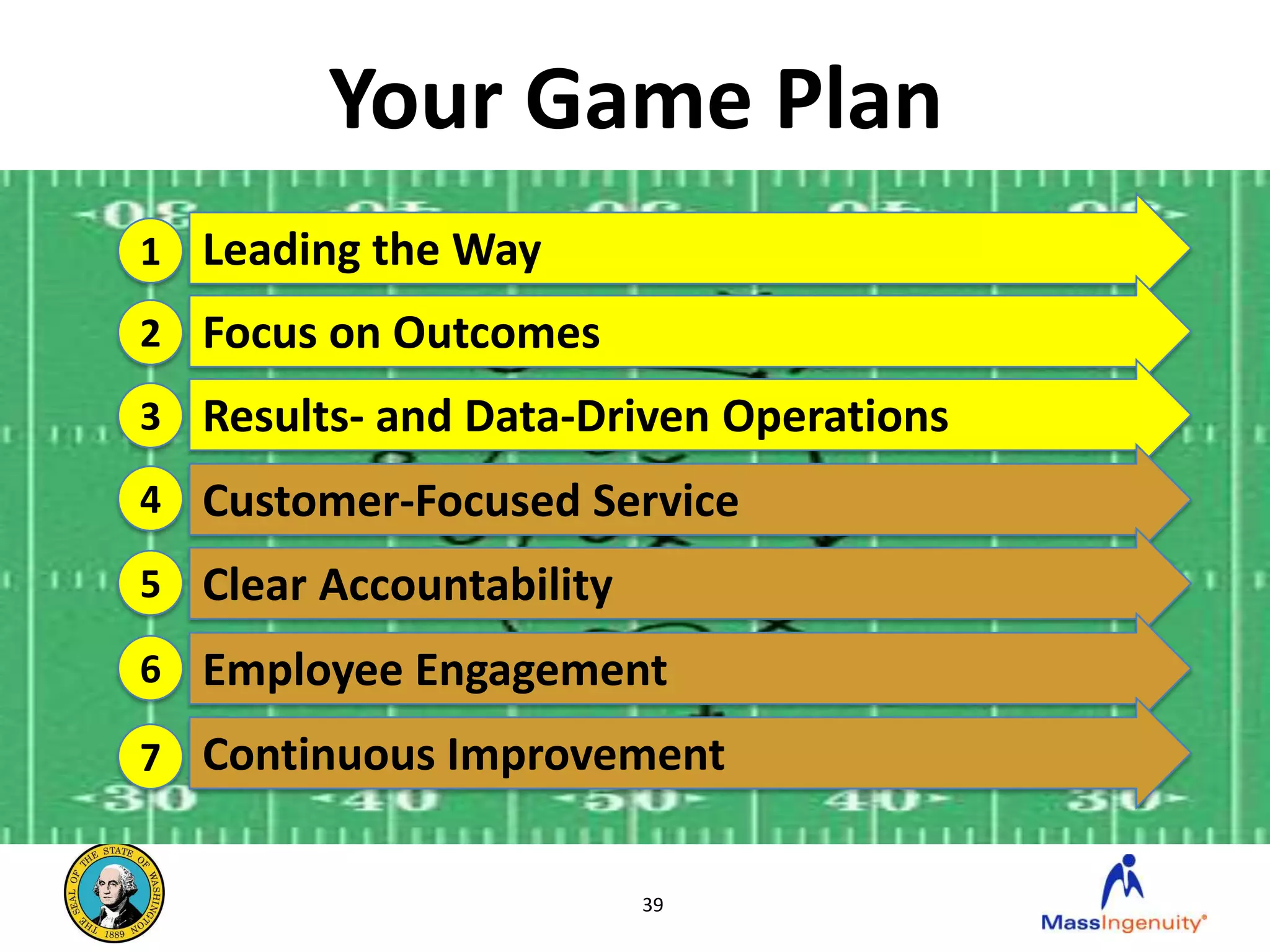
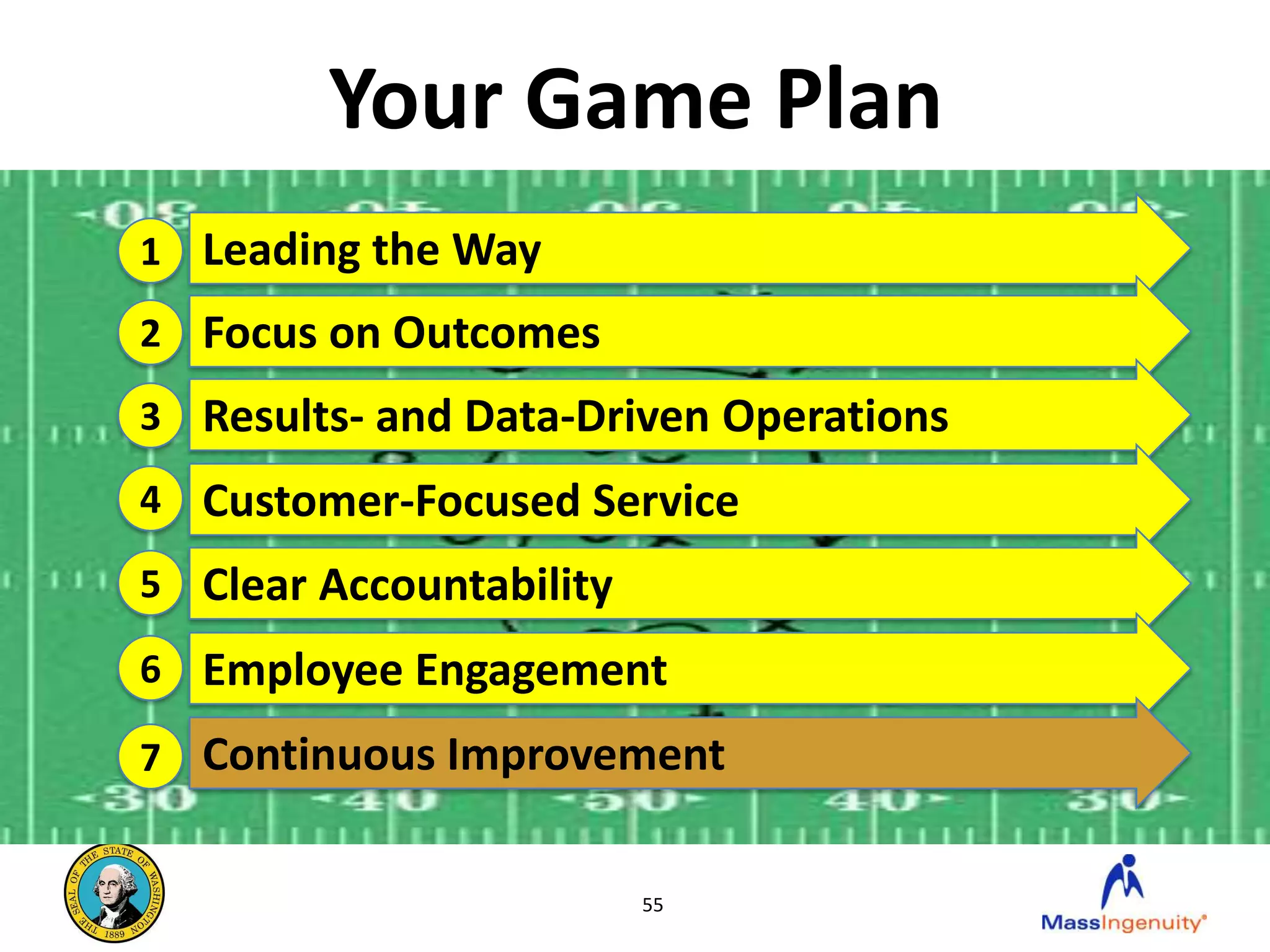
Your Game Plan
1 Leading the Way
2 Focus on Outcomes
3 Results- and Data-Driven Operations
4 Customer-Focused Service
5 Clear Accountability

6 Employee Engagement

7 Continuous Improvement


                         27
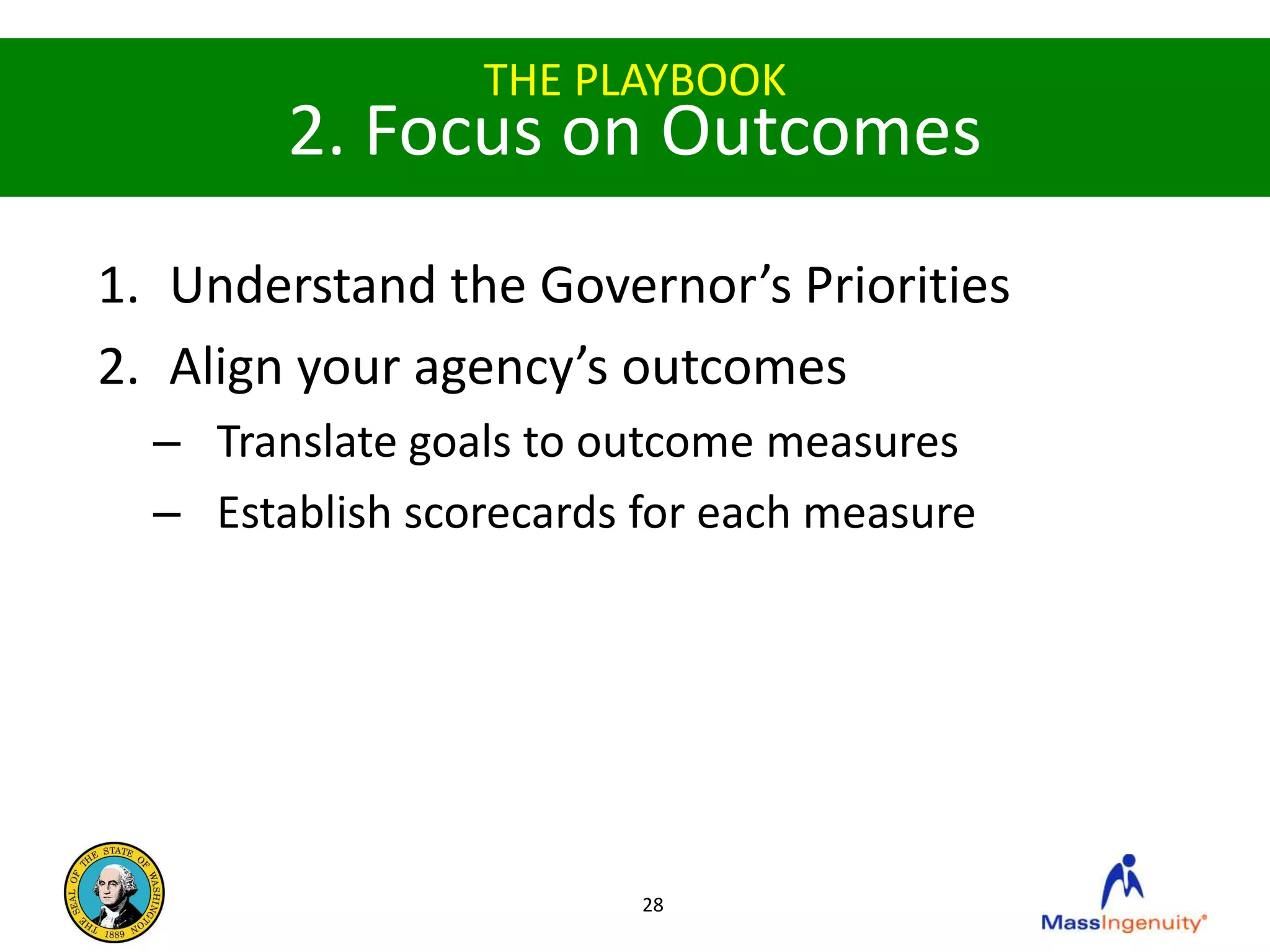
THE PLAYBOOK
        2. Focus on Outcomes
1. Understand the Governor’s Priorities
2. Align your agency’s outcomes
  – Translate goals to outcome measures
  – Establish scorecards for each measure


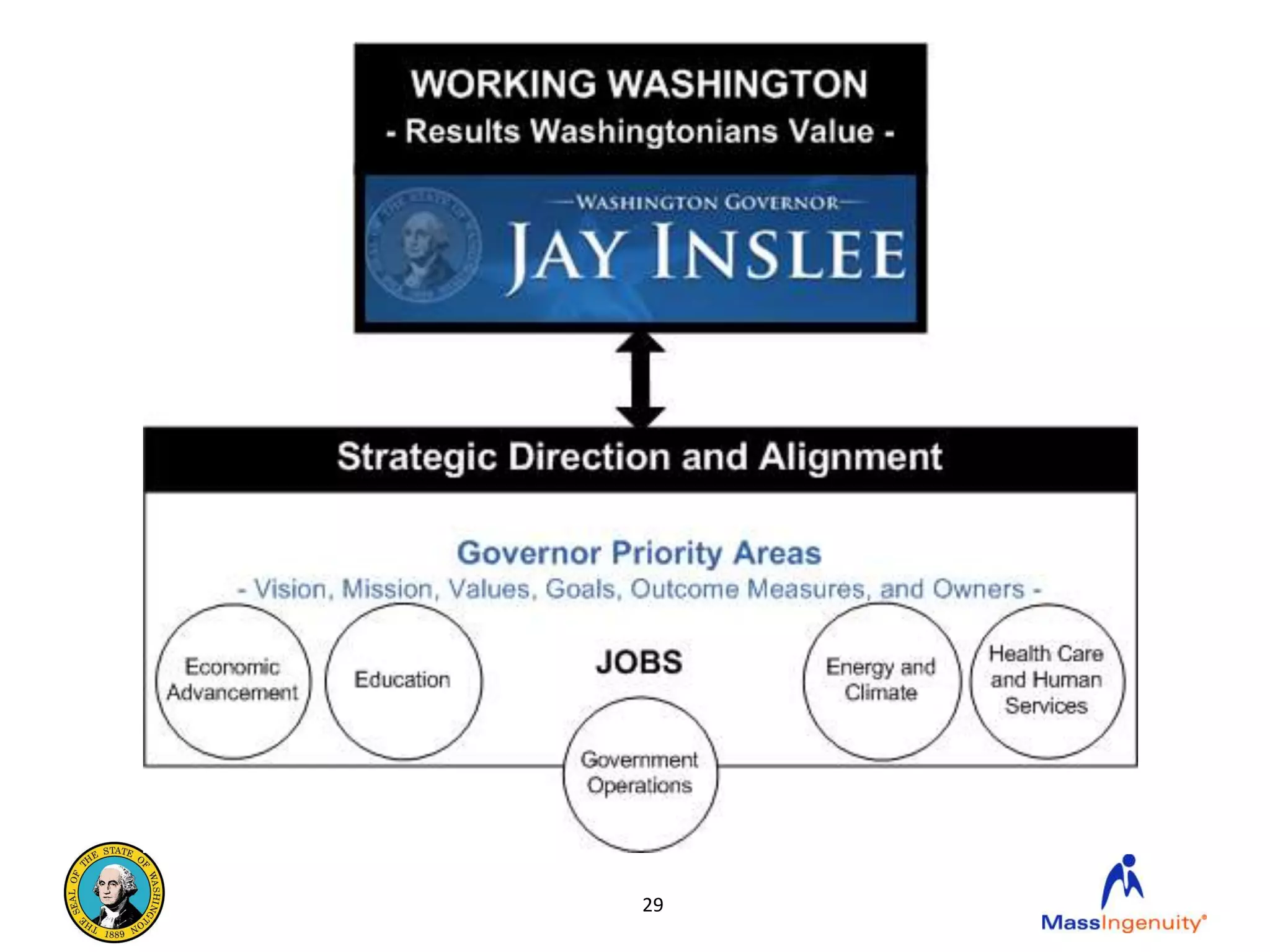
                         28
29
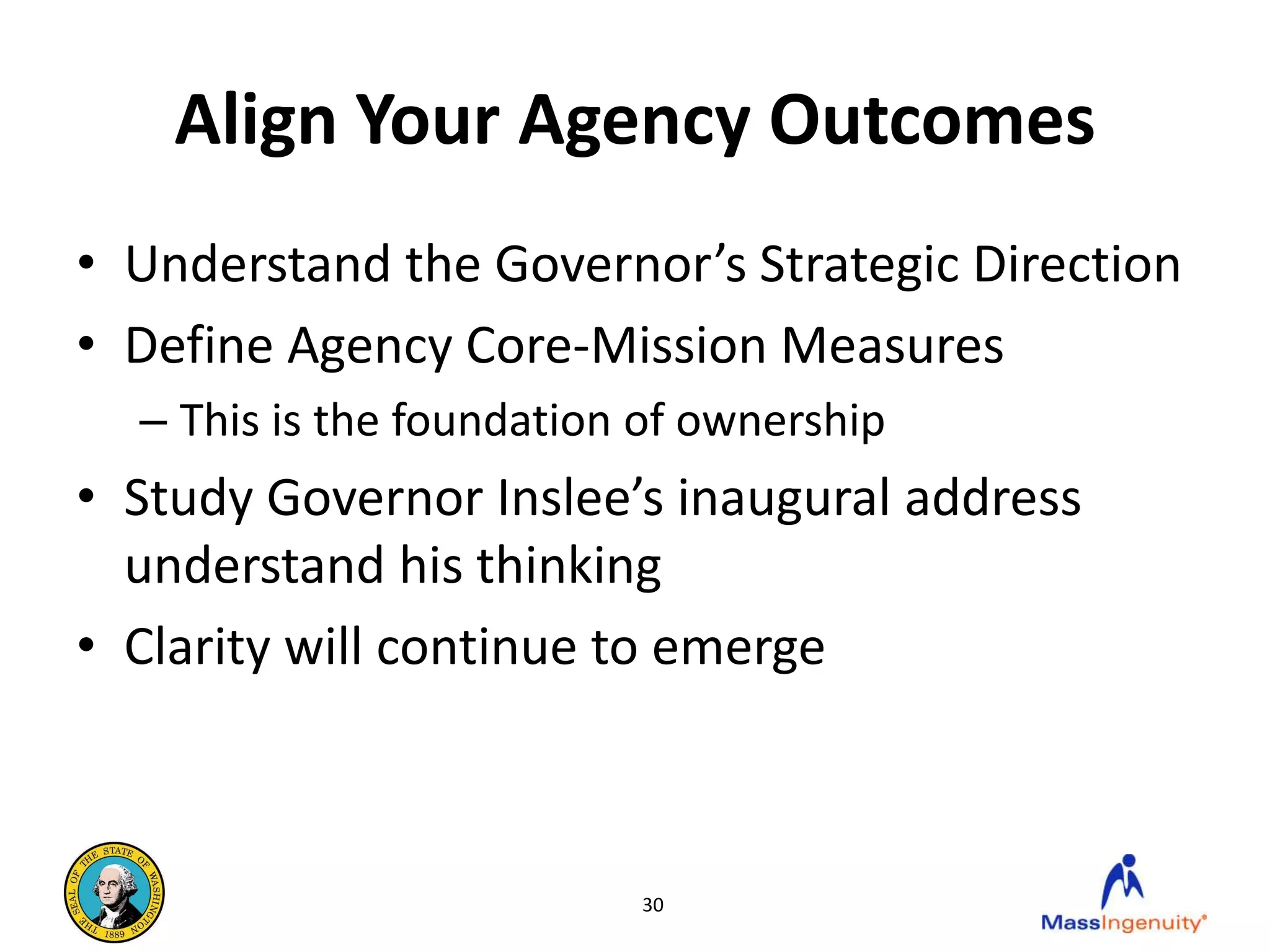
Align Your Agency Outcomes
• Understand the Governor’s Strategic Direction
• Define Agency Core-Mission Measures
  – This is the foundation of ownership
• Study Governor Inslee’s inaugural address
  understand his thinking
• Clarity will continue to emerge


                          30
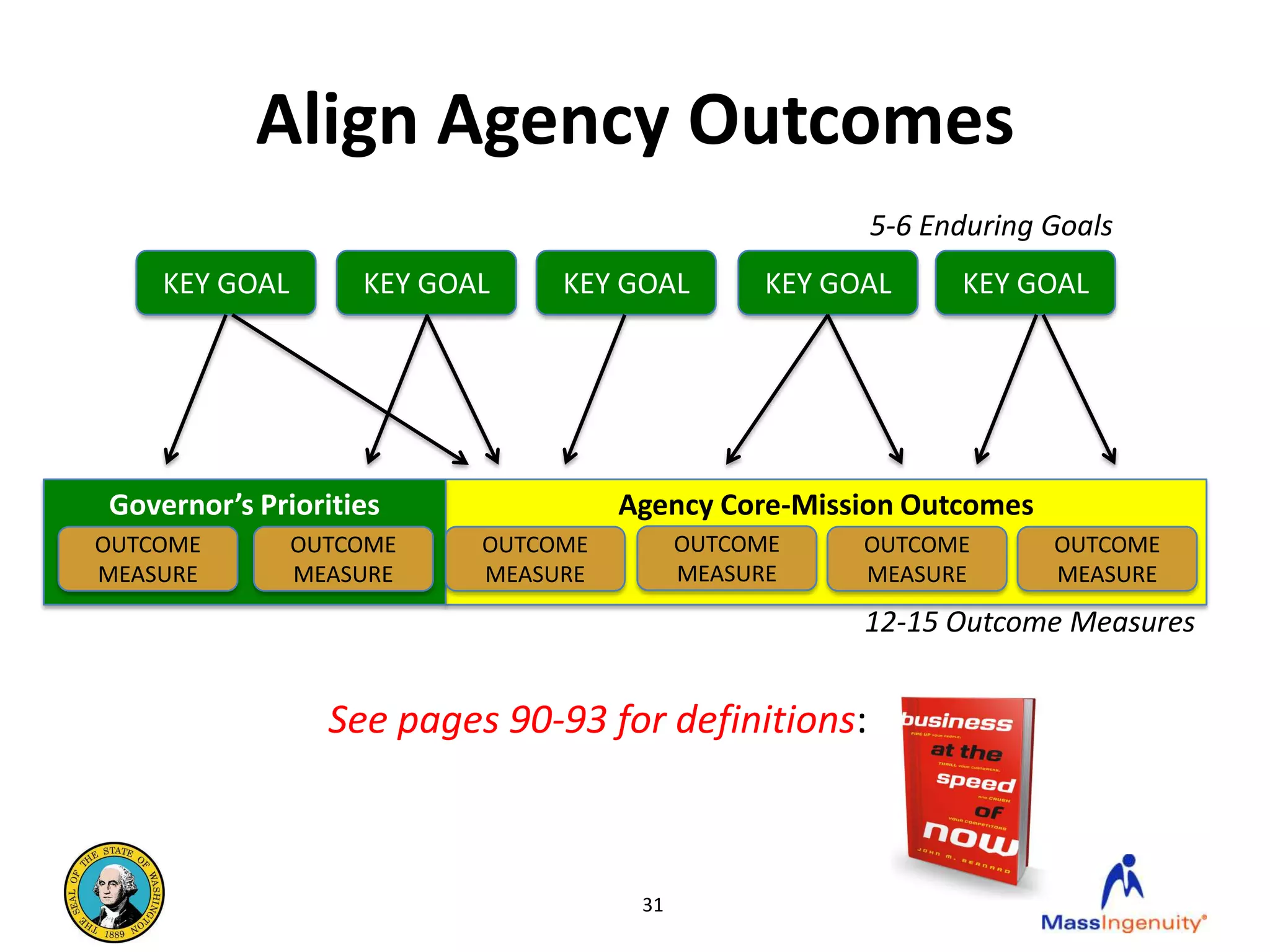
Align Agency Outcomes
                                                     5-6 Enduring Goals
    KEY GOAL       KEY GOAL    KEY GOAL        KEY GOAL    KEY GOAL


Governor’s Priorities               Agency Core-Mission Outcomes
OUTCOME        OUTCOME    OUTCOME         OUTCOME    OUTCOME       OUTCOME
MEASURE        MEASURE    MEASURE         MEASURE    MEASURE       MEASURE

                                                     12-15 Outcome Measures


                 See pages 90-93 for definitions:


                                     31
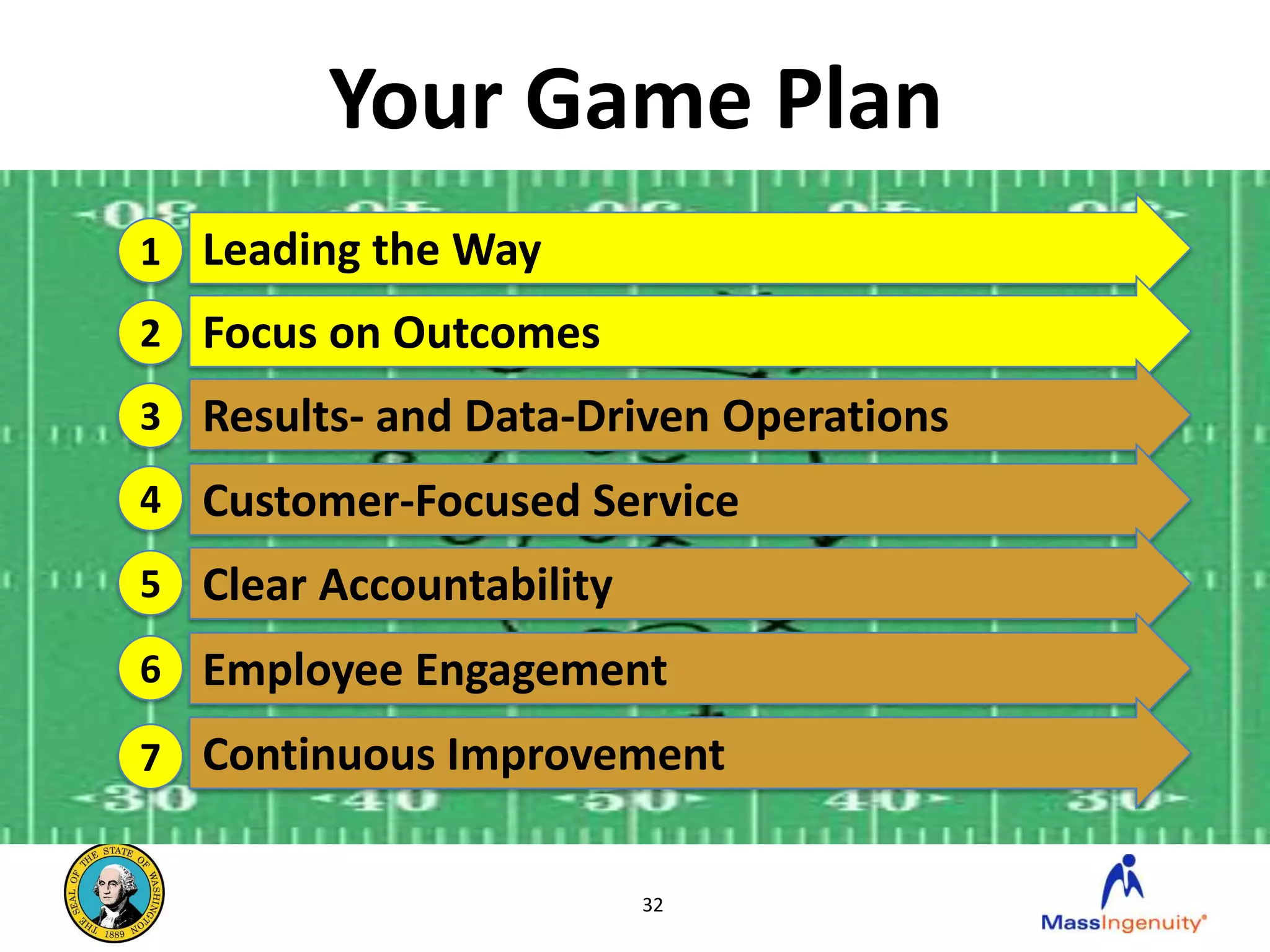
Your Game Plan
1 Leading the Way
2 Focus on Outcomes
3 Results- and Data-Driven Operations
4 Customer-Focused Service
5 Clear Accountability

6 Employee Engagement

7 Continuous Improvement


                         32
THE PLAYBOOK
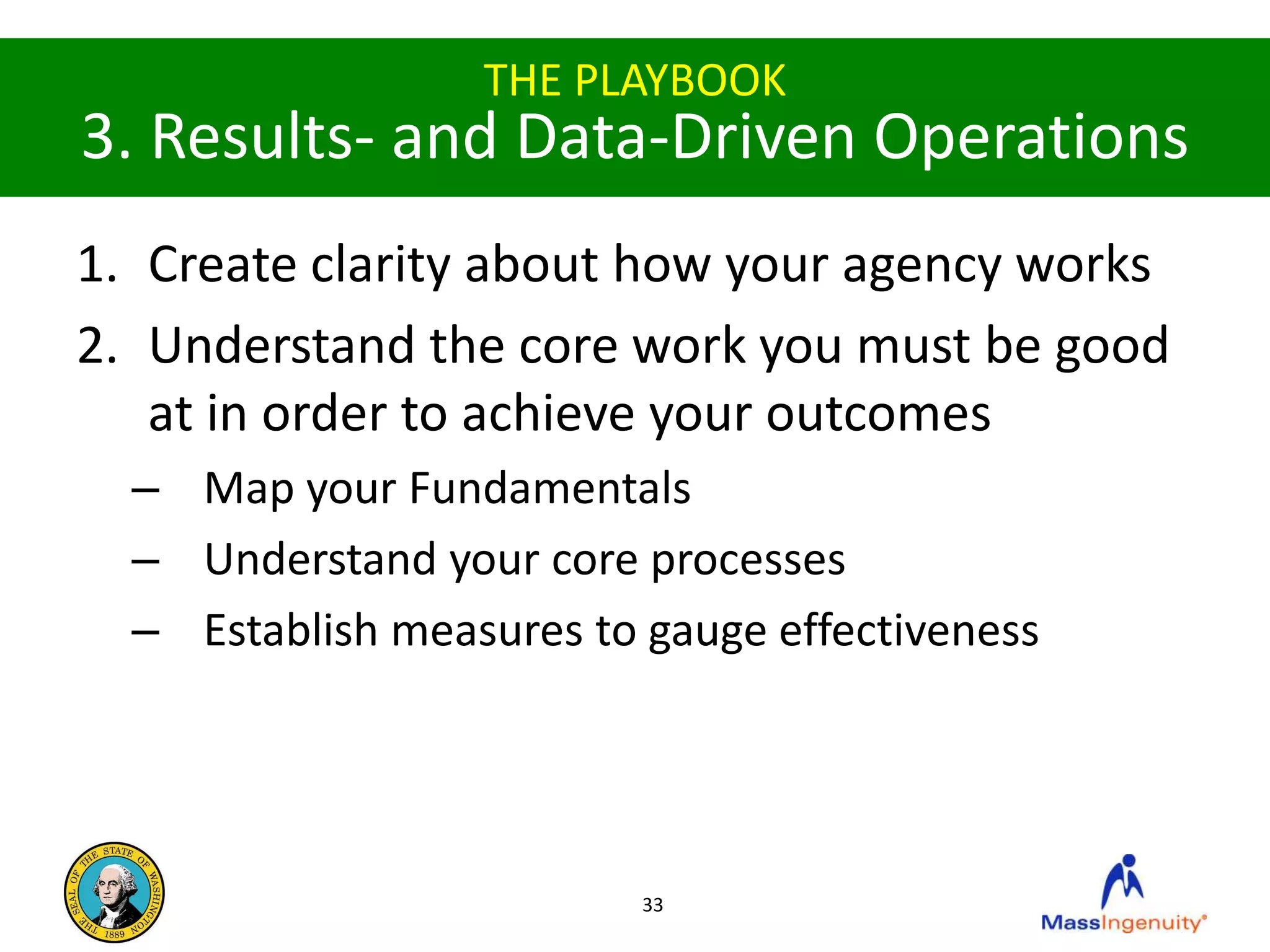
3. Results- and Data-Driven Operations
1. Create clarity about how your agency works
2. Understand the core work you must be good
   at in order to achieve your outcomes
  – Map your Fundamentals
  – Understand your core processes
  – Establish measures to gauge effectiveness


                          33
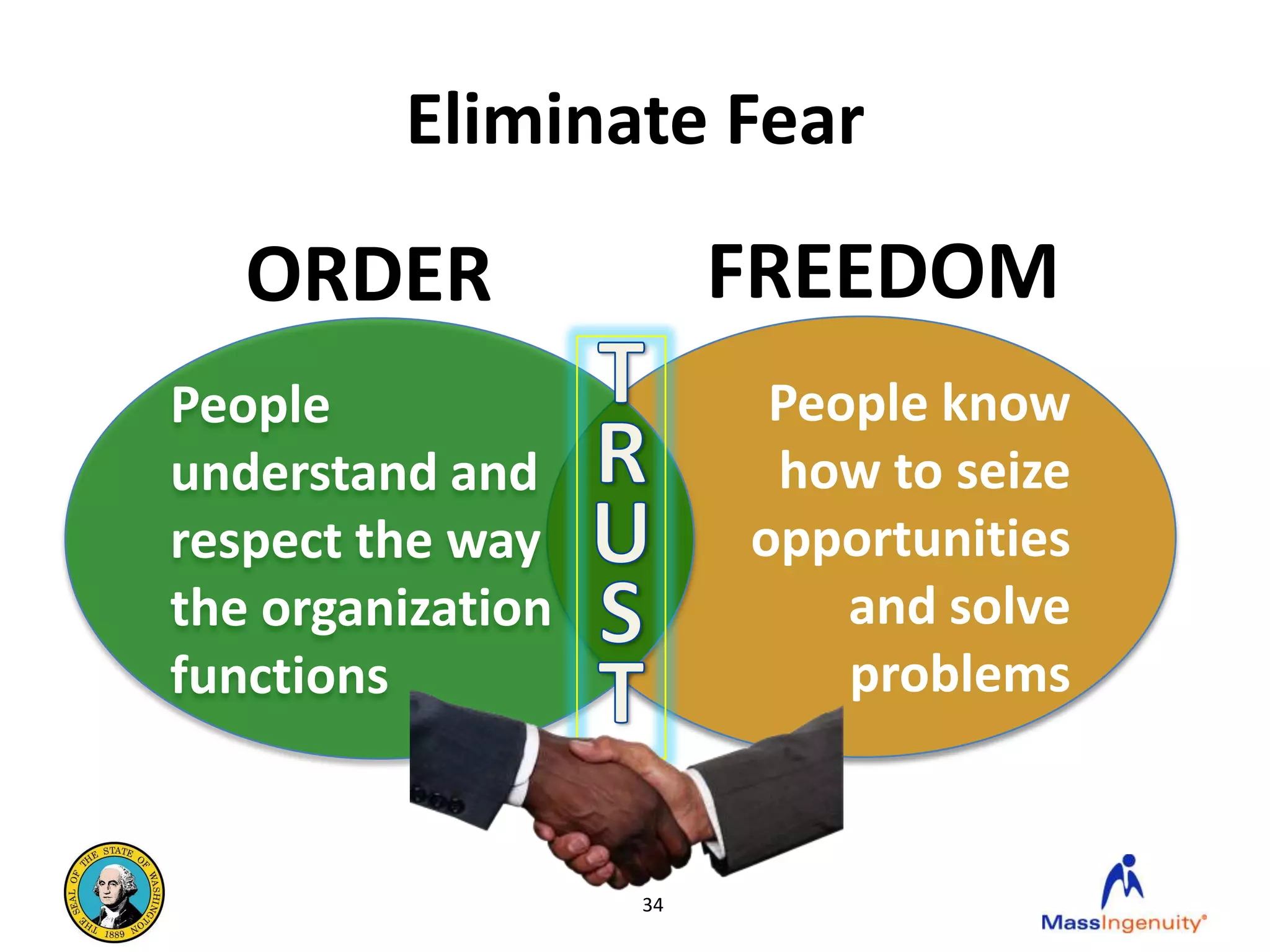
Eliminate Fear

   ORDER                FREEDOM
People                   People know
understand and           how to seize
respect the way         opportunities
the organization            and solve
functions                   problems


                   34
35
36
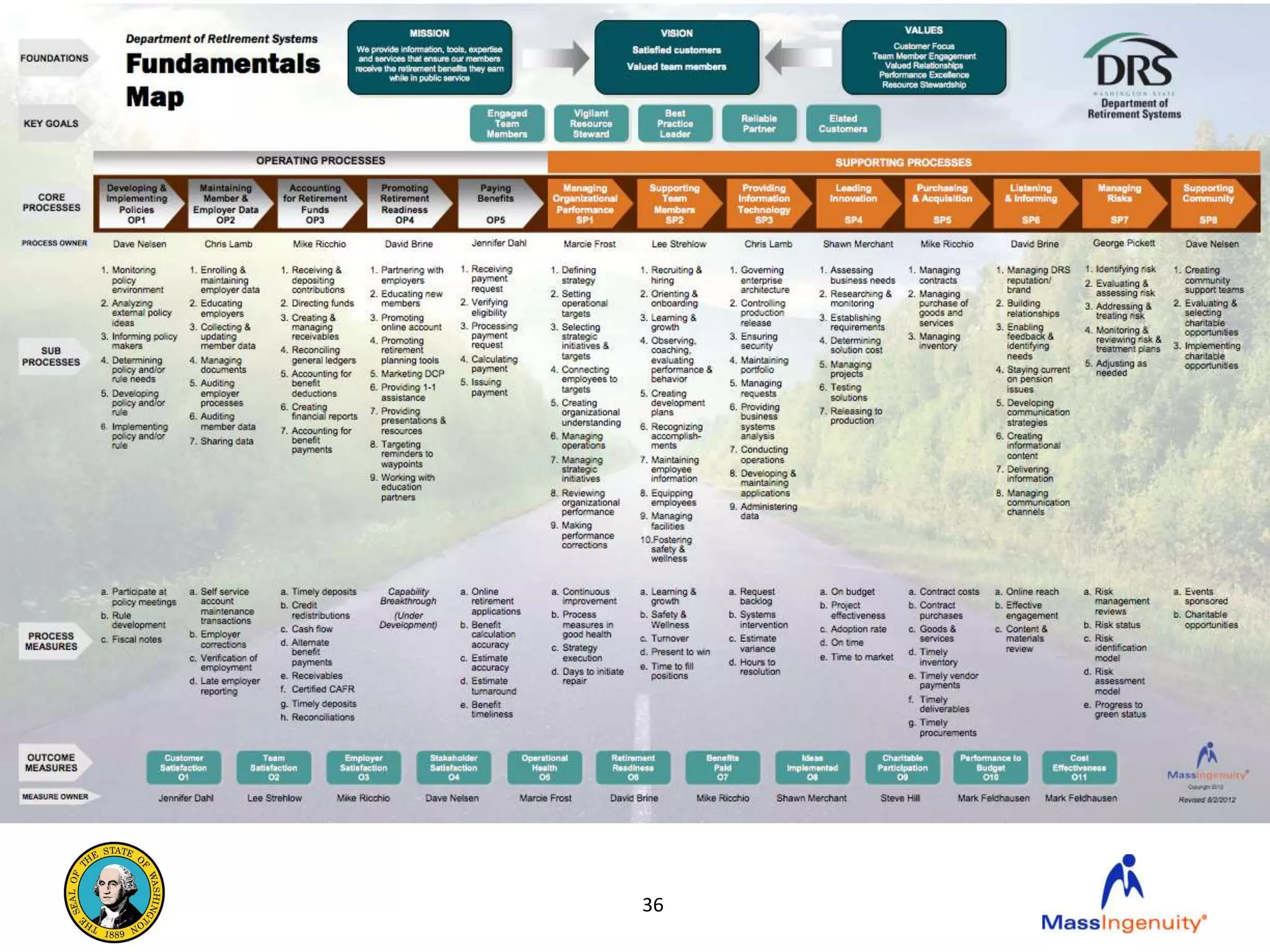
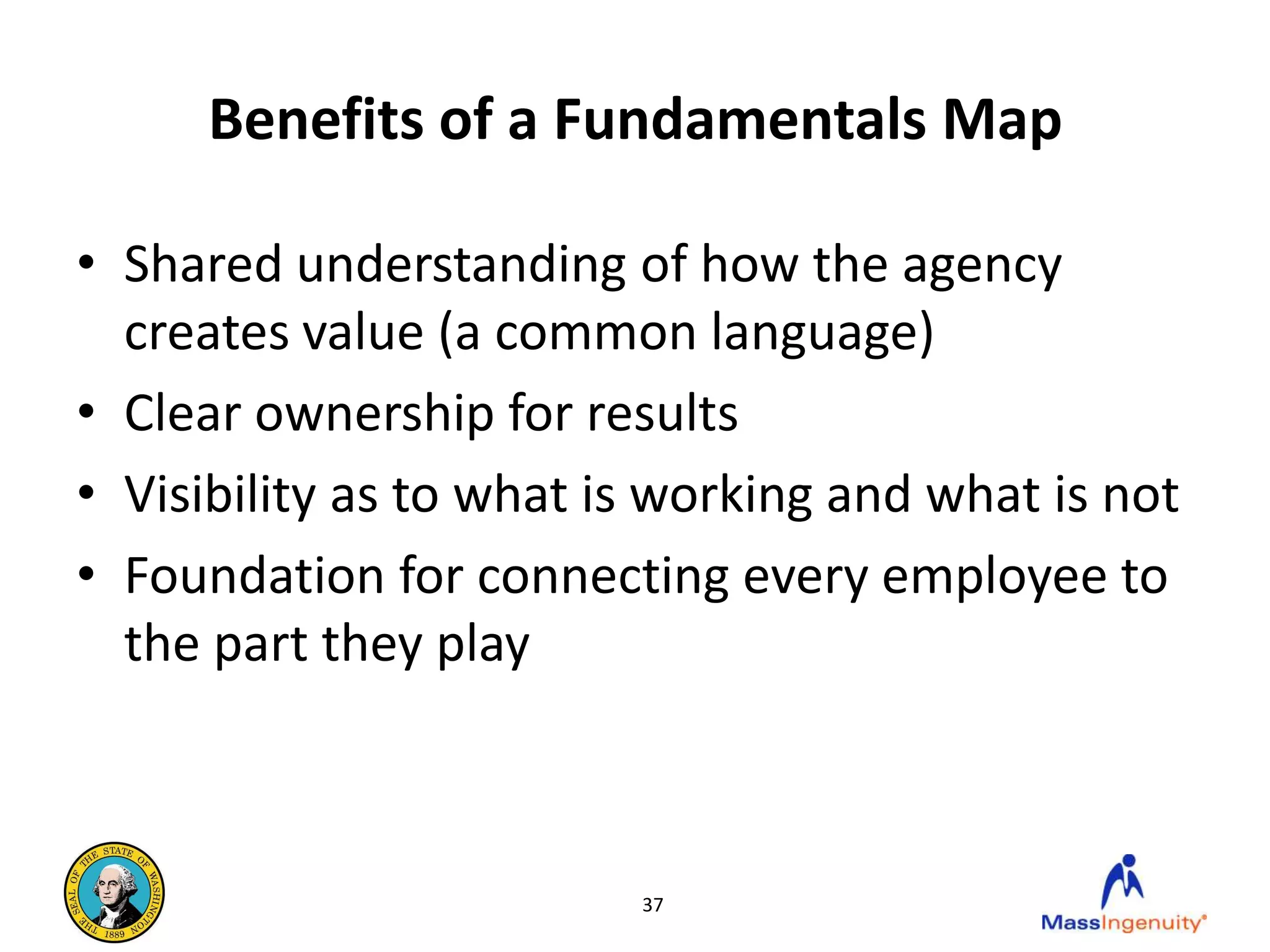
Benefits of a Fundamentals Map

• Shared understanding of how the agency
  creates value (a common language)
• Clear ownership for results
• Visibility as to what is working and what is not
• Foundation for connecting every employee to
  the part they play


                         37
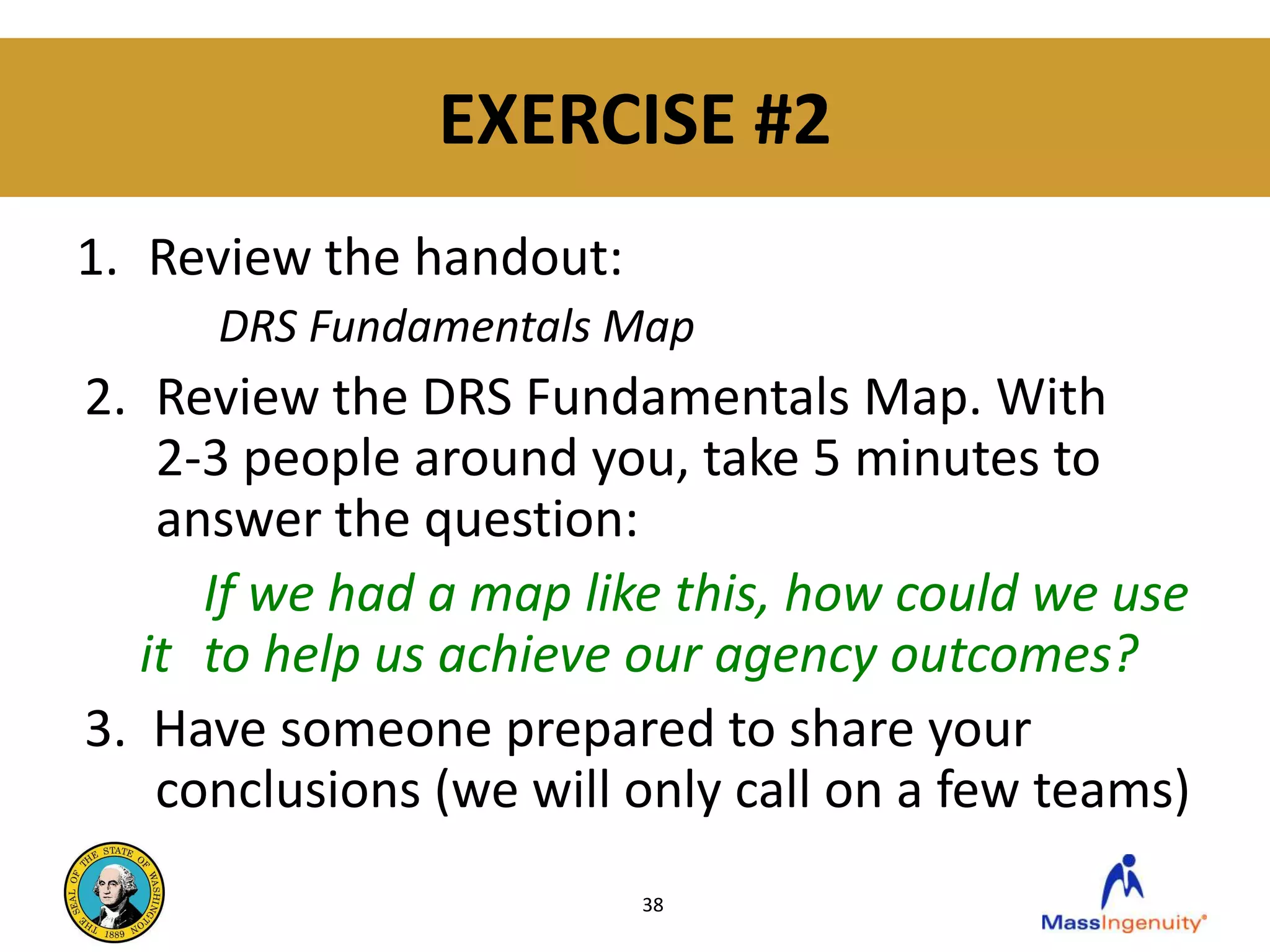
EXERCISE #2
1. Review the handout:
     DRS Fundamentals Map
2. Review the DRS Fundamentals Map. With
   2-3 people around you, take 5 minutes to
   answer the question:
     If we had a map like this, how could we use
  it to help us achieve our agency outcomes?
3. Have someone prepared to share your
   conclusions (we will only call on a few teams)
                         38
Your Game Plan
1 Leading the Way
2 Focus on Outcomes
3 Results- and Data-Driven Operations
4 Customer-Focused Service
5 Clear Accountability

6 Employee Engagement

7 Continuous Improvement


                         39
BREAK
  40
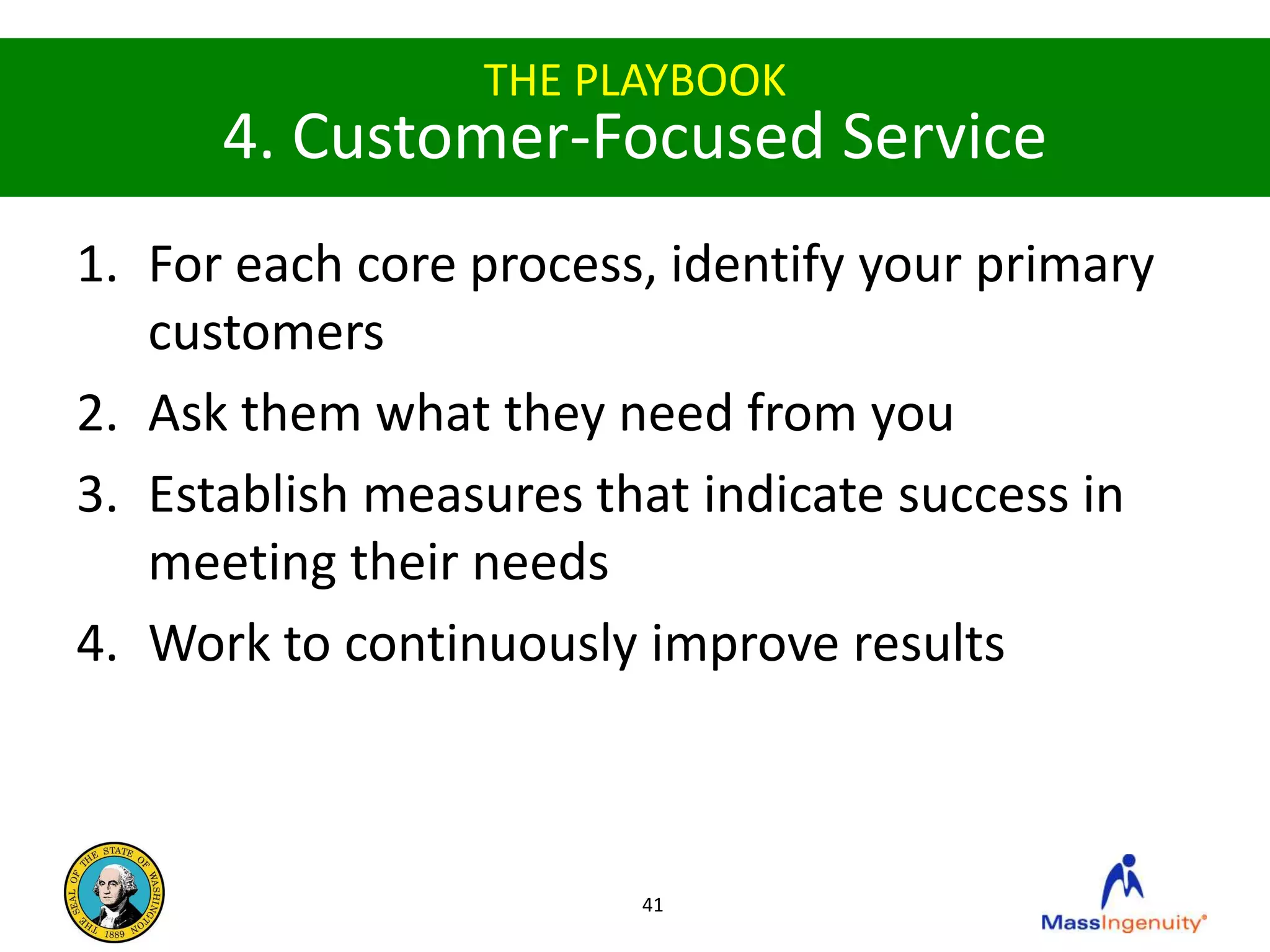
THE PLAYBOOK
      4. Customer-Focused Service
1. For each core process, identify your primary
   customers
2. Ask them what they need from you
3. Establish measures that indicate success in
   meeting their needs
4. Work to continuously improve results


                        41
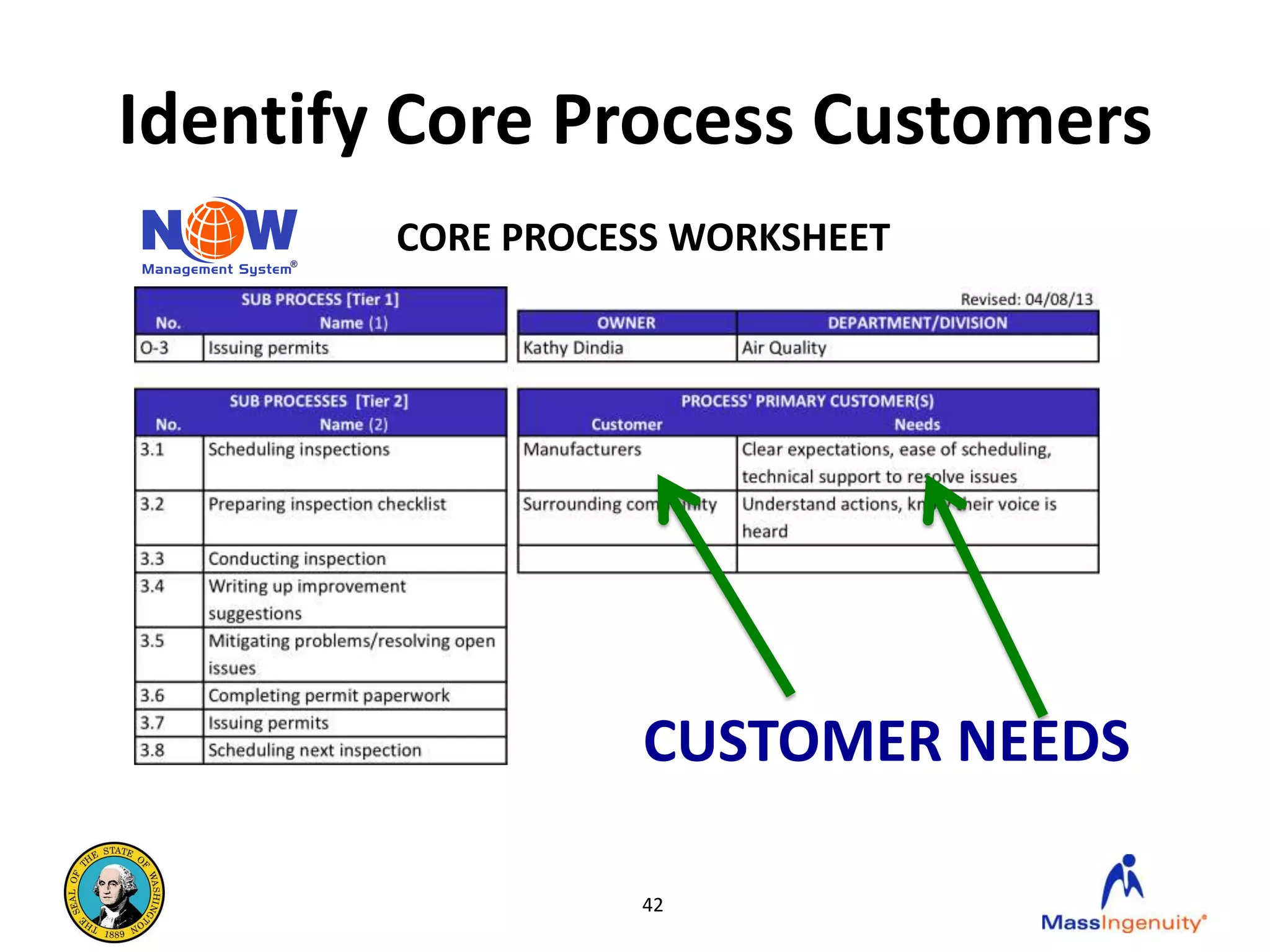
Identify Core Process Customers
        CORE PROCESS WORKSHEET


                  CUSTOMER NEEDS

                  42
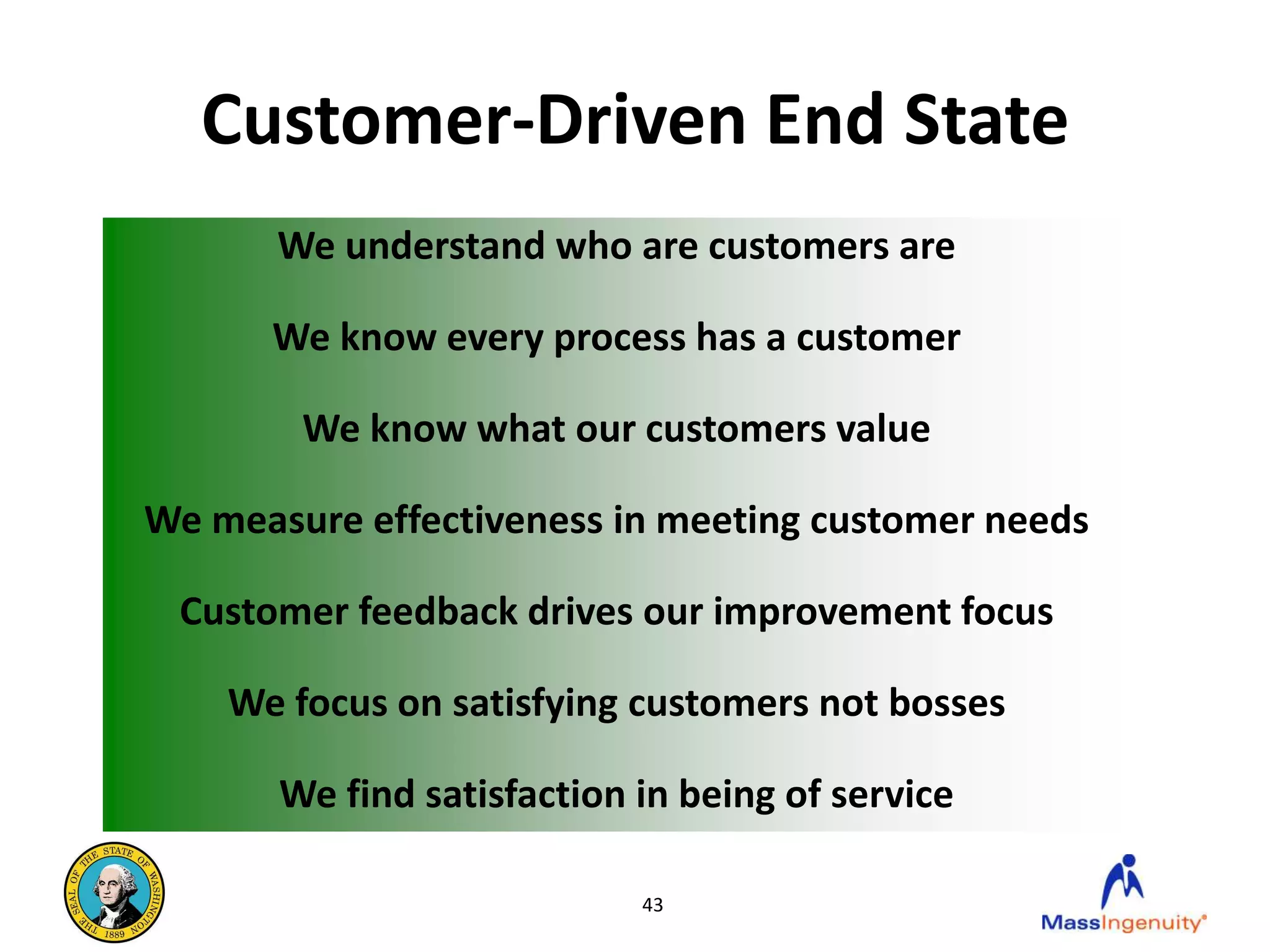
Customer-Driven End State
       We understand who are customers are

      We know every process has a customer

        We know what our customers value

We measure effectiveness in meeting customer needs

 Customer feedback drives our improvement focus

    We focus on satisfying customers not bosses

       We find satisfaction in being of service

                            43
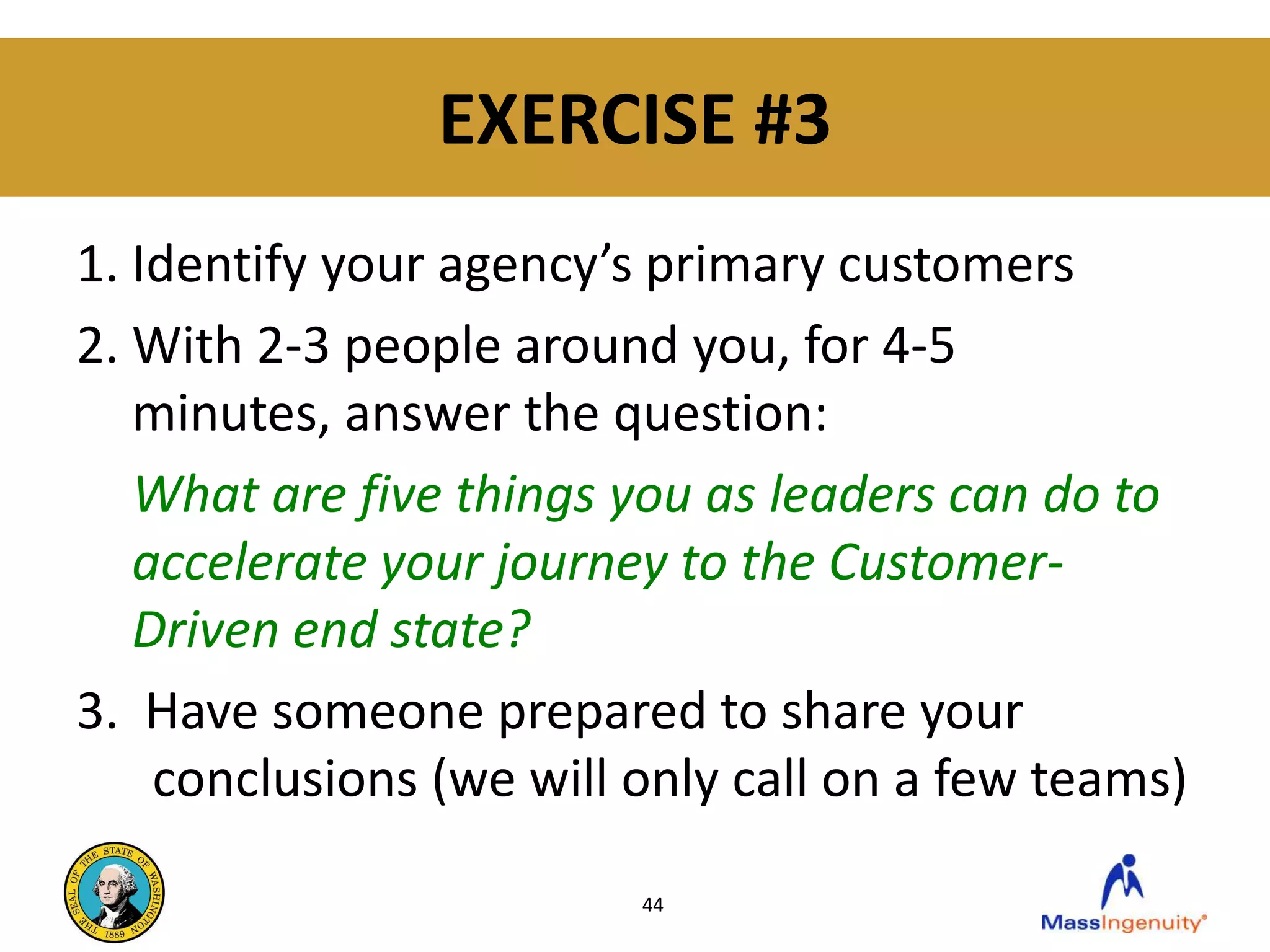
EXERCISE #3
1. Identify your agency’s primary customers
2. With 2-3 people around you, for 4-5
   minutes, answer the question:
   What are five things you as leaders can do to
   accelerate your journey to the Customer-
   Driven end state?
3. Have someone prepared to share your
    conclusions (we will only call on a few teams)

                         44
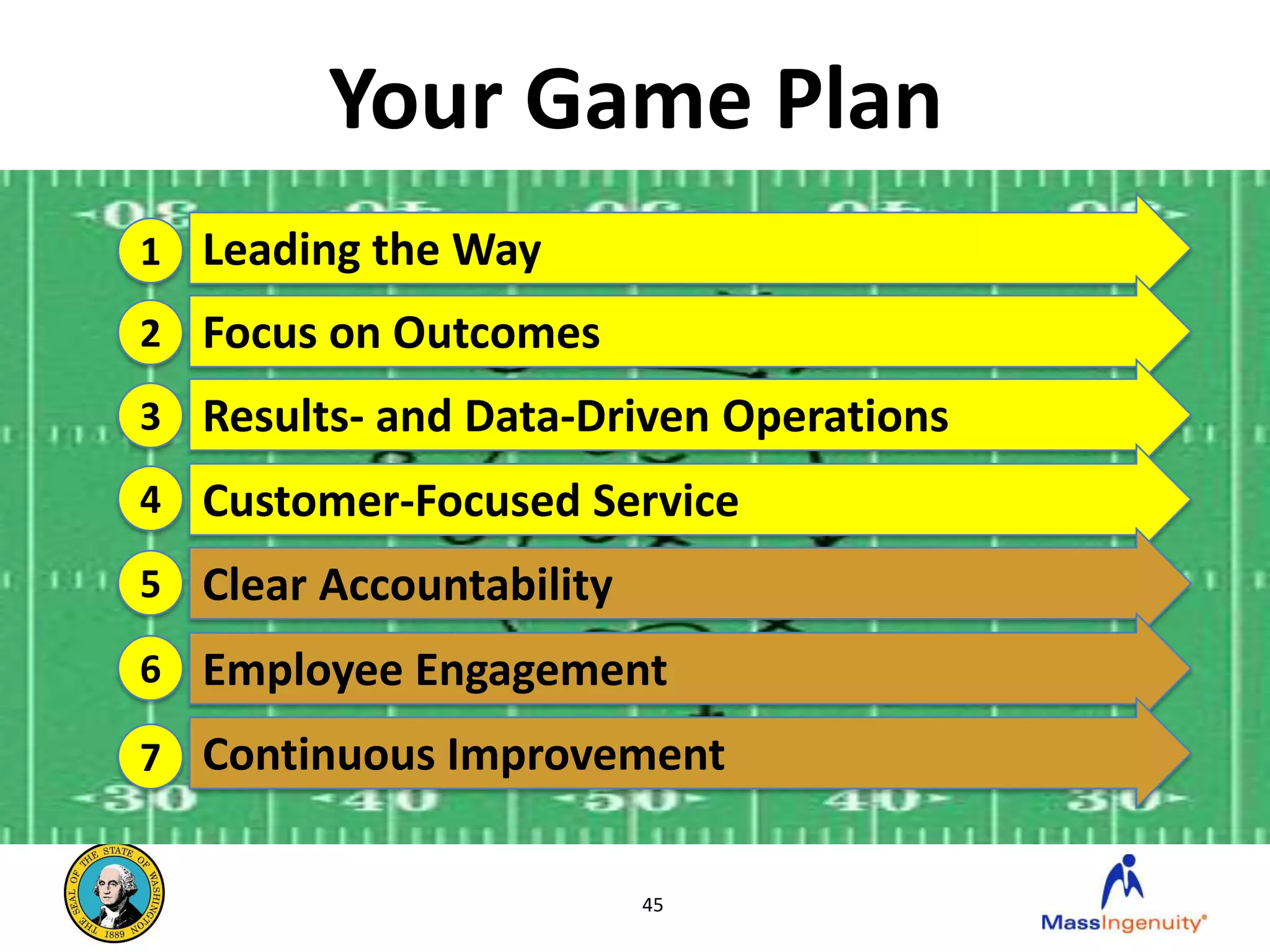
Your Game Plan
1 Leading the Way
2 Focus on Outcomes
3 Results- and Data-Driven Operations
4 Customer-Focused Service
5 Clear Accountability

6 Employee Engagement

7 Continuous Improvement


                         45
THE PLAYBOOK
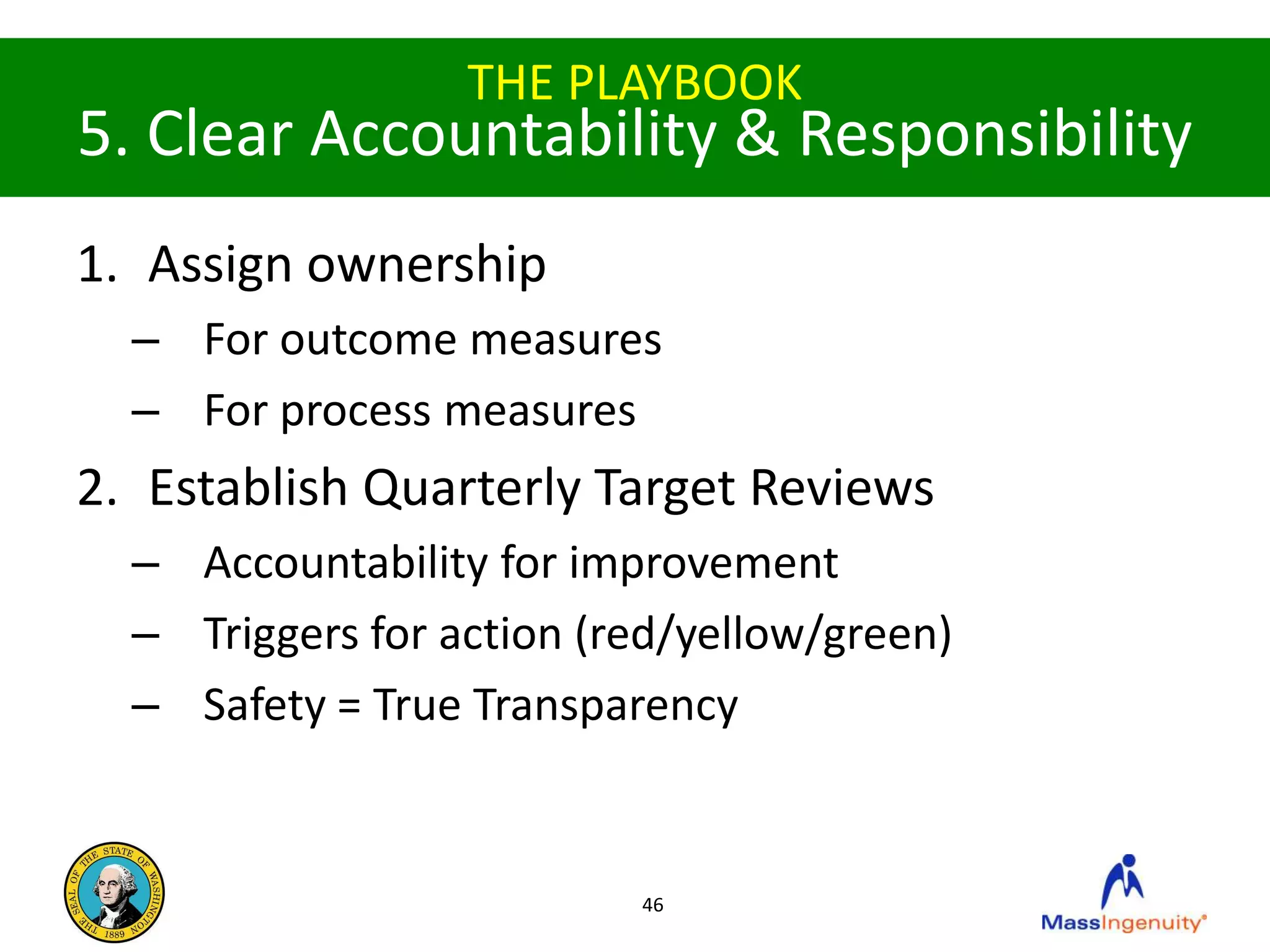
5. Clear Accountability & Responsibility
1. Assign ownership
  – For outcome measures
  – For process measures
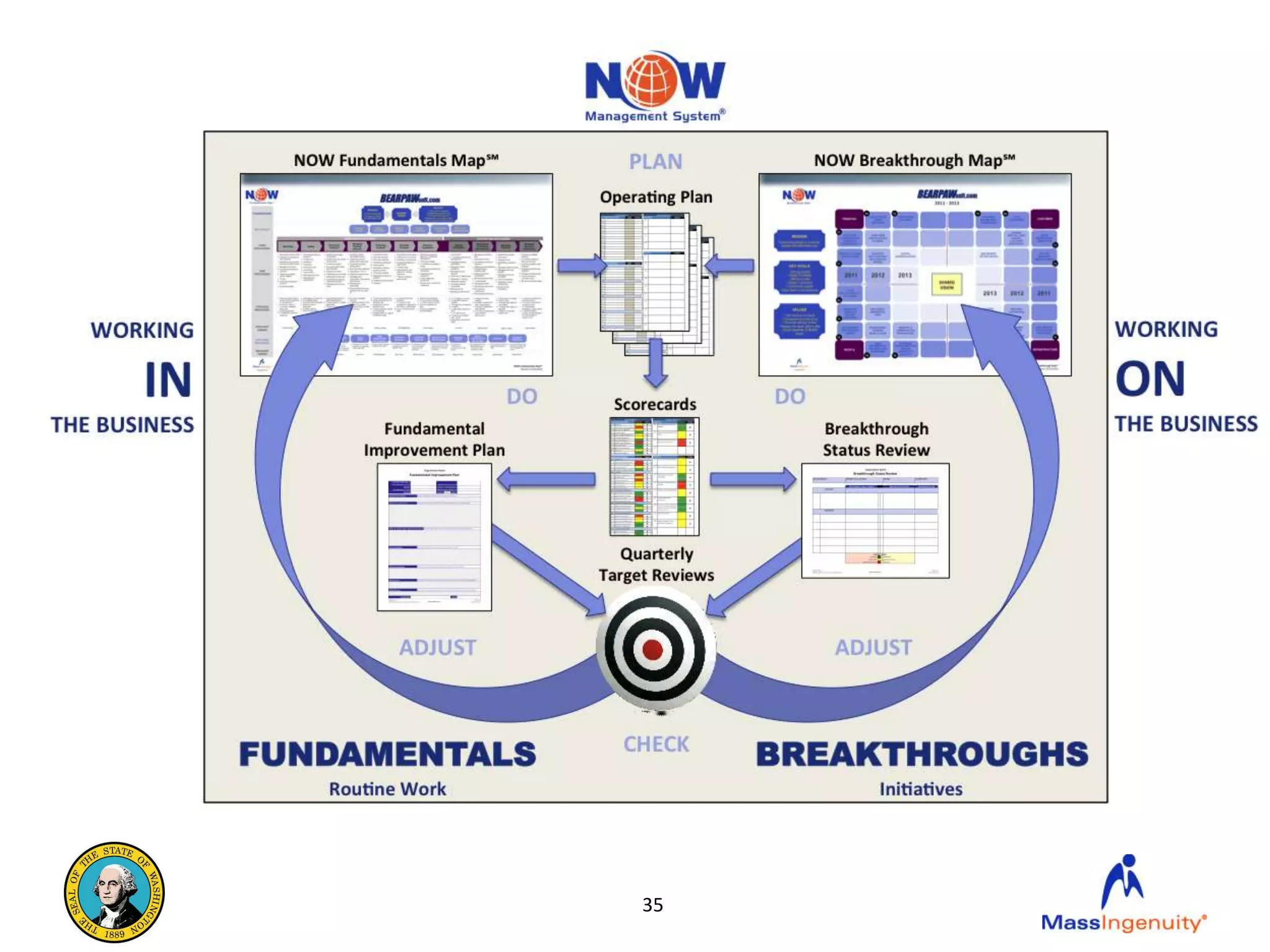
2. Establish Quarterly Target Reviews
  – Accountability for improvement
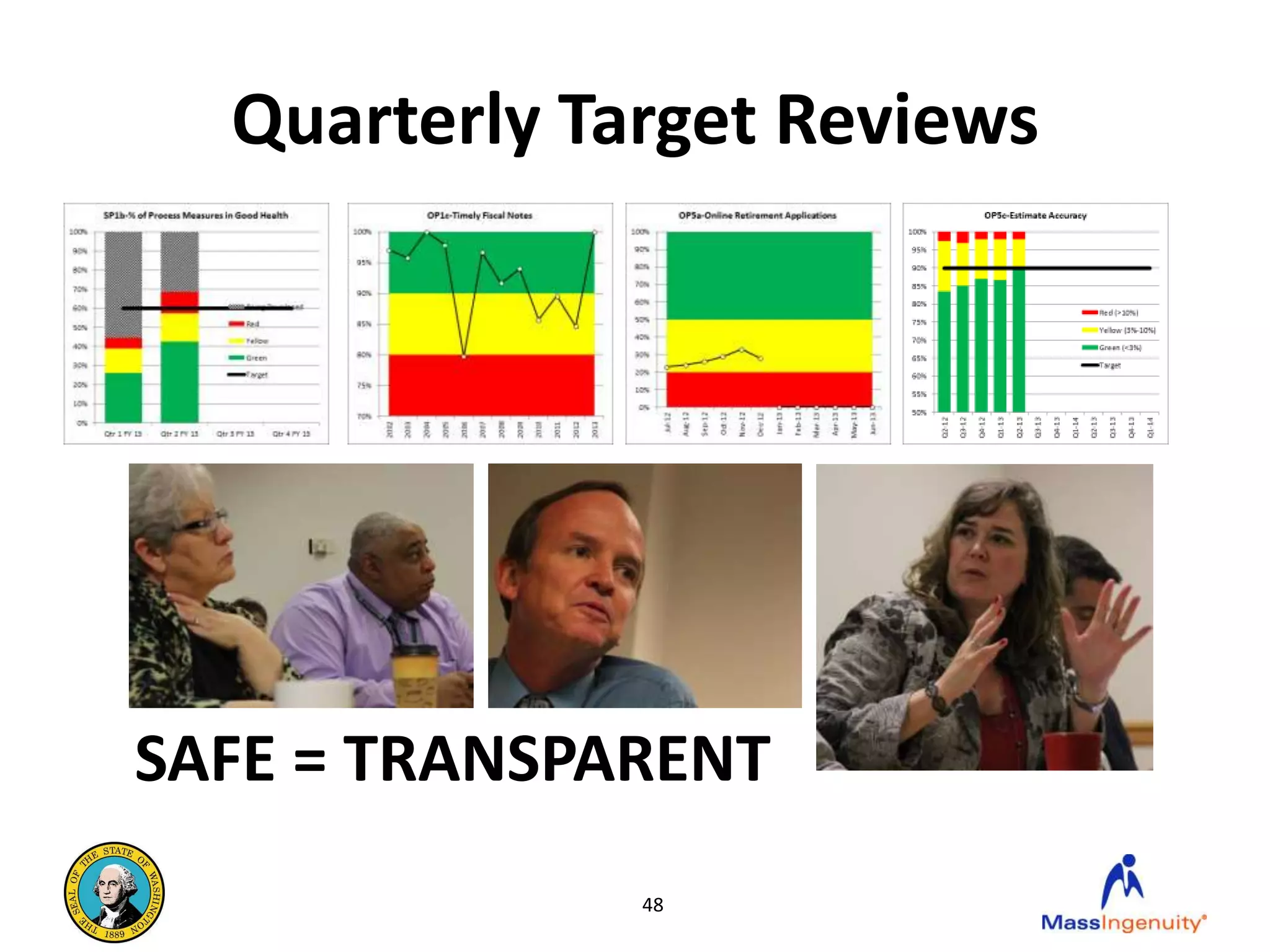
  – Triggers for action (red/yellow/green)
  – Safety = True Transparency


                          46
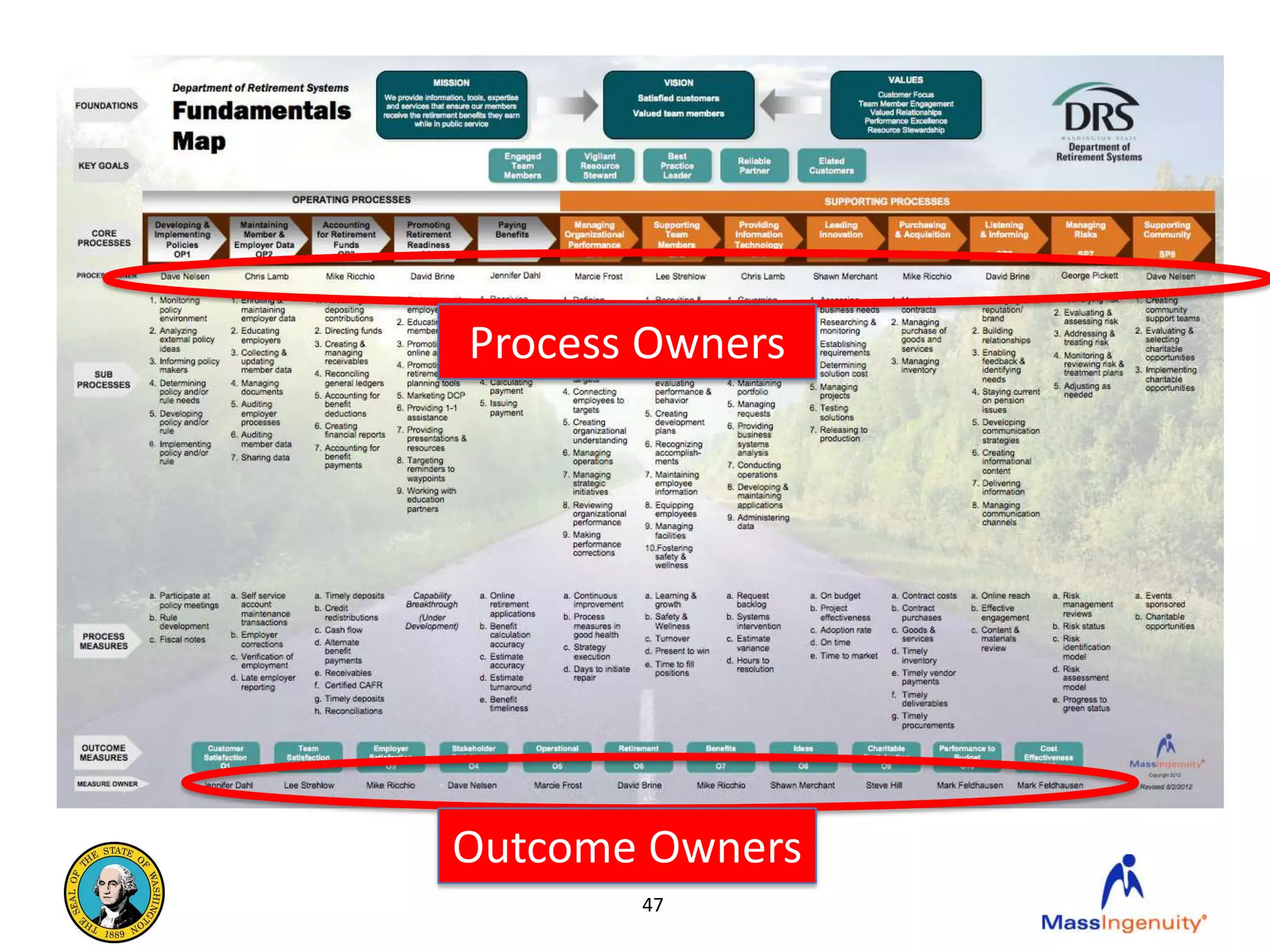
Process Owners


Outcome Owners
       47
Quarterly Target Reviews


SAFE = TRANSPARENT
              48
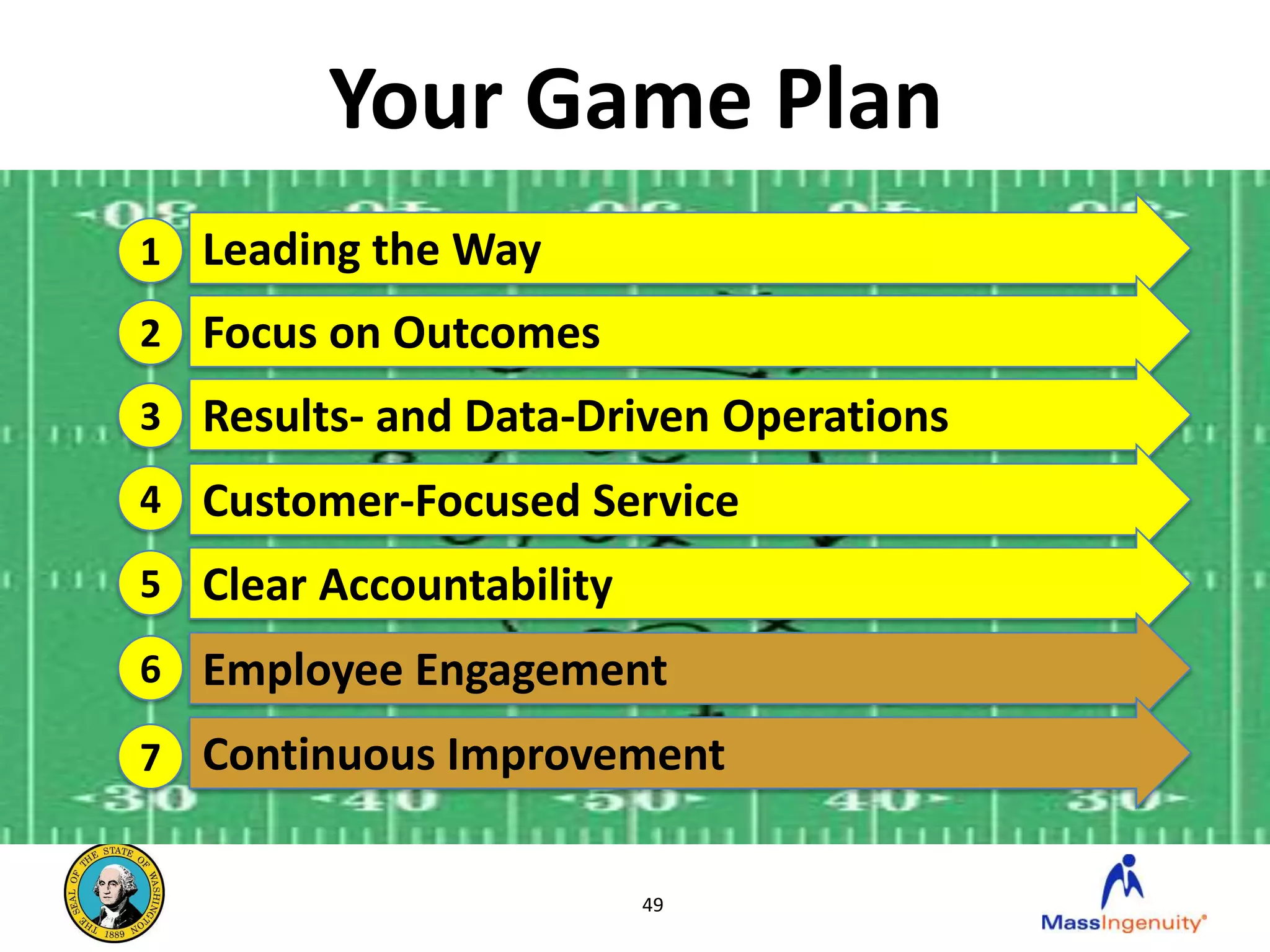
Your Game Plan
1 Leading the Way
2 Focus on Outcomes
3 Results- and Data-Driven Operations
4 Customer-Focused Service
5 Clear Accountability

6 Employee Engagement

7 Continuous Improvement


                         49
THE PLAYBOOK
      6. Employee Engagement
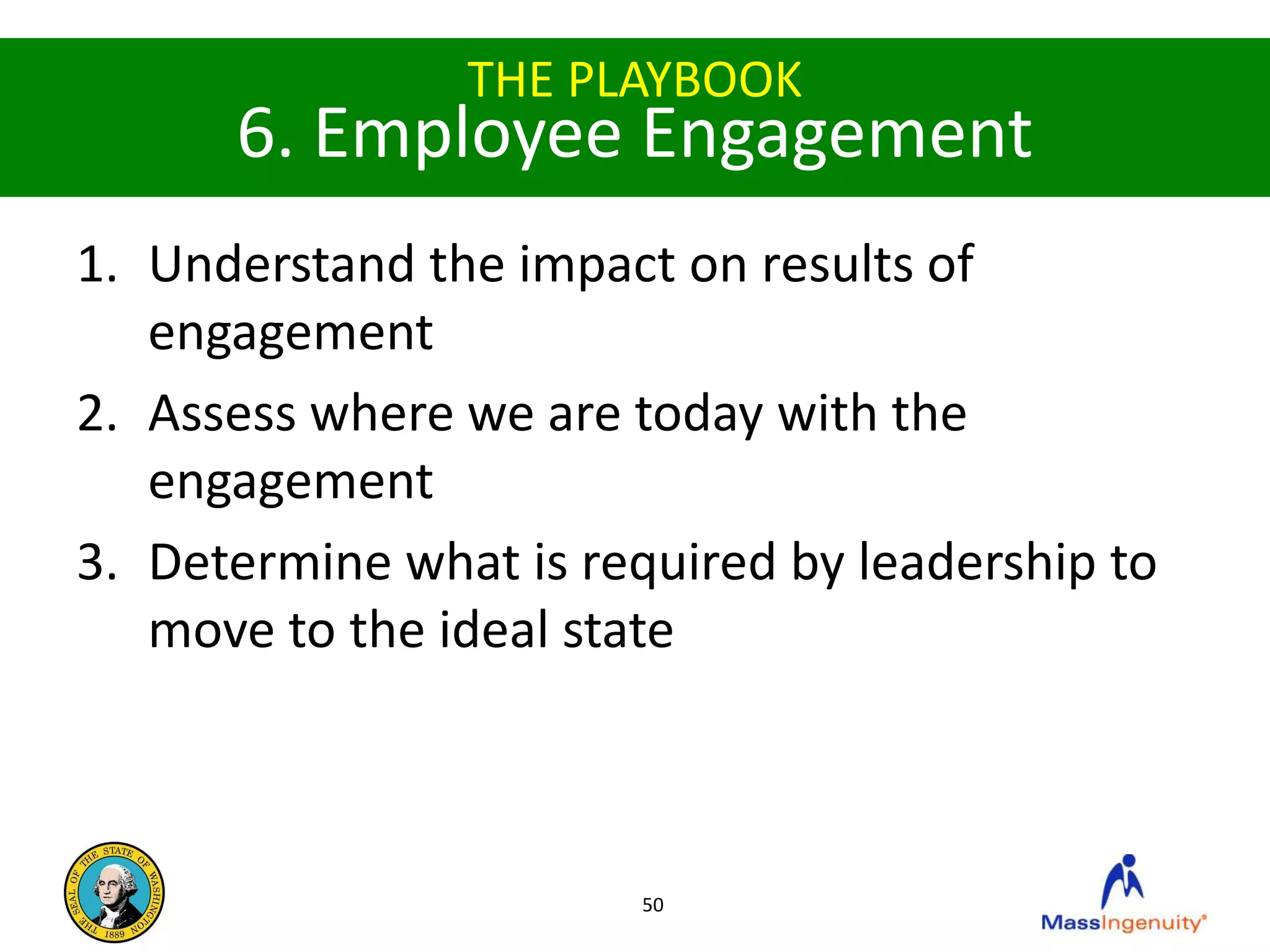
1. Understand the impact on results of
   engagement
2. Assess where we are today with the
   engagement
3. Determine what is required by leadership to
   move to the ideal state


                        50
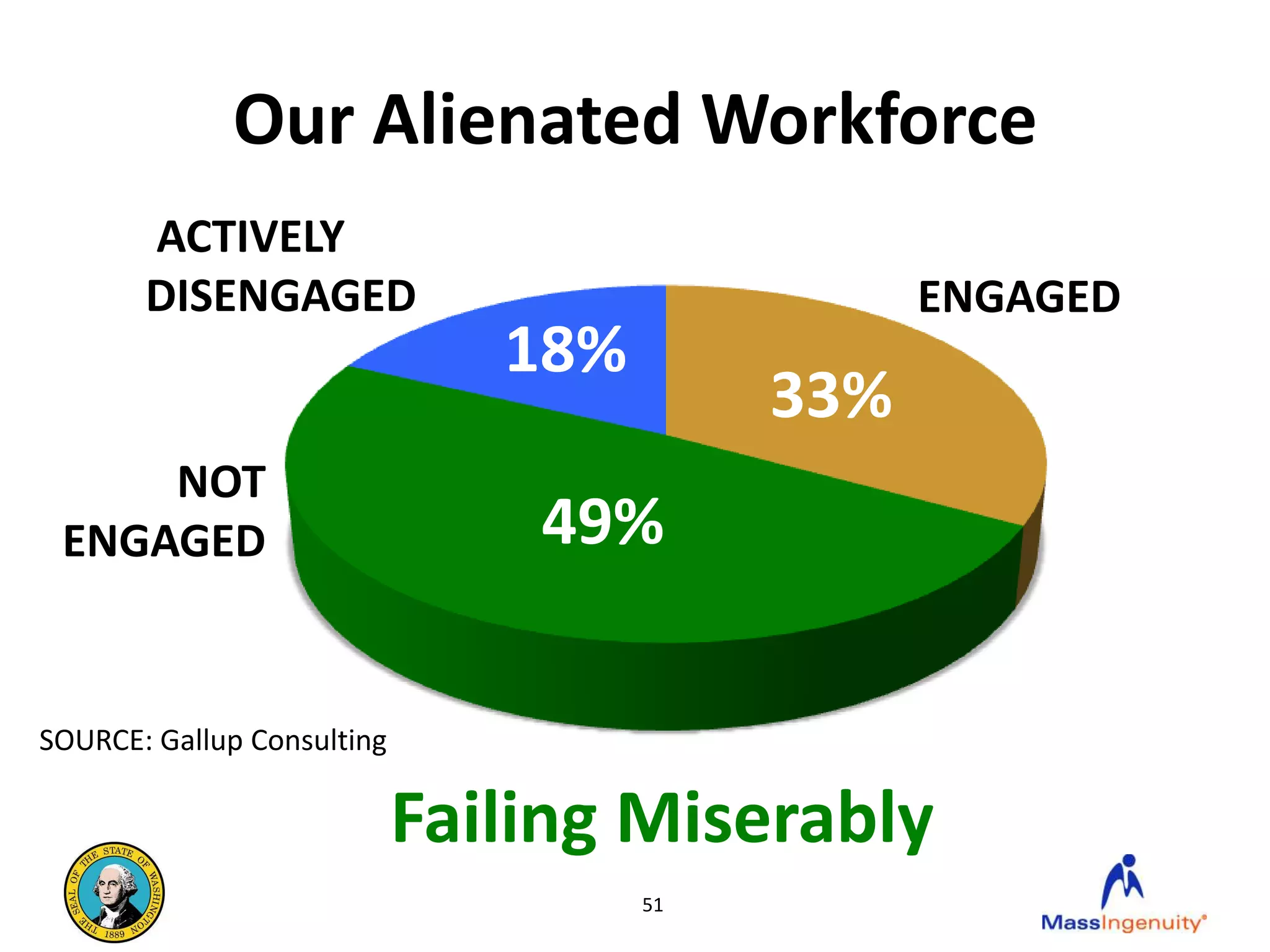
Our Alienated Workforce
       ACTIVELY
       DISENGAGED                               ENGAGED
                               18%
                                          33%
     NOT
 ENGAGED                        49%

SOURCE: Gallup Consulting

                            Failing Miserably
                                     51
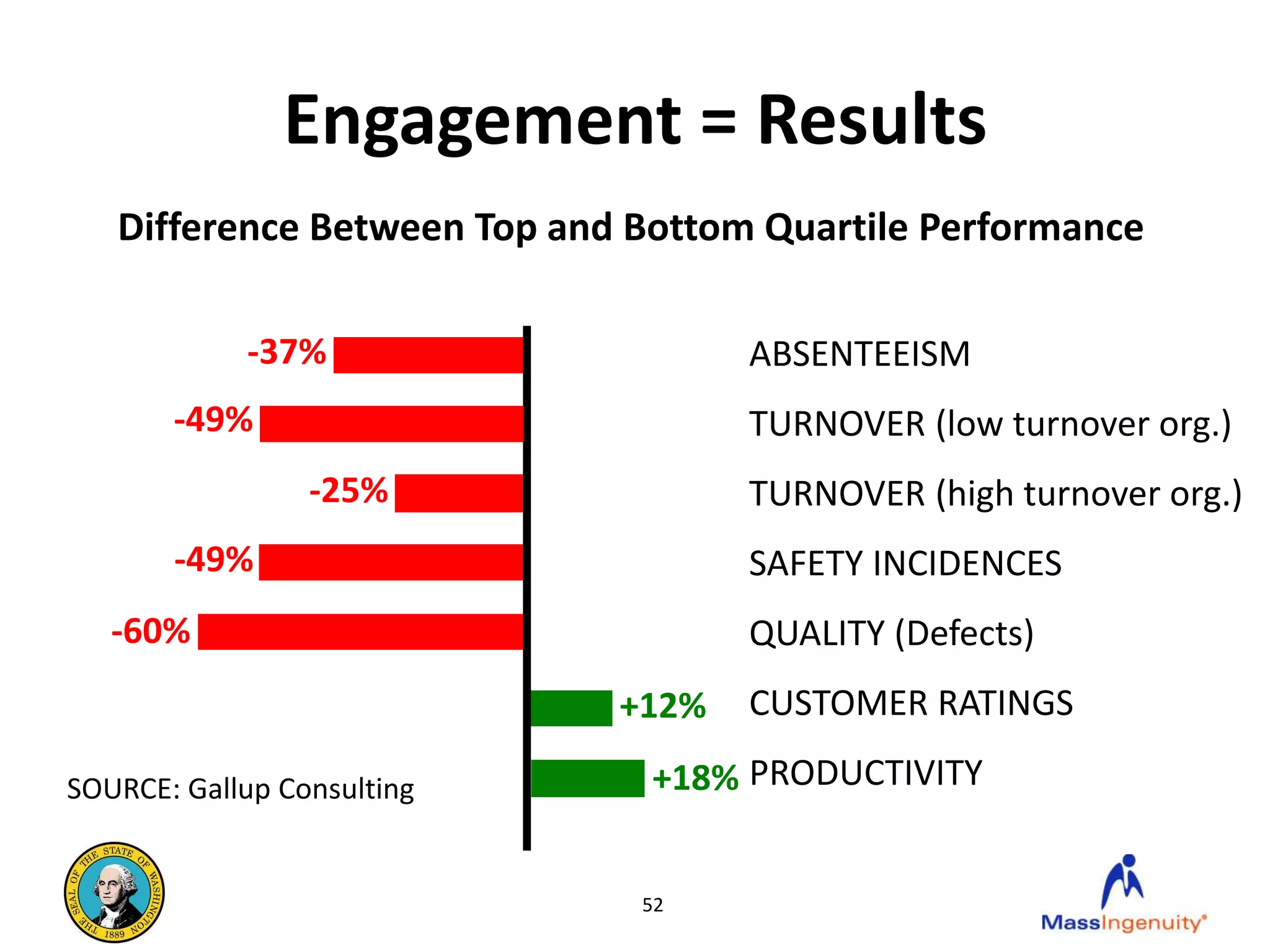
Engagement = Results
   Difference Between Top and Bottom Quartile Performance

            -37%                    ABSENTEEISM
       -49%                         TURNOVER (low turnover org.)
                 -25%               TURNOVER (high turnover org.)
       -49%                         SAFETY INCIDENCES
   -60%                             QUALITY (Defects)
                             +12%   CUSTOMER RATINGS

SOURCE: Gallup Consulting      +18% PRODUCTIVITY


                              52
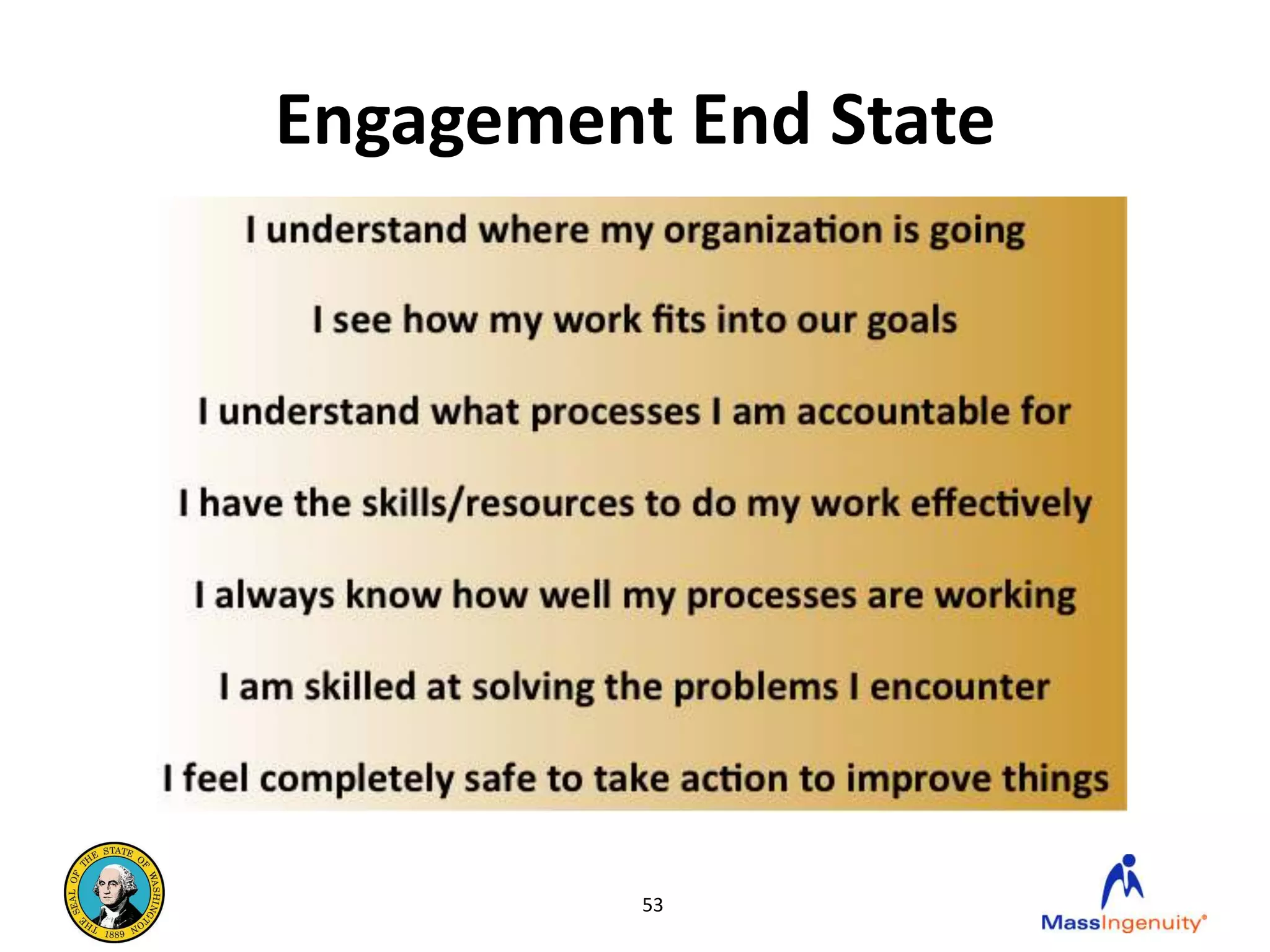
Engagement End State
   I understand where my organization is going

       I see how my work fits into our goals

 I understand what processes I am accountable for

I have the skills/resources to do my work effectively

I always know how well my processes are working

  I am skilled at solving the problems I encounter


                          53
EXERCISE #4
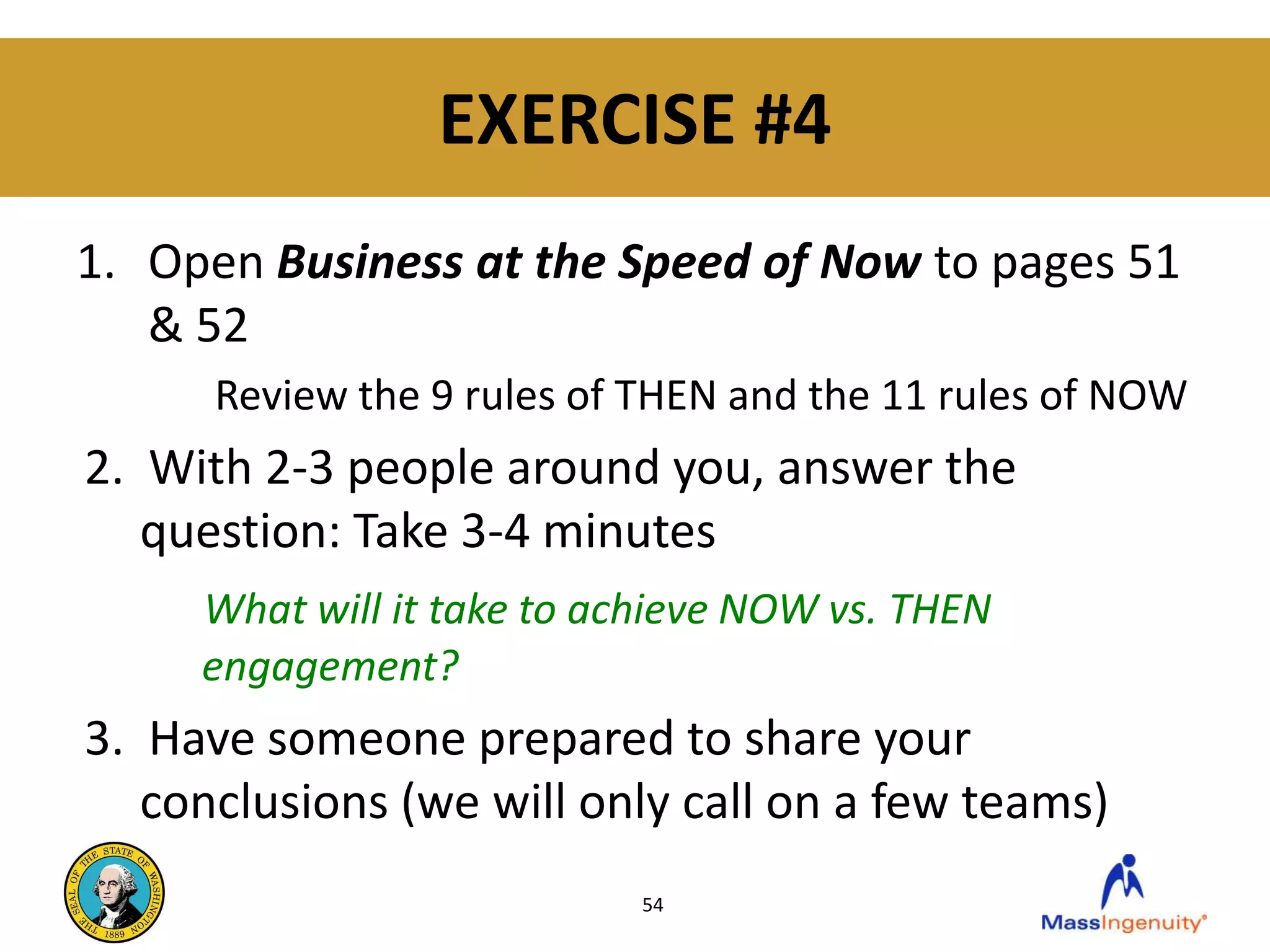
1. Open Business at the Speed of Now to pages 51
   & 52
      Review the 9 rules of THEN and the 11 rules of NOW
2. With 2-3 people around you, answer the
   question: Take 3-4 minutes
     What will it take to achieve NOW vs. THEN
     engagement?
3. Have someone prepared to share your
   conclusions (we will only call on a few teams)
                           54
Your Game Plan
1 Leading the Way
2 Focus on Outcomes
3 Results- and Data-Driven Operations
4 Customer-Focused Service
5 Clear Accountability

6 Employee Engagement

7 Continuous Improvement


                         55
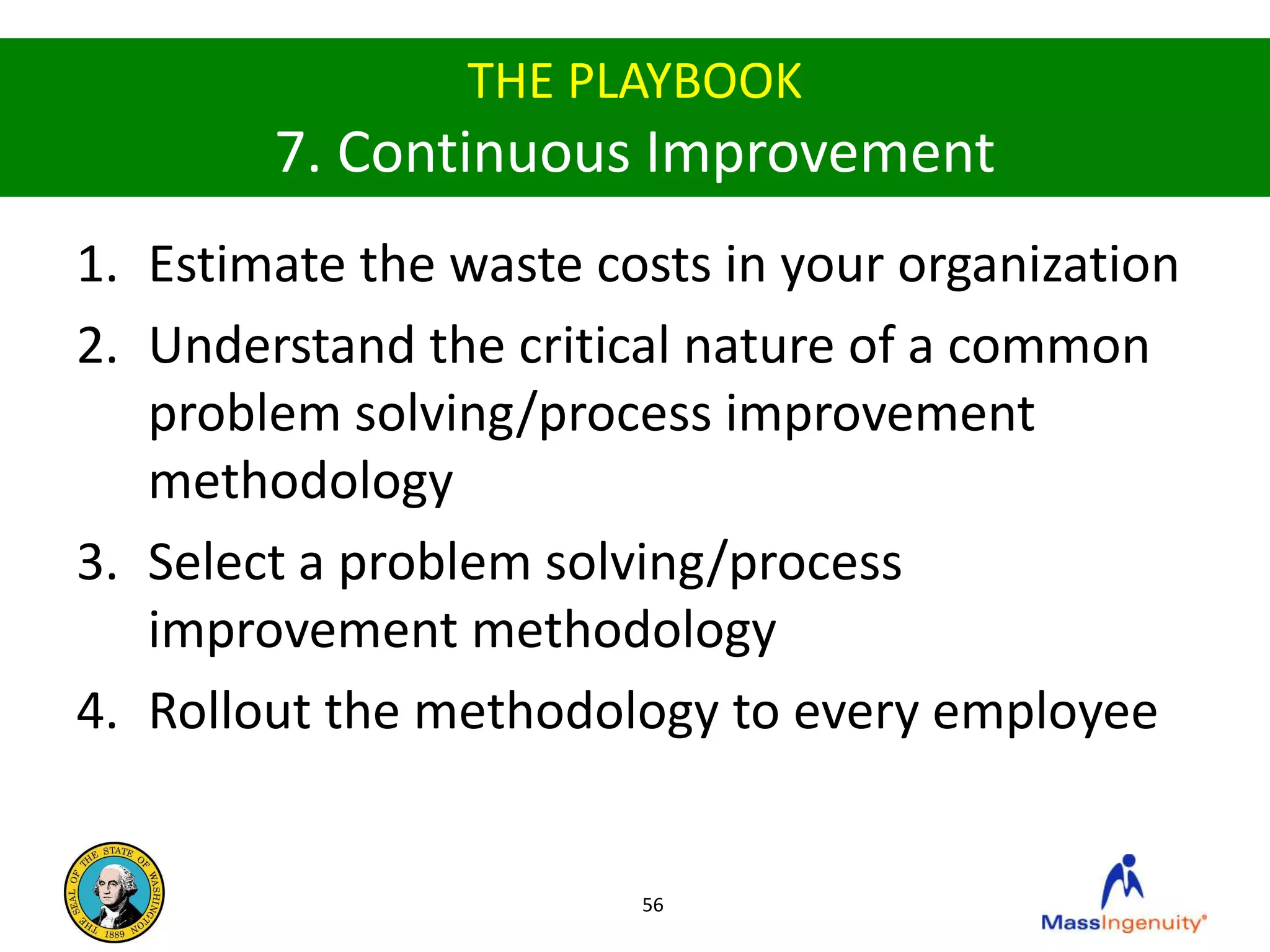
THE PLAYBOOK
        7. Continuous Improvement
1. Estimate the waste costs in your organization
2. Understand the critical nature of a common
   problem solving/process improvement
   methodology
3. Select a problem solving/process
   improvement methodology
4. Rollout the methodology to every employee


                        56
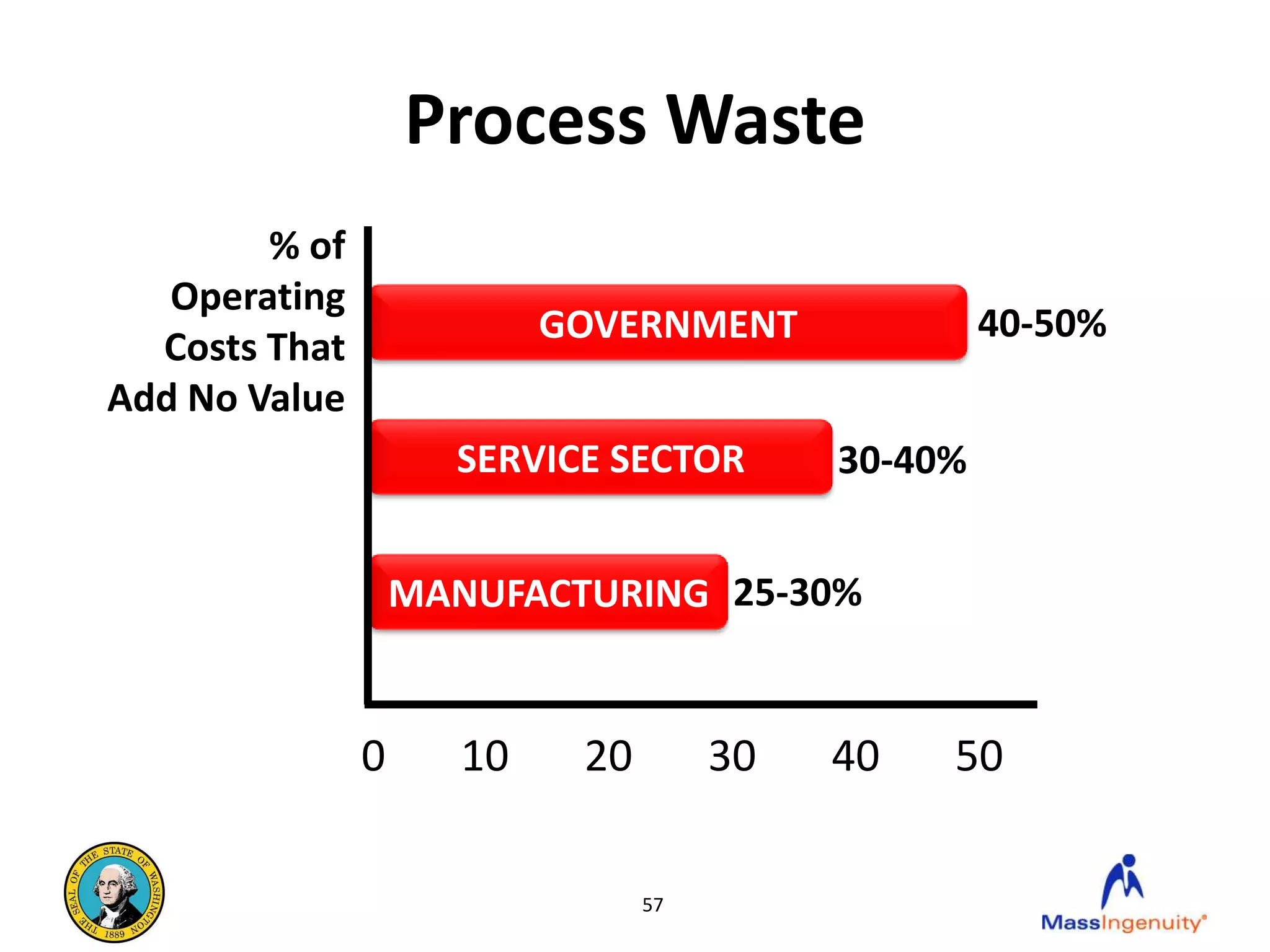
Process Waste
        % of
   Operating
                           GOVERNMENT               40-50%
  Costs That
Add No Value
                     SERVICE SECTOR        30-40%


                   MANUFACTURING 25-30%


               0      10    20        30   40   50

                                 57
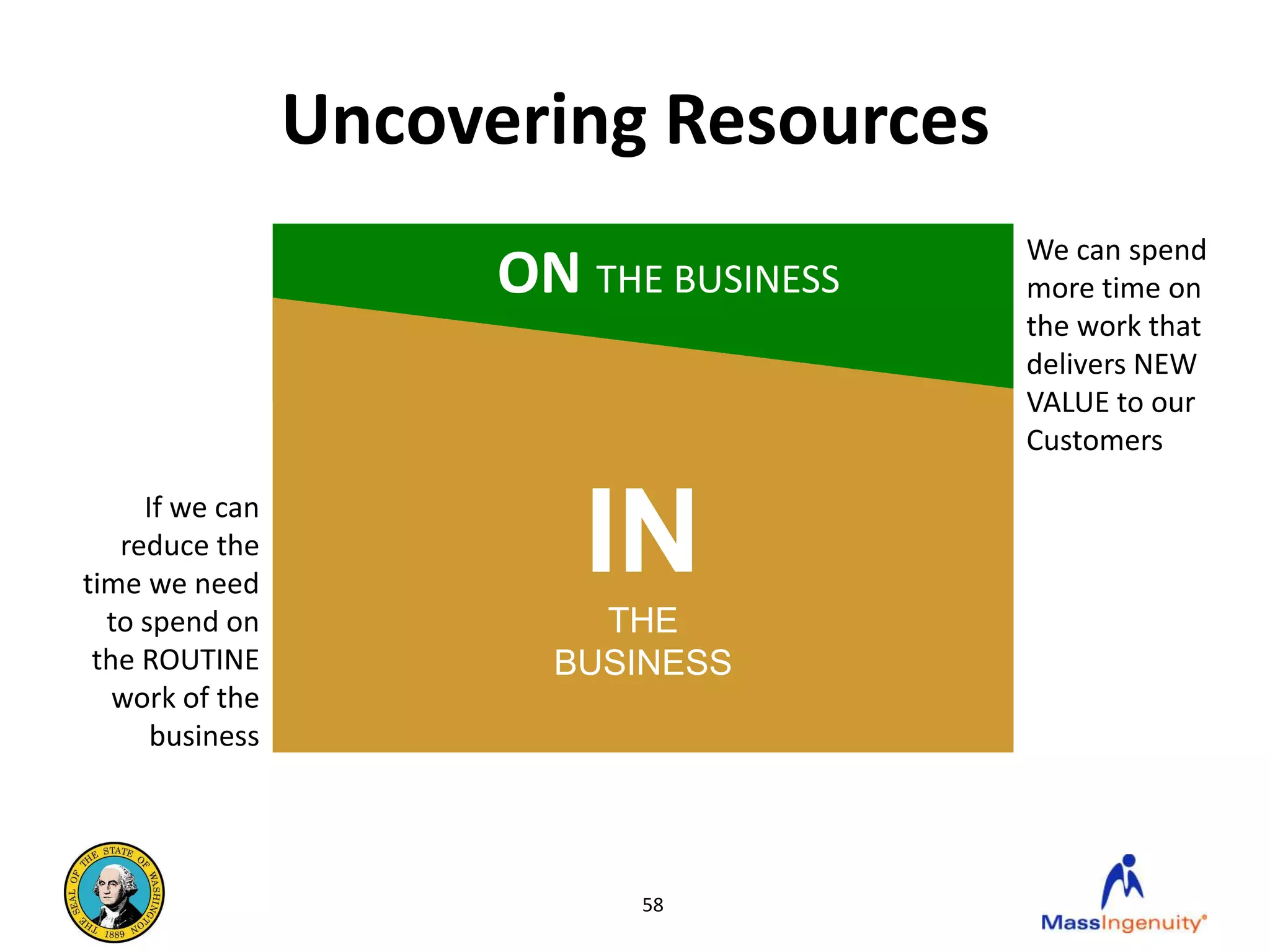
Uncovering Resources
                                         We can spend
                       ON THE BUSINESS   more time on
                                         the work that
                                         delivers NEW
                                         VALUE to our
                                         Customers

     If we can
   reduce the
time we need
                          IN
  to spend on              THE
 the ROUTINE             BUSINESS
   work of the
      business


                             58
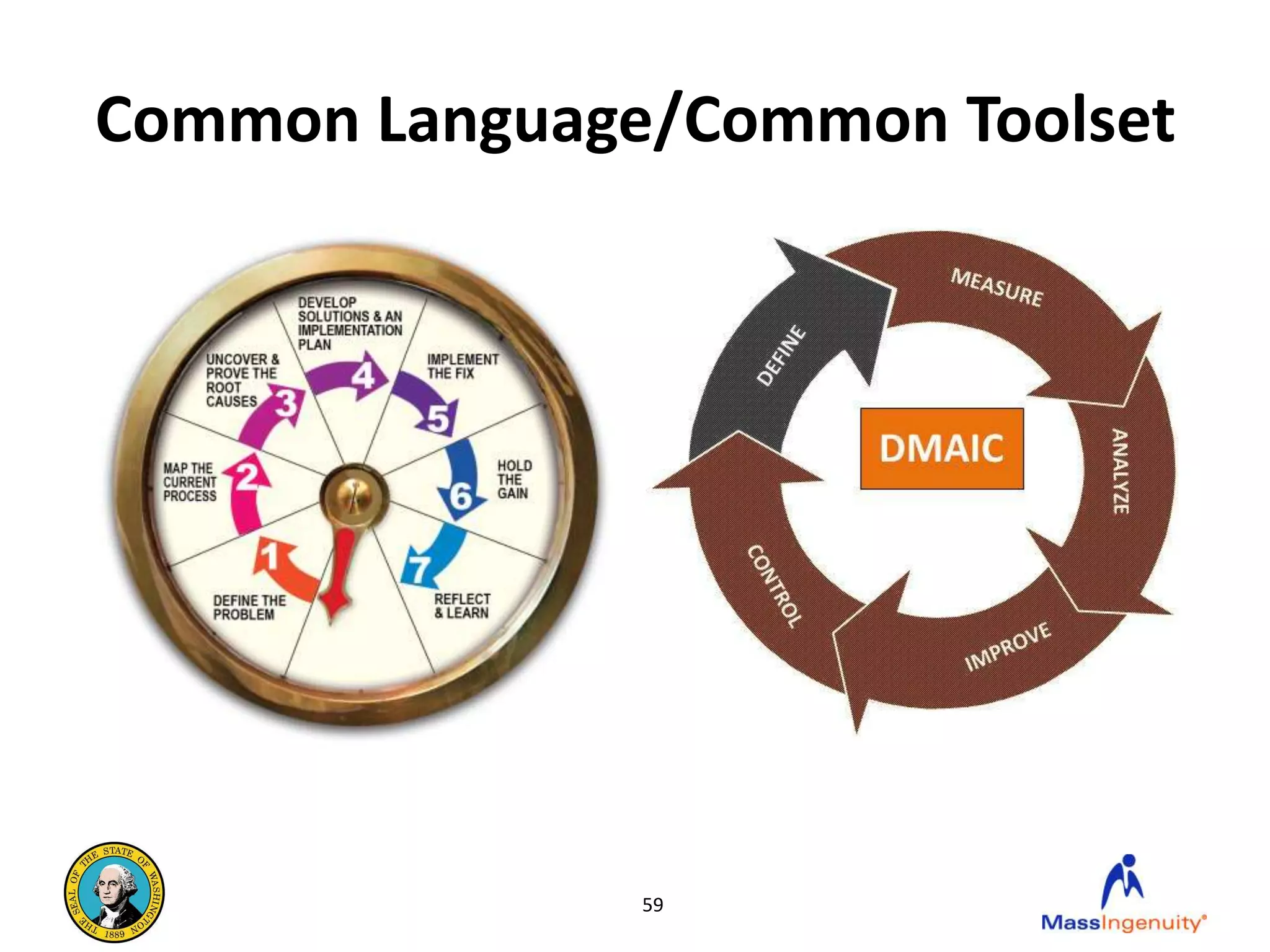
Common Language/Common Toolset


               59
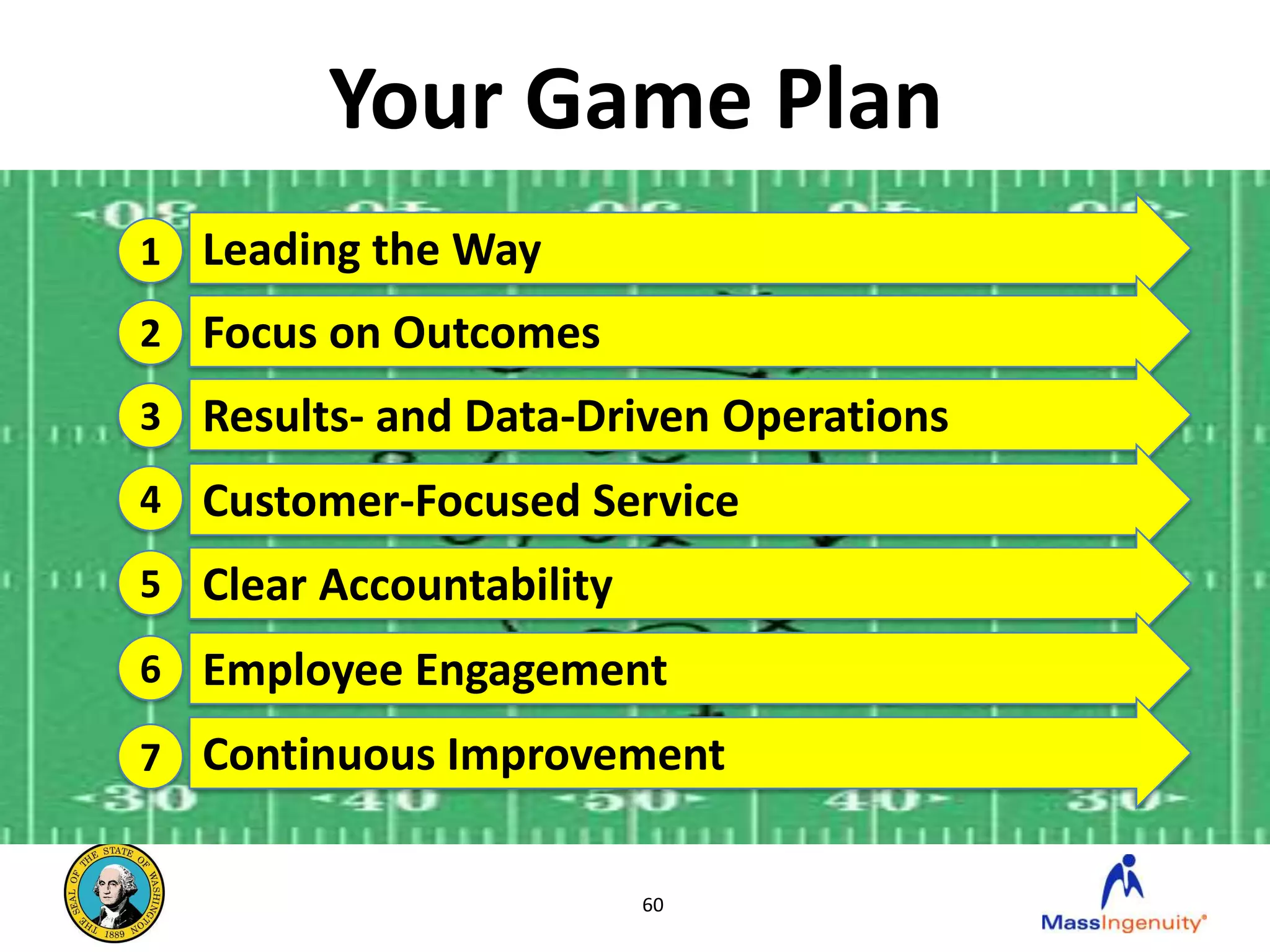
Your Game Plan
1 Leading the Way
2 Focus on Outcomes
3 Results- and Data-Driven Operations
4 Customer-Focused Service
5 Clear Accountability

6 Employee Engagement

7 Continuous Improvement


                         60
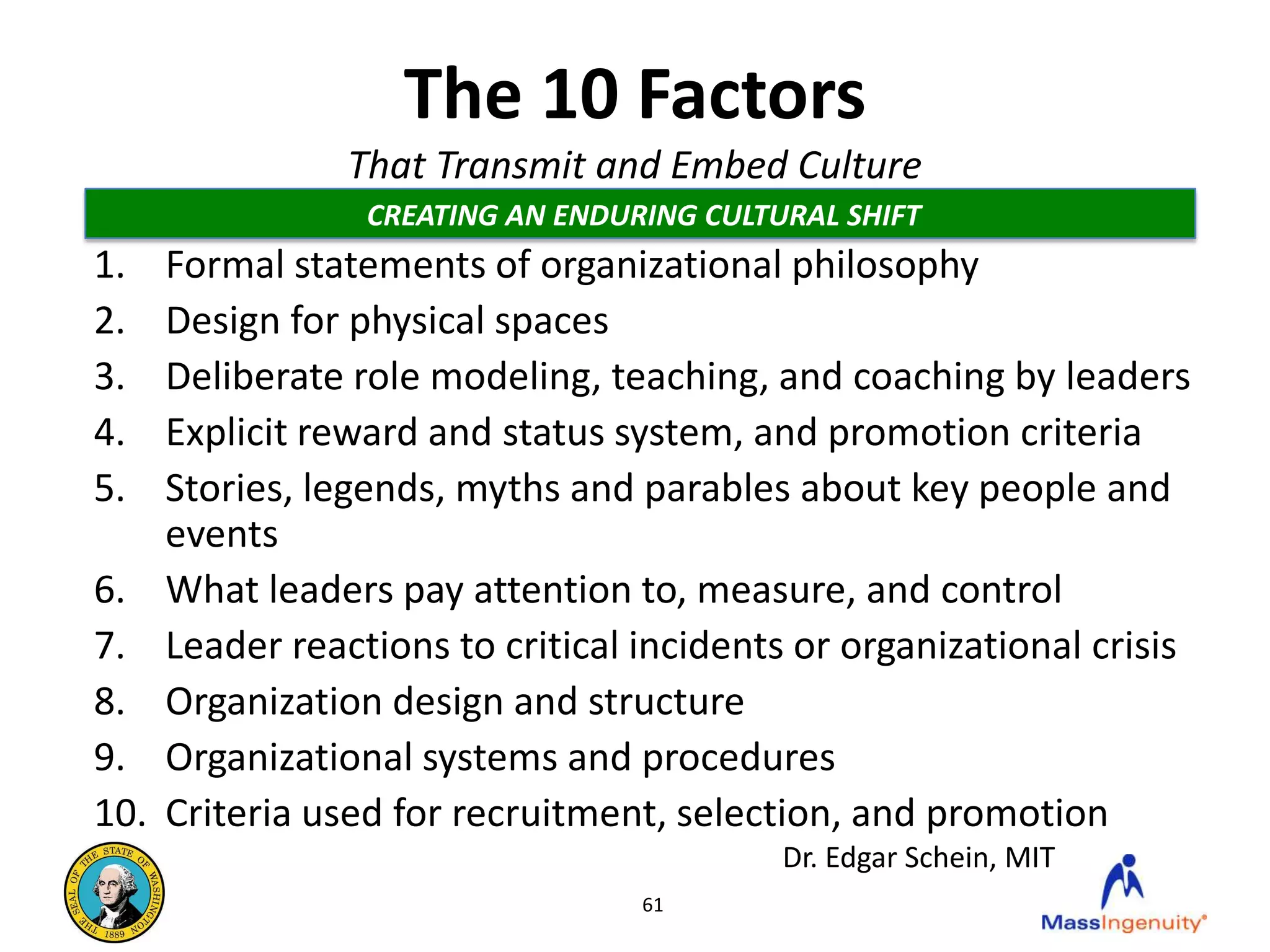
The 10 Factors
                 That Transmit and Embed Culture
                  CREATING AN ENDURING CULTURAL SHIFT
1.    Formal statements of organizational philosophy
2.    Design for physical spaces
3.    Deliberate role modeling, teaching, and coaching by leaders
4.    Explicit reward and status system, and promotion criteria
5.    Stories, legends, myths and parables about key people and
      events
6.    What leaders pay attention to, measure, and control
7.    Leader reactions to critical incidents or organizational crisis
8.    Organization design and structure
9.    Organizational systems and procedures
10.   Criteria used for recruitment, selection, and promotion
                                            Dr. Edgar Schein, MIT
                                   61
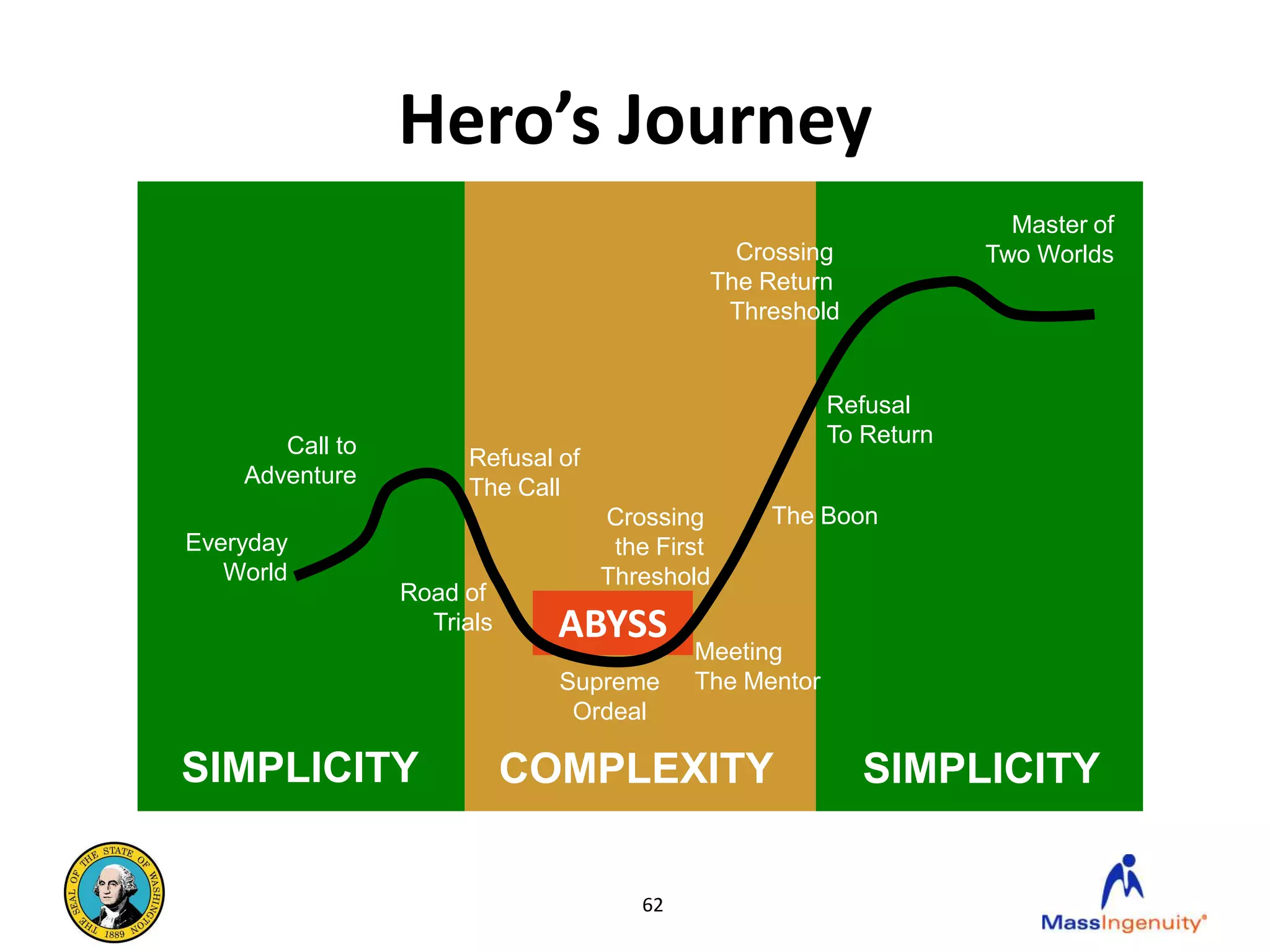
Hero’s Journey
                                                                      Master of
                                              Crossing              Two Worlds
                                            The Return
                                             Threshold


                                                        Refusal
       Call to                                          To Return
                      Refusal of
    Adventure         The Call
                                   Crossing      The Boon
Everyday                            the First
   World                           Threshold
                 Road of
                   Trials     ABYSS
                                           Meeting
                              Supreme      The Mentor
                               Ordeal

SIMPLICITY                  COMPLEXITY                     SIMPLICITY


                                      62
We Serve
    63

Lessons in leadership 031513 final

  • 1.
    LEAN GOVERNMENT What LeadersNeed to Do to Lead From the Front Creating Your Agency Game Plan LESSONS IN LEADERSHIP SERIES March 20, 2013
  • 2.
    “Today we begina multi-year effort to bring disruptive change to Olympia, starting with the very core of how we do business.” 2
  • 3.
    EFFECTIVE EFFICIENT ACCOUNTABLE LEAN GOVERNMENT Leaders Customer-Focused Service Leading WHAT HOW Clear Accountability & WHY the Way Improved Responsibility Results- Citizen and Data- Employee Engagement Outcomes Driven Operations Continuous Improvement CREATING AN ENDURING CULTURAL SHIFT 3
  • 4.
  • 5.
    Marcie Frost DIRECTOR, DEPARTMENTOF RETIREMENT SYSTEMS • 20-years public leadership, & planning & operations • A career noted for a focus on outcomes, strategy and alignment • Three years into major customer- focused/team engagement transformation at DRS 5
  • 6.
    John M. Bernard CHAIRMAN& FOUNDER, MASS INGENUITY • Participated on the first U.S. team to implement Lean in 1981 • Translated Lean concepts into plain English and applied them to the service sector and government agencies • Architect of the Now Management System®, a systemic solution to create a Lean culture and to optimize Lean 6
  • 7.
  • 8.
    THE CHANGE IMPERATIVE “Todaywe begin a multi-year effort to bring disruptive change to Olympia, starting with the very core of how we do business.” 8
  • 9.
    Today: Leave Witha Plan 1 Leading the Way 2 Focus on Outcomes 3 Results- and Data-Driven Operations 4 Customer-Focused Service 5 Clear Accountability 6 Employee Engagement 7 Continuous Improvement 9
  • 10.
    THEN NOW DRIVER Managerial Hierarchy Customer Need ORGANIZATION Functional Process Centric DECISIONS Centralized Decentralized IMPROVEMENT Big Ideas Micro-Improvements USE OF DATA Management Everyone PROBLEM SOLVING Ad Hoc, Intuitive Standardized, Fact Based SPEED Slow Fast TRADITIONAL LEAN MANAGEMENT MANAGEMENT THINKING THINKING 10
  • 11.
  • 12.
    LEAN MANAGEMENT “In theweeks to come, I will be taking action to transition to a results- and data-driven government, with continuous quality improvement, engagement and clear accountability.” 12
  • 13.
    The Washington GamePlan EFFECTIVE EFFICIENT ACCOUNTABLE LEAN GOVERNMENT Leaders 4 Customer-Focused Service 1 Leading WHAT HOW Clear Accountability & WHY the Way Improved 5 Responsibility Results- 2 Citizen 3 and Data- 6 Employee Engagement Outcomes Driven Operations 7 Continuous Improvement CREATING AN ENDURING CULTURAL SHIFT 13
  • 14.
    Origins of theJourney Dr. W. Edwards Deming JUSE Lectures General MacArthur Deming Prize 1947 1950 1951 1965 1981 1987 1989 Toyota Wins “Lean” Deming Prize term TOYOTA: Taicchi coined Ohno, Shigeo Shingo & Eiji Toyoda 14
  • 15.
    Organizing Principles Customers define People are our People who do Every process what value is most valuable asset the work has a customer know it best We work to People want to serve Focus Respect be a part of customers not something satisfy bosses on for bigger than themselves Facts reveal Customer People truth about Determine Create People want to how effectively do good work Value Value we are meeting People need to have customer the skills to do their needs work well and to Continuous customer People will engage if feedback drives improve it they feel safe continuous process making decisions improvement 15
  • 16.
    Big “L” Lean 1.Lead from the front 2. Focus on serving the customer 3. Respect the gifts of people 4. Drive out all forms of fear 5. Use measures to find improvement opportunities 6. Engage everyone in achieving outcomes 7. Break down barriers to pride and collaboration 8. Think processes; make improvement a constant 9. Eliminate waste at its root cause 10. Focus on the long-term 16
  • 17.
    Small “l” lean •Reduction of overtime • Improved on-time report • Reduction of time/cost to issuance process background checks • Reduction in hiring cycle • Reduction of time-to-lease • Streamlined regulatory compliance office space • Reduced cycle time to close • Reduction in inmate assaults the monthly books • Improved on-time permit • Reduced time to process issuance payroll • Permit streamlining • Reduced medication errors • Reduction in uncollected • Reduced cost-per-vehicle mile revenue 17
  • 18.
    EXERCISE #1 1. Reviewslides 15, 16, & 17: Central Themes of Lean, Big “L” Lean and Small “l” lean 2. With 2-3 people around you, answer the question: Take 2-3 minutes What are the implications of these principles to the agency leader team? 3. Have someone prepared to share your conclusions (we will call on a few teams) 18
  • 19.
    LEAN MANAGEMENT “It’s aboutinstituting a cultural shift that will endure well beyond my administration.” 19
  • 20.
    Today: Leave Witha Plan 1 Leading the Way 2 Focus on Outcomes 3 Results- and Data-Driven Operations 4 Customer-Focused Service 5 Clear Accountability 6 Employee Engagement 7 Continuous Improvement 20
  • 21.
    THE PLAYBOOK 1. Leading the Way 1. Lead the learning 2. Assess your management waste 3. Get the right leaders on the bus and in the right seats 4. Prepare the culture 21
  • 22.
    Lead the Learning •Host book study teams • Lead study visits – DRS, Oregon Agencies, Boeing, Virginia Mason 22
  • 23.
  • 24.
    Remove Management Waste 1. Unclear Direction 7 Deadly Sins of Management 2. No Line-of-Sight 3. Unclear Accountability 4. Inconsistent Language 5. Poor Issue Transparency 6. Inappropriate Resources 7. Inadequate Tools/Skills 24
  • 25.
    Prepare the Culture Anorganization’s culture… …is reflective of the behaviors of its leaders 25
  • 26.
  • 27.
    Your Game Plan 1Leading the Way 2 Focus on Outcomes 3 Results- and Data-Driven Operations 4 Customer-Focused Service 5 Clear Accountability 6 Employee Engagement 7 Continuous Improvement 27
  • 28.
    THE PLAYBOOK 2. Focus on Outcomes 1. Understand the Governor’s Priorities 2. Align your agency’s outcomes – Translate goals to outcome measures – Establish scorecards for each measure 28
  • 29.
  • 30.
    Align Your AgencyOutcomes • Understand the Governor’s Strategic Direction • Define Agency Core-Mission Measures – This is the foundation of ownership • Study Governor Inslee’s inaugural address understand his thinking • Clarity will continue to emerge 30
  • 31.
    Align Agency Outcomes 5-6 Enduring Goals KEY GOAL KEY GOAL KEY GOAL KEY GOAL KEY GOAL Governor’s Priorities Agency Core-Mission Outcomes OUTCOME OUTCOME OUTCOME OUTCOME OUTCOME OUTCOME MEASURE MEASURE MEASURE MEASURE MEASURE MEASURE 12-15 Outcome Measures See pages 90-93 for definitions: 31
  • 32.
    Your Game Plan 1Leading the Way 2 Focus on Outcomes 3 Results- and Data-Driven Operations 4 Customer-Focused Service 5 Clear Accountability 6 Employee Engagement 7 Continuous Improvement 32
  • 33.
    THE PLAYBOOK 3. Results-and Data-Driven Operations 1. Create clarity about how your agency works 2. Understand the core work you must be good at in order to achieve your outcomes – Map your Fundamentals – Understand your core processes – Establish measures to gauge effectiveness 33
  • 34.
    Eliminate Fear ORDER FREEDOM People People know understand and how to seize respect the way opportunities the organization and solve functions problems 34
  • 35.
  • 36.
  • 37.
    Benefits of aFundamentals Map • Shared understanding of how the agency creates value (a common language) • Clear ownership for results • Visibility as to what is working and what is not • Foundation for connecting every employee to the part they play 37
  • 38.
    EXERCISE #2 1. Reviewthe handout: DRS Fundamentals Map 2. Review the DRS Fundamentals Map. With 2-3 people around you, take 5 minutes to answer the question: If we had a map like this, how could we use it to help us achieve our agency outcomes? 3. Have someone prepared to share your conclusions (we will only call on a few teams) 38
  • 39.
    Your Game Plan 1Leading the Way 2 Focus on Outcomes 3 Results- and Data-Driven Operations 4 Customer-Focused Service 5 Clear Accountability 6 Employee Engagement 7 Continuous Improvement 39
  • 40.
  • 41.
    THE PLAYBOOK 4. Customer-Focused Service 1. For each core process, identify your primary customers 2. Ask them what they need from you 3. Establish measures that indicate success in meeting their needs 4. Work to continuously improve results 41
  • 42.
    Identify Core ProcessCustomers CORE PROCESS WORKSHEET CUSTOMER NEEDS 42
  • 43.
    Customer-Driven End State We understand who are customers are We know every process has a customer We know what our customers value We measure effectiveness in meeting customer needs Customer feedback drives our improvement focus We focus on satisfying customers not bosses We find satisfaction in being of service 43
  • 44.
    EXERCISE #3 1. Identifyyour agency’s primary customers 2. With 2-3 people around you, for 4-5 minutes, answer the question: What are five things you as leaders can do to accelerate your journey to the Customer- Driven end state? 3. Have someone prepared to share your conclusions (we will only call on a few teams) 44
  • 45.
    Your Game Plan 1Leading the Way 2 Focus on Outcomes 3 Results- and Data-Driven Operations 4 Customer-Focused Service 5 Clear Accountability 6 Employee Engagement 7 Continuous Improvement 45
  • 46.
    THE PLAYBOOK 5. ClearAccountability & Responsibility 1. Assign ownership – For outcome measures – For process measures 2. Establish Quarterly Target Reviews – Accountability for improvement – Triggers for action (red/yellow/green) – Safety = True Transparency 46
  • 47.
  • 48.
  • 49.
    Your Game Plan 1Leading the Way 2 Focus on Outcomes 3 Results- and Data-Driven Operations 4 Customer-Focused Service 5 Clear Accountability 6 Employee Engagement 7 Continuous Improvement 49
  • 50.
    THE PLAYBOOK 6. Employee Engagement 1. Understand the impact on results of engagement 2. Assess where we are today with the engagement 3. Determine what is required by leadership to move to the ideal state 50
  • 51.
    Our Alienated Workforce ACTIVELY DISENGAGED ENGAGED 18% 33% NOT ENGAGED 49% SOURCE: Gallup Consulting Failing Miserably 51
  • 52.
    Engagement = Results Difference Between Top and Bottom Quartile Performance -37% ABSENTEEISM -49% TURNOVER (low turnover org.) -25% TURNOVER (high turnover org.) -49% SAFETY INCIDENCES -60% QUALITY (Defects) +12% CUSTOMER RATINGS SOURCE: Gallup Consulting +18% PRODUCTIVITY 52
  • 53.
    Engagement End State I understand where my organization is going I see how my work fits into our goals I understand what processes I am accountable for I have the skills/resources to do my work effectively I always know how well my processes are working I am skilled at solving the problems I encounter 53
  • 54.
    EXERCISE #4 1. OpenBusiness at the Speed of Now to pages 51 & 52 Review the 9 rules of THEN and the 11 rules of NOW 2. With 2-3 people around you, answer the question: Take 3-4 minutes What will it take to achieve NOW vs. THEN engagement? 3. Have someone prepared to share your conclusions (we will only call on a few teams) 54
  • 55.
    Your Game Plan 1Leading the Way 2 Focus on Outcomes 3 Results- and Data-Driven Operations 4 Customer-Focused Service 5 Clear Accountability 6 Employee Engagement 7 Continuous Improvement 55
  • 56.
    THE PLAYBOOK 7. Continuous Improvement 1. Estimate the waste costs in your organization 2. Understand the critical nature of a common problem solving/process improvement methodology 3. Select a problem solving/process improvement methodology 4. Rollout the methodology to every employee 56
  • 57.
    Process Waste % of Operating GOVERNMENT 40-50% Costs That Add No Value SERVICE SECTOR 30-40% MANUFACTURING 25-30% 0 10 20 30 40 50 57
  • 58.
    Uncovering Resources We can spend ON THE BUSINESS more time on the work that delivers NEW VALUE to our Customers If we can reduce the time we need IN to spend on THE the ROUTINE BUSINESS work of the business 58
  • 59.
  • 60.
    Your Game Plan 1Leading the Way 2 Focus on Outcomes 3 Results- and Data-Driven Operations 4 Customer-Focused Service 5 Clear Accountability 6 Employee Engagement 7 Continuous Improvement 60
  • 61.
    The 10 Factors That Transmit and Embed Culture CREATING AN ENDURING CULTURAL SHIFT 1. Formal statements of organizational philosophy 2. Design for physical spaces 3. Deliberate role modeling, teaching, and coaching by leaders 4. Explicit reward and status system, and promotion criteria 5. Stories, legends, myths and parables about key people and events 6. What leaders pay attention to, measure, and control 7. Leader reactions to critical incidents or organizational crisis 8. Organization design and structure 9. Organizational systems and procedures 10. Criteria used for recruitment, selection, and promotion Dr. Edgar Schein, MIT 61
  • 62.
    Hero’s Journey Master of Crossing Two Worlds The Return Threshold Refusal Call to To Return Refusal of Adventure The Call Crossing The Boon Everyday the First World Threshold Road of Trials ABYSS Meeting Supreme The Mentor Ordeal SIMPLICITY COMPLEXITY SIMPLICITY 62
  • 63.

Editor's Notes

  • #3 1:00 – 1:05Wendy:Welcome.Purpose of the day.Introduction of Dr. Mary Alice Heuschel
  • #4 1:05 – 1:15:Dr. Mary AliceOpening remarksOverview of Governor’s expectations
  • #5 1:15 – 1:20Darrell:Introduction of presenters
  • #6 Darrell:Introduction of Marcie Frost(content to be provided by David Brine)
  • #7 Darrell:Introduction of John BernardJohn BernardChairman & FounderMass IngenuityPortland, Oregon John’s has a deep passion for the talents and gifts of people which underlies everything he doesPrincipal author of the recommendations produced by Governor Inslee’s Government Transformation Advisory GroupMost experience practitioner of Lean in America having served on the first documented large-scale implementation ay Omark in 1981Long-ago adapted Lean for the American business culture including terminology anyone can understand – as you can see in John’s book, Business at the Speed on Now
  • #8 Darrel continues introduction of John Bernard…Chief architect of the Now Management System, which has been implemented in 9 Oregon agencies and is fast becoming the standard for agency management in Oregon
  • #9 1:20 – 1:22John:I invite you to join Marcie and me on a journey for a few hours…with all you have heard about Lean, good and bad, amazing and confusing…we ask that you suspend what you know and engage with usMarcie:We all have the honor to serve this great state…and a great, new and energetic governor…who expects we use Lean to disrupt the status quo…
  • #10 1:22 – 1:25Marcie:Here’s what we hope you will walk away this today…. Clarity about what is Lean really …we intent to challenge your assumptions about it …we will examine a high-level set of whys…. …and look at some practical hows…
  • #11 1:25 – 1:30John:We live in very fast times…. …and most organization’s are managed with an outdate framework …one based on the Industrial Age… the Age of Mass ProductionBut our world is no longer the same…that was THEN, this is NOW …(story of logo design)In our NOW world the rules have changed
  • #12 1:30 – 1:35Marcie:
  • #13 1:35 – 1:50John leads, Marcie does color
  • #14 Marcie:Governor Inslee’s Lean Government agenda is clear…This is what he is asking us for….
  • #15 John:Thought it would be worth 2 minutes on the prequel to Lean….If we are beginning a journey, we ought to know the roots….Deming inspired Toyota….Jack Warne…my boss….trip to Japan in 1980…Shingo’s Book and study teamsBaldrige award….tie to Egils Millbergs
  • #16 John:
  • #17 John:80 percent of Lean efforts fail or fall significantly short of expectations within three years of their start…LEAN IS NOT …process improvement projects …the domain of black belts …a training program …an employee involvement program …a fix-all for waste elimination …a set of toolsLEAN IS …a way of thinking (customers determine value, employees create it) …a belief system, a philosophy …a redefinition of the role of leadership
  • #18 John:These are examples of projects in Oregon….The key thing to understand is that lean projects must be aligned to your organization’s primary constraints….which we will tell you how to identify….When it is, lean projects become a primary tool to organizational improvement
  • #19 1:50 – 2:00(capture primary ideas on flipchart)
  • #20 2:00 - JohnPeter Drucker:“The best way to predict the future is to create it.”
  • #21 1:22 – 1:25Marcie:Here’s what we hope you will walk away this today…. Clarity about what is Lean really …we intent to challenge your assumptions about it …we will examine a high-level set of whys…. …and look at some practical hows…
  • #23 John:The power of study team… …We started studying Shigeo Shingo’s book …allow people to find their own meaning … “case for change” is the foundation for change managementLean for Dummies….Marcie and DRSOregon’s Chief Operating Officer, Michael Jordan, asked me to extend an invitation to all of you to visit Oregon….we would be happy to facilitate a field trip to come and meet agency directors and Michael….
  • #24 Models are useful to gain understanding, like the Shingo Model… …but you have to find your own understanding, at a gut level, and be cautious of relying on models
  • #25 John:One of the most rarely talked about forms of waste, is confusionEngaging your people in creating customer value demands management has its processes under control!
  • #26 Marcie:
  • #27 Marcie:
  • #28 Please take a minute to write down any thoughts you have for your game plan on Leading the Way.
  • #29 2:15
  • #32 The case for a COMMON LANGUAGE
  • #33 Please take a minute to write down any thoughts you have for your game plan on Focus on Outcomes.
  • #34 2:25
  • #39 2:45
  • #40 Please take a minute to write down any thoughts you have for your game plan on Results- and Data-Driven Operations.
  • #41 3:00
  • #42 3:15
  • #45 3:20
  • #46 Please take a minute to write down any thoughts you have for your game plan on Customer-Focused Service.
  • #47 3:30
  • #50 Please take a minute to write down any thoughts you have for your game plan on Clear Accountability.
  • #51 3:40
  • #52 What do you think
  • #55 3:50
  • #56 Please take a minute to write down any thoughts you have for your game plan on Employee Engagement.
  • #57 4:00
  • #61 Please take a minute to write down any thoughts you have for your game plan on Continuous improvement.
  • #62 4:10
  • #63 The basic model of Human Learning created by anthropologist Joseph Campbell…George Lucas’s Star Wars…. …Luke Skywalker….all you have to do is trust the force….Lean is a journey….I’ve been on it for over 30 years…a journey to understand what it takes to be both a great leader – and a great manager in this NOW world.I hope you enjoyed today, and I encourage you to embrace the challenges set out forth by your Governor.I close my part, before Marcie has the final word, with the opening sentence from the Governor’s Transition Plan:Great government is no small undertaking, and Washington State has many of the foundational pieces in place to achieve a stature as one of the best places in the United States to live, raise a family, get an education, build a business or pursue a career, enjoy the outdoors, and live out a long, healthy retirement. Lean Government is a journey. Have fun.
  • #64 4:15Marcie: