





EFFECTIVE FLOWGRAPH-
BASED MALWARE VARIANT
DETECTION
Silvio Cesare, Ph.D. Candidate, Deakin University
http://www.foocodechu.com
silvio.cesare@gmail.com
WHO AM I AND WHERE DID THIS TALK
COME FROM?
   Ph.D. Student at Deakin University.

   Research interests include:
     Automated vulnerability discovery.
     Software similarity and classification.
     Malware detection.


   This presentation is based on my malware
    research.
OUTLINE
1.   Introduction (you might already know this)

2.   New approaches to flowgraph-based
     classification

3.   Evaluation

4.   Other things we use our system on.

5.   Conclusion
INTRODUCTION
This is to make sure everyone is up to speed.
If you’ve been to my presentations before, you
might have already seen it.
INTRODUCTION
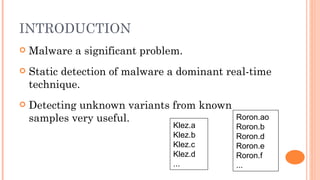
   Malware a significant problem.
   Static detection of malware a dominant real-time
    technique.
   Detecting unknown variants from known
    samples very useful.                     Roron.ao
                                Klez.a       Roron.b
                                Klez.b       Roron.d
                                Klez.c       Roron.e
                                Klez.d       Roron.f
                                ...          ...
SIGNATURES AND BIRTHMARKS
   A birthmark is an invariant property in related
    samples.

   Birthmark comparison should allow inexact
    matching.
LIMITATIONS OF EXISTING
BIRTHMARKS
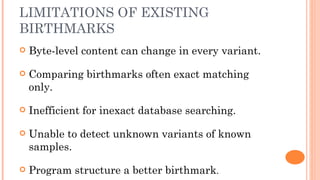
   Byte-level content can change in every variant.

   Comparing birthmarks often exact matching
    only.

   Inefficient for inexact database searching.

   Unable to detect unknown variants of known
    samples.

   Program structure a better birthmark.
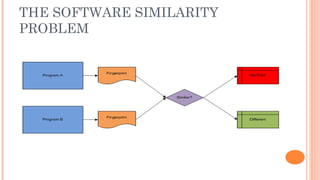
THE SOFTWARE SIMILARITY
PROBLEM
THE SOFTWARE SIMILARITY
SEARCH
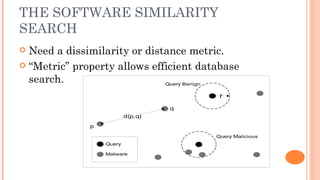
 Need a dissimilarity or distance metric.
 “Metric” property allows efficient database
  search.                     Query Benign

                                         r
                                   q
                          d(p,q)
              p
                                        Query Malicious
                  Query

                  Malware
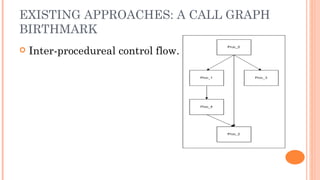
EXISTING APPROACHES: A CALL GRAPH
BIRTHMARK
   Inter-procedureal control flow.
AN OPTIMAL DISSIMILARITY METRIC
FOR GRAPHS
   Graph edit distance.

   Number of operations to transform one graph to
    another.

   Complexity in NP.

   Non optimal solutions possible in cubic time.
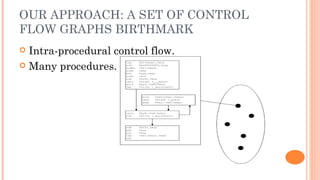
OUR APPROACH: A SET OF CONTROL
FLOW GRAPHS BIRTHMARK
 Intra-procedural control flow.
 Many procedures.
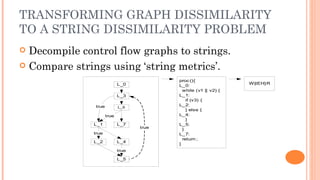
TRANSFORMING GRAPH DISSIMILARITY
TO A STRING DISSIMILARITY PROBLEM
 Decompile control flow graphs to strings.
 Compare strings using ‘string metrics’.
                                           proc (){
                             L_0                                  W|IEH}R
                                           L_0:
                                             while (v1 || v2) {
                             L_3           L_1:
                                               if (v3) {
               true                        L_2:
                             L_6
                                               } else {
                      true                 L_4:
                                               }
               L_1           L_7           L_5:
                                    true     }
               true                        L_7:
                                             return ;
               L_2           L_4
                                           }
                             true

                             L_5
NEW APPROACHES TO
FLOWGRAPH-BASED
CLASSIFICATION
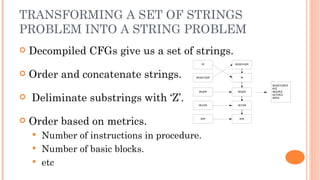
TRANSFORMING A SET OF STRINGS
PROBLEM INTO A STRING PROBLEM
   Decompiled CFGs give us a set of strings.
                                             R    W|IEH}R


   Order and concatenate strings.      W|IEH}R     R


                                                            W|IEH}RZ
                                                            RZ
                                         W|}R      W|}R     W|}RZ

   Deliminate substrings with ‘Z’.
                                                            IEHRZ
                                                            SRZ

                                         IEHR      IEHR


   Order based on metrics.               SR        SR


     Number of instructions in procedure.
     Number of basic blocks.
     etc
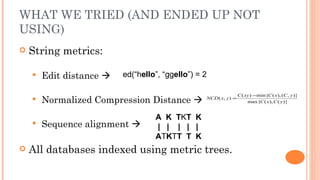
WHAT WE TRIED (AND ENDED UP NOT
USING)
   String metrics:

       Edit distance    ed(“hello”, “ggello”) = 2

                                                                   C ( xy ) −min{C ( x), (C , y )}
       Normalized Compression Distance          NCD ( x, y ) =
                                                                        max{C ( x), C ( y )}


                                   A K TKT K
       Sequence alignment        | | | | |
                                   ATKTT T K
   All databases indexed using metric trees.
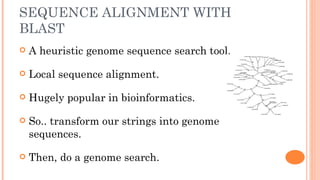
SEQUENCE ALIGNMENT WITH
BLAST
   A heuristic genome sequence search tool.

   Local sequence alignment.

   Hugely popular in bioinformatics.

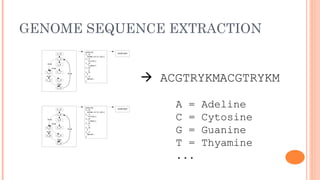
   So.. transform our strings into genome
    sequences.

   Then, do a genome search.
GENOME SEQUENCE EXTRACTION
                               proc (){
                 L_0                                  W|IEH}R
                               L_0:
                                 while (v1 || v2) {
                 L_3           L_1:
                                   if (v3) {
   true                        L_2:
                 L_6
                                   } else {
          true                 L_4:
                                   }


                                                                 ACGTRYKMACGTRYKM
  L_1            L_7           L_5:
                        true     }
  true                         L_7:
                                 return ;
  L_2            L_4
                               }
                 true

                 L_5


                 L_0
                               proc (){
                               L_0:
                                                      W|IEH}R
                                                                    A =   Adeline
                                 while (v1 || v2) {


   true

          true
                 L_3

                 L_6
                               L_1:

                               L_2:

                               L_4:
                                   if (v3) {

                                   } else {
                                                                    C =   Cytosine
                                                                    G =   Guanine
                                   }
  L_1            L_7           L_5:
                        true     }
  true                         L_7:
                                 return ;
  L_2            L_4
                               }


                                                                    T =   Thyamine
                 true

                 L_5


                                                                    ...
WHY DIDN’T WE USE THOSE
APPROACHES?
   Not optimally effective.

   Too slow.

   Best speed was using NCD.
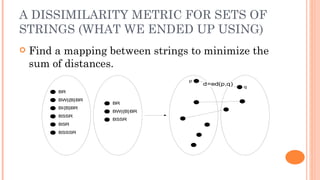
A DISSIMILARITY METRIC FOR SETS OF
STRINGS (WHAT WE ENDED UP USING)
   Find a mapping between strings to minimize the
    sum of distances.
                                  p
                                      d=ed(p,q)
                                                  q
         BR

         BW|{B}BR
                    BR
         BI{B}BR
                    BW|{B}BR
         BSSR
                    BSSR
         BSR
         BSSSR
COMBINATORIAL OPTIMISATION: THE
ASSIGNMENT PROBLEM
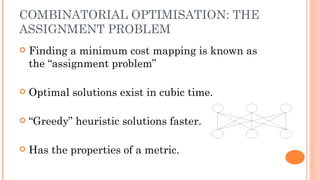
   Finding a minimum cost mapping is known as
    the “assignment problem”

   Optimal solutions exist in cubic time.

   “Greedy” heuristic solutions faster.

   Has the properties of a metric.
EVALUATION
IMPLEMENTATION
   Malwise system is 100,000 lines of code of C++.

   The modules for this work < 3000 lines of code.

   Unpacks malware using an application level
    emulator (Ruxcon 2010)

   Pre-filtering stage to quickly cull non matching
    variants (Ruxcon 2011)
EVALUATION - EFFECTIVENESS
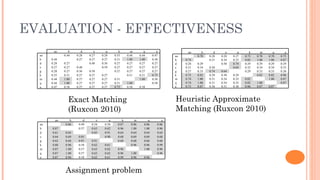
   Calculated similarity between Roron malware
    variants.

   Compared results to Ruxcon 2010 work.

   In tables, highlighted cells indicates a positive
    match.

   The more matches the more effective it is.
EVALUATION - EFFECTIVENESS
        ao       b       d       e       g        k       m         q         a            ao       b      d      e      g      k     m       q      a
  ao          0.44    0.28    0.27    0.28     0.55     0.44     0.44      0.47      ao          0.70   0.28   0.28   0.27   0.75   0.70   0.70   0.75
  b    0.44           0.27    0.27    0.27     0.51     1.00     1.00      0.58      b    0.74          0.31   0.34   0.33   0.82   1.00   1.00   0.87
  d    0.28   0.27            0.48    0.56     0.27     0.27     0.27      0.27      d    0.28   0.29          0.50   0.74   0.29   0.29   0.29   0.29
  e    0.27   0.27    0.48            0.59     0.27     0.27     0.27      0.27      e    0.31   0.34   0.50          0.64   0.32   0.34   0.34   0.33
  g    0.28   0.27    0.56    0.59             0.27     0.27     0.27      0.27      g    0.27   0.33   0.74   0.64          0.29   0.33   0.33   0.30
  k    0.55   0.51    0.27    0.27    0.27              0.51     0.51      0.75      k    0.75   0.82   0.29   0.30   0.29          0.82   0.82   0.96
  m    0.44   1.00    0.27    0.27    0.27     0.51              1.00      0.58      m    0.74   1.00   0.31   0.34   0.33   0.82          1.00   0.87
  q    0.44   1.00    0.27    0.27    0.27     0.51     1.00               0.58      q    0.74   1.00   0.31   0.34   0.33   0.82   1.00          0.87
  a    0.47   0.58    0.27    0.27    0.27     0.75     0.58     0.58                a    0.75   0.87   0.30   0.31   0.30   0.96   0.87   0.87


                Exact Matching                                                       Heuristic Approximate
                (Ruxcon 2010)                                                        Matching (Ruxcon 2010)
         ao       b       d       e        g        k       m          q         a
  ao           0.86    0.49    0.54     0.50     0.87     0.86      0.86      0.86
  b    0.87            0.57    0.63     0.62     0.96     1.00      1.00      0.96
  d    0.61    0.64            0.85     0.91     0.64     0.64      0.64      0.64
  e    0.64    0.69    0.85             0.90     0.68     0.69      0.69      0.68
  g    0.62    0.68    0.91    0.91              0.68     0.68      0.68      0.68
  k    0.88    0.96    0.58    0.62     0.61              0.96      0.96      0.99
  m    0.87    1.00    0.57    0.63     0.62     0.96               1.00      0.96
  q    0.87    1.00    0.57    0.63     0.62     0.96     1.00                0.96
  a    0.87    0.96    0.58    0.62     0.61     0.99     0.96      0.96


               Assignment problem
EVALUATION – FALSE POSITIVES
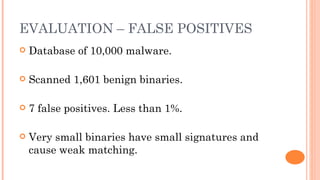
   Database of 10,000 malware.

   Scanned 1,601 benign binaries.

   7 false positives. Less than 1%.

   Very small binaries have small signatures and
    cause weak matching.
EVALUATION - EFFICIENCY
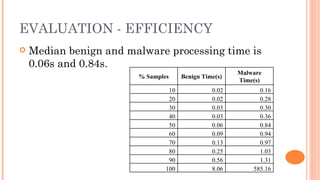
   Median benign and malware processing time is
    0.06s and 0.84s.
                                                       Malware
                        % Samples     Benign Time(s)
                                                       Time(s)
                                 10             0.02         0.16
                                 20             0.02         0.28
                                 30             0.03         0.30
                                 40             0.03         0.36
                                 50             0.06         0.84
                                 60             0.09         0.94
                                 70             0.13         0.97
                                 80             0.25         1.03
                                 90             0.56         1.31
                                100             8.06       585.16
BUT THAT’S NOT ALL WE
USE THE MALWISE ENGINE
FOR..
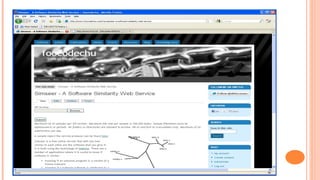
SIMSEER – A SOFTWARE SIMILARITY
WEB SERVICE
   An online service to identify similarity between
    programs
   Based on Malwise.
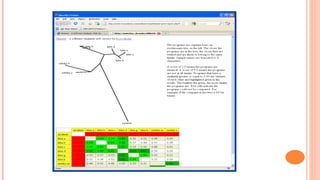
   Renders an evolutionary tree to show program
    relationships.
   Free to use!
   http://www.foocodechu.com/?q=simseer-a-software-similarit
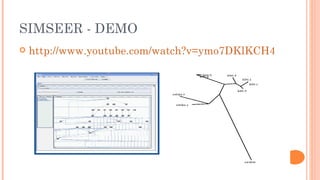
SIMSEER - DEMO
   http://www.youtube.com/watch?v=ymo7DKlKCH4
BUGWISE
   Automatically detect bugs and vulnerabilities in
    Linux executable binaries.
   Uses static program analysis from Malwise.
     Decompilation
     Data Flow Analysis 

   Free to use!
   http://www.foocodechu.com/?q=bugwise-a-bug-detection-we
BUGWISE – SGID GAMES XONIX BUG IN
DEBIAN LINUX
  memset(score_rec[i].login, 0, 11);

  strncpy(score_rec[i].login, pw->pw_name, 10);

  memset(score_rec[i].full, 0, 65);

  strncpy(score_rec[i].full, fullname, 64);

  score_rec[i].tstamp = time(NULL);

  free(fullname);


  if((high = freopen(PATH_HIGHSCORE, "w",high)) == NULL) {

      fprintf(stderr, "xonix: cannot reopen high score filen");

      free(fullname);
      gameover_pending = 0;

      return;

  }
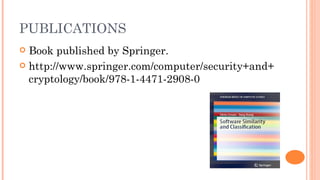
PUBLICATIONS
 Book published by Springer.
 http://www.springer.com/computer/security+and+
  cryptology/book/978-1-4471-2908-0
CONCLUSION
   Malwise effectively identifies malware variants.

   Runs in real-time in expected case.

   Large functional code base and years of
    development time.

   Happy to talk to vendors.

   http://www.FooCodeChu.com

Effective flowgraph-based malware variant detection

  • 1.
    EFFECTIVE FLOWGRAPH- BASED MALWAREVARIANT DETECTION Silvio Cesare, Ph.D. Candidate, Deakin University http://www.foocodechu.com silvio.cesare@gmail.com
  • 2.
    WHO AM IAND WHERE DID THIS TALK COME FROM?  Ph.D. Student at Deakin University.  Research interests include:  Automated vulnerability discovery.  Software similarity and classification.  Malware detection.  This presentation is based on my malware research.
  • 3.
    OUTLINE 1. Introduction (you might already know this) 2. New approaches to flowgraph-based classification 3. Evaluation 4. Other things we use our system on. 5. Conclusion
  • 4.
    INTRODUCTION This is tomake sure everyone is up to speed. If you’ve been to my presentations before, you might have already seen it.
  • 5.
    INTRODUCTION  Malware a significant problem.  Static detection of malware a dominant real-time technique.  Detecting unknown variants from known samples very useful. Roron.ao Klez.a Roron.b Klez.b Roron.d Klez.c Roron.e Klez.d Roron.f ... ...
  • 6.
    SIGNATURES AND BIRTHMARKS  A birthmark is an invariant property in related samples.  Birthmark comparison should allow inexact matching.
  • 7.
    LIMITATIONS OF EXISTING BIRTHMARKS  Byte-level content can change in every variant.  Comparing birthmarks often exact matching only.  Inefficient for inexact database searching.  Unable to detect unknown variants of known samples.  Program structure a better birthmark.
  • 8.
  • 9.
    THE SOFTWARE SIMILARITY SEARCH Need a dissimilarity or distance metric.  “Metric” property allows efficient database search. Query Benign r q d(p,q) p Query Malicious Query Malware
  • 10.
    EXISTING APPROACHES: ACALL GRAPH BIRTHMARK  Inter-procedureal control flow.
  • 11.
    AN OPTIMAL DISSIMILARITYMETRIC FOR GRAPHS  Graph edit distance.  Number of operations to transform one graph to another.  Complexity in NP.  Non optimal solutions possible in cubic time.
  • 12.
    OUR APPROACH: ASET OF CONTROL FLOW GRAPHS BIRTHMARK  Intra-procedural control flow.  Many procedures.
  • 13.
    TRANSFORMING GRAPH DISSIMILARITY TOA STRING DISSIMILARITY PROBLEM  Decompile control flow graphs to strings.  Compare strings using ‘string metrics’. proc (){ L_0 W|IEH}R L_0: while (v1 || v2) { L_3 L_1: if (v3) { true L_2: L_6 } else { true L_4: } L_1 L_7 L_5: true } true L_7: return ; L_2 L_4 } true L_5
  • 14.
  • 15.
    TRANSFORMING A SETOF STRINGS PROBLEM INTO A STRING PROBLEM  Decompiled CFGs give us a set of strings. R W|IEH}R  Order and concatenate strings. W|IEH}R R W|IEH}RZ RZ W|}R W|}R W|}RZ  Deliminate substrings with ‘Z’. IEHRZ SRZ IEHR IEHR  Order based on metrics. SR SR  Number of instructions in procedure.  Number of basic blocks.  etc
  • 16.
    WHAT WE TRIED(AND ENDED UP NOT USING)  String metrics:  Edit distance  ed(“hello”, “ggello”) = 2 C ( xy ) −min{C ( x), (C , y )}  Normalized Compression Distance  NCD ( x, y ) = max{C ( x), C ( y )} A K TKT K  Sequence alignment  | | | | | ATKTT T K  All databases indexed using metric trees.
  • 17.
    SEQUENCE ALIGNMENT WITH BLAST  A heuristic genome sequence search tool.  Local sequence alignment.  Hugely popular in bioinformatics.  So.. transform our strings into genome sequences.  Then, do a genome search.
  • 18.
    GENOME SEQUENCE EXTRACTION proc (){ L_0 W|IEH}R L_0: while (v1 || v2) { L_3 L_1: if (v3) { true L_2: L_6 } else { true L_4: }  ACGTRYKMACGTRYKM L_1 L_7 L_5: true } true L_7: return ; L_2 L_4 } true L_5 L_0 proc (){ L_0: W|IEH}R A = Adeline while (v1 || v2) { true true L_3 L_6 L_1: L_2: L_4: if (v3) { } else { C = Cytosine G = Guanine } L_1 L_7 L_5: true } true L_7: return ; L_2 L_4 } T = Thyamine true L_5 ...
  • 19.
    WHY DIDN’T WEUSE THOSE APPROACHES?  Not optimally effective.  Too slow.  Best speed was using NCD.
  • 20.
    A DISSIMILARITY METRICFOR SETS OF STRINGS (WHAT WE ENDED UP USING)  Find a mapping between strings to minimize the sum of distances. p d=ed(p,q) q BR BW|{B}BR BR BI{B}BR BW|{B}BR BSSR BSSR BSR BSSSR
  • 21.
    COMBINATORIAL OPTIMISATION: THE ASSIGNMENTPROBLEM  Finding a minimum cost mapping is known as the “assignment problem”  Optimal solutions exist in cubic time.  “Greedy” heuristic solutions faster.  Has the properties of a metric.
  • 22.
  • 23.
    IMPLEMENTATION  Malwise system is 100,000 lines of code of C++.  The modules for this work < 3000 lines of code.  Unpacks malware using an application level emulator (Ruxcon 2010)  Pre-filtering stage to quickly cull non matching variants (Ruxcon 2011)
  • 24.
    EVALUATION - EFFECTIVENESS  Calculated similarity between Roron malware variants.  Compared results to Ruxcon 2010 work.  In tables, highlighted cells indicates a positive match.  The more matches the more effective it is.
  • 25.
    EVALUATION - EFFECTIVENESS ao b d e g k m q a ao b d e g k m q a ao 0.44 0.28 0.27 0.28 0.55 0.44 0.44 0.47 ao 0.70 0.28 0.28 0.27 0.75 0.70 0.70 0.75 b 0.44 0.27 0.27 0.27 0.51 1.00 1.00 0.58 b 0.74 0.31 0.34 0.33 0.82 1.00 1.00 0.87 d 0.28 0.27 0.48 0.56 0.27 0.27 0.27 0.27 d 0.28 0.29 0.50 0.74 0.29 0.29 0.29 0.29 e 0.27 0.27 0.48 0.59 0.27 0.27 0.27 0.27 e 0.31 0.34 0.50 0.64 0.32 0.34 0.34 0.33 g 0.28 0.27 0.56 0.59 0.27 0.27 0.27 0.27 g 0.27 0.33 0.74 0.64 0.29 0.33 0.33 0.30 k 0.55 0.51 0.27 0.27 0.27 0.51 0.51 0.75 k 0.75 0.82 0.29 0.30 0.29 0.82 0.82 0.96 m 0.44 1.00 0.27 0.27 0.27 0.51 1.00 0.58 m 0.74 1.00 0.31 0.34 0.33 0.82 1.00 0.87 q 0.44 1.00 0.27 0.27 0.27 0.51 1.00 0.58 q 0.74 1.00 0.31 0.34 0.33 0.82 1.00 0.87 a 0.47 0.58 0.27 0.27 0.27 0.75 0.58 0.58 a 0.75 0.87 0.30 0.31 0.30 0.96 0.87 0.87 Exact Matching Heuristic Approximate (Ruxcon 2010) Matching (Ruxcon 2010) ao b d e g k m q a ao 0.86 0.49 0.54 0.50 0.87 0.86 0.86 0.86 b 0.87 0.57 0.63 0.62 0.96 1.00 1.00 0.96 d 0.61 0.64 0.85 0.91 0.64 0.64 0.64 0.64 e 0.64 0.69 0.85 0.90 0.68 0.69 0.69 0.68 g 0.62 0.68 0.91 0.91 0.68 0.68 0.68 0.68 k 0.88 0.96 0.58 0.62 0.61 0.96 0.96 0.99 m 0.87 1.00 0.57 0.63 0.62 0.96 1.00 0.96 q 0.87 1.00 0.57 0.63 0.62 0.96 1.00 0.96 a 0.87 0.96 0.58 0.62 0.61 0.99 0.96 0.96 Assignment problem
  • 26.
    EVALUATION – FALSEPOSITIVES  Database of 10,000 malware.  Scanned 1,601 benign binaries.  7 false positives. Less than 1%.  Very small binaries have small signatures and cause weak matching.
  • 27.
    EVALUATION - EFFICIENCY  Median benign and malware processing time is 0.06s and 0.84s. Malware % Samples Benign Time(s) Time(s) 10 0.02 0.16 20 0.02 0.28 30 0.03 0.30 40 0.03 0.36 50 0.06 0.84 60 0.09 0.94 70 0.13 0.97 80 0.25 1.03 90 0.56 1.31 100 8.06 585.16
  • 28.
    BUT THAT’S NOTALL WE USE THE MALWISE ENGINE FOR..
  • 29.
    SIMSEER – ASOFTWARE SIMILARITY WEB SERVICE  An online service to identify similarity between programs  Based on Malwise.  Renders an evolutionary tree to show program relationships.  Free to use!  http://www.foocodechu.com/?q=simseer-a-software-similarit
  • 32.
    SIMSEER - DEMO  http://www.youtube.com/watch?v=ymo7DKlKCH4
  • 33.
    BUGWISE  Automatically detect bugs and vulnerabilities in Linux executable binaries.  Uses static program analysis from Malwise.  Decompilation  Data Flow Analysis   Free to use!  http://www.foocodechu.com/?q=bugwise-a-bug-detection-we
  • 34.
    BUGWISE – SGIDGAMES XONIX BUG IN DEBIAN LINUX memset(score_rec[i].login, 0, 11); strncpy(score_rec[i].login, pw->pw_name, 10); memset(score_rec[i].full, 0, 65); strncpy(score_rec[i].full, fullname, 64); score_rec[i].tstamp = time(NULL); free(fullname); if((high = freopen(PATH_HIGHSCORE, "w",high)) == NULL) { fprintf(stderr, "xonix: cannot reopen high score filen"); free(fullname); gameover_pending = 0; return; }
  • 35.
    PUBLICATIONS  Book publishedby Springer.  http://www.springer.com/computer/security+and+ cryptology/book/978-1-4471-2908-0
  • 36.
    CONCLUSION  Malwise effectively identifies malware variants.  Runs in real-time in expected case.  Large functional code base and years of development time.  Happy to talk to vendors.  http://www.FooCodeChu.com