List-based Monadic Computations for
Dynamically Typed Languages
Wim Vanderbauwhede
School of Computing Science, University of Glasgow, UK
Overview
Program Composition in Dynamically
Typed Languages
Objects
Monads
Defining Karma
Karmic Types
Combining Functions using Functions
The Rules
Designing Karma
Syntactic Sugar
fold and chain
Karma Needs Dynamic Typing
Karmic Computations By Example
Maybe
State
Parsing
Conclusion
Dynamically Typed Languages
size proportional to
√
#projects on GitHub
Perl ...
Notorious
$_=’while(read+STDIN,$_,2048){$a=29;$b=73;
$c=142;$t=255;@t=map{$_%16or$t^=$c^=($m=
(11,10,116,100,11,122,20,100)[$_/16%8])&110;
$t^=(72,@z=(64,72,$a^=12*($_%16 -2?0:$m&17)),
$b^=$_%64?12:0,@z)[$_%8]}(16..271);
if((@a=unx"C*",$_)[20]&48){$h =5;$_=unxb24,
join"",@b=map{xB8,unxb8,chr($_^$a[--$h+84])}
@ARGV;s/...$/1$&/;$ d=unxV,xb25,$_;$e=256|
(ord$b[4])<‌<9|ord$b[3];$d=$d>‌>8^($f=$t&
($d>‌>12^$d>‌>4^$d^$d/8))<‌<17,$e=$e>‌>8^($t
&($g=($q=$e>‌>14&7^$e)^$q*8^$q<‌<6))<‌<9,$_=
$t[$_]^(($h>‌>=8)+=$f+(~$g&$t))for
@a[128..$#a]}print+x"C*",@a}’;s/x/pack+/g;
eval;
But I like Perl (*ducks*)
Program Composition
Most Dynamic Languages use an OOP approach to
structure/compose programs
But what if you don’t like object orientation?
Or what if it is simply not the best approach?
An alternative approach to program composition:
Functional Languages use composition of higher-order functions
In particular, Haskell uses monads ...
Haskell ...
Most empathically not
dynamically typed ...
Makes easy things hard ...
But I like Haskell (*ducks*)
Monads
a reputation of being esoteric
hard to understand
the province of academic
languages
(unknown poet, 21st century)
Monas Hieroglyphica,
(“The Hieroglyphic Monad”),
John Dee, Antwerp 1564
Monads in Dynamic Languages
Have been done many times for many languages
https://en.wikipedia.org/wiki/Monad(functional_programming)#Monads_in_other_languages
But have not found widespread adoption
So ...
The Claim
... are monads of practical use in day-to-day programming?
Yes!
Only we won’t call them monads ...
Karmic Computations
Karma is a Sanskrit word meaning action, work or deed.
A different approach from the many existing implementations of
monads in dynamic languages.
Based on types, lambda functions and higher-order functions.
Types and Notation
Haskell-style syntax for types:
A function g from a type a to a type b:
g :: a → b
A function s with two arguments and the result of type a:
s :: a → a → a
A function f from a type a to a type m b, i.e. a type m parametrised
on a type b:
f :: a → m b
A function h which takes as arguments two functions of type
a → b and b → c and returns a function of type a → m b:
h :: (a → b) → (b → c) → (a → m b)
Lambda Functions
Also knows as anonymous subroutines, i.e. functions without a
name.
They are expressions that can be assigned to variables.
Language Lambda Syntax
Haskell x y -> f x y
LiveScript (x,y) -> f x,y
Perl sub ($x,$y) { f $x,$y }
Python lambda x,y : f(x,y)
Ruby -> (x,y) { f x,y }
Higher-Order Functions
Functions that take other
functions as arguments and/or
return functions as results
Available in your favourite
dynamically type language: Ruby,
Python, LiveScript, JavaScript, ...
What is Karma?
A karmic computation consists of:
a given type m a;
the higher-order functions bind and wrap
and three rules governing those functions.
Karmic Types
A karmic type can be viewed as a “wrapper” around another type.
It does not have to have a particular structure, e.g. it can be an
object, or a list, or a map, or a function.
The key point is that the “karmic” type contains more information
than the “bare” type.
We will write m a as the karmic type constructor, regardless of
the structure of the type.
For example, in Ruby the following function f has a type
f :: a → m b, if g has type g :: a → b:
def f(x)
m.new( g(x) )
end
Combining Functions
using Functions
The purpose of the karmic computation is to combine functions that
operates on karmic types.
The bind function composes values of type m a with functions
from a to m b:
bind :: m a → (a → m b) → m b
The wrap function takes a given type a and returns m a:
wrap :: a → m a
With these two functions we can create expressions that consists of
combinations of functions.
The Rules
Three rules govern bind and wrap to ensure that the composition is
well-behaved:
1. bind (wrap x) f ≡ f x
2. bind m wrap ≡ m
3. bind (bind m f) g ≡ bind m (x -> bind (f x) g)
For reference, the rules in Ruby syntax:
1. bind(wrap(x),f) = f.call(x)
2. bind(m,wrap) = m
3. bind(bind(m,f),g) = bind(m,->(c){bind(f.call(x),g))})
Syntactic Sugar for Monads
In Haskell:
No sugar:
ex x =
x -> (bind (g x) (y -> (f (bind y (z -> wrap z)))))
Operator sugar:
ex x =
g x >‌>= y ->
f y >‌>= z ->
wrap z
Do-notation sugar:
ex x = do
y <- g x
z <- f y
wrap z
Syntactic Sugar for Karma
Our approach:
Use lists to combine computations
For example:
[
word,
maybe parens choice
natural,
[
symbol ’kind’,
symbol ’=’,
natural
]
]
Designing Karma
Grouping items in lists provides a natural sequencing
mechanism, and allows easy nesting.
In most dynamic languages, lists us the [...,...] syntax, it’s
portable and non-obtrusive.
We introduce a chain function to chain computations together.
Pass chain a list of functions and it will combine these functions
into a single expression.
Preliminary: fold
To define chain in terms of bind and wrap, we need the left fold
function (foldl).
foldl performs a left-to-right reduction of a list via iterative
application of a function to an initial value:
foldl :: (a → b → a) → a → [b] → [a]
A possible implementation e.g. in Perl would be
sub foldl ($f, $acc, @lst) {
for my $elt (@lst) {
$acc=$f->($acc,$elt)
}
return $acc
}
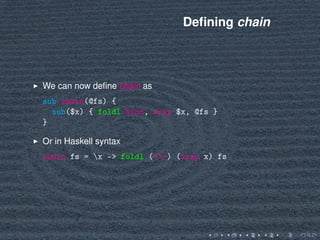
Defining chain
We can now define chain as
sub chain(@fs) {
sub($x) { foldl bind, wrap $x, @fs }
}
Or in Haskell syntax
chain fs = x -> foldl (>‌>=) (wrap x) fs
Karma Needs Dynamic Typing
The above definition of chain is valid in Haskell, but only if the
type signature is
chain :: [(a → m a)] → (a → m a)
But the type of bind is bind :: m a → (a → m b) → m b
the karmic type m b returned by bind does not have to be the same
as the karmic type argument m a.
every function in the list passed to chain should be allowed to have
a different type!
This is not allowed in a statically typed language like Haskell, so
only the restricted case of functions of type a → m a can be
used.
However, in a dynamically typed language there is no such
restriction, so we can generalise the type signature:
chain :: [(ai−1 → m ai )] → (a0 → m aN ) ∀i ∈ 1 .. N
Demonstrating Karma
Combining computations that can fail
Stateful computation
Parser combinators
Combining Fallible Computations (1)
Expressing failure
A Maybe class
class Maybe
attr_accessor :val,:ok
def initialize(value,status)
@val=value
@ok=status # true or false
end
end
For convenience: a fail instance
fail = Maybe.new(nil,false)
Assume f, g, h :: a → Maybe b
Combining Fallible Computations (2)
Without karma
v1 = f(x)
if (v1.ok)
v2=g(v1.val)
if (v2.ok)
v3 = h(v2.val)
if (v3.ok)
v3.val
else
fail
end
else
fail
end
else
fail
end
With karma:
comp = chain [
->(x) {f x},
->(y) {g y},
->(z) {h z}
]
v1=comp.call x
If f, g and h are defined as
lambda functions:
comp =
chain [ f,g,h ]
v1=comp.call x
bind and wrap for Maybe
For the Maybe karmic type, bind is defined as:
def bind(x,f)
if x.ok
f.call(x)
else
fail
end
end
and wrap as:
def wrap(x)
Maybe.new(x,true)
end
Stateful Computation
Using karma to perform stateful computations without actual
mutable state.
Example in LiveScript, because LiveScript has the option to force
immutable variables.
There is a growing interest in the use of immutable state in other
dynamic languages, in particular for web programming, because
immutable state greatly simplifies concurrent programming and
improves testability of code.
State Concept and API
We simulate state by combining functions that transform the
state, and applying the resulting function to an initial state
(approach borrowed from Haskell’s Control.State).
A small API to allow the functions in the list to access a shared
state:
get = -> ( (s) -> [s, s] )
put = (s) -> ( -> [[],s])
The get function reads the state, the put function writes an
updated state. Both return lambda functions.
A top-level function to apply the stateful computation to an initial
state:
res = evalState comp, init
where
evalState = (comp,init) -> comp!(init)
Trivial Interpreter:
Instructions
We want to interpret a list of instructions of type
type Instr = (String, ([Int] → Int, [a]))
For example
instrs = [
["v1",[set,[1]]],
["v2",[add,["v1",2]]],
["v2",[mul,["v2","v2"]]],
["v1",[add,["v1","v2"]]],
["v3",[mul,["v1","v2"]]]
]
where add, mul and set are functions of type [Int] → Int
The interpreter should return the final values for all variables.
The interpreter will need a context for the variables, we use a
simple map { String : Int } to store the values for each variable.
This constitutes the state of the computation.
Trivial Interpreter:
the Karmic Function
We write a function interpret_instr_st :: Instr → [[a], Ctxt]:
interpret_instr_st = (instr) ->
chain( [
get,
(ctxt) ->
[v,res] = interpret_instr(instr, ctxt)
put (insert v, res, ctxt)
] )
interpret_instr_st
gets the context from the state,
uses it to compute the instruction,
updates the context using the insert function and
puts the context back in the state.
Trivial Interpreter:
the Stateless Function
Using Ctxt as the type of the context, the type of interpret_instr is
interpret_instr :: Instr → Ctxt → (String, Int) and the
implementation is straightforward:
interpret_instr = (instr, ctxt) ->
[v,rhs] = instr # unpacking
[op,args] = rhs # unpacking
vals = map (‘get_val‘ ctxt), args
[v, op vals]
get_val looks up the value of a variable in the context; it is
backticked into an operator here to allow partial application.
bind and wrap for State
For the State karmic type, bind is defined as:
bind = (f,g) ->
(st) ->
[x,st_] = f st
(g x) st_
and wrap as
wrap = (x) -> ( (s) -> [x,s] )
modify: Modifying the State
The pattern of calling get to get the state, then computing using
the state and then updating the state using put is very common.
So we combine it in a function called modify:
modify = (f) ->
chain( [
get,
(s) -> put( f(s))
] )
Using modify we can rewrite interpret_instr_st as
interpret_instr_st = (instr) ->
modify (ctxt) ->
[v,res] = interpret_instr(instr, ctxt)
insert v, res, ctxt
mapM: a Dynamic chain
We could in principle use chain to write a list of computations on
each instruction:
chain [
interpret_instr_st instrs[0],
interpret_instr_st instrs[1],
interpret_instr_st instrs[2],
...
]
but clearly this is not practical as it is entirely static.
Instead, we use a monadic variant of the map function, mapM:
mapM :: Monad m ⇒ (a → m b) → [a] → m [b]
mapM applies the computations to the list of instructions (using
map) and then folds the resulting list using bind.
With mapM, we can simply write :
res = evalState (mapM interpret_instr_st, instrs), {}
Fortran ...
I like Fortran (*ducks*)
Parser Combinators
Or more precisely, I needed to
parse Fortran for source
transformations.
So I needed a Fortran parser ...
... in Perl (for reasons).
So I created a Perl version of
Haskell’s Parsec parser
combinator library ...
... using Karma.
Parser Combinator Basics
Each basic parser returns a function which operates on a string
and returns a result.
Parser :: String → Result
The result is a tuple containing the status, the remaining string
and the substring(s) matched by the parser.
type Result = (Status, String, [Match])
To create a complete parser, the basic parsers are combined
using combinators.
A combinator takes a list of parsers and returns a parsing
function similar to the basic parsers:
combinator :: [Parser] → Parser
Karmic Parser Combinators
For example, a parser for a Fortran-95 type declaration:
my $parser = chain [
identifier,
maybe parens choice
natural,
[
symbol ’kind’,
symbol ’=’,
natural
]
];
In dynamic languages the actual chain combinator can be
implicit, i.e. a bare list will result in calling of chain on the list.
For statically typed languages this is of course not possible as all
elements in a list must have the same type.
bind and wrap for Parser
For the Parser karmic type, bind is defined as (Perl):
sub bind($t, $p) {
my ($st_,$r_,$ms_) = @{$t};
if ($st_) {
($st,$r,$ms) = $p->($r_);
if ($st) {
(1,$r,[@{$ms_},@{$ms}]);
} else {
(0,$r,undef)
}
} else {
(0,$r_,undef)
}
and wrap as:
sub wrap($str){ (1,$str,undef) }
bind and wrap for Parser
For the Parser karmic type, bind is defined as (LiveScript):
bind = (t, p) ->
[st_,r_,ms_] = t
if st_ then
[st,r,ms] = p r_
if st then
[1,r,ms_ ++ ms]
else
[0,r,void]
else
[0,r_,void]
and wrap as:
wrap = (str) -> [1,str,void]
Final Example (1)
Parsers can combine several other parsers, and can be labeled:
my $f95_arg_decl_parser =
chain [
whiteSpace,
{TypeTup => $type_parser},
maybe [
comma,
$dim_parser
],
maybe [
comma,
$intent_parser
],
symbol ’::’,
{Vars => sepBy ’,’,word}
];
Final Example (2)
We can run this parser e.g.
my $var_decl =
"real(8), dimension(0:ip,-1:jp+1,kp) :: u,v"
my $res =
run $f95_arg_decl_parser, $var_decl;
This results in the parse tree:
{
’TypeTup’ => {
’Type’ => ’real’,
’Kind’ => ’8’
},
’Dim’ => [’0:ip’,’-1:jp+1’,’kp’],
’Vars’ => [’u’,’v’]
}
Parser Combinators Library
The Perl and LiveScript versions are on GitHub:
https:
//github.com/wimvanderbauwhede/Perl-Parser-Combinators
https:
//github.com/wimvanderbauwhede/parser-combinators-ls
The Perl library is actually used in a Fortran source compiler
https://github.com/wimvanderbauwhede/RefactorF4Acc
Conclusion
We have presented a design for list-based monadic
computations, which we call karmic computations.
Karmic computations
are equivalent to monadic computations in statically typed
languages such as Haskell,
but rely essentially on dynamic typing through the use of
heterogeneous lists.
The proposed list-based syntax
is easy to use,
results in concise, elegant and very readable code, and
is largely language-independent.
The proposed approach can be applied very widely, especially as
a design technique for libraries.
Thank you

List-based Monadic Computations for Dynamic Languages

  • 1.
    List-based Monadic Computationsfor Dynamically Typed Languages Wim Vanderbauwhede School of Computing Science, University of Glasgow, UK
  • 2.
    Overview Program Composition inDynamically Typed Languages Objects Monads Defining Karma Karmic Types Combining Functions using Functions The Rules Designing Karma Syntactic Sugar fold and chain Karma Needs Dynamic Typing Karmic Computations By Example Maybe State Parsing Conclusion
  • 3.
    Dynamically Typed Languages sizeproportional to √ #projects on GitHub
  • 4.
    Perl ... Notorious $_=’while(read+STDIN,$_,2048){$a=29;$b=73; $c=142;$t=255;@t=map{$_%16or$t^=$c^=($m= (11,10,116,100,11,122,20,100)[$_/16%8])&110; $t^=(72,@z=(64,72,$a^=12*($_%16 -2?0:$m&17)), $b^=$_%64?12:0,@z)[$_%8]}(16..271); if((@a=unx"C*",$_)[20]&48){$h=5;$_=unxb24, join"",@b=map{xB8,unxb8,chr($_^$a[--$h+84])} @ARGV;s/...$/1$&/;$ d=unxV,xb25,$_;$e=256| (ord$b[4])<‌<9|ord$b[3];$d=$d>‌>8^($f=$t& ($d>‌>12^$d>‌>4^$d^$d/8))<‌<17,$e=$e>‌>8^($t &($g=($q=$e>‌>14&7^$e)^$q*8^$q<‌<6))<‌<9,$_= $t[$_]^(($h>‌>=8)+=$f+(~$g&$t))for @a[128..$#a]}print+x"C*",@a}’;s/x/pack+/g; eval; But I like Perl (*ducks*)
  • 5.
    Program Composition Most DynamicLanguages use an OOP approach to structure/compose programs But what if you don’t like object orientation? Or what if it is simply not the best approach? An alternative approach to program composition: Functional Languages use composition of higher-order functions In particular, Haskell uses monads ...
  • 6.
    Haskell ... Most empathicallynot dynamically typed ... Makes easy things hard ... But I like Haskell (*ducks*)
  • 7.
    Monads a reputation ofbeing esoteric hard to understand the province of academic languages (unknown poet, 21st century) Monas Hieroglyphica, (“The Hieroglyphic Monad”), John Dee, Antwerp 1564
  • 8.
    Monads in DynamicLanguages Have been done many times for many languages https://en.wikipedia.org/wiki/Monad(functional_programming)#Monads_in_other_languages But have not found widespread adoption So ...
  • 9.
    The Claim ... aremonads of practical use in day-to-day programming? Yes! Only we won’t call them monads ...
  • 10.
    Karmic Computations Karma isa Sanskrit word meaning action, work or deed. A different approach from the many existing implementations of monads in dynamic languages. Based on types, lambda functions and higher-order functions.
  • 11.
    Types and Notation Haskell-stylesyntax for types: A function g from a type a to a type b: g :: a → b A function s with two arguments and the result of type a: s :: a → a → a A function f from a type a to a type m b, i.e. a type m parametrised on a type b: f :: a → m b A function h which takes as arguments two functions of type a → b and b → c and returns a function of type a → m b: h :: (a → b) → (b → c) → (a → m b)
  • 12.
    Lambda Functions Also knowsas anonymous subroutines, i.e. functions without a name. They are expressions that can be assigned to variables. Language Lambda Syntax Haskell x y -> f x y LiveScript (x,y) -> f x,y Perl sub ($x,$y) { f $x,$y } Python lambda x,y : f(x,y) Ruby -> (x,y) { f x,y }
  • 13.
    Higher-Order Functions Functions thattake other functions as arguments and/or return functions as results Available in your favourite dynamically type language: Ruby, Python, LiveScript, JavaScript, ...
  • 14.
    What is Karma? Akarmic computation consists of: a given type m a; the higher-order functions bind and wrap and three rules governing those functions.
  • 15.
    Karmic Types A karmictype can be viewed as a “wrapper” around another type. It does not have to have a particular structure, e.g. it can be an object, or a list, or a map, or a function. The key point is that the “karmic” type contains more information than the “bare” type. We will write m a as the karmic type constructor, regardless of the structure of the type. For example, in Ruby the following function f has a type f :: a → m b, if g has type g :: a → b: def f(x) m.new( g(x) ) end
  • 16.
    Combining Functions using Functions Thepurpose of the karmic computation is to combine functions that operates on karmic types. The bind function composes values of type m a with functions from a to m b: bind :: m a → (a → m b) → m b The wrap function takes a given type a and returns m a: wrap :: a → m a With these two functions we can create expressions that consists of combinations of functions.
  • 17.
    The Rules Three rulesgovern bind and wrap to ensure that the composition is well-behaved: 1. bind (wrap x) f ≡ f x 2. bind m wrap ≡ m 3. bind (bind m f) g ≡ bind m (x -> bind (f x) g) For reference, the rules in Ruby syntax: 1. bind(wrap(x),f) = f.call(x) 2. bind(m,wrap) = m 3. bind(bind(m,f),g) = bind(m,->(c){bind(f.call(x),g))})
  • 18.
    Syntactic Sugar forMonads In Haskell: No sugar: ex x = x -> (bind (g x) (y -> (f (bind y (z -> wrap z))))) Operator sugar: ex x = g x >‌>= y -> f y >‌>= z -> wrap z Do-notation sugar: ex x = do y <- g x z <- f y wrap z
  • 19.
    Syntactic Sugar forKarma Our approach: Use lists to combine computations For example: [ word, maybe parens choice natural, [ symbol ’kind’, symbol ’=’, natural ] ]
  • 20.
    Designing Karma Grouping itemsin lists provides a natural sequencing mechanism, and allows easy nesting. In most dynamic languages, lists us the [...,...] syntax, it’s portable and non-obtrusive. We introduce a chain function to chain computations together. Pass chain a list of functions and it will combine these functions into a single expression.
  • 21.
    Preliminary: fold To definechain in terms of bind and wrap, we need the left fold function (foldl). foldl performs a left-to-right reduction of a list via iterative application of a function to an initial value: foldl :: (a → b → a) → a → [b] → [a] A possible implementation e.g. in Perl would be sub foldl ($f, $acc, @lst) { for my $elt (@lst) { $acc=$f->($acc,$elt) } return $acc }
  • 22.
    Defining chain We cannow define chain as sub chain(@fs) { sub($x) { foldl bind, wrap $x, @fs } } Or in Haskell syntax chain fs = x -> foldl (>‌>=) (wrap x) fs
  • 23.
    Karma Needs DynamicTyping The above definition of chain is valid in Haskell, but only if the type signature is chain :: [(a → m a)] → (a → m a) But the type of bind is bind :: m a → (a → m b) → m b the karmic type m b returned by bind does not have to be the same as the karmic type argument m a. every function in the list passed to chain should be allowed to have a different type! This is not allowed in a statically typed language like Haskell, so only the restricted case of functions of type a → m a can be used. However, in a dynamically typed language there is no such restriction, so we can generalise the type signature: chain :: [(ai−1 → m ai )] → (a0 → m aN ) ∀i ∈ 1 .. N
  • 24.
    Demonstrating Karma Combining computationsthat can fail Stateful computation Parser combinators
  • 25.
    Combining Fallible Computations(1) Expressing failure A Maybe class class Maybe attr_accessor :val,:ok def initialize(value,status) @val=value @ok=status # true or false end end For convenience: a fail instance fail = Maybe.new(nil,false) Assume f, g, h :: a → Maybe b
  • 26.
    Combining Fallible Computations(2) Without karma v1 = f(x) if (v1.ok) v2=g(v1.val) if (v2.ok) v3 = h(v2.val) if (v3.ok) v3.val else fail end else fail end else fail end With karma: comp = chain [ ->(x) {f x}, ->(y) {g y}, ->(z) {h z} ] v1=comp.call x If f, g and h are defined as lambda functions: comp = chain [ f,g,h ] v1=comp.call x
  • 27.
    bind and wrapfor Maybe For the Maybe karmic type, bind is defined as: def bind(x,f) if x.ok f.call(x) else fail end end and wrap as: def wrap(x) Maybe.new(x,true) end
  • 28.
    Stateful Computation Using karmato perform stateful computations without actual mutable state. Example in LiveScript, because LiveScript has the option to force immutable variables. There is a growing interest in the use of immutable state in other dynamic languages, in particular for web programming, because immutable state greatly simplifies concurrent programming and improves testability of code.
  • 29.
    State Concept andAPI We simulate state by combining functions that transform the state, and applying the resulting function to an initial state (approach borrowed from Haskell’s Control.State). A small API to allow the functions in the list to access a shared state: get = -> ( (s) -> [s, s] ) put = (s) -> ( -> [[],s]) The get function reads the state, the put function writes an updated state. Both return lambda functions. A top-level function to apply the stateful computation to an initial state: res = evalState comp, init where evalState = (comp,init) -> comp!(init)
  • 30.
    Trivial Interpreter: Instructions We wantto interpret a list of instructions of type type Instr = (String, ([Int] → Int, [a])) For example instrs = [ ["v1",[set,[1]]], ["v2",[add,["v1",2]]], ["v2",[mul,["v2","v2"]]], ["v1",[add,["v1","v2"]]], ["v3",[mul,["v1","v2"]]] ] where add, mul and set are functions of type [Int] → Int The interpreter should return the final values for all variables. The interpreter will need a context for the variables, we use a simple map { String : Int } to store the values for each variable. This constitutes the state of the computation.
  • 31.
    Trivial Interpreter: the KarmicFunction We write a function interpret_instr_st :: Instr → [[a], Ctxt]: interpret_instr_st = (instr) -> chain( [ get, (ctxt) -> [v,res] = interpret_instr(instr, ctxt) put (insert v, res, ctxt) ] ) interpret_instr_st gets the context from the state, uses it to compute the instruction, updates the context using the insert function and puts the context back in the state.
  • 32.
    Trivial Interpreter: the StatelessFunction Using Ctxt as the type of the context, the type of interpret_instr is interpret_instr :: Instr → Ctxt → (String, Int) and the implementation is straightforward: interpret_instr = (instr, ctxt) -> [v,rhs] = instr # unpacking [op,args] = rhs # unpacking vals = map (‘get_val‘ ctxt), args [v, op vals] get_val looks up the value of a variable in the context; it is backticked into an operator here to allow partial application.
  • 33.
    bind and wrapfor State For the State karmic type, bind is defined as: bind = (f,g) -> (st) -> [x,st_] = f st (g x) st_ and wrap as wrap = (x) -> ( (s) -> [x,s] )
  • 34.
    modify: Modifying theState The pattern of calling get to get the state, then computing using the state and then updating the state using put is very common. So we combine it in a function called modify: modify = (f) -> chain( [ get, (s) -> put( f(s)) ] ) Using modify we can rewrite interpret_instr_st as interpret_instr_st = (instr) -> modify (ctxt) -> [v,res] = interpret_instr(instr, ctxt) insert v, res, ctxt
  • 35.
    mapM: a Dynamicchain We could in principle use chain to write a list of computations on each instruction: chain [ interpret_instr_st instrs[0], interpret_instr_st instrs[1], interpret_instr_st instrs[2], ... ] but clearly this is not practical as it is entirely static. Instead, we use a monadic variant of the map function, mapM: mapM :: Monad m ⇒ (a → m b) → [a] → m [b] mapM applies the computations to the list of instructions (using map) and then folds the resulting list using bind. With mapM, we can simply write : res = evalState (mapM interpret_instr_st, instrs), {}
  • 36.
    Fortran ... I likeFortran (*ducks*)
  • 37.
    Parser Combinators Or moreprecisely, I needed to parse Fortran for source transformations. So I needed a Fortran parser ... ... in Perl (for reasons). So I created a Perl version of Haskell’s Parsec parser combinator library ... ... using Karma.
  • 38.
    Parser Combinator Basics Eachbasic parser returns a function which operates on a string and returns a result. Parser :: String → Result The result is a tuple containing the status, the remaining string and the substring(s) matched by the parser. type Result = (Status, String, [Match]) To create a complete parser, the basic parsers are combined using combinators. A combinator takes a list of parsers and returns a parsing function similar to the basic parsers: combinator :: [Parser] → Parser
  • 39.
    Karmic Parser Combinators Forexample, a parser for a Fortran-95 type declaration: my $parser = chain [ identifier, maybe parens choice natural, [ symbol ’kind’, symbol ’=’, natural ] ]; In dynamic languages the actual chain combinator can be implicit, i.e. a bare list will result in calling of chain on the list. For statically typed languages this is of course not possible as all elements in a list must have the same type.
  • 40.
    bind and wrapfor Parser For the Parser karmic type, bind is defined as (Perl): sub bind($t, $p) { my ($st_,$r_,$ms_) = @{$t}; if ($st_) { ($st,$r,$ms) = $p->($r_); if ($st) { (1,$r,[@{$ms_},@{$ms}]); } else { (0,$r,undef) } } else { (0,$r_,undef) } and wrap as: sub wrap($str){ (1,$str,undef) }
  • 41.
    bind and wrapfor Parser For the Parser karmic type, bind is defined as (LiveScript): bind = (t, p) -> [st_,r_,ms_] = t if st_ then [st,r,ms] = p r_ if st then [1,r,ms_ ++ ms] else [0,r,void] else [0,r_,void] and wrap as: wrap = (str) -> [1,str,void]
  • 42.
    Final Example (1) Parserscan combine several other parsers, and can be labeled: my $f95_arg_decl_parser = chain [ whiteSpace, {TypeTup => $type_parser}, maybe [ comma, $dim_parser ], maybe [ comma, $intent_parser ], symbol ’::’, {Vars => sepBy ’,’,word} ];
  • 43.
    Final Example (2) Wecan run this parser e.g. my $var_decl = "real(8), dimension(0:ip,-1:jp+1,kp) :: u,v" my $res = run $f95_arg_decl_parser, $var_decl; This results in the parse tree: { ’TypeTup’ => { ’Type’ => ’real’, ’Kind’ => ’8’ }, ’Dim’ => [’0:ip’,’-1:jp+1’,’kp’], ’Vars’ => [’u’,’v’] }
  • 44.
    Parser Combinators Library ThePerl and LiveScript versions are on GitHub: https: //github.com/wimvanderbauwhede/Perl-Parser-Combinators https: //github.com/wimvanderbauwhede/parser-combinators-ls The Perl library is actually used in a Fortran source compiler https://github.com/wimvanderbauwhede/RefactorF4Acc
  • 45.
    Conclusion We have presenteda design for list-based monadic computations, which we call karmic computations. Karmic computations are equivalent to monadic computations in statically typed languages such as Haskell, but rely essentially on dynamic typing through the use of heterogeneous lists. The proposed list-based syntax is easy to use, results in concise, elegant and very readable code, and is largely language-independent. The proposed approach can be applied very widely, especially as a design technique for libraries.
  • 46.